


Abstract
This paper examines downstream firms’ incentives to accept equity participation by an upstream supplier in a vertically related market. We develop a multi-stage model in which the upstream firm offers an equity stake and sets input prices under price discrimination, while downstream firms subsequently compete à la Cournot. We show that upstream equity ownership induces the upstream firm to lower input prices by partially internalizing downstream profits. This mechanism generates a positive market-expansion effect for downstream firms through lower input costs, while equity ownership simultaneously creates a negative equity-dilution effect by reducing the share of profits retained by downstream firms. When products are homogeneous, the equity-dilution effect dominates the market-expansion effect, leading downstream firms into a Prisoner’s Dilemma. In contrast, under product differentiation, when the ownership share is sufficiently small, the market-expansion effect dominates the equity-dilution effect, resulting in higher downstream profits. In this case, accepting equity participation can be individually optimal for downstream firms, even though mutual acceptance may reduce their retained profits.
JEL Classification:
D43; L21; L22
1. Introduction
Vertical cross-ownership has become a prevalent phenomenon in many industries. In practice, it typically takes two forms: forward ownership, where an upstream firm holds equity in a downstream firm, and backward ownership, where a downstream firm acquires equity in its upstream suppliers, as observed in Japanese automobile supply chains (Flath, 1989).
Empirical evidence shows that such ownership structures are closely linked to product market relationships. Allen and Phillips (2000) find that corporate block ownership often accompanies strategic alliances and improves firms’ investment and operating performance, while Fee et al. (2006) show that partial equity ownership mitigates contractual frictions and stabilizes customer–supplier relationships. These findings suggest that equity ownership functions not only as a financial arrangement but also as a mechanism for coordinating incentives along the supply chain.
Since the 1960s, vertical relationships have been central to industrial organization research. Hart et al. (1990) show that vertical integration can alter competitive interactions and generate market foreclosure. A related literature examines pricing and strategic behavior in vertically related markets, highlighting how input pricing and vertical integration affect downstream competition and market outcomes (DeGraba, 1990; Chen, 2001; Bresnahan & Levin, 2012).
In terms of ownership structures, Flath (1989) shows that vertical shareholding patterns lead to distinct equilibrium outcomes. Greenlee and Raskovich (2006) demonstrate that backward ownership can act as a partial rebate mechanism, while Hunold and Stahl (2016) show that such arrangements may soften competition and reshape strategic interactions. More recent studies further show that welfare effects depend on market structure and product differentiation (Papadopoulos et al., 2022; Sun & Wang, 2023; Wang & Wang, 2023). These results highlight the importance of ownership structures in shaping both strategic behavior and welfare outcomes in vertically related markets.
While this literature focuses on the effects of vertical cross-ownership under given ownership structures, relatively little attention has been paid to firms’ incentives to accept such equity participation. We fill this gap by endogenizing downstream firms’ acceptance decisions in a vertically related market with input price discrimination and Cournot competition.
The results reveal a fundamental trade-off: upstream equity ownership lowers input prices by partially internalizing downstream profits, but simultaneously reduces downstream firms’ retained profits through equity dilution. We show that when the ownership share is sufficiently small, the pricing effect dominates, making equity participation individually optimal for downstream firms.
2. The Basic Model
Consider a vertically related market with one upstream supplier of an intermediate good and two downstream firms. The total market supply of final-goods is given by . The inverse market demand function is assumed to be , where denotes the market size and represents demand quantity. In equilibrium, market supply quantity equals market demand quantity, i.e., .
Suppose that, in downstream production, each unit of final output requires one unit of the input. That is, the demand for the input by downstream firm is given by , .
Assume that firms incur no other production costs apart from the cost of the input. The prices of the input faced by the two downstream firms are denoted by and , respectively.
The operating profit functions of the two downstream firms can be written as
There is one upstream intermediate-goods firm whose profit is derived from selling the input to downstream firms. Without loss of generality, we assume that the upstream firm has zero production cost. Under this assumption, the profit of the upstream firm can be simplified as
The upstream firm may acquire an equity stake in downstream firm , . Given the equity offer made by the upstream firm, downstream firms compare net profits across acceptance and rejection. Once a downstream firm is partially owned by the upstream firm, its retained/net profit is given by:
Accordingly, the profit function of the upstream firm can be rewritten as
where denotes the equity share held by the upstream firm in downstream firm , . We restrict the equity share to , ensuring that ownership remains passive and control rights are not transferred. In the above expression, the first component corresponds to the upstream firm’s revenue from input sales, whereas the second component reflects the profit participation arising from its equity ownership in downstream firms.
In this economy, consumer surplus can be expressed as
Since Equation (8) reports downstream net profits, social welfare can be written as the sum of consumer surplus and the payoffs accruing to all agents:
This definition avoids double counting because downstream net profits exclude the equity income paid to the upstream firm.
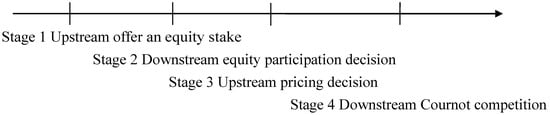
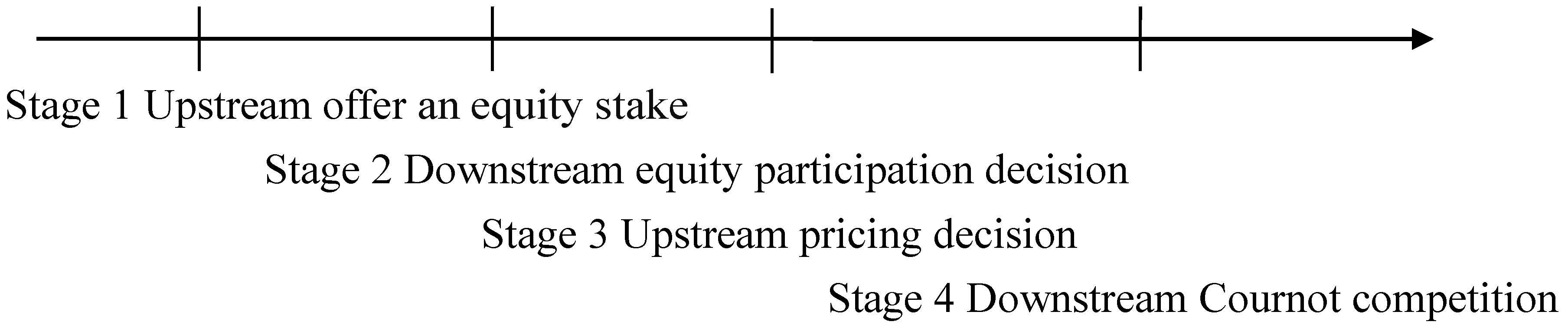
The model is a multi-stage game. In Stage 1, the upstream firm makes equity offers to both downstream firms and chooses an ownership share . In Stage 2, the downstream firms simultaneously decide whether to accept the offer. If downstream firm accepts, then ; otherwise, . In Stage 3, anticipating downstream behavior, the upstream firm sets input prices (allowing for price discrimination , ). In Stage 4, downstream firms engage in Cournot quantity competition and choose and .
The analysis proceeds by applying backward induction to derive the optimal decisions at each stage and thereby obtain the subgame perfect equilibrium of the game. Specifically, we first solve for the output levels that maximize downstream firms’ profits in the final stage (Cournot stage). Then, taking the downstream firms’ reaction functions into account, the upstream intermediate-goods firm determines the optimal input prices in the third stage. Finally, anticipating downstream acceptance decisions in Stage 2, the upstream firm chooses the ownership share in Stage 1. The timing of decisions is illustrated in Figure 1.
Figure 1.
Timing of the game.
3. Model Analysis
3.1. Benchmark Case: No Downstream Cross-Ownership
We first examine the equilibrium outcome in the absence of downstream equity ownership by the upstream firm, that is, .
In the fourth stage (the final-goods market stage), the two downstream firms each choose their output levels to maximize their respective profits. Taking the first-order derivative of each firm’s profit function with respect to its own output and setting it equal to zero yields the corresponding first-order condition.
Solving Equations (9) and (10) simultaneously yields the optimal output levels of the two firms in the market stage, which constitute the Nash equilibrium of this stage.
Next, we examine the upstream firm’s determination of the input prices. In the third stage, under rational expectations, the upstream firm takes the downstream firms’ behavior into account when making its decision and then chooses the input prices. Accordingly, its optimization problem can be expressed as
Substituting Equations (11) and (12) into Equation (13) yields the profit function of the upstream firm as
At this point, the upstream firm determines the optimal input prices. Taking the first-order derivatives of with respect to and , respectively, yields the following first-order conditions:
Solving Equations (15) and (16) simultaneously yields the equilibrium input prices as
The superscript denotes the equilibrium without upstream–downstream cross-ownership.
Substituting Equations (17) and (18) into the preceding system of equations yields the following subgame perfect equilibrium. We can also derive the following result.
Lemma 1.
The subgame perfect equilibrium in the absence of downstream cross-ownership is given by:
3.2. Downstream Firm Is Partially Owned
We next analyze the equilibrium in which the upstream firm holds equity in only one downstream final-goods firm. Specifically, we assume that the upstream firm acquires a share of downstream firm , i.e., , , , while it does not hold any equity in downstream firm , i.e., .
In the fourth stage (the final-goods market stage), the two downstream firms each choose their output levels to maximize their respective profits. The Nash equilibrium in the market stage is the same as Equations (11) and (12).
In the third stage, under rational expectations, the upstream firm takes the downstream firms’ behavior into account when making its decision and then chooses the input prices. Accordingly, its optimization problem can be expressed as
The upstream firm determines the optimal input prices as
The superscript denotes the equilibrium in which the upstream firm holds equity in the first downstream firm but does not hold equity in the second downstream firm.
To examine the impact of upstream equity ownership in downstream firms, we conduct a comparative statics analysis. Taking the partial derivatives of and with respect to the ownership share yields:
Lemma 2.
As the upstream firm increases its equity share () in downstream firm, the input price () charged to firmdecreases, while the input price charged to firm 2 () remains unaffected.
Lemma 2 indicates that, as the upstream firm increases its equity share in downstream firm , the input price charged to firm decreases.
The underlying intuition is as follows. When the upstream firm holds equity in downstream firm , sales of the intermediate good to firm generate not only direct revenue from input sales but also a profit feedback effect through equity participation. As a result, the marginal benefit of supplying the intermediate good to downstream firm increases. Consequently, the upstream firm optimally lowers the input price charged to firm in order to enhance its downstream competitiveness and expand input sales.
By contrast, an increase in the upstream firm’s equity ownership in downstream firm has no effect on the input price charged to firm . The main reason is that, when setting input prices, the upstream firm primarily takes into account each downstream firm’s derived demand for the intermediate input. Because the upstream firm engages in price discrimination, changes in equity ownership with respect to downstream firm do not directly affect the derived demand function of downstream firm . Consequently, the input price charged to firm remains unchanged. We can also derive the following result.
Lemma 3.
The subgame perfect equilibrium in which the upstream firm holds equity in the first downstream firm but does not hold equity in the second downstream firm.
By comparing the equilibrium outcomes in Lemmas 1 and 3, we obtain the following result.
Lemma 4.
The welfare ranking is given by:
Proof.
See Appendix A. □
Lemma 4 shows that, when one downstream firm is partially owned by the upstream firm, the effect on its retained profit depends on the magnitude of the ownership share. This effect operates through two opposing channels: a market-expansion effect and an equity-dilution effect.
The first is a positive market-expansion effect. When the upstream firm holds equity in a downstream firm, it lowers the input price charged to that firm, thereby reducing its production cost and increasing its profit.
The second is a negative equity-dilution effect. Because part of the downstream firm’s equity is held by the upstream firm, profits must be shared with the upstream firm, which reduces the net profit accruing to the downstream firm.
When the ownership share is sufficiently small (), the market-expansion effect dominates, and the partially owned downstream firm’s retained profit increases, i.e., .
3.3. Both Downstream Firms Are Partially Owned
We next analyze the equilibrium in which the upstream firm simultaneously holds equity in both downstream final-goods firms. Specifically, we assume that the upstream intermediate-goods firm acquires identical ownership shares in the two downstream firms, that is, .
In the fourth stage (the final-goods market stage), the two downstream firms each choose their output levels to maximize their respective profits. The Nash equilibrium in the market stage is the same as Equations (11) and (12).
In the third stage, under rational expectations, the upstream firm takes the downstream firms’ behavior into account when making its decision and then chooses the input prices. Accordingly, its optimization problem can be expressed as
The upstream firm determines the optimal input prices as
The superscript denotes the equilibrium in which the upstream firm simultaneously holds equity stakes in both downstream firms.
Taking the partial derivatives of and with respect to the ownership share yields:
Lemma 5.
When the upstream firm simultaneously holds higher equity shares () in the downstream firms, the input prices charged to both firms, (), decrease.
As discussed in Lemma 2, when the upstream firm holds a higher equity share in the downstream firms, it sets lower input prices. The main reason is that, by holding equity in downstream firms, the upstream firm obtains not only profits from selling the intermediate good but also a share of downstream profits through equity participation. As a result, the upstream firm has an incentive to reduce the input prices. We obtain the following result.
Lemma 6.
The subgame perfect equilibrium under simultaneous downstream cross-ownership by the upstream supplier is given by:
By comparing the equilibrium outcomes in Lemmas 1 and 6, we obtain the following result.
Lemma 7.
The welfare ranking is given by:
Proof.
See Appendix B. □
Lemma 7 shows that, when both downstream firms are partially owned by the upstream firm, their retained profits depend on the magnitude of the ownership share. As in Lemma 4, the effect of upstream equity ownership operates through two opposing channels: a market-expansion effect and an equity-dilution effect.
The interaction of these two effects determines the overall outcome. When the ownership share is sufficiently small (), the dilution effect dominates under mutual ownership, and downstream firms’ retained profits decrease, i.e., .
4. Incentives to Equity Ownership
4.1. Downstream Acceptance of Upstream Equity Offers
Consider the simultaneous-move game in Stage 2, where each downstream firm chooses whether to accept () or reject () the upstream firm’s equity ownership proposal. The resulting payoffs are summarized in Table 1.
Table 1.
Payoff Matrix of Downstream Firms under Equity Ownership.
Table 1 reports downstream firms’ net (retained) profits, i.e., profits accruing to downstream firms after equity sharing. Given the equity offer made by the upstream firm, downstream firms compare net profits under acceptance and rejection. Accordingly, in this stage each downstream firm chooses , where denotes accepting the equity offer () and denotes rejecting it ().
From Lemma 4 (and the corresponding results summarized in Table 1), when the ownership share is not too high (), accepting upstream ownership increases a downstream firm’s retained profit under unilateral deviation, as the market-expansion effect dominates the equity-dilution effect. In particular, the following incentive inequalities hold:
- Firm 1’s deviation when firm 2 rejects.
Given that firm 2 rejects (), firm 1 strictly prefers accepting () to rejecting ():
- B.
- Firm 1’s deviation when firm 2 accepts.
Given that firm 2 accepts (), firm 1 prefers accepting:
By symmetry, firm 2 satisfies analogous conditions:
- C.
- Firm 2’s deviation when firm 1 rejects.
- D.
- Firm 2’s deviation when firm 1 accepts.
These conditions imply that accepting is each firm’s best response regardless of the rival’s action. Therefore, the unique Nash equilibrium in Stage 2 is (A, A), in which both downstream firms accept upstream ownership.
Proposition 1.
When the upstream firm’s ownership share is sufficiently small (), unilateral acceptance of equity participation increases a downstream firm’s retained profit, whereas mutual acceptance reduces it.
This also has implications for the upstream firm’s ownership decision. Upstream equity ownership induces the upstream firm to partially internalize downstream profits, leading to lower input prices and generating a positive market-expansion effect. At the same time, equity participation reduces downstream firms’ retained profits through profit sharing, creating a negative equity-dilution effect.
The interaction of these two opposing effects gives rise to a strategic tension. While unilateral acceptance is profitable due to the market-expansion effect, mutual acceptance leads to lower retained profits as the dilution effect dominates. Consequently, downstream firms face a Prisoner’s Dilemma: accepting equity participation is individually optimal but collectively suboptimal.
This result implies that equity participation arises not from mutual gains, but from strategic incentives to avoid competitive disadvantage.
4.2. Upstream Choice of the Ownership Share
So far, we have analyzed downstream firms’ acceptance decisions given an equity offer made by the upstream firm. We now turn to the upstream firm’s choice of the ownership share in Stage 1.
Proposition 1 shows that when , accepting upstream equity ownership is individually optimal for each downstream firm, even though mutual acceptance reduces their retained profits. As a result, both downstream firms choose to accept the equity offer in equilibrium.
Consequently, if the upstream firm seeks to ensure that its equity offer is accepted by both downstream firms, the ownership share must satisfy . Anticipating downstream acceptance behavior, the upstream firm optimally chooses an ownership share within this range to maximize its profit.
Corollary 1.
In equilibrium, when the upstream firm endogenously chooses the ownership share, it will never optimally set .
5. Extension
5.1. Differentiated Products
To examine the robustness of our findings, we consider an extension with differentiated products. The inverse demand function is given by , where . A higher value of indicates a greater degree of substitutability between the goods. The resulting payoffs are summarized in Table 2.
Table 2.
Payoff Matrix of Downstream Firms under Differentiated Products.
The equilibrium outcome depends on the following conditions:
where denotes the threshold function determining the critical value of , and .
By symmetry, we have
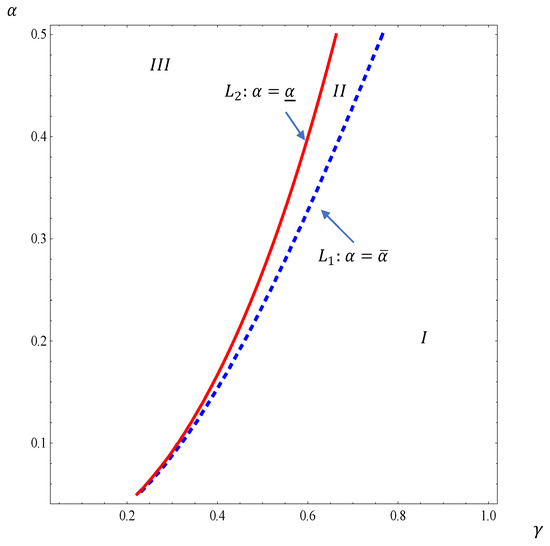
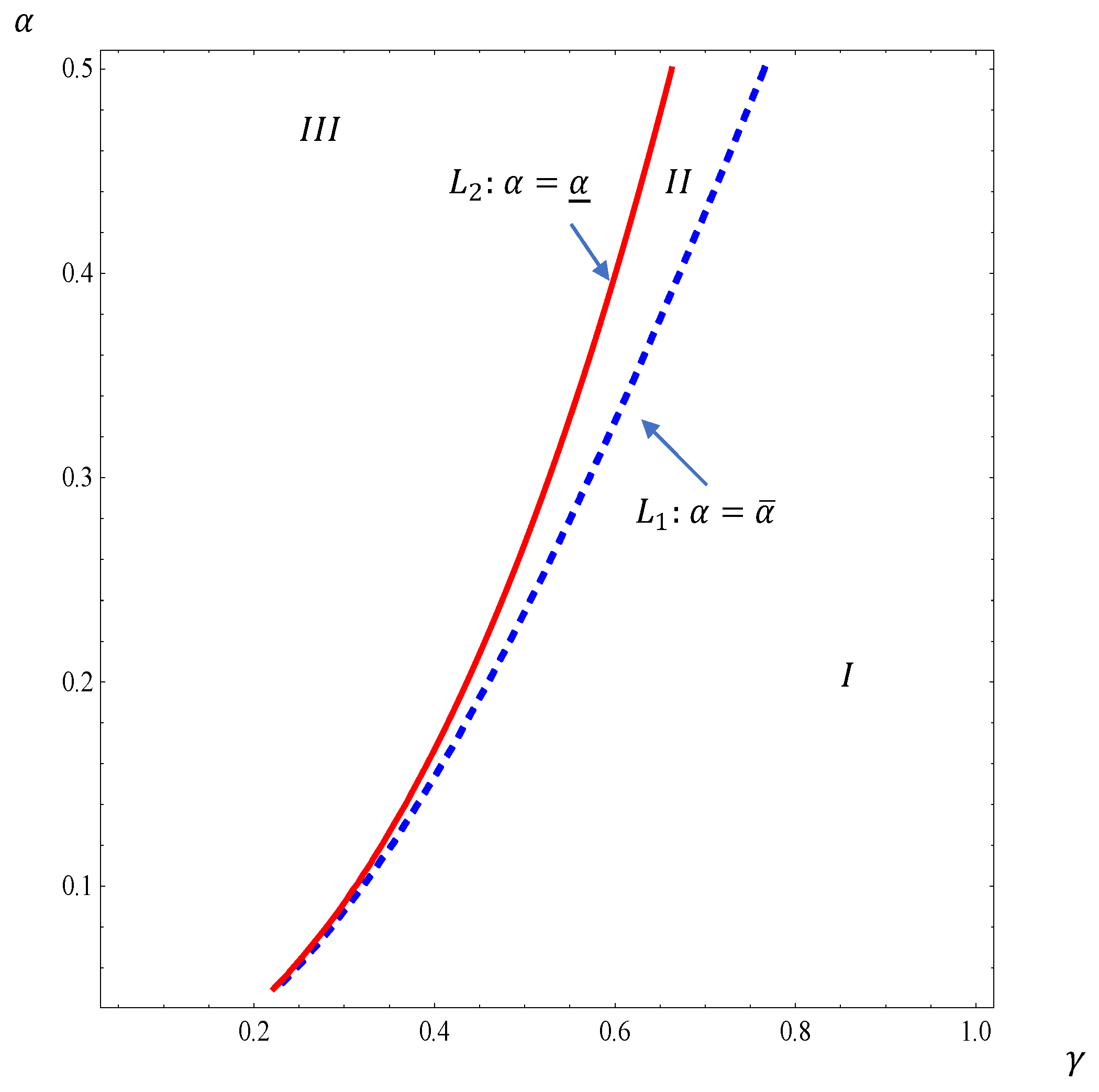
To provide a brief explanation of the results, the parameter space of and is illustrated in Figure 2 based on Equations (25) and (26). The blue dashed line () represents the combinations of () such that , while the red solid line () represents the combinations where .
Figure 2.
Equilibrium Regions of Equity Participation.
In Region I (the area below ), and , indicating that both firms choose to accept equity participation.
In the region between and , and , implying that multiple equilibria arise, in which one firm accepts and the other rejects equity participation.
In Region III (the area above ), and , indicating that both firms choose to reject equity participation.
The acceptance of upstream equity participation depends crucially on the degree of product substitutability. A higher degree of substitutability, measured by (γ), intensifies downstream competition and raises the strategic value of cost reduction. When the input price falls, a downstream firm can expand output more aggressively and capture market share from its rival. At the same time, however, stronger competition also compresses equilibrium profit-margins, so the gains from cost reduction are partly offset by lower profitability. Accordingly, the incentive to accept equity participation is determined by the balance between these two opposing effects.
The threshold functions defined in Equations (25) and (26) characterize this trade-off and partition the parameter space into regions with distinct equilibrium outcomes. Since downstream acceptance determines whether upstream equity participation is feasible, these incentives also constrain the upstream firm’s ownership choice. When product substitutability is high, firms are more willing to accept equity participation because the strategic benefit of lower input costs becomes more important. This enlarges the feasible range of ownership shares that the upstream firm can profitably choose. By contrast, when substitutability is low, competition is weaker and the benefit of cost reduction is less pronounced, so the acceptance constraint becomes tighter and the upstream firm is induced to choose a lower ownership share.
These results are summarized in the following proposition.
Proposition 2.
(i) When is sufficiently small (), the unique equilibrium outcome is that both firms accept equity participation.
(ii) When is moderate (), multiple equilibria arise, in which one firm accepts and the other rejects equity participation.
(iii) When is sufficiently large (), the unique equilibrium outcome is that both firms reject equity participation.
Proposition 2 highlights that equilibrium acceptance patterns are jointly determined by ownership share and product substitutability. A higher value of implies more intense downstream competition, which increases the strategic value of cost reduction and thus strengthens firms’ incentives to accept equity participation. At the same time, intensified competition reduces equilibrium profit margins, limiting the net benefit from participation. The equilibrium outcome therefore reflects the balance between these opposing forces. Overall, greater product substitutability relaxes the acceptance constraint and expands the range of ownership shares that can be sustained in equilibrium, whereas lower substitutability tightens this constraint and restricts the upstream firm’s feasible ownership choice.
5.2. Two-Part Tariff
As pointed out by Papadopoulos et al. (2022), when the upstream firm possesses sufficient market power, it may adopt two-part tariff pricing. Under such a scheme, downstream firms’ net profits are fully extracted through fixed fees, eliminating the equity-dilution effect. Consequently, the fundamental trade-off between the market-expansion effect and the equity-dilution effect no longer holds, and the acceptance decision may differ significantly across pricing institutions.
In this case, downstream firms’ net profits are driven to zero, and their participation decisions are governed solely by individual rationality constraints. As long as these constraints are satisfied, downstream firms are willing to accept equity participation.
6. Concluding Remarks
The existing literature has largely focused on the effects of vertical cross-ownership on market performance, while paying limited attention to firms’ incentives to accept such arrangements. We fill this gap by explicitly examining downstream firms’ willingness to be partially owned by an upstream firm.
We show that upstream equity ownership induces the upstream firm to lower input prices by partially internalizing downstream profits. This generates a positive market-expansion effect through lower input costs, while equity participation simultaneously creates a negative equity-dilution effect by reducing downstream firms’ retained profits.
When products are homogeneous, the equity-dilution effect dominates, leading downstream firms into a Prisoner’s Dilemma: accepting equity participation is individually optimal but collectively suboptimal. Under product differentiation, however, when the ownership share is sufficiently small, the market-expansion effect dominates, increasing downstream firms’ profits. In this case, equity participation remains individually optimal, although its collective implications depend on the competitive environment.
These findings have important implications for competition policy. Minority or passive vertical shareholdings—despite not conferring formal control rights—can significantly affect pricing incentives, market outcomes, and welfare by altering firms’ strategic interactions. In particular, small equity stakes may enhance efficiency by mitigating double marginalization, whereas larger stakes may distort incentives and generate coordination failures among downstream firms.
Overall, our analysis highlights that the effects of vertical ownership are governed by a common mechanism: the interaction between cost-reduction incentives and profit-sharing distortions. The relative importance of these forces depends on market structure, ownership shares, and the degree of product differentiation.
These findings contribute to the literature by showing that ownership structures not only affect market outcomes but also shape firms’ strategic participation decisions. In particular, the model emphasizes how acceptance incentives endogenously constrain feasible ownership arrangements.
Finally, the analysis assumes a monopoly upstream market structure. Introducing upstream competition may alter equilibrium outcomes by affecting pricing power and strategic behavior. Examining these extensions constitutes a promising direction for future research.
Author Contributions
Conceptualization, C.-H.L.; Methodology, C.-H.L.; Formal analysis, C.-H.L. and J.-Y.L.; Investigation, C.-H.L. and J.-Y.L.; Writing—original draft, C.-H.L.; Writing—review & editing, J.-Y.L.; Supervision, J.-Y.L. All authors have read and agreed to the published version of the manuscript.
Funding
The APC was funded by Center for Global Operation & Enterprise Development, National Kaohsiung University of Science and Technology, Taiwan.
Data Availability Statement
Data sharing is not applicable to this article as no new data were created or analyzed in this study.
Conflicts of Interest
The authors declare no conflicts of interest.
Appendix A
Appendix B
References
- Allen, J. W., & Phillips, G. M. (2000). Corporate equity ownership, strategic alliances, and product market relationships. The Journal of Finance, 55(6), 2791–2815. [Google Scholar] [CrossRef] [Scilit]
- Bresnahan, T. F., & Levin, J. D. (2012). Vertical integration and market structure (NBER Working Paper No. 17889). National Bureau of Economic Research. [CrossRef] [Scilit]
- Chen, Y. (2001). On vertical mergers and their competitive effects. RAND Journal of Economics, 32(4), 667–685. [Google Scholar] [CrossRef] [Scilit]
- DeGraba, P. (1990). Input market price discrimination and the choice of technology. American Economic Review, 80(5), 1246–1253. [Google Scholar]
- Fee, C. E., Hadlock, C. J., & Thomas, S. (2006). Corporate equity ownership and the governance of product market relationships. The Journal of Finance, 61(3), 1217–1251. [Google Scholar] [CrossRef] [Scilit]
- Flath, D. (1989). Vertical integration by means of shareholding interlocks. International Journal of Industrial Organization, 7(3), 369–380. [Google Scholar] [CrossRef] [Scilit]
- Greenlee, P., & Raskovich, A. (2006). Partial vertical ownership. European Economic Review, 50(4), 1017–1041. [Google Scholar] [CrossRef] [Scilit]
- Hart, O., Tirole, J., Carlton, D. W., & Williamson, O. E. (1990). Vertical integration and market foreclosure. Brookings Papers on Economic Activity: Microeconomics, 1990, 205–286. [Google Scholar] [CrossRef] [Scilit]
- Hunold, M., & Stahl, K. (2016). Passive vertical integration and strategic delegation. RAND Journal of Economics, 47(4), 891–913. [Google Scholar] [CrossRef] [Scilit]
- Papadopoulos, K. G., Petrakis, E., & Skartados, P. (2022). The ambiguous competitive effects of passive partial forward ownership. Southern Economic Journal, 89(2), 540–568. [Google Scholar] [CrossRef] [Scilit]
- Sun, J., & Wang, L. F. S. (2023). Vertical cross-ownership, input price discrimination, and social welfare. International Journal of Economic Theory, 19(2), 290–308. [Google Scholar] [CrossRef] [Scilit]
- Wang, X., & Wang, L. F. S. (2023). Vertical shareholding, vertical product differentiation and social welfare. Metroeconomica, 74(3), 478–494. [Google Scholar] [CrossRef] [Scilit]

Disclaimer/Publisher’s Note: The statements, opinions and data contained in all publications are solely those of the individual author(s) and contributor(s) and not of MDPI and/or the editor(s). MDPI and/or the editor(s) disclaim responsibility for any injury to people or property resulting from any ideas, methods, instructions or products referred to in the content. |
© 2026 by the authors. Licensee MDPI, Basel, Switzerland. This article is an open access article distributed under the terms and conditions of the Creative Commons Attribution (CC BY) license.