


Individuals’ attitudes to both risks and social norms crucially determine what players in a social interaction will decide to do. Separate studies exist analyzing risk attitudes and social norms in isolation; however, risk attitudes and social norms also stand in a complex relationship that works both ways. For example, risk attitudes of individuals can be governed and shaped by social norms about the appropriateness and adequacy of risk-taking behaviors (resulting in normative demands such as “Don’t be reckless!” in some communities, or “Don’t be a chicken!” in others). Hence, our understanding of risk attitudes should benefit from understanding how social norms license or sanction risk-taking behavior depending on context. Conversely, different attitudes toward and the perceptions of risk may determine the formation, change, and abandonment of social norms: whether one will publicly defy a social norm, for example, may depend on one’s individual attitudes to the risks that are associated with its disobedience.
In this Special Issue of Games, we bring together scholarship from various disciplines (economics, sociology, and psychology) concerned with the formation of and changes in society-wide risk attitudes and social norms.
In this Special Issue, Schmitz [1] experimentally investigates how helping norms are affected by changes in the underlying group constitution, in particular when larger groups form through mergers of groups. Helping norms in smaller groups may differ from one another and there is heterogeneity in helping attitudes, but results indicate that helping increases through mergers compared with groups of the same size that remain in the same constellation throughout the interaction.
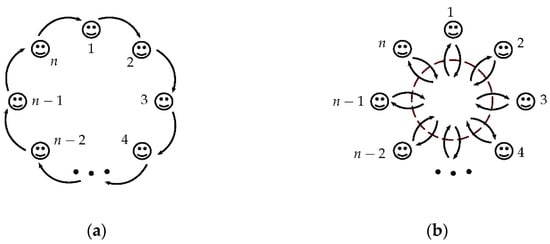
Grech [2] proposes a novel family of voluntary giving mechanisms, where players give to one another under different network topologies, and theoretically investigates the structure of Nash equilibria as a function of the players’ degrees of pro-sociality. Figure 1 illustrates two examples of such mechanisms. Grech [2] identifies what kind of mechanisms are most effective at implementing high levels of giving behavior.
Figure 1.
Two examples of mechanisms studied in [2] (as also considered in [3]). Reproduced with permission from [2]. (a) A simple ‘giving circle’; (b) the well-known linear voluntary contributions mechanism.
Ackermann and Murphy [3] experimentally investigate how preferences and beliefs interact with one another in determining individual contribution decisions in giving situations and public goods games similar to those studied by Grech. They show that pro-sociality is determined by beliefs about others’ pro-sociality, and that updating those beliefs in light of observed behaviors of others may lead to changes in preferences.
Newton [4] theoretically investigates how the notion and nature of equilibrium depends on the decision-makers’ agency being exercised by individuals (e.g., experimental subjects and players) or collective entities (e.g., groups of players, firms, and households). Newton extends Bayesian Nash Equilibria to incorporate incomplete information regarding agency.
Funding
This research received no external funding.
Conflicts of Interest
The author declares no conflict of interest.
References
- Schmitz, J. When Two Become One: How Group Mergers Affect Solidarity. Games 2019, 10, 30. [Google Scholar] [CrossRef] [Scilit]
- Grech, P. Give and Let Give: Alternative Mechanisms Based on Voluntary Contributions. Games 2019, 10, 21. [Google Scholar] [CrossRef] [Scilit]
- Ackermann, K.; Murphy, R. Explaining Cooperative Behavior in Public Goods Games: How Preferences and Beliefs Affect Contribution Levels. Games 2019, 10, 15. [Google Scholar] [CrossRef] [Scilit]
- Newton, J. Agency Equilibrium. Games 2019, 10, 14. [Google Scholar] [CrossRef] [Scilit]
Publisher’s Note: MDPI stays neutral with regard to jurisdictional claims in published maps and institutional affiliations. |
© 2021 by the author. Licensee MDPI, Basel, Switzerland. This article is an open access article distributed under the terms and conditions of the Creative Commons Attribution (CC BY) license (https://creativecommons.org/licenses/by/4.0/).