


Abstract
Human–AI teaming is increasingly attractive also for safety-critical industrial decision making, where the reliability of the joint system depends not only on the accuracy of the AI but also on the sequence in which the human and the AI contribute to the decision under time pressure. This paper examines three decision-making workflows for weld-crack fault prediction at the entry section of a steel pickling line: a human-only workflow (HO), an AI-first workflow (AIF) in which the prediction is presented before the operator’s judgment, and a human-first workflow (HF) in which the operator decides first and the AI provides feedback only in case of disagreement. The AI component is implemented as a Random-Undersampling-Boosted classification ensemble trained on twelve process parameters from past flash-butt welding operations. The three workflows were deployed in a live three-shift production environment over 40 days, with the active workflow randomly assigned at each shift change, resulting in 6600 evaluated welds. Performance was evaluated separately for the initial inspection of a weld and for repeat inspections, and complemented by a human-reliability analysis that quantifies the contribution of time pressure to the predicted human error probability. The HF workflow yields the best detection performance during the initial inspection and reduces unnecessary repeats compared to HO, whereas the AIF workflow clearly outperforms the others in repeat inspections, where it nearly halves the repeat rate while maintaining a higher specificity. These findings support a stage-dependent allocation of decision authority in human–AI teaming for safety-critical industrial assessment tasks.
1. Introduction and Motivation
Many industrial processes are controlled by operator decisions. Given the high volatility and exceptional situations such as material breakdowns, the operator intervention is currently of great benefit. The outcome of this intervention depends, among other things, on the operator’s concentration and limited information processing capacity [1]. The aim is to reduce or eliminate these human limitations by introducing technical support systems. Previous considerations regarding occupational and process safety indicate that the goal is not to replace humans. Instead, the aim is to increase the functional safety and process accuracy of the entire human–machine system by establishing support systems [2]. In this context, more and more of these operator decision-making processes have been supplemented by model-based machine support. These have become widely adopted and established in an industrial context over the past few years. The volume of information has continued to increase in recent years as a result of built-in sensor technology and new technologies for data acquisition. This information is made available to the operator in the control stations as the basis for their decisions and must be processed for evaluation. When processing these large volumes of data, model-based support systems are to be replaced by AI systems based on machine learning [3]. This is intended to improve both the accuracy of the results and the public acceptance of AI-based decisions [4]. This advancement is to be implemented through an initial experimental integration of AI into the decision-making process.
However, the integration of AI-based decision support into time-critical industrial processes presents several unresolved challenges. First, it remains unclear at what stage of the decision-making process an AI prediction should be presented to the operator. Providing the prediction before the operator has generated an independent judgment could influence that judgment, whereas presenting it only after an initial human decision has been made might preserve the operator’s independent judgment but reduce the immediate influence of the AI support. Additionally, the effectiveness of these decision-making processes may depend on the specific phase of the operational process as well as external operational influences. Second, insights from real-world industrial production remain limited, as ongoing operations restrict experimental control, individual randomization, and complete verification under real-world conditions.
To address these challenges and preserve the strengths of both humans and AI, the concept of human–AI collaboration has been gaining traction for some time. The success of such cooperation depends on the hierarchy of decision-makers. This raises the intriguing question of whether a human would review their decision or adopt AI’s decision if it differs from their own assessment. This contribution examines the various possible decision-making sequences in human–AI teaming with the aim of identifying which approach yields the most accurate and stable results in a practical setting. To this end, different workflows of this collaboration are systematically incorporated into everyday production processes in an easy to realize initial form and analyzed.
This contribution thus took a different approach from the papers presented by the authors in [5,6], which also examined AI-assisted decision support and decision-making using various workflows from both experimental and statistical perspectives. Unlike previous work, this paper does not consider synthetic recognition tasks, but rather a real assessment session from a real industrial context. No typical test subjects were used here but rather workers from various shifts who apply their decades of assessment experience in a matter of seconds to make a judgment. Due to the real-industry context, the experimental possibilities are also limited, precisely because these are experiments conducted within an ongoing operation. Building on established theoretical concepts of human–AI teaming, including the definition of interdependent human–AI collaboration [7], the discussion of levels of autonomy and the automation conundrum [8], and design principles for trustworthy, explainable human–AI interaction [9] this study shifts the focus from the standalone performance of the AI model to its integration into the joint decision process. While the production task and the underlying classifier remain unchanged, the timing of the AI contribution relative to the operator’s judgment is systematically varied. The main contribution lies in evaluating these decision sequences with experienced operators in a live industrial production environment and separately examining their effects during initial and repeat inspections.
This contribution is structured as follows: First, an overview is provided of the current state of research on human–AI teaming, as well as established applications in industrial settings. The methods examined and the experiments conducted—including the data collection process—are presented next. The third section covers the analysis of the collected data and the presentation of the resulting findings. These findings are critically examined and generalized in the following section.
2. State of the Art
2.1. AI Utilization in Industrial Applications
In the manufacturing industry two main goals have been followed by the application of AI methods: model predictive control of production processes [10] and predictive maintenance to optimize the utilization of the remaining useful life of manufacturing components [11]. This field started with the application of mathematical modeling with classical statistics and model-based prognosis done by regression algorithms [12]. Deep learning methods and the introduction of LLM generated higher accuracy in diagnosis and prognosis of machine defects [13]. Recent advances have also explored more sophisticated AI-based representation-learning methods, including state-space and Mamba-based architectures such as MambaX [14], spectral foundation models such as SpectralGPT [15], and image-to-state fusion approaches such as Im2State [16]. These methods primarily target high-dimensional image or spectral data, learned feature representations, and multimodal data fusion. Although such approaches illustrate important developments in modern AI, they are outside the scope of the present study, which focuses on human–AI decision-making workflows, operator reliability, and functional aspects of AI-supported fault assessment rather than on the development of advanced image- or signal-representation models. System-based applications for the diagnosis and prognosis of machine faults and production defects are established in the manufacturing industry. The value generated from these predictive maintenance approaches is yet based on human decision making in collaboration with the AI insights provided to them. Related to this interaction trust to the AI is build through a barrier of slow adoption and can be rapidly lost if the AI produces a wrong diagnosis or prognosis, also observed in [17].
2.2. Background and Related Work in Human–AI Teaming and Interaction
Human–AI teaming describes the interdependent collaboration between humans and autonomous agents/systems to leverage their complementary capabilities for complex task execution [7]. Consistent with the established strengths and limitations of humans and machines [18], briefly described humans contribute creativity, emotional intelligence, and adaptive, context-sensitive behavior, whereas AI provides high-speed data processing and precise decision-making. Intelligent assistance systems, particularly in aviation, exemplify this division of labor by using AI to support complex and dynamic operational goals.
Related research increasingly focused on improving human–AI interaction and coordination, with particular emphasis on trust, transparency, and ethical considerations [19,20,21]. Based on established principles of human–computer interaction, recent work proposes structured design guidelines that incorporate emerging neurocognitive insights to standardize and enhance human–AI interaction [22]. For example, Ref. [22] introduced comprehensive design principles for developing intuitive, reliable, and trustworthy AI interfaces. Similarly, the authors of [23] highlight the importance of human-centered AI principles, such as adaptability and transparency, for improving collaboration quality in joint cognitive systems, with experimental evidence demonstrating significant gains in team performance.
A key prerequisite for reliable human–AI teamwork is the AI’s ability to make its reasoning and decisions understandable [24], enabling human partners to critically evaluate and, when necessary, override, or correct them. This capability is supported by Explainable AI (XAI) approaches [25] and, increasingly, by large language models (LLMs). Developing an accurate understanding of an AI system’s capabilities and limitations is essential for calibrating trust and enabling appropriate reliance or manual intervention when required [9]. Accordingly, AI systems should present salient and integrated information that is aligned with users’ goals and decision requirements to facilitate timely and effective comprehension, particularly under high workload conditions [9]. Related research in human trust not only in automation but additionally in AI is one of the key research fields of the last five years [6].
These requirements are particularly important in time- and safety-critical domains such as aviation, healthcare, and emergency management, where complex decisions are often made under time pressure. Cognitive overload and poorly structured information can cause decision-relevant cues to be overlooked or misinterpreted. Accordingly, explainability is an important aspect in effective human–AI teaming. Controlled experiments show that explainable AI can improve task performance and user trust [26], while iterative, user-centered design with continuous feedback helps address trust and usability challenges [27].
Human–AI teaming refers to the interdependent collaboration between humans and autonomous agents, combining their complementary capabilities to perform complex tasks [7]. Humans contribute creativity, emotional intelligence, and flexible, context-sensitive behavior, whereas AI can process large amounts of data and support precise decision-making [18]. This division of labor is reflected in intelligent assistance systems, particularly in aviation. Research in this area also examines levels of autonomy (LOAs) and their effects on team performance and human well-being. Although higher autonomy can reduce cognitive workload, it may also impair situational awareness and human control in critical situations [8]. This so-called automation conundrum can make it more difficult for operators to reengage when intervention becomes necessary [8,28]. Appropriate LOAs and task-allocation strategies are therefore essential for effective teamwork and human-centered system design [8,29]. Long-term effects, including skill development and potential skill degradation, should also be considered [30]. Although large pretrained models may further advance human–AI teaming, their functions must be aligned with team dynamics and established workflows [31].
Current research further addresses human–AI interaction and coordination, with particular emphasis on trust, transparency, and ethical considerations [19,20,21]. Proposed guidelines extend established human–computer interaction principles by incorporating neurocognitive considerations [32]. For example, [22] presents design guidelines for intuitive, reliable, and trustworthy AI interfaces, while [23] emphasizes adaptability and transparency as important human-centered AI principles for joint cognitive systems.
A reliable human–AI team also requires AI decisions to be sufficiently understandable for human partners to evaluate, question, and, if necessary, override them. Explainable AI (XAI) and, increasingly, large language models (LLMs) support this requirement [25]. Users must understand an AI system’s capabilities and limitations to calibrate trust and determine when to rely on its recommendations or intervene manually [9]. Artificial intelligence systems should therefore provide salient, integrated information that is aligned with decision objectives and users’ needs, particularly in high-demand situations [9]. Empirical evidence indicates that explainable systems can improve task performance and trust [26], while iterative, user-feedback-driven design can help address related usability challenges [27].
2.3. State of the Art of Human and AI Reliability
Human Reliability Assessment
Methods of probabilistic safety analysis (PSA) are fundamental tools in safety engineering for systematically analyzing dependencies in complex systems by deriving characteristic values for individual components through analytical or experimental approaches. Analogously, human reliability (also decision making, etc.) can be evaluated for well-defined tasks and contexts using Human Reliability Analysis (HRA) methods, which provide structured frameworks for both qualitative and quantitative assessments.
Time pressure is a major performance shaping factor (PSF) affecting human judgment and decision-making, as coping strategies differ substantially from those applied under stress-free conditions [30,33]. Its relationship with performance follows an inverted U-curve: moderate time pressure may enhance performance, whereas excessive time pressure degrades it [34]. Across many application domains, high time pressure increases the likelihood of hasty decisions, risk-taking, and reduced cognitive performance [35]. Human behavior can further be characterized by Rasmussen’s Skill–Rule–Knowledge (SRK) framework, which distinguishes skill-, rule-, and knowledge-based behaviors. Recently the relation between the levels with human reliability stating decreasing reliability from subconscious execution to conscious problem-solving was shown on the base of a literature analysis [30].
Traditional first-generation HRA methods have been criticized because they treat humans largely in isolation and neglect dynamic interactions with physical and social work environments [30,36]. Consequently, second-generation approaches such as CREAM incorporate cognitive models and qualitative assessments to better capture error mechanisms [37], while third-generation methods employ simulation and artificial intelligence to dynamically model human behavior in complex scenarios and improve prediction accuracy [38].
Within the CREAM framework, a cognitive demand profile is generated for a set of tasks to identify potential cognitive functional errors [39]. These are quantified by the Cognitive Failure Probability (CFP), which depends on basic cognitive functions—perception, interpretation, planning, and execution (PIPE) [40]—and on Common Performance Conditions (CPCs), such as environmental factors, workload, and time pressure. A further key concept is the control mode, which describes the operator’s behavioral strategy under prevailing performance conditions. Different control modes (for example, strategic or opportunistic) modify the CFP and thereby account for contextual influences on cognitive performance, yielding a more realistic estimate of error probability [39].
In this work, the CREAM framework and the SRK model are used to highlight the relevance of cognitive aspects (e.g., perception, interpretation, planning, and execution) and of time pressure as a performance-shaping condition, rather than to conduct a full CREAM-based human reliability quantification. The analysis extends from a controlled, synthetic recognition task to a real industrial decision-making task, in which experienced operators visually assess weld seams in a pickling line under varying time pressure. The cognitive sub-steps of perception, interpretation, and response selection are no longer performed in a clearly separable manner by non-expert participants but are integrated into a routine assessment carried out by domain experts whose long-term experience shifts large parts of the task from knowledge- and rule-based toward skill-based behavior in the sense of Rasmussen’s SRK framework. Time pressure is considered the central performance shaping factor, since the time available for the decision is directly determined by the filling level of the in-feed strip storage and therefore varies systematically during operation. Observed error rates are derived for the binary weld-assessment decision and used as a reference value for comparing the three workflows examined in this paper, namely the human-only workflow (HO), the AI-first workflow (AIF), and the human-first workflow (HF). The resulting error rates allow the quantification of the influence of time pressure on the reliability of the human decision, the comparison of error rates across the three workflows, and the assessment of the extent to which the introduction of AI support modifies the predicted reliability of the joint human–AI system.
3. Materials and Methods
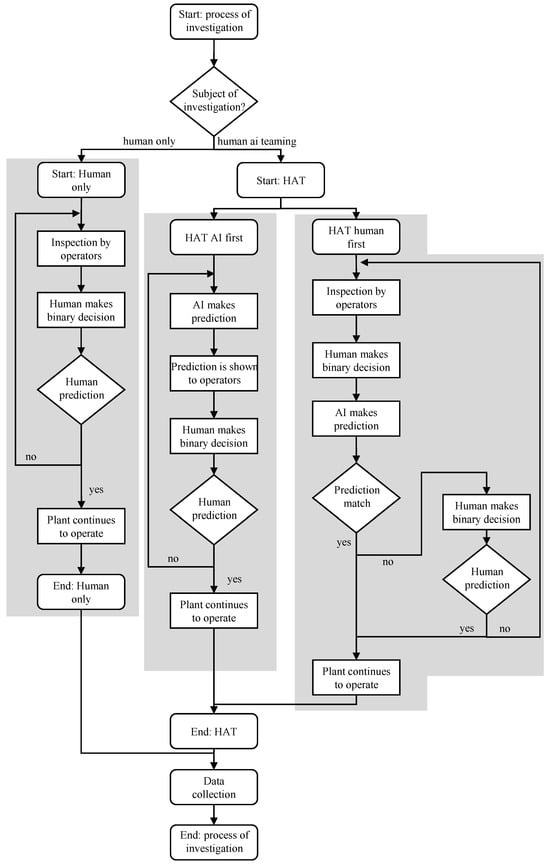
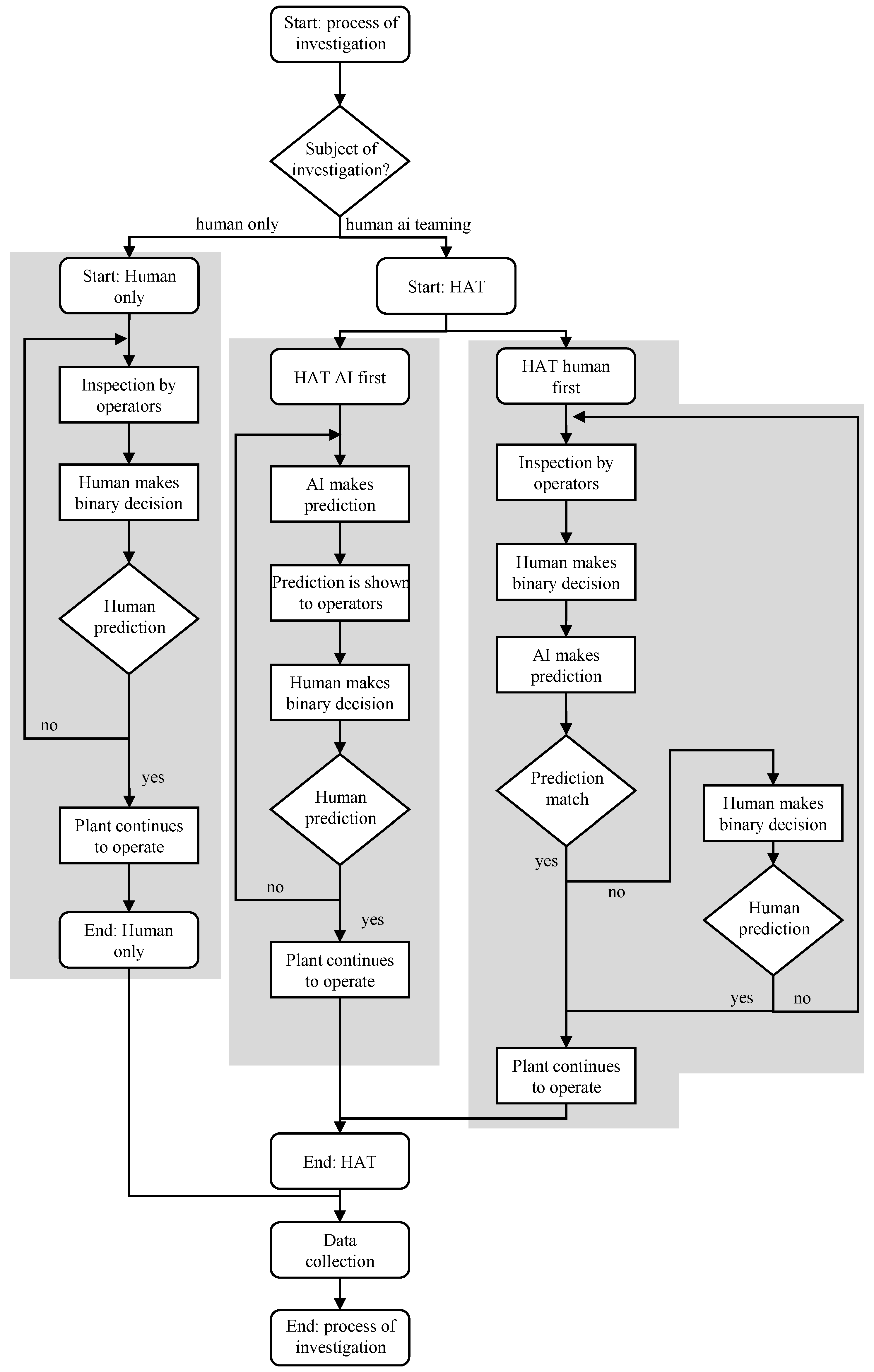
The methodology presented here enables the study of both the human decision-making process and human–AI Teaming (HAT) in decision-making contexts. This decision-making process is examined in various workflows (humans acting alone (HO) and humans and AI working together (AIF,HF)). In the context of human–AI teaming, particular emphasis is placed on the sequence of decision-making between humans and AI. The investigations are conducted in a real production facility operating on a 5-shift schedule. The general sequence of the decision-making process under investigation is shown in Figure 1.
Figure 1.
Process flowchart of human and HAT investigation in the field of industrial weld crack prediction.
In the purely HO workflow, the operator visually inspects the weld bead in the actual production environment. Based on their experience and visual inspection, the operator must then make a binary decision as to whether the weld is acceptable. If the operator gives a positive assessment, the steel strip is fed further into the system; if the assessment is negative, it is pulled back and the weld is repeated. After the weld is repeated, the operator’s decision-making process takes place again. This decision must be made within a defined time frame. The time is determined by how full the infeed strip storage area is prior to the pickling process in the system.
In the field of HAT, a distinction is made between two workflows. The first workflow involves the “AI-first” approach (AIF). In this approach, the AI’s prediction is made available to the operator immediately, before the operator has made a decision. Armed with the AI’s decision, the operator must now inspect the weld seam by him-/herself and decide whether to agree with or override the AIs decision. Depending on the operator’s decision, he or she must either continue feeding the steel strip or reverse it to repeat the weld. In the “human-first” workflow approach (HF), the operator must first visually assess the weld and make a binary decision on whether to continue the process or have the weld repeated. As long as the operator’s decision aligns with the AI’s internal prediction, the production process continues following the operator’s decision to ‘continue’ or “repeat”. If there is a discrepancy between the operator’s and the AI’s decisions, the AI informs the operator that the AI-prediction differ. The operator must then make the final decision as to whether to trust the AI’s prediction or his/her own previous decision. Accordingly, the operator then makes a final binary decision by confirming their decision or revising it based on the AI’s prediction.
The three different workflows are tested around the clock in a live production environment. Production operates on a three-shift schedule—morning, afternoon, and night—and is carried out by five production teams. To prevent operator-dependent evaluation, a random assignment of the form of collaboration between humans and AI is implemented in combination with the existing shift system. One of the three workflows is randomly selected at each shift change and activated for the entire following shift. Thus, in the investigation of each shift, each form is randomly assigned at least once during every time of day.
3.1. Study Design, Analysis Method, and Modeling
The interface through which the AI forecasts are presented to the operator has been designed to be as simple as possible. Based on research in software ergonomics on cognitive-psychological aspects, AI forecasts are displayed using simple symbols and colors to avoid overwhelming the operator. The simplicity of the presentation and the selection of the model is intended to prevent possible human errors in operation and interpretation. Before the trial phase was conducted in production, all shifts were trained on how the system works. In addition, following the training, a test version of the system was made available for eight days. The eight-day period was chosen because during this time, each shift was present on the morning shift at least once and could thus be trained on the system. This gave operators the opportunity to familiarize themselves with the system. The interaction itself required only a binary confirmation or rejection, supported by simple visual symbols. This was implemented as an additional measure to prevent human errors. After the implementation and testing phase, the experiment began, and the AI model was live for 40 days, always activating according to the randomly selected form for the current shift.
The AI model used in the human–AI teaming approaches was a classification model based on supervised learning. The overall model consists of many “small” classification models combined into what is known as a classification ensemble. Individual models, known as weak learners, are based on the principle of decision trees. The model was trained using past welding processes at this production facility that had been recorded in a database. Due to the unequal number of available cases of “crack” and “no crack”, the classification ensemble was expanded using the Random Undersampling Boosting algorithm to improve accuracy. This reduces the class of “no crack” detected more frequently until a comparable number of cases from both result classes are available for model training. The collection of process data used for model training is described in Section 3.2. Following model optimization using Bayesian optimization method, the model achieved a sensitivity, i.e., weld crack detection, of 70% and a specificity, i.e., detection of the “no crack” class, of over 99%. To enable the use of the AI model in time-critical situations within the production process, the model was kept simple, and the number of process variables was minimized while maintaining high accuracy. As a result, the time required to calculate the model output and integrate it into the production environment was reduced to just a few seconds. The time frame of the operational decision-making process depends heavily on the current line speed and the material properties of the coil and ranges from approximately 30 s. All generated predictions were accordingly available as part of the operational decision-making process.
3.2. Data Collection and Participant Selection
The first step in the cold-forming of flat steel is the pickling of the hot-rolled strip. In this section, the surface is broken down by a stretching and leveling process and then picked in acid tanks. This continuous process is achieved by welding two hot-rolled strips together at the entrance to the line.
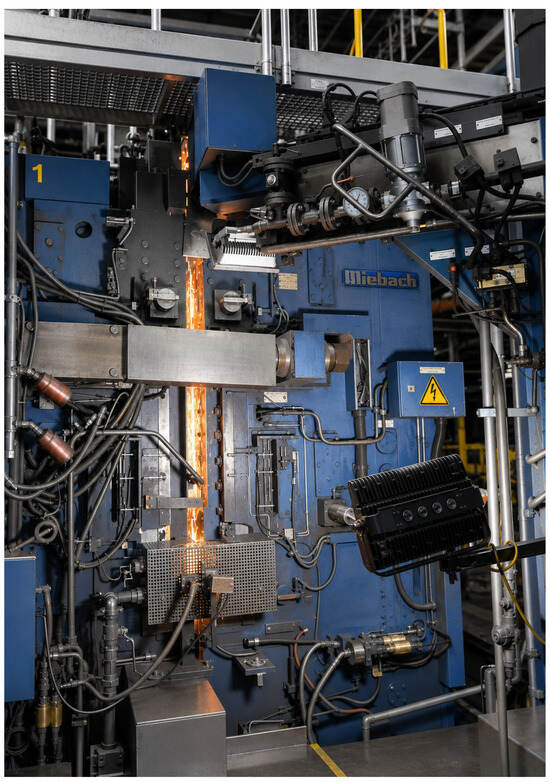
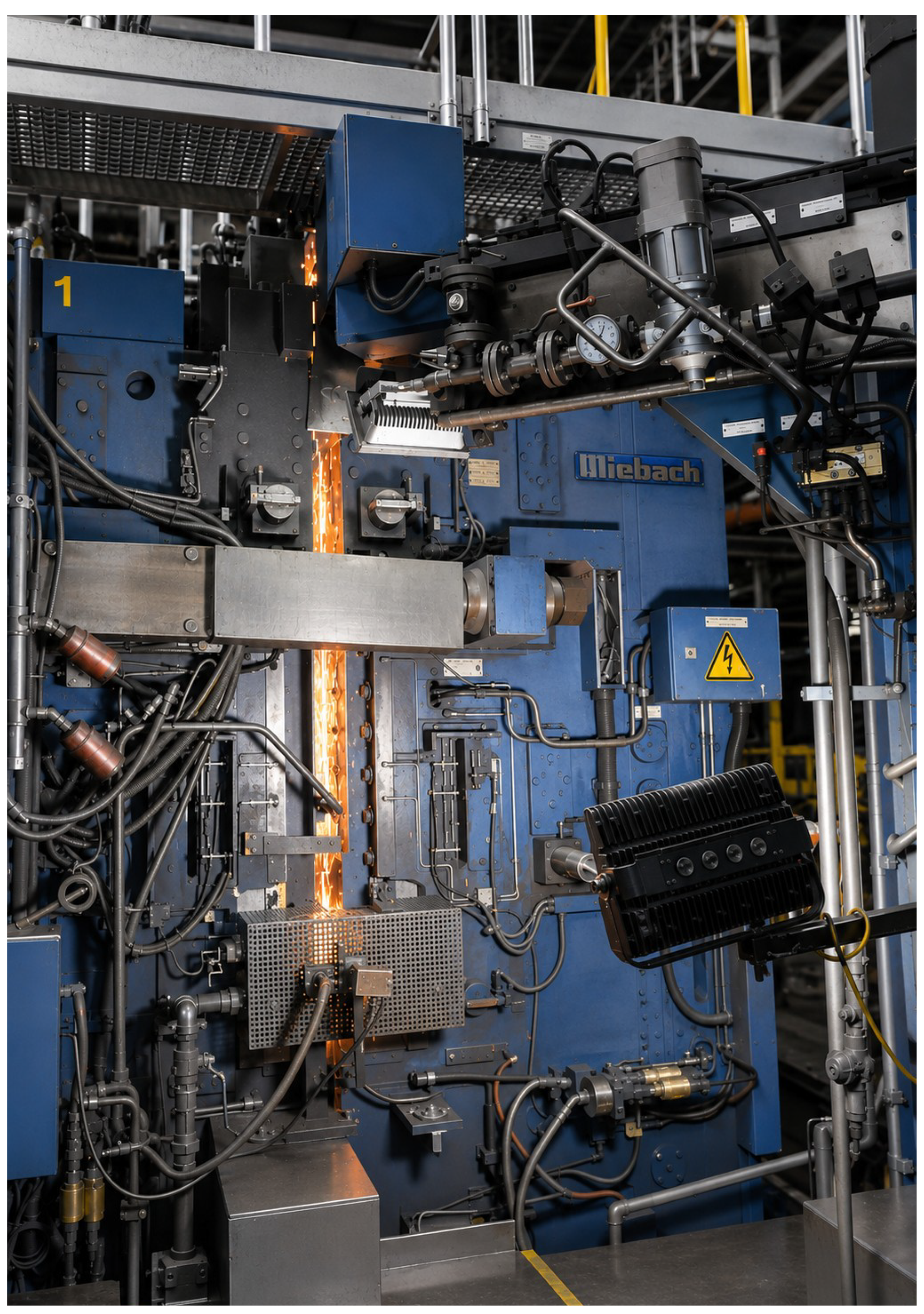
The welding process is performed on a flash butt welding machine (shown in Figure 2) and is divided into eight phases. In the first two phases, the compression frames are closed by measuring compressed air pressure, duration of rupture, and distance of rupture. These parameters are continuously recorded throughout the entire process. The current generated during this process is recorded as no-load current and serves as an indicator of contamination. This is followed by the actual joining process, including preheating, flashing, burn-off, and upsetting. Statistical parameters of the electrical variables are recorded, with the regulated welding current and the upset speed varying phase-specifically.
Figure 2.
Flash butt welding machine.
During the upset phase, there is an additional focus on recording differences in the upset pressure across the strip width to detect asymmetrical force distributions at an early stage. Following the welding process, a dwell time is incorporated to allow the weld to cool. As part of the post-welding processing, the planing process is digitally recorded, including the position, planing force, and compressed air pressure. In addition, phase-independent and material-specific parameters are recorded. This collected data is stored in [41] serving as the base dataset for the AI, which is designed to support the operator’s decision-making process. An applied preprocessing step reduces the number of measured parameters to the 12 predictors shown in Table 1, which are assigned significant weights for the supervised learning-based classification model. This model is integrated into the production process and is designed to assess the welds produced for their susceptibility to weld cracking. During the study period, a total of 7,761 welding processes—each involving one of the three methods—were examined and recorded [41]. The dataset was selected because it originates from the same production facility, the same welding process, the same sensor infrastructure, and the same operational decision-making context in which the workflows of the human–AI teams were evaluated. It therefore reflects naturally occurring variations in material properties, process conditions, shift schedules, operator experience, workload, and available decision-making time. Unlike a hypothesis-specific laboratory dataset, the observations reflect routine production without artificial error injection or isolated test tasks. This increases ecological validity but limits experimental control and the ability to fully inspect rejected welds.
Table 1.
Display of significant predictors from the feature selection in preprocessing.
4. Results
To analyze the generated raw data [41], the data are cleaned using standard algorithms to remove, for example, missing values or other data errors. This resulted in a total of 6600 analyzable cases.
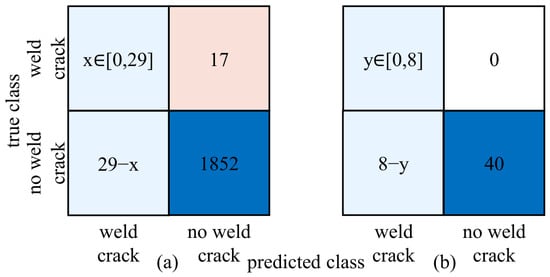
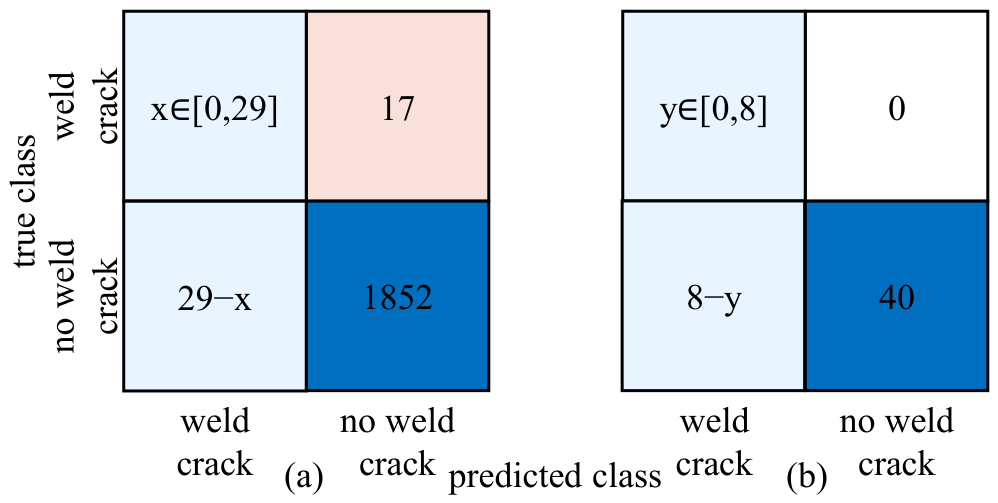
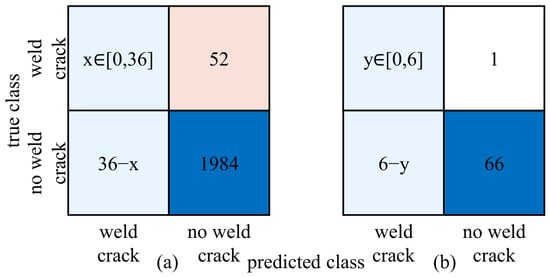
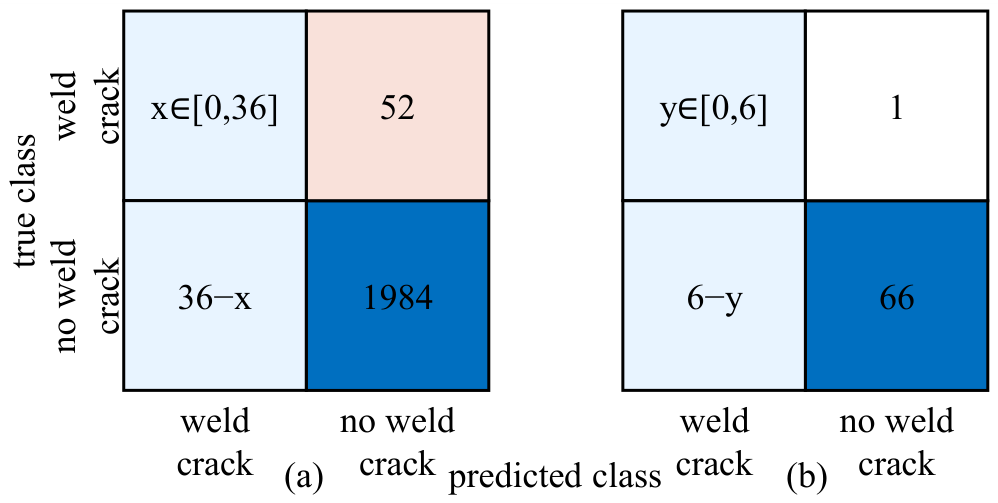
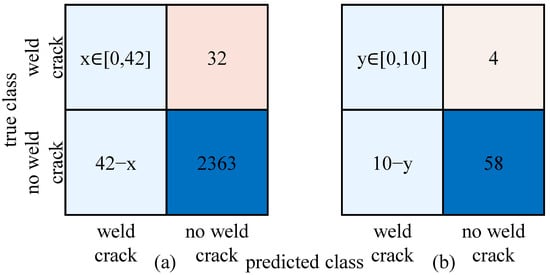
A distinction is made between the three types of welds, as well as between the initial weld and a repeat weld. The breakdown of the recorded datasets is shown (cf. Table 2). The randomly selected display format shown here for shift changes provides a comparable and sufficiently accurate breakdown for evaluation. The following section presents the results of the three workflows examined. The absolute numbers of weld crack predictions in the various display formats are visualized and analyzed using a confusion matrix. Due to the real-time nature of the application in the production process, the predicted class “Crack” cannot be assigned to a true class, as these welds are repeated and thus not processed by the system. For this reason, the number a of the predicted class “Crack” is distributed between the two true classes using a variable in the following. The distribution of the number a of the predicted class towards the true crack class is represented by the variable . According to this distribution, the number of predicted cracks assigned to the true “no crack” class is given by . To enable a comparable presentation, the various display formats are represented separately as
Table 2.
Breakdown of the evaluated welds by form, initial contact, and rerun.
- Sensitivity;
- Specificity;
- Accuracy;
- Error rate;
- Repeat rate;
- Crack rate.
They are evaluated. The repeat rate indicates how often the operator decides to repeat the weld being inspected and is defined as the percentage of welding processes that are performed again. Only passed welds are considered in the crack rate evaluation metric. The results obtained during the defined experiment period are shown (cf. Figure 3, Figure 4 and Figure 5).
Figure 3.
Confusion matrix for workflow 1 (HO) after initial contact (a) and rerun (b).
Figure 4.
Confusion matrix for workflow 2 (AIF) after initial contact (a) and rerun (b).
Figure 5.
Confusion matrix for workflow 3 (HF) after initial contact (a) and rerun (b).
The actual distribution within the interval is unknown, so no specific distribution can be empirically determined from the available production data. To provide a clear and easily interpretable comparison of the three workflows, Table 3 and Table 4 use the midpoint as a reference scenario. This midpoint does not represent an assumed or empirically validated uniform distribution of the actual classes but serves solely as an illustrative example within the entire spectrum of possible distributions. Accordingly, the values given for accuracy, error rate, sensitivity, and specificity refer to the illustrative midpoint scenario and should not be interpreted as fully observed diagnostic performance measures. This yields the metrics mentioned at the beginning of the chapter. These are shown for the initial contact (cf. Table 3) and for the cases of repetitions (cf. Table 4).
Table 3.
Illustrative performance metrics for the three workflows during the initial inspection under the midpoint scenario .
Table 4.
Illustrative performance metrics for the three workflows during the repeat inspection under the midpoint scenario .
Under the illustrative midpoint scenario, the HO workflow achieves slightly better results—with an accuracy of 98.35% and a sensitivity (i.e., crack detection rate) of 46.03%—than the HAT workflow HF during the initial inspection, in which the human makes the initial decision and the AI provides feedback only in the event of a discrepancy. The AIF workflow, in which the AI always provides the result to the operator first, achieves the least accurate results here during the initial contact. In comparison, the AIF workflow achieves the highest results in the repetitions (cf. Table 4) assuming the midpoint scenario with an accuracy of 94.50%. The specificity also reaches the best values among the considered workflows here, at 96.65%.
When repeat and crack rates are analyzed by mold type and first contact versus repetition (Table 5), a similar pattern emerges. In the initial weld category, the HO workflow configuration achieves the best rate with a crack rate of <1%. Among the HAT configurations, the HF configuration achieves the lowest repeat and crack rates. For repeat welds, the AIF configuration yields the farthest repeat rate at 8.22%, which is approximately half the repeat rate of the HO workflow configuration.
Table 5.
Comparison of the repeat and crack rates between the initial contact and the rerun for the three forms examined.
5. Discussion and Outlook
In the discussion of the results, the three workflows examined (HO, AIF, and HF) are compared with one another at the production facility described, based on the performance metrics presented in Section 4, separately for the “initial contact” and “repeat” cases. In terms of sensitivity—that is, crack detection—the HO workflow achieves the best results in this experiment, both in the first contact and in the repeat test. When the performance metrics of accuracy and specificity are also taken into account, it becomes apparent that, in the first contact, the HO workflow achieves the best overall results among the three workflows. When comparing human–AI configurations, the HF configuration achieves better results in the scenario of “first contact”. The particular strength of the HF workflow lies in the fact that it achieves a lower repetition rate during the initial contact than the HO workflow. This may be due to the fact that in cases where the operator is somewhat uncertain, the assistance provided by the AI prediction (by revising the decision or not reacting if the prediction matches) gives the operator greater confidence. This may lead to borderline cases being more likely to proceed.
Compared to the initial inspection, it can be stated that, in cases of repeated inspections, the AIF workflow achieves better accuracy and specificity values than the HO workflow. In particular, the repeat rate for welds that have already been inspected is significantly lower in the AIF workflow—at approximately —than in the other workflows examined. The low repeat rate and high specificity (i.e., detection of “non-cracks”) highlight the major advantage of an AI decision based on objective data compared to the operator’s decision in the HO workflow. The poorer detection of the “no crack” case in repeated welds—or the operator’s high repeat rate—can likely be attributed to uncertainty. In other words, once the operator has already decided to repeat a weld, they tend to perform a second repetition.
However, these results must be interpreted with respect to the limited availability of ground-truth information. Welds classified as potentially cracked were repeated before further processing, and the true condition of the original weld could therefore not be verified. Consequently, the study cannot clearly distinguish between necessary safety-related repetitions and unnecessary repetitions resulting from false-positive decisions. For a welds classified as potentially cracked, the unknown number x of actual crack cases may take any value within the complete interval , while the remaining cases would belong to the true “no crack” class. As the available production data do not support any specific allocation within this interval, the midpoint used in Table 3 and Table 4 serves solely as an illustrative reference scenario for a consistent and readily interpretable comparison of the three workflows. It does not represent an assumed, expected, or empirically validated equal distribution of the true classes. Accordingly, the diagnostic performance metrics reported in Table 3 and Table 4 are conditional on this illustrative midpoint scenario and should not be interpreted as fully observed performance measures. In contrast, the repeat rate represents a directly observed operational outcome and does not depend on the allocation variable x. The study therefore provides direct evidence of how the three decision workflows affect operational behavior, particularly the frequency of repeated welds and the differences between initial and repeat inspections. The results support conclusions regarding workflow-related operational effects within the investigated production environment, but do not provide a complete diagnostic validation of the joint human–AI system. Future studies could investigate possibilities for obtaining an independent reference assessment of rejected welds without interfering with production safety and continuity.
In summary, the study of human–AI teaming models shows that, during initial contact, the HF workflow—in which the operator makes the decision first and receives guidance from the AI only when there is a discrepancy in the decisions—achieves the best results. In repeat interactions, however, the best results are achieved when the AI first provides the operator with a forecast as guidance before the operator makes a final decision.
The present results indicate that the effectiveness of human–AI teaming depends on the stage of the decision process rather than on the simple combination of human and AI capabilities. The HF configuration reduced the repeat rate during initial contact, whereas the AIF configuration improved accuracy and specificity during rerun decisions. This stage-dependent pattern is only partially consistent with the broader human–AI teaming literature. Meta-analytic evidence in [42], based on 370 effects from 106 experiments, reports that human–AI combinations in decision tasks performed on average worse than the better of the two individual decision makers, suggesting no overall synergy. A comparable result was reported in [5], where the same three workflows (HO, AIF, and HF) were compared in a controlled recognition task under time pressure and none consistently outperformed the best individual decision maker. The findings reported in this work provide a more differentiated perspective, indicating that synergistic effects may emerge in specific phases of a task even when no global performance advantage is observed across the entire decision process. At the same time, the generalizability of the results is limited by the application-specific nature of the study. The study was conducted at a single production facility and focused on a single defect prediction task, namely the assessment of potential weld cracks in a steel pickling plant. The number of production teams, the range of steel grades processed, the prevailing process conditions, and the AI model implemented were therefore determined by this specific industrial context. The results provide ecologically valid evidence for the application under study; however, they should not be directly generalized to other production facilities, defect types, or human–AI collaboration tasks without further validation.
In addition to discernible synergy effects—and thus improvements in, for example, accuracy, crack detection, or repeatability in human–AI teaming—a deterioration can also be observed in the workflow between the initial contact and repeated welds. In the HF workflow, the crack rate deteriorates from to . One possible explanation for this behavior is the operator’s potential lack of trust in the AI’s result after the operator has already formed an opinion. This problem specifically affects cases of repeated welds in the HF workflow.
As the lack of user compliance to follow the AI suggestions is possibly the result of either a lack of trust, a lack of attention or both, other psychological factors in the building of trust can be further researched. In the therapeutic context the concept of contact exists, consisting of empathy, trust and collaboration within common goals. This has been researched in the field of Digital Therapeutic Alliance to generate a therapeutic relationship between a human patient and an AI therapist [43]. Key insights may offer the possibility to be transferable to the collaboration within common goals in complex problem solving without being centered on the consciousness and subconsciousness of the human but on their mental workload.
The element of modal interaction can be expanded to different workflows of verbal communication, with the option to return questions to the AI to receive justifying arguments for the original suggestion. This kind of bidirectional interaction offers to include the insights of the concept of self-disclosure to conversational AI [44], where virtual social presence, which is more than the purely goal orientated communication, natural turn-taking and features of perceived closeness can lead to a higher trust by the human in the AI interaction.
Author Contributions
Conceptualization, N.B. and D.S.; methodology, N.B. and J.G.; software, N.B.; validation, N.B., J.G. and D.N.; formal analysis, N.B.; investigation, N.B.; resources, N.B.; data curation, N.B.; writing—original draft preparation, N.B., J.G. and O.S.; writing—review and editing, D.N. and D.S.; visualization, N.B., J.G. and O.S.; supervision, D.S.; project administration, N.B. and O.S. All authors have read and agreed to the published version of the manuscript.
Funding
This research received no external funding.
Institutional Review Board Statement
Ethical approval was not required as the study exclusively assessed human–machine interaction during standard production workflows under established operational agreements.
Informed Consent Statement
Not applicable. Participants and their representatives were informed prior to the study that all operational data would be gathered strictly without personal references, ensuring absolute data anonymity.
Data Availability Statement
The dataset is available to download under the following link: https://doi.org/10.5281/zenodo.20428512, accessed on 2 September 2026.
Acknowledgments
The authors acknowledge the use of ChatGPT [https://chat.openai.com/, accessed on 2 September 2026] (version 5) by OpenAI and CoPilot [https://copilot.microsoft.com, accessed on 24 September 2026] based on the same model, for initial text refinement, summarization, literature review and certain stylistic improvements. The tool was employed to save time and enhance the quality of writing. All generated outputs were subsequently reviewed and corrected to ensure accuracy and alignment with the intended statements. We gratefully acknowledge the support provided by the Open Access Publication Fund of the University of Duisburg–Essen.
Conflicts of Interest
Authors Nicolas Bacher, Jérôme Göbel and Dennis Nowak were employed by the company thyssenkrupp Steel Europe AG. The remaining authors declare that the research was conducted in the absence of any commercial or financial relationships that could be construed as a potential conflict of interest. The funders had no role in the design of the study; in the collection, analyses, or interpretation of data; in the writing of the manuscript; or in the decision to publish the results.
References
- Roques, A.; Keriven Serpollet, D.; Nicolaï, A.; Buffat, S.; James, Y.; Vayatis, N.; Bargiotas, I.; Vidal, P.P. Continuous Assessment of Mental Workload During Complex Human–Machine Interaction: Inferring Cognitive State from Signals External to the Operator. Sensors 2025, 25, 3624. [Google Scholar] [CrossRef] [Scilit] [PubMed]
- Mietkiewicz, J.; Abbas, A.N.; Amazu, C.W.; Baldissone, G.; Madsen, A.L.; Demichela, M.; Leva, M.C. Enhancing Control Room Operator Decision Making. Processes 2024, 12, 328. [Google Scholar] [CrossRef] [Scilit]
- Lawrence, N.P.; Damarla, S.K.; Kim, J.W.; Tulsyan, A.; Amjad, F.; Wang, K.; Chachuat, B.; Lee, J.M.; Huang, B.; Bhushan Gopaluni, R. Machine learning for industrial sensing and control: A survey and practical perspective. Control Eng. Pract. 2024, 145, 105841. [Google Scholar] [CrossRef] [Scilit]
- Abbas, A.N.; Amazu, C.W.; Mietkiewicz, J.; Briwa, H.; Perez, A.A.; Baldissone, G.; Demichela, M.; Chasparis, G.C.; Kelleher, J.D.; Leva, M.C. Analyzing Operator States and the Impact of AI-Enhanced decision support in Control Rooms: A Human-in-the-Loop Specialized Reinforcement Learning Framework for Intervention Strategies. Int. J. Hum.–Comput. Interact. 2025, 41, 7218–7252. [Google Scholar] [CrossRef] [Scilit]
- Shyshova, O.; Mayouche, A.K.; Seesunkur, M.; Söffker, D. Performing Best: Organizing Suitable Human-AI Teaming for Improved Performance: An Experimental Study on Human Recognition Processes Under Time Pressure. In Proceedings of the IEEE Conference on Cognitive and Computational Aspects of Situation Management (CogSIMA), Duisburg, Germany, 2–5 June 2025. [Google Scholar]
- Söffker, D.; Shyshova, O. Reliability or ethics: Why should the human decision be initial or final? In Proceedings of the 35th European Safety and Reliability Conference (ESREL) & 33rd Society for Risk Analysis Europe Conference, Stavanger, Norway, 16–19 June 2025. [Google Scholar]
- O’Neill, T.A.; McNeese, N.J.; Barron, A.; Schelble, B. Human-Autonomy Teaming: A Review and Analysis of the Empirical Literature. Hum. Factors J. Hum. Factors Ergon. Soc. 2020, 64, 904–938. [Google Scholar] [CrossRef] [Scilit] [PubMed]
- Endsley, M. From Here to Autonomy: Lessons Learned From Human–Automation Research. Hum. Factors 2016, 59. [Google Scholar] [CrossRef] [Scilit] [PubMed]
- Endsley, M.R. Supporting Human-AI Teams:Transparency, explainability, and situation awareness. Comput. Hum. Behav. 2023, 140, 107574. [Google Scholar] [CrossRef] [Scilit]
- Lee, S.K.; Stone, R.F.P.; Gao, M.; Zhang, W.; Sha, Z.; Ko, H. Generative Model Predictive Control in Manufacturing Processes: A Review. Electronics 2026, 26, 080801. [Google Scholar] [CrossRef] [Scilit]
- Biedermann, H. Predicitive Maintenance: Realität und Vision; TÜV Media: Cologne, Germany, 2018. [Google Scholar]
- Si, X.S.; Wang, W.; Hu, C.H.; Zhou, D.H. Remaining useful life estimation—A review on the statistical data driven approaches. Eur. J. Oper. Res. 2011, 213, 1–14. [Google Scholar] [CrossRef] [Scilit]
- Azeta, J.; Omeche, T.T.; Daniyan, I.; Abiola, J.O.; Daniyan, L.; Phuluwa, H.S.; Muvunzi, R. Artificial intelligence and robotics in predictive maintenance: A comprehensive review. Front. Mech. Eng. 2026, 11, 1722114. [Google Scholar] [CrossRef] [Scilit]
- Li, C.; Hong, D.; Zhang, B.; Pan, Z.; Yokoya, N.; Chanussot, J. MambaX: Image Super-Resolution with State Predictive Control. In IEEE Transactions on Pattern Analysis and Machine Intelligence; IEEE: Piscataway, NJ, USA, 2026; pp. 1–15. [Google Scholar] [CrossRef] [Scilit] [PubMed]
- Hong, D.; Zhang, B.; Li, X.; Li, Y.; Li, C.; Yao, J.; Yokoya, N.; Li, H.; Ghamisi, P.; Jia, X.; et al. SpectralGPT: Spectral Remote Sensing Foundation Model. IEEE Trans. Pattern Anal. Mach. Intell. 2024, 46, 5227–5244. [Google Scholar] [CrossRef] [Scilit] [PubMed]
- Li, C.; Hong, D.; Zhang, B.; Chanussot, J. Im2State: Image-to-state Mamba for hyperspectral and multispectral image fusion. Inf. Fusion 2026, 134, 104385. [Google Scholar] [CrossRef] [Scilit]
- Amaliah, N.R.; Tjahjono, B.; Palade, V. Human-in-the-Loop XAI for Predictive Maintenance: A Systematic Review of Interactive Systems and Their Effectiveness in Maintenance Decision-Making. Electronics 2025, 14, 3384. [Google Scholar] [CrossRef] [Scilit]
- Fitts, P.M. (Ed.) Human Engineering for an Effective Air-Navigation And Traffic-Control System; National Research Council: Washington, DC, USA, 1951. [Google Scholar]
- Vössing, M.; Kühl, N.; Lind, M.; Satzger, G. Designing Transparency for Effective Human-AI Collaboration. Inf. Syst. Front. 2022, 24, 877–895. [Google Scholar] [CrossRef] [Scilit]
- Shneiderman, B. Bridging the Gap Between Ethics and Practice: Guidelines for Reliable, Safe, and Trustworthy Human-centered AI Systems. ACM Trans. Interact. Intell. Syst. 2020, 10, 1–31. [Google Scholar] [CrossRef] [Scilit]
- Wickramasinghe, C.S.; Marino, D.L.; Grandio, J.; Manic, M. Trustworthy AI development guidelines for human system interaction. In Proceedings of the 2020 13th International Conference on Human System Interaction (HSI), Virtual, 6–8 June 2020; Virtual, 6–8 June 2020, IEEE: Piscataway, NJ, USA, 2020; pp. 130–136. [Google Scholar]
- Amershi, S.; Weld, D.; Vorvoreanu, M.; Fourney, A.; Nushi, B.; Collisson, P.; Suh, J.; Iqbal, S.; Bennett, P.N.; Inkpen, K.; et al. Guidelines for Human-AI Interaction. In Proceedings of the 2019 CHI Conference on Human Factors in Computing Systems, New York, NY, USA, 4–9 May 2019; CHI ’19. pp. 1–13. [Google Scholar] [CrossRef] [Scilit]
- Xu, W.; Gao, Z. Applying HCAI in Developing Effective Human-AI Teaming: A Perspective from Human-AI Joint Cognitive Systems. Interactions 2024, 31, 32–37. [Google Scholar] [CrossRef] [Scilit]
- Bansal, G.; Nushi, B.; Kamar, E.; Lasecki, W.S.; Weld, D.S.; Horvitz, E. Beyond Accuracy: The Role of Mental Models in Human-AI Team Performance. Proc. Aaai Conf. Hum. Comput. Crowdsourcing 2019, 7, 2–11. [Google Scholar] [CrossRef] [Scilit]
- Chamola, V.; Hassija, V.; Sulthana, A.; Ghosh, D.; Dhingra, D.; Sikdar, B. A Review of Trustworthy and Explainable Artificial Intelligence (XAI). IEEE Access 2023, 11, 78994–79015. [Google Scholar] [CrossRef] [Scilit]
- Kim, S.S.; Watkins, E.A.; Russakovsky, O.; Fong, R.; Monroy-Hernández, A. “Help Me Help the AI”: Understanding How Explainability Can Support Human-AI Interaction. In Proceedings of the 2023 CHI Conference on Human Factors in Computing Systems, Hamburg, Germany, 23–28 April 2023; pp. 1–17. [Google Scholar]
- Yang, Q.; Steinfeld, A.; Rosé, C.; Zimmerman, J. Re-examining whether, why, and how human-AI interaction is uniquely difficult to design. In Proceedings of the 2020 Chi Conference on Human Factors in Computing Systems, Honolulu, HI, USA, 25–30 April 2020; pp. 1–13. [Google Scholar]
- Shneiderman, B. Human-centered artificial intelligence: Reliable, safe & trustworthy. Int. J.-Hum.-Comput. Interact. 2020, 36, 495–504. [Google Scholar] [CrossRef] [Scilit]
- Marcano, M.; Castellano, A.; Diaz, S.; Pérez Rastelli, J.; Tango, F.; Landini, E.; Burgio, P. Shared and traded control for human-automation interaction: A haptic steering controller and a visual interface. Hum.-Intell. Syst. Integr. 2021, 3, 25–35. [Google Scholar] [CrossRef] [Scilit]
- He, C.; Söffker, D. Quantification of human behavior levels by extending Rasmussen’s SRK model and the effects of time pressure and training on the levels switching. Heliyon 2023, 9, e15019. [Google Scholar] [CrossRef] [Scilit]
- Hagemann, V.; Rieth, M.; Suresh, A.; Kirchner, F. Human-AI teams-Challenges for a team-centered AI at work. Front. Artif. Intell. 2023, 6, 1252897. [Google Scholar] [CrossRef] [Scilit] [PubMed]
- Gonzalez, C.; Donahue, K.; Goldstein, D.G.; Heidari, H.; Jalali, M.S.; Schelble, B.; Singh, A.; Woolley, A.W. Toward a science of human–AI teaming for decision making: A complementarity framework. PNAS Nexus 2026, 5, pgag030. [Google Scholar] [CrossRef] [Scilit] [PubMed]
- Edland, A.M.A. The effects of time pressure on human judgment and decision making. In Decision Making: Cognitive Models and Explanations; Routledge: London, UK, 1997; pp. 189–204. [Google Scholar]
- Hwang, M.I. Decision making under time pressure: A model for information systems research. Inf. Manag. 1997, 27, 197–203. [Google Scholar]
- Hinkelmann, K.; Moritz, S.; Botzenhardt, J.; Riedesel, K.; Wiedemann, K.; Kellner, M.; Otte, C. Cognitive impairment in major depression: Association with salivary cortisol. Biol. Psychiatry 2009, 66, 879–885. [Google Scholar] [CrossRef] [Scilit] [PubMed]
- Yang, Z.; Bonsall, S.; Wall, A.; Wang, J.; Usman, M. A modified CREAM to human reliability quantification in marine engineering. Ocean. Eng. 2013, 58, 293–303. [Google Scholar] [CrossRef] [Scilit]
- Makajić-Nikolić, D. Human Reliability Assessment: Methods and Applications. PaKSoM 2020, 311. [Google Scholar]
- He, C.; Lum, Y.Y.; Yen Lee, K.; Söffker, D. Human reliability estimation based on fuzzy logic-modified CREAM approach. In Proceedings of the 2021 IEEE Conference on Cognitive and Computational Aspects of Situation Management (CogSIMA), Virtual, 14–22 May 2021; pp. 45–50. [Google Scholar]
- Hollnagel, E. Cognitive Reliability and Error Analysis Method (CREAM); Elsevier: Amsterdam, The Netherlands, 1998. [Google Scholar]
- Cacciabue, P.C. Modelling and Simulation of Human Behaviour in System Control; Springer: London, UK, 2011. [Google Scholar]
- Bacher, N.; Jérôme, G.; Nowak, D.; Shyshova, O.; Söffker, D. flash_butt_welding_machine_process_data, 2026. Dataset. Available online: https://zenodo.org/records/20428512 (accessed on 2 September 2026).
- Vaccaro, M.; Almaatouq, A.; Malone, T. When combinations of humans and AI are useful: A systematic review and meta-analysis. Nat. Hum. Behav. 2024, 8, 2293–2303. [Google Scholar] [CrossRef] [Scilit] [PubMed]
- Lee, S.K.; Stone, R.F.P.; Gao, M.; Zhang, W.; Sha, Z.; Ko, H. Does the Digital Therapeutic Alliance Exist? Integrative Review. JMIR Ment. Health 2025, 12, e69294. [Google Scholar] [CrossRef] [Scilit] [PubMed]
- Lee, S.K.; Stone, R.F.P.; Gao, M.; Zhang, W.; Sha, Z.; Ko, H. Self-disclosure to conversational AI: A literature review, emergent framework, and future directions. Pers. Ubiquitous Comput. 2024, 29, 119–151. [Google Scholar] [CrossRef] [Scilit]

Disclaimer/Publisher’s Note: The statements, opinions and data contained in all publications are solely those of the individual author(s) and contributor(s) and not of MDPI and/or the editor(s). MDPI and/or the editor(s) disclaim responsibility for any injury to people or property resulting from any ideas, methods, instructions or products referred to in the content. |
© 2026 by the authors. Licensee MDPI, Basel, Switzerland. This article is an open access article distributed under the terms and conditions of the Creative Commons Attribution (CC BY) license.