


Abstract
Universal Design for Learning (UDL) is increasingly recognized as a critical framework for promoting equity and accessibility in Science, Technology, Engineering, and Mathematics (STEM) education. In this review, we synthesize research published between 2002 and 2025 on UDL in STEM education, with attention to technology-enhanced learning environments. Searches were conducted in Scopus, Web of Science, Education Resources Information Center (ERIC), and IEEE Xplore. After title/abstract screening and full-text assessment, 13 studies were included: 11 empirical studies and 2 theoretical/conceptual papers. Across the empirical studies, the findings suggest promising but heterogeneous evidence that UDL-informed STEM practices may support access, engagement, self-regulation, persistence, and inclusive participation, while evidence for standardized achievement gains remains more mixed. The synthesis also highlights recurring design considerations, including multimodal representation, flexible participation, scaffolded learning, and social–emotional support. We conclude that UDL offers practical guidance for inclusive STEM education, particularly when learning environments are designed to support cognitive access, emotional engagement, collaboration, and diverse learner needs.
1. Introduction
Universal Design for Learning (UDL) is an educational and instructional design framework that aims to provide accessible learning experiences for all learners, regardless of their individual characteristics or needs [1]. From an academic perspective, UDL constitutes a set of curriculum design principles intended to ensure equal opportunities for every student [2]. Originating in the 1990s, the framework was developed by David H. Rose and Anne Meyer at the Center for Applied Special Technology (CAST), responding to the necessity of creating learning environments flexible enough to accommodate learner variability [3,4]. Instead of attempting to “fix” students’ deviations from an imagined average, UDL acknowledges diversity as the norm rather than the exception and seeks to remove barriers by offering alternative pathways to access and demonstrate learning [5,6].
Historically, UDL emerged from the broader Universal Design movement and from the work of CAST, which shifted attention from adapting learners to fixed curricula toward designing flexible curricula that anticipate learner variability [7,8]. The key implication of this development is not merely historical but pedagogical: barriers to learning should be understood as features of the learning environment rather than deficits located within students. This shift supports the central premise of the present review, namely that inclusive Science, Technology, Engineering, and Mathematics (STEM) education requires proactively designed learning environments that provide multiple pathways for access, participation, and demonstration of understanding.
1.1. Cognitive and Neuroscientific Foundations
UDL is grounded in learning sciences, particularly cognitive and neuroscientific findings, which show that learner diversity is the rule rather than the exception [9,10]. The framework draws on Vygotsky’s zone of proximal development, Bruner’s guided discovery, Bloom’s taxonomy, and Piaget’s constructivist stages, integrating them with neuroscience research on brain networks [4,11]. Specifically, the three core principles of UDL are: (a) multiple means of representation, which refer to how learners access and perceive information; (b) multiple means of action and expression, which refer to how learners interact with learning tasks and demonstrate understanding; and (c) multiple means of engagement, which refer to how learners are motivated, sustained, and emotionally involved in learning. These principles are commonly associated with three functional brain networks: (1) recognition networks, (2) strategic networks, and (3) affective networks [12,13]. Recent neuroimaging evidence further demonstrates that learners respond differently to teaching methods depending on their neural profiles [14,15,16].
1.2. UDL and Technology-Enhanced STEM Learning Environments
Although originally developed within pedagogy, UDL principles are increasingly relevant to software engineering for education. Modern STEM learning environments rely heavily on digital platforms, simulations, interactive notebooks, and adaptive learning tools. Because these environments mediate how learners access information, interact with tasks, receive feedback, and demonstrate understanding, their design directly affects whether UDL principles are actually enacted in practice. Although the present review focuses on STEM education, the relevance of UDL is not limited to STEM contexts. Broader UDL literature in general and higher education has shown that multiple means of representation, flexible action and expression, and varied forms of engagement can reduce barriers and support learner variability across disciplines [2,6,8,17,18]. The STEM context is nevertheless particularly important because students often encounter abstract concepts, symbolic representations, specialized terminology, laboratory practices, and complex problem-solving tasks. Therefore, evidence from broader UDL research strengthens the rationale for examining how these principles operate in STEM learning environments. In these contexts, UDL principles can inform the design of technology-enhanced STEM learning environments by guiding decisions about accessibility, multimodality, flexibility, learner choice, and scaffolded participation. Recent studies highlight that embedding accessibility and UDL principles into the design stage of educational software enhances both usability and learning outcomes [17,18,19]. In STEM specifically, software environments such as digital science notebooks and augmented reality (AR)- and virtual reality (VR)-based simulations demonstrate how UDL principles guide the development of inclusive multimodal content and adaptive interaction pathways [20,21,22]. Therefore, UDL is treated in this review primarily as an instructional and design framework for inclusive STEM learning environments. Where technology is involved, the implications are discussed as design-oriented considerations rather than as empirically validated software engineering requirements [23,24].
Previous systematic reviews have explored diverse approaches to STEM and inclusive education, such as the use of mind maps for algorithmic and procedural learning [25], digital simulations for science and engineering concepts [26], and the role of 3D printing in both general and special schools [27]. These studies highlighted the importance of multimodal and technology-supported learning, which aligns directly with the principles of UDL. Previous work has also examined UDL in postsecondary STEM education. For example, Schreffler et al. [28] reviewed UDL in postsecondary STEM education for students with disabilities and identified a small number of eligible studies under focused inclusion criteria. This indicates that, although UDL is broadly discussed across education, explicitly UDL-framed empirical research in STEM contexts remains comparatively limited.
1.3. Emotional and Social Dimensions of UDL in STEM Learning
In addition to its cognitive and accessibility foundations, UDL is increasingly recognized as a framework that supports the emotional and social dimensions of learning. Research in the learning sciences demonstrates that affective factors such as motivation, interest, anxiety, and sense of belonging play a critical role in students’ engagement and persistence in STEM fields [29]. UDL’s emphasis on multiple means of engagement directly aligns with these findings, as it encourages the design of learning environments that foster emotional safety, curiosity, and sustained effort. Similarly, the social dimension of learning, including collaboration, peer interaction, and community building, is essential for STEM success and is supported by UDL’s call for flexible pathways for communication and participation [30]. Integrating emotional and social considerations into UDL-aligned STEM environments therefore strengthens both inclusivity and learning effectiveness.
The objective was to systematically identify and synthesize studies that explicitly applied UDL in STEM contexts with an emphasis on digital/technology-enhanced learning environments and to map (a) contexts and designs, (b) outcomes reported, and (c) design implications for inclusive STEM educational technologies.
The contribution of this review is therefore specific and focused rather than broad. Previous reviews have examined UDL in higher education, postsecondary STEM education, inclusive pedagogy, or technology-supported learning more generally. By contrast, the present review focuses on studies that explicitly combine UDL with STEM education across educational levels, with particular attention to technology-enhanced learning environments. Its contribution is threefold. First, it consolidates the available evidence on explicitly UDL-framed STEM practices across different educational levels and STEM domains. Second, it distinguishes the main outcome patterns reported in the empirical literature, including learning performance, engagement, self-regulation, teaching practice, persistence, accessibility, and inclusive participation. Third, it separates empirical outcome evidence from conceptual and design-oriented implications, thereby clarifying how UDL-informed principles may guide inclusive STEM practice without overstating claims about effectiveness or software engineering requirements. In this way, the review does not claim to introduce a new instructional model but rather provides a focused synthesis of how existing UDL evidence can be organized and interpreted to inform inclusive STEM education and future technology-enhanced learning design.
Self-regulation is also a central mechanism through which UDL may support STEM learning. STEM tasks often require students to plan procedures, monitor their progress, manage cognitive load, persist through errors, and adjust strategies during problem solving. UDL-informed environments can support these processes through explicit scaffolds, worked examples, feedback, goal-setting opportunities, self- and peer-assessment, and flexible pacing. In this sense, self-regulation connects the cognitive, emotional, and social dimensions of UDL because it helps learners manage both task demands and affective challenges such as frustration, anxiety, and uncertainty.
2. Materials and Methods
The review followed the Preferred Reporting Items for Systematic Reviews and Meta-Analyses (PRISMA) 2020 guidelines for systematic reviews [31]. Searches were conducted across four major databases-Scopus, Web of Science, Education Resources Information Center (ERIC), and Institute of Electrical and Electronics Engineers (IEEE) Xplore-covering the period 2002–2025. The starting year was chosen because the seminal work of Rose and Meyer [4] formally introduced the UDL framework, making earlier publications less relevant to the research focus.
The review was guided by the following question: How has Universal Design for Learning been applied in STEM education, and what outcomes and design-oriented implications have been reported in relation to learning performance, engagement, self-regulation, persistence, accessibility, and inclusive participation? Before the final study selection and synthesis, the eligibility criteria, data extraction fields, and thematic synthesis categories were defined. The main outcomes of interest were learning performance, engagement, self-regulation, teaching practices, persistence in STEM, accessibility, and inclusive participation. The synthesis strategy was narrative and deductive, using the predefined thematic categories described below. The review protocol was not prospectively registered, and no protocol was published. This is acknowledged as a limitation of the review.
The search was conducted on 5 March 2026 using a precision-oriented strategy designed to identify studies that explicitly combined Universal Design for Learning with STEM education. The following database-specific search strategies were used.
In Scopus, the search was conducted in title, abstract, and keywords using the following advanced search string: TITLE-ABS-KEY((“universal design for learning” OR UDL) AND STEM) AND (LIMIT-TO(LANGUAGE, “English”)) AND PUBYEAR > 2001 AND PUBYEAR < 2026.
In Web of Science Core Collection, the search was conducted as a topic search using the following: TS = (“universal design for learning” OR UDL) AND TS = (STEM) AND LA = (English) AND PY = (2002–2025).
In ERIC, the search was conducted in the “Anywhere” field using (“universal design for learning” OR UDL) AND STEM. Filters were applied for peer-reviewed publications, English language, and publication date from 2002 to 2025.
In IEEE Xplore, the advanced search query was: (“universal design for learning” OR UDL) AND STEM. Filters were applied for publication years 2002–2025, English language, and journal content.
The combined searches retrieved 41 records before duplicate removal. The use of the umbrella term STEM was intentional and reflected a precision-oriented strategy designed to identify studies that explicitly positioned themselves at the intersection of UDL and STEM education. Therefore, the review should be interpreted as a focused synthesis of explicitly UDL- and STEM-framed studies, rather than as an exhaustive review of all UDL-related work in individual STEM disciplines. This strategy may have excluded relevant discipline-specific studies in science, mathematics, engineering, or technology education that did not use the term STEM in searchable fields.
The screening process took place in two stages. In the first stage, titles and abstracts were examined to exclude works clearly outside the scope of the review (e.g., non-STEM contexts, conference abstracts, or articles without reference to UDL). In the second stage, full texts of the remaining records were reviewed in detail against predefined inclusion and exclusion criteria. Data extraction was performed using a structured form. Extracted items included publication year, educational level, STEM domain, study design, participants, type of UDL-aligned intervention/strategy, outcome measures, and main findings. One reviewer extracted the data, and a second reviewer cross-checked the extracted information for accuracy and consistency.
To clarify the analytical procedure, we did not conduct inductive qualitative coding in the sense of developing emergent codes from primary data. Instead, the included studies were classified using a predefined data extraction and thematic framework aligned with the aims of the review. The framework included the following fields: educational level, STEM domain, study design, type of UDL-related intervention or strategy, target population, reported outcomes, and relevance to inclusive STEM practice. The thematic categories used for synthesis were: (a) learning performance, (b) benefits for diverse learners, (c) skill development and self-regulation, (d) teaching practices, and (e) persistence and continuation in STEM. One reviewer extracted and classified the studies, and a second reviewer checked the classification for consistency. Disagreements were resolved through discussion and consensus. These categories were then used to structure both the Section 3 and Section 4. Although the synthesis was deductive and organized around predefined thematic categories, mixed findings, null findings, methodological limitations, and contextual differences were examined within and across categories in order to avoid treating the evidence as uniformly positive.
Methodological quality of the empirical studies was appraised using the Mixed Methods Appraisal Tool (MMAT) [32] as a supportive quality assessment to inform the interpretation of the evidence, rather than as a comprehensive risk-of-bias evaluation. In line with MMAT guidance, the appraisal is reported as the number of criteria met for descriptive transparency rather than as a formal overall quality score. For each empirical study, the relevant MMAT study-design category was applied, and the appraisal considered the appropriateness of the study design, the adequacy of the data in relation to the research question, the suitability of outcome measures or qualitative data sources, the coherence of the reported findings, and design-specific limitations such as non-randomized allocation, small sample size, perception-based outcomes, mixed findings, or limited generalizability. The resulting judgments were used to guide the interpretation of the synthesis rather than to exclude studies. The two theoretical/conceptual papers were not subjected to MMAT appraisal, as they were included to provide design-oriented conceptual insights. These theoretical/conceptual papers were analyzed separately from the empirical studies and were not treated as evidence of intervention effectiveness. Any disagreements in quality appraisal were resolved through discussion.
Due to heterogeneity in study designs, outcomes, and contexts, results were synthesized narratively. Studies were grouped thematically according to the main outcome focus (e.g., learning performance, engagement, skill development, teaching practices, and persistence).
2.1. Inclusion Criteria
Empirical studies were included when they met all of the following criteria:
- They explicitly referred to Universal Design for Learning (UDL) as a framework.
- They were situated in formal STEM education contexts, including primary, secondary, or higher education.
- They focused on UDL-informed STEM interventions, instructional practices, digital tools, or technology-supported learning environments.
- They reported outcomes related to learning performance, student engagement, self-regulation, teaching practices, accessibility, persistence in STEM, or inclusive participation.
Theoretical or conceptual papers were included only when they met all of the following criteria:
- They explicitly addressed UDL in STEM or STEM-related learning environments.
- They provided concrete instructional, conceptual, or design-oriented guidance relevant to inclusive STEM education
- They helped contextualize the interpretation of empirical findings. These papers were not used as evidence of intervention effectiveness.
2.2. Exclusion Criteria
- Non-STEM contexts or general education studies without STEM components.
- Articles with no substantive link to UDL.
- Non-English publications, conference abstracts, grey literature, or unpublished theses.
- Studies addressing only professional training or workplace learning without connection to formal STEM education.
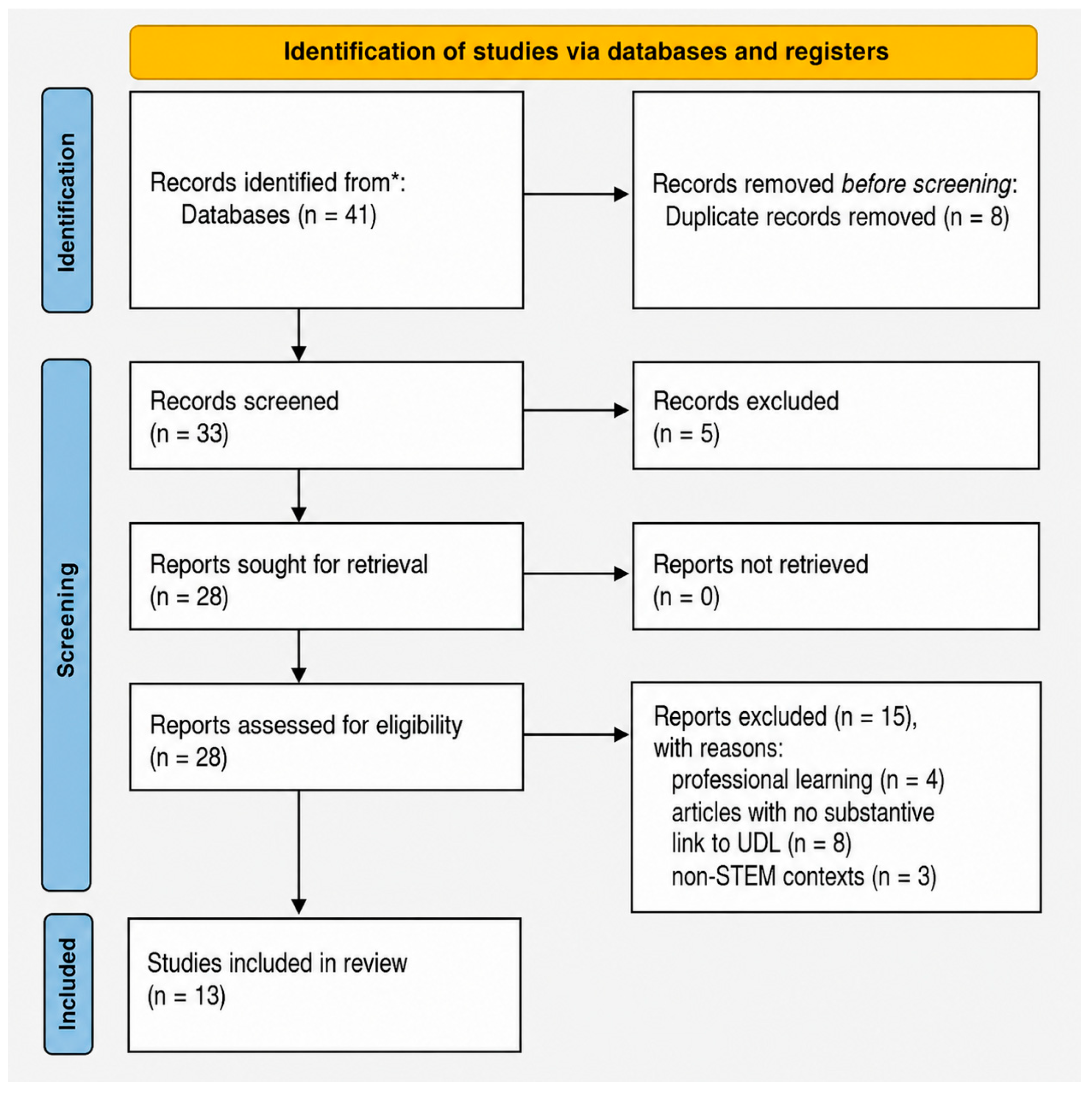
The database search identified 41 records. After removing duplicate records (n = 8), 33 records were screened at the title and abstract level. Of these, 5 records were excluded as clearly outside the scope of the review. The full texts of 28 reports were then assessed for eligibility. Fifteen reports were excluded for predefined reasons: professional learning without connection to formal STEM education (n = 4), no substantive link to UDL (n = 8), and non-STEM contexts (n = 3). Finally, 13 studies were included in the final synthesis.
The relatively small number of included studies reflects the focused eligibility criteria of the review. Studies were retained only when they explicitly referred to UDL, were situated in a STEM education context, and provided empirical evidence or conceptual guidance relevant to inclusive STEM learning environments. Therefore, the final corpus should be interpreted as a focused evidence base on explicit UDL applications in STEM rather than as an exhaustive review of all accessibility, inclusion, or educational technology studies in STEM. This interpretation is also consistent with previous focused reviews of UDL in STEM, which have similarly reported a limited number of eligible studies after applying strict inclusion criteria.
Following this process, 13 studies were retained for the final synthesis: 11 empirical studies and 2 theoretical/conceptual papers. Two reviewers independently carried out the screening and selection procedure, and disagreements were resolved through consensus. The study selection process is presented in the PRISMA 2020 flow diagram (Figure 1). The review protocol was not prospectively registered, and no protocol was published.
Figure 1.
PRISMA 2020 flow diagram summarizing the identification, screening, eligibility assessment, and inclusion of studies. Note: The asterisk indicates records identified through database searching.
3. Results
The three fundamental principles of UDL-multiple means of representation, multiple means of action/expression, and multiple means of engagement-are directly aligned with the needs and challenges of STEM education. The results are organized according to the thematic framework described in Section 2, which groups the included studies by their main reported contribution to inclusive STEM education. In the following section, we present the empirical evidence and theoretical contributions of the 13 included studies while maintaining a distinction between these two forms of contribution. Empirical studies were synthesized in relation to reported outcomes, whereas theoretical/conceptual papers were used only to contextualize instructional and design-oriented implications and were not treated as evidence of intervention effectiveness. We first summarize their main features and outcomes in Table 1 and then discuss their findings in thematic subsections.
Table 1.
Summary of included studies, reported outcomes, Mixed Methods Appraisal Tool (MMAT) criteria met, and main methodological limitations.
The supportive MMAT-based appraisal indicates that the empirical evidence should be interpreted cautiously. Controlled, quasi-experimental, and larger mixed-methods studies provided comparatively stronger evidence for learning-related outcomes, whereas perception-based surveys and case studies were treated as exploratory evidence regarding access, engagement, participation, and learner experience. Accordingly, the synthesis does not treat all empirical studies as equally strong evidence of effectiveness; instead, findings are interpreted in relation to study design, sample size, outcome type, and methodological limitations. No empirical study was interpreted as providing definitive evidence of effectiveness; rather, the strength of each finding was considered in relation to the methodological design and the limitations identified through the MMAT-based appraisal.
To improve readability and clarify the logic of the synthesis, Table 2 summarizes how the three UDL principles relate to common barriers in STEM learning, inclusive practices identified in the reviewed studies, and the main reported outcomes.
Table 2.
Conceptual synthesis linking Universal Design for Learning (UDL) principles with Science, Technology, Engineering, and Mathematics (STEM) learning barriers, inclusive practices, and reported outcomes across the included studies.
3.1. Improvement of Learning Performance
The study of Yavuzarslan and Arslan (2020) [33] investigated the impact of UDL-based instruction on students’ academic performance and attitudes towards mathematics. Conducted with 33 fourth-grade students, divided into an experimental and a control group, the intervention lasted 18 weeks. A mixed-methods approach was adopted: quantitatively, a non-equivalent group design with pre- and post-tests was applied, while qualitatively, a focus group interview was conducted with the experimental group. Instruction for the experimental group was adapted according to the three UDL principles, while the control group followed the standard curriculum. Results from achievement tests and an attitude scale towards mathematics showed that the experimental group performed significantly better in terms of learning outcomes. Although attitudinal differences were not statistically significant, qualitative findings revealed improvements in attention, motivation, knowledge retention, peer collaboration, active participation, and self-regulation.
Similarly, King-Sears and Johnson (2020) [35] examined UDL-based teaching in high school chemistry, focusing on molecular conversion calculations with students with and without learning disabilities. Their research comprised two sub-studies: one in co-taught classes divided into intervention (UDL) and control groups, and one with students with learning disabilities in special education settings. Instructional materials for the intervention group included multimedia resources, differentiated worksheets (Mole Student Workbook), and the IDEAS self-regulation strategy (Identify, Draw, Enter, Answer, Solve), supplemented with diagrammatic guides and scaffolded videos. Data collection tools included a mole conversion test (pre- and post-) and a social validity questionnaire. Results demonstrated that students in the intervention group significantly outperformed their peers in mole conversions. Students with learning disabilities also improved substantially, though they required more time to complete tasks. Social validity findings indicated that UDL-based tools (IDEAS strategy, scaffolded videos, diagrammatic organizers) supported comprehension and memory of procedural steps.
In elementary science, Rappolt-Schlichtmann et al. (2013) [34] investigated the effectiveness of a web-based UDL Science Notebook (UDSN) compared to traditional notebooks. This tool integrated accessibility features such as text-to-speech, multimedia glossaries, translation, and multiple options for expression (typing, drawing, recording). It also provided pedagogical scaffolds like instructional videos, feedback tools, and teacher monitoring. A total of 621 fourth-grade students and 22 teachers participated, covering a unit on magnetism and electricity. Quantitative measures included content knowledge tests, reading and writing proficiency indices, and motivation scales; qualitative data were collected through teacher interviews and student focus groups. Results showed that students using the UDSN outperformed peers in science content knowledge regardless of initial literacy or motivation levels. Qualitative findings highlighted that students found the tool more engaging, fun, and autonomy-enhancing, while teachers emphasized improved access to authentic student thinking, especially among low-achieving or learning-disabled students.
These outcomes illustrate how UDL principles can inform inclusive instructional design decisions, such as multimodal presentation, scaffolded learning activities, and flexible ways for students to demonstrate understanding. Taken together, these studies suggest that UDL is especially important in STEM when learning depends on complex concepts, symbolic representations, and procedural reasoning. The key message is that UDL does not simply make instruction more accessible; it can also help students demonstrate STEM understanding by reducing barriers that are unrelated to the target concept.
3.2. Inclusive Benefits for Diverse Learners
In this section, “diverse learners” refers to the broader student population, including students with and without identified learning disabilities, who may benefit from flexible access, varied modes of participation, and multiple ways of engaging with STEM content.
Regarding engagement and participation, Marino et al. (2014) [36] investigated the implementation of UDL in secondary science through digital games and alternative texts. Their sample comprised 341 students, including 57 with learning disabilities. Both traditional and UDL-enhanced units were taught. Results showed that UDL-aligned instruction significantly increased student interest, participation, and collaboration, though standardized test scores did not show statistically significant differences. Students reported that games and simplified texts made complex concepts more understandable and attractive, sustaining higher levels of engagement and focus. These gains can be interpreted through a socio-emotional lens: flexible participation routes can strengthen belonging and reduce anxiety, which is known to undermine participation in STEM settings. In this way, UDL features function as “social accessibility” mechanisms that normalize variability and promote inclusive interaction [44].
Regarding perceived accessibility and technology-supported participation, Shin et al. (2021) [37] studied the perceptions of 330 South Korean high school students regarding the application of UDL-based practices in mathematics classes with technological support. Questionnaires measured access to multiple means of representation, action/expression, and engagement, as well as frequency of digital tool use (computers, interactive boards, tablets, e-books). Students expressed positive attitudes toward UDL practices, particularly appreciating the variety of formats for accessing and expressing knowledge. Although technology use was largely teacher-centered, students reported increased accessibility and participation. These findings indicate that UDL benefits all learners, regardless of achievement level, by fostering inclusive and motivating learning environments.
From a design perspective, these findings stress the value of learning environments that provide multiple representations, flexible participation routes, and supports for diverse learners. The main message from these studies is that UDL should not be viewed only as a compensatory approach for students with disabilities. Instead, flexible access, varied participation routes, and multimodal supports can improve engagement and perceived accessibility for a wider range of learners.
3.3. Development of Skills and Specific Learning Outcomes
Thoma et al. (2023) [38] presented the outcomes of the eTwinning Great eXplorers project, involving 76 s-grade students in Greece and Belgium and four teachers. Activities combined plugged (Lego WeDo, robotics, Web 2.0 tools) and unplugged (coding games, arts) approaches, guided by UDL and connectivism principles. Findings showed that students developed collaboration, self-regulation, creative problem-solving, computational and mathematical thinking, as well as linguistic and intercultural competencies. Assessment rubrics for self- and peer-evaluation supported reflection and the transfer of learning to real-life contexts (e.g., nutrition, sustainability, democratic processes). From an affective perspective, self-regulation supports not only strategy execution but also emotion regulation during demanding STEM tasks (e.g., managing frustration and anxiety). UDL scaffolds that externalize steps, provide feedback, and allow paced practice can increase perceived control, thereby reducing negative achievement emotions and supporting sustained engagement [45].
Stylianidou et al. (2020) [21] implemented an intervention in Cypriot second-grade classrooms using augmented reality (AR) and alternate reality games (ARG), framed by UDL. In the first phase, students collaboratively solved puzzles through multimodal AR stimuli; in the second, they designed their own ARG scenarios using digital tools. Results showed clear learning benefits in language (reading comprehension, creative writing), mathematics (pattern recognition, operations, time concepts), and arts (imagination, expression, social issue integration). Students also enhanced collaboration, creativity, and self-regulation, supported by self- and peer-assessment processes.
Street et al. (2012) [39] examined the adaptation of the Peer-Led Team Learning (PLTL) model with Universal Design for Instruction (UDI) principles to support students with learning disabilities and attention-deficit/hyperactivity disorder (ADHD) in STEM. The modified model, called Mastery PLTL (MPLTL), was applied in general chemistry and calculus courses. Small groups of students were supported by trained peer mentors using step-by-step problem-solving templates (written and video). Results showed that MPLTL improved STEM persistence (71% vs. 61% continuation rates), enhanced study skills and self-regulation, and helped students develop metacognitive strategies such as self-talk to maintain focus.
The reported development of collaboration, self-regulation, and problem-solving points to the need for learning environments that integrate adaptive supports, multimodal resources, and opportunities for reflection. Across these studies, UDL appears to support not only content learning but also transferable STEM-related competencies, including collaboration, self-regulation, problem-solving, and computational thinking. This broadens the value of UDL from access to active participation and skill development.
3.4. Improvement of Teaching Practices
Moon et al. (2011) [40] evaluated the SciTrain U program, which trained STEM faculty at Georgia Tech and the University of Georgia in UDL principles. The program combined face-to-face workshops (focused on challenges in large lectures, labs, and online environments) with an online platform offering materials, disability guides, and inclusive pedagogy examples. Mixed-method evaluation (student completion rates, teaching observations, faculty diaries, surveys, focus groups) showed increased accessibility scores, higher student success rates (94% completion), and positive faculty perceptions. Teachers gradually adopted inclusive practices such as collaborative note-taking, group projects, digital forums, and multimodal materials.
Basham & Marino (2013) [42], in a conceptual article, argued that UDL should be used as a framework for redesigning STEM instruction. They emphasized anticipatory design for learner variability, the integration of multimodal and digital tools (simulations, educational games, e-books), and the cultivation of creativity, critical thinking, and collaboration. Although not empirical, their contribution provides guidelines for improving teaching practices in STEM through UDL.
These findings highlight how UDL can inform faculty-facing resources, accessibility guidelines, and design templates that help educators plan inclusive STEM instruction. Rather than implying specific software architecture requirements, this finding points to the importance of organized, accessible, and reusable supports for teaching practice.
These studies indicate that UDL also has implications for teaching practice. The main contribution is that UDL shifts inclusive education from individual accommodation toward proactive instructional planning, helping educators anticipate learner variability before difficulties emerge.
3.5. Enhancement of Learning Outcomes and Continuation of Studies
The Comprehensive Support for STEM Students with Learning Disabilities (CS3LD) model described by Kreider et al. (2018) [41] combined individual (group meetings, psychoeducation, reflective activities), interpersonal (mentorship from graduate students and faculty trained in LD and UDL), and institutional (council for LD-friendly culture and service coordination) interventions. Implemented with 52 undergraduate STEM students with LD over two years, results showed significant gains in self-efficacy (p = 0.001), university connectedness (p < 0.001), and professional development (p ≤ 0.002). Qualitative testimonies revealed that many students attributed their academic success and even graduation to participation in the program. Data confirmed higher persistence and adaptation in STEM studies, underlining the long-term benefits of UDL-aligned support.
Finally, Quirk & Rice (2025) [43] examined Universal Design in Astronomy, addressing educational and professional practices. They highlighted how accessibility should be embedded from the design stage rather than through ad hoc accommodations. Examples included data sonification and tactile models for visually impaired students, as well as hybrid participation in conferences and courses. The authors argued that such practices not only empower students with disabilities but also benefit wider groups facing systemic disadvantages, thus supporting equity and persistence in STEM pathways.
At the level of long-term participation, longitudinal outcomes such as persistence and professional participation suggest that inclusive design should support self-efficacy, belonging, and sustained access to STEM pathways.
The key implication is that UDL-informed support may contribute to longer-term participation in STEM by strengthening self-efficacy, belonging, and persistence. This is particularly important for learners who face structural, cognitive, emotional, or accessibility-related barriers in STEM pathways.
Across the thematic categories, several cross-cutting patterns emerged. First, UDL-informed STEM practices were most consistently associated with improved access, engagement, and participation, while evidence for standardized achievement gains was more mixed. Second, interventions in primary and secondary education tended to emphasize multimodal representation, scaffolding, and engagement, whereas higher education studies more often focused on persistence, self-efficacy, and institutional support. Third, technology-supported interventions appeared most useful when they were combined with pedagogical scaffolding and teacher guidance rather than used as stand-alone tools. These patterns suggest that the value of UDL in STEM depends on the alignment between learner needs, instructional design, context, and implementation quality.
4. Discussion
The discussion follows the thematic structure described in the Section 2 and further interprets the main patterns identified across the included studies. Overall, the findings suggest promising but heterogeneous evidence that UDL-informed STEM practices may support student performance, engagement, self-regulation, and inclusive participation in some learning contexts [33,35]. However, these patterns should be interpreted cautiously because the evidence base includes quasi-experimental studies, mixed-methods studies, perception-based surveys, case studies, and conceptual papers. Across the empirical studies, the strongest recurring evidence concerns access, engagement, participation, and learner support, whereas evidence for standardized achievement gains is more mixed. From a design perspective, the findings suggest that technology-enhanced STEM environments may benefit from multimodal access, scaffolded participation, and opportunities for learner choice. These should be understood as design-oriented implications derived from the educational literature rather than as validated software engineering requirements [24,46].
The use of a variety of digital tools, including simulations, interactive science notebooks, and AR/VR environments, underlined the importance of flexibility, accessibility, and pedagogical integration. The reviewed studies suggest that such tools are most useful when they are aligned with instructional goals and accompanied by appropriate scaffolding [21,22]. Therefore, the technology-related implications of this review should be understood primarily as educational design considerations, rather than as evidence for specific software architectures or engineering models [23].
Evaluation methods used in the reviewed studies typically relied on pre- and post-tests, interviews, perception measures, and social validity indicators [34,36]. These methods provide evidence about educational outcomes and user experiences, but they do not directly validate software engineering processes [46]. For this reason, future work on technology-enhanced UDL environments should combine educational evaluation with usability and accessibility testing involving diverse learners [18].
Longitudinal interventions highlighted the potential contribution of UDL-informed support to persistence, self-efficacy, and professional identity in STEM learning [39,41]. These findings suggest that inclusive STEM environments should be evaluated not only through short-term achievement measures but also through longer-term indicators such as belonging, self-regulation, continuation in STEM, and learner confidence [17,19].
Usability also emerged as a relevant consideration in technology-enhanced STEM learning environments. Students valued autonomy and increased engagement, while teachers highlighted the value of digital tools for making student thinking more visible [37,40]. These findings suggest that UDL-informed technologies should be designed with attention to clarity, cognitive load, accessible feedback, and ease of use. However, the reviewed studies do not provide direct evidence for specific interface designs, dashboard architectures, or software development processes. Therefore, usability-related points are interpreted here as educational design considerations that require further empirical testing in future technology-focused research [23].
Moreover, the alignment between UDL and social–emotional learning (SEL) frameworks further strengthens the case for integrating emotional and social supports into STEM education. SEL competencies such as self-regulation, collaboration, and responsible decision-making are strongly associated with academic success and long-term persistence in STEM pathways [47]. UDL’s emphasis on autonomy, scaffolding, and flexible expression provides a natural structure for embedding SEL principles into instructional and technological design. In digital STEM environments, this may include tools for reflection, goal-setting, peer feedback, and collaborative problem-solving. Embedding SEL-aligned features into UDL-based systems ensures that learners receive holistic support that addresses cognitive, emotional, and social needs simultaneously [48].
The synthesis suggests several practical implications for inclusive STEM practice. First, abstract STEM concepts should be presented through multiple representations, including verbal explanations, visual models, worked examples, and hands-on activities. Second, complex procedural tasks should be supported through step-by-step scaffolds, checklists, templates, or guided problem-solving strategies. Third, students should be offered flexible ways to demonstrate understanding, such as written solutions, oral explanations, models, drawings, collaborative products, or digital artifacts. Fourth, teachers should intentionally build collaborative structures that support peer interaction and belonging. Finally, UDL-informed STEM environments should address emotional barriers by reducing unnecessary uncertainty, supporting self-regulation, and providing feedback that encourages persistence rather than only performance.
The findings also suggest future-oriented considerations for artificial intelligence (AI)-, augmented reality (AR)-, and virtual reality (VR)-supported STEM learning environments. These considerations should not be interpreted as direct empirical conclusions about AI-, AR-, or VR-based systems, because only a limited number of included studies directly examined such technologies. Rather, UDL principles may provide a useful design lens for future work in these areas. In AR- and VR-supported settings, future research could examine how multimodal representations, safe exploration, and alternative interaction pathways support diverse learners. In AI-supported systems, future work could investigate how adaptive feedback, personalized scaffolding, and learner choice can be implemented transparently and accessibly. Such systems should avoid assuming a single “ideal” learner profile and should remain optional, explainable, and responsive to learner variability, while also supporting emotional safety, collaboration, and accessibility.
Overall, the discussion indicates that UDL functions primarily as a pedagogical and instructional design framework for inclusive STEM education. The reviewed studies do not directly validate software engineering processes or architectures; rather, they suggest design implications for technology-enhanced STEM environments. These implications include multimodal access, scaffolded participation, flexible expression, learner choice, and attention to emotional and social participation. Therefore, software- and technology-related points in this review should be understood as design-oriented implications derived from educational evidence, not as empirically validated software engineering requirements [42,43].
These findings should be interpreted with caution. The included studies differ substantially in design, sample size, educational level, STEM domain, intervention type, and outcome measures. Some studies relied on quasi-experimental or mixed-methods designs, whereas others reported perceptions, case-based findings, or conceptual contributions. Therefore, the present synthesis does not support claims about the superiority of one intervention or approach over another. Instead, it identifies recurring patterns and design implications across a heterogeneous body of evidence. UDL should therefore not be interpreted as a stand-alone guarantee of effectiveness. Its value depends on implementation quality, teacher preparation, alignment with disciplinary goals, and the extent to which supports are meaningfully integrated into instruction. Mixed findings, perception-based outcomes, and small-sample studies indicate that further empirical work is needed to determine when, how, and for whom UDL-informed STEM practices are most effective. In addition, because the search strategy used the umbrella term STEM, relevant studies in individual STEM disciplines that did not use the term STEM in searchable fields may have been missed. The restriction to peer-reviewed English-language journal articles may also have introduced publication and language bias and excluded relevant conference papers, dissertations, grey literature, or non-English studies.
The findings of this review are consistent with other systematic inquiries into inclusive STEM practices. For example, the STREAMING approach emphasizes comprehensive inclusion strategies in STEM [49], while studies on humanoid robots in classroom settings demonstrate measurable learning gains [50]. Similarly, targeted interventions in populations with special educational needs, such as Down syndrome [51] or ADHD [52], reinforce that adaptive and accessible tools benefit both typical and neurodiverse learners.
5. Conclusions
In this focused systematic narrative synthesis, we reviewed evidence on the application of UDL in STEM education. The included empirical studies suggest promising trends, particularly in relation to access, engagement, self-regulation, collaboration, persistence, and inclusive participation. However, because the evidence base is small, heterogeneous, and methodologically varied, these findings should be interpreted as indicative patterns rather than as robust evidence of effectiveness.
The core finding of the review is that UDL is most useful when it is implemented as a proactive instructional design framework rather than as a set of isolated accommodations. Across the included studies, the most consistent implications concern multimodal representation, structured scaffolding, flexible expression, peer collaboration, and attention to emotional and social participation.
These findings also indicate that inclusive STEM practice requires both cognitive and socio-emotional support. UDL-aligned environments may reduce barriers related to abstract concepts, procedural demands, anxiety, limited participation routes, and a weak sense of belonging. For this reason, the practical value of UDL lies in helping educators and designers anticipate learner variability before difficulties emerge.
Future research should examine how UDL principles can be implemented more systematically in artificial intelligence (AI)-, augmented reality (AR)-, and virtual reality (VR)-supported STEM environments. Such work should move beyond simply adding technology to instruction and should evaluate whether emerging tools genuinely reduce barriers, support diverse learners, and promote equitable participation in STEM. Future studies should also use stronger empirical designs, clearer outcome measures, and transparent reporting of implementation conditions in order to determine when, how, and for whom UDL-informed STEM practices are most effective.
Author Contributions
Conceptualization, C.K., C.S., C.P. and A.D.; methodology, C.K., C.S., C.P. and A.D.; validation, C.K., C.S., C.P. and A.D.; formal analysis, C.K., C.S., C.P. and A.D.; investigation, C.K., C.S., C.P. and A.D.; resources, C.K., C.S., C.P. and A.D.; data curation, C.K. and C.P.; writing—original draft preparation, C.K., C.S., C.P. and A.D.; writing—review and editing, C.K., C.S., C.P. and A.D.; visualization, C.K.; supervision, C.S. and A.D.; project administration, C.K. and A.D. All authors have read and agreed to the published version of the manuscript.
Funding
This research received no external funding.
Informed Consent Statement
Not applicable.
Data Availability Statement
No new data were created or analyzed in this study. Data sharing is not applicable to this article.
Conflicts of Interest
The authors declare no conflicts of interest.
References
- Rusconi, L.; Squillaci, M. Effects of a Universal Design for Learning (UDL) Training Course on the Development Teachers’ Competences: A Systematic Review. Educ. Sci. 2023, 13, 466. [Google Scholar] [CrossRef] [Scilit]
- Boothe, K.A.; Lohmann, M.J.; Donnell, K.A.; Hall, D.D. Applying the Principles of Universal Design for Learning (UDL) in the College Classroom. J. Spec. Educ. Apprenticesh. 2018, 7, n3. [Google Scholar] [CrossRef] [Scilit]
- Rose, D. Universal Design for Learning. J. Spec. Educ. Technol. 2001, 16, 64–67. [Google Scholar] [CrossRef] [Scilit]
- Rose, D.H.; Meyer, A. Teaching Every Student in the Digital Age: Universal Design for Learning; Association for Supervision and Curriculum Development: Alexandria, VA, USA, 2002; ISBN 0-87120-599-8. [Google Scholar]
- Orndorf, H.C.; Waterman, M.; Lange, D.; Kavin, D.; Johnston, S.C.; Jenkins, K.P. Opening the Pathway: An Example of Universal Design for Learning as a Guide to Inclusive Teaching Practices. CBE—Life Sci. Educ. 2022, 21, ar28. [Google Scholar] [CrossRef] [Scilit] [PubMed]
- Rao, K.; Meo, G. Using Universal Design for Learning to Design Standards-Based Lessons. Sage Open 2016, 6, 2158244016680688. [Google Scholar] [CrossRef] [Scilit]
- Tarconish, E.; Scott, S.; Banerjee, M.; Lombardi, A. Universal Design for Instruction & Learning in Higher Education: Where Have We Been and Where Are We Headed? J. Postsecond. Educ. Disabil. 2023, 36, 207–223. [Google Scholar]
- Fornauf, B.S.; Erickson, J.D. Toward an Inclusive Pedagogy through Universal Design for Learning in Higher Education: A Review of the Literature. J. Postsecond. Educ. Disabil. 2020, 33, 183–199. [Google Scholar]
- Leinenbach, M.T.; Corey, M.L. Universal Design for Learning: Theory and Practice. In Proceedings of the Society for Information Technology & Teacher Education International Conference; Association for the Advancement of Computing in Education (AACE): Waynesville, NC, USA, 2004; pp. 4919–4926. [Google Scholar]
- Roski, M.; Walkowiak, M.; Nehring, A. Universal Design for Learning: The More, the Better? Educ. Sci. 2021, 11, 164. [Google Scholar] [CrossRef] [Scilit]
- Vasinda, S.; Pilgrim, J. Technology Supports in the UDL Framework: Removable Scaffolds or Permanent New Literacies? Read. Res. Q. 2023, 58, 44–58. [Google Scholar]
- Rose, D.H.; Harbour, W.S.; Johnston, C.S.; Daley, S.G.; Abarbanell, L. Universal Design for Learning in Postsecondary Education: Reflections on Principles and Their Application. J. Postsecond. Educ. Disabil. 2006, 19, 135–151. [Google Scholar] [CrossRef] [Scilit]
- Rose, D.H.; Strangman, N. Universal Design for Learning: Meeting the Challenge of Individual Learning Differences through a Neurocognitive Perspective. Univers. Access Inf. Soc. 2007, 5, 381–391. [Google Scholar] [CrossRef] [Scilit]
- Capilla, A.; Belin, P.; Gross, J. The Early Spatio-Temporal Correlates and Task Independence of Cerebral Voice Processing Studied with MEG. Cereb. Cortex 2013, 23, 1388–1395. [Google Scholar] [CrossRef] [Scilit] [PubMed]
- Horowitz-Kraus, T.; Hutton, J.S. Brain Connectivity in Children Is Increased by the Time They Spend Reading Books and Decreased by the Length of Exposure to Screen-Based Media. Acta Paediatr. 2018, 107, 685–693. [Google Scholar] [CrossRef] [Scilit] [PubMed]
- Nguyen, M.; Chang, A.; Micciche, E.; Meshulam, M.; Nastase, S.A.; Hasson, U. Teacher–Student Neural Coupling during Teaching and Learning. Soc. Cogn. Affect. Neurosci. 2021, 17, 367–376. [Google Scholar] [CrossRef] [Scilit] [PubMed]
- Al-Azawei, A.; Serenelli, F.; Lundqvist, K. Universal Design for Learning (UDL): A Content Analysis of Peer Reviewed Journals from 2012 to 2015. J. Scholarsh. Teach. Learn. 2016, 16, 39–56. [Google Scholar] [CrossRef] [Scilit]
- Burgstahler, S.E. (Ed.) Universal Design in Higher Education: From Principles to Practice, 2nd ed.; Harvard Education Press: Cambridge, MA, USA, 2015; ISBN 978-1-61250-816-0. [Google Scholar]
- Basham, J.D.; Smith, S.J.; Satter, A.L. Universal Design for Learning: Scanning for Alignment in K–12 Blended and Fully Online Learning Materials. J. Spec. Educ. Technol. 2016, 31, 147–155. [Google Scholar] [CrossRef] [Scilit]
- Rappolt-Schlichtmann, G. (Ed.) A Research Reader in Universal Design for Learning; Harvard Education: Cambridge, MA, USA, 2012; ISBN 978-1-61250-501-5. [Google Scholar]
- Stylianidou, N.; Sofianidis, A.; Manoli, E.; Meletiou-Mavrotheris, M. “Helping Nemo!”—Using Augmented Reality and Alternate Reality Games in the Context of Universal Design for Learning. Educ. Sci. 2020, 10, 95. [Google Scholar] [CrossRef] [Scilit]
- Yu, J.; Wei, X.; Hall, T.E.; Oehlkers, A.; Ferguson, K.; Robinson, K.H.; Blackorby, J. Findings from a Two-Year Effectiveness Trial of the Science Notebook in a Universal Design for Learning Environment. In Frontiers in Education; Frontiers Media SA: Lausanne, Switzerland, 2021; Volume 6, p. 719672. [Google Scholar]
- Cooper, M.; Sloan, D.; Kelly, B.; Lewthwaite, S. A Challenge to Web Accessibility Metrics and Guidelines: Putting People and Processes First. In Proceedings of the International Cross-Disciplinary Conference on Web Accessibility, Lyon, France, 16–17 April 2012; ACM: Rockville, MD, USA, 2012; pp. 1–4. [Google Scholar]
- Seale, J.K. E-Learning and Disability in Higher Education: Accessibility Research and Practice, 2nd ed.; Routledge, Taylor & Francis Group: New York, NY, USA; London, UK, 2014; ISBN 978-0-415-62941-6. [Google Scholar]
- Kefalis, C.; Skordoulis, C.; Drigas, A. A Systematic Review of Mind Maps, STEM Education, Algorithmic and Procedural Learning. Computers 2025, 14, 204. [Google Scholar] [CrossRef] [Scilit]
- Kefalis, C.; Skordoulis, C.; Drigas, A. Digital Simulations in STEM Education: Insights from Recent Empirical Studies, a Systematic Review. Encyclopedia 2025, 5, 10. [Google Scholar] [CrossRef] [Scilit]
- Kefalis, C.; Skordoulis, C.; Drigas, A. The Role of 3D Printing in Science, Technology, Engineering, and Mathematics (S.T.E.M.) Education in General and Special Schools. Int. J. Online Biomed. Eng. 2024, 20, 4. [Google Scholar] [CrossRef] [Scilit]
- Schreffler, J.; Vasquez, E., III; Chini, J.; James, W. Universal Design for Learning in Postsecondary STEM Education for Students with Disabilities: A Systematic Literature Review. Int. J. STEM Educ. 2019, 6, 8. [Google Scholar] [CrossRef] [Scilit]
- Morton, B.; Pilgrim, J. Promoting Inclusive Education: Social and Emotional Learning through the Lens of Universal Design for Learning. Eest. Haridusteaduste Ajakiri. Est. J. Educ. 2023, 11, 28–47. [Google Scholar] [CrossRef] [Scilit]
- Rappolt-Schlichtmann, G.; Todd, K.; Daley, S. Universal Design for—Emotion in—Learning: A Practice for the Creation of Emotionally Accessible Digital Learning Experiences. In Inclusive Digital Interactives: Best Practices and Research Smithsonian Institution; Access Smithsonian: Washington, DC, USA; Institute for Human Centered Design: Boston, MA, USA; MuseWeb: Culver City, CA, USA, 2020; pp. 139–166. [Google Scholar]
- Page, M.J.; McKenzie, J.E.; Bossuyt, P.M.; Boutron, I.; Hoffmann, T.C.; Mulrow, C.D.; Shamseer, L.; Tetzlaff, J.M.; Akl, E.A.; Brennan, S.E. The PRISMA 2020 Statement: An Updated Guideline for Reporting Systematic Reviews. BMJ 2021, 372, n71. [Google Scholar] [CrossRef] [Scilit] [PubMed]
- Hong, Q.N.; Fàbregues, S.; Bartlett, G.; Boardman, F.; Cargo, M.; Dagenais, P.; Gagnon, M.-P.; Griffiths, F.; Nicolau, B.; O’Cathain, A.; et al. The Mixed Methods Appraisal Tool (MMAT) Version 2018 for Information Professionals and Researchers. Educ. Inf. 2018, 34, 285–291. [Google Scholar] [CrossRef] [Scilit]
- Yavuzarslan, H.; Arslan, A. Usage of Universal Design for Learning in Mathematic Course. Psycho-Educ. Res. Rev. 2020, 9, 26–39. [Google Scholar]
- Rappolt-Schlichtmann, G.; Daley, S.G.; Lim, S.; Lapinski, S.; Robinson, K.H.; Johnson, M. Universal Design for Learning and Elementary School Science: Exploring the Efficacy, Use, and Perceptions of a Web-Based Science Notebook. J. Educ. Psychol. 2013, 105, 1210–1225. [Google Scholar] [CrossRef] [Scilit]
- King-Sears, M.E.; Johnson, T.M. Universal Design for Learning Chemistry Instruction for Students with and without Learning Disabilities. Remedial Spec. Educ. 2020, 41, 207–218. [Google Scholar] [CrossRef] [Scilit]
- Marino, M.T.; Gotch, C.M.; Israel, M.; Vasquez, E.; Basham, J.D.; Becht, K. UDL in the Middle School Science Classroom: Can Video Games and Alternative Text Heighten Engagement and Learning for Students with Learning Disabilities? Learn. Disabil. Q. 2014, 37, 87–99. [Google Scholar] [CrossRef] [Scilit]
- Shin, M.; Kang, E.; Lee, O. High School Students’ Perceptions of Mathematics Teachers’ Implementation of UDL-Based Practices and Technology in Mathematics Classes. Int. J. Contents 2021, 17, 9–19. [Google Scholar] [CrossRef]
- Thoma, R.; Farassopoulos, N.; Lousta, C. Teaching STEAM through Universal Design for Learning in Early Years of Primary Education: Plugged-in and Unplugged Activities with Emphasis on Connectivism Learning Theory. Teach. Teach. Educ. 2023, 132, 104210. [Google Scholar] [CrossRef] [Scilit]
- Street, C.D.; Koff, R.; Fields, H.; Kuehne, L.; Handlin, L.; Getty, M.; Parker, D.R. Expanding Access to STEM for At-Risk Learners: A New Application of Universal Design for Instruction. J. Postsecond. Educ. Disabil. 2012, 25, 363–375. [Google Scholar]
- Moon, N.W.; Utschig, T.T.; Todd, R.L.; Bozzorg, A. Evaluation of Programmatic Interventions to Improve Postsecondary STEM Education for Students with Disabilities: Findings from SciTrain University. J. Postsecond. Educ. Disabil. 2011, 24, 331–349. [Google Scholar]
- Kreider, C.M.; Medina, S.; Lan, M.-F.; Wu, C.-Y.; Percival, S.S.; Byrd, C.E.; Delislie, A.; Schoenfelder, D.; Mann, W.C. Beyond Academics: A Model for Simultaneously Advancing Campus-Based Supports for Learning Disabilities, STEM Students’ Skills for Self-Regulation, and Mentors’ Knowledge for Co-Regulating and Guiding. Front. Psychol. 2018, 9, 1466. [Google Scholar] [CrossRef] [Scilit] [PubMed]
- Basham, J.D.; Marino, M.T. Understanding STEM Education and Supporting Students through Universal Design for Learning. Teach. Except. Child. 2013, 45, 8–15. [Google Scholar] [CrossRef] [Scilit]
- Quirk, A.; Rice, T. Applying the Principles of Universal Design to Make Astronomy More Accessible. arXiv 2025, arXiv:2505.23498. [Google Scholar]
- Katz, J.N. The Three Block Model of Universal Design for Learning (UDL): Engaging Students in Inclusive Education. Can. J. Educ./Rev. Can. L’éducation 2013, 36, 153–194. [Google Scholar] [CrossRef] [Scilit]
- Kapoor, B. The Influence of Universal Design for Learning on Primary School Students’ Social and Emotional Competence. In An International Approach to Developing Early Career Researchers; Routledge: London, UK, 2024; pp. 62–73. [Google Scholar]
- World Wide Web Consortium (W3C). Web Content Accessibility Guidelines (WCAG) 2.1; W3C: Wakefield, MA, USA, 2018. [Google Scholar]
- Garner, P.W.; Gabitova, N.; Gupta, A.; Wood, T. Innovations in Science Education: Infusing Social Emotional Principles into Early STEM Learning. Cult. Stud. Sci. Educ. 2018, 13, 889–903. [Google Scholar]
- Efastri, S.M.; Novembli, M.S.; Yonanda, D.A. The Effectiveness of Universal Design for Learning (UDL)-Based Counselling Guidance Programs on the Social-Emotional Readiness of Early Childhood Children to Elementary School Early Childhood Children for Elementary School. Prim. J. Pendidik. Guru Sekol. Dasar 2025, 14, 768–779. [Google Scholar] [CrossRef] [Scilit]
- Drigas, A.; Kefalis, C. STREAMING: A Comprehensive Approach to Inclusive STEM Education. Sci. Electron. Arch. 2024, 17, 1–7. [Google Scholar] [CrossRef] [Scilit]
- Mertzani, V.; Drigas, A. Exploring the Learning Gains of Implementing Teacher Humanoid Robots in STEM Education: A Systematic Review. Int. J. Online Biomed. Eng. 2023, 19, 18–30. [Google Scholar] [CrossRef] [Scilit]
- Karagianni, E.; Drigas, A. The STEM Education of Down Syndrome Children in Algorithmic and Computation Thinking for a Sustainable Life. Tech. Sustain. 2022, 2, 58–78. [Google Scholar] [CrossRef] [Scilit]
- Drakatos, N.; Drigas, A. The Impact of STEAM Education Using Robotics on the Executive Function of Typical and ADHD Students along with Developmental Exploration. Braz. J. Sci. 2023, 3, 113–122. [Google Scholar] [CrossRef] [Scilit]

Disclaimer/Publisher’s Note: The statements, opinions and data contained in all publications are solely those of the individual author(s) and contributor(s) and not of MDPI and/or the editor(s). MDPI and/or the editor(s) disclaim responsibility for any injury to people or property resulting from any ideas, methods, instructions or products referred to in the content. |
© 2026 by the authors. Licensee MDPI, Basel, Switzerland. This article is an open access article distributed under the terms and conditions of the Creative Commons Attribution (CC BY) license.