


Abstract
The increasing demand for intelligent transportation systems (ITS) and advanced driver assistance system (ADAS) significantly demands a real-time and robust perception to recognize road-side obstacles in varying different weather settings. This paper presents DriveEdgeAI, a lightweight YOLO11 based embedded deep learning framework for efficient road anomaly detection with the emphasis on potholes, speed bumps and relevant traffic sign detection. We have prepared a custom dataset consisting of 17,061 annotated images to train and test the model under different lighting conditions, weather conditions, and roads configurations. The proposed system also managed to demonstrate good convergence and generalization with a precision@50 of 95.8%, recall@50 of 89.7%, mAP@50 of 95.4%, surpassing previous YOLO versions. The stability and robustness of the model at different thresholds were also substantiated by Precision-Recall and F1-Confidence analyses. DriveEdgeAI was also deployed on a number of edge devices, such as Jetson Nano, Raspberry Pi 5, Intel Movidius VPU and Hailo-8L NPU respectively reaching 9.5 FPS/W and 28.5 FPS for the Raspberry Pi 5 + Hailo-8L version. From these results, one can conclude that DriveEdgeAI is an energy-efficient and scalable solution for real-world ADAS applications.
1. Introduction
The integration of Artificial Intelligence (AI) and embedded computing has significantly transformed Intelligent Transportation Systems (ITS), enabling vehicles to perceive, interpret, and respond to complex road environments in real time. Advanced Driver Assistance Systems (ADAS) now rely heavily on perception modules to enhance driving safety, comfort, and efficiency by supporting or automating critical vehicle decisions. Features such as lane keeping, collision avoidance, adaptive cruise control, and road-surface awareness are becoming standard components of modern vehicles [1]. Among these functionalities, detecting road anomalies including potholes, speed bumps, and regulatory signs is crucial. Accurate identification of such irregularities reduces vehicle damage, improves suspension lifespan, and enhances driver safety by enabling timely speed adjustments, warnings, and predictive maintenance planning [2,3].
Despite notable progress, achieving high-accuracy detection with low latency on embedded platforms remains a major challenge. State-of-the-art deep learning models often require substantial computational and memory resources, making them difficult to deploy on low-power automotive hardware. This limitation highlights the importance of lightweight architectures, hardware-aware optimization, and efficient inference pipelines capable of balancing speed and accuracy under real-world constraints. Recent YOLO versions (v8–v12) include pruning, quantization, and redesigned feature extractors to improve speed and accuracy. However, they still show limitations on embedded devices, especially under challenging lighting, weather, and road-surface conditions. These unresolved challenges motivate the development of a specialized, embedded-oriented detection framework [3,4,5].
In parallel, the emergence of edge-AI hardware such as the NVIDIA Jetson Nano, Raspberry Pi 5, Intel Movidius Myriad X VPU, and Hailo-8L NPU has opened new opportunities for real-time onboard inference. These platforms offer a balance between processing power, energy efficiency, and compact design, enabling low-cost ADAS functionalities without dependence on cloud computing. Cloud-based inference introduces latency, bandwidth, and privacy concerns, whereas edge devices perform computation locally, ensuring reliable, fast, and secure responses. When coupled with optimized inference runtimes such as TensorRT, ONNX Runtime, OpenVINO, and HailoRT, these devices can execute complex neural networks efficiently under tight power budgets [6,7].
DriveEdgeAI emphasizes hardware scalability through a modular design that works efficiently across heterogeneous embedded processors. It integrates image acquisition, preprocessing, and real-time anomaly detection into a unified pipeline for dynamic driving environments. Furthermore, its outputs can interface with higher-level vehicle controllers such as adaptive speed regulation or intelligent suspension systems to enhance comfort, reduce mechanical stress, and support predictive maintenance strategies.
Overall, embedded ADAS and ITS technologies are rapidly advancing, and DriveEdgeAI contributes to this evolution by demonstrating that high-quality road perception can be achieved on low-power hardware using an optimized deep learning pipeline. By combining efficient edge processing with YOLO11’s detection capabilities, the framework offers a scalable, energy-efficient solution for future connected and autonomous vehicles. Its alignment with the broader vision of smart mobility highlights the importance of systems that integrate safety, efficiency, and adaptability.
To summarize, this work provides four principal contributions. First, we present DriveEdgeAI, a dedicated embedded perception framework centered on the YOLO11 detector, designed to achieve real-time road anomaly recognition under stringent resource constraints. Second, we construct a comprehensive and diverse dataset encompassing multiple lighting, weather, and road-surface conditions to enhance the robustness and generalization capability of the detection model. Third, the proposed framework is systematically optimized and deployed across several heterogeneous edge-AI platforms, demonstrating its portability and adaptability to different hardware architectures, with YOLO11 fully implemented and validated on embedded processors. Finally, through a comparative study of recent YOLO versions (YOLOv8–YOLO11), we empirically demonstrate the superior accuracy, stability, and energy efficiency of YOLO11, confirming its suitability for practical embedded ADAS applications.
2. Related Work
The development of Advanced Driver Assistance Systems (ADAS) in the context of Intelligent Transportation Systems (ITS) has been decisively influenced by improvements on embedded artificial intelligence (AI) and computer vision. These technologies had made it possible for a vehicle to perceive, understand and react to the complexities of other vehicles and road conditions in real time. One of the most important perception problems related to modern ADAS is road anomaly detection, where, respectively, the detection of anomalies such as potholes, speed bumps and warning signs on the road is performed for improving the driving safety, comfort, vehicle stability. More recently, with the generalization of deep learning approaches and hardware supporting embedded processing design, efficient real-time solutions can be designed under hard limitations on cost and energy consumption.
Early approaches relied mainly on handcrafted image-processing algorithms or sensor-based methods using accelerometers and gyroscopes to detect uneven road surfaces. Gupta et al. [8] surveyed hybrid models that fused camera data with inertial sensor measurements, demonstrating improved robustness in speed bump detection but also underscoring persistent challenges related to generalization and low-power performance. Hussein et al. [9] implemented a YOLO-based detection system using an Xbox Kinect camera deployed on a Jetson Nano, achieving an mAP of 81%. Although cost-effective and capable of real-time operation, their system’s reliability declined under variable lighting and surface conditions. Similarly, Aguilar-González et al. [10] proposed a CNN architecture for road event recognition using multiaxial vibration and acceleration signals, achieving 93.5% accuracy; however, reliance on inertial data limited the interpretability and adaptability of their solution compared to purely visual methods.
With the emergence of vision-based deep learning, researchers began shifting toward fully visual perception systems that could operate on compact embedded hardware. Dewangan and Sahu [11] presented a CNN-based prototype for speed bump detection on a Raspberry Pi, reporting 99.05% precision and 97.89% F1-score clear evidence that embedded deep learning could achieve real-time feasibility. Peralta-López et al. [12] designed a lightweight deep neural network consisting of seven convolutional layers to classify potholes and speed bumps from ZED stereo camera imagery, achieving 98.13% precision while maintaining minimal computational load. Harshalatha et al. [13] further advanced this direction by employing YOLOv8 for real-time detection of road humps and potholes, showcasing the benefits of single-stage object detectors for autonomous driving but also emphasizing the challenges of deploying parameter-heavy models on low-power embedded devices.
Building on these advances, recent studies have turned their attention toward lightweight YOLO variants and embedded inference optimization. Hosseinikhah et al. [14] connected CNN-based speed bump detection to energy-efficient driving and traffic optimization, highlighting its contribution to sustainability in transportation systems. Sarvajcz et al. [15] developed a low-cost embedded solution for simultaneous pedestrian and traffic sign detection using a Jetson Nano coupled with a MobileNet-SSD backbone, demonstrating real-time reliability with minimal latency. Asad et al. [16] conducted a comparative study across several YOLO versions (YOLOv1–YOLOv5) and SSD-MobileNetv2 architectures for pothole detection on Raspberry Pi and OAK-D platforms. Their experiments revealed that Tiny-YOLOv4 achieved the best trade-off between accuracy (90%) and inference speed (31.76 FPS), effectively balancing performance and efficiency. In a related effort, Cantero Burgos et al. [17] proposed an optimized SSD-MobileNetV1 model integrated into an embedded platform called iADASys for traffic light detection, underlining the importance of hardware–software co-design in next-generation ADAS systems.
Chaman et al. [18] introduced a YOLO11-based framework for real-time vehicle detection, successfully deployed on Jetson Nano and Raspberry Pi 5. The model achieved an impressive 98.1% mAP@50 and 98% precision, confirming that carefully optimized YOLO architectures can deliver both high accuracy and energy efficiency on edge platforms. Likewise, Azevedo and Santos [19] evaluated multiple YOLO-based detectors and trackers from YOLOv5 to YOLORon Jetson AGX Xavier devices, achieving up to 33.3 FPS using YOLOR-CSP combined with DeepSORT, proving the potential of real-time multi-object tracking on embedded hardware. More recently, Almasri et al. [20] assessed YOLOv8n, YOLO11n, and YOLOv12n for pothole detection in real-world conditions, obtaining an average precision and recall of 84%. Their findings demonstrate the growing reliability of compact YOLO architectures when integrated with ADAS cameras and GNSS modules. Similarly, Dhatrika et al. [21] achieved 91.9% mAP, 98.6% precision, and 96% recall in multi-entity road detection tasks, reaffirming the viability of deep learning frameworks on edge AI boards for real-time ADAS deployment.
Beyond automotive applications, YOLO architectures have also shown strong performance in defect detection problems involving low-contrast, noisy, and irregular surface textures conditions closely resembling potholes and degraded road surfaces. Mao et al. [22] proposed an automated inspection system for industrial electronic components using YOLOv3–YOLOv9 combined with ConSinGAN to address data scarcity. Their system reached 95.50% accuracy and significantly outperformed threshold-based approaches. This demonstrates that YOLO architectures are capable of handling fine-grained, texture-based defects similar to cracks, holes, and worn surfaces commonly found on roads. This evidence reinforces the suitability of YOLO-based models for robust road anomaly detection under diverse environmental conditions.
Recent advancements in the YOLO family have had substantial implications for embedded ADAS applications. YOLOv8 [23] introduced C2f modules, an anchor-free decoupled head, and improved training dynamics, resulting in faster convergence and stronger small-object detection. YOLOv9 [24] incorporated Programmable Gradient Information (PGI) and GELAN modules, providing more stable gradient flow and improved feature aggregation beneficial for detecting irregular road textures and small anomalies.
YOLOv10 [25] introduced end-to-end training without NMS, reducing latency and improving temporal consistency an important requirement for real-time embedded ADAS. Finally, YOLO11 [26] integrated C3k2 and C2PSA modules, enhancing spatial attention, feature refinement, and robustness under occlusion and poor illumination, while maintaining a lightweight profile suitable for edge deployment.
This evolution from YOLOv8 to YOLO11 shows a clear trend toward higher accuracy, better stability across domains, and improved compatibility with constrained hardware factors that support the selection of YOLO11 for the proposed DriveEdgeAI system.
Despite progress in embedded detection systems, significant challenges remain. Many deep models still require high computational resources; others address only single-task detection; and generalization across diverse conditions is still limited. Hybrid sensor–vision approaches improve robustness but lack semantic richness. Vision-only systems provide strong semantic understanding but require optimized architectures for embedded deployment.
To address these gaps, we present DriveEdgeAI, a YOLO11-based embedded detection framework that supports model compression, optimized inference, and quantized multi-hardware deployment (Jetson Nano, Raspberry Pi 5, Intel VPU, Hailo-8L). Unlike earlier systems, DriveEdgeAI demonstrates that real-time accuracy, robustness, and energy efficiency can be achieved simultaneously on low-power edge platforms, marking a significant step toward scalable next-generation ADAS.
3. Research Method
The proposed research methodology aims to establish an effective procedure to design, optimize and evaluate resource-aware embedded deep learning structures suitable for real-time road anomaly detection in constrained environments. DriveEdgeAI is an innovative perspective pipeline beyond the traditional one by incorporating efficient deep learning architectures, wide-ranging dataset preparation and multi-hardware optimization techniques that have shown to overcome the limitations of prior arts. The workflow adopts a thoughtful design procedure from full dataset acquisition and annotation to model-YOLO11 training optimization, and final embedded deployment with support on various hardware accelerators. Each stage is designed to be highly accurate, low latency and scalable across diverse platforms such as Jetson Nano, Raspberry Pi 5, Intel Movidius Myriad X VPU and Hailo-8L NPU. We kept consistent datasets, training settings and inference setups to be fair in performance comparison. The approach is designed to be modular, reusable and deployable cross-platform, supporting DriveEdgeAI as a scalable low-power consumption perception framework for today’s ADAS and ITS systems.
3.1. Proposed Embedded DriveEdgeAI-Based Approach
The continuous advancement of Artificial Intelligence (AI) and embedded computing has accelerated the development of Intelligent Transportation Systems (ITS) and Advanced Driver Assistance Systems (ADAS) capable of improving safety, comfort, and efficiency in modern vehicles. Real-time performance with low-risk platforms is still a major strict requirement though. Traditional object detection and road monitoring pipeline commonly suffers from high inference latency, compromised detection performance across different illumination and weather conditions, as well as lack of portability across heterogeneous hardware. These constraints may affect the robustness of ADAS functionalities like collision avoidance, lane keeping or adaptive cruise control when processed on resource-constraint embedded systems.
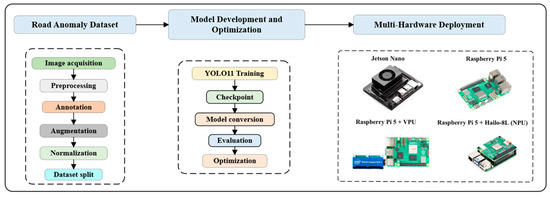
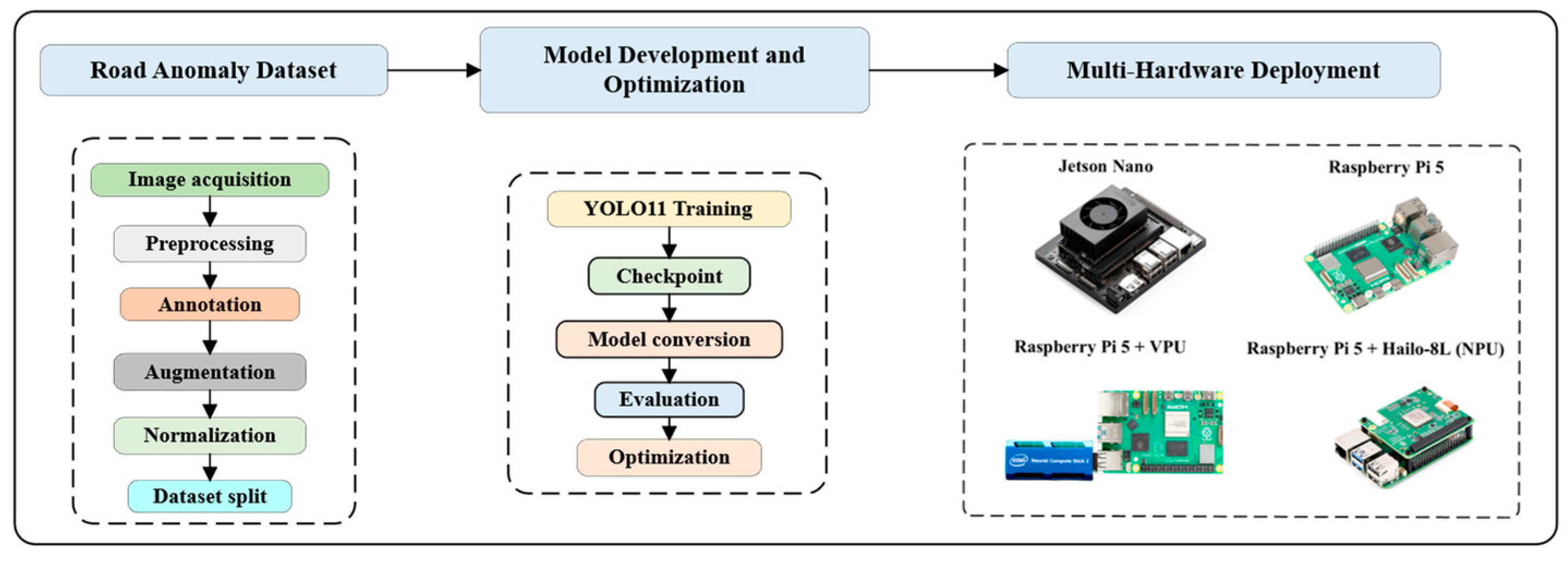
To tackle these problems, a new embedded deep learning framework called DriveEdgeAI is proposed in this work to accomplish real-time road anomaly detection for multiple inexpensive edge AI platforms. We’ve developed a model which is ready for you to use! The proposed model uses a YOLO11 based object detector specifically tuned to detect speed bumps, speed bump signs and potholes under various driving conditions! As shown in Figure 1, the three main stages of the methodology can be summarized as follows: (1) Road Anomaly Dataset Preparation, (2) Model Development and Optimization, (3) Multi-Hardware Deployment and. Every stage is carefully designed to guarantee strong detection performance in various embedded platforms.
Figure 1.
Workflow of the proposed DriveEdgeAI framework for embedded road anomaly detection on edge AI platforms.
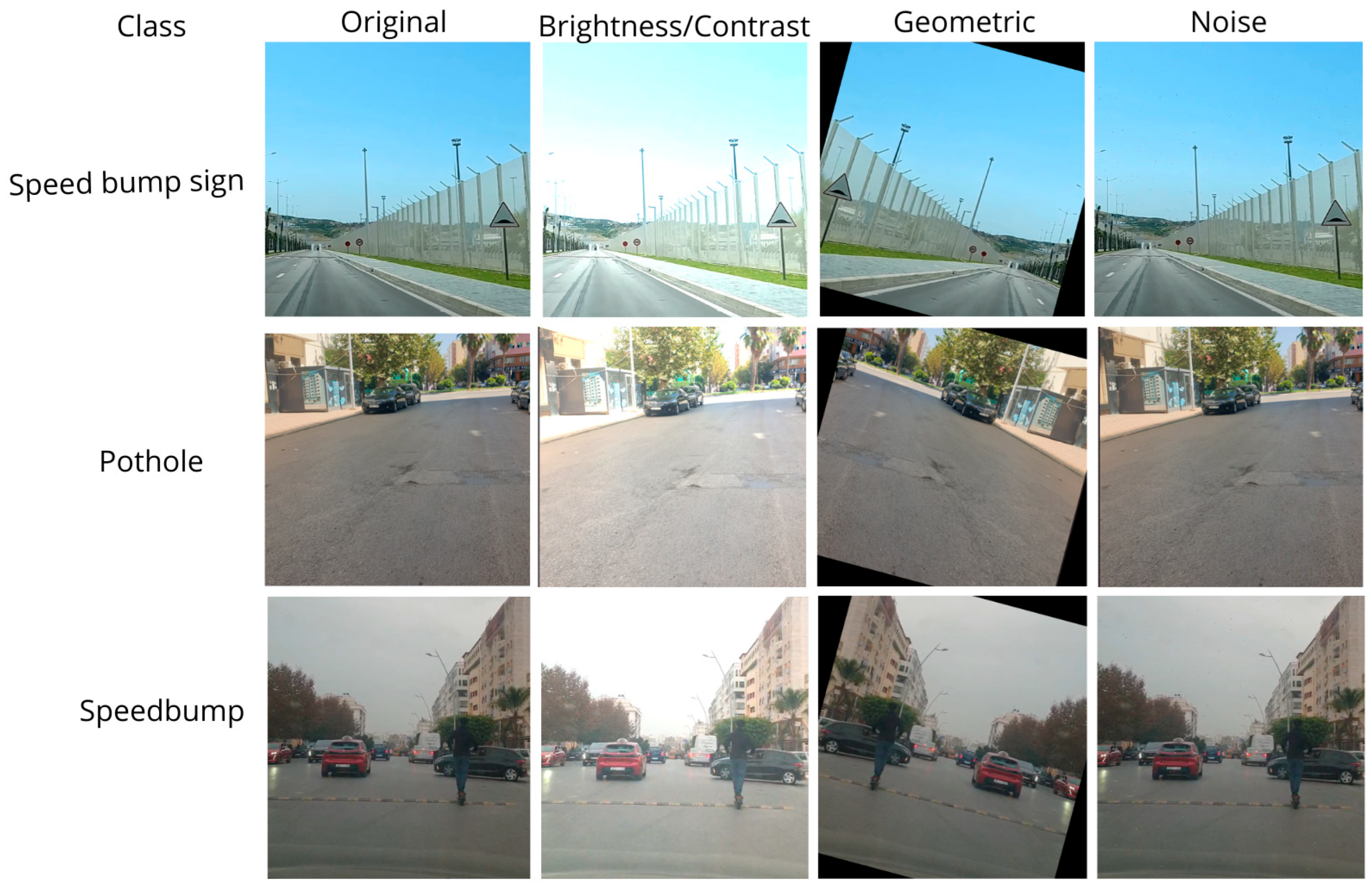
In the dataset preparation stage, high-resolution road images were captured from various urban and suburban environments using vehicle-mounted cameras. Each image was manually annotated in YOLO format, labeling the precise boundaries of speed bumps, bump signs, and potholes. To enhance the model’s robustness against illumination variance and surface texture differences, extensive data augmentation was applied, including geometric transformations, brightness and contrast adjustments, and random noise injection. The dataset was normalized to a resolution of 640 × 640 pixels and divided into training, validation, and testing subsets to ensure balanced model evaluation.
Model training and tuning While developing the model, we trained our YOLO11 using a stochastic gradient descent (SGD) optimizer with tuned hyperparameters to balance precision and recall. Finally, the trained model weights were exported in several deployment-friendly formats (ONNX, OpenVINO and HEF) across different hardware targets. Platform specific inference optimization was conducted utilizing TensorRT for the NVIDIA Jetson Nano, ONNX Runtime for the Raspberry Pi 5, OpenVINO Toolkit for the Intel Movidius Myriad X VPU and Hailo Dataflow Compiler for the Hailo-8L NPU. The optimized model implementation demonstrated low latency, high throughput and power efficient performance across all the evaluated platforms for real time inference.
The detected anomalies can be seamlessly integrated into various ADAS functionalities. Visual dashboard alerts, audible warnings, and adaptive cruise-control adjustments can be triggered to assist the driver in real time. In addition, V2V and V2X communication modules may be used to broadcast detected hazards to nearby vehicles or roadside units, supporting cooperative safety within ITS environments. These integration possibilities demonstrate that DriveEdgeAI can provide accurate perception, efficient processing, and real-time decision support across a wide range of embedded ADAS applications.
This unified framework shows that DriveEdgeAI successfully encapsulates deep learning accuracy, hardware efficiency and real-time performance into a scalable and energy-efficient perception model for future-edge embedded ADAS.
To ensure reproducibility and to provide a clear operational blueprint of the proposed embedded framework, Algorithm 1 formalizes the complete DriveEdgeAI pipeline, detailing every stage from dataset construction to real-time deployment on heterogeneous edge devices. While Figure 1 offers a high-level conceptual view, Algorithm 1 translates this workflow into a systematic sequence of actionable steps. The algorithm begins with the DatasetHandler stage, where raw road-scene images captured under diverse conditions are annotated in YOLO format and enriched through extensive augmentation geometric distortions, photometric adjustments, and noise perturbations to strengthen the model’s robustness to shadows, glare, nighttime illumination, and irregular road textures. Following augmentation, the images are normalized to 640 × 640 and partitioned into consistent training, validation, and testing sets.
The Trainer stage describes the full YOLO11 learning process: the initialization of official Ultralytics weights, hyperparameter configuration, forward propagation, computation of localization, classification, and distribution focal losses, and the saving of optimal checkpoint weights based on mAP@50–95 improvement. This structured cycle guarantees stable convergence and preserves fairness in cross-model comparison.
The Evaluator block defines the final assessment, generating PR curves, F1-Confidence curves, and all accuracy metrics required to validate generalization.
Finally, the Deployer stage includes exporting the trained model into ONNX, TensorRT, OpenVINO, and HEF formats, followed by device-specific inference loops where each platform performs on-board detection, NMS processing, FPS measurement, latency evaluation, and power-efficiency profiling. This detailed algorithmic representation ensures that DriveEdgeAI can be fully replicated, extended, and adapted for future embedded ADAS implementations.
| Algorithm 1: DriveEdgeAI—YOLO11 Training, Validation, and Deployment Pipeline |
| 1 As DatasetHandler 2 Load raw dataset D_raw from all driving sessions 3 Annotate each image in YOLO format (classes + bounding boxes) 4 Apply data augmentation: 5 – geometric transformations 6 – brightness/contrast adjustment 7 – random noise injection 8 Resize all images to 640 × 640 9 Split dataset into Train (70%), Validation (20%), Test (10%) 10 As Trainer 11 Initialize YOLO11 model M with official Ultralytics weights 12 Set hyperparameters (epochs = 100, lr = 0.01, momentum = 0.937, wd = 0.0005, batch = 16) 13 For each epoch e = 1 to 100 14 Run forward pass on training data 15 Compute losses: L = L_box + L_cls + L_DFL 16 Backpropagate and update model weights 17 Evaluate on validation set (Precision, Recall, F1-score, mAP@50, mAP@50–95) 18 If mAP@50–95 improves, save best model weights 19 End For 20 As Evaluator 21 Test best model on held-out Test set 22 Compute final metrics: Precision, Recall, F1-score, mAP@50, mAP@50–95 23 Generate PR curves and F1-Confidence curves 24 As Deployer 25 Export trained model to multiple formats: 26 – ONNX (Raspberry Pi 5) 27 – TensorRT FP16 engine (Jetson Nano) 28 – OpenVINO IR (Intel Movidius VPU) 29 – HEF file via Hailo Dataflow Compiler (Hailo-8L NPU) 30 For each embedded device p in {Jetson Nano, Pi 5, Intel VPU, Hailo-8L} 31 Initialize camera stream 32 Preprocess each frame (resize 640 × 640) 33 Run YOLO11 inference on device p 34 Apply NMS and display detections 35 Measure FPS, latency, and power consumption 36 End For |
3.2. YOLO11 Model Employed in DriveEdgeAI
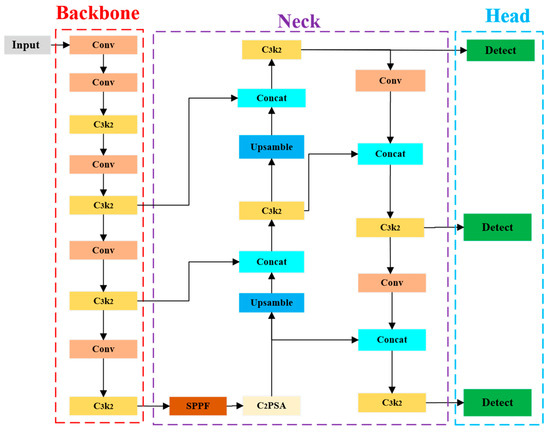
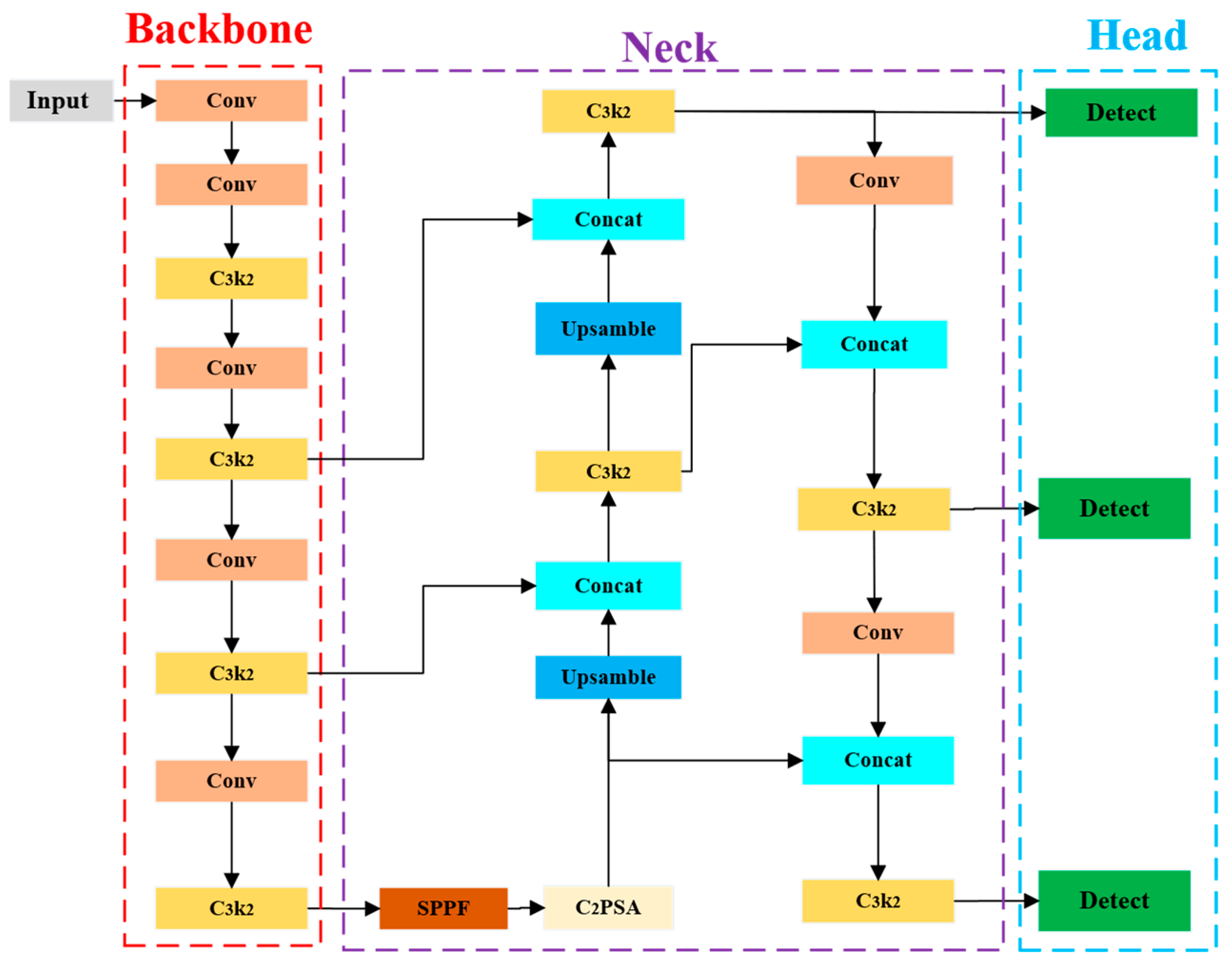
In this work, we adopt the official YOLO11 detection architecture as introduced by Ultralytics, without modifying its core structure. YOLO11 was selected because it offers an improved balance between accuracy, speed, and computational efficiency, making it well suited for embedded ADAS applications. As shown in Figure 2, the model follows the standard three-stage design: backbone, neck, and detection head, forming a lightweight and efficient detection pipeline appropriate for resource-limited platforms [27,28].
Figure 2.
Overview of the YOLO11 architecture adopted in the DriveEdgeAI framework.
The backbone integrates two key modules: C3k2 and C2PSA.
The C3k2 (Cross-Stage Partial with 2 × 2 kernels) structure enhances local feature extraction using smaller kernels, improving sensitivity to small road anomalies such as distant potholes and speed bump signs. The C2PSA (Cross-Stage Partial with Spatial Attention) module incorporates spatial attention to highlight salient regions of the feature maps, increasing robustness under complex visual conditions including shadows, partial occlusion, and illumination variability. Together, these components strengthen the representation ability of the backbone without increasing computational cost.
The neck utilizes a refined Feature Pyramid Network (FPN) coupled with a Path Aggregation Network (PAN) to merge multi-scale features. This improves the connection between shallow and deeper layers, allowing the detector to maintain stability and precision across objects of different sizes an important requirement for road anomaly detection.
The detection head applies additional C3k2 blocks for deeper feature refinement and uses Conv–BatchNorm–SiLU layers to ensure stable training. The final output layer predicts bounding boxes, objectness scores, and class probabilities, followed by Non-Maximum Suppression (NMS) to eliminate redundant detections [29].
By leveraging these architectural enhancements, the official YOLO11 model provides an effective trade-off between accuracy and inference speed, enabling real-time deployment across embedded platforms such as the NVIDIA Jetson Nano, Raspberry Pi 5, Intel Movidius Myriad X VPU, and Hailo-8L NPU. In the DriveEdgeAI framework, YOLO11 serves as the core detector due to its robustness, efficiency, and adaptability to edge-computing constraints in modern ADAS environments.
3.3. Embedded Deployment Platforms
The DriveEdgeAI system was deployed and evaluated across four heterogeneous embedded platforms to assess its real-time performance for road-anomaly detection in Advanced Driver Assistance Systems (ADAS) and Intelligent Transportation Systems (ITS). The selected hardware configurations Raspberry Pi 5, NVIDIA Jetson Nano, Raspberry Pi 5 with Intel Movidius Myriad X VPU, and Raspberry Pi 5 with Hailo-8L NPU represent distinct classes of edge-AI processors with different tradeoffs in compute capability, energy efficiency, and deployment cost. Evaluating YOLO11 across these platforms allows a comprehensive understanding of how the proposed framework behaves under realistic embedded constraints. All deployments used identical model weights, the same dataset, and the same camera setup to ensure consistency across experiments.
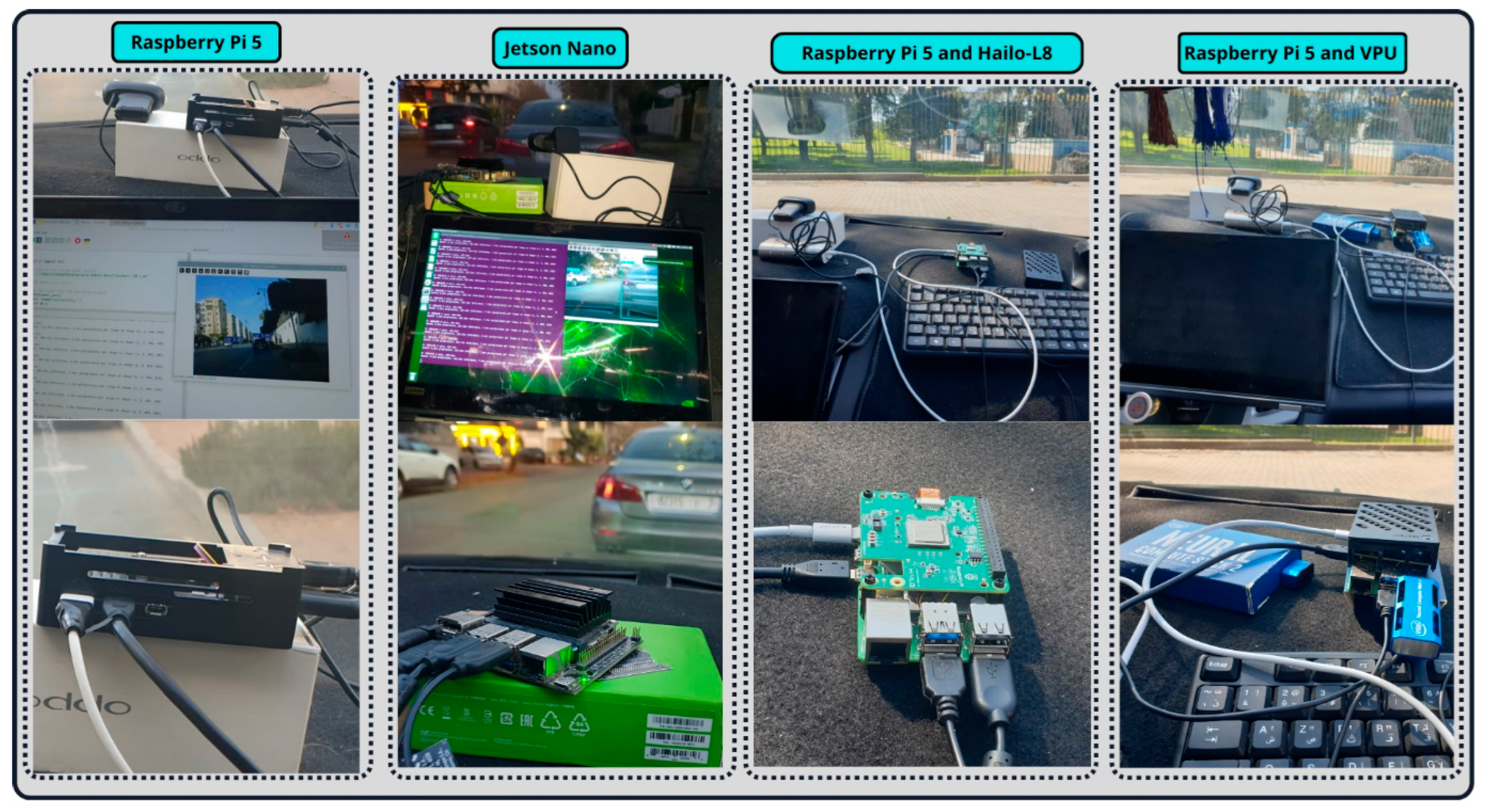
For in-vehicle evaluation, each embedded platform was mounted on the dashboard and connected to a forward-facing HD camera for real-time perception. Figure 3 illustrates the complete setup, showing the integration of cameras, displays, embedded boards, and power modules during on-road experiments.
Figure 3.
Experimental setup for multi-hardware deployment of the DriveEdgeAI system on Raspberry Pi 5, Jetson Nano, Raspberry Pi 5 + Hailo-8L, and Raspberry Pi 5 + Intel VPU platforms.
The NVIDIA Jetson Nano was selected for its GPU-accelerated design, enabling efficient deep learning inference at the edge. It features a quad-core ARM Cortex-A57 CPU @ 1.43 GHz, a 128-core Maxwell GPU @ 921 MHz, and 4 GB LPDDR4 RAM with 25.6 GB/s bandwidth sufficient for executing YOLO-based models. The deployment environment relied on Ubuntu 18.04/20.04 and JetPack SDK (CUDA 10.2, cuDNN 8, TensorRT 8, OpenCV 4.11 GPU build). The YOLO11 model was optimized to FP16 using TensorRT with kernel fusion and GPU-accelerated tensor operations, achieving 25–30 FPS within a 5–10 W envelope. This provided a strong balance between speed and energy usage for resource-limited ADAS systems [30,31].
The Raspberry Pi 5 served as a baseline low-cost option for CPU-based inference. Its quad-core ARM Cortex-A76 CPU @ 2.4 GHz and 8 GB LPDDR4X RAM offer substantial gains over earlier Raspberry Pi models. Despite lacking a GPU, the device efficiently executed YOLO11 using ONNX Runtime and OpenCV 4.11. In the full DriveEdgeAI pipeline, the Pi handled real-time video capture (Camera Module V3), preprocessing, inference, and visualization. Running Raspberry Pi OS (Bookworm) with Python 3.11.2, the system achieved near real-time performance at only 5–7 W, demonstrating suitability for ultra-low-power ADAS applications [32].
The Intel Myriad X VPU is a dedicated vision accelerator delivering up to 1 TOPS at under 2 W, making it highly appropriate for embedded perception. Connected to the Raspberry Pi 5 via USB 3.0, the inference pipeline was executed using OpenVINO Toolkit 2022.3 LTS. YOLO11 was exported to OpenVINO FP16 format and converted to IR files using the Model Optimizer. During operation, the Raspberry Pi performed image preprocessing and post-processing, while the VPU handled all inference stages. This configuration achieved stable low-latency performance at 4.5–5 W, confirming its effectiveness for compact and energy-sensitive ADAS modules [33,34].
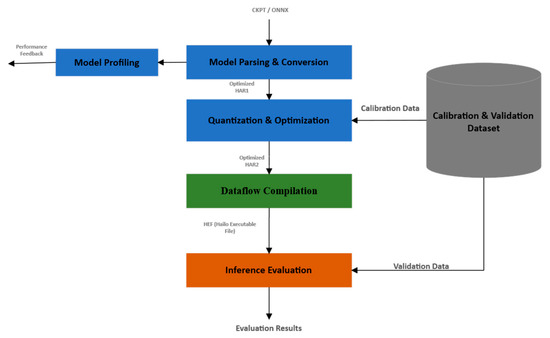
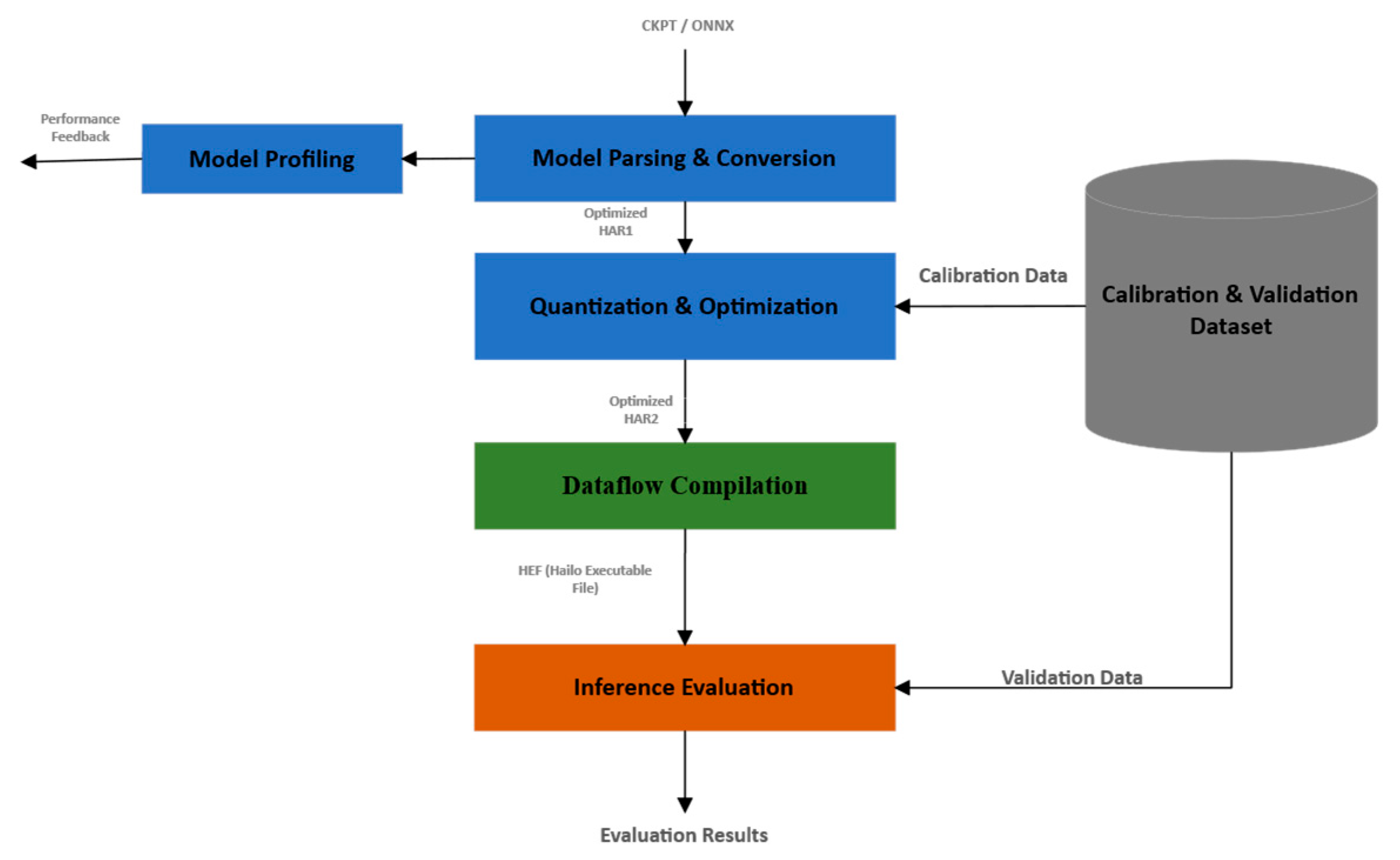
The Hailo-8L NPU represents next-generation embedded AI acceleration, delivering up to 26 TOPS within a 2.5–3 W envelope (over 8 TOPS/W). Combined with the Raspberry Pi 5 through the PCIe-based Hailo AI Hat, it achieved the highest performance-per-watt ratio among all evaluated platforms. The deployment environment consisted of Raspberry Pi OS (Bookworm), Python 3.11.2, HailoRT 4.21.0, OpenCV 4.11.0, and GStreamer 1.22.0 for real-time video synchronization. The YOLO11 model was exported to ONNX, quantized to INT8, and processed using the Hailo Dataflow Compiler, which applied graph slicing, kernel fusion, and memory-efficient scheduling before generating the Hailo Executable File (HEF). During inference, the NPU executed all compute-intensive operations while the Raspberry Pi CPU handled preprocessing and NMS. This complete optimization workflow is illustrated in Figure 4, which outlines the profiling, parsing, quantization, dataflow compilation, and evaluation stages required for efficient Hailo-8L deployment [35].
Figure 4.
Model optimization and evaluation workflow of Hailo-8L [36].
To enhance transparency regarding optimization, this revised version clarifies the model processing workflow across platforms. The training-to-deployment pipeline includes dataset ingestion, augmentation, YOLO11 training and validation, export to platform-specific formats (ONNX, FP16 IR, TensorRT engine, HEF), and execution using the appropriate hardware runtime. Each backend applied tailored optimizations TensorRT FP16 acceleration, ONNX Runtime operator fusion, OpenVINO FP16 pipelines, and Hailo INT8 quantization without modifying the YOLO11 architecture itself. Only training hyperparameters such as batch size and learning rate schedules were tuned, respecting the official YOLO11 design. The integration of these heterogeneous optimizations demonstrates the portability and scalability of DriveEdgeAI across a wide spectrum of embedded AI hardware.
3.4. Road-Anomaly Dataset Development for DriveEdgeAI
The proposed DriveEdgeAI framework relies on a robust and diverse road-anomaly dataset combined with optimized embedded deployment strategies to achieve real-time performance on resource-constrained edge AI platforms. The dataset was meticulously curated to train and evaluate the YOLO11 object-detection model, enabling reliable detection of three primary road-surface classes: pothole, speed bump, and speed bump sign. In total, 17,061 images containing 21,456 annotated instances were collected under varied road, illumination, and weather conditions. Data acquisition covered both urban and suburban routes, captured during daylight, dusk, and night scenes, as well as in foggy, rainy, and low-contrast environments. This diversity ensures that the model learns discriminative spatial and contextual cues representative of real-world driving scenarios.
To ensure generalizability, the dataset was collected across diverse roadway environments in Morocco, covering a mix of urban, suburban, and rural scenes. All images were acquired using an HD automotive-grade camera mounted at a fixed windshield position to preserve viewpoint consistency. To avoid spatial leakage, the dataset was partitioned according to distinct driving routes rather than individual frames, guaranteeing that no road segment appears in more than one dataset split. Additionally, training was repeated with multiple random seeds (0, 42, 123), yielding minimal variance (±0.2% mAP@50, ±0.2% precision, ±0.3% recall), which confirms the statistical stability of the dataset and training process.
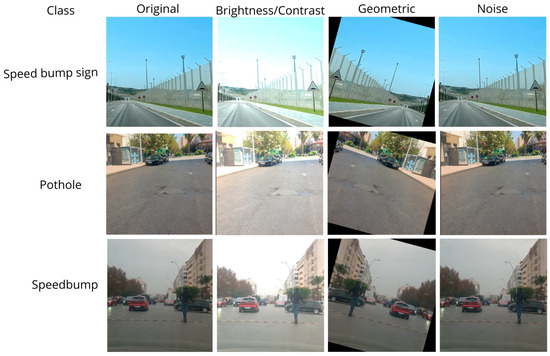
Each image was manually annotated using the Roboflow platform, with annotations exported in YOLO format for seamless integration into the training pipeline. All images were resized to 640 × 640 pixels and normalized to balance visual detail with computational efficiency. The dataset was divided into 70% training, 20% validation, and 10% testing, as summarized in Table 1. Figure 5 shows examples of the data-augmentation pipeline, including brightness/contrast adjustment, geometric transformations, and noise injection. These augmentations increase dataset diversity and improve model robustness under different road conditions.
Table 1.
Dataset distribution across training, validation, and testing subsets.
Figure 5.
Sample images of the applied data augmentation: original, brightness/contrast, geometric transformation, and noise for each class.
3.5. Evaluation Metrics and Performance Assessment
To evaluate the performance of the proposed DriveEdgeAI framework, several key metrics were adopted to assess both the detection accuracy and the real-time inference efficiency of the system. These include Precision, Recall, Average Precision (AP), mean Average Precision (mAP), F1-score, Intersection over Union (IoU), and Frames Per Second (FPS). Together, these parameters provide a comprehensive understanding of how accurately the model detects, classifies, and localizes road anomalies while maintaining real-time performance on embedded hardware platforms used in Advanced Driver Assistance Systems (ADAS) and Intelligent Transportation Systems (ITS) [29,37].
Precision (Equation (1)) measures the proportion of correct positive detections among all predicted positives. Recall (Equation (2)) measures how many actual positives the model successfully detects. Both metrics are critical for understanding the trade-off between accuracy and completeness in detection [38].
The Average Precision (AP), formulated in Equation (3), represents the area under the Precision-Recall curve for a single class, integrating both detection accuracy and stability across confidence thresholds. The mean Average Precision (mAP), shown in Equation (4), calculates the mean of AP values across all classes to provide a single, global measure of detection performance. In parallel, the F1-score, given in Equation (5), serves as a harmonic mean between Precision and Recall, reflecting the overall balance between minimizing false alarms and maximizing correct detections [39].
For evaluating localization accuracy, the Intersection over Union (IoU) metric, expressed in Equation (6), measures the overlap ratio between the predicted bounding box and the corresponding ground-truth box. A higher IoU indicates more precise localization of detected objects. Finally, Frames Per Second (FPS), defined in Equation (7), measures the number of frames the model can process per second, directly indicating inference speed and real-time capability [40].
By jointly analyzing these seven metrics, the DriveEdgeAI framework ensures a balanced evaluation of accuracy, robustness, and computational efficiency, validating its suitability for real-time embedded ADAS applications.
4. Experimental Results
The experimental evaluation confirmed the robust convergence, high accuracy, and strong generalization capability of the proposed YOLO11-based DriveEdgeAI model for real-time road anomaly detection, specifically targeting potholes, speed bumps, and speed bump signs. The model was trained using PyTorch (v2.5.1) with CUDA 11.8 GPU acceleration for 100 epochs to ensure stable learning dynamics. Optimization was performed using Stochastic Gradient Descent (SGD) with an initial learning rate of 0.01, momentum of 0.937, and weight decay of 0.0005, providing an optimal balance between convergence speed and regularization to prevent overfitting. A batch size of 16 was selected to optimize GPU utilization while maintaining training stability. All experiments were executed on a high-performance workstation powered by an AMD Ryzen 9 7940HX CPU, NVIDIA GeForce RTX 4070 GPU (8 GB VRAM), and 32 GB DDR5 RAM, running Windows 11 and Python 3.12.4.
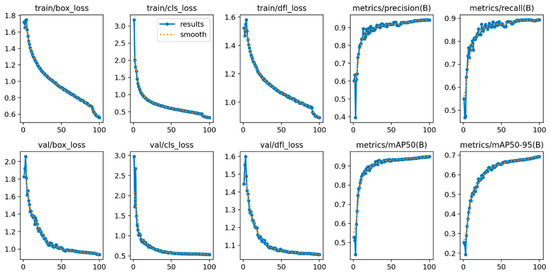
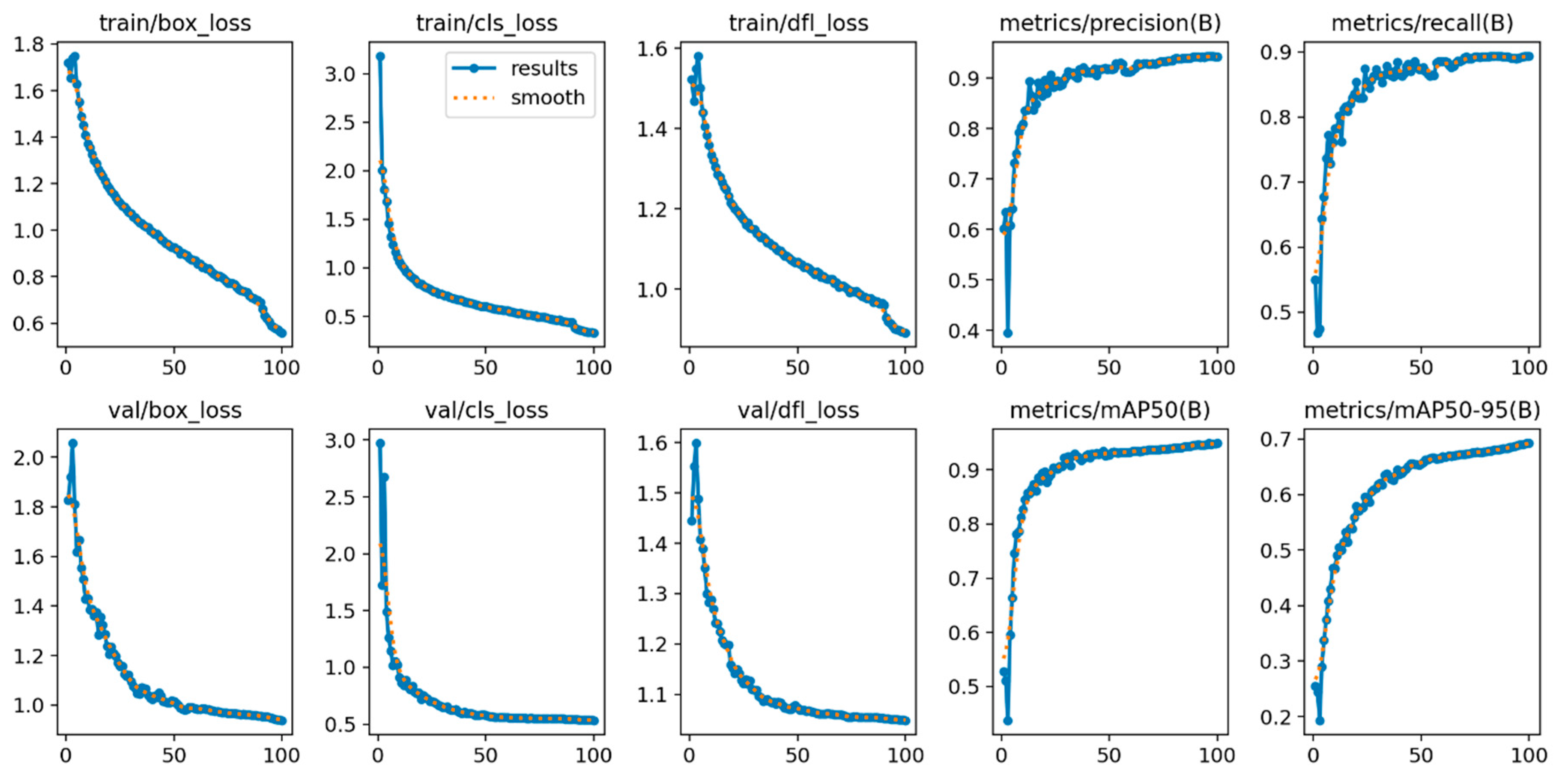
As shown in Figure 6, training and validation curves yield a calm and regular convergence after 100 epochs. The losses of box, cls and regression focal losses (DFL) decreased gradually in training process, which demonstrated the good optimization of localization and classification targets. The close proximity of the training and validation loss curves further validates good generalization and low overfitting when using the YOLO11 architecture, implying that discriminative spatial characteristics from different road scenarios are well captured by the proposed framework. Besides, the precision, recall, and mean Average Precision (mAP) metrics further validate the model’s learning stability and strong inference capability under real-world variability such as changes in illumination, surface texture, and object size.
Figure 6.
Training and validation loss convergence curves of the YOLO11 model for road anomaly detection.
The quantitative results presented in Table 2 reveal that the DriveEdgeAI system achieved an overall precision of 95.8%, recall of 89.7%, and a balanced F1-score of 92.6%, reflecting a high level of detection reliability. Class-wise analysis shows that the speed bump sign category achieved the best results with a precision of 99.2%, F1-score of 94.8%, and mAP@50 of 97.6%, due to its distinct visual characteristics. The pothole and speed bump classes also demonstrated strong accuracy, with F1-scores of 91.2% and 92.0%, respectively, confirming robust feature generalization. Furthermore, the overall mAP@50 (95.4%) and mAP@50–95 (71.3%) values confirm that YOLO11 maintains excellent Precision-Recall balance across varying IoU thresholds. Collectively, these results demonstrate that the proposed DriveEdgeAI framework achieves high detection accuracy and real-time performance, making it a powerful and efficient solution for embedded ADAS applications in intelligent transportation systems.
Table 2.
Detection performance metrics of the YOLO11-based DriveEdgeAI framework across road anomaly classes.
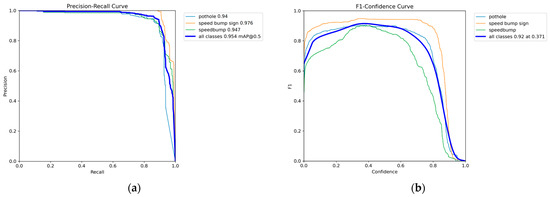
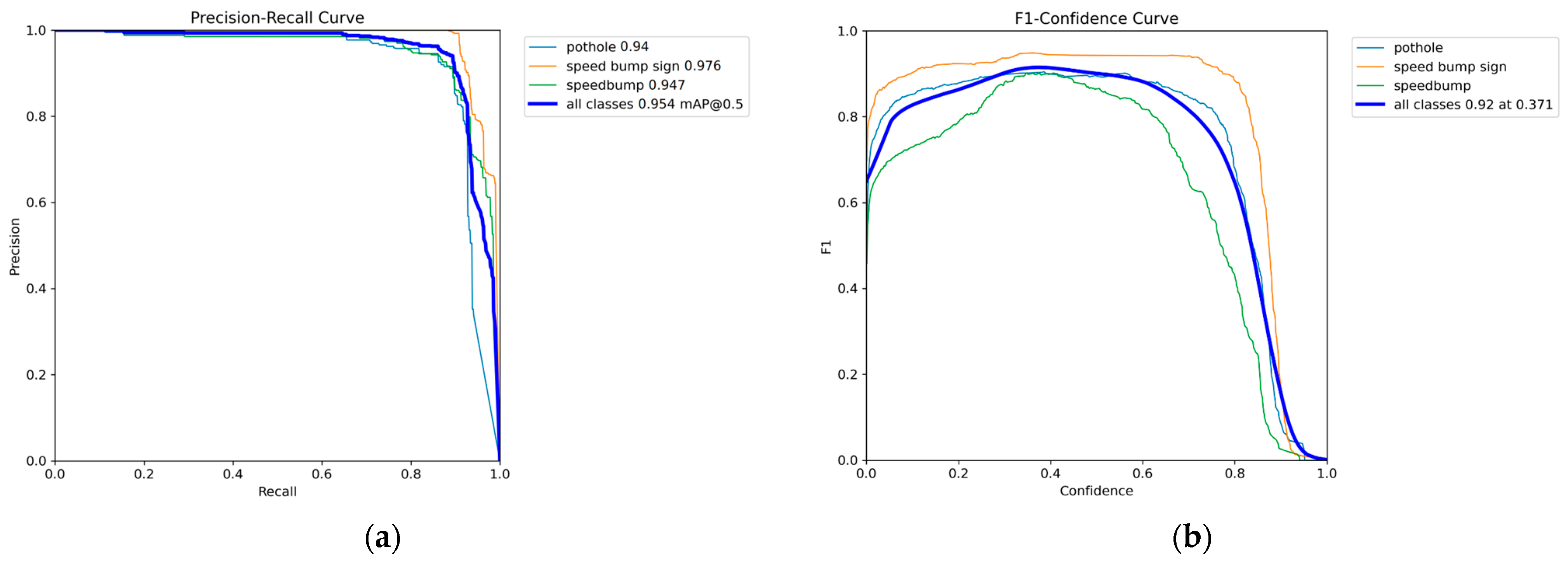
The Precision-Recall (PR) curve presented in Figure 7a offers a comprehensive evaluation of the YOLO11-based DriveEdgeAI framework’s capability to detect three critical road anomaly classes: pothole, speed bump, and speed bump sign. These curves illustrate the trade-off between precision (the accuracy of positive detections) and recall (the ability to identify all true instances) across varying confidence thresholds. The model achieved an impressive mean Average Precision (mAP@50) of 0.954 over all categories, underscoring its strong generalization ability and reliability under diverse conditions. Among the individual classes, the speed bump sign attained the highest area under the curve (AUC) of 0.976, indicating its high detectability due to its distinct geometric shape and strong visual contrast against the road background. The pothole and speed bump classes also demonstrated robust performance, with AUC values of 0.94 and 0.947, respectively. These results highlight the framework’s resilience in recognizing irregular, low-contrast anomalies that typically challenge conventional detection algorithms. The close clustering of all PR curves near the upper-right region of the graph confirms that the model sustains high precision without compromising recall, reflecting low false-positive rates and consistent performance across variations in lighting, shadowing, and surface texture.
Figure 7.
YOLO11 DriveEdgeAI performance curves: (a) Precision-Recall and (b) F1-Confidence for road anomaly classes.
Complementing these findings, the F1-Confidence curve shown in Figure 7b provides insight into the model’s predictive stability and calibration across different confidence thresholds. The DriveEdgeAI framework achieved a global F1-score of 0.92 at an optimal confidence level of 0.371, representing a well-balanced equilibrium between precision and recall for reliable detection in real-time applications. The speed bump sign class again exhibited the most stable trend, maintaining the highest F1-scores across all confidence thresholds owing to its clear visual markers and high-contrast boundaries. Although the pothole and speed bump categories achieved slightly lower peak F1-scores, their smooth and gradual curves indicate stable detection behavior and consistent performance even under dynamic environmental conditions. These results suggest that the YOLO11 architecture effectively captures fine-grained spatial and textural cues on the road surface, enabling the DriveEdgeAI system to distinguish reliably between flat depressions (potholes) and elevated obstacles (speed bumps) across a wide range of real-world scenarios.
The overall smoothness of the F1-Confidence curves across all classes illustrates the model’s stable confidence calibration and robust predictive consistency, indicating that the probabilities assigned by the network accurately correspond to real-world detection reliability. The sustained F1 performance observed between confidence thresholds of 0.3 and 0.8 further demonstrates that the DriveEdgeAI framework maintains high detection accuracy under varying sensitivity settings a key requirement for adaptive ADAS integration. This consistency enables system designers to dynamically adjust detection thresholds according to operational needs: for instance, prioritizing maximum sensitivity in dense urban traffic or higher precision in high-speed highway environments, without significant loss of performance.
Collectively, the Precision-Recall (PR) and F1-Confidence analyses confirm that the YOLO11-based DriveEdgeAI framework achieves both high precision and balanced recall, ensuring reliable, real-time road anomaly detection across diverse environmental and lighting conditions. This combination of accuracy, stability, and adaptability firmly establishes DriveEdgeAI as a robust embedded deep learning solution for intelligent transportation and next-generation ADAS applications.
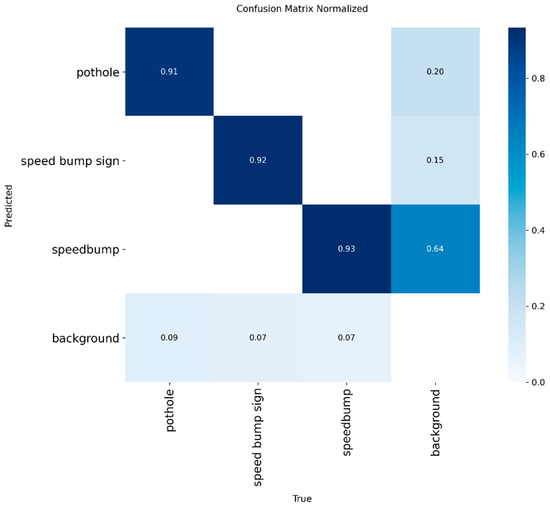
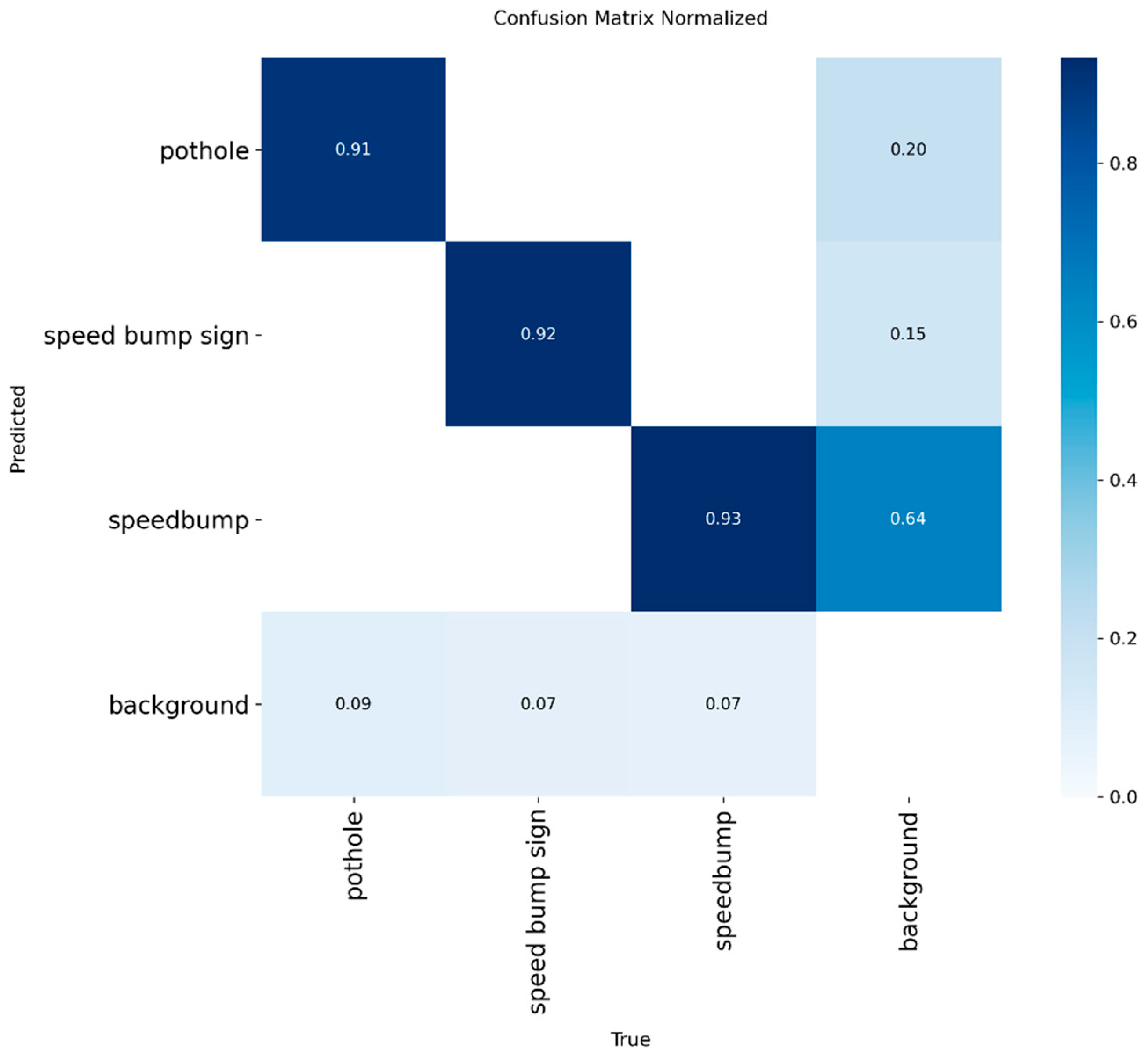
The normalized confusion matrix in Figure 8 provides a full evaluation of DriveEdgeAI’s classification from every target class category: pothole, speed bump, speed bump sign, and the background class. The diagonal values indicate high per-class accuracy, achieving 91% for potholes, 92% for speed bump signs, and 93% for speed bumps, demonstrating strong reliability across visually distinct road anomalies. These results confirm that the YOLO11-based detector maintains stable performance despite variations in texture, illumination, camera angle, and partial occlusion.
Figure 8.
Normalized confusion matrix of the YOLO11-based DriveEdgeAI model.
Misclassifications remain limited and follow clear visual patterns. A subset of potholes is mistakenly classified as speed bumps, primarily in low-contrast scenes or under shadowed regions where surface boundaries become less distinguishable. A small number of speed bump signs are misidentified due to reflections or motion blur, particularly during high-speed vehicle movement. The background class maintains a false-positive rate below 10%, indicating effective separation between normal road surfaces and true anomalies.
The confusion-matrix results demonstrate that DriveEdgeAI provides accurate, consistent, and interpretable detection performance across heterogeneous driving scenes. The low confusion levels and stable confidence calibration further confirm the suitability of the system for real-time embedded ADAS operations, where precise hazard recognition is essential for maintaining vehicle safety, comfort, and efficient decision-making.
A performance comparison included four generations of YOLO models, such as YOLOv8, YOLOv9, YOLOv10, and YOLO11 to assess the accuracy of detection, genericness and stability in road anomaly recognition. In order to control confounders and make a fair, objective comparison; each model was trained and tested in the same settings (with the same dataset, input resolution and training setup) on a common evaluation regime. As shown in Table 3, all YOLO models performed well for detection and can achieve precision of more than 95% and recall around 90%. of these, YOLOv10 achieved the best F1-score (92.8%), which is an optimal balance result between precision and recall. Meanwhile, the best performance overall was obtained by YOLO11 with mAP@50 of 95.4 percent and mAP@50–95 of 71.3 percent, suggesting that it is also most effective in terms of keeping accuracy at different levels of IoU (intersect over-union). In comparison previous versions like YOLOv8 and v9 also got competitive results but had a lower recall and were not consistent enough over all IoU ranges in mAP.
Table 3.
Comparative performance of YOLO models for road anomaly detection.
Overall, the results reveal a clear progression in detection accuracy, generalization, and model efficiency with each successive YOLO generation. The YOLO11 architecture delivers the most stable and computationally efficient performance, making it exceptionally well-suited for real-time embedded deployment within the proposed DriveEdgeAI framework for intelligent ADAS and road anomaly detection.
In general, like for all previous YOLO generations the results show a smooth improvement in detection accuracy (accuracy), generalization and model efficiency for each new generation of YOLO. The YOLO11 model provides most consistent least computing resource intensive performance, and is ideal for real-time embedded deployment in the proposed DriveEdgeAI framework for intelligent ADAS and road anomaly detection.
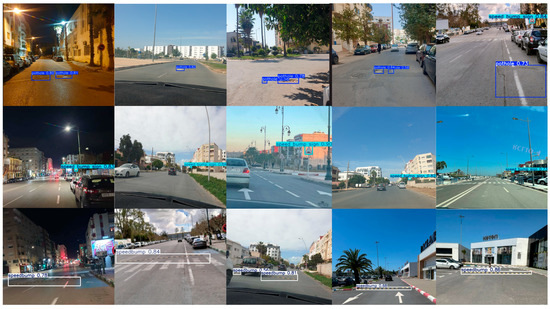
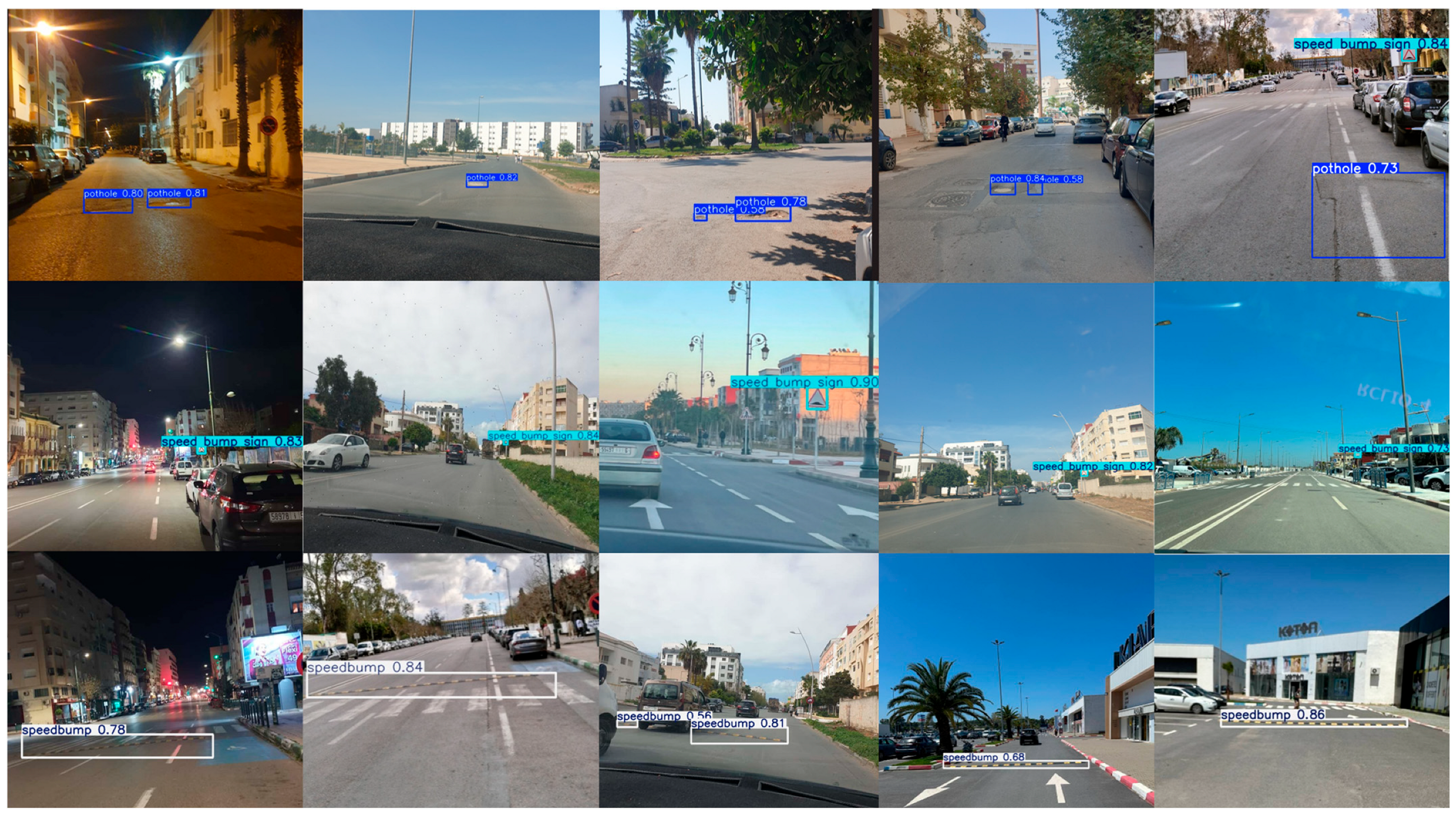
The qualitative detection results illustrated in Figure 9 demonstrate the effectiveness of the proposed YOLO11-based DriveEdgeAI framework in accurately identifying and localizing various road anomalies under diverse environmental conditions. The model successfully detected potholes, speed bumps, and speed bump signs across a wide range of scenarios, including daytime, nighttime, cloudy, and low-contrast lighting. The bounding boxes displayed in the figure indicate strong detection confidence scores, with most predictions exceeding 0.80, confirming the model’s reliability and stability in real-world driving environments.
Figure 9.
Qualitative detection results of the YOLO11-based DriveEdgeAI framework across all hardware platforms.
The visualization highlights the robustness of the framework in handling illumination variations, shadow effects, and occlusions, which commonly challenge conventional detection systems. For example, speed bump signs were consistently detected at long distances and under complex backgrounds, reflecting the model’s ability to extract distinct spatial and semantic features. Similarly, potholes and speed bumps were accurately identified despite irregular textures and surface inconsistencies, demonstrating the model’s sensitivity to subtle structural differences in road geometry.
Overall, these qualitative results reinforce the quantitative findings presented earlier, confirming that the DriveEdgeAI system achieves high-precision detection across all classes. Its robust visual understanding and adaptability to environmental variability make it a strong candidate for real-time road anomaly detection in embedded ADAS and ITS platforms, contributing to enhanced safety and improved driving comfort.
The comparative analysis on hardware platforms in Table 4 shows the various computational and energy characteristics of those potential systems that can comprise the deployed YOLO11-based DriveEdgeAI framework. All the platforms were considered to be analysed for instant street anomalies detection in embedded ADAS and ITS applications in terms of throughput, power consumption and cost-effectiveness.
Table 4.
Comparative Hardware and Performance Specifications for DriveEdgeAI Deployment.
The hardware deployment outcomes also support that DriveEdgeAI is flexible and can scale to a range of computational platforms. The desk-top RTX 4070 also stood as a reference for performance (high throughput at high power). In sharp contrast, Jetson Nano offered a nice trade-off between power and performance maintaining real-time submission performance of the network at only 10 W.
Raspberry Pi 5 showed passable results, yet employing domain-specific accelerators like Intel Movidius VPU and Hailo-8L NPU dramatically improved the inference efficiency. Notably, the Hailo-8L’s energy efficiency was 9.5 FPS/W which demonstrates its promise for low-power real-time applications such as those in autonomous and connected vehicles. These findings emphasize the necessity of hardware–software co-design in design and implementation of efficient embedded AI systems that could trade-off between speed, power, and accuracy.
Through all experiments, it is shown that, although the inference with high-end desktops has a fastest performance, edge processors like Hailo-8L and Jetson Nano have speed as well as power and cost efficient to keep the system scalable for on-vehicle AI deployment. This verifies that our DriveEdgeAI pipeline framework is able to work effectively in edge-cloud computing paradigm and meanwhile achieving invariant detection accuracy, even in resource-bound edge-device.
5. Discussion
The experimental results demonstrate that the proposed DriveEdgeAI framework, powered by YOLO11, provides a robust, accurate, and computationally efficient solution for embedded road-anomaly detection. The model achieved a mAP@50 of 95.4% and an overall F1-score of 92.6%, confirming its strong capability to discriminate between potholes, speed bumps, and speed bump signs across diverse lighting conditions and surface textures. The stability of the training and validation curves further confirms effective convergence without signs of overfitting, indicating that the architectural refinements of YOLO11—particularly improved feature aggregation and spatial attention—are well aligned with the requirements of real-time ADAS perception.
Class-wise results also highlight consistent behavior. Speed bump signs recorded the highest precision and F1-score due to their distinctive geometric and color features, while potholes and speed bumps—both texture-dependent objects—achieved slightly lower but still reliable performance. The Precision-Recall and F1-Confidence curves remained smooth and well-calibrated across thresholds, evidencing the model’s stable confidence estimation under variable environmental conditions.
A cross-generation comparison confirmed the advantages of YOLO11 over YOLOv8, YOLOv9, and YOLOv10. Although YOLOv10 marginally exceeded YOLO11 in F1-score, YOLO11 provided more balanced accuracy across all metrics and showed higher IoU consistency, which is crucial for ADAS-grade localization. This reflects the effectiveness of architectural improvements introduced in YOLO11, including enhanced neck structures and attention-based feature refinement.
Hardware deployment results further validate DriveEdgeAI’s scalability and adaptability. The desktop GPU (RTX 4070) provided the upper performance bound, while the Jetson Nano delivered a favorable balance between throughput and power consumption, sustaining real-time inference at only 10 W. The Raspberry Pi 5 demonstrated moderate standalone performance, but performance increased substantially when paired with dedicated accelerators such as the Intel Movidius VPU and the Hailo-8L NPU. Notably, the Hailo-8L platform achieved the best overall energy efficiency (9.5 FPS/W), confirming its suitability for low-power, cost-effective embedded ADAS integration.
Although the proposed implementation demonstrates strong real-time performance across diverse embedded platforms, a noticeable gap remains between the detection precision achieved on high-end GPUs and that obtained on edge-constrained hardware. This discrepancy arises from reduced computational capacity, lower memory bandwidth, and the more aggressive quantization strategies required for platforms such as the Intel VPU and Hailo-8L. Such factors can lead to slight degradation in feature representation quality and, consequently, affect overall detection accuracy in challenging scenarios. Addressing this limitation will require future work focused on hardware-adaptive training, quantization-aware fine-tuning, and hybrid architectures that combine lightweight detection with temporal smoothing or multi-sensor fusion. These enhancements would help narrow the precision gap across platforms while enabling more consistent performance in real-world ADAS deployments. Moreover, real-vehicle tests revealed that factors such as camera vibration, sudden illumination changes, and dynamic workload fluctuations introduce occasional latency spikes. Although no critical failures occurred, these effects underscore the importance of future improvements such as temporal consistency modeling and more advanced noise-robust pre-processing.
Finally, several concrete directions emerge for future development. Incorporating multi-sensor fusion (camera + LiDAR/radar/IMU) could significantly improve robustness under low-visibility conditions. Integrating lane-geometry analysis and contextual reasoning would enhance system awareness in complex road layouts. Adopting temporal filtering—such as optical flow, feature aggregation, or lightweight recurrent modules—could reduce instability during fast motion. Additionally, introducing a lightweight segmentation branch may improve boundary accuracy for irregular pothole shapes. YOLO11 can be combined with optical-flow or depth cues to improve temporal and spatial consistency. These additions enhance resilience to blur, glare, and rapid viewpoint changes.
The discussion confirms that DriveEdgeAI satisfies key ADAS requirements—high accuracy, low latency, low power consumption, and strong hardware scalability—while also identifying practical constraints and future opportunities for enhancing robustness and multi-modal perception.
6. Conclusions
This work presented DriveEdgeAI, a YOLO11-based embedded deep learning framework designed for real-time road anomaly detection in ADAS and intelligent transportation environments. The proposed system demonstrated strong detection performance, stability, and computational efficiency across diverse embedded platforms, confirming its readiness for real-world deployment. Through extensive experimentation on a dataset of 17,061 annotated images, DriveEdgeAI achieved an overall precision of 95.8%, recall of 89.7%, and mAP@50 of 95.4%, enabling accurate identification of potholes, speed bumps, and speed bump signs under varying lighting, weather, and road conditions. Smooth convergence curves and consistent class-wise evaluations further validated the model’s generalization ability and stable confidence calibration across different thresholds.
Comparative analysis with recent YOLO versions (YOLOv8–YOLOv10) highlighted YOLO11’s improved balance between detection accuracy, localization precision, and IoU consistency, attributable to enhanced backbone modules, spatial attention mechanisms, and efficient multi-scale feature aggregation. Hardware deployment experiments confirmed the scalability of DriveEdgeAI across multiple platforms, from high-end GPUs to low-power edge devices. Notably, the Raspberry Pi 5 paired with the Hailo-8L NPU achieved the highest energy efficiency (9.5 FPS/W), demonstrating the practical value of specialized AI accelerators for automotive applications where power and thermal constraints are critical.
DriveEdgeAI offers an effective and hardware-adaptable solution for on-board road perception. It helps translate high-performance deep-learning research into practical real-time deployment for connected and autonomous vehicles. Its lightweight design, strong detection performance, and cross-platform flexibility position it as a promising candidate for next-generation ADAS systems.
Looking ahead, future work will focus on extending the detection scope to include additional road anomalies such as cracks, lane irregularities, and road debris. Further enhancements will explore multi-sensor fusion, temporal consistency modeling, and lightweight segmentation modules to improve robustness in dynamic driving scenarios. Additionally, techniques such as quantization-aware training, neural architecture search, and runtime optimization will be investigated to further reduce inference latency and energy consumption. Ultimately, this work highlights the potential of combining deep learning with embedded AI accelerators to advance safe, adaptive, and energy-efficient transportation systems.
Author Contributions
Conceptualization, M.C., M.B. and A.E.M. (Anas El Maliki); Methodology, M.C. and M.B.; Software, M.C.; Validation, M.C., M.B., A.E.M. (Anas El Maliki) and W.B.; Formal analysis, M.C.; Investigation, M.C. and A.E.M. (Azzedine El Mrabet); Resources, A.E.M. (Anas El Maliki) and H.D.; data curation, W.B.; Supervision, A.H.; Writing—original draft preparation, M.C.; Writing—review and editing, M.C., M.B., H.D. and A.H. All authors have read and agreed to the published version of the manuscript.
Funding
This research received no external research funding. The Article Processing Charge (APC) was funded by the Scientific Publication Support Center of Ibn Tofail University, Kenitra, Morocco.
Data Availability Statement
Data will be made available on request.
Acknowledgments
This research was carried out at the Faculty of Sciences of Ibn Tofail University, Kenitra, Morocco, within the Laboratory of Electronic Systems for Information Processing, Mechanics, and Energetics, in collaboration with the Higher School of Technology and the National School of Applied Sciences. The authors gratefully acknowledge the scientific support and research facilities provided by these institutions, which significantly contributed to the successful completion of this work.
Conflicts of Interest
The authors declare no conflicts of interest.
References
- Aleksa, M.; Schaub, A.; Erdelean, I.; Wittmann, S.; Soteropoulos, A.; Fürdös, A. Impact Analysis of Advanced Driver Assistance Systems (ADAS) Regarding Road Safety—Computing Reduction Potentials. Eur. Transp. Res. Rev. 2024, 16, 39. [Google Scholar] [CrossRef] [Scilit]
- Mehta, A.A.; Padaria, A.A.; Bavisi, D.J.; Ukani, V.; Thakkar, P.; Geddam, R.; Kotecha, K.; Abraham, A. Securing the Future: A Comprehensive Review of Security Challenges and Solutions in Advanced Driver Assistance Systems. IEEE Access 2024, 12, 643–678. [Google Scholar] [CrossRef] [Scilit]
- Ayachi, R.; Said, Y.; Afif, M.; Alshammari, A.; Hleili, M.; Ben Abdelali, A. Assessing YOLO Models for Real-Time Object Detection in Urban Environments for Advanced Driver-Assistance Systems (ADAS). Alex. Eng. J. 2025, 123, 530–549. [Google Scholar] [CrossRef] [Scilit]
- Chaman, M.; El Maliki, A.; Jariri, N.; Dahou, H.; Laâmari, H.; Hadjoudja, A. Enhanced Deep Neural Network-Based Vehicle Detection System Using YOLOv11 for Autonomous Vehicles. In Proceedings of the 2025 5th International Conference on Innovative Research in Applied Science, Engineering and Technology (IRASET), Fez, Morocco, 15–16 May 2025; pp. 1–6. [Google Scholar]
- Ji, Y.; Ma, T.; Shen, H.; Feng, H.; Zhang, Z.; Li, D.; He, Y. Transmission Line Defect Detection Algorithm Based on Improved YOLOv12. Electronics 2025, 14, 2432. [Google Scholar] [CrossRef] [Scilit]
- Nurul Achmadiah, M.; Ahamad, A.; Sun, C.-C.; Kuo, W.-K. Energy-Efficient Fast Object Detection on Edge Devices for IoT Systems. IEEE Internet Things J. 2025, 12, 16681–16694. [Google Scholar] [CrossRef] [Scilit]
- Giedra, H.; Sledevič, T.; Matuzevičius, D.; Giedra, H.; Sledevič, T.; Matuzevičius, D. Deploying Optimized Deep Vision Models for Eyeglasses Detection on Low-Power Platforms. Electronics 2025, 14, 2796. [Google Scholar] [CrossRef] [Scilit]
- Gupta, A.; Abirami, P.; Bharthuar, O.P.; Malviya, M.; Deshpande, S. Towards Safer Roads: A Review of Hybrid Machine Learning and Vision-Based Approaches for Speed Bump Detection in Intelligent Transportation Systems. Int. J. Saf. Secur. Eng. 2025, 15, 1293–1308. [Google Scholar] [CrossRef] [Scilit]
- Hussein, A.A.; Omar, M.M.; Altamimi, J.S.; Ead, W.M. An Intelligent Approach for Speed Bump Detection. In Proceedings of the 2024 IEEE 3rd International Conference on Computing and Machine Intelligence (ICMI), Mt Pleasant, MI, USA, 13–14 April 2024; pp. 1–6. [Google Scholar]
- Aguilar-González, A.; Medina Santiago, A. CNN-Based Road Event Detection Using Multiaxial Vibration and Acceleration Signals. Appl. Sci. 2025, 15, 10203. [Google Scholar] [CrossRef] [Scilit]
- Dewangan, D.K.; Sahu, S.P. Deep Learning-Based Speed Bump Detection Model for Intelligent Vehicle System Using Raspberry Pi. IEEE Sens. J. 2021, 21, 3570–3578. [Google Scholar] [CrossRef] [Scilit]
- Peralta-López, J.-E.; Morales-Viscaya, J.-A.; Lázaro-Mata, D.; Villaseñor-Aguilar, M.-J.; Prado-Olivarez, J.; Pérez-Pinal, F.-J.; Padilla-Medina, J.-A.; Martínez-Nolasco, J.-J.; Barranco-Gutiérrez, A.-I. Speed Bump and Pothole Detection Using Deep Neural Network with Images Captured through ZED Camera. Appl. Sci. 2023, 13, 8349. [Google Scholar] [CrossRef] [Scilit]
- Harshalatha, Y.; Singhal, A.; Suraj, A.; Chandak, J.; Kumar, A. Computer Vision-Based Speed Hump and Pothole Detection System for Vehicles. In Proceedings of the 2025 3rd International Conference on Smart Systems for applications in Electrical Sciences (ICSSES), Tumakuru, India, 21–22 March 2025; pp. 1–5. [Google Scholar]
- Hosseinikhah, S.; Mirzahossein, H.; Asadi, M.A.; Naderan, A. Application of Deep Neural Networks in Detecting Speed Bumps and Speed Humps for Fuel Consumption Optimization. Transp. Eng. 2025, 22, 100387. [Google Scholar] [CrossRef] [Scilit]
- Sarvajcz, K.; Ari, L.; Menyhart, J. AI on the Road: NVIDIA Jetson Nano-Powered Computer Vision-Based System for Real-Time Pedestrian and Priority Sign Detection. Appl. Sci. 2024, 14, 1440. [Google Scholar] [CrossRef] [Scilit]
- Asad, M.H.; Khaliq, S.; Yousaf, M.H.; Ullah, M.O.; Ahmad, A. Pothole Detection Using Deep Learning: A Real-Time and AI-on-the-Edge Perspective. Adv. Civ. Eng. 2022, 2022, 9221211. [Google Scholar] [CrossRef] [Scilit]
- Burgos, D.C.; Iztueta, E.J.; Ormaechea, I.M.; Martínez-Otzeta, J.M.; Mugica, A.C. Deep Learning-Based Traffic Light Detection in a Custom Embedded Hardware Platform for ADAS Applications. IEEE Access 2024, 12, 127862–127878. [Google Scholar] [CrossRef] [Scilit]
- Chaman, M.; Maliki, A.E.; Jariri, N.; Mrabet, A.E.; Dahou, H.; Laamari, H.; Hadjoudja, A. A Real-Time Vehicle Detection System for ADAS in Autonomous Vehicles Using YOLOv11 Deep Neural Network on Embedded Edge Platforms. Eng. Technol. Appl. Sci. Res. 2025, 15, 28077–28082. [Google Scholar] [CrossRef] [Scilit]
- Nguyen, H.-H.; Nguyen-Ngoc Tran, D.; Pham, L.H.; Jeon, J.W. Optimizing Monocular Driving Assistance for Real-Time Processing on Jetson AGX Xavier. IEEE Access 2024, 12, 71853–71865. [Google Scholar] [CrossRef] [Scilit]
- Azevedo, P.; Santos, V. Comparative Analysis of Multiple YOLO-Based Target Detectors and Trackers for ADAS in Edge Devices. Robot. Auton. Syst. 2024, 171, 104558. [Google Scholar] [CrossRef] [Scilit]
- Almasri, I.; Manasreh, D.; Nazzal, M.D. AI Meets ADAS: Intelligent Pothole Detection for Safer AV Navigation. Vehicles 2025, 7, 109. [Google Scholar] [CrossRef] [Scilit]
- Mao, W.-L.; Wang, C.-C.; Chou, P.-H.; Liu, Y.-T. Automated Defect Detection for Mass-Produced Electronic Components Based on YOLO Object Detection Models. IEEE Sens. J. 2024, 24, 26877–26888. [Google Scholar] [CrossRef] [Scilit]
- Varghese, R.; Sambath, M. YOLOv8: A Novel Object Detection Algorithm with Enhanced Performance and Robustness. In Proceedings of the 2024 International Conference on Advances in Data Engineering and Intelligent Computing Systems (ADICS), Chennai, India, 18–19 April 2024; pp. 1–6. [Google Scholar]
- Wang, C.-Y.; Yeh, I.-H.; Mark Liao, H.-Y. YOLOv9: Learning What You Want to Learn Using Programmable Gradient Information. In Computer Vision—ECCV 2024, Proceedings of the Computer Vision—ECCV 2024, Milan, Italy, 29 September–4 October 2024; Leonardis, A., Ricci, E., Roth, S., Russakovsky, O., Sattler, T., Varol, G., Eds.; Springer Nature: Cham, Switzerland, 2025; pp. 1–21. [Google Scholar]
- Wang, A.; Chen, H.; Liu, L.; Chen, K.; Lin, Z.; Han, J.; Ding, G. YOLOv10: Real-Time End-to-End Object Detection. Adv. Neural Inf. Process. Syst. 2024, 37, 107984–108011. [Google Scholar]
- Khanam, R.; Hussain, M. YOLOv11: An Overview of the Key Architectural Enhancements. arXiv 2024, arXiv:2410.17725. [Google Scholar] [CrossRef] [Scilit]
- Júnior, E.S.d.S.; Paixão, T.; Alvarez, A.B. Comparative Performance of YOLOv8, YOLOv9, YOLOv10, and YOLOv11 for Layout Analysis of Historical Documents Images. Appl. Sci. 2025, 15, 3164. [Google Scholar] [CrossRef] [Scilit]
- Chaman, M.; El Maliki, A.; El Yanboiy, H.; Dahou, H.; Laâmari, H.; Hadjoudja, A. Comparative Analysis of Deep Neural Networks YOLOv11 and YOLOv12 for Real-Time Vehicle Detection in Autonomous Vehicles. Int. J. Transp. Dev. Integr. 2025, 9, 39–48. [Google Scholar] [CrossRef] [Scilit]
- Chaman, M.; Maliki, A.E.; Dahou, H.; Gouri, R.E.; Laamari, H.; Hadjoudja, A. Deep Learning-Based Speed Limit Sign Detection Using YOLOv11 Applied to Speed Regulation in Electric Vehicles for ADAS. Eng. Technol. Appl. Sci. Res. 2025, 15, 25354–25362. [Google Scholar] [CrossRef] [Scilit]
- Aishwarya, N.; Yaythish Kannaa, G.S.; Seemakurthy, K. YOLOSkin: A Fusion Framework for Improved Skin Cancer Diagnosis Using YOLO Detectors on Nvidia Jetson Nano. Biomed. Signal Process. Control 2025, 100, 107093. [Google Scholar] [CrossRef] [Scilit]
- Tran, D.N.-N.; Pham, L.H.; Nguyen, H.-H.; Tran, T.H.-P.; Jeon, H.-J.; Jeon, J.W. Universal Detection-Based Driving Assistance Using a Mono Camera With Jetson Devices. IEEE Access 2022, 10, 59400–59412. [Google Scholar] [CrossRef] [Scilit]
- Raspberry Pi Hardware—Raspberry Pi Documentation. Available online: https://www.raspberrypi.com/documentation/computers/raspberry-pi.html (accessed on 22 September 2025).
- Gao, T.; Suto, J. Acceleration of Image Classification and Object Tracking by the Intel Neural Compute Stick 2 with Power Efficiency Evaluation on Raspberry Pi 4B. Sensors 2025, 25, 1794. [Google Scholar] [CrossRef] [Scilit] [PubMed]
- Mohamed, B.; Hajar, E.K.; Noura, J.; Rachid, E.G.; Lamaari, H.; Abdelkader, M. Strengthen Aircraft Real-Time Multiple Object Tracking with Optical Flow and Histogram of Oriented Gradient Provided HSMA Implemented in Low-Cost Energy VPU for UAV. In Proceedings of the 2023 3rd International Conference on Innovative Research in Applied Science, Engineering and Technology (IRASET), Casablanca, Morocco, 18–19 May 2023; pp. 1–5. [Google Scholar]
- Bueno, G.; Sanchez-Vargas, L.; Diaz-Maroto, A.; Ruiz-Santaquiteria, J.; Blanco, M.; Salido, J.; Cristobal, G. Real-Time Edge Computing vs. GPU-Accelerated Pipelines for Low-Cost Microscopy Applications. Electronics 2025, 14, 930. [Google Scholar] [CrossRef] [Scilit]
- Open Model Zoos: Advancing TensorFlow & ONNX AI | Hailo. Available online: https://hailo.ai/blog/how-an-open-model-zoo-can-boost-your-edge-ai-system-development/ (accessed on 13 October 2025).
- Martes, D.O.; Gunderson, E.; Neuman, C.; Kachouie, N.N.; Smaali, A.; Alla, S.B.; Touhafi, A. TSRACE-AI: Traffic Sign Recognition Accelerated with Co-Designed Edge AI Based on Hybrid FPGA Architecture for ADAS. Information 2025, 16, 703. [Google Scholar] [CrossRef] [Scilit]
- Diaz-Santos, S.; Caballero-Gil, P.; Caballero-Gil, C.; Diaz-Santos, S.; Caballero-Gil, P.; Caballero-Gil, C. Real-Time Passenger Flow Analysis in Tram Stations Using YOLO-Based Computer Vision and Edge AI on Jetson Nano. Computers 2025, 14, 476. [Google Scholar] [CrossRef] [Scilit]
- Du, S.; Pan, W.; Li, N.; Dai, S.; Xu, B.; Liu, H.; Xu, C.; Li, X. TSD-YOLO: Small Traffic Sign Detection Based on Improved YOLO V8. IET Image Process. 2024, 18, 2884–2898. [Google Scholar] [CrossRef] [Scilit]
- Natij, Y.; El Karch, H.; Maafiri, A.; Mezouari, A. Evaluating the Performance of YOLO Object Detectors for Plant Disease Detection. In Proceedings of the 2024 11th International Conference on Wireless Networks and Mobile Communications (WINCOM), Leeds, UK, 23–25 July 2024; pp. 1–6. [Google Scholar]

Disclaimer/Publisher’s Note: The statements, opinions and data contained in all publications are solely those of the individual author(s) and contributor(s) and not of MDPI and/or the editor(s). MDPI and/or the editor(s) disclaim responsibility for any injury to people or property resulting from any ideas, methods, instructions or products referred to in the content. |
© 2026 by the authors. Licensee MDPI, Basel, Switzerland. This article is an open access article distributed under the terms and conditions of the Creative Commons Attribution (CC BY) license.