


Abstract
Single image super-resolution (SR) is an important part of image processing, which aims to improve the spatial resolution of images. This is a typical ill-posed inverse problem. The main difficulty is that a low-resolution image block usually corresponds to multiple high-resolution image blocks. The existing methods cannot provide enough correlation to determine the unique high-resolution image block, which leads to artifacts and image distortion in the reconstructed image. To address this problem, a method (EHNet) is proposed to achieve super-resolution by using a Hybrid-Channel Fusion Block (HCFB) and an Enhanced Dual-Convolution Block (EDCB). The EDCB effectively enhances the network’s ability to capture image details and textures by combining local and global feature processing. The HCFB strengthens the information interaction between channels by combining channel segmentation with large-kernel convolution, fully explores feature dependencies, and thus optimizes the feature extraction effect. Experimental results show that the super-resolution reconstructed image of EHNet achieves 32.59 dB PSNR and 0.9006 SSIM on the Set5 ×4 SR benchmark, outperforming several state-of-the-art SR methods. In addition, the model exhibits notable improvements in artifact suppression, and the reconstructed image’s subjective visual impact surpasses that of other current techniques.
1. Introduction
Single-image super-resolution (SISR) is a classic task in computer vision, which aims to restore a high-resolution (HR) image from a low-resolution (LR) image. Since the problem is inherently ill-posed, a single LR image may correspond to multiple valid HR reconstructions [1]. In recent years, with the rapid development of artificial intelligence and deep learning technologies, SISR has been widely used in remote sensing imaging, medical image processing, surveillance systems, and old image restoration [2,3].
SISR reconstructs HR images from LR inputs by exploiting image features and priors. Traditional SISR relies on interpolation and handcrafted priors, yielding modest visual gains and failing to recover high-frequency detail. In contrast, deep learning (DL)-based SISR learns an mapping from data, fusing local and global cues to resolve ambiguity. Nevertheless, content complexity and local similarities can still cause errors, artifacts, and distortions. Modern SR models therefore integrate specialized modules and hyperparameter tuning to enhance texture recovery and suppress spurious SR artifacts. Tian et al. [4] proposed ESRGCNN, which integrates group convolution and residual operations to fuse local details with global context, enhancing high-frequency feature extraction. Chen et al. [5] introduced a dual residual block (DRB) that exploits local–global correlations for accurate super-resolution mapping. Wang et al. [6] developed MAN, combining multi-scale strategies with large-kernel convolutions to emphasize and reconstruct high-frequency information. Liu et al. [7] proposed the single-shift building block (SBB), which shifts part of the channel and input features along spatial axes to directly mix adjacent information, improving high-frequency reconstruction. Tian et al. [8] presented HDSRNet, employing heterogeneous blocks to expand the receptive field and enhance global structure modeling. These methods effectively improve feature extraction and fusion from both local and global perspectives. However, they still process pixels within limited neighborhoods, restricting their ability to model long-range dependencies. As a result, high-frequency regions may suffer from incorrect correspondences, leading to artifacts, local deformations, and structural distortions in the reconstructed images.
To address the shortcomings of existing SISR models in capturing long-range dependencies, we propose a novel model, EHNet, which comprises two novel modules. The Enhanced Dual-Convolution Block (EDCB) applies cascaded dual convolutions to extract fine-grained local textures while expanding the receptive field for deeper inter-channel feature integration. The Hybrid-Channel Fusion Block (HCFB) partitions feature channels into two groups: one dedicated to local detail refinement and the other leveraging large-kernel convolutions to harvest global structures. Together, these modules realize unified local–global feature modeling, yielding precise texture reconstruction and robust structural coherence.
The contributions of this paper can be summarized as follows:
- We propose a novel EHNet model, which integrates an Enhanced Dual-Convolution Block (EDCB) and a Hybrid-Channel Fusion Block (HCFB) into an innovative architecture, significantly improving the performance of image super-resolution.
- To address the challenge of accurately representing complex image content, we design the EDCB, which employs a dual-convolution feature-processing strategy that not only precisely extracts local details but also expands the receptive field, effectively capturing texture and edge information.
- To process structural information at multiple levels, we propose the HCFB, which integrates channel segmentation with large-kernel convolution. This design ensures precise local detail extraction and effectively models long-range dependencies, enabling accurate feature alignment and structural consistency for super- resolution reconstruction
- Extensive experiments on multiple benchmark datasets (such as Set5, Set14, BSD100, Urban100, and Manga109) demonstrate that EHNet consistently outperforms existing SISR methods in both subjective and objective evaluation metrics across various scaling factors.
2. Related Work
2.1. CNNs for Single-Image Super-Resolution
To overcome the limitations of manually tuned parameters in traditional SISR methods, deep convolutional neural networks (CNNs) were introduced to automatically learn image features via end-to-end architectures. Dong et al. [9] first applied deep learning to SISR by proposing the three-layer SRCNN. Since then, numerous deep learning-based SISR models have emerged, improving performance through stacking and combining network modules. He et al. [10] introduced ResNet to address training difficulties in deeper networks. Noting that low- and high-resolution images share similar low-frequency content, Lim et al. [11] used residual learning in VDSR to focus on high-frequency information. However, existing methods often overlook hierarchical features. Liu et al. [12] addressed this with the residual feature aggregation (RFA) framework. To mitigate performance degradation from upsampling, Shi et al. [13] proposed sub-pixel convolution. Despite these advances, current methods still struggle with long-range dependencies, often resulting in artifacts and structural distortions that require further improvement.
2.2. Dual Convolution for Image Restoration
To improve feature extraction and model adaptability in CNNs, researchers proposed dual convolution (DualConv), which cascades two convolution kernels to process different input channels, enabling dynamic parameter adjustment and adaptive feature learning. Zhong et al. [14] combined and kernels with group convolution to process input channels efficiently, though detail recovery remained limited. To enhance contextual extraction, Wang et al. [15] used dual convolution for boundary enhancement in segmentation, but edge and texture extraction still needed improvement. Tiwari et al. [16] stacked two convolution layers to progressively refine feature representation, yielding better edge and texture recovery. Lei et al. [17] employed asymmetric dual convolution with GhostConv to improve contour integrity in changing regions. Yan et al. [18] integrated dual convolution into both encoding and decoding paths, improving spectral reconstruction and fine detail recovery. These studies demonstrate that dual convolution effectively fuses local and global features, enhances high-frequency recovery, and holds promise for detailed image restoration tasks.
2.3. Hybrid Channel for Image Super-Resolution
The hybrid channel concept enhances network architecture by optimizing channel allocation and fusion, enabling effective feature extraction while suppressing redundancy. By segmenting and independently processing channel groups, the network captures both local details and inter-channel dependencies. Each group focuses on specific feature aspects, such as textures or edges, for more accurate representation. Prajapati et al. [19] proposed ChaSNet with a Channel Splitting Block (CSB) to reduce redundancy and improve feature diversity. Hui et al. [20] introduced IMDN to refine hierarchical features via channel segmentation. Liu et al. [21] designed RFDN using residual blocks for effective fusion in segmented channels. Su et al. [22] developed a network with 1 × 1 residual and pyramid dilated convolutions for better reconstruction. Lee et al. [23] adopted large-kernel convolutions to expand the receptive field and enhance local feature extraction. Inspired by these, we propose the Hybrid-Channel Fusion Block (HCFB), which combines segmented-channel learning with large-kernel convolutions to jointly capture local–global features and inter-channel dependencies while applying multi-scale constraints for accurate HR reconstruction and artifact suppression.
3. Method
3.1. Network Structure
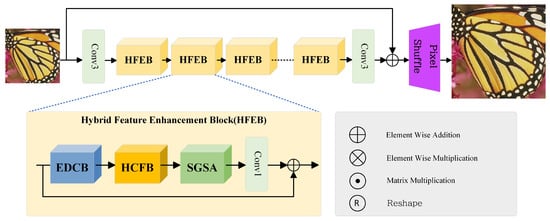
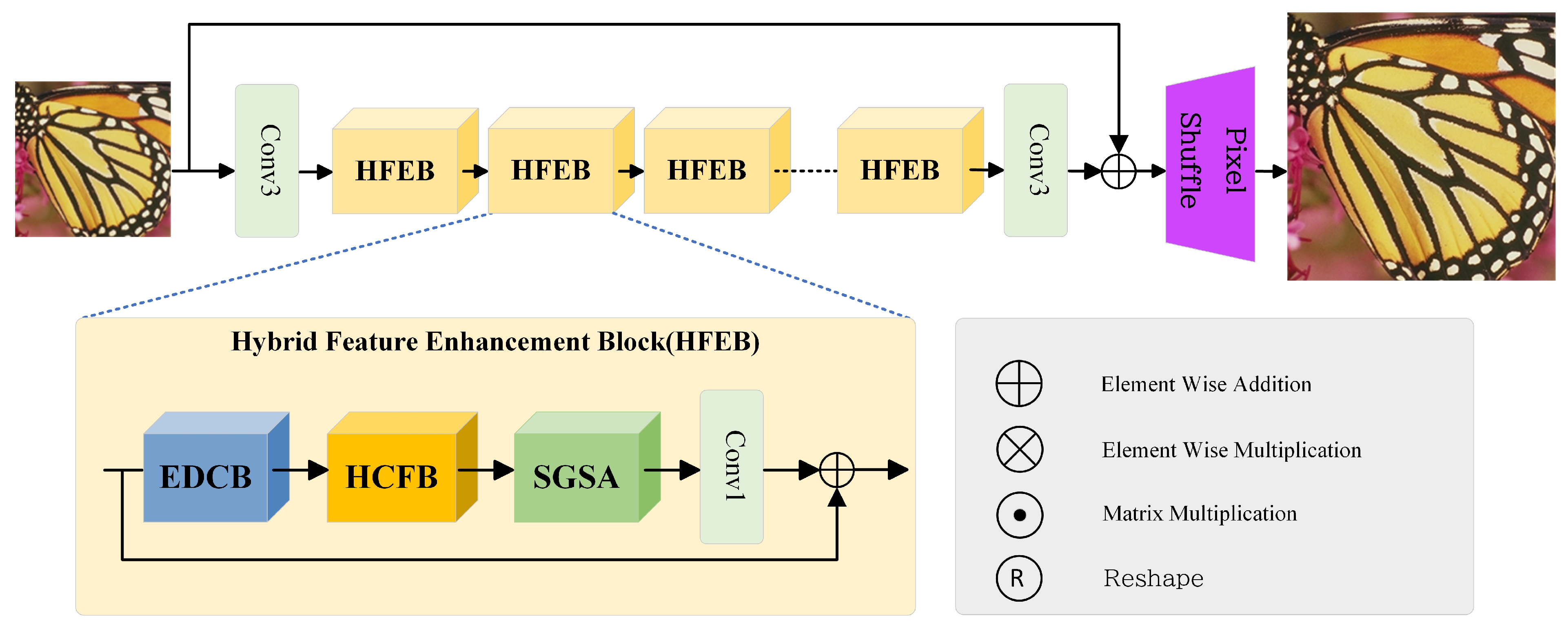
The overall structure of the network is shown in Figure 1. EHNet is mainly composed of a shallow feature extraction module, a deep feature extraction module, and a reconstruction module. The shallow feature extraction module is responsible for capturing the basic structural information of the image and providing a basis for subsequent processing. The deep feature extraction module integrates the EDCB, the HCFB, and the SGSA to more efficiently extract and enhance the local and global features of the image.
Figure 1.
The architecture of the EHNet for single-image super-resolution.
To better illustrate the process described above, we define the following notation. Let represent the LR image and represent the SR image. The reconstruction process is formalized as follows:
where denotes the mapping function of the EHNet network.
3.2. Enhanced Dual-Convolution Block (EDCB)
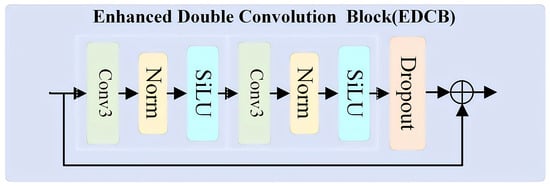
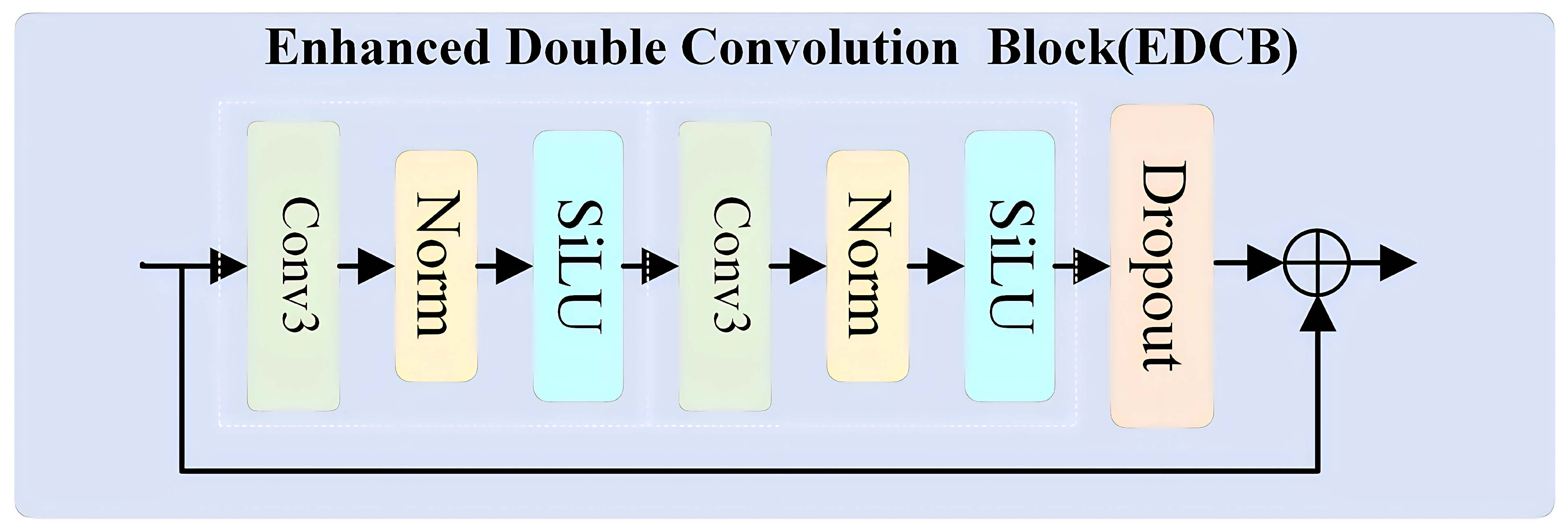
Based on the previous description, we designed the EDCB to enhance the information mixing ability between channels. This module effectively processes complex image details through two process operations, as shown in Figure 2.
Figure 2.
Enhanced Dual-Convolution Block (EDCB).
In the implementation, the convolution layer in Process 1 has an input channel count of dim and an output channel count of . Process 1 is responsible for expanding the number of channels and extracting features, as described by:
In contrast, the convolution layer in Process 2 restores the channel count from back to dim. Process 2 thus recovers the original channel dimension and further enhances the extracted features, as described by:
Finally, an optional dropout operation is applied to enhance the network’s generalization ability. Moreover, a residual connection is introduced, adding the input features to the output features, thereby mitigating potential gradient vanishing issues in deep networks, as described by:
where and denote the input and output tensors of the module, respectively. With this architectural design, and represent the output feature maps of Process 1 and Process 2, respectively. The notation refers to a convolution kernel, represents batch normalization, corresponds to the dropout operation, and denotes the Sigmoid Linear Unit activation function, which is defined as
where is the Sigmoid function. Compared with ReLU, SiLU provides smoother non-linear feature transformation and more stable gradient propagation, enhancing feature representation in the EDCB module.
3.3. Hybrid-Channel Fusion Block (HCFB)
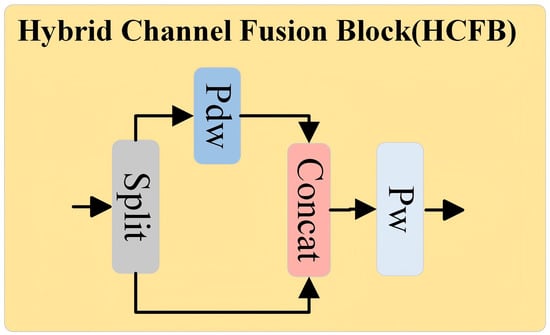
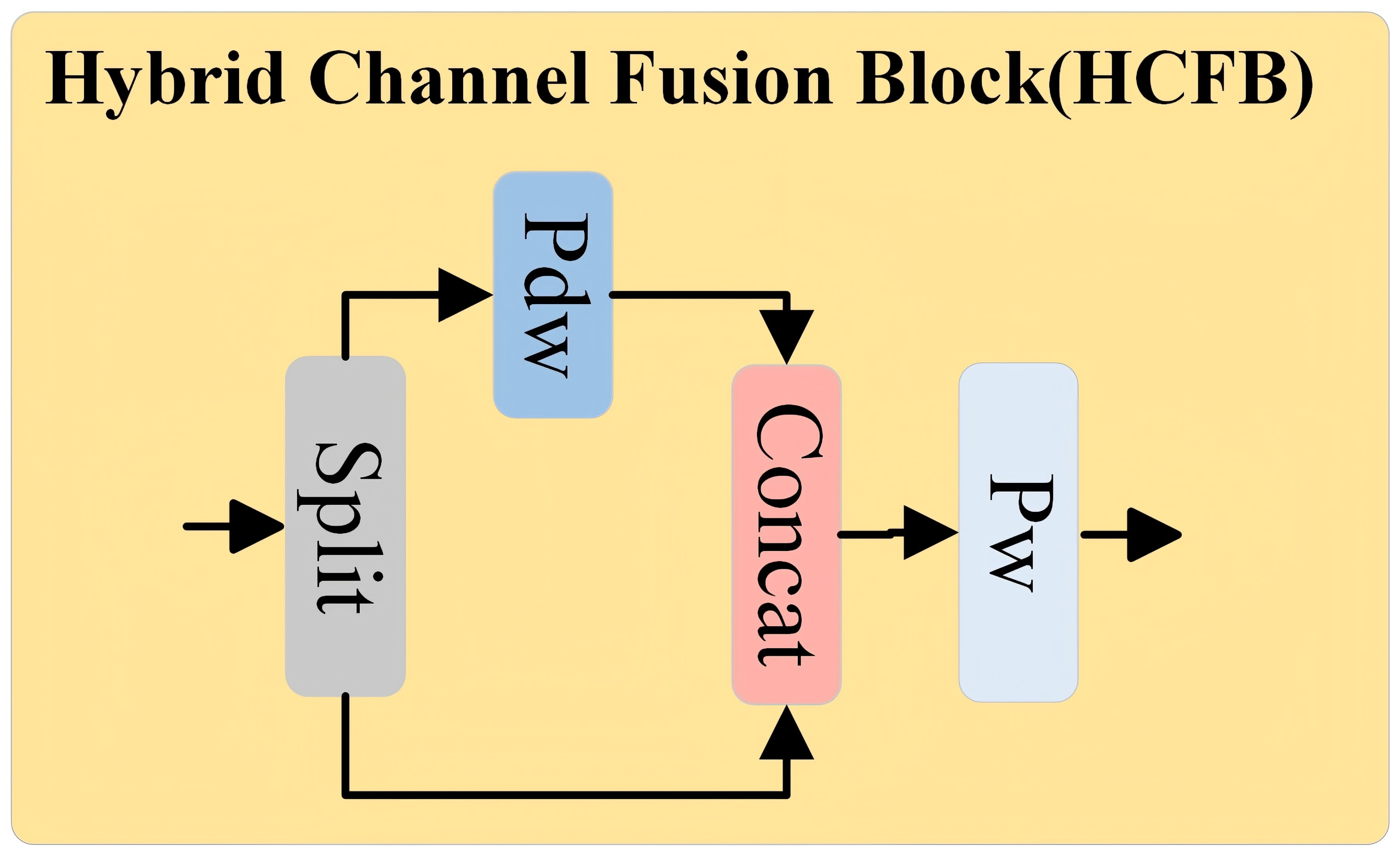
The HCFB is a specialized module that utilizes channel segmentation combined with the characteristics of large-kernel convolution to reduce redundant features and capture a wide range of spatial feature information, Figure 3.
Figure 3.
Hybrid-Channel Fusion Block (HCFB).
First, after entering the HCFB, the input feature map is divided into two feature maps according to channel C: and , as described by:
Subsequently, the module applies only a partial depthwise convolution on to generate a large-kernel-filtered feature map, denoted as , as described by:
Then, is cascaded with the channel to generate , as described by:
Finally, the module applies pointwise convolution on to generate a feature map, denoted as , as described by:
where denotes the division of the input feature map by the number of channels, while represents the merging of the channel dimensions.
3.4. Sparse Global Self-Attention (SGSA)
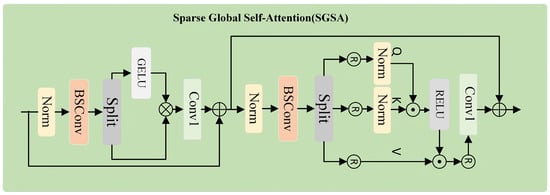
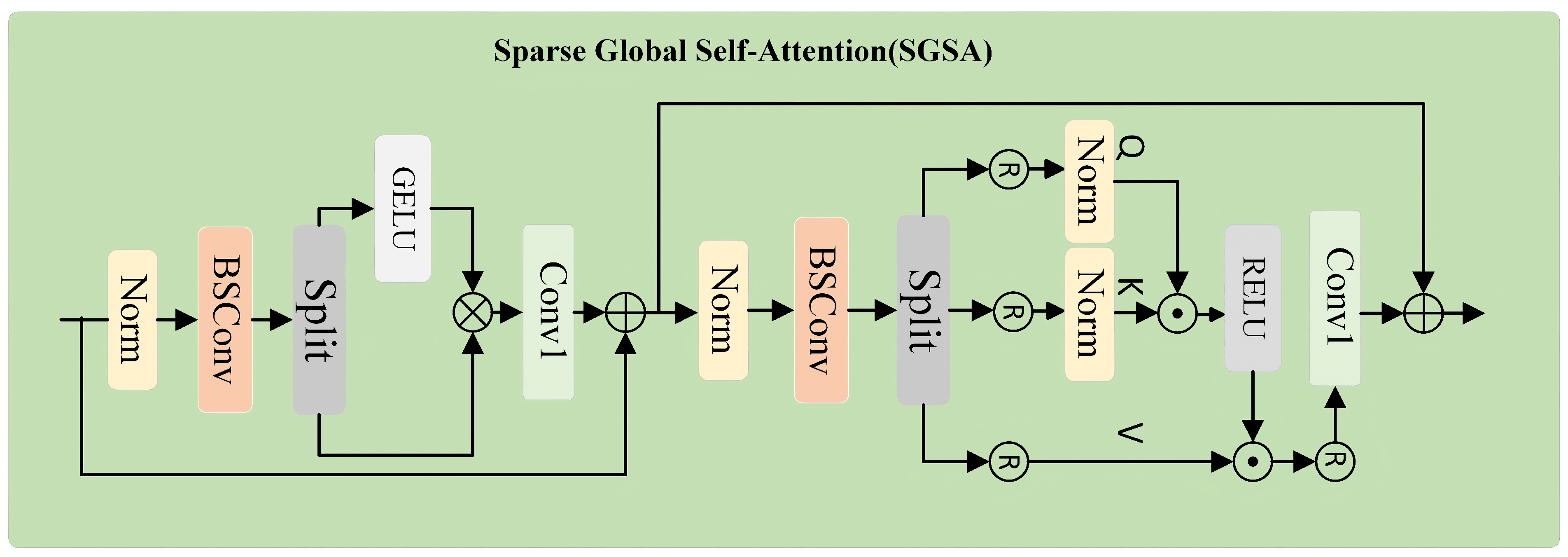
In order to enhance the network’s ability to focus on important features and model complex dependencies, SGSA is introduced to estimate features in the channel direction (Figure 4). This method improves the quality of reconstructed high-resolution images by simultaneously utilizing local and global context information. Different from other attention mechanisms, such as spatial/channel attention, which usually involve dimensionality reduction, we use this module’s dependency modulation similar to the transformer, as described by:
where is the output feature map of the SGSA module, and denotes the mapping function of the module. With this architectural design, Q, K, and V denote the query, key, and value feature maps in the attention computation; represents a 1 × 1 pointwise convolution used for channel projection and adaptive feature fusion; denotes a bottleneck-separable convolution for efficient spatial filtering; and and denote the Gaussian Error Linear Unit and Rectified Linear Unit activation functions, respectively. Specifically, ReLU applies a hard threshold at zero, setting all negative inputs to zero, which introduces abrupt non-linearity, whereas GELU applies a smooth probabilistic gating function, allowing small negative values to pass through and resulting in smoother non-linear transformations within the attention computation.
Figure 4.
Sparse Global Self-Attention (SGSA).
3.5. Loss Function
Image super-resolution aims to reconstruct a high-resolution image from a low-resolution input using convolutional neural networks. A loss function is required to measure similarity between the super-resolved and original images. Common choices are and losses. While suppresses large errors, it is less effective for small ones. In contrast, offers better reconstruction, convergence, and gradient stability, making it the preferred choice. The loss is defined as:
where s is the target upsampling multiple, the image size is , and is the pixel position.
4. Experiment
4.1. Datasets and Evaluation Metrics
The training set used in the experiment is the DIV2K [24] dataset, which contains 800 real-world training images covering a variety of categories, such as cities, buildings, landscapes, and nature. In the test phase, five benchmark datasets, Set5 [25], Set14 [26], B100 [27], Urban100 [28], and Manga109 [29], were used to evaluate and compare the performance of each model. The experiment used the Peak Signal-to-Noise Ratio (PSNR) and Structural Similarity Index (SSIM) as quantitative evaluation indicators. The PSNR is an indicator related to the mean square error of the grayscale value between the reconstructed image and the HR. The higher the index, the better. The SSIM reflects the similarity index between the HR and the reconstructed image. The value range is [0, 1]. The larger the value, the higher the similarity between the reconstructed image and the HR.
4.2. Experimental Details
The HR images were downsampled using bicubic interpolation in MATLAB R2023b (MathWorks, Natick, MA, USA) to generate training LR images with scale factors of X2, X3, and X4. The model was trained in the RGB channels, where LR patches were randomly cropped along with their corresponding HR counterparts as input. The batch size was set to 96. To enhance the training dataset, data augmentation techniques such as horizontal flipping and random rotations of 90°, 180°, and 270° were applied. The training was optimized using the ADAM [30] optimizer with parameters , , and . The initial learning rate was set to and was halved at iterations of 100k, 200k, 300k, 400k, and 425k. The final model was obtained after 1000 epochs. All experiments were conducted on a workstation equipped with an NVIDIA RTX 3090 GPU, an Intel Core i9 CPU, and 64 GB RAM, using the PyTorch 2.1.0 framework. To accelerate computation, all training processes utilized FP16 precision. These details ensure reproducibility and clarify the computational setup used for all experiments.
4.3. Effect of the Number of HFEBs on SR
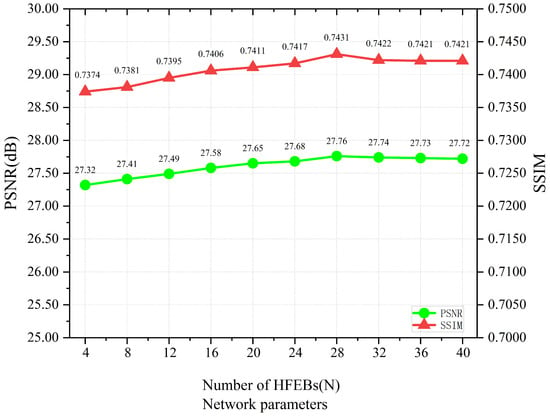
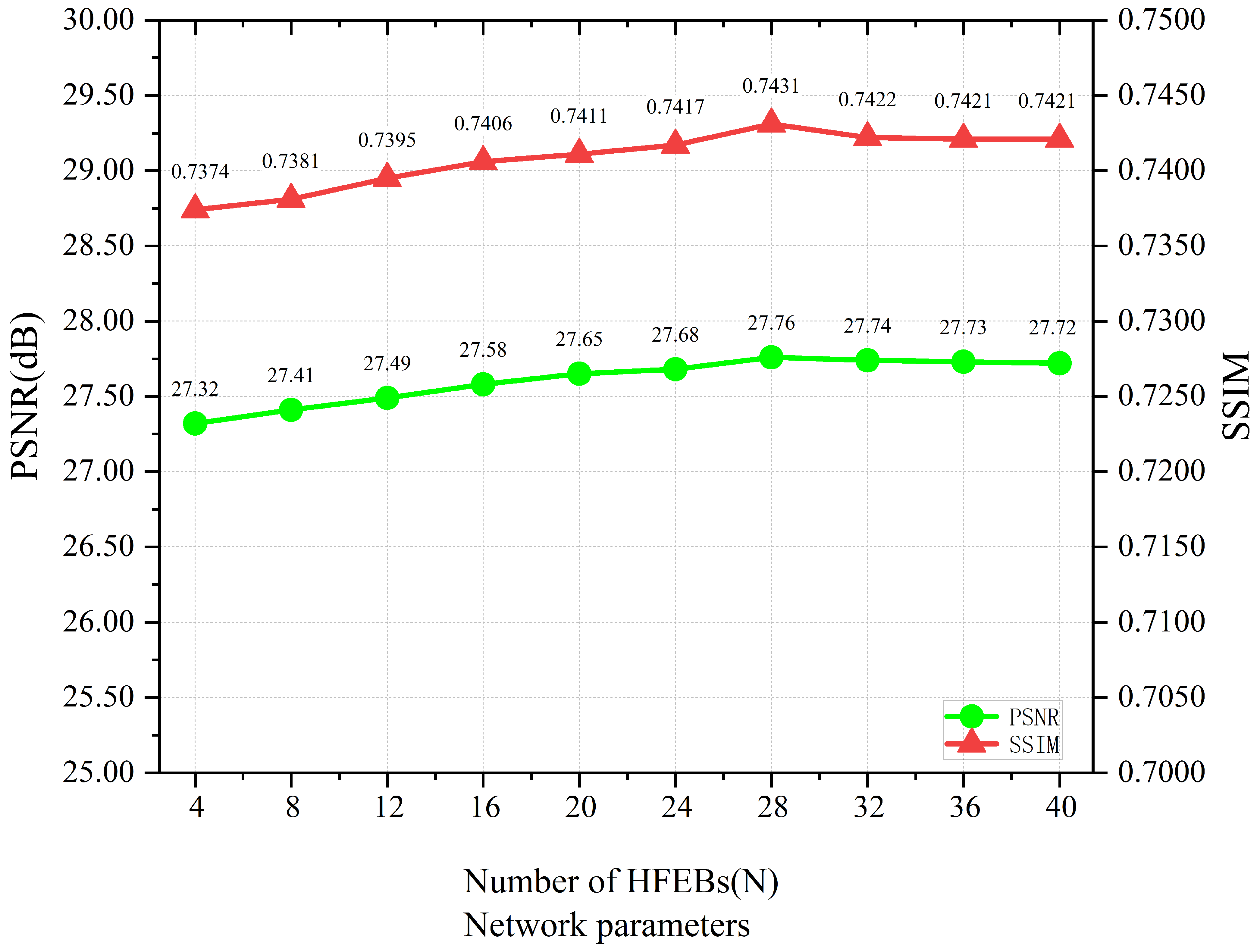
In this subsection, N denotes the number of HFEBs used in EHNet, and the effect of N on the reconstruction performance of EHNet is studied. Figure 5 shows the PSNR/SSIM of HENet as N increases from 4 to 40. It can be seen that as N continues to increase from 4 to 28, the reconstruction performance of EHNet keeps rising and tends to decrease after N = 28. At the same time, the total number of network parameters also increases. Considering the trade-off, EHNet with N = 28 is selected as the final network, achieving the best PSNR/SSIM on the Urban100 dataset in Figure 5.
Figure 5.
PSNR/SSIM results achieved by EHNet on Urban100 dataset as N increases from 4 to 40.
4.4. Comparison with Other Super-Resolution Methods
For the classic image SR task, we quantitatively and qualitatively compare our developed model with a series of state-of-the-art models, namely, SRCNN [9], FSRCNN [31], VDSR [32], DRCN [33], LapSRN [34], IDN [35], CARN [36], LKDN [37], ShuffleMixer [38], OISR [39], BSRN [40], EDSR [11], and RDN [41].
4.4.1. Quantitative Comparison
The quantitative comparison of classic image SR processing methods is shown in Table 1. For a fair comparison, Table 1 shows the average PSNR/SSIM for scale factors 2, 3, and 4 on the datasets Set5, Set14, BSD100, Urban100, and Manga109. The best and second-best results are highlighted in red and blue fonts, respectively. Our proposed model, EHNet, achieves the best performance on all public datasets under X2, X3, and X4 SR tasks. Under the X4 SR task, our proposed EHNet outperforms the second-best method by only 0.04 dB–0.15 dB. Since calculating self-attention in HFEM allows more information to be aggregated within a region, our EHNet shows significant superiority when applied to high-resolution test sets such as Urban100 and Manga109. In particular, for X4 SR training on DIV2K, our EHNet achieves a PSNR score of 31.15 dB on the Manga109 dataset, which is 0.15 dB higher than RDN. The above results strongly support the effectiveness of our EHNet.
Table 1.
Quantitative comparison of PSNR and SSIM for different super-resolution methods across five benchmark datasets (Set5, Set14, BSD100, Urban100, Manga109) for scale factors ×2, ×3, and ×4. The best and second-best results are highlighted in red and blue, respectively.
4.4.2. Qualitative Comparison
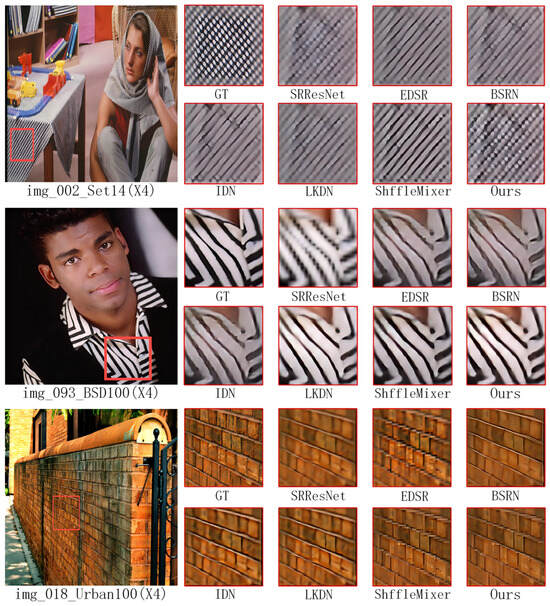
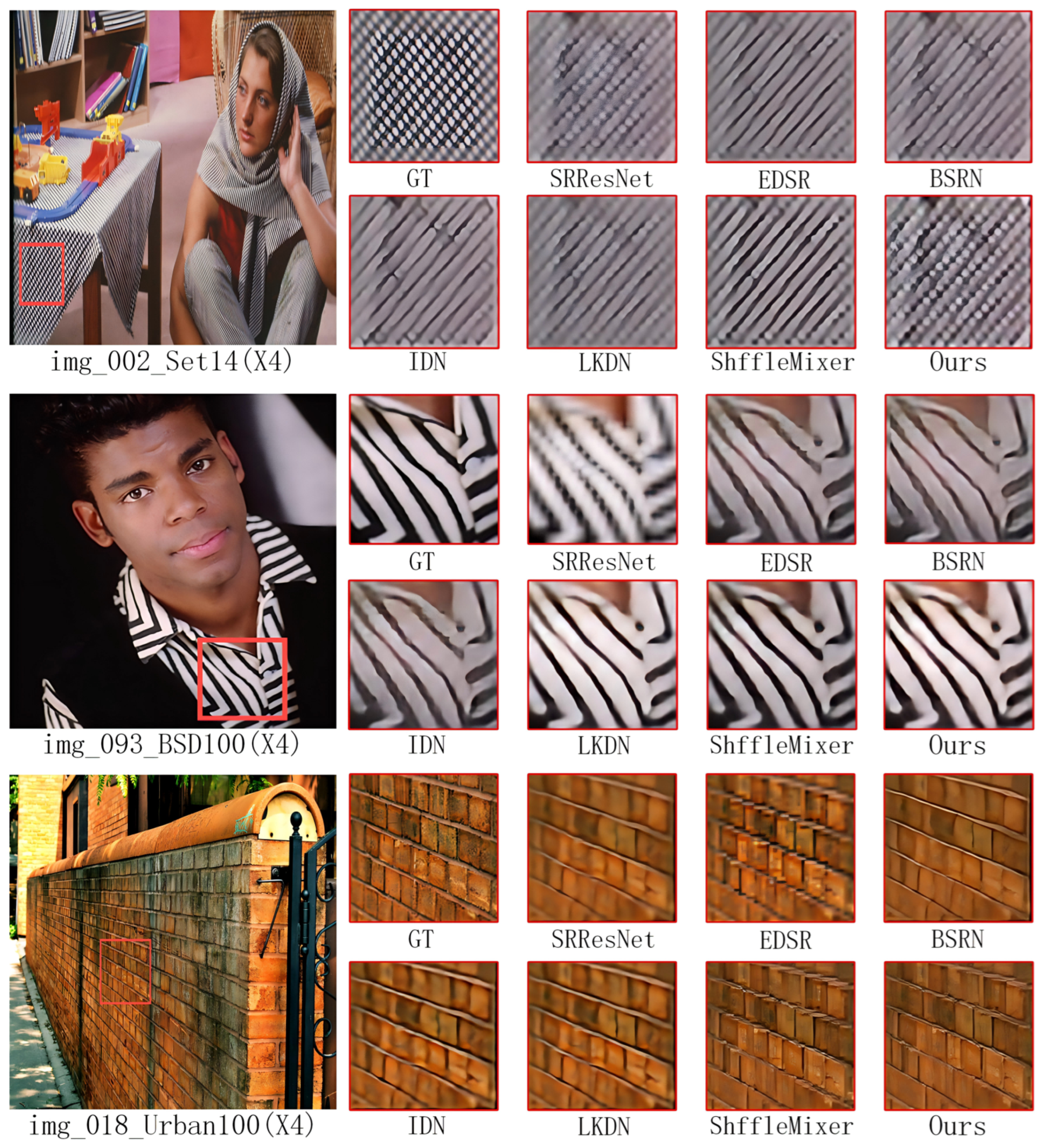
We present a qualitative comparison of EHNet with other state-of-the-art SR methods on the ×4 SR task in Figure 6. From the magnified view, the textures and contours reconstructed by EHNet are closer to the ground truth than those of other methods, restoring clearer and more detailed structures. In contrast, results from other models often appear blurred or contain minor distortions. For example, on img_002 from Set14, EHNet recovers finer details than IDN and BSRN while preserving structural integrity. On img_093 from BSD100, EHNet outperforms EDSR and ShuffleMixer in reconstructing stripes and patterns, maintaining the correct shapes without distortion. These observations demonstrate that EHNet effectively reconstructs high-frequency textures and structural details, consistent with the quantitative improvements reported in Table 1.
Figure 6.
Visual comparison of EHNet with other state-of-the-art methods.
4.4.3. LAM Comparison
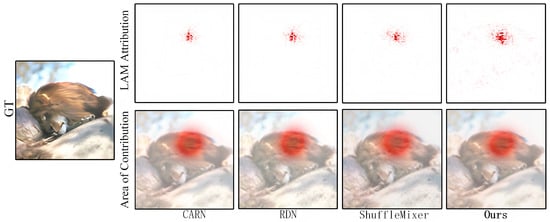
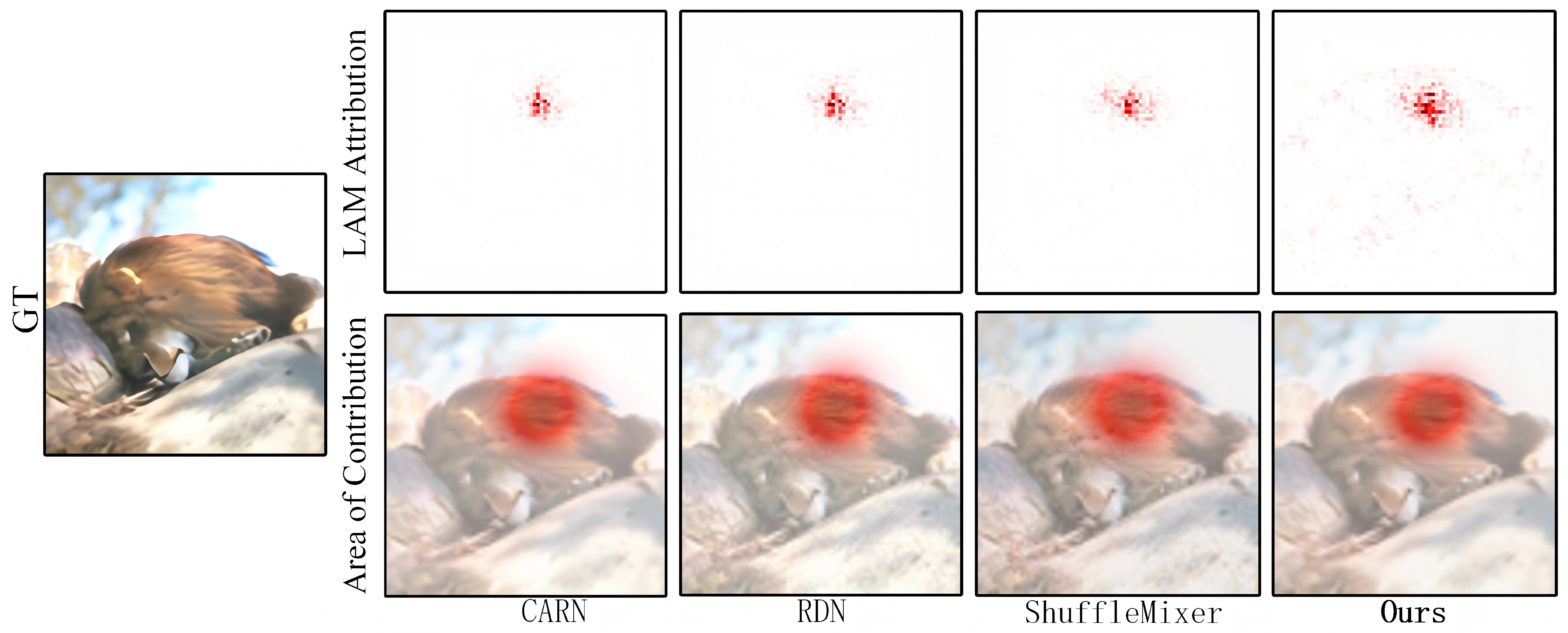
In order to observe the range of pixels used for SR reconstruction, EHNet is compared with several SOTA methods using the interpretability analysis tool LAM [42], as shown in Figure 7. LAM shows the range of pixels used by the super-resolution network when inferring a certain part of the HR image. For the LAM results of multiple challenging examples, the pixel range of the SR image inferred by HENet is significantly larger than that of multiple SOTA methods. The experimental results are consistent with our motivation and demonstrate the superiority of our method from the perspective of interpretability.
Figure 7.
LAM comparisons between SOTA methods and the proposed EHNet. Results of the sample from BSD100 datasets are presented. One can find that the proposed EHNet outperforms other advanced models with lager receptive fields and richer textures (zoom in for more details).
4.5. Ablation Experiment
We conducted detailed ablation studies to evaluate the effectiveness of each key module in EHNet. For the EDCB, Table 2 shows that adding dual convolution, normalization, SiLU, and dropout progressively improves PSNR and SSIM, indicating enhanced local feature extraction. For the HCFB, Table 3 demonstrates that channel fusion and large-kernel convolution contribute to improved global structure modeling. Finally, embedding SGSA into the HFEB block further increases PSNR/SSIM by focusing on salient features and aggregating long-range dependencies, as presented in Table 4. These results elucidate the individual contributions of EHNet’s components and highlight their importance for high-quality SR reconstruction.
Table 2.
The ablation analysis for EDCB in EHNet on Urban100 for ×4 SR.
Table 3.
The ablation analysis for HCFB in EHNet on Urban100 for ×4 SR.
Table 4.
The ablation analysis for components of attentional mechanisms on Urban100 for ×4 SR.
4.5.1. Effectiveness of Enhanced Double-Convolution Block
Table 2 shows that including the EDCB progressively improves the PSNR and SSIM on the Urban100 ×4 SR dataset. Specifically, adding dual convolution alone achieves 26.54 dB/0.7969, and including normalization, SiLU activation, and dropout incrementally increases the performance to 26.66 dB/0.8056. This demonstrates that the EDCB effectively extracts and integrates local features, particularly for high-frequency details.
4.5.2. Effectiveness of Hybrid-Channel Fusion Block
Table 3 shows that adding the HCFB to the baseline (with EDCB and SGSA) further improves PSNR/SSIM from 26.45/0.7894 to 26.66/0.8056. This indicates that the HCFB enhances global structure modeling while maintaining local detail, improving overall reconstruction robustness.
Although HCFB reduces feature redundancy through channel segmentation and selective large-kernel convolution, important information is preserved via residual feature aggregation and complementary channel interactions. The proposed method does not rely on a fixed redundancy threshold; instead, the network adaptively learns which features to retain during training, ensuring critical information is preserved while redundant components are suppressed. Ablation results in Table 3 confirm that HCFB improves reconstruction performance without causing feature loss.
4.5.3. Effectiveness of Sparse Global Self-Attention
We experiment with three different attention blocks in the model. The results are shown in Table 4. Compared with the network structure without attention blocks, the performances of CCA [20] and ESA [21] are improved by 0.07–0.10 dB, which shows that the attention module is indeed helpful. Embedding SGSA into the HFEB feature extraction block achieves a performance gain of up to 0.12 dB, highlighting its ability to focus on salient features and long-range dependencies.
4.5.4. Real-World Image Super-Resolution
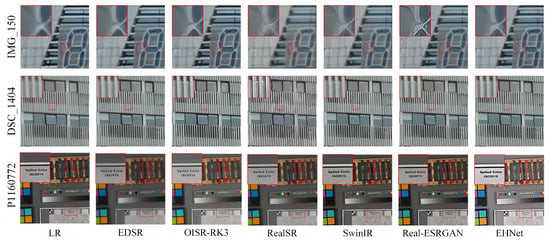
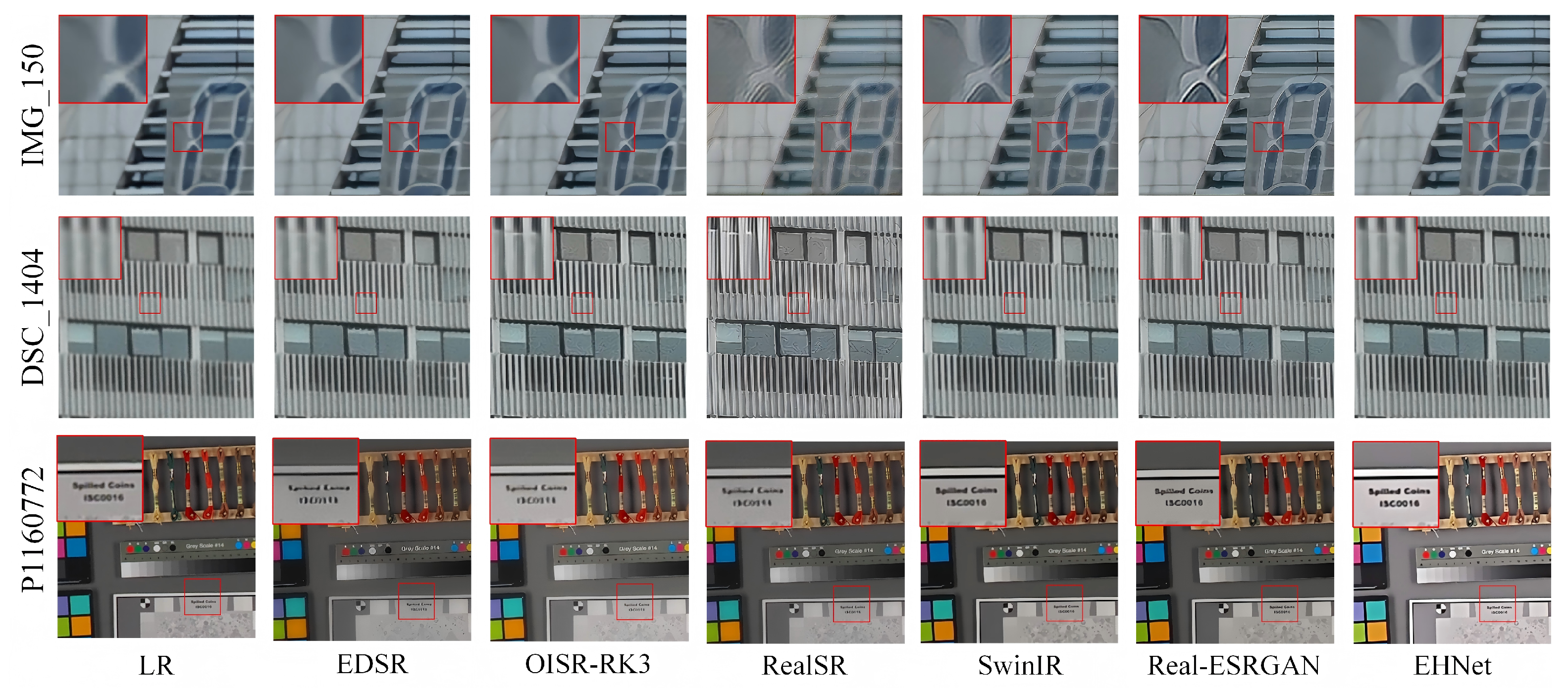
Since the ultimate goal of image SR is to address rich real-world degradations and generate more visually realistic images, following SwinIR [43] and BSRGAN [44], EHNet is retrained using multiple degradations, and the results are shown in Figure 8. When processing real-world images, EHNet still produces more realistic and visually realistic textures and details, which demonstrates the robustness of our approach.
Figure 8.
Qualitative comparisons with recent state-of-the-art methods on the X4 real-world image SR task.
5. Conclusions
In this paper, we propose a novel super-resolution network, EHNet, which integrates the EDCB and the HCFB. EHNet is designed to impose multi-scale image block constraints, enabling more accurate HR patch selection and super-resolution reconstruction while reducing the likelihood of inaccurate feature correspondences. This facilitates the recovery of high-frequency details such as textures and fine structures. Motivated by the importance of deep feature enhancement in existing architectures, EDCB adopts a dual-convolution strategy to effectively fuse local and global features, thereby improving reconstruction in detail-rich and edge-sensitive regions. To further enhance the modeling of structural information at various scales, HCFB combines channel segmentation with large-kernel convolution. This design allows different channel groups to focus on distinct feature aspects while expanding the receptive field, which enhances the extraction of both fine-grained details and global structures. Extensive experiments demonstrate that EHNet outperforms state-of-the-art SR methods across qualitative, quantitative, and LAM-based evaluations while also significantly suppressing artifacts in complex scenes. Although EHNet achieves competitive reconstruction performance, the network still has some limitations. First, the current experiments mainly focus on bicubic degradation, and the generalization of EHNet to more complex or real-world degradations requires further investigation. Second, while EHNet produces high-quality SR images, its performance in downstream vision tasks such as segmentation or classification has not been evaluated. These aspects provide directions for future research. Future work will focus on evaluating the applicability of SR images generated by EHNet in downstream vision tasks.
Author Contributions
Conceptualization, S.S. and Y.Z.; methodology, S.S.; software, S.S.; validation, S.S., W.Y. and R.Y.; formal analysis, S.S.; investigation, S.S.; data curation, W.Y.; writing—original draft preparation, S.S.; writing—review and editing, Y.Z. and W.Y.; visualization, S.S.; supervision, Y.Z.; project administration, Y.Z.; funding acquisition, Y.Z. All authors have read and agreed to the published version of the manuscript.
Funding
This research was funded by Changzhou Municipal Science and Technology Bureau, China, grant number CJ20240047.
Data Availability Statement
The data that support the findings of this study are available from the corresponding author upon reasonable request.
Conflicts of Interest
The authors declare no competing interests.
References
- Lepcha, D.C.; Goyal, B.; Dogra, A.; Goyal, V. Image super-resolution: A comprehensive review, recent trends, challenges and applications. Inf. Fusion 2023, 91, 230–260. [Google Scholar] [CrossRef] [Scilit]
- Chen, H.; He, X.; Qing, L.; Wu, Y.; Ren, C.; Sheriff, R.E.; Zhu, C. Real-world single image super-resolution: A brief review. Inf. Fusion 2022, 79, 124–145. [Google Scholar] [CrossRef] [Scilit]
- Wang, Z.; Chen, J.; Hoi, S.C. Deep learning for image super-resolution: A survey. IEEE Trans. Pattern Anal. Mach. Intell. 2020, 43, 3365–3387. [Google Scholar] [CrossRef] [Scilit]
- Tian, C.; Yuan, Y.; Zhang, S.; Lin, C.W.; Zuo, W.; Zhang, D. Image super-resolution with an enhanced group convolutional neural network. Neural Netw. 2022, 153, 373–385. [Google Scholar] [CrossRef] [Scilit]
- Chen, Y.; Xia, R.; Yang, K.; Zou, K. MFFN: Image super-resolution via multi-level features fusion network. Vis. Comput. 2024, 40, 489–504. [Google Scholar] [CrossRef] [Scilit]
- Wang, H.; Wei, Z.; Tang, Q.; Cheng, S.; Wang, L.; Li, Y. Attention Guidance Distillation Network for Efficient Image Super-Resolution. In Proceedings of the IEEE/CVF Conference on Computer Vision and Pattern Recognition, Seattle, WA, USA, 16–17 June 2024; pp. 6287–6296. [Google Scholar]
- Liu, S.; Yan, K.; Qin, F.; Wang, C.; Ge, R.; Zhang, K.; Huang, J.; Peng, Y.; Cao, J. Infrared image super-resolution via lightweight information split network. In Proceedings of the International Conference on Intelligent Computing; Springer: Berlin/Heidelberg, Germany, 2024; pp. 293–304. [Google Scholar]
- Tian, C.; Zhang, X.; Ren, J.; Zuo, W.; Zhang, Y.; Lin, C.W. A heterogeneous dynamic convolutional neural network for image super-resolution. arXiv 2024, arXiv:2402.15704. [Google Scholar]
- Dong, C.; Loy, C.C.; He, K.; Tang, X. Learning a deep convolutional network for image super-resolution. In Proceedings of the Computer Vision—ECCV 2014: 13th European Conference, Zurich, Switzerland, 6–12 September 2014; Proceedings Part IV; Springer: Berlin/Heidelberg, Germany, 2014; Volume 13, pp. 184–199. [Google Scholar]
- He, K.; Zhang, X.; Ren, S.; Sun, J. Deep residual learning for image recognition. In Proceedings of the IEEE Conference on Computer Vision and Pattern Recognition, Las Vegas, NV, USA, 26 June–1 July 2016; pp. 770–778. [Google Scholar]
- Lim, B.; Son, S.; Kim, H.; Nah, S.; Mu Lee, K. Enhanced deep residual networks for single image super-resolution. In Proceedings of the IEEE Conference on Computer Vision and Pattern Recognition Workshops, Honolulu, HI, USA, 21–26 July 2017; pp. 136–144. [Google Scholar]
- Liu, J.; Zhang, W.; Tang, Y.; Tang, J.; Wu, G. Residual feature aggregation network for image super-resolution. In Proceedings of the IEEE/CVF Conference on Computer Vision and Pattern Recognition, Virtual, 13–19 June 2020; pp. 2359–2368. [Google Scholar]
- Shi, W.; Caballero, J.; Huszár, F.; Totz, J.; Aitken, A.P.; Bishop, R.; Rueckert, D.; Wang, Z. Real-time single image and video super-resolution using an efficient sub-pixel convolutional neural network. In Proceedings of the IEEE Conference on Computer Vision and Pattern Recognition, Las Vegas, NV, USA, 26 June–1 July 2016; pp. 1874–1883. [Google Scholar]
- Zhong, J.; Chen, J.; Mian, A. DualConv: Dual convolutional kernels for lightweight deep neural networks. IEEE Trans. Neural Netw. Learn. Syst. 2022, 34, 9528–9535. [Google Scholar] [CrossRef] [Scilit] [PubMed]
- Wang, Q.; Shi, S.; Zheng, S.; Zhao, K.; Chu, X. Fadnet: A fast and accurate network for disparity estimation. In Proceedings of the 2020 IEEE International Conference on Robotics and Automation (ICRA); IEEE: New York, NY, USA, 2020; pp. 101–107. [Google Scholar]
- Tiwari, P.; Qian, J.; Li, Q.; Wang, B.; Gupta, D.; Khanna, A.; Rodrigues, J.J.; de Albuquerque, V.H.C. Detection of subtype blood cells using deep learning. Cogn. Syst. Res. 2018, 52, 1036–1044. [Google Scholar] [CrossRef] [Scilit]
- Lei, T.; Wang, J.; Ning, H.; Wang, X.; Xue, D.; Wang, Q.; Nandi, A.K. Difference enhancement and spatial–spectral nonlocal network for change detection in VHR remote sensing images. IEEE Trans. Geosci. Remote Sens. 2021, 60, 1–13. [Google Scholar] [CrossRef] [Scilit]
- Yan, Y.; Zhang, L.; Li, J.; Wei, W.; Zhang, Y. Accurate spectral super-resolution from single RGB image using multi-scale CNN. In Proceedings of the Pattern Recognition and Computer Vision: First Chinese Conference, PRCV 2018, Guangzhou, China, 23–26 November 2018; Proceedings Part II; Springer: Berlin/Heidelberg, Germany, 2018; Volume 1, pp. 206–217. [Google Scholar]
- Prajapati, K.; Chudasama, V.; Patel, H.; Sarvaiya, A.; Upla, K.P.; Raja, K.; Ramachandra, R.; Busch, C. Channel split convolutional neural network (ChaSNet) for thermal image super-resolution. In Proceedings of the IEEE/CVF Conference on Computer Vision and Pattern Recognition, Virtual, 21–24 June 2021; pp. 4368–4377. [Google Scholar]
- Hui, Z.; Gao, X.; Yang, Y.; Wang, X. Lightweight image super-resolution with information multi-distillation network. In Proceedings of the 27th ACM International Conference on Multimedia, Nice, France, 21–25 October 2019; pp. 2024–2032. [Google Scholar]
- Liu, J.; Tang, J.; Wu, G. Residual feature distillation network for lightweight image super-resolution. In Proceedings of the Computer Vision–ECCV 2020 Workshops, Glasgow, UK, 23–28 August 2020; Proceedings, Part III; Springer: Berlin/Heidelberg, Germany, 2020; Volume 16, pp. 41–55. [Google Scholar]
- Su, Z.; Wang, L. Channel Splitting Network for Single Image Dehazing. In Proceedings of the 2020 IEEE 20th International Conference on Communication Technology (ICCT); IEEE: New York, NY, USA, 2020; pp. 1333–1337. [Google Scholar]
- Lee, D.; Yun, S.; Ro, Y. Partial large kernel CNNS for efficient super-resolution. arXiv 2024, arXiv:2404.11848. [Google Scholar] [CrossRef] [Scilit]
- Agustsson, E.; Timofte, R. Ntire 2017 challenge on single image super-resolution: Dataset and study. In Proceedings of the IEEE Conference on Computer Vision and Pattern Recognition Workshops, Honolulu, HI, USA, 21–26 July 2017; pp. 126–135. [Google Scholar]
- Bevilacqua, M.; Roumy, A.; Guillemot, C.; Alberi-Morel, M.L. Low-complexity single-image super-resolution based on nonnegative neighbor embedding. In Proceedings of the 23rd British Machine Vision Conference (BMVC); BMVA Press: Malvern, UK, 2012. [Google Scholar]
- Zeyde, R.; Elad, M.; Protter, M. On single image scale-up using sparse-representations. In Proceedings of the Curves and Surfaces: 7th International Conference, Avignon, France, 24–30 June 2010; Revised Selected Papers 7; Springer: Berlin/Heidelberg, Germany, 2012; pp. 711–730. [Google Scholar]
- Martin, D.; Fowlkes, C.; Tal, D.; Malik, J. A database of human segmented natural images and its application to evaluating segmentation algorithms and measuring ecological statistics. In Proceedings Eight IEEE International Conference on Computer Vision, ICCV 2001; IEEE: New York, NY, USA, 2001; Volume 2, pp. 416–423. [Google Scholar]
- Huang, J.B.; Singh, A.; Ahuja, N. Single image super-resolution from transformed self-exemplars. In Proceedings of the IEEE Conference on Computer Vision and PATTERN Recognition, Boston, MA, USA, 8–10 June 2015; pp. 5197–5206. [Google Scholar]
- Matsui, Y.; Ito, K.; Aramaki, Y.; Fujimoto, A.; Ogawa, T.; Yamasaki, T.; Aizawa, K. Sketch-based manga retrieval using manga109 dataset. Multimed. Tools Appl. 2017, 76, 21811–21838. [Google Scholar] [CrossRef] [Scilit]
- Kingma, D.P.; Ba, J. Adam: A method for stochastic optimization. arXiv 2014, arXiv:1412.6980. [Google Scholar]
- Dong, C.; Loy, C.C.; Tang, X. Accelerating the super-resolution convolutional neural network. In Proceedings of the Computer Vision—ECCV 2016: 14th European Conference, Amsterdam, The Netherlands, 11–14 October 2016; Proceedings Part II; Springer: Berlin/Heidelberg, Germany, 2016; Volume 14, pp. 391–407. [Google Scholar]
- Kim, J.; Lee, J.K.; Lee, K.M. Accurate image super-resolution using very deep convolutional networks. In Proceedings of the IEEE Conference on Computer Vision and Pattern Recognition, Las Vegas, NV, USA, 26 June–1 July 2016; pp. 1646–1654. [Google Scholar]
- Kim, J.; Lee, J.K.; Lee, K.M. Deeply-recursive convolutional network for image super-resolution. In Proceedings of the IEEE Conference on Computer Vision and Pattern Recognition, Las Vegas, NV, USA, 26 June–1 July 2016; pp. 1637–1645. [Google Scholar]
- Lai, W.S.; Huang, J.B.; Ahuja, N.; Yang, M.H. Deep laplacian pyramid networks for fast and accurate super-resolution. In Proceedings of the IEEE Conference on Computer Vision and Pattern Recognition, Honolulu, HI, USA, 21 July–26 July 2017; pp. 624–632. [Google Scholar]
- Hui, Z.; Wang, X.; Gao, X. Fast and accurate single image super-resolution via information distillation network. In Proceedings of the IEEE Conference on Computer Vision and Pattern Recognition, Salt Lake City, UT, USA, 18–23 June 2018; pp. 723–731. [Google Scholar]
- Ahn, N.; Kang, B.; Sohn, K.A. Fast, accurate, and lightweight super-resolution with cascading residual network. In Proceedings of the European Conference on Computer Vision (ECCV), Munich, Germany, 8–14 September 2018; pp. 252–268. [Google Scholar]
- Xie, C.; Zhang, X.; Li, L.; Meng, H.; Zhang, T.; Li, T.; Zhao, X. Large kernel distillation network for efficient single image super-resolution. In Proceedings of the IEEE/CVF Conference on Computer Vision and Pattern Recognition, Vancouver, BC, Canada, 17–24 June 2023; pp. 1283–1292. [Google Scholar]
- Sun, L.; Pan, J.; Tang, J. Shufflemixer: An efficient convnet for image super-resolution. Adv. Neural Inf. Process. Syst. 2022, 35, 17314–17326. [Google Scholar]
- He, X.; Mo, Z.; Wang, P.; Liu, Y.; Yang, M.; Cheng, J. Ode-inspired network design for single image super-resolution. In Proceedings of the IEEE/CVF Conference on Computer Vision and Pattern Recognition, Long Beach, CA, USA, 16–20 June 2019; pp. 1732–1741. [Google Scholar]
- Li, Z.; Liu, Y.; Chen, X.; Cai, H.; Gu, J.; Qiao, Y.; Dong, C. Blueprint separable residual network for efficient image super-resolution. In Proceedings of the IEEE/CVF Conference on Computer Vision and Pattern Recognition, New Orleans, LA, USA, 19–20 June 2022; pp. 833–843. [Google Scholar]
- Zhang, Y.; Tian, Y.; Kong, Y.; Zhong, B.; Fu, Y. Residual dense network for image super-resolution. In Proceedings of the IEEE Conference on Computer Vision and Pattern Recognition, Salt Lake City, UT, USA, 19–21 June 2018; pp. 2472–2481. [Google Scholar]
- Gu, J.; Dong, C. Interpreting super-resolution networks with local attribution maps. In Proceedings of the IEEE/CVF Conference on Computer Vision and Pattern Recognition, Virtual, 19–25 June 2021; pp. 9199–9208. [Google Scholar]
- Liang, J.; Cao, J.; Sun, G.; Zhang, K.; Van Gool, L.; Timofte, R. Swinir: Image restoration using swin transformer. In Proceedings of the IEEE/CVF International Conference on Computer Vision, Virtual, 11–17 October 2021; pp. 1833–1844. [Google Scholar]
- Zhang, K.; Liang, J.; Van Gool, L.; Timofte, R. Designing a practical degradation model for deep blind image super-resolution. In Proceedings of the IEEE/CVF International Conference on Computer Vision, Virtual, 11–17 October 2021; pp. 4791–4800. [Google Scholar]

Disclaimer/Publisher’s Note: The statements, opinions and data contained in all publications are solely those of the individual author(s) and contributor(s) and not of MDPI and/or the editor(s). MDPI and/or the editor(s) disclaim responsibility for any injury to people or property resulting from any ideas, methods, instructions or products referred to in the content. |
© 2026 by the authors. Licensee MDPI, Basel, Switzerland. This article is an open access article distributed under the terms and conditions of the Creative Commons Attribution (CC BY) license.