


Abstract
Speech alterations are early markers of neurodegenerative diseases. Transformer-based speech models such as Whisper have advanced automated speech assessment, but most systems rely on cloud-based computation, raising privacy concerns. On-device processing could offer a scalable and privacy-preserving alternative. This research’s objective was to evaluate whether a fully on-device speech analysis pipeline can achieve competitive accuracy in detecting Alzheimer’s disease and to quantify the contributions of acoustic, linguistic, and embedding features. Therefore, we developed an iOS application running all components, including acoustic analysis, two transformer-based speech-to-text modules (WhisperBase and quantized CrisperWhisper), linguistic feature extraction, and embedding generation, directly on the device. Using the ADReSS Challenge 2020 dataset (N = 156), we trained classical machine-learning classifiers across 20 configurations and evaluated them via a stratified 10-fold cross-validation. Area under the receiver operating curve (AUC), accuracy, precision, recall, and F1 scores were used as performance metrics. An ablation study examined the relevance of each feature group. The best-performing setup (Random Forest with CrisperWhisper transcription and Apple embeddings) achieved an accuracy of 85.4% and an AUC of 0.85. Performance was 5–7% below benchmark models relying on manual transcripts or server-based processing. Embedding features provided the strongest individual contribution, but the highest accuracy required combining acoustic, linguistic, and embedding information. A fully on-device pipeline for Alzheimer’s disease detection from speech is feasible and achieves competitive accuracy while maintaining strict data privacy. These findings highlight the potential of on-device transformer architectures for scalable, privacy-preserving digital screening. Future work should validate the approach in larger and more diverse cohorts.
1. Introduction
Language assessment plays an important role in the clinical diagnosis of various neurodegenerative diseases (NDDs) [1,2]. As a non-invasive method, the analysis of extended speech production provides information about the phonetic (sounds of speech), phonological (sounds of particular languages), lexical-semantic (word meanings and relationships), morpho-syntactic (forms of words and grammar), and pragmatic (context and meaning of language) levels of language organization. The knowledge of the characteristic linguistic variables that identify language deficits associated with various NDDs has improved increasingly in recent years [2,3,4].
Language deficits occur in different NDDs, sometimes already appearing in the early stages [5]. In early stages of Alzheimer’s disease (AD), patients typically experience lexical-semantic decline, including anomias, semantic paraphasias, and reduced word comprehension, reflecting a breakdown of semantic memory networks [6,7]. Pragmatic abilities are also affected, with alterations in discourse planning that impair the organization and effective communication of information [8]. As AD advances, these deficits become increasingly pervasive. Initial lexical and semantic impairments evolve into profound global language dysfunction, and speech may ultimately become restricted to echolalia and verbal stereotypes, indicating a severe loss of communicative capacity [9]. Language changes also occur in other NDDs, although they present with different emphases. Motor speech disruptions are common in Parkinson’s disease (PD) and amyotrophic lateral sclerosis (ALS), affecting respiration, articulation, and prosody in PD [10], while speech rate and articulation are affected in ALS [11]. Syntactic impairments can also appear in PD, Huntington’s disease (HD), and ALS, ranging from difficulties in verb inflection and sentence comprehension even in non-demented individuals with PD [12] to simplified syntactic structures in HD [13] and deficits in syntactic comprehension in ALS [14,15].
Because such speech changes can already emerge in the early stages of neurodegeneration, analyzing spontaneous speech has become a promising non-invasive approach for early detection and monitoring of NDDs. Over the past decades, clinicians and researchers have developed speech-based assessment techniques from traditional acoustic analyses of voice recordings to advanced natural language processing of speech transcripts to identify linguistic markers correlated with neurodegeneration, enabling models to capture subtle patterns in speech indicative of conditions like AD and PD [16,17,18,19,20,21,22,23,24,25,26]. Recent breakthroughs in transformer architectures not only pushed advances in generative AI but also have further revolutionized automated language assessment, offering the potential to support early diagnosis and monitoring procedures for NDDs by making them widely accessible.
Despite considerable progress in automatic speech analysis for NDDs, current solutions face several important limitations. Existing systems often depend on cloud-based services for speech recognition and language analysis [27,28]. This dependency on external computing resources is a major problem. External processing poses privacy compliance challenges since speech data are a highly sensitive source of information that can be used to uniquely determine a person’s identity [29,30]. In addition, data transfer and analysis places demands on networks and infrastructure. Sending personal audio recordings to external servers can furthermore conflict with strict data protection regulations such as the General Data Protection Regulation (GDPR) [31]. Advances in transformer architectures for automatic speech recognition offer great opportunities to further automate the evaluation of speech tests, but running larger models on smartphones or other edge devices can be prohibitively slow and memory intensive without optimization. In summary, the state of the art is limited by a trade-off between the accuracy and complexity of models versus the feasibility and privacy of deploying them in real-world, everyday settings. A solution must overcome the need for external computation, comply with privacy requirements, and operate efficiently within the limited computational budget of edge devices, while maintaining high diagnostic accuracy.
This research thus aims at providing insights into the feasibility of on-device transformer models for the detection of Alzheimer’s disease that aim at overcoming the aforementioned problems by providing a privacy-preserving solution that is able to run on consumer-grade edge devices such as smartphones and tables. We investigated the following two hypotheses:
Hypothesis 1.
On-device end-to-end speech processing can achieve competitive performance to traditional approaches without requiring external processing power.
Hypothesis 2.
Acoustic, linguistic, and embedding features individually contribute to the classification performance, with each feature group providing distinct and complementary information.
By investigating these hypotheses, this paper delivers the following contributions:
- We develop a fully on-device speech analysis pipeline for Alzheimer’s disease detection, integrating acoustic, linguistic, and embedding-based features within a native mobile application.
- We demonstrate the feasibility of deploying transformer-based speech processing models (WhisperBase and quantized CrisperWhisper) directly on consumer-grade edge devices without relying on cloud-based computation.
- We evaluate the proposed pipeline on the ADReSS Challenge dataset and show that competitive classification performance can be achieved while preserving strict data privacy.
- We systematically analyze the contribution of different feature groups (acoustic, linguistic, and embeddings) through ablation studies and model interpretability techniques.
2. Methods
2.1. Dataset
We used the ADReSS Challenge 2020 [32] dataset to train and test our approach. The ADReSS dataset comprises balanced data of 156 participants (78 AD, 78 HC) (Table 1) performing the Cookie Theft picture description task, a commonly used task in AD diagnosis originating from the Boston Diagnostic Aphasia Examination [33]. The dataset contains the first standardized, balanced corpus for AD research in spontaneous speech, thus serving as a common benchmark in this field. The task recordings are available in audio format, acoustically enhanced by removing background noise and volume normalization. The dataset holds transcripts in the standardized CHAT1 (Codes for the Human Analysis of Transcripts) format, including timestamp markers, along with special labels for pauses, unintelligible words, self-corrections, and other common phenomena in spontaneous speech.
Table 1.
Basic characteristics of the patients in each group in the ADReSS challenge dataset.
2.2. Speech Processing Pipeline
To realize the on-device speech processing pipeline, we developed a native mobile application for the iOS platform. The mobile application consists of several components: an acoustic analyzer, a speech-to-text (STT) module using Whisper and CrisperWhisper, a linguistic analyzer, and a classifier to obtain the final classification result. All components run on device and require no external server, thus preserving the user’s privacy efficiently.
The STT module runs two transcription tasks in parallel to extract a maximum of information from the recording: CrisperWhisper to obtain a verbatim transcription including filler words and repetitive utterances and WhisperBase for a concise transcription of the content. To enable near-real-time processing speed on edge devices, we applied mixed-bits quantization and palettization for the CrisperWhisper model. Mixed-bits quantization reduces model size by reducing the dimensionality of the model, while palettization achieves size reduction by clustering weights and storing them in a lookup table. To distinguish our compressed version of CrisperWhisper from the non-compressed version, we will further refer to it as CrisperWhisper(C).
The resulting transcripts were then used to derive linguistic features, including lexico-syntactic features, lexical diversity measures, fluency features, and readability features (see Table A1). Furthermore, we employed two different embedding models (DistilBERT, 756-dimensional vector, and Swift NLP, 512-dimensional vector) to generate vector representations of the texts. The transcripts were extended by integrating information about pause lengths following Yuan et al. [25,26] to preserve temporal information. Pauses were grouped by duration (<0.5 s, 0.5–2 s, >2 s) and encoded using up to three punctuations, representing their length. Any existing punctuation was removed from the transcript before integrating the temporal information.
Additional acoustic features were derived from the audio files using the openSmile library, which extracts 88 audio features based on the Geneva Minimalistic Acoustic Parameter Set (GeMAPS), including features such as fundamental frequency, jitter, shimmer, formant frequencies, and spectral energy [34].
The derived audio, linguistic, and embedding features sum up to a total of 629 features and were further extended by including the user’s age and gender. These features were then standardized using the Yeo–Johnson transformation to achieve a Gaussian distribution to improve classification performance. Furthermore, z-score normalization was applied to mitigate issues regarding different measurement units or large differences in feature scales.
2.3. Classifier Training
Classifier training was performed using the PyCaret framework (version 3.3.2; https://pycaret.gitbook.io/ (accessed on 26 January 2026)). In this framework, preprocessing steps, including normalization, transformation, and feature selection, are integrated into a pipeline that is applied within each fold. This setup ensures that feature selection is performed exclusively on the training portion of each fold and not on the full dataset, thereby preventing data leakage and overly optimistic performance estimates. To prevent overfitting and improve generalizability, feature selection was performed using a univariate approach based on feature importance scores derived from a LightGBM estimator. The number of retained features was determined automatically by PyCaret. In our setup, approximately 20% of the features were selected, corresponding to around 126 features on average across folds. We selected five classification models to identify the best approach for our pipeline, including Random Forests (RF), Extra Trees (ET), AdaBoost (ADA), Support Vector Machines (SVM), and Logistic Regression (LR). The classifiers were trained on the ADReSS challenge dataset (Section 2.1) using a 10-fold StratifiedKFold evaluation approach. The hold-out test set as provided in the ADReSS Challenge dataset was not used during training, feature selection, or model selection. Due to the small amount of samples in the ADReSS challenge dataset, we refrained from applying end-to-end deep learning approaches. This design choice was motivated by the relatively small dataset size, which increases the risk of overfitting when training more complex models. Classical models such as Random Forests and Support Vector Machines provide robust performance under such conditions and allow for a more controlled evaluation of feature contributions. Furthermore, the primary focus of this work is not to propose a novel classification architecture, but to demonstrate the feasibility of a complete on-device pipeline integrating multiple processing steps under real-world constraints.
2.4. Evaluation
2.4.1. Speech-to-Text Performance
During the implementation of the mobile application, we evaluated the performance of WhisperBase, CrisperWhisper, and the palettized and quantized version of CrisperWhisper on an iPhone 15 Pro. We evaluated transcription quality, file size, processing speed in tokens per second, and memory consumption in gigabytes on sample inputs.
2.4.2. Classifier Performance
Classifier performance was evaluated based on the test data from the ADReSS dataset to achieve comparability with the benchmark. Each classifier trained on a set of different inputs: with the output of one of the two transcription models and one of the two embeddings, resulting in 20 configurations (5 models × 2 text outputs × 2 embeddings). We selected two metrics for performance comparison: accuracy and area under the ROC curve (AUC). These metrics offer insights into different aspects of classification performance. Accuracy highlights overall correctness and was the main metric used in the ADReSS Challenge [32], while AUC captures the ranking quality, thus enabling different insights into model performance.
For a binary classification, accuracy is given by
AUC summarizes the performance of a classifier by integrating the trade-off between true positive rate (TPR) and false positive rate (FPR) across different classification thresholds. For a binary classifier, AUC is computed as the area under the receiver operating characteristic (ROC) curve as follows:
Since the ADreSS challenge additionally reported precision, recall, and F1 scores, we also computed them to ensure comparability of our results against previous research.
2.4.3. Ablation Study
We furthermore performed an ablation study to gain insights into the contributions of the acoustic, linguistic, and embedding features comparing the four different combinations (all three vs. only two feature sets combined). Feature importance was further assessed using SHapley Additive exPlanations (SHAP), a game-theoretic framework that quantifies the contribution of each input feature to individual model predictions in a consistent and locally accurate manner [35].
3. Results
3.1. Speech-to-Text Performance
While we were able to run the non-compressed version of CrisperWhisper on the iPhone 15 Pro, its requirements in terms of size and memory were significantly higher, whereas speed was lower than for the other two models (see Table 2). However, it delivered the most accurate transcription in the test, including filler words (see Table 3). However, even the iPhone 15 Pro failed at transcribing longer speech inputs due to memory overflow, rendering it unusable for our research. The WhisperBase showed accurate transcription, fastest processing time, and smallest memory and file size, but did not transcribe filler words. The compressed version of CrisperWhisper delivered good processing speed, but the least accurate transcriptions. Due to the constraints in using the non-compressed CrisperWhisper version, we only continued our research with WhisperBase and CrisperWhisper compressed.
Table 2.
Comparison of WhisperBase, CrisperWhisper, and CrisperWhisper(C) (mixed-bit quantized and 4-bit palettized).
Table 3.
Comparison of WhisperBase, CrisperWhisper, and CrisperWhisper(C) (mixed-bit quantized and 4-bit palettized) on an audio sample.
3.2. Classifier Performance
To evaluate classifier performance, we calculated AUC, accuracy, recall, precision, and F1 score for 20 classifier combinations and compared them (see Table 4). Training metrics for the 10-fold cross-validation are reported in Appendix B. The best overall processing pipeline was the Random Forest Model using CrisperWhisper(C) + Apple embeddings, achieving the highest accuracy, precision, recall, and F1 score (all around 0.85). The best AUC (0.87) was achieved by the Extra Trees Classifier using WhisperBase + BERT, with an accuracy, precision, recall, and F1 score of around 0.83. Since the ADReSS Challenge primarily used accuracy for scoring, we continued our analysis with the classifier with the best accuracy: the Random Forest Model using CrisperWhisper(C) + Apple embeddings.
Table 4.
Classification accuracy comparison of embeddings created with DistilBERT and Apple on WhisperBase and CrisperWhisper(C) transcription on the test set.
3.3. Ablation Study
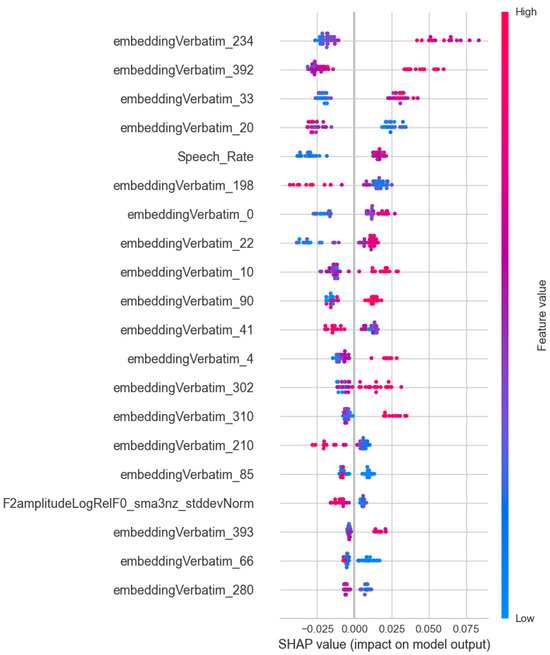
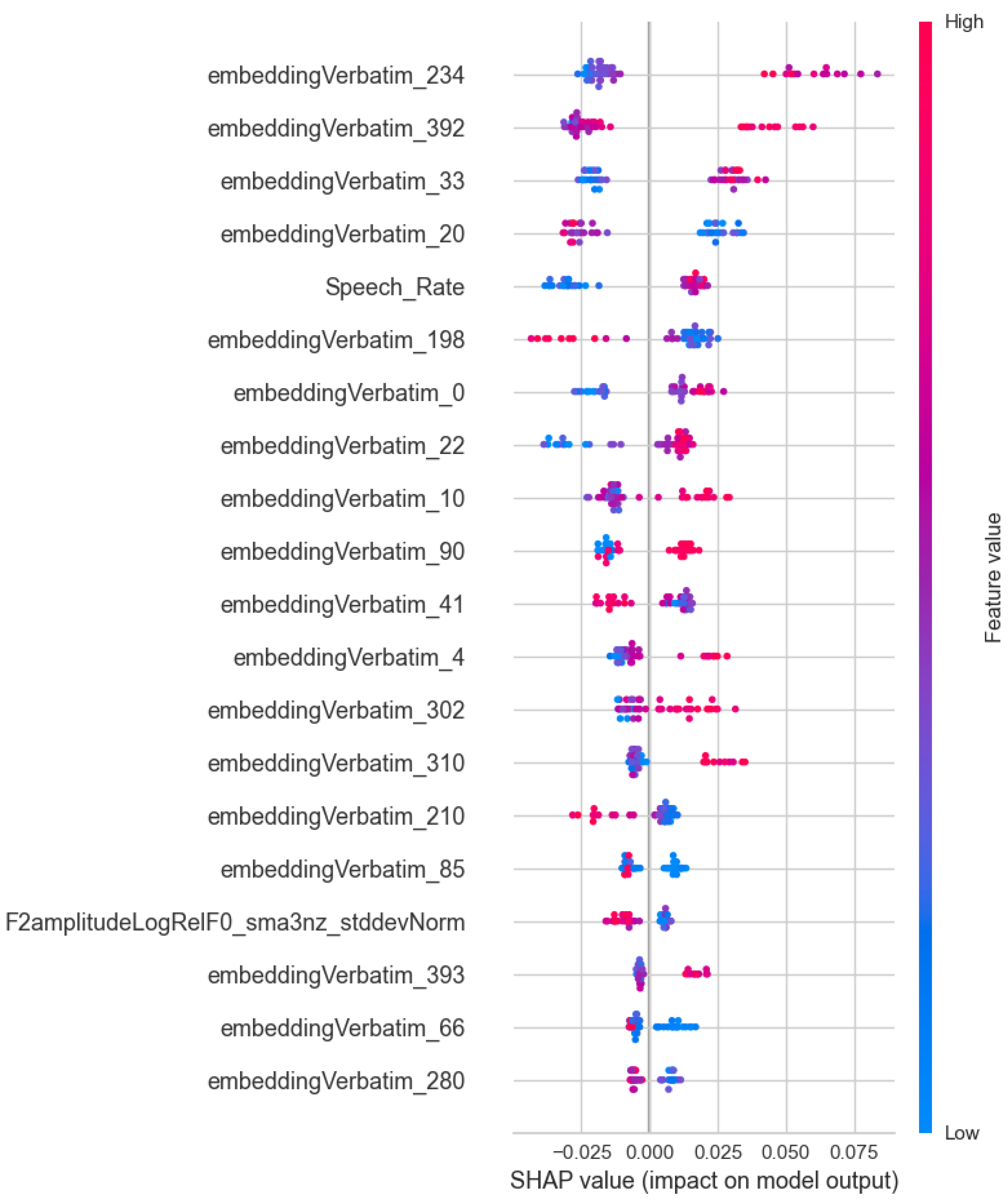
The highest accuracy (0.85) was achieved when all three feature types (Embedding (EB) + Acoustic (AC) + Linguistic (LI)) were included (see Table 5). Omitting any feature category led to lower accuracy, precision, recall, and F1 scores, indicating that all features contain distinct information not included in the other features. However, the most relevant information for classification was included in the embedding features, resulting in an accuracy of 0.813 when used alone. The importance of the embedding features is further emphasized when looking at the SHAP values (see Figure 1) that include only two non-embedding features (Speech Rate, linguistic feature, and F2amplitudeLogRelF0_sma3nz_stddevNorm, acoustic feature) among the top 20 features. When analyzing the top 100 features, 10 linguistic and 15 acoustic features are included, indicating that the model’s predictions were dominated by embedding dimensions.
Table 5.
Comparison between subsets of embedding, acoustic, and linguistic features on the test set. The best performance metrics are marked in bold for each metric.
Figure 1.
Feature importance using SHAP of Random Forest classifier (EB + AC + LI).
4. Discussion
4.1. General Findings
In this research, we successfully developed an end-to-end processing pipeline to identify speech patterns related to Alzheimer’s disease, running entirely on edge devices such as smartphones or tablets. We compared the performances of two speech-to-text models for transcript creation (CrisperWhisper(C) and WhisperBase) in combination with two embedding algorithms (DistilBERT and Apple Embeddings), all running on an iPhone. The best processing pipeline using CrisperWhisper(C) and Apple Embeddings classified AD on the ADReSS challenge benchmarking dataset with a competitive performance with an accuracy of 85%. Embedding features extracted from the automatically created transcript dominated the classifier performance, with additionally derived acoustic and linguistic features only adding small contributions. While 5–7% lower than established benchmarks in terms of accuracy, our approach delivers competitive performance and a fully automated and privacy-friendly alternative to traditional speech data processing, thus partly confirming H1. Even though the ablation study showed that the prediction was mainly driven by the embedding features, accuracy increased slightly when adding acoustic and linguistic features, hinting at their marginal contributions and thus confirming H2.
4.2. Comparison with Published Benchmarks
Our first hypothesis, to achieve competitive performance on edge devices without the need for external computing power, could only be partially confirmed. Our single-model classifier accuracy of 85.4% on the ADReSS dataset is lower than the previously achieved value of 89.6% by Yuan et al. [25,26] and 91.7% achieved by Martinc et al. [36]. Zaragoza et al. even applied a similar approach using Whisper for automatically transcribing the interviews [37], also resulting in accuracies of around 83%. However, these results can only be compared with a limited extent, as our approach takes the automation of the evaluation one step further through automatic transcription and running end-to-end on edge devices. It is to be expected that an automatic transcription is more error-prone than a manual transcription, which is why part of the loss of accuracy can be attributed to this.
In contrast with the ADReSS challenge benchmarks, which used manual transcripts as input for their classifiers, our approach integrated the transcription process directly into the pipeline. While transformer-based speech recognition frameworks such as Whisper outperform previous speech-to-text models [38], manual transcriptions might still be more accurate. This is even emphasized through the fact that some of the audio data in the ADReSS challenge dataset contain hardly understandable recordings. Moreover, we had to use less accurate models to run on the edge devices to accommodate for their reduced processing powers. While we were able to run CrisperWhisper on device, the processing was comparatively slow (0.2 tokens/second vs. 4 tokens/second for the compressed model). This resulted in two key changes: the use of a quantized model of CrisperWhisper to capture filler words and breaks and the use of WhisperBase instead of Whisper to have a smaller yet still accurate model for transcription. While our WhisperBase transcription outperforms CrisperWhisper in spelling accuracy, it cannot capture disfluencies such as filler words or repetitions. The compression successfully significantly lowered transcription time, but the spelling error rate increased substantially when quantizing the CrisperWhisper model to reduce its size. This compression also introduced issues like hallucinated text and repetitive “looping” outputs.
Moreover, for embedding creation, a distilled version of BERT was used, compared with BERT in the benchmarking papers. The impact of using DistilBERT as a compressed version of BERT is unknown, but a performance decrease is to be expected.
4.3. Model Interpretability
A key observation of this study is that embedding-based features dominate classification performance, as also reflected in the SHAP analysis. While these features provide strong predictive power, they are inherently less interpretable than traditional acoustic or linguistic features. This introduces a trade-off between model performance and interpretability, which is particularly relevant in clinical contexts. Although embedding dimensions themselves are not directly interpretable, they capture complex latent representations of linguistic and semantic information that may not be accessible through handcrafted features. The inclusion of acoustic and linguistic features, even with smaller contributions, partially improves interpretability by linking model behavior to clinically meaningful speech characteristics. Nevertheless, the reliance on embedding-based representations highlights the need for future work on improving the explainability of such models, for example, by mapping embedding dimensions to higher-level linguistic constructs or by combining them with more interpretable feature engineering approaches.
4.4. Benefits of On-Device Processing
Running the entire analysis pipeline on device was a core design requirement of this research. It was primarily motivated by privacy and user protection considerations in the context of disease screening, but also includes other benefits. On-device processing ensures that speech, highly sensitive biometric information, remains under the user’s control and never leaves the device. By eliminating the need for data transmission or centralized storage, on-device analysis substantially reduces security risks and attack surfaces, as unauthorized access would require access to every single device rather than remote exploitation of a central database, thus making attacks more difficult and costly. Moreover, attacks to single devices would only compromise the data obtained from the specific device, while other devices would remain unaffected. Beyond privacy and security, our approach lowers regulatory and ethical barriers associated with processing biometric data, thereby enabling more scalable and affordable screening solutions for diseases known to affect speech. In addition, local processing can improve system responsiveness and reduce latency by avoiding network-related overhead. All of these factors might increase trust and user acceptance of such a tool.
4.5. Runtime and Practicality
While the compressed CrisperWhisper model achieved a processing speed of approximately 4 tokens per second, this does not correspond to strict real-time performance for longer recordings. For typical clinical speech recordings lasting several minutes, transcription may require several minutes of processing time on current hardware. Therefore, the system should be considered near real-time under practical constraints rather than fully real-time. Nevertheless, the achieved performance demonstrates the feasibility of executing end-to-end speech analysis directly on device without external computation. The trade-off between processing speed and model size reflects current limitations of edge-device hardware and model compression techniques. In addition to processing speed, resource consumption is an important factor for practical deployment. The evaluated models showed substantial differences in memory usage and computational requirements, with the compressed CrisperWhisper model significantly reducing memory demands compared with the full model. While precise energy consumption was not directly measured, reduced model size and memory footprint are expected to lower energy usage, which is particularly relevant for mobile devices. Overall, the results indicate that on-device deployment is feasible, although further optimization is required to improve runtime efficiency and energy consumption for real-world clinical applications.
4.6. Limitations
While our research provides a comprehensive evaluation of our end-to-end speech analysis pipeline, some limitations remain. First, despite the ADReSS challenge dataset being used as benchmarking data by several research papers, the dataset size is quite small with participants, which may limit the generalizability of the findings. While the results are promising for providing an easy method for speech analysis, the approach has only been validated against a benchmarking dataset. No external validation on independent datasets was conducted, and future work should evaluate the proposed pipeline across multiple datasets and clinical settings.
Second, the dataset only contains English-speaking participants that were diagnosed with Alzheimer’s disease or recruited as matched controls. No participants with other neurodegenerative diseases such as Parkinson’s disease, amyotrophic lateral sclerosis, or Huntington’s disease, which also show altered speech patterns, were included in this analysis. Therefore, the applicability of the approach to other languages and cultural contexts remains unclear. Since linguistic and acoustic markers of neurodegenerative diseases may vary across languages, further validation in multilingual settings is required.
Third, we used speech-to-text models for automatic transcription of the audio tasks, while benchmarks used the standardized CHAT1 format. While this proposed an interesting approach to enabling end-to-end speech analysis, the performance of these models remains a bottleneck for the whole analysis, since especially the smaller models are still error-prone.
Fourth, experiments were conducted on a single hardware platform (iPhone 15 Pro). Although this device represents a modern consumer-grade smartphone, performance may vary across devices with different computational capabilities. Future work should systematically evaluate hardware generalization across a broader range of edge devices.
Fifth, no direct comparison with state-of-the-art approaches has been conducted due to differences in experimental setups. Many existing studies rely on manually transcribed data or cloud-based processing, whereas our approach integrates automatic transcription and operates fully on device. These differences introduce additional sources of error, particularly in transcription quality, which may partially explain performance gaps. Nevertheless, our results demonstrate that competitive performance can be achieved under stricter constraints, highlighting the potential of on-device approaches for privacy-preserving applications.
5. Conclusions
This research achieved a proof-of-concept implementation of an end-to-end speech analysis pipeline, able to run on edge devices such as smartphones and tablets. The showcased on-device detection of Alzheimer’s disease was based on different audio, linguistic, and embedding features extracted from audio recordings. In an evaluation based on the ADReSS challenge dataset, our pipeline achieved a competitive accuracy of 85.4%, thus highlighting the possibilities of such approaches in privacy-preserving environments. We were furthermore able to show the potential of such pipelines for widespread, secure, and accessible use, e.g., for disease screening purposes. As technological advancement will likely further push the capabilities of soft- and hardware, we expect that current limitations like error-prone transcriptions of smaller models will be decreasingly relevant, thus further promoting the possibilities of our approach.
Future work should focus on expanding the included speech tasks to account for different areas of speech processing: sustained vowels, syllable repetition, and free conversation. Moreover, multiple languages and demographic background should be included and analyzed. Clinical usability and validity still need to be addressed in a larger follow-up study. The models employed in the pipeline should be further improved, e.g., through fine-tuning, distillation, or training on larger datasets. Once the pipeline is improved, certification and further development as medical product should be considered, with the pipeline finally being clinically validated in real-world settings.
Author Contributions
Conceptualization: L.M.R., L.P., F.S., L.N. and S.M.J.; methodology: L.M.R., L.P. and F.S.; software: L.P.; validation: L.M.R. and L.P.; formal analysis: L.M.R. and L.P.; investigation: L.M.R. and L.P.; data curation: L.P.; resources: L.M.R. and S.M.J.; writing—original draft preparation: L.M.R. and L.P.; writing—review and editing: L.M.R., L.P., F.S., L.N. and S.M.J.; visualization: L.M.R. and L.P.; supervision: L.M.R., F.S., L.N. and S.M.J.; project administration: L.M.R., L.P., F.S. and S.M.J.; funding acquisition: L.M.R. and S.M.J. All authors have read and agreed to the published version of the manuscript.
Funding
This research was supported by a grant from the German Federal Ministry of Research, Technology, and Space, grant number 01ZZ2022. This publication was supported by the Open Access Publication Fund of the University of Bonn.
Informed Consent Statement
Not applicable.
Data Availability Statement
The ADDReSS Challenge 2020 dataset used in this research is available at https://talkbank.org/dementia/ (accessed on 3 January 2025).
Acknowledgments
During the preparation of this work, the authors used ChatGPT 5.3 to proofread the text and eliminate typos and grammatical flaws. In addition, a human checked the remaining spelling errors and ensured the correct use of the English language. After using the tool, the authors reviewed and edited the content as needed and take full responsibility for the content of the work.
Conflicts of Interest
The authors declare no conflicts of interest. The funders had no role in the design of the study; in the collection, analyses, or interpretation of data; in the writing of the manuscript; or in the decision to publish the results.
Abbreviations
The following abbreviations are used in this manuscript:
| AB | AdaBoost |
| AC | acoustic features |
| AD | Alzheimer’s disease |
| ADA | AdaBoost |
| ADReSS | Alzheimer’s Dementia Recognition through Spontaneous Speech |
| AI | artificial intelligence |
| ALS | amyotrophic lateral sclerosis |
| AUC | area under the curve |
| BERT | Bidirectional Encoder Representations from Transformers |
| EB | embedding features |
| ET | Extra Trees |
| FN | false negative |
| FP | false positive |
| FPR | false positive rate |
| GDPR | General Data Protection Regulation |
| HC | healthy controls |
| HD | Huntington’s disease |
| LI | linguistic features |
| LR | logistic regression |
| MCC | Matthews correlation coefficient |
| NDDs | neurodegenerative diseases |
| NLP | natural language processing |
| PD | Parkinson’s disease |
| RF | Random Forest |
| ROC | receiver operating characteristic |
| SHAP | SHapley Additive exPlanations |
| STT | speech-to-text |
| SVM | Support Vector Machine |
| TN | true negative |
| TP | true positive |
| TPR | true positive rate |
Appendix A. List of Text Features Used in the Classifiers
Table A1.
Overview of text-analysis features, grouped into semantic, lexico-syntactic, lexical-diversity, fluency, and readability categories.
Appendix B. Classifier Metrics on the Training Data
Table A2.
Classification accuracy comparison of embeddings created with DistilBERT and Apple on WhisperBase and CrisperWhisper(C) transcription on the training set.
References
- García, A.M.; de Leon, J.; Tee, B.L.; Blasi, D.E.; Gorno-Tempini, M.L. Speech and language markers of neurodegeneration: A call for global equity. Brain 2023, 146, 4870–4879. [Google Scholar] [CrossRef] [Scilit]
- Gumus, M.; Koo, M.; Studzinski, C.M.; Bhan, A.; Robin, J.; Black, S.E. Linguistic changes in neurodegenerative diseases relate to clinical symptoms. Front. Neurol. 2024, 15, 1373341. [Google Scholar] [CrossRef] [Scilit]
- Coppieters, R.; Bouzigues, A.; Jiskoot, L.; Montembeault, M.; Tee, B.L.; Rohrer, J.D.; Bruffaerts, R.; Russell, L.L.; Foster, P.H.; Ferry-Bolder, E.; et al. A systematic review of the quantitative markers of speech and language of the frontotemporal degeneration spectrum and their potential for cross-linguistic implementation. Neurosci. Biobehav. Rev. 2024, 167, 105909. [Google Scholar] [CrossRef] [Scilit]
- Chen, S.; Li, L.; Han, S.; Luo, W.; Wang, W.; Yang, Y.; Wang, X.; Zhang, W.; Chen, M.; Wang, Z. Review of voice biomarkers in the screening of neurodegenerative diseases. Interdiscip. Nurs. Res. 2024, 3, 190. [Google Scholar] [CrossRef] [Scilit]
- Boschi, V.; Catricala, E.; Consonni, M.; Chesi, C.; Moro, A.; Cappa, S.F. Connected speech in neurodegenerative language disorders: A review. Front. Psychol. 2017, 8, 269. [Google Scholar] [CrossRef] [Scilit] [PubMed]
- Forbes-McKay, K.E.; Venneri, A. Detecting subtle spontaneous language decline in early Alzheimer’s disease with a picture description task. Neurol. Sci. 2005, 26, 243–254. [Google Scholar] [CrossRef] [Scilit]
- Taler, V.; Phillips, N.A. Language performance in Alzheimer’s disease and mild cognitive impairment: A comparative review. J. Clin. Exp. Neuropsychol. 2008, 30, 501–556. [Google Scholar] [CrossRef] [Scilit] [PubMed]
- Chapman, S.B.; Highley, A.P.; Thompson, J.L. Discourse in fluent aphasia and Alzheimer’s disease: Linguistic and pragmatic considerations. J. Neurolinguistics 1998, 11, 55–78. [Google Scholar] [CrossRef] [Scilit]
- Ferris, S.H.; Farlow, M. Language impairment in Alzheimer’s disease and benefits of acetylcholinesterase inhibitors. Clin. Interv. Aging 2013, 1007–1014. [Google Scholar] [CrossRef] [Scilit]
- Dashtipour, K.; Tafreshi, A.; Lee, J.; Crawley, B. Speech Disorders in Parkinson’s Disease: Pathophysiology, Medical Management and Surgical Approaches. Neurodegener. Dis. Manag. 2018, 8, 337–348. [Google Scholar] [CrossRef] [Scilit]
- Ash, S.; Olm, C.; McMillan, C.T.; Boller, A.; Irwin, D.J.; McCluskey, L.; Elman, L.; Grossman, M. Deficits in sentence expression in amyotrophic lateral sclerosis. Amyotroph. Lateral Scler. Front. Degener. 2015, 16, 31–39. [Google Scholar] [CrossRef] [Scilit] [PubMed]
- Grossman, M. Sentence processing in Parkinson’s disease. Brain Cogn. 1999, 40, 387–413. [Google Scholar] [CrossRef] [Scilit]
- Podoll, K.; Caspary, P.; Lange, H.W.; Noth, J. Language functions in Huntington’s disease. Brain 1988, 111, 1475–1503. [Google Scholar] [CrossRef] [Scilit]
- Tsermentseli, S.; Leigh, P.N.; Taylor, L.J.; Radunovic, A.; Catani, M.; Goldstein, L.H. Syntactic processing as a marker for cognitive impairment in amyotrophic lateral sclerosis. Amyotroph. Lateral Scler. Front. Degener. 2016, 17, 69–76. [Google Scholar] [CrossRef] [Scilit] [PubMed]
- Yoshizawa, K.; Yasuda, N.; Fukuda, M.; Yukimoto, Y.; Ogino, M.; Hata, W.; Ishizaka, I.; Higashikawa, M. Syntactic comprehension in patients with amyotrophic lateral sclerosis. Behav. Neurol. 2014, 2014, 230578. [Google Scholar] [CrossRef] [Scilit]
- Alexopoulou, Z.S.; Köhler, S.; Mallick, E.; Tröger, J.; Linz, N.; Spruth, E.; Fliessbach, K.; Bartels, C.; Rostamzadeh, A.; Glanz, W.; et al. Speech-based digital cognitive assessments for detection of mild cognitive impairment: Validation against paper-based neurocognitive assessment scores. J. Alzheimer’s Dis. 2025, 108, S5–S7. [Google Scholar] [CrossRef] [Scilit]
- Shellikeri, S.; Cho, S.; Ash, S.; Gonzalez-Recober, C.; Mcmillan, C.T.; Elman, L.; Quinn, C.; Amado, D.A.; Baer, M.; Irwin, D.J.; et al. Digital markers of motor speech impairments in spontaneous speech of patients with ALS-FTD spectrum disorders. Amyotroph. Lateral Scler. Front. Degener. 2024, 25, 317–325. [Google Scholar] [CrossRef] [Scilit] [PubMed]
- Wang, J.T.; Zhi, N.; Xu, G.; Geng, J.L.; Xiao, J.W.; Li, H.X.; Li, J.P.; Xie, X.Y.; Song, Y.Y.; Cao, W.W.; et al. Speech digital biomarker combined with fluid biomarkers predict cognitive impairment through machine learning. Alzheimer’s Res. Ther. 2025, 17, 229. [Google Scholar] [CrossRef] [Scilit]
- König, A.; Linz, N.; Baykara, E.; Tröger, J.; Ritchie, C.; Saunders, S.; Teipel, S.; Köhler, S.; Sánchez-Benavides, G.; Grau-Rivera, O.; et al. Screening over Speech in Unselected Populations for Clinical Trials in AD (PROSPECT-AD): Study Design and Protocol. J. Prev. Alzheimer’S Dis. 2023, 10, 314–321. [Google Scholar] [CrossRef] [Scilit]
- He, D.; Xu, L.; Betthauser, T.; Van Hulle, C.; Liss, J.; Berisha, V.; Mueller, K. Automated bimodal pause analysis for acoustic markers of cognitive decline and Alzheimer’s disease in connected speech. Alzheimer’s Dement. 2025, 21, e70635. [Google Scholar] [CrossRef] [Scilit]
- Berry, J.D.; Paganoni, S.; Carlson, K.; Burke, K.; Weber, H.; Staples, P.; Salinas, J.; Chan, J.; Green, J.R.; Connaghan, K.; et al. Design and results of a smartphone-based digital phenotyping study to quantify ALS progression. Ann. Clin. Transl. Neurol. 2019, 6, 873–881. [Google Scholar] [CrossRef] [Scilit]
- Freeburn, J.L.; Finkelstein, S.A.; Westlin, C.; Perez, D.L.; Rezaii, N. Using Digital Speech Markers to Classify Functional Speech Disorder: A Proof-of-Concept Pilot Study. Mov. Disord. 2025, 40, 1704–1708. [Google Scholar] [CrossRef] [Scilit]
- Aresta, S.; Battista, P.; Palmirotta, C.; Tagliente, S.; Lagravinese, G.; Santacesaria, P.; Benzini, A.; Mongelli, D.; Minafra, B.; Lunetta, C.; et al. Digital phenotyping of Parkinson’s disease via natural language processing. NPJ Park. Dis. 2025, 11, 182. [Google Scholar] [CrossRef] [Scilit] [PubMed]
- Sedigh Malekroodi, H.; Madusanka, N.; Lee, B.i.; Yi, M. Speech-Based Parkinson’s Detection Using Pre-Trained Self-Supervised Automatic Speech Recognition (ASR) Models and Supervised Contrastive Learning. Bioengineering 2025, 12, 728. [Google Scholar] [CrossRef] [Scilit]
- Yuan, J.; Bian, Y.; Cai, X.; Huang, J.; Ye, Z.; Church, K. Disfluencies and Fine-Tuning Pre-Trained Language Models for Detection of Alzheimer’s Disease. Proc. Interspeech 2020, 2020, 2162–2166. [Google Scholar]
- Yuan, J.; Cai, X.; Bian, Y.; Ye, Z.; Church, K. Pauses for Detection of Alzheimer’s Disease. Front. Comput. Sci. 2021, 2, 624488. [Google Scholar] [CrossRef] [Scilit]
- Yamada, Y.; Shinkawa, K.; Nemoto, M.; Nemoto, K.; Arai, T. A mobile application using automatic speech analysis for classifying Alzheimer’s disease and mild cognitive impairment. Comput. Speech Lang. 2023, 81, 101514. [Google Scholar] [CrossRef] [Scilit]
- Konig, A.; Satt, A.; Sorin, A.; Hoory, R.; Derreumaux, A.; David, R.; Robert, P.H. Use of speech analyses within a mobile application for the assessment of cognitive impairment in elderly people. Curr. Alzheimer Res. 2018, 15, 120–129. [Google Scholar] [CrossRef] [Scilit]
- Jain, A.; Hong, L.; Pankanti, S. Biometric identification. Commun. ACM 2000, 43, 90–98. [Google Scholar] [CrossRef] [Scilit]
- Furui, S. Recent advances in speaker recognition. In Audio- and Video-Based Biometric Person Authentication; Goos, G., Hartmanis, J., Van Leeuwen, J., Bigün, J., Chollet, G., Borgefors, G., Eds.; Series Title: Lecture Notes in Computer Science; Springer: Berlin/Heidelberg, Germany, 1997; Volume 1206, pp. 235–252. [Google Scholar] [CrossRef] [Scilit]
- Regulation, P. Regulation (EU) 2016/679 of the European Parliament and of the Council. Regulation (EU) 2016, 679, 2016. [Google Scholar]
- Luz, S.; Haider, F.; de la Fuente Garcia, S.; Fromm, D.; MacWhinney, B. Alzheimer’s dementia recognition through spontaneous speech. Front. Comput. Sci. 2021, 3, 780169. [Google Scholar] [CrossRef] [Scilit] [PubMed]
- Goodglass, H.; Kaplan, E. Boston Diagnostic Aphasia Examination (BDAE); Lea & Febiger: Philadelphia, PA, USA, 1972. [Google Scholar]
- Eyben, F.; Scherer, K.R.; Schuller, B.W.; Sundberg, J.; André, E.; Busso, C.; Devillers, L.Y.; Epps, J.; Laukka, P.; Narayanan, S.S.; et al. The Geneva minimalistic acoustic parameter set (GeMAPS) for voice research and affective computing. IEEE Trans. Affect. Comput. 2015, 7, 190–202. [Google Scholar] [CrossRef] [Scilit]
- Lundberg, S.M.; Lee, S.I. A Unified Approach to Interpreting Model Predictions. In Proceedings of the Advances in Neural Information Processing Systems, Long Beach, CA, USA, 4–9 December 2017; Guyon, I., Luxburg, U.V., Bengio, S., Wallach, H., Fergus, R., Vishwanathan, S., Garnett, R., Eds.; Curran Associates, Inc.: Red Hook, NY, USA, 2017; Volume 30. [Google Scholar]
- Martinc, M.; Haider, F.; Pollak, S.; Luz, S. Temporal integration of text transcripts and acoustic features for Alzheimer’s diagnosis based on spontaneous speech. Front. Aging Neurosci. 2021, 13, 642647. [Google Scholar] [CrossRef] [Scilit] [PubMed]
- Gómez-Zaragozá, L.; Wills, S.; Tejedor-Garcia, C.; Marín-Morales, J.; Alcañiz, M.; Strik, H. Alzheimer Disease Classification through ASR-based Transcriptions: Exploring the Impact of Punctuation and Pauses. In Proceedings of the INTERSPEECH 2023, ISCA, Dublin, Ireland, 20–24 August 2023; pp. 2403–2407. [Google Scholar] [CrossRef] [Scilit]
- Radford, A.; Kim, J.W.; Xu, T.; Brockman, G.; McLeavey, C.; Sutskever, I. Robust speech recognition via large-scale weak supervision. In Proceedings of the International Conference on Machine Learning, Honolulu, HI, USA, 23–29 July 2023; PMLR: Red Hook, NY, USA, 2023; pp. 28492–28518. [Google Scholar]

Disclaimer/Publisher’s Note: The statements, opinions and data contained in all publications are solely those of the individual author(s) and contributor(s) and not of MDPI and/or the editor(s). MDPI and/or the editor(s) disclaim responsibility for any injury to people or property resulting from any ideas, methods, instructions or products referred to in the content. |
© 2026 by the authors. Licensee MDPI, Basel, Switzerland. This article is an open access article distributed under the terms and conditions of the Creative Commons Attribution (CC BY) license.