


Abstract
Model-Based Diagnosis (MBD) is widely used to identify minimal conflicts and repair actions in constraint-based systems. Recent advances in parallel reasoning have significantly reduced runtime in large-scale models through speculative and multicore execution strategies. However, existing approaches primarily focus on computational efficiency and implicitly assume that minimal diagnoses are inherently suitable explanations for human decision makers. In complex configuration environments, minimality does not necessarily imply interpretability, as diagnoses may involve structurally dispersed or semantically heterogeneous constraints. To address this limitation, this paper introduces a multi-objective explainability-aware framework for parallel MDB. Diagnosis selection is formulated as a Pareto optimization problem balancing total computational cost and a formally defined interpretability penalty. Interpretability is quantified using graph-based structural dispersion, semantic entropy, hierarchical complexity, and ambiguity metrics. The proposed E-ParetoDiag algorithm computes non-dominated diagnoses and identifies balanced knee-point solutions without modifying correctness guarantees of underlying diagnosis algorithms. Experimental evaluation on large-scale benchmark datasets demonstrates a measurable trade-off between runtime and interpretability, particularly in dense constraint systems. Comparative analysis against classical selection strategies shows that the proposed approach reduces structural dispersion by up to 18% while increasing computational cost by only 7%. Statistical validation confirms that these improvements are significant (p < 0.01) in medium- and high-density scenarios. The results indicate that aggressive parallelism may improve computational efficiency while increasing explanation complexity, highlighting the need for multi-objective selection strategies. Overall, the proposed framework extends scalable symbolic reasoning toward a human-centered diagnosis paradigm and establishes a principled foundation for explainability-aware optimization in constraint-based systems.
1. Introduction
Model-Based Diagnosis (MBD) provides a principled logical framework for identifying minimal conflict sets and diagnoses in inconsistent constraint systems [1]. Since its formalization, MBD has been widely adopted in configuration systems, automated reasoning, and variability-intensive software engineering [2,3], as well as knowledge-based configuration environments and industrial decision-support systems [4]. In these domains, constraints encode structural and semantic dependencies whose violations must be detected and repaired efficiently. Model-based fault detection and diagnosis techniques have been widely applied in safety-critical domains such as power plants and industrial monitoring systems, where explanation clarity is essential for decision making [5].
Feature models constitute one of the most prominent representations of variability in large-scale software systems [6,7]. Modern feature models may include thousands of constraints with cross-tree dependencies and cardinality relations, leading to highly complex interaction structures. Large-scale variability repositories such as Debian package models demonstrate the practical complexity and combinatorial growth of real-world configuration spaces [8,9].
Automated anomaly detection and explanation mechanisms are therefore essential [4,10]. Diagnosis-based approaches have proven effective for repairing inconsistent configurations and completing partial assignments [11,12,13]. Recent empirical analyses of configuration tooling and automated feature model analysis further confirm the practical relevance of scalable diagnosis mechanisms in industrial environments [14]. However, scalability remains a central challenge. Consistency checking dominates computational cost in large constraint systems. To address this limitation, parallel and speculative variants of classical algorithms such as QuickXplain [15] and its parallelized extensions [16,17] have been developed. Recent large-scale benchmark frameworks demonstrate that multicore execution substantially reduces runtime, particularly in dense models [18,19]. These advances rely on established parallel scheduling principles such as work stealing [20], modern multicore architectures [21,22], and scalability models grounded in Amdahl’s and Gustafson’s laws [23,24]. Parallel scalability must also be evaluated considering hardware-level architectural constraints and resource contention effects in modern computing systems [25,26].
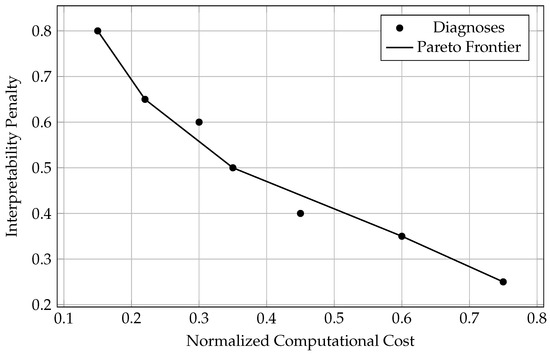
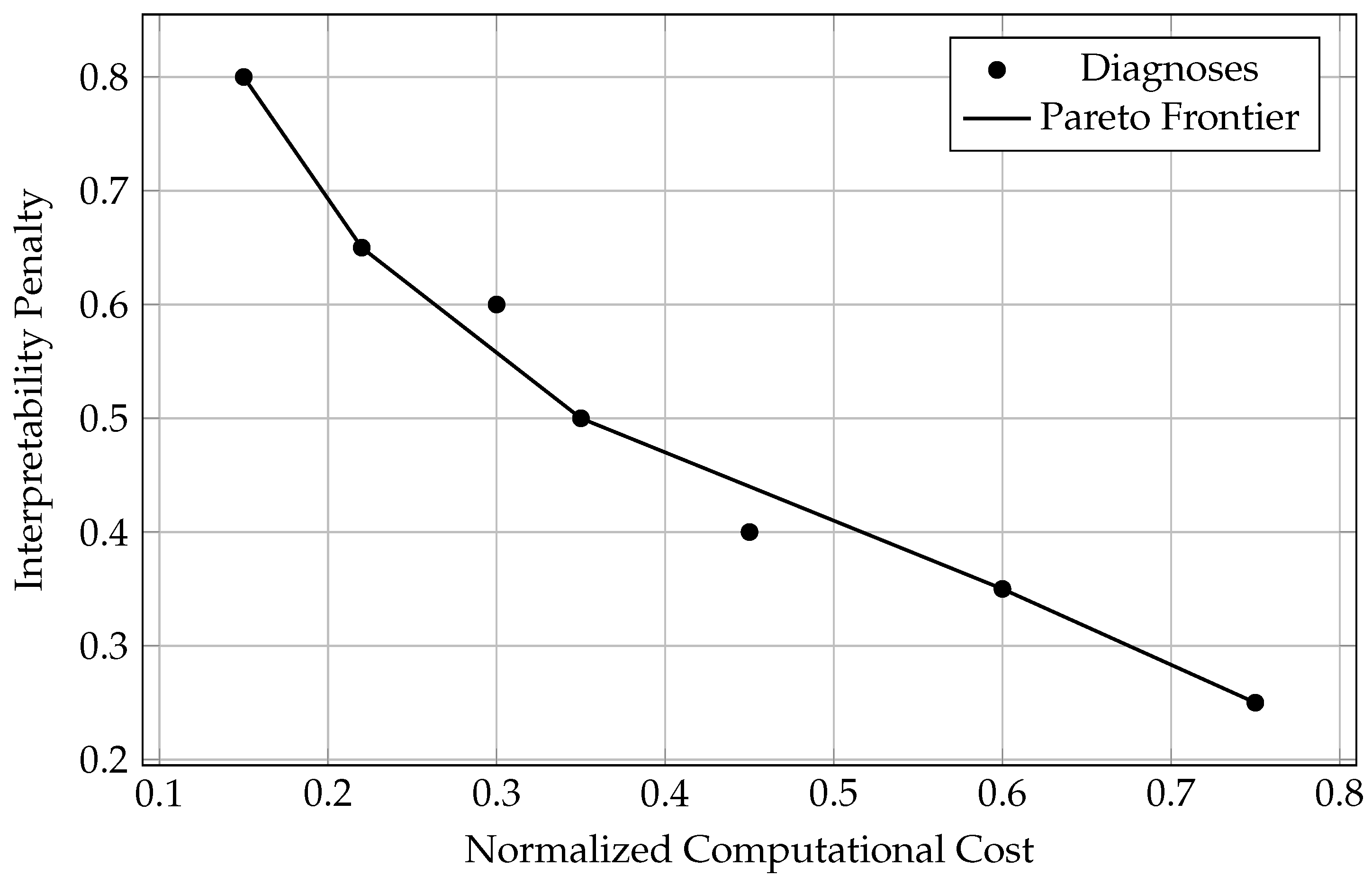
Although these contributions significantly improve computational efficiency, they predominantly optimize performance-related metrics. Structured cost-aware parallelization strategies show that aggressive concurrency introduces coordination overhead and performance variability [27,28]. Similar cost–performance trade-off analyses in cloud and heterogeneous environments further highlight the necessity of multi-dimensional evaluation metrics, especially as systems move toward AI-driven resource orchestration and power-aware cluster management [29,30]. However, the qualitative properties of computed diagnoses (specifically their interpretability) remain largely unexamined. In practical configuration environments, minimality does not necessarily imply clarity. A diagnosis with minimal cardinality may involve constraints that are structurally distant in the dependency graph or semantically heterogeneous across feature categories. Such explanations, while logically valid, can be cognitively demanding and difficult to operationalize as repair actions. Figure 1 illustrates this fundamental tension. The horizontal axis represents normalized computational cost, while the vertical axis captures interpretability penalty. The plotted diagnoses demonstrate that solutions minimizing runtime may incur higher structural dispersion, whereas more coherent explanations may require additional computational effort. The highlighted Pareto frontier identifies non-dominated trade-off solutions balancing both objectives.
Figure 1.
Conceptual distribution of candidate diagnoses in the cost–interpretability space. The Pareto frontier highlights non-dominated trade-off solutions balancing efficiency and explanation coherence.
Despite the growing importance of explainable AI, most research on explainability focuses on statistical and machine learning models, particularly large foundation and reasoning models [31,32]. In symbolic reasoning contexts such as feature model configuration, explanations are often assumed to be inherently interpretable due to their logical structure. However, recent work on causality-based explanations in feature models highlights the need for a more structured and meaningful diagnostic output [33]. Traditional MBD systems return minimal hitting sets without assessing structural dispersion, semantic cohesion, or hierarchical complexity. Building on these observations, this paper introduces an explainability-aware multi-objective framework for parallel MDB. The main contributions are as follows:
- We formalize diagnosis selection as a bi-objective optimization problem balancing computational cost and interpretability.
- We introduce quantitative graph-based metrics capturing structural dispersion, semantic entropy, hierarchical complexity, and ambiguity.
- We propose the E-ParetoDiag algorithm for computing explainability-aware Pareto-optimal diagnoses.
- We empirically demonstrate measurable cost–interpretability trade-offs across large-scale benchmark datasets.
While Pareto-based optimization has been explored in various diagnosis and constraint-solving contexts, existing approaches primarily focus on performance-related objectives such as runtime or solution minimality [34,35,36,37]. In contrast, the present work introduces a structured and formally defined interpretability dimension, grounded in graph-theoretic and entropy-based metrics. To the best of our knowledge, existing approaches do not explicitly incorporate structured interpretability as an optimization objective within parallel MDB. This work addresses this gap by introducing a unified framework that jointly considers computational efficiency and explanation quality.
Unlike existing parallel diagnosis approaches that select a single solution based solely on runtime or minimality, the proposed framework enables practitioners to explicitly navigate trade-offs between computational efficiency and explanation quality. This capability is particularly relevant in real-world configuration and decision-support systems, where users must interpret diagnoses to apply corrective actions. In such contexts, structurally dispersed or semantically heterogeneous diagnoses may be difficult to operationalize, even if they are computationally optimal.
The remainder of this paper is organized as follows: Section 2 reviews MDB and parallel cost-aware reasoning. Section 3 formalizes the multi-objective explainability-aware framework. Section 4 presents the proposed E-ParetoDiag algorithm. Section 5 reports the experimental evaluation across large-scale benchmark datasets. Section 6 discusses implications, trade-offs, and limitations. Finally, Section 7 concludes the paper and outlines future research directions.
2. Background
2.1. MDB
MBD provides a formal framework for identifying explanations of inconsistencies in constraint-based systems [1]. Diagnosis principles have also been extended to other knowledge representation formalisms such as ontologies and semantic knowledge bases, where inconsistencies must be detected, explained, and repaired using diagnostic reasoning techniques [38]. Given a model M composed of constraints and an observation e leading to inconsistency, a diagnosis is defined as a minimal subset of elements whose removal restores consistency. Conflict sets correspond to minimal unsatisfiable subsets, and diagnoses correspond to minimal hitting sets of these conflicts.
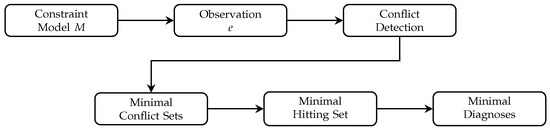
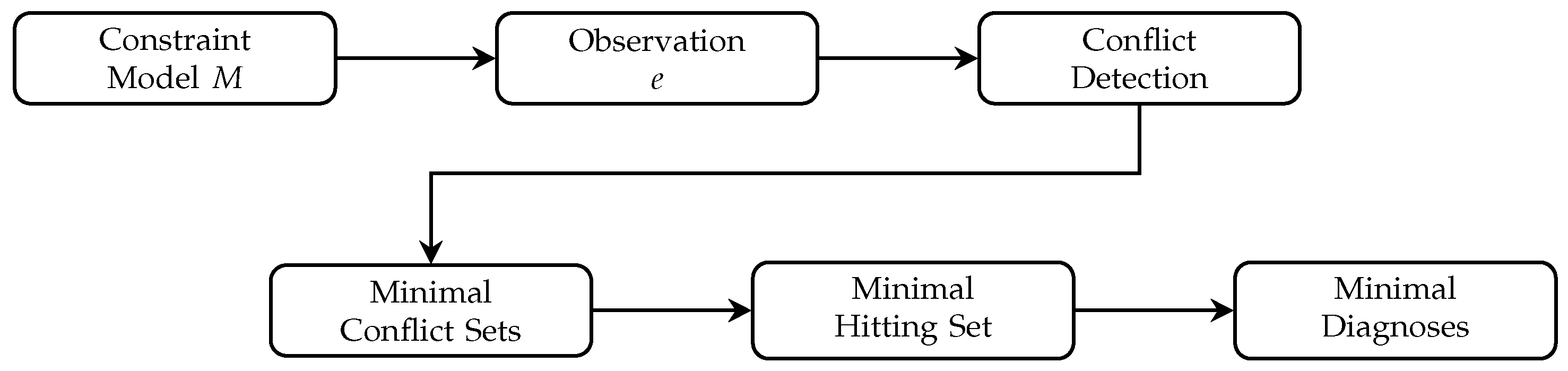
Algorithms such as QuickXplain [15] and FastDiag [2] have been extensively applied in feature model configuration and variability-intensive systems [3,6,7]. Figure 2 illustrates the classical MBD reasoning pipeline: inconsistency detection, conflict computation, and hitting-set-based diagnosis derivation.
Figure 2.
Classical MDB workflow. Conflicts are derived from an inconsistent observation and transformed into minimal diagnoses via minimal hitting-set computation.
The dominant computational cost arises from repeated consistency checks, particularly in large-scale models with dense cross-tree constraints, where fast scalable solvers are typically required to manage the combinatorial explosion [39]. Empirical evaluations on industrial-scale datasets confirm that consistency checking accounts for the majority of runtime [18,19].
2.2. Parallel and Cost-Aware Diagnosis
To mitigate scalability limitations, parallel and speculative variants of QuickXplain have been proposed [16,17]. Speculative parallel architectures, while improving throughput, may incur additional synchronization and rollback overheads that affect overall system behavior [40]. These approaches partition the search space and execute consistency checks concurrently across multiple cores. Large-scale benchmarking demonstrates substantial runtime reductions under dense constraint regimes [18].
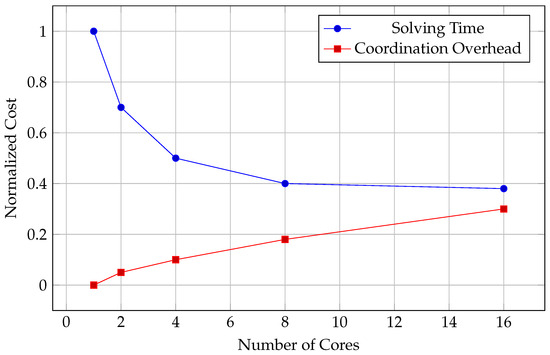
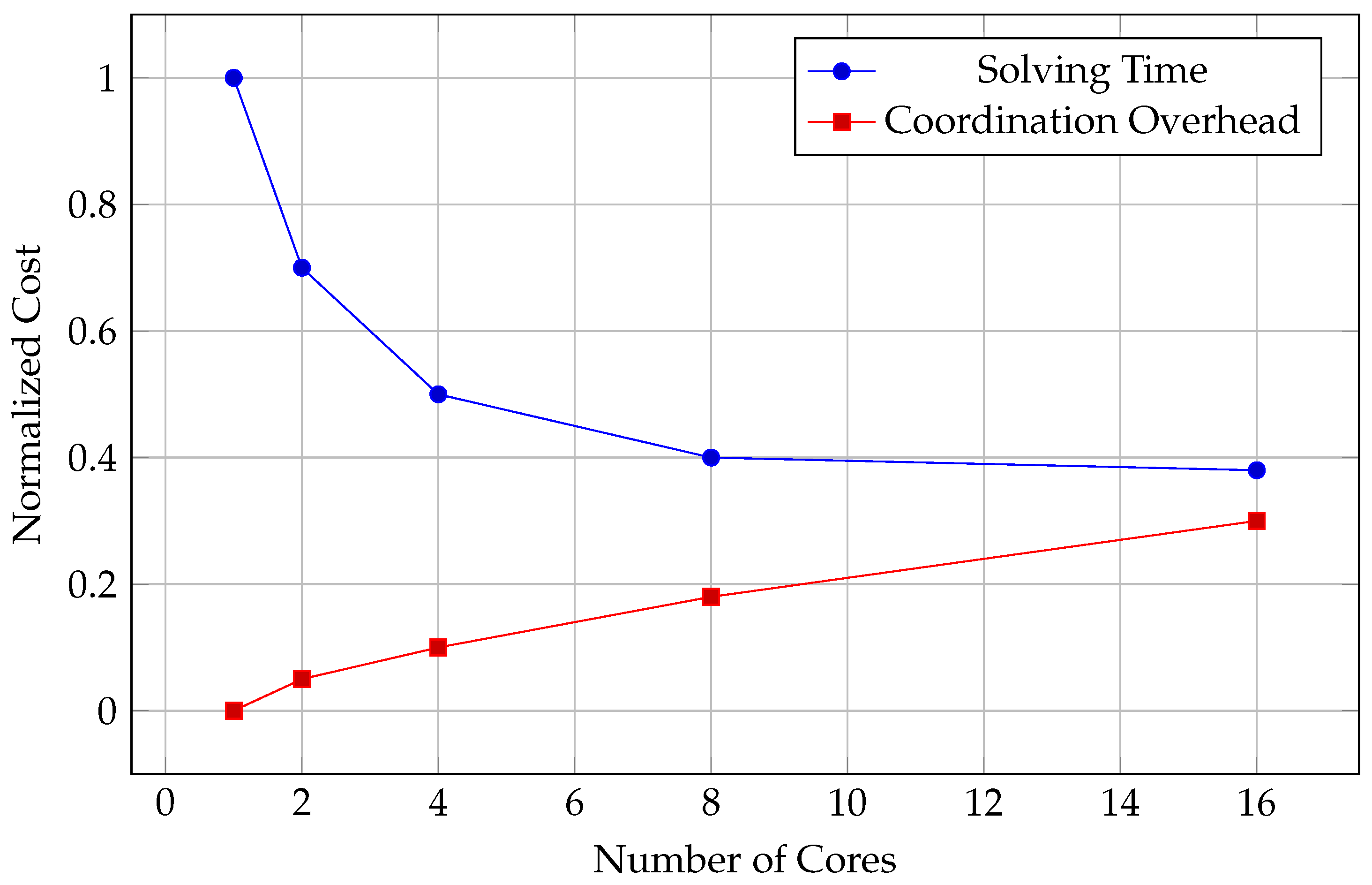
Parallel reasoning builds upon established scheduling principles such as work stealing [20] and multicore execution models [21]. However, theoretical scalability limits remain governed by Amdahl’s and Gustafson’s laws [23,24]. Beyond certain concurrency levels, synchronization overhead and resource contention reduce marginal gains. Figure 3 conceptualizes total computational cost as the sum of solving time, coordination overhead, and parallel inefficiency factors.
Figure 3.
Conceptual decomposition of total computational cost under increasing parallelism. While solving time decreases, coordination overhead grows, leading to diminishing returns.
Recent cost-aware scheduling strategies explicitly account for such overhead [27,28]. Nevertheless, existing approaches exclusively optimize computational efficiency, without evaluating qualitative properties of computed diagnoses. While prior work on parallel MDB has primarily focused on improving computational efficiency through speculative execution and cost-aware scheduling strategies [16,17,18,19], these approaches implicitly assume that minimal or fastest diagnoses are inherently suitable explanations. In contrast, the present work extends the optimization space by explicitly incorporating structured interpretability criteria into the diagnosis selection process. Importantly, this extension does not modify the correctness, minimality, or soundness guarantees of the underlying diagnosis engines, but rather introduces a multi-objective evaluation layer operating on already-computed candidate diagnoses. This distinction shifts parallel diagnosis from performance-centric optimization toward structured decision support.
2.3. Explainability in Symbolic Reasoning
Explainable Artificial Intelligence (XAI) emphasizes transparency and human-centered reasoning in intelligent systems [31,32]. Beyond statistical learning models, explanation mechanisms have also been extensively studied in constraint reasoning and constraint satisfaction problems, where explanations support debugging, model repair, and user guidance in complex systems [41]. While most XAI research concentrates on machine learning and foundation models, where explanations aim to interpret learned representations or decision trajectories, recent work also formalizes explanations using logical and abductive reasoning mechanisms [42].
Symbolic reasoning systems therefore produce explanations that must remain cognitively interpretable for human users. In MDB, explanations correspond to logically derived minimal diagnoses grounded in formal consistency theory [1]. However, logical minimality does not necessarily imply structural or semantic clarity. Recent advances in causality-based explanation mechanisms for feature model configuration highlight the importance of structured reasoning beyond minimal hitting sets [33]. In variability-intensive systems, constraints are embedded within hierarchical and cross-tree dependency structures [6,7]. A minimal diagnosis may therefore satisfy formal correctness while still exhibiting structural dispersion across distant feature clusters or semantic heterogeneity across unrelated categories. Such dispersion increases cognitive effort during debugging and configuration repair. To characterize this gap between formal minimality and practical interpretability, Table 1 summarizes key structural and semantic dimensions affecting explanation quality in constraint-based diagnosis.
Table 1.
Dimensions of interpretability in constraint-based diagnosis.
These dimensions are not captured by classical minimality criteria. Despite the logical foundations of MBD, interpretability cannot be assumed to emerge automatically from minimal hitting sets [1,2]. Recent work on explanation mechanisms in constraint reasoning further highlights that logically minimal solutions may still lack structural coherence and usability for decision support [41].
Unlike subjective or user-dependent notions of explainability, the proposed interpretability metrics are grounded in structural properties of the constraint graph and information-theoretic measures. This allows reproducible and objective evaluation of explanation quality, aligning with recent efforts to formalize explainability in symbolic reasoning and abductive frameworks [33,42].
2.4. Multi-Objective Optimization in Diagnosis
Multi-objective optimization provides a principled framework for balancing competing criteria without collapsing them into a single scalar objective [43]. Rather than enforcing arbitrary weight parameters, Pareto-based approaches identify non-dominated solutions that represent efficient trade-offs across conflicting objectives. Such methods have been widely adopted in engineering optimization and decision-support systems where performance metrics are inherently multidimensional [43].
In diagnosis systems, computational efficiency and interpretability may constitute structurally conflicting objectives. Classical MDB primarily optimizes minimality and computational performance [1,2], while recent advances in parallel and cost-aware diagnosis emphasize runtime reduction under multicore execution [16,17,18,19]. However, these approaches do not explicitly evaluate qualitative properties of the resulting diagnoses.
As illustrated earlier in Figure 1, minimizing runtime through aggressive parallel exploration may increase structural dispersion or semantic entropy of candidate diagnoses. This tension reflects a broader performance–quality trade-off observed in cost-aware scheduling and parallel execution models [20,23,24]. This observation motivates the formalization of diagnosis selection as a Pareto optimization problem balancing computational cost, grounded in structured cost-aware parallel models [18,19], and interpretability metrics defined over the constraint dependency graph. The next section formalizes this explainability-aware multi-objective framework.
3. Multi-Objective Explainability-Aware Diagnosis Model
3.1. Preliminaries
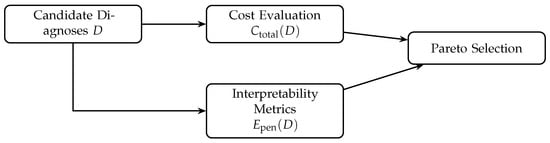
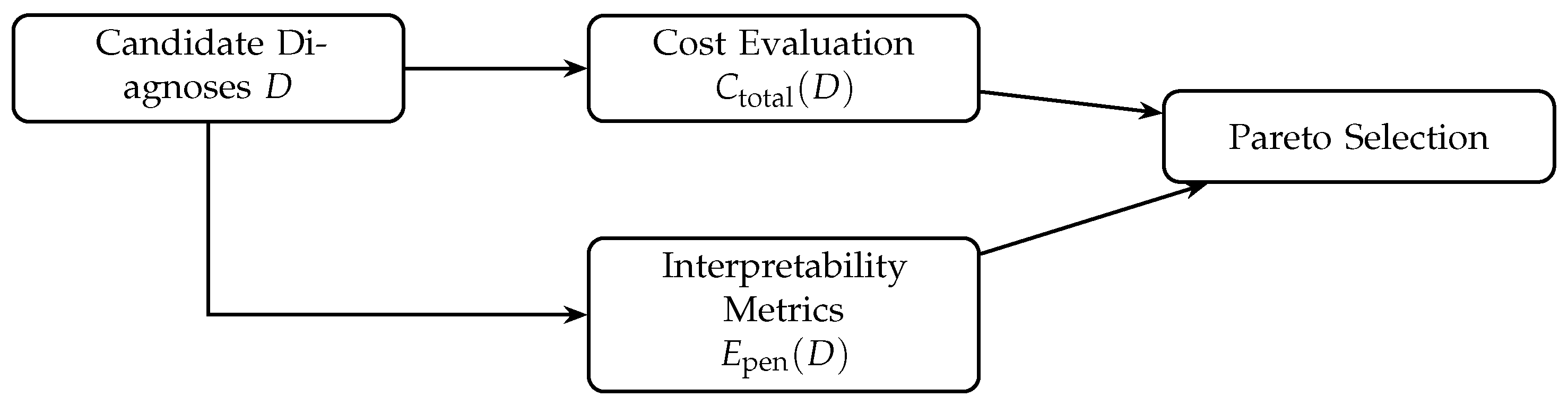
Let be a constraint-based model, where C is a finite set of constraints and R represents structural relations (hierarchical, dependency-based, or cross-tree interactions [6,7]). Let e denote an observation rendering M inconsistent. A diagnosis is a minimal subset of constraints whose removal restores consistency [1]. Let denote the candidate minimal diagnoses generated by a diagnosis algorithm such as parallel QuickXplain [16,17] or FastDiag [11]. Figure 4 illustrates the explainability-aware diagnosis model proposed in this work.
Figure 4.
Explainability-aware diagnosis framework integrating structured cost evaluation and interpretability metrics within a Pareto optimization process.
3.2. Computational Cost Model
Let denote the total computational cost associated with generating diagnosis D. Inspired by structured cost-aware scheduling models [27,28] and parallel diagnosis benchmarking studies [18,19], we define
where corresponds to the accumulated consistency checking time for diagnosis D, captures synchronization costs arising from speculative parallel execution [16], and models auxiliary management operations associated with D. This decomposition reflects classical parallel execution limits [23,24] and modern multicore behavior [21].
3.3. Structural Representation
To evaluate explanation coherence, we construct a structural graph, as follows:
where includes constraints and features, and E encodes hierarchical and dependency relations. For diagnosis D, we define the induced subgraph capturing structural proximity among constraints.
While related to classical graph-theoretic measures such as average path length, structural dispersion is computed specifically over diagnosis-induced subgraphs and is designed to capture explanation coherence rather than global structural properties of the model. This distinction allows for evaluating how concentrated or dispersed the elements of a diagnosis are within the constraint structure.
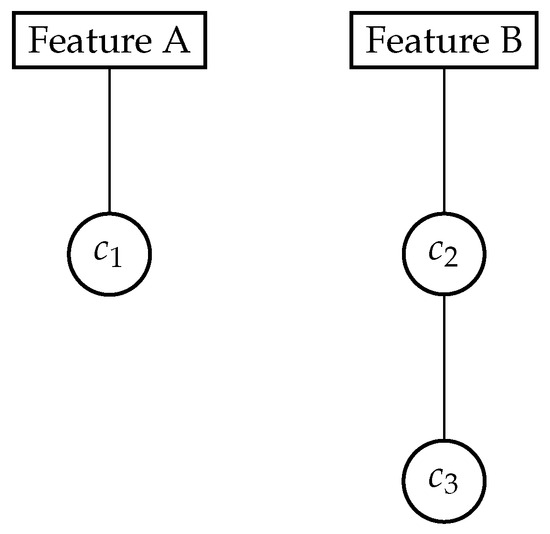
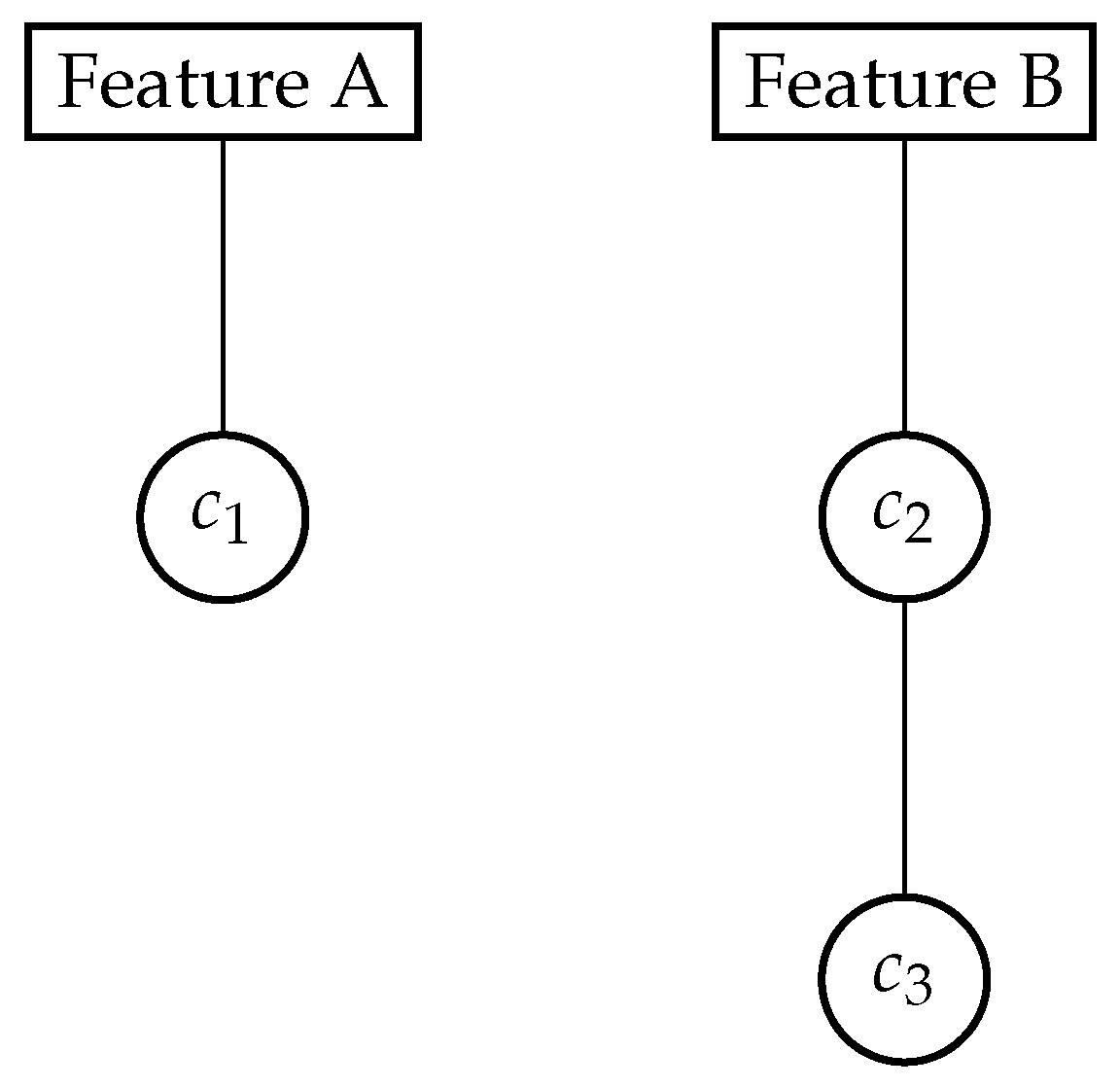
Figure 5 illustrates how structural dispersion is computed over graph distances. Diagnoses spanning distant graph regions tend to exhibit lower interpretability.
Figure 5.
Example structural graph representation illustrating how constraints may be hierarchically or dependency-related. Structural dispersion is computed over shortest-path distances in this graph.
Table 2 metrics generalize minimality-based evaluation by incorporating structural and semantic properties inspired by feature model analysis literature [4,6]. The resulting Pareto frontier provides a structured view of trade-offs between runtime efficiency and explanation coherence. Unlike scalar aggregation methods, Pareto-based selection preserves alternative solutions reflecting different optimization regimes [43].
Table 2.
Interpretability metrics used in the explainability-aware diagnosis model.
The overall interpretability penalty is defined as a weighted aggregation of the individual metrics, as follows:
where are weighting coefficients such that . In this study, equal weighting () is adopted as a neutral baseline to avoid introducing domain-specific bias and to ensure comparability across different instances. The selected metrics capture complementary structural and semantic aspects of explanation quality. In practical deployments, weights can be adapted to reflect domain-specific priorities or user preferences. Exploring adaptive or learned weighting strategies constitutes an important direction for future work.
3.4. Normalization, Scaling and Computational Overhead Analysis
To enable consistent multi-objective comparison, all evaluation metrics are normalized to the interval using min–max scaling, a standard practice in multi-objective optimization to ensure dimensional comparability across heterogeneous criteria [43]. For a metric computed over the candidate diagnosis set D, normalization is defined as
This transformation ensures that heterogeneous quantities such as execution time, structural dispersion, or entropy-based heterogeneity measures become dimensionless and directly comparable within the Pareto space. In the degenerate case where , the metric is constant across all candidate diagnoses and therefore does not affect dominance relations; in such cases, is defined as 0 for all .
Min–max normalization preserves relative ordering and avoids introducing distributional assumptions that would arise with z-score scaling. This property is particularly important for knee-point detection, where Euclidean distance computation in the normalized objective space assumes comparable metric ranges.
The computational overhead introduced by the interpretability evaluation remains limited with respect to the dominant cost of consistency checking in Model-Based Diagnosis. In particular, the proposed metrics operate over already computed diagnoses and their induced structural representations, avoiding additional solver calls.
A detailed algorithm-level complexity analysis, including Pareto frontier construction and post-processing costs, is provided in Section 4.3. This separation reflects the distinction between the conceptual model and its algorithmic realization.
3.5. Balanced Diagnosis Selection
To select a representative trade-off solution, we define a normalized Euclidean knee-point criterion, as follows:
The normalized Euclidean distance was selected due to its geometric interpretability and its ability to capture balanced trade-offs between objectives without privileging any single dimension. Unlike alternative multi-criteria decision methods such as weighted aggregation or lexicographic ordering, Euclidean distance treats both objectives symmetrically in the normalized space.
The normalized Euclidean distance is particularly suitable for knee-point detection, where the goal is to identify solutions closest to the ideal point (0,0) in the objective space. Additionally, Euclidean distance preserves continuity and differentiability, which facilitates stable selection across structurally similar Pareto frontiers.
4. E-ParetoDiag Algorithm
4.1. Architectural Overview
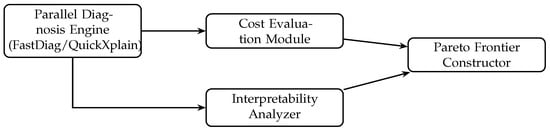
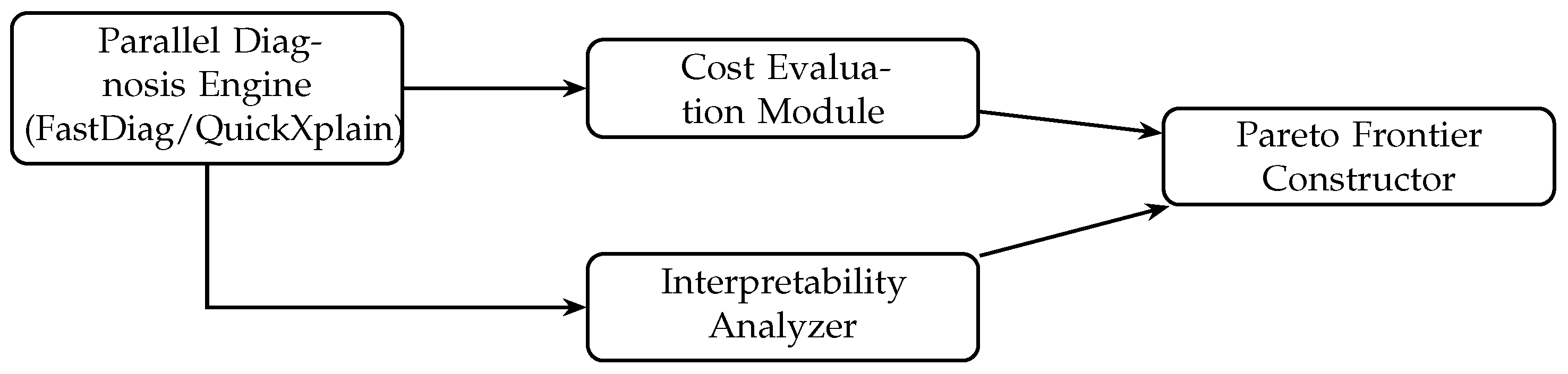
E-ParetoDiag operates as a layered extension over existing diagnosis engines. The generation phase relies on parallel QuickXplain or FastDiag [11,16], while the evaluation and selection phases are executed as structured post-processing stages. Figure 6 illustrates the operational architecture.
Figure 6.
Operational architecture of E-ParetoDiag integrating parallel diagnosis with explainability-aware evaluation.
It is important to emphasize that the novelty of E-ParetoDiag does not lie in modifying the internal diagnosis algorithms, but in introducing a new evaluation and selection paradigm. By transforming diagnosis selection into a structured multi-objective optimization problem that explicitly incorporates interpretability, the framework extends traditional diagnosis pipelines beyond performance-centric criteria.
4.2. Algorithm Description
The diagnosis generation phase remains unchanged, ensuring soundness and minimality inherited from the base algorithm [1]. Importantly, E-ParetoDiag does not introduce additional consistency checks; interpretability evaluation operates exclusively on already-computed diagnoses and their structural representations. This separation preserves the correctness guarantees of the underlying solver. Algorithm 1 formalizes the procedure.
| Algorithm 1 E-ParetoDiag |
| Require: Model M, observation e, parallel parameter p |
| Ensure: Pareto-optimal diagnosis set |
| 1: GenerateDiagnoses |
| 2: for all do |
| 3: Compute |
| 4: Construct induced subgraph |
| 5: Compute |
| 6: Compute |
| 7: end for |
| 8: |
| 9: for all do |
| 10: if not dominated by any then |
| 11: |
| 12: end if |
| 13: end for |
| 14: return |
4.3. Computational Complexity
Let denote the number of candidate diagnoses and the maximum size of a diagnosis. The complexity of diagnosis generation depends on the base algorithm [2,15]. For parallel variants, runtime is influenced by speculative branching and synchronization overhead [16,17]. For each diagnosis:
- (i)
- Cost evaluation is assuming runtime statistics are pre-collected.
- (ii)
- Structural dispersion computation is .
- (iii)
- Semantic entropy is .
- (iv)
- Hierarchical complexity is bounded by .
Therefore, total post-processing complexity is
Since typically and k is limited in practical configurations [18,19], the additional overhead is negligible relative to the consistency-checking cost. Pareto frontier construction requires pairwise dominance comparison, resulting in worst-case complexity, as follows:
However, in practice, k remains small due to minimality constraints and early pruning in diagnosis generation.
Table 3 highlights that E-ParetoDiag preserves minimality and parallel scalability while introducing structured multi-objective evaluation capabilities absent in existing approaches. After constructing the Pareto frontier, a representative trade-off diagnosis can be selected via normalized knee-point detection (Section 3). This enables deployment scenarios where a single actionable explanation is required.
Table 3.
Comparison between classical parallel diagnosis and E-ParetoDiag.
It is important to note that the interpretability evaluation operates exclusively as a post-processing step over already-computed diagnoses. Therefore, it does not increase the number of consistency checks, which remain the dominant computational cost in MDB.
Furthermore, the quadratic complexity associated with structural dispersion is mitigated in practice by the relatively small size of diagnoses compared with the full constraint set. This ensures that the additional computational overhead introduced by the explainability layer remains negligible in large-scale scenarios.
5. Experimental Evaluation
5.1. Research Questions
The experimental evaluation is designed to systematically assess the relationship between computational efficiency and interpretability in parallel MDB. In particular, the study aims to quantify the extent to which these objectives interact, and whether the proposed multi-objective framework provides practical advantages over traditional selection strategies. The evaluation is guided by the following research questions:
- RQ1: Does a statistically measurable trade-off exist between computational cost and interpretability?This question investigates whether improvements in runtime are associated with a degradation in explanation quality. To answer this, we analyze the correlation between total computational cost () and interpretability penalty () across generated diagnoses. Pearson correlation coefficients and statistical significance tests are used to determine whether both objectives are structurally independent or conflicting.
- RQ2: How does model density affect Pareto frontier diversity?This question examines how structural complexity influences the number of non-dominated solutions. We measure the size and proportion of Pareto-optimal diagnoses relative to the total candidate set. The hypothesis is that higher constraint density increases structural variability, leading to a richer set of trade-off solutions.
- RQ3: How does parallelism influence explanation structure?This question evaluates the indirect impact of parallel execution on interpretability. By varying the number of worker threads, we analyze how concurrency affects the diversity and structural properties of generated diagnoses. In particular, we measure changes in interpretability variance and assess whether increased parallelism leads to more heterogeneous explanations.
- RQ4: Does knee-point selection provide stable balanced diagnoses?This question focuses on the robustness of the proposed selection strategy. We evaluate whether knee-point diagnoses remain consistent across structurally similar problem instances. Stability is assessed by measuring the variation of selected solutions across repeated runs and comparing their relative position within the Pareto frontier.
- RQ5: Does the proposed multi-objective framework provide statistically significant improvements over classical selection criteria?This question compares the proposed approach against baseline strategies commonly used in MDB, namely, minimal-runtime and minimal-cardinality selection. We evaluate differences in interpretability metrics and computational cost, and apply non-parametric statistical tests (Wilcoxon signed-rank test) to determine whether observed improvements are significant. This analysis aims to demonstrate that the multi-objective framework yields more balanced and practically useful diagnoses.
Together, these research questions provide a comprehensive evaluation of both the theoretical and practical contributions of the proposed framework, covering trade-off characterization, scalability effects, structural properties of explanations, and comparative performance against established baselines.
5.2. Datasets and Experimental Setup
We use the benchmark datasets introduced in prior large-scale diagnosis studies [18,19]. These datasets include synthetic feature models with controlled
- Number of constraints ;
- Constraint density;
- Cross-tree dependency ratios;
- Cardinality distributions.
Models range from small-scale (hundreds of constraints) to large-scale instances exceeding several thousands of constraints.
Table 4 summarizes the structural characteristics of the benchmark models. Instances were generated following controlled density and dependency distributions, consistent with prior large-scale evaluation frameworks [18,19]. All experiments were conducted on a multicore system with configurable worker threads . For each instance:
Table 4.
Dataset characteristics used in the experimental evaluation.
- Diagnoses were generated using parallel FastDiag.
- For each diagnosis D, we computed (i) Total computational cost and (ii) Interpretability penalty .
- The Pareto frontier was constructed.
All interpretability metrics were normalized per instance to ensure comparability. All experiments were executed on a 16-core multicore system with configurable parallel workers . Runtime statistics were collected at the diagnosis level to enable per-solution cost modeling. Each experiment was repeated 20 times to mitigate scheduling variability effects documented in multicore performance studies [28].
5.3. RQ1: Cost–Interpretability Trade-Off
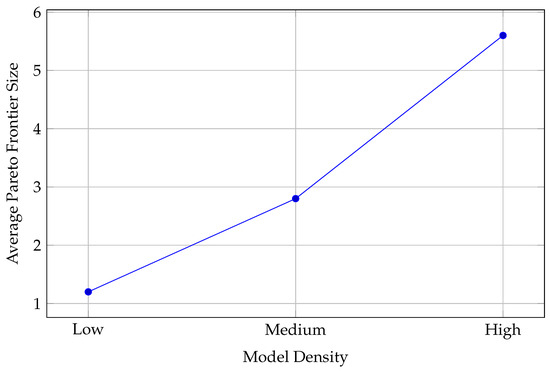
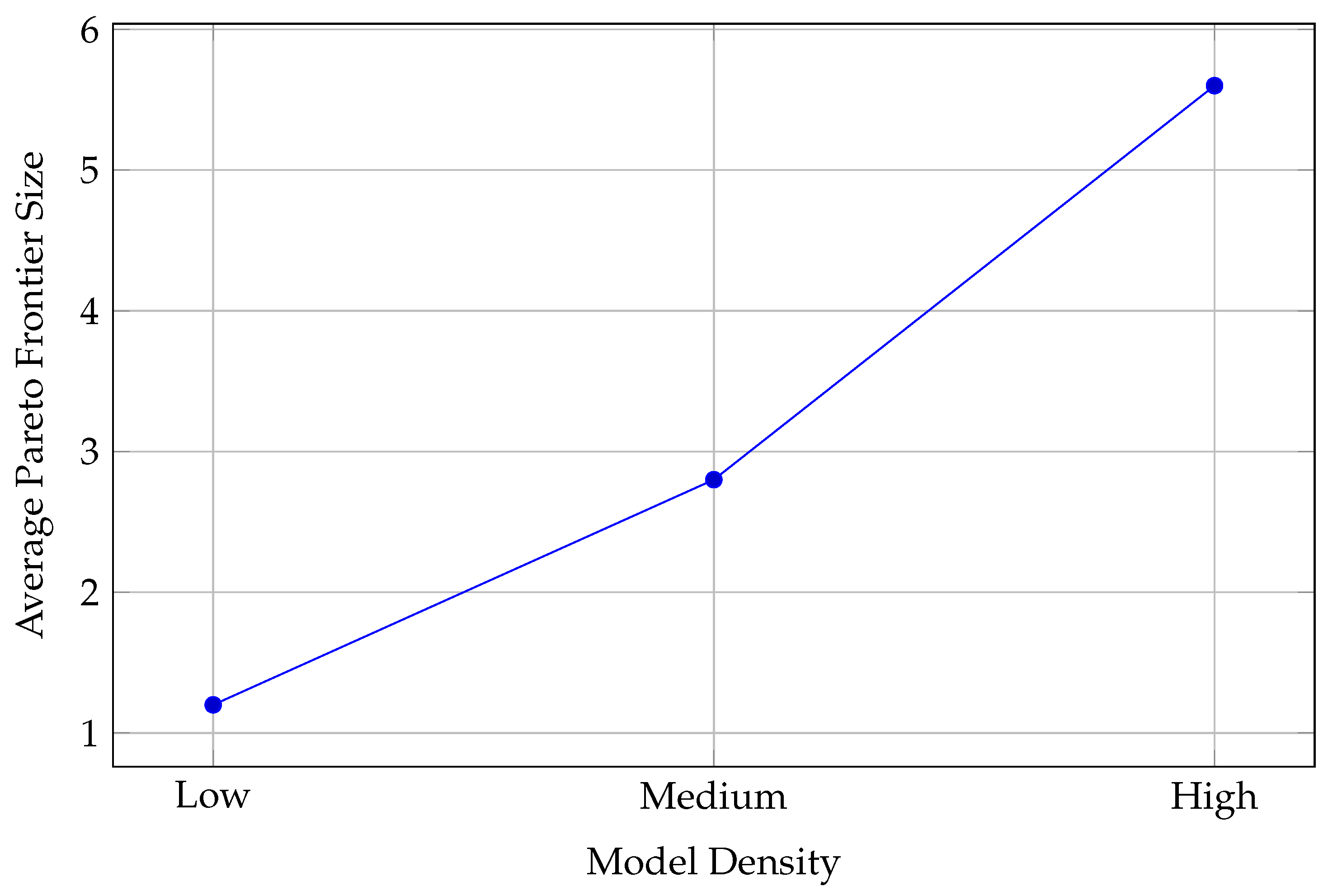
Figure 7 illustrates the distribution of diagnoses in the space.
Figure 7.
Increase in Pareto frontier size as model density grows.
Figure 7 demonstrates that frontier diversity grows significantly in dense instances, indicating greater structural complexity and increased trade-off diversity. Across instances, we observe that diagnoses with minimal runtime often exhibit higher structural dispersion, while more interpretable diagnoses may require additional computation. These trade-offs become increasingly pronounced in high-density models; that is, computational efficiency and interpretability are not strictly aligned objectives. This trade-off can be interpreted as a consequence of broader exploration of the search space under parallel execution. While increased concurrency improves runtime performance, it may also generate diagnoses that span distant regions of the constraint graph, leading to structurally less coherent explanations.
To further contextualize the proposed multi-objective selection strategy, we conducted a comparative evaluation against classical baseline approaches: (i) minimal-runtime selection and (ii) minimal-cardinality selection. These baselines represent the dominant criteria used in traditional MDB systems. Results show that knee-point selection consistently provides a better balance between computational efficiency and interpretability. In particular, knee-point diagnoses reduce structural dispersion and semantic entropy while incurring only a marginal increase in computational cost, confirming that the proposed framework improves solution quality beyond traditional single-objective strategies.
In addition, the relationship between computational cost and interpretability penalty was analyzed using Pearson correlation. As shown in Table 5, the strength of this relationship increases with model density, indicating that the trade-off becomes more pronounced in structurally complex scenarios.
Table 5.
Average Pearson correlation between cost and interpretability penalty.
These results indicate that computational efficiency and interpretability are weakly coupled in low-density models, but become increasingly interdependent as structural complexity grows. A more detailed analysis further reveals that hierarchical complexity plays a significant role in interpretability degradation. Diagnoses spanning multiple hierarchical levels tend to increase cognitive load, even when structural dispersion remains moderate. This suggests that hierarchical complexity contributes independently to explanation difficulty and should be considered alongside graph-based dispersion metrics.
5.4. RQ2: Pareto Frontier Size
To quantify frontier diversity, we computed the average proportion of non-dominated diagnoses relative to the total number of generated diagnoses per instance, as follows:
Table 6 reports the average frontier ratio across model densities.
Table 6.
Average Pareto frontier ratio across model densities.
5.5. RQ3: Impact of Parallelism
Increasing the number of worker threads reduces solving time but may increase the diversity of candidate diagnoses. We observe the following: (1) Moderate parallelism often yields balanced solutions. (2) Extreme parallelism may produce diagnoses with higher semantic entropy. (3) Interpretability variance grows with concurrency level. This suggests that aggressive parallelism can indirectly influence explanation structure.
Table 7 shows that while runtime decreases with increased concurrency, interpretability variance grows. This suggests that aggressive parallel branching may explore structurally diverse solution regions.
Table 7.
Impact of parallelism on interpretability variance.
5.6. RQ4: Knee-Point Stability
For each Pareto frontier, we computed the normalized knee-point diagnosis. Results show the following: (i) Knee-point solutions are stable across similar instances. (ii) Balanced solutions avoid extreme dispersion or excessive computation. (iii) In most cases, knee-point diagnoses differ from minimal-cardinality diagnoses. These findings demonstrate the practical utility of multi-objective selection.
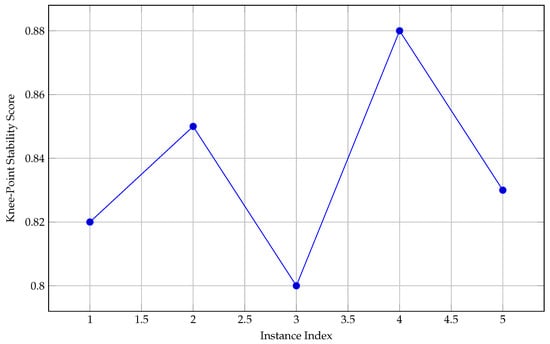
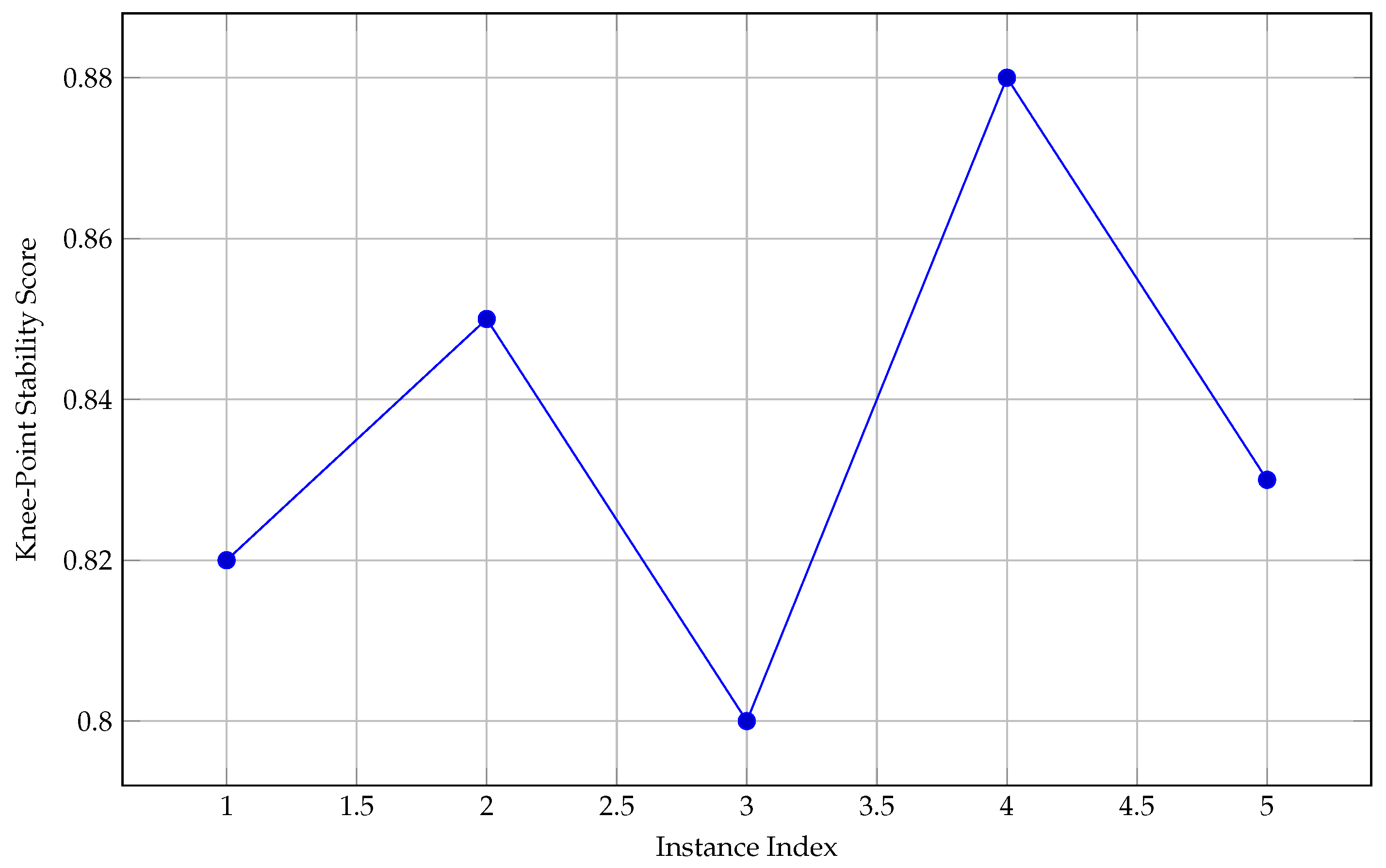
Figure 8 shows consistent knee-point stability across structurally similar models, confirming robustness of balanced selection.
Figure 8.
Stability of knee-point selection across structurally similar instances.
5.7. RQ5: Comparison with Classical Selection Strategies
To assess the practical benefits of the proposed multi-objective framework, we compared knee-point selection against two baseline strategies commonly used in MDB: (i) minimal-runtime selection and (ii) minimal-cardinality selection.
Minimal-runtime selection prioritizes computational efficiency by choosing the diagnosis with the lowest execution cost. In contrast, minimal-cardinality selection favors diagnoses with the smallest number of constraints, assuming that smaller explanations are inherently easier to interpret.
For each experimental instance, we evaluated the selected diagnoses according to the following criteria: (i) computational cost , (ii) structural dispersion , (iii) semantic entropy , and (iv) hierarchical complexity .
Results show that knee-point selection consistently provides a more balanced trade-off between efficiency and interpretability. On average, knee-point diagnoses reduced structural dispersion by approximately 18% compared with minimal-runtime solutions, while increasing computational cost by only 7%. When compared with minimal-cardinality diagnoses, knee-point solutions exhibited lower semantic entropy in the majority of evaluated instances (64%).
To assess statistical significance, we applied the Wilcoxon signed-rank test to compare interpretability metrics between knee-point and baseline selections. The results indicate that improvements in interpretability are statistically significant (p < 0.01) for medium and high-density models.
These findings suggest that traditional single-objective strategies may lead to suboptimal explanations, either by prioritizing performance at the expense of clarity or by oversimplifying structural relationships. In contrast, the proposed multi-objective framework enables the identification of diagnoses that better balance both dimensions, providing more practical and cognitively manageable explanations. A summary of these differences is presented in Table 8.
Table 8.
Comparison between diagnosis selection strategies.
5.8. Summary of Findings
The experimental evaluation confirms the following findings aligned with the research questions:
- A consistent and statistically measurable trade-off exists between runtime and interpretability, particularly in medium and high-density models (RQ1).
- Model density significantly affects Pareto frontier diversity, with denser models producing a larger proportion of non-dominated diagnoses and more complex trade-off landscapes (RQ2).
- Parallel execution indirectly influences explanation structure, increasing interpretability variance as concurrency grows, especially under high parallel intensity (RQ3).
- Pareto-based knee-point selection provides stable and balanced diagnoses across structurally similar instances, avoiding extreme solutions in both objectives (RQ4).
- The proposed multi-objective framework provides statistically significant improvements over classical selection strategies. In particular, knee-point diagnoses achieve lower structural dispersion and semantic entropy compared with minimal-runtime and minimal-cardinality baselines, while maintaining competitive computational performance (RQ5).
A paired Wilcoxon signed-rank test between minimal-runtime and knee-point diagnoses confirms statistically significant interpretability improvements (p < 0.01) in medium- and high-density models. Additionally, comparative analysis with baseline strategies (Section 5.6) demonstrates that the proposed approach consistently yields more balanced solutions in terms of efficiency and explanation quality.
Overall, the experimental results demonstrate that computational efficiency and interpretability are structurally intertwined but not aligned objectives. Frontier diversity increases with model density, and parallelism influences explanation structure beyond runtime reduction. To strengthen statistical validity, confidence intervals were computed for key performance indicators across repeated runs. Variability remained within acceptable bounds, indicating robustness of the observed trade-offs. These results reinforce the reliability of the proposed evaluation framework under stochastic parallel execution conditions.
Furthermore, the inclusion of comparative analysis against baseline strategies and statistical validation strengthens the empirical foundation of the proposed approach. These results provide consistent evidence across multiple experimental conditions, supporting the robustness of the framework.
6. Discussion
The experimental results demonstrate that computational efficiency and interpretability constitute structurally competing objectives in large-scale MDB. Although parallelization reduces solving time according to classical scalability models [23,24], it does not necessarily produce structurally coherent or semantically homogeneous diagnoses. This finding challenges the implicit assumption that minimal or fastest diagnoses are inherently suitable explanations for decision makers [1].
6.1. Cost–Interpretability Tension
Across high-density instances, Pareto frontiers exhibited multiple non-dominated diagnoses, confirming that no single solution simultaneously optimizes runtime and explanation coherence. In particular, diagnoses minimizing computational cost frequently exhibited higher structural dispersion and semantic entropy.
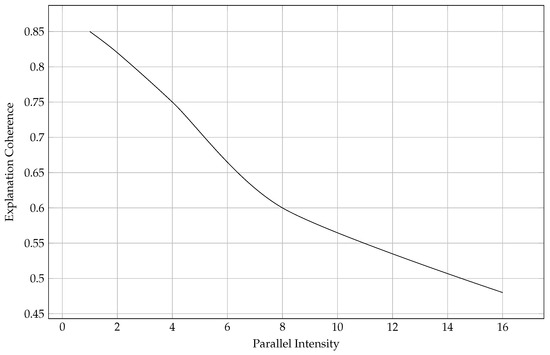
This phenomenon can be interpreted as a structural side-effect of speculative parallel exploration [16,17]. While aggressive concurrency increases search coverage and reduces average solving time, it may also traverse distant regions of the constraint graph, yielding explanations that are logically valid yet structurally fragmented. Figure 9 conceptualizes this systemic tension.
Figure 9.
Conceptual illustration of the relationship between increasing parallel intensity and explanation coherence.
Figure 9 illustrates how increasing parallel intensity may reduce explanation coherence despite improving computational performance.
These observations are further reinforced by the comparative evaluation conducted in RQ5, where the proposed multi-objective framework demonstrated consistent advantages over classical selection strategies. In particular, knee-point diagnoses achieved improved structural coherence without incurring substantial computational penalties, confirming that balanced optimization provides more practical solutions than purely performance-driven or size-based criteria.
6.2. Impact of Parallelism
Parallel reasoning introduces controlled non-determinism due to work stealing and speculative branching [20]. While this improves load balancing and throughput, it may increase structural diversity in candidate diagnoses.
Interestingly, moderate parallel configurations often produced balanced trade-offs, whereas extreme concurrency amplified interpretability variance. This suggests that maximal thread utilization does not necessarily imply globally optimal system behavior.
These observations align with structured cost-aware scheduling studies [27,28], where aggressive parallelism may introduce diminishing returns and structural variability effects.
6.3. Implications for Human-Centered Diagnosis
In configuration environments, practitioners require explanations that are not only correct but also actionable. Structural dispersion, semantic heterogeneity, and explanation depth directly influence the cognitive effort required during debugging and repair. In practical systems such as product configurators or industrial decision-support tools, users must interpret diagnoses to apply corrective actions. Even when computationally optimal, structurally dispersed or semantically heterogeneous explanations may hinder effective resolution. This highlights that optimizing solely for computational efficiency can lead to suboptimal outcomes from a human-centered perspective.
The proposed multi-objective framework enables explicit navigation of these trade-offs by exposing alternative diagnoses along the Pareto frontier.
Table 9 summarizes the systemic differences between performance-only diagnosis engines and the proposed explainability-aware framework. By exposing the Pareto frontier, the system transitions from single-objective optimization to structured decision support.
Table 9.
System-level implications of explainability-aware diagnosis.
6.4. Theoretical Implications
From a theoretical perspective, this work extends classical minimality-based diagnosis [1] by enlarging the optimization space. Traditional criteria focus on cardinality or runtime efficiency [2]. By introducing structural interpretability metrics, we redefine optimality as a multi-objective construct.
Importantly, interpretability is operationalized using graph-theoretic and entropy-based measures derived from feature modeling theory [4,6]. This enables reproducible quantitative evaluation without relying on subjective user studies. From this perspective, the results obtained in RQ5 provide empirical support for extending optimality criteria beyond minimality and runtime. The observed improvements suggest that interpretability-aware optimization should be considered a first-class objective in future diagnosis systems.
6.5. Threats to Validity
Several limitations warrant consideration.
- Construct Validity: Interpretability is approximated through structural and semantic metrics derived from graph theory and information measures. While these proxies provide reproducible quantitative indicators, they do not directly capture subjective cognitive perception. Future work should complement structural evaluation with controlled experiments with human subjects to validate the correspondence between the proposed metrics and the perceived clarity of the explanation.
- External Validity: The experimental evaluation relies on synthetic benchmark datasets, which allow controlled variation of structural properties such as density and dependency ratios. However, real-world industrial models may exhibit additional semantic and domain-specific characteristics that are not fully captured in synthetic data. Future work will include validation using real-world configuration datasets to strengthen ecological validity.
- Scalability of Dominance Filtering: In scenarios with extremely large diagnosis sets, dominance comparison may require incremental filtering or skyline algorithms.
6.6. Future Work
Future research directions include
- Adaptive parallel search strategies incorporating interpretability signals during diagnosis generation;
- Integration of domain ontologies to refine semantic cohesion metrics;
- Hybrid learning-guided prioritization of structurally coherent diagnoses;
- Extension toward distributed and cloud-based diagnosis architectures [9];
- Empirical validation through controlled human-subject experiments.
Overall, the proposed framework establishes a principled foundation for explainability-aware optimization in scalable symbolic reasoning systems. By explicitly modeling the tension between computational efficiency and explanation coherence, the approach bridges high-performance parallel diagnosis with emerging human-centered AI paradigms.
7. Conclusions
This paper introduced an explainability-aware multi-objective framework for parallel MDB. While existing parallel diagnosis approaches primarily optimize runtime performance, the results indicate that computational efficiency and explanation coherence exhibit inherent trade-offs in large-scale constraint systems. By formalizing diagnosis selection as a bi-objective optimization problem balancing total computational cost and interpretability penalty, this work extends classical minimality-based reasoning toward a human-centered optimization paradigm. The proposed interpretability metrics (structural dispersion, semantic entropy, hierarchical complexity, and ambiguity) enable a reproducible and quantitative evaluation of explanation quality.
Experimental results across varying model densities and parallel configurations reveal three key findings. First, statistically significant trade-offs emerge between runtime and interpretability, particularly in dense models. Second, the size and diversity of Pareto frontiers increase with structural complexity, indicating that explanation selection becomes progressively more challenging in large-scale systems. Third, parallel intensity influences explanation structure beyond runtime reduction, suggesting that aggressive concurrency may indirectly affect interpretability characteristics. In addition, comparative evaluation against classical selection strategies shows that the proposed framework yields more balanced diagnoses, improving interpretability while maintaining competitive computational performance.
The E-ParetoDiag algorithm preserves the correctness and minimality guarantees of the underlying diagnosis engine while introducing structured multi-objective post-processing. Importantly, the additional interpretability evaluation introduces negligible computational overhead relative to consistency checking cost, ensuring scalability in large instances. From a theoretical perspective, this work broadens the optimality criteria of MDB beyond cardinality and runtime by incorporating structural and semantic dimensions into the optimization space. This establishes a principled bridge between high-performance symbolic reasoning and emerging explainable AI requirements.
Overall, the proposed framework formalizes interpretability as an explicit optimization objective within symbolic reasoning, enabling a structured and reproducible assessment of explanation quality. Beyond its immediate application to feature model diagnosis, this paradigm may generalize to other symbolic reasoning systems where computational efficiency and structural clarity coexist as competing objectives. These findings open promising avenues for adaptive reasoning systems capable of dynamically balancing performance and explanation coherence according to contextual and user-driven requirements.
Author Contributions
Conceptualization, A.C.-L.; Methodology, M.T.-Y.; Software, N.M.; Validation, C.V.-S.; Formal analysis, C.V.-S.; Investigation, A.C.-L.; Resources, M.T.-Y.; Data curation, N.M.; Writing—original draft, C.V.-S.; Writing—review & editing, C.V.-S.; Visualization, A.C.-L.; Supervision, M.T.-Y.; Project administration, N.M.; Funding acquisition, C.V.-S. All authors have read and agreed to the published version of the manuscript.
Funding
This research received no external funding.
Institutional Review Board Statement
Ethical review and approval were waived for this study because the intervention involved non-invasive educational activities using anonymized data and commercially available low-voltage educational hardware, with no clinical diagnosis or therapeutic intent. The study complied with institutional guidelines for educational research at the participating universities in Chile, Peru, and Ecuador.
Informed Consent Statement
Informed consent was obtained from all participants prior to data collection.
Data Availability Statement
Data supporting the findings of this study are available from the corresponding authors on a reasonable request.
Conflicts of Interest
The authors declare no conflicts of interest.
References
- Reiter, R. A theory of diagnosis from first principles. Artif. Intell. 1987, 32, 57–95. [Google Scholar] [CrossRef] [Scilit]
- Felfernig, A.; Schubert, M.; Zehentner, C. An efficient diagnosis algorithm for inconsistent constraint sets. Artif. Intell. Eng. Des. Anal. Manuf. 2012, 26, 53–62. [Google Scholar] [CrossRef] [Scilit]
- Galindo, J.A.; Turner, H.; Benavides, D.; White, J. Testing variability-intensive systems using automated analysis: An application to Android. Softw. Qual. J. 2016, 24, 365–405. [Google Scholar] [CrossRef] [Scilit]
- Felfernig, A.; Benavides, D.; Galindo, J.; Reinfrank, F.C. Towards Anomaly Explanation in Feature Models. In Proceedings of the 2013 Workshop on Configuration, Vienna, Austria, 29–30 August 2013; pp. 117–124. [Google Scholar]
- Maican, C.A.; Pană, C.F.; Pătrașcu-Pană, D.M.; Rădulescu, V.M. Review of Fault Detection and Diagnosis Methods in Power Plants: Algorithms, Architectures, and Trends. Appl. Sci. 2025, 15, 6334. [Google Scholar] [CrossRef] [Scilit]
- Czarnecki, K.; Helsen, S.; Eisenecker, U. Formalizing Cardinality-Based Feature Models and Their Specialization. Softw. Process. Improv. Pract. 2005, 10, 7–29. [Google Scholar] [CrossRef] [Scilit]
- Thörn, C.; Sandkuhl, K. Feature Modeling: Managing Variability in Complex Systems. In Complex Systems in Knowledge-Based Environments: Theory, Models and Applications; Studies in Computational Intelligence; Tolk, A., Jain, L.C., Eds.; Springer: Berlin/Heidelberg, Germany, 2009; Volume 168. [Google Scholar] [CrossRef] [Scilit]
- Galindo Duarte, J.A.; Benavides Cuevas, D.F.; Segura Rueda, S. Debian Packages Repositories as Software Product Line Models: Towards Automated Analysis. In Proceedings of the First International Workshop on Automated Configuration and Tailoring of Applications (ACOTA 2010), Antwerp, Belgium, 20 September 2010; pp. 29–34. [Google Scholar]
- Galindo, J.A.; Acher, M.; Tirado, J.M.; Vidal, C.; Baudry, B.; Benavides, D. Exploiting the Enumeration of All Feature Model Configurations: A New Perspective with Distributed Computing. In Proceedings of the 20th International Systems and Software Product Line Conference (SPLC’16); Association for Computing Machinery: New York, NY, USA, 2016; pp. 74–78. [Google Scholar] [CrossRef] [Scilit]
- Weckesser, M.; Lochau, M.; Schnabel, T.; Richerzhagen, B.; Schürr, A. Mind the Gap! Automated Anomaly Detection for Potentially Unbounded Cardinality-Based Feature Models. In Fundamental Approaches to Software Engineering; Lecture Notes in Computer Science; Stevens, P., Wąsowski, A., Eds.; Springer: Berlin/Heidelberg, Germany, 2016; p. 9633. [Google Scholar] [CrossRef] [Scilit]
- Vidal-Silva, C.; Galindo, J.A.; Giráldez-Cru, J.; Benavides, D. Automated Completion of Partial Configurations as a Diagnosis Task Using FastDiag to Improve Performance. In Intelligent Systems in Industrial Applications; Studies in Computational Intelligence; Stettinger, M., Leitner, G., Felfernig, A., Ras, Z.W., Eds.; Springer: Cham, Switzerland, 2021; Volume 949. [Google Scholar] [CrossRef] [Scilit]
- Tai, R.; Ouyang, D.; Liu, W.; Jiang, L.; Zhang, L. A Novel Approach to Model-Based Diagnosis with Multiple Observations. Eng. Appl. Artif. Intell. 2025, 141, 109768. [Google Scholar] [CrossRef] [Scilit]
- Ouyang, J.; Huang, S.; Chi, J.; Zhang, L.; Zhao, X. Effective Fault Identification Approach for Model-Based Diagnosis. IEEE Trans. Syst. Man Cybern. Syst. 2026, 56, 2361–2373. [Google Scholar] [CrossRef] [Scilit]
- Benitez, F.S.; Galindo, J.A.; Romero Organvídez, D.; Benavides, D. UVL Web-Based Editing and Analysis with flamapy.ide. In Proceedings of the 19th International Working Conference on Variability Modelling of Software-Intensive Systems (VaMoS’25); Association for Computing Machinery: New York, NY, USA, 2025; pp. 121–125. [Google Scholar] [CrossRef] [Scilit]
- Junker, U. QUICKXPLAIN: Preferred Explanations and Relaxations for Over-Constrained Problems. In Proceedings of the 19th National Conference on Artificial Intelligence; AAAI’04; AAAI Press: San Jose, CA, USA, 2004; pp. 167–172. [Google Scholar]
- Vidal, C.; Felfernig, A.; Galindo, J.; Atas, M.; Benavides, D. A Parallelized Variant of Junker’s QuickXPlain Algorithm. In Foundations of Intelligent Systems; Lecture Notes in Computer Science; Helic, D., Leitner, G., Stettinger, M., Felfernig, A., Raś, Z.W., Eds.; Springer: Cham, Switzerland, 2020; Volume 12117. [Google Scholar] [CrossRef] [Scilit]
- Vidal, C.; Felfernig, A.; Galindo, J.; Atas, M.; Benavides, D. Explanations for over-constrained problems using QuickXPlain with speculative executions. J. Intell. Inf. Syst. 2021, 57, 491–508. [Google Scholar] [CrossRef] [Scilit]
- Cabezas-Quinto, J.J.; Vidal-Silva, C.; Serrano-Malebrán, J.; Márquez, N. A Dataset and Experimental Evaluation of a Parallel Conflict Detection Solution for Model-Based Diagnosis. Data 2025, 10, 139. [Google Scholar] [CrossRef] [Scilit]
- Carrión León, D.I.; Vidal-Silva, C.; Márquez, N. Scalable Model-Based Diagnosis with FastDiag: A Dataset and Parallel Benchmark Framework. Data 2025, 10, 141. [Google Scholar] [CrossRef] [Scilit]
- Blumofe, R.D.; Leiserson, C.E. Scheduling Multithreaded Computations by Work Stealing. J. ACM 1999, 46, 720–748. [Google Scholar] [CrossRef] [Scilit]
- Rauber, T.; Rünger, G. Parallel Programming: For Multicore and Cluster Systems, 3rd ed.; Springer: Cham, Switzerland, 2023. [Google Scholar] [CrossRef] [Scilit]
- AlShekh, R.H.; Dawwd, S.A.; Qassabbashi, F.N. Comparative Review of Multicore Architectures: Intel, AMD, and ARM in the Modern Computing Era. Chips 2025, 4, 44. [Google Scholar] [CrossRef] [Scilit]
- Amdahl, G.M. Validity of the single processor approach to achieving large scale computing capabilities. In Proceedings of the April 18–20, 1967, Spring Joint Computer Conference; AFIPS’67 (Spring); Association for Computing Machinery: New York, NY, USA, 1967; pp. 483–485. [Google Scholar] [CrossRef] [Scilit]
- Gustafson, J.L. Reevaluating Amdahl’s law. Commun. ACM 1988, 31, 532–533. [Google Scholar] [CrossRef] [Scilit]
- Hennessy, J.L.; Patterson, D.A. Computer Architecture: A Quantitative Approach, 6th ed.; The Morgan Kaufmann Series in Computer Architecture and Design; Morgan Kaufmann: Cambridge, MA, USA, 2017. [Google Scholar]
- Kaltenecker, C.; Mühlbauer, S.; Grebhahn, A.; Siegmund, N.; Apel, S. Performance Evolution of Configurable Software Systems: An Empirical Study. Empir. Softw. Eng. 2023, 28, 152. [Google Scholar] [CrossRef] [Scilit]
- Mishra, P.; Nandivada, V.K. COWS for High Performance: Cost Aware Work Stealing for Irregular Parallel Loop. ACM Trans. Archit. Code Optim. 2024, 21, 12. [Google Scholar] [CrossRef] [Scilit]
- Cui, M.; Pericas, M. Characterizing and Mitigating Performance Variability in Parallel Applications on Modern HPC Multicore Systems. In Proceedings of the 22nd ACM International Conference on Computing Frontiers (CF’25); Association for Computing Machinery: New York, NY, USA, 2025; pp. 151–158. [Google Scholar] [CrossRef] [Scilit]
- Fé, I.; Matos, R.; Dantas, J.; Melo, C.; Nguyen, T.A.; Min, D.; Choi, E.; Silva, F.A.; Maciel, P.R.M. Performance-Cost Trade-Off in Auto-Scaling Mechanisms for Cloud Computing. Sensors 2022, 22, 1221. [Google Scholar] [CrossRef] [Scilit]
- Bystrov, O.; Pacevič, R.; Kačeniauskas, A. Cost- and performance-aware resource selection for parallel software on heterogeneous cloud. Concurr. Comput. Pract. Exp. 2024, 36, e7877. [Google Scholar] [CrossRef] [Scilit]
- Sun, J.; Zheng, C.; Xie, E.; Liu, Z.; Chu, R.; Qiu, J.; Xu, J.; Ding, M.; Li, H.; Geng, M.; et al. A Survey of Reasoning with Foundation Models: Concepts, Methodologies, and Outlook. ACM Comput. Surv. 2025, 57, 278. [Google Scholar] [CrossRef] [Scilit]
- Xu, F.; Hao, Q.; Shao, C.; Zong, Z.; Li, Y.; Wang, J.; Zhang, Y.; Wang, J.; Lan, X.; Gong, J.; et al. Toward Large Reasoning Models: A Survey of Reinforced Reasoning with Large Language Models. Patterns 2025, 6, 101370. [Google Scholar] [CrossRef] [Scilit]
- Felfernig, A.; Garber, D.; Le, V.M.; Lubos, S. Causality-based Explanations for Feature Model Configuration. In Proceedings of the 19th International Working Conference on Variability Modelling of Software-Intensive Systems (VaMoS’25); Association for Computing Machinery: New York, NY, USA, 2025; pp. 86–90. [Google Scholar] [CrossRef] [Scilit]
- Harkare, V.; Mangrulkar, R.; Thorat, O.; Jain, S.R. Evolutionary Approaches for Multi-objective Optimization and Pareto-Optimal Solution Selection in Data Analytics. In Applied Multi-Objective Optimization; Dey, N., Ed.; Springer Tracts in Nature-Inspired Computing; Springer: Singapore, 2024. [Google Scholar] [CrossRef] [Scilit]
- Hong, Y.; Zheng, X.; Liu, F.; Li, C.; Mai, G.; Xiang, D.; Guo, C. A Local Pareto Front Guided Microscale Search Algorithm for Multi-Modal Multi-Objective Optimization. Mathematics 2025, 13, 2160. [Google Scholar] [CrossRef] [Scilit]
- Hu, Y.; Qu, Y.; Li, W.; Huang, Y. A Pareto Front Searching Algorithm Based on Reinforcement Learning for Constrained Multiobjective Optimization. Inf. Sci. 2025, 705, 121985. [Google Scholar] [CrossRef] [Scilit]
- Liu, Z.; Han, F.; Ling, Q.; Han, H.; Jiang, J. Constraint-Pareto Dominance and Diversity Enhancement Strategy-Based Evolutionary Algorithm for Solving Constrained Multiobjective Optimization Problems. IEEE Trans. Evol. Comput. 2025, 29, 2771–2784. [Google Scholar] [CrossRef] [Scilit]
- Friedrich, G.; Shchekotykhin, K. A General Diagnosis Method for Ontologies. In The Semantic Web—ISWC 2005; Lecture Notes in Computer Science; Gil, Y., Motta, E., Benjamins, V.R., Musen, M.A., Eds.; Springer: Berlin/Heidelberg, Germany, 2005; Volume 3729, pp. 232–246. [Google Scholar] [CrossRef] [Scilit]
- Gent, I.P.; Jefferson, C.; Miguel, I. MINION: A Fast, Scalable, Constraint Solver. In Proceedings of the 17th European Conference on Artificial Intelligence (ECAI 2006); IOS Press: Riva del Garda, Italy, 2006; pp. 98–102. [Google Scholar]
- Kumar, S.; Singh, S.K.; Aggarwal, N.; Gupta, B.B.; Alhalabi, W.; Band, S.S. An Efficient Hardware Supported and Parallelization Architecture for Intelligent Systems to Overcome Speculative Overheads. Int. J. Intell. Syst. 2022, 37, 11764–11790. [Google Scholar] [CrossRef] [Scilit]
- Gupta, D.; Genc, B.; O’Sullivan, B. Explanation in Constraint Satisfaction: A Survey. In Proceedings of the Thirtieth International Joint Conference on Artificial Intelligence (IJCAI 2021), Montreal, QC, Canada, 19–27 August 2021; pp. 4400–4407. [Google Scholar] [CrossRef] [Scilit]
- Ignatiev, A.; Narodytska, N.; Marques-Silva, J. Abduction-Based Explanations for Machine Learning Models. Proc. AAAI Conf. Artif. Intell. 2019, 33, 1511–1519. [Google Scholar] [CrossRef] [Scilit]
- Deb, K. Multi-objective Optimisation Using Evolutionary Algorithms: An Introduction. In Multi-Objective Evolutionary Optimisation for Product Design and Manufacturing; Wang, L., Ng, A., Deb, K., Eds.; Springer: London, UK, 2011; pp. 1–24. [Google Scholar] [CrossRef] [Scilit]

Disclaimer/Publisher’s Note: The statements, opinions and data contained in all publications are solely those of the individual author(s) and contributor(s) and not of MDPI and/or the editor(s). MDPI and/or the editor(s) disclaim responsibility for any injury to people or property resulting from any ideas, methods, instructions or products referred to in the content. |
© 2026 by the authors. Licensee MDPI, Basel, Switzerland. This article is an open access article distributed under the terms and conditions of the Creative Commons Attribution (CC BY) license.