


Abstract
Online social networks have become a crucial medium for global communication, with many users accessing their accounts multiple times a day. This trend was particularly pronounced during the Covid-19 crisis, as quarantines and extended periods at home drove a significant increase in online activity. However, this surge in usage also brought about negative societal behaviors, such as heightened instances of offensive language, hate speech, and online bullying. Therefore, detecting these abuses electronically has become necessary, despite the slowness that accompanies manual detection, particularly with large data. This paper proposes a model for the automatic identification of offensive language in Arabic tweets using fine-tuned word embedding models. The proposed GWO-RWN model combines a Random Weight Network (RWN) as the classifier with a Grey Wolf Optimizer (GWO) to optimize the RWN configuration. Experiments were conducted on the ArCybC dataset of 4505 Arabic tweets, using an 60% training, 20% validation and 20% testing split. Word2Vec embeddings with CBOW and Skip-G architectures and GloVe embeddings were evaluated, and the proposed GWO-RWN was compared with GA-, PSO-, and ABC-optimized RWN models over 30 independent runs. The proposed approach achieved an accuracy of 90.5%, with precision, recall, and F1-score of 0.891, 0.888, and 0.889, respectively, using Skip-G embeddings. This represents a 4.8-percentage-point improvement over the non-optimized RWN, which achieved an accuracy of 85.7%.This exceeds previously reported results on the same dataset, including 88.2% accuracy with a GA-optimized SVM and 86.3% accuracy with an SVM using word embeddings.
1. Introduction
With the growing dependency on digital platforms for communication, the detection of offensive language has become a crucial challenge. Technology has made communication easy and anonymous, enabling individuals to freely express opinions, often leading to the use of harmful and inappropriate language. This has gone beyond individual impacts to pose serious threats to communities, organizations, and well-being within societies. Offensive language contributes to online toxicity, fostering behaviors such as discrimination harassment, and vitriol, which pose significant risks to mental health, emotional stability, and societal cohesion, not to mention the greater social fabric [1]. The effective detection of such language not only protects against harm to make digital spaces safer and more respectful but also bolsters platform governance to drive advanced business intelligence strategies. Through addressing this challenge, platforms get to understand better how the users behave, refine their content moderation, and strengthen decision-making processes to keep the online environment positive and inclusive [2].
Offensive language can manifest itself in many forms, from discriminatory remarks and personal attacks to threats and the spread of damaging stereotypes of various groups [3]. It targets individuals of every different background, belief, and identity, making its presence pervasive and damaging in digital spaces. The consequences of such language reach far beyond the virtual world, such as psychological injuries, social exclusion, and physical violence. This multilayered question requires a profound understanding of the causes, mechanisms, and effects of offensive language, together with effective strategy and tool development for mitigating harm in consequence and furthering healthier digital interactions.
Most of the research in the field of offensive language detection has predominantly focused on the English language [4]. However, Arabic is one of the top four languages on the internet and also one of the top six languages used on the X app [4]. Due to its intricate structure and grammar, Arabic is quite a challenging language when it comes to text processing [5,6]. Due to these challenges, the research on Arabic is far from being extensive compared to that on English. Moreover, the performance of the models in Arabic language lags behind those developed for English. Therefore, there is a crucial need to develop a highly accurate and robust offensive language detection system for Arabic.
The key challenge in this advancement lies in accurately forecasting the presence of inappropriate language in Arabic tweets. This issue is framed as a classification task, where improving model performance primarily involves selecting effective text representations and developing suitable classification models and model configurations. Existing approaches have explored different classifiers and optimization techniques to improve offensive language detection performance. However, identifying suitable model configurations can involve a complex fine-tuning process, particularly when several parameters need to be determined simultaneously. To address this challenge and improve the optimization process, researchers have explored stochastic techniques, including evolutionary algorithms such as the Grey Wolf Optimizer (GWO) [7], which have shown promise in effectively tuning hyperparameters and enhancing the overall performance of offensive language detection systems.
Among the classification approaches, Random Weight Networks (RWNs) provide a lightweight learning model that can be trained with relatively low computational requirements compared with more complex deep-learning models. Their fast training characteristics make them suitable for classification tasks where model configurations need to be repeatedly evaluated during an optimization process. However, the performance of an RWN can depend on its configuration and parameter settings. Therefore, optimizing the RWN configuration can provide an opportunity to improve its classification performance. Despite the use of optimization techniques in offensive language detection, the integration of GWO with RWN for Arabic offensive-language classification has not been sufficiently investigated.
This paper proposes an Arabic offensive language detection model, based on a GWO-optimized RWN. The proposed approach begins by fine-tune various word embedding models on the training dataset to extract effective word features. It then employs a hybrid approach that combines the RWN classifier with GWO to identify suitable model parameters and enhance the performance of the model. The proposed approach is evaluated on the Arabic Cyberbullying Corpus (ArCybC) dataset [8] using different word embedding models and compared with other optimized RWN configurations. The main contribution of this study is the integration of GWO with RWN for Arabic offensive-language classification, where GWO is used to optimize the selected RWN parameters to improve classification performance.
2. Related Work
Recently, the focus on offensive language detection has increased, drawing significant attention from researchers aiming to develop diverse models to identify hate features and content. Warner and Hirschberg [9] were pioneers in investigating offensive language on the World Wide Web, specifically targeting anti-Semitic offensive language. Numerous studies have since examined offensive language in online communities and digital platforms, especially within Arabic-language materials. This section, however, surveys previous academic investigations on online offensive language dectation within the Arabic content.
Almaliki et al. [10] Propose an Arabic BERT-Mini Model (ABMM) for extracting hate speech from Arabic tweets. This work involves creating the initial lexicon dedicated to hate terms in Arabicand and a comprehensive dataset, showcasing ABMM’s superiority over existing models in effectively detecting hate speech. Hassan et al. [11] explore various methodologies for identifying offensive language in tweets, focusing on both Arabic and English. For Arabic tweets, they employ SVM, Deep Networks, and fine-tuned BERT models, while for English tweets, they rely solely on fine-tuning BERT. However, in [12] The study extracts hashtags and obscene terms to analyze offensive content and classifies Twitter users by their use of these terms. The results are reported in a newly created dataset of classified Arabic tweets (categorized as obscene, offensive, and clean), and this classification is used to expand the list. The dataset, along with the list of obscene terms and hashtags, is made freely available for research.
Nonetheless, the detection of hateful discourse in Turkish and Arabic tweets utilizing BERT-based models, as demonstrated by [13], involves models that were adapted for binary categorization to effectively differentiate between hostile and non-hostile content. The authors improved data handling by creating a specialized PyTorch Dataset class and employing DataLoader instances to guarantee effective training and validation. This approach significantly contributes to improving online content moderation and safety across various languages, including Arabic.
Also, Albadi et al. [14] developed a publicly available Arabic hate speech dataset consisting of approximately 6.6K instances. They employed Recurrent Neural Network (RNN) architecture with Gated Recurrent Units (GRU) and pre-trained word embeddings, achieving an Area Under the Receiver Operating Characteristic curve (AUROC) of 0.84 in detecting religious hate speech.
Additionally, Lexicon-based classifier combined with a Support Vector Machine (SVM) classifier, trained using AraVec-Web embeddings, resulting in an evaluation accuracy of 79% [15].
Other researchers [16] utilized dual word-embedding models for offensive language detection, achieving a precision of 65% for offensive language identification and 71% for non-offensive language identification. The upcoming sections focus on detailing the dataset and the experiments we conducted as part of our involvement in offensive language detection. The present work is presented a technique to detect offensive language in Arabic tweets. The proposed model integrates word embeddings for feature extraction combined with the RWN as the classifier. This approach employs RWN for rapid learning and better performance testing over the conventional methods used to train a Single-Layer Feedforward Network (SLFN) and other standard training techniques. Moreover, automatically optimized by RWN includes connection weights, hidden biases, and the number of hidden neurons without requiring manual parameter tuning, ensuring the efficiency and effectiveness of detection.
The reviewed studies employed lexicon-based methods [12], embedding-based approaches [16], recurrent neural networks [14], and transformer-based models [10,11,13], as summarized in Table 1. However, these studies differ in their datasets, classification tasks (offensive language, hate speech, or specific forms of hate speech such as religious hate speech [14]), label sets, and evaluation metrics, including accuracy, F1-score, and AUROC. Consequently, their reported results provide useful context but are not directly comparable. Each approach also has limitations. For example, the lexicon-based method proposed by Mubarak et al. [12] relies on word-list-based resources and achieved high precision but relatively low recall, while the transformer-based studies [10,11,13] were evaluated using different datasets and task settings. Among the reviewed studies, Shannaq et al. [2] is particularly relevant because it evaluated offensive-language classification on the same ArCybC dataset [8] used in the present study, employing a genetic algorithm to optimize SVM and XGBoost classifiers. However, the use of alternative metaheuristic optimization algorithms and lightweight learning models for Arabic offensive-language classification remains less explored.
Table 1.
Summary of previous Arabic offensive-language and hate-speech detection studies.
Recent studies have employed pretrained transformer-based models for Arabic text classification, including AraBERT and MARBERT [17,18]. AraBERT is an Arabic-specific BERT model developed for Arabic language understanding, while MARBERT is a transformer-based model developed to represent diverse Arabic varieties and was evaluated on a range of Arabic language-understanding tasks [17,18].
AraBERT has also been applied specifically to Arabic offensive-language detection, where a multi-task AraBERT model achieved second place in both subtasks of the OSACT4 shared task competition [19].
For the ArCybC dataset considered in this study, Shannag et al. [8] also investigated AraBERT and reported an accuracy below 87%. This finding provides additional context for evaluating alternative classification approaches on the same dataset.
In this context, RWN provides a lightweight alternative for Arabic offensive-language classification. Unlike conventional gradient-based neural-network training, RWN analytically determines the output weights using the Moore–Penrose pseudoinverse, without requiring iterative gradient-based updates of these weights [8,19,20]. In the proposed model, the RWN configuration is further optimized using GWO, jointly considering the number of hidden neurons, input-to-hidden weights, and hidden-layer biases. Therefore, the proposed method combines word embeddings for feature representation with a GWO-optimized RWN classifier for offensive-language classification on the relatively small ArCybC dataset.
3. Preliminaries
3.1. Random Weight Network (RWN)
The RWN was first introduced by Schmidt et al. in 1992 [21] as an efficient learning approach for single-layer feedforward neural networks (SLFNs). Unlike conventional gradient-based learning algorithms, which iteratively adjust network parameters through backpropagation, RWN randomly initializes the input-to-hidden weights and hidden-layer biases and analytically determines the output weights. This learning mechanism reduces the computational complexity associated with iterative parameter adjustment and eliminates the need to specify learning rates and training iterations [20,22,23,24].
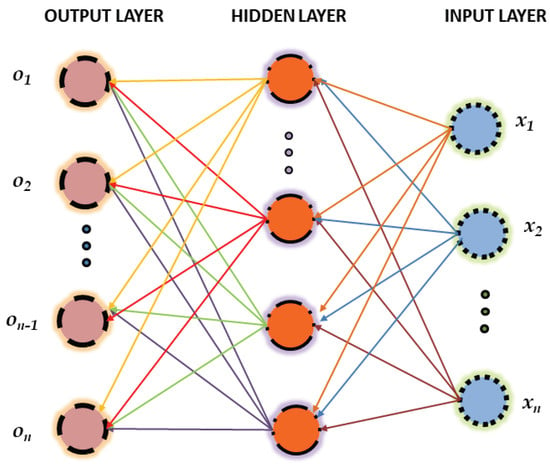
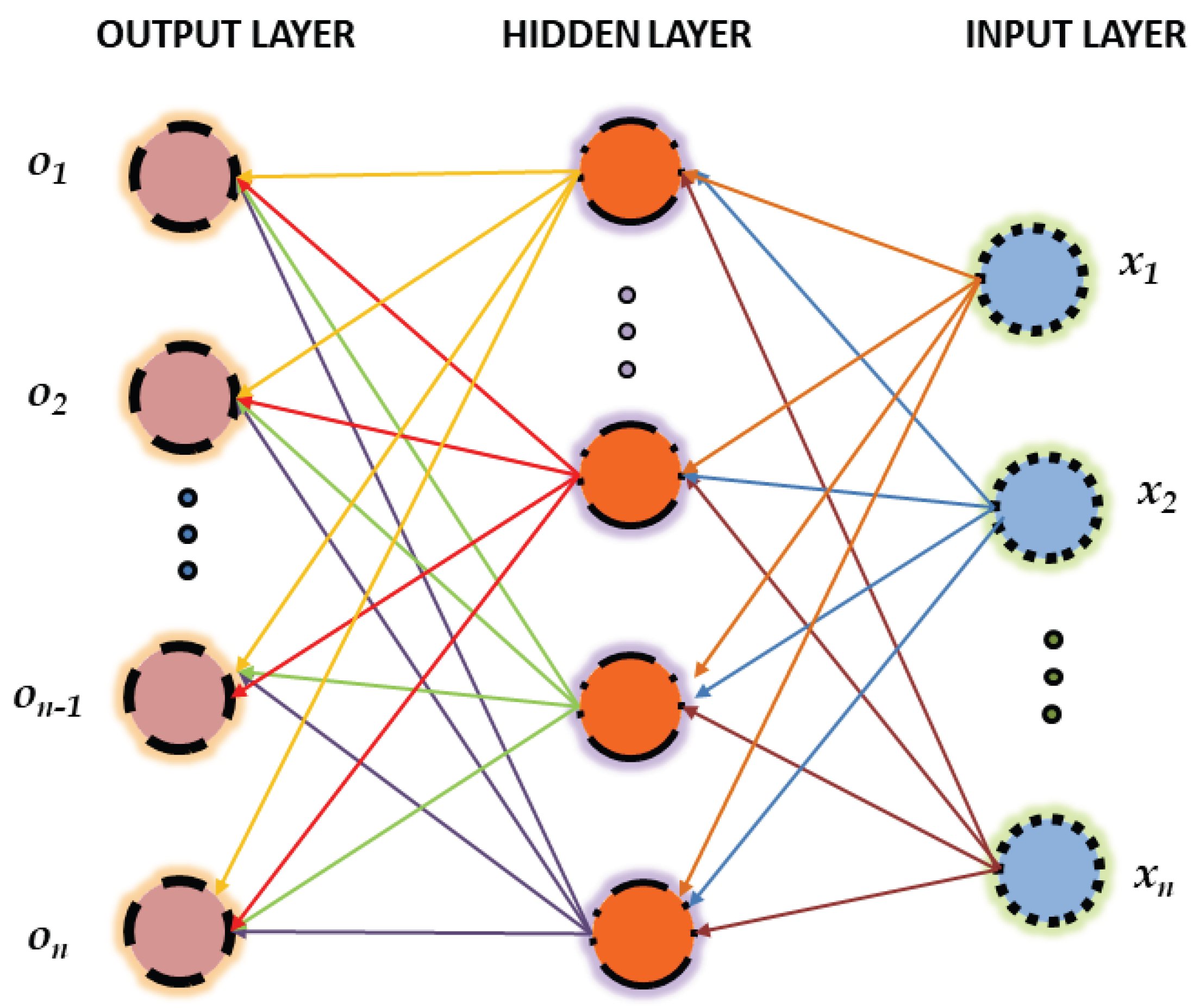
As illustrated in Figure 1, the RWN architecture consists of an input layer, a single hidden layer, and an output layer. The input nodes are fully connected to the hidden neurons, which are connected to the output nodes. In the conventional RWN formulation, the input-to-hidden weights and hidden-layer biases are randomly generated and remain fixed during training, while the output weights are calculated analytically.
Figure 1.
The architecture of RWN.
The learning process begins by randomly initializing the input-to-hidden weights and hidden-layer biases. These parameters are used to construct the hidden-layer output matrix by applying the activation function to the training samples. The output weights are subsequently determined using the Moore–Penrose pseudoinverse of the hidden-layer output matrix.
Consider N distinct training samples represented as , where the input feature vector is defined as and the corresponding target output is According to Huang et al. [25], the output of an SLFN with L hidden neurons can be expressed in Equation (1):
where represents the weight vector connecting the input nodes to the ith hidden neuron, denotes the bias of the ith hidden neuron, and represents the weight vector connecting the ith hidden neuron to the output nodes. Furthermore, denotes the hidden-layer activation function, and represents the network output corresponding to the jth training sample.
For a network that can represent the training targets exactly, the output error satisfies in Equation (2):
Accordingly, the network parameters satisfy:
The above equations can be expressed in matrix form as:
where the hidden-layer output matrix H is defined as:
The output-weight matrix and the target matrix T are represented as:
Here, H denotes the hidden-layer output matrix, where each column represents the outputs of a hidden neuron across all N training samples [25].
The output weights are analytically determined by minimizing the difference between the network outputs and the target values. The corresponding least-squares solution is obtained using the Moore–Penrose pseudoinverse:
where denotes the Moore–Penrose pseudoinverse of H. This formulation provides a minimum-norm least-squares solution without iterative adjustment of the output weights or the application of an explicit regularization term.
RWN offers several advantages for Arabic offensive-language classification. First, unlike conventional gradient-based neural networks, RWN does not require iterative backpropagation to determine the output weights. In its standard formulation, the input-to-hidden weights and hidden-layer biases are randomly assigned, while the output weights are analytically computed using the Moore–Penrose pseudoinverse [17,18]. This analytical solution eliminates the need for iterative gradient-based updates and can reduce the computational cost associated with iterative training [17,18]. Second, the standard RWN formulation does not require learning rates, batch sizes, or the number of training epochs to be tuned, which simplifies the training process and can be beneficial for datasets of limited size, such as ArCybC, which contains 4505 tweets [8,19,21]. Third, word-embedding representations can produce high-dimensional feature spaces. Random-weight networks have been reported to achieve good classification performance even when the number of hidden neurons is of the same order as the input dimensionality, provided that the dimensionality is sufficiently high [26]. This finding provides motivation for investigating RWN with high-dimensional word-embedding representations.
Despite these properties, RWN performance can depend on the number of hidden neurons and the input-to-hidden weights and biases. In the present study, GWO is employed to search for suitable values for these parameters rather than relying on a manually selected configuration. Specifically, GWO optimizes the number of hidden neurons and the input-to-hidden weights and biases, while the output weights are analytically determined using the Moore–Penrose pseudoinverse. This optimization process reduces the need for manual parameter selection and is implemented using the chromosome representation described in Section 4.3, which consists of three components: the input-to-hidden weights, hidden-layer biases, and number of hidden neurons.
3.2. Grey Wolf Optimizer (GWO)
The GWO introduced in [7], is a nature-inspired metaheuristic algorithm modeled on the social structure and hunting strategies of grey wolves. As one of the latest swarm intelligence (SI) algorithms, GWO has gained significant attention for its simplicity, flexibility, scalability, and minimal parameter tuning. Its ability to balance exploration and exploitation ensures efficient convergence, making it a valuable tool across diverse optimization problems.
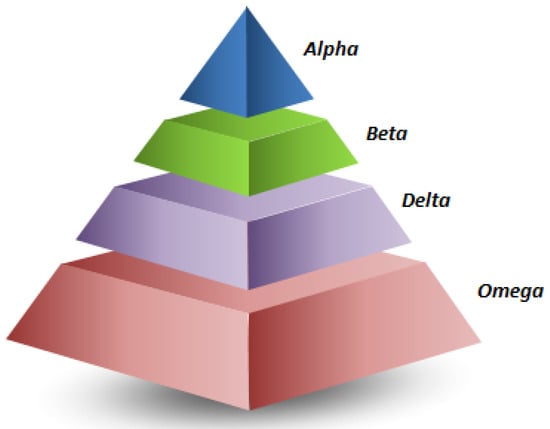
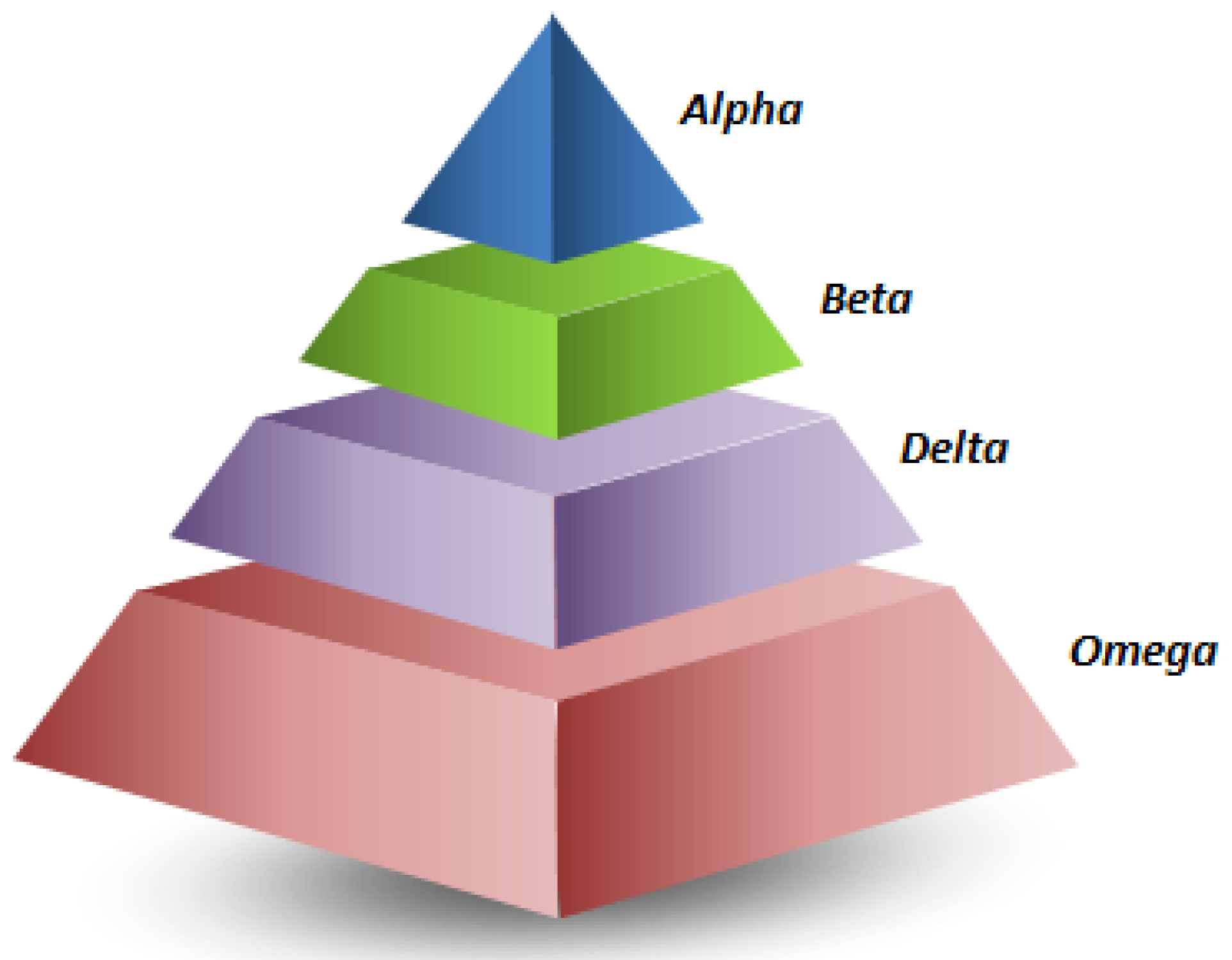
The algorithm is inspired by the dominance and predatory behaviors of grey wolves in nature. Wolves typically live in groups following a rigid hierarchy: the alpha () leads the pack in hunting for prey, migration, and feeding processes, the beta () steps in to lead if the alpha is illness or dead, followed by delta () wolves. The remaining wolves are referred to as omega (). Figure 2 illustrates the hierarchy within a wolf pack, showing alphas as the strongest and omegas as the weakest. The second inspiration for GWO is the hunting of pray strategy of grey wolves, which involves several steps: pursuing, encircling, intimidating, and capturing prey. One of GWO’s key features is its ability to balance exploration and exploitation throughout the optimization process. During the iterations, the value of parameter gradually declines from 2 to 0, the algorithm transitions from exploring the search space to exploiting the best solutions found. This strategic shift ensures an effective search process, allowing GWO to efficiently navigate the search space and enhance optimization performance.
Figure 2.
Social hierarchy of wolves in GWO.
In the proposed GWO-RWN model, the fundamental RWN architecture and analytical output-weight calculation are retained. However, rather than keeping the randomly initialized input-to-hidden weights and hidden-layer biases fixed, GWO is employed to optimize these parameters together with the number of hidden neurons. The number of hidden neurons is initially set to three times the number of input features (). The optimized parameters are subsequently used to construct the hidden-layer output matrix, while the output weights are calculated using Equation (7). The Sigmoid activation function is employed in the hidden layer and is defined as:
This integration preserves the analytical learning mechanism of the conventional RWN while introducing GWO-based optimization to improve the network configuration and classification performance. When RWN is integrated with GWO, additional computational cost arises because multiple candidate network configurations must be evaluated throughout the optimization process. Each candidate requires the construction and evaluation of an RWN model. Consequently, the overall computational requirements depend on the population size, number of optimization iterations, network configuration, and cost of evaluating each candidate solution. Thus, the analytical training mechanism of RWN does not eliminate the computational overhead introduced by metaheuristic optimization.
4. Proposed Model
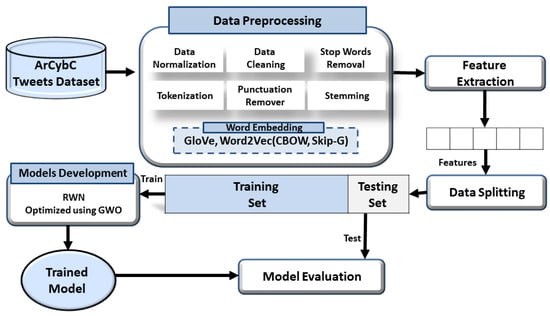
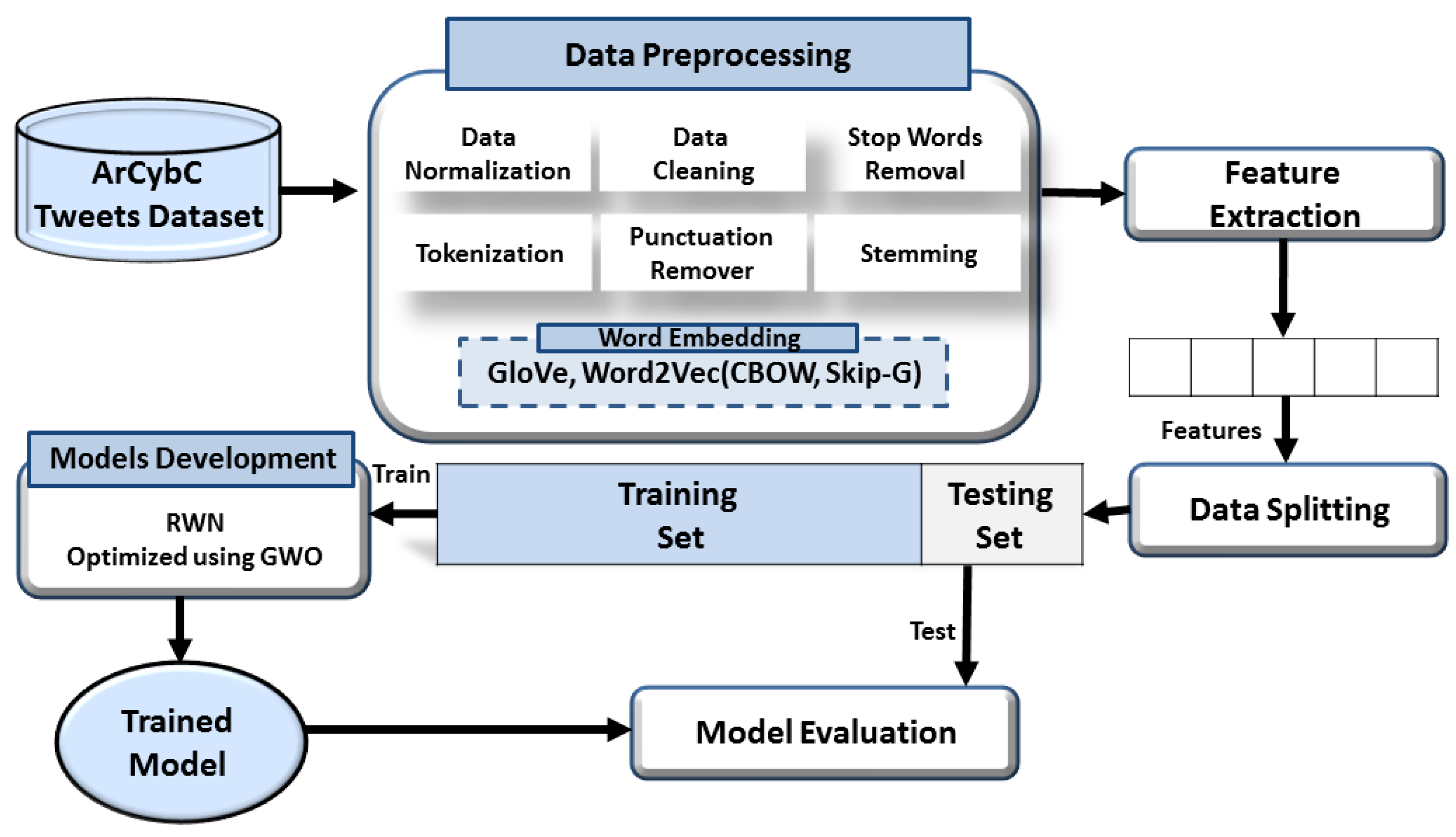
This study aimed to develop an optimized model for detecting offensive language on X App (Twitter), specifically in Arabic. As shown in Figure 3, the process begins with data preparation and preprocessing of the ArCybC corpus to extract features. Next, it involves hyperparameter tuning for the RWN network using GWO. Finally, the model is evaluated.
Figure 3.
The proposed approach for offensive language detection.
4.1. Data Preprocessing
In this study, the dataset was obtained using Twitter’s streaming API, incorporating the ArCybC [8], a publicly accessible resource specifically designed for Arabic cyberbullying content (available at: https://data.mendeley.com/datasets/z2dfgrzx47/1, accessed on 22 May 2026). This approach allowed the dataset to capture real-world Arabic social media interactions and provided a basis for examining offensive language in different online discussions.
The study covered four domains, sports, gaming, celebrities, and news. Identified through an analysis of the most-followed accounts in the Arab online community. These domains were chosen to represent discussions on different topics rather than focusing on a single subject. This variety also allowed the proposed offensive language detection approach to be evaluated across different communication contexts.
After removing duplicate and irrelevant tweets, the final dataset contained 4505 tweets. Four native Arabic speakers, aged between 23 and 37 years, manually labeled each tweet as Offensive or Non-Offensive based on its meaning and context. To assess annotation consistency, we calculated the unanimous agreement rate, which represents the percentage of tweets assigned the same label by all four annotators. The annotators reached unanimous agreement on 69% of the tweets. Conflicting annotations were reviewed by a designated adjudicator to determine their final labels. After annotation, the dataset was divided into training, validation, and testing subsets using a 60%–20%–20 split. Accordingly, 2703 tweets were used for training, 901 tweets for validation, and 901 tweets for testing. The training and validation subsets together comprised 3604 tweets, while the test subset was kept independent for the final evaluation.
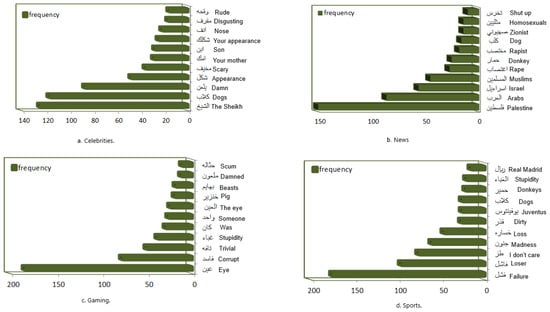
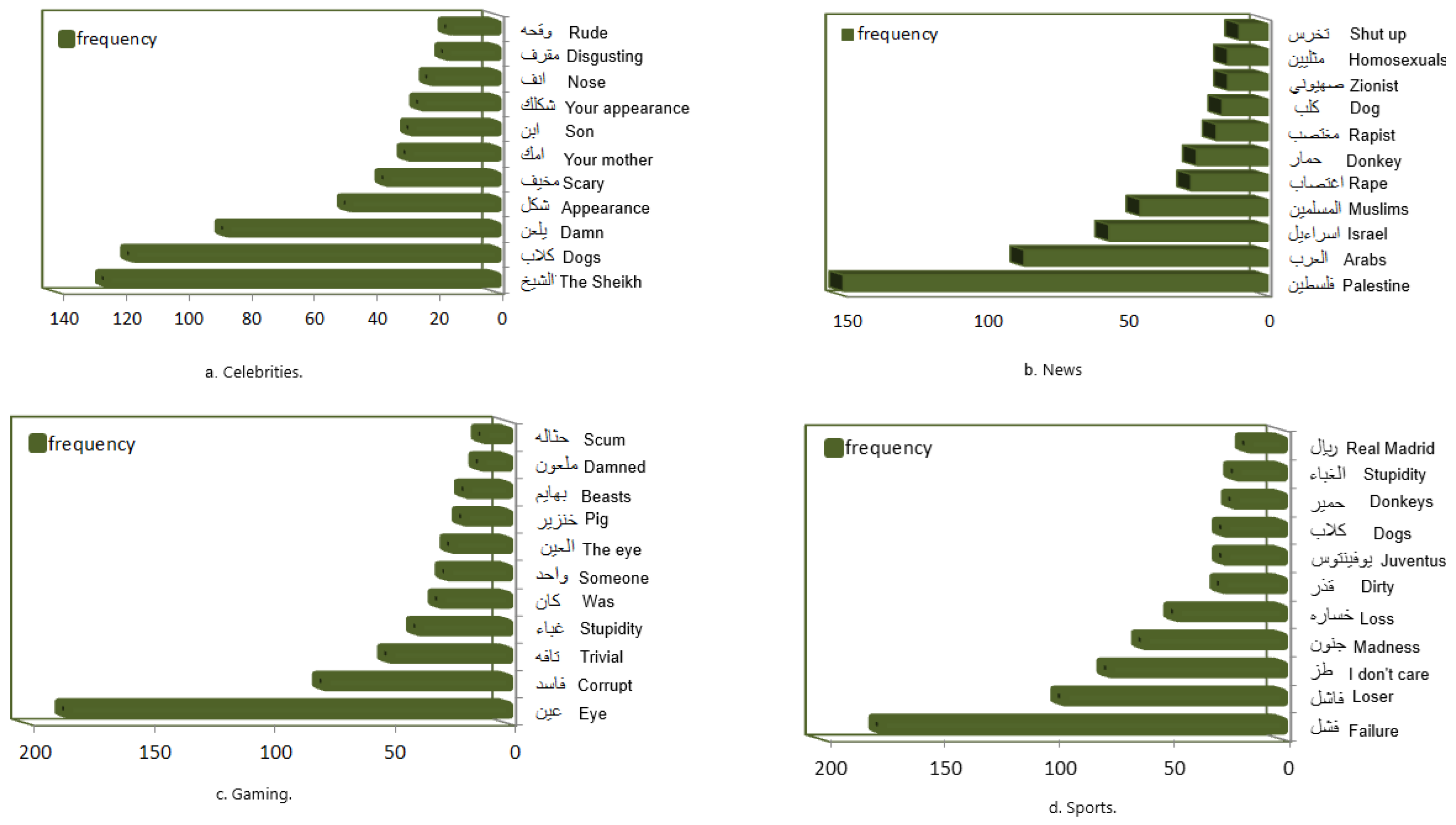
Table 2 presents the tweet counts for each domain and their distribution across categories, and Figure 4 highlights significant unigram features for each domain. To enhance classification accuracy and address the noisy nature of social media data, preprocessing included removing unwanted elements such as non-Arabic characters, punctuation, numbers, stop words, symbols, web links, hashtags, diacritical marks, and negation words.
Table 2.
Number of tweets by domain and category.
Figure 4.
Unigram features for each domain.
The stopword filtering procedure excluded the Arabic keywords listed in Table 3, together with their English translations. Common explicit Arabic negation words, such as لا (no/not), لم (did not), لن (will not), and ليس (is not), were not included in the exclusion list. Retaining these negation words helps preserve information relevant to the meaning of offensive and non-offensive statements.
Table 3.
Arabic stopwords excluded during data preprocessing, with their transliterations and English translations.
Additionally, text normalization was applied to standardize Arabic characters. For example:
- The Arabic character (Alef) (<أ>), which exhibits several manifestations <(ا, إ, أ)>, is subject to normalization, unifying these four manifestations into the singular form (<ا>)
- The Arabic character (Ya) (<ي>) has undergone normalization to yield (<ى>)
- The Arabic character (Taa Marbouta) (<ة>) has been standardized to assume the form of (<ه>)
4.2. Word Embedding
Numerous text representations have been developed to assist machine learning algorithms in understanding text. One notable example is one-hot encoding, which represents words as binary vectors based on the number of unique words. However, one-hot encoding is inefficient and cannot capture implicit word meanings. A more advanced approach is word embedding, where words with similar meanings are represented as fixed-length dense vectors, with components learned during training. Increasing the embedding dimension improves the model’s ability to capture word semantics, but requires more extensive training data.
In this study, textual characteristics from the tweets were extracted and transformed into numerical vectors suitable for processing by machine learning models. Pretrained GloVe and Word2Vec were selected to provide effective static word representations without training embeddings from scratch. These models enable the generation of word vectors by analyzing their co-occurrence in sentences, mapping them into a lower-dimensional vector space. This transformation allowed machine learning algorithms to categorize words based on their semantic similarities effectively. Following preprocessing, the vocabulary was adapted according to the requirements of each word embedding model. The resulting vocabulary sizes for the evaluated embedding configurations are reported in Table 4.
Table 4.
Word embedding configurations and vocabulary statistics used in the experiments.
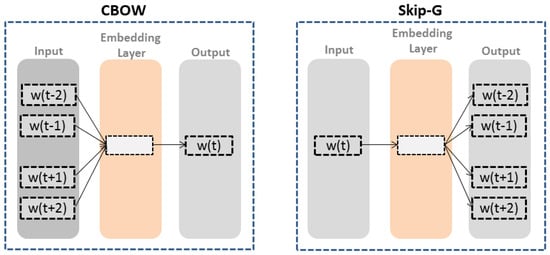
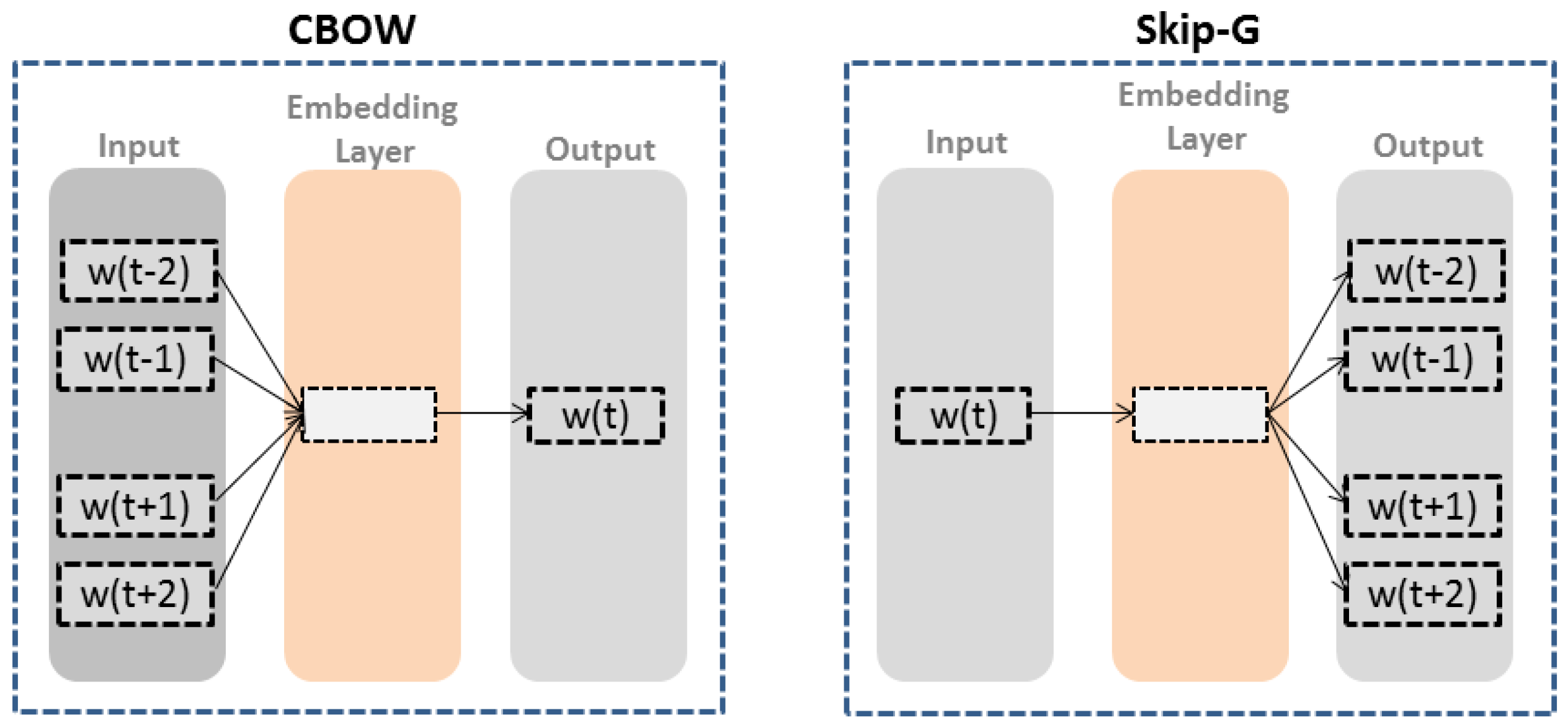
Word2Vec [27] is a technique for word representation in natural language processing (NLP) with a three-layer neural network. The architecture’s primary goal is to learn hidden layer weights, which serve as word embedding’s. Word2Vec employs two architectures: the Continuous Bag-of-Words (CBOW) and the Skip-Gram (Skip-G). The CBOW predicts target middle word using context words, whereas the Skip-G uses the target word as input to predict context words. In this study, the pretrained AraVec models were employed to obtain Arabic word representations using the CBOW and Skip-G architectures.
Glove is a word embedding technique to represent the semantic meaning of words through analyzing the global co-occurrence statistics within a large corpus of text. Unlike Word2Vec that learns embeddings through local context prediction (e.g., CBOW and Skip-G), GloVe constructs a co-occurrence matrix that counts how often each word appears with others within a certain window. This is coupled with matrix factorization techniques to give word vectors such that the dot product of two vectors is set to be equal to the logarithm of the frequency at which the respective words co-occur. So, GloVe embeddings really help to capture the syntactic as well as semantic relations between words and thereby find their application in NLP tasks. AraVec and GloVe were selected to investigate the effectiveness of the proposed GWO-RWN model using conventional static word representations. Specifically, AraVec was evaluated through its CBOW and Skip-G architectures, while GloVe was included to provide an additional representation based on global word co-occurrence statistics. The use of pretrained embeddings enabled the construction of numerical feature representations without training the embedding models from scratch on the relatively small ArCybC dataset. Furthermore, evaluating these embedding configurations under the same classification and optimization protocol allowed us to examine the influence of different word representation strategies on the performance of GWO-RWN. To extend the evaluation beyond static word representations, AraBERT was also considered as a transformer-based comparison in Experiment III.
Figure 5 illustrates the main principles of the CBOW and Skip-G models. In the CBOW model, a set of input words, determined by a window size, is used to predict the corresponding middle word (wt). For instance, with a window size of two, the model considers four words—two preceding words , and two following words , . In contrast, Skip-G takes a one-word word and predicts its neighboring words by identifying those with the highest similarity to the given word.
Figure 5.
A illustration of the CBOW and Skip-G word embedding models.
For each embedding technique, the word vectors associated with the tokens in a tweet were averaged to obtain a single fixed-length numerical representation. Out-of-vocabulary (OOV) words, for which no embedding vector was available, were excluded from the averaging process.
Let denote the sequence of words in the j-th tweet with available embedding vectors, and let represent the d-dimensional embedding vector of word w. The final feature representation of the tweet is calculated as
where denotes the number of words with available embedding vectors. This procedure produces a fixed-length feature vector , regardless of tweet length. The resulting feature vectors are supplied to the RWN classifier. CBOW, Skip-G, and GloVe were evaluated independently rather than combined into a single representation.
4.3. Model Development
The proposed approach is developed in two main phases. In the first phase, the effectiveness of different word embedding models is evaluated in conjunction with the conventional RWN and six established machine learning classifiers, namely LightGBM, Logistic Regression (LR), SVM, K-Nearest Neighbors (KNN), Naive Bayes (NB), and Decision Tree (DT). For each embedding technique, the word vectors associated with a tweet are averaged to form a fixed-length feature representation, which is subsequently used as input to the classification models.
In the second phase, GWO is integrated with RWN to improve its classification performance by optimizing the input-to-hidden weights, hidden-layer biases, and number of hidden neurons. These parameters were selected because they directly influence the hidden-layer representation generated by RWN. The input-to-hidden weights and biases determine the transformation of the input features, whereas the number of hidden neurons controls the size and representational capacity of the hidden layer. Since the output weights are analytically determined from the hidden-layer output matrix, optimizing these parameters jointly allows GWO to explore different RWN configurations rather than relying solely on random initialization.
For each candidate configuration generated by GWO, the RWN hidden-layer output matrix is computed using the sigmoid activation function, while the output weights are analytically determined using the Moore–Penrose pseudoinverse. The classification accuracy obtained on the validation subset is used to evaluate the candidate configuration and guide the optimization process. The selected GWO-RWN model is then evaluated on the independent test subset.
Accordingly, the word embedding models provide the numerical feature representations, RWN performs classification, and GWO optimizes the RWN configuration without modifying the embedding vectors.
To prevent potential test-set leakage and ensure an unbiased evaluation of the proposed GWO-RWN model, the dataset was partitioned into training (60%), validation (20%), and testing (20%) subsets using stratified sampling. The training subset was used to construct the hidden-layer output matrix and analytically calculate the RWN output weights using the Moore–Penrose pseudoinverse. The validation subset was employed to evaluate the fitness of candidate solutions generated by the metaheuristic optimization algorithms.
During optimization, each candidate solution represented a combination of input-to-hidden weights, hidden-layer biases, and the number of hidden neurons. The corresponding RWN model was constructed using the training subset, and its classification accuracy on the validation subset was used as the fitness value to guide the optimization process. This procedure was repeated until the maximum number of iterations was reached.
The testing subset was kept separate throughout the optimization process and was not used for fitness evaluation, parameter adjustment, or model selection.
After optimization, the selected RWN configuration was evaluated on the previously unseen test set to assess its generalization performance.
The optimization of RWN parameters using GWO involves two main design aspects:
- Solution Representation: GWO searches for an optimal RWN configuration. Each grey wolf represents a candidate solution containing three components: the input-to-hidden weights, hidden-layer biases, and number of hidden neurons.The number of hidden neurons is initially set to three times the input feature dimension (), where n represents the number of input features. During optimization, the number of hidden neurons is restricted to the integer range .The input-to-hidden weights and hidden-layer biases are randomly initialized within the search interval and remain bounded within this interval throughout the optimization process. Each candidate solution is represented as a one-dimensional position vector containing the parameters required to construct the corresponding RWN model.To ensure that the randomly generated parameter values remain within the predefined search-space bounds, the following rescaling equation is employed [2]:where represents the scaled parameter value, denotes a randomly generated value within , and and represent the lower and upper bounds of the search space, respectively.During optimization, GWO updates the candidate solutions to identify the most effective combination of input-to-hidden weights, hidden-layer biases, and hidden neurons for the RWN model.
- Fitness Function: The fitness function evaluates the quality of each candidate solution generated by GWO based on the classification performance of the corresponding RWN network. For each candidate solution, the input-to-hidden weights, hidden-layer biases, and number of hidden neurons are used to construct the RWN hidden-layer output matrix. The output weights are subsequently calculated analytically using the Moore–Penrose pseudoinverse. The resulting model is evaluated using the validation subset, and classification accuracy is employed as the fitness criterion. Candidate solutions achieving higher validation accuracy are assigned higher fitness values, guiding GWO toward the optimal combination of RWN parameters. The optimization process aims to maximize validation accuracy while identifying an effective RWN configuration for Arabic offensive language detection. Classification accuracy was selected as the fitness criterion to measure the overall proportion of correctly classified instances on the validation subset. The same fitness criterion was applied across GWO, GA, PSO, and ABC to maintain a consistent optimization objective.Although accuracy provides an overall measure of classification performance, it may not fully reflect differences between the Offensive and Non-Offensive classes. Therefore, precision, recall, F1-score, and G-mean were also employed during the final evaluation. Furthermore, class-wise precision, recall, and F1-score were examined separately to provide a more detailed assessment of the classification performance for each category. Based on the solution representation and fitness function described above, the overall procedure of the proposed GWO-RWN algorithm is summarized in Algorithm 1.After completing the optimization process, the best configuration represented by the alpha wolf is used to construct the final GWO-RWN model, which is subsequently evaluated on the independent test set. The test set is not involved in the optimization or fitness evaluation process.
| Algorithm 1 Pseudocode of the proposed GWO‑RWN algorithm |
|
4.4. Evaluation Metrics
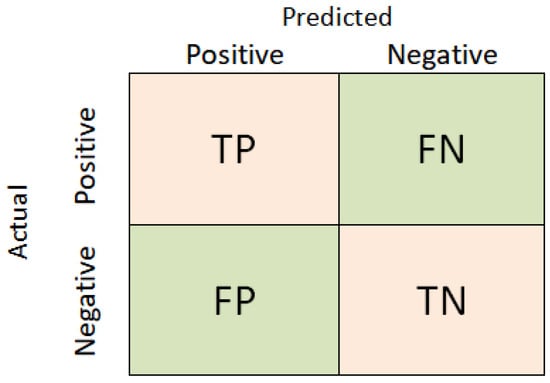
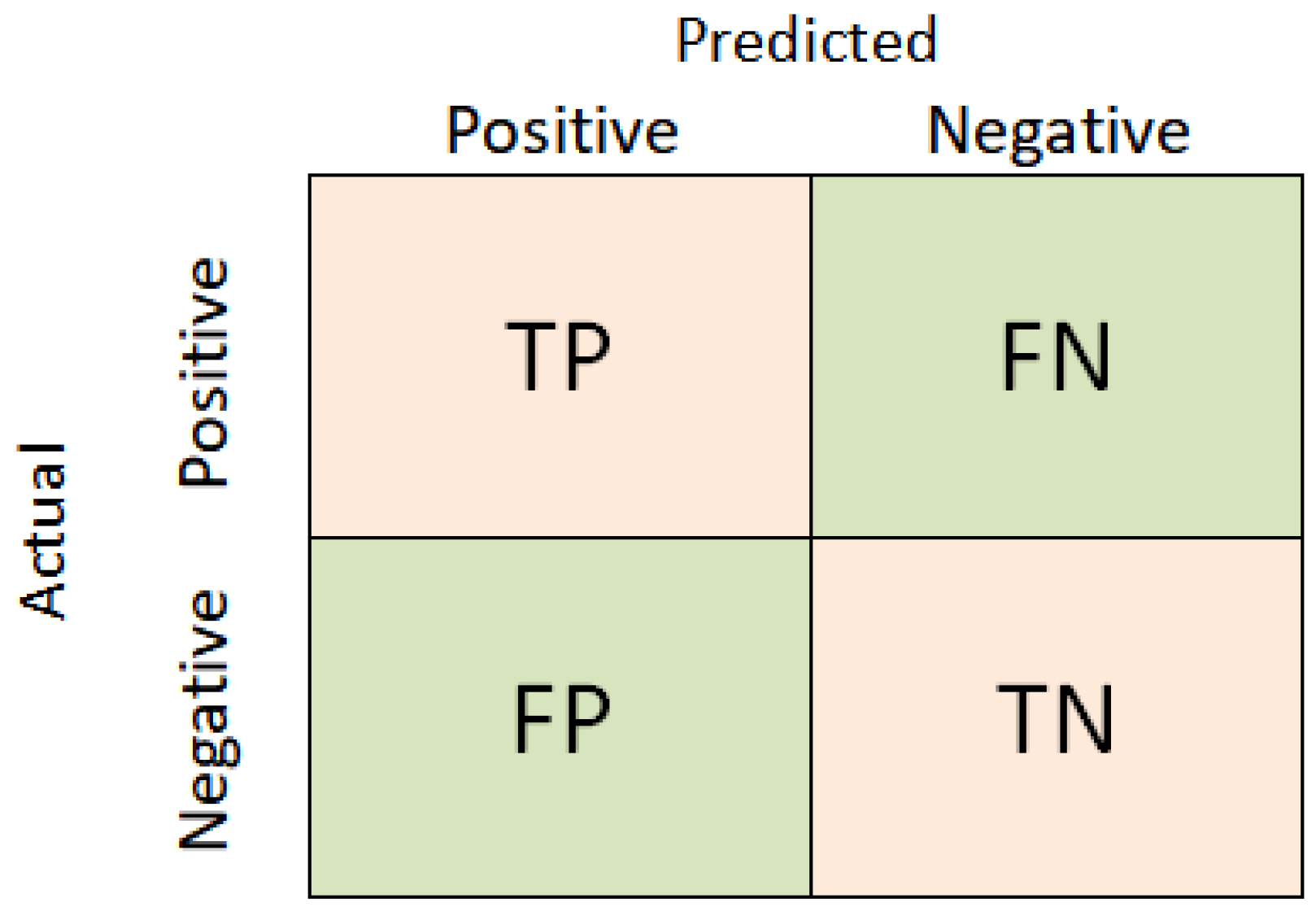
To evaluate the performance of the best-performing RWN model, five key metrics were used: ACCU, PRECI, REC, G-mean, and F1-S. These metrics assess how well the model is performing in the binary classification task of detecting offensive content. The calculations of these metrics relied on the confusion matrix as presented in Figure 6, a structured table that visualizes the model’s effectiveness in classification tasks [28]. In this study, ’Offensive’ is considered the positive class, while ’non-Offensive’ represents the negative class, as described by Equations (11)–(15) [14].
Figure 6.
Confusion matrix illustrating true positives (TP), true negatives (TN), false positives (FP), and false negatives (FN).
Within the context of our research, the confusion matrix includes the following terminologies: TP, which counts the instances correctly identified as offensive; TN, referring to cases accurately classified as non-offensive; FP, representing instances incorrectly classified as offensive; and FN, indicating the cases that were wrongly identified as non-offensive.
5. Experiments and Results
In section provide an extensive comparison of the classification performance of the proposed model. All experiments were executed on a desktop computer equipped with an Intel (R) Core (TM) i7-5500U 2.4 GHz processor and 16 GB of RAM. Python 3.9 was used as the programming environment, with the imbalanced-learn and scikit-learn libraries supporting the implementation and evaluation of the classification algorithms [29,30]. The experiments were structured as follows:
- Experiment I: This experiment conducts a comparative analysis of the performance of established classification algorithms on the ArCybC dataset. The aim is to evaluate the initial data results and determine the effectiveness of various classification algorithms, including RWN, LightGBM, LR, SVM, KNN, NB, and DT.
- Experiment II: This experiment investigates the impact of using various meta-heuristic algorithms, including GA, PSO, ABC, and GWO, to optimize the hyperparameters of the models that achieved the best results in the initial experiment.
- Experiment III: This experiment provides an additional comparison of the proposed GWO-RWN model with existing Arabic offensive language detection approaches. It includes previously published methods evaluated on the same ArCybC dataset, as well as an AraBERT baseline implemented and evaluated in this study. This comparison provides additional context for assessing GWO-RWN against conventional machine learning, deep learning, and transformer-based approaches.
The parameter settings of the four metaheuristic algorithms are summarized in Table 5. The configurations were selected based on established studies in the literature to ensure a consistent and reproducible experimental comparison. All algorithms were evaluated using a population size of 100 and a maximum of 100 iterations, with 30 independent runs conducted to account for the stochastic nature of the optimization process. The search-space bounds for the input-to-hidden weights and hidden-layer biases were set to [−1, 1]. During optimization, candidate solutions were evaluated using classification accuracy on the validation subset, while the training subset was used to fit the RWN model. The independent test subset was excluded from the optimization process and used only to evaluate the final selected models.
Table 5.
Experimental parameter settings for the metaheuristic optimization algorithms.
For GA, the crossover and mutation probabilities were set to 0.9 and 0.1, respectively, while roulette-wheel selection and elitism were employed to support population diversity and preserve high-quality solutions. For PSO, the inertia factor was set to 0.1, and the cognitive and social coefficients were both set to 2, with particle velocities constrained to [−0.2, 0.2]. For ABC, the acceleration coefficient upper bound and abandonment limit were set to 1.0 and 100, respectively. In GWO, the control parameter was linearly decreased from 2 to 0 throughout the optimization process to regulate the transition from exploration to exploitation.
These settings were adopted to provide a consistent experimental framework for comparing the optimization algorithms in terms of their ability to improve the classification performance of the RWN model.
5.1. Experiment I: Performance Results of Classification Algorithms
This study evaluated several well-known classification models on the ArCybC dataset for offensive content detection using the text representations described previously. In the first experiment, the classifiers were compared using accuracy, precision, recall, G-mean, and F1-score. The results are presented in Table 6.
Table 6.
Comparative analysis of classification models employing different vectorization strategies. Bold denotes the best result recorded for each measure.
The results show that classifier performance varies depending on the text representation used. With Skip-G features, LightGBM achieved the highest precision and G-mean, whereas RWN obtained the highest accuracy, recall, and F1-score. These results indicate that RWN was particularly effective in identifying offensive content while maintaining a good balance between precision and recall.
With CBOW features, RWN achieved the best results across all evaluation metrics. LightGBM also performed well, followed by LR, SVM, KNN, NB, and DT, although their performance was lower than that of RWN.
A similar pattern was observed with GloVe features, where RWN achieved the highest performance across the reported evaluation metrics. LightGBM and LR also produced competitive results, showing that their performance remained relatively strong with different word representations.
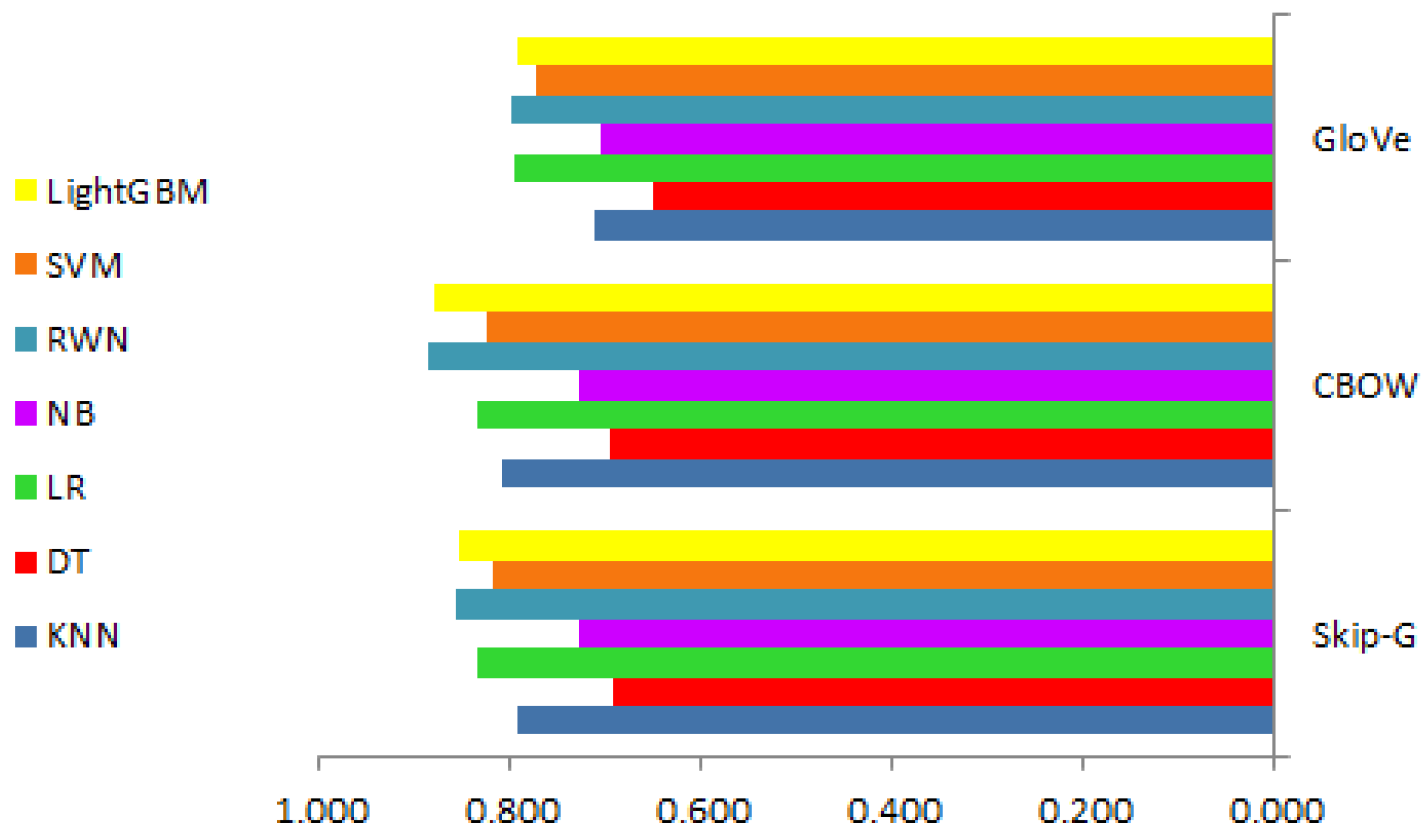
Overall, Experiment I shows that RWN performed well across the three text representations and achieved the strongest overall results among the evaluated classifiers, as illustrated in Figure 7. These findings provide the basis for further optimizing the RWN configuration using metaheuristic algorithms in the subsequent experiment.
Figure 7.
Comparison between classification models based on accuracy performance.
5.2. Experiment II: Comparative Performance Analysis of the Proposed Model Versus Other Metaheuristic Algorithms
Following the evaluation of conventional classifiers in Experiment I, Experiment II investigates the potential improvements achieved by integrating metaheuristic optimization algorithms with RWN. In this experiment, RWN serves as the underlying classification model, while GA, PSO, ABC, and GWO are employed to optimize its configuration. The optimization settings are presented in Table 5.
To examine the contribution of GWO optimization, the proposed GWO-RWN model is compared with the conventional RWN evaluated in Experiment I. The conventional RWN serves as a baseline without metaheuristic optimization, whereas GWO-RWN incorporates the joint optimization of the input-to-hidden weights, hidden-layer biases, and number of hidden neurons.
Furthermore, GWO-RWN is compared with GA-RWN, PSO-RWN, and ABC-RWN to investigate the influence of different metaheuristic optimization algorithms within the same RWN framework. These comparisons allow the contribution of introducing GWO optimization to be examined separately from the effect of selecting GWO rather than another metaheuristic algorithm.
The results, summarized in Table 7, shows that GWO-RWN recorded the best performance on the Skip-G model, followed by PSO-RWN, ABC-RWN, and GA-RWN, respectively. For the CBOW model, GWO-RWN demonstrated outstanding performance, achieving an accuracy score of 0.876. Regarding the GloVe embedding, 0.811 and 0.813, respectively, while GWO-RWN excelled in other key performance metrics.
Table 7.
Performance results of the metaheuristic algorithms with RWN. Bold denotes the best result recorded for each measure.
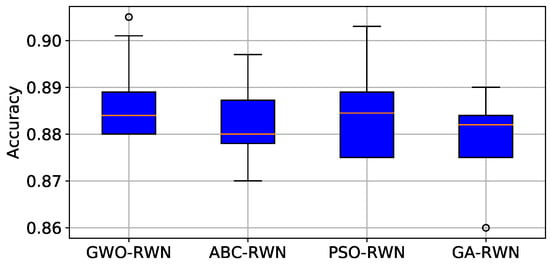
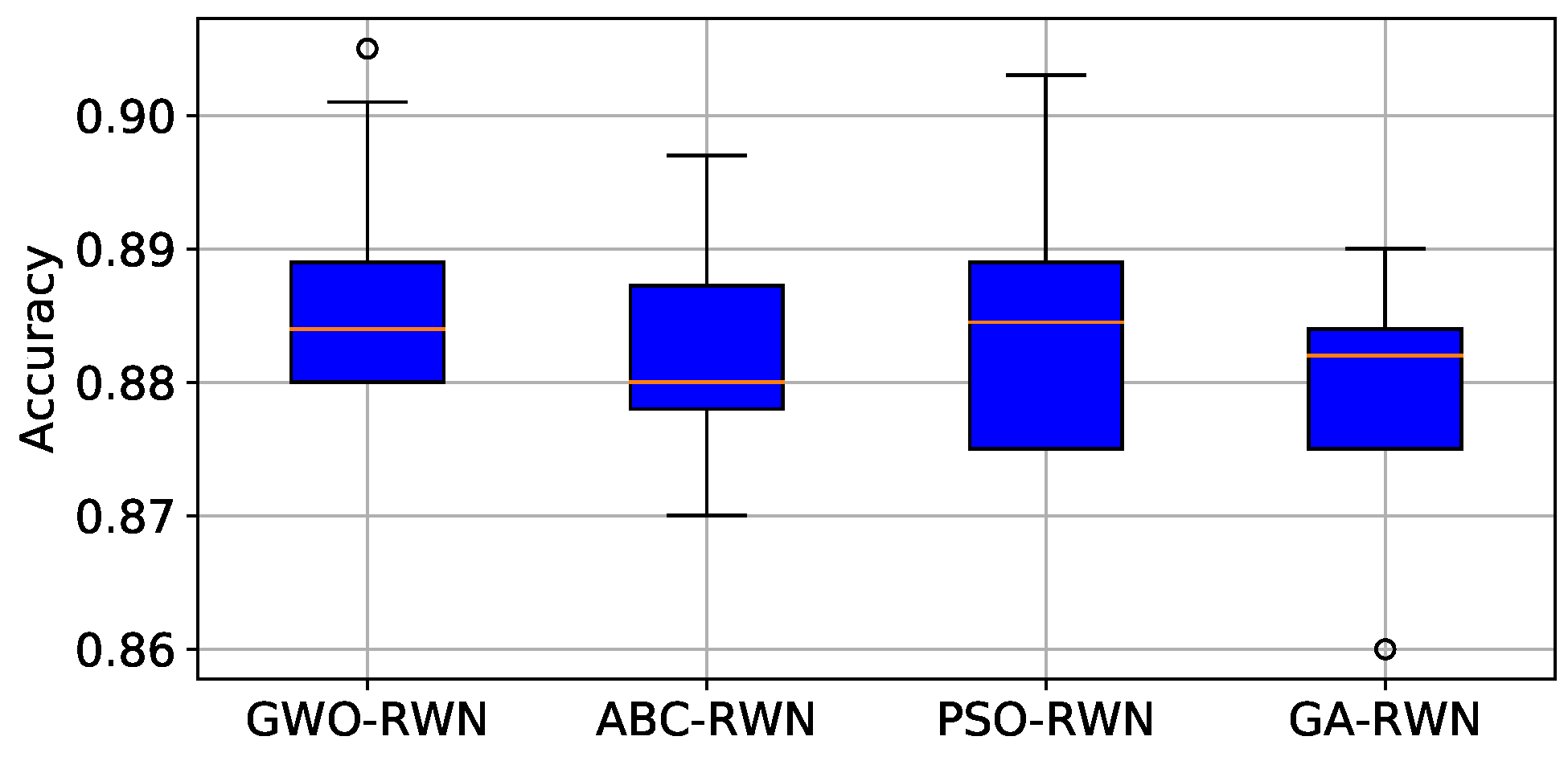
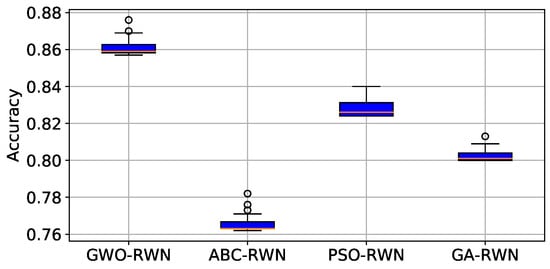
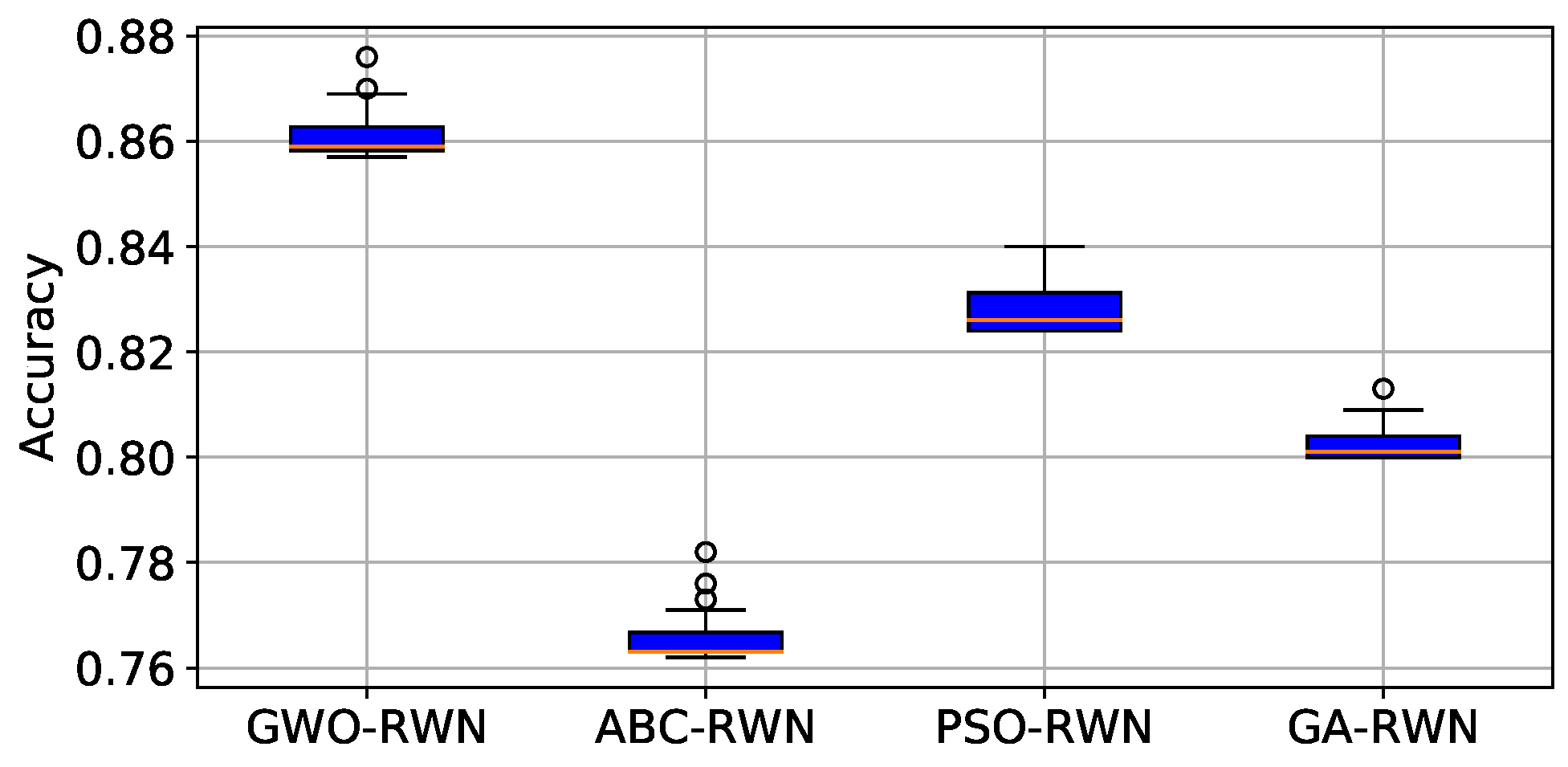
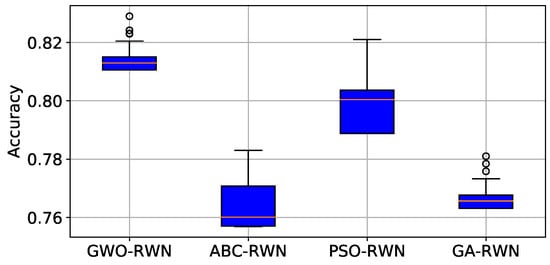
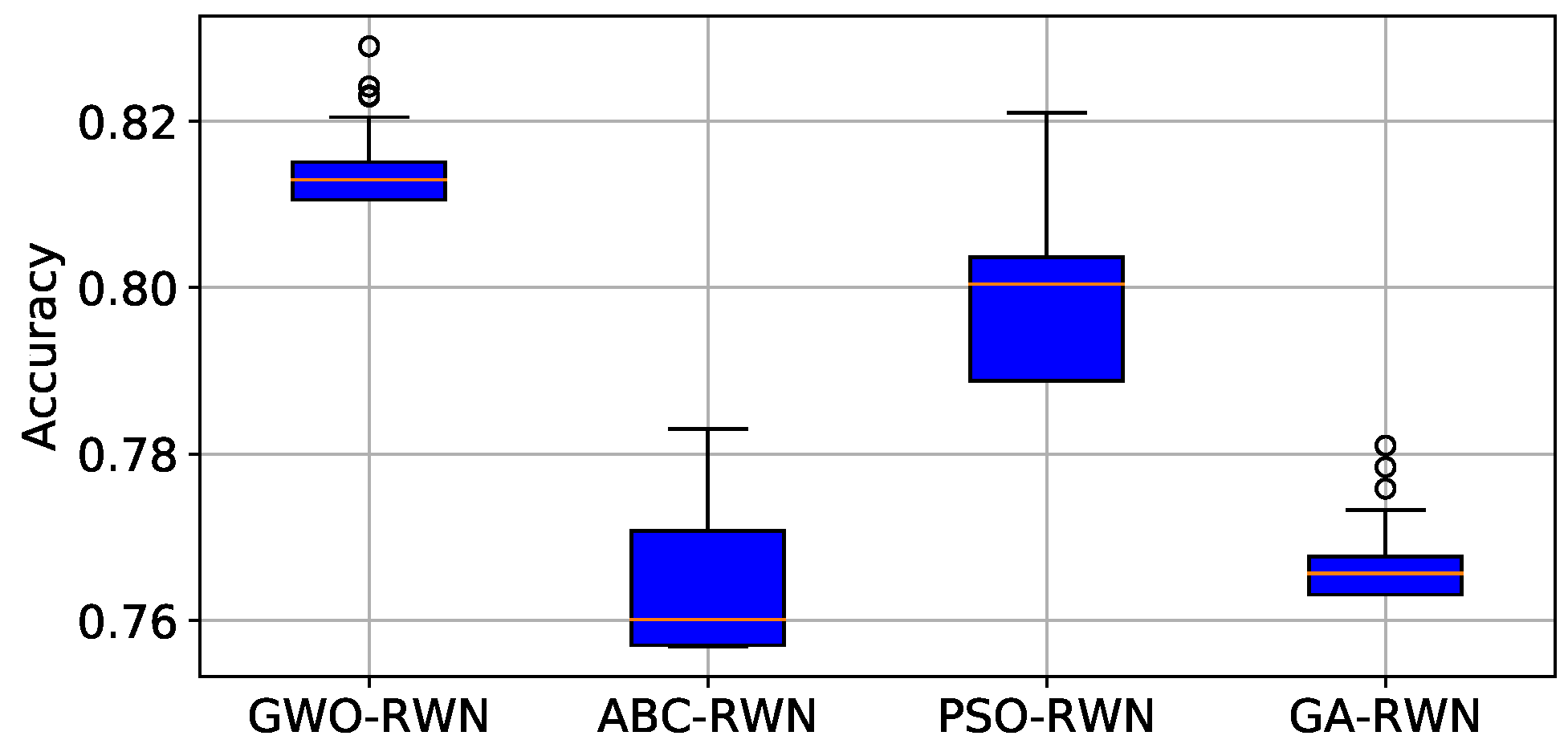
The box plots in Figure 8, Figure 9 and Figure 10 show the distribution for the classification accuracy on Skip-G, CBOW, and GloVe. These results are after running the models, namely, GWO-RWN, ABC-RWN, PSO-RWN, and GA-RWN, 30 times. From these results, it can be concluded that GWO-RWN dominates in the optimization of the RWN network.
Figure 8.
Box-plot chart for GWO-RWN and other models for Skip-G.
Figure 9.
Box-plot chart for GWO-RWN and other models for CBOW.
Figure 10.
Box-plot chart for GWO-RWN and other models for GloVe.
To provide further insight into the variability of the classification results, 95% confidence intervals were calculated for the mean accuracy obtained from 30 independent runs of each metaheuristic algorithm. The results for CBOW, Skip-G, and GloVe embeddings are presented in Table 8.
Table 8.
Mean classification accuracy, standard deviation, and 95% confidence intervals of the evaluated metaheuristic algorithms over 30 independent runs. Bold denotes the best result recorded for each measure.
As shown in Table 8, GWO-RWN achieved the highest mean accuracy under all three embedding configurations. The highest overall mean accuracy was obtained using Skip-G embeddings, where GWO-RWN achieved , with a 95% confidence interval of .
Under CBOW embeddings, GWO-RWN achieved a mean accuracy of , with a 95% confidence interval of . For GloVe embeddings, the corresponding mean accuracy was , with a 95% confidence interval of .
These confidence intervals complement the reported mean accuracy and standard deviation by providing an estimate of the uncertainty associated with the mean classification performance across independent runs. The statistical significance of the differences between GWO-RWN and the competing algorithms is examined separately in the Statistical Significance Analysis subsection.
To provide a more detailed evaluation of the proposed GWO-RWN model, the classification performance was examined separately for the Offensive and Non-Offensive classes using Skip-G embeddings.
Class-wise precision, recall, and F1-score were calculated to assess the model’s ability to recognize each category independently. The corresponding results are presented in Table 9.
Table 9.
Class-wise classification performance of the proposed GWO-RWN model using Skip-G embeddings on the independent test set.
As shown in Table 9, the class-wise results provide additional insight into the classification behavior of the proposed GWO-RWN model.
Unlike the macro-averaged metrics reported in the main experimental comparison tables, these results allow the performance of the Offensive and Non-Offensive classes to be examined independently.
To further investigate the performance differences between the proposed GWO-RWN and the competing metaheuristic-based RWN models, statistical significance testing was conducted using the Wilcoxon signed-rank test. The analysis was performed on the classification accuracy obtained from 30 matched independent runs for each optimization algorithm. Three pairwise comparisons were conducted for each word embedding strategy (CBOW, Skip-G, and GloVe), resulting in nine comparisons. Holm’s correction was applied across all comparisons to control the family-wise error rate, with the significance level set to 0.05. The results are presented in Table 10.
Table 10.
Wilcoxon signed-rank test results comparing GWO-RWN with alternative metaheuristic-based RWN models across different word embedding strategies.
As shown in Table 10, the proposed GWO-RWN achieved statistically significant improvements over GA-RWN, PSO-RWN, and ABC-RWN when using CBOW embeddings, with all Holm-adjusted p-values below 0.001. For GloVe embeddings, statistically significant improvements were observed over GA-RWN and ABC-RWN, whereas the difference between GWO-RWN and PSO-RWN was not statistically significant. In contrast, none of the comparisons under Skip-G embeddings demonstrated statistically significant differences after Holm’s correction. Overall, five of the nine comparisons were statistically significant, indicating that the statistical evidence supporting the performance improvements of GWO-RWN varies according to the embedding strategy employed.
All four metaheuristic algorithms were evaluated using the same population size and maximum number of iterations to maintain a consistent optimization budget. Nevertheless, identical population and iteration settings do not necessarily imply equal execution times, as the algorithms differ in their candidate-update mechanisms and computational operations.
The present comparison focuses primarily on classification performance under a common experimental protocol. A systematic runtime and computational complexity comparison of the optimizers was not conducted. Future work will investigate execution time, computational resource consumption, and the trade-off between classification performance and optimization cost under controlled experimental conditions.
5.3. Experiment III: Comparison with Previous Studies
To further contextualize the performance of the proposed GWO-RWN model, an additional comparison was conducted with previously published approaches evaluated on the ArCybC dataset. Specifically, the proposed model was compared with the SVM-based approach reported in the original ArCybC study [8] and the SVM model employing AraVec Skip-G embeddings presented by Shannaq et al. [2]. These studies were selected because they employed the same dataset, providing a relevant reference for assessing the proposed approach against previously reported results.
Table 11 summarizes the classification accuracy and F1-score reported by the selected studies alongside the results obtained by the proposed GWO-RWN model using Skip-G embeddings.
Table 11.
Comparison of the proposed GWO-RWN model with previous studies on the ArCybC dataset.
Although the selected studies employ the same dataset, differences in preprocessing, data partitioning, and experimental settings may influence the comparability of their reported results. Therefore, this literature-based comparison complements the controlled experimental evaluations presented in Experiments I and II and provides additional context for interpreting the classification performance of the proposed GWO-RWN model.
In addition to the comparison with previously published studies, AraBERT was implemented as a transformer-based baseline and evaluated on the same independent test set. Across three independent runs, AraBERT achieved a mean accuracy of .
In comparison, the proposed GWO-RWN model with Skip-G embeddings achieved a mean accuracy of across 30 independent runs. Thus, GWO-RWN achieved higher mean accuracy than AraBERT in the conducted experiments. However, the limited number of AraBERT runs should be considered when interpreting this comparison.
5.4. Discussion and Future Work
The dataset includes 4505 tweets collected from four different domains. Nevertheless, its size and the use of a single dataset may limit the generalizability of the findings to broader Arabic social media contexts. Although an independent test subset was used for final evaluation, the proposed model was not validated on an external dataset.
Future work will evaluate the proposed approach on larger and independent Arabic offensive-language datasets covering a wider range of topics, dialects, and communication settings. This will provide a broader assessment of the model’s generalizability and robustness beyond the dataset considered in this study.
A consistent preprocessing pipeline was applied to all classification and optimization methods to ensure a fair comparison. Common explicit Arabic negation words were retained during stopword filtering; however, the contribution of each preprocessing step was not examined separately. A systematic ablation study could therefore be conducted to determine how individual preprocessing operations affect classification performance.
The experiments also used fixed embedding dimensions: 300 dimensions for AraVec CBOW and Skip-G and 256 dimensions for GloVe. While these settings allowed the different word embedding strategies to be compared, the effect of embedding dimensionality was not examined independently. Further experiments with different embedding dimensions could investigate their impact on classification performance, model complexity, and computational efficiency.
6. Conclusions and Future Work
This study introduced GWO-RWN, an approach for Arabic offensive language detection that combines GWO with RWN. GWO is used to optimize the input-to-hidden weights, hidden-layer biases, and number of hidden neurons in the RWN. The study also examined three word embedding representations, CBOW, Skip-G, and GloVe, to explore their effect on classification performance.
The experimental results showed that GWO-RWN performed well compared with conventional classification algorithms and RWN models optimized using alternative metaheuristic algorithms. The results also demonstrate the potential of combining metaheuristic optimization with RWN for Arabic offensive language detection.
Despite these results, several limitations should be considered. First, the evaluation was conducted using a single Arabic dataset, ArCybC, containing 4505 tweets collected from four domains. The relatively small dataset size may limit the generalizability of the findings to broader Arabic social media contexts. Although an independent test subset was used for final evaluation, the proposed model was not validated on an external dataset. Furthermore, the comparative evaluation included only one transformer-based Arabic language model, AraBERT, limiting the scope of the comparison with recent deep-learning approaches.
Future work will investigate the integration of deep-learning models with metaheuristic optimization algorithms. In particular, Arabic transformer-based models will be explored as contextual feature extractors, with their representations used as inputs to the proposed GWO-RWN model. Additional experiments will investigate the optimization of deep-learning model configurations using metaheuristic algorithms.
Moreover, future research will evaluate the GWO-RWN on larger and independent Arabic offensive language datasets covering additional topics, dialects, and communication settings. These experiments will provide a broader assessment of the generalizability and robustness of the proposed approach.
Author Contributions
Conceptualization, E.R., R.Z., G.A. and T.B.-A.; methodology, E.R., R.Z., G.A. and T.B.-A.; software, E.R., R.Z., G.A. and T.B.-A.; validation, E.R., R.Z., G.A. and T.B.-A.; formal analysis, E.R., R.Z., G.A. and T.B.-A.; investigation, E.R., R.Z., G.A. and T.B.-A.; resources, E.R., R.Z., G.A. and T.B.-A.; data curation, E.R., R.Z., G.A. and T.B.-A.; writing–original draft preparation, E.R., R.Z., G.A. and T.B.-A.; writing–review and editing, E.R., R.Z., G.A. and T.B.-A.; visualization, E.R., R.Z., G.A. and T.B.-A.; supervision, E.R., R.Z., G.A. and T.B.-A.; project administration, E.R., R.Z., G.A. and T.B.-A. All authors have read and agreed to the published version of the manuscript.
Funding
This research received no external funding.
Data Availability Statement
The ArCybC dataset analyzed in this study is publicly available at https://data.mendeley.com/datasets/z2dfgrzx47/1 (accessed on 22 May 2026).
Conflicts of Interest
The authors declare no conflicts of interest.
References
- Ala’M, A.Z.; Mora, A.M.; Faris, H. A multilingual spam reviews detection based on pre-trained word embedding and weighted swarm support vector machines. IEEE Access 2023, 11, 72250–72271. [Google Scholar] [CrossRef] [Scilit]
- Shannaq, F.; Hammo, B.; Faris, H.; Castillo-Valdivieso, P.A. Offensive language detection in Arabic social networks using evolutionary-based classifiers learned from fine-tuned embeddings. IEEE Access 2022, 10, 75018–75039. [Google Scholar] [CrossRef] [Scilit]
- Sadiq, S.; Mehmood, A.; Ullah, S.; Ahmad, M.; Choi, G.S.; On, B.W. Aggression detection through deep neural model on twitter. Future Gener. Comput. Syst. 2021, 114, 120–129. [Google Scholar] [CrossRef] [Scilit]
- Caselli, T.; Basile, V.; Mitrović, J.; Granitzer, M. Hatebert: Retraining bert for abusive language detection in english. arXiv 2020, arXiv:2010.12472. [Google Scholar]
- Elzobi, M.; Al-Hamadi, A.; Al Aghbari, Z.; Dings, L.; Saeed, A. Gabor wavelet recognition approach for off-line handwritten arabic using explicit segmentation. In Proceedings of the Image Processing and Communications Challenges; Springer: Berlin/Heidelberg, Germany, 2014; Volume 5, pp. 245–254. [Google Scholar]
- Dinges, L.; Al-Hamadi, A.; Elzobi, M.; Al Aghbari, Z.; Mustafa, H. Offline automatic segmentation based recognition of handwritten Arabic words. Int. J. Signal Process. Image Process. Pattern Recognit. 2011, 4, 131–143. [Google Scholar]
- Mirjalili, S.; Mirjalili, S.M.; Lewis, A. Grey Wolf Optimizer. Adv. Eng. Softw. 2014, 69, 46–61. [Google Scholar] [CrossRef] [Scilit]
- Shannag, F.; Hammo, B.H.; Faris, H. The design, construction and evaluation of annotated Arabic cyberbullying corpus. Educ. Inf. Technol. 2022, 27, 10977–11023. [Google Scholar] [CrossRef] [Scilit] [PubMed]
- Warner, W.; Hirschberg, J. Detecting hate speech on the world wide web. In Proceedings of the Second Workshop on Language in Social Media, Montréal, QC, Canada, 7 June 2012; pp. 19–26. [Google Scholar]
- Almaliki, M.; Almars, A.M.; Gad, I.; Atlam, E.S. Abmm: Arabic bert-mini model for hate-speech detection on social media. Electronics 2023, 12, 1048. [Google Scholar] [CrossRef] [Scilit]
- Hassan, S.; Samih, Y.; Mubarak, H.; Abdelali, A. ALT at SemEval-2020 task 12: Arabic and English offensive language identification in social media. In Proceedings of the Fourteenth Workshop on Semantic Evaluation, Barcelona, Spain, 12–13 December 2020; pp. 1891–1897. [Google Scholar]
- Mubarak, H.; Darwish, K.; Magdy, W. Abusive language detection on Arabic social media. In Proceedings of the First Workshop on Abusive Language Online, Vancouver, BC, Canada, 30 July–4 August 2017; pp. 52–56. [Google Scholar]
- Barkhodar, E.; Topçu, I.; Hürriyetoğlu, A. Team Curie at HSD-2Lang 2024: Hate Speech Detection in Turkish and Arabic Tweets using BERT-based models. In Proceedings of the 7th Workshop on Challenges and Applications of Automated Extraction of Socio-political Events from Text (CASE 2024), St. Julians, Malta, 21–22 March 2024; pp. 215–220.
- Albadi, N.; Kurdi, M.; Mishra, S. Are they our brothers? analysis and detection of religious hate speech in the arabic twittersphere. In Proceedings of the 2018 IEEE/ACM International Conference on Advances in Social Networks Analysis and Mining (ASONAM); IEEE: New York, NY, USA, 2018; pp. 69–76. [Google Scholar]
- Ashi, M.M.; Siddiqui, M.A.; Nadeem, F. Pre-trained word embeddings for Arabic aspect-based sentiment analysis of airline tweets. In Proceedings of the International Conference on Advanced Intelligent Systems and Informatics 2018; Springer: Berlin/Heidelberg, Germany, 2019; pp. 241–251. [Google Scholar]
- Awajan, A.A. Offensive Language Detection from Arabic Texts. In Proceedings of the Science and Information Conference, London, UK, 11–12 July 2024; pp. 77–91. [Google Scholar]
- Antoun, W.; Baly, F.; Hajj, H. AraBERT: Transformer-based Model for Arabic Language Understanding. In Proceedings of the 4th Workshop on Open-Source Arabic Corpora and Processing Tools, with a Shared Task on Offensive Language Detection, Marseille, France, 12 May 2020; pp. 9–15. [Google Scholar]
- Abdul-Mageed, M.; Elmadany, A.; Nagoudi, E.M.B. ARBERT & MARBERT: Deep Bidirectional Transformers for Arabic. In Proceedings of the 59th Annual Meeting of the Association for Computational Linguistics and the 11th International Joint Conference on Natural Language Processing, Bangkok, Thailand, 1–6 August 2021; pp. 7088–7105. [Google Scholar]
- Djandji, M.; Baly, F.; Antoun, W.; Hajj, H. Multi-Task Learning using AraBert for Offensive Language Detection. In Proceedings of the 4th Workshop on Open-Source Arabic Corpora and Processing Tools, with a Shared Task on Offensive Language Detection, Marseille, France, 11–16 May 2020; pp. 97–101. [Google Scholar]
- Cao, K.; Wang, G.; Han, D.; Ning, J.; Zhang, X. Classification of uncertain data streams based on extreme learning machine. Cogn. Comput. 2015, 7, 150–160. [Google Scholar] [CrossRef] [Scilit]
- Schmidt, W.F.; Kraaijveld, M.A.; Duin, R.P. Feed forward neural networks with random weights. In Proceedings of the International Conference on Pattern Recognition; IEEE Computer Society Press: New York, NY, USA, 1992; p. 1. [Google Scholar]
- Cao, W.; Wang, X.; Ming, Z.; Gao, J. A review on neural networks with random weights. Neurocomputing 2018, 275, 278–287. [Google Scholar] [CrossRef] [Scilit]
- Rawashdeh, E.F.; Aljarah, I.; Faris, H. A cooperative coevolutionary method for optimizing random weight networks and its application for medical classification problems. J. Ambient Intell. Humaniz. Comput. 2021, 12, 321–342. [Google Scholar] [CrossRef] [Scilit]
- Rawashdeh, E.; Al-Ramahi, N.; Ahmad, H.; Zaghloul, R. Efficient credit card fraud detection using evolutionary hybrid feature selection and random weight networks. Int. J. Data Netw. Sci. 2024, 8, 463–472. [Google Scholar] [CrossRef] [Scilit]
- Huang, G.B.; Zhu, Q.Y.; Siew, C.K. Extreme learning machine: A new learning scheme of feedforward neural networks. In Proceedings of the 2004 IEEE International Joint Conference on Neural Networks (IEEE Cat. No. 04CH37541); IEEE: New York, NY, USA, 2004; Volume 2, pp. 985–990. [Google Scholar]
- Andrecut, M. Residual Random Neural Networks. arXiv 2024, arXiv:2410.19987. [Google Scholar]
- Goldberg, Y. Word2vec Explained: Deriving Mikolov et al.’s negative-sampling word-embedding method. arXiv 2014, arXiv:1402.3722. [Google Scholar]
- De Diego, I.M.; Redondo, A.R.; Fernández, R.R.; Navarro, J.; Moguerza, J.M. General performance score for classification problems. Appl. Intell. 2022, 52, 12049–12063. [Google Scholar] [CrossRef] [Scilit]
- Lemaître, G.; Nogueira, F.; Aridas, C.K. Imbalanced-learn: A Python Toolbox to Tackle the Curse of Imbalanced Datasets in Machine Learning. J. Mach. Learn. Res. 2017, 18, 1–5. [Google Scholar]
- Pedregosa, F.; Varoquaux, G.; Gramfort, A.; Michel, V.; Thirion, B.; Grisel, O.; Blondel, M.; Prettenhofer, P.; Weiss, R.; Dubourg, V.; et al. Scikit-learn: Machine Learning in Python. J. Mach. Learn. Res. 2011, 12, 2825–2830. [Google Scholar]

Disclaimer/Publisher’s Note: The statements, opinions and data contained in all publications are solely those of the individual author(s) and contributor(s) and not of MDPI and/or the editor(s). MDPI and/or the editor(s) disclaim responsibility for any injury to people or property resulting from any ideas, methods, instructions or products referred to in the content. |
© 2026 by the authors. Licensee MDPI, Basel, Switzerland. This article is an open access article distributed under the terms and conditions of the Creative Commons Attribution (CC BY) license.