


Abstract
Phishing attacks have continued to increase globally over the past several decades and remain a major entry point for multi-vector cyberattacks. As conventional single-method detection techniques often struggle to identify increasingly sophisticated phishing attempts, researchers have increasingly focused on AI-based hybrid detection approaches. This systematic review, conducted in accordance with the PRISMA 2020 statement, provides a focused synthesis of these approaches. A comprehensive search was conducted across seven academic databases and one scholarly search engine. Three reviewers independently screened the records, extracted the data, and conducted the methodological quality assessment, with disagreements resolved through discussion and consensus. Following a multi-stage screening process, 18 peer-reviewed studies published between January 2020 and June 2026 were included. The methodological quality of each study was evaluated using a structured quality-assessment checklist. The included studies were synthesized narratively with emphasis on hybridization techniques, data modalities, model architectures, evaluation metrics, strengths, limitations, and future research directions. The findings indicate that AI-based hybrid approaches generally achieved strong benchmark performance and improved robustness against the phishing scenarios evaluated within the included studies. However, limitations were identified in relation to explainability, generalizability, computational complexity, and real-time deployment. The review also identified continuing challenges involving the trade-off between accuracy and efficiency, dependence on unimodal or benchmark datasets, limited reproducibility reporting, and insufficient real-world validation. Future research should prioritize lightweight and fairness-aware hybrid architectures, multimodal data integration, continual learning, and stronger model interpretability to support reliable and scalable deployment in real-world environments.
1. Introduction
In this rapidly changing digital era, technology advances at a rate that frequently surpasses our capacity to address the increasing prevalence of cybercrimes [1]. Now, cybercriminals have become increasingly active and equipped with advanced strategies, adversely affecting both persons and enterprises. At present, instead of depending on a singular technique, cybercriminals often employ multi-vector strategies [2,3,4], complicating the detection and mitigation of these threats. In multi-vector strategies, phishing continues to be a predominant tactic employed by cybercriminals, primarily functioning as the entry point for launching more extensive attacks. Commonly termed “human hacking” [5], phishing is characterized as a cyber-enabled crime in which perpetrators utilize psychological manipulation, merging social engineering with technical deceit, to mislead individuals or organizations into revealing confidential information [6]. Where other cybercrimes entail direct manipulation of systems, phishing targets human psychology and exploits the cognitive vulnerabilities of the person behind the system [7,8]. So, despite being an old technique, phishing remains highly effective and a preferred method for initiating cyber-attacks due to its ability to bypass technological defenses by exploiting human behavior.
Furthermore, the emergence of generative artificial intelligence (GenAI), particularly Large Language Models (LLMs), has further exacerbated this issue [9]. These advanced technologies enable cybercriminals to craft highly realistic phishing content, execute targeted attacks, and personalize their approaches [10]. Studies by [11,12] found that LLMs, such as ChatGPT and Claude, are capable of generating human-like text, engaging in coherent conversations, and performing linguistic tasks at superhuman levels, thereby making phishing attempts more sophisticated, harder to detect, and faster with less cost. Consequently, the incidence of phishing attacks continues to rise over recent years [13]. This continued proliferation of phishing attacks underscores the adaptability and dynamicity of cybercriminals, making phishing one of the most organized cybercrimes of the twenty-first century [14]. Consequently, it has recently gained increasing focus as an alarming cybercrime globally, from individuals to organizations.
Previous review studies have extensively covered various aspects of phishing, highlighting the multifaceted nature of the problem and the ongoing evolution of combat strategies. Studies such as [1,13,15,16,17], and [18] focused on history, lifecycle, motivations, taxonomies, various attack vectors, and mitigation strategies. A subset of these, like [15] and [17], also discussed existing countermeasures and the challenges faced in combating phishing. Another category of reviews concentrated specifically on detection strategies. Some, like [19,20,21,22] and [23], analyzed and compared different detection approaches, including rule-based, list-based, heuristic-based, visual-similarity-based, and various machine-learning-based techniques. More recent reviews, such as [24,25,26,27,28,29,30] and [31], delved into the specific application of advanced techniques like deep learning, graph-based, network-embedding-based, eye-tracking-based, and other AI-enabled approaches for phishing detection. On the other hand, few review articles focused on the human element of phishing, addressing user susceptibility and the effectiveness of training and awareness programs [32,33,34,35].
Although previous reviews have examined AI-based phishing detection techniques broadly, they primarily focus on individual learning paradigms such as machine learning, deep learning, or specific detection modalities. However, the increasing adoption of hybrid architectures that combine multiple models, heterogeneous feature spaces, multimodal information sources, and operational components introduces unique design considerations, deployment challenges, and evaluation issues that remain insufficiently synthesized. To address this gap, this study spotlights AI-based hybrid phishing detection strategies, examining their strengths and weaknesses, highlighting existing controversies, and outlining potential future developments in the field. Hence, the specific objectives of this study can be summarized as follows:
- To review the existing state-of-the-art AI-based hybrid anti-phishing strategies, including with an emphasis on their applications and effectiveness.
- To analyze the strengths and weaknesses of these strategies, identifying the challenges and opportunities inherent in combating phishing threats.
- To investigate and clarify existing controversies surrounding different AI-based hybrid anti-phishing strategies, including debates on their implementation, scalability, and efficacy.
- To outline potential future developments in anti-phishing strategies, and provide actionable insights for researchers, practitioners, and policymakers to combat phishing more efficiently.
2. Study Methodology
This systematic review aims to provide a focused overview of AI-based hybrid phishing detection strategies. To ensure methodological rigor and transparency, the review was conducted and is reported in accordance with the Preferred Reporting Items for Systematic reviews and Meta-Analyses (PRISMA) 2020 statement [36]. The completed PRISMA 2020 checklist, indicating the section and page on which each item is reported, is provided as a Supplementary File accompanying this submission. This study was not prospectively registered in a public protocol registry (e.g., PROSPERO), as focused reviews of this scope are not eligible for registration on that platform; consequently, checklist items relating to protocol registration are reported as not applicable. Because a narrative synthesis (rather than a meta-analysis) was performed, checklist items concerning effect measures, statistical heterogeneity, meta-analysis methods, and certainty-of-evidence (GRADE) assessment are also reported as not applicable.
2.1. Eligibility Criteria
This study applied predefined inclusion and exclusion criteria to ensure the relevance, reliability, and quality of the included studies. Peer-reviewed journal articles, conference papers, and book chapters published between January 2020 and June 2026 were considered eligible for inclusion. The year 2020 was selected as the lower temporal boundary because this review specifically focuses on the contemporary generation of AI-based hybrid phishing detection approaches, including ensemble, multimodal, explainable, and adaptive architectures. Earlier phishing-detection studies and reviews were considered in establishing the background and research gap; however, restricting the systematic synthesis to studies published from 2020 onward enabled a focused assessment of recent developments in hybrid AI-based phishing detection while reducing overlap with earlier broad reviews of phishing-detection techniques.
Studies were included if they addressed AI-based hybrid phishing detection strategies, including their applications, effectiveness, strengths, and challenges. For this review, hybrid phishing detection was operationally defined as a phishing detection framework that integrates at least two functionally distinct detection or representation components within a unified detection pipeline, where the integrated components jointly contribute to feature representation, learning, classification, or the final phishing detection decision. The integration of these components had to be explicitly described in the methodology of the original study. Under this definition, hybrid approaches primarily included the integration of multiple AI models, heterogeneous feature representations, and/or multimodal data sources. Examples include combining heterogeneous URL, HTML, DOM, email, or semantic features; integrating multiple machine learning or deep learning models through ensemble, stacking, cascading, or related mechanisms; and fusing distinct information modalities such as textual, visual, structural, metadata, or behavioral information. To ensure consistency in study selection, the presence of an additional technique alone was not considered sufficient evidence of hybridization. In particular, a study was not classified as hybrid solely because it employed an explainability technique, conventional optimization algorithm, class-balancing procedure, data augmentation method, or operational adaptation mechanism together with a single detection model. Such techniques were treated as supporting characteristics unless they constituted a functionally distinct component explicitly integrated into the phishing detection pipeline.
Studies focusing exclusively on single-method phishing detection, non-peer-reviewed publications, and publications lacking original research contributions, such as editorials, opinions, and commentaries, were excluded. Studies with insufficient methodological detail or insufficient information relevant to the analysis of hybrid detection strategies were also excluded from the selection pool. All included studies were grouped into a single narrative synthesis (Section 3.1, Section 3.2, Section 3.3, Section 3.4 and Section 3.5); no separate sub-syntheses or meta-analytic pooling were performed because of the heterogeneity of study designs, datasets, and evaluation metrics.
2.2. Information Sources
A targeted search was conducted across multiple academic databases and one general-purpose scholarly search engine to ensure comprehensive coverage of relevant articles. The databases searched, together with the date each was last searched, were: IEEE Xplore Digital Library (last searched: 12 July 2026), ScienceDirect (last searched: 12 July 2026), Springer (last searched: 12 July 2026), Emerald Insight (last searched: 12 July 2026), Wiley Online Library (last searched: 12 July 2026), SAGE (last searched: 12 July 2026), Taylor & Francis (last searched: 12 July 2026), and Google Scholar (last searched: 12 July 2026). An additional six records were identified through manual reference-list on 12 July 2026.
2.3. Search Strategy
To identify relevant studies, a structured search strategy was executed using a combination of keywords and Boolean operators. The primary search string was: (“phishing” OR “phishing detection” OR “anti-phishing”) AND (“AI” OR “hybrid” OR “ensemble” OR “multimodal” OR “integrated approach”). This base string was adapted to align with the indexing and search functionalities and syntax of each database. The full, database-specific search strings, together with all filters and limits applied (e.g., document type, publication year, language, and subject-area restrictions), are reported in Table 1 to support reproducibility, in line with PRISMA 2020 item 7.
Table 1.
Full search strings, filters, and search dates by database.
2.4. Selection Process
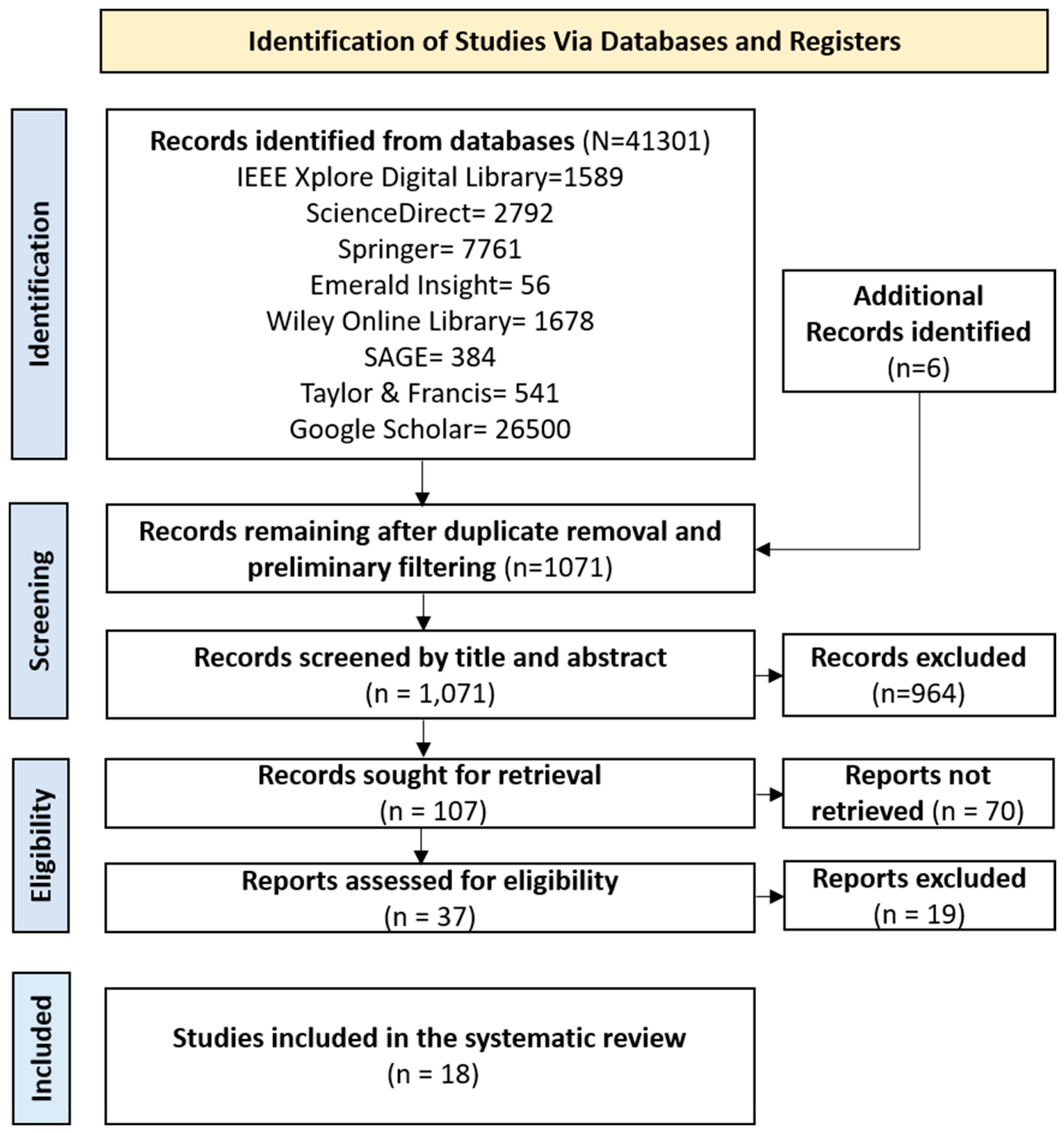
The study-selection process followed a systematic, multi-stage procedure conducted independently by three reviewers (Maruf Ahmed Tamal, Kazi Imtiaz Kabir, and Rubaiyat Islam). The database and search-engine searches yielded 41,301 records, and an additional six records were identified through manual reference-list searching, resulting in 41,307 records in total.
Before formal screening, the retrieved records were consolidated and checked for duplicate entries using available bibliographic information, including article titles, authors, publication details, and DOI information where available. This process resulted in the removal of 3219 duplicate records. The remaining 38,088 records were then subjected to preliminary filtering based on bibliographic information and search-result metadata to remove records that were clearly outside the predefined scope of the review. At this stage, 37,017 records were excluded: 16,091 were clearly unrelated to phishing detection, 9781 fell outside the specified publication period, 7201 did not meet the eligible publication-type criteria, and 3944 failed to satisfy other basic eligibility requirements defined in Section 2.1. Each record was assigned to a single primary exclusion category to avoid double counting. Following duplicate removal and preliminary filtering, 1071 records remained for formal title and abstract screening.
All three reviewers independently screened the titles and abstracts of these 1071 records for relevance to AI-based hybrid phishing detection. Each reviewer conducted the assessment independently, without access to the decisions of the other reviewers. Following title and abstract screening, 964 records were excluded because they did not meet the eligibility criteria, leaving 107 reports for which full texts were sought. Full-text retrieval was attempted through the respective publisher websites, available institutional or library access, Google Scholar, DOI-based searches, and additional searches using article titles and author names where necessary. Despite these efforts, 70 reports could not be retrieved and were excluded at the retrieval stage. The remaining 37 reports proceeded to full-text eligibility review. During this stage, one additional record that initially appeared retrievable could not ultimately be obtained in complete form and was therefore excluded because it could not be fully assessed against the eligibility criteria. The remaining 36 reports underwent substantive full-text assessment against the predefined eligibility criteria specified in Section 2.1. During this assessment, the reviewers explicitly applied the operational definition of hybrid phishing detection established in Section 2.1. In particular, each reviewer assessed whether the proposed detection framework integrated at least two functionally distinct detection or representation components within a unified detection pipeline, whether these components jointly contributed to feature representation, learning, classification, or the final phishing detection decision, and whether the integration was explicitly described in the study methodology. The reviewers also distinguished genuine hybridization from the presence of supporting techniques, such as explainability, optimization, class balancing, data augmentation, or operational adaptation, when these techniques did not constitute a functionally distinct integrated detection or representation component. Eighteen reports were excluded for substantive eligibility reasons, while one additional report was excluded because the complete full text remained unavailable, resulting in a total of 19 exclusions at the full-text eligibility-review stage, as summarized in Table 2. Consequently, 18 studies were included in the final narrative synthesis. Disagreements at any stage were resolved through discussion and consensus among the reviewers. In particular, disagreements concerning whether a study satisfied the operational hybridization criterion were resolved by jointly reviewing the study’s methodological description against the predefined eligibility criteria in Section 2.1. No automation tools were used during retrieval, screening, or study selection.
Table 2.
Reasons for exclusion at the full-text screening stage (n = 19).
2.5. Data Extraction and Synthesis
Data were independently extracted from the 18 included studies by all three reviewers using a standardized, piloted extraction form covering study methodology, AI model(s) employed (hybrid strategy), dataset(s) used, evaluation metrics, key findings, reported strengths and limitations, and identified future research directions. In addition, the extraction process recorded the principal hybridization characteristics of each included study according to the operational definition established in Section 2.1, including the integration of heterogeneous feature representations, multiple AI models, and/or multimodal data sources, as applicable. Extracted data were cross-checked between reviewers, and discrepancies were resolved through discussion and, where necessary, re-examination of the source article. No automation tools were used for data extraction. Where a study reported results across multiple datasets or configurations, the extraction form captured the range or best-performing configuration. The extracted data were subsequently synthesized using a narrative synthesis approach, following the framework of Campbell et al. [37], highlighting recurrent themes and patterns across the included studies. The synthesis was structured to address the study’s research objectives, including an analysis of state-of-the-art hybrid anti-phishing strategies, their strengths and limitations, existing debates, and potential future developments (Section 3.2, Section 3.3, Section 3.4 and Section 3.5). To assess the influence of methodological quality on the review findings, a qualitative sensitivity analysis was performed by excluding the only low-quality study and reassessing whether the principal hybridization strategies, performance trends, methodological limitations, and research challenges remained supported by the other included studies.
2.6. Methodological Quality Assessment
Because the included studies primarily involved algorithmic evaluations rather than clinical, epidemiological, or observational research, established risk-of-bias instruments designed for clinical and observational studies, such as Cochrane RoB 2, ROBINS-I, and the Newcastle-Ottawa Scale, were not directly applicable. Therefore, methodological quality was assessed using a seven-item checklist developed specifically for this review. The seven criteria assessed (C1) clarity of research objectives, (C2) adequacy of dataset reporting, (C3) appropriateness of evaluation methodology, (C4) comparison with baseline or existing methods, (C5) explicit discussion of study limitations, (C6) availability of code or data supporting reproducibility, and (C7) evidence of large-scale or real-world validation. These criteria were selected to capture research transparency, evaluation rigor, reproducibility, and generalizability. Each criterion was scored as 1 (fully met), 0.5 (partially met), or 0 (not met), producing a maximum total score of 7. Studies scoring 6.0–7.0 were classified as high quality, 4.0–5.5 as moderate quality, and below 4.0 as low quality. These review-specific thresholds were selected to distinguish studies meeting nearly all assessment criteria from those with more substantial methodological or reporting deficiencies. All seven criteria received equal weight, and the categories were intended for descriptive interpretation rather than as externally validated quality classifications. Three reviewers independently assessed all 18 included studies. Inter-rater agreement was evaluated using Cohen’s kappa, calculated as Formula (1):
where Po represents the observed agreement and Pe represents the agreement expected by chance. For the three reviewers, the arithmetic mean of the three pairwise Cohen’s kappa coefficients were calculated as Formula (2):
Here, κ12, κ13, and κ23 denote Cohen’s kappa for reviewers 1–2, 1–3, and 2–3, respectively. The resulting coefficient (0.82) indicates strong inter-rater agreement among the reviewers. Scoring disagreements were resolved through discussion and re-examination of the original articles until consensus was reached. Final scores were obtained by summing the seven agreed criterion-level ratings for each study. Quality scores were used to contextualize the methodological strengths, limitations, and reliability of the evidence during narrative synthesis. They were not used as statistical weights. No minimum quality threshold had been predefined as an eligibility criterion, and all 18 eligible studies were retained in the synthesis. Findings from studies with lower scores were interpreted more cautiously, particularly where limitations in evaluation design, reproducibility, or external validation affected the strength of the supporting evidence. Detailed criterion-level scores are presented in Table 3, with the assessment checklist provided in Appendix A (Table A1).
Table 3.
Methodological quality assessment of the included studies (0 = not met, 0.5 = partially met, 1 = fully met).
3. Results and Discussions
3.1. Study Selection and Quality Assessment
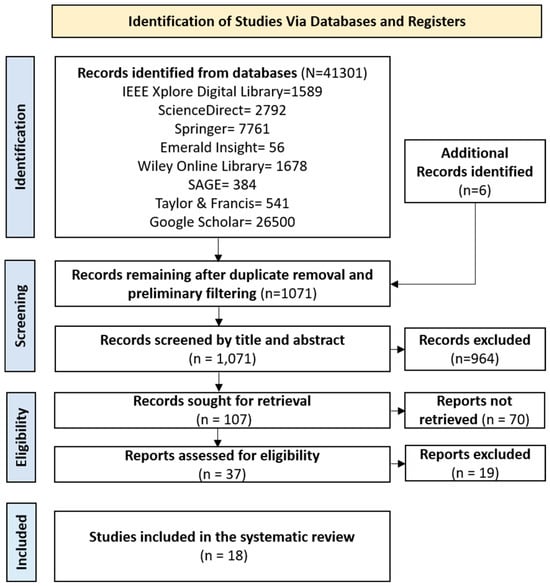
Of the 41,301 records identified through the searched sources, together with six additional records identified through manual reference-list searching, 1071 records remained after duplicate removal and preliminary relevance filtering (Figure 1). Following independent title and abstract screening by three reviewers, 964 records were excluded because they did not address AI-based hybrid phishing detection, leaving 107 reports for which full texts were sought. Of these, 70 reports could not be retrieved, and the remaining 37 full-text reports were assessed against the predefined eligibility criteria. Nineteen reports were excluded following full-text assessment for the reasons summarized in Table 2. Consequently, 18 studies met all eligibility criteria and were included in the narrative synthesis. The methodological quality of the included studies was evaluated using the seven-item checklist described in Section 2.6 and Appendix A (Table A1), with detailed scores presented in Table 3. Among the 18 studies, 16 (88.9%) were classified as high quality, one (5.6%) as moderate quality, and one (5.6%) as low quality. Shaukat et al. [42] received a moderate-quality classification (5.0/7), whereas Alsubaei et al. [40] received the lowest score (3.5/7). The latter study exhibited incomplete dataset reporting, limited evaluation-methodology details, an absence of explicit discussion of study limitations, insufficient reproducibility resources, and limited evidence of broader validation. These deficiencies warrant caution when interpreting its reported performance improvements, particularly those associated with SMOTE-based class balancing and hyperparameter optimization. Overall, most studies clearly stated their research objectives, adequately described their datasets, employed appropriate evaluation procedures, and compared their proposed models with baseline or previously published approaches. The evaluation strategies included train–test splitting, cross-validation, ablation analysis, cross-dataset testing, adversarial evaluation, and deployment-oriented experiments. Nevertheless, reproducibility remained a common methodological weakness, as several studies did not provide complete source code, processed datasets, trained models, or configuration files required for independent replication. Furthermore, evaluations conducted on individual benchmark datasets or under controlled experimental conditions limited the generalizability of reported performance to evolving real-world phishing attacks. Some studies also provided insufficient discussion of their methodological constraints.
Figure 1.
PRISMA flow diagram.
3.2. Hybrid Anti-Phishing Strategies
This review includes 18 peer-reviewed studies published between 2020 and 2026, all of which met the predefined inclusion criteria. The selected articles differ in their levels of hybridization, data modalities, model architectures, fusion strategies, evaluation settings, and performance metrics. Collectively, they represent the current development of AI-based hybrid phishing detection, ranging from feature-level and mod-el-level combinations to multimodal, explainable, adaptive, and deployment-oriented frameworks. Table 4 presents a comparative summary of the included studies, high-lighting their hybrid strategies, objectives, key findings, strengths, limitations, unresolved challenges, and future research directions. The selected 18 studies demonstrate a clear shift from single-method phishing detection toward hybrid systems that combine complementary data sources, learning algorithms, and, in some cases, additional operational components. To provide a consistent taxonomy, the hybridization characteristics observed across the included studies can be organized into three primary forms of hybridization—feature-level, model-level, and multimodal hybridization—together with an additional pipeline- and lifecycle-level dimension describing supporting operational characteristics. The three primary forms correspond directly to the operational definition established in Section 2.1 because they involve the explicit integration of multiple functionally distinct feature representations, learning models, or information modalities within the detection pipeline. Pipeline- and lifecycle-level mechanisms, in contrast, describe additional characteristics that enhance robustness, explainability, adaptability, or deployment readiness and are not considered sufficient by themselves to classify a single-model detector as hybrid. First, feature-level hybridization remains a common strategy, where heterogeneous features such as URL lexical characteristics, HTML content, DOM structures, email metadata, sender reputation, and semantic embeddings are jointly used [38,39,46,54]. These approaches generally improve detection by combining syntactic, contextual, and structural signals that may not be sufficiently informative when used independently. For example, the hybrid CNN–LSTM model in [54] integrates email text with metadata, URL characteristics, and sender-reputation information, enabling the model to capture both local linguistic cues and longer sequential dependencies. Second, model-level hybridization is widely adopted through ensemble learning, stacking, super-learning, and parallel deep architectures [38,40,41,43,44,45,47]. These approaches combine multiple classifiers or specialized branches to exploit their complementary strengths. Several studies report-ed accuracies above 99%, while learned stacking and super-learner architectures produced measurable gains over individual base models. The new multimodal expert system in [52], for example, processes email text through DistilBERT, URL features through an MLP, webpage screenshots through ResNet-18, and behavioural logs through TF-IDF with Logistic Regression. Their outputs are combined using a Logistic Regression meta-learner in a late-fusion design. Third, multimodal hybridization has become more prominent. Earlier studies mainly combined URL and HTML features, while newer systems integrate textual, visual, structural, metadata, and behavioural modalities [42,51,52,53,55]. The framework in [53] combines textual, visual, and metadata representations through cross-attention and supplements learned representations with symbolic rules. Similarly [55], employs four modality-specific branches based on CatBoost, CNN1D, CodeBERT, and EfficientNet-B7, followed by weighted late fusion. These studies show that multimodal integration can detect phishing evidence distributed across different channels, including brand imitation, malicious page structure, suspicious text, and URL manipulation. Finally, a smaller group of studies extends hybrid phishing detection beyond the core feature, model, and modality integration toward the broader pipeline and lifecycle level, incorporating class balancing, feature optimization, adversarial augmentation, explainability, concept-drift handling, continual learning, fairness auditing, and human-in-the-loop adaptation [40,41,46,48,49,50,53,55]. These mechanisms should be interpreted as supporting or operational characteristics of hybrid detection frameworks rather than independent evidence of hybridization when used alone with a single detection model. Their relevance lies in extending the capabilities of an already integrated detection framework toward robustness, interpretability, adaptability, and real-world deployment. The NeuroSym-bolicPhishDefend framework in [53] combines multimodal learning, explicit rule-based reasoning, diffusion-based adversarial augmentation, SHAP explanations, and online learning with a replay buffer. In contrast [55], focuses on operational deployment through a micro-service architecture integrated with security operations infrastructure, while also incorporating SHAP, Grad-CAM, attention analysis, and LLM-generated explanations. Study [48] similarly integrates deep learning and optimization components through a GAN- and transformer-based feature-learning framework, while [49] addresses automated lifecycle management and adaptive phishing detection through a hybrid MLOps framework. These developments indicate that recent research is moving beyond classification accuracy toward resilience, explainability, adaptability, and real-world usability.
Table 4.
AI-based hybrid phishing detection strategies (summary of the selected 18 articles).
3.3. Strengths and Limitations
Across the included studies, hybrid phishing detection strategies generally demonstrated strong predictive performance under their respective experimental settings (see Table 4). Most models reported accuracies between approximately 95% and 99.9%, with several achieving AUC values above 0.99 and false-positive rates below 3%. However, these performance values should not be interpreted as directly comparable across studies because the reviewed works used different datasets, class distributions, feature representations, validation strategies, and baseline configurations. Therefore, the observed performance gains are more appropriately interpreted as within-study improvements over the corresponding baseline or competing models evaluated under the same experimental conditions. For example, the hybrid CNN in [38] outperformed URL-only and HTML-only variants within the same evaluation setting, SMOTE increased accuracy from 83% to 98% in [40], and the ensembles in [41] and [47] outperformed their respective individual base classifiers. However, the performance improvement reported in [40] should be interpreted cautiously given the study’s low methodological quality score and limitations in evaluation reporting and external validation. Apart from this, feature fusion, ensemble learning, and class balancing were recurrent strategies associated with improved performance within individual studies. Models that combined semantic embeddings with sequential, statistical, visual, or metadata features also demonstrated improved capability for handling homograph URLs, shortened links, syntactic manipulation, and multimodal phishing content within their evaluated datasets [39,43,52,53,54,55]. Large-scale evaluations involving hundreds of thousands or millions of samples further provided evidence of scalability and performance stability for the specific datasets and evaluation settings considered by those studies [39,43,47,55]. These findings indicate the potential benefits of hybridization, but they do not establish a universal performance advantage across datasets or deployment environments. Despite these strengths, several limitations were identified across the reviewed literature. Computational complexity is a recurring concern, especially in deep ensembles, multimodal pipelines, optimization-heavy frameworks, and systems that combine multiple explainability components [43,44,46,48,49,51,52,53,54,55]. Higher training costs, memory requirements, and inference latency may restrict real-time deployment, particularly in resource-constrained environments. Many high-performing models also remain URL-centric, which may limit their ability to detect content-rich, image-based, attachment-based, or voice-based phishing attacks [43,45,47,50]. In addition, reliance on handcrafted features, static datasets, external reputation services, or synchronized multimodal inputs may reduce robustness when phishing tactics and data distributions evolve [44,47,50,52,53,54,55]. These limitations are consistent with the quality appraisal in Section 3.1, which identified reproducibility reporting and large-scale real-world validation as the most frequently under-reported aspects across the included studies. So, the evidence suggests that hybridization can improve performance within specific experimental settings, while questions concerning generalizability, deployment efficiency, reproducibility, and robustness remain insufficiently addressed.
3.4. Challenges and Controversies
Despite the generally strong empirical results reported within individual studies, several unresolved challenges remain in hybrid phishing detection. A central concern is the trade-off between detection performance and computational efficiency. Complex ensembles, multimodal pipelines, and adaptive frameworks may improve performance over their respective baselines, but they also increase training costs, memory requirements, inference latency, and deployment complexity, particularly in browser, mobile, and edge environments [43,44,45,49,52,53,54,55]. Consequently, performance improvements reported under controlled experimental conditions do not necessarily translate into equivalent benefits in resource-constrained or real-time deployment environments.
Generalization and dataset dependency also remain important challenges. Many studies rely on benchmark or curated datasets that may not fully represent evolving real-world phishing patterns [38,39,47,48,52,53,54,55]. Data augmentation, synthetic sample generation, and resampling may improve class balance and, in some cases, robustness, but they can also introduce distributional artifacts or fail to represent genuinely unseen attacks [40,48,53,54]. In particular, the performance improvements reported by Alsubaei et al. [40] should be interpreted cautiously because of limitations in methodological reporting, reproducibility, and broader validation. The use of separately collected multimodal datasets further raises concerns regarding data alignment and evaluation realism [52,53]. Thus, reported performance should be interpreted in relation to the dataset characteristics, modalities, and evaluation designs of individual studies rather than as evidence of general superiority across the literature. Temporal validation, cross-dataset evaluation, and adversarial testing warrant greater attention when estimating practical performance under evolving attack conditions.
Explainability represents another continuing challenge. Although several frameworks incorporate SHAP, attention mechanisms, symbolic rules, Grad-CAM, or LLM-generated explanations [48,49,52,53,54,55], many deep hybrid models still operate largely as black boxes. Post-hoc explanations may improve transparency, but they do not necessarily guarantee causal reliability or consistent interpretation by security analysts. Symbolic and rule-based components may also become outdated as phishing tactics evolve [53,55]. These observations indicate a need to evaluate not only whether explanations can be generated but also whether they remain reliable, stable, and useful under changing attack distributions.
Other issues, including fairness, privacy, and continual adaptation, appear less extensively represented in the reviewed literature. Apart from a small number of lifecycle-oriented or adaptive frameworks, limited attention was given to performance disparities across user groups, privacy-preserving learning, and the risks associated with continual model updates [49,53]. These topics should therefore be regarded as underexplored areas within the reviewed evidence rather than as extensively established research gaps. More broadly, the literature indicates a need to extend hybridization beyond model architecture toward robust evaluation, drift monitoring, secure adaptation, and human-in-the-loop validation. Such extensions may help bridge the gap between strong performance under study-specific experimental conditions and sustainable deployment in dynamic phishing environments.
To examine the influence of methodological quality on the review findings, a qualitative sensitivity analysis was undertaken by excluding Alsubaei et al. [40], the only study classified as low quality (3.5/7), and reconsidering the evidence from the remaining 17 studies. The exclusion removed the study-specific performance improvements attributed to SMOTE-based class balancing and hyperparameter optimization from the sensitivity comparison. The principal challenges concerning computational efficiency, dataset dependency, generalizability, explainability, and reproducibility remained represented across other included studies [38,39,43,44,45,47,48,49,52,53,54,55]. Accordingly, the exclusion did not materially alter the principal qualitative themes of the review, although it reduced the evidence supporting the specific performance gains reported by Alsubaei et al. [40].
3.5. Future Directions
The future research directions proposed in this study are informed by the limitations and challenges identified in the reviewed literature, while also incorporating emerging areas that were only lightly represented among the included studies. To address the accuracy-efficiency trade-off, future work should prioritize lightweight hybrid architectures that reduce computational overhead while preserving the within-study performance advantages of hybridization. Techniques such as model pruning, quantization, modular late-fusion designs, and efficient ensemble construction may support real-time deployment in resource-constrained environments. To address generalization and dataset dependency, future studies should place greater emphasis on temporal validation, cross-dataset evaluation, and real-world testing. Continual learning and adaptive retraining mechanisms may further improve robustness against evolving and previously unseen phishing attacks. Replay-buffer-based online learning and controlled adaptation strategies could also be investigated to support model updates while reducing the risk of catastrophic forgetting or uncontrolled adaptation. These approaches should be evaluated using clearly defined temporal and cross-domain settings rather than relying solely on performance within a single benchmark dataset. The limitations of predominantly URL-centric detection also motivate further investigation of multimodal hybrid frameworks that integrate URL, HTML, visual, textual, and behavioral signals. Metadata, sender reputation, webpage screenshots, attachment content, and missing-modality handling could be incorporated to improve robustness in more realistic environments. However, multimodal integration should be accompanied by explicit evaluation of data alignment, computational cost, and the contribution of individual modalities to ensure that additional complexity provides measurable practical benefits. To enhance explainability, future AI-based hybrid models could incorporate interpretable AI components at both the feature and decision levels. SHAP, Grad-CAM, attention mechanisms, symbolic reasoning, and analyst-oriented LLM-generated explanations may provide complementary forms of interpretability [48,49,52,53,54,55]. Future evaluations should additionally examine explanation stability, fidelity, and usefulness to security analysts rather than treating the presence of an explanation mechanism alone as evidence of trustworthy interpretation. Fairness-aware and privacy-preserving hybrid detection also represent promising emerging research directions. Because these topics received relatively limited attention among the included studies [49,53], future research could investigate performance disparities across relevant user or data groups, privacy-preserving learning mechanisms, and secure model adaptation. Such work would extend the scope of hybrid phishing detection beyond predictive performance toward responsible and trustworthy deployment. These directions are proposed as opportunities for further investigation rather than as extensively established gaps directly demonstrated by the current review. Finally, the increasing use of AI and large language models to generate or facilitate phishing content creates an emerging security challenge. Although this topic was only lightly represented in the reviewed literature, future studies could investigate hybrid defenses capable of detecting semantically sophisticated, obfuscated, and AI-generated phishing content. Diffusion-based adversarial augmentation, neuro-symbolic reasoning, semantic analysis, and broader adversarial testing may provide useful directions for evaluating robustness against such threats. Because the evidence base for LLM-generated phishing within the included studies remains limited, these directions should be considered emerging research opportunities rather than conclusions directly established by the systematic review.
4. Conclusions
This systematic review examined 18 peer-reviewed studies on AI-based hybrid phishing detection published between 2020 and June 2026 following the systematic literature review guidance of Kitchenham and Charters [56]. The findings indicate that hybrid approaches integrating multiple feature types, learning models, data modalities, and operational components generally achieved strong detection performance and frequently outperformed the single-method baselines evaluated within individual studies. Recent research also demonstrates a shift from URL-centered approaches toward multimodal, explainable, adaptive, and deployment-oriented frameworks. Despite these advances, several methodological and practical limitations remain. Many studies relied on benchmark or curated datasets, provided insufficient resources for reproducibility, and lacked extensive cross-dataset or real-world validation. Computational complexity, inference latency, and limited explainability further constrain practical deployment, particularly in resource-limited environments. Consequently, high detection performance under controlled experimental conditions should not be interpreted as evidence of equivalent effectiveness against evolving real-world phishing threats. A qualitative sensitivity analysis excluding Alsubaei et al. [40], the only low-quality study, indicated that the principal findings remained supported by the remaining 17 studies. However, the exclusion reduced the evidence supporting the specific performance improvements associated with SMOTE-based resampling and hyperparameter optimization reported by that study. This finding highlights the importance of considering methodological quality when interpreting reported detection performance. Future research should prioritize lightweight and scalable hybrid architectures, broader multimodal integration, continual learning, and rigorous evaluation through temporal testing, cross-dataset validation, adversarial assessment, and realistic deployment scenarios. Greater attention is also needed to reproducibility, privacy, fairness, robustness against AI-generated phishing, and interpretable decision-making. Addressing these challenges will be essential for translating promising experimental performance into reliable, adaptable, and sustainable phishing detection systems.
Supplementary Materials
The following supporting information can be downloaded at https://www.mdpi.com/article/10.3390/computers15110746/s1, Table S1: PRISMA 2020 Checklist.
Author Contributions
M.A.T.: Writing—Original Draft, Conceptualization, Methodology, Data Curation, Formal Analysis. K.I.K.: Writing—review & editing, Data curation, Formal analysis, Investigation; R.I.: Writing—review & editing, Conceptualization, Data curation; F.C.: Writing—review & editing, Methodology, Supervision; M.M.R.: Writing—review & editing, Methodology, Supervision; K.M.R.: Writing—review & editing, Methodology, Supervision; K.N.e.A.S.: Writing—review & editing, Methodology, Supervision; M.S.I.: Writing—review & editing, Methodology, Supervision. All authors have read and agreed to the published version of the manuscript.
Funding
This research received no external funding.
Data Availability Statement
The data supporting the findings of this systematic literature review are contained within the article. The information was extracted from previously published studies, which are cited in the manuscript.
Acknowledgments
During the preparation of this manuscript, the authors used AI-assisted technologies for language polishing and code debugging. The authors subsequently reviewed and edited the generated content as needed and take full responsibility for the content of the published article.
Conflicts of Interest
The authors declare no conflicts of interest.
Appendix A
Table A1.
Quality assessment checklist.
References
- Alkhalil, Z.; Hewage, C.; Nawaf, L.; Khan, I. Phishing Attacks: A recent comprehensive study and a new anatomy. Front. Comput. Sci. 2021, 3, 563060. [Google Scholar] [CrossRef] [Scilit]
- Chaskos, E.; Diakoumakos, J.; Kolokotronis, N.; Lepouras, G. Gamification mechanisms in cyber range and cyber security training environments. In Handbook of Research on Gamification Dynamics and User Experience Design; Advances in web technologies and engineering book series; IGI Global Scientific Publishing: Hershey, PA, USA, 2022; pp. 363–383. [Google Scholar] [CrossRef] [Scilit]
- Kim, K.; Shin, Y.; Lee, J.; Lee, K. Automatically Attributing Mobile Threat Actors by Vectorized ATT&CK Matrix and Paired Indicator. Sensors 2021, 21, 6522. [Google Scholar] [CrossRef] [Scilit] [PubMed]
- Rose, J.R.; Swann, M.; Grammatikakis, K.P.; Koufos, I.; Bendiab, G.; Shiaeles, S.; Kolokotronis, N. IDERES: Intrusion detection and response system using machine learning and attack graphs. J. Syst. Archit. 2022, 131, 102722. [Google Scholar] [CrossRef] [Scilit]
- Klimburg-Witjes, N.; Wentland, A. Hacking humans? Social engineering and the construction of the “Deficient user” in cybersecurity discourses. Sci. Technol. Hum. Values 2021, 46, 1316–1339. [Google Scholar] [CrossRef] [Scilit]
- Tamal, M.A.; Islam, M.K.; Bhuiyan, T.; Sattar, A.; Prince, N.U. Unveiling suspicious phishing attacks: Enhancing detection with an optimal feature vectorization algorithm and supervised machine learning. Front. Comput. Sci. 2024, 6, 1428013. [Google Scholar] [CrossRef] [Scilit]
- Gallo, L.; Gentile, D.; Ruggiero, S.; Botta, A.; Ventre, G. The human factor in phishing: Collecting and analyzing user behavior when reading emails. Comput. Secur. 2023, 139, 103671. [Google Scholar] [CrossRef] [Scilit]
- Mutlutürk, M.; Wynn, M.; Metin, B. Phishing and the Human Factor: Insights from a Bibliometric Analysis. Information 2024, 15, 643. [Google Scholar] [CrossRef] [Scilit]
- Eze, C.S.; Shamir, L. Analysis and prevention of AI-Based phishing email attacks. Electronics 2024, 13, 1839. [Google Scholar] [CrossRef] [Scilit]
- Schmitt, M.; Flechais, I. Digital deception: Generative artificial intelligence in social engineering and phishing. Artif. Intell. Rev. 2024, 57, 324. [Google Scholar] [CrossRef] [Scilit]
- Heiding, F.; Schneier, B.; Vishwanath, A.; Bernstein, J.; Park, P.S. Devising and detecting phishing emails using large language models. IEEE Access 2024, 12, 42131–42146. [Google Scholar] [CrossRef] [Scilit]
- Yao, Y.; Duan, J.; Xu, K.; Cai, Y.; Sun, Z.; Zhang, Y. A survey on large language model (LLM) security and privacy: The Good, The Bad, and The Ugly. High-Confid. Comput. 2024, 4, 100211. [Google Scholar] [CrossRef] [Scilit]
- Naqvi, B.; Perova, K.; Farooq, A.; Makhdoom, I.; Oyedeji, S.; Porras, J. Mitigation strategies against the phishing attacks: A systematic literature review. Comput. Secur. 2023, 132, 103387. [Google Scholar] [CrossRef] [Scilit]
- Vayansky, I.; Kumar, S. Phishing—Challenges and solutions. Comput. Fraud. Secur. 2018, 2018, 15–20. [Google Scholar] [CrossRef] [Scilit]
- Gupta, B.B.; Tewari, A.; Jain, A.K.; Agrawal, D.P. Fighting against phishing attacks: State of the art and future challenges. Neural Comput. Appl. 2016, 28, 3629–3654. [Google Scholar] [CrossRef] [Scilit]
- Aleroud, A.; Zhou, L. Phishing environments, techniques, and countermeasures: A survey. Comput. Secur. 2017, 68, 160–196. [Google Scholar] [CrossRef] [Scilit]
- Jain, A.K.; Gupta, B. A survey of phishing attack techniques, defence mechanisms and open research challenges. Enterp. Inf. Syst. 2021, 16, 527–565. [Google Scholar] [CrossRef] [Scilit]
- Goenka, R.; Chawla, M.; Tiwari, N. A comprehensive survey of phishing: Mediums, intended targets, attack and defence techniques and a novel taxonomy. Int. J. Inf. Secur. 2024, 23, 819–848. [Google Scholar] [CrossRef] [Scilit]
- Varshney, G.; Misra, M.; Atrey, P.K. A survey and classification of web phishing detection schemes. Secur. Commun. Netw. 2016, 9, 6266–6284. [Google Scholar] [CrossRef] [Scilit]
- Chiew, K.L.; Yong, K.S.C.; Tan, C.L. A survey of phishing attacks: Their types, vectors and technical approaches. Expert Syst. Appl. 2018, 106, 1–20. [Google Scholar] [CrossRef] [Scilit]
- Qabajeh, I.; Thabtah, F.; Chiclana, F. A recent review of conventional vs. automated cybersecurity anti-phishing techniques. Comput. Sci. Rev. 2018, 29, 44–55. [Google Scholar] [CrossRef] [Scilit]
- Safi, A.; Singh, S. A systematic literature review on phishing website detection techniques. J. King Saud Univ.-Comput. Inf. Sci. 2023, 35, 590–611. [Google Scholar] [CrossRef] [Scilit]
- Zieni, R.; Massari, L.; Calzarossa, M.C. Phishing or not phishing? A survey on the detection of phishing websites. IEEE Access 2023, 11, 18499–18519. [Google Scholar] [CrossRef] [Scilit]
- Basit, A.; Zafar, M.; Liu, X.; Javed, A.R.; Jalil, Z.; Kifayat, K. A comprehensive survey of AI-enabled phishing attacks detection techniques. Telecommun. Syst. 2021, 76, 139–154. [Google Scholar] [CrossRef] [Scilit] [PubMed]
- Do, N.Q.; Selamat, A.; Krejcar, O.; Herrera-Viedma, E.; Fujita, H. Deep Learning for Phishing Detection: Taxonomy, Current Challenges and Future Directions. IEEE Access 2022, 10, 36429–36463. [Google Scholar] [CrossRef] [Scilit]
- Thakur, K.; Ali, M.L.; Obaidat, M.A.; Kamruzzaman, A. A Systematic Review on Deep-Learning-Based Phishing Email Detection. Electronics 2023, 12, 4545. [Google Scholar] [CrossRef] [Scilit]
- Kritika, E. A comprehensive literature review on phishing URL detection using deep learning techniques. J. Cyber Secur. Technol. 2024, 9, 315–343. [Google Scholar] [CrossRef] [Scilit]
- Li, W.; Manickam, S.; Chong, Y.; Leng, W.; Nanda, P. A state-of-the-art review on phishing website detection techniques. IEEE Access 2024, 12, 187976–188012. [Google Scholar] [CrossRef] [Scilit]
- Thomopoulos, G.A.; Lyras, D.P.; Fidas, C.A. A systematic review and research challenges on phishing cyberattacks from an electroencephalography and gaze-based perspective. Pers. Ubiquitous Comput. 2024, 28, 449–470. [Google Scholar] [CrossRef] [Scilit]
- Kavya, S.; Sumathi, D. Staying ahead of phishers: A review of recent advances and emerging methodologies in phishing detection. Artif. Intell. Rev. 2024, 58, 50. [Google Scholar] [CrossRef] [Scilit]
- Popescul, D.; Radu, L.D. AI in phishing detection: A bibliometric review. Front. Artif. Intell. 2025, 8, 1496580. [Google Scholar] [CrossRef] [Scilit] [PubMed]
- Jampen, D.; Gür, G.; Sutter, T.; Tellenbach, B. Don’t click: Towards an effective anti-phishing training: A comparative literature review. Hum.-Centric Comput. Inf. Sci. 2020, 10, 33. [Google Scholar] [CrossRef] [Scilit]
- Sarker, O.; Jayatilaka, A.; Haggag, S.; Liu, C.; Babar, M.A. A Multi-vocal Literature Review on challenges and critical success factors of phishing education, training and awareness. J. Syst. Softw. 2023, 208, 111899. [Google Scholar] [CrossRef] [Scilit]
- Marshall, N.; Sturman, D.; Auton, J.C. Exploring the evidence for email phishing training: A scoping review. Comput. Secur. 2023, 139, 103695. [Google Scholar] [CrossRef] [Scilit]
- Yasin, A.; Fatima, R.; Wen, L.; Zheng, J.; Niazi, M. What goes wrong during phishing education? A probe into a game-based assessment with unfavorable results. Entertain. Comput. 2024, 52, 100815. [Google Scholar] [CrossRef] [Scilit]
- Page, M.J.; McKenzie, J.E.; Bossuyt, P.M.; Boutron, I.; Hoffmann, T.C.; Mulrow, C.D.; Shamseer, L.; Tetzlaff, J.M.; Akl, E.A.; Brennan, S.E.; et al. The PRISMA 2020 statement: An updated guideline for reporting systematic reviews. BMJ 2021, 372, n71. [Google Scholar] [CrossRef] [Scilit] [PubMed]
- Campbell, M.; Thomson, H.; Katikireddi, S.V.; Sowden, A. Reporting of narrative synthesis in systematic reviews of public health interventions: A methodological assessment. Lancet 2016, 388, S34. [Google Scholar] [CrossRef] [Scilit]
- Opara, C.; Chen, Y.; Wei, B. Look before you leap: Detecting phishing web pages by exploiting raw URL and HTML characteristics. Expert Syst. Appl. 2023, 236, 121183. [Google Scholar] [CrossRef] [Scilit]
- Remya, S.; Pillai, M.J.; Aparna, B.S.; Subbareddy, S.R.; Cho, Y.Y. BGL-PhishNet: Phishing website detection using hybrid Model-BERT, GNN, and LightGBM. IEEE Access 2025, 13, 47552–47569. [Google Scholar] [CrossRef] [Scilit]
- Alsubaei, F.S.; Almazroi, A.A.; Ayub, N. Enhancing Phishing Detection: A novel hybrid deep learning framework for cybercrime forensics. IEEE Access 2024, 12, 8373–8389. [Google Scholar] [CrossRef] [Scilit]
- Yang, T.; Sun, J. A hybrid ensemble deep learning framework with novel metaheuristic optimization for scalable malicious website detection. Sci. Rep. 2025, 15, 44630. [Google Scholar] [CrossRef] [Scilit] [PubMed]
- Shaukat, M.W.; Amin, R.; Muslam, M.M.A.; Alshehri, A.H.; Xie, J. A hybrid approach for alluring ads phishing attack detection using machine learning. Sensors 2023, 23, 8070. [Google Scholar] [CrossRef] [Scilit] [PubMed]
- Doshi, T.; Patel, V.; Shah, N.; Swain, D.; Swain, D.; Acharya, B. PhishHunter-XLD: An ensemble approach integrating machine learning and deep learning for phishing URL classification. Frankl. Open 2025, 12, 100349. [Google Scholar] [CrossRef] [Scilit]
- Kalabarige, L.R.; Rao, R.S.; Pais, A.R.; Gabralla, L.A. A Boosting-Based hybrid feature selection and Multi-Layer stacked ensemble learning model to detect phishing websites. IEEE Access 2023, 11, 71180–71193. [Google Scholar] [CrossRef] [Scilit]
- Alshehri, S.M.; Sharaf, S.A.; Molla, R.A. A hybrid Graph neural network framework for malicious URL classification. Electronics 2025, 14, 4387. [Google Scholar] [CrossRef] [Scilit]
- Alsakarnah, R.; Masoud, M.Z.; Ghababsheh, A. Hybridizing Explainable AI (XAI) for intelligent feature extraction in phishing website detection. Electronics 2026, 15, 350. [Google Scholar] [CrossRef] [Scilit]
- Rao, R.S.; Kondaiah, C.; Pais, A.R.; Lee, B. A hybrid super learner ensemble for phishing detection on mobile devices. Sci. Rep. 2025, 15, 16839. [Google Scholar] [CrossRef] [Scilit] [PubMed]
- Ghadami, R.; Rahebi, J. An explainable hybrid deep learning-optimization framework for robust phishing attack detection using GAN and transformer-based feature learning. Ain Shams Eng. J. 2025, 16, 103745. [Google Scholar] [CrossRef] [Scilit]
- Reda, A.; Taie, S.A.; Shaheen, M.E. Hybrid MLOps framework for automated lifecycle management of adaptive phishing detection models. Sci. Rep. 2025, 15, 38478. [Google Scholar] [CrossRef] [Scilit] [PubMed]
- Gupta, B.B.; Gaurav, A.; Attar, R.W.; Arya, V.; Bansal, S.; Alhomoud, A.; Chui, K.T. A hybrid CNN-Brown-Bear optimization framework for enhanced detection of URL phishing attacks. Comput. Mater. Contin./Comput. Mater. Contin. 2024, 81, 4853–4874. [Google Scholar] [CrossRef] [Scilit]
- Li, W.; Manickam, S.; Chong, Y. FedPhishLLM: A privacy-preserving and explainable phishing detection mechanism using federated learning and LLMs. J. King Saud Univ.-Comput. Inf. Sci. 2025, 37, 252. [Google Scholar] [CrossRef] [Scilit]
- Preeti; Priti. An expert system for phishing detection: A multimodal hybrid framework integrating deep and shallow machine learning. Neural Comput. Appl. 2026, 38, 391. [Google Scholar] [CrossRef] [Scilit]
- Lakshmi, G.; Swetha, P. NeuroSymbolicPhishDefend for adaptive multimodal phishing detection against evolving artificial intelligence driven threats. Sci. Rep. 2026, 16, 28177. [Google Scholar] [CrossRef] [Scilit] [PubMed]
- Mandela, N.; Mwendwa, G.; Etyang, F. Hybrid CNN-LSTM model for phishing email detection. J. Electr. Syst. Inf. Technol. 2026, 13, 45. [Google Scholar] [CrossRef] [Scilit]
- Vulfin, A.; Sulavko, A.; Vasiliev, V.; Minko, A.; Kirillova, A.; Samotuga, A. A multimodal phishing website detection system using explainable artificial intelligence technologies. Mach. Learn. Knowl. Extr. 2026, 8, 11. [Google Scholar] [CrossRef] [Scilit]
- Kitchenham, B.; Charters, S. Guidelines for Performing Systematic Literature Reviews in Software Engineering; EBSE Technical Report EBSE-2007-01; Keele University: Keele, UK; Durham University: Durham, UK, 2007. [Google Scholar]

Disclaimer/Publisher’s Note: The statements, opinions and data contained in all publications are solely those of the individual author(s) and contributor(s) and not of MDPI and/or the editor(s). MDPI and/or the editor(s) disclaim responsibility for any injury to people or property resulting from any ideas, methods, instructions or products referred to in the content. |
© 2026 by the authors. Licensee MDPI, Basel, Switzerland. This article is an open access article distributed under the terms and conditions of the Creative Commons Attribution (CC BY) license.