


Abstract
This paper investigates whether dedicated scouting roles improve decentralized search, pickup, and delivery in warehouse environments where object locations are unknown and agents must balance exploration, transport, and communication costs. We compare heterogeneous spatial roles (HSR), which separate exploration from transport, with generalist exploration strategies. By keeping the sensing, allocation, routing, and communication mechanisms identical across policies, we measure the specific cost of rigid role assignment. Results show that assigning agents exclusively to scouting increases resource discovery but often reduces overall delivery performance, as the additional information does not compensate for the loss of transport capacity. Allowing scouts to retain transport capabilities preserves exploratory behavior while improving delivery performance. Furthermore, lightweight communication and stigmergic coordination are beneficial only when information can effectively spread through the team. These findings suggest that soft specialization is more effective than rigid role assignment, enabling agents to explore effectively without sacrificing service performance within the range of team sizes and conditions tested here.
1. Introduction
Collective foraging is a classical case study in decentralized swarm robotics, where a team equipped only with local sensing and communication must discover useful objects and carry them to a given location. These activities stay tightly coupled once energy and communication are not free [1,2,3]. A team can respond in more than one way: every agent can keep the ability to search and carry, so specialization is only a difference in the place it tends to look [4,5], or some agents can be permanently assigned to searching alone, never breaking off a promising trail to carry an object home [6]. This second option has an overlooked cost: an agent that can only search is one fewer pair of hands available to deliver anything. We call an agent assigned to search alone a scout. We call an agent that retains the ability to transport objects a worker.
Existing studies on division of labor show that information and recruitment carry context-dependent costs [7,8]; specialization depends on task structure and coordination overhead [9,10]; heterogeneous swarms can develop specialized sub-group behavior without explicit design [11], and even minimal per-individual controllers evolved only for collective performance settle into distinct exploratory and exploitative roles, without any mechanism enforcing that diversity [12]. In swarm foraging, the number of active foragers is commonly regulated through response-threshold models that adapt to demand and congestion [13]; adapting role mixtures to the environment helps because fixed assignments cannot [14]. Whether information produced by one agent is actually taken up by the others is itself a variable: when a dedicated explorer reports path costs to a team navigating an unknown environment, agents that rely on that external source outperform those falling back on their peers, and the advantage grows the earlier the explorer sets out [15].
More generally, one subpopulation’s behavior can reshape and even improve another’s effective performance, a pattern observed both in ant colonies [16] and in mixed-behavior crowd evacuation [17]. The picture for rigid roles remains mixed: heterogeneous teams outperform homogeneous ones in some settings [18]; specialized controllers cooperate less effectively than generalists in other settings [19]; and specialization benefits may depend on environmental density [20]. None of these studies isolates the loss of transport capacity from the exploratory behavior of a fixed scouting role, so it remains unclear whether dedicated scouts help because they explore differently or despite no longer transporting.
This choice is fundamentally a task-allocation decision, and a parallel literature on Multi-Agent Pickup and Delivery (MAPD) has formalized related problems, typically under centralized planning and known task lists. Foundational task-allocation frameworks describe when roles should remain fixed rather than be dynamically reassigned [21,22,23]. In multi-robot exploration, exploration itself can be treated as one task to be allocated to the same robots competing with the other tasks for the same agents [24]; our question is of this kind since assigning an agent to scouting removes it from transport. Lifelong MAPD captures the interaction between assignment and routing as agents repeatedly perform pickup and delivery tasks [25]. Energy-aware MAPD formulations make similar resource trade-offs explicit in centralized planning [26], and the value of flexibility over fixed assignments extends to other coordination tasks [27]. Recent work on advanced routing and drone-assisted delivery further identifies heterogeneous capabilities, synchronization, and uncertainty as central challenges in coordinated delivery systems [28].
Our setting differs mainly in what is unknown upfront; object locations rather than a task list; and in decentralizing planning and communication. The underlying question, however, remains the same: when should a role be held rigid or allowed to adapt with the mission state?
This raises a concrete question: under fixed team energy and local communication, when does assigning dedicated scouts outweigh the transport capacity they remove compared with allowing every agent to carry objects? In this research work, we investigate whether the answer depends on team size, radio range (known to influence swarm adaptation [29]), and whether lightweight stigmergic coordination can replace, rather than merely complement, dedicated scouts. Isolating which perceptual, spatial, and energetic factors actually matter has proved productive in this kind of agent-based navigation study: earlier work compared pathfinding strategies under limited visibility and memory [30], and its energy-aware extension found that the best trade-off between exploring and recharging is context-dependent rather than fixed [31]. Team size and radio radius define the operating conditions under which the trade-off is measured; the mechanism ablations only verify that the effect is not an artifact of one particular exploration heuristic.
To answer the questions, we compare policies that differ along two axes: (i) whether search follows a fixed, individually differentiated, spatial preference or only what has been observed so far; and () whether a searching agent may also carry objects home. The heterogeneous spatial roles (HSR) family assigns each agent a profile drawn from one of two libraries, scout or worker, and separately controls whether scout agents are permitted to transport objects. As a pool, scout profiles tend to favor positions farther from the warehouse, whereas worker profiles are mostly radially neutral. HSR-s assigns the scout profile to s agents and the worker profile to the rest. In HSR-0, every agent follows a worker profile, and all agents can transport. In HSR-1, a single agent is assigned a scout profile instead and is barred from claiming, picking up, or carrying objects, so it contributes only to exploration and no longer adds to the team’s transport capacity. Soft-HSR-1 keeps that same agent on the same scout profile, so it explores exactly as in HSR-1, but restores its ability to transport. Comparing Soft-HSR-1 against HSR-1, therefore, isolates the cost of the transport bar alone; comparing it against HSR-0, where every agent also transports, further checks whether assigning the scout profile leaves any residual effect on performance once transport capacity is equalized. Beyond this HSR family, three further policies let every agent transport and differ only in how they choose where to explore next. We call a policy generalist when every agent both explores and transports, and no agent is assigned a fixed spatial profile. Transport-Capable Generalists with Randomized Goals (TGR) picks a reachable, previously unseen cell at random, with no preference for how much new ground it might reveal. Visibility-Gain Exploration (VGE) instead evaluates several candidate cells and heads toward the one expected to reveal the most unseen territory relative to the distance needed to reach it. Announced-Intent Reweighting (AIR) applies the same visibility-gain criterion as VGE but discounts candidate cells that a teammate has recently announced heading toward, reducing the chance that two agents explore the same area. Experiments have been conducted on directed warehouse grids with unknown object locations and number, where agents share a fixed energy budget; rely on local sensing and radio-limited communication; and policies are evaluated across team sizes and communication ranges by both the number of delivered objects and the timeliness of deliveries.
The results obtained show that barring a scout from transporting costs the team more delivery capacity than the extra information it gathers can make up for. Restoring that same agent’s ability to transport, without changing how it searches, recovers most of that loss. However, this pattern is not guaranteed: whether lightweight coordination between agents can add anything on top of it depends on having enough radio range for agents to actually exchange information.
2. Problem Formulation
An instance of side length L is a unit-cost grid directed graph , where walls are excluded from V. Note that almost all traversable cells can be crossed in both directions, except the entrances and exits of depots that are instead accessible in a single direction. Let and be the set of traversable and depot cells, respectively; the shortest-path distance; and the distance from v to the nearest depot. Every outside cell has a finite outward and return path.
A team aims to retrieve an object set , whose value M is, however, unknown. While an object is on the ground, denotes its location cell. Every agent starts its exploration from the designated exterior cell ( in our investigation) and is aware only of the complete static grid-graph topology: object locations and number of objects (M) remain unknown information.
At timestep (tick) t, the agent i has a position ; an energy ; and no load or an object. A valid move advances the agent by one cell and costs one energy unit, while sensing, waiting, communication, pickup, and delivery are cost-free. Throughout, search and exploration denote the same agent mode, namely, moving toward a waypoint while no object is targeted; discovery denotes its outcome, an object entering an agent’s belief set. A scout is an agent assigned a scout profile and is called hard when it is also barred from transport.
An agent detects ground objects in the obstacle-aware grid neighborhood of radius : walls are visible, but sensing stops beyond them. By contrast, radio links depend only on Manhattan distance and may cross walls,
Communication is synchronous and one-hop; information received at t cannot be relayed until a later tick. Setting disables communication; while permits only co-located contact. No agent otherwise observes a peer or accesses a global object table.
Let denote the number of traversable cells (i.e., empty, depot, entrance, or exit) in the medium-density reference grid of side length L; it follows, then, that the energy assigned to each agent is given by (for ), with k a constant set to , and N the agent number; while the team-size independent mission horizon (i.e., ticks) is given by
where and are user-defined parameters, set to 5 and 100 in our investigation, respectively. All agents are identical in sensing radius, radio range, energy budget, and movement capability; policies differ only in the assigned spatial profile and in whether an agent is permitted to transport objects.
Let and let be deliveries by tick t; the primary endpoint is
which rewards early as well as numerous deliveries. We refer to this quantity as the delivery AUC (area under the cumulative-delivery curve). Note that we consider the M value only for evaluation metrics purposes.
Secondary endpoints are delivery ratio ; discovered objects; secured objects (with carried in H); and coverage , where contains the outside cells directly observed by the agent i. Each agent’s locally known observation set also includes cells received from peers, as communication only unions such sets, . The target herding is , with agents concurrently pursuing object o. All policies use a return margin m. An unladen agent switches irrevocably to return mode when
and an exploration move to v is allowed only if . An object is selected only if its exact mission cost fits the remaining energy; its carrier then follows an exact shortest route to a depot. At H, all operational agents enter a mandatory return tail. A run ends only when every agent is parked in a depot or exhausted; positive-energy agents cannot remain outside. Agents inside are defined as “alive”, and zero-energy agents outside are defined as “dead”. Mission endpoints are frozen at H, whereas movement diagnostics include the tail.
3. Decentralized Strategies
Before detailing each controller, it is worth restating how the policies map onto the two axes introduced in Section 1. HSR-1 and Soft-HSR-1 differ only in whether the scout-profile agent may transport, isolating the pure service-capacity cost of a rigid role. HSR-0 versus TGR, VGE, and AIR instead keeps transport capacity fixed across all agents and varies only how they choose where to explore, isolating the effect of the exploration rule itself. Oracle keeps the same VGE exploration controller but starts with all object locations known, so it removes the discovery problem and serves as an information reference only. The deployable policies are instances of the same decentralized controller: same sensing, same object allocation, same claims, same breadth-first search (BFS) routing, same energy accounting, same safe-return rule. Table 1 summarizes what is left to differ. Each agent maintains a local observation set , timestamped object beliefs, a target and route, an exploration waypoint, advisory object claims, and the most recent waypoint received directly from each peer. During each tick, agents perceive their surroundings, resolve feasible pickups and deliveries, communicate over , choose their actions, move simultaneously, resolve the resulting pickup and delivery events, and finally update exhaustion, parking, and pheromone state. A new observation updates the corresponding belief and invalidates a previous report when its reported cell is seen empty. Any unladen transport-capable agent not committed to safe return may opportunistically collect a co-located object, even if it was not its target, provided that its remaining energy covers the exact route to a depot; simultaneous attempts are resolved by a deterministic seed-based ranking.
Table 1.
Policy differences after holding perception, object allocation, claims, BFS routing, energy, pickup/delivery, and safe return fixed. Oracle is the sole exception because it changes initial object knowledge. “All” means every agent may transport.
In direct radio contact, agents synchronously exchange observation sets, object beliefs and claims, positions, and exploration waypoints. Received information is not relayed again within the same tick: observation sets are unioned, the newest object belief is retained, and AIR waypoint records expire after their specified lifetime, whereas other merged knowledge persists. When an unladen transport-capable agent has no valid target, it considers feasible believed objects not protected by a known foreign claim and lexicographically minimizes , namely, total mission cost, approach distance, and object identifier; BFS then gives the exact route. Selection creates a renewable 12-tick advisory claim and claims exchanged on contact favor the lower mission-cost bid and then the lower agent identifier. Because these leases are neither global locks nor available outside contact, duplicate pursuit can still occur. Action selection follows a common priority: carriers return by an exact shortest path, agents committed to safe return do likewise and park, and all others continue a valid retrieval, select a feasible known object, or explore, in that order; the move-level guard in Equation (4) may always override exploration. A valid target is not pre-empted merely because a cheaper object is discovered. Thus, the policy labels introduced below denote alternative exploration controllers rather than standard algorithm names, while Table 1 summarizes the remaining differences.
3.1. Heterogeneous Spatial Roles (HSR) and Soft HSR (Soft-HSR)
HSR assigns fixed spatial profiles to scout and worker roles. In HSR-s, the first s agents in fixed identifier order are hard scouts: they explore and communicate but cannot claim, pick up, or carry objects. The remaining agents are workers and retain all transport capabilities. Profiles are assigned in the displayed order and cycle independently within each role: , . For profile , controls radial preference relative to the nearest depot, and controls avoidance of recently explored cells. In particular, favors positions farther from depot, whereas is radially neutral.
An agent retains its waypoint until that cell enters , either by direct observation or communication. When agent i needs a new waypoint, it draws outside cells independently and uniformly with replacement. It rejects its current cell, cells already in , and cells failing the lower-bound screen
Among the accepted samples, it retains the first sampled maximizer of . If all samples fail, it scans the outside-cell list cyclically from a uniformly random offset and takes the first cell passing the same screen. The Manhattan term is only a cheap lower bound; obstacles can make the exact approach longer, so the move-level safe-return guard remains authoritative.
A reverse BFS from the waypoint labels its exact directed distance. At each step, the agent considers only outgoing neighbors v that reduce this label by one and chooses uniformly among maximizers of . Hence, every move remains on a shortest path to the waypoint, while radial preference and local pheromone values choose among equal-length alternatives. When the pheromone mechanism is enabled, the non-negative field starts from . Only movements made in exploration mode deposit on the arrival cell; the environmental trace then evolves as
where is the number of exploring arrivals at v during tick t. The factor 0.95 makes the trace evaporate: a cell that is no longer visited loses its pheromone geometrically, so the field reflects recent exploration rather than the whole history of the run. The trace is a stigmergic environmental signal and does not require radio communication. HSR-0 assigns only the heterogeneous worker profiles, so every agent can transport. Soft-HSR-s uses exactly the same role profiles and, whenever an agent is exploring, exactly the same waypoint and movement policy as HSR-s but also permits scout-profile agents to claim, pick up, and carry objects. Soft-HSR-s versus HSR-s, therefore, changes transport permission while holding the exploration controller fixed; their realized trajectories may differ after a soft scout enters retrieval mode. Soft-HSR-0 and HSR-0 are identical.
3.2. Transport-Capable Generalists with Randomized Goals (TGR)
TGR is an all-generalist controller: every agent explores, claims, retrieves, and delivers. It uses the same independent samples and lower-bound screen in Equation (5) but accepts the first feasible unseen sample rather than ranking candidates by a spatial profile. If none succeeds, it uses the same cyclic full scan from a random offset. It then computes one exact BFS route and follows it until the waypoint becomes observed, a retrieval action preempts exploration, or the return guard intervenes. TGR has no hard role, radial score, pheromone, frontier gain, or waypoint-intent penalty; all information, allocation, claim, and safety rules remain shared.
3.3. Visibility-Gain Exploration (VGE) and Announced-Intent Reweighting (AIR)
VGE and AIR are also all-generalist controllers. Like TGR, each retains its route until its waypoint enters . Whenever a new waypoint is required, a forward BFS computes exact approach distances from . VGE evaluates the same 64 uniform samples, discarding cells that are observed, unreachable, or incompatible with exact approach, return distance, and margin. It assigns each eligible cell
where counts outside cells not in that would be visible from x. If none of the sampled cells is eligible, all outside cells are evaluated. VGE maximizes ; utility ties prefer larger , shorter exact approach, and finally a fixed agent-specific deterministic ordering. The chosen waypoint is reached along the BFS route. AIR reweights candidates using announced exploration intentions without changing any other rule. During direct contact, agent i stores peer j’s current waypoint and contact tick. Let
where is the last waypoint directly announced by j. AIR maximizes
The penalty is soft: an overlapping region remains selectable when its sensing gain justifies it. Intent records are neither global nor relayed and expire after 12 ticks. The development study retained the intent-only configuration: the triggers for active warehouse rendezvous and gossip are zero, so these behaviours are disabled. With no radio links, for every candidate, and AIR is pathwise identical to VGE under the same seed.
3.4. Oracle Diagnostic
Oracle initializes every agent with all true object locations at and then uses the same greedy allocation, claims, BFS routing, and VGE exploration. It is a diagnostic information reference, not a deployable policy or a mathematical upper bound.
4. Experimental Protocol
The factorial design below operationalizes the trade-off introduced in Section 1: team size and radio radius set the conditions under which transport capacity is suspended or restored, while the additional ablations check that the resulting cost is not an artifact of one exploration rule. The benchmark crosses side length , target shelf density , and random or border object placement. Each connected directed grid contains four boundary depots with separate entrance and exit cells and objects. Border placements use traversable cells within cells of the boundary; random placements use any traversable exterior cell.
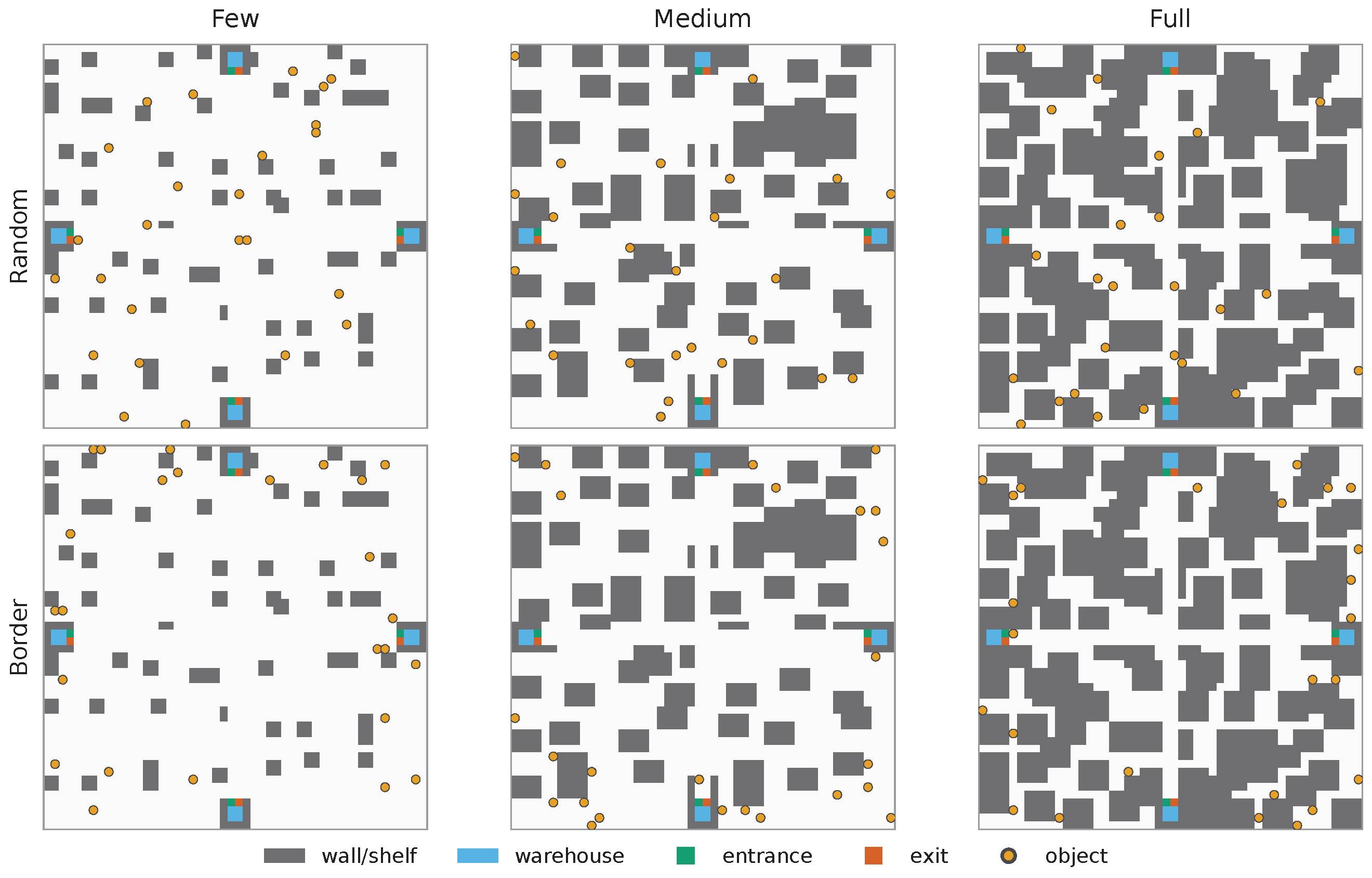
The factorial test comprises nine size density strata. In each stratum, 30 independently generated topologies use seeds 3001–3030. For every topology, three object-placement seeds are instantiated under each of the two placement rules, random and border, yielding 270 topologies and 1620 test instances. A disjoint development set contains five topologies per stratum. Figure 1 shows representative test maps across density and placement conditions.
Figure 1.
Representative test instances (topology seed 3001, object seed 13,001). Columns vary shelf density and rows object placement; each map has four directed depots ports and 25 hidden objects.
The main experiment crosses eight configurations (HSR-0, HSR-1, Soft-HSR-0, Soft-HSR-1, TGR, VGE, AIR, Oracle), , , and five policy seeds (23,001–23,005), for 648,000 runs. Radii , 0, and 200 mean no communication, co-location only, and effectively global communication. Table 2 gives common parameters. Team energy is fixed within map size, split evenly with a seed-permuted remainder. The N-independent deadline is as described above in Section 2. Mission metrics freeze there; a mandatory return tail completes terminal accounting.
Table 2.
Experimental parameters.
Eight AIR parameterizations were evaluated on the disjoint development split (72,000 runs in total). A prespecified parsimony rule selected the least complex configuration whose mean delivery AUC was within 0.25 percentage points of the development best. The selected parameters were then frozen before evaluation on the test split.
On the test split, the claim ablation compared time-to-live (TTL) values 0 and 12 for HSR-0, TGR, VGE, and AIR (648,000 runs). The HSR mechanism ablation crossed radial differentiation and repulsive pheromone in a factorial design, for both zero and one hard scout (648,000 runs). The role-composition ablation evaluated for (121,500 runs) and for (162,000 runs). A further 7200-run replication on the calibration maps is reported descriptively. Together with the 648,000-run main experiment, the study comprises 2,306,700 simulations.
Estimationand Uncertainty
Topology is the independent unit. Contrasts pair topology, placement, policy seed, team size, radio, and all common factors. All policies are evaluated on exactly the same topologies, object placements, and policy seeds, and every agent starts from the same exterior cell with a team energy budget that depends only on map size and team size; contrasts are, therefore, computed within matched instances, and no policy benefits from a more favorable draw. If averages these paired differences for topology j in size–density stratum q, then
giving equal weight to strata and topologies. We report raw effects and 95% percentile intervals from 10,000 bootstrap replicates resampling complete topologies within strata (seed 20,260,718). Prespecified contrasts are AIR–VGE, AIR–HSR-0, Soft-HSR-1–HSR-1, HSR-0–HSR-1, and HSR-0–TGR. All stored runs have zero invalid moves, drops, and agents dead or operational outside at termination. Experiments were run on a 32-thread AMD Ryzen 9 7950X3D processor. All results reported in Section 5 are computed directly from the output logs of these simulation runs.
5. Results
The results are organized around the same question: Section 5.1 quantifies the transport-capacity cost directly; Section 5.2 checks whether it survives once spatial, stigmergic, and contact-mediated mechanisms are varied. All effects below are reported with bootstrap confidence intervals over topologies; an interval excluding zero is treated as a reliable effect in place of p-values. Because the design is large and contrasts are computed within matched instances, intervals are narrow and most effects exclude zero. We, therefore, read effects by their magnitude in percentage points rather than by the exclusion of zero alone: an interval excluding zero establishes that an effect is present, not that it is large enough to matter operationally.
Table 3 reports the balanced means over the full test design. AIR has the highest AUC and horizon delivery among deployable configurations. The Oracle exposes a substantial residual information gap but is not a mathematical upper bound and does not enter the ranking. Soft-HSR-0 exactly reproduces HSR-0, as expected when no scout profile is assigned, and is omitted from the table.
Table 3.
Balanced test means over 270 topologies. Except for AUC, mission outcomes are measured at horizon H. Bold denotes the best deployable value in each column. Oracle has all object locations at tick zero and is diagnostic only.
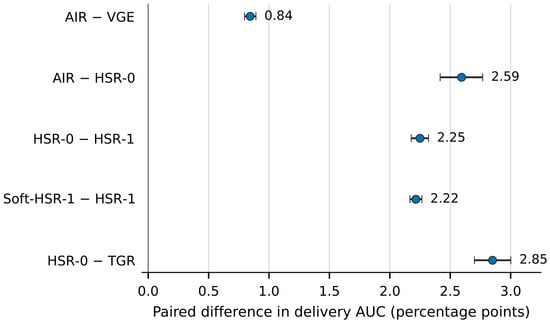
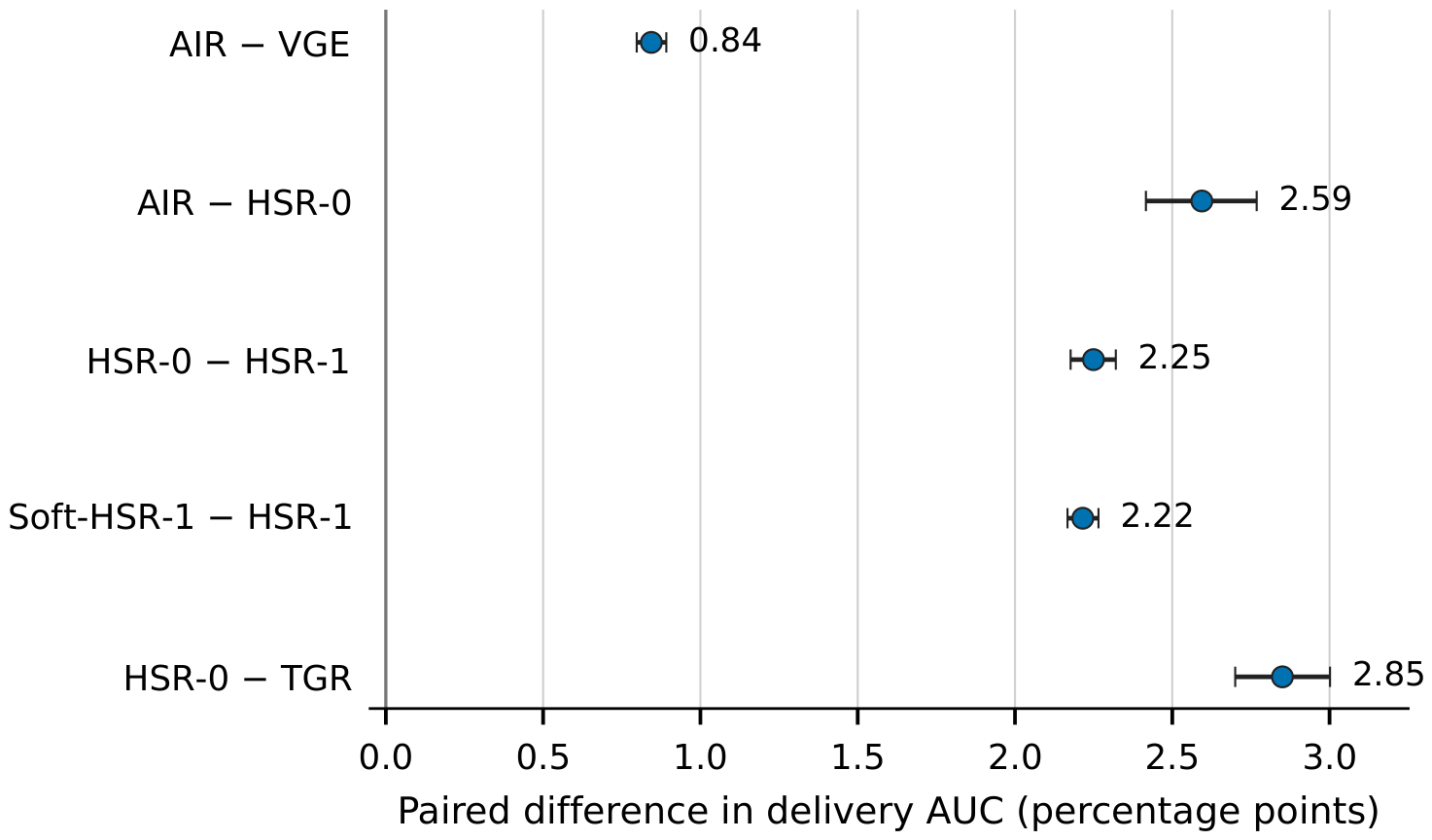
Figure 2 shows the paired delivery-AUC effects. AIR improves on matched VGE by 0.844 points (95% CI [0.798, 0.892]) and on HSR-0 by 2.594 [2.416, 2.768]. The complete HSR policy without a hard scout exceeds TGR by 2.850 [2.700, 3.001]. These are average effects over the complete factorial design, not claims of pointwise dominance.
Figure 2.
Prespecified paired delivery-AUC effects. Points are percentage-point differences; bars are 95% stratified topology-clustered bootstrap intervals (10,000 replicates, ). Positive values favor the first policy.
5.1. Rigid Roles Produce Information but Remove Service Capacity
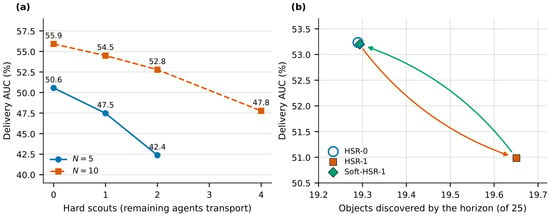
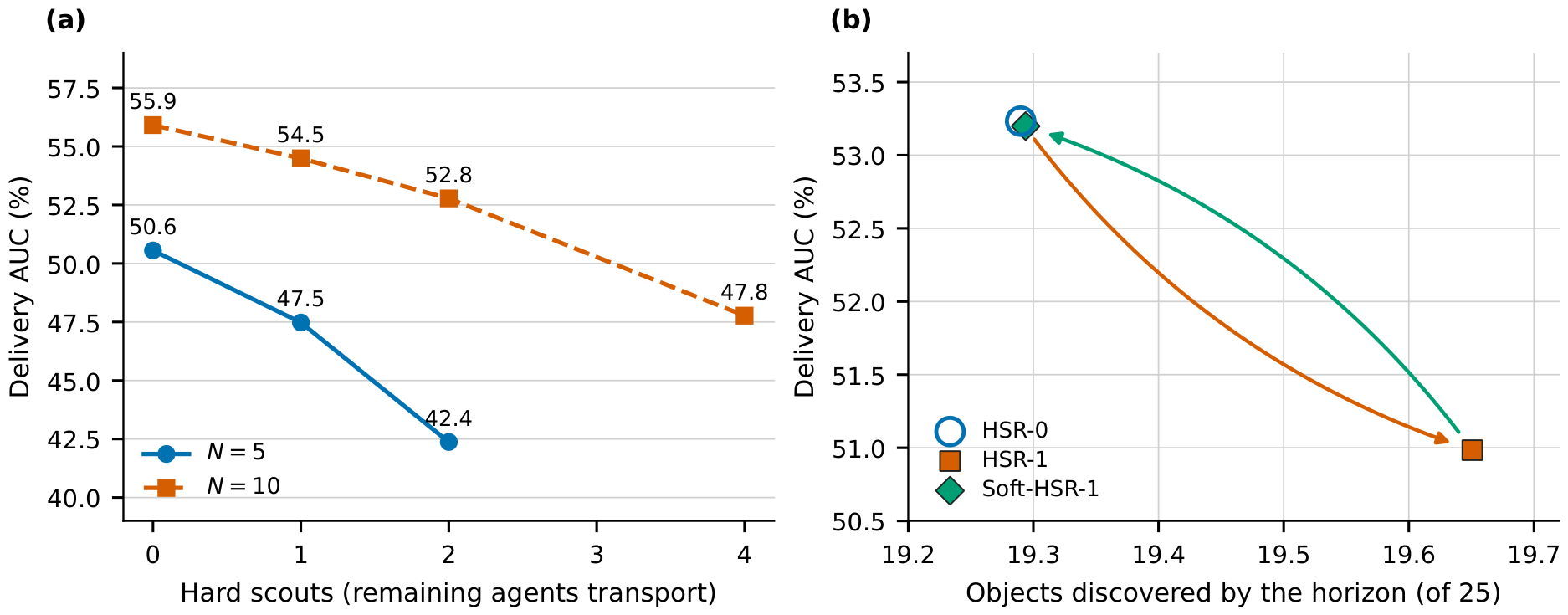
HSR-1 discovers more objects than HSR-0 (19.651 vs. 19.290) and covers more exterior cells (81.49% vs. 80.91%), yet this information gain does not translate into reward: HSR-0 delivers 0.611 more objects and exceeds HSR-1 by 2.249 AUC points [2.177, 2.321]. Restoring the same scout profile’s transport rights in Soft-HSR-1 recovers 2.215 points [2.167, 2.265], leaving only a 0.034-point gap from HSR-0, nearly the entire hard-role loss thus reflects withheld service capacity, not the exploratory profile itself.
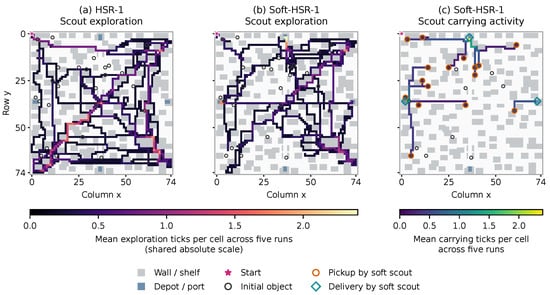
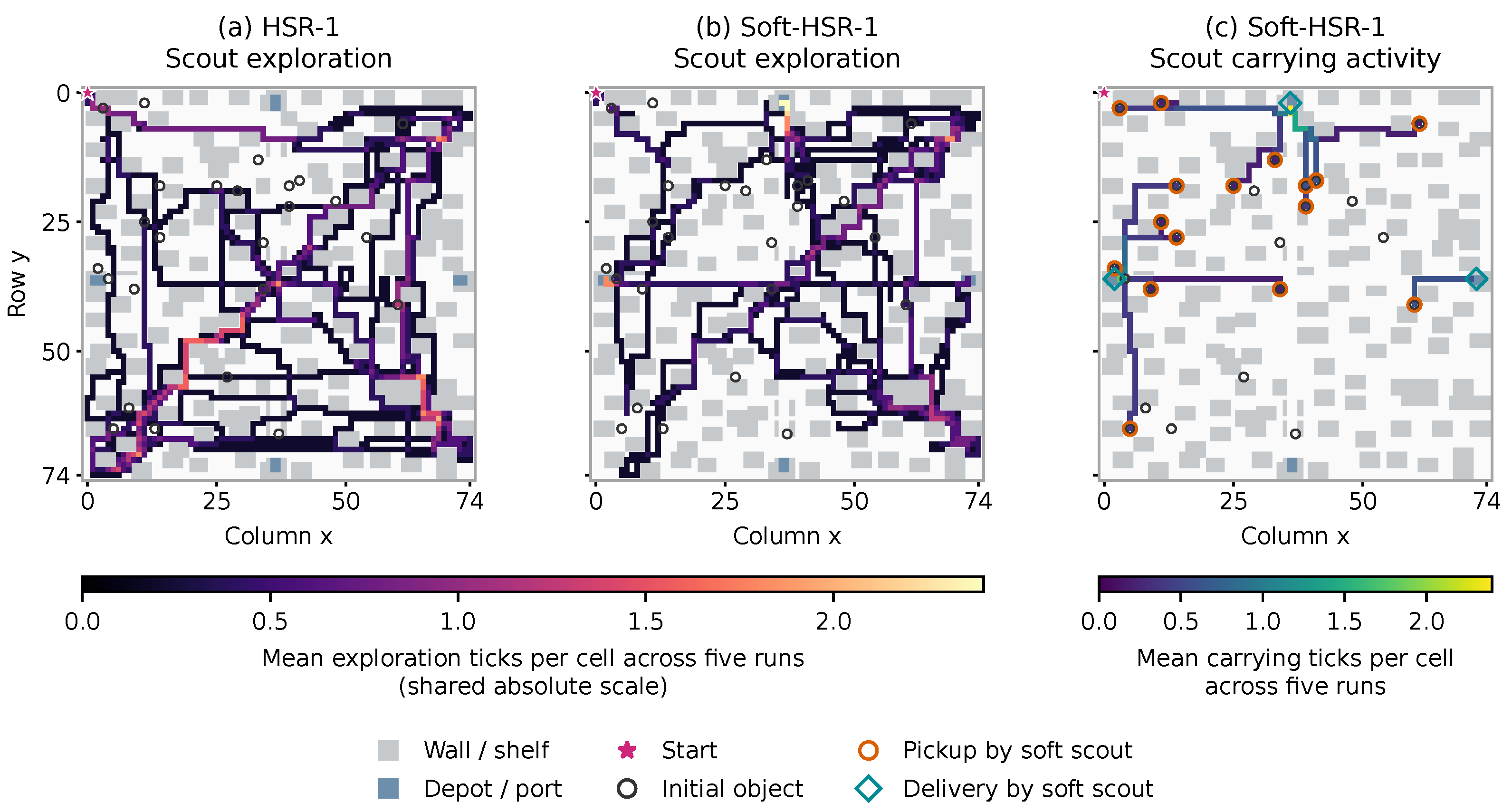
Figure 3 provides an operational view of the matched HSR-1 and Soft-HSR-1 comparison. Both policies use the same scout profile and exploration controller whenever the scout is exploring, across five paired seeds, the Soft-HSR-1 scout retained substantial exploration (431.8 ticks per run, versus 594.2 for HSR-1) while also spending 114.4 ticks carrying objects and completing 4.8 deliveries on average. Thus, soft specialization allows part of the scout’s activity to be converted into transport service without changing its exploration rule. The visualization is illustrative; quantitative effect estimates remain those of the full factorial study.
Figure 3.
Illustrative scout behavior on a fixed medium-density instance (, ), averaged over five paired seeds. Panels (a,b) show HSR-1 and Soft-HSR-1 exploration occupancy on a shared scale; panel (c) shows Soft-HSR-1 carrying activity with pickup and delivery locations. HSR-1 scout carrying is identically zero.
The composition sweeps reinforce this mechanism (Figure 4a). For , AUC falls from 50.554% with no hard scout to 47.477% with one and 42.373% with two; the zero-versus-one effect is 3.077 points [2.981, 3.173]. For , the corresponding values for 0, 1, 2, and 4 scouts are 55.912%, 54.490%, 52.780%, and 47.769%; zero versus one differs by 1.421 points [1.333, 1.509]. Equal 20% scout fractions produce similar losses: 3.077 points for and 3.131 for . Zero hard scouts are best for both tested team sizes, but this does not establish the optimal composition outside these budgets and maps.
Figure 4.
Role composition and information–service conversion. (a) Mean AUC by hard-scout count; remaining agents transport. (b) Mean discovery versus AUC for matched variants. Arrows show assigning one hard scout (orange) and restoring its transport capability (green). Means cover all 270 test topologies and radio regimes.
5.2. Spatial, Stigmergic, and Contact-Mediated Mechanisms
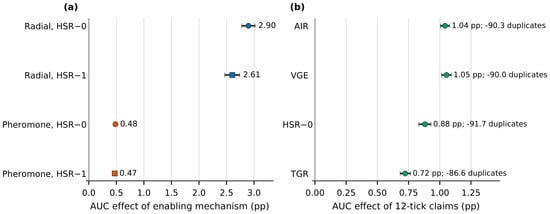
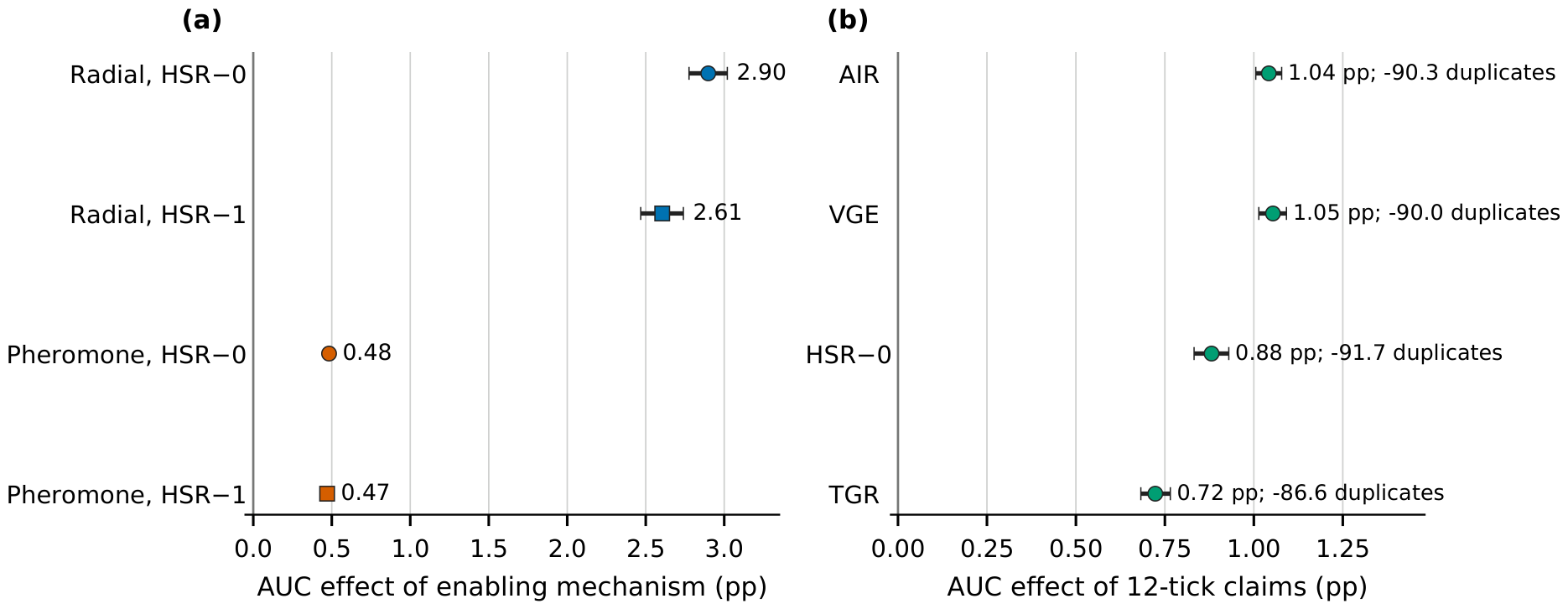
The HSR factorial separates spatial differentiation from stigmergic avoidance (Figure 5a): radial profiles add 2.898 AUC points [2.776, 3.020] for HSR-0 and 2.605 [2.468, 2.740] for HSR-1, while repulsive pheromone adds a smaller 0.483 [0.459, 0.507] and 0.470 [0.444, 0.497], respectively, HSR-0’s advantage over TGR is thus primarily spatial, with the pheromone trace a modest addition. Both contributions exclude zero, but they differ in size by roughly a factor of six, and only the radial one is large enough to change the ranking of policies. Lease-based claims improve all four tested controllers (Figure 5b): a 12-tick claim raises AUC by 1.042 points for AIR, 1.054 for VGE, 0.881 for HSR-0, and 0.723 for TGR (all topology-clustered intervals exclude zero), while duplicate-target agent-ticks fall by 86.6–91.7 (72–74% of no-claim levels), target herding is thus a shared failure mode, not a peculiarity of one policy.
Figure 5.
Mechanism ablations. (a) Marginal AUC effects of radial bias and repulsive pheromone, averaged over the other factor. (b) AUC effect of 12-tick claims; labels report changes in duplicate-target agent-ticks. Bars are 95% stratified topology-clustered bootstrap intervals (10,000 replicates, ).
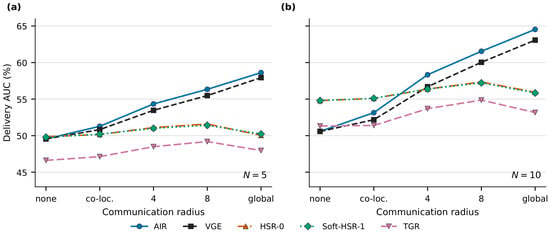
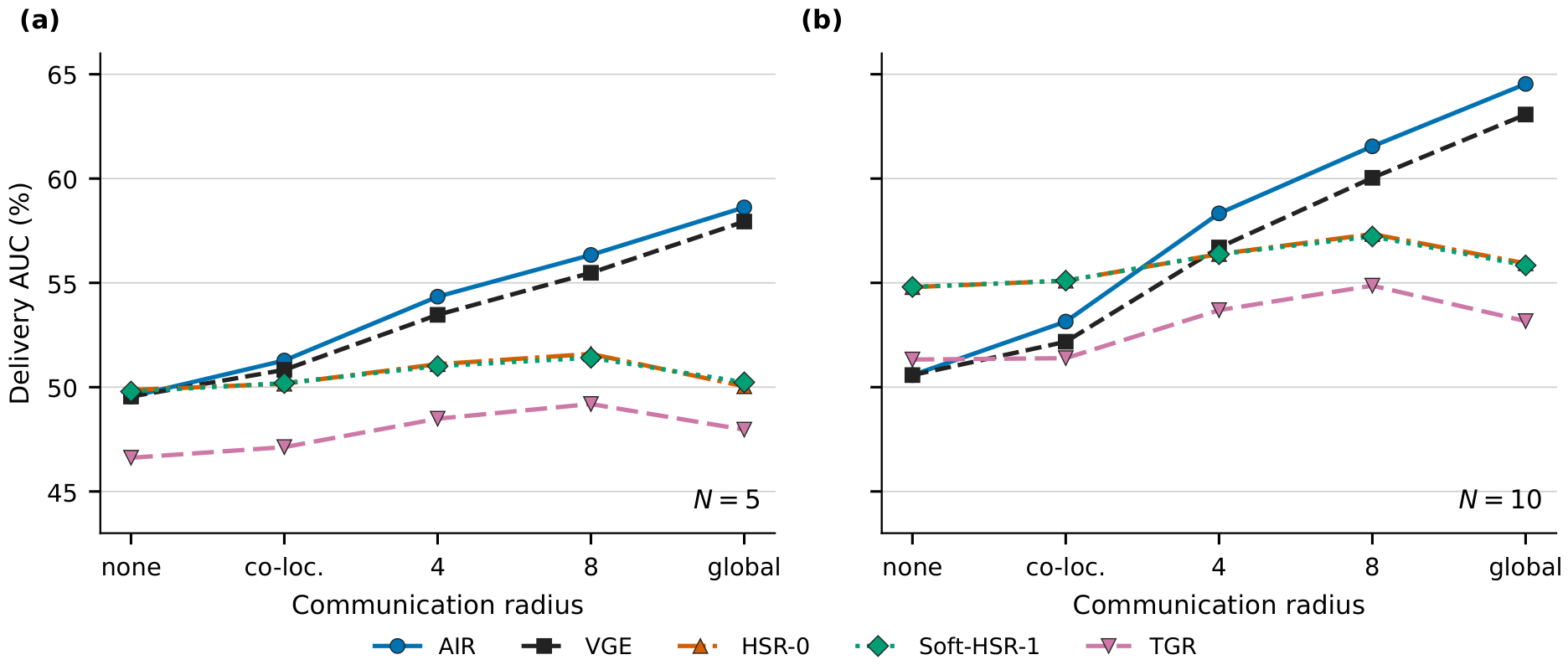
Waypoint intents have a narrower, connectivity-dependent role. AIR and VGE are identical when communication is disabled because no peer waypoint can be observed. AIR has the highest descriptive mean in seven of the ten cells (Figure 6). HSR-0 leads for ; Soft-HSR-1 leads for . At radii 4, 8, and global, AIR leads for both team sizes. These cell-wise winners motivate connectivity-aware coordination but are descriptive; the data do not establish a continuous phase transition.
Figure 6.
Mean delivery AUC across communication regimes for (a) five and (b) ten agents. Each point balances the full 270-topology test design.
6. Conclusions
In this paper, we studied whether dedicating agents exclusively to scouting in decentralized, energy-constrained multi-agent foraging repays the transport capacity it removes, comparing a matched heterogeneous spatial roles (HSR) family against randomized, visibility-gain, and intent-aware generalist exploration under common sensing, claim, routing, and energy rules. Under fixed team energy and local communication, it does not: HSR-1 discovers more objects than HSR-0 but costs 2.249 AUC points, almost entirely recovered (2.215) once the same exploratory profile regains the right to transport, a service-capacity cost, not a consequence of how the scout explores, and this holds for both team sizes tested, with the loss scaling roughly with the fraction of the team held back from delivery. Radial spatial differentiation, rather than the pheromone trace, drives most of HSR-0’s advantage over randomized exploration, and lightweight intent-based coordination (AIR) achieves the strongest aggregate performance of all, but only where radio contact is frequent enough to exploit it; at low connectivity, preserving transport capacity through a soft role matters more than any coordination mechanism tested. In the environments, team sizes, and energy budgets tested here, soft specialization consistently outperformed rigid role assignment: agents can be made to search differently without permanently surrendering the ability to serve what they find. We read this as an empirical finding about the conditions we examined, not as evidence that soft specialization is superior in general. The mechanism behind it is itself conditional: a hard scout removes a pair of hands from a team whose transport capacity is already the binding constraint, and the loss scales with the fraction of the team held back from delivery.
It is worth emphasizing that these findings can also be interpreted through broader theoretical frameworks from the Information Systems literature. The updated IS Success Model suggests that increased information availability does not automatically translate into greater net benefits, as the value of information depends on the ability of a system to effectively exploit it [32,33]. Similarly, theories of information quality and their hierarchical organization of quality dimensions argue that generating more information is not sufficient if the organizational process lacks the capacity to convert that information into useful outcomes [34]. Our findings provide an analogous observation in decentralized multi-agent foraging: dedicated scouts increase information acquisition through higher discovery and coverage; however, the additional information does not necessarily improve delivery performance when transport capacity becomes the limiting resource. From this perspective, the effectiveness of coordination mechanisms depends not only on how much information is generated but also on the system’s ability to transform that information into operational value. Nothing here establishes that hard roles can never be useful.
6.1. Limitations
It is worth noting that, although the findings obtained by the proposed framework are challenging and relevant, the model presents some limitations in its current form, which need to be further investigated as a future research line (see Section 6.2). In particular, the main proposed framework limitations lie in its failure to take collisions into account among agents and synchronous, one-hop, lossless communication within the radio radius. Alongside these, there are further model boundaries that may be considered less relevant than the previous ones, as they do not affect the framework itself but rather the experimental design, namely, each instance contains a fixed budget of objects, and only two team sizes are tested: and . Maps come from a single family of directed warehouse grids, varying in side length and shelf density but sharing four boundary depots and one generation procedure. Energy is fixed/static within map size and splits evenly across the team, so the results say nothing about unequal or replenishable budgets. As mentioned earlier, and described in detail in the next section, all of these boundaries will be the focus of our future research lines.
6.2. Future Work
This study deliberately isolates the trade-off between searching and transporting in an idealized setting so that the value of each activity can be measured before further complexity is added. Relaxing these idealizations one at a time is the natural continuation. A first line concerns the physical environment. Adding collision dynamics would make movement contended, especially near the depots where carriers converge, and a three-dimensional layout, such as a multi-level warehouse or an aerial platform, would change the relative cost of carrying an object and of observing the surroundings. Whether the service-capacity cost measured here survives these conditions is an open question. A second line concerns communication. Under packet loss, information gathered by a hard scout may never reach an agent able to act on it, and measuring how the hard–soft comparison responds as loss grows would show how far our conclusion depends on reliable radio. A related question concerns the form of the messages themselves. Our agents exchange fixed, structured records, namely, observation sets, object beliefs, claims, and waypoints, whereas agents built on large language models would communicate in unstructured natural language, where a message may carry more context but is neither guaranteed to be relevant nor interpreted identically by every receiver. How unstructured communication affects the coordination measured here, and whether iterative critique between agents can keep it reliable [35], is worth examining. A third line concerns the roles themselves. Rather than being fixed at the start of the mission, assignments could be periodically evaluated and revised from accumulated evidence. Energy sweeps, clustered objects, and physical validation on real robots complete the list of natural next tests.
Author Contributions
Conceptualization, M.P., A.M., and C.C.; methodology, M.P., M.B., M.C., A.M., and C.C.; software, M.B., M.C., and A.M.; validation, M.P., A.M., and C.C.; formal analysis, M.P., A.M., and C.C.; investigation, M.P., M.B., M.C., A.M., and C.C.; data curation, A.M. and C.C.; writing—original draft preparation, A.M. and C.C.; writing—review and editing, M.P.; supervision, M.P. All authors have read and agreed to the published version of the manuscript.
Funding
This research received no external funding.
Data Availability Statement
All research data and reported results, including the datasets, will be made publicly available on the GitHub repository of the Complex Intelligent Systems research group at the following link: https://github.com/Complex-Intelligent-Systems-Research/when-information-does-not-deliver (accessed on 27 September 2026).
Acknowledgments
The authors wish to thank the anonymous reviewers for their important and valuable comments. This research is supported by the project PIACERI—PIAno di inCEntivi per la Ricerca di Ateneo 2024/2026—Linea di Intervento i “Progetti di ricerca collaborativa”.
Conflicts of Interest
Author Alessio Mezzina was employed by the company Koexai S.R.L. The remaining authors declare that the research was conducted in the absence of any commercial or financial relationships that could be construed as a potential conflict of interest.
References
- Brambilla, M.; Ferrante, E.; Birattari, M.; Dorigo, M. Swarm robotics: A review from the swarm engineering perspective. Swarm Intell. 2013, 7, 1–41. [Google Scholar] [CrossRef] [Scilit]
- Dorigo, M.; Theraulaz, G.; Trianni, V. Swarm robotics: Past, present, and future [point of view]. Proc. IEEE 2021, 109, 1152–1165. [Google Scholar] [CrossRef] [Scilit]
- Lu, Q.; Fricke, G.M.; Ericksen, J.C.; Moses, M.E. Swarm foraging review: Closing the gap between proof and practice. Curr. Robot. Rep. 2020, 1, 215–225. [Google Scholar] [CrossRef] [Scilit]
- Vardy, A.; Seidl, M. Scalable Foraging: A Paired Body and Controller Design for Foraging Robots. In Proceedings of the International Conference on Swarm Intelligence; Springer: Berlin/Heidelberg, Germany, 2026; pp. 429–437. [Google Scholar]
- Talamali, M.S.; Bose, T.; Haire, M.; Xu, X.; Marshall, J.A.; Reina, A. Sophisticated collective foraging with minimalist agents: A swarm robotics test. Swarm Intell. 2020, 14, 25–56. [Google Scholar] [CrossRef] [Scilit]
- Adams, S.; Jarne Ornia, D.; Mazo, M., Jr. A self-guided approach for navigation in a minimalistic foraging robotic swarm. Auton. Robot. 2023, 47, 905–920. [Google Scholar] [CrossRef] [Scilit]
- Pitonakova, L.; Crowder, R.; Bullock, S. Information flow principles for plasticity in foraging robot swarms. Swarm Intell. 2016, 10, 33–63. [Google Scholar] [CrossRef] [Scilit][Green Version]
- Pitonakova, L.; Crowder, R.; Bullock, S. The Information-Cost-Reward framework for understanding robot swarm foraging. Swarm Intell. 2018, 12, 71–96. [Google Scholar] [CrossRef] [Scilit]
- Pini, G.; Gagliolo, M.; Brutschy, A.; Dorigo, M.; Birattari, M. Task partitioning in a robot swarm: A study on the effect of communication. Swarm Intell. 2013, 7, 173–199. [Google Scholar] [CrossRef] [Scilit]
- Debie, E.; Kasmarik, K.; Garratt, M. Swarm robotics: A survey from a multi-tasking perspective. ACM Comput. Surv. 2023, 56, 49. [Google Scholar] [CrossRef] [Scilit]
- van Diggelen, F.; De Carlo, M.; Cambier, N.; Ferrante, E.; Eiben, G. Emergence of specialised collective behaviors in evolving heterogeneous swarms. In Proceedings of the International Conference on Parallel Problem Solving from Nature; Springer: Berlin/Heidelberg, Germany, 2024; pp. 53–69. [Google Scholar]
- Mezzina, A.; Pavone, M. Evolved Micro-Neural Networks for Per-Ant Behavioral Modulation in Ant Colony Optimization. In Proceedings of the Vol. ALIFE 2026: Proceedings of the 2026 Artificial Life Conference, Waterloo, ON, Canada, 17–21 August 2026; p. 95. [Google Scholar]
- Pang, B.; Zhang, Z.; Song, Y.; Yuan, X.; Xu, Q. Dynamic Response Threshold Model for Self-Organized Task Allocation in a Swarm of Foraging Robots. Appl. Sci. 2023, 13, 9107. [Google Scholar] [CrossRef] [Scilit]
- Zakir, R.; Salahshour, M.; Dorigo, M.; Reina, A. Heterogeneity Can Enhance the Adaptivity of Robot Swarms to Dynamic Environments. In Proceedings of the International Conference on Swarm Intelligence; Springer: Berlin/Heidelberg, Germany, 2024; pp. 112–126. [Google Scholar]
- Cangelosi, A.; Crespi, C.; Pavone, M.; Romeo, M. Modeling Trust Dynamics on a Multi-Agent System. In Proceedings of the Optimization and Learning; Dorronsoro, B., Talbi, E.G., Weraikat, D., Bouamama, S., Eds.; Springer: Cham, Switzerland, 2026; pp. 215–226. [Google Scholar]
- Crespi, C.; Scollo, R.A.; Fargetta, G.; Pavone, M. How a different ant behavior affects on the performance of the whole colony. In Proceedings of the Metaheuristics International Conference; Springer: Berlin/Heidelberg, Germany, 2022; pp. 187–199. [Google Scholar]
- Crespi, C.; Fargetta, G.; Pavone, M.; Scollo, R.A. An agent-based model for crowd simulation. In Proceedings of the Italian Workshop on Artificial Life and Evolutionary Computation; Springer: Berlin/Heidelberg, Germany, 2022; pp. 15–26. [Google Scholar]
- Kaminka, G.A.; Douchan, Y. Heterogeneous foraging swarms can be better. Front. Robot. AI 2025, 11, 1426282. [Google Scholar] [CrossRef] [Scilit] [PubMed]
- Leopardi, P.; Hamann, H.; Kuckling, J.; Kaiser, T.K. On the Cost of Evolving Task Specialization in Multi-Robot Systems. In Proceedings of the International Conference on Swarm Intelligence; Springer: Berlin/Heidelberg, Germany, 2026; pp. 402–410. [Google Scholar]
- Debie, E.; Kasmarik, K.; Garrat, M. Task-focused robotic swarming: Maximising effectiveness via specialised roles. Robot. Auton. Syst. 2025, 194, 105133. [Google Scholar] [CrossRef] [Scilit]
- Gerkey, B.P.; Matarić, M.J. A formal analysis and taxonomy of task allocation in multi-robot systems. Int. J. Robot. Res. 2004, 23, 939–954. [Google Scholar] [CrossRef] [Scilit]
- KA, A.; Subramaniam, U. A systematic literature review on multi-robot task allocation. ACM Comput. Surv. 2024, 57, 68. [Google Scholar] [CrossRef] [Scilit]
- Chakraa, H.; Guérin, F.; Leclercq, E.; Lefebvre, D. Optimization techniques for Multi-Robot Task Allocation problems: Review on the state-of-the-art. Robot. Auton. Syst. 2023, 168, 104492. [Google Scholar] [CrossRef] [Scilit]
- O’Brien, M.; Williams, J.; Chen, S.; Pitt, A.; Arkin, R.; Kottege, N. Dynamic task allocation approaches for coordinated exploration of subterranean environments. Auton. Robot. 2023, 47, 1559–1577. [Google Scholar] [CrossRef] [Scilit]
- Ma, H.; Li, J.; Kumar, T.S.; Koenig, S. Lifelong Multi-Agent Path Finding for Online Pickup and Delivery Tasks. In Proceedings of the 16th Conference on Autonomous Agents and MultiAgent Systems, AAMAS’17, São Paulo, Brazil, 8–12 May 2017; pp. 837–845. [Google Scholar]
- Kudo, F.; Cai, K. Anytime multi-task multi-agent pickup and delivery under energy constraint. IEEE Robot. Autom. Lett. 2024, 9, 10145–10152. [Google Scholar] [CrossRef] [Scilit]
- Losey, D.P.; Li, M.; Bohg, J.; Sadigh, D. Learning from my partner’s actions: Roles in decentralized robot teams. In Proceedings of the Conference on Robot Learning, PMLR, Virtual, 16–18 November 2020; pp. 752–765. [Google Scholar]
- Mezzina, A.; Pavone, M. A Comprehensive Review of Metaheuristics for the Modern Traveling Salesman Problem and Drone-Assisted Delivery. Algorithms 2026, 19, 278. [Google Scholar] [CrossRef] [Scilit]
- Talamali, M.S.; Saha, A.; Marshall, J.A.; Reina, A. When less is more: Robot swarms adapt better to changes with constrained communication. Sci. Robot. 2021, 6, eabf1416. [Google Scholar] [CrossRef] [Scilit] [PubMed]
- Crespi, C.; Cutello, V.; Pavone, M.; Zito, F. An agent framework to explore pathfinding strategies in maze navigation problem. Le. Mat. 2024, 79, 555–583. [Google Scholar]
- Crespi, C.; Cutello, V.; Di Natale, A.; Pavone, M. Energy-Aware Navigation in Maze-Like Environments: Balancing Exploration and Recharge Strategies in Autonomous Agents. In Proceedings of the Decision Sciences; Pavone, M., Coello Coello, C.A., Cerulli, R., Greco, S., Talbi, E.G., Eds.; Springer: Cham, Switzerland, 2026; pp. 33–47. [Google Scholar]
- Delone, W.H.; McLean, E.R. The DeLone and McLean Model of Information Systems Success: A Ten-Year Update. J. Manag. Inf. Syst. 2003, 19, 9–30. [Google Scholar] [CrossRef] [Scilit]
- Petter, S.; DeLone, W.; McLean, E.R. Measuring information systems success: Models, dimensions, measures, and interrelationships. Eur. J. Inf. Syst. 2008, 17, 236–263. [Google Scholar] [CrossRef] [Scilit]
- Wang, R.Y.; Strong, D.M. Beyond Accuracy: What Data Quality Means to Data Consumers. J. Manag. Inf. Syst. 1996, 12, 5–33. [Google Scholar] [CrossRef] [Scilit]
- Mezzina, A.; Naso, L.; Pavone, M. Retrieval Augmented Generation with Iterative Critique: A Framework for Structured Task Solving. In Proceedings of the Decision Sciences; Pavone, M., Coello Coello, C.A., Cerulli, R., Greco, S., Talbi, E.G., Eds.; Springer: Cham, Switzerland, 2026; pp. 183–196. [Google Scholar]

Disclaimer/Publisher’s Note: The statements, opinions and data contained in all publications are solely those of the individual author(s) and contributor(s) and not of MDPI and/or the editor(s). MDPI and/or the editor(s) disclaim responsibility for any injury to people or property resulting from any ideas, methods, instructions or products referred to in the content. |
© 2026 by the authors. Licensee MDPI, Basel, Switzerland. This article is an open access article distributed under the terms and conditions of the Creative Commons Attribution (CC BY) license.