Skip to Content

Cancers, Volume 9, Issue 6

2017 June - 16 articles

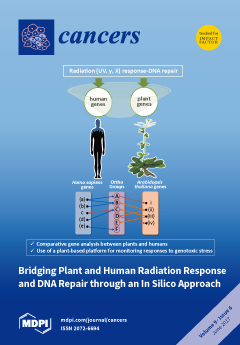
Cover Story: Bridging plant and animal stress responses. The conserved features of the DNA damage response and repair (DDR/R) in plants and animals might facilitate interdisciplinary studies that cross the traditional boundaries between animal and plant biology in order to discover new DNA damage biomarkers, particularly gene transcripts, for radiation exposure monitoring (REM) in environmental and biomedical settings. In this work, we have used a hybrid bioinformatics and experimental analysis, to reveal the common and divergent features of the most relevant DDR/R players in animals and plants focusing on ionizing radiation (IR) and UV-light. A plant-based platform for monitoring responses to genotoxic stresses is proposed. View this paper
  • Issues are regarded as officially published after their release is announced to the table of contents alert mailing list .
  • You may sign up for email alerts to receive table of contents of newly released issues.
  • PDF is the official format for papers published in both, html and pdf forms. To view the papers in pdf format, click on the "PDF Full-text" link, and use the free Adobe Reader to open them.

Articles (16)

  • Review
  • Open Access
98 Citations
14,224 Views
33 Pages

Selection of Nucleic Acid Aptamers Targeting Tumor Cell-Surface Protein Biomarkers

  • Marie-Cécile Mercier,
  • Monique Dontenwill and
  • Laurence Choulier

21 June 2017

Aptamers are nucleic acids referred to as chemical antibodies as they bind to their specific targets with high affinity and selectivity. They are selected via an iterative process known as ‘selective evolution of ligands by exponential enrichment’ (S...

  • Review
  • Open Access
63 Citations
11,524 Views
15 Pages

18 June 2017

Macrophages interact with cells in every organ to facilitate tissue development, function and repair. However, the close interaction between macrophages and parenchymal cells can be subverted in disease, particularly cancer. Motility is an essential...

  • Review
  • Open Access
112 Citations
16,686 Views
19 Pages

12 June 2017

Despite the initial efficacy of androgen deprivation in prostate cancer, virtually all patients progress to castration-resistant prostate cancer (CRPC). Androgen receptor (AR) signaling is critically required for CRPC. A new generation of medications...

  • Review
  • Open Access
166 Citations
20,191 Views
30 Pages

Carbon Ion Radiotherapy: A Review of Clinical Experiences and Preclinical Research, with an Emphasis on DNA Damage/Repair

  • Osama Mohamad,
  • Brock J. Sishc,
  • Janapriya Saha,
  • Arnold Pompos,
  • Asal Rahimi,
  • Michael D. Story,
  • Anthony J. Davis and
  • D.W. Nathan Kim

Compared to conventional photon-based external beam radiation (PhXRT), carbon ion radiotherapy (CIRT) has superior dose distribution, higher linear energy transfer (LET), and a higher relative biological effectiveness (RBE). This enhanced RBE is driv...

  • Article
  • Open Access
12 Citations
7,599 Views
20 Pages

Bridging Plant and Human Radiation Response and DNA Repair through an In Silico Approach

  • Zacharenia Nikitaki,
  • Athanasia Pavlopoulou,
  • Marcela Holá,
  • Mattia Donà,
  • Ioannis Michalopoulos,
  • Alma Balestrazzi,
  • Karel J. Angelis and
  • Alexandros G. Georgakilas

The mechanisms of response to radiation exposure are conserved in plants and animals. The DNA damage response (DDR) pathways are the predominant molecular pathways activated upon exposure to radiation, both in plants and animals. The conserved featur...

  • Article
  • Open Access
20 Citations
7,789 Views
17 Pages

Indocyanine green (ICG) has been reported as a potential near-infrared (NIR) photosensitizer for photodynamic therapy (PDT) of cancer. However the application of ICG-mediated PDT is both intrinsically and physiologically limited. Here we report a com...

  • Article
  • Open Access
3 Citations
7,158 Views
21 Pages

How do people with cancer occupy places within the health system during their journey through palliative care? The answer to this question was explored by the authors as part of a wider ethnographic study of eight people’s journeys from referral to p...

  • Article
  • Open Access
8 Citations
4,932 Views
13 Pages

A carcinogen-induced premalignant oral lesion model that progresses to oral cancer was used to examine the immunological impact of a 5-week treatment regimen to block programmed cell death protein 1 (PD-1). PD-1 antibody treatment resulted in concurr...

  • Article
  • Open Access
112 Citations
12,430 Views
16 Pages

A Novel Micro Cold Atmospheric Plasma Device for Glioblastoma Both In Vitro and In Vivo

  • Zhitong Chen,
  • Hayk Simonyan,
  • Xiaoqian Cheng,
  • Eda Gjika,
  • Li Lin,
  • Jerome Canady,
  • Jonathan H. Sherman,
  • Colin Young and
  • Michael Keidar

Cold atmospheric plasma (CAP) treatment is a rapidly expanding and emerging technology for cancer treatment. Direct CAP jet irradiation is limited to the skin and it can also be invoked as a supplement therapy during surgery as it only causes cell de...

  • Review
  • Open Access
27 Citations
6,417 Views
13 Pages

The PI3K pathway is one of the most highly perturbed cell signaling pathways in human cancer, including the most common malignant brain tumors, gliomas, where either activating mutations of positive pathway effectors or loss/inactivation of pathway i...

  • Review
  • Open Access
44 Citations
11,693 Views
9 Pages

The poor prognosis of hepatocellular carcinoma (HCC), one of the most devastating cancers worldwide, is due to frequent recurrence and metastasis. Among the metastatic factors in the tumor microenvironment, hepatocyte growth factor (HGF) has been wel...

  • Review
  • Open Access
72 Citations
13,587 Views
17 Pages

Chemotherapeutic Drugs: DNA Damage and Repair in Glioblastoma

  • Laura Annovazzi,
  • Marta Mellai and
  • Davide Schiffer

Despite improvements in therapeutic strategies, glioblastoma (GB) remains one of the most lethal cancers. The presence of the blood–brain barrier, the infiltrative nature of the tumor and several resistance mechanisms account for the failure of curre...

  • Feature Paper
  • Review
  • Open Access
31 Citations
7,667 Views
17 Pages

RGD-Binding Integrins in Head and Neck Cancers

  • Hanadi Talal Ahmedah,
  • Laurence H. Patterson,
  • Steven D. Shnyder and
  • Helen M. Sheldrake

Alterations in integrin expression and function promote tumour growth, invasion, metastasis and neoangiogenesis. Head and neck cancers are highly vascular tumours with a tendency to metastasise. They express a wide range of integrin receptors. Expres...

  • Review
  • Open Access
6 Citations
4,874 Views
8 Pages

Improving Outcomes in Patients with CRC: The Role of Patient Reported Outcomes—An ESDO Report

  • Eric Van Cutsem,
  • Aimery De Gramont,
  • Geoffrey Henning,
  • Philippe Rougier,
  • Franck Bonnetain and
  • Thomas Seufferlein

Colorectal cancer is one of the most commonly diagnosed cancers worldwide and nearly half of patients will develop metastatic disease at some point during the course of their disease. The goal of anticancer therapy in this context is to extend surviv...

  • Review
  • Open Access
72 Citations
8,572 Views
19 Pages

The tumor microenvironment, including cancer-associated fibroblasts (CAF), has developed as an important target for understanding tumor progression, clinical prognosis and treatment responses of cancer. Cancer cells appear to transform normal fibrobl...

  • Article
  • Open Access
33 Citations
6,925 Views
13 Pages

Self-Esteem and Academic Difficulties in Preadolescents and Adolescents Healed from Paediatric Leukaemia

  • Marta Tremolada,
  • Livia Taverna,
  • Sabrina Bonichini,
  • Giuseppe Basso and
  • Marta Pillon

Adolescents with cancer may demonstrate problems in their self-esteem and schooling. This study aims to screen the preadolescents and adolescents more at risk in their self-esteem perception and schooling difficulties post-five years from the end of...

Get Alerted

Add your email address to receive forthcoming issues of this journal.

XFacebookLinkedIn
Cancers - ISSN 2072-6694