

Skip to Content

Cancers, Volume 9, Issue 5

2017 May - 14 articles

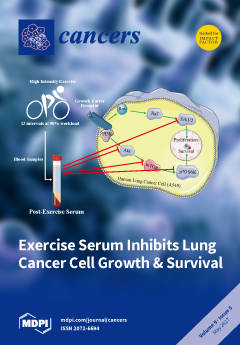
Cover Story: Lung cancer accounts for the most cancer-related deaths globally, indicating an urgent need to find strategies for its prevention and treatment. The Akt, mammalian target of rapamycin (mTOR) and p70 S6K, and the Ras-extracellular signal-regulated kinase (Erk1/2) pathways are activated in cancer leading to cell survival and growth. Exercise is associated with health benefits and in the present study we found that exposure of lung cancer cells to post exercise serum resulted in inhibition of cell proliferation and survival, as well as a significant reduction in activated Akt, mTOR, p70 S6K and Erk1/2. Our data suggest that post exercise serum has anti-cancer properties in lung cancer and deserves further systematic investigation. View this paper
  • Issues are regarded as officially published after their release is announced to the table of contents alert mailing list .
  • You may sign up for email alerts to receive table of contents of newly released issues.
  • PDF is the official format for papers published in both, html and pdf forms. To view the papers in pdf format, click on the "PDF Full-text" link, and use the free Adobe Reader to open them.

Articles (14)

  • Review
  • Open Access
82 Citations
13,165 Views
29 Pages

Physical Activity and Quality of Life in Cancer Survivors: A Meta-Synthesis of Qualitative Research

  • Shaunna Burke,
  • Amanda Wurz,
  • Andrew Bradshaw,
  • Stephanie Saunders,
  • Malcolm A. West and
  • Jennifer Brunet

Qualitative research on the impact of physical activity on quality of life (QoL) in adults diagnosed with cancer is accumulating. However, the field of physical activity and cancer survivorship lack a synthesis of this research to reliably understand...

  • Review
  • Open Access
1,667 Citations
67,031 Views
45 Pages

The epidermal growth factor receptor (EGFR) is a receptor tyrosine kinase that is commonly upregulated in cancers such as in non-small-cell lung cancer, metastatic colorectal cancer, glioblastoma, head and neck cancer, pancreatic cancer, and breast c...

  • Article
  • Open Access
8 Citations
5,263 Views
10 Pages

Purpose: This study investigates the feasibility of personalizing radiotherapy prescription schemes (treatment margins and fractional doses) for glioblastoma (GBM) patients and their potential benefits using a proliferation and invasion (PI) glioma m...

  • Review
  • Open Access
59 Citations
7,668 Views
12 Pages

Lung cancer is the leading cause of deaths resulting from cancer owing to late diagnosis and limited treatment intervention. MicroRNAs are short, non-coding RNA molecules that regulate gene expression post-transcriptionally by translational repressio...

  • Review
  • Open Access
51 Citations
7,890 Views
11 Pages

Cancer is a main public health problem all over the world. It affects millions of humans no matter their age, gender, education, or social status. Although chemotherapy is the main strategy for the treatment of cancer, a major problem limiting its su...

  • Article
  • Open Access
44 Citations
10,418 Views
14 Pages

Inhibition of Human Lung Cancer Cell Proliferation and Survival by Post-Exercise Serum Is Associated with the Inhibition of Akt, mTOR, p70 S6K, and Erk1/2

  • Nigel Kurgan,
  • Evelyn Tsakiridis,
  • Rozalia Kouvelioti,
  • Jessy Moore,
  • Panagiota Klentrou and
  • Evangelia Tsiani

Non-small cell lung cancer (NSCLC) accounts for 85% of all lung cancer cases, and for the most cancer-related deaths. The survival pathway of Akt, its downstream effectors, the mammalian target of rapamycin (mTOR) and ribosomal protein S6 kinase (p70...

  • Review
  • Open Access
60 Citations
8,977 Views
15 Pages

MTH1 as a Chemotherapeutic Target: The Elephant in the Room

  • Govindi J. Samaranayake,
  • Mai Huynh and
  • Priyamvada Rai

Many tumors sustain elevated levels of reactive oxygen species (ROS), which drive oncogenic signaling. However, ROS can also trigger anti-tumor responses, such as cell death or senescence, through induction of oxidative stress and concomitant DNA dam...

  • Review
  • Open Access
59 Citations
8,941 Views
16 Pages

Cancer cells display enhanced growth rates and a resistance to apoptosis. The ability of cancer cells to evade homeostasis and proliferate uncontrollably while avoiding programmed cell death/apoptosis is acquired through mutations to key signaling mo...

  • Brief Report
  • Open Access
19 Citations
6,334 Views
6 Pages

Androgen Receptor Could Be a Potential Therapeutic Target in Patients with Advanced Hepatocellular Carcinoma

  • Tatsuo Kanda,
  • Koji Takahashi,
  • Masato Nakamura,
  • Shingo Nakamoto,
  • Shuang Wu,
  • Yuki Haga,
  • Reina Sasaki,
  • Xia Jiang and
  • Osamu Yokosuka

Hepatocellular carcinoma (HCC) is a male-dominant disease with poor prognosis. Sorafenib is the only approved systemic chemotherapeutic drug for patients with advanced HCC. Previous studies have shown that androgen and androgen receptor (AR) are invo...

  • Review
  • Open Access
51 Citations
11,320 Views
12 Pages

The invasion of cancer cells into surrounding tissue and the vasculature is essential for tumor metastasis. Increasing evidence indicates that hepatocyte growth factor (HGF) induces cancer cell migration and invasion. A broad spectrum of mechanisms u...

  • Review
  • Open Access
222 Citations
19,409 Views
8 Pages

KRAS, TP53, CDKN2A, SMAD4, BRCA1, and BRCA2 Mutations in Pancreatic Cancer

  • Jonas Cicenas,
  • Kotryna Kvederaviciute,
  • Ingrida Meskinyte,
  • Edita Meskinyte-Kausiliene,
  • Aiste Skeberdyte and
  • Jonas Cicenas

28 April 2017

Pancreatic cancer is a disease that has a very high fatality rate and one of the highest mortality ratios among all major cancers, remaining the fourth leading cause of cancer-related deaths in developed countries. The major treatment of pancreatic c...

  • Review
  • Open Access
194 Citations
21,532 Views
25 Pages

Targeting the ATR-CHK1 Axis in Cancer Therapy

  • Stuart Rundle,
  • Alice Bradbury,
  • Yvette Drew and
  • Nicola J. Curtin

27 April 2017

Targeting the DNA damage response (DDR) is a new therapeutic approach in cancer that shows great promise for tumour selectivity. Key components of the DDR are the ataxia telangiectasia mutated and Rad3 related (ATR) and checkpoint kinase 1 (CHK1) kin...

  • Review
  • Open Access
69 Citations
18,104 Views
33 Pages

26 April 2017

HER2 receptor tyrosine kinase that is overexpressed in approximately 20% of all breast cancers (BCs) is a poor prognosis factor and a precious target for BC therapy. Trastuzumab is approved by FDA to specifically target HER2 for treating HER2+ BC. Ho...

Get Alerted

Add your email address to receive forthcoming issues of this journal.

XFacebookLinkedIn
Cancers - ISSN 2072-6694