

You are currently viewing a new version of our website. To view the old version click .

Cancers, Volume 9, Issue 11

November 2017 - 15 articles

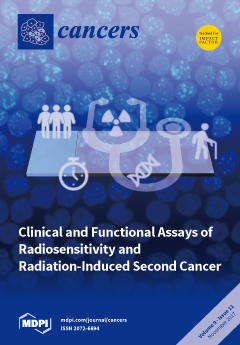
Cover Story: Whilst the near instantaneous physical interaction of radiation energy with living cells leaves little opportunity for inter-individual variation in the initial yield of DNA damage, how damage is recognized, repaired or resolved varies across the population. Radiosensitivity is a multi-dimensional problem that spans levels of tissue organization, time, people, patients and physics. Radiosensitive individuals may be at increased risk of radiotherapy-induced second cancers. Functional assays for cellular radiosensitivity represent a strategy to identify radiosensitive patients before radiotherapy begins, without needing to discover or evaluate the impact of the precise genetic determinants. View the paper
  • Issues are regarded as officially published after their release is announced to the table of contents alert mailing list .
  • You may sign up for email alerts to receive table of contents of newly released issues.
  • PDF is the official format for papers published in both, html and pdf forms. To view the papers in pdf format, click on the "PDF Full-text" link, and use the free Adobe Reader to open them.

Articles (15)

  • Feature Paper
  • Perspective
  • Open Access
3 Citations
5,019 Views
11 Pages

Genomic Destabilization Triggered by Replication Stress during Senescence

  • Yusuke Minakawa,
  • Atsuhiro Shimizu,
  • Yusuke Matsuno and
  • Ken-ichi Yoshioka

21 November 2017

Most cancers develop after middle age, and are often associated with multiple mutations and genomic instability, implying that genomic destabilization is critical for age-related tumor development. In this manuscript, we review current knowledge rega...

  • Review
  • Open Access
394 Citations
26,352 Views
23 Pages

Pancreatic Cancer Chemoresistance to Gemcitabine

  • Manoj Amrutkar and
  • Ivar P. Gladhaug

16 November 2017

Pancreatic ductal adenocarcinoma (PDAC), commonly referred to as pancreatic cancer, ranks among the leading causes of cancer-related deaths in the Western world due to disease presentation at an advanced stage, early metastasis and generally a very l...

  • Review
  • Open Access
14 Citations
6,356 Views
22 Pages

16 November 2017

Objective: In order to find low abundant proteins secretome and tumor tissue proteome data have been explored in the last few years for the diagnosis of colorectal cancer (CRC). In this review we aim to summarize the results of studies evaluating mar...

  • Review
  • Open Access
140 Citations
18,488 Views
22 Pages

Current and Prospective Protein Biomarkers of Lung Cancer

  • Tatiana N. Zamay,
  • Galina S. Zamay,
  • Olga S. Kolovskaya,
  • Ruslan A. Zukov,
  • Marina M. Petrova,
  • Ana Gargaun,
  • Maxim V. Berezovski and
  • Anna S. Kichkailo

13 November 2017

Lung cancer is a malignant lung tumor with various histological variants that arise from different cell types, such as bronchial epithelium, bronchioles, alveoli, or bronchial mucous glands. The clinical course and treatment efficacy of lung cancer d...

  • Review
  • Open Access
31 Citations
5,454 Views
13 Pages

10 November 2017

The practice of liquid biopsy (LB) has revolutionized the care of patients with metastatic lung cancer. Many oncologists now use this approach in daily practice, applying precise procedures for the detection of activating or resistance mutations in E...

  • Feature Paper
  • Review
  • Open Access
118 Citations
12,680 Views
14 Pages

Role of LFA-1 and ICAM-1 in Cancer

  • Manuel Reina and
  • Enric Espel

3 November 2017

The lymphocyte function-associated antigen-1 (LFA-1) (also known as CD11a/CD18 and αLβ2), is just one of many integrins in the human body, but its significance is derived from its exclusive presence in leukocytes. In this review, we summarize the stu...

  • Feature Paper
  • Review
  • Open Access
41 Citations
7,044 Views
17 Pages

1 November 2017

mTOR inhibitors have demonstrated remarkable anti-tumor activity in experimental models, mainly by reducing cancer cell growth and tumor angiogenesis. Their use in cancer patients as monotherapy has, however, generated only limited benefits, increasi...

  • Review
  • Open Access
63 Citations
9,539 Views
22 Pages

Evolving Therapeutic Strategies to Exploit Chromosome Instability in Cancer

  • Laura L. Thompson,
  • Lucile M-P. Jeusset,
  • Chloe C. Lepage and
  • Kirk J. McManus

1 November 2017

Cancer is a devastating disease that claims over 8 million lives each year. Understanding the molecular etiology of the disease is critical to identify and develop new therapeutic strategies and targets. Chromosome instability (CIN) is an abnormal ph...

of 2

Get Alerted

Add your email address to receive forthcoming issues of this journal.

XFacebookLinkedIn
Cancers - ISSN 2072-6694