


Simple Summary
Recurrent ovarian cancer is difficult to treat and new options are urgently needed. This study investigates whether the existing drug itraconazole can slow cancer growth by blocking specific pathways that are involved in the processes of tumor growth and survival. Previous research has suggested that itraconazole has the ability to inhibit these pathways. Patients whose recurrent ovarian cancer tumors showed high pathway activity, measured using an mRNA-based assay, were treated with itraconazole. Disease progression was compared to their previous treatment. Unfortunately, the itraconazole treatment did not show benefit, as almost all patients experienced disease progression and there was no prolonged survival. Although the tumor marker CA125 did not reflect treatment response, its rapid increase after stopping treatment suggests the drug may have had a (temporary) effect on tumor activity. Overall, itraconazole alone does not appear to be an effective treatment, but the findings provide insight for future research into targeted therapies.
Abstract
Background: Treatment options for recurrent ovarian cancer (OC) are limited, leading to poor prognosis. Targeting tumor-promoting signaling transduction pathways (STPs), such as Hedgehog (HH) and Phosphoinositide-3-kinase (PI3K) STPs, might be an option for treatment. This study evaluates the efficacy of itraconazole as a targeted treatment in HH and/or PI3K active recurrent OC. Methods: We assessed HH and PI3K STP activity in recurrent OC patients. If activity was aberrantly high in either STP, patients received itraconazole treatment, which has been shown to inhibit both HH and PI3K pathways. The primary objective is to compare progression-free survival (PFS) on itraconazole therapy (PFS2) to the PFS on therapy prior to enrolment (PFS1). A PFS2/PFS1 ≥ 1.0 was considered successful. Secondary objectives included side effects, best overall response, one-year survival, and CA125 levels, though this was not a secondary endpoint. Results: Of sixteen patients with successful STP analysis, 93% were eligible for itraconazole therapy. Nine patients started treatment, with a mean duration of 55 days. None achieved a PFS2/PFS1 ratio ≥ 1.0 (mean 0.26, range 0.1–0.7). One patient had radiologically stable disease, while the others experienced disease progression. Side effects were mostly limited to grade 1–2, including fatigue, nausea, dysgeusia, dyspnea, cough, vertigo, and edema. No grade ≥ 3 adverse effects were linked to treatment. One-year survival was 22%. CA125 levels did not correlate with the treatment outcome, but increased rapidly after ceasing treatment. Conclusions: Itraconazole monotherapy for recurrent HH and/or PI3K aberrantly active OC is an ineffective treatment. While CA125 did not correlate with treatment outcome, the rapid increase in CA125 after therapy cessation suggests tumor inhibitory effects.
1. Introduction
Despite aggressive treatment involving surgery and chemotherapy, recurrence of ovarian cancer (OC) is almost always inevitable [1]. Treatment of recurrent OC is generally limited to second- or third-line palliative chemotherapy [2]. Despite the rapid development of targeted therapies for cancer patients, only a few, e.g., poly(ADP-ribose) polymerase (PARP) inhibitors and bevacizumab, have proven to enhance progression-free survival (PFS) in OC patients [3,4].
The poor prognosis may be attributed to the lack of predictive biomarkers to appropriately stratify patients for treatment options [5,6]. Therefore, new stratification approaches are needed to predict the response to targeted therapies. OC heterogeneity, with multiple histological subtypes (i.e., serous, endometrioid, mucinous, clear cell), complicates treatment decisions due to distinct clinical and genomic profiles [7]. Stratification by genomic alterations or protein expression may offer insights into aberrantly active tumor-driving signaling transduction pathways (STPs). However, the presence of these genomic alterations or aberrant protein expression does not always imply aberrantly active STPs, which might be an explanation for the disappointing response rates in clinical trials [5,6,8,9]. The tumor microenvironment is another factor potentially influencing treatment response, but is often disregarded [10]. The tumor microenvironment contains hormones, immune cells and cytokines, which can activate or inhibit STPs, affecting cellular function. Genomic, histopathological and environmental factors influence STPs and ultimately shape the functional phenotype of the cell [11]. Considering that the functional phenotype provides a comprehensive understanding of the cell’s behavior, more insight could potentially improve treatment decisions and outcomes [11,12].
To better reflect functional cell activity, a different strategy was developed using Bayesian network models to determine STP activity from mRNA expression of validated target genes in tumor tissue [12,13,14]. Models are currently available for thirteen pathways involved in oncogenesis [15]. By integrating multiple pathway-specific target genes rather than relying on a single marker, this approach provides a more functional measure of pathway activation. Studies on breast and salivary duct cancers suggest that this mRNA-based assay may aid in selecting patients for pathway-targeted therapies [9,16,17,18].
There are about twelve STPs that are potentially oncogenic when dysregulated [12,19]. The Hedgehog (HH) and Phosphoinositide-3-kinase (PI3K) pathways are major drivers in OC [20,21,22,23]. Dysregulation of these pathways occurs both in the early and late stage of disease [24]. This makes the HH and PI3K pathways two potential therapeutic targets [20,21,22,23].
Itraconazole, registered as an antifungal agent, has shown the ability to inhibit both HH and PI3K pathway activity and may hold promise as a repurposed treatment option [25,26,27,28,29]. Classic HH inhibitors such as vismodegib are direct inhibitors of canonical Smoothened (SMO) on the cell membrane, preventing the activation of the HH signaling cascade. Itraconazole inhibits SMO in an alternative way, impairing downstream GLI activation [30]. Itraconazole shows downregulated ERBB2 mRNA, indicating the inhibition of the PI3K pathway [29]. Its therapeutic potential has demonstrated therapy response in other cancer types as monotherapy, but also in OC in combined chemotherapy treatment with impact on survival [25,26,27,28].
In this study we evaluate the efficacy of itraconazole in OC patients with aberrantly active HH and/or PI3K STP OC as part of a larger prospective study (NCT0345822). Key outcomes include progression-free survival (PFS) on itraconazole treatment compared to PFS on prior therapy (PFS ratio), best overall response, toxicity and survival.
2. Materials and Methods
2.1. Study Design and Participants
Patients were screened for eligibility in the routine multidisciplinary tumor board (MTB) meeting including seven regional hospitals as part of the Gynecologic Oncologic center south (GOCZ) in the Netherlands or through referral from external hospitals. Patients with recurrent OC, regardless of histology, were eligible if they met one of the following criteria: (1) platinum-resistant OC, (2) refusal of standard therapy, or (3) asymptomatic with elevated CA125 levels (>35 U/mL) after first-line treatment. Additional criteria included radiologically evaluable disease according to RECIST 1.1 criteria, WHO performance status 0-II and the ability to obtain a tumor biopsy with a tumor cell percentage (TCP) ≥ 50% to reduce stromal contamination. Exclusion criteria included concurrent anti-cancer therapy or other malignancies. Eligible patients were referred to the initiating center (Catharina Hospital Eindhoven). The full eligibility criteria, full methods and materials, sample size and plan for analysis are described in the study protocol [31]. This study was reported according to the TREND guidelines (Table S1) [32].
2.2. Tumor Sampling and Signal Transduction Pathway Activity Analysis
Obtained biopsy tissue was prepared by a pathologist. Subsequently, RNA extraction, qRT-PCR and measurements of mRNA concentrations were performed. STP scores for seven oncogenic pathways (Mitogen Activated Protein Kinase (MAPK), Androgen Receptor (AR), Estrogen Receptor (ER), HH, Notch, Transforming Growth Factor–β (TGF-β), and PI3K) were determined using OncoSIGNal technology (InnoSIGN Inc., Eindhoven, The Netherlands) to obtain a comprehensive tumor profile and to analyze possible crosstalk mechanisms.
2.3. Treatment Decision and Follow-Up
STP activity scores were compared to reference values from healthy fallopian tube epithelium (FTE), the tissue of origin of the majority of OC [24,33]. To correct for natural variation within the samples (n = 20), cut-off values for aberrantly high STP activity were determined as two standard deviations above the mean FTE values [24,34]. The MTB evaluated these scores along with clinicopathological data, to determine eligibility for itraconazole therapy. An MTB, compromised of oncologists, gynecologic-oncologists, radiologists, radiation therapists and pathologists, evaluated these scores through a standardized form to help guide treatment selection. The form assessed the score elevation above the cut-off, identified the most likely tumor-driving pathways, and determined the availability of targeted therapies within the study. Alongside the individual’s clinicopathological data, eligibility for itraconazole therapy was determined.
Treatment was initiated with itraconazole 300 mg PO BID, within four weeks of MTB decision. Baseline CT scans were performed within two weeks before treatment initiation. Follow-up consultations occurred at least 1, 3, 6, and 12 weeks after treatment initiation, including laboratory tests and itraconazole toxicity evaluation by CTCAE v5.0. Adverse events were reported from treatment initiation until 12 weeks after ceasing treatment, with the highest grade reported for recurring or worsening events. Radiological assessments followed every 12 weeks.
2.4. Dose Reductions and Treatment Cessation
Itraconazole levels were monitored during treatment. Serum levels were evaluated after 1, 3, 6 and subsequently every 12 weeks. A serum level ≥ 6.0 mg/L (sum of serum levels itraconazole and active metabolite hydroxy-itraconazole) was considered potentially toxic in our study population, based on therapeutic drug monitoring studies reporting an increased incidence of adverse effects at itraconazole concentrations of ≥5.0 mg/L [35]. In case of unacceptable toxicity or toxic serum levels, temporary discontinuation and dose reduction took place to 200 mg PO BID. Treatment continued until disease progression, unacceptable toxicity, or death. For research purposes, patients were asked to undergo a secondary biopsy for STP analysis after treatment was ceased to particularly evaluate the HH and PI3K pathway activity and pathway escape mechanisms after treatment.
2.5. Outcome Measures
The primary outcome was the PFS2/PFS1 ratio, comparing the PFS of prior treatment (PFS1) to the PFS under itraconazole (PFS2) [36]. PFS2/PFS1 ≥ 1.0 was considered successful. As part of a multi-arm, multistage trial design, in case none of the first eight patients achieve PFS2/PFS1 ≥ 1.0, the treatment arm should be closed due to the lack of efficacy [31]. Secondary outcomes included best overall response by RECIST 1.1, one-year survival, overall survival and adverse effects.
2.6. (Statistical) Analysis
Statistical analysis was performed using SPSS version 29 and RStudio version 2023.12.1+402. Fisher-exact and Mann–Whitney U tests were used for categorical and continuous variables respectively. A p-value of <0.05 was considered statistically significant.
Using the available data, explorative analysis of CA125 levels was performed. The slope of CA125 change in the period before, during and after treatment was assessed. CA125 levels during subsequent anti-cancer therapy were excluded from analysis.
3. Results
3.1. Patient Population
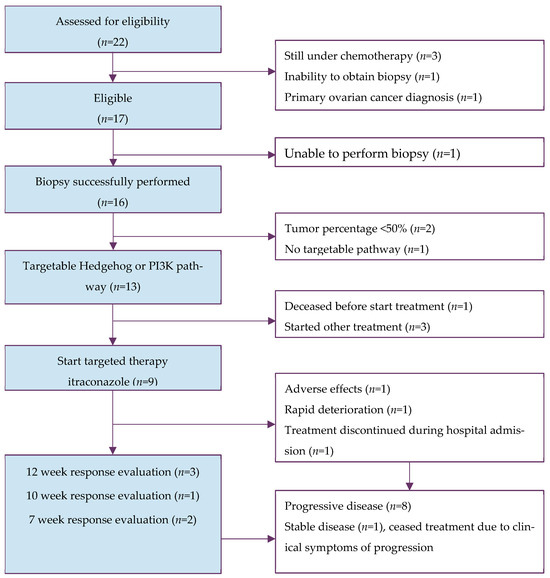
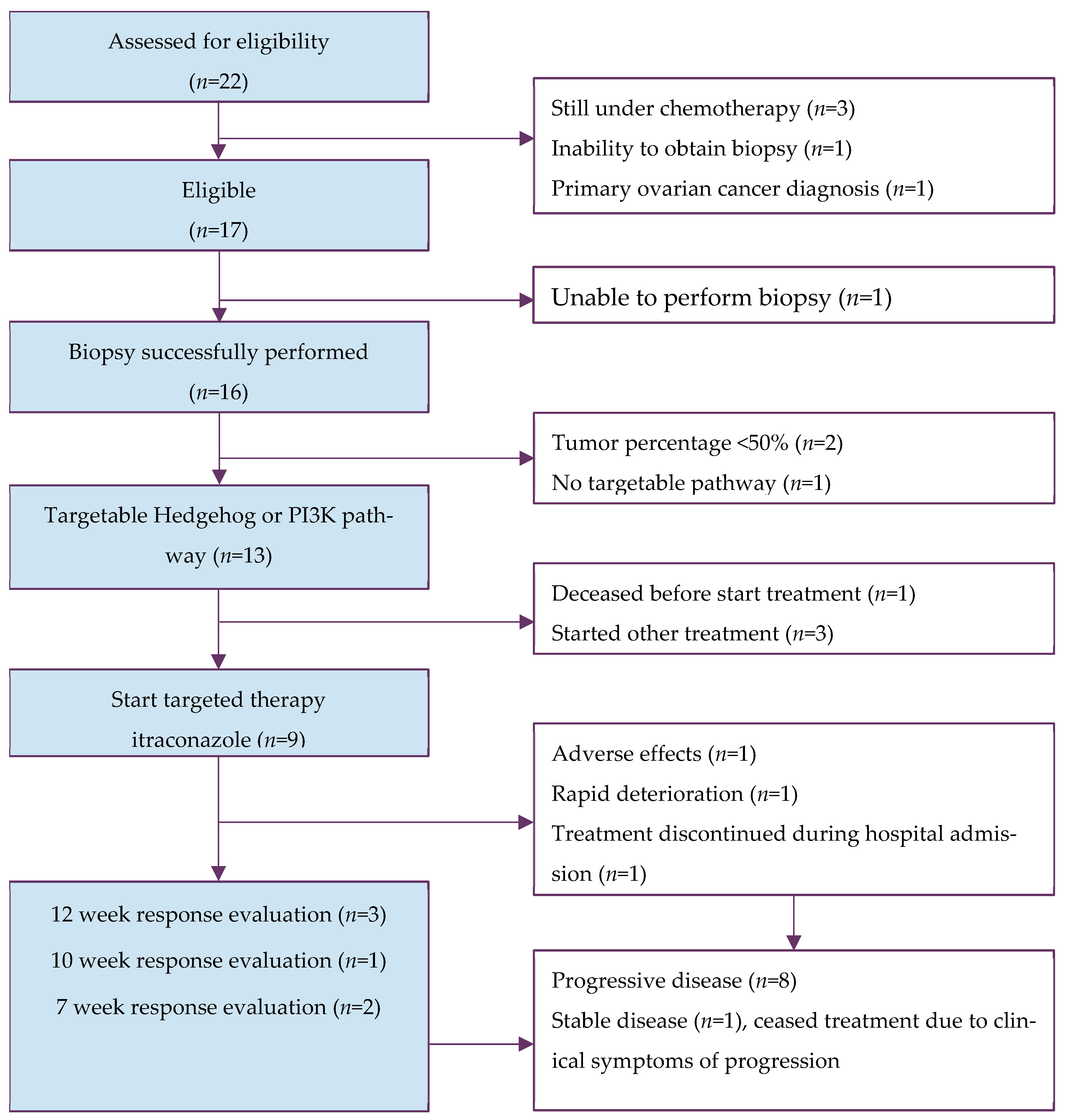
A total of 22 patients were assessed for eligibility. Five patients did not meet the eligibility criteria due to active chemotherapy treatment (n = 3), inability to obtain a tumor biopsy (n = 2) and primary OC diagnosis (n = 1) (Figure 1). Biopsies were successful in 16 patients. After pathologist assessment, two patients were excluded due to insufficient TCP. Thus, samples of 14 patients were available for analysis of STP activity. The MTB deemed 13 patients, with an aberrantly active HH and/or PI3K pathway, eligible for targeted therapy with itraconazole. For nine patients itraconazole therapy was initiated; the other eligible patients were excluded due to unexpected death (n = 1) and preference to pursue other treatment (n = 3). Baseline characteristics are presented in Table 1.
Figure 1.
Flowchart of inclusion of patients. Abbreviations: PI3K = Phosphatidylinositol 3-kinase.
Table 1.
Clinicopathological characteristics of included patients treated with itraconazole.
3.2. Itraconazole Treatment
Nine patients initiated itraconazole treatment and the average treatment time was 55 days (range 24–85 days). Three patients with recurrent high-grade serous OC ceased treatment prematurely due to unacceptable side effects, rapid clinical deterioration or hospital admission. The median PFS1 was 7.2 months and PFS2 was 1.7 months. The mean PFS2/PFS1 ratio was 0.26 (range 0.1–0.7).
Radiological response was evaluated in seven patients. The best overall response at the first radiological evaluation was stable disease for one patient, and the remaining patients all showed progressive disease (Table 2). For two patients, no radiological evaluation could be performed due to rapid deterioration and early discontinuation of treatment followed by prompt subsequent chemotherapy.
Table 2.
Best overall response by RECIST 1.1.
During toxicity monitoring, eight toxic serum levels of itraconazole were observed in six patients. This led to a total of four dose reductions in three patients. One patient experienced unacceptable adverse effects and discontinued therapy after dose reduction, which did not improve symptoms. The remaining patients had toxic serum levels and treatment was ceased due to progressive disease or hospital admission. One patient was incompliant with the itraconazole use after six weeks of treatment. This was confirmed by almost absent itraconazole serum levels six weeks later. Based on the serum levels, there were no other indications for incompliance in other patients.
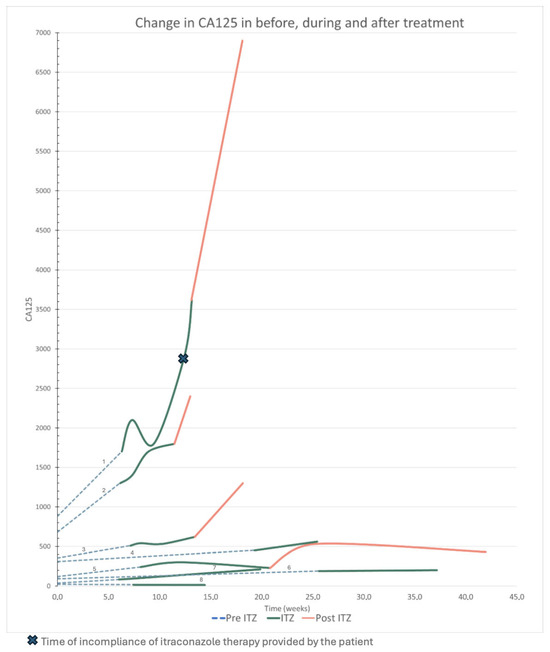
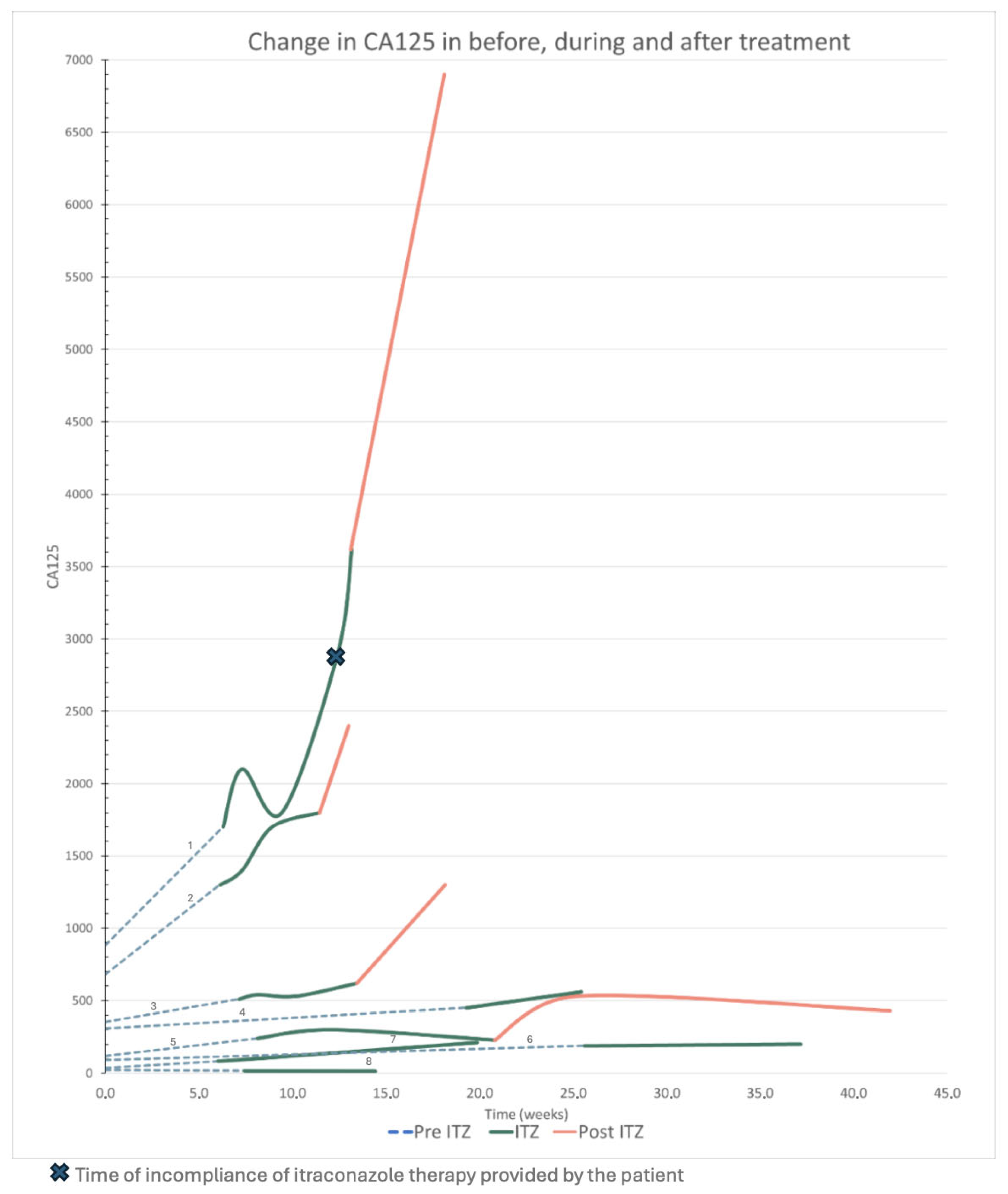
CA125 tumor marker levels were available from eight patients for analysis. In 50% of the patients, the slope during treatment was more gradual compared to pre-treatment. In one of these patients, CA125 levels decreased (Figure 2) and for three patients the CA125 levels increased faster compared to pre-treatment. Notably, all four patients with available CA125 levels after itraconazole treatment experienced a marked rise in CA125 levels after ceasing treatment with itraconazole.
Figure 2.
Change in CA125 before during and after treatment with itraconazole. Numbers 1–8 refer to the clinical characteristics described in Table S2.
There was no tumor tissue available for STP analysis after Itraconazole treatment.
3.3. Adverse Effects and Serious Adverse Events
Overall, patients reported itraconazole treatment to be tolerable. Common adverse effects were fatigue, nausea, dysgeusia, dyspnea, loss of appetite, cough, vertigo and edema (CTCAE grade 1–2). Grade ≥ 3 adverse effects were related to serious adverse events (SAEs). One patient underwent elective abdominal surgery for a pre-existing enterorectal fistula, complicated by multiple reoperations due to anastomotic leaks and peritoneal infections (CTCAE grade 3). This resulted in death shortly after ceasing therapy (CTCAE grade 5). Another patient was hospitalized for a complicated urinary tract infection, heart failure and atrial fibrillation (CTCAE grade 3). Upon admission, itraconazole serum level was at a toxic level. One patient had rapid progression which resulted in death (CTCAE grade 5). All SAEs were acknowledged by the Medical Research Ethics Committees United and no causal relationship was determined with itraconazole. All adverse effects and SAEs are described in Table 3.
Table 3.
Adverse events graded by CTCAE v5.0 during itraconazole treatment and up to 12 weeks after ceasing treatment. The reported numbers represent the number of affected patients, with adverse events classified by the highest grade experienced during the study period.
4. Discussion
In this study we found HH and/or PI3K pathways are aberrantly active in almost all recurrent OC tumors. Targeted treatment with itraconazole, containing HH and PI3K inhibitory properties, did not result in improved clinical response or increased PFS (PFS2/PFS1 ratio < 1.0). Since this treatment arm in the study did not reach its primary endpoint, further accrual of patients for treatment with itraconazole was discontinued.
Previous studies reported a significantly longer PFS when itraconazole was combined with chemotherapy compared to chemotherapy alone in patients with refractory OC and recurrent clear-cell OC [25,26]. In contrast, our study used itraconazole as monotherapy, achieving stable disease in one patient with a treatment duration of 12 weeks. This may reflect the patient population, which included heavily pretreated individuals with poor prognosis, resulting in a low likelihood for successful treatment response. Additionally, it is important to consider that itraconazole has been reported to inhibit angiogenesis and may resensitize refractory OC by inhibiting the P-glycoprotein efflux pump. These mechanisms could potentially enhance the effectiveness of itraconazole when used in combination with chemotherapy, which may explain the differences in outcomes observed in previous studies compared to our findings with single-agent itraconazole [25,37].
The low efficacy observed could also be due to the involvement of other active tumor-driving pathways. Although all patients had an aberrantly active HH and/or PI3K pathway, in 46% of these patients, there was yet another active pathway (Table S3). The HH pathway is activated through overexpression of the Sonic HH ligand (Shh), loss-of-function mutations of included membrane receptors and gain-of-function mutations of the SMO. The latter is the target for itraconazole and other drugs targeting the HH pathway. Itraconazole binds to SMO on the cell membrane, suppressing its activity. This binding mirrors the situation in absence of ligand Shh where the expression of HH target genes are suppressed [30]. For the PI3K pathway the inhibitory mechanism is more unknown. There is evidence that the PI3K pathway is inhibited through the decreased expression of HER2/ERBB2. Moreover, in multiple studies, a decrease in the phosphorylation of the AKT and S6 protein, both downstream components of the PI3K pathway, was observed [29,38,39]. During treatment with inhibitors targeting the HH and/or PI3K pathways, other oncogenic STPs such as the MAPK pathway may become more active and contribute to tumor progression [40]. Pathway crosstalk and multi-active STPs may be the reason monotherapy with itraconazole is not sufficient to achieve tumor response. Therefore, in line with the treatment strategy of previous studies with positive results, combination therapy targeting multiple pathways might be more effective. Albeit, at the cost of more side-effects.
The optimal dosage of itraconazole as an anti-cancer treatment is not yet determined. Based on the limited previous studies performed with itraconazole as an anti-cancer treatment, the dosage was determined to be 300 mg PO BID [28,41]. To achieve the maximum possible tumor suppressive potential of itraconazole, the dosage may have to be increased. However, this may not be achievable without compromising on the risks of serious adverse effects and toxicity. In our study, six out of nine patients had one or more itraconazole toxic serum levels during treatment. Although most of these patients did not experience serious adverse effects, itraconazole is characterized by dose-dependent toxicity and increasing dosage should only be considered closely monitoring adverse effects and when clinical benefit is reasonably expected [35].
CA125 is a commonly used tumor marker in OC for monitoring treatment response, but is not disease-specific [42]. While increases in CA125 can be attributed to non-cancerous conditions such as abdominal infections, explanations for decreases or stabilization in CA125 levels—aside from treatment response—are not well-documented [43]. There are no established pharmacodynamic interactions between itraconazole and CA125. Although fluctuations in CA125 levels are a known phenomenon, this is unlikely to explain the observed effects. Despite no radiological response in our study population, the more indolent increase or stabilization of CA125 was noted in four (50%) patients. A similar effect was observed in a phase II study where 53% of the patients with biochemically recurrent prostate cancer had a decline in PSA levels [28]. This suggests that itraconazole may have a suppressive effect on tumor activity to some extent, possibly slowing down tumor growth by inhibiting the PI3K and HH STPs.
This is the first prospective cohort study in recurrent OC using functional STP analysis to stratify patients for targeted treatment. Although this technique has shown predictive value in retrospective studies in breast and salivary duct cancer, there are some limitations to consider. Firstly, in the absence of validated cut-off values, we used healthy FTE from post-menopausal women to determine reference values. While this is a reasonable approach, it may not accurately reflect biologically or clinically relevant STP activity. To improve the clinical applicability of this approach, future studies should aim to validate cut-off values in larger cohorts with prospective clinical outcome data. Establishing reference values will be essential to optimize patient stratification.
Secondly, the STP activity profile included seven oncogenic pathways. Although this includes the most important pathways involved in oncogenesis, there may be underlying crosstalk mechanisms from unexamined STPs that are overlooked. Lastly, the tumor after itraconazole treatment could not be evaluated due to unavailability of post-itraconazole biopsies. This is important to gain better understanding in evaluating the success of targeted STP inhibition, STP crosstalk and the development of resistance mechanisms. Cross-talk mechanisms have been reported before between the HH and PI3K, TGF-β and MAPK pathways. The PI3K pathway has interaction with the MAPK, NF-κB and the Wnt pathways [44,45]. Such interactions may enable rapid compensatory activation of alternative survival pathways following inhibition of HH or PI3K signaling, for example through downstream activation of GLI via PI3K or MAPK signaling through upregulation of receptor tyrosine kinase.
To improve the efficacy of targeted therapies in personalized medicine, multiple components play a role, including patient selection, treatment matching, and drug delivery. Future strategies in recurrent OC should therefore focus on improved selection of patients for appropriate therapies. Functional STP tumor profiling, as applied in our study, contributes to more precise identification of patients who are most likely to benefit from pathway-targeted treatments. Furthermore, minimizing adverse effects and considering quality of life in cancer treatment are an important goal from the patient perspective. To support this, the pharmacokinetic properties of therapeutic agents should be considered, and alternative administration or drug delivery approaches may be explored in the future to optimize bioavailability, improve tumor targeting, and improve safety profiles. Nanocarrier-based drug delivery systems represent one such approach. A well-established example in clinical practice is Caelyx, a liposomal formulation of doxorubicin used in recurrent OC treatment [46]. More advanced nanocarrier systems are currently under investigation [47].
Itraconazole alone is insufficiently potent to induce tumor regression in recurrent OC patients. However, this repurposed drug may be promising in other treatment phases. For example, combined with adjuvant chemotherapy during primary treatment, or as maintenance therapy. At these stages, there is less (genomic) heterogeneity induced by subsequent anti-cancer treatments compared to recurrent OC [36]. By inhibiting HH and/or PI3K pathways at an earlier stage, the goal is to prolong disease-free and overall survival. Furthermore, combination therapy with other targeted drugs like MAPK inhibitors might be an option for treatment of women with recurrent OC. Itraconazole could also be combined with other HH inhibitors to potentially gain a stronger inhibitory effect, since targeted HH inhibitory drugs like vismodigib bind to another part of SMO compared to itraconazole [29].
5. Conclusions
In conclusion, itraconazole as targeted therapy for aberrantly active HH and/or PI3K recurrent OC did not prolong survival and has very limited clinical benefit.
Supplementary Materials
The following supporting information can be downloaded at: https://www.mdpi.com/article/10.3390/cancers18091468/s1, Table S1: TREND-22 checklist; Table S2: Supporting clinical information for Figure 2; Table S3: Aberrant Signal Transduction Pathways.
Author Contributions
Conceptualization J.M.J.P. and P.v.d.P.; methodology J.M.J.P., P.v.d.P., H.P.M.S., H.M.W., S.L. and R.L.M.B.; formal analysis C.S.E.H.; investigation C.S.E.H.; visualization: C.S.E.H.; resources J.M.J.P., R.L.M.B., A.M.J.T., B.E.P.J.V., H.P.M.S. and H.M.W.; data curation C.S.E.H., N.V. and S.B.; writing—original draft preparation C.S.E.H.; writing—review and editing J.M.J.P., P.v.d.P., N.V., H.P.M.S., H.M.W., S.L., S.B., A.M.J.T., B.E.P.J.V., R.I.L. and R.L.M.B.; supervision J.M.J.P.; project administration J.M.J.P. and A.M.J.T.; funding acquisition J.M.J.P., R.L.M.B. and C.S.E.H. All authors have read and agreed to the published version of the manuscript.
Funding
This research was funded by the European Union, OPZUID grant number STIM-00107 and the Catharina Research fund, Project number 2022-3.
Institutional Review Board Statement
This study was conducted following the principles of the Declaration of Helsinki and obtained ethical approval from the Medical Research Ethics Committees United (MEC-U, study number R21.033; approval date: 30 August 2021) and the Central Committee on Human Research (CCMO, study number NL77022.100.21; approval date: 18 May 2021). The study was registered with the EU Drug Regulating Authorities Clinical Trials database (reference number NL2020-005091-36).
Informed Consent Statement
Informed consent was obtained from all subjects involved in the study.
Data Availability Statement
The data generated during analysis in the current study will be available upon request.
Acknowledgments
Firstly, we would like to express our sincere gratitude to the women who have participated in our study. Next, we want to thank the team of InnoSIGN Inc. for their support and expertise, in particular, Paul v.d. Wiel, Sigi Neerken, Diederick Keizer, Yvonne Wesseling-Rozendaal, Saskia Vermeer, Dianne van Strijp and Gwen Sülter. The help and guidance from the Therapie op Maat Foundation throughout the study was very much appreciated. Furthermore, we would like to acknowledge Sanne Achten and Monique Smulders for the valuable guidance for the participants throughout the study.
Conflicts of Interest
Author Jurgen M.J. Piek received a grant from OPZUID. Author Cynthia S.E. Hendrikse received a grant from Catharina Research fund. The other authors declare no competing interests.
Abbreviations
The following abbreviations are used in this manuscript:
| OC | Ovarian Cancer |
| STPs | Signal Transduction Pathways |
| HH | Hedgehog |
| PI3K | Phosphoinositide-3-kinase |
| PFS | Progression-free survival |
| PFS1 | Progression-free survival on therapy prior to enrolment |
| PFS2 | Progression-free survival on itraconazole therapy |
| PARP | Poly(ADP-ribose) Polymerase |
| mRNA | Messenger RNA |
| SMO | Smoothened |
| MTB | Multidisciplinary Tumor Board |
| GOCZ | Gynecologic Oncologic center south |
| RECIST | Response Evaluation Criteria in Solid Tumors |
| WHO | World Health Organization |
| TCP | Tumor cell percentage |
| MEC-U | Medical Research Ethics Committees United |
| CCMO | Central Committee on Human Research |
| qRT-PCR | Quantitative Reverse Transcription Polymerase Chain Reaction |
| MAPK | Mitogen Activated Protein Kinase |
| AR | Androgen Receptor |
| ER | Estrogen Receptor |
| TGF-β | Transforming Growth Factor–β |
| FTE | Fallopian Tube Epithelium |
| PO BID | Per os twice daily |
| CTCAE | Common Terminology Criteria for Adverse Events |
| SAE | Serious Adverse Event |
| Shh | Sonic Hedgehog |
| SD | Stable disease |
| PD | Progressive disease |
| HGSC | High-Grade Serous Carcinoma |
| LGSC | Low-Grade serous Carcinoma |
| AHT | Anit-hormonal Therapy |
| FIGO | Internation Federation of Gynecology and Obstetrics |
| NOS | Not Otherwise Specified |
References
- Siegel, R.L.; Miller, K.D.; Wagle, N.S.; Jemal, A. Cancer statistics, 2023. CA Cancer J. Clin. 2023, 73, 17–48. [Google Scholar] [CrossRef] [Scilit] [PubMed]
- Berek, J.S.; Renz, M.; Kehoe, S.; Kumar, L.; Friedlander, M. Cancer of the ovary, fallopian tube, and peritoneum: 2021 update. Int. J. Gynaecol. Obstet. 2021, 155, 61–85. [Google Scholar] [CrossRef] [Scilit] [PubMed]
- Dinkins, K.; Barton, W.; Wheeler, L.; Smith, H.J.; Mythreye, K.; Arend, R.C. Targeted therapy in high grade serous ovarian Cancer: A literature review. Gynecol. Oncol. Rep. 2024, 54, 101450. [Google Scholar] [CrossRef] [Scilit]
- Pujade-Lauraine, E.; Hilpert, F.; Weber, B.; Reuss, A.; Poveda, A.; Kristensen, G.; Sorio, R.; Vergote, I.; Witteveen, P.; Bamias, A.; et al. Bevacizumab combined with chemotherapy for platinum-resistant recurrent ovarian cancer: The AURELIA open-label randomized phase III trial. J. Clin. Oncol. 2014, 32, 1302–1308. [Google Scholar] [CrossRef] [Scilit]
- Le Tourneau, C.; Delord, J.P.; Goncalves, A.; Gavoille, C.; Dubot, C.; Isambert, N.; Campone, M.; Tredan, O.; Massiani, M.A.; Mauborgne, C.; et al. Molecularly targeted therapy based on tumour molecular profiling versus conventional therapy for advanced cancer (SHIVA): A multicentre, open-label, proof-of-concept, randomised, controlled phase 2 trial. Lancet Oncol. 2015, 16, 1324–1334. [Google Scholar] [CrossRef] [Scilit]
- Massard, C.; Michiels, S.; Ferte, C.; Le Deley, M.C.; Lacroix, L.; Hollebecque, A.; Verlingue, L.; Ileana, E.; Rosellini, S.; Ammari, S.; et al. High-Throughput Genomics and Clinical Outcome in Hard-to-Treat Advanced Cancers: Results of the MOSCATO 01 Trial. Cancer Discov. 2017, 7, 586–595. [Google Scholar] [CrossRef] [Scilit]
- Kossai, M.; Leary, A.; Scoazec, J.Y.; Genestie, C. Ovarian Cancer: A Heterogeneous Disease. Pathobiology 2018, 85, 41–49. [Google Scholar] [CrossRef] [Scilit]
- Nie, Q.; Omerza, G.; Chandok, H.; Prego, M.; Hsiao, M.C.; Meyers, B.; Hesse, A.; Uvalic, J.; Soucy, M.; Bergeron, D.; et al. Molecular profiling of gynecologic cancers for treatment and management of disease–demonstrating clinical significance using the AMP/ASCO/CAP guidelines for interpretation and reporting of somatic variants. Cancer Genet. 2020, 242, 25–34. [Google Scholar] [CrossRef] [Scilit]
- Hendrikse, C.S.E.; van der Ploeg, P.; van de Kruis, N.M.A.; Wilting, J.H.C.; Oosterkamp, F.; Theelen, P.M.M.; Lok, C.A.R.; de Hullu, J.A.; Smedts, H.P.M.; Vos, M.C.; et al. Functional estrogen receptor signal transduction pathway activity and antihormonal therapy response in low-grade ovarian carcinoma. Cancer 2023, 129, 1361–1371. [Google Scholar] [CrossRef] [Scilit]
- Yang, Y.; Yang, Y.; Yang, J.; Zhao, X.; Wei, X. Tumor Microenvironment in Ovarian Cancer: Function and Therapeutic Strategy. Front. Cell Dev. Biol. 2020, 8, 758. [Google Scholar] [CrossRef] [Scilit] [PubMed]
- van de Stolpe, A.; Verhaegh, W.; Blay, J.Y.; Ma, C.X.; Pauwels, P.; Pegram, M.; Prenen, H.; De Ruysscher, D.; Saba, N.F.; Slovin, S.F.; et al. RNA Based Approaches to Profile Oncogenic Pathways From Low Quantity Samples to Drive Precision Oncology Strategies. Front. Genet. 2020, 11, 598118. [Google Scholar] [CrossRef] [Scilit] [PubMed]
- Verhaegh, W.; van Ooijen, H.; Inda, M.A.; Hatzis, P.; Versteeg, R.; Smid, M.; Martens, J.; Foekens, J.; van de Wiel, P.; Clevers, H.; et al. Selection of personalized patient therapy through the use of knowledge-based computational models that identify tumor-driving signal transduction pathways. Cancer Res. 2014, 74, 2936–2945. [Google Scholar] [CrossRef] [Scilit]
- van Ooijen, H.; Hornsveld, M.; Dam-de Veen, C.; Velter, R.; Dou, M.; Verhaegh, W.; Burgering, B.; van de Stolpe, A. Assessment of Functional Phosphatidylinositol 3-Kinase Pathway Activity in Cancer Tissue Using Forkhead Box-O Target Gene Expression in a Knowledge-Based Computational Model. Am. J. Pathol. 2018, 188, 1956–1972. [Google Scholar] [CrossRef] [Scilit]
- van de Stolpe, A.; Holtzer, L.; van Ooijen, H.; Inda, M.A.; Verhaegh, W. Enabling precision medicine by unravelling disease pathophysiology: Quantifying signal transduction pathway activity across cell and tissue types. Sci. Rep. 2019, 9, 1603. [Google Scholar] [CrossRef] [Scilit]
- Cell Signaling Pathways. Available online: https://www.innosignbio.com/products/science/ (accessed on 11 February 2026).
- Inda, M.A.; van Swinderen, P.; van Brussel, A.; Moelans, C.B.; Verhaegh, W.; van Zon, H.; den Biezen, E.; Bikker, J.W.; van Diest, P.J.; van de Stolpe, A. Heterogeneity in Signaling Pathway Activity within Primary and between Primary and Metastatic Breast Cancer. Cancers 2021, 13, 1345. [Google Scholar] [CrossRef] [Scilit] [PubMed]
- Sieuwerts, A.M.; Inda, M.A.; Smid, M.; van Ooijen, H.; van de Stolpe, A.; Martens, J.W.M.; Verhaegh, W.F.J. ER and PI3K Pathway Activity in Primary ER Positive Breast Cancer Is Associated with Progression-Free Survival of Metastatic Patients under First-Line Tamoxifen. Cancers 2020, 12, 802. [Google Scholar] [CrossRef] [Scilit]
- van Boxtel, W.; Verhaegh, G.W.; van Engen-van Grunsven, I.A.; van Strijp, D.; Kroeze, L.I.; Ligtenberg, M.J.; van Zon, H.B.; Hendriksen, Y.; Keizer, D.; van de Stolpe, A.; et al. Prediction of clinical benefit from androgen deprivation therapy in salivary duct carcinoma patients. Int. J. Cancer 2020, 146, 3196–3206. [Google Scholar] [CrossRef] [Scilit]
- Sanchez-Vega, F.; Mina, M.; Armenia, J.; Chatila, W.K.; Luna, A.; La, K.C.; Dimitriadoy, S.; Liu, D.L.; Kantheti, H.S.; Saghafinia, S.; et al. Oncogenic Signaling Pathways in The Cancer Genome Atlas. Cell 2018, 173, 321–337.e10. [Google Scholar] [CrossRef] [Scilit] [PubMed]
- Li, H.; Li, J.; Feng, L. Hedgehog signaling pathway as a therapeutic target for ovarian cancer. Cancer Epidemiol. 2016, 40, 152–157. [Google Scholar] [CrossRef] [Scilit]
- Liao, X.; Siu, M.K.; Au, C.W.; Wong, E.S.; Chan, H.Y.; Ip, P.P.; Ngan, H.Y.; Cheung, A.N. Aberrant activation of hedgehog signaling pathway in ovarian cancers: Effect on prognosis, cell invasion and differentiation. Carcinogenesis 2009, 30, 131–140. [Google Scholar] [CrossRef] [Scilit]
- Ediriweera, M.K.; Tennekoon, K.H.; Samarakoon, S.R. Role of the PI3K/AKT/mTOR signaling pathway in ovarian cancer: Biological and therapeutic significance. Semin. Cancer Biol. 2019, 59, 147–160. [Google Scholar] [CrossRef] [Scilit]
- Huang, T.T.; Lampert, E.J.; Coots, C.; Lee, J.M. Targeting the PI3K pathway and DNA damage response as a therapeutic strategy in ovarian cancer. Cancer Treat. Rev. 2020, 86, 102021. [Google Scholar] [CrossRef] [Scilit]
- van der Ploeg, P.; Uittenboogaard, A.; Bosch, S.L.; van Diest, P.J.; Wesseling-Rozendaal, Y.J.W.; van de Stolpe, A.; Lambrechts, S.; Bekkers, R.L.M.; Piek, J.M.J. Signal transduction pathway activity in high-grade serous carcinoma, its precursors and Fallopian tube epithelium. Gynecol. Oncol. 2022, 165, 114–120. [Google Scholar] [CrossRef] [Scilit] [PubMed]
- Tsubamoto, H.; Sonoda, T.; Yamasaki, M.; Inoue, K. Impact of combination chemotherapy with itraconazole on survival of patients with refractory ovarian cancer. Anticancer Res. 2014, 34, 2481–2487. [Google Scholar] [PubMed]
- Tsubamoto, H.; Sonoda, T.; Yamasaki, M.; Inoue, K. Impact of combination chemotherapy with itraconazole on survival for patients with recurrent or persistent ovarian clear cell carcinoma. Anticancer Res. 2014, 34, 2007–2014. [Google Scholar] [PubMed]
- Antonarakis, E.S.; Heath, E.I.; Smith, D.C.; Rathkopf, D.; Blackford, A.L.; Danila, D.C.; King, S.; Frost, A.; Ajiboye, A.S.; Zhao, M.; et al. Repurposing itraconazole as a treatment for advanced prostate cancer: A noncomparative randomized phase II trial in men with metastatic castration-resistant prostate cancer. Oncologist 2013, 18, 163–173. [Google Scholar] [CrossRef] [Scilit]
- Lee, M.; Hong, H.; Kim, W.; Zhang, L.; Friedlander, T.W.; Fong, L.; Lin, A.M.; Small, E.J.; Wei, X.X.; Rodvelt, T.J.; et al. Itraconazole as a Noncastrating Treatment for Biochemically Recurrent Prostate Cancer: A Phase 2 Study. Clin. Genitourin. Cancer 2019, 17, e92–e96. [Google Scholar] [CrossRef] [Scilit]
- Zhang, W.; Bhagwath, A.S.; Ramzan, Z.; Williams, T.A.; Subramaniyan, I.; Edpuganti, V.; Kallem, R.R.; Dunbar, K.B.; Ding, P.; Gong, K.; et al. Itraconazole Exerts Its Antitumor Effect in Esophageal Cancer By Suppressing the HER2/AKT Signaling Pathway. Mol. Cancer Ther. 2021, 20, 1904–1915. [Google Scholar] [CrossRef] [Scilit]
- Pounds, R.; Leonard, S.; Dawson, C.; Kehoe, S. Repurposing itraconazole for the treatment of cancer. Oncol. Lett. 2017, 14, 2587–2597. [Google Scholar] [CrossRef] [Scilit]
- van der Ploeg, P.; Hendrikse, C.S.E.; Thijs, A.M.; Westgeest, H.M.; Smedts, H.P.; Vos, M.C.; Jalving, M.; Lok, C.A.; Boere, I.A.; van Ham, M.A.; et al. Phenotype-guided targeted therapy based on functional signal transduction pathway activity in recurrent ovarian cancer patients: The STAPOVER study protocol. Heliyon 2024, 10, e23170. [Google Scholar] [CrossRef] [Scilit] [PubMed]
- Des Jarlais, D.C.; Lyles, C.; Crepaz, N.; Group, T. Improving the reporting quality of nonrandomized evaluations of behavioral and public health interventions: The TREND statement. Am. J. Public Health 2004, 94, 361–366. [Google Scholar] [CrossRef] [Scilit] [PubMed]
- Piek, J.M.; van Diest, P.J.; Zweemer, R.P.; Jansen, J.W.; Poort-Keesom, R.J.; Menko, F.H.; Gille, J.J.; Jongsma, A.P.; Pals, G.; Kenemans, P.; et al. Dysplastic changes in prophylactically removed Fallopian tubes of women predisposed to developing ovarian cancer. J. Pathol. 2001, 195, 451–456. [Google Scholar] [CrossRef] [Scilit]
- van der Ploeg, P.; Uittenboogaard, A.; Bucks, K.M.M.; Lentjes-Beer, M.; Bosch, S.L.; van Rumste, M.M.E.; Vos, M.C.; van Diest, P.J.; Lambrechts, S.; van de Stolpe, A.; et al. Cyclic activity of signal transduction pathways in fimbrial epithelium of the human fallopian tube. Acta Obstet. Gynecol. Scand. 2022, 101, 256–264. [Google Scholar] [CrossRef] [Scilit] [PubMed]
- Lestner, J.M.; Roberts, S.A.; Moore, C.B.; Howard, S.J.; Denning, D.W.; Hope, W.W. Toxicodynamics of itraconazole: Implications for therapeutic drug monitoring. Clin. Infect. Dis. 2009, 49, 928–930. [Google Scholar] [CrossRef] [Scilit]
- van de Kruis, N.; van der Ploeg, P.; Wilting, J.H.C.; Caroline Vos, M.; Thijs, A.M.J.; de Hullu, J.; Ottevanger, P.B.; Lok, C.; Piek, J.M.J. The progression-free survival ratio as outcome measure in recurrent ovarian carcinoma patients: Current and future perspectives. Gynecol. Oncol. Rep. 2022, 42, 101035. [Google Scholar] [CrossRef] [Scilit] [PubMed]
- Besheir, A.E.S.; El-Hagar, S.M.; Tawfik, H.A.; Mostafa, T.M. A Novel Approach to Reducing Chemoresistance in Advanced Ovarian Cancer: The Effect of Itraconazole-A Single-Institution Randomized Placebo-Controlled Trial. Curr. Oncol. 2025, 33, 21. [Google Scholar] [CrossRef] [Scilit]
- Wang, W.; Dong, X.; Liu, Y.; Ni, B.; Sai, N.; You, L.; Sun, M.; Yao, Y.; Qu, C.; Yin, X.; et al. Itraconazole exerts anti-liver cancer potential through the Wnt, PI3K/AKT/mTOR, and ROS pathways. Biomed. Pharmacother. 2020, 131, 110661. [Google Scholar] [CrossRef] [Scilit]
- Liang, G.; Liu, M.; Wang, Q.; Shen, Y.; Mei, H.; Li, D.; Liu, W. Itraconazole exerts its anti-melanoma effect by suppressing Hedgehog, Wnt, and PI3K/mTOR signaling pathways. Oncotarget 2017, 8, 28510–28525. [Google Scholar] [CrossRef] [Scilit]
- Hendrikse, C.S.E.; Theelen, P.M.M.; van der Ploeg, P.; Westgeest, H.M.; Boere, I.A.; Thijs, A.M.J.; Ottevanger, P.B.; van de Stolpe, A.; Lambrechts, S.; Bekkers, R.L.M.; et al. The potential of RAS/RAF/MEK/ERK (MAPK) signaling pathway inhibitors in ovarian cancer: A systematic review and meta-analysis. Gynecol. Oncol. 2023, 171, 83–94. [Google Scholar] [CrossRef] [Scilit]
- Suzman, D.L.; Antonarakis, E.S. High-dose itraconazole as a noncastrating therapy for a patient with biochemically recurrent prostate cancer. Clin. Genitourin. Cancer 2014, 12, e51–e53. [Google Scholar] [CrossRef] [Scilit]
- Zhang, M.; Cheng, S.; Jin, Y.; Zhao, Y.; Wang, Y. Roles of CA125 in diagnosis, prediction, and oncogenesis of ovarian cancer. Biochim. Biophys. Acta Rev. Cancer 2021, 1875, 188503. [Google Scholar] [CrossRef] [Scilit] [PubMed]
- Charkhchi, P.; Cybulski, C.; Gronwald, J.; Wong, F.O.; Narod, S.A.; Akbari, M.R. CA125 and Ovarian Cancer: A Comprehensive Review. Cancers 2020, 12, 3730. [Google Scholar] [CrossRef] [Scilit]
- Nguyen, N.M.; Cho, J. Hedgehog Pathway Inhibitors as Targeted Cancer Therapy and Strategies to Overcome Drug Resistance. Int. J. Mol. Sci. 2022, 23, 1733. [Google Scholar] [CrossRef] [Scilit]
- He, Y.; Sun, M.M.; Zhang, G.G.; Yang, J.; Chen, K.S.; Xu, W.W.; Li, B. Targeting PI3K/Akt signal transduction for cancer therapy. Signal Transduct. Target. Ther. 2021, 6, 425. [Google Scholar] [CrossRef] [Scilit]
- Gabizon, A.A.; Gabizon-Peretz, S.; Modaresahmadi, S.; La-Beck, N.M. Thirty years from FDA approval of pegylated liposomal doxorubicin (Doxil/Caelyx): An updated analysis and future perspective. BMJ Oncol. 2025, 4, e000573. [Google Scholar] [CrossRef] [Scilit] [PubMed]
- Karaosmanoglu, S.; Zhou, M.; Shi, B.; Zhang, X.; Williams, G.R.; Chen, X. Carrier-free nanodrugs for safe and effective cancer treatment. J. Control. Release 2021, 329, 805–832. [Google Scholar] [CrossRef] [Scilit] [PubMed]

Disclaimer/Publisher’s Note: The statements, opinions and data contained in all publications are solely those of the individual author(s) and contributor(s) and not of MDPI and/or the editor(s). MDPI and/or the editor(s) disclaim responsibility for any injury to people or property resulting from any ideas, methods, instructions or products referred to in the content. |
© 2026 by the authors. Licensee MDPI, Basel, Switzerland. This article is an open access article distributed under the terms and conditions of the Creative Commons Attribution (CC BY) license.