


Simple Summary
Open surgery for locally advanced hypopharyngeal squamous cell carcinoma can impair laryngopharyngeal function, including speech and swallowing. Immunotherapy has shown promising efficacy in head and neck cancer. We explored whether neoadjuvant immunochemotherapy, combining immunotherapy and chemotherapy before surgery, could facilitate surgical de-escalation and functional preservation. Among 105 patients who underwent surgery after treatment, the objective response rate was 90.5%. Surgical de-escalation, meaning a less extensive operation than initially planned, was achieved in 91 patients, and 75 underwent transoral endoscope-assisted microsurgery (TOEMi). The estimated 2-year survival with a functional larynx was 74.9%, and 2-year overall survival was 84.8%. These findings suggest that neoadjuvant immunochemotherapy may facilitate laryngeal function preservation and support further research on surgical de-escalation.
Abstract
Background: Total laryngopharyngectomy has been the standard surgical approach for locally advanced hypopharyngeal squamous cell carcinoma (HPSCC), resulting in permanent loss of laryngeal function. This study evaluated whether neoadjuvant immunochemotherapy enables response-adapted surgical de-escalation with laryngeal preservation. Methods: This retrospective analysis of two phase 2 trials (NCT06208826, NCT05522985) included 105 patients with stage III–IV HPSCC who received three cycles of PD-1 inhibitor toripalimab plus albumin-bound paclitaxel and cisplatin, followed by response-adapted surgery selected by multidisciplinary consensus: transoral endoscope-assisted microsurgery (TOEMi) or open surgery. Main outcomes were surgical de-escalation rate, objective response rate (ORR), overall survival (OS), and event-free survival (EFS). Results: Surgical de-escalation was achieved in 86.7% (91/105), and the ORR was 90.5%. Of 76 patients initially planned for total laryngopharyngectomy, 93.4% (71/76) avoided this procedure. TOEMi was performed in 71.4% (75/105). The 2-year LFS was 80.6% and 2-year survival with a functional larynx was 74.9%. In exploratory multivariable analysis, baseline primary tumor diameter (OR = 0.928 per mm, p = 0.041) and objective response of the primary lesion (OR = 19.093, p = 0.012) were associated with receipt of TOEMi. At a median follow-up of 27.3 months, 2-year OS and EFS were 84.8% and 67.7%, respectively. Conclusions: Among patients planned for surgery after neoadjuvant immunochemotherapy, substantial shifts from pretreatment surgical plans toward larynx-preserving procedures were observed. These findings support further evaluation of response-adapted surgical de-escalation, with prospective comparative studies needed to establish its functional benefits and oncological safety.
1. Introduction
Hypopharyngeal squamous cell carcinoma (HPSCC) represents one of the most surgically challenging head and neck cancers, with 70–85% of patients presenting with locally advanced disease [1]. For these patients, total laryngopharyngectomy is the standard surgical approach, imposing irreversible functional deficits including permanent tracheostomy, loss of phonation, and severe dysphagia [2]. The significant decline in quality of life has imposed economic and mental burdens on both patients and their families. Over recent decades, larynx-preservation strategies have included induction chemotherapy followed by radiotherapy or chemoradiotherapy, as evaluated in trials such as EORTC 24891 and TAX 324 [3,4]. These approaches can preserve the larynx in selected patients, although disease control and treatment-related morbidity remain important concerns [4,5]. Furthermore, salvage surgery following locoregional failure is technically demanding owing to radiation-induced fibrosis and substantially elevated complication rates [6,7]. These problems have motivated alternative protocols that combine tumor control with laryngeal preservation.
Organ-preserving microsurgery includes transoral robotic surgery (TORS), transoral laser microsurgery (TLM), and transoral endoscope-assisted microsurgery (TOEMi). TOEMi combines the wide field of view of TORS in deep and complex areas with the precision of TLM in superficial lesions [8,9]. With effective tumor downstaging, TOEMi may enable minimally invasive resection with laryngeal preservation in patients who would otherwise require total laryngopharyngectomy. Neoadjuvant immunochemotherapy has demonstrated promising efficacy in locally advanced head and neck squamous cell carcinoma (HNSCC). The KEYNOTE-689 trial demonstrated improved event-free survival (EFS) with perioperative pembrolizumab [10], while phase 2 studies of neoadjuvant PD-1 inhibitors combined with chemotherapy have reported pathologic complete response (pCR) rates ranging from 37% to 56% and major pathologic response (MPR) rates of 63–74% [11,12]. Such tumor shrinkage provides a rationale for surgical de-escalation, since it may permit a less invasive resection than initially planned. In laryngeal and hypopharyngeal cancer specifically, retrospective series have reported objective response rates of 71.9–88.2% and organ-preservation rates of 80.4–97.1% following neoadjuvant immunochemotherapy [13,14]. However, organ preservation in these studies was reported as a binary endpoint, without specifying the surgical procedures performed, the resulting laryngeal function, or long-term survival, and median follow-up did not exceed 12 months.
It remains unknown whether tumor downstaging after neoadjuvant immunochemotherapy can be converted into a defined surgical strategy that preserves laryngeal function without compromising oncological outcomes. This retrospective analysis of prospectively collected data from two clinical trials evaluated the feasibility, surgical outcomes, and survival of response-adapted TOEMi after neoadjuvant immunochemotherapy in locally advanced resectable HPSCC.
2. Materials and Methods
This was a retrospective cohort study analyzing prospectively collected data from two clinical trials (NCT06208826 and NCT05522985) conducted at Tianjin Medical University Cancer Institute & Hospital. Patients were enrolled from September 2022 to May 2025. The analysis plan, including the hypotheses and endpoints, was formulated retrospectively, after enrollment was completed. The study was approved by the institutional review board, and written informed consent was obtained from all participants. Patients were eligible if they had histopathologically confirmed resectable clinical stage III or IV HPSCC without distant metastasis per the 8th edition AJCC TNM staging system, no prior systemic therapy or head and neck radiotherapy, at least one measurable lesion per RECIST version 1.1, and no contraindications to chemotherapy or immunotherapy. Patients with active autoimmune disease, active infection requiring systemic treatment, or concurrent enrollment in another interventional trial were excluded. Of the 120 patients with locally advanced HPSCC who received neoadjuvant immunochemotherapy, 15 declined surgery following multidisciplinary reassessment. Among these 15 patients, nine subsequently received radiotherapy, four received chemoradiotherapy, and two were lost to contact after completing neoadjuvant therapy. This post hoc analysis focused on surgical de-escalation, assessed by comparing pretreatment surgical plans with the procedures actually performed in the 105 patients who underwent surgery (Figure S1). Longitudinal outcome data were unavailable for most of the 15 patients who declined surgery, precluding reliable estimation of survival outcomes for the entire treated population. Survival and safety analyses were restricted to the surgical cohort.
Patients included in this pooled analysis from both sources received an identical planned neoadjuvant regimen: toripalimab 240 mg, albumin-bound paclitaxel 260 mg/m2, and cisplatin 75 mg/m2, administered every 3 weeks for three cycles. In both source cohorts, pretreatment surgical plans were determined and documented by the multidisciplinary team (MDT), and the surgical approach was reassessed after neoadjuvant therapy using imaging and endoscopic findings. For this retrospective analysis, surgical de-escalation was defined as a less extensive procedure than initially planned, using a standardized hierarchy of total laryngopharyngectomy, open partial hypopharyngectomy, and TOEMi. Patients from the pretreatment/screening cohort associated with NCT06208826 were included irrespective of MPR status. Albumin-bound paclitaxel was chosen to avoid corticosteroid premedication, which might blunt immune activation [15]. The longest diameter of the primary lesion was measured on contrast-enhanced imaging at baseline, and radiologic response was assessed per RECIST version 1.1 after neoadjuvant therapy [16,17]. Primary-lesion pCR was defined as the absence of residual viable tumor in the resected primary tumor bed. Primary-lesion major pathologic response (MPR) was defined as less than 10% residual viable tumor in the primary tumor bed. Patients with primary-lesion pCR were included in the MPR category. Both primary-lesion pCR and MPR were assessed irrespective of regional lymph node status. Overall pCR was defined as the absence of residual viable tumor in both the primary tumor bed and all examined regional lymph nodes (ypT0N0) [18,19]. Adjuvant therapy was individualized based on postoperative pathologic findings, most commonly residual nodal disease or adverse pathologic features.
The surgical approach for the primary lesion comprised TOEMi or traditional open surgery, including partial hypopharyngectomy and total laryngopharyngectomy. TOEMi was indicated for patients meeting the following criteria: (1) residual tumor confined to a single hypopharyngeal subsite on combined radiologic and endoscopic assessment; (2) adequate transoral exposure without mandibulotomy; (3) feasibility of en bloc resection with negative margins while preserving at least one functional arytenoid cartilage; and (4) absence of deep thyroid or cricoid cartilage invasion precluding laryngeal framework preservation. TOEMi procedures were performed under general anesthesia using a Weerda distending laryngoscope (FK-WO; Karl Storz, Tuttlingen, Germany) with 0° or 30° rigid endoscope visualization. For TOEMi procedures involving primary-site resection, cold instruments, a plasma surgery system, and monopolar electrocautery were used to achieve en bloc excision. Resection margins were assessed intraoperatively by frozen-section examination in all patients undergoing primary-site resection. If a margin was positive, additional resection was performed until negative margins were confirmed on repeat frozen-section examination. Neck dissection was performed in patients with suspected regional lymph node metastases.
Patients underwent assessments every 3 months for the first 2 years, then every 6 months for the subsequent 3 years. Anatomical larynx preservation was assessed at 3 months after surgery and was defined as preservation of the larynx with at least one arytenoid cartilage remaining. This anatomical endpoint was assessed separately from functional outcomes. OS was defined from the date of initiation of neoadjuvant therapy to death from any cause; EFS was calculated from the date of initiation of neoadjuvant therapy to the first occurrence of disease progression precluding surgery, local, regional, or distant recurrence, or death from any cause. The ability to resume oral intake was assessed at 1–2 weeks after surgery. As the analysis cohort was defined after multidisciplinary reassessment, survival estimates should be interpreted as conditional on proceeding to surgery. Laryngectomy-free survival (LFS) was defined as the time from initiation of neoadjuvant therapy to the first occurrence of total laryngopharyngectomy, salvage total laryngectomy for a nonfunctional larynx, or death from any cause. Survival with a functional larynx was calculated from the date of initiation of neoadjuvant therapy using an endpoint adapted from the EORTC 24891 trial, with the earliest of local recurrence or persistent disease at the primary site, total laryngopharyngectomy, tracheostomy dependence or feeding-tube dependence, or death from any cause as events [20]. Postoperative tracheostomy dependence and feeding-tube dependence were assessed at 1, 3, and 6 months. For the dependence component of the endpoint adapted from the EORTC 24891 trial, functional failure was determined by tracheostomy dependence or feeding-tube dependence at the 6-month postoperative assessment. Temporary postoperative support that had resolved by this assessment was not classified as failure for this component. New-onset tracheostomy or feeding-tube dependence after the 6-month postoperative assessment was not incorporated into the dependence component of this endpoint. Because cause-specific mortality could not be reliably ascertained in this retrospective analysis, the definition treating death from any cause as failure was applied, for which the corresponding EORTC estimate is 28% at 3 years (42% when only death from local progression is counted as failure) [20].
Statistical analyses were performed using SPSS version 26.0 (IBM) and R version 4.4.2. Continuous variables were compared using one-way analysis of variance; categorical variables were compared using the chi-square test or Fisher exact test. Kaplan–Meier survival curves were compared using the log-rank test. Exploratory multivariable Cox regression was used to assess associations with OS and EFS, and binary logistic regression was used to assess associations with primary-lesion pCR and receipt of TOEMi. The multivariable OS and EFS Cox models were refitted in R using the survival package (version 3.8.6) for proportional hazards diagnostics. The proportional hazards assumption was assessed using scaled Schoenfeld residual-based score tests with a log-time transformation. Model-specific covariate selection criteria, analysis sample sizes, outcome event counts, and missing-data handling are detailed in Tables S2–S5. Sankey diagrams were used to illustrate T-stage migration and surgical de-escalation. All confidence intervals are 95% two-sided intervals. p < 0.05 was considered statistically significant.
3. Results
3.1. Patient Characteristics
A total of 105 patients with pathologically confirmed resectable HPSCC were enrolled (Table 1). All patients were male, with a median age of 59.0 years (41 to 78 years). The median longest diameter of the primary lesion was 27.0 mm. The majority (83.8%) presented with stage IV disease. The most common primary site was the pyriform sinus (91.4%), including multi-site involvement, while postcricoid involvement was present in 42.9%. During the adjuvant phase, 48 patients received chemoradiotherapy, 38 received radiotherapy, 10 were enrolled in immune-maintenance trials, and 9 underwent observation.
Table 1.
Patient characteristics. Smoking and alcohol use histories were defined as smoking and alcohol consumption, respectively, for at least 10 years before neoadjuvant therapy, including both current and former users. Percentages were calculated using all 105 patients as the denominator.
3.2. Tumor Response
After neoadjuvant immunochemotherapy, 23 patients (21.9%) achieved complete response (CR) and 72 (68.6%) achieved partial response (PR), yielding an objective response rate (ORR) of 90.5% (Table 2). Post-treatment imaging showed primary tumor downstaging (ycT < cT) in 74.3% of patients. The primary lesion pCR rate was 58.1% (61/105) and MPR rate was 65.7% (69/105). Overall pCR was achieved in 26.7% (28/105). Among the 13 patients who proceeded to definitive radio(chemo)therapy after multidisciplinary reassessment, primary-lesion response was CR in 4, PR in 8, and SD in 1.
Table 2.
Treatment response and surgical outcomes after neoadjuvant immunochemotherapy. Data are presented as n (%), with percentages calculated using the number of patients in the corresponding row as the denominator. MPR includes pCR.
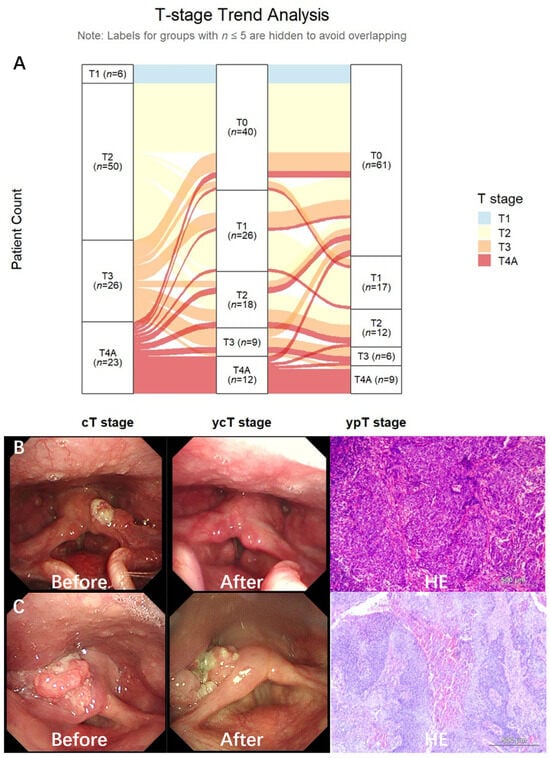
Post-neoadjuvant T-stage re-evaluation (Figure 1A) revealed that 38.1% (40/105) were assessed as ycT0, 24.8% (26/105) as ycT1, and 17.1% (18/105) as ycT2. In 25.7% of patients (27/105), the pathologic T stage was lower than the post-treatment clinical T stage, indicating that imaging underestimated the pathologic response. Representative cases demonstrating CR and stable disease are shown in Figure 1B,C.
Figure 1.
T-stage trend analysis and representative endoscopic and histopathologic images following neoadjuvant therapy. (A) Sankey diagram illustrating the T-stage migration from initial clinical T-stage (cT) to post-neoadjuvant clinical T-stage (ycT) and final pathologic T-stage (ypT). The diagram demonstrates substantial downstaging across all baseline T categories, with the majority of patients achieving ypT0. The primary lesion downstaging rate was 74.3%. Downstaging was defined as post-treatment ycT lower than baseline cT. (B) Representative case demonstrating CR. Endoscopic images show significant tumor regression from baseline (Before) to post-neoadjuvant therapy (After). Corresponding hematoxylin–eosin (HE) staining of the surgical specimen reveals no residual viable tumor cells, consistent with a pathologic complete response (ypT0). (C) Representative case demonstrating SD. Endoscopic images show persistent bulky tumor with minimal morphological change after neoadjuvant therapy (After). HE staining confirms residual invasive carcinoma in the resected specimen, corresponding to an advanced ypT stage.
In univariable analysis, older age was associated with a higher pCR rate in the primary lesion (OR 1.097 per year, 95% CI = 1.029 to 1.170, p = 0.005, Table S5) but not with overall pCR (p = 0.643). In multivariable analysis, age remained significantly associated with primary-lesion pCR after adjustment (p = 0.005, OR = 1.112, 95% CI = 1.032–1.198, Table S5). A longer pretreatment diameter of the primary lesion was associated with a lower MPR rate (p = 0.022). The nodal pCR rate was lower in tobacco users (p = 0.032) and correlated with primary-lesion pCR (p = 0.031). Nodal MPR likewise correlated with primary-lesion pCR (p = 0.028).
3.3. Surgical De-Escalation and TOEMi Implementation
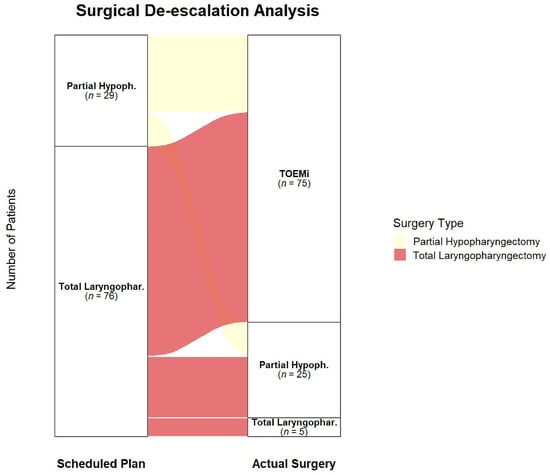
Before neoadjuvant therapy, 72.4% of patients (76/105) were planned for total laryngopharyngectomy and 27.6% of patients (29/105) for partial hypopharyngectomy (Figure 2). Following neoadjuvant therapy and response-adapted planning, surgical de-escalation was achieved in 86.7% (91/105). Among the 76 patients initially scheduled for total laryngopharyngectomy, 72.4% (55/76) underwent TOEMi and 21.1% (16/76) underwent partial hypopharyngectomy; only 6.6% (5/76) ultimately required total laryngopharyngectomy. Among the 29 patients planned for partial hypopharyngectomy, 69.0% (20/29) were further de-escalated to TOEMi. In total, 93.4% of patients initially planned for total laryngopharyngectomy avoided this procedure, and the overall TOEMi rate was 71.4% (75/105).
Figure 2.
Sankey diagram illustrating surgical de-escalation following neoadjuvant immunochemotherapy. Among 105 patients, 29 were initially scheduled for partial hypopharyngectomy and 76 for total laryngopharyngectomy. Following neoadjuvant therapy and re-evaluation, the actual procedures performed were 75 TOEMi, 25 partial hypopharyngectomies, and only 5 total laryngopharyngectomies, demonstrating a substantial de-escalation of surgical intervention.
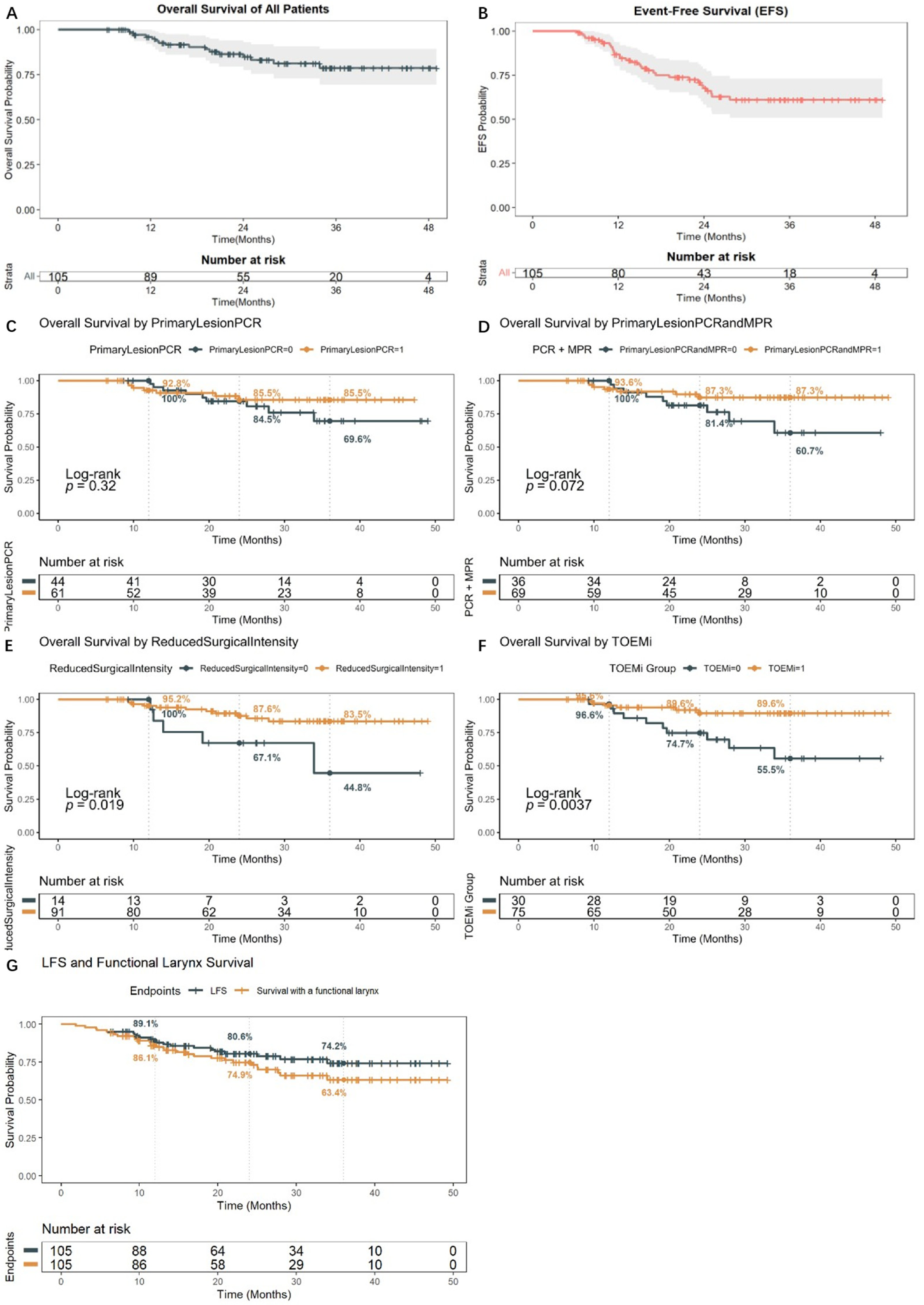
Anatomical larynx preservation was achieved in 95.2% of patients (100/105). LFS was 80.6% at 2 years and 74.2% at 3 years (Figure 3G). Survival with a functional larynx, using the adapted EORTC 24891 definition with death from any cause treated as failure, was 74.9% at 2 years and 63.4% at 3 years (Figure 3G). No patient who underwent TOEMi required tracheostomy (0/75). At the assessment conducted 1–2 weeks after surgery, all 75 patients who underwent TOEMi were able to resume oral intake. Temporary nasogastric feeding was required in 25 patients (33.3%), with a mean tube duration of 7 days among those requiring a tube. All five patients who underwent total laryngopharyngectomy had a permanent tracheostoma. All 30 patients who underwent open surgery had their initial postoperative feeding tube removed, with a mean interval from insertion to removal of 14 days. Across all 55 patients who received an initial postoperative feeding tube, including 25 in the TOEMi group and 30 in the open surgery group, the mean interval from insertion to removal was 10.8 days.
Figure 3.
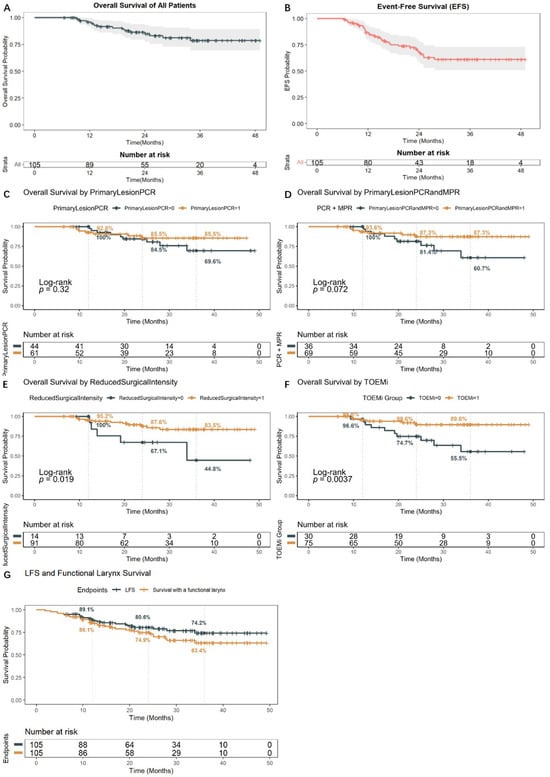
Kaplan–Meier survival analyses. (A) OS in the surgical cohort (n = 105): 2-year OS, 84.8% (95% CI = 77.5–92.9%); 3-year OS, 78.6% (95% CI = 69.3–89.2%). (B) EFS in the surgical cohort: 2-year EFS, 67.7% (95% CI = 58.3–78.6%); 3-year EFS, 60.9% (95% CI = 50.8–73.1%). Shaded areas in panels A and B indicate 95% confidence intervals; tick marks indicate censored observations. (C) OS stratified by pCR status in the primary tumor (2-year OS: 85.5% vs. 84.5%; p = 0.32). (D) OS stratified by pathologic response: MPR (including pCR) versus non-MPR (2-year OS: 87.3% vs. 81.4%; p = 0.072). (E) OS stratified by surgical de-escalation (2-year OS: 87.6% vs. 67.1%; p = 0.019). (F) OS stratified by surgical approach: TOEMi versus non-TOEMi (2-year OS: 89.6% vs. 74.7%; p = 0.0037). (G) LFS and survival with a functional larynx. The 2-year and 3-year LFS estimates were 80.6% (95% CI = 72.9–89.2%) and 74.2% (95% CI = 64.5–85.3%), respectively. The corresponding estimates for survival with a functional larynx were 74.9% (95% CI = 66.4–84.5%) and 63.4% (95% CI = 52.7–76.2%), respectively. The annotated percentages in panels C–G represent estimates at 12, 24, and 36 months.
In univariable analyses, baseline cT3–T4 stage, greater baseline primary-lesion longest diameter, and baseline vocal cord paralysis were associated with lower odds of receiving TOEMi, whereas primary-lesion objective response after neoadjuvant therapy was associated with higher odds (Table S4). In the exploratory multivariable analysis, greater baseline primary-lesion longest diameter was associated with lower odds of receiving TOEMi (adjusted OR = 0.928 per 1-mm increase, 95% CI = 0.863–0.997, p = 0.041), whereas post-treatment primary-lesion objective response was associated with higher odds (adjusted OR = 19.093, 95% CI = 1.936–188.325, p = 0.012). The association with baseline vocal cord paralysis was not statistically significant after adjustment (adjusted OR = 0.442, 95% CI = 0.141–1.382, p = 0.160).
3.4. Oncological Outcomes
At a median follow-up of 27.3 months (6.3–49.0 months), the 2-year and 3-year OS were 84.8% and 78.6% (Figure 3A). The 2-year and 3-year EFS were 67.7% and 60.9% for the entire cohort (Figure 3B). Patients with primary lesion pCR had a 2-year OS of 85.5% versus 84.5% in those without pCR (p = 0.32) (Figure 3C), and patients achieving MPR had a 2-year OS of 87.3% versus 81.4% (p = 0.072) (Figure 3D). During follow-up, primary-site recurrence was documented in 10 of 75 patients (13.3%) in the TOEMi group and 2 of 30 patients (6.7%) in the open surgery group.
Patients undergoing surgical de-escalation had superior 2-year OS compared to those requiring originally planned extensive surgery (87.6% vs. 67.1%, p = 0.019) (Figure 3E). The TOEMi group demonstrated significantly better 2-year OS than the non-TOEMi group (89.6% vs. 74.7%, p = 0.0037) (Figure 3F).
In the initial constant-coefficient Cox model, age and primary-lesion MPR were associated with OS (Table S2). However, Schoenfeld residual testing indicated nonproportional hazards for MPR (p = 0.010; global p = 0.036). The multivariable OS findings should therefore be considered exploratory, and the single adjusted HR for MPR (0.268) should not be interpreted as a constant association throughout follow-up or as establishing MPR as a definitive independent prognostic factor. Neither age nor primary-lesion MPR showed a statistically significant association with EFS (Table S3), and no evidence of nonproportional hazards was detected in the multivariable EFS model (global p = 0.204).
3.5. Adverse Events
Treatment-related adverse events (TRAEs) of grade 3 or worse occurred in 20 patients (19.0%, Table S1). The most common grade ≥3 TRAEs were leukocytopenia (3.8%) and electrolyte disturbance (3.8%), followed by neutropenia (2.9%) and thrombocytopenia (1.9%). The most serious TRAE was one case of grade 4 immune-related pneumonitis, which occurred after the final planned cycle of neoadjuvant therapy and was managed during inpatient admission. This patient recovered and proceeded to surgery as scheduled. No TRAE resulted in dose reduction or death.
4. Discussion
4.1. Surgical De-Escalation After Neoadjuvant Immunochemotherapy
Among all 105 patients, 72.4% of patients (76/105) were planned for total laryngopharyngectomy, and 27.6% (29/105) of patients were planned for partial hypopharyngectomy. After neoadjuvant immunochemotherapy, surgical de-escalation was achieved in 86.7% of patients (91/105), and 93.4% of patients (71/76) avoided total laryngopharyngectomy (Figure 2). Because the planned operation was recorded prospectively by MDT, these proportions reflected the change from the baseline rather than a retrospective reclassification.
Surgical de-escalation was based on the high ORR. The ORR of 90.5% exceeded the 72% and 64% reported for TPF and PF induction chemotherapy in TAX 324 [21]. Moreover, the pathologic response appeared greater as well. The overall pCR rate (26.7%) was higher than the 10.7% to 13.4% reported with TPF induction in oral cavity cancer [22,23]. The primary-lesion pCR rate in the present cohort (58.1%) also exceeded the 32.6% reported in an independent 46-patient hypopharyngeal series treated with the same regimen [13], while the difference in magnitude may reflect differences in baseline characteristics and sample sizes between the two cohorts.
After neoadjuvant immunochemotherapy, 30.4% of cT4a patients were ypT0 in the final specimen (Figure 1A), supporting the extent of surgery based on tumor re-assessment after treatment rather than on initial staging. Sampieri et al. evaluated induction chemotherapy followed by TORS in 100 patients with stage III or IV laryngeal or hypopharyngeal carcinoma and reported 2-year OS and LFS rates of 75% and 72%, respectively, with three salvage total laryngectomies [24]. The 2-year LFS of 80.6% in the present cohort was higher, although the comparison is limited by differences in regimen and baseline patient and tumor characteristics.
4.2. TOEMi Feasibility and Functional Preservation
TOEMi was performed in 71.4% (75/105) of patients. Baseline primary-lesion longest diameter and post-treatment primary-lesion objective response were associated with receipt of TOEMi in the exploratory multivariable analysis. Because treatment response informed MDT surgical selection, the objective-response association may partly reflect the clinical decision-making process, while its wide confidence interval indicates substantial uncertainty. These findings should not be interpreted as a validated tool for selecting patients for TOEMi and require independent validation. Because ORR was available only after treatment and reflected imaging shrinkage rather than resectability, ORR itself was not sufficient for the final decision, which still required endoscopic and imaging reassessment of the residual tumor, including its confinement to a single subsite, adequate transoral exposure, preservation of at least one functional arytenoid cartilage, and the absence of deep thyroid or cricoid cartilage invasion. Vocal cord paralysis was associated with lower receipt of TOEMi in univariable analysis but did not retain significance in the multivariable model.
TORS provided three-dimensional articulation and tremor filtration, whereas TOEMi offered comparable endoscopic visualization with broader instrument accessibility and substantially lower equipment costs, which might make the approach feasible in settings where robotic systems are unavailable [8,9].
Larynx preservation was normally reported as a binary outcome. However, an anatomically preserved larynx without function offers limited benefit. The anatomic larynx preservation rate at 3 months was 95.2% in this cohort, which reflected the surgical result only. Time-to-event endpoints capture the durability of laryngeal preservation more fully. In this study, the 2- and 3-year LFS rates were 80.6% and 74.2%, respectively. Survival with a functional larynx was defined more stringently, with tracheostomy dependence, feeding-tube dependence, and persistent or recurrent disease at the primary site also counted as failure. This endpoint was 74.9% at 2 years and 63.4% at 3 years (Figure 3G). The lower estimates for survival with a functional larynx reflect its broader composite definition, which includes persistent or recurrent disease at the primary site and functional failure in addition to laryngectomy and death. The difference between the two curves therefore should not be interpreted solely as loss of function in an anatomically preserved larynx.
Using a definition adapted from EORTC 24891, the 3-year estimate of 63.4% compares with 28% in the induction chemotherapy study of EORTC 24891 [20]. Given the limitations of historical comparisons, this finding provided a reference rather than evidence of superiority. In a clinical trial of advanced laryngeal cancer treated with induction chemotherapy followed by radiotherapy or chemoradiation, 79% of patients retained an anatomically intact larynx, but 30% of them never restored the function of swallowing or airway protection [25]. Hypopharyngeal cancer studies reported similar results, with 16% to 28% of patients remaining gastrostomy tube-dependent between 6 months and 1 year after radiotherapy or chemoradiotherapy [26,27]. No patient who underwent TOEMi required tracheostomy, and all 75 patients were able to resume oral intake at the assessment conducted 1–2 weeks after surgery. Among the 25 TOEMi patients requiring temporary nasogastric feeding, the mean interval from insertion to removal of the initial postoperative tube was 7 days. All 30 patients undergoing open surgery had their initial postoperative feeding tube removed, with a mean interval from insertion to removal of 14 days. All five patients who underwent total laryngopharyngectomy had a permanent tracheostoma. These findings describe early postoperative recovery and do not establish normal swallowing function or long-term freedom from feeding-tube dependence.
However, TOEMi is not universally applicable. The 28.6% non-TOEMi rate indicates that surgical de-escalation must be individualized based on the tumor response. Patients with insufficient tumor response, bilateral arytenoid fixation, or deep cartilage invasion requiring framework resection remained candidates for open surgery.
4.3. Survival and Biomarkers of Pathology
With a median follow-up of 27.3 months, the 2-year OS, EFS, and LFS rates were 84.8%, 67.7%, and 80.6%, respectively (Figure 3A,B,G). A phase II clinical trial of TPF plus camrelizumab in locally advanced hypopharyngeal cancer reported a 2-year OS of 83.0% [28].
The 2-year OS was higher in patients who underwent de-escalated surgery than in those who required the originally planned operation (87.6% vs. 67.1%), and higher in the TOEMi group than in the non-TOEMi group (89.6% vs. 74.7%) (Figure 3E,F). Surgical selection was guided by treatment response and post-treatment MDT reassessment. Patients with more favorable baseline characteristics or treatment responses may therefore have been more likely to undergo TOEMi or surgical de-escalation, introducing selection bias and confounding into the survival comparisons. Consequently, the observed survival differences do not establish a causal survival benefit from either approach or demonstrate oncological equivalence to more extensive surgery. These comparisons should be interpreted as exploratory and hypothesis-generating.
The association between primary-lesion MPR and OS was exploratory, consistent with findings from studies of neoadjuvant immunotherapy in lung cancer [29,30]. However, residual diagnostics indicated a time-varying association. A single HR from the initial model therefore provides an incomplete description of this relationship. Beyond the extent of pathological response, immunometabolic interactions within the tumor microenvironment may also influence antitumor immune activity and treatment response. Metabolic reprogramming and altered inflammatory signaling can affect immune-cell function and contribute to tumor immune escape [31]. Older age was associated with a higher primary-lesion pCR rate (OR = 1.112, p = 0.005), although this exploratory finding requires independent validation.
4.4. Imaging–Pathology Discordance
Post-treatment imaging underestimated the pathologic response in 27 patients (25.7%), in whom the pathologic T stage was lower than the post-treatment clinical T stage (Figure 1A,C). Fibrosis and inflammatory infiltration may persist at the primary lesion, which was described in neoadjuvant immunotherapy trials for lung cancer [32,33]. For this reason, the extent of resection was not determined by imaging alone. Endoscopic reassessment, intraoperative frozen-section margin control, and conversion to open surgery when transoral margins were inadequate formed the practical safeguards of the response-adapted strategy.
4.5. Limitations
This retrospective, single-institution analysis of two clinical trials was based on post hoc hypotheses and included an all-male cohort, limiting generalizability. Restriction to patients who underwent surgery and surgical selection guided by treatment response may have introduced selection bias and confounding into comparisons between surgical approaches. Adjuvant radiotherapy or chemoradiotherapy was administered to 86 of 105 patients (81.9%) and may have influenced both survival and late functional outcomes; its contribution cannot be separated from that of the surgical approach in this analysis. Standardized swallowing and voice outcome measures, including FOIS, MDADI, and VHI, were unavailable, limiting the assessment of swallowing impairment, voice outcomes, and patient-reported functional recovery. Because new-onset tracheostomy or feeding-tube dependence beyond 6 months was not included in the dependence component, survival with a functional larynx may not fully capture late functional deterioration and should not be interpreted as a comprehensive measure of long-term laryngeal function. With a median follow-up of 27.3 months, the 3-year estimates remain exploratory, and the available follow-up is insufficient to establish long-term oncological and functional safety. Longer follow-up with longitudinal functional assessment is therefore needed.
The limited sample size and number of outcome events, particularly the 16 deaths in the OS analysis, raise concerns about model instability and potential overfitting. Nonproportional hazards for primary-lesion MPR limit interpretation of its constant OS HR, while the small number of deaths constrains the precision of estimates of time-varying associations. Complete-case analyses in the logistic regression models may also have introduced selection bias. The association between primary-lesion objective response and receipt of TOEMi had a wide confidence interval (adjusted OR, 19.093; 95% CI = 1.936–188.325), indicating substantial uncertainty in the magnitude of the association. These findings should therefore be interpreted as exploratory and require validation in independent cohorts.
5. Conclusions
The KEYNOTE-689 trial evaluated perioperative pembrolizumab in resectable locally advanced head and neck cancer, but patients with hypopharyngeal cancer represented only a small minority of the study population. Evidence specific to this subgroup and to surgical de-escalation following tumor regression remains limited. Within that gap, the present study provides procedure-level data documenting the use of less extensive procedures than initially planned, including TOEMi, in this selected surgical cohort following neoadjuvant immunochemotherapy. These findings are hypothesis-generating and require validation in multicenter randomized trials with long-term follow-up and standardized functional assessment.
Supplementary Materials
The following supporting information can be downloaded at https://www.mdpi.com/article/10.3390/cancers18233752/s1. Figure S1: Study design and treatment protocol; Table S1: Treatment-Related Adverse Events During Neoadjuvant Immunochemotherapy (N = 105); Table S2: Univariable and Multivariable Cox Regression Analysis of Overall Survival (N = 105); Table S3: Univariable and Multivariable Cox Regression Analysis of Event-Free Survival (N = 105); Table S4: Univariable and Multivariable Logistic Regression Analysis of Factors Associated With TOEMi Selection (N = 105); Table S5: Univariable and Multivariable Logistic Regression Analyses of Pretreatment Factors Associated with Primary-Lesion pCR.
Author Contributions
Conceptualization, H.W. and X.W.; methodology, Y.D. and C.J.; software, S.C. and K.Y.; validation, S.C., H.W., and X.W.; formal analysis, S.C. and Y.W.; investigation, S.C., K.Y. and R.S.; resources, H.W. and X.W.; data curation, H.W.; writing—original draft preparation, S.C.; writing—review and editing, H.W. and X.W.; visualization, Y.D. and C.J.; supervision, Y.W.; project administration, X.W.; funding acquisition, X.W. All authors have read and agreed to the published version of the manuscript.
Funding
This research and APC was funded by Tianjin Medical University Cancer Institute and Hospital: “14th Five-Year Plan” for Supporting Key Prominent Disciplines, Basic and Clinical Research on Malignant Tumors of the Head and Neck Region, grant number 7-2-8.
Institutional Review Board Statement
The study was conducted in accordance with the Declaration of Helsinki. The source research protocols were approved by the Medical Ethics Committee of Tianjin Cancer Hospital under approval numbers E20210381A (2 July 2021), E20221385 (30 December 2022), and E20230947 (August 2023). E20210381A covered the source trial registered as NCT05522985. E20221385 covered the original hypopharyngeal cancer protocol, which was subsequently expanded to head and neck cancer under E20230947 within the research program registered as NCT06208826.
Informed Consent Statement
Informed consent was obtained from all subjects involved in the study. Written informed consent has been obtained from the patients to publish this paper.
Data Availability Statement
The de-identified data supporting the findings of this study are available from the corresponding authors upon reasonable request. The data are not publicly available to protect patient privacy.
Acknowledgments
We thank all patients who participated in this study and this work was supported by Follow-up Center of Tianjin Medical University Cancer Institute & Hospital.
Conflicts of Interest
The authors declare no conflicts of interest.
Abbreviations
The following abbreviations are used in this manuscript:
| HPSCC | Hypopharyngeal Squamous Cell Carcinoma |
| HNSCC | Head and Neck Squamous Cell Carcinoma |
| TOEMi | Transoral Endoscope-assisted Microsurgery |
| TORS | Transoral Robotic Surgery |
| TLM | Transoral Laser Microsurgery |
| MDT | Multidisciplinary Team |
| ORR | Objective Response Rate |
| CR | Complete Response |
| PR | Partial Response |
| SD | Stable Disease |
| pCR | Pathologic Complete Response |
| MPR | Major Pathologic Response |
| OS | Overall Survival |
| EFS | Event-free Survival |
| LFS | Laryngectomy-free Survival |
| TRAE(s) | Treatment-related Adverse Event(s) |
References
- Takes, R.P.; Strojan, P.; Silver, C.E.; Bradley, P.J.; Haigentz, M.; Wolf, G.T.; Shaha, A.R.; Hartl, D.M.; Olofsson, J.; Langendijk, J.A.; et al. Current Trends in Initial Management of Hypopharyngeal Cancer: The Declining Use of Open Surgery. Head Neck 2012, 34, 270–281. [Google Scholar] [CrossRef] [Scilit] [PubMed]
- Clark, J.R.; Gilbert, R.; Irish, J.; Brown, D.; Neligan, P.; Gullane, P.J. Morbidity after Flap Reconstruction of Hypopharyngeal Defects. Laryngoscope 2006, 116, 173–181. [Google Scholar] [CrossRef] [Scilit] [PubMed]
- Lefebvre, J.-L.; Andry, G.; Chevalier, D.; Luboinski, B.; Collette, L.; Traissac, L.; de Raucourt, D.; Langendijk, J.A.; EORTC Head and Neck Cancer Group. Laryngeal Preservation with Induction Chemotherapy for Hypopharyngeal Squamous Cell Carcinoma: 10-Year Results of EORTC Trial 24891. Ann. Oncol. 2012, 23, 2708–2714. [Google Scholar] [CrossRef] [Scilit] [PubMed]
- Posner, M.R.; Norris, C.M.; Wirth, L.J.; Shin, D.M.; Cullen, K.J.; Winquist, E.W.; Blajman, C.R.; Mickiewicz, E.A.; Frenette, G.P.; Plinar, L.F.; et al. Sequential Therapy for the Locally Advanced Larynx and Hypopharynx Cancer Subgroup in TAX 324: Survival, Surgery, and Organ Preservation. Ann. Oncol. 2009, 20, 921–927. [Google Scholar] [CrossRef] [Scilit] [PubMed]
- Lefebvre, J.L.; Pointreau, Y.; Rolland, F.; Alfonsi, M.; Baudoux, A.; Sire, C.; de Raucourt, D.; Malard, O.; Degardin, M.; Tuchais, C.; et al. Induction Chemotherapy Followed by Either Chemoradiotherapy or Bioradiotherapy for Larynx Preservation: The TREMPLIN Randomized Phase II Study. J. Clin. Oncol. 2013, 31, 853–859. [Google Scholar] [CrossRef] [Scilit] [PubMed]
- Schwartz, S.R.; Yueh, B.; Maynard, C.; Daley, J.; Henderson, W.; Khuri, S.F. Predictors of Wound Complications after Laryngectomy: A Study of over 2000 Patients. Otolaryngol.—Head Neck Surg. 2004, 131, 61–68. [Google Scholar] [CrossRef] [Scilit] [PubMed]
- Clark, J.R.; de Almeida, J.; Gilbert, R.; Irish, J.; Brown, D.; Neligan, P.; Gullane, P.J. Primary and Salvage (Hypo)Pharyngectomy: Analysis and Outcome. Head Neck 2006, 28, 671–677. [Google Scholar] [CrossRef] [Scilit] [PubMed]
- Topal, Ö. Minimally Invasive Procedures for Laryngeal Carcinoma: Transoral Endoscopic Laser and Transoral Robotic Surgery. Turk. Arch. Otorhinolaryngol. 2017, 55, 34–37. [Google Scholar] [CrossRef] [Scilit] [PubMed]
- Tateya, I.; Shiotani, A.; Satou, Y.; Tomifuji, M.; Morita, S.; Muto, M.; Ito, J. Transoral Surgery for Laryngo-Pharyngeal Cancer—The Paradigm Shift of the Head and Cancer Treatment. Auris Nasus Larynx 2016, 43, 21–32. [Google Scholar] [CrossRef] [Scilit] [PubMed]
- Uppaluri, R.; Haddad, R.I.; Tao, Y.; Le Tourneau, C.; Lee, N.Y.; Westra, W.; Chernock, R.; Tahara, M.; Harrington, K.J.; Klochikhin, A.L.; et al. Neoadjuvant and Adjuvant Pembrolizumab in Locally Advanced Head and Neck Cancer. N. Engl. J. Med. 2025, 393, 37–50. [Google Scholar] [CrossRef] [Scilit] [PubMed]
- Zhang, Z.; Wu, B.; Peng, G.; Xiao, G.; Huang, J.; Ding, Q.; Yang, C.; Xiong, X.; Ma, H.; Shi, L.; et al. Neoadjuvant Chemoimmunotherapy for the Treatment of Locally Advanced Head and Neck Squamous Cell Carcinoma: A Single-Arm Phase 2 Clinical Trial. Clin. Cancer Res. 2022, 28, 3268–3276. [Google Scholar] [CrossRef] [Scilit] [PubMed]
- Wu, D.; Li, Y.; Xu, P.; Fang, Q.; Cao, F.; Lin, H.; Li, Y.; Su, Y.; Lu, L.; Chen, L.; et al. Neoadjuvant Chemo-Immunotherapy with Camrelizumab plus Nab-Paclitaxel and Cisplatin in Resectable Locally Advanced Squamous Cell Carcinoma of the Head and Neck: A Pilot Phase II Trial. Nat. Commun. 2024, 15, 2177. [Google Scholar] [CrossRef] [Scilit] [PubMed]
- Pan, Y.; Li, H.; Zhu, M.; Xu, B.; Chen, M.; Zhang, C.; Zheng, H. Neoadjuvant Chemoimmunotherapy for Laryngeal Preservation in Locally Advanced Hypopharyngeal Cancer. Int. Immunopharmacol. 2024, 142, 113197. [Google Scholar] [CrossRef] [Scilit] [PubMed]
- Chen, S.; Zhong, Q.; Zhang, S.; Zhang, Y.; Hou, L.; Ma, H.; He, S.; Lian, M.; He, Y.; Wang, R.; et al. Neoadjuvant Immunochemotherapy in Locally Advanced Laryngeal Cancer and Hypopharyngeal Cancer: Higher Objective Response Rate and Organ-Preservation Rate. Investig. New Drugs 2024, 42, 694–702. [Google Scholar] [CrossRef] [Scilit] [PubMed]
- Arbour, K.C.; Mezquita, L.; Long, N.; Rizvi, H.; Auclin, E.; Ni, A.; Martínez-Bernal, G.; Ferrara, R.; Lai, W.V.; Hendriks, L.E.L.; et al. Impact of Baseline Steroids on Efficacy of Programmed Cell Death-1 and Programmed Death-Ligand 1 Blockade in Patients With Non-Small-Cell Lung Cancer. J. Clin. Oncol. 2018, 36, 2872–2878. [Google Scholar] [CrossRef] [Scilit] [PubMed]
- Schwartz, L.H.; Litière, S.; De Vries, E.; Ford, R.; Gwyther, S.; Mandrekar, S.; Shankar, L.; Bogaerts, J.; Chen, A.; Dancey, J.; et al. RECIST 1.1—Update and Clarification: From the RECIST Committee. Eur. J. Cancer 2016, 62, 132–137. [Google Scholar] [CrossRef] [Scilit] [PubMed]
- Eisenhauer, E.A.; Therasse, P.; Bogaerts, J.; Schwartz, L.H.; Sargent, D.; Ford, R.; Dancey, J.; Arbuck, S.; Gwyther, S.; Mooney, M.; et al. New Response Evaluation Criteria in Solid Tumours: Revised RECIST Guideline (Version 1.1). Eur. J. Cancer 2009, 45, 228–247. [Google Scholar] [CrossRef] [Scilit] [PubMed]
- Cottrell, T.R.; Thompson, E.D.; Forde, P.M.; Stein, J.E.; Duffield, A.S.; Anagnostou, V.; Rekhtman, N.; Anders, R.A.; Cuda, J.D.; Illei, P.B.; et al. Pathologic Features of Response to Neoadjuvant Anti-PD-1 in Resected Non-Small-Cell Lung Carcinoma: A Proposal for Quantitative Immune-Related Pathologic Response Criteria (irPRC). Ann. Oncol. 2018, 29, 1853–1860. [Google Scholar] [CrossRef] [Scilit] [PubMed]
- Hellmann, M.D.; Chaft, J.E.; William, W.N.; Rusch, V.; Pisters, K.M.W.; Kalhor, N.; Pataer, A.; Travis, W.D.; Swisher, S.G.; Kris, M.G.; et al. Pathological Response after Neoadjuvant Chemotherapy in Resectable Non-Small-Cell Lung Cancers: Proposal for the Use of Major Pathological Response as a Surrogate Endpoint. Lancet Oncol. 2014, 15, e42–e50. [Google Scholar] [CrossRef] [Scilit] [PubMed]
- Lefebvre, J.L.; Chevalier, D.; Luboinski, B.; Kirkpatrick, A.; Collette, L.; Sahmoud, T. Larynx Preservation in Pyriform Sinus Cancer: Preliminary Results of a European Organization for Research and Treatment of Cancer Phase III Trial. JNCI J. Natl. Cancer Inst. 1996, 88, 890–899. [Google Scholar] [CrossRef] [Scilit] [PubMed]
- Posner, M.R.; Hershock, D.M.; Blajman, C.R.; Mickiewicz, E.; Winquist, E.; Gorbounova, V.; Tjulandin, S.; Shin, D.M.; Cullen, K.; Ervin, T.J.; et al. Cisplatin and Fluorouracil Alone or with Docetaxel in Head and Neck Cancer. N. Engl. J. Med. 2007, 357, 1705–1715. [Google Scholar] [CrossRef] [Scilit] [PubMed]
- Noronha, V.; Patil, V.; Chaturvedi, P.; Mathrudev, V.; Menon, N.; Bhattacharjee, A.; Singh, A.; Peelay, Z.; Chakraborty, S.; Jadhav, M.; et al. Phase 3 RCT Comparing Docetaxel-Platinum with Docetaxel-Platinum-5FU as Neoadjuvant Chemotherapy in Borderline Resectable Oral Cancer. Eur. J. Cancer 2024, 200, 113560. [Google Scholar] [CrossRef] [Scilit] [PubMed]
- Zhong, L.; Zhang, C.; Ren, G.; Guo, W.; William, W.N.; Sun, J.; Zhu, H.; Tu, W.; Li, J.; Cai, Y.; et al. Randomized Phase III Trial of Induction Chemotherapy with Docetaxel, Cisplatin, and Fluorouracil Followed by Surgery versus up-Front Surgery in Locally Advanced Resectable Oral Squamous Cell Carcinoma. J. Clin. Oncol. 2013, 31, 744–751. [Google Scholar] [CrossRef] [Scilit] [PubMed]
- Sampieri, C.; Costantino, A.; Pirola, F.; Kim, D.; Lee, K.; Kim, S.-H. Neoadjuvant Chemotherapy Combined with Transoral Robotic Surgery for Stage III and IV Laryngeal and Hypopharyngeal Carcinomas. Oral Oncol. 2023, 140, 106371. [Google Scholar] [CrossRef] [Scilit] [PubMed]
- Guadagnolo, B.A.; Haddad, R.I.; Posner, M.R.; Weeks, L.; Wirth, L.J.; Norris, C.M.; Sullivan, C.A.; Goguen, L.; Busse, P.M.; Tishler, R. Organ Preservation and Treatment Toxicity with Induction Chemotherapy Followed by Radiation Therapy or Chemoradiation for Advanced Laryngeal Cancer. Am. J. Clin. Oncol. 2005, 28, 371–378. [Google Scholar] [CrossRef] [Scilit] [PubMed]
- Murono, S.; Tsuji, A.; Endo, K.; Kondo, S.; Wakisaka, N.; Yoshizaki, T. Factors Associated with Gastrostomy Tube Dependence after Concurrent Chemoradiotherapy for Hypopharyngeal Cancer. Support. Care Cancer 2015, 23, 457–462. [Google Scholar] [CrossRef] [Scilit] [PubMed]
- Bhayani, M.K.; Hutcheson, K.A.; Barringer, D.A.; Roberts, D.B.; Lewin, J.S.; Lai, S.Y. Gastrostomy Tube Placement in Patients with Hypopharyngeal Cancer Treated with Radiotherapy or Chemoradiotherapy: Factors Affecting Placement and Dependence. Head Neck 2013, 35, 1641–1646. [Google Scholar] [CrossRef] [Scilit] [PubMed]
- Gong, H.; Tian, S.; Ding, H.; Tao, L.; Wang, L.; Wang, J.; Wang, T.; Yuan, X.; Heng, Y.; Zhang, M.; et al. Camrelizumab-Based Induction Chemoimmunotherapy in Locally Advanced Stage Hypopharyngeal Carcinoma: Phase II Clinical Trial. Nat. Commun. 2024, 15, 5251. [Google Scholar] [CrossRef] [Scilit] [PubMed]
- Chen, Y.; Qin, J.; Wu, Y.; Lin, Q.; Wang, J.; Zhang, W.; Liang, F.; Hui, Z.; Zhao, M.; Wang, J. Does Major Pathological Response after Neoadjuvant Immunotherapy in Resectable Nonsmall-Cell Lung Cancers Predict Prognosis? A Systematic Review and Meta-Analysis. Int. J. Surg. 2023, 109, 2794–2807. [Google Scholar] [CrossRef] [Scilit] [PubMed]
- Deutsch, J.S.; Cimino-Mathews, A.; Thompson, E.; Provencio, M.; Forde, P.M.; Spicer, J.; Girard, N.; Wang, D.; Anders, R.A.; Gabrielson, E.; et al. Association between Pathologic Response and Survival after Neoadjuvant Therapy in Lung Cancer. Nat. Med. 2024, 30, 218–228. [Google Scholar] [CrossRef] [Scilit] [PubMed]
- Mousavi, S.E.; Davoudi, S.; Soleimani, E. Immunometabolic Reprogramming in Disease: From Energy Homeostasis and Inflammatory Signaling to Therapeutic Targeting Across Organ Systems. NPT J. 2026, 1, 1–19. [Google Scholar] [CrossRef]
- Provencio, M.; Nadal, E.; Insa, A.; García-Campelo, M.R.; Casal-Rubio, J.; Dómine, M.; Majem, M.; Rodríguez-Abreu, D.; Martínez-Martí, A.; De Castro Carpeño, J.; et al. Neoadjuvant Chemotherapy and Nivolumab in Resectable Non-Small-Cell Lung Cancer (NADIM): An Open-Label, Multicentre, Single-Arm, Phase 2 Trial. Lancet Oncol. 2020, 21, 1413–1422. [Google Scholar] [CrossRef] [Scilit] [PubMed]
- Chai, L.F.; Prince, E.; Pillarisetty, V.G.; Katz, S.C. Challenges in Assessing Solid Tumor Responses to Immunotherapy. Cancer Gene Ther. 2020, 27, 528–538. [Google Scholar] [CrossRef] [Scilit] [PubMed]

Disclaimer/Publisher’s Note: The statements, opinions and data contained in all publications are solely those of the individual author(s) and contributor(s) and not of MDPI and/or the editor(s). MDPI and/or the editor(s) disclaim responsibility for any injury to people or property resulting from any ideas, methods, instructions or products referred to in the content. |
© 2026 by the authors. Licensee MDPI, Basel, Switzerland. This article is an open access article distributed under the terms and conditions of the Creative Commons Attribution (CC BY) license.