


Simple Summary
Circulating tumor DNA (ctDNA) provides molecular information from a blood sample, but its clinical value in pancreatic cancer changes across the patient journey. Before treatment, ctDNA may complement tissue-based molecular profiling and help refine risk assessment, although limited release of tumor DNA into the bloodstream reduces sensitivity in localized disease. After surgery, detectable ctDNA can identify patients at high risk of recurrence, and serial testing during follow-up may reveal molecular recurrence before it becomes visible on imaging. During treatment for advanced disease, changes in ctDNA may provide an early indication of response or progression. ctDNA should therefore complement, rather than replace, tissue analysis, imaging, CA19-9, and clinical assessment. The key remaining question is whether using ctDNA results to guide treatment or surveillance improves patient outcomes.
Abstract
Background/Objectives: Circulating tumor DNA (ctDNA) provides molecular information at different stages of the pancreatic ductal adenocarcinoma (PDAC) patient journey, but its clinical value differs according to when and why it is measured. This narrative review examines ctDNA from diagnosis and molecular profiling through neoadjuvant therapy, postoperative molecular residual disease (MRD), surveillance, and dynamic monitoring during systemic therapy, critically assessing the strength and limitations of the evidence at each clinical stage and its implications for clinical decision-making. Methods: Relevant studies were identified primarily through PubMed/MEDLINE, supplemented by forward citation tracking in Google Scholar, backward reference screening, and ClinicalTrials.gov searches for ongoing interventional studies. Original PDAC clinical studies were prioritized, with selected reviews, guidelines, consensus statements, and position papers used for context. Results: In localized disease, limited ctDNA shedding constrains diagnostic sensitivity, although baseline detection may provide prognostic information. After surgery, ctDNA positivity consistently identifies patients at increased risk of recurrence, whereas a negative result cannot reliably exclude residual disease. During surveillance, newly detectable or rising ctDNA may precede radiological recurrence. In advanced disease, serial ctDNA kinetics provide increasingly consistent information on treatment response and progression. Evidence for dynamic monitoring is increasing, but evidence that ctDNA-guided treatment or surveillance improves patient outcomes remains insufficient. Conclusions: The clinical value of ctDNA depends on when and why it is measured. ctDNA should complement rather than replace conventional assessments. By distinguishing established prognostic associations from emerging monitoring applications and unproven ctDNA-guided interventions, this review provides a practical framework for interpreting ctDNA across the PDAC patient journey. Prospective trials are needed to determine whether ctDNA-guided decisions improve patient outcomes.
1. Introduction
Management of pancreatic ductal adenocarcinoma (PDAC) requires accurate assessment of disease extent, treatment response, and recurrence at different stages of care [1,2]. Anatomical imaging is indispensable for diagnosis, staging, and response assessment, but radiographic changes may not fully reflect pathological treatment response, particularly after neoadjuvant therapy [3,4]. Serum carbohydrate antigen 19-9 (CA19-9) is clinically useful but is limited by Lewis antigen status and by non-malignant conditions including biliary obstruction and inflammation [5,6]. These limitations support the need for additional biomarkers that can complement imaging, CA19-9, and pathological assessment.
Circulating tumor DNA (ctDNA), the tumor-derived fraction of cell-free DNA (cfDNA), provides molecular information from a minimally invasive blood sample. Its short circulating half-life creates the possibility of near-real-time assessment of changes in tumor burden and biology [7,8]. In PDAC, the high prevalence of KRAS mutations [9,10] has provided a practical molecular target for KRAS-focused ctDNA assays [11]. Broader sequencing approaches have further enabled detection of additional genomic alterations in plasma [12].
As ctDNA assays have improved, the clinical question has also changed. The question is no longer only whether ctDNA can be detected, but how the result should be interpreted at each stage of the patient journey. Yet sensitivity remains strongly dependent on disease burden, tumor shedding, assay design, and sampling context [13]. Analytical performance alone does not establish clinical utility.
Previous reviews and consensus statements have discussed the analytical and clinical requirements for ctDNA testing and its potential roles across diagnosis, prognosis, treatment monitoring, and follow-up, including the distinction between clinical validity and clinical utility [14,15]. Building on this foundation, a patient-journey perspective can help clarify how the strength and clinical implications of ctDNA evidence differ across disease settings [16].
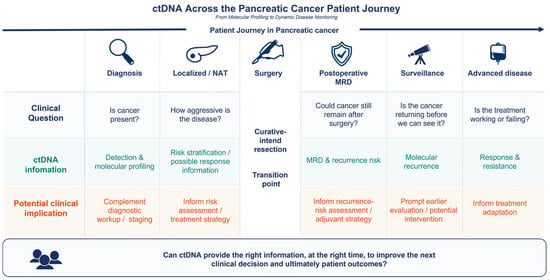
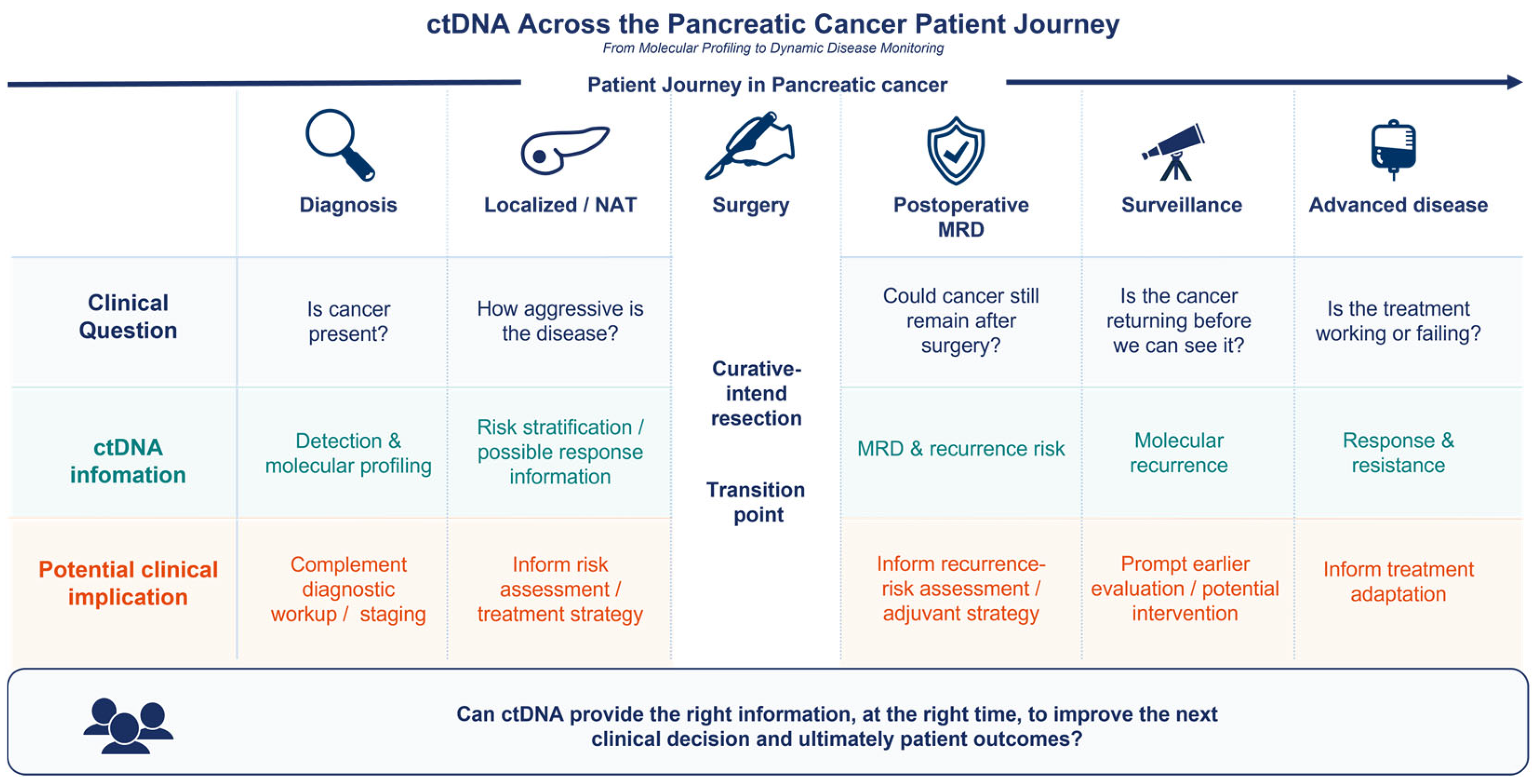
This structured narrative review therefore examines ctDNA across the PDAC patient journey, from diagnosis and molecular profiling through neoadjuvant therapy, postoperative molecular residual disease (MRD) and surveillance, to dynamic monitoring during systemic therapy. We focus on what a positive or negative ctDNA result means at each stage of the patient journey, what it adds to conventional assessment, and whether the available evidence is sufficient to change patient management. The overall clinical framework is summarized in Figure 1.
Figure 1.
ctDNA across the patient journey in pancreatic cancer. Schematic overview linking major clinical stages with the questions ctDNA may help address and the decisions it may eventually inform. ctDNA is presented as complementary to imaging, tissue analysis, CA19-9, pathology, clinical factors, and patient preferences. ctDNA, circulating tumor DNA; NAT, neoadjuvant therapy; MRD, molecular residual disease.
2. Methods
This narrative review was based primarily on literature identified through PubMed/MEDLINE. Searches were supplemented by forward citation tracking in Google Scholar and backward screening of relevant references. Original clinical studies were prioritized, particularly those addressing ctDNA across key stages of the PDAC patient journey, while selected reviews, guidelines, consensus statements, and position papers were used to provide broader context. Studies were selected based on their relevance to the clinical questions addressed in this review, with particular attention to study population, assay methodology, and clinical outcomes. Ongoing interventional studies evaluating ctDNA-informed management were identified through ClinicalTrials.gov. The literature search was last updated in October 2026.
3. Biological and Analytical Framework
ctDNA constitutes a variable and often small fraction of total circulating cfDNA [17]. Its detectability varies with disease extent, with lower detection rates generally observed in localized than in metastatic cancers [18]. In PDAC, plasma KRAS mutations are detected less frequently in localized than in advanced disease [19]. PDAC is characterized by abundant desmoplastic stroma and relatively sparse vascularization [20], and these features may contribute to limited ctDNA release into circulation, although their direct effects on ctDNA detectability remain unclear [13]. In previously treated PDAC, metastatic distribution also influences ctDNA detectability, with higher KRAS detection rates observed in patients with liver metastases than in those with metastases to other sites [21]. Therefore, a negative ctDNA result does not necessarily mean that molecular disease is absent, as too little tumor DNA may have entered the circulation to be detected [13]. The rapid clearance of circulating mutant DNA further enables ctDNA to reflect relatively short-term changes in disease burden [7].
ctDNA analysis in PDAC has evolved from predominantly mutation-focused approaches, particularly KRAS-based PCR and digital PCR, toward broader targeted next-generation sequencing (NGS) [11,13]. Contemporary assays include both tumor-naïve and personalized tumor-informed strategies [12,22,23]. These approaches differ in genomic breadth, analytical sensitivity, turnaround time, resource requirements, and dependence on available tumor tissue. Importantly, tumor-informed and tumor-naïve approaches represent different assay strategies rather than sequential generations of the same technology [24,25]. The main characteristics of these assay approaches are summarized in Supplementary Table S1.
Among mutation-focused approaches, droplet digital PCR (ddPCR) has played an important role in PDAC ctDNA research. By partitioning DNA into numerous individual reactions, ddPCR enables sensitive detection and quantitative measurement of predefined mutations, particularly KRAS alterations. Its applications in PDAC have included plasma mutation detection across disease stages [11], postoperative MRD assessment [26], and longitudinal monitoring during systemic therapy [27,28]. Broader sequencing approaches have also been used for longitudinal monitoring during chemotherapy [29]. However, ddPCR is generally limited to selected mutations, and high analytical sensitivity cannot fully overcome low ctDNA shedding, particularly in localized disease [13,18].
Pre-analytical and analytical factors are also integral to assay performance. Blood collection and processing conditions, including collection tube, processing time, centrifugation, and storage, can affect cfDNA yield and sample quality [30]. However, not all processing variations necessarily affect ctDNA measurements; for example, centrifugation protocols did not significantly alter KRAS variant allele fractions in a study involving patients with metastatic PDAC [31]. Beyond preanalytical processing, analytical factors, including sequencing depth and bioinformatic filtering, also affect assay performance [32]. Another challenge is determining where a detected mutation comes from. Somatic alterations arising from clonal hematopoiesis may be detected in plasma and incorrectly attributed to the tumor if appropriate filtering is not performed [33].
These biological and analytical limitations need to be considered when ctDNA results are interpreted clinically. The meaning of a positive or negative result depends on the clinical setting, assay, and timing of blood collection.
4. Diagnosis and Molecular Profiling
4.1. Diagnosis and Initial Assessment
ctDNA is attractive as a diagnostic biomarker because molecular information can be obtained from a blood sample without invasive tissue acquisition [11,34]. In practice, however, diagnostic sensitivity remains a major limitation, particularly in localized disease [19,34]. Early KRAS-focused studies and subsequent NGS-based analyses demonstrated that plasma ctDNA detection generally increases with disease stage but remains limited in localized PDAC [11,19,35]. In the ddPCR-based study by Takai et al. [11], plasma KRAS mutations were detected in 8.3% (9/108) of patients with resectable PDAC, 18.2% (8/44) of those with unresectable disease without distant metastases, and 58.9% (63/107) of those with distant metastases. Similarly, Le Calvez-Kelm et al. [19] reported detection rates of 10.3% (4/39), 17.5% (25/143), and 33.3% (45/135) in local, regional, and systemic disease, respectively, using amplicon-based deep sequencing. Moreover, Le Calvez-Kelm et al. [19] also reported that low-frequency KRAS mutations were detected in patients with chronic pancreatitis and healthy controls. These findings illustrate both the limited sensitivity of plasma KRAS testing for early-stage PDAC and the fact that KRAS mutations detected in plasma are not entirely specific to PDAC [19,34]. Another important limitation is the potential for false-negative results due to limited sensitivity. In a meta-analysis of seven studies using PCR-based ctDNA assays, Zhu et al. [36] reported a pooled sensitivity of 64% (95% CI, 58–70%) and specificity of 92% (95% CI, 88–95%) for pancreatic cancer detection, highlighting the limitations of ctDNA as a stand-alone diagnostic test. Accordingly, a negative ctDNA result cannot reliably exclude PDAC.
Direct comparison with tissue-based diagnosis further illustrates this limitation. In a prospective cohort of patients with solid pancreatic lesions, Wang et al. [34] detected KRAS mutations in 83.8% of endoscopic ultrasound-guided fine-needle aspiration (EUS-FNA) specimens but in only 35.2% of plasma samples from patients with pancreatic adenocarcinoma, illustrating the limited standalone diagnostic sensitivity of plasma ctDNA.
At present, ctDNA cannot replace established diagnostic procedures [1,2,19,34]. Its role is to provide additional molecular information alongside imaging, tissue pathology, and conventional biomarkers [37]. These limitations do not diminish the potential importance of blood-based early detection, which remains an active area of investigation, but rather highlight the biological challenges of applying ctDNA-based detection to early-stage PDAC.
4.2. Molecular Profiling
The value of ctDNA changes when the clinical question shifts from “Does this patient have pancreatic cancer?” to “What molecular information can be obtained from this patient’s disease?” In this setting, ctDNA may complement tissue-based profiling by providing a systemic and repeatable source of tumor-derived genomic information [37,38].
In advanced PDAC, broader ctDNA sequencing can identify alterations beyond KRAS and may reveal potentially actionable genomic changes [11,12]. Takai et al. [11] demonstrated the feasibility of targeted deep sequencing of plasma DNA in selected patients with sufficient detectable ctDNA, while Botrus et al. [12] subsequently showed that clinically relevant alterations could be identified using broader ctDNA-based genomic profiling in patients with locally advanced or metastatic PDAC. Furthermore, in a prospective study of metastatic PDAC, Huerta et al. identified potentially actionable alterations through plasma whole-exome sequencing, including alterations that were not detected in matched tumor tissue [38].
4.3. Complementarity with Tissue Analysis
Concordance between tissue and plasma is influenced by disease stage, tissue sampling site, and assay characteristics [35,39,40]. Lee et al. [40] reported higher concordance of KRAS alterations between tumor and plasma using multiplex ddPCR in metastatic than in resectable PDAC (80% vs. 44%), while Keane et al. independently observed higher KRAS concordance in untreated stage IV than in stage I–III disease [35], consistent with greater ctDNA shedding in advanced disease. Discordance between tissue and plasma does not necessarily mean that either test has failed [37,39]. The two samples can provide different biological information [37,38,41].
Highly sensitive molecular approaches can also extend the genomic information obtainable from limited diagnostic specimens; for example, KRAS mutation analysis by ddPCR using residual EUS-FNA cytology material showed high concordance with tissue-based analysis [42]. Tissue remains essential for pathological diagnosis and provides spatial information, whereas ctDNA offers a minimally invasive and repeatable source of tumor-derived genomic information [37,39]. Representative studies evaluating ctDNA for diagnosis and molecular profiling are summarized in Table 1.
Table 1.
Representative studies evaluating ctDNA for diagnosis and molecular profiling in PDAC.
5. ctDNA in Localized PDAC
5.1. Neoadjuvant Therapy
Assessing response to neoadjuvant therapy (NAT) in PDAC is difficult because radiological response may not fully reflect pathological treatment response [4]. Available studies suggest that baseline or preoperative ctDNA can provide prognostic information, whereas evidence for serial ctDNA change as a treatment-response marker remains less mature and less consistent than in advanced disease or the postoperative MRD setting [43,44,45,46]. In a prospective study of 113 patients with localized PDAC, baseline co-detection of KRAS and TP53 alterations was independently associated with shorter overall survival, while an increase in total ctDNA maximum variant allele frequency from diagnosis to after NAT was also associated with inferior survival [47]. These findings provide additional support for baseline molecular risk assessment and suggest a potential role for longitudinal monitoring, although they do not establish that ctDNA-guided treatment adaptation improves outcomes. Assay sensitivity may also influence the prognostic interpretation of ctDNA in localized PDAC. In a prospective cohort of 106 patients undergoing neoadjuvant chemotherapy, Sridalla et al. reported higher baseline KRAS ctDNA detection with ddPCR than with NGS (64.9% vs. 17.2%). Patients positive by both assays had the poorest overall survival, whereas those positive only by ddPCR showed intermediate survival, suggesting that high-sensitivity mutation detection may improve risk stratification [48].
The current evidence for ctDNA during NAT is therefore stronger for risk stratification than for treatment guidance. Molecular response may eventually contribute to treatment adaptation or surgical decision-making, but current evidence does not support changing or withholding potentially curative treatment solely on the basis of ctDNA kinetics.
5.2. Surgery and MRD
The postoperative setting currently provides some of the strongest evidence for the clinical validity of ctDNA in localized PDAC. Postoperative ctDNA positivity has repeatedly been associated with recurrence and inferior survival [23,26,49,50,51,52,53]. Despite differences in assay strategy, these studies show that ctDNA can identify MRD in a subset of patients after apparently curative surgery. The prognostic value of perioperative ctDNA has also been supported by a recent meta-analysis of 18 studies including 965 patients, in which postoperative ctDNA positivity was associated with worse disease-free (HR, 3.29; 95% CI, 2.10–5.15) and overall (HR, 3.42; 95% CI, 2.06–5.67) survival [54].
The timing of postoperative sampling is important, because very early sampling may be influenced by perioperative cfDNA release, whereas later sampling may overlap with the initiation of adjuvant therapy [49,55]. Postoperative ctDNA status may also identify patients with different risks despite adjuvant chemotherapy, and early studies have raised the possibility that ctDNA could help refine postoperative treatment strategies [23,49]. In a cohort of 75 surgically treated patients, Aaquist et al. reported that ctDNA positivity at 7–9 months after surgery was independently associated with shorter recurrence-free survival (HR 4.48, p = 0.017), whereas the association at one month did not reach statistical significance (p = 0.055) [52]. Combined assessment of ctDNA and CA19-9 may provide complementary prognostic information, although its incremental value requires further validation [52]. However, these observational associations do not establish that ctDNA-guided escalation, de-escalation, or maintenance therapy improves outcomes.
Nevertheless, a negative postoperative result should not be equated with absence of residual disease. Low tumor shedding and limited assay sensitivity may result in undetectable ctDNA despite the presence of residual disease. In a tumor-informed study of 32 patients assessed after completion of curative-intent therapy, ctDNA positivity was associated with shorter recurrence-free survival (3.6 vs. 29.0 months, p < 0.001), although sensitivity for detecting radiographic recurrence was 47.4% [53]. Because sampling occurred after completion of curative-intent therapy, these findings should not be interpreted as performance estimates for an immediate postoperative MRD assay. In a separate retrospective cohort of 51 patients with resected PDAC, Guo et al. [51] reported a sensitivity of 35.7% and a negative predictive value of 53.2% for ctDNA testing during the early postoperative window, indicating that a negative result does not reliably exclude subsequent recurrence. Although postoperative ctDNA has shown prognostic value, a key unresolved question is whether MRD-guided changes in adjuvant treatment can improve patient outcomes.
5.3. Postoperative Surveillance and Molecular Recurrence
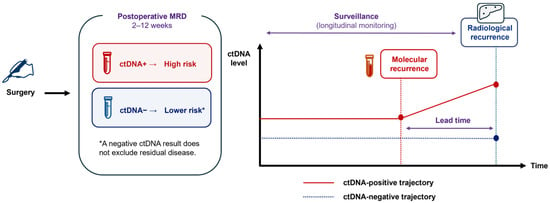
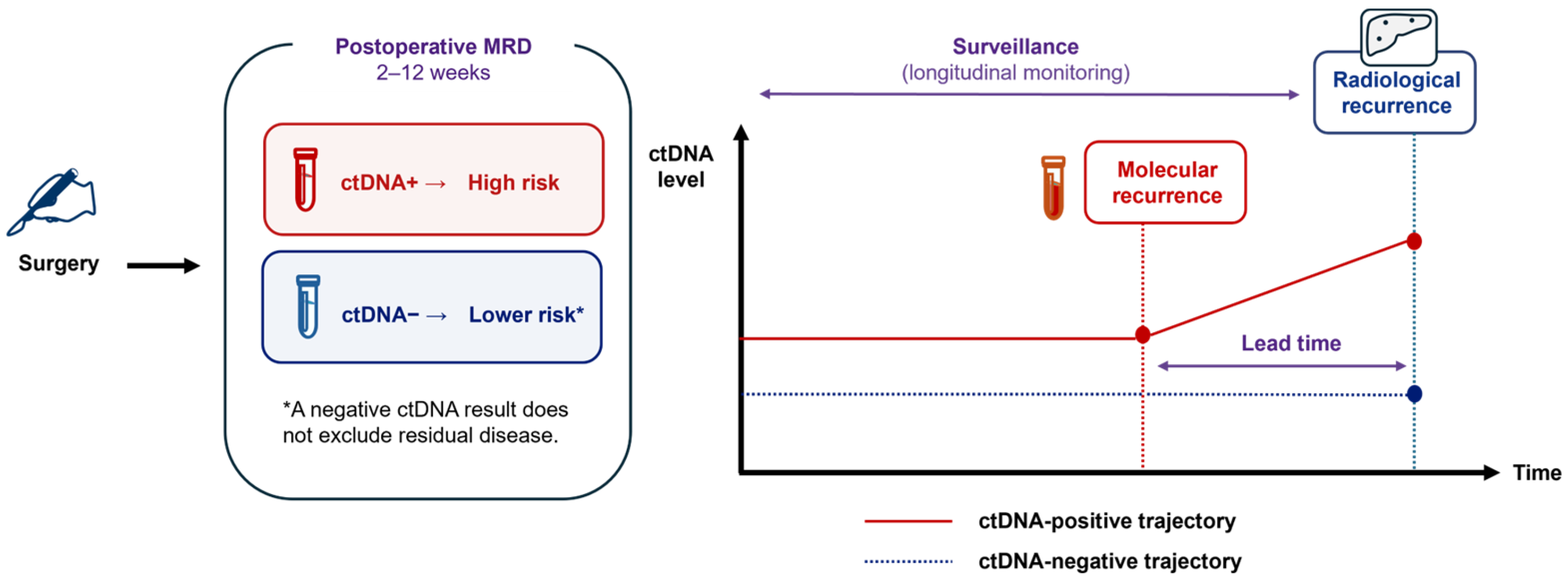
Serial ctDNA after the postoperative MRD window may identify molecular recurrence before conventional radiological recurrence. The conceptual transition from postoperative MRD to molecular recurrence is illustrated in Figure 2. Early longitudinal work and more recent tumor-informed studies support a measurable lead time in at least a subset of patients [56,57,58]. Early studies by Sausen et al. [56] and Groot et al. [57] demonstrated that postoperative ctDNA detection could precede clinical or radiological recurrence, with reported lead times of 6.5 months (mean) and 84 days (median), respectively. Zhang et al. [59] also demonstrated the potential of ctDNA for recurrence prediction, while Chen et al. [58] reported that ctDNA detection preceded radiological recurrence in 11 of 16 patients who experienced recurrence, with a median lead time of 4.59 months (range, 0.88–15.61 months).
Figure 2.
From postoperative MRD to molecular recurrence. Postoperative MRD is shown as an early landmark assessment, approximately 2–12 weeks after surgery, although timing varies across studies. During subsequent surveillance, newly detectable or rising ctDNA may define molecular recurrence before radiological recurrence, creating a potential lead-time interval. A negative postoperative ctDNA result does not exclude residual disease. The trajectories are conceptual and are not intended to represent quantitative ctDNA levels. The absence of a molecular recurrence point on the ctDNA-negative trajectory illustrates that recurrence may not always be detected by ctDNA before radiological recurrence. ctDNA, circulating tumor DNA; MRD, molecular residual disease.
However, lead time should not itself be considered a clinical benefit. CA19-9 may also rise before radiological recurrence in a subset of patients [60], and numerical comparisons between biomarkers are strongly influenced by blood-sampling and imaging schedules. ctDNA and CA19-9 may offer complementary information for postoperative risk assessment [52], while the limited sensitivity observed in tumor-informed surveillance studies reinforces the need to interpret negative ctDNA results alongside imaging, CA19-9, and clinical findings [53]. Whether this earlier molecular signal provides a clinically useful window for intervention remains to be established. That question requires interventional rather than purely observational evidence. Representative studies of postoperative MRD and molecular recurrence are summarized in Table 2.
Table 2.
Postoperative MRD and molecular recurrence.
6. ctDNA in Advanced PDAC
6.1. Molecular Profiling and Treatment Selection
In advanced PDAC, ctDNA provides an additional opportunity for molecular profiling when tissue is limited or when repeat tissue sampling is impractical [12,37]. An important advantage in advanced disease is that ctDNA can be measured repeatedly during treatment.
6.2. Baseline Prognostic Stratification
ctDNA detection at baseline and higher ctDNA burden have consistently been associated with more advanced disease and inferior outcomes in PDAC [61,62,63,64,65,66]. These findings establish prognostic value but, by themselves, do not indicate how treatment should be modified. For clinical decision-making, serial measurement during treatment may be more informative than a single baseline value.
6.3. Dynamic Treatment Monitoring
Serial ctDNA monitoring may be particularly useful in advanced PDAC. Early studies demonstrated that serial mutant KRAS measurements and cfDNA profiling can reflect response to systemic chemotherapy [28,29,63,67]. Subsequent longitudinal studies strengthened this concept, demonstrating that ctDNA dynamics can provide prognostic and treatment-response information during systemic therapy [27,64,65,66,68]. Several studies have evaluated longitudinal KRAS monitoring using ddPCR. In a cohort of 27 patients with advanced PDAC, Del Re et al. [69] reported that an increase in plasma KRAS-mutant ctDNA at day 15 was associated with shorter progression-free survival (2.5 vs. 7.5 months, p = 0.03) and overall survival (6.5 vs. 11.5 months, p = 0.009), while Watanabe et al. [28] demonstrated that longitudinal KRAS-mutant ctDNA detection was associated with prognosis and response to first-line chemotherapy in patients with PDAC. Sugimori et al. [70] reported that clearance of KRAS-mutant ctDNA during chemotherapy was associated with longer progression-free survival than persistent detection. More recently, Motobayashi et al. [27] reported that an increase in KRAS-mutant allele frequency within seven days of chemotherapy initiation was associated with shorter progression-free survival (250.5 vs. 397 days, p < 0.001) in a small cohort of 18 patients, although this association was not significant in multivariable analysis.
Early ctDNA changes may provide useful information during treatment. Kirchweger et al. [71] reported that changes in KRAS-mutant ctDNA as early as two weeks after treatment initiation were associated with subsequent treatment response and survival in metastatic PDAC. In the prospective KRASCIPANC study, Evrard et al. [72] reported that a combined score incorporating baseline cfDNA levels and KRAS-mutant ctDNA status at day 28 was associated with treatment response and survival in unresectable PDAC. More recently, Steiniche et al. [73] evaluated ctDNA-RECIST using methylated HOXA9 in 220 patients with metastatic PDAC receiving first-line chemotherapy. Among patients with positive baseline ctDNA, early ctDNA response categories, assessed at a median of 28 days after treatment initiation, were associated with overall survival, supporting the potential value of standardized molecular response assessment. However, the early ctDNA progression group included only five patients, and prospective validation is required before these criteria can guide treatment decisions. Importantly, ctDNA dynamics may also provide prognostic information in patients with negative CA19-9, as reported by You et al. [66].
In some patients, molecular changes may precede radiological evidence of response or progression. Edland et al. [68] reported that serial ctDNA monitoring identified disease progression before radiological imaging in 20 of 30 patients (67%) with baseline-detectable ctDNA, with a median lead time of 23 days. However, the magnitude and consistency of this lead time vary across studies and are influenced by sampling and imaging schedules.
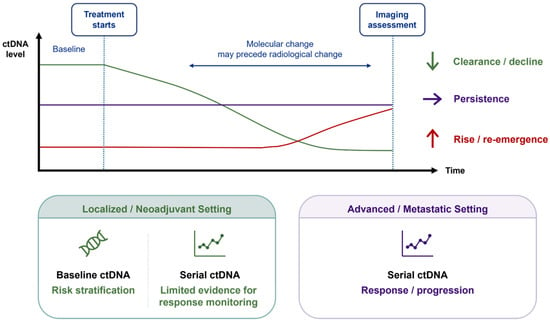
Recent systematic and meta-analytic evidence in non-resectable and advanced PDAC also supports an association between unfavorable ctDNA kinetics and shorter overall and progression-free survival, although substantial methodological heterogeneity remains [62,74]. These findings provide increasingly consistent clinical validity for serial monitoring in advanced disease, but they do not yet prove that treatment should be changed at the first molecular sign of non-response. Premature switching could avoid ineffective therapy, but it could also discontinue a regimen that retains clinical benefit. Whether molecularly triggered treatment adaptation improves outcomes therefore remains an unresolved clinical question. The main patterns of longitudinal ctDNA change during treatment are illustrated in Figure 3. Representative studies evaluating ctDNA during therapy are summarized in Table 3.
Figure 3.
Longitudinal ctDNA dynamics during treatment. Schematic trajectories for patients with detectable ctDNA at baseline: decline/clearance, persistence, and rise/re-emergence. Declining or clearing ctDNA has generally been associated with more favorable disease control, whereas persistent or rising ctDNA has been associated with treatment failure or progression. Evidence for serial response monitoring remains less established in localized/neoadjuvant disease than in advanced disease. ctDNA, circulating tumor DNA.
Table 3.
Representative studies evaluating ctDNA during therapy in PDAC.
7. Discussion
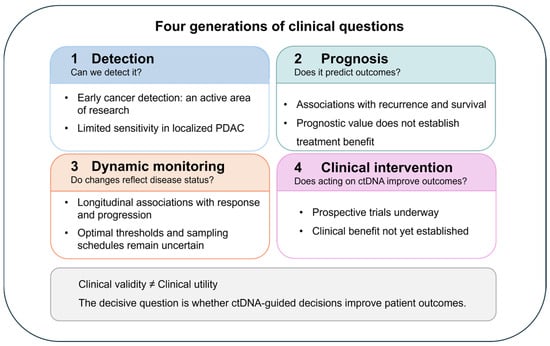
Across the PDAC patient journey, the clinical role of ctDNA can be viewed through four generations of questions: Generation 1, can we detect it? Generation 2, does it predict outcome? Generation 3, do changes over time reflect disease status or treatment response? Generation 4, can we use this information to improve clinical decisions and patient outcomes? These generations describe clinical questions rather than assay technologies, and they overlap rather than follow a strict chronological sequence. These four overlapping clinical questions, together with the current evidence and unresolved challenges at each level, are summarized in Figure 4.
Figure 4.
From ctDNA Detection to Clinical Utility: Four Questions Across the PDAC Patient Journey. Conceptual framework summarizing four overlapping clinical questions in PDAC ctDNA research: (1) whether ctDNA can be detected, (2) whether ctDNA findings predict clinical outcomes, (3) whether longitudinal ctDNA changes reflect disease status or treatment response, and (4) whether ctDNA-guided clinical decisions improve patient outcomes. Early cancer detection remains an active area of liquid biopsy research, including approaches based on cfDNA methylation analysis, although the sensitivity of mutation-based ctDNA detection remains limited in localized PDAC. Prognostic associations and longitudinal monitoring findings have been reported, but their clinical implications vary across disease settings. These four generations represent overlapping clinical questions rather than sequential stages of technological development. Importantly, clinical validity does not necessarily establish clinical utility, and the benefit of ctDNA-guided interventions remains to be demonstrated in prospective trials. Abbreviations: ctDNA, circulating tumor DNA; PDAC, pancreatic ductal adenocarcinoma.
Importantly, these applications should not be viewed as a linear evolution from early detection to disease monitoring. Early cancer detection remains an important and actively investigated application of blood-based molecular testing, alongside longitudinal disease monitoring. The randomized NHS-Galleri trial represents a major step toward evaluating the clinical utility of multi-cancer early detection using cfDNA methylation analysis [75,76]. Although the trial did not meet its primary endpoint of reducing the incidence of stage III/IV cancers, approximately 16% more stage I/II cancers were diagnosed in the screening group across 12 prespecified cancer types, suggesting potential for earlier cancer detection. However, further evidence is needed to establish a clinical benefit. These findings should not be directly extrapolated to mutation-based ctDNA detection in localized PDAC. In parallel, serial ctDNA analysis in established malignancies has demonstrated the potential to detect molecular recurrence and to track treatment response or emerging resistance [77,78]. Patient-specific tumor profiling has also enabled individualized, tumor-informed longitudinal monitoring across several cancer types [79,80]. These observations provide broader proof of principle for longitudinal molecular monitoring, although disease-specific validation remains essential in PDAC.
In PDAC, ctDNA has repeatedly shown prognostic value, and evidence for dynamic monitoring is also growing. Postoperative ctDNA can provide molecular evidence of residual disease and help predict recurrence [23,26,51], while serial changes during systemic therapy can reflect response or progression [27,66,67]. However, the strength of this evidence differs across the patient journey. Evidence supporting serial ctDNA monitoring is currently more developed in postoperative and advanced disease settings than during NAT. In localized PDAC, low detection rates and limited longitudinal data constrain response-guided treatment decisions, whereas studies in metastatic PDAC have demonstrated associations between early ctDNA kinetics, treatment response, and survival. This difference may partly reflect disease biology and measurement context. In advanced PDAC, greater tumor burden and metastatic disease generally increase ctDNA detectability, allowing serial molecular changes to be tracked during systemic therapy. In localized disease, lower baseline shedding limits both ctDNA detection and the interpretation of subsequent changes.
Positive and negative ctDNA results should not be interpreted in the same way. This asymmetry is important for the clinical interpretation of ctDNA in PDAC. A positive result, particularly after surgery or during surveillance, can provide strong evidence of biologically active disease and identify patients at high risk of recurrence. In contrast, a negative result is less definitive because low tumor burden, limited shedding, sampling timing, and assay sensitivity can all reduce detectability. Thus, “ctDNA-negative” should not automatically be interpreted as “disease-free” [25,51]. Studies of postoperative and post-treatment ctDNA have demonstrated that negative results cannot reliably exclude subsequent recurrence [51,53].
ctDNA should therefore not be considered a replacement for conventional assessment. Each test provides different information. Tissue analysis provides pathological and spatial genomic information. Imaging shows anatomical disease. CA19-9 is inexpensive and widely available. ctDNA provides molecular information that can be measured repeatedly over time. Their limitations are also different. In surgically treated PDAC, combined assessment of ctDNA and CA19-9 may provide complementary prognostic information [52]. In a prospective observational study of 136 patients with resected stage I–III PDAC receiving adjuvant chemotherapy, longitudinal integration of ctDNA and CA19-9 improved prognostic discrimination between treatment-response patterns [81]. Together with advances in assay sensitivity and complementary molecular approaches, these findings suggest opportunities to extend mutation-based ctDNA monitoring toward more integrated disease assessment. The clinically relevant question is not which single modality is superior, but how these sources of information can be integrated at specific decision points. The additional clinical value of ctDNA testing must also be considered in relation to its cost and resource requirements. Although ctDNA may provide molecular information beyond imaging and CA19-9, its routine incorporation into PDAC management cannot be justified solely by prognostic associations or earlier detection of recurrence. Prospective studies should therefore establish not only whether ctDNA-guided interventions improve patient outcomes, but also whether the benefits justify the additional testing burden and costs.
The major remaining transition is therefore from Generation 3 to Generation 4—from observing molecular change to acting on it. Prognostic association, earlier detection of recurrence, or even reliable identification of treatment response does not by itself establish clinical utility [15,25]. For ctDNA to change practice, a molecular result must lead to a different clinical decision, and that decision must ultimately improve an outcome that matters to the patient.
This becomes particularly important when ctDNA and conventional assessment disagree. Molecular recurrence may be detected while imaging remains negative. For example, when ctDNA becomes positive during postoperative surveillance despite negative imaging, it remains unclear whether intensified surveillance, earlier systemic therapy, or continued standard follow-up offers the greatest clinical benefit. Earlier detection may provide an opportunity for treatment, but it may also label a patient as having recurrent disease earlier without evidence that earlier treatment improves survival or quality of life. Similarly, an early molecular sign of non-response could justify changing therapy, but it could also lead to premature discontinuation of an effective regimen. These uncertainties provide a rationale for prospective interventional testing, rather than immediate treatment modification based on ctDNA results alone.
8. Future Directions
The key question is now whether ctDNA can be used to guide clinical decisions. Ongoing prospective studies are beginning to test this at different points across the patient journey, including initial treatment selection, postoperative adjuvant therapy, surveillance, and early adaptation of systemic therapy (Table 4).
Table 4.
Ongoing Clinical Studies Evaluating ctDNA-Informed and ctDNA-Guided Management in PDAC.
In localized disease, LIQUIPANC (NCT06391892) evaluates whether preoperative ctDNA can contribute to treatment selection between upfront surgery and neoadjuvant therapy in a non-randomized interventional study [82]. After resection, ADAPT-MRD (NCT06966440) tests whether adjuvant treatment can be adapted according to serial MRD results, including shortening or prolongation of adjuvant chemotherapy compared with standard care in a randomized trial [83]. CIRCPAC (NCT05788744) includes an observational cohort evaluating the prognostic value of circulating DNA and a randomized substudy comparing ctDNA-guided postoperative surveillance with standard surveillance [84]. In metastatic disease, NCT07096362 uses a staged phase II design to evaluate early methylation-based ctDNA response during first-line mFOLFIRINOX and whether a molecularly triggered switch to gemcitabine plus nab-paclitaxel can improve progression-free survival [85]. These studies address different clinical decisions and should be evaluated according to their intervention strategies, predefined endpoints, and evidence that acting on ctDNA results improves patient outcomes.
Beyond individual trials, several methodological and clinical questions require resolution before ctDNA-guided management can be implemented routinely. These include optimal sampling schedules, clinically meaningful thresholds for molecular response or recurrence, strategies for confirming unexpected results, and predefined actions when ctDNA and conventional assessments disagree. Future studies should also evaluate the incremental benefit of ctDNA over imaging and CA19-9, together with patient-centered outcomes, resource requirements, and cost-effectiveness.
A separate future direction is whether locally collected biofluids can overcome some of the biological limitations of plasma ctDNA. Pancreatic juice and bile may provide complementary sources of tumor-derived DNA, particularly in low-shedding disease. Pancreatic juice analysis has demonstrated the feasibility of detecting tumor-derived genetic alterations in early PDAC, while systematic evidence has further evaluated the diagnostic potential and limitations of pancreatic juice DNA analysis [86,87]. Studies involving patients with PDAC have also demonstrated the feasibility of mutation profiling using bile-derived cfDNA, with higher detection of tissue-matched alterations than plasma in a small pancreatobiliary cancer cohort [88]. In addition, Nagai et al. [89] investigated cfDNA analysis of pancreatic juice and bile obtained during ERCP in patients with pancreaticobiliary strictures, supporting the feasibility of these local biofluids as complementary diagnostic specimens. Multigene analysis of bile has also demonstrated the feasibility of detecting driver alterations in biliary tract cancers [90]. Further studies are needed to determine whether these alternative biofluids can improve early detection or molecular profiling in PDAC and whether their potential advantages justify the need for endoscopic sample acquisition.
Liquid biopsy research is also expanding beyond mutation-based ctDNA analysis to include circulating RNA, cfDNA fragmentomics, and DNA methylation analysis. Recent studies in PDAC have reported promising results using circulating RNA and miRNA signatures [91,92], cfDNA fragmentomic features [93,94], and methylation-based markers [95,96]. Earlier work combining cfDNA mutations with circulating protein biomarkers also demonstrated the feasibility of multi-analyte blood testing [97]. More recently, Zhao et al. investigated genomic and epigenomic profiling of plasma cfDNA, suggesting that methylation-based analysis and CA19-9 may provide complementary information for PDAC detection [98]. In a prospective cohort of 1926 individuals with diabetes or obesity, Wang et al. reported that a cfDNA model integrating copy-number and fragmentation features detected 6 of 8 pancreatic neoplastic cases (75%), including all three stage 0 lesions, compared with 1 of 8 (12.5%) using CA19-9, with a median lead time of 227.5 days before imaging detection [99]. Together, these studies illustrate how complementary molecular features may extend the diagnostic potential of liquid biopsy beyond mutation detection alone, particularly in early-stage disease. Their clinical utility requires further prospective validation.
9. Conclusions
The clinical value of ctDNA changes across the PDAC patient journey. Its limited sensitivity, particularly in localized disease, prevents its use as a stand-alone diagnostic test. However, ctDNA can complement tissue-based molecular profiling, provide prognostic information after surgery, help detect molecular recurrence during surveillance, and offer dynamic information during systemic therapy. A negative result must be interpreted cautiously because low tumor shedding and limited assay sensitivity can result in undetectable ctDNA despite residual disease.
The central challenge is now to translate this molecular information into better clinical decisions. ctDNA should not replace tissue analysis, imaging, or CA19-9. It should be used as a complementary and dynamic source of information, with its value depending on the clinical setting and purpose. Integration with conventional biomarkers, including CA19-9, may further refine longitudinal risk assessment, although its clinical benefit remains to be established. By distinguishing established prognostic associations from emerging monitoring applications and unproven ctDNA-guided interventions, this review provides a framework for interpreting ctDNA findings across the PDAC patient journey. Prospective interventional trials must now determine whether acting on ctDNA results, rather than merely detecting or predicting disease, leads to meaningful improvements in patient outcomes. Until such benefit is demonstrated, ctDNA should inform clinical assessment rather than determine treatment by itself.
Supplementary Materials
The following supporting information can be downloaded at: https://www.mdpi.com/article/10.3390/cancers18213471/s1, Table S1: Major ctDNA analytical approaches and assay strategies relevant to pancreatic cancer.
Author Contributions
Conceptualization, M.A.; methodology, M.A.; investigation, M.A.; writing—original draft preparation, M.A.; visualization, M.A.; writing—review and editing, M.A., N.A., T.M., A.M., S.N. and J.Y.; N.A. and J.Y. suggested additional references and helped refine the discussion; T.M. provided a surgical perspective on perioperative management; A.M. contributed expertise in pancreatic diseases; and S.N. provided expertise in ctDNA analysis and ddPCR methodology. All authors have read and agreed to the published version of the manuscript.
Funding
This research received no external funding.
Institutional Review Board Statement
Not applicable.
Informed Consent Statement
Not applicable.
Data Availability Statement
No new data were created or analyzed in this study. Data sharing is not applicable to this article.
Acknowledgments
During the preparation of this manuscript, the authors used ChatGPT (OpenAI; GPT-5.6 and GPT-6) to assist with manuscript organization, language editing, and refinement of the presentation. The authors reviewed and edited all outputs and take full responsibility for the content of this publication.
Conflicts of Interest
Satoshi Nishizuka is the CEO and a stockholder of Quantdetect, Inc. The other authors declare no conflicts of interest.
References
- Conroy, T.; Pfeiffer, P.; Vilgrain, V.; Lamarca, A.; Seufferlein, T.; O’Reilly, E.M.; Hackert, T.; Golan, T.; Prager, G.; Haustermans, K.; et al. Pancreatic Cancer: ESMO Clinical Practice Guideline for Diagnosis, Treatment and Follow-Up. Ann. Oncol. 2023, 34, 987–1002. [Google Scholar] [CrossRef] [Scilit] [PubMed]
- Abe, T.; Nakamura, M.; Morizane, C.; Yoshida, M.; Kitano, M.; Ohtsuka, T.; Nakata, K.; Someya, M.; Mizuno, N.; Nakai, Y.; et al. Clinical Practice Guidelines for Pancreatic Cancer 2025 From the Japan Pancreas Society: A Synopsis. Pancreas 2026, 55, e120–e133. [Google Scholar] [CrossRef] [Scilit] [PubMed]
- Katz, M.H.G.; Fleming, J.B.; Bhosale, P.; Varadhachary, G.; Lee, J.E.; Wolff, R.; Wang, H.; Abbruzzese, J.; Pisters, P.W.T.; Vauthey, J.-N.; et al. Response of Borderline Resectable Pancreatic Cancer to Neoadjuvant Therapy Is Not Reflected by Radiographic Indicators. Cancer 2012, 118, 5749–5756. [Google Scholar] [CrossRef] [Scilit] [PubMed]
- Miyahara, S.; Takahashi, H.; Tomimaru, Y.; Kobayashi, S.; Yamada, D.; Akita, H.; Noda, T.; Doki, Y.; Eguchi, H. Discrepancy Between Radiographic and Pathological Response Assessment in Neoadjuvant Treatment for Pancreatic Cancer: A Comparison Between Neoadjuvant Chemotherapy and Neoadjuvant Chemoradiotherapy. Ann. Gastroenterol. Surg. 2025, 9, 1312–1321. [Google Scholar] [CrossRef] [Scilit] [PubMed]
- Locker, G.Y.; Hamilton, S.; Harris, J.; Jessup, J.M.; Kemeny, N.; Macdonald, J.S.; Somerfield, M.R.; Hayes, D.F.; Bast, R.C.; American Society of Clinical Oncology. ASCO 2006 Update of Recommendations for the Use of Tumor Markers in Gastrointestinal Cancer. J. Clin. Oncol. 2006, 24, 5313–5327. [Google Scholar] [CrossRef] [Scilit] [PubMed]
- Ballehaninna, U.K.; Chamberlain, R.S. The Clinical Utility of Serum CA 19-9 in the Diagnosis, Prognosis and Management of Pancreatic Adenocarcinoma: An Evidence Based Appraisal. J. Gastrointest. Oncol. 2012, 3, 105–119. [Google Scholar] [CrossRef] [Scilit] [PubMed]
- Diehl, F.; Schmidt, K.; Choti, M.A.; Romans, K.; Goodman, S.; Li, M.; Thornton, K.; Agrawal, N.; Sokoll, L.; Szabo, S.A.; et al. Circulating Mutant DNA to Assess Tumor Dynamics. Nat. Med. 2008, 14, 985–990. [Google Scholar] [CrossRef] [Scilit] [PubMed]
- Wan, J.C.M.; Massie, C.; Garcia-Corbacho, J.; Mouliere, F.; Brenton, J.D.; Caldas, C.; Pacey, S.; Baird, R.; Rosenfeld, N. Liquid Biopsies Come of Age: Towards Implementation of Circulating Tumour DNA. Nat. Rev. Cancer 2017, 17, 223–238. [Google Scholar] [CrossRef] [Scilit] [PubMed]
- Waddell, N.; Pajic, M.; Patch, A.-M.; Chang, D.K.; Kassahn, K.S.; Bailey, P.; Johns, A.L.; Miller, D.; Nones, K.; Quek, K.; et al. Whole Genomes Redefine the Mutational Landscape of Pancreatic Cancer. Nature 2015, 518, 495–501. [Google Scholar] [CrossRef] [Scilit] [PubMed]
- Cancer Genome Atlas Research Network. Integrated Genomic Characterization of Pancreatic Ductal Adenocarcinoma. Cancer Cell 2017, 32, 185–203.e13. [Google Scholar] [CrossRef] [Scilit] [PubMed]
- Takai, E.; Totoki, Y.; Nakamura, H.; Morizane, C.; Nara, S.; Hama, N.; Suzuki, M.; Furukawa, E.; Kato, M.; Hayashi, H.; et al. Clinical Utility of Circulating Tumor DNA for Molecular Assessment in Pancreatic Cancer. Sci. Rep. 2015, 5, 18425. [Google Scholar] [CrossRef] [Scilit] [PubMed]
- Botrus, G.; Kosirorek, H.; Sonbol, M.B.; Kusne, Y.; Uson Junior, P.L.S.; Borad, M.J.; Ahn, D.H.; Kasi, P.M.; Drusbosky, L.M.; Dada, H.; et al. Circulating Tumor DNA-Based Testing and Actionable Findings in Patients with Advanced and Metastatic Pancreatic Adenocarcinoma. Oncologist 2021, 26, 569–578. [Google Scholar] [CrossRef] [Scilit] [PubMed]
- Sivapalan, L.; Kocher, H.M.; Ross-Adams, H.; Chelala, C. Molecular Profiling of ctDNA in Pancreatic Cancer: Opportunities and Challenges for Clinical Application. Pancreatology 2021, 21, 363–378. [Google Scholar] [CrossRef] [Scilit] [PubMed]
- Abdallah, R.; Taly, V.; Zhao, S.; Pietrasz, D.; Bachet, J.-B.; Basile, D.; Mas, L.; Zaanan, A.; Laurent-Puig, P.; Taieb, J. Plasma Circulating Tumor DNA in Pancreatic Adenocarcinoma for Screening, Diagnosis, Prognosis, Treatment and Follow-up: A Systematic Review. Cancer Treat. Rev. 2020, 87, 102028. [Google Scholar] [CrossRef] [Scilit] [PubMed]
- Pascual, J.; Attard, G.; Bidard, F.-C.; Curigliano, G.; De Mattos-Arruda, L.; Diehn, M.; Italiano, A.; Lindberg, J.; Merker, J.D.; Montagut, C.; et al. ESMO Recommendations on the Use of Circulating Tumour DNA Assays for Patients with Cancer: A Report from the ESMO Precision Medicine Working Group. Ann. Oncol. 2022, 33, 750–768. [Google Scholar] [CrossRef] [Scilit] [PubMed]
- Hasenleithner, S.O.; Speicher, M.R. A Clinician’s Handbook for Using ctDNA throughout the Patient Journey. Mol. Cancer 2022, 21, 81. [Google Scholar] [CrossRef] [Scilit] [PubMed]
- Diaz, L.A.; Bardelli, A. Liquid Biopsies: Genotyping Circulating Tumor DNA. J. Clin. Oncol. 2014, 32, 579–586. [Google Scholar] [CrossRef] [Scilit] [PubMed]
- Bettegowda, C.; Sausen, M.; Leary, R.J.; Kinde, I.; Wang, Y.; Agrawal, N.; Bartlett, B.R.; Wang, H.; Luber, B.; Alani, R.M.; et al. Detection of Circulating Tumor DNA in Early- and Late-Stage Human Malignancies. Sci. Transl. Med. 2014, 6, 224ra24. [Google Scholar] [CrossRef] [Scilit] [PubMed]
- Le Calvez-Kelm, F.; Foll, M.; Wozniak, M.B.; Delhomme, T.M.; Durand, G.; Chopard, P.; Pertesi, M.; Fabianova, E.; Adamcakova, Z.; Holcatova, I.; et al. KRAS Mutations in Blood Circulating Cell-Free DNA: A Pancreatic Cancer Case-Control. Oncotarget 2016, 7, 78827–78840. [Google Scholar] [CrossRef] [Scilit] [PubMed]
- Olive, K.P.; Jacobetz, M.A.; Davidson, C.J.; Gopinathan, A.; McIntyre, D.; Honess, D.; Madhu, B.; Goldgraben, M.A.; Caldwell, M.E.; Allard, D.; et al. Inhibition of Hedgehog Signaling Enhances Delivery of Chemotherapy in a Mouse Model of Pancreatic Cancer. Science 2009, 324, 1457–1461. [Google Scholar] [CrossRef] [Scilit] [PubMed]
- Umemoto, K.; Sunakawa, Y.; Ueno, M.; Furukawa, M.; Mizuno, N.; Sudo, K.; Kawamoto, Y.; Kajiwara, T.; Ohtsubo, K.; Okano, N.; et al. Clinical Significance of Circulating-Tumour DNA Analysis by Metastatic Sites in Pancreatic Cancer. Br. J. Cancer 2023, 128, 1603–1608. [Google Scholar] [CrossRef] [Scilit] [PubMed]
- Dubrovsky, G.; Ross, A.; Jalali, P.; Lotze, M. Liquid Biopsy in Pancreatic Ductal Adenocarcinoma: A Review of Methods and Applications. Int. J. Mol. Sci. 2024, 25, 11013. [Google Scholar] [CrossRef] [Scilit] [PubMed]
- Botta, G.P.; Abdelrahim, M.; Drengler, R.L.; Aushev, V.N.; Esmail, A.; Laliotis, G.; Brewer, C.M.; George, G.V.; Abbate, S.M.; Chandana, S.R.; et al. Association of Personalized and Tumor-Informed ctDNA with Patient Survival Outcomes in Pancreatic Adenocarcinoma. Oncologist 2024, 29, 859–869, Erratum in Oncologist 2024, 29, e1630. [Google Scholar] [CrossRef] [Scilit] [PubMed]
- Santonja, A.; Cooper, W.N.; Eldridge, M.D.; Edwards, P.A.W.; Morris, J.A.; Edwards, A.R.; Zhao, H.; Heider, K.; Couturier, D.-L.; Vijayaraghavan, A.; et al. Comparison of Tumor-Informed and Tumor-Naïve Sequencing Assays for ctDNA Detection in Breast Cancer. EMBO Mol. Med. 2023, 15, e16505. [Google Scholar] [CrossRef] [Scilit] [PubMed]
- Kobayashi, S.; Nakamura, Y.; Hashimoto, T.; Bando, H.; Oki, E.; Karasaki, T.; Horinouchi, H.; Ozaki, Y.; Iwata, H.; Kato, T.; et al. Japan Society of Clinical Oncology Position Paper on Appropriate Clinical Use of Molecular Residual Disease (MRD) Testing. Int. J. Clin. Oncol. 2025, 30, 605–654. [Google Scholar] [CrossRef] [Scilit] [PubMed]
- Hata, T.; Mizuma, M.; Motoi, F.; Ohtsuka, H.; Nakagawa, K.; Morikawa, T.; Unno, M. Prognostic Impact of Postoperative Circulating Tumor DNA as a Molecular Minimal Residual Disease Marker in Patients with Pancreatic Cancer Undergoing Surgical Resection. J. Hepatobiliary Pancreat. Sci. 2023, 30, 815–824. [Google Scholar] [CrossRef] [Scilit] [PubMed]
- Motobayashi, H.; Kitahata, Y.; Okada, K.-I.; Miyazawa, M.; Ueno, M.; Hayami, S.; Miyamoto, A.; Shimizu, A.; Sato, M.; Yoshimura, T.; et al. Short-Term Serial Circulating Tumor DNA Assessment Predicts Therapeutic Efficacy for Patients with Advanced Pancreatic Cancer. J. Cancer Res. Clin. Oncol. 2024, 150, 35. [Google Scholar] [CrossRef] [Scilit] [PubMed]
- Watanabe, F.; Suzuki, K.; Tamaki, S.; Abe, I.; Endo, Y.; Takayama, Y.; Ishikawa, H.; Kakizawa, N.; Saito, M.; Futsuhara, K.; et al. Longitudinal Monitoring of KRAS-Mutated Circulating Tumor DNA Enables the Prediction of Prognosis and Therapeutic Responses in Patients with Pancreatic Cancer. PLoS ONE 2019, 14, e0227366. [Google Scholar] [CrossRef] [Scilit] [PubMed]
- Wei, T.; Zhang, Q.; Li, X.; Su, W.; Li, G.; Ma, T.; Gao, S.; Lou, J.; Que, R.; Zheng, L.; et al. Monitoring Tumor Burden in Response to FOLFIRINOX Chemotherapy Via Profiling Circulating Cell-Free DNA in Pancreatic Cancer. Mol. Cancer Ther. 2019, 18, 196–203. [Google Scholar] [CrossRef] [Scilit] [PubMed]
- Risberg, B.; Tsui, D.W.Y.; Biggs, H.; Ruiz-Valdepenas Martin de Almagro, A.; Dawson, S.-J.; Hodgkin, C.; Jones, L.; Parkinson, C.; Piskorz, A.; Marass, F.; et al. Effects of Collection and Processing Procedures on Plasma Circulating Cell-Free DNA from Cancer Patients. J. Mol. Diagn. 2018, 20, 883–892. [Google Scholar] [CrossRef] [Scilit] [PubMed]
- Till, J.E.; Black, T.A.; Gentile, C.; Abdalla, A.; Wang, Z.; Sangha, H.K.; Roth, J.J.; Sussman, R.; Yee, S.S.; O’Hara, M.H.; et al. Optimization of Sources of Circulating Cell-Free DNA Variability for Downstream Molecular Analysis. J. Mol. Diagn. 2021, 23, 1545–1552. [Google Scholar] [CrossRef] [Scilit] [PubMed]
- Godsey, J.H.; Silvestro, A.; Barrett, J.C.; Bramlett, K.; Chudova, D.; Deras, I.; Dickey, J.; Hicks, J.; Johann, D.J.; Leary, R.; et al. Generic Protocols for the Analytical Validation of Next-Generation Sequencing-Based ctDNA Assays: A Joint Consensus Recommendation of the BloodPAC’s Analytical Variables Working Group. Clin. Chem. 2020, 66, 1156–1166. [Google Scholar] [CrossRef] [Scilit] [PubMed]
- Razavi, P.; Li, B.T.; Brown, D.N.; Jung, B.; Hubbell, E.; Shen, R.; Abida, W.; Juluru, K.; De Bruijn, I.; Hou, C.; et al. High-Intensity Sequencing Reveals the Sources of Plasma Circulating Cell-Free DNA Variants. Nat. Med. 2019, 25, 1928–1937. [Google Scholar] [CrossRef] [Scilit] [PubMed]
- Wang, R.; Zhao, Y.; Wang, Y.; Zhao, Z.; Chen, Q.; Duan, Y.; Xiong, S.; Luan, Z.; Wang, J.; Cheng, B. Diagnostic and Prognostic Values of KRAS Mutations on EUS-FNA Specimens and Circulating Tumor DNA in Patients with Pancreatic Cancer. Clin. Transl. Gastroenterol. 2022, 13, e00487. [Google Scholar] [CrossRef] [Scilit] [PubMed]
- Keane, F.; Saadat, L.V.; O’Connor, C.A.; Chou, J.F.; Bowman, A.S.; Xu, F.; Crowley, F.; Debnath, N.; Schoenfeld, J.D.; Singhal, A.; et al. Clinical Utility and Tissue Concordance of Circulating Tumor DNA in Pancreatic Ductal Adenocarcinoma. J. Natl. Cancer Inst. 2025, 117, 1848–1857. [Google Scholar] [CrossRef] [Scilit] [PubMed]
- Zhu, Y.; Zhang, H.; Chen, N.; Hao, J.; Jin, H.; Ma, X. Diagnostic Value of Various Liquid Biopsy Methods for Pancreatic Cancer: A Systematic Review and Meta-Analysis. Medicine 2020, 99, e18581. [Google Scholar] [CrossRef] [Scilit] [PubMed]
- Mahadevia, H.; Majeed, U.; Patel, J.; Ahmed, A.K.; Elhariri, A.; Albelal, D.; Rao, N.N.M.; Rachamala, H.K.; Mosalem, O.; Mukhopadhyay, D.; et al. Circulating Tumor DNA and Tissue Testing for Pancreatobiliary Tumors. JAMA Netw. Open 2025, 8, e2531373. [Google Scholar] [CrossRef] [Scilit] [PubMed]
- Huerta, M.; Martín-Arana, J.; Gimeno-Valiente, F.; Carbonell-Asins, J.A.; García-Micó, B.; Martínez-Castedo, B.; Robledo-Yagüe, F.; Camblor, D.G.; Fleitas, T.; García Bartolomé, M.; et al. ctDNA Whole Exome Sequencing in Pancreatic Ductal Adenocarcinoma Unveils Organ-Dependent Metastatic Mechanisms and Identifies Actionable Alterations in Fast Progressing Patients. Transl. Res. 2024, 271, 105–115. [Google Scholar] [CrossRef] [Scilit] [PubMed]
- Patel, H.; Okamura, R.; Fanta, P.; Patel, C.; Lanman, R.B.; Raymond, V.M.; Kato, S.; Kurzrock, R. Clinical Correlates of Blood-Derived Circulating Tumor DNA in Pancreatic Cancer. J. Hematol. Oncol. 2019, 12, 130. [Google Scholar] [CrossRef] [Scilit] [PubMed]
- Lee, M.R.; Woo, S.M.; Kim, M.K.; Han, S.-S.; Park, S.-J.; Lee, W.J.; Lee, D.-E.; Choi, S.I.; Choi, W.; Yoon, K.-A.; et al. Application of Plasma Circulating KRAS Mutations as a Predictive Biomarker for Targeted Treatment of Pancreatic Cancer. Cancer Sci. 2024, 115, 1283–1295, Erratum in Cancer Sci. 2024, 115, 2846. [Google Scholar] [CrossRef] [Scilit] [PubMed]
- Lee, J.-S.; Han, Y.; Yun, W.-G.; Kwon, W.; Kim, H.; Jeong, H.; Seo, M.-S.; Park, Y.; Cho, S.I.; Kim, H.; et al. Parallel Analysis of Pre- and Postoperative Circulating Tumor DNA and Matched Tumor Tissues in Resectable Pancreatic Ductal Adenocarcinoma: A Prospective Cohort Study. Clin. Chem. 2022, 68, 1509–1518. [Google Scholar] [CrossRef] [Scilit] [PubMed]
- Umemoto, K.; Nakahara, K.; Ohike, N.; Satta, Y.; Sekine, A.; Igarashi, Y.; Nagata, Y.; Kubota, Y.; Takeda, H.; Horie, Y.; et al. Diagnostic Performance of Droplet Digital PCR for KRAS Mutation Analysis in Pancreatic Cancer Cytology Specimens. J. Gastroenterol. 2026, 61, 1668–1677. [Google Scholar] [CrossRef] [Scilit] [PubMed]
- Kitahata, Y.; Kawai, M.; Hirono, S.; Okada, K.-I.; Miyazawa, M.; Motobayashi, H.; Ueno, M.; Hayami, S.; Miyamoto, A.; Yamaue, H. Circulating Tumor DNA as a Potential Prognostic Marker in Patients with Borderline-Resectable Pancreatic Cancer Undergoing Neoadjuvant Chemotherapy Followed by Pancreatectomy. Ann. Surg. Oncol. 2022, 29, 1596–1605. [Google Scholar] [CrossRef] [Scilit] [PubMed]
- Shah, D.; Wells, A.; Cox, M.; Dawravoo, K.; Abad, J.; D’Souza, A.; Suh, G.; Bayer, R.; Chaudhry, S.; Zhang, Q.; et al. Prospective Evaluation of Circulating Tumor DNA Using Next-Generation Sequencing as a Biomarker During Neoadjuvant Chemotherapy in Localized Pancreatic Cancer. Ann. Surg. 2025, 281, 997–1005. [Google Scholar] [CrossRef] [Scilit] [PubMed]
- Labiano, I.; Huerta, A.E.; Alsina, M.; Arasanz, H.; Castro, N.; Mendaza, S.; Lecumberri, A.; Gonzalez-Borja, I.; Guerrero-Setas, D.; Patiño-Garcia, A.; et al. Building on the Clinical Applicability of ctDNA Analysis in Non-Metastatic Pancreatic Ductal Adenocarcinoma. Sci. Rep. 2024, 14, 16203. [Google Scholar] [CrossRef] [Scilit] [PubMed]
- Yamaguchi, T.; Uemura, K.; Murakami, Y.; Kondo, N.; Nakagawa, N.; Okada, K.; Seo, S.; Hiyama, E.; Takahashi, S.; Sueda, T. Clinical Implications of Pre- and Postoperative Circulating Tumor DNA in Patients with Resected Pancreatic Ductal Adenocarcinoma. Ann. Surg. Oncol. 2021, 28, 3135–3144. [Google Scholar] [CrossRef] [Scilit] [PubMed]
- Sridalla, K.; Vitello, D.J.; Cox, M.; Masnyk, L.; Wells, A.; Horowitz, A.; Shah, D.; Machhi, J.K.; Rengaraju, V.; Chibucos, A.; et al. KRAS and TP53 Circulating Tumor DNA Are Prognostic in Localized Pancreatic Cancer. Ann. Surg. Oncol. 2026, 33, 10138–10149. [Google Scholar] [CrossRef] [Scilit] [PubMed]
- Sridalla, K.; Machhi, J.K.; Vitello, D.J.; Chibucos, A.; Cox, M.; Wells, A.; Horowitz, A.; Rengaraju, V.; Shen, C.; Romero, N.; et al. High-Sensitivity ctDNA Analysis Uncovers Relevant Signals Missed by NGS in Pancreatic Cancer. Clin. Cancer Res. 2026, 32, 4105–4112. [Google Scholar] [CrossRef] [Scilit] [PubMed]
- Lee, B.; Lipton, L.; Cohen, J.; Tie, J.; Javed, A.A.; Li, L.; Goldstein, D.; Burge, M.; Cooray, P.; Nagrial, A.; et al. Circulating Tumor DNA as a Potential Marker of Adjuvant Chemotherapy Benefit Following Surgery for Localized Pancreatic Cancer. Ann. Oncol. 2019, 30, 1472–1478. [Google Scholar] [CrossRef] [Scilit] [PubMed]
- Jiang, J.; Ye, S.; Xu, Y.; Chang, L.; Hu, X.; Ru, G.; Guo, Y.; Yi, X.; Yang, L.; Huang, D. Circulating Tumor DNA as a Potential Marker to Detect Minimal Residual Disease and Predict Recurrence in Pancreatic Cancer. Front. Oncol. 2020, 10, 1220. [Google Scholar] [CrossRef] [Scilit] [PubMed]
- Guo, M.Z.; Sachidanand, A.S.; Nguyen, T.; Patel, S.D.; Burns, W.R.; Burkhart, R.; Le, D.T.; Lafaro, K.; Bever, K.M.; Pishvaian, M.J.; et al. Postsurgical Circulating Tumor DNA as a Prognostic Biomarker for Relapse of Resected Pancreatic Ductal Adenocarcinoma. J. Gastrointest. Surg. 2026, 30, 102359. [Google Scholar] [CrossRef] [Scilit] [PubMed]
- Aaquist, T.; Henriksen, T.V.; Mariager Jakobsen, L.L.; Fristrup, C.W.; Pfeiffer, P.; de Stricker, K.; Sparrelid, E.; Moro, C.F.; Mortensen, F.; Knudsen, A.R.; et al. Circulating Tumour DNA as a Prognostic Tool for Surgically Treated Pancreatic Ductal Adenocarcinoma. Hum. Pathol. 2026, 168, 106024. [Google Scholar] [CrossRef] [Scilit] [PubMed]
- Dickey, E.M.; Martos, M.P.; Yanala, U.; Corona, A.; Ezenwajiaku, N.; Pizzolato, J.; Franceschi, D.; Livingstone, A.S.; Terrero, G.; Hester, C.A.; et al. Utility of Tumor-Informed Circulating Tumor DNA for Detection of Minimal Residual Disease after Curative-Intent Therapy in Localized Pancreatic Cancer. Surg. Oncol. Insight 2025, 2, 100116. [Google Scholar] [CrossRef] [Scilit]
- Borges, F.C.; Pinto, M.S.; Borges, M.F.; João, A.A.; Francisco, E.; Sousa, M.; Aral, M.; Oliveira, V.; Cunha, J.F.; Mehrabi, A.; et al. The Role of Circulating Tumor DNA in Surgical Management of Pancreatic Cancer: Systematic Review and Meta-Analysis. Ann. Surg. 2026. Online ahead of print. [Google Scholar] [CrossRef] [Scilit] [PubMed]
- Henriksen, T.V.; Reinert, T.; Christensen, E.; Sethi, H.; Birkenkamp-Demtröder, K.; Gögenur, M.; Gögenur, I.; Zimmermann, B.G.; IMPROVE Study Group; Dyrskjøt, L.; et al. The Effect of Surgical Trauma on Circulating Free DNA Levels in Cancer Patients-Implications for Studies of Circulating Tumor DNA. Mol. Oncol. 2020, 14, 1670–1679. [Google Scholar] [CrossRef] [Scilit] [PubMed]
- Sausen, M.; Phallen, J.; Adleff, V.; Jones, S.; Leary, R.J.; Barrett, M.T.; Anagnostou, V.; Parpart-Li, S.; Murphy, D.; Kay Li, Q.; et al. Clinical Implications of Genomic Alterations in the Tumour and Circulation of Pancreatic Cancer Patients. Nat. Commun. 2015, 6, 7686. [Google Scholar] [CrossRef] [Scilit] [PubMed]
- Groot, V.P.; Mosier, S.; Javed, A.A.; Teinor, J.A.; Gemenetzis, G.; Ding, D.; Haley, L.M.; Yu, J.; Burkhart, R.A.; Hasanain, A.; et al. Circulating Tumor DNA as a Clinical Test in Resected Pancreatic Cancer. Clin. Cancer Res. 2019, 25, 4973–4984. [Google Scholar] [CrossRef] [Scilit] [PubMed]
- Chen, J.; Zou, L.; Bai, X.; Tong, F.; Ni, J.; Tang, H.; Liu, Y.; Kong, X.; Yin, J.; Wang, F.; et al. Personalized Tumor-Informed Circulating Tumor DNA Monitoring for Early Detection of Recurrence in Postoperative Pancreatic Cancer. Front. Oncol. 2026, 16, 1745466. [Google Scholar] [CrossRef] [Scilit] [PubMed]
- Zhang, Y.; Esmail, A.; Hassanain, H.; Dhillon, V.; Abdelrahim, W.; Al-Najjar, E.; Khasawneh, B.; Abdelrahim, M. Correlative Analysis of Tumor-Informed Circulating Tumor DNA (ctDNA) and the Survival Outcomes of Patients with Pancreatic Adenocarcinoma. Biomedicines 2025, 13, 1124. [Google Scholar] [CrossRef] [Scilit] [PubMed]
- Azizian, A.; Rühlmann, F.; Krause, T.; Bernhardt, M.; Jo, P.; König, A.; Kleiß, M.; Leha, A.; Ghadimi, M.; Gaedcke, J. CA19-9 for Detecting Recurrence of Pancreatic Cancer. Sci. Rep. 2020, 10, 1332. [Google Scholar] [CrossRef] [Scilit] [PubMed]
- Guven, D.C.; Sahin, T.K.; Yildirim, H.C.; Aktepe, O.H.; Dizdar, O.; Yalcin, S. A Systematic Review and Meta-Analysis of the Association between Circulating Tumor DNA (ctDNA) and Prognosis in Pancreatic Cancer. Crit. Rev. Oncol. Hematol. 2021, 168, 103528. [Google Scholar] [CrossRef] [Scilit] [PubMed]
- Steiniche, M.M.; Callesen, L.B.; Vlk, E.H.; Ventzel, L.; Timm, S.; Andersen, R.F.; Lindgaard, S.C.; Hansen, T.F.; Ladekarl, M.; Spindler, K.-L.G. Circulating Tumour DNA (ctDNA) as a Predictor of Progression-Free and Overall Survival in Non-Resectable Pancreatic Cancer: A Systematic Review and Meta-Analysis. J. Liq. Biopsy 2025, 10, 100441. [Google Scholar] [CrossRef] [Scilit] [PubMed]
- Tjensvoll, K.; Lapin, M.; Buhl, T.; Oltedal, S.; Steen-Ottosen Berry, K.; Gilje, B.; Søreide, J.A.; Javle, M.; Nordgård, O.; Smaaland, R. Clinical Relevance of Circulating KRAS Mutated DNA in Plasma from Patients with Advanced Pancreatic Cancer. Mol. Oncol. 2016, 10, 635–643. [Google Scholar] [CrossRef] [Scilit] [PubMed]
- Lapin, M.; Edland, K.H.; Tjensvoll, K.; Oltedal, S.; Austdal, M.; Garresori, H.; Rozenholc, Y.; Gilje, B.; Nordgård, O. Comprehensive ctDNA Measurements Improve Prediction of Clinical Outcomes and Enable Dynamic Tracking of Disease Progression in Advanced Pancreatic Cancer. Clin. Cancer Res. 2023, 29, 1267–1278. [Google Scholar] [CrossRef] [Scilit] [PubMed]
- Chun, J.W.; Lee, D.-E.; Kim, M.K.; Hwang, J.-H.; Lee, S.H.; Jung, M.K.; Kim, E.J.; Ahn, D.-W.; Kim, Y.-H.; Han, S.-S.; et al. Optimal Value of Mutant KRAS Circulating Tumor DNA for Predicting Prognosis and Monitoring in Patients with Pancreatic Adenocarcinoma: A Prospective Multicenter Cohort Study. Clin. Chem. 2025, 71, 993–1004. [Google Scholar] [CrossRef] [Scilit] [PubMed]
- You, T.; Tang, H.; Yuan, M.; Song, D.; Wang, C.; Ying, J.; Chen, R.; Bai, C.; Cheng, Y.; Wang, Y. Dynamics of Circulating Tumor DNA (ctDNA) Predict Treatment Efficacy and Prognosis in Patients with Advanced Pancreatic Cancer: A Prospective Large-Cohort Study. MedComm 2026, 7, e70829. [Google Scholar] [CrossRef] [Scilit] [PubMed]
- Kruger, S.; Heinemann, V.; Ross, C.; Diehl, F.; Nagel, D.; Ormanns, S.; Liebmann, S.; Prinz-Bravin, I.; Westphalen, C.B.; Haas, M.; et al. Repeated mutKRAS ctDNA Measurements Represent a Novel and Promising Tool for Early Response Prediction and Therapy Monitoring in Advanced Pancreatic Cancer. Ann. Oncol. 2018, 29, 2348–2355. [Google Scholar] [CrossRef] [Scilit] [PubMed]
- Edland, K.H.; Tjensvoll, K.; Oltedal, S.; Dalen, I.; Lapin, M.; Garresori, H.; Glenjen, N.; Gilje, B.; Nordgård, O. Monitoring of Circulating Tumour DNA in Advanced Pancreatic Ductal Adenocarcinoma Predicts Clinical Outcome and Reveals Disease Progression Earlier than Radiological Imaging. Mol. Oncol. 2023, 17, 1857–1870. [Google Scholar] [CrossRef] [Scilit] [PubMed]
- Del Re, M.; Vivaldi, C.; Rofi, E.; Vasile, E.; Miccoli, M.; Caparello, C.; d’Arienzo, P.D.; Fornaro, L.; Falcone, A.; Danesi, R. Early Changes in Plasma DNA Levels of Mutant KRAS as a Sensitive Marker of Response to Chemotherapy in Pancreatic Cancer. Sci. Rep. 2017, 7, 7931. [Google Scholar] [CrossRef] [Scilit] [PubMed]
- Sugimori, M.; Sugimori, K.; Tsuchiya, H.; Suzuki, Y.; Tsuyuki, S.; Kaneta, Y.; Hirotani, A.; Sanga, K.; Tozuka, Y.; Komiyama, S.; et al. Quantitative Monitoring of Circulating Tumor DNA in Patients with Advanced Pancreatic Cancer Undergoing Chemotherapy. Cancer Sci. 2020, 111, 266–278. [Google Scholar] [CrossRef] [Scilit] [PubMed]
- Kirchweger, P.; Kupferthaler, A.; Burghofer, J.; Webersinke, G.; Jukic, E.; Schwendinger, S.; Wundsam, H.; Biebl, M.; Petzer, A.; Rumpold, H. Prediction of Response to Systemic Treatment by Kinetics of Circulating Tumor DNA in Metastatic Pancreatic Cancer. Front. Oncol. 2022, 12, 902177. [Google Scholar] [CrossRef] [Scilit] [PubMed]
- Evrard, C.; Ingrand, P.; Rochelle, T.; Martel, M.; Tachon, G.; Flores, N.; Randrian, V.; Ferru, A.; Haineaux, P.-A.; Goujon, J.-M.; et al. Circulating Tumor DNA in Unresectable Pancreatic Cancer Is a Strong Predictor of First-Line Treatment Efficacy: The KRASCIPANC Prospective Study. Dig. Liver Dis. 2023, 55, 1562–1572. [Google Scholar] [CrossRef] [Scilit] [PubMed]
- Steiniche, M.M.; Lindgaard, S.C.; Chen, I.M.; Johansen, J.S.; Andersen, R.F.; Hansen, T.F.; Jensen, L.H.; Rasmussen, L.S.; Johansen, M.W.; Ladekarl, M.; et al. The Prognostic Impact of Early ctDNA Kinetics in Metastatic Pancreatic Cancer Using the ctDNA-RECIST. Clin. Cancer Res. 2025, 31, 4720–4729. [Google Scholar] [CrossRef] [Scilit] [PubMed]
- Peshin, S.; Takrori, E.; Sahin, I.H.; Kim, H.; Rubinstein, M.; Verschragen, C.; Hamedi, Z.; Rahman, S. Serial ctDNA Dynamics Predict Clinical Outcomes in Metastatic and Locally Advanced PDAC: A Systematic Review. Front. Oncol. 2026, 16, 1901721, Erratum in Front. Oncol. 2026, 16, 1955091. [Google Scholar] [CrossRef] [Scilit] [PubMed]
- Sasieni, P.; Johnson, P.; Round, T.; Warwick, J.; Jones, H.; Dolly, S.; Lee, L.; Lee, Y.; Kumar, H.; Liang, W.; et al. Effect of Screening with Multicancer Early-Detection Test on Late-Stage Cancer Diagnosis. N. Engl. J. Med. 2026, 395, 1374–1386. [Google Scholar] [CrossRef] [Scilit] [PubMed]
- Neal, R.D.; Dolly, S.; Johnson, P.; Jones, H.; Kumar, S.H.; Lee, L.Y.W.; Lee, Y.; Liang, W.; Round, T.; Smittenaar, R.; et al. Performance of a Multi-Cancer Early Detection Test in the Randomized Controlled NHS-Galleri Trial. Nat. Med. 2026, 32, 3770–3780. [Google Scholar] [CrossRef] [Scilit] [PubMed]
- Ito, S.; Tsurumi, K.; Shindo, N.; Soma, S.; Yamaguchi, K.; Tamai, K.; Mochizuki, M.; Fujimori, H.; Morita, M.; Watanabe, K.; et al. Multi-Gene Liquid Biopsy to Detect Resistance to First-Line Osimertinib in Patients with EGFR-Mutated Lung Adenocarcinoma. Anticancer. Res. 2023, 43, 5031–5040. [Google Scholar] [CrossRef] [Scilit] [PubMed]
- Minato, T.; Ito, S.; Li, B.; Fujimori, H.; Mochizuki, M.; Yamaguchi, K.; Tamai, K.; Shimada, M.; Tokunaga, H.; Shigeta, S.; et al. Liquid Biopsy with Droplet Digital PCR Targeted to Specific Mutations in Plasma Cell-Free Tumor DNA Can Detect Ovarian Cancer Recurrence Earlier than CA125. Gynecol. Oncol. Rep. 2021, 38, 100847. [Google Scholar] [CrossRef] [Scilit] [PubMed]
- Iwaya, T.; Endo, F.; Takahashi, F.; Tokino, T.; Sasaki, Y.; Nishizuka, S.S. Frequent Tumor Burden Monitoring of Esophageal Squamous Cell Carcinoma with Circulating Tumor DNA Using Individually Designed Digital Polymerase Chain Reaction. Gastroenterology 2021, 160, 463–465.e4. [Google Scholar] [CrossRef] [Scilit] [PubMed]
- Sasaki, T.; Hiraki, H.; Yashima-Abo, A.; Nagashima, H.; Endo, F.; Yaegashi, M.; Miura, S.; Obata, K.; Yanagawa, N.; Itamochi, H.; et al. Comprehensive Genome Profiling-Initiated Tumor-Informed Circulating Tumor DNA Monitoring for Patients with Advanced Cancer. Cancer Sci. 2025, 116, 764–774. [Google Scholar] [CrossRef] [Scilit] [PubMed]
- Zou, S.; Li, F.; Xu, L.-D.; Zhang, J.; Qian, J.; Tian, Q.; Liu, D.; Jiang, C.; Shen, B.; Wen, C.; et al. Longitudinal Analysis of Circulating Tumor DNA and CA19-9 Dynamics in Predicting Disease Relapse and Monitoring Treatment Response in Stage I-III Pancreatic Ductal Adenocarcinoma: An Interim Analysis of a Prospective Observational Study. Eur. J. Cancer 2026, 247, 117042. [Google Scholar] [CrossRef] [Scilit] [PubMed]
- Kirchweger, P. Liquid Biopsy Guided Treatment in Localized Pancreatic Cancer (LIQUIPANC): Circulating Tumor DNA (ctDNA) as Precision Medicine Tool for Stratification of Neoadjuvant Chemotherapy vs. Upfront Surgery. clinicaltrials.gov. 2024. Available online: https://clinicaltrials.gov/study/NCT06391892 (accessed on 13 August 2026).
- Shen, B. Assessing the Impact of Ct-DNA MRD-Guided Adjuvant Therapy on Outcomes in Resectable Pancreatic Cancer. clinicaltrials.gov. 2025. Available online: https://clinicaltrials.gov/study/NCT06966440 (accessed on 13 August 2026).
- Johansen, P.J.S. Implementing Non-Invasive Circulating Tumor DNA and Circular DNA Analysis in Patients with Localized Pancreatic Cancer to Optimize the Pre- and Postoperative Treatment: Predicting Recurrence and Survival and Changing Prognosis Over Time. clinicaltrials.gov. 2026. Available online: https://clinicaltrials.gov/study/NCT05788744 (accessed on 13 August 2026).
- Terrero, G. A Phase 2 Study Assessing Utility of ctDNA in Early Switch of First-Line mFOLFIRINOX in Metastatic Pancreatic Ductal Adenocarcinoma. clinicaltrials.gov. 2025. Available online: https://clinicaltrials.gov/study/NCT07096362 (accessed on 13 August 2026).
- Okada, T.; Iwano, H.; Ono, Y.; Karasaki, H.; Sato, T.; Yamada, M.; Omori, Y.; Sato, H.; Hayashi, A.; Kawabata, H.; et al. Utility of “Liquid Biopsy” Using Pancreatic Juice for Early Detection of Pancreatic Cancer. Endosc. Int. Open 2018, 6, E1454–E1461. [Google Scholar] [CrossRef] [Scilit] [PubMed]
- Visser, I.J.; Levink, I.J.M.; Peppelenbosch, M.P.; Fuhler, G.M.; Bruno, M.J.; Cahen, D.L. Systematic Review and Meta-Analysis: Diagnostic Performance of DNA Alterations in Pancreatic Juice for the Detection of Pancreatic Cancer. Pancreatology 2022, 22, 973–986. [Google Scholar] [CrossRef] [Scilit] [PubMed]
- Driescher, C.; Fuchs, K.; Haeberle, L.; Goering, W.; Frohn, L.; Opitz, F.V.; Haeussinger, D.; Knoefel, W.T.; Keitel, V.; Esposito, I. Bile-Based Cell-Free DNA Analysis Is a Reliable Diagnostic Tool in Pancreatobiliary Cancer. Cancers 2020, 13, 39. [Google Scholar] [CrossRef] [Scilit] [PubMed]
- Nagai, K.; Kuwatani, M.; Hirata, K.; Suda, G.; Hirata, H.; Takishin, Y.; Furukawa, R.; Kishi, K.; Yonemura, H.; Nozawa, S.; et al. Genetic Analyses of Cell-Free DNA in Pancreatic Juice or Bile for Diagnosing Pancreatic Duct and Biliary Tract Strictures. Diagnostics 2022, 12, 2704. [Google Scholar] [CrossRef] [Scilit] [PubMed]
- Ito, S.; Ando, M.; Aoki, S.; Soma, S.; Zhang, J.; Hirano, N.; Kashiwagi, R.; Murakami, K.; Yoshimachi, S.; Sato, H.; et al. Usefulness of Multigene Liquid Biopsy of Bile for Identifying Driver Genes of Biliary Duct Cancers. Cancer Sci. 2024, 115, 4054–4063. [Google Scholar] [CrossRef] [Scilit] [PubMed]
- Moore, T.W.; Spiliotopoulos, E.; Callahan, R.L.; Kirschbaum, C.W.; Bailey, C.F.; Kim, H.J.; Roskams-Hieter, B.; Goncalves, F.; Keith, D.; Grossberg, A.J.; et al. Cell Free RNA Detection of Pancreatic Cancer in Pre Diagnostic High Risk and Symptomatic Patients. Nat. Commun. 2025, 16, 7345. [Google Scholar] [CrossRef] [Scilit] [PubMed]
- Xu, C.; Mannucci, A.; Han, H.; Munoz, R.M.; Cridebring, D.; Darabi, S.; Toiyama, Y.; Okugawa, Y.; Singh, G.; Raoof, M.; et al. Liquid Biopsy for Early Detection of Pancreatic Ductal Adenocarcinoma. Nat. Med. 2026, 32, 3781–3791. [Google Scholar] [CrossRef] [Scilit] [PubMed]
- Yin, L.; Cao, C.; Lin, J.; Wang, Z.; Peng, Y.; Zhang, K.; Xu, C.; Yang, R.; Zhu, D.; Wang, F.; et al. Development and Validation of a Cell-Free DNA Fragmentomics-Based Model for Early Detection of Pancreatic Cancer. J. Clin. Oncol. 2025, 43, 2863–2874. [Google Scholar] [CrossRef] [Scilit] [PubMed]
- Wu, J.; Xu, X.; Zhang, Q.; Li, P.; Wu, T.; Guo, S.; Du, L.; Xue, D.; Shen, S.; Sun, F.; et al. Cell-Free DNA Testing for the Detection and Prognosis Prediction of Pancreatic Cancer. Nat. Commun. 2025, 16, 6645. [Google Scholar] [CrossRef] [Scilit] [PubMed]
- Ben-Ami, R.; Wang, Q.-L.; Zhang, J.; Supplee, J.G.; Fahrmann, J.F.; Lehmann-Werman, R.; Brais, L.K.; Nowak, J.; Yuan, C.; Loftus, M.; et al. Protein Biomarkers and Alternatively Methylated Cell-Free DNA Detect Early Stage Pancreatic Cancer. Gut 2024, 73, 639–648. [Google Scholar] [CrossRef] [Scilit] [PubMed]
- Guler, G.D.; Ning, Y.; Ku, C.-J.; Phillips, T.; McCarthy, E.; Ellison, C.K.; Bergamaschi, A.; Collin, F.; Lloyd, P.; Scott, A.; et al. Detection of Early Stage Pancreatic Cancer Using 5-Hydroxymethylcytosine Signatures in Circulating Cell Free DNA. Nat. Commun. 2020, 11, 5270. [Google Scholar] [CrossRef] [Scilit] [PubMed]
- Cohen, J.D.; Li, L.; Wang, Y.; Thoburn, C.; Afsari, B.; Danilova, L.; Douville, C.; Javed, A.A.; Wong, F.; Mattox, A.; et al. Detection and Localization of Surgically Resectable Cancers with a Multi-Analyte Blood Test. Science 2018, 359, 926–930. [Google Scholar] [CrossRef] [Scilit] [PubMed]
- Zhao, G.; Jiang, R.; Shi, Y.; Gao, S.; Wang, D.; Li, Z.; Zhou, Y.; Sun, J.; Wu, W.; Peng, J.; et al. Circulating Cell-Free DNA Methylation-Based Multi-Omics Analysis Allows Early Diagnosis of Pancreatic Ductal Adenocarcinoma. Mol. Oncol. 2024, 18, 2801–2813. [Google Scholar] [CrossRef] [Scilit] [PubMed]
- Wang, X.; Wang, H.; Zhang, M.; Li, H.; Liu, Y.; Huang, H.; Pei, J.; Huang, J.; Zang, F.; Zhang, Y.; et al. Development and Prospective Validation of a Cell-Free DNA-Based Model for the Early Detection of Pancreatic Cancer. Cancer Discov. 2026, 16, 66–80. [Google Scholar] [CrossRef] [Scilit] [PubMed]

Disclaimer/Publisher’s Note: The statements, opinions and data contained in all publications are solely those of the individual author(s) and contributor(s) and not of MDPI and/or the editor(s). MDPI and/or the editor(s) disclaim responsibility for any injury to people or property resulting from any ideas, methods, instructions or products referred to in the content. |
© 2026 by the authors. Licensee MDPI, Basel, Switzerland. This article is an open access article distributed under the terms and conditions of the Creative Commons Attribution (CC BY) license.