


Simple Summary
Thyroid cancer has become one of the most rapidly growing cancer diagnoses worldwide over recent decades, largely attributed to the increased detection of small, clinically insignificant tumors through improved imaging technologies—a phenomenon known as overdiagnosis. However, this rise cannot be explained by detection alone. This study examines how the incidence of thyroid cancer has changed over a 20-year period (2002–2021) in the province of Girona, Spain, using data from a population-based cancer registry. The findings confirmed a steady increase in incidence, predominantly affecting women and driven by early-stage papillary tumors, which may be consistent with overdiagnosis. Notably, a concerning rise in intermediate-stage cases and a narrowing gap between sexes in older age groups suggest that additional risk factors beyond improved detection may be at play. These results highlight the need for more tailored clinical approaches and continued epidemiological surveillance in this population.
Abstract
Background/Objectives: The incidence of thyroid cancer (TC) has increased worldwide over recent decades, particularly for well-differentiated histological subtypes, a trend largely attributed to overdiagnosis. Given potential geographical differences, this study analyzed TC incidence and temporal trends in the province of Girona, Spain, between 2002 and 2021. Methods: We conducted a cross-sectional study using data from the Girona Cancer Registry. Crude incidence rates (CRs), age-standardized incidence rates using the 2013 European (ASRe) and the 1960 World (ASRw) standard populations were calculated per 100,000 person-years. Temporal trends were assessed via the annual percentage change (APC) using generalized linear models. Results: A total of 998 incident TC cases were identified. Most patients were women (78.0%), with a median age at diagnosis of 48 years. Papillary TC was the predominant histological subtype (81.7%), and 70.6% of cases were diagnosed at Stage I. The overall ASRe was 6.8 and ASRw was 5.5, with incidence rates 3–4 times higher in women than in men. Overall, TC incidence increased significantly (APC: 2.7%), driven by increases in the 35–44 and ≥55 age groups, papillary histology, and early-stage disease (Stages I–II). Conclusions: The rise in TC incidence in Girona over the last two decades has been largely driven by Stage I papillary tumors, in both sexes, supporting a potentially substantial contribution of overdiagnosis. However, the concurrent increase in Stage II disease warrants continued surveillance, as it may reflect additional risk factors.
1. Introduction
Thyroid cancer (TC) is the most common type of endocrine cancer. In 2022, an estimated 821,214 new cases were diagnosed worldwide, ranking TC as the seventh most frequently diagnosed cancer. However, TC accounted for only 47,507 cancer-related deaths in 2022, placing it twenty-fourth among all cancers in terms of mortality [1].
Over the past few decades, the incidence rates of TC have increased markedly worldwide, particularly among women. In high-income countries, for instance, incidence rates rose from approximately 10 cases per 100,000 women-years in the early 1980s to 60 cases per 100,000 women-years in the early 2010s. Numerous studies have examined temporal trends in TC incidence worldwide. Several countries, including South Korea, the United States, Canada, and Israel, as well as European countries, such as France, Italy, Austria, and Ireland, have revealed an increasing trend until the early 2010s, followed by a decline in some of them [2]. Meanwhile, previous research in Spain has shown a significant increase in the incidence of TC from 1978 to 2010, primarily due to the diagnosis of early-stage carcinomas [3].
This increase has largely been attributed to overdiagnosis, which is defined as the identification of a condition that would not have caused symptoms or death, primarily driven by the widespread accessibility of neck ultrasonography and fluorodeoxyglucose-positron emission tomography as an oncological screening technique [4]. This is further supported by the rapid yet geographically heterogeneous rise in incidence rates observed across different regions [5]. Despite the increase in incidence rates, mortality rates have remained stable or declined in many countries [6].
This rise in incidence has primarily been associated with the papillary subtype [7]. In addition, autopsy studies conducted in individuals of different ages and sexes who died from causes unrelated to TC have reported a prevalence of subclinical papillary TC of 12.9% (95% confidence intervals (CIs): 7.8, 16.8) when the entire thyroid gland was examined histologically [8].
Understanding incidence trends in TC can provide valuable insights into its evolving patterns and contribute to the understanding of its epidemiology. Given this geographical heterogeneity, local population-based data are needed to accurately describe the burden of TC in our region and to inform health planning. Therefore, the present study aims to analyze the incidence and incidence trends of TC in the province of Girona, a region in north-east Spain, during the period 2002–2021. The analysis will focus on differences according to age at diagnosis, sex, histological type, and stage at diagnosis.
2. Materials and Methods
2.1. Study Population
This population-based study included all malignant incident cases of TC obtained from the Girona Cancer Registry (GCR) between 2002 and 2021. The GCR is part of the Spanish Network of Cancer Registries (REDECAN), the European Network of Cancer Registries (ENCR) and the International Association for Cancer Registries (IACR). Cancer registration procedures and coding rules were applied according to the standards of the International Agency for Research on Cancer (IARC) and ENCR recommendations. The GCR covers the population of the Girona province, located in north-east Spain, which had 784,941 inhabitants in 2021 [9].
All invasive primary malignant tumors located in the thyroid gland diagnosed among residents of the province of Girona during the study period were included. Hematological malignancies and sarcomas were excluded. For each case, information on sociodemographic variables (sex and date of birth) and tumor characteristics (date of diagnosis, age at diagnosis, method of diagnosis, tumor topography, morphology, and stage at diagnosis) were available.
Tumor morphology codes according to the International Classification of Diseases for Oncology, 3rd Edition (ICD-O-3) were classified into five types as (1) papillary (codes: 8050, 8260, 8340–8344, 8350), (2) follicular including oncocytic (codes: 8290, 8330, 8332, 8335, 8339), (3) medullary (codes: 8345, 8510–8513), (4) anaplastic and poorly differentiated (codes: 8020, 8021, 8337), (5) others (codes: 8000, 8010, 8430, 8346, 8347, 8200). Age at diagnosis was grouped into five groups: <35, 35–44, 45–54, 55–64, and >64 years. Stage at diagnosis was categorized into five stages according to the American Joint Committee on Cancer (AJCC), I, II, III, IV, and unstaged, according to the edition in effect at the time of diagnosis [10,11]. During the study period (2002–2021), four AJCC TNM editions were applied: the 5th edition (2002), the 6th edition (2003–2009), the 7th edition (2010–2017), and the 8th edition (2018–2021).
2.2. Ethics Statement
This study was conducted in accordance with the principles of the Declaration of Helsinki. It was reviewed and approved by the Institutional Review Board of the Hospital Universitari de Girona Dr. Josep Trueta (protocol code: GEDGPC-TIR-2022-01, approval number: 2022.141). Informed consent was not required as the study falls under the legal framework for public health research and surveillance. Specifically, the processing of data was carried out in accordance with Spanish General Health Laws (14/1986 and 33/2011), which governs the Pla Estadístic de Catalunya (extended period 2017–2020) and recognizes the GCR as an official statistical file. Furthermore, data confidentiality and privacy were strictly maintained according to the General Data Protection Regulation (EU 2016/679) and the Spanish Organic Law 3/2018 on the Protection of Personal Data and Guarantee of Digital Rights.
2.3. Statistical Analyses
Descriptive analyses were performed using absolute and relative frequencies expressed as a percentage for categorical variables and medians and interquartile range (IQR) for numerical data. Statistical comparisons by sex were performed using a t-test for numerical data and the chi-squared test and Fisher exact test for categorical data. The latter was applied only when expected counts were below 5.
Incidence rates were estimated as crude rates (CRs) and age-standardized rates (ASRs), expressed per 100,000 person-years (p-y). For the latter, direct standardization of quinquennial age-bands employing the 2013 European standard population (ASRe) and the 1960 Segi world standard population (ASRw) were used [12,13]. In addition, sex ratio (SR) was estimated as the ratio between the ASRe in women with respect to the ASRe in men.
Incidence trends were modeled through generalized linear models (GLMs) with a Poisson distribution adjusted by age and year of diagnosis. For each model, overdispersion, zero-inflation, and goodness-of-fit test for Poisson assumption were assessed. Additionally, segmented models were used to assess point changes in the trend based on the Akaike Information Criterion (AIC). From the final selected model, the annual percentage change (APC) was estimated. A sensitivity analysis was performed comparing the APCs estimated from three different models fitted with data from 2002 to 2021, 2002 to 2021 (excluding 2020), and 2002 to 2019 to assess the possible effect of the COVID-19 pandemic into the incidence trends.
The population at risk in the province of Girona during 2002–2021 was obtained from the Spanish National Institute of Statistics (Supplementary Table S1). Statistical significance was assessed at the 95.0% confidence level. All the statistical analyses were performed using R software, version 4.5.0.
3. Results
From 2002 to 2021, a total of 998 TC cases were diagnosed in the Girona Province. Women accounted for 78.0% of all cases (N = 778). The median age at diagnosis was 48 years [IQR: 37–60], with women being diagnosed at a younger age than men (median 46 years [IQR: 36–59] vs. 52 years [IQR: 41–63], respectively). In the overall study population, nearly half of all TC cases were diagnosed between 35 and 54 years of age. Nevertheless, women were diagnosed at earlier ages, predominantly at <55 years, in comparison with men, who were mostly diagnosed from 45 years onward (Table 1).
Table 1.
Sociodemographic and tumor characteristics of overall thyroid cancer cases by sex, 2002–2021, Girona, Spain.
As seen in Table 1, a confirmed histological diagnosis was available for 99.6% of cases (N = 994). An evaluation of the histological subtypes of TC revealed that papillary TC was the most common, accounting for 81.7% of cases. Follicular TC represented 9.6%, medullary TC 5.0%, and anaplastic or poorly differentiated TC 2.6% of cases. Notable sex differences were observed in the distribution of histological subtypes: differentiated histology was more frequent in women, whereas medullary and undifferentiated histologies were more frequent in men. Regarding stage at diagnosis, 70.6% of cases (n = 704) were diagnosed at Stage I. Sex-specific differences were also evident. Stage I predominated among women, whereas men presented a higher proportion of more advanced stages at diagnosis.
3.1. Incidence Rates
The overall CR of TC was 7.0 per 100,000 p-y [95% CI: 6.5, 7.4] and was substantially higher in women than in men. This sex disparity persisted after age standardization using both the ASRw and the ASRe. The SR confirmed a clear female predominance (SR = 3.4 [95% CI: 2.9, 3.9]) (Table 2).
Table 2.
Crude rates, age-specific rates and sex ratio of incidence of thyroid cancer according to sociodemographic and tumor characteristics, 2002–2021, Girona, Spain.
Based on the data presented in Table 2, across all age groups, incidence rates were consistently higher in women than in men, although the magnitude of this difference decreased progressively with increasing age. The greatest sex disparity was observed among individuals younger than 35 years, with a highest predominance of women compared to men (SR = 5.9 [95% CI: 3.9, 8.8]). Among older adults, this difference between sexes further diminished, reaching an SR = 2.4 [95% CI: 1.7, 3.4] in those aged >64 years.
A pronounced female predominance was observed for papillary (SR = 3.9 [95% CI: 3.3, 4.7]) and follicular TC (SR = 4.2 [95% CI: 2.5, 7.1]). In contrast, no meaningful sex differences were observed for medullary, anaplastic and poorly differentiated TC, as summarized in Table 2.
Women exhibited higher incidence rates than men across all stages at diagnosis, with the magnitude of the sex difference decreasing with advancing stages. A marked female predominance was observed for Stage I (SR = 4.8 [95% CI: 4.0, 5.9]) and Stage II (SR = 3.0 [95% CI: 1.8, 5.0]), whereas Stage IV showed no sex difference (SR = 1.2 [95% CI: 0.8, 1.7]) (Table 2).
3.2. Incidence Trends
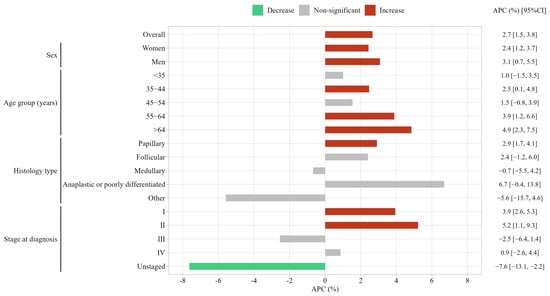
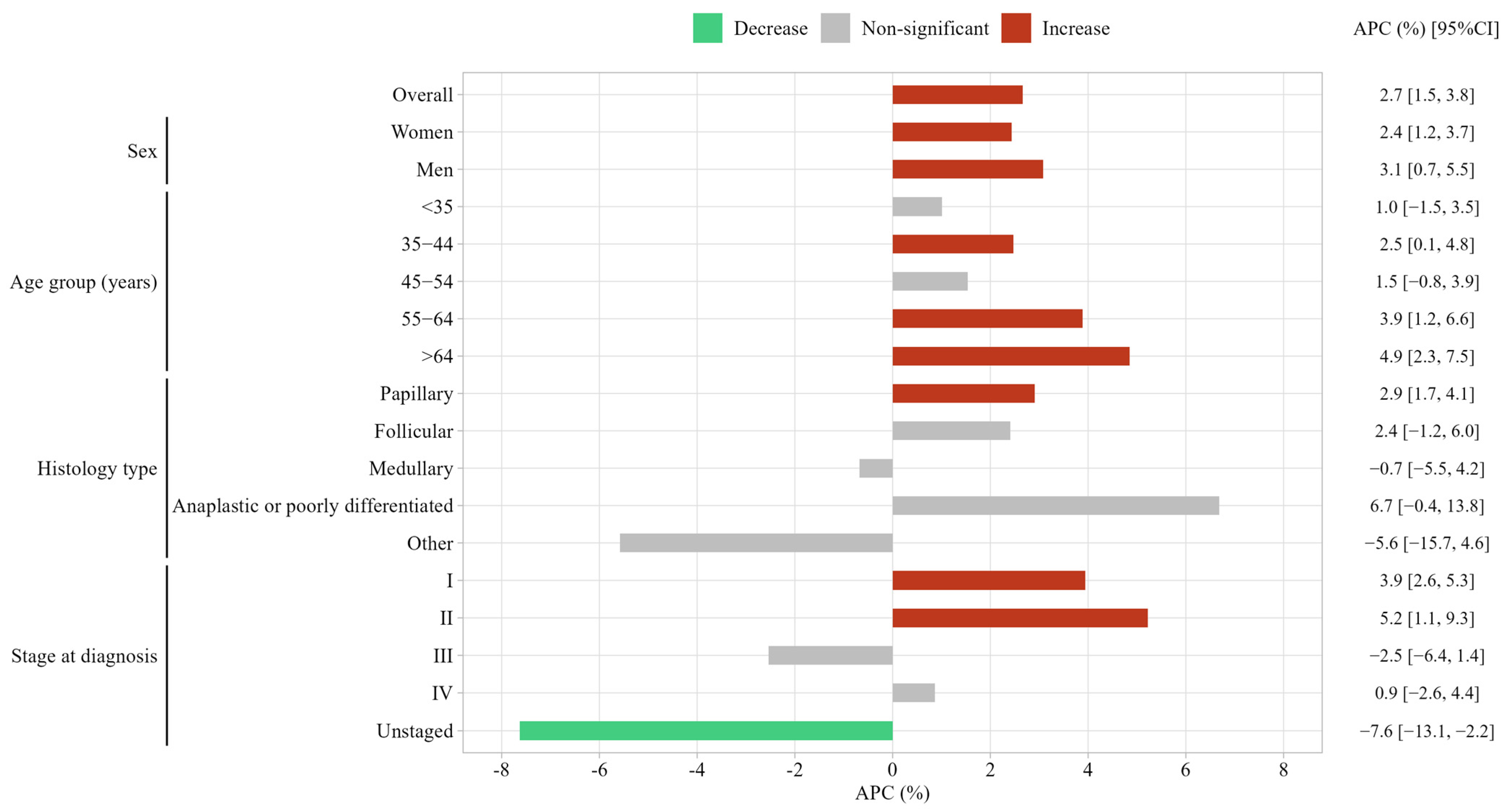
The incidence trends of TC are detailed in Figure 1. Overall incidence increased significantly over the study period, with an APC of 2.7% [95% CI: 1.6, 3.8]. Increasing trends were observed in both sexes, with a seemingly higher APC in men (APC = 3.1% [95% CI: 0.7, 5.5]) compared with women (APC = 2.4% [95% CI: 1.2, 3.7]). The results of the overdispersion, zero-inflation, and goodness of fit for Poisson assumption are shown in Supplementary Table S2. In addition, across all Poisson GLMs, no point changes in the incidence trend were detected. The sensitivity analysis revealed no differences in the APCs for the 2002–2021, 2002–2021 (excluding 2020), and 2002–2019 periods.
Figure 1.
Incidence trends of thyroid cancer by age group, histology and stage, 2002-2021, Girona, Spain. Statistical significance of the APC was determined by whether the 95% CI excluded 0.
Age-specific analyses showed the steepest increases among individuals older than 54 years, particularly in those aged >64 years (APC = 4.9% [95% CI: 2.3, 7.5]). A non-negligible rise in APC was also observed in the 35–44-year group (APC = 2.5% [95% CI: 0.1, 4.8]) (Figure 1).
The only histological subtype responsible for the upward trend of the APC amongst all cases is papillary TC (APC = 2.9% [95% CI: 1.7, 4.1]). An increasing but not significant trend was observed for anaplastic and poorly differentiated carcinoma, with an APC of 6.7% [95% CI: −0.4, 13.8]). With respect to stage at diagnosis, remarkable increases were observed only for Stage I (APC = 3.9% [95% CI: 2.6, 5.3]) and Stage II (APC = 5.2% [95% CI: 1.1–9.3]), as reported in Figure 1.
4. Discussion
This population-based study, including 998 incident cases of TC diagnosed in Girona Province between 2002 and 2021, revealed a significant and sustained increase in overall TC incidence, with an APC of 2.7%. This growth was observed in both sexes and was predominantly driven by papillary TC, particularly Stage I and Stage II, and mainly affected patients aged between 35 and 44 and older than 54 years old.
These patterns could be suggestive of overdiagnosis, whereby indolent tumors that are unlikely to cause symptoms or affect survival are increasingly detected. This phenomenon is widely attributed to the widespread use of neck ultrasonography or the growing availability of other diagnostic tools such as computed tomography and positron emission tomography, which are frequently performed for non-thyroid indications in clinical and oncological settings [4]. Globally, TC incidence has risen substantially over recent decades. Between 1990 and 2013, the global ASR of TC increased by approximately 20% [14]. This upward trend was primarily attributed to overdiagnosis. A prominent example is South Korea, where the implementation of a national screening program led to an APC of 24.4% in TC incidence between 1999 and 2010, predominantly driven by the increased detection of papillary TC, without any parallel reduction in mortality [15,16].
Weaker trends have been noted across Europe and North America. In France, data from eight cancer registries showed an increase of 6.2% per year in women and 8.1% per year in men in TC incidence between 1978 and 1997 [17]. In the Italian region of Venezia, the ASR for TC increased by 33.1% in women and 44.2% in men between 2002 and 2013 [18]. Denmark reported steady APCs (1.7% in men, 1.8% in women) from 1943 to 2008 [19]. In the United States, papillary TC incidence increased sharply between 1993 and 2012 (APC 6.26%), while follicular TC and medullary TC showed more modest rises (1.57% and 1.87%, respectively) [20].
In Spain, studies conducted in Granada (1985–2013) and Navarre (1986–2010) reported APCs slightly higher than those observed in our study. APCs increased in both sexes, predominantly driven by papillary TC (Granada: 5.4% in men, 4.7% in women; Navarre: 4.7% in men, 2.5% in women) [21,22]. This phenomenon underscores the issue of overdiagnosis although our findings indicate a more moderate rise in incidence, which may reflect differences in diagnostic practices and healthcare systems. In high-income countries, private healthcare services and liberal use of neck ultrasonography have contributed significantly to overdiagnosis. Consequently, regional disparities in TC incidence likely reflect differences in medical practice patterns, as well as urban–rural disparities [23]. Therefore, overdiagnosis may result in overtreatment, psychological distress, reduced quality of life, and an increased financial burden on the healthcare system without improved survival [24,25]. Similar trends have been observed in other malignancies with established screening programs, such as breast and prostate cancer [26,27].
Traditionally, the rise in TC has been attributed to the overdiagnosis of small incidentally detected tumors, so there have been changes in the main clinical guidelines, such as the American Thyroid Association (ATA) guidelines in 2015 [28]. Acknowledging the potential harms of overdiagnosis and overtreatment, the new guidelines now advocate for less aggressive diagnostic and therapeutic approaches [29].
In parallel with these shifts in clinical management, important modifications were also introduced in the staging system to better align risk stratification with disease-specific outcomes. The main changes focused on risk stratification were age cutoff (raised from 45 to 55 years), microscopic extrathyroidal extension removal (from T3 definition), and N1 disease status (patients are no longer upstaged to Stage III). This led to a large proportion of patients being significantly downstaged, particularly those aged 45–54 years at diagnosis, with the application of the 8th edition of the AJCC TNM staging system, implemented solely to the final four years of the study period (2018–2021) [11].
While shifts toward conservative management may have mitigated overdiagnosis in some regions, they have not influenced the incidence of more advanced or aggressive tumors. This observation suggests that both improved detection methods and a possible true increase in disease incidence may be contributing to global trends [30].
Likewise, the rising trend observed in Stage II in our study—which, from 2018 onward, includes locally advanced tumors and/or tumors with lymph node involvement—should be interpreted in the context of the changes introduced by the 8th edition of the AJCC staging system, which represents a plausible explanation for the observed increase in Stage II cases. Beyond this staging reclassification, other potential contributing factors may also warrant consideration, including environmental exposure to ionizing radiation at an early age, such as that resulting from radiological examinations or nuclear accidents, as well as environmental pollution, particularly exposure to heavy metals. Other potentially modifiable factors, including variations in dietary iodine intake and high body mass index, may also contribute to the observed trends [31,32,33,34]. Regional disparities in TC burden are likely influenced by a complex interplay of environmental, biological, and healthcare-related factors, as well as lifestyle changes and socioeconomic inequalities in healthcare access. Worldwide TC studies have underscored the importance of local sociodemographic and healthcare system characteristics in shaping TC incidence trends and outcomes [2].
TC shows sexual dimorphism, with a three- to five-fold higher incidence in women [35]. This gap, evident in our cohort based on SR, peaks during the reproductive years and narrows after menopause, suggesting estrogens as drivers of thyroid carcinogenesis [36,37]. However, sex hormones should not be regarded as the primary drivers of these differences, but rather as potential contributors, alongside other biological, demographic, and epidemiological factors. Estrogens act genomically, through nuclear estrogen receptor α (ERα) and ERβ regulating cyclin D1 (CCND1) transcription, and non-genomically, through membrane-bound receptors such as G protein-coupled estrogen receptor 1 (GPER1) [38]. ERα promotes proliferation, survival, and aggressive tumor behavior, whereas ERβ generally acts as a tumor suppressor, inducing differentiation and apoptosis [39,40]; an increased ERα/ERβ ratio drives carcinogenesis and predicts aggressiveness and poorer prognosis in papillary TC [41,42]. BRAF V600E acts synergistically, enhancing estrogen-induced metastatic potential by regulating ER expression [43]. Estrogen-activated GPER1 signals via PI3K/AKT/mTOR and RAS/RAF/MAPK promote survival, migration, and epithelial-to-mesenchymal transition [44]. Papillary TC risk appears to increase with prolonged high endogenous estrogen exposure, multiparity, and recent pregnancy, while breastfeeding and oral contraceptive use may confer a protective effect [44,45,46,47]. A higher risk of TC during pregnancy is likely due to elevated estrogens levels, iodine deficiency, and the TSH receptor-stimulating effects of hCG [46,48]. ER-positive breast cancer is a significant risk factor for the development of TC; therefore regular thyroid screening should be recommended for this population to mitigate the increased risk of secondary malignancy driven by genetic and hormonal factors [49].
Environmental exposure to endocrine-disrupting chemicals (EDCs) represents a growing public health concern related to TC incidence. These chemicals, such as phthalates, bisphenols, heavy metals (cadmium), per-/poly-fluoroalkyl substances (PFAS) and polychlorinated biphenyls (PCBs), can interfere with the endocrine axis and mimic or block the effects of natural estrogen, increasing the risk of TC [50,51,52].
Although papillary TC is more frequent in females, the gap in advanced stages and aggressive histologies becomes closer between sexes. These findings may be consistent with prior studies reporting higher mortality and worse prognoses in male patients [53,54,55,56].
A notable limitation of this study is the use of different editions of the AJCC TNM staging system over the study period (2002–2021), which introduces heterogeneity in stage classification. Four editions were applied: the 5th (2002), 6th (2003–2009), 7th (2010–2017), and 8th (2018–2021). Changes from the 5th until the 7th edition had minimal impact on overall stage distribution; however, the transition to the 8th edition resulted in substantial downstaging. Furthermore, the low number of cases in Stages II, III, and IV might contribute to a low statistical power affecting stage-specific trends in the study. Thus, it is imperative to exercise caution when interpreting stage-based analyses due to variations in staging criteria across different editions. Such disparities may compromise the comparability of these analyses over time.
Furthermore, information on tumor size and the reason for diagnosis were unavailable, preventing differentiation between clinically detected and incidentally discovered tumors. Consequently, the predominance of Stage I disease should not be considered a direct measure of overdiagnosis and the ability to quantify the extent of overdiagnosis is limited. In addition, the descriptive nature of the study precludes causal inference regarding environmental or lifestyle or risk factors.
Despite these limitations, this study represents the third population-based analysis of TC incidence in Spain, following those conducted in Navarre and Granada [21,22]. It is the first and only study to include the period after publication of the 2015 American Thyroid Association guidelines [28], which marked a significant shift toward more conservative management strategies. This inclusion allows the evaluation of recent trends in diagnosis and treatment within the context of updated clinical practice.
A key strength of this study lies in the comprehensive stratified analysis by sex, age, stage, and histological subtype, providing a detailed and nuanced picture of TC epidemiology in the region of Girona. Furthermore, it is worth noting that incidence trends based on tumor staging are included, which is not common in Spanish registry studies. This study shows demographic and clinical differences in tumor presentation, offering valuable insights into disease behavior and its variation across population subgroups.
5. Conclusions
Over the last two decades, papillary TC diagnosed at Stages I and II has been the main contributor to the increasing incidence of TC in Girona province in both sexes. Consistent with findings from other studies, these trends may suggest that overdiagnosis accounts for a substantial proportion of the observed increase. Nevertheless, the increase observed in Stage II cases (APC: 5.2%) may warrant further monitoring to better understand the factors that could be contributing to changes in the disease burden beyond improved detection.
Furthermore, the female predominance was most pronounced in younger age groups, in differentiated histological subtypes, and in early-stage disease. Further research is warranted to clarify the role of sex in TC incidence and to determine to what extent this predominance reflects biological susceptibility rather than differential diagnostic scrutiny. These findings underscore the relevance of sex-specific, patient-centered approaches to TC management and reinforce the need to balance early detection against unnecessary diagnosis and treatment.
Supplementary Materials
The following supporting information can be downloaded at https://www.mdpi.com/article/10.3390/cancers18193146/s1, Table S1: Annual population by sex for the province of Girona, 2002–2021. Table S2: Overdispersion, zero-inflation and goodness-of-fit test for Poisson assumption results for all Poisson generalized linear models (GLMs).
Author Contributions
M.A.-C., N.B., J.T., J.R.-C., W.G., M.F.-B., R.M.-G. and J.B. contributed to the design, coordination, analysis and interpretation of study results. M.A.-C., N.B. and J.B. mainly wrote the manuscript, with help from J.T. and J.R.-C. M.P., A.V. and A.R. were responsible for the databases in the Girona Cancer Registry. A.S. and J.T. performed statistical analysis. All authors have read and agreed to the published version of the manuscript.
Funding
Aina Romaguera is a recipient of a Banco Santander-University of Girona predoctoral grant (grant number: IFUdG2025/46).
Institutional Review Board Statement
The study was conducted in accordance with the Declaration of Helsinki, and approved by the local Ethics Committee in the Hospital Universitari de Girona Dr. Josep Trueta (protocol code: GEDGPC-TIR-2022-01, approval number: 2022.141, date of approval: 13 October 2022).
Informed Consent Statement
Not applicable.
Data Availability Statement
The original contributions presented in this study are included in the article/Supplementary Materials. Further inquiries can be directed to the corresponding author.
Conflicts of Interest
The authors declare no conflicts of interest.
Abbreviations
The following abbreviations are used in this manuscript:
| TC | Thyroid cancer |
| CRs | Crude rates |
| ASRe | Age-standardized rate using the 2013 European population |
| ASRw | Age-standardized rate using the 1960 World population |
| APC | Annual percentage change |
| CIs | confidence intervals |
| GCR | Girona Cancer Registry |
| REDECAN | Spanish Network of Cancer Registries |
| ENCR | European Network of Cancer Registries |
| IACR | International Association for Cancer Registries |
| IARC | International Agency for Research on Cancer |
| ICD-O-3 | International Classification of Diseases for Oncology, 3rd Edition |
| AJCC | American Joint Committee on Cancer |
| IQR | Interquartile range |
| ASRs | Age-standardized rates |
| SR | Sex ratio |
| GLM | Generalized linear model |
| ATA | American Thyroid Association |
| ER | Estrogen receptor |
| CCND1 | cyclin D1 |
| GPER1 | G protein-coupled estrogen receptor 1 |
| TSH | Thyroid-stimulating hormone |
| hCG | Human chorionic gonadotropin |
| EDC | Endocrine-disrupting chemical |
| PFAS | Per-/poly-fluoroalkyl substances |
| PCBs | Polychlorinated biphenyls |
References
- Bray, F.; Laversanne, M.; Sung, H.; Ferlay, J.; Siegel, R.L.; Soerjomataram, I.; Jemal, A. Global Cancer Statistics 2022: GLOBOCAN Estimates of Incidence and Mortality Worldwide for 36 Cancers in 185 Countries. CA Cancer J. Clin. 2024, 74, 229–263. [Google Scholar] [CrossRef] [Scilit]
- Li, M.; Dal Maso, L.; Pizzato, M.; Vaccarella, S. Evolving Epidemiological Patterns of Thyroid Cancer and Estimates of Overdiagnosis in 2013–17 in 63 Countries Worldwide: A Population-Based Study. Lancet Diabetes Endocrinol. 2024, 12, 824–836. [Google Scholar] [CrossRef] [Scilit]
- Galofré, J.C. Incidencia de cáncer de tiroides: El descubrimiento del iceberg oculto. Endocrinol. Diabetes Nutr. 2017, 64, 285–287. [Google Scholar] [CrossRef] [Scilit]
- Yasuda, S.; Ide, M. PET and Cancer Screening. Ann. Nucl. Med. 2005, 19, 167–177. [Google Scholar] [CrossRef] [Scilit]
- GBD 2019 Diseases and Injuries Collaborators. Global Burden of 369 Diseases and Injuries in 204 Countries and Territories, 1990–2019: A Systematic Analysis for the Global Burden of Disease Study 2019. Lancet 2020, 396, 1204–1222. [Google Scholar] [CrossRef]
- Li, M.; Brito, J.P.; Vaccarella, S. Long-Term Declines of Thyroid Cancer Mortality: An International Age-Period-Cohort Analysis. Thyroid 2020, 30, 838–846. [Google Scholar] [CrossRef] [Scilit]
- Miranda-Filho, A.; Lortet-Tieulent, J.; Bray, F.; Cao, B.; Franceschi, S.; Vaccarella, S.; Dal Maso, L. Thyroid Cancer Incidence Trends by Histology in 25 Countries: A Population-Based Study. Lancet Diabetes Endocrinol. 2021, 9, 225–234. [Google Scholar] [CrossRef] [Scilit]
- Arroyo, N.; Bell, K.J.L.; Hsiao, V.; Fernandes-Taylor, S.; Alagoz, O.; Zhang, Y.; Davies, L.; Francis, D.O. Prevalence of Subclinical Papillary Thyroid Cancer by Age: Meta-Analysis of Autopsy Studies. J. Clin. Endocrinol. Metab. 2022, 107, 2945–2952. [Google Scholar] [CrossRef] [Scilit]
- Institut d’Estadística de Catalunya. Estimacions de Població. Available online: https://www.idescat.cat/poblacioestrangera/?geo=prov:17&nac=a&b=0 (accessed on 14 July 2026).
- Fritz, A.; Percy, C.; Jack, A.; Shanmugaratnam, K.; Sobin, L.H.; Parkin, D.M.; Whelan, S.L. International Classification of Diseases for Oncology; World Health Organization: Geneva, Switzerland, 2000. [Google Scholar]
- Amin, M.B.; Greene, F.L.; Edge, S.B.; Compton, C.C.; Gershenwald, J.E.; Brookland, R.K.; Meyer, L.; Gress, D.M.; Byrd, D.R.; Winchester, D.P. The Eighth Edition AJCC Cancer Staging Manual: Continuing to Build a Bridge from a Population-Based to a More “Personalized” Approach to Cancer Staging. CA Cancer J. Clin. 2017, 67, 93–99. [Google Scholar] [CrossRef] [Scilit]
- European Commission; Statistical Office of the European Union. Revision of the European Standard Population: Report of Eurostat’s Task Force: 2013 Edition; Publications Office of the European Union: Luxembourg, 2013. [Google Scholar] [CrossRef]
- Segi, M. Cancer Mortality for Selected Sites in 24 Countries; Japan Cancer Society: Nagoya, Japan; Sendai, Japan, 1950. [Google Scholar]
- The Global Burden of Cancer 2013. JAMA Oncol. 2015, 1, 505–527. [CrossRef] [Scilit]
- Ahn, H.S.; Kim, H.J.; Kim, K.H.; Lee, Y.S.; Han, S.J.; Kim, Y.; Ko, M.J.; Brito, J.P. Thyroid Cancer Screening in South Korea Increases Detection of Papillary Cancers with No Impact on Other Subtypes or Thyroid Cancer Mortality. Thyroid 2016, 26, 1535–1540. [Google Scholar] [CrossRef] [Scilit]
- Ahn, H.S.; Kim, H.J.; Welch, H.G. Korea’s Thyroid-Cancer “Epidemic”—Screening and Overdiagnosis. N. Engl. J. Med. 2014, 371, 1765–1767. [Google Scholar] [CrossRef] [Scilit]
- Colonna, M.; Grosclaude, P.; Remontet, L.; Schvartz, C.; Mace-Lesech, J.; Velten, M.; Guizard, A.; Tretarre, B.; Buemi, A.V.; Arveux, P.; et al. Incidence of Thyroid Cancer in Adults Recorded by French Cancer Registries (1978–1997). Eur. J. Cancer 2002, 38, 1762–1768. [Google Scholar] [CrossRef] [Scilit]
- Panato, C.; Serraino, D.; De Santis, E.; Forgiarini, O.; Angelin, T.; Bidoli, E.; Zanier, L.; Del Zotto, S.; Vaccarella, S.; Franceschi, S.; et al. Thyroid Cancer in Friuli Venezia Giulia, Northeastern Italy: Incidence, Overdiagnosis, and Impact of Type of Surgery on Survival. Tumori 2019, 105, 296–303. [Google Scholar] [CrossRef] [Scilit]
- Blomberg, M.; Feldt-Rasmussen, U.; Andersen, K.K.; Kjaer, S.K. Thyroid Cancer in Denmark 1943–2008, before and after Iodine Supplementation. Int. J. Cancer 2012, 131, 2360–2366. [Google Scholar] [CrossRef] [Scilit]
- Megwalu, U.C.; Moon, P.K. Thyroid Cancer Incidence and Mortality Trends in the United States: 2000–2018. Thyroid 2022, 32, 560–570. [Google Scholar] [CrossRef] [Scilit]
- Salamanca-Fernández, E.; Rodriguez-Barranco, M.; Chang-Chan, Y.-L.; Redondo-Sánchez, D.; Domínguez-López, S.; Bayo, E.; Narankiewicz, D.; Expósito, J.; Sánchez, M.J. Thyroid Cancer Epidemiology in South Spain: A Population-Based Time Trend Study. Endocrine 2018, 62, 423–431. [Google Scholar] [CrossRef] [Scilit]
- Rojo Álvaro, J.; Bermejo Fraile, B.; Menéndez Torre, E.; Ardanaz, E.; Guevara, M.; Anda Apiñániz, E. Increased Incidence of Thyroid Cancer in Navarra (Spain). Evolution and Clinical Characteristics, 1986–2010. Endocrinol. Diabetes Nutr. 2017, 64, 303–309. [Google Scholar] [CrossRef] [Scilit]
- Huston-Paterson, H.H.; Mao, Y.; Tseng, C.-H.; Kim, J.; Bobanga, I.; Wu, J.X.; Yeh, M.W. Rural-Urban Disparities in the Continuum of Thyroid Cancer Care: Analysis of 92,794 Cases. Thyroid 2024, 34, 635–645. [Google Scholar] [CrossRef] [Scilit]
- Jensen, C.B.; Pitt, S.C. Patient Perception of Receiving a Thyroid Cancer Diagnosis. Curr. Opin. Endocrinol. Diabetes Obes. 2021, 28, 533–539. [Google Scholar] [CrossRef] [Scilit]
- Li, M.; Meheus, F.; Polazzi, S.; Delafosse, P.; Borson-Chazot, F.; Seigneurin, A.; Simon, R.; Combes, J.-D.; Dal Maso, L.; Colonna, M.; et al. The Economic Cost of Thyroid Cancer in France and the Corresponding Share Associated with Treatment of Overdiagnosed Cases. Value Health 2023, 26, 1175–1182. [Google Scholar] [CrossRef] [Scilit]
- Qaseem, A.; Lin, J.S.; Mustafa, R.A.; Horwitch, C.A.; Wilt, T.J.; Clinical Guidelines Committee of the American College of Physicians; Forciea, M.A.; Fitterman, N.; Iorio, A.; Kansagara, D.; et al. Screening for Breast Cancer in Average-Risk Women: A Guidance Statement from the American College of Physicians. Ann. Intern. Med. 2019, 170, 547–560. [Google Scholar] [CrossRef] [Scilit]
- Loeb, S.; Bjurlin, M.A.; Nicholson, J.; Tammela, T.L.; Penson, D.F.; Carter, H.B.; Carroll, P.; Etzioni, R. Overdiagnosis and Overtreatment of Prostate Cancer. Eur. Urol. 2014, 65, 1046–1055. [Google Scholar] [CrossRef] [Scilit]
- Haugen, B.R.; Alexander, E.K.; Bible, K.C.; Doherty, G.M.; Mandel, S.J.; Nikiforov, Y.E.; Pacini, F.; Randolph, G.W.; Sawka, A.M.; Schlumberger, M.; et al. 2015 American Thyroid Association Management Guidelines for Adult Patients with Thyroid Nodules and Differentiated Thyroid Cancer: The American Thyroid Association Guidelines Task Force on Thyroid Nodules and Differentiated Thyroid Cancer. Thyroid 2016, 26, 1–133. [Google Scholar] [CrossRef] [Scilit]
- Ringel, M.D.; Sosa, J.A.; Baloch, Z.; Bischoff, L.; Bloom, G.; Brent, G.A.; Brock, P.L.; Chou, R.; Flavell, R.R.; Goldner, W.; et al. 2025 American Thyroid Association Management Guidelines for Adult Patients with Differentiated Thyroid Cancer. Thyroid 2025, 35, 841–985. [Google Scholar] [CrossRef] [Scilit]
- Chen, D.W.; Haymart, M.R. Unravelling the Rise in Thyroid Cancer Incidence and Addressing Overdiagnosis. Nat. Rev. Endocrinol. 2026, 22, 10–20. [Google Scholar] [CrossRef] [Scilit]
- Jacob, P.; Kenigsberg, Y.; Zvonova, I.; Goulko, G.; Buglova, E.; Heidenreich, W.F.; Golovneva, A.; Bratilova, A.A.; Drozdovitch, V.; Kruk, J.; et al. Childhood Exposure Due to the Chernobyl Accident and Thyroid Cancer Risk in Contaminated Areas of Belarus and Russia. Br. J. Cancer 1999, 80, 1461–1469. [Google Scholar] [CrossRef] [Scilit]
- Van Gerwen, M.; Alerte, E.; Alsen, M.; Little, C.; Sinclair, C.; Genden, E. The Role of Heavy Metals in Thyroid Cancer: A Meta-Analysis. J. Trace Elem. Med. Biol. 2022, 69, 126900. [Google Scholar] [CrossRef] [Scilit]
- Zhang, X.; Zhang, F.; Li, Q.; Aihaiti, R.; Feng, C.; Chen, D.; Zhao, X.; Teng, W. The Relationship between Urinary Iodine Concentration and Papillary Thyroid Cancer: A Systematic Review and Meta-Analysis. Front. Endocrinol. 2022, 13, 1049423. [Google Scholar] [CrossRef] [Scilit]
- Shin, A.; Cho, S.; Jang, D.; Abe, S.K.; Saito, E.; Rahman, M.S.; Islam, M.R.; Sawada, N.; Shu, X.-O.; Koh, W.-P.; et al. Body Mass Index and Thyroid Cancer Risk: A Pooled Analysis of Half a Million Men and Women in the Asia Cohort Consortium. Thyroid 2022, 32, 306–314. [Google Scholar] [CrossRef] [Scilit]
- Shobab, L.; Burman, K.D.; Wartofsky, L. Sex Differences in Differentiated Thyroid Cancer. Thyroid 2022, 32, 224–235. [Google Scholar] [CrossRef] [Scilit]
- Suteau, V.; Munier, M.; Briet, C.; Rodien, P. Sex Bias in Differentiated Thyroid Cancer. Int. J. Mol. Sci. 2021, 22, 12992. [Google Scholar] [CrossRef] [Scilit]
- Rahbari, R.; Zhang, L.; Kebebew, E. Thyroid Cancer Gender Disparity. Future Oncol. 2010, 6, 1771–1779. [Google Scholar] [CrossRef] [Scilit]
- Gong, Z.; Yang, S.; Wei, M.; Vlantis, A.C.; Chan, J.Y.K.; van Hasselt, C.A.; Li, D.; Zeng, X.; Xue, L.; Tong, M.C.F.; et al. The Isoforms of Estrogen Receptor Alpha and Beta in Thyroid Cancer. Front. Oncol. 2022, 12, 916804. [Google Scholar] [CrossRef] [Scilit]
- Dong, W.; Zhang, H.; Li, J.; Guan, H.; He, L.; Wang, Z.; Shan, Z.; Teng, W. Estrogen Induces Metastatic Potential of Papillary Thyroid Cancer Cells through Estrogen Receptor α and β. Int. J. Endocrinol. 2013, 2013, 941568. [Google Scholar] [CrossRef] [Scilit]
- Denaro, N.; Romanò, R.; Alfieri, S.; Dolci, A.; Licitra, L.; Nuzzolese, I.; Ghidini, M.; Bareggi, C.; Bertaglia, V.; Solinas, C.; et al. The Tumor Microenvironment and the Estrogen Loop in Thyroid Cancer. Cancers 2023, 15, 2458. [Google Scholar] [CrossRef] [Scilit]
- Qiu, Y.-B.; Liao, L.-Y.; Jiang, R.; Xu, M.; Xu, L.-W.; Chen, G.G.; Liu, Z.-M. PES1 Promotes the Occurrence and Development of Papillary Thyroid Cancer by Upregulating the ERα/ERβ Protein Ratio. Sci. Rep. 2019, 9, 1032. [Google Scholar] [CrossRef] [Scilit]
- Huang, Y.; Dong, W.; Li, J.; Zhang, H.; Shan, Z.; Teng, W. Differential Expression Patterns and Clinical Significance of Estrogen Receptor-α and β in Papillary Thyroid Carcinoma. BMC Cancer 2014, 14, 383. [Google Scholar] [CrossRef] [Scilit]
- Kim, M.; Kim, S.; Ha, S.Y.; Xu, Z.; Han, Y.; Jee, H.-G.; Cho, S.W.; Park, Y.J.; Lee, K.E. BRAFV600E Mutation Enhances Estrogen-Induced Metastatic Potential of Thyroid Cancer by Regulating the Expression of Estrogen Receptors. Endocrinol. Metab. 2022, 37, 879–890. [Google Scholar] [CrossRef] [Scilit]
- Liu, J.; Xu, T.; Ma, L.; Chang, W. Signal Pathway of Estrogen and Estrogen Receptor in the Development of Thyroid Cancer. Front. Oncol. 2021, 11, 593479. [Google Scholar] [CrossRef] [Scilit]
- Derwahl, M.; Nicula, D. Estrogen and Its Role in Thyroid Cancer. Endocr. Relat. Cancer 2014, 21, T273–T283. [Google Scholar] [CrossRef] [Scilit]
- Moleti, M.; Sturniolo, G.; Di Mauro, M.; Russo, M.; Vermiglio, F. Female Reproductive Factors and Differentiated Thyroid Cancer. Front. Endocrinol. 2017, 8, 111. [Google Scholar] [CrossRef] [Scilit]
- Dan, R.; Paran, N.; Vinegrad, N.; Fraenkel, M.; Yoel, U. Parity as a Risk Factor for Differentiated Thyroid Carcinoma: A Population-Based Study. J. Clin. Endocrinol. Metab. 2026, 111, e1281–e1288. [Google Scholar] [CrossRef] [Scilit]
- Messuti, I.; Corvisieri, S.; Bardesono, F.; Rapa, I.; Giorcelli, J.; Pellerito, R.; Volante, M.; Orlandi, F. Impact of Pregnancy on Prognosis of Differentiated Thyroid Cancer: Clinical and Molecular Features. Eur. J. Endocrinol. 2014, 170, 659–666. [Google Scholar] [CrossRef] [Scilit]
- Wang, H.; Li, S.; Shi, J.; Feng, C.; Wang, Y.; Zhang, F. Unbalanced Bidirectional Causal Association between Thyroid Cancer and ER-Positive Breast Cancer: Should We Recommend Screening for Thyroid Cancer in Breast Cancer Patients? BMC Genom. 2023, 24, 762. [Google Scholar] [CrossRef] [Scilit]
- Modica, R.; Benevento, E.; Colao, A. Endocrine-Disrupting Chemicals (EDCs) and Cancer: New Perspectives on an Old Relationship. J. Endocrinol. Investig. 2023, 46, 667–677. [Google Scholar] [CrossRef] [Scilit]
- Alsen, M.; Leung, A.M.; van Gerwen, M. Per- and Polyfluoroalkyl Substances (PFAS) in Community Water Systems (CWS) and the Risk of Thyroid Cancer: An Ecological Study. Toxics 2023, 11, 786. [Google Scholar] [CrossRef] [Scilit]
- Macedo, S.; Teixeira, E.; Gaspar, T.B.; Boaventura, P.; Soares, M.A.; Miranda-Alves, L.; Soares, P. Endocrine-Disrupting Chemicals and Endocrine Neoplasia: A Forty-Year Systematic Review. Environ. Res. 2023, 218, 114869. [Google Scholar] [CrossRef] [Scilit]
- Liu, Q.; Ma, B.; Song, M.; Sun, W.; Zhang, H. Age-Dependent Changes in the Prognostic Advantage of Papillary Thyroid Cancer in Women: A SEER-Based Study. Clin. Endocrinol. 2023, 99, 342–349. [Google Scholar] [CrossRef] [Scilit]
- Machens, A.; Hauptmann, S.; Dralle, H. Disparities between Male and Female Patients with Thyroid Cancers: Sex Difference or Gender Divide? Clin. Endocrinol. 2006, 65, 500–505. [Google Scholar] [CrossRef] [Scilit]
- Zhang, Y.; Ji, X.; Yang, Z.; Wang, Y. Risk Factors for Cervical Lymph Node Metastasis of Papillary Thyroid Cancer in Elderly Patients Aged 65 and Older. Front. Endocrinol. 2024, 15, 1418767. [Google Scholar] [CrossRef] [Scilit]
- Zahedi, A.; Bondaz, L.; Rajaraman, M.; Leslie, W.D.; Jefford, C.; Young, J.E.; Pathak, K.A.; Bureau, Y.; Rachinsky, I.; Badreddine, M.; et al. Risk for Thyroid Cancer Recurrence Is Higher in Men Than in Women Independent of Disease Stage at Presentation. Thyroid 2020, 30, 871–877. [Google Scholar] [CrossRef] [Scilit]

Disclaimer/Publisher’s Note: The statements, opinions and data contained in all publications are solely those of the individual author(s) and contributor(s) and not of MDPI and/or the editor(s). MDPI and/or the editor(s) disclaim responsibility for any injury to people or property resulting from any ideas, methods, instructions or products referred to in the content. |
© 2026 by the authors. Licensee MDPI, Basel, Switzerland. This article is an open access article distributed under the terms and conditions of the Creative Commons Attribution (CC BY) license.