Differences in Hepatocellular Carcinoma Incidence Trends Across US Census Divisions, 2001 to 2021
by
 , , , and
Itunu O. Sokale
1,2,* ,
,
Omar Rosales
1,
Aaron P. Thrift
1,2,
Hashem B. El-Serag
2,3,
Elyse Burgess
1 and
Abiodun O. Oluyomi
1,2,4 1
Section of Epidemiology and Population Sciences, Department of Medicine, Baylor College of Medicine, Houston, TX 77030, USA
2
Dan L. Duncan Comprehensive Cancer Center, Baylor College of Medicine, Houston, TX 77030, USA
3
Section of Gastroenterology and Hepatology and Clinical Epidemiology and Comparative Effectiveness Program in the Health Services Research, Michael E. DeBakey VA Medical Center, Baylor College of Medicine, Houston, TX 77030, USA
4
Center for Precision Environmental Health, Baylor College of Medicine, Houston, TX 77030, USA
*
Author to whom correspondence should be addressed.
Cancers 2025, 17(9), 1431; https://doi.org/10.3390/cancers17091431
Submission received: 2 March 2025
/
Revised: 7 April 2025
/
Accepted: 15 April 2025
/
Published: 24 April 2025
(This article belongs to the Section Cancer Epidemiology and Prevention)
Simple Summary
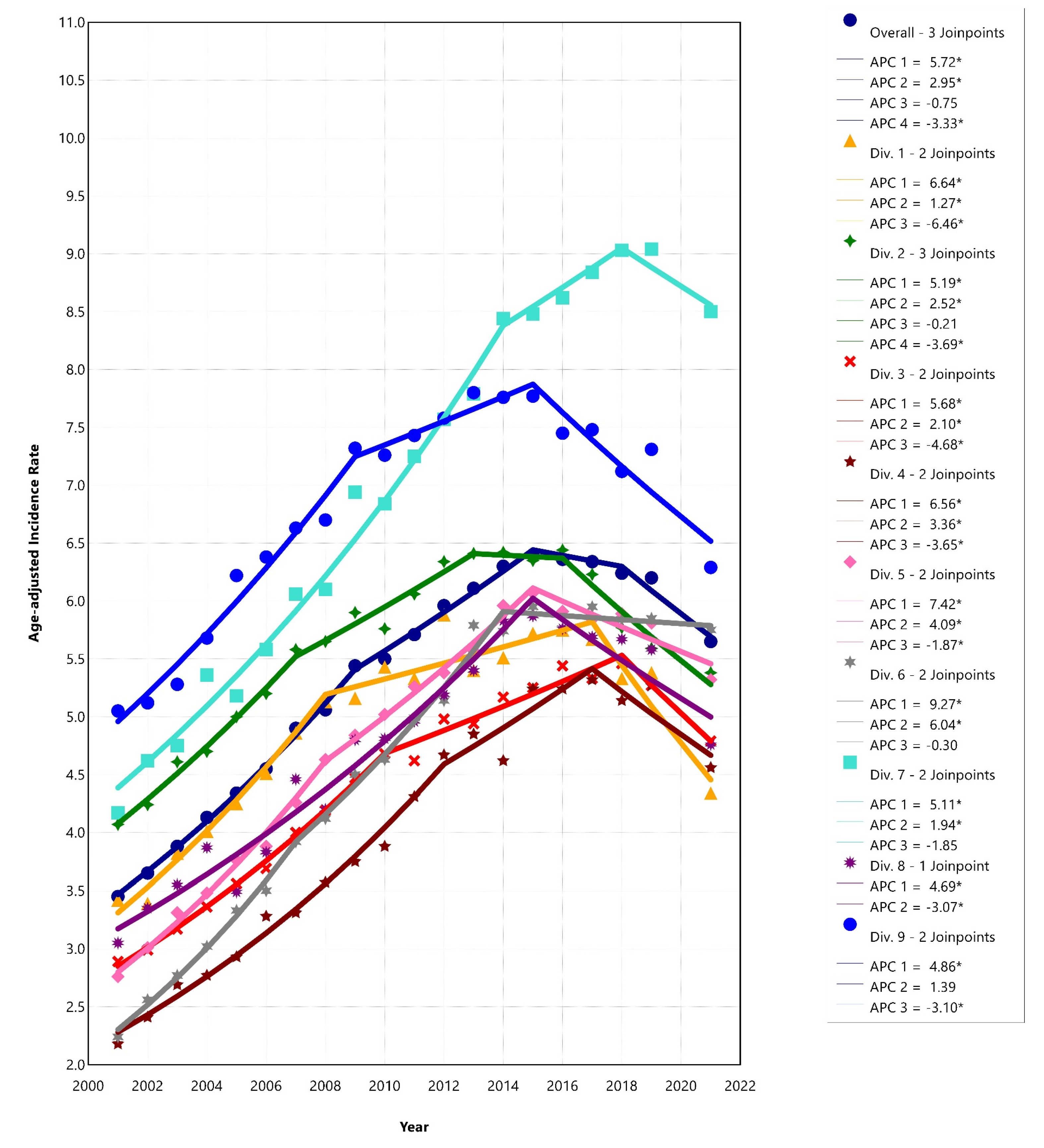
Hepatocellular carcinoma (HCC) is a leading cause of cancer-related deaths globally. Current data regarding national HCC disparities may mask important place-based differences in trends. The national HCC incidence rate dropped significantly in recent years from 2018 to 2021, suggesting progress. However, the decrease was not uniform across US geographic divisions and racial/ethnic groups, highlighting the need for additional strategic interventions. Interventions with racial/ethnic- and place-specific considerations may offer practical solutions to HCC disparities.
Abstract
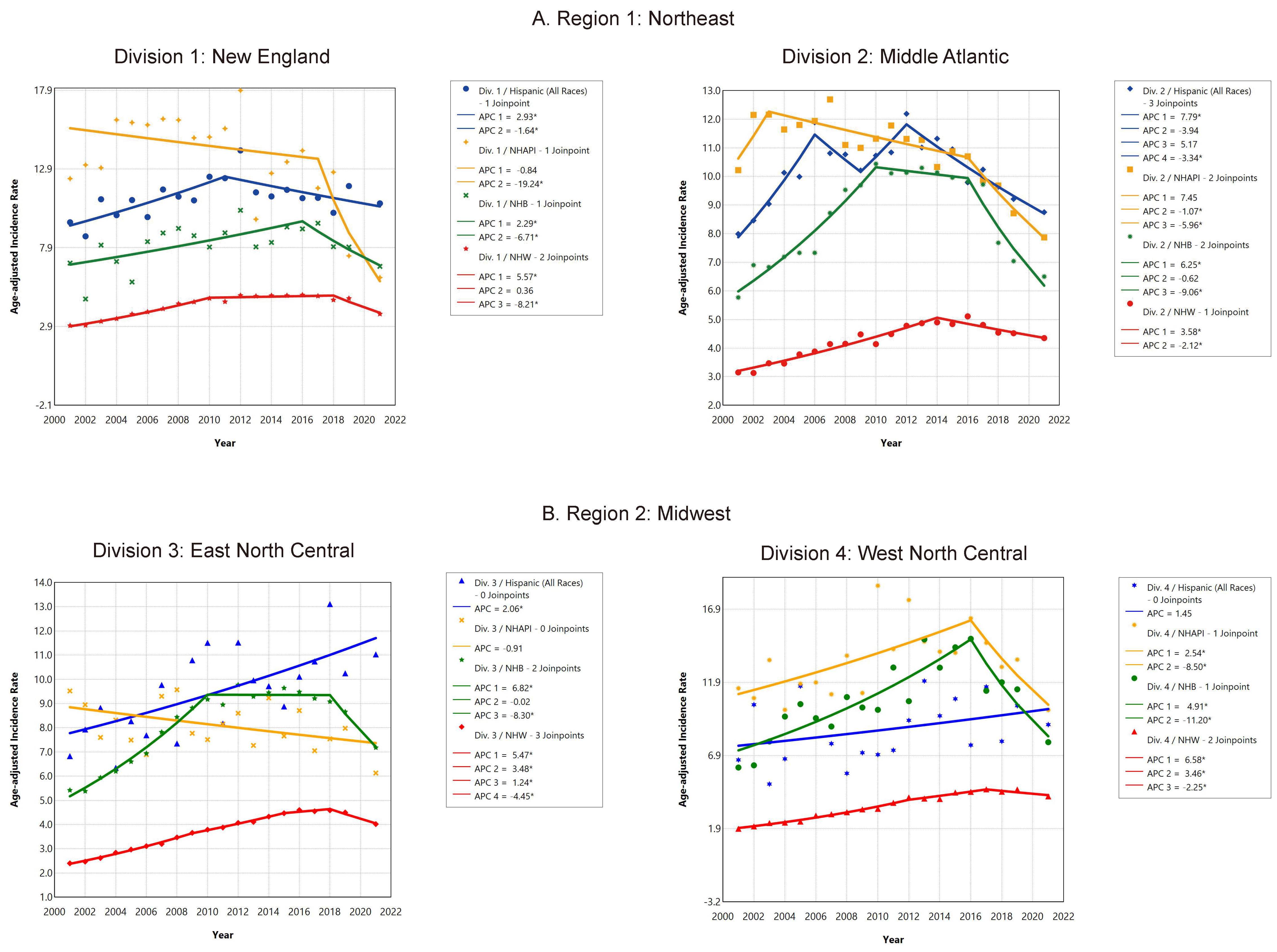
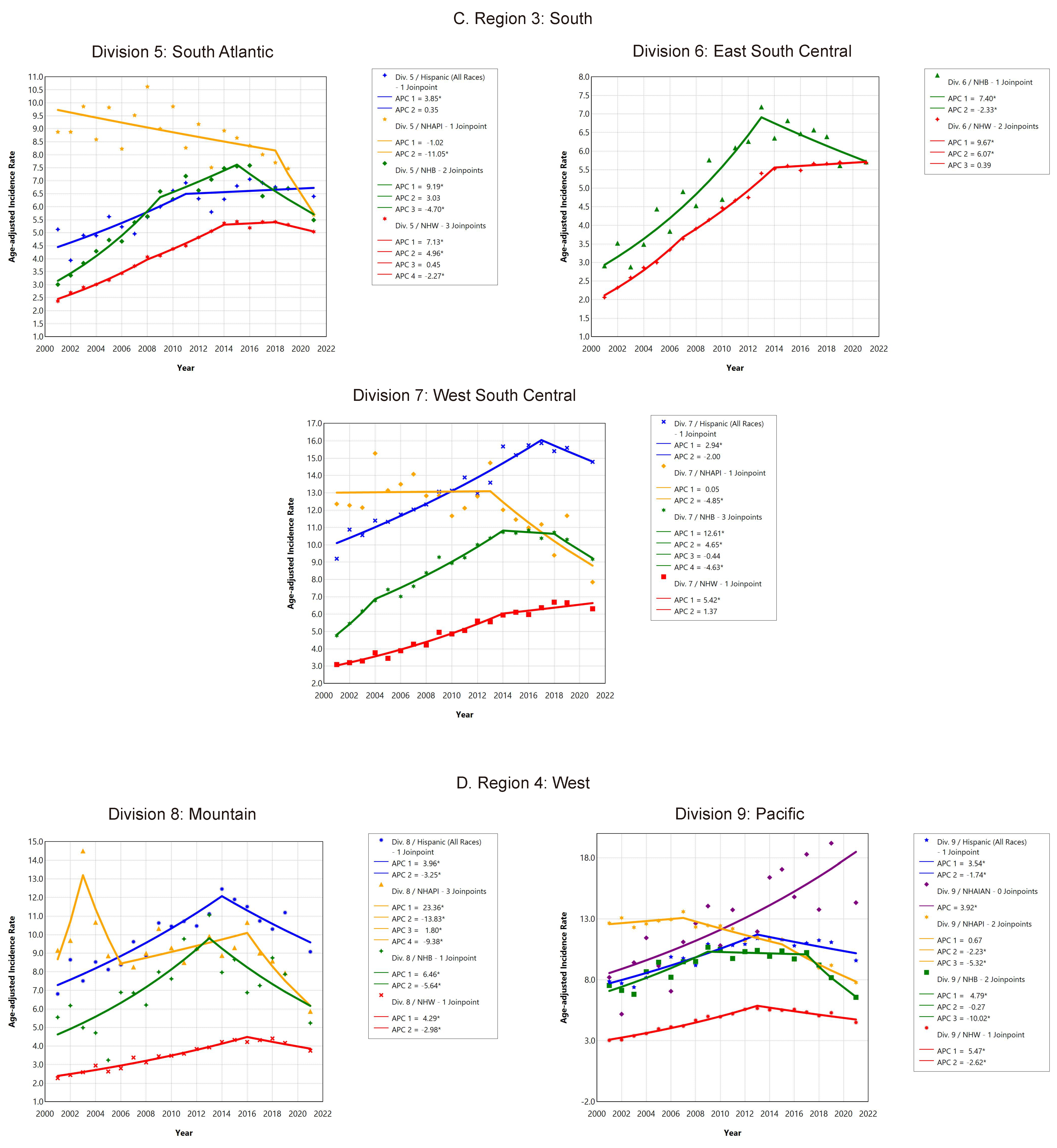
Background/Objectives: Hepatocellular carcinoma (HCC) is a leading cause of cancer diagnoses and deaths in the United States. This study serves as an update on secular trends in national HCC incidence rates while exploring potential geographic and racial/ethnic differences across all nine US census divisions. Methods: We analyzed HCC incidence data reported to the United States Cancer Statistics (USCS) database from 2001 to 2021 (excluding 2020 data, based on the Centers for Disease Control and Prevention’s cautionary recommendations for COVID-19 pandemic data usage for trend analysis). We performed trend analyses of age-adjusted incidence rates in the US overall, by census divisions, and then stratified by race/ethnicity, using the National Cancer Institute’s Joinpoint Regression Program. Results: Between 2001 and 2021, HCC incidence rates increased nationally, with an average annual percentage change (AAPC) of 2.51 (95% confidence interval (CI): 2.32–2.72); however, the rate decreased (annual percentage change (APC) −3.33 (95% CI: −4.78–−1.96) in recent years from 2018 to 2021. Division 1 had the greatest decrease (APC −6.46 (95% CI: −9.62–−3.96) from 2017 to 2021, while rates leveled in Division 6 (East South Central) and Division 7 (West South Central). HCC trends decreased substantially for non-Hispanic Black and Non-Hispanic Asian and Pacific Islander groups in almost all divisions in recent years, but trends were stable, decreased, or increased for other racial/ethnic populations. Conclusions: Despite declining national HCC incidence rates, these trends were not uniform across racial/ethnic groups or US census divisions. Race-specific interventions are needed to reduce disparities in HCC incidence in all US census divisions.