Dog Owners Exhibit Better Diet Quality but Similar Physical Activity Compared to Non-Owners: A Case-Control Study

 , ,
, ,  ,
, Highlights
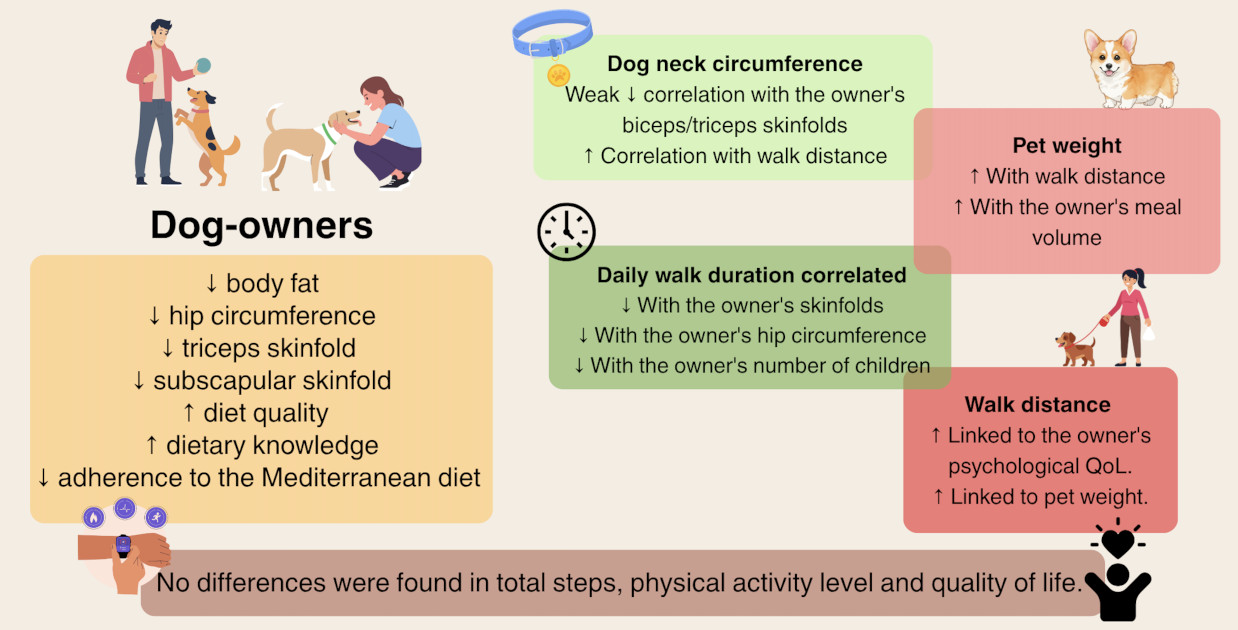
- Dog owners had lower body fat and better anthropometric measures than non-owners, but they did not differ in overall physical activity levels (daily steps) and quality of life.
- Dog ownership was associated with better diet quality and nutrition knowledge.
- Dog ownership alone is not sufficient to improve physical activity or reduce body fat. However, it may promote healthier eating behaviors and nutrition awareness.
Abstract
1. Introduction
2. Materials and Methods
2.1. Study Design
2.2. Dog Breed, Characteristics, and Anthropometric Data
2.3. Anthropometry of Dog Owners and Non-Owners
2.4. Physical Activity
2.5. Diet Quality and Knowledge
2.6. Quality of Life
2.7. Statistical Analyses
3. Results
3.1. General Comparisons Between Dog Owners and Non-Owners
3.2. Relationships Between Pet Characteristics, Owner Characteristics, and Lifestyle Measures
3.3. Differences in Nutritional Knowledge and Diet Quality by Dog Ownership
3.4. Multivariate Regression Analyses
4. Discussion
5. Conclusions
Author Contributions
Funding
Institutional Review Board Statement
Informed Consent Statement
Data Availability Statement
Acknowledgments
Conflicts of Interest
Abbreviations
| BF% | Body fat percentage |
| BMI | Body mass index |
| CVD | Cardiovascular disease |
| EAT | Eating Assessment Table |
| IQR | Interquartile ranges |
| MedDietScore | Mediterranean Diet Score |
| MVPA | Moderate-to-vigorous physical activity |
| PAL | Physical activity level |
| QoL | Quality of life |
| SD | Standard deviation |
| WHO | World Health Organization |
| WHOQOL-BREF | World Health Organization Quality of Life-brief |
References
- Wollrab, T.I. Human-Animal Bond Issues. J. Am. Vet. Med. Assoc. 1998, 212, 1675. [Google Scholar]
- Dunn, S.L.; Sit, M.J.; DeVon, H.A.; Makidon, D.; Tintle, N.L. Abstract P313: Dog Walking Is Associated With Increased Home-Based Exercise in Patients with Coronary Heart Disease. Circulation 2017, 135, AP313. [Google Scholar] [CrossRef]
- Mubanga, M.; Byberg, L.; Nowak, C.; Egenvall, A.; Magnusson, P.K.; Ingelsson, E.; Fall, T. Dog Ownership and the Risk of Cardiovascular Disease and Death—A Nationwide Cohort Study. Sci. Rep. 2017, 7, 15821. [Google Scholar] [CrossRef]
- Schreiner, P.J. Emerging Cardiovascular Risk Research: Impact of Pets on Cardiovascular Risk Prevention. Curr. Cardiovasc. Risk Rep. 2016, 10, 8. [Google Scholar] [CrossRef]
- Yeh, T.-L.; Lei, W.-T.; Liu, S.-J.; Chien, K.-L. A Modest Protective Association between Pet Ownership and Cardiovascular Diseases: A Systematic Review and Meta-Analysis. PLoS ONE 2019, 14, e0216231. [Google Scholar] [CrossRef]
- Levine, G.N.; Allen, K.; Braun, L.T.; Christian, H.E.; Friedmann, E.; Taubert, K.A.; Thomas, S.A.; Wells, D.L.; Lange, R.A. Pet Ownership and Cardiovascular Risk. Circulation 2013, 127, 2353–2363. [Google Scholar] [CrossRef] [PubMed]
- Surma, S.; Oparil, S.; Narkiewicz, K. Pet Ownership and the Risk of Arterial Hypertension and Cardiovascular Disease. Curr. Hypertens. Rep. 2022, 24, 295–302. [Google Scholar] [CrossRef] [PubMed]
- Kramer, C.K.; Mehmood, S.; Suen, R.S. Dog Ownership and Survival. Circ. Cardiovasc. Qual. Outcomes 2019, 12, e005554. [Google Scholar] [CrossRef]
- Cutt, H.E.; Giles-Corti, B.; Wood, L.J.; Knuiman, M.W.; Burke, V. Barriers and Motivators for Owners Walking Their Dog: Results from Qualitative Research. Health Promot. J. Aust. 2008, 19, 118–124. [Google Scholar] [CrossRef]
- Curl, A.L.; Bibbo, J.; Johnson, R.A. Dog Walking, the Human–Animal Bond and Older Adults’ Physical Health. Gerontologist 2016, 57, gnw051. [Google Scholar] [CrossRef]
- Martins, C.F.; Soares, J.P.; Cortinhas, A.; Silva, L.; Cardoso, L.; Pires, M.A.; Mota, M.P. Pet’s Influence on Humans’ Daily Physical Activity and Mental Health: A Meta-Analysis. Front. Public Health 2023, 11, 1196199. [Google Scholar] [CrossRef]
- Coleman, K.J.; Rosenberg, D.E.; Conway, T.L.; Sallis, J.F.; Saelens, B.E.; Frank, L.D.; Cain, K. Physical Activity, Weight Status, and Neighborhood Characteristics of Dog Walkers. Prev. Med. 2008, 47, 309–312. [Google Scholar] [CrossRef]
- Brown, S.G.; Rhodes, R.E. Relationships Among Dog Ownership and Leisure-Time Walking in Western Canadian Adults. Am. J. Prev. Med. 2006, 30, 131–136. [Google Scholar] [CrossRef] [PubMed]
- Mičková, E.; Machová, K.; Daďová, K.; Svobodová, I. Does Dog Ownership Affect Physical Activity, Sleep, and Self-Reported Health in Older Adults? Int. J. Environ. Res. Public Health 2019, 16, 3355. [Google Scholar] [CrossRef] [PubMed]
- Scoresby, K.J.; Strand, E.B.; Ng, Z.; Brown, K.C.; Stilz, C.R.; Strobel, K.; Barroso, C.S.; Souza, M. Pet Ownership and Quality of Life: A Systematic Review of the Literature. Vet. Sci. 2021, 8, 332. [Google Scholar] [CrossRef]
- Applebaum, J.W.; Ellison, C.; Struckmeyer, L.; Zsembik, B.A.; McDonald, S.E. The Impact of Pets on Everyday Life for Older Adults During the COVID-19 Pandemic. Front. Public Health 2021, 9, 652610. [Google Scholar] [CrossRef]
- Irvine, L.; Cilia, L. More-than-human Families: Pets, People, and Practices in Multispecies Households. Sociol. Compass 2017, 11, e12455. [Google Scholar] [CrossRef]
- Kogan, L.R.; Currin-McCulloch, J.; Bussolari, C.; Packman, W.; Erdman, P. The Psychosocial Influence of Companion Animals on Positive and Negative Affect during the COVID-19 Pandemic. Animals 2021, 11, 2084. [Google Scholar] [CrossRef]
- Ham, S.A.; Epping, J. Dog Walking and Physical Activity in the United States. Prev. Chronic Dis. 2006, 3, A47. [Google Scholar] [PubMed]
- Ballin, M.; Antonsson, O.; Rosenqvist, V.; Nordström, P.; Nordström, A. Association of Dog Ownership with Accelerometer-Measured Physical Activity and Daily Steps in 70-Year-Old Individuals: A Population-Based Cross-Sectional Study. BMC Public Health 2021, 21, 2313. [Google Scholar] [CrossRef]
- Dall, P.M.; Ellis, S.L.H.; Ellis, B.M.; Grant, P.M.; Colyer, A.; Gee, N.R.; Granat, M.H.; Mills, D.S. The Influence of Dog Ownership on Objective Measures of Free-Living Physical Activity and Sedentary Behaviour in Community-Dwelling Older Adults: A Longitudinal Case-Controlled Study. BMC Public Health 2017, 17, 496. [Google Scholar] [CrossRef]
- Grammatikopoulou, M.G.; Poulimeneas, D.; Gounitsioti, I.S.; Gerothanasi, K.; Tsigga, M.; Kiranas, E. Prevalence of Simple and Abdominal Obesity in Greek Adolescents: The ADONUT Study. Clin. Obes. 2014, 4, 303–308. [Google Scholar] [CrossRef] [PubMed]
- Ekelund, U.; Ward, H.A.; Norat, T.; Luan, J.; May, A.M.; Weiderpass, E.; Sharp, S.J.; Overvad, K.; Østergaard, J.N.; Tjønneland, A.; et al. Physical Activity and All-Cause Mortality across Levels of Overall and Abdominal Adiposity in European Men and Women: The European Prospective Investigation into Cancer and Nutrition Study (EPIC). Am. J. Clin. Nutr. 2015, 101, 613–621. [Google Scholar] [CrossRef] [PubMed]
- Nijland, M.L.; Stam, F.; Seidell, J.C. Overweight in Dogs, but Not in Cats, Is Related to Overweight in Their Owners. Public Health Nutr. 2010, 13, 102–106. [Google Scholar] [CrossRef]
- Suarez, L.; Bautista-Castaño, I.; Peña Romera, C.; Montoya-Alonso, J.A.; Corbera, J.A. Is Dog Owner Obesity a Risk Factor for Canine Obesity? A “One-Health” Study on Human–Animal Interaction in a Region with a High Prevalence of Obesity. Vet. Sci. 2022, 9, 243. [Google Scholar] [CrossRef]
- Linder, D.E.; Santiago, S.; Halbreich, E.D. Is There a Correlation Between Dog Obesity and Human Obesity? Preliminary Findings of Overweight Status Among Dog Owners and Their Dogs. Front. Vet. Sci. 2021, 8, 654617. [Google Scholar] [CrossRef]
- Muñoz-Prieto, A.; Nielsen, L.R.; Dąbrowski, R.; Bjørnvad, C.R.; Söder, J.; Lamy, E.; Monkeviciene, I.; Ljubić, B.B.; Vasiu, I.; Savic, S.; et al. European Dog Owner Perceptions of Obesity and Factors Associated with Human and Canine Obesity. Sci. Rep. 2018, 8, 13353. [Google Scholar] [CrossRef] [PubMed]
- Dodd, S.A.S.; Cave, N.J.; Adolphe, J.L.; Shoveller, A.K.; Verbrugghe, A. Plant-Based (Vegan) Diets for Pets: A Survey of Pet Owner Attitudes and Feeding Practices. PLoS ONE 2019, 14, e0210806. [Google Scholar] [CrossRef]
- World Health Organization. Obesity: Preventing and Managing the Global Epidemic: Report of a WHO Consultation; World Health Organization: Geneva, Switzerland, 2000. [Google Scholar]
- WHO. Waist Circumference and Waist-Hip Ratio: Report of a WHO Expert Consultation; World Health Organization: Geneva, Switzerland, 2011. [Google Scholar]
- Aswathappa, J.; Garg, S.; Kutty, K.; Shankar, V. Neck Circumference as an Anthropometric Measure of Obesity in Diabetics. N. Am. J. Med. Sci. 2013, 5, 28. [Google Scholar] [CrossRef] [PubMed]
- Evenson, K.R.; Goto, M.M.; Furberg, R.D. Systematic Review of the Validity and Reliability of Consumer-Wearable Activity Trackers. Int. J. Behav. Nutr. Phys. Act. 2015, 12, 159. [Google Scholar] [CrossRef]
- Govig, B.; de Souza, R.; Levitan, E.B.; Crookston, D.; Kestens, Y.; Mendivil, C.O.; Mittleman, M.A. The Eating Assessment Table—An Evidence-Based Nutrition Tool for Clinicians. Crit. Pathw. Cardiol. A J. Evid.-Based Med. 2009, 8, 55–62. [Google Scholar] [CrossRef]
- Panagiotakos, D.B.; Milias, G.A.; Pitsavos, C.; Stefanadis, C. MedDietScore: A Computer Program That Evaluates the Adherence to the Mediterranean Dietary Pattern and Its Relation to Cardiovascular Disease Risk. Comput. Methods Programs Biomed. 2006, 83, 73–77. [Google Scholar] [CrossRef]
- WHOQOL-Files|The World Health Organization. Available online: https://www.who.int/tools/whoqol/whoqol-bref (accessed on 17 November 2025).
- R Core Team. R: A Language and Environment for Statistical Computing; R Foundation for Statistical Computing: Vienna, Austria, 2016. Available online: http//www.R-project.org/ (accessed on 17 December 2025).
- Kim, G.-M.; Lee, D.-Y. Physical Activity and Health Benefits of Human-Pet Interaction: A Focus on Dog Ownership. J. Korean Phys. Ther. 2025, 37, 143–149. [Google Scholar] [CrossRef]
- Brown, B.B.; Jensen, W.A. Dog Ownership and Walking: Perceived and Audited Walkability and Activity Correlates. Int. J. Environ. Res. Public Health 2020, 17, 1385. [Google Scholar] [CrossRef] [PubMed]
- Powell, L.; Edwards, K.M.; Bauman, A.; McGreevy, P.; Podberscek, A.; Neilly, B.; Sherrington, C.; Stamatakis, E. Does Dog Acquisition Improve Physical Activity, Sedentary Behaviour and Biological Markers of Cardiometabolic Health? Results from a Three-Arm Controlled Study. BMJ Open Sport Exerc. Med. 2020, 6, e000703. [Google Scholar] [CrossRef] [PubMed]
- Nayor, M.; Chernofsky, A.; Spartano, N.L.; Tanguay, M.; Blodgett, J.B.; Murthy, V.L.; Malhotra, R.; Houstis, N.E.; Velagaleti, R.S.; Murabito, J.M.; et al. Physical Activity and Fitness in the Community: The Framingham Heart Study. Eur. Heart J. 2021, 42, 4565–4575. [Google Scholar] [CrossRef]
- Koohsari, M.J.; Shibata, A.; Ishii, K.; Kurosawa, S.; Yasunaga, A.; Hanibuchi, T.; Nakaya, T.; McCormack, G.R.; Oka, K. Dog Ownership and Adults’ Objectively-Assessed Sedentary Behaviour and Physical Activity. Sci. Rep. 2020, 10, 17487. [Google Scholar] [CrossRef]
- Johnson, R.A.; Meadows, R.L. Dog-Walking: Motivation for Adherence to a Walking Program. Clin. Nurs. Res. 2010, 19, 387–402. [Google Scholar] [CrossRef]
- Richards, E.A.; Woodcox, S. Barriers and Motivators to Physical Activity Prior to Starting a Community-Based Walking Program. Int. J. Environ. Res. Public Health 2021, 18, 10659. [Google Scholar] [CrossRef]
- Hancock, J.; Jackson, S.; Johnson, A.B. The Importance of Dog Ownership: Implications for Long-Term Weight Reduction after Gastric Banding. Am. J. Lifestyle Med. 2017, 11, 86–89. [Google Scholar] [CrossRef]
- Richards, E.A. Does Dog Walking Predict Physical Activity Participation. Am. J. Health Promot. 2016, 30, 323–330. [Google Scholar] [CrossRef]
- Zablan, K.; Melvin, G.; Hayley, A. Dog Ownership, Physical Activity, Loneliness and Mental Health: A Comparison of Older Adult and Younger Adult Companion Animal Owners. BMC Psychol. 2024, 12, 618. [Google Scholar] [CrossRef] [PubMed]
- Merkouri, A.; Graham, T.M.; O’Haire, M.E.; Purewal, R.; Westgarth, C. Dogs and the Good Life: A Cross-Sectional Study of the Association Between the Dog–Owner Relationship and Owner Mental Wellbeing. Front. Psychol. 2022, 13, 903647. [Google Scholar] [CrossRef]
- Barcelos, A.M.; Kargas, N.; Maltby, J.; Hall, S.; Mills, D.S. A Framework for Understanding How Activities Associated with Dog Ownership Relate to Human Well-Being. Sci. Rep. 2020, 10, 11363. [Google Scholar] [CrossRef] [PubMed]
- Banton, S.; Baynham, A.; Pezzali, J.G.; von Massow, M.; Shoveller, A.K. Grains on the Brain: A Survey of Dog Owner Purchasing Habits Related to Grain-Free Dry Dog Foods. PLoS ONE 2021, 16, e0250806. [Google Scholar] [CrossRef]
- Lund, T.B.; McKeegan, D.E.F.; Cribbin, C.; Sandøe, P. Animal Ethics Profiling of Vegetarians, Vegans and Meat-Eaters. Anthrozoos 2016, 29, 89–106. [Google Scholar] [CrossRef]
- Heuberger, R. Associations of Pet Ownership with Older Adults Eating Patterns and Health. Curr. Gerontol. Geriatr. Res. 2017, 2017, 9417350. [Google Scholar] [CrossRef] [PubMed]
- Panagiotakos, D.B.; Pitsavos, C.; Arvaniti, F.; Stefanadis, C. Adherence to the Mediterranean Food Pattern Predicts the Prevalence of Hypertension, Hypercholesterolemia, Diabetes and Obesity, among Healthy Adults; the Accuracy of the MedDietScore. Prev. Med. 2007, 44, 335–340. [Google Scholar] [CrossRef]
- Maugeri, A.; Medina-Inojosa, J.R.; Kunzova, S.; Barchitta, M.; Agodi, A.; Vinciguerra, M.; Lopez-Jimenez, F. Dog Ownership and Cardiovascular Health: Results From the Kardiovize 2030 Project. Mayo Clin. Proc. Innov. Qual. Outcomes 2019, 3, 268–275. [Google Scholar] [CrossRef]
- German, A.J. Style over Substance: What Can Parenting Styles Tell Us about Ownership Styles and Obesity in Companion Animals? Br. J. Nutr. 2015, 113, S72–S77. [Google Scholar] [CrossRef]
- Courcier, E.A.; Thomson, R.M.; Mellor, D.J.; Yam, P.S. An Epidemiological Study of Environmental Factors Associated with Canine Obesity. J. Small Anim. Pract. 2010, 51, 362–367. [Google Scholar] [CrossRef] [PubMed]
- Colliard, L.; Ancel, J.; Benet, J.-J.; Paragon, B.-M.; Blancenterd, G. Risk Factors for Obesity in Dogs in France. J. Nutr. 2006, 136, 1951S–1954S. [Google Scholar] [CrossRef] [PubMed]
- Campbell, K.J.; Crawford, D.A.; Ball, K. Family Food Environment and Dietary Behaviors Likely to Promote Fatness in 5–6 Year-Old Children. Int. J. Obes. 2006, 30, 1272–1280. [Google Scholar] [CrossRef]
- Birch, L.L.; Davison, K.K. Family Environmental Factors Influencing the Developing Behavioral Controls of Food Intake and Childhood Overweight. Pediatr. Clin. N. Am. 2001, 48, 893–907. [Google Scholar] [CrossRef]
- Vitger, A.D.; Stallknecht, B.M.; Miles, J.E.; Hansen, S.L.; Vegge, A.; Bjørnvad, C.R. Immunometabolic Parameters in Overweight Dogs during Weight Loss with or without an Exercise Program. Domest. Anim. Endocrinol. 2017, 59, 58–66. [Google Scholar] [CrossRef]
- Hoerster, K.D.; Mayer, J.A.; Sallis, J.F.; Pizzi, N.; Talley, S.; Pichon, L.C.; Butler, D.A. Dog Walking: Its Association with Physical Activity Guideline Adherence and Its Correlates. Prev. Med. 2011, 52, 33–38. [Google Scholar] [CrossRef]
- Cutt, H.; Giles-Corti, B.; Knuiman, M. Encouraging Physical Activity through Dog Walking: Why Don’t Some Owners Walk with Their Dog? Prev. Med. 2008, 46, 120–126. [Google Scholar] [CrossRef] [PubMed]
- Robertson, I.D. The Association of Exercise, Diet and Other Factors with Owner-Perceived Obesity in Privately Owned Dogs from Metropolitan Perth, WA. Prev. Vet. Med. 2003, 58, 75–83. [Google Scholar] [CrossRef]
- Bland, I.M.; Guthrie-Jones, A.; Taylor, R.D.; Hill, J. Dog Obesity: Owner Attitudes and Behaviour. Prev. Vet. Med. 2009, 92, 333–340. [Google Scholar] [CrossRef]
- Warren, B.S.; Wakshlag, J.J.; Maley, M.; Farrell, T.J.; Struble, A.M.; Panasevich, M.R.; Wells, M.T. Use of Pedometers to Measure the Relationship of Dog Walking to Body Condition Score in Obese and Non-Obese Dogs. Br. J. Nutr. 2011, 106, S85–S89. [Google Scholar] [CrossRef]
- Kluess, H.A.; Jones, R.L. A Comparison of Owner Perceived and Measured Body Condition, Feeding and Exercise in Sport and Pet Dogs. Front. Vet. Sci. 2023, 10, 1211996. [Google Scholar] [CrossRef] [PubMed]
- Kim, K.; Song, B.; Kim, D.; Kim, D.H.; Lee, H.J.; Kim, G. Effect of Leash Walking on Weight Loss and Assessment of Hair Cortisol in Overweight Dogs. Comp. Exerc. Physiol. 2024, 20, 283–291. [Google Scholar] [CrossRef]
- Oka, K.; Shibata, A. Prevalence and Correlates of Dog Walking Among Japanese Dog Owners. J. Phys. Act. Health 2012, 9, 786–793. [Google Scholar] [CrossRef] [PubMed]
- Lentino, C.; Visek, A.J.; McDonnell, K.; DiPietro, L. Dog Walking Is Associated With a Favorable Risk Profile Independent of a Moderate to High Volume of Physical Activity. J. Phys. Act. Health 2012, 9, 414–420. [Google Scholar] [CrossRef]


| Dog Owners (n = 55) | Non-Owners (n = 55) | |
|---|---|---|
| Sex (men/women) (n) | 22/33 | 19/36 |
| Age (years) | 31.6 ± 11.7 | 32.8 ± 11.9 |
| BMI (kg/m2) | 23.3 ± 3.3 | 24.7 ± 3.9 |
| Weight Status (underweight/normoweight/overweight/obese) (n) | 3/41/8/3 | 2/23/14/7 |
| Education (primary/secondary/tertiary/postgraduate) (n) | 2/10/37/6 | 1/14/40/0 |
| Marital status (single/married/divorced/widow) | 40/11/2/2 | 32/22/1/0 |
| Number of children (0/1/2/3) (n) | 38/3/11/3/0 | 32/2/12/9 |
| Occupation (student/employee/unemployed/household/retired/entrepreneur) (n) | 16/19/5/1/1/13 | 15/26/4/1/3/6 |
| Dog breed (n) | Akita/Boxer/Brack/Canis/Cocker/German Sheppard/Golden Retriever | 1/3/3/1/3/4/2 |
| Greek Kokoni/Greyhound/Husky/Jack Russell/Labrador/Maltese | 1/1/1/2/1/3 | |
| Pincher/Pointer/Puggle/Tsow tsow/Yorkshire/Mixed breeds | 1/1/1/1/3/1/21 | |
| Number of dogs in household (1/2/3) (n) | 50/3/2 | |
| Dog breed size (large/medium/small) (n) | 13/24/18 | |
| Dog weight (kg) | 15.9 ± 9.1 | |
| Dog age (years) | 4.7 ± 2.9 | |
| Dog neck perimeter (cm) | 31.5 ± 10.0 | |
| Able-bodied dogs (n) | 55 | |
| Apparently healthy dogs (n) | 53 | |
| Variables | Dog Owners (n = 55) | Non-Owners (n = 55) | Effect Size | p-Value | |
|---|---|---|---|---|---|
| Body fat | Body fat (% body weight) * | 24.0 ± 6.0 | 27.1 ± 6.7 | −0.46 | 0.009 |
| Body fat (kg) adjusted for sex, age, and BMI * | 24.1 ± 5.9 | 27.0 ± 6.7 | −0.46 | 0.009 | |
| Body fat (kg) ♮ | 15.8 (7.0) | 17.66 (7.18) | −0.34 | 0.034 | |
| Perimeters | Waist circumference (cm) ♮ | 76.0 (13.0) | 79.0 (11.3) | −0.05 | NS |
| Neck circumference (cm) ♮ | 34.0 (5.0) | 33.40 (5.5) | −0.22 | NS | |
| Hips circumference (cm) ♮ | 95.5 (11.5) | 103.00 (9.8) | −0.04 | <0.001 | |
| Skinfolds | Biceps skinfold (mm) ♮ | 10.0 (6.0) | 9.40 (5.3) | −0.28 | NS |
| Triceps skinfold (mm) * | 16.3 ± 6.0 | 18.9 ± 5.8 | −0.01 | 0.012 | |
| Subscapular skinfold (mm) ♮ | 12.4 (5.3) | 15.6 (5.5) | −0.001 | 0.003 | |
| Suprailiac skinfold (mm) ♮ | 18.1 (11.8) | 20.5 (10.2) | −0.15 | NS | |
| Steps | Average steps/day ♮ | 8352 (5301) | 7122 (4116) | −0.02 | NS |
| Average steps/day adjusted for age ♮ | 8541 (795) | 8335 (1015) | −0.06 | NS | |
| Average steps/day adjusted for age and BMI ♮ | 8467 (812) | 8494 (1072) | −0.01 | NS | |
| Average dog-walk duration/day (min) | 50.7 ± 32.1 | - | |||
| Average dog-walk distance/day (m) | 1091.8 ± 647.5 | - | |||
| QoL | Physical domain of QoL ♮ | 57.1 (14.3) | 53.6 (14.3) | −0.07 | NS |
| Psychological domain of QoL ♮ | 62.5 (12.5) | 62.5 (16.6) | 0.00 | NS | |
| Social relations domain of QoL ♮ | 66.7 (25.0) | 75.0 (25.0) | −0.07 | NS | |
| Environmental domain of QoL ♮ | 59.4 (15.7) | 68.8 (18.8) | −0.07 | NS |
| Q | Category | Dog Owners (n = 55) | Non-Owners (n = 55) | Effect Size | p-Value * |
|---|---|---|---|---|---|
| 1 | Fruit ♮ | 6.0 (4.0, 6.0) | 4.0 (2.0, 6.0) | −0.10 | NS |
| 2 | Vegetables ♮ | 4.0 (4.0, 6.0) | 4.0 (4.0, 4.0) | −0.14 | NS |
| 3 | Legumes ♮ | 4.0 (4.0, 4.0) | 4.0 (4.0, 4.0) | −0.02 | NS |
| 4 | Cooking methods ♮ | 10.0 (8.0, 10.0) | 8.0 (8.0, 10.0) | −0.16 | NS |
| 5a | Fat content of meat intake ♮ | 4.0 (2.0, 4.0) | 2.0 (2.0, 4.0) | −0.23 | 0.017 |
| 5b | Weekly meat intake ♮ | 3.0 (3.0, 3.0) | 3.0 (2.0, 3.0) | −0.07 | NS |
| 5c | Average meat portion ♮ | 2.0 (1.0, 2.0) | 2.0 (1.0, 2.0) | −0.18 | NS |
| 6a | Whole grain vs. processed ♮ | 2.0 (2.0, 4.0) | 2.0 (0.0, 2.0) | −0.15 | NS |
| 6b | Recognition of starchy foods ♮ | 2.0 (1.0, 3.0) | 3.0 (2.0, 3.0) | −0.21 | 0.027 |
| 6c | Portion control ♮ | 2.0 (2.0, 3.0) | 2.0 (2.0, 3.0) | −0.13 | NS |
| 7a | Total dairy ♮ | 2.0 (0.0, 2.0) | 2.0 (0.0, 2.0) | −0.11 | NS |
| 7b | High-fat dairy ♮ | 0.0 (−1.0, 0.0) | 0.0 (0.0, 0.0) | −0.01 | NS |
| 7c | Low-fat dairy ♮ | 0.0 (0.0, 2.0) | 0.0 (0.0, 0.0) | −0.21 | 0.027 |
| 8a | Knowledge of nutritional labels concerning fat ♮ | 2.0 (0.0, 2.0) | 2.0 (0.0, 2.0) | −0.14 | NS |
| 8b | Knowledge of trans fats in increasing CVD risk ♮ | 2.0 (0.0, 2.0) | 0.0 (0.0, 2.0) | −0.26 | 0.007 |
| 8c | Distinction between MUFA, PUFA, and SFA ♮ | 2.0 (0.0, 2.0) | 2.0 (0.0, 2.0) | −0.4 | NS |
| 8d | Ability to calculate % energy from fat ♮ | 0.0 (0.0, 2.0) | 0.0 (0.0, 0.0) | −0.16 | NS |
| 8e | Regularly read nutrition labels to estimate fat intake ♮ | 0.0 (0.0, 2.0) | 0.0 (0.0, 2.0) | −0.04 | NS |
| 9a | Weekly alcohol intake ♮ | 0.0 (0.0, 1.5) | 0.0 (0.0, 0.0) | −0.34 | 0.001 |
| 9b | Fish intake ♮ | 1.0 (1.0, 2.0) | 1.0 (1.0, 2.0) | −0.02 | NS |
| 9c | Omega-3 fatty acid intake ♮ | 1.0 (0.0, 2.0) | 1.0 (0.0, 3.0) | −0.05 | NS |
| 10a | Diversity ♮ | 2.0 (2.0, 2.0) | 2.0 (2.0, 2.0) | −0.03 | NS |
| 10b | Portion control ♮ | 2.0 (0.0, 2.0) | 2.0 (0.0, 2.0) | −0.15 | NS |
| 10c | Nuts intake ♮ | 2.0 (0.0, 2.0) | 0.0 (0.0, 2.0) | −0.15 | NS |
| 10d | Vitamin supplements intake ♮ | 0.0 (0.0, 0.0) | 0.0 (0.0, 0.0) | −0.07 | NS |
| 10e | Grazing ♮ | 2.0 (0.0, 2.0) | 0.0 (0.0, 2.0) | −0.02 | 0.008 |
| 11a | Empty calories from drinks ♮ | 0.0 (−2.0, 0.0) | 0.0 (−2.0, 0.0) | −0.25 | NS |
| 11b | Empty calories from salty snacks ♮ | 0.0 (0.0, 0.0) | 0.0 (−2.0, 0.0) | −0.14 | NS |
| 11c | Empty calories from 1 dessert/day ♮ | 0.0 (−2.0, 0.0) | 0.0 (−2.0, 0.0) | −0.03 | NS |
| 11d | Empty calories from 2 desserts/day ♮ | 0.0 (0.0, 0.0) | 0.0 (0.0, 0.0) | −0.12 | NS |
| 11e | Empty calories from sweet snacks ♮ | 0.0 (0.0, 0.0) | 0.0 (−2.0, 0.0) | −0.04 | NS |
| 1–4 | Food groups intake and cooking methods * | 23.1 ± 5.2 | 21.5 ± 4.3 | 0.34 | 0.004 |
| 5–11 | Nutrition knowledge and specific habits * | 29.3 ± 9.2 | 24.2 ± 9.1 | 0.55 | 0.002 |
| Total EAT score (raw) * | 52.2 ± 12.3 | 45.7 ± 12.0 | 0.53 | 0.003 | |
| Total EAT score (adjusted for education and BMI) * | 49.6 ± 2.6 | 48.3 ± 3.3 | −0.43 | 0.026 | |
| BF (% of Body Weight) | EAT Score | MedDietScore | ||||||||||||
|---|---|---|---|---|---|---|---|---|---|---|---|---|---|---|
| Variable | B | β | 95%Cl | p-Value | Variable | B | β | 95%CI | p-Value | Variable | B | β | 95%CI | p-Value |
| Dog owner | −0.08 | −0.01 | −0.97, 0.81 | 0.862 | Dog owner | 6.29 | 0.25 | 1.8, 10.8 | 0.007 | Dog owner | −1.78 | −0.17 | −2.5, 0.1 | 0.08 |
| Age | 0.03 | 0.05 | −0.02, 0.07 | 0.21 | Age | 0.02 | 0.02 | −0.2, 0.2 | 0.87 | Sex (w) | 1.01 | 0.17 | −0.2, 2.5 | 0.09 |
| Sex (w) | 7.01 | 0.5 | 6.0, 8.0 | <0.001 | Sex (w) | 8.01 | 0.31 | 3.0, 13.0 | 0.002 | BF (kg) | 0.04 | 0.08 | −0.05, 0.12 | 0.40 |
| Total steps | −0.000035 | −0.061 | −0.00007, 0.000001 | 0.065 | Total steps | 0.00006 | 0.06 | −0.0001, 0.0002 | 0.51 | Psychological QoL | −0.051 | −0.19 | −0.1, 0.0 | 0.048 |
| BMI | 1.68 | 0.91 | 1.5, 1.9 | <0.001 | BMI | −0.34 | −0.10 | −1.1, 0.4 | 0.36 | Total steps | −0.000002 | −0.01 | 0.0, 0.0 | 0.926 |
| Category | Dog Owners (n = 55) | Non-Owners (n = 55) | Effect Size | p-Value * |
|---|---|---|---|---|
| Cereal ♮ | 1.0 (1.0–2.0) | 1.0 (0.0–2.0) | −0.15 | NS |
| Potatoes ♮ | 1.0 (1.0–2.0) | 3.0 (2.0–4.0) | −0.62 | <0.001 |
| Fruit ♮ | 2.0 (1.0–3.0) | 2.0 (1.0–3.0) | −0.12 | NS |
| Vegetables ♮ | 2.0 (2.0–3.0) | 2.0 (2.0–2.0) | −0.16 | NS |
| Legumes ♮ | 2.0 (2.0–2.0) | 2.0 (2.0–2.0) | 0.00 | NS |
| Fish ♮ | 1.0 (1.0–2.0) | 2.0 (1.0–2.0) | −0.01 | NS |
| Red meat ♮ | 4.0 (4.0–5.0) | 4.0 (4.0–5.0) | −0.13 | NS |
| Poultry ♮ | 5.0 (4.0–5.0) | 5.0 (4.0–5.0) | −0.04 | NS |
| Dairy ♮ | 4.0 (4.0–5.0) | 5.0 (4.0–5.0) | −0.13 | NS |
| Olive oil ♮ | 5.0 (5.0–5.0) | 5.0 (4.0–5.0) | −0.18 | NS |
| Alcohol ♮ | 5.0 (4.0–5.0) | 5.0 (5.0–5.0) | −0.25 | 0.009 |
| Total MedDietScore * | 33.8 ± 4.0 | 35.1 ± 2.7 | −0.40 | 0.018 |
Disclaimer/Publisher’s Note: The statements, opinions and data contained in all publications are solely those of the individual author(s) and contributor(s) and not of MDPI and/or the editor(s). MDPI and/or the editor(s) disclaim responsibility for any injury to people or property resulting from any ideas, methods, instructions or products referred to in the content. |
© 2025 by the authors. Licensee MDPI, Basel, Switzerland. This article is an open access article distributed under the terms and conditions of the Creative Commons Attribution (CC BY) license.
Share and Cite
Margaritis, K.L.; Perantonaki, M.; Pyrga, K.; Pardali, E.C.; Poulimeneas, D.; Goulis, D.G.; Tsigga, M.; Grammatikopoulou, M.G. Dog Owners Exhibit Better Diet Quality but Similar Physical Activity Compared to Non-Owners: A Case-Control Study. Nutrients 2026, 18, 78. https://doi.org/10.3390/nu18010078
Margaritis KL, Perantonaki M, Pyrga K, Pardali EC, Poulimeneas D, Goulis DG, Tsigga M, Grammatikopoulou MG. Dog Owners Exhibit Better Diet Quality but Similar Physical Activity Compared to Non-Owners: A Case-Control Study. Nutrients. 2026; 18(1):78. https://doi.org/10.3390/nu18010078
Chicago/Turabian StyleMargaritis, Konstantinos Lazaridis, Marilena Perantonaki, Katerina Pyrga, Eleni C. Pardali, Dimitrios Poulimeneas, Dimitrios G. Goulis, Maria Tsigga, and Maria G. Grammatikopoulou. 2026. "Dog Owners Exhibit Better Diet Quality but Similar Physical Activity Compared to Non-Owners: A Case-Control Study" Nutrients 18, no. 1: 78. https://doi.org/10.3390/nu18010078
APA StyleMargaritis, K. L., Perantonaki, M., Pyrga, K., Pardali, E. C., Poulimeneas, D., Goulis, D. G., Tsigga, M., & Grammatikopoulou, M. G. (2026). Dog Owners Exhibit Better Diet Quality but Similar Physical Activity Compared to Non-Owners: A Case-Control Study. Nutrients, 18(1), 78. https://doi.org/10.3390/nu18010078