A New Resistant Starch Material Obtained from Faba Beans (Vicia faba L. Creole): Potential Modulation of the Diabetic Condition in Diabetic Wistar Rat Model

 , , ,
, , ,  , , and
 Highlights
- The retrograded starch ingredient derived from creole beans was highlighted as a potential functional ingredient for reducing the glycaemic response.
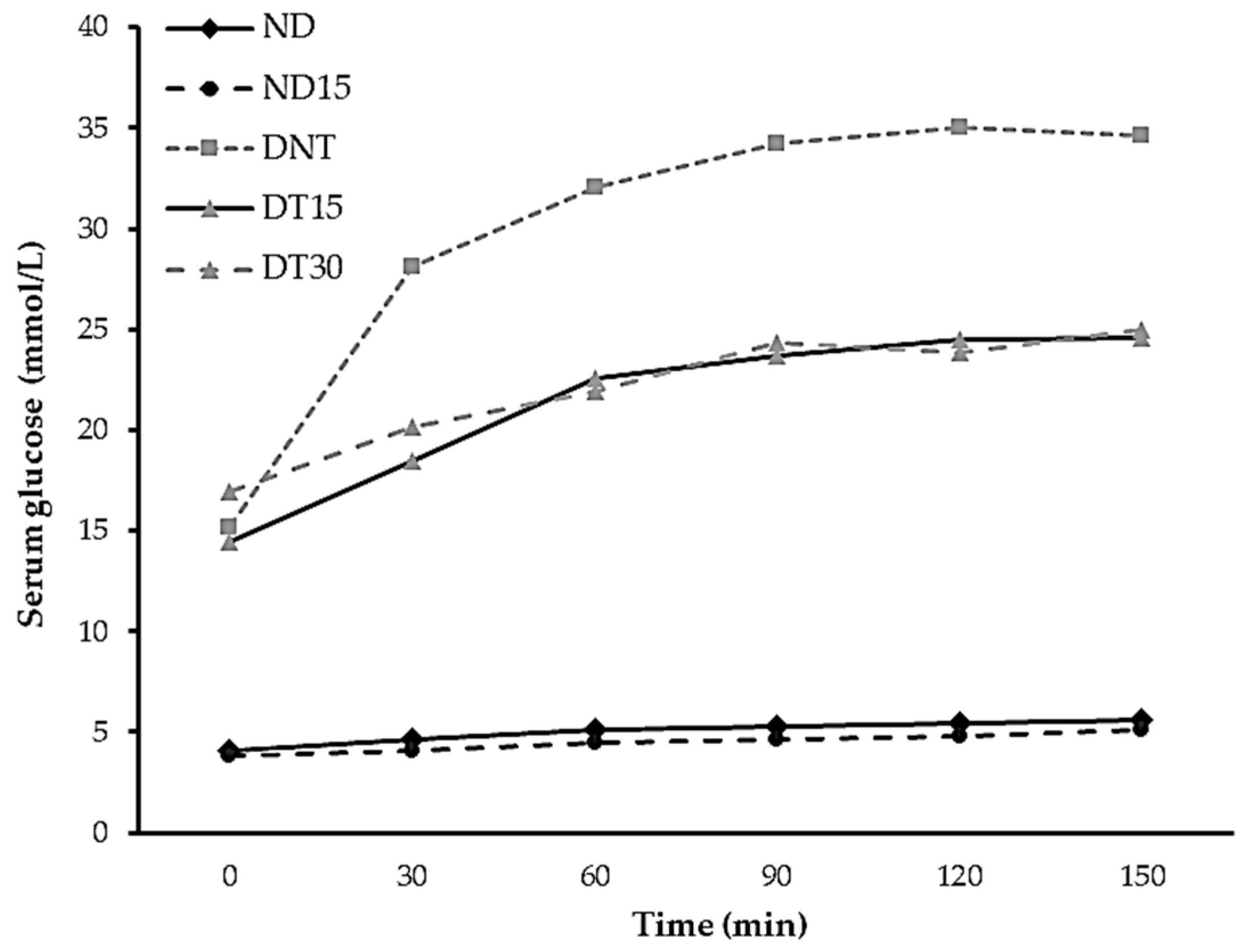
- The hyperglycaemic response and insulin resistance index were attenuated in diabetic rats treated with a 15% or 30% resistant starch replacement in the diet.
- Diabetic rats treated with the resistant starch functional ingredient showed improved diverse nutritional parameters compared to untreated rats, suggesting improved homeostasis and glucose control.
- AGEs and the percentage of glycosylated haemoglobin were reduced in diabetic rats treated with resistant starch as a result of the reduction in postprandial glycaemic response, as well as the improvement in fasting glucose levels.
Abstract
1. Introduction
2. Materials and Methods
2.1. Plant Material
2.2. Chemicals
2.3. Obtention of the RS Sample
2.4. Animal Acquisition and Husbandry
2.5. Ethical Clearance
2.6. Establishment of Streptozotocin (STZ)-Induced Diabetes in Rats
2.7. Serum and Tissue Collection
2.8. Metabolic Biomarkers
2.9. Nutritional Parameters
2.10. Glucose Homeostasis Analyses
2.10.1. Postprandial Glucose Response
2.10.2. Insulin Resistance Index
2.10.3. Oxidative Stress Biomarkers
2.11. Statistical Analyses
3. Results and Discussion
3.1. Effect of the RS Ingredient on Nutritional Parameters
3.2. Effect of the RS Ingredient on Glucose Metabolism Biomarkers
3.3. Effect of the RS Ingredient on Lipid Metabolism Biomarkers
3.4. Effect of the RS Ingredient on Glucose Homeostasis: Postprandial Response
3.5. Effect of the RS Ingredient on Glucose Homeostasis: Insulin Resistance Index
3.6. Effect of the RS Ingredient on Oxidative Stress
4. Conclusions
Supplementary Materials
Author Contributions
Funding
Institutional Review Board Statement
Informed Consent Statement
Data Availability Statement
Conflicts of Interest
Abbreviations
| AGEs | Advanced Glycation End Products |
| BMG | Body mass gain |
| CAT | Catalase |
| CHO | Cholesterol |
| DNT | Diabetic non-treated (control) group |
| DT15 | Diabetic treated 15% RS replacement group |
| DT30 | Diabetic treated 30% RS replacement group |
| FCR | Food conversion ratio |
| HDL | High-density lipoproteins |
| LDL | Low-density lipoprotein |
| MGR | Metabolic growth rate |
| ND | Non-diabetic control group |
| ND15 | Non-diabetic treated 15% RS replacement group |
| RS | Resistant starch |
| SGR | Specific growth rate |
| SOD | Superoxide dismutase |
| TG | Triglycerides |
| VLDL | Very low-density lipoproteins |
References
- Liu, Y.; Wang, Q.; Wu, K.; Sun, Z.; Tang, Z.; Li, X.; Zhang, B. Anthocyanins’ effects on diabetes mellitus and islet transplantation. Crit. Rev. Food Sci. Nutr. 2023, 63, 12102–12125. [Google Scholar] [CrossRef]
- Jamrozik, D.; Borymska, W.; Kaczmarczyk-Żebrowska, I. Hibiscus sabdariffa in diabetes prevention and treatment. Does it work? An evidence-based review. Foods 2022, 11, 2134. [Google Scholar] [CrossRef]
- Kim, M.K.; Park, J.; Kim, D.M. Resistant starch and type 2 diabetes mellitus: Clinical perspective. J. Diabetes Investig. 2024, 15, 395–401. [Google Scholar] [CrossRef]
- Duyen, T.T.M.; Huong, N.T.M.; Phi, N.T.L.; Van-Hung, P. Physicochemical properties and in vitro digestibility of mung-bean starches varying amylose contents under citric acid and hydrothermal treatments. Int. J. Biol. Macromol. 2020, 164, 651–658. [Google Scholar] [CrossRef]
- Butterworth, P.J.; Warren, F.J.; Ellis, P.R. Human α-amylase and starch digestion: An interesting marriage. Starch/Stärke 2011, 63, 395–405. [Google Scholar] [CrossRef]
- Suárez-Diéguez, T.; Pérez-Moreno, F.; Ariza-Ortega, J.A.; López-Rodríguez, G.; Nieto, J.A. Obtention and characterization of resistant starch from creole faba bean (Vicia faba L. creole) as a promising functional ingredient. LWT 2021, 145, 111247. [Google Scholar] [CrossRef]
- Tabibloghmany, F.S.; Ehsandoost, E. Investigation of nutritional and functional properties of resistant starch in food industry: A review. Int. J. Rev. Res. 2014, 7, 27–44. [Google Scholar]
- Chen, Y.F.; Singh, J.; Midgley, J.; Archer, R. Influence of time-temperature cycles on potato starch retrogradation in tuber and starch digestion in vitro. Food Hydrocoll. 2020, 98, 105240. [Google Scholar] [CrossRef]
- Li, H.; Li, J.; Xiao, Y.; Cui, B.; Fang, Y.; Guo, L. In vitro digestibility of rice starch granules modified by β-amylase, transglucosidase and pullulanase. Int. J. Biol. Macromol. 2019, 136, 1228–1236. [Google Scholar] [CrossRef]
- EFSA. Panel on Dietetic Products, Nutrition, and Allergies (NDA). Scientific opinion on dietary reference values for carbohydrates and dietary fibre. EFSA J. 2010, 8, 1462. [Google Scholar]
- Suárez-Diéguez, T.; Olvera-Nájera, M.; Galván, M.; Nieto, J.A. Impact of a retrograded starch ingredient obtained from Negro Jamapa beans (Phaseolus vulgaris L. Negro Jamapa) on glucose metabolism and oxidative stress in induced diabetic lab rats model. Int. J. Biol. Macromol. 2023, 25, 127447. [Google Scholar]
- Cai, S.; Su, Q.; Zhou, Q.; Duan, Q.; Huang, W.; Huang, W.; Xie, F. Purple rice starch in wheat: Effect on retrogradation dependent on addition amount. Int. J. Biol. Macromol. 2024, 268, 131788. [Google Scholar] [CrossRef]
- Jiang, J.; Han, W.; Zhao, S.; Liu, Q.; Lin, Q.; Xiao, H.; Lu, H. Comparison of structural and in vitro digestive properties of autoclave-microwave treated maize starch under different retrogradation temperature conditions. Int. J. Biol. Macromol. 2024, 271, 132410. [Google Scholar] [CrossRef]
- Santanilla, E.B.F.; López, L.L.B.; Rodríguez, L.E.C.; Falla, D.S.G. Resistant starch from a tuberous root from the Andes cordillera improves metabolic and immune parameters in broilers. Bioact. Carbohydr. Diet. Fibre 2024, 31, 100420. [Google Scholar]
- Suárez-Diéguez, T.; Soriano-García, M.; Anaya-Sosa, I.; Cruz y Victoria, M.T. Comparative studies of two α-amylases acting on two sorghum hybrids starches (Monticello’s hybrid 2 and 3) and their significant differences in their catalytic activities. Carbohydr. Polym. 2009, 75, 538–540. [Google Scholar] [CrossRef]
- Zhou, Z.; Wang, F.; Ren, X.; Wang, Y.; Blanchard, C. Resistant starch manipulated hyperglycemia/hyperlipidemia and related gene expression in diabetic rats. Int. J. Biol. Macromol. 2015, 75, 316–321. [Google Scholar] [CrossRef]
- Kim, W.K.; Chung, M.K.; Kang, N.E.; Kim, M.H.; Park, O.J. Effect of resistant starch from corn or rice on glucose control, colonic events, and blood lipid concentrations in streptozotocin-induced diabetic rats. J. Nutr. Biochem. 2003, 14, 166–172. [Google Scholar] [CrossRef]
- Ansari, N.A.; Alam, K.; Ali, A. Preferential recognition of Amadori-rich lysine residues by serum antibodies in diabetes mellitus: Role of protein glycation in the disease process. Hum. Immunol. 2009, 70, 417–424. [Google Scholar] [CrossRef]
- Kumar, V.; Akinleye, A.O.; Makkar, H.P.; Angulo-Escalante, M.A.; Becker, K. Growth performance and metabolic efficiency in Nile tilapia (Oreochromis niloticus L.) fed on a diet containing Jatropha platyphylla kernel meal as a protein source. J. Anim. Physiol. Anim. Nutr. 2012, 96, 37–46. [Google Scholar] [CrossRef]
- Unger, G.; Benozzi, S.F.; Perruzza, F.; Pennacchiotti, G.L. Triglycerides and glucose index: A useful indicator of insulin resistance. Endocrinol. Nutr. 2014, 61, 533–540. [Google Scholar] [CrossRef]
- Sun, Y.; Oberley, L.W.; Li, Y.A. Simple method for clinical assay of superoxide dismutase. Clin. Chem. 1988, 34, 497–500. [Google Scholar] [CrossRef]
- Baudhuin, P.; Beaufay, H.; Rahmen-Li, Y.; Sellinger, O.Z.; Wattiaux, R.; Jacques, P. Tissue fractionation studies, intracellular distribution of monoamine oxidase, aspartate aminotransferase, D-amino acid oxidase and catalase in rat liver tissue. Biochem. J. 1964, 92, 179–184. [Google Scholar] [CrossRef]
- Salahuddin, M.D.; Jalalpure, S.S. Antidiabetic activity of aqueous fruit extract of Cucumis trigonus Roxb. in streptozotocin-induced-diabetic rats. J. Ethnopharmacol. 2010, 127, 565–567. [Google Scholar] [CrossRef]
- Arias-Córdova, Y.; Ble-Castillo, J.L.; García-Vázquez, C.; Olvera-Hernández, V.; Ramos-García, M.; Navarrete-Cortes, A.; Jiménez-Domínguez, G.; Juárez-Rojop, I.E.; Tovilla-Zárate, C.A.; Martínez-López, M.C.; et al. Resistant starch consumption effects on glycemic control and glycemic variability in patients with type 2 diabetes: A randomized crossover study. Nutrients 2021, 13, 4052. [Google Scholar] [CrossRef]
- Rahat-Rozenbloom, S.; Fernandes, J.; Cheng, J.; Gloor, G.B.; Wolever, T.M. The acute effects of inulin and resistant starch on postprandial serum short-chain fatty acids and second-meal glycemic response in lean and overweight humans. Eur. J. Clin. Nutr. 2017, 71, 227–233. [Google Scholar] [CrossRef]
- Dodevska, M.S.; Sobajic, S.S.; Djordjevic, P.B.; Dimitrijevic-Sreckovic, V.S.; Spasojevic-Kalimanovska, V.V.; Djordjevic, B.I. Effects of total fibre or resistant starch-rich diets within lifestyle intervention in obese prediabetic adults. Eur. J. Nutr. 2016, 55, 127–137. [Google Scholar] [CrossRef]
- van Oostrom, A.J.; van Dijk, H.; Verseyden, C.; Sniderman, A.D.; Cianflone, K.; Rabelink, T.J.; Cabezas, M.C. Addition of glucose to an oral fat load reduces postprandial free fatty acids and prevents the postprandial increase in complement component 3. Am. J. Clin. Nutr. 2004, 79, 510–515. [Google Scholar] [CrossRef]
- Péronnet, F.; Meynier, A.; Sauvinet, V.; Normand, S.; Bourdon, E.; Mignault, D.; St-Pierre, D.H.; Laville, M.; Rabasa-Lloret, R.; Vinoy, S. Plasma glucose kinetics and response of insulin and GIP following a cereal breakfast in female subjects: Effect of starch digestibility. Eur. J. Clin. Nutr. 2015, 69, 740–745. [Google Scholar] [CrossRef]
- Lu, X.; Xie, Q.; Pan, X.; Zhang, R.; Zhang, X.; Peng, G.; Zhang, Y.; Shen, S.; Tong, N. Type 2 diabetes mellitus in adults: Pathogenesis, prevention and therapy. Signal Transduct. Target. Ther. 2024, 9, 262. [Google Scholar] [CrossRef]
- Olagunju, A.I.; Omoba, O.S. Functional Cereals and Cereal Foods; Punia Bangar, S., Kumar Siroha, A., Eds.; Springer: Cham, Switzerland, 2022; pp. 113–137. [Google Scholar]
- Sun, H.; Ma, X.; Zhang, S.; Zhao, D.; Liu, X. Resistant starch produces antidiabetic effects by enhancing glucose metabolism and ameliorating pancreatic dysfunction in type 2 diabetic rats. Int. J. Biol. Macromol. 2018, 110, 276–284. [Google Scholar] [CrossRef]
- Wang, H.; Qiu, B.; Xu, T.; Zong, A.; Liu, L.; Xiao, J. Effects of resistant starch on the indicators of glucose regulation in persons diagnosed with type 2 diabetes and those at risk: A meta-analysis. J. Food Process. Preserv. 2020, 44, 14594. [Google Scholar] [CrossRef]
- Snelson, M.; Tan, S.M.; Sourris, K.; Thallas-Bonke, V.; Ziemann, M.; El-Osta, S.; Coughlan, M. SAT-301 resistant starch ameliorates advanced glycation endproduct-induced gut dysbiosis and albuminuria in a mouse model of type 2 diabetes. Kidney Int. Rep. 2019, 4, S134. [Google Scholar] [CrossRef]
- Makris, K.; Spanou, L. Is there a relationship between mean blood glucose and glycated hemoglobin? J. Diabetes Sci. Technol. 2011, 5, 1572–1583. [Google Scholar] [CrossRef]
- Giugliano, D.; Ceriello, A.; Esposito, K. Glucose metabolism and hyperglycemia. Am. J. Clin. Nutr. 2008, 87, 217–222. [Google Scholar] [CrossRef]
- Khalid, M.; Petroianu, G.; Adem, A. Advanced glycation end products and diabetes mellitus: Mechanisms and perspectives. Biomolecules 2022, 12, 542. [Google Scholar] [CrossRef]
- Yao, D.; Brownlee, M. Hyperglycemia-induced reactive oxygen species increase expression of the receptor for advanced glycation end products (RAGE) and RAGE ligands. Diabetes 2010, 59, 249–255. [Google Scholar] [CrossRef]
- Bjornstad, P.; Eckel, R.H. Pathogenesis of lipid disorders in insulin resistance: A brief review. Curr. Diab. Rep. 2018, 18, 127. [Google Scholar] [CrossRef] [PubMed]
- Hirano, T. Pathophysiology of diabetic dyslipidemia. J. Atheroscler. Thromb. 2018, 25, 771–782. [Google Scholar] [CrossRef] [PubMed]
- Bodinham, C.L.; Smith, L.; Thomas, E.L.; Bell, J.D.; Swann, J.R.; Costabile, A.; Russell-Jones, D.; Umpleby, A.M.; Robertson, M.D. Efficacy of increased resistant starch consumption in human type 2 diabetes. Endocr. Connect. 2014, 3, 75–84. [Google Scholar] [CrossRef]
- De Geest, B.; Mishra, M. Role of oxidative stress in diabetic cardiomyopathy. Antioxidants 2022, 11, 784. [Google Scholar] [CrossRef]
- Sadi, G.; Bozan, D.; Yildiz, H.B. Redox regulation of antioxidant enzymes: Post-translational modulation of catalase and glutathione peroxidase activity by resveratrol in diabetic rat liver. Mol. Cell. Biochem. 2014, 393, 111–122. [Google Scholar] [CrossRef]
- Maritim, A.C.; Sanders, R.A.; Watkins, J.B., III. Diabetes, oxidative stress, and antioxidants: A review. J. Biochem. Mol. Toxicol. 2003, 17, 24–38. [Google Scholar] [CrossRef]
- Johansen, J.S.; Harris, A.K.; Rychly, D.J.; Ergul, A. Oxidative stress and the use of antioxidants in diabetes: Linking basic science to clinical practice. Cardiovasc. Diabetol. 2005, 4, 5. [Google Scholar] [CrossRef]
- Marí, M.; Cederbaum, A.I. Induction of catalase, alpha, and microsomal glutathione S-transferase in CYP2E1 overexpressing HepG2 cells and protection against short-term oxidative stress. Hepatology 2001, 33, 652–661. [Google Scholar] [CrossRef] [PubMed]
- Lucchesi, A.N.; Freitas, N.T.D.; Cassettari, L.L.; Marques, S.F.G.; Spadella, C.T. Diabetes mellitus triggers oxidative stress in the liver of alloxan-treated rats: A mechanism for diabetic chronic liver disease. Acta Cir. Bras. 2013, 28, 502–508. [Google Scholar] [CrossRef]
- Kakkar, R.; Mantha, S.V.; Radhi, J.; Prasad, K.; Kalra, J. Antioxidant defense system in diabetic kidney: A time course study. Life Sci. 1997, 60, 667–679. [Google Scholar] [CrossRef] [PubMed]


| Group | Initial Weight (g) | Final Weight (g) | Weight Gain (g) | BMG (%) | SGR (%/Day) | MGR (g/Kg Day) | Feed Intake (g) | FCR |
|---|---|---|---|---|---|---|---|---|
| ND | 321.00 ± 27.33 | 360.67 ± 32.93 a | 39.67 ± 8.73 a | 12.33 ± 2.32 a | 0.39 ± 0.07 a | 3.12 ± 0.57 a | 166.80 ± 35.39 b | 4.43 ± 1.60 a |
| ND15 | 312.00 ± 34.39 | 346.67 ± 27.25 a | 34.67 ± 20.35 a | 11.59 ± 7.86 a | 0.36 ± 0.23 a | 2.86 ± 1.77 a | 143.78 ± 39.51 b | 4.69 ± 1.35 a |
| DNT | 236.43 ± 18.90 | 245.43 ± 8.85 b | 9.00 ± 19.84 b | 4.33 ± 9.18 b | 0.13 ± 0.30 b | 0.98 ± 2.26 b | 249.44 ± 13.45 a | −1.26 ± 30.73 a |
| DT15 | 232.29 ± 29.83 | 260.57 ± 33.92 a,* | 28.29 ± 12.54 a,* | 12.27 ± 5.38 a,* | 0.38 ± 0.16 a,* | 2.88 ± 1.20 a,* | 269.67 ± 20.33 a | 11.45 ± 5.37 a |
| DT30 | 243.27 ± 23.03 | 269.33 ± 26.45 a,* | 25.67 ± 8.29 a,* | 10.00 ± 2.77 a,* | 0.32 ± 0.11 a,* | 2.40 ± 0.87 a,* | 258.64 ± 12.46 a | 12.21 ± 4.90 a |
| Group | Initial Glucose (mmol/L) | Final Glucose (mmol/L) | Glycosylated Hemoglobin (%) | AGEs µg 5-HMF/mg Protein | TyG Index |
|---|---|---|---|---|---|
| ND | 4.71 ± 0.89 b | 5.34 ± 0.55 d | 5.34 ± 0.59 c | 0.21 ± 0.05 b | 8.68 ± 0.26 c |
| ND15 | 4.86 ± 1.16 b | 5.21 ± 0.25 d | 5.02 ± 0.70 c | 0.22 ± 0.05 b | 8.54 ± 0.23 c |
| DNT | 23.73 ± 3.62 a | 27.81 ± 3.09 a | 13.78 ± 2.29 a | 0.45 ± 0.08 a | 10.49 ± 0.11 a |
| DT15 | 21.94 ± 2.00 a | 16.89 ± 2.29 c,* | 9.73 ± 0.82 b | 0.36 ± 0.09 a | 9.88 ± 0.60 b |
| DT30 | 24.76 ± 2.94 a | 19.36 ± 2.81 b,* | 9.01 ± 2.47 b | 0.35 ± 0.08 a | 9.94 ± 0.30 b |
| Group | CHO (mmol/L Blood) | TG (mmol/L Blood) | HDL (mmol/L Blood) | VLDL (mmol/L Blood) | LDL (mmol/L Blood) | LDL/HDL Index |
|---|---|---|---|---|---|---|
| ND | 2.86 ± 0.28 b | 1.14 ± 0.13 b | 0.96 ± 0.15 c | 0.23 ± 0.03 b | 1.67 ± 0.43 a | 1.82 ± 0.70 a |
| ND15 | 2.95 ± 0.30 b | 1.16 ± 0.05 b | 1.04 ± 0.08 b,c | 0.23 ± 0.01 b | 1.67 ± 0.28 a | 1.61 ± 0.30 a |
| DNT | 3.71 ± 0.42 a | 1.58 ± 0.25 a | 1.39 ± 0.12 a | 0.32 ± 0.05 a | 2.00 ± 0.31 a | 1.45 ± 0.19 a |
| DT15 | 3.41 ± 0.23 a | 1.46 ± 0.15 a | 1.27 ± 0.25 b | 0.29 ± 0.03 a | 1.85 ± 0.43 a | 1.56 ± 0.66 a |
| DT30 | 3.72 ± 0.18 a | 1.50 ± 0.19 a | 1.38 ± 0.24 a,b | 0.30 ± 0.04 a | 2.03 ± 0.29 a | 1.54 ± 0.56 a |
| Groups | Liver | Kidney | ||
|---|---|---|---|---|
| SOD (U/mg Protein) | CAT (K/s/mg Protein) | SOD (U/mg Protein) | CAT (K/s/mg Protein) | |
| ND | 4.92 ± 0.58 a | 9.77 ± 2.55 b | 7.83 ± 3.44 a,b | 5.08 ± 1.60 b |
| ND15 | 5.11 ± 2.80 a | 10.29 ± 0.78 b | 6.48 ± 2.53 b | 5.43 ± 1.06 b |
| DNT | 6.72 ± 0.93 a | 16.87 ± 2.40 a | 11.39 ± 4.02 a | 9.18 ± 3.42 a |
| DT15 | 4.99 ± 1.06 a | 14.01 ± 3.39 a | 9.93 ± 3.30 a,b | 5.56 ± 1.92 b |
| DT30 | 5.69 ± 3.32 a | 17.19 ± 3.95 a | 9.87 ± 1.26 a,b | 5.50 ± 2.28 b |
Disclaimer/Publisher’s Note: The statements, opinions and data contained in all publications are solely those of the individual author(s) and contributor(s) and not of MDPI and/or the editor(s). MDPI and/or the editor(s) disclaim responsibility for any injury to people or property resulting from any ideas, methods, instructions or products referred to in the content. |
© 2025 by the authors. Licensee MDPI, Basel, Switzerland. This article is an open access article distributed under the terms and conditions of the Creative Commons Attribution (CC BY) license (https://creativecommons.org/licenses/by/4.0/).
Share and Cite
Suárez-Diéguez, T.; Olvera Nájera, M.; Silva, M.; López-Rodríguez, G.; Ariza-Ortega, J.A.; García-Tejedor, A.; Nieto, J.A. A New Resistant Starch Material Obtained from Faba Beans (Vicia faba L. Creole): Potential Modulation of the Diabetic Condition in Diabetic Wistar Rat Model. Nutrients 2025, 17, 3807. https://doi.org/10.3390/nu17233807
Suárez-Diéguez T, Olvera Nájera M, Silva M, López-Rodríguez G, Ariza-Ortega JA, García-Tejedor A, Nieto JA. A New Resistant Starch Material Obtained from Faba Beans (Vicia faba L. Creole): Potential Modulation of the Diabetic Condition in Diabetic Wistar Rat Model. Nutrients. 2025; 17(23):3807. https://doi.org/10.3390/nu17233807
Chicago/Turabian StyleSuárez-Diéguez, Teodoro, Mariza Olvera Nájera, Mariana Silva, Guadalupe López-Rodríguez, José Alberto Ariza-Ortega, Aurora García-Tejedor, and Juan Antonio Nieto. 2025. "A New Resistant Starch Material Obtained from Faba Beans (Vicia faba L. Creole): Potential Modulation of the Diabetic Condition in Diabetic Wistar Rat Model" Nutrients 17, no. 23: 3807. https://doi.org/10.3390/nu17233807
APA StyleSuárez-Diéguez, T., Olvera Nájera, M., Silva, M., López-Rodríguez, G., Ariza-Ortega, J. A., García-Tejedor, A., & Nieto, J. A. (2025). A New Resistant Starch Material Obtained from Faba Beans (Vicia faba L. Creole): Potential Modulation of the Diabetic Condition in Diabetic Wistar Rat Model. Nutrients, 17(23), 3807. https://doi.org/10.3390/nu17233807