You are currently viewing a new version of our website. To view the old version click .

Remote Sensing, Volume 9, Issue 12

December 2017 - 134 articles

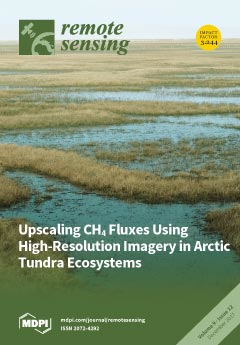
Cover Story: Release of methane (CH4) from the Arctic can affect global climate. Predicting future CH4 emissions remains challenging because Arctic landscapes are characterized by high spatial heterogeneity with vegetation types, environmental conditions, and CH4 fluxes varying substantially over the meter scale. This large spatial heterogeneity requires the use of high resolution remote sensing imagery to upscale the chamber measurements to the ecosystem scale eddy covariance (EC) tower measurements. However, there is still disagreement on the methodologies used to perform this upscaling. We show that high resolution vegetation maps can be successfully integrated into both a simple upscaling technique and a more sophisticated footprint modelling analysis, and that these upscaled chamber-based CH4 fluxes using both methods showed good agreement with the EC flux estimates. View this paper
  • Issues are regarded as officially published after their release is announced to the table of contents alert mailing list .
  • You may sign up for email alerts to receive table of contents of newly released issues.
  • PDF is the official format for papers published in both, html and pdf forms. To view the papers in pdf format, click on the "PDF Full-text" link, and use the free Adobe Reader to open them.

Articles (134)

  • Technical Note
  • Open Access
28 Citations
6,168 Views
14 Pages

20 December 2017

Over the past four decades Delhi, India, has witnessed rapid urbanization and change in land use land cover (LULC) pattern, with most of the cultivable areas and wasteland being converted into built-up areas. Presently around 40% land is under built-...

  • Article
  • Open Access
4 Citations
4,377 Views
22 Pages

20 December 2017

Although lake surface water temperature (LSWT) is defined as an essential climate variable (ECV) within the global climate observing system (GCOS), current satellite-based retrieval techniques do not fulfill the GCOS accuracy requirements. The split-...

  • Article
  • Open Access
28 Citations
12,095 Views
26 Pages

20 December 2017

Semi-arid ecosystems play a key role in global agricultural production, seasonal carbon cycle dynamics, and longer-run climate change. Because semi-arid landscapes are heterogeneous and often sparsely vegetated, repeated and large-scale ecosystem ass...

  • Article
  • Open Access
16 Citations
6,332 Views
16 Pages

20 December 2017

Accurate quantification of coarse roots without disturbance represents a gap in our understanding of belowground ecology. Ground penetrating radar (GPR) has shown significant promise for coarse root detection and measurement, however root orientation...

  • Article
  • Open Access
16 Citations
6,788 Views
19 Pages

Short-Term Impacts of the Air Temperature on Greening and Senescence in Alaskan Arctic Plant Tundra Habitats

  • Jeremy L. May,
  • Nathan C. Healey,
  • Hella E. Ahrends,
  • Robert D. Hollister,
  • Craig E. Tweedie,
  • Jeffrey M. Welker,
  • William A. Gould and
  • Steven F. Oberbauer

20 December 2017

Climate change is warming the temperatures and lengthening the Arctic growing season with potentially important effects on plant phenology. The ability of plant species to acclimate to changing climatic conditions will dictate the level to which thei...

  • Feature Paper
  • Article
  • Open Access
61 Citations
16,495 Views
19 Pages

20 December 2017

Temperature time series with high spatial and temporal resolutions are important for several applications. The new MODIS Land Surface Temperature (LST) collection 6 provides numerous improvements compared to collection 5. However, being remotely sens...

  • Article
  • Open Access
19 Citations
6,262 Views
22 Pages

20 December 2017

In this study, we examined the phenology of the salt marsh ecosystem across coastal Louisiana (LA) for a 16-year time period (2000–2015) using NASA’s Moderate Resolution Imaging Spectroradiometer’s (MODIS) eight-day average surface reflectance images...

  • Article
  • Open Access
20 Citations
5,670 Views
17 Pages

High-Resolution Mapping of Freeze/Thaw Status in China via Fusion of MODIS and AMSR2 Data

  • Tongxi Hu,
  • Tianjie Zhao,
  • Jiancheng Shi,
  • Shengli Wu,
  • Dan Liu,
  • Haiming Qin and
  • Kaiguang Zhao

20 December 2017

Transition of freeze/thaw (F/T) affects land-atmospheric interactions and other biospheric dynamics. Global F/T statuses are normally monitored using microwave remote sensing, but at coarse resolutions (e.g., 25 km). Integration of coarse microwave r...

  • Article
  • Open Access
46 Citations
6,449 Views
18 Pages

19 December 2017

Grassland, as the primary vegetation on the Qinghai-Tibet Plateau, has been increasingly influenced by water availability due to climate change in last decades. Therefore, identifying the evolution of drought becomes crucial to the efficient manageme...

  • Article
  • Open Access
4 Citations
5,435 Views
21 Pages

19 December 2017

A variety of data assimilation approaches have been applied to enhance modelling capability and accuracy using observations from different sources. The algorithms have varying degrees of complexity of implementation, and they improve model results wi...

of 14

Get Alerted

Add your email address to receive forthcoming issues of this journal.

XFacebookLinkedIn
Remote Sens. - ISSN 2072-4292