Article

Research on Vortex Radar Imaging Characteristics Based on the Scattering Distribution of Three-Dimensional Wind-Driven Sea Surface Waves


1
School of Electronic Engineering, Xi’an University of Posts & Telecommunications, Xi’an 710121, China
2
China Academy of Space Technology, Xi’an 710100, China
3
State Key Laboratory of Satellite Ocean Environment Dynamics, Second Institute of Oceanography, State Oceanic Administration, Hangzhou 310012, China
4
School of Physics, Xidian University, Xi’an 710071, China
*
Author to whom correspondence should be addressed.
Remote Sens. 2026, 18(8), 1111; https://doi.org/10.3390/rs18081111
Submission received: 28 February 2026 / Revised: 26 March 2026 / Accepted: 4 April 2026 / Published: 8 April 2026
(This article belongs to the Special Issue Observations of Atmospheric and Oceanic Processes by Remote Sensing)

Highlights

What are the main findings?
  • A novel vortex radar imaging method is proposed, which, for the first time, integrates the three-dimensional scattering characteristics of the ocean surface (based on the Elfouhaily spectrum and a semi-deterministic facet-based two-scale method) with Orbital Angular Momentum (OAM) modes.
  • The study quantitatively reveals that vortex imaging performance for sea surfaces improves with higher wind speeds and steeper (smaller) radar incidence angles, and that the system can effectively capture wave fluctuations and wind direction patterns.
What are the implications of the main findings?
  • This work validates the feasibility of using vortex radar for high-resolution, continuous monitoring of dynamic sea scenes from coastal platforms, moving beyond traditional point-target assumptions to real-world, complex scatterers.
  • By establishing a direct link between sea state parameters and vortex imaging results, this method lays a theoretical foundation for advanced ocean remote sensing applications, such as the inversion of sea surface wind fields and wave spectra.

Abstract

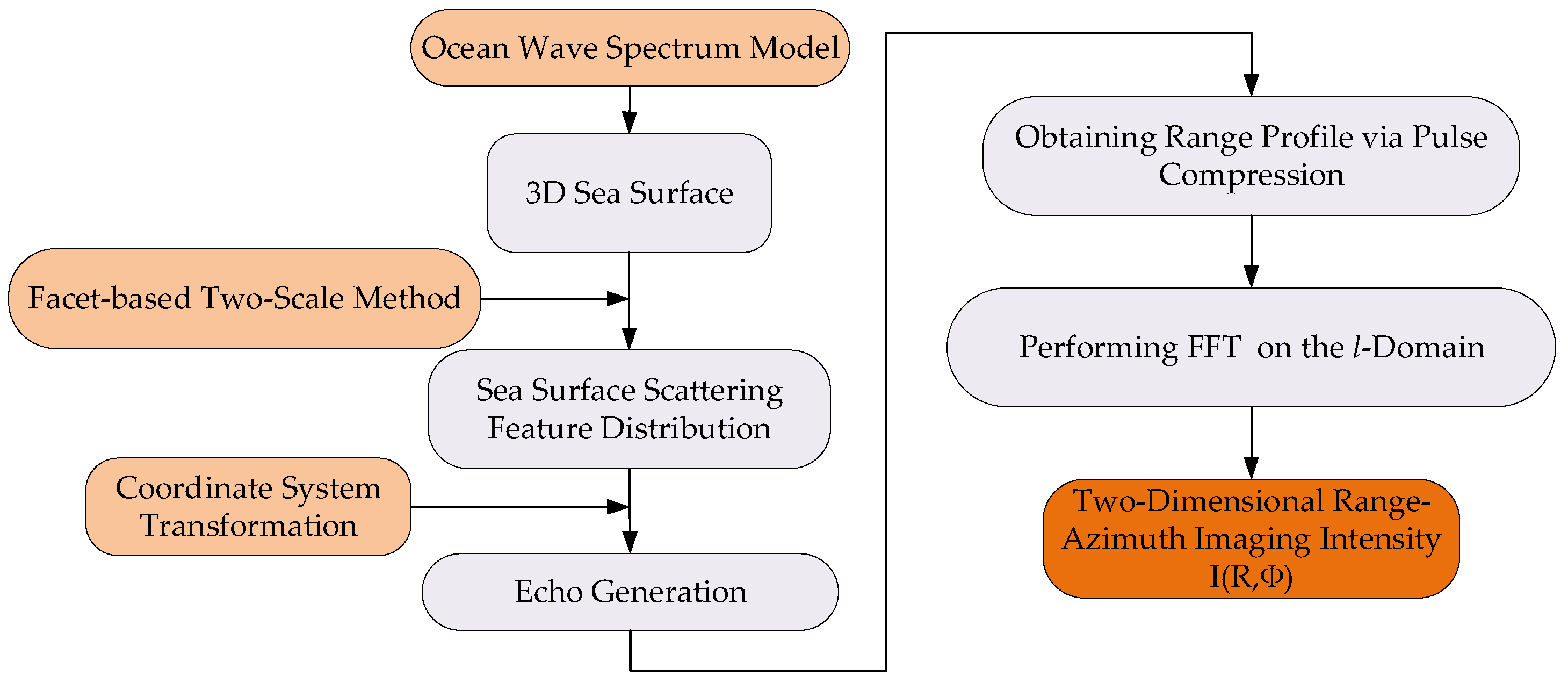
The resolution and accuracy of airborne/spaceborne SAR are continuously improving, making it an effective means for observing ocean dynamic processes and detecting marine targets. In contrast, utilizing its unique orbital angular momentum (OAM) mode, vortex radar does not require temporal accumulation to achieve azimuthal resolution, making it particularly suitable for observing moving sea surfaces. This capability enables stable and continuous monitoring of dynamic ocean scenes. This paper proposes a vortex radar imaging method based on three-dimensional sea surface scattering characteristics: first, a three-dimensional wind-driven sea surface geometric model is established based on the Elfouhaily sea spectrum, and its scattering characteristics under different incident angles, wind speeds, and wind directions are analyzed using the semi-deterministic facet-based two-scale method; then, two-dimensional range-azimuth imaging is achieved through coordinate transformation, echo modeling, pulse compression, and fast Fourier transform (FFT) in OAM mode domain, with the correctness of the imaging algorithm verified through multiple point target imaging results. Finally, simulation results of two-dimensional sea surface vortex imaging under different incident angles are presented, and the influence of wind speed and direction on sea surface vortex imaging is analyzed. The study shows that the vortex imaging system can effectively reflect wave fluctuations and wind direction characteristics, demonstrating the feasibility and potential of vortex radar imaging in oceanographic applications.

1. Introduction

In the 1990s, Allen demonstrated that light beams with a helical structure can carry substantial orbital angular momentum (OAM), providing higher degrees of freedom for optical communication [1]. Over the past decades, significant progress has been made in applying OAM in optics, including optical communications [2,3] and optical manipulation [4]. In 2007, Thidé et al. extended OAM to the microwave regime [5], laying the groundwork for subsequent research on vortex electromagnetic wave radar imaging. Subsequent studies have focused on the generation [6,7,8,9,10,11] and scattering [12,13] of OAM waves, further establishing the foundation for developing OAM radar systems. Electromagnetic waves carrying OAM are referred to as vortex electromagnetic waves due to their helical wavefronts. The OAM endows them with higher degrees of freedom in information transmission, and vortex electromagnetic imaging technology holds significant potential for target detection and recognition [14].
In 2013, Guo et al. proposed a multiple-input multiple-output (MIMO) vortex electromagnetic wave imaging model and achieved one-dimensional azimuthal imaging of point targets using the back-projection method [15]. Since then, imaging models and related algorithms based on vortex electromagnetic waves have been proposed. In 2015, Liu et al. utilized vortex electromagnetic wave radar with an incremental-phase uniform circular array (UCA), established echo signal models for multiple-input multiple-output and multiple-input single-output modes, and achieved two-dimensional imaging of point targets using FFT and back-projection algorithms [16]. In 2020, Liu et al. realized two-dimensional imaging of extended targets using dual-coupled multiplexed OAM modes, reducing transmission time by half while maintaining the same resolution compared with conventional methods [17]. In the same year, Lin et al. combined traditional two-dimensional SAR with vortex electromagnetic waves to obtain three-dimensional information of targets, achieving three-dimensional imaging of point targets [18]. In 2021, Liu et al. [19] proposed an electromagnetic vortex SAR three-dimensional imaging algorithm based on a joint two-dimensional azimuth (SAR azimuth–vortex azimuth) compression algorithm, achieving three-dimensional coordinate reconstruction of eight point targets. In 2022, Liang et al. proposed a bistatic radar imaging model based on OAM modes, realizing two-dimensional imaging of point targets through fast Fourier transform (FFT) and matched filtering, and achieved three-dimensional imaging of multiple point targets using a dual-channel structure [20,21]. Chen et al. proposed a vortex radar imaging algorithm based on a joint low-rank and sparse constraint representation to eliminate the Bessel function modulation effect caused by the vortex wavefront characteristics, thereby obtaining two-dimensional vortex radar images of extended targets [22].
Most existing vortex wave imaging techniques are based on ideal point targets or simple extended targets. Although these methods verify imaging principles and algorithm performance, they often do not adequately account for the true scattering characteristics of targets. Particularly for the sea surface—a typical time-varying, non-uniform scatterer—its electromagnetic scattering mechanisms are complex and highly sensitive to various sea state parameters (e.g., wind speed, wind direction) and radar parameters (e.g., incidence angle, frequency, polarization). To achieve high-quality vortex radar imaging for sea surface scenes, it is essential first to model the scattering characteristics of the sea surface under different sea states and radar parameters, and to construct a sea surface vortex echo model that accurately reflects its complex scattering feature distribution. On the basis of the sea surface scattering distribution, fast Fourier transform (FFT) and matched filtering techniques are employed to achieve two-dimensional imaging in range and azimuth. Compared to previous vortex electromagnetic wave imaging techniques designed for ideal point targets, this paper focuses on vortex radar imaging characteristics based on the scattering feature distribution of the sea surface, analyzing the influence of radar incidence angles and sea state parameters on sea surface vortex imaging, thereby providing a theoretical foundation for using vortex electromagnetic waves in ocean environment remote sensing and monitoring.
The remainder of this paper is organized as follows: Section 2 combines sea surface electromagnetic scattering models with vortex echo models to establish a two-dimensional OAM radar imaging system for sea surface scenarios. Section 3 utilizes this vortex imaging system to perform imaging simulations of the sea surface under various sea state conditions and, through comparison with scattering feature distributions, validates the effectiveness of using vortex radar for the wind driven sea surface observation. Section 4 discusses the advantages and limitations of the proposed method, specifies the wind speed range of the proposed model and provides an outlook on future applications in ocean remote sensing. Section 5 summarizes the paper.

2. Mothed

2.1. Three-Dimensional Sea Surface Generation and Scattering Model

This paper employs the linear filtering method, utilizing the inverse fast Fourier transform (IFFT), to achieve rapid simulation of the sea surface. The linear filtering method transforms white noise into the frequency domain via the Fourier transform, then filters it using the ocean wave spectrum to obtain the frequency-domain expression of the sea surface at time t :
F ( k m k , k n k ; t ) = γ n π 2 W ( k m k , k n k ) / ( L x L y ) exp ( i ω ( k ) t )   + γ n * π 2 W ( k m k , k n k ) / ( L x L y ) exp ( i ω ( k ) t )
where { γ n } is a Gaussian random variable, L x and L y represent the modeling lengths of the sea surface in the x and y directions, respectively, with M and N discrete points. W ( k mk , k nk ) denotes the wave spectrum, for which the Elfouhaily spectrum is adopted in this paper [23]. The directional function employs the one-sided cosine directional distribution function proposed by Longuet-Higgins [24], while the seawater dispersion relation, accounting for both gravity waves and capillary waves, is considered:
ω 2 = g k 1 + k / k m 2 tanh k h
Among them, h represents the seawater depth. In deep-water regions, tanh ( k h ) 1 ,   ( k h 1 ) . By performing an inverse Fourier transform on Equation (1), the sea surface elevation can be obtained.
f ( x m , y n ) = m k = M / 2 + 1 M / 2 n k = N / 2 + 1 N / 2 F ( k m k , k n k ; t ) e i k m k x m + k n k y n
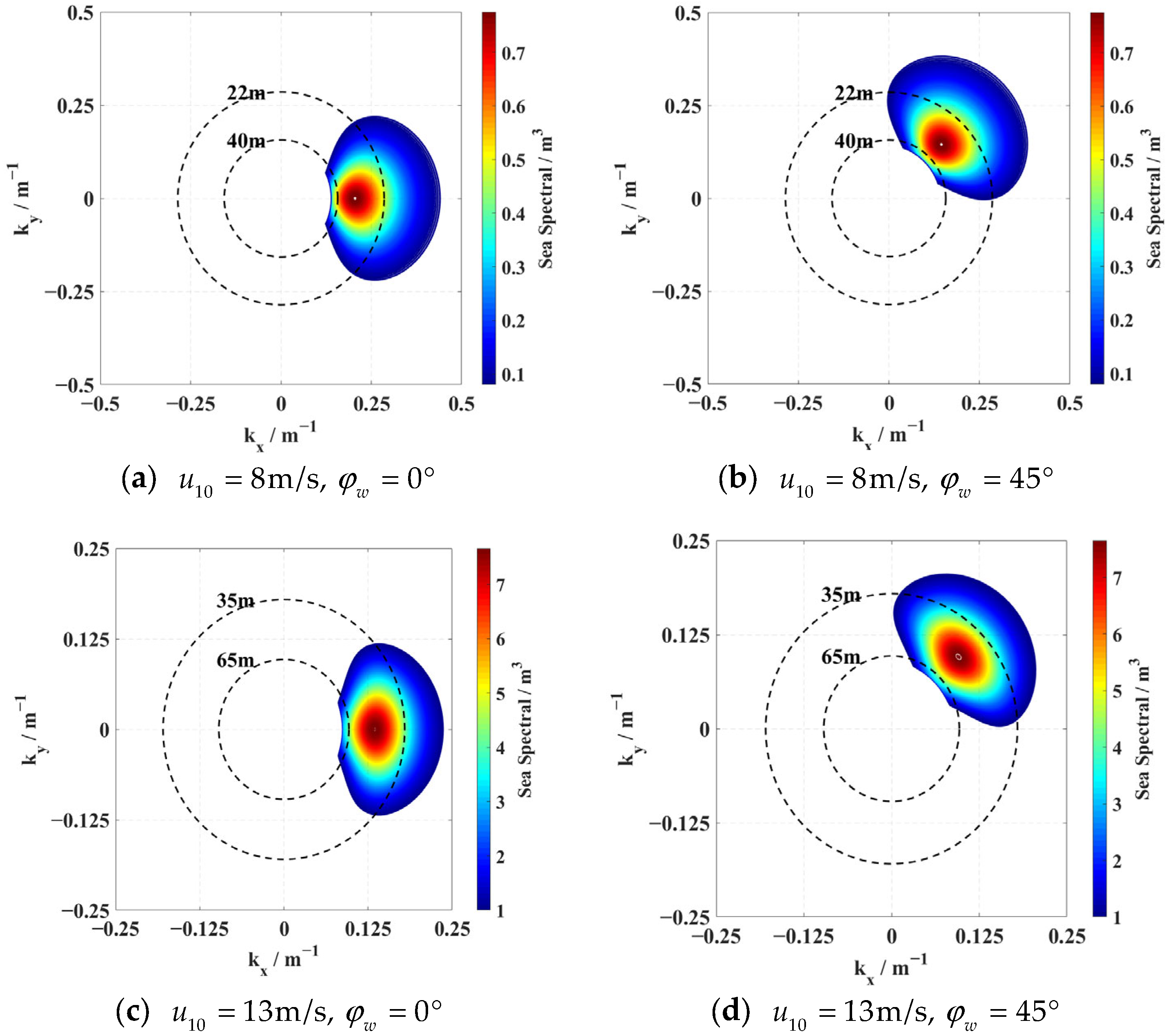
Figure 1 presents the two-dimensional ocean wave spectra under different wind speeds and wind directions. Comparing Figure 1a,b, as well as Figure 1c,d, it can be observed that wind direction significantly influences the directional distribution of waves. In the figure, the origin corresponds to k = 0 , representing waves with infinite wavelength. As | k | increases, the wavelength of the waves gradually decreases. Based on the gradient of the contour lines, it can be inferred that as the wavelength decreases from infinity, wave energy increases rapidly. When the wavelength becomes smaller than the peak wavelength, wave energy gradually decreases, and the rate of decline is slower than the earlier rate of increase. From Figure 1a,b, it is evident that at a wind speed of 8 m/s, waves with wavelengths ranging from 22 m to 40 m possess the highest energy. Similarly, at a wind speed of 13 m/s, waves with wavelengths between 34 m and 65 m exhibit the maximum energy. This indicates that as wind speed increases, wave energy shifts toward longer wavelengths.
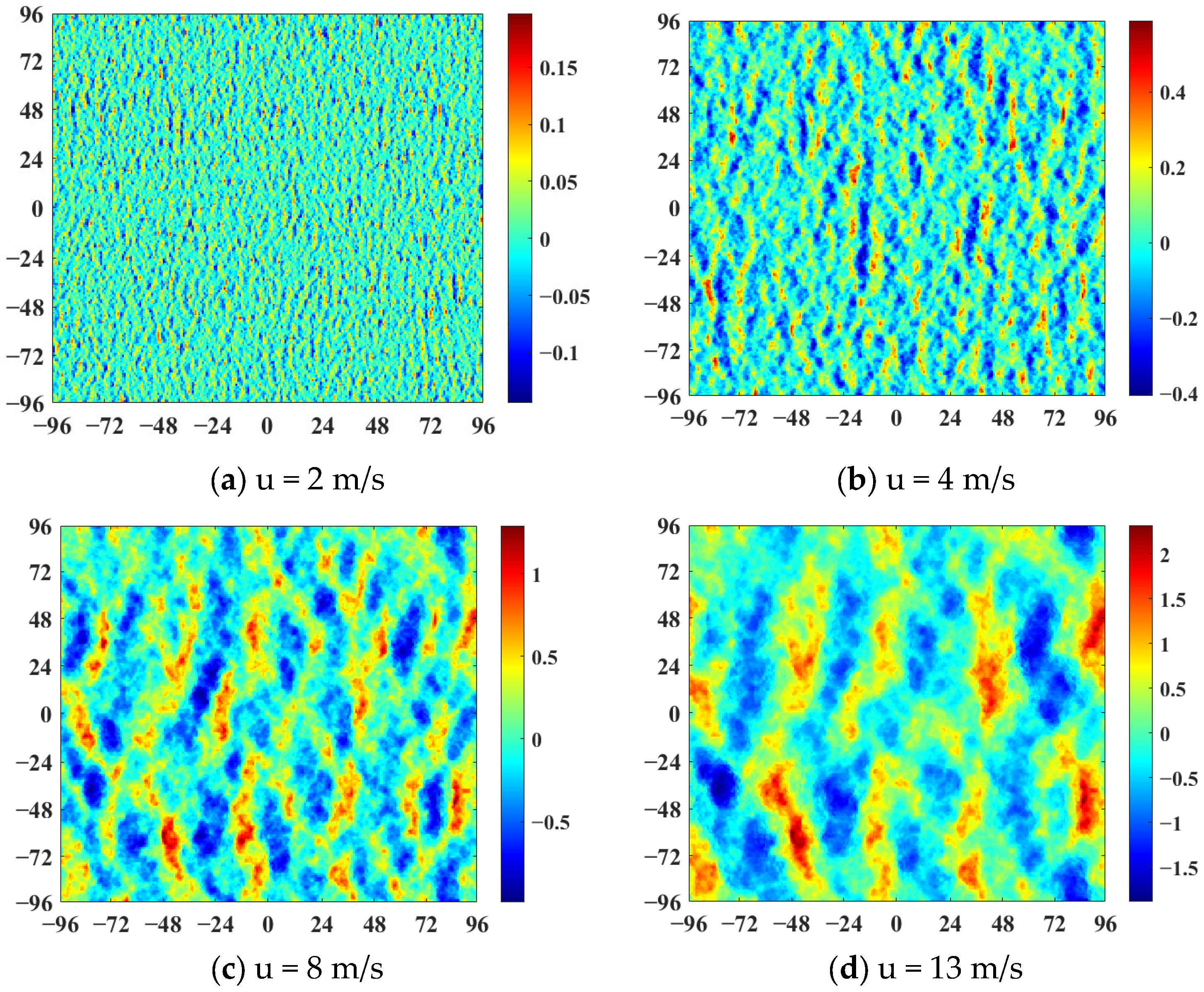
Figure 2a–d present top-view images of the three-dimensional sea surfaces generated based on the Elfouhaily wave spectrum under different wind speeds. The sea surface dimensions are 192 m × 192 m, with a spatial sampling interval of Δ x = Δ y = 0.75   m . From Figure 2a–d, it can be observed that as the wind speed increases, the waves exhibit longer wavelengths and greater wave heights, indicating an increase in wave scale.
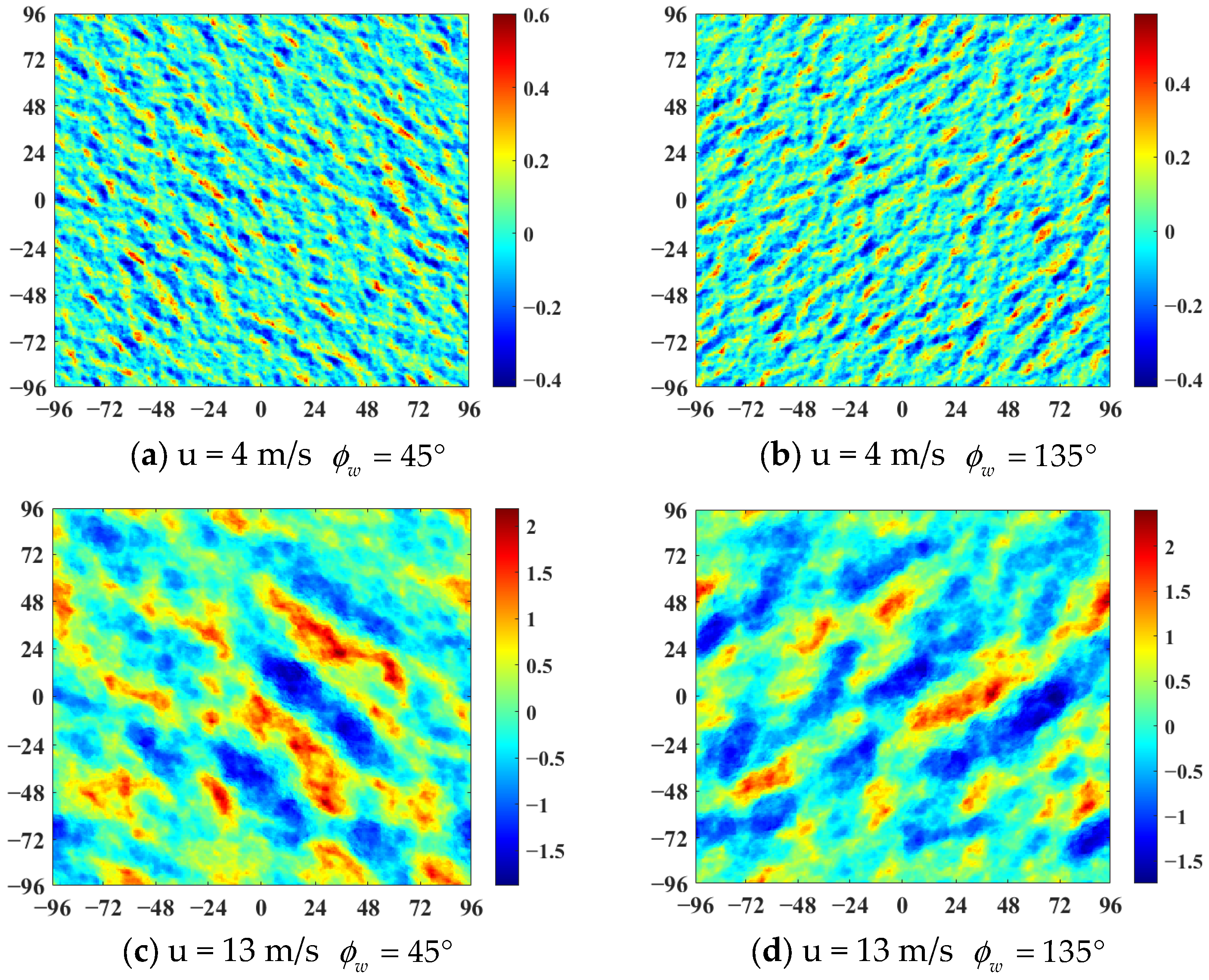
Figure 3a,b display top-view images of sea surfaces under a wind speed of 4 m/s with different wind directions, while Figure 3c,d show corresponding images under 13 m/s. From the figures, the undulation of large-scale waves and short waves aligns with the wind direction, confirming that the generated sea surface scene correctly reproduces the directional distribution characteristics of waves driven by the wind.
Next, based on the sea surface generated above, the semi-deterministic facet-based two-scale method is used to calculate its scattering characteristics. The large scale corresponds to the facet size of the generated sea surface (Δx = Δy = 0.75 m in this study). This scale corresponds to the low-frequency, long-wave components of the sea surface spectrum and primarily manifests as the geometric tilt modulation of the facets, which determines the change in the local incidence angle. In the near-vertical incidence region, specular reflection from large-scale gravity waves dominates [25,26]. Under such conditions, the Kirchhoff method based on the tangent plane approximation can be employed, combined with the probability density function of large-scale slopes, to compute the sea surface scattering coefficient in the near-vertical incidence region. The small scale refers to the sub-facet with microscale roughness consisting mainly of short gravity waves and capillary waves. Since their spatial scales are much smaller than the facet size, we do not explicitly generate their geometry. Instead, we describe their contribution to electromagnetic scattering using the perturbation method based on the high-frequency part of the Elfouhaily spectrum with the tilt modulation of the large-scale waves taken into account.
The expression for the Kirchhoff method is as follows [27]:
σ p q K A M ( k i , k s ) = π k 2 q 2 q z 4 U ˜ p q K A M 2 P ( Z x tan , Z y tan )
where q = k ( k ^ s k ^ i ) , { k ^ i , k ^ s } are the unit vectors of the incident and scattered directions, respectively, and k is the electromagnetic wavenumber. P ( z x tan , z y tan ) is the Cox-Munk PDF [28], and the slopes of the tangent plane along the x and y directions, can be expressed as:
Z x tan = q x / q z Z y tan = q y / q z
U ˜ p q K A M is the polarization factor, and its expression is given by
U ˜ v v K A M = M 0 [ R v ( θ i ) ( V ^ s k i ) ( V ^ i k s ) + R h ( θ i ) ( H ^ s k i ) ( H ^ i k s ) ] U ˜ v h K A M = M 0 [ R v ( θ i ) ( V ^ s k i ) ( H ^ i k s ) + R h ( θ i ) ( H ^ s k i ) ( V ^ i k s ) ] U ˜ h v K A M = M 0 [ R v ( θ i ) ( H ^ s k i ) ( V ^ i k s ) + R h ( θ i ) ( V ^ s k i ) ( H ^ i k s ) ] U ˜ h h K A M = M 0 [ R v ( θ i ) ( H ^ s k i ) ( H ^ i k s ) + R h ( θ i ) ( V ^ s k i ) ( V ^ i k s ) ]
where { H ^ i , V ^ i , H ^ s , V ^ s } is the polarization unit vector, M 0 = q q z / { [ ( H ^ s k ^ i ) 2 + ( V ^ s k ^ i ) 2 ] k q z } . R v ( θ i ) and R h ( θ i ) represent the Fresnel reflection coefficients, whose expressions are as follows:
R h θ i = cos θ i ε r sin 2 θ i cos θ i + ε r sin 2 θ i R v θ i = ε r 1 sin 2 θ i ε r 1 + sin 2 θ i ε r cos θ i + ε r sin 2 θ i 1 / 2
where θ i is the local incident angle of the facet, ε r is the relative permittivity of seawater, given by the Two-Debye model.
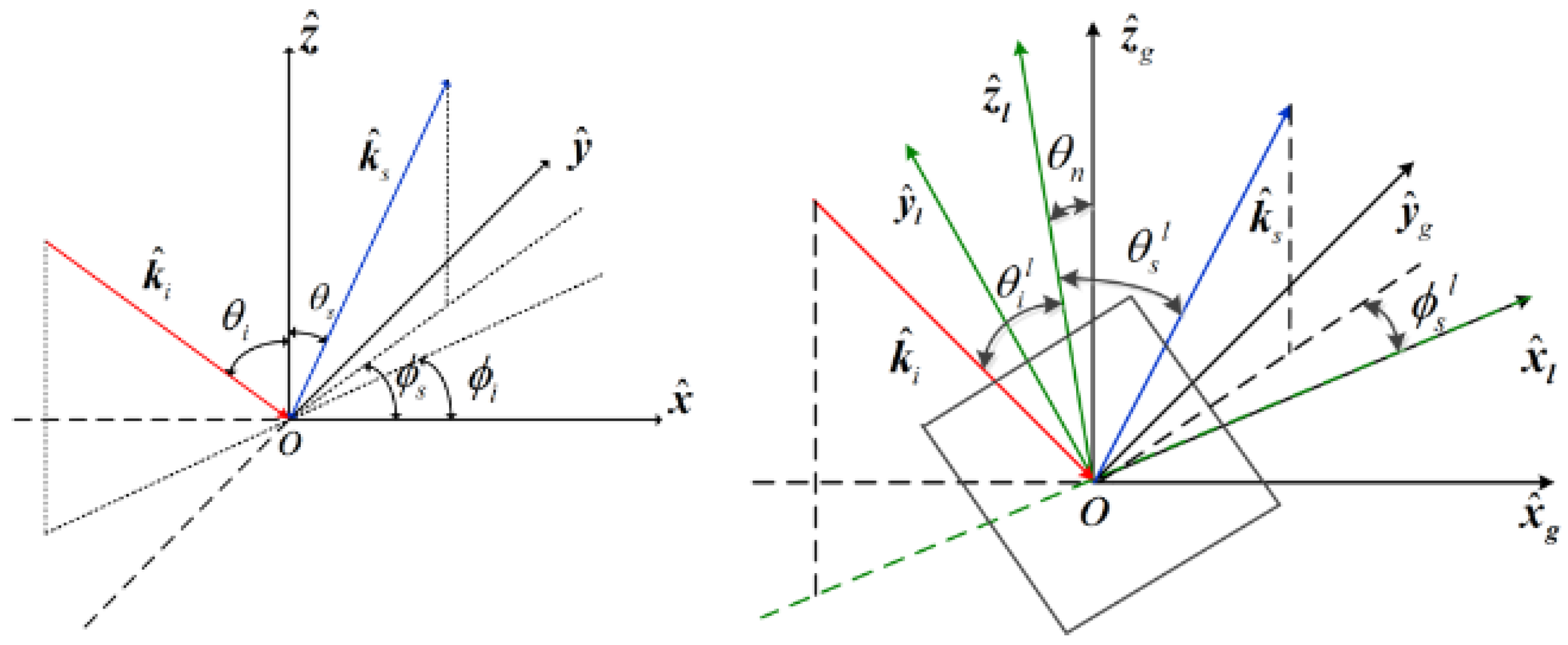
For the scattering from small facets modulated by the tilt of gravity waves, it is necessary to establish the relationship between the global coordinate system and the local facet coordinate system, as illustrated in Figure 4. The local coordinate system is established on the local rough tilted facet as follows:
z ^ l = n ^ y ^ l = n ^ × k ^ i / n ^ × k ^ i x ^ l = y ^ l × z ^ l
n ^ = ( Z x x ^ g Z y y ^ g + z ^ g ) / 1 + Z x 2 + Z y 2 is the normal vector of the small facet. The relationship between the global polarization vector { H ^ i , V ^ i , H ^ s , V ^ s } and the local polarization vector { h ^ i , v ^ i , h ^ s , v ^ s } is given by
H ^ i = ( H ^ i v ^ i ) v ^ i + ( H ^ i h ^ i ) h ^ i ,       V ^ i = ( V ^ i v ^ i ) v ^ i + ( V ^ i h ^ i ) h ^ i H ^ s = ( H ^ s v ^ s ) v ^ s + ( H ^ s h ^ s ) h ^ s ,       V ^ s = ( V ^ s v ^ s ) v ^ s + ( V ^ s h ^ s ) h ^ s
U ˜ p q is the polarization factor in the global coordinate system, and it satisfies
U ˜ V V     U ˜ V H U ˜ H V     U ˜ H H = V ^ s v ^ s         H ^ s v ^ s V ^ s h ^ s         H ^ s h ^ s U v v     U v h U h v     U h h V ^ i v ^ i         V ^ i h ^ i H ^ i v ^ i         H ^ i h ^ i
Therefore, the scattering coefficient of a single facet can be expressed as
σ P Q , m n facet = σ P Q , m n K A M ( k ^ i , k ^ s ) + σ P Q , m n T S P M ( k ^ i , k ^ s )
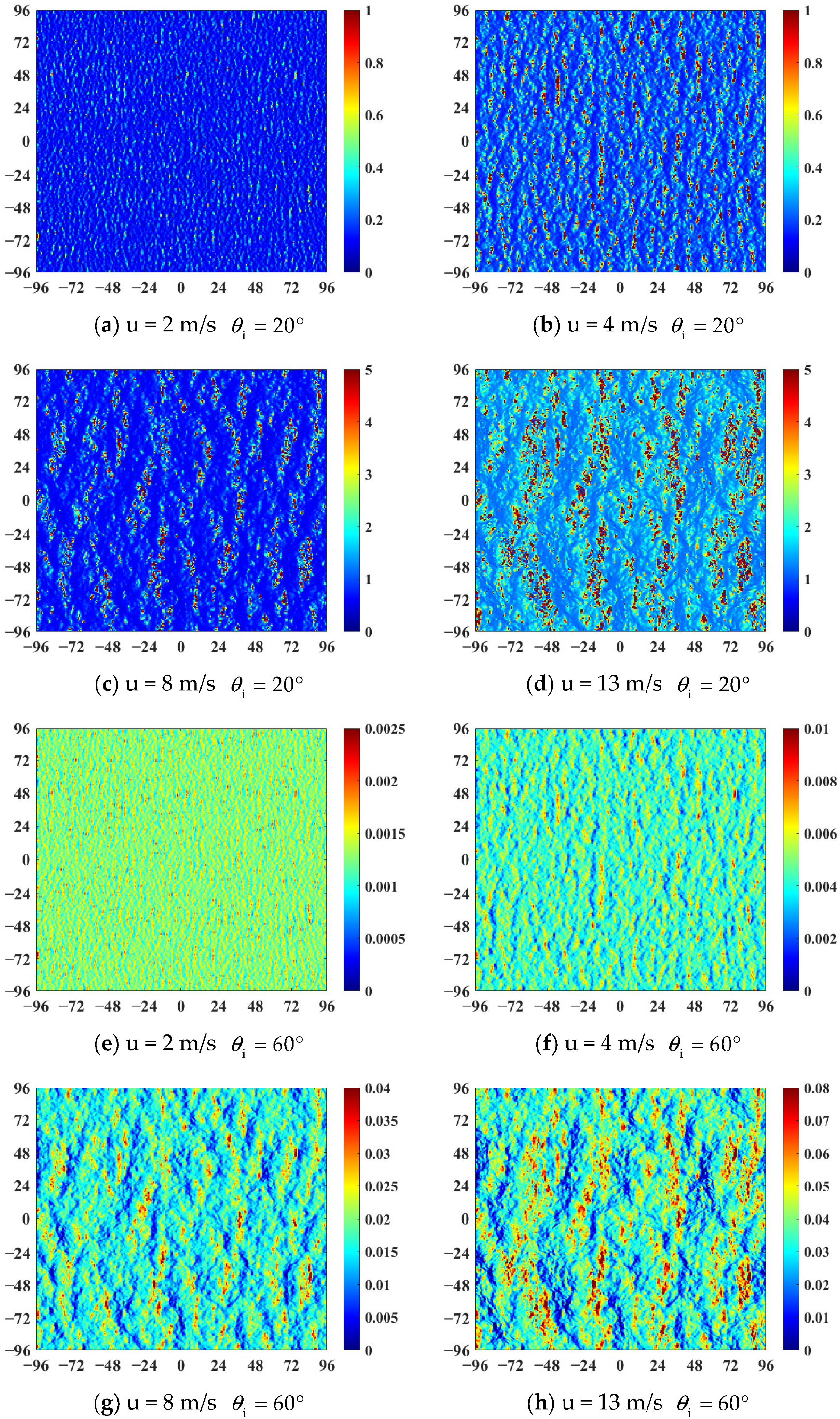
Figure 5 presents the distribution of sea surface scattering coefficients under VV polarization for different wind speeds and incidence angles. It can be observed from the figure that, for a fixed incidence angle, the sea surface scattering coefficient increases with higher wind speeds, which is consistent with the sea surface undulations shown in Figure 2a–d. Comparing Figure 5a–d with Figure 5e–h, it is evident that the sea surface scattering coefficient decreases as the incidence angle increases. This is attributed to the weakening of specular reflection and the increasing dominance of diffuse scattering from the sea surface at larger incidence angles.
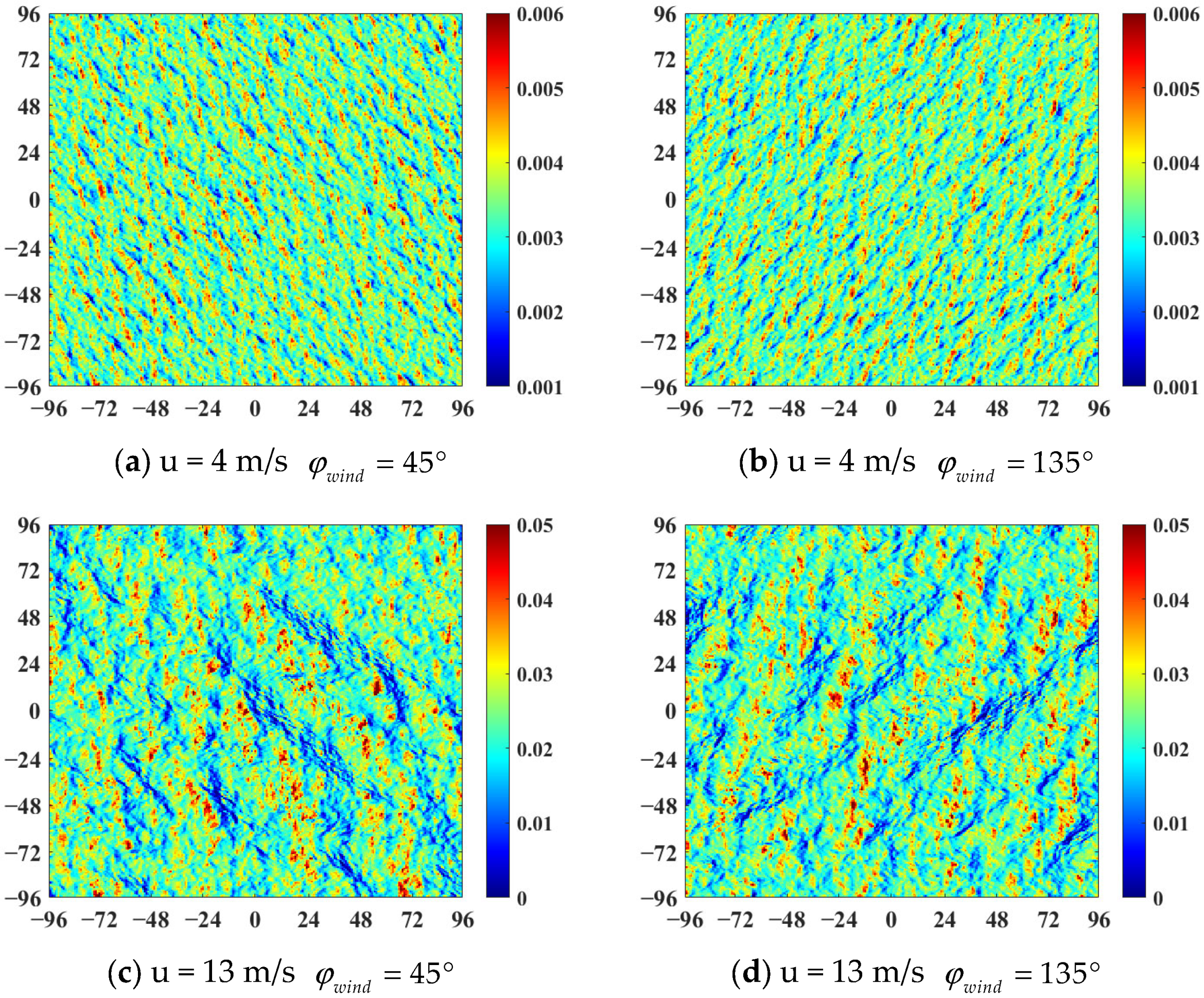
Figure 6 illustrates the variation in the distribution of sea surface scattering coefficients with wind direction at wind speeds of 4 m/s and 13 m/s, with the incidence angle fixed at 60°. Compared with Figure 3a–d, a clear consistency can be observed between the distribution of scattering coefficients and the sea surface undulations under different wind directions.

2.2. Echo Model and Imaging Algorithm Based on Sea Surface Scattering Characteristics

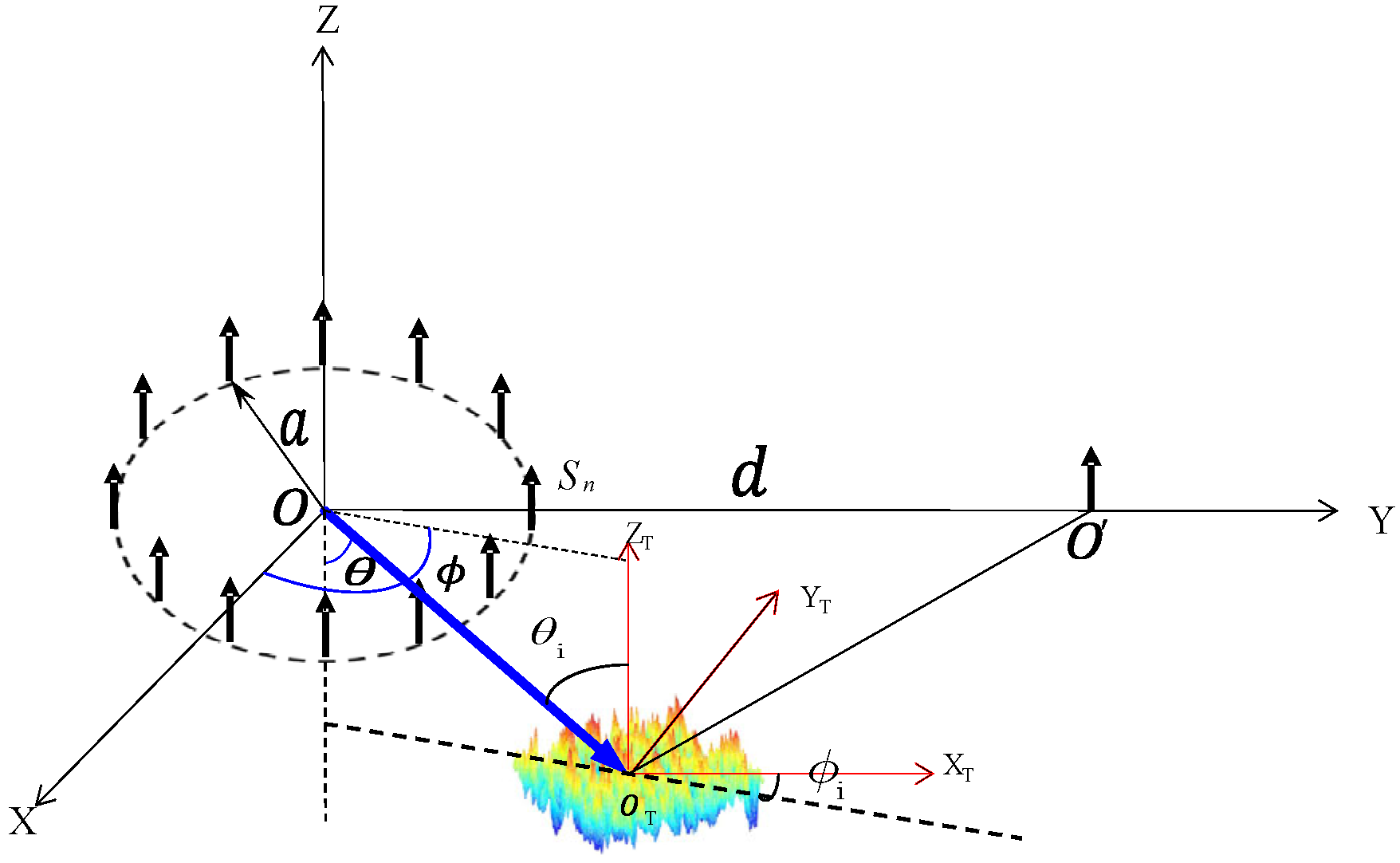
The vortex radar imaging system for sea surface observation is illustrated in Figure 7. The system consists of an independent omnidirectional transmitting antenna element and a Uniform Circular Array (UCA) used to generate vortex electromagnetic echoes. The UCA is composed of multiple equally spaced antenna elements arranged along a circle of radius a. O denotes the center of the UCA, and O represents the position of the independent omnidirectional transmitting antenna element. The distance between the receiving array center O and the transmitting position O is d. The coordinates of a target point M in the detection scene are given as M ( r , θ , φ ) , where r is the distance between point M and the array center O , θ is the angle between the line connecting M to O and the positive Z-axis, and φ is the angle between the projection of M onto the XOY plane and the positive X-axis.
In this paper, a Linear Frequency Modulated (LFM) signal is employed as the transmitted signal, denoted by s ( t ) :
s ( t ) = r e c t ( t τ T p ) exp j 2 π ( f c ( t τ ) + 1 2 K ( t τ ) 2 )
Here, τ represents the round-trip time from the transmitting unit to the sea surface and back to the receiving unit and τ   = 2 R / c   , R is the distance from the radar to the sea surface, c is the speed of light, K denotes the chirp rate, T p is the pulse width, and f c is the center frequency.
The sea surface scattered echoes S total ( t , l ) received by the UCA can be expressed as [20]
S total ( t , l ) = i = 1 N σ i s ( t τ ) exp ( j l φ i ) J l ( k a sin θ i )
where σ i represents the backscattering coefficient of an individual small facet on the sea surface, and N denotes the total number of sea surface facets. l is the OAM mode of the vortex electromagnetic wave, φ i is the azimuth angle of the i-th facet, and θ i is the elevation angle of the i-th facet. J l ( · ) denotes the Bessel function.
For point target imaging, the local coordinate system of the target can be disregarded. However, in the imaging of complex sea surfaces, it becomes essential to express the positional coordinates of sea surface facets within the radar imaging coordinate framework. A schematic diagram illustrating the imaging coordinate system and the sea surface local coordinate system is shown in Figure 7. Coordinate system transformation is achieved through rotation matrices and translation vectors. Without loss of generality, assuming the local sea surface coordinate system is rotated around the Z-axis (in this paper, β = 90°) to align its X- and Y-axes with those of the global coordinate system, the rotation matrix can be expressed as
R z = cos β sin β 0 sin β cos β 0 0 0 1
Let the distance from the origin of the imaging coordinate system to the origin of the local sea-surface coordinate system be R D , with the elevation angle denoted as θ D and the azimuth angle as φ D . Then the translation vector can be expressed as
T R = R D sin θ D   cos φ D ;         R D sin θ D   sin φ D ;         R D cos θ D
Thus, the coordinates of a sea-surface facet in the imaging coordinate system can be expressed as
x y z = cos β sin β 0 sin β cos β 0 0 0 1 x y z + T R
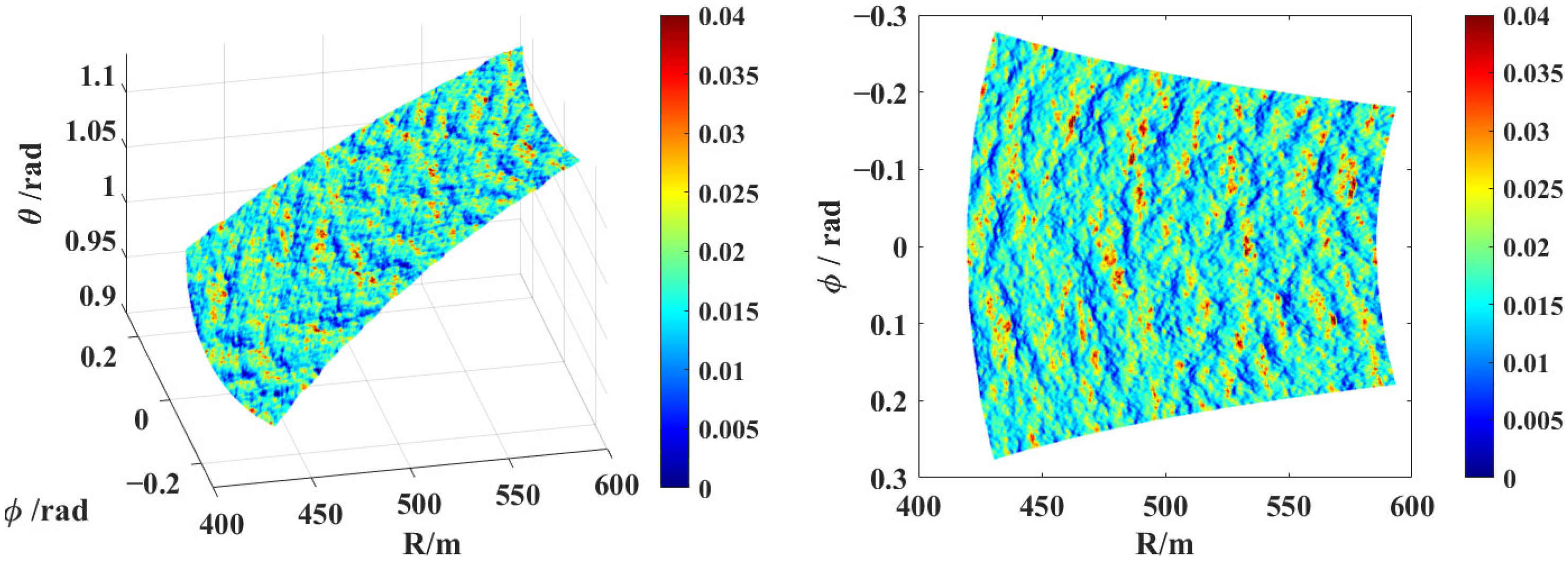
It should be noted that this vortex imaging system operates in a spherical coordinate system. Therefore, the sea surface coordinates were also transformed into spherical coordinates. Figure 8 presents the distribution of the sea surface scattering coefficient in spherical coordinates and its two-dimensional range-azimuth cross-section under the conditions of a wind speed of 8 m/s, a wind direction of 0°, and an incidence angle of 60°.
The flowchart of the two-dimensional vortex electromagnetic wave imaging process based on sea surface scattering distribution is shown in Figure 9.
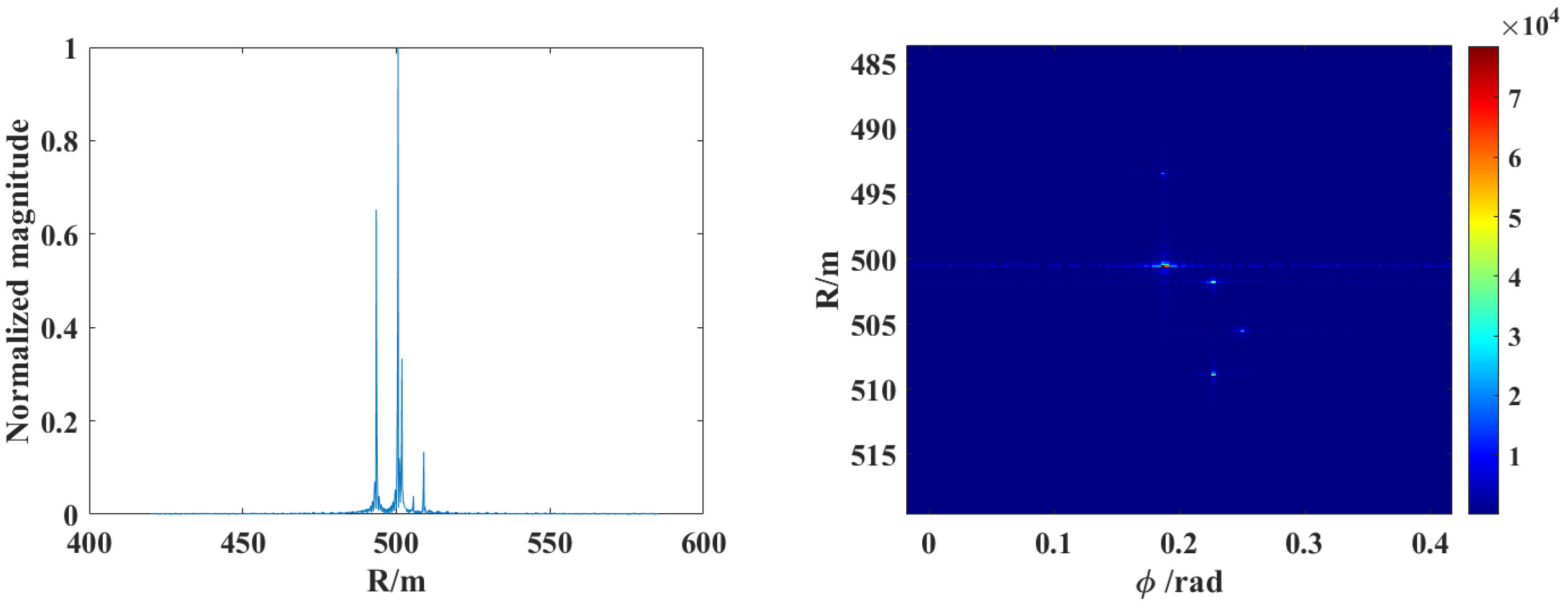
To validate the imaging capability of the vortex imaging system, a simulation experiment involving five-point targets was conducted in this study. The simulation parameters of the vortex radar are listed in Table 1, while the target position parameters and corresponding simulation results are presented in Table 2.
The simulation results presented in Table 2, and Figure 10 demonstrate that when imaging point targets, the vortex imaging system achieves an azimuth error of less than 0.02 rad and a range error of less than 1 m, enabling accurate reconstruction of target positions.

3. Simulation Results

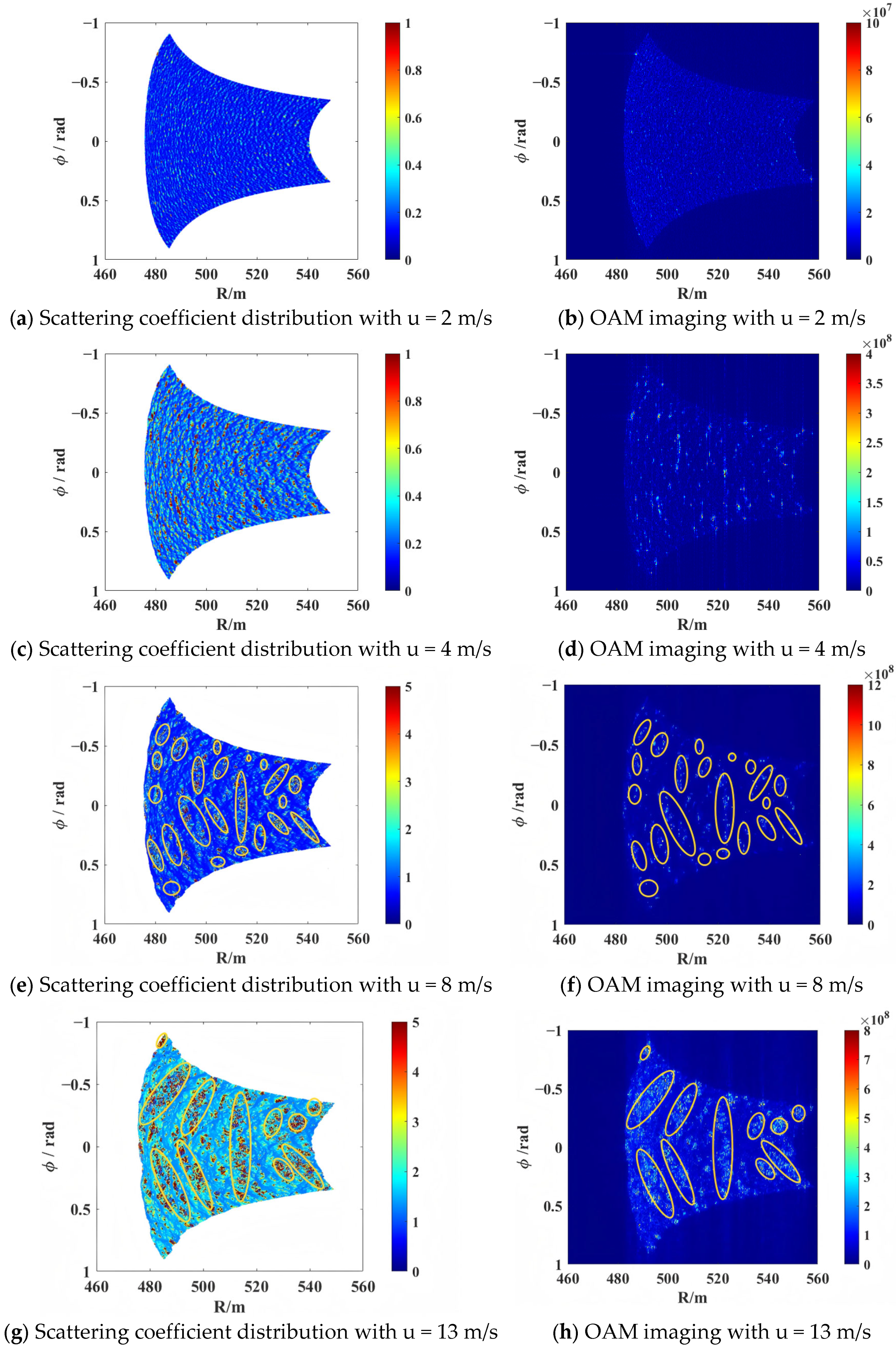
Figure 11 presents the comparison between the two-dimensional range-azimuth profile of sea scattering coefficient distribution and OAM imaging distribution under an incidence angle of 20°, with wind speeds of 2, 4, 8, and 13 m/s and a wind direction of 0°. It can be observed from the figure that the vortex imaging results effectively reflect the scattering texture characteristics of the sea surface and the geometric scale information of ocean waves. From Figure 11a–d, it is evident that under low wind speeds, the sea surface is predominantly composed of short waves with low roughness, resulting in relatively small and uniformly distributed scattering coefficients, which correspond to lower imaging intensities. From Figure 11e–h, as wind speed increases, the sea surface scattering coefficients intensify, and the imaging intensity also rises accordingly. Comparing the left and right panels, it can be observed that the regions with strong scattering intensity in the scattering coefficient distribution map correspond well with the regions exhibiting stronger texture signals in the OAM imaging map, clearly capturing the large-scale undulations of the sea surface. This spatial correspondence qualitatively demonstrates the accuracy of the imaging system in characterizing the distribution of sea surface texture.
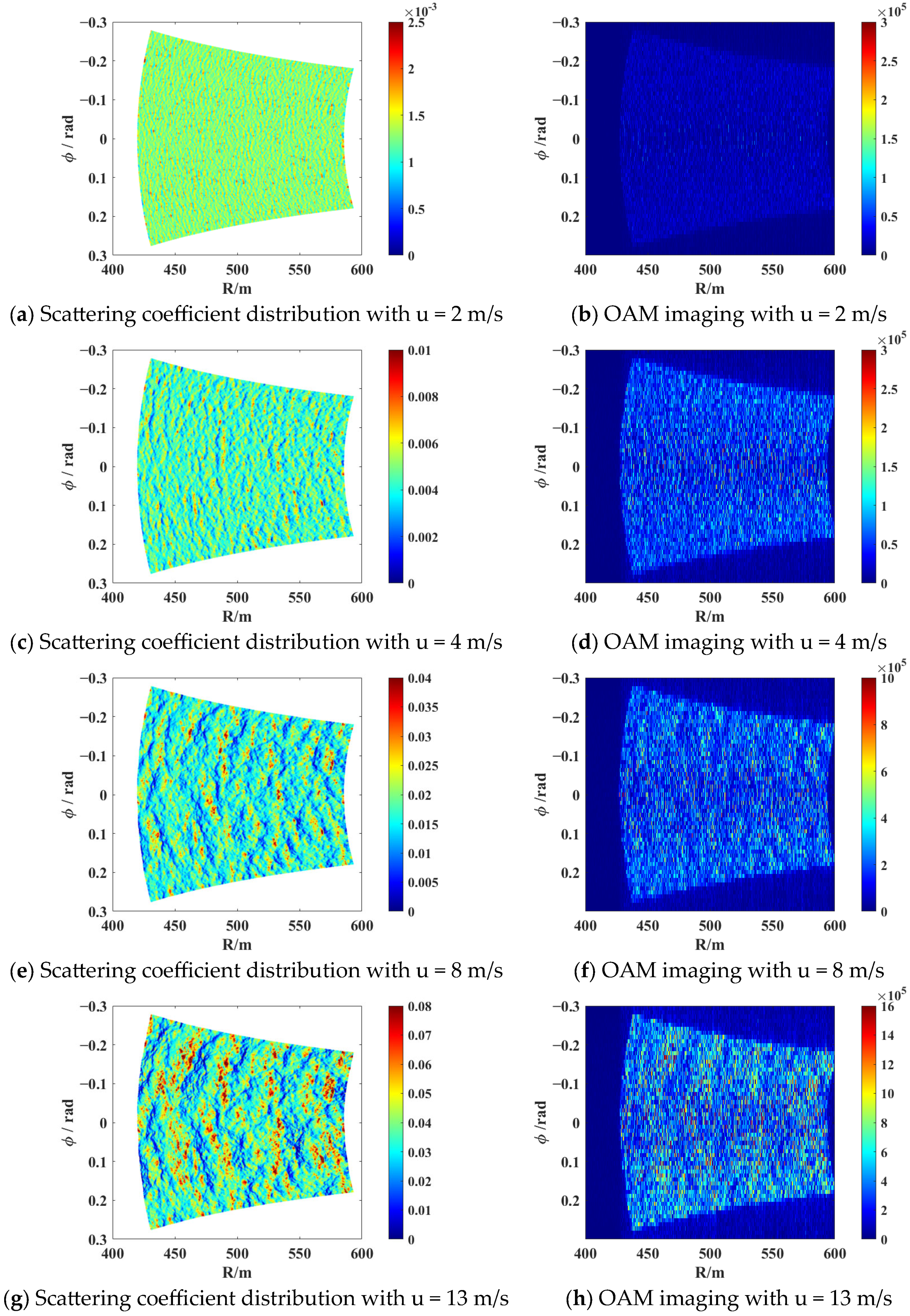
Figure 12 shows the comparison between the two-dimensional range-azimuth profile of sea scattering coefficient distribution and OAM imaging distribution under an incidence angle of 60°, with wind speeds of 2, 4, 8, and 13 m/s and a wind direction of 0°. Compared with Figure 11, the reduction in incidence angle leads to a decrease in sea surface scattering intensity. Especially under low wind speeds, as seen in Figure 12b,d, the vortex imaging results struggle to clearly reflect the scattering texture or geometric scale of the sea surface. However, when wind speeds increase to 8–13 m/s, as shown in Figure 12f,h, the vortex imaging results are able to capture the large-scale undulations of the sea surface.
Figure 11 and Figure 12 present the effects of wind speed and incidence angle on vortex imaging performance. However, the sea surface is inherently anisotropic, and its scattering behavior is strongly dependent on wind direction. To further validate the capability of vortex radar in capturing directional ocean features, Figure 13 presents and analyzes vortex imaging results for different wind directions. The observed azimuthal variations in imaging intensity and texture are discussed in relation to the directional wave spectrum and semi-deterministic facet-based two-scale scattering theory, highlighting the potential of vortex electromagnetic waves for wind field retrieval and marine environmental monitoring.
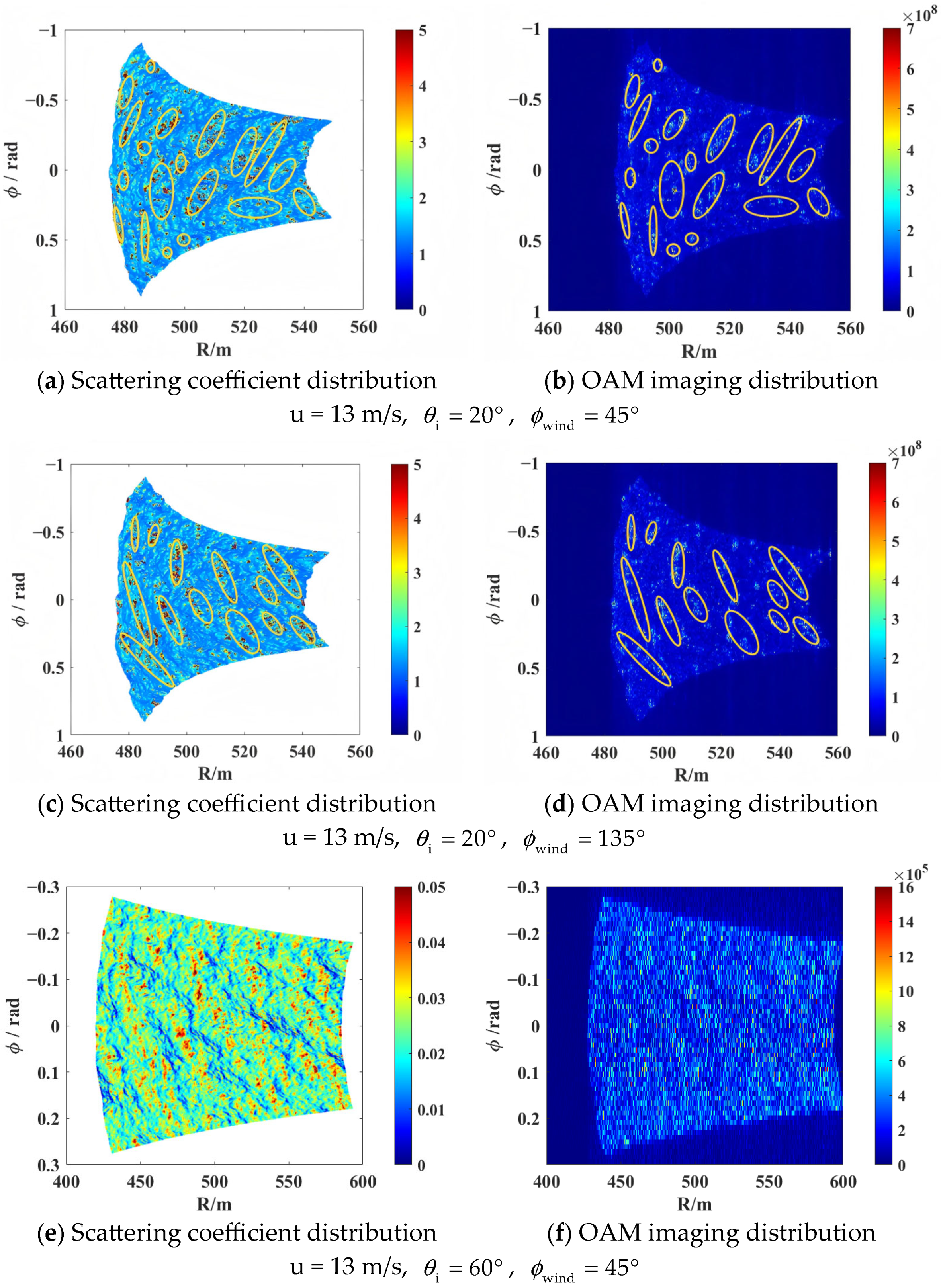
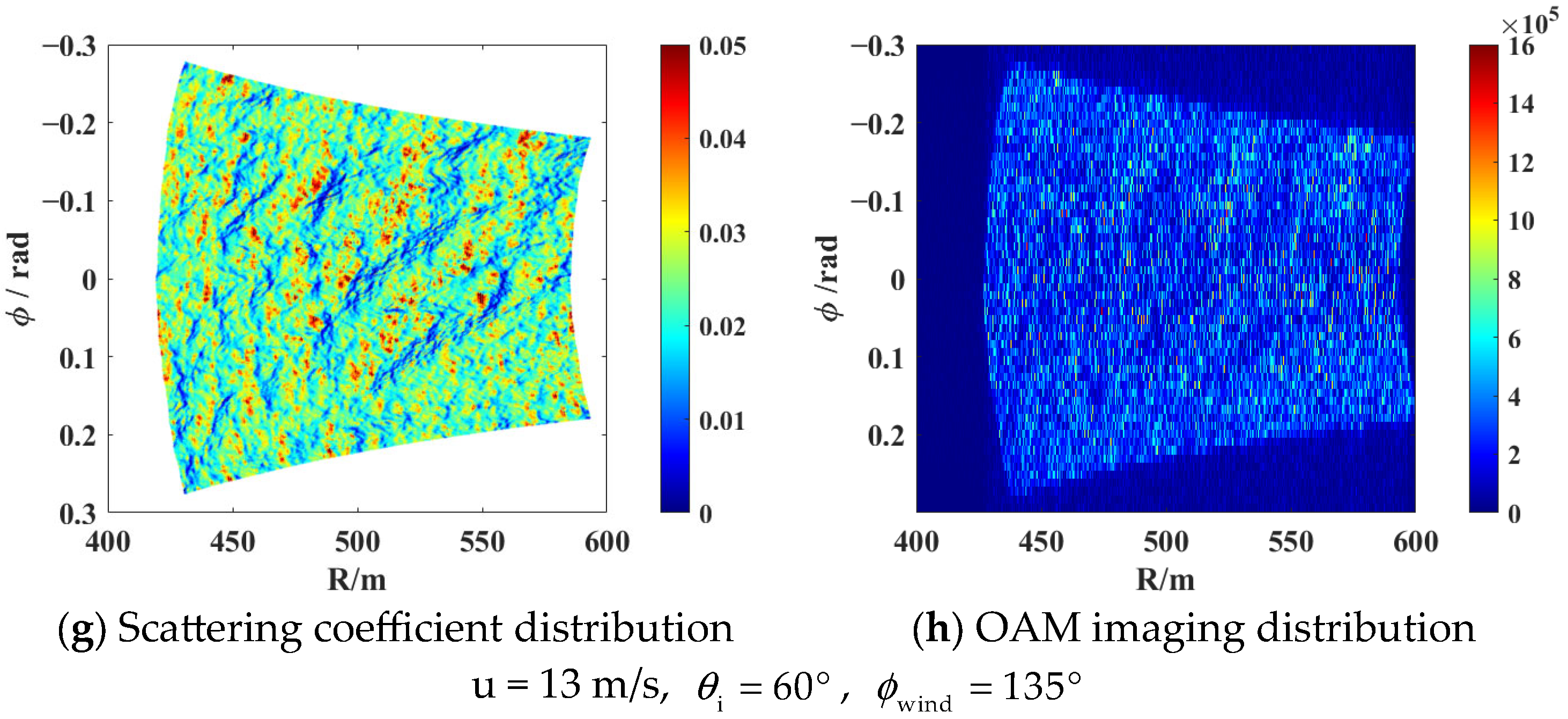
Figure 13a–d present the comparison between two-dimensional range-azimuth profile of scattering coefficient distribution and OAM imaging distribution under a wind speed of 13 m/s, an incidence angle of 20°, and wind directions of 45° and 135°, respectively. Figure 13e–h show the comparison under the same wind speed of 13 m/s, an incidence angle of 60°, and wind directions of 45° and 135°, respectively. The vortex imaging results presented in the figures effectively capture both the undulation of sea waves and the variation in wind direction. This sensitivity can be primarily attributed to the anisotropic nature of sea surface scattering. As described by the Elfouhaily directional spectrum, the energy of ocean waves is not isotropically distributed but is concentrated along the wind direction. Consequently, according to the two-scale scattering model, the Bragg-resonant waves that dominate the radar backscatter are modulated by the tilt effect of large-scale gravity waves. This modulation directly imprints on the spatial texture of the resulting vortex images. These findings suggest that vortex radar not only captures sea surface roughness but also encodes directional information, offering a promising tool for wind direction inversion.

4. Discussion

4.1. Differences Between Theoretical Scenarios and Real-Sea Applications

Considering that the imaging method may produce different sampling results for the current theoretical scenarios and future real-sea applications, this section discusses the differences between the virtual scene and the real scene. The main differences between the current theoretical scenarios and future real-sea applications are as follows:
  • Sea Surface Modeling
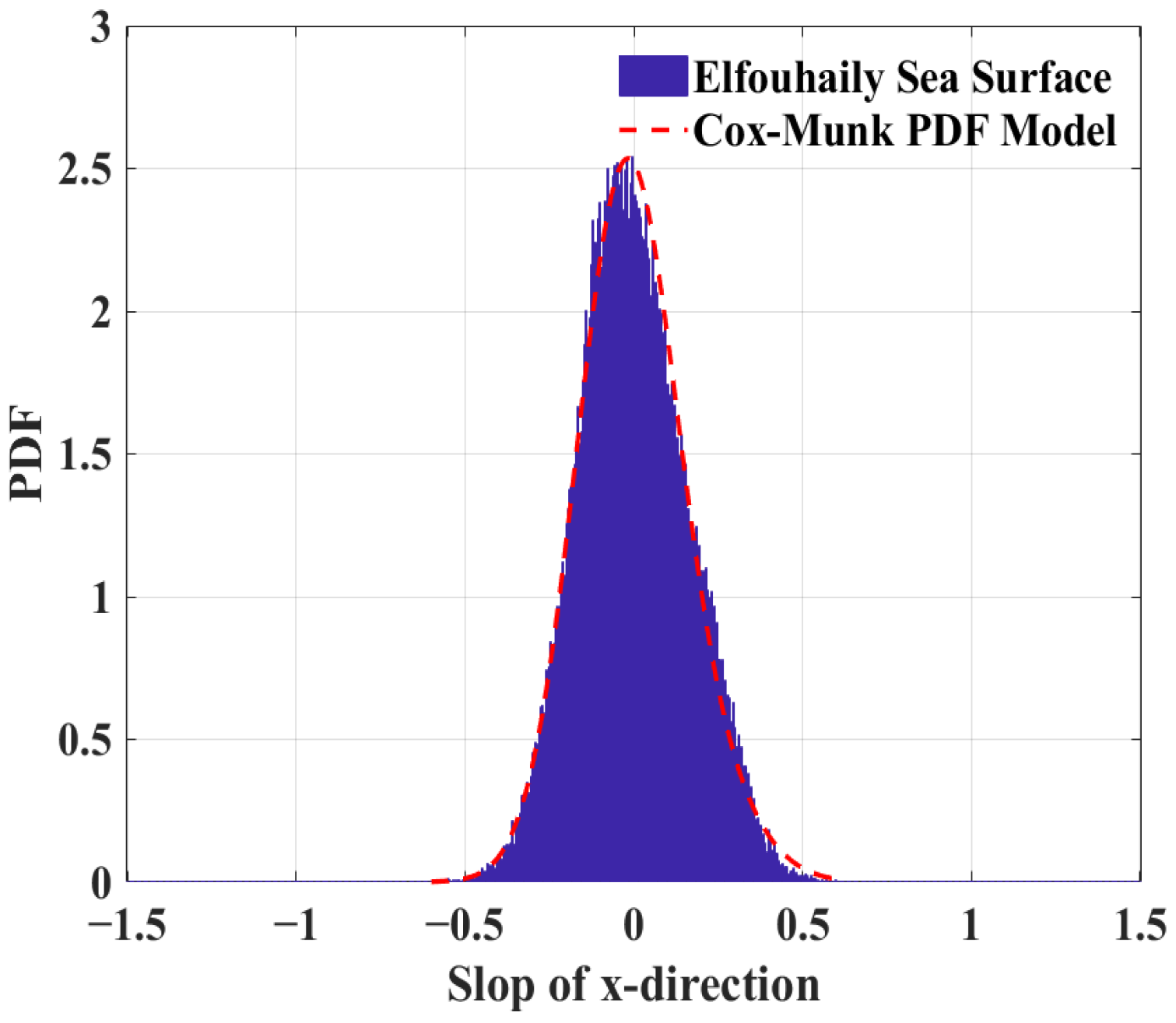
The inhomogeneity of the real sea surface and the interaction of multi-scale waves are more complex than the scenarios simulated in this study. We validated the slope distribution of the generated sea surface, as shown in Figure 14.
It can be observed that the probability density function (PDF) of our generated surface slopes agrees well with the results of Cox and Munk. This indicates that the slopes of the simulated sea surface are consistent with experimental data, which is crucial for accurately calculating electromagnetic scattering.
  • Sea Surface Scattering Modeling
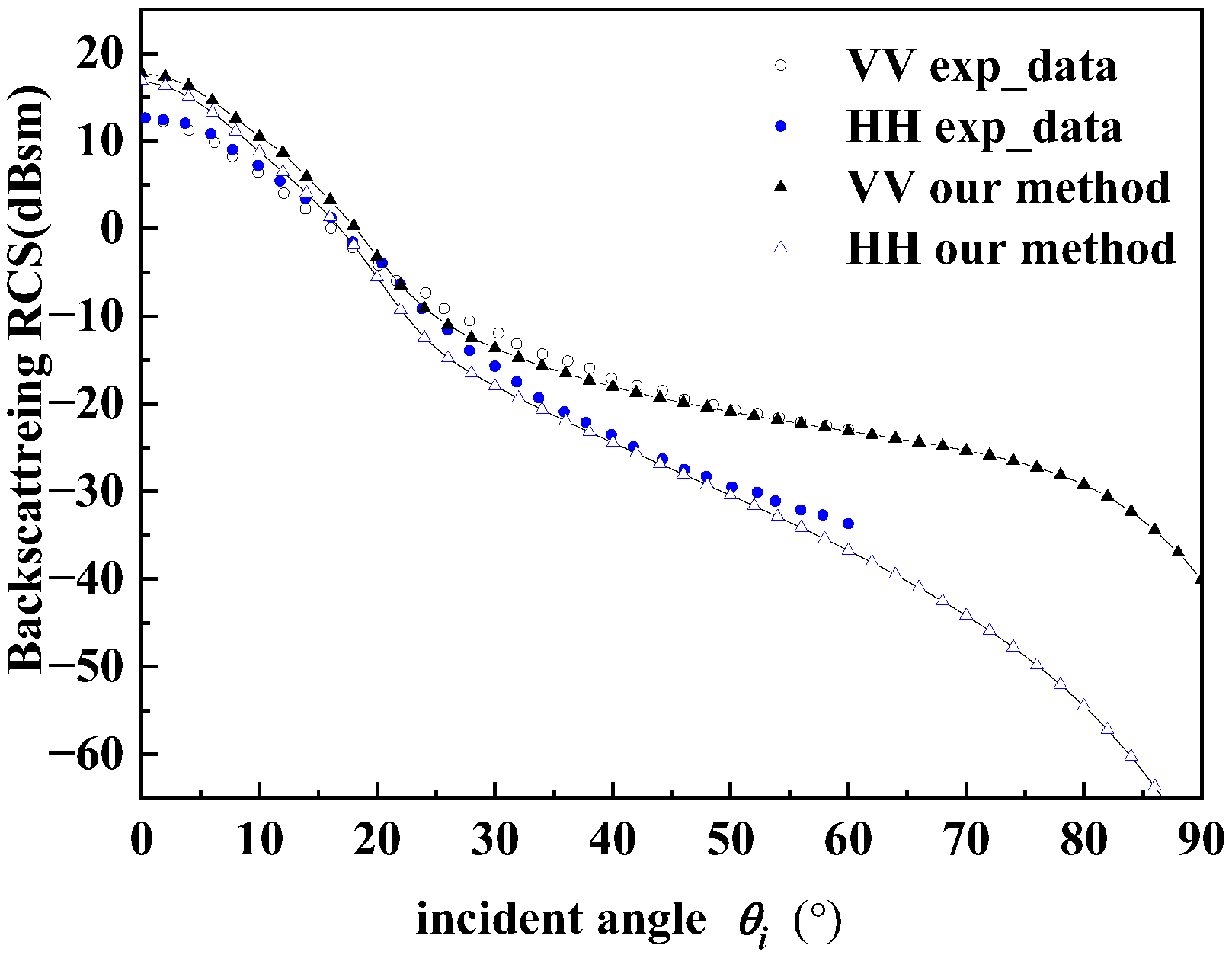
We compared the scattering model with measured data from the SASS-II experiment [29], as shown in Figure 15. This calculation was performed at a radar frequency of 14.6 GHz for both horizontal (HH) and vertical (VV) polarizations. The results show that the theoretical radar cross-section (RCS) values agree quite well with the measured data for both polarizations, which verifies the correctness of our method.
  • Echo and Imaging Model
In real-world applications, the echo and imaging model will face additional complexities beyond those present in theoretical simulations. Factors such as atmospheric propagation effects, ocean currents, and inherent sensor noise can degrade the signal-to-noise ratio (SNR) of the received echoes, thereby affecting image quality.
It is important to note that while the core processing workflow—specifically, pulse compression and FFT across the OAM mode domain—remains conceptually the same for both simulated and real data, the application to real-world data requires additional preprocessing steps. These include system calibration, noise filtering, and compensation for environmental disturbances. Moreover, the robustness of the imaging algorithm to SNR degradation and parameter uncertainties must be carefully evaluated when transitioning from idealized simulations to practical observations.
In this study, we focus on validating the fundamental imaging capability of the vortex radar system under idealized conditions. The use of theoretical data allows us to isolate and assess the intrinsic performance of the proposed imaging method without the confounding effects of real-world environmental factors. The successful demonstration under these controlled conditions establishes a necessary foundation for future extensions to real-sea applications, where the challenges of data preprocessing and algorithm robustness will be addressed.

4.2. Wind Speed Range and Limitations and Future Work

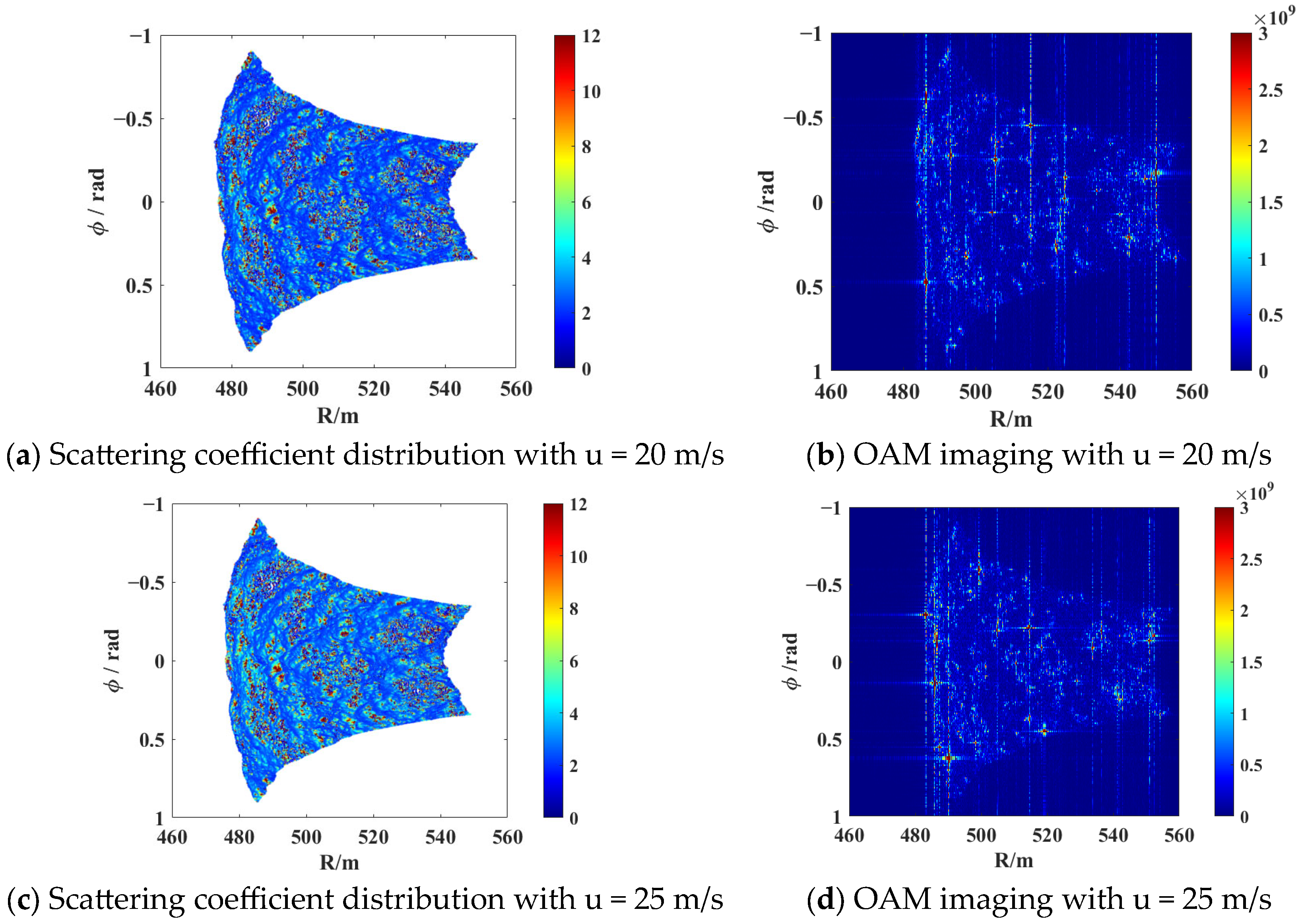
When the wind speed is high, such as during a typhoon, the sea surface is chaotic, and various signals are mixed, resulting in a lot of noise in the measured signals. In addition, typhoons are often accompanied by rainfall, which affects radar returns in two main aspects: one is the volume scattering caused by raindrops and the attenuation effect in the atmosphere; the other is the influence of the ring wave spectrum generated by raindrops on the sea surface roughness, which in turn affects the radar scattering echo [30]. Moreover, under high sea states, breaking waves and sea foam occur [31]. Airborne measurements conducted during hurricanes [32] have confirmed that co-polarized scattering suffers from signal saturation and damping, making it only weakly sensitive to wind speed variations above 25 m/s. Therefore, the wind speeds considered in this paper do not include high-wind conditions exceeding 25 m/s. While the simulation with wind speeds of 2, 4, 8, and 13 m/s are discussed in Section 3, we have now presented the simulation cases at 20 m/s and 25 m/s, while also incorporating the effects of breaking waves and foam, thereby extending the applicability of our scattering model to 25 m/s.
As can be seen from Figure 16, compared with low wind speeds, when the wind speed increases to 20–25 m/s, the sea surface wave undulations intensify and the scattering coefficient increases. The OAM radar imaging system can better reflect the undulations of large-scale waves.
While our work has made progress in OAM-based sea surface imaging, it is also necessary to acknowledge the limitations of the current model. Our current model is applicable to wind-driven sea surfaces under open ocean conditions for wind speeds ranging from 0 to 25 m/s. The core objective of this study is to validate the capability of vortex radar imaging for detecting sea surface texture, rather than to conduct an in-depth investigation of wave dynamics. Therefore, the surface scattering model in this study does not account for the propagation direction of swell or nearshore waves. In addition, given the number of modes used in this study, achieving high azimuth resolution imposes higher demands on the antenna configuration.
Future work will consider applications under diverse wind and wave conditions to better approximate real ocean scenarios. We will also focus on integrating this method with synthetic aperture radar (SAR) technology to reduce the number of required modes while achieving high-resolution imaging.
Nevertheless, using the model developed in this paper, we simulated multiple sample scenarios by adjusting input parameters (such as incidence angle, wind speed, and wind direction), thereby systematically testing the sensitivity of the OAM radar to different sea states. This provides a basis and guidance for subsequent radar system design and experimental work.

5. Conclusions

The development of vortex radar technology provides a new approach for the routine monitoring and high-resolution imaging of sea surface dynamics. This paper proposes a two-dimensional vortex radar imaging method based on the three-dimensional sea surface scattering characteristics distribution. Firstly, a three-dimensional sea surface geometric model is established based on the Elfouhaily wave spectrum, and the sea surface scattering coefficient distribution is calculated using the semi-deterministic facet-based two-scale method. Building on the sea surface scattering coefficients, a vortex electromagnetic echo model of the sea surface is constructed using a Uniform Circular Array (UCA) antenna and Linear Frequency Modulated (LFM) signals. The sea surface range-azimuth imaging results are obtained through pulse compression and Fast Fourier Transform (FFT) applied to the Orbital Angular Momentum (OAM) mode domain. This study focuses on investigating the impact of different sea surface wind speeds, wind directions, and radar incidence angles on vortex imaging of the sea surface. The results indicate that the vortex imaging system can effectively reflect sea wave undulations and wind direction characteristics. Moreover, the imaging performance improves with increasing wind speed and decreasing incidence angle, validating the feasibility and potential of vortex radar imaging for ocean applications. Overall, this study lays a theoretical foundation for sea surface imaging using vortex radar and opens up new possibilities for ocean remote sensing and parameter inversion.

Author Contributions

Conceptualization, X.Z., X.S., L.R. and Z.W.; methodology, X.S., H.G. and X.Z.; formal analysis, H.G. and X.Z.; funding acquisition, X.Z. and L.R.; investigation, H.G.; writing—original draft, H.G. and X.Z.; writing—review and editing, X.Z. All authors have read and agreed to the published version of the manuscript.

Funding

This research was funded by the National Natural Science Foundation of China, grant number 62101445 and the Interdisciplinary Research Program of the School of Electronic Engineering, Xi’an University of Posts and Telecommunications (No. XKJC2502).

Data Availability Statement

No new data were created or analyzed in this study.

Conflicts of Interest

The authors declare no conflicts of interest.

References

  1. Allen, L.; Beijersbergen, M.W.; Spreeuw, R.J.; Woerdman, J.P. Orbital angular momentum of light and the transformation of Laguerre-Gaussian laser modes. Phys. Rev. A 1992, 45, 8185–8189. [Google Scholar] [CrossRef]
  2. Wang, J.; Yang, J.-Y.; Irfan, M.F.; Nisar, A.; Yan, Y.; Huang, H.; Ren, Y.-X.; Yue, Y.; Samuel, D.; Moshe, T.; et al. Terabit free-space data transmission employing orbital angular momentum multiplexing. Nat. Photonics 2012, 6, 488–496. [Google Scholar] [CrossRef]
  3. Yao, A.M.; Padgett, M.J. Orbital angular momentum: Origins, behavior and applications. Adv. Opt. Photonics 2011, 3, 161–204. [Google Scholar] [CrossRef]
  4. Graham, G.; Johannes, C.; Miles, J.P.; Mikhail, V.; Valeriy, P.; Stephen, M.B.; Sonja, F. Free-space information transfer using light beams carrying orbital angular momentum. Opt. Express 2012, 6, 488–496. [Google Scholar] [CrossRef]
  5. Thidé, B.; Then, H.; Sjöholm, J.; Palmer, K.; Bergman, J.; Carozzi, T.D.; Istomin, Y.N.; Ibragimov, N.H.; Khamitova, R. Utilization of photon orbital angular momentum in the low-frequency radio domain. Phys. Rev. Lett. 2007, 99, 087701. [Google Scholar] [CrossRef] [PubMed]
  6. Tamburini, F.; Mari, E.; Thidé, B.; Barbieri, C.; Romanato, F. Experimental Verification of Photon Angular Momentum and Vorticity with Radio Techniques. Appl. Phys. Lett. 2011, 99, 204102. [Google Scholar] [CrossRef]
  7. Mohammadi, S.M.; Daldorff, L.K.S.; Bergman, J.E.S.; Karlsson, R.L.; Thidé, B. Orbital Angular Momentum in Radio—A System Study. IEEE Trans. Antennas Propag. 2010, 58, 565–572. [Google Scholar] [CrossRef]
  8. Mohammadi, S.M.; Daldorff, L.K.S.; Forozesh, K.; Thidé, B.; Bergman, J.E.S.; Isham, B.; Karlsson, R. Orbital Angular Momentum in Radio: Measurement Methods. Radio Sci. 2010, 45, RS4007. [Google Scholar] [CrossRef]
  9. Tamburini, F.; Mari, E.; Sponselli, A.; Thidé, B.; Bianchini, A.; Romanato, F. Encoding Many Channels in the Same Frequency through Radio Vorticity: First Experimental Test. New J. Phys. 2012, 14, 033001. [Google Scholar] [CrossRef]
  10. Li, Y.-H.; Yang, G.; Li, W.-W.; Wang, K.; Huang, M. Dual-Band Antenna with OAM Mode Radiated by Ground Plane. J. Electromagn. Eng. Sci. 2023, 23, 244–250. [Google Scholar] [CrossRef]
  11. Meng, X.-S.; Wu, J.-L.; Wu, Z.-S.; Hu, Y. Reflectarray for Orbital Angular Momentum Wave in Radio Frequency. IEEE Antennas Wirel. Propag. Lett. 2018, 17, 2269–2273. [Google Scholar] [CrossRef]
  12. Zhang, X.-X.; Su, X.; Wu, Z.-S.; Hu, Y. Analysis of Electromagnetic Scattering from Typical Targets for Orbital-Angular-Momentum Waves: Theoretical Model. IET Microw. Antennas Propag. 2022, 16, 699–708. [Google Scholar] [CrossRef]
  13. Wu, Z.; Wu, J.-L.; Li, H.-Y.; Hu, Y.; Wu, Z.-S. Integrated Physical Optics for Calculating Electric-Large Metallic Sphere Scattering Irradiated by Vortex Wave in Microwave Frequency Band. IEEE Antennas Wirel. Propag. Lett. 2022, 21, 1288–1292. [Google Scholar] [CrossRef]
  14. Guo, Z.-Y.; Wang, Y.-L.; Wang, Y.-Z.; Guo, K. Research advances in vortex radar imaging technology. J. Radars 2021, 10, 665–679. [Google Scholar] [CrossRef]
  15. Guo, G.-R.; Hu, W.-D.; Du, X.-Y. Electromagnetic vortex based radar target imaging. J. Natl. Univ. Def. Technol. 2013, 35, 71–76. [Google Scholar] [CrossRef]
  16. Liu, K.; Cheng, Y.-Q.; Yang, Z.-C.; Wang, H.-Q.; Qin, Y.-L.; Li, X. Orbital-Angular-Momentum-Based Electromagnetic Vortex Imaging. IEEE Antennas Wirel. Propag. Lett. 2015, 14, 711–714. [Google Scholar] [CrossRef]
  17. Liu, H.-Y.; Liu, K.; Cheng, Y.-Q.; Xiao, S.-Q. Microwave vortex imaging based on dual coupled OAM beams. IEEE Sens. J. 2020, 20, 806–815. [Google Scholar] [CrossRef]
  18. Wang, L.; Tao, L.-J.; Li, Z.-Y.; Wu, J.-J.; Yang, J.-Y. Three Dimensional Electromagnetic Vortex Radar Imaging Based on the Modified RD Algorithm. In Proceedings of the 2020 IEEE Radar Conference, Florence, Italy, 21–25 September 2020. [Google Scholar] [CrossRef]
  19. Lyu, K.; Ma, H.; Liu, H.-W. Three-dimensional imaging using the electromagnetic vortex synthetic aperture radar. J. Radars 2021, 10, 691–698. [Google Scholar] [CrossRef]
  20. Liang, J.; Zhang, Q.; Luo, Y.; Yuan, H.; Chen, Y.-J. Three-Dimensional Imaging with Bistatic Vortex Electromagnetic Wave Radar. Remote Sens. 2022, 14, 2972. [Google Scholar] [CrossRef]
  21. Liang, J.; Chen, Y.-J.; Zhang, Q.; Luo, Y.; Li, X.-H. Three-Dimensional Imaging of Vortex Electromagnetic Wave Radar with Integer and Fractional Order OAM Modes. Remote Sens. 2023, 15, 2903. [Google Scholar] [CrossRef]
  22. Qu, H.; Li, S.; Chen, C.; Li, J. High-Resolution Orbital Angular Momentum Imaging with the Removal of Bessel Function Modulation Effect. IEEE Trans. Microw. Theory Tech. 2024, 72, 2577–2590. [Google Scholar] [CrossRef]
  23. Elfouhaily, T.; Chapron, B.; Katsaros, K.; Vandemark, D. A Unified Directional Spectrum for Long and Short Wind-Driven Waves. J. Geophys. Res. Ocean. 1997, 102, 15781–15796. [Google Scholar] [CrossRef]
  24. Longuet-Higgins, M.S. The Effect of Non-Linearities on Statistical Distributions in the Theory of Sea Waves. J. Fluid Mech. 1963, 17, 459–480. [Google Scholar] [CrossRef]
  25. Valenzuela, G.R. Theories for the interaction of electromagnetic and ocean waves: A review. Bound.-Layer Meteorol. 1978, 13, 61–85. [Google Scholar] [CrossRef]
  26. Winebrenner, D.P.; Hasselmann, K. Specular point scattering contribution to the mean synthetic aperture radar image of the ocean surface. J. Geophys. Res. Ocean. 1988, 93, 9281–9294. [Google Scholar] [CrossRef]
  27. Bass, F.G.; Fuks, I.M.; Kalmykov, A.I.; Ostrovsky, I.E.; Rosenberg, A.D. Very high frequency radiowave scattering by a disturbed sea surface Part I: Scattering from a slightly disturbed boundary. IEEE Trans. Antennas Propag. 1968, 16, 554–559. [Google Scholar] [CrossRef]
  28. Cox, C.; Munk, W.H. Statistics of the sea surface derived from sun glitter. J. Mar. Res. 1954, 13, 198–227. [Google Scholar]
  29. Wentz, F.J.; Peteherich, S.; Thomas, L.A. A model function for ocean radar cross-section at 14.6 GHz. J. Geophys. Res. 1984, 89, 3689–3704. [Google Scholar] [CrossRef]
  30. Xu, F.; Li, X.; Wang, P.; Yang, J.; Picheland, W.G.; Jin, Y.-Q. A Backscattering Model of Rainfall Over Rough Sea Surface for Synthetic Aperture Radar. IEEE Trans. Geosci. Remote Sens. 2015, 53, 3042–3054. [Google Scholar] [CrossRef]
  31. Zhang, X.; Su, X.; Wu, Z. A volume-surface composite scattering model for nonlinear ocean surface with breaking waves and foam layers under high wind conditions. Prog. Electromagn. Res. B 2019, 85, 125–142. [Google Scholar] [CrossRef]
  32. Fernandez, D.E.; Carswell, J.R.; Frasier, S.; Chang, P.S.; Black, P.G.; Marks, F.D. Dual-polarized C- and Ku-band ocean backscatter response to hurricane-force winds. J. Geophys. Res. 2006, 111, C08013. [Google Scholar] [CrossRef]
Figure 1. Sea spectra under different wind speeds and wind directions.
Remotesensing 18 01111 g001
Figure 2. Top view of sea surface under different wind speeds with ϕ w = 0 ° .
Remotesensing 18 01111 g002
Figure 3. Top view of sea surface under different wind directions.
Remotesensing 18 01111 g003
Figure 4. Global coordinate system and local coordinate system of the sea surface.
Remotesensing 18 01111 g004
Figure 5. Distribution of sea surface scattering coefficients under different wind speeds and incidence angles.
Remotesensing 18 01111 g005
Figure 6. Distribution of sea surface scattering coefficients under different wind directions with θ i = 60 ° .
Remotesensing 18 01111 g006
Figure 7. Schematic diagram of the vortex radar system.
Remotesensing 18 01111 g007
Figure 8. Distribution of sea surface scattering coefficient in spherical coordinates and its two-dimensional range-azimuth profile.
Remotesensing 18 01111 g008
Figure 9. Flowchart of two-dimensional vortex electromagnetic wave imaging.
Remotesensing 18 01111 g009
Figure 10. One-dimensional range imaging and two-dimensional range-azimuth imaging results.
Remotesensing 18 01111 g010
Figure 11. Two-dimensional range-azimuth profile of scattering coefficient distribution and OAM imaging distribution under different wind speeds with θ i = 20 ° , ϕ wind = 0 ° .
Remotesensing 18 01111 g011
Figure 12. Two-dimensional range-azimuth profile of scattering coefficient distribution and OAM imaging distribution under different wind speeds with θ i = 60 ° , ϕ wind = 0 ° .
Remotesensing 18 01111 g012
Figure 13. Two-dimensional range-azimuth profile of scattering coefficient distribution and OAM imaging distribution under a wind speed of 13 m/s for different incidence angles and wind directions.
Remotesensing 18 01111 g013aRemotesensing 18 01111 g013b
Figure 14. PDF of the slop of x-direction compared with Cox and Munk at a windspeed of 8 m/s.
Remotesensing 18 01111 g014
Figure 15. The measured data of SASS-II experiment and the simulated RCS of our method.
Remotesensing 18 01111 g015
Figure 16. Two-dimensional range-azimuth profile of scattering coefficient distribution and OAM imaging distribution under high wind speeds with θ i = 20 ° .
Remotesensing 18 01111 g016
Table 1. Simulation parameters.
ParameterValueUnit
Array Radius0.5m
Center Frequency10GHz
Bandwidth1GHz
Pulse Width1 × 10−6s
OAM Modes[−300 300]/
Incidence AnglePoint Targets 20°
Sea Surface 20, 60°
Azimuth AnglePoint Targets 40°
Sea Surface 0°
Distance from Scene to UCA Center500m
Table 2. Target Position Parameters.
Target
Number
Target Position
( R , θ , φ )
Simulation Result
( R , θ , φ )
Target 1(493.30, 0.31, 0.58)(493.43, /, 0.59)
Target 2(500.16, 0.34, 0.59)(500.54, /, 0.59)
Target 3(501.72, 0.35, 0.70)(501.79, /, 0.72)
Target 4(508.49, 0.39, 0.71)(508.91, /, 0.72)
Target 5(505.03, 0.37, 0.78)(505.54, /, 0.78)
Disclaimer/Publisher’s Note: The statements, opinions and data contained in all publications are solely those of the individual author(s) and contributor(s) and not of MDPI and/or the editor(s). MDPI and/or the editor(s) disclaim responsibility for any injury to people or property resulting from any ideas, methods, instructions or products referred to in the content.