


Highlights
What are the main findings?
- A novel cross-image feature interaction network is proposed for change detection, introducing a cross-image non-local enhancement (CINE) module to capture global semantic relationships across the entire sample set, and a cross-temporal feature enhancement (CTFE) module to interact bi-temporal features, which suppresses irrelevant pseudo-changes while enhancing real change features.
- The implementation of a difference feature adaptive fusion (DFAF) module utilizes extracted bi-temporal features by adaptively learning fusion parameters, which effectively eliminates feature redundancy and yields more discriminative change representations.
What are the implication of the main findings?
- The ability of the proposed network to explicitly model global semantic relationships and suppress irrelevant pseudo-changes, such as those caused by lighting or seasonal variations, significantly enhances the reliability of automated change detection in complex, high-resolution remote sensing scenarios, facilitating more accurate practical applications.
- The success of the adaptive difference feature fusion and cross-temporal interactions demonstrates that explicitly mitigating feature redundancy and learning adaptive fusion weights is crucial for maximizing the utility of extracted bi-temporal features, offering a more efficient and discriminative architectural paradigm over traditional simple fusion methods like concatenation or subtraction.
Abstract
Remote sensing change detection (CD) is a technique for quantitatively analyzing and determining the characteristics and processes of surface change using bi-temporal remote sensing data. Deep convolutional networks have achieved remarkable success in CD tasks. However, due to the complexity of the natural lighting environment and other factors, how to use bi-temporal images and segment objects more accurately and effectively has become a focus of research. Many existing studies have overlooked the relationship between samples, disregarding the potential connection between the same semantics across the entire sample set. Moreover, they have ignored the semantic connection between bi-temporal images and have resorted to simple techniques such as concatenation or absolute value subtraction to achieve bi-temporal feature fusion, resulting in information loss. We propose a cross-image feature interaction network consisting of three modules to address the above issues: cross-image non-local enhancement (CINE) module, which can enhance the spatial dimensional links between the same type of objects in the sample space and explores the potential relationship between the same semantics samples on the whole sample set; cross-temporal feature enhancement (CTFE) module, which interacts with bi-temporal image features to enhance real change features while suppressing irrelevant change features; and difference feature adaptive fusion (DFAF) module, which can make effective use of the bi-temporal image features extracted by the network and adaptively learns the fusion parameters. We conducted extensive experiments on two CD datasets, LEVIR-CD and DSIFN-CD, and obtained evaluation scores of 90.75%/83.07% and 69.94%/53.78% on the F1-score and IoU metrics, respectively. Our strategy surpasses existing attention-based approaches such as BIT.
1. Introduction
The change detection task is one of the most important research topics in current remote sensing image processing. Change detection is used to obtain binarized (changed or unchanged) pixel-level classified images by analyzing pairs of images of the same area taken at different times after alignment [1,2]. This technique has been widely applied in practical tasks, such as urban expansion [3,4,5], damage assessment [6,7], and natural environmental change [8]. Developing an efficient automatic change detection method is crucial since the process of manually annotating remotely sensed images for change detection can be prohibitively expensive.
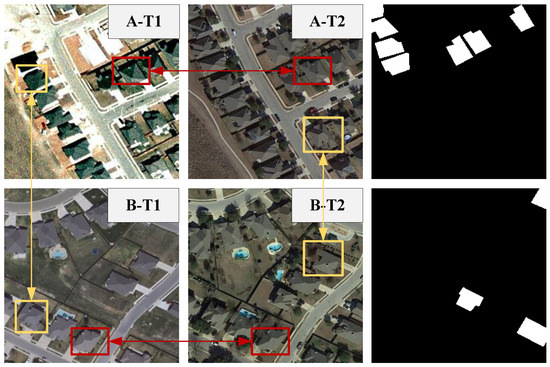
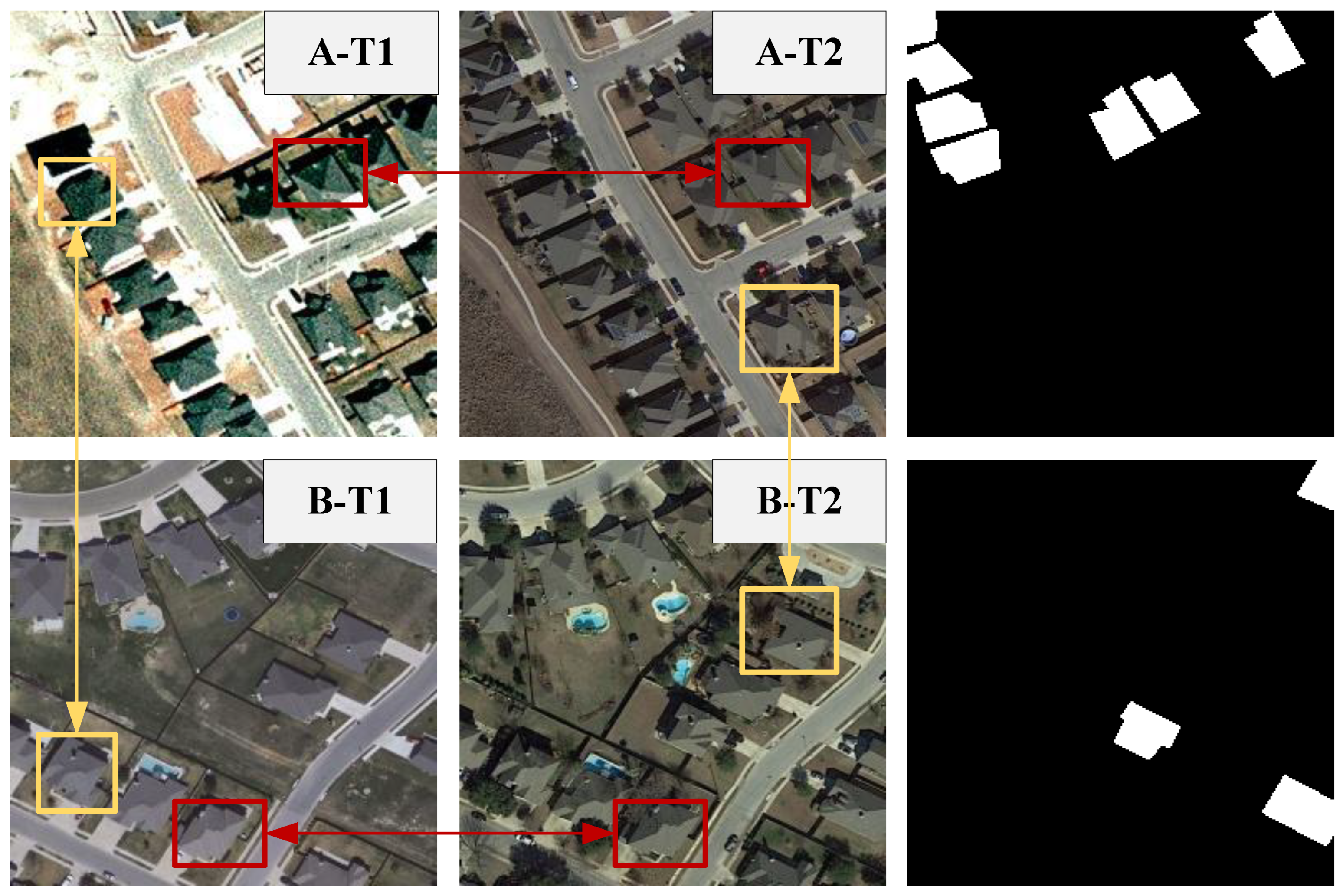
CD based on remote sensing images is still a challenging task. Current remote sensing data are high-resolution and contain more complex scenery within the images, often having objects with different characteristics. Pseudo-change due to seasonal changes in weather and illumination conditions also challenges visible light remote sensing imaging. This is because the shooting time is often long intervals, which results in a tremendous difference in style between image pairs. Moreover, different weather, season, and lighting conditions cause the same semantic images to present different color textures and other spectral features, as shown in Figure 1, which leads to difficulty in distinguishing fundamental changes from irrelevant changes [9].
Figure 1.
An illustration of a complex scenario in bi-temporal high-resolution imagery. Building structures exhibit varying spectral responses across different acquisition times at the same spatial positions (red boxes), as well as distinct spectral characteristics at different spatial locations at the same time (yellow boxes).
Before deep learning was used for change detection, there were some algebraic-based methods such as PCA [10], ICA [11], etc. These methods typically obtain the difference images (DIs) as an initial step and then classify the difference images using thresholding or clustering methods to maximize the different features. Still, these methods are only limited to the image spectral information [12]. With the improvement of imaging technology, the accuracy requirement for variation detection is subsequently increased. However, these methods remain highly sensitive to noise and generally yield suboptimal detection performance due to their dependence on handcrafted features. Data-driven deep learning strategies can extract more effective features than traditional manual feature extraction methods. In particular, convolutional neural networks (CNNs), which have demonstrated powerful feature extraction capabilities in remote sensing image segmentation and related tasks, have also performed well on change detection tasks [13]. Obtaining better feature representation from each time dimension is also the main direction of the existing research.
More non-local information is essential to obtain more effective semantic representations. However, the above methods are often limited to using spatial attention mechanisms. They can use these mechanisms to obtain spatial contextual details inside the image at each temporal feature or weight the fused image in the temporal or channel dimension. These methods only focus on the affinity between different channels or spatial positions within the image, but they pay little attention to the potential relationships among the same class of objects in the entire sample space. However, such potential relationships are crucial for capturing the most discriminative features. It can exclude background and other interfering information, which is critical to overall model performance. Meanwhile, context modeling in both temporal and spatial scope is crucial to obtain better difference feature representation, unlike traditional segmentation and other remote sensing image tasks. However, existing methods struggle to explicitly model the intrinsic relationships between bi-temporal images. They have only been limited to each temporal feature enhancement or fusion feature enhancement, ignoring the semantic connection between bi-temporal images. At the same time, these strategies cannot fully utilize the different information between bi-temporal features and do not pay attention to the enhancement of the same semantic features by feature interaction between bi-temporal features. As a result, they exhibit limited capability in distinguishing the pseudo-change due to light and weather from actual change.
However, the existing deep learning work on change detection tasks mainly focuses on feature extraction and feature enhancement. These works always take concatenation, addition, absolute value subtraction, or simply a variety of fusion fixed weight summations to get the final difference features. However, these ways do not fully utilize the features of each temporal already extracted. These methods lead to redundant feature representations and the absence of effective discriminatory information, which is not conducive to the discrimination of results.
To solve the aforementioned problems, we propose a novel change detection network composed of three modules: a cross-image non-local enhancement module, a cross-temporal feature enhancement module, and a difference feature adaptive fusion module. In order to capture consistent semantic relationship on the set of samples, we propose a novel cross-image non-local enhancement module. This module is independent of a single sample. It uses memory units to learn highly discriminative semantic patterns from all training samples. By modeling global correlations among samples, it emphasizes the most informative feature regions while simultaneously strengthening intra-image spatial feature extraction and suppressing irrelevant or noisy information. To effectively model interactions between bi-temporal images, we propose a new cross-temporal feature enhancement module that uses the internal features of bi-temporal images for interactive enhancement. We use the correlation between bi-temporal semantic features to guide the construction of enhanced information. We use simple and effective self-attention for intra-temporal features to enhance them through model interactions. We design a modified difference feature adaptive fusion module to fully utilize the rich features extracted by the front layer network. This module can directly learn how to filter the feature maps obtained by different fusion methods spatially and adaptively fuse the features of different fusion methods at each location to obtain a more discriminative representation. Notably, the proposed fusion module is simple in design and the added computational cost is minimal.
The contributions of the work in this paper can be summarized as follows:
- A cross-image non-local enhancement module is proposed for better extraction of features within a single temporal image. The CINE can enhance the connection between objects of the same type on the sample space in spatial dimensions and excavate the potential relationships between the same semantics on the whole sample set, suppressing the generation of pseudo-variation of the same semantics.
- To improve real change feature extraction while suppressing irrelevant change features, we developed a cross-temporal feature enhancement module. Our CTFE module leverages bi-temporal image features to effectively learn the different representations among features.
- A difference feature adaptive fusion module was designed to adaptively learn fusion parameters, suppress redundant features, and obtain a higher-quality change feature map. Our DFAF module effectively exploits the bi-temporal image features extracted by the network.
2. Related Work
2.1. Change Detection Based on Deep Learning
Traditional remote sensing CD methods can generally be categorized into two paradigms: single-stage and two-stage methods [1].
Two-stage [14,15,16] change detection is a process where a backbone such as a CNN extracts features from bi-temporal phase images and then completes the classification. After that, the bi-temporal phase classification results are analyzed and compared to get the change detection results. However, this strategy has some limitations, i.e., achieving satisfactory feature learning performance requires not only the different labels but also the segmentation labels of each temporal phase.
In contrast, the single-stage change detection strategy avoids the classification task at each temporal step and outputs the difference images directly. Patch-based change detection models divide bi-temporal images into image pairs and further compares the similarity of the bi-temporal features learned by the feature extraction network. For example, Faiz Rahman proposed a patch-based siamese network [17]. Another pixel-based method [5,7,18,19,20,21,22,23,24,25,26,27,28,29] uses networks such as FCN to obtain high-resolution feature maps directly. In contrast, this method has better accuracy and efficiency than the patch-based method. Since change detection has bi-temporal image input, how to fuse bi-temporal image information also becomes a key area of research. Currently, according to the different stages of information fusion, we can divide them into two categories: image-level [18,28,29,30,31] and feature-level fusion [5,7,19,20,21,22,24,25,26]. Image-level fusion refers to the strategy of combining bi-temporal images into a single input by methods such as channel concatenate and then combining them further into the network to learn features and obtain segmentation results. The method, however, focuses only on the different features but pays less attention to the image itself. Feature-level fusion involves independently extracting features from each image and then fusing these representations to obtain better difference features. This is also the predominant research method nowadays.
Many recent works have focused on enhancing feature extraction capabilities in an attempt to improve the feature discrimination ability of neural networks and enhance the global modeling ability of models. Since many existing works adopt the strategy of using deeper CNN models [5,19], the use of dilated convolution [20] and applying attention mechanisms [5,32,33,34] increases the effective perception field of the model.
2.2. Attention Mechanism for Change Detection
Due to the pixel-level classification requirement of the segmentation task and the complexity of high-resolution scenes, the CD task is essential to accurately separate the foreground and background for the high-resolution change region of interest. The effective perceptual fields of small convolutional kernels are too narrow. Although increasing network depth can partially mitigate this limitation, it makes network training difficult. The attention mechanism can obtain a better feature representation by assigning weights to focus learning on more effective information and better distinguish between foreground and background classes. To obtain non-local features to expand the effective sensory field, Hu et al. introduced SENet [32], demonstrating that the attention mechanism can effectively reduce noise and enhance classification performance. On the other hand, CBAM [33] superimposes spatial attention with channel attention, expanding the SE approach by adding a maximal set branch, summing the two branches, and then passing the sigmoid activation function. SNUNet [34] utilizes channel attention in the decoder to improve feature recognition. DSIFN [21] by Zhang et al. applies the idea of the channel attention mechanism (CAM) to remote sensing image CD. It reconstructs the disparity map by linking spatial and channel attention in tandem, thus enhancing the tightness within the changing objects.
The attention mechanisms discussed above primarily focus on learning weight distribution maps to highlight informative features. Self-attention can be regarded as a specific form of attention, whose core idea is to compute weighted feature aggregations, using pairwise affinities between all locations. Self-attention can capture long-term dependencies within a single sample and thus update the features at each location. Chen et al. proposed a change detection framework based on a fully convolutional siamese architecture, DASNet [19], which uses dual attention to increase the attention to change features. However, most of them still struggle to fully exploit temporal contextual information. The reason is that attention is often applied independently to each temporal image or simply used to reweight fused bi-temporal features along spatial or channel dimensions. Without using the information in the temporal dimension, the bi-temporal images are not made to interact to obtain differential feature enhancement. Lei [35] et al. proposed a very-high-resolution (VHR) image CD framework termed DESSN, which integrates difference enhancement with spatial–spectral non-local modeling. Owing to the strong feature representation learning and global context modeling of transformer [36], it also performs well in change detection. For example, BIT [9] uses the transformer module to exploit the dual global semantic representations in temporal images. ChangeFormer [37] has been proposed, which unifies the transformer encoder with an MLP decoder in a hierarchical structure to capture multi-scale, detailed information. Still, most existing approaches rely on relatively simple attention mechanisms to reweight bi-temporal feature sets along spatial or channel dimensions.
2.3. Bi-Temporal Feature Fusion Mechanism
Existing change detection networks often use siamese feature extractors to obtain features at each temporal step. These features are then fused and fed into the difference feature extractor to obtain the difference features. Common feature fusion methods are concatenation [37,38], summation, and making differences to take absolute values [9,35]. The direct difference or summation approach has more losses on the extracted image features. At the same time, it often uses the concatenated approach or a combination of multiple fusion modes to achieve feature fusion. However, this method retains a large amount of information and may cause information redundancy, which affects the final prediction results.
3. Methods
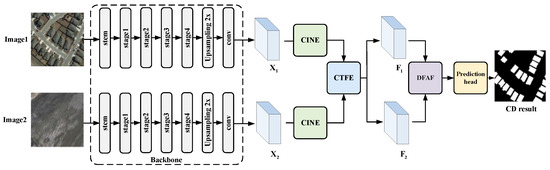
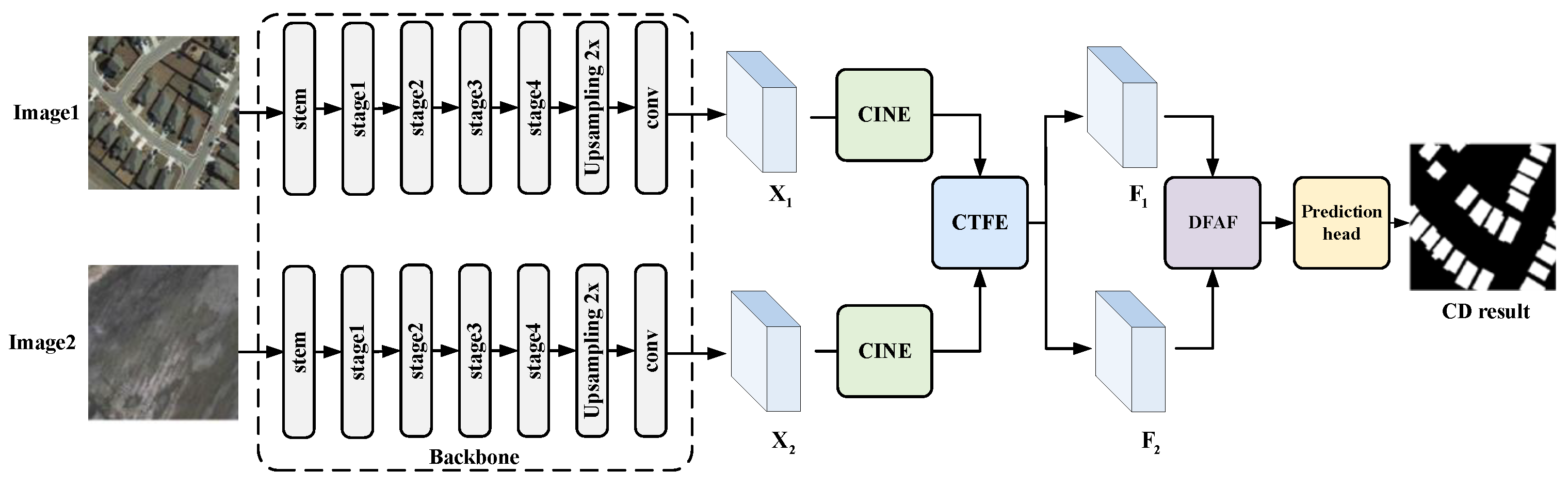
We propose a cross-image feature interaction network for change detection; the overall framework is shown in Figure 2. The bi-temporal image pairs are subjected to feature extraction through a weight-sharing dual-branch network. The cross-image non-local enhancement module enhances the extracted features to enhance the association of the same semantic objects. Subsequently, the enhanced feature maps enter the cross-temporal feature enhancement module, which highlights the change features while suppressing the influence of irrelevant pseudo-changes on the results. Finally, the bi-temporal feature maps are input into the difference feature adaptive fusion module. The fused features are obtained and fed into the classifier to obtain the change detection results.
Figure 2.
Overall framework of the proposed network. Bi-temporal images are first processed by a weight-sharing backbone for initial feature extraction. To strengthen intra-image spatial representations, the CINE module independently refines each temporal feature by capturing global semantic dependencies. Then, the CTEF module performs bi-directional feature interaction to emphasize real change regions while suppressing pseudo-changes. Finally, the DFAF module dynamically integrates multiple difference features to produce a robust difference representation for the subsequent prediction head.
3.1. Cross-Image Non-Local Enhancement Module
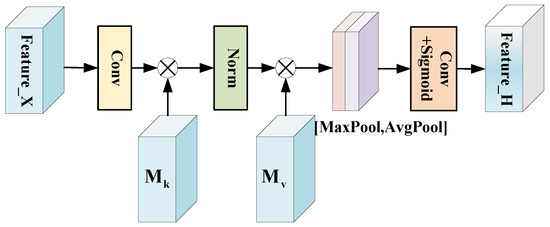
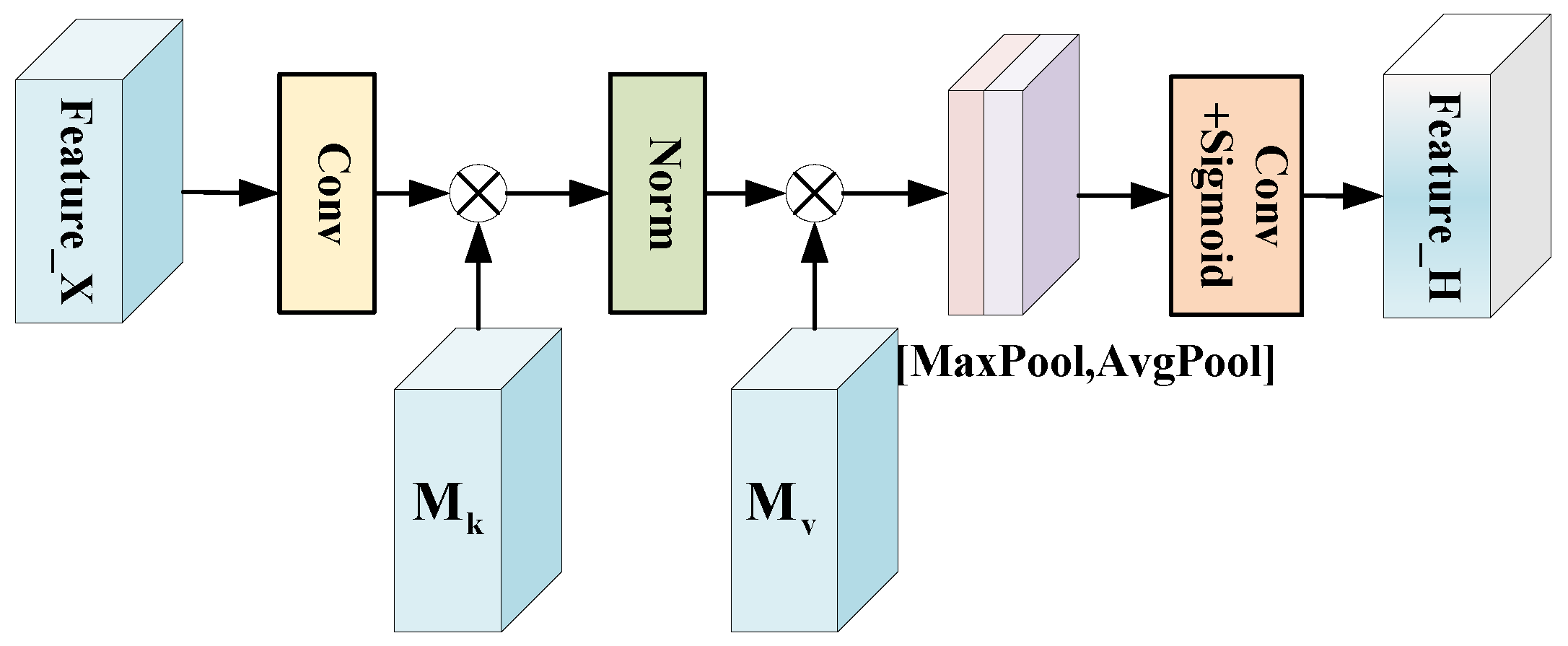
In order to enhance the connections between identical semantic objects, we propose a new attention module, a non-local spatial feature enhancement module, as illustrated in Figure 3, given the input feature map of a single temporal image denoted as , which is reshaped into . The CINE accumulates samples’ space potential information in concatenated storage units and at the same time enhances spatial connections within a single sample, further releasing the capacity and flexibility of potential self-attention. The CINE introduces the global memory units that are input-independent and shared across all samples. Specifically, the memory units are parameterized as two learnable matrices, and , where M denotes the number of memory slots. The memory units are implemented as learnable convolutional layers, initialized using standard random initialization. They are updated jointly with the network parameters through backpropagation during training. The learning of memory units is invariant to the order of training samples and reflects aggregated semantic information over all mini-batches throughout training. The attention map and the aggregated feature representation are obtained by
Figure 3.
Cross-image non-local enhancement module.
Different from the traditional attention mechanism, is only the similarity between the ith pixel of the memory unit and the jth row. The attention map a is inferred from dataset-level prior knowledge and normalized in a manner analogous to self-attention. These memory units act as dataset-level semantic anchors that encode recurring patterns shared across different training samples. Through repeated interactions with spatial features during training, the memory units implicitly capture semantic associations, enabling regions with similar semantics across different samples to be enhanced in a consistent manner. During inference, they remain fixed and are directly applied to incoming features.
Instead of explicitly assigning semantic labels to each memory slot, the CINE automatically discovers and encodes recurring semantic patterns through the attention-based interaction between spatial features and memory units. This mechanism naturally encourages features belonging to the same semantic category to be mapped closer in the latent space through shared affinity to the same memory units, thereby enhancing semantic consistency across samples.
Furthermore, average pooling and max pooling are performed along the channel axis, and the resulting features are concatenated and fed into a convolutional layer to produce an effective feature descriptor that enhances the internal spatial representation of a single sample. denotes the sigmoid function; indicates a convolution operation with a kernel size of .
3.2. Cross-Temporal Feature Enhancement Module
The consideration of global features in traditional methods tends to focus only on the spatial, channel concatenate after the feature map or simple re-weighting in the temporal dimension. Still, it fails to consider the inter-temporal information interaction and the mutual enhancement effect between bi-temporal features. Inspired by the idea of pursuing overall good performance and optimizing each branch in multi-task learning [39], we devised a new mechanism for enhancing bi-temporal feature map dialogue through feature swapping, which builds on the idea of discovering unique but complementary features at each temporal step.
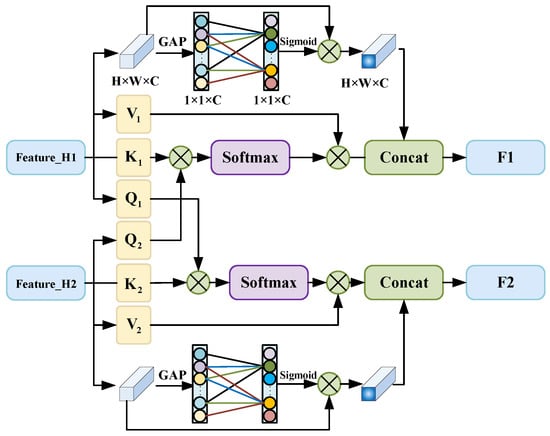
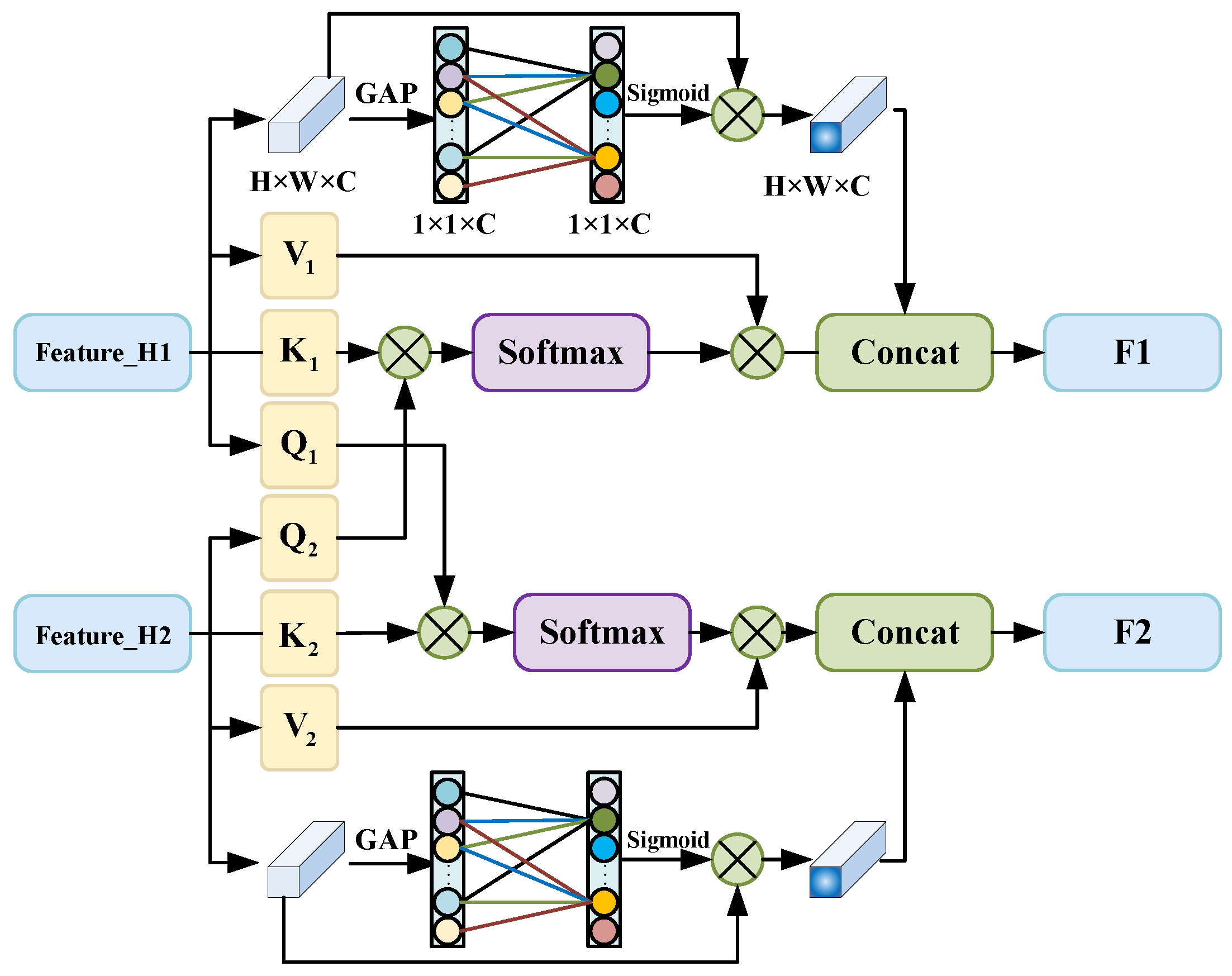
As illustrated in Figure 4, our module tries to estimate the features in each temporal feature map that contribute to the other temporal features. We utilize two types of attention: (i) bi-temporal relevance-guided attention, which aims to exploit semantic and spatial correlations between cross-temporal features to guide the extraction of features of interest from the temporal feature map to the temporal feature map, and (ii) self-attention within each temporal feature, which uses self-attention as a complementary signal that is beneficial to single-temporal features.
Figure 4.
Cross-temporal feature enhancement module.
Bi-temporal relevance-guided attention: To guide the mutual enhancement of features, we rely on the semantic and spatial correlations of different temporal features. In practice, since computing such correlations is memory-intensive, we reduce the complexity by projecting and features into a d-dimensional subspace. It is worth noting that the purpose of the cross-temporal attention in CTFE is not to preserve all fine-grained channel-wise details but to model semantic and spatial correlations between bi-temporal features. Therefore, a compact embedding is sufficient to capture the dominant change-related patterns, while redundant or appearance-specific information is intentionally suppressed. Moreover, the self-attention branch within each temporal complements the cross-temporal interaction by reinforcing intra-temporal discriminative features.
For each temporal feature , we generate its corresponding query, key, and value representations, denoted as . To enhance using information from , the query is taken from , while the key and value are taken from . This design allows to guide the selection of relevant semantic and spatial information within . Conversely, to enhance , the query is derived from , and the key and value are derived from . The cross-temporal attention operations are formulated as
where A denotes the cross-attention operation and d is the dimensionality of the projected feature space. Through this asymmetric query–key–value assignment, the proposed module enables effective bidirectional information interaction and mutual enhancement between the two temporal phases.
Self-attention within each temporal: using the ECA [40] method, the input feature map with dimensions is first processed. The input is aggregated with spatial features by applying global average pooling (GAP) over the spatial dimensions to obtain a feature representation of ; channel-wise feature learning is then performed on the compressed representation, and the importance between different channels is captured by convolution.
Subsequently, the learned channel attention weights are applied to the original input feature. Specifically, the feature with channel attention is multiplied with the original input feature in a channel-wise manner, yielding the final attention-enhanced feature map. To ensure the perceptual field size, ECA uses a dynamic convolutional kernel for the convolution and learns the relative importance among channels:
where k denotes the convolution kernel size, C represents the number of channels, and indicates that k is restricted to odd values. and b are set to 2 and 1, respectively, which is used to adjust the ratio between the channel number C and the kernel size k.
Finally, we use concatenation to cascade self-attentive and diachronic correlation-guided attention to obtain cross-temporal spatial disparity features and semantic information enhancement.
3.3. Adaptive Difference Feature Fusion Module
Traditional CD bi-temporal image feature fusion tends to calculate DIs directly by subtracting the front and back temporal images and then uses them in the disparity segmentation head. However, the difference map generated by this method is heavily noisy. It loses the information obtained at each temporal step, which is not conducive to the accuracy of such pixel-level tasks as change detection. In order to learn high-quality disparity feature maps and make maximum use of the extracted features, this paper proposes an adaptive feature fusion module.
The DFAF module is designed to exploit complementary information from multiple bi-temporal fusion strategies while avoiding the limitations of fixed or single-mode fusion. In remote sensing change detection, different feature fusion operations capture distinct aspects of temporal relationships. Therefore, instead of committing to a single fusion rule, DFAF integrates three commonly used disparity feature fusion modes: summation, absolute value subtraction, and concatenation. Specifically, summation emphasizes invariant semantic information shared across temporal features, subtraction highlights explicit temporal changes, and concatenation preserves complete feature representations for flexible downstream discrimination. These three operations collectively form a compact yet expressive fusion basis.
First, we obtain the feature maps obtained by three different fusion modes, where the feature map’s number of channels obtained by the concatenating method is two times the original feature map, and we use the convolution operation to unify the number of channels. Let , , and denote the features obtained by summing, absolute-value subtraction and concatenate at the temporal steps and , respectively. Adaptive feature fusion follows as shown in the following equation:
where denotes the feature vector at spatial position on the feature maps; denotes the feature vector at position on the output features. , , and correspond to the spatial importance weights associated with three distinct fused pattern feature maps, which are learned by the network adaptively.
It is worth noting that that , , and are implemented as scalar weights shared across all channels. Inspired by [41], we impose and .
In the text, we define , using softmax function by denoting the weight mappings of different fusion patterns by respectively. To enable these weights to be learned effectively via standard backpropagation, we use three different convolution layers to compute the weight scalar mappings from respectively.
3.4. Network Details
CNN backbone: We use the improved ResNet18 algorithm to extract the bi-time image feature. Borrowing from the BIT [9] network base model, the stride of the last two stages is replaced by 1. In addition, a point-by-point convolution is added behind the ResNet to reduce the feature dimensionality. Subsequently, a bilinear interpolation is added to obtain outputs of 1/4 of the original image size, thereby alleviating the loss of spatial details.
Prediction head: Thanks to the network output containing detailed high-level semantic features, we take a very shallow FCN network as the segmentation head. The input feature maps are progressively upsampled twice, each with a scaling factor of two, to recover feature maps at the original map resolution.
where the feature difference map D is the output of DFAF; denotes the change classifier.
Loss function: During training, the network parameters are optimized by minimizing the cross-entropy loss, which is formally defined as follows:
where denotes the ground-truth label of the pixel at the location and represents the cross-entropy loss.
4. Experiments
4.1. Experimental Setup
We conducted experiments on two widely used benchmark change detection datasets, LEVIR-CD [5] and DSIFN-CD [21], to assess the effectiveness of the proposed network.
LEVIR-CD is currently a relatively clear, large-scale public construction of a CD dataset. Due to computational constraints, the non-overlapping images were randomly cropped into patches of size 256 × 256. As a result, we obtained 7120, 1024, and 2048 sample pairs for training, validation, and testing, respectively.
DSIFN-CD is a public binary CD dataset composed of high-definition satellite images with a spatial resolution of 2m per pixel. The default crop sample provided by the authors is 512 × 512. We had 3600/340/48 pairs of samples for training, validation, and testing, respectively.
Implementation details: The proposed model was implemented using the PyTorch 2.0.1 framework and trained on a single NVIDIA RTX 2080Ti GPU. We applied conventional data enhancement to the input image pairs, including flipping, scaling, cropping, and Gaussian blurring. We adopted a SGD optimizer with momentum, where the momentum and weight decay were set to 0.99 and 0.0005, respectively. The learning rate was initialized to 0.01 and linearly decayed to zero over 200 training epochs. The model was trained with a batch size of 16. Validation was performed after each training epoch and the best model on the validation set was used to evaluate the test set.
Evaluation Metrics: In the experiments, the F1-score was adopted as the primary evaluation metric. Additionally, we also used precision, recall, Intersection over Union (IoU) of the change category, and overall accuracy (OA) to further demonstrate the effectiveness of the proposed method.
4.2. Comparison Experiments
We compared the proposed approach with ten state-of-the-art methods. Among them, FC EF [30], FC-Siam-Di [30], and FC-Siam-Conc [30] are purely convolutional-based methods; DTCDSCN [7], STANet [5], SNUNet [34], BIT [9], and ChangeFormer [37] are attention-based methods; and MambaBCD [42] and CDMamba [43] are Mamba-based methods. The results marked with a symbol (*) in the table are our re-implementation results, while the results for all other methods are sourced from the official paper.
Table 1 and Table 2 show the quantitative comparison results on the LEVIR-CD and DSIFN-CD test sets. The experimental results demonstrate that the proposed method consistently achieves superior performance over competing approaches on both datasets. It is also worth noting that our CNN backbone is simply part of the layers in ResNet18. Unlike many existing methods, we do not incorporate complex architectures such as FPN or U-Net. Despite this simplicity, our proposed network can perform well even using a simple backbone. This may be because our network can explore the potential relationships between the same semantics on the whole sample set, use bi-temporal dimension features for enhancement and make full use of extracted bi-temporal features, and more efficiently fuse effective features to suppress the interference of redundant features in results.
Table 1.
Comparison results for the LEVIR-CD dataset. The best results are highlighted in bold. All metrics are expressed as a percentage (%). The symbol “*” indicates results obtained from our re-implementation.
Table 2.
Comparison results for the DSIFN-CD dataset. The best results are highlighted in bold. All metrics are expressed as a percentage (%). The symbol “*” indicates results obtained from our re-implementation.
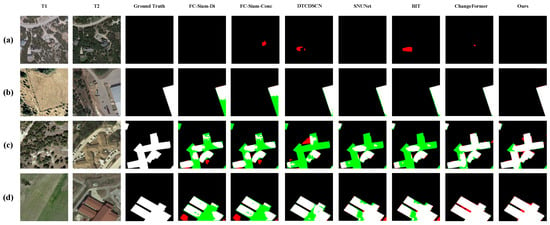
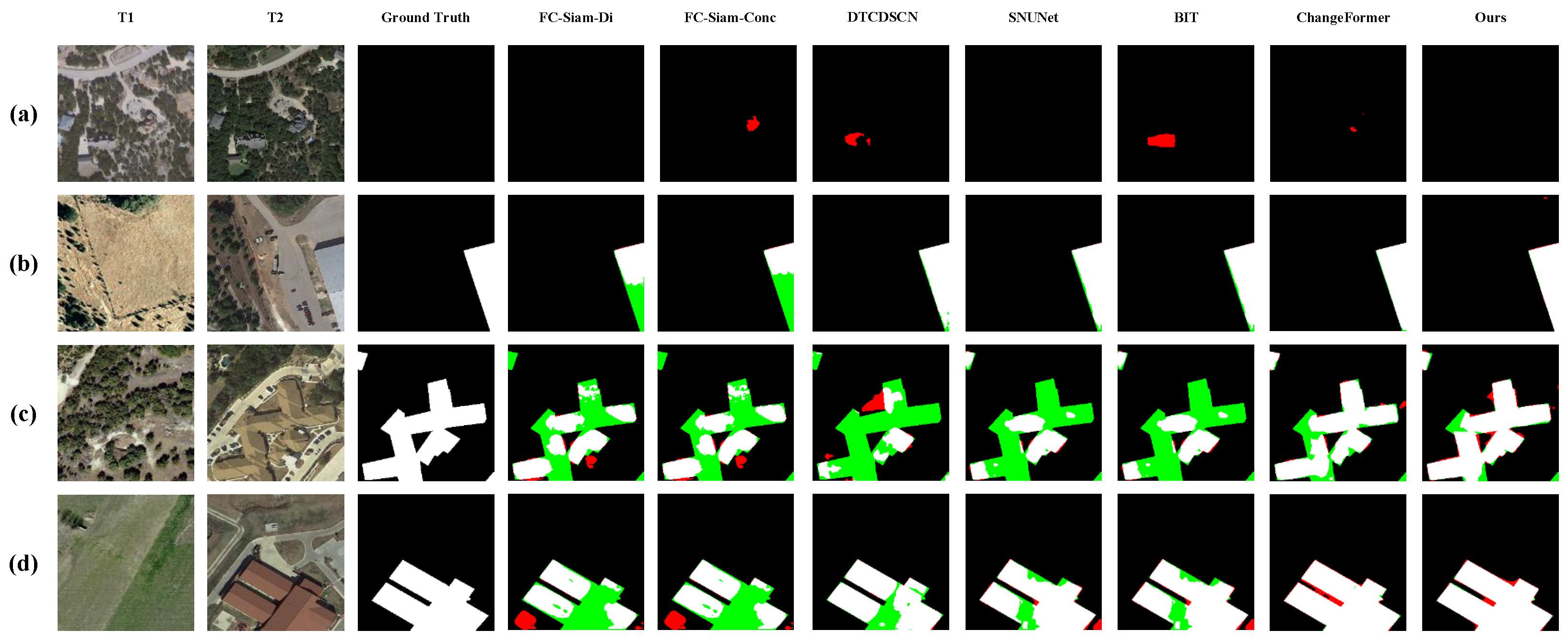
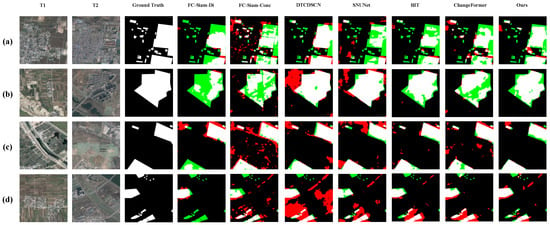
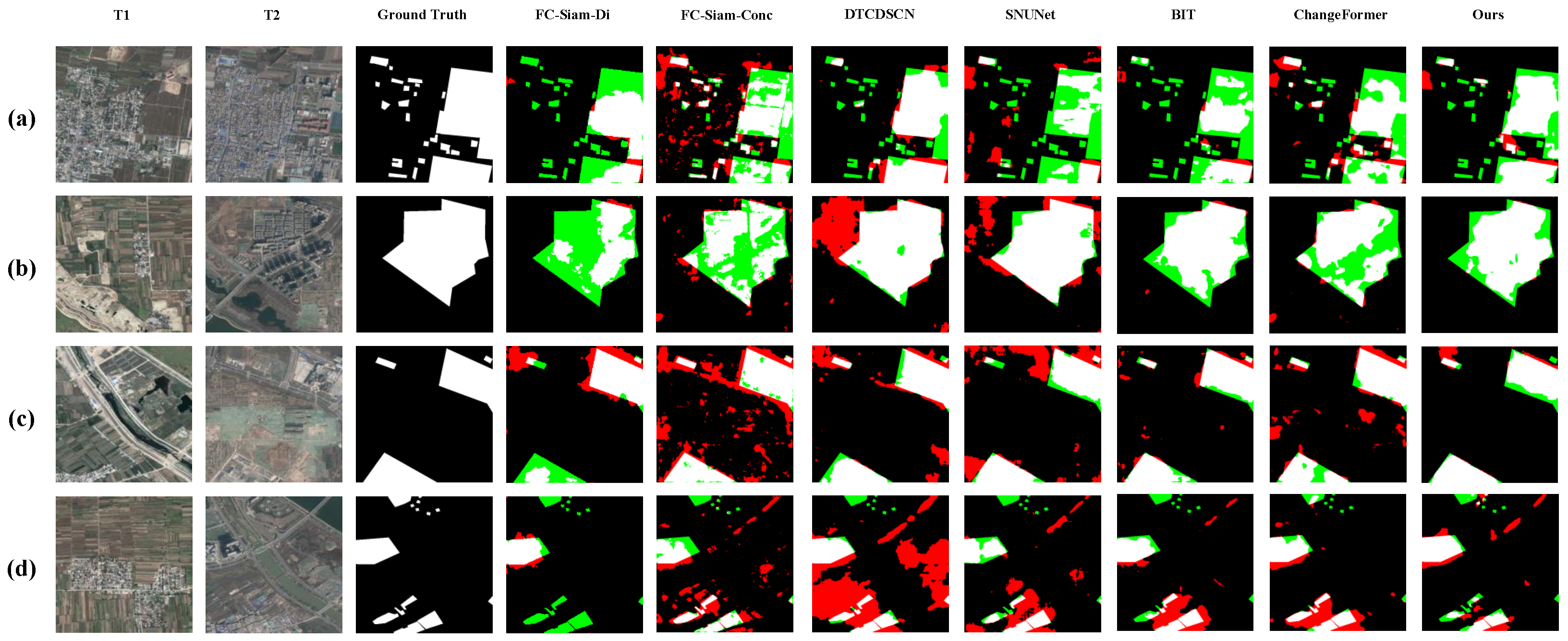
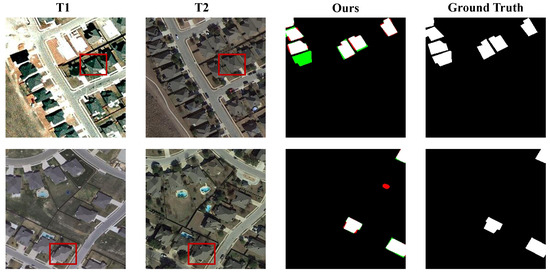
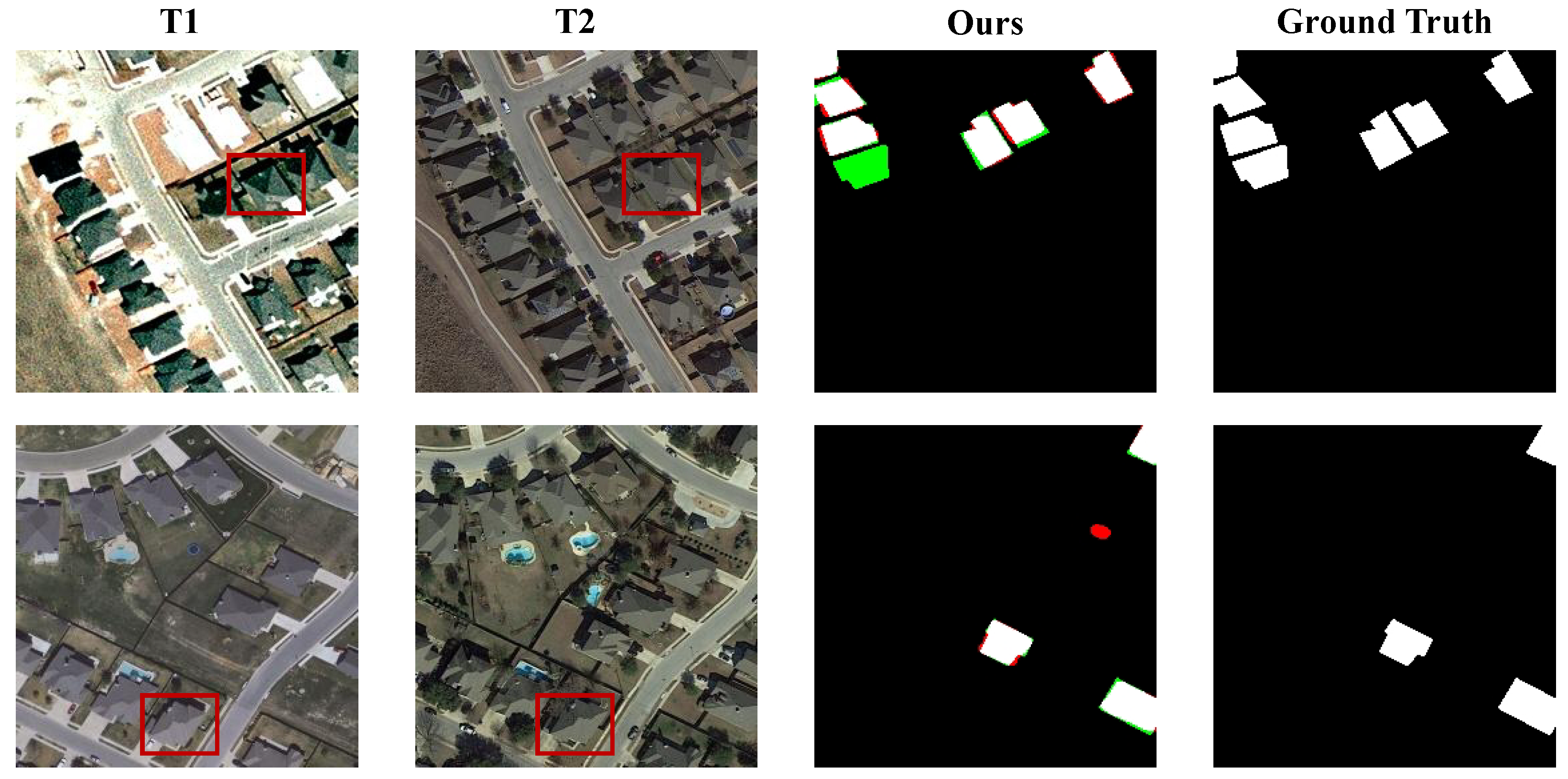
The visualization comparison results for the two datasets are shown in Figure 5 and Figure 6. Different colors are used to denote TP (white), TN (black), FP (red), and FN (green). We can observe that the proposed method achieved better results than the other models. The results show that the proposed model can effectively learn actual changes and suppress the interference of uncorrelated changes in results. As shown in Figure 5a, for changes caused by lighting or vegetation, the proposed model avoided their influence. To further demonstrate the effectiveness of our method in suppressing pseudo changes, Figure 7 visualizes the detection results on two samples exhibiting seasonal and weather variations. As can be seen, our method effectively suppressed the pseudo-changes in the affected buildings within the red box. In Figure 5b, we can see that the prediction results for each structure for large buildings are more complete. As shown in Figure 5c,d, the proposed model can better grasp semantic information such as buildings, and the segmentation boundary is finer and smoother. Our model had fewer false and missed detection areas and cleaner background areas (red and green parts in the figure), allowing better differentiation between foreground and background classes. Furthermore, on the DSIFN dataset, with more class variations, our proposed model had fewer FP cases in the background, which was also because our proposed model had captured better semantic information on the entire dataset and was more accurate in background distinction.
Figure 5.
Visualization results of different methods for the LEVIR-CD dataset. Different colors are used to indicate prediction: white denotes true positives, black denotes true negatives, red denotes false positives, and green denotes false negatives. (a–d) Four images of scenes in LEVIR-CD.
Figure 6.
Visualization results of different methods for the DSIFN-CD dataset. (a–d) Four images of scenes in DSIFN-CD.
Figure 7.
Visualization results of our methods on the samples exhibiting seasonal and weather variations (red boxes).
4.3. Model Efficiency and Effectiveness
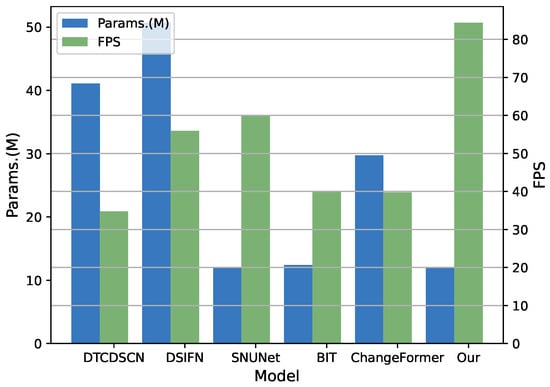
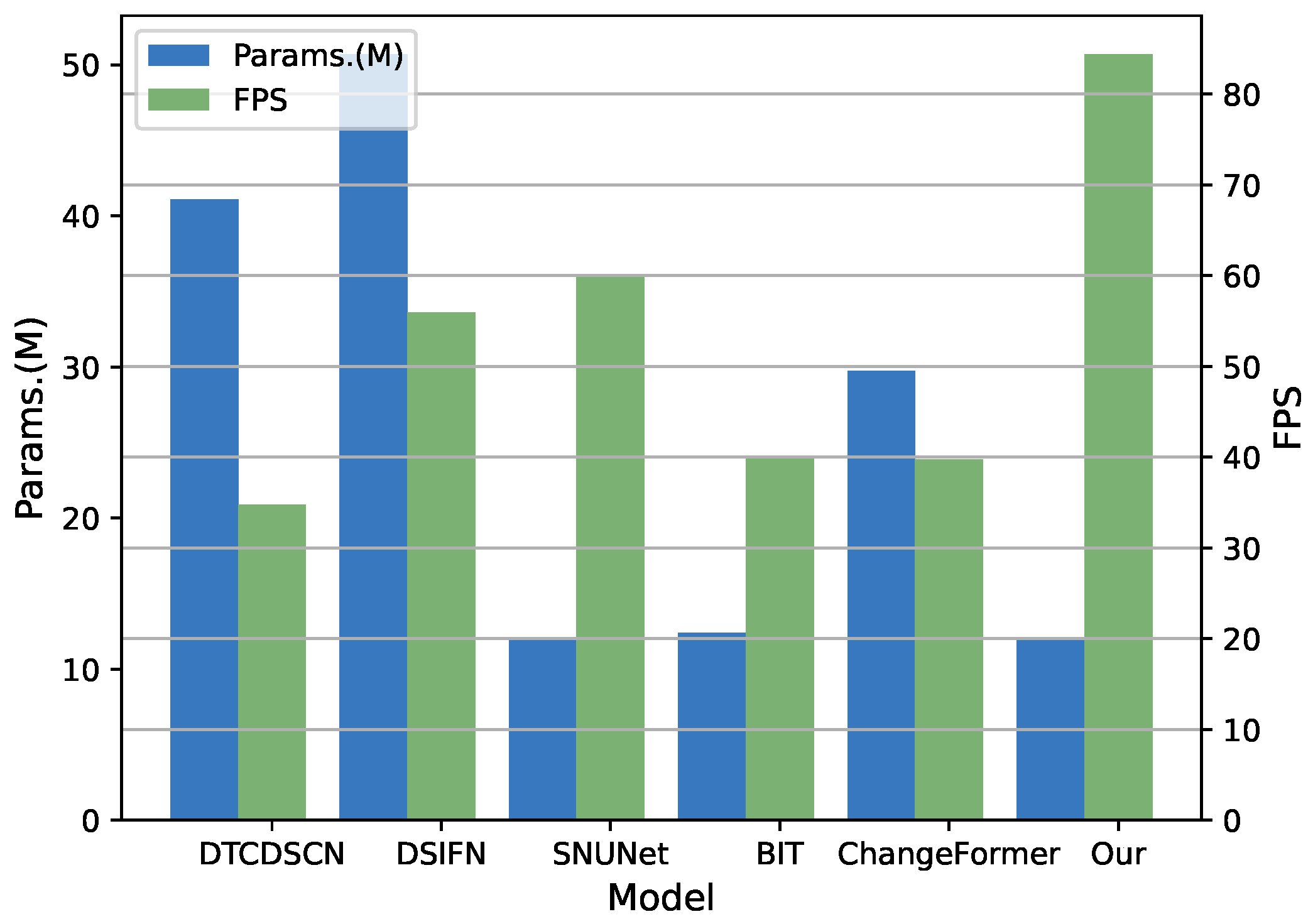
(1) Network efficiency: Regarding network efficiency, we compared five attention-based approaches: DTCDSCN, DSIFN, SNUNet, BIT, and ChangeFormer. As shown in Figure 8, the model proposed in this paper outperformed the methods mentioned above regarding F1/IoU scores while balancing computational complexity and running speed. At the same time, our network had an FPS of 83, which is a very good processing speed, and ensured accuracy. The comparison results further demonstrate the effectiveness and efficiency of the proposed model.
Figure 8.
Comparison of the different methods in terms of model size.
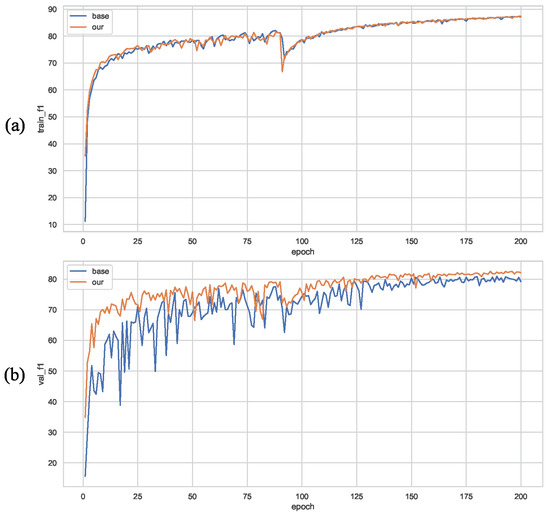
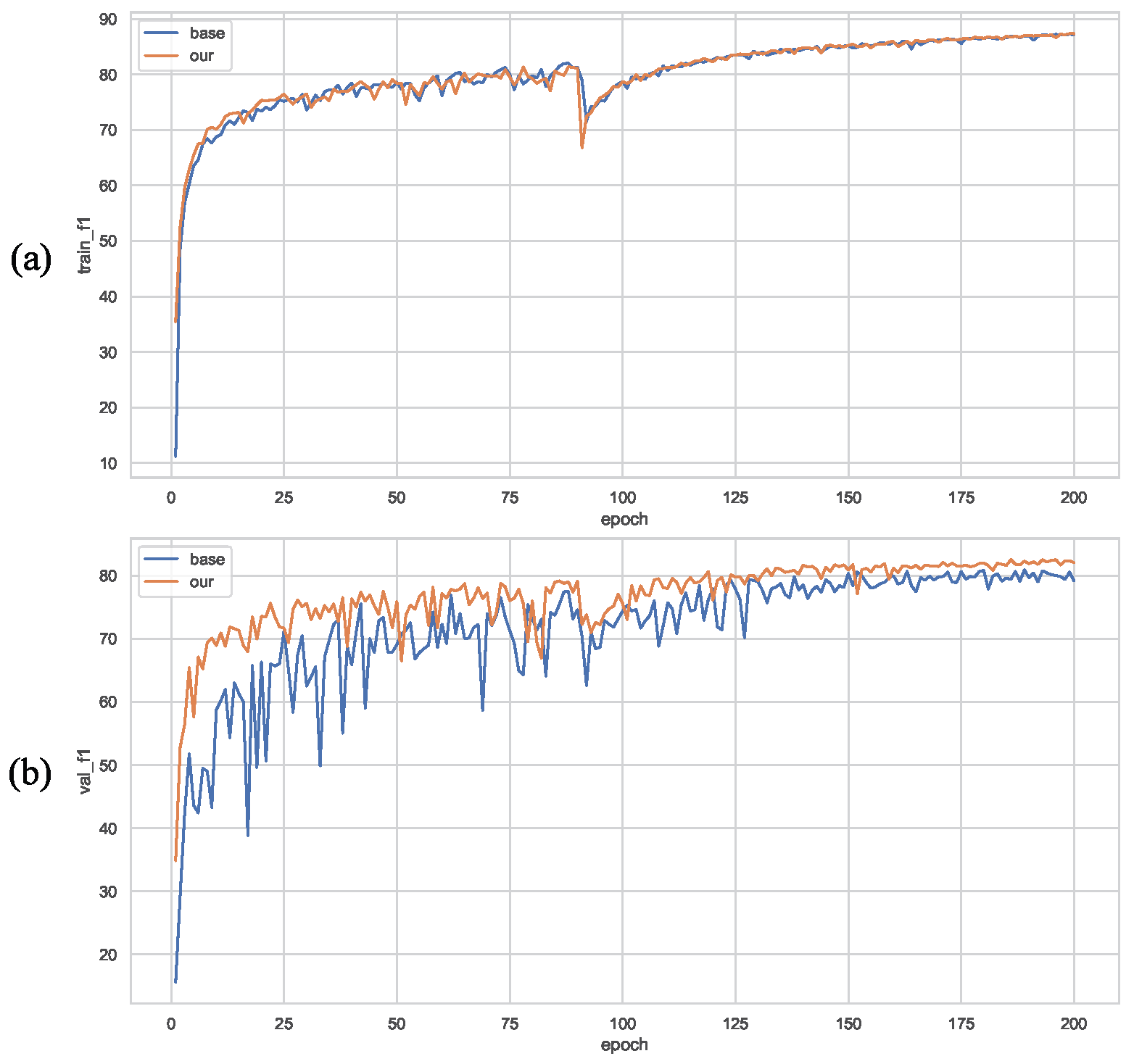
(2) Training efficiency: A visualization of the training and validation process is shown in Figure 9, which shows the foreground F1 scores on the training/validation set for each training cycle. We can observe that although the baseline and proposed models performed similarly in terms of training accuracy, the validation accuracy of the proposed model in terms of stability and effectiveness was better than the baseline. This indicates that the proposed model is more stable and efficient in training, with better generalization ability and robustness. At the same time, the initial network had a better feature extraction effect, better foreground–background discrimination ability, and better discrimination ability concerning real changes.
Figure 9.
Model accuracy (using the F1-score) across training epochs. (a) Training on LEVIR-CD. (b) Validation on LEVIR-CD.
4.4. Ablation Study
To validate the effectiveness of different modules in our proposed network, we conducted ablation experiments on the LEVIR-CD dataset and the DSIFN-CD dataset, including using different combinations of modules. The experimental results are shown in Table 3 and Table 4. The cross-image non-local enhancement module took into account the correlation between all data samples and improved the F1 distribution by and and the IoU by and . The cross-temporal feature enhancement module exploited the deep connection between image pairs to enhance the real variation features while suppressing the effect of pseudo-variation on the results, which improved the F1 distribution by and and the IoU by and . The difference feature adaptive fusion module further adaptively fused the extracted bi-temporal features using simple structures, resulting in an improvement in F1 distribution by and and in IoU by and . This shows the effectiveness of all three proposed modules. The combined results of the modules were and higher than the backbone network IoU and and higher than the F1, which fully demonstrates the effectiveness of the proposed network.
Table 3.
Module ablation on the LEVIR-CD dataset. The “✗” indicates that the module is not used; The “✓” indicates that the module is used. The best results are highlighted in bold.
Table 4.
Module ablation on the DSIFN-CD dataset. The “✗” indicates that the module is not used; The “✓” indicates that the module is used. The best results are highlighted in bold.
Also from the results, it can be seen that the DFAF fusion module had a certain effect enhancement whether it was superimposed on still or one kind of attention. However, when two feature enhancement modules, CINE and CTFE, were superimposed, the results obtained were not as good as those for single-feature enhancement. We believe that the reason for this situation comes from the fact that features that are too rich will instead cause a certain information redundancy, which leads to the generalization performance of the results receiving influence and the prediction results becoming worse.
Specifically, CINE enhances spatial consistency by amplifying features aligned with dataset-level semantic priors, while CTFE further strengthens responses that are highly correlated across temporal features. In unchanged regions with strong semantic consistency, these two effects can compound, leading to redundant feature amplification. When such features are fused using fixed operations, the network may overly focus on stable semantics at the expense of subtle but meaningful temporal differences. The addition of the DFAF module resolved this issue and further improved the results. By learning spatially varying fusion weights over multiple fusion strategies, DFAF suppresses redundant information and selectively retains change-sensitive features.
4.5. Discussion
(1) Discussion of the number of attention channels: The cross-notice part of the CTFE module proposed in this paper projects the original feature dimension to the d dimension. To investigate the influence of the projection dimension d, ablation experiments were conducted by setting d to 1/4, 1/8, and 1/16 of the original feature channel. As reported in Table 5 and Table 6, the performance difference was relatively marginal when the projection dimension was 1/4 and 1/8 of the original feature. Notably, 1/8 achieved a better performance with more minor computation. In contrast, further reducing the dimension to 1/16 of the original feature led to a noticeable drop in accuracy, indicating that excessive compression causes a loss of critical semantic information. Still, it had a good score compared to other methods, further validating the effectiveness of the proposed method. Therefore, we adopted 1/8 as the default configuration in CTFE. This setting effectively balances representational capacity and computational cost, enabling robust bi-temporal feature interaction without introducing redundant computation.
Table 5.
Attention channel number ablation on the LEVIR-CD dataset. The best results are highlighted in bold.
Table 6.
Attention channel number ablation on the DSIFN-CD dataset. The best results are highlighted in bold.
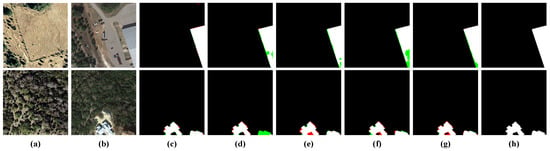
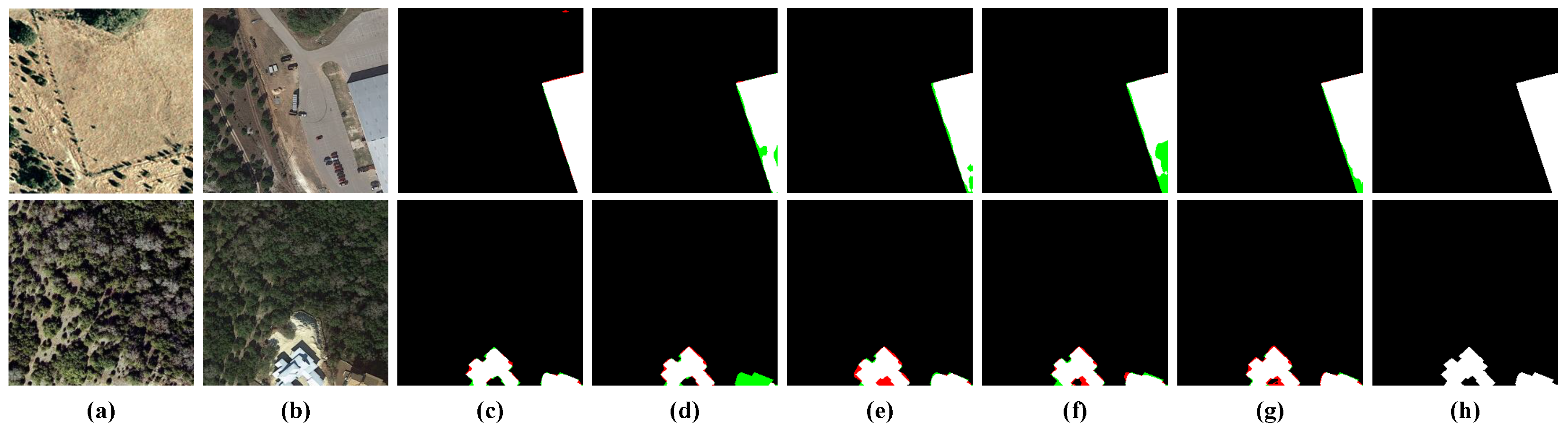
(2) Discussion of the bi-temporal feature fusion approach: Remote sensing image change detection work focuses on extracting better feature representations, and the bi-temporal image feature fusion approach often takes a simple phase subtraction approach. At the same time, this paper argues that a more reasonable and effective fusion mode can give full play to the potential of the front-layer extracted features. Table 7 and Table 8 show that the fusion mode with fixed weights significantly improves both F1 and IoU over the use of single absolute value subtraction, which also demonstrates the significant effect of making fuller use of extracted features. Simply fusing the channels of two feature mappings tends to lead to extremely redundant features, so we used adaptive weights to constrain further the features obtained by multiple fusion modes. Adaptive learning weights reduce computational and memory costs. The design is simple and its performance is better on both F1 and IoU, as shown in the table. The visualization of the prediction results of different fusion methods is shown in Figure 10. From the figure, we can see that our fusion method can obtain more details, such as smoother edges in Figure 10g, a more complete internal structure of the image, and less missed detection in Figure 10c.
Table 7.
Comparison of different fusion approaches on the LEVIR-CD dataset. The best results are highlighted in bold.
Table 8.
Comparison of different fusion approaches on the DSIFN-CD dataset. The best results are highlighted in bold.
Figure 10.
Qualitative results of the different fusion methods on the LEVIR-CD test sets. (a) Image1, (b) Image2, (c) DFAF, (d) absolute value subtractive fusion, (e) additive fusion, (f) channel concatenate fusion, (g) fixed weight fusion, (h) ground truth.
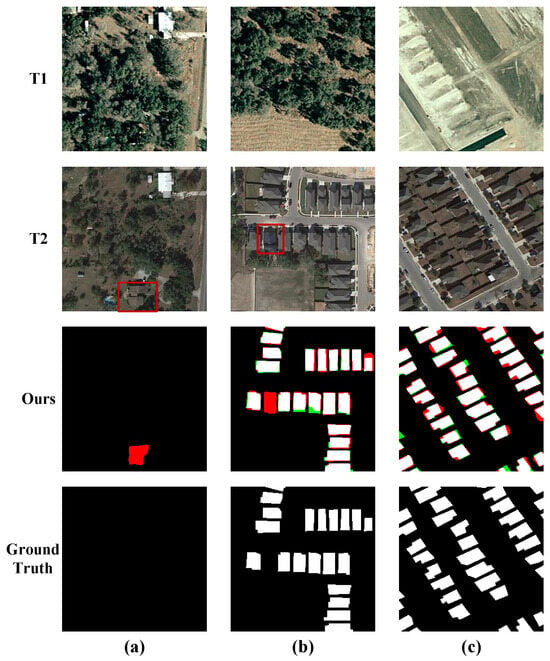
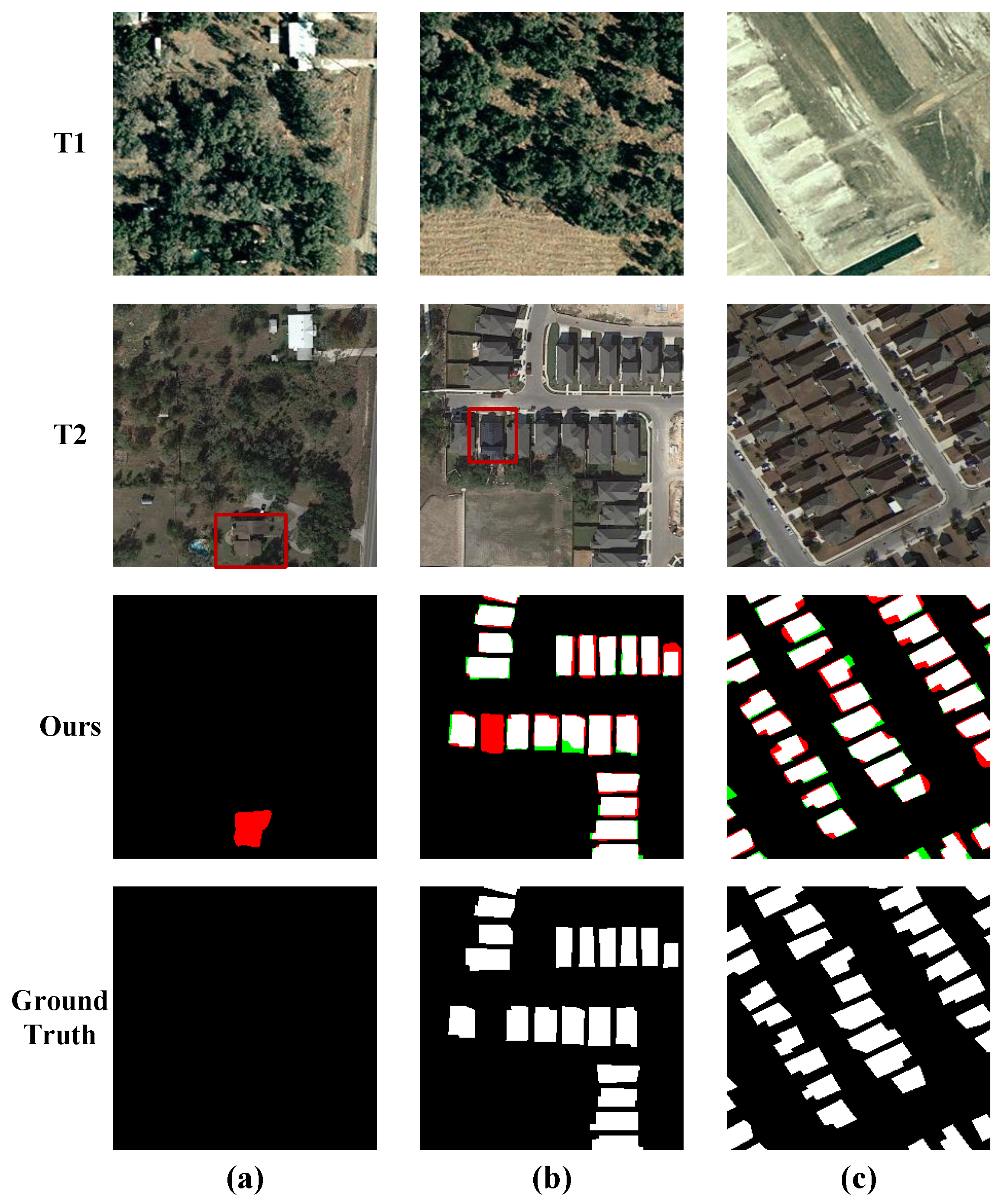
(3) Discussion of misdetection and omission: Regarding the visualization and analysis of some error judgments in the experimental results, first of all, there were some mistakes in the labelling, as shown in Figure 11a; the proposed model detected the appearance of construction below the picture, which was not marked in the label. The visualization results in Figure 11b show that when construction with different styles appeared, it was also easy to produce missed detections. We believe that the network learned some color and shape information of construction, but the performance became worse when the regularity changed. Also, we can see in Figure 11c that when the construction was denser and the background color was more similar to the roof, there was a judgment error at the boundary. Also, we think that the boundary shadow of the house was one of the reasons for the error in the boundary segmentation.
Figure 11.
Visual analysis of some missed false detection results for the LEVIR-CD dataset. (a–c) Three images of scenes in LEVIR-CD.
4.6. Network Visualization
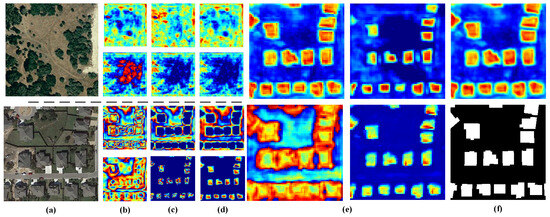
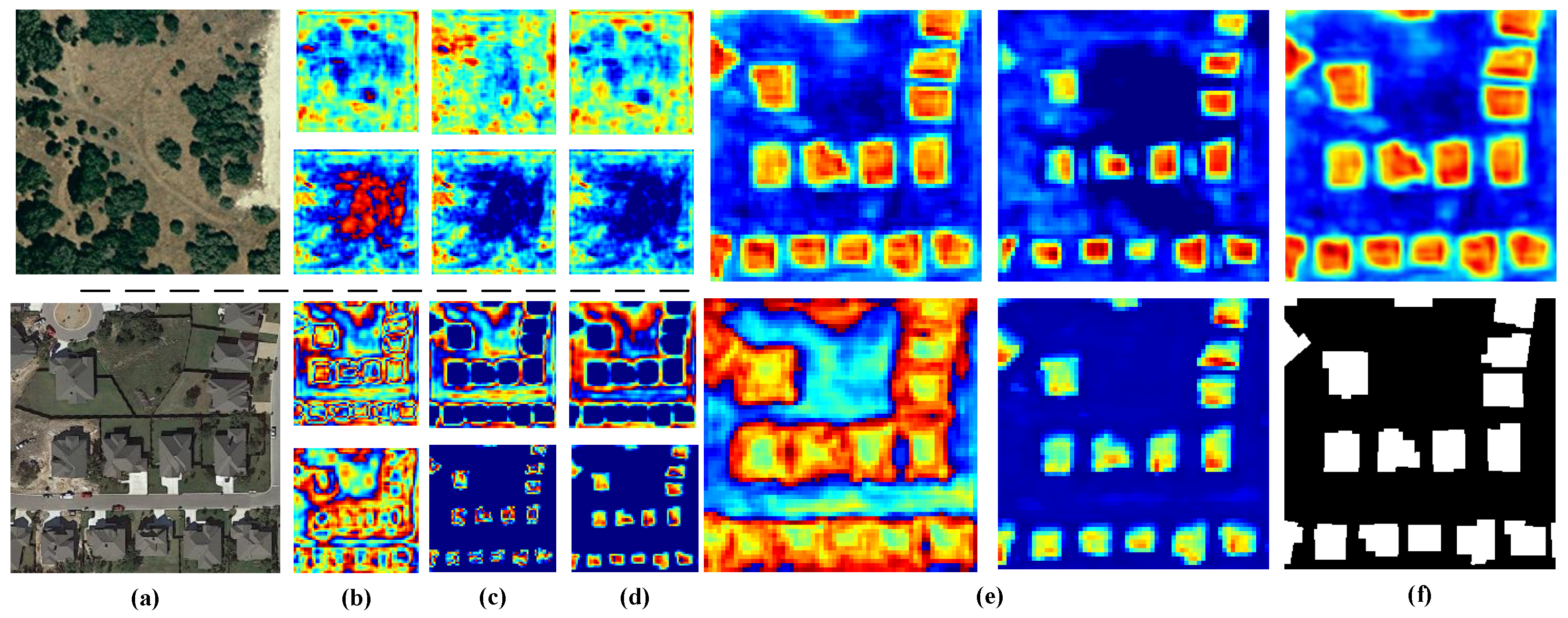
To facilitate a clearer understanding of the proposed model, we present a representative example illustrating the activation mapping of different stages of the network. We believe that our proposed modules are capable of extracting more discriminative high-level semantic features that are closely related to regions of interest undergoing change. To better show the performance of the modules, we visualize the attention mapping extracted by the tagger from the bi-temporal feature mapping. The red regions correspond to higher attention values and the blue regions indicate lower attention values.
As can be seen from Figure 12, for the three different modules designed in this study, the weight of the change region and the semantic target of interest are higher. At the same time, the visualization of certain channels shows that we were able to not only capture the features of the building of interest but also learn the building boundary features to obtain better edge segmentation. On the other hand, the model can distinguish between the changing background and foreground to obtain a cleaner segmentation background and reduce the background noise interference in the prediction. The model is more sensitive to building features in the LEVIR-CD dataset, which only describes building changes.
Figure 12.
(a) Bi-temporal images, (b) original features, (c) features from CINE, (d) features from CTFE, (e) features from DFAF, (f) change probability map and ground truth. The example is taken from the LEVIR-CD dataset.
5. Conclusions
This paper presented a novel change detection framework for remote-sensing images. The CINE module mines the feature associations among targets with the same semantic information on the whole dataset. The CTFE module exploits bi-temporal features to enhance feature representations. At the same time, it can enhance the features’ representation of interest while suppressing pseudo-change features. The DFAF module is designed to utilize the high-level features extracted from the previous layer effectively, and effectively improves model performance with a small overhead. Extensive experimental results validate the effectiveness of the proposed framework.
Author Contributions
Conceptualization, X.H., F.Y. and X.Z.; methodology, X.H. and F.Y.; software, X.H. and J.D.; validation, F.Y. and J.D.; writing—original draft preparation, X.H. and F.Y.; writing—review and editing, X.Z., H.Z. and B.H.; visualization, F.Y. All authors have read and agreed to the published version of the manuscript.
Funding
This work was supported in part by the Shaanxi Province Innovation Capability Support Plan under grant 2023-CX-TD-09, the National Natural Science Foundation of China under grant 62276197, the Fundamental Research Funds for the Centra Universities under grant QTZX25070, and the National Natural Science Foundation of China under grant 62501433 and 62506285.
Data Availability Statement
The datasets in this study are available online from https://opendatalab.org.cn/OpenDataLab/LEVIR-CD and https://opendatalab.org.cn/OpenDataLab/DSIFN-CD (accessed on 20 February 2026).
Conflicts of Interest
The authors declare no conflicts of interest.
References
- Zhang, M.; Shi, W. A Feature Difference Convolutional Neural Network-Based Change Detection Method. IEEE Trans. Geosci. Remote Sens. 2020, 58, 7232–7246. [Google Scholar] [CrossRef] [Scilit]
- Fortunato, S. Community detection in graphs. Phys. Rep.-Rev. Sec. Phys. Lett. 2010, 486, 75–174. [Google Scholar] [CrossRef] [Scilit]
- Huang, X.; Wen, D.; Li, J.; Qin, R. Multi-level monitoring of subtle urban changes for the megacities of China using high-resolution multi-view satellite imagery. Remote Sens. Environ. 2017, 196, 56–75. [Google Scholar] [CrossRef] [Scilit]
- Amini Amirkolaee, H.; Arefi, H. 3D change detection in urban areas based on DCNN using a single image. Int. Arch. Photogramm. Remote Sens. Spat. Inf. Sci. 2019, 42, 89–95. [Google Scholar] [CrossRef] [Scilit]
- Chen, H.; Shi, Z. A spatial-temporal attention-based method and a new dataset for remote sensing image change detection. Remote Sens. 2020, 12, 1662. [Google Scholar] [CrossRef] [Scilit]
- Vetrivel, A.; Gerke, M.; Kerle, N.; Nex, F.; Vosselman, G. Disaster damage detection through synergistic use of deep learning and 3D point cloud features derived from very high resolution oblique aerial images, and multiple-kernel-learning. ISPRS J. Photogramm. Remote Sens. 2018, 140, 45–59. [Google Scholar] [CrossRef] [Scilit]
- Liu, Y.; Pang, C.; Zhan, Z.; Zhang, X.; Yang, X. Building Change Detection for Remote Sensing Images Using a Dual-Task Constrained Deep Siamese Convolutional Network Model. IEEE Geosci. Remote Sens. Lett. 2021, 18, 811–815. [Google Scholar] [CrossRef] [Scilit]
- Xian, G.; Homer, C.; Fry, J. Updating the 2001 National Land Cover Database land cover classification to 2006 by using Landsat imagery change detection methods. Remote Sens. Environ. 2009, 113, 1133–1147. [Google Scholar] [CrossRef] [Scilit]
- Chen, H.; Qi, Z.; Shi, Z. Remote Sensing Image Change Detection with Transformers. IEEE Trans. Geosci. Remote Sens. 2021, 60, 1–14. [Google Scholar] [CrossRef] [Scilit]
- Deng, J.; Wang, K.; Deng, Y.; Qi, G. PCA-based land-use change detection and analysis using multitemporal and multisensor satellite data. Int. J. Remote Sens. 2008, 29, 4823–4838. [Google Scholar] [CrossRef] [Scilit]
- Marchesi, S.; Bruzzone, L. ICA and kernel ICA for change detection in multispectral remote sensing images. In Proceedings of the 2009 IEEE International Geoscience and Remote Sensing Symposium, Cape Town, South Africa, 12–17 July 2009; Institute of Electrical and Electronics Engineers Inc.: New York, NY, USA, 2009; Volume 2, pp. 980–984. [Google Scholar] [CrossRef] [Scilit]
- Ghosh, S.; Mishra, N.S. Unsupervised change detection of remotely sensed images using fuzzy clustering. In Proceedings of the 2009 Seventh International Conference on Advances in Pattern Recognition, Kolkata, India, 4–6 February 2009; pp. 385–388. [Google Scholar] [CrossRef] [Scilit]
- Khelifi, L.; Mignotte, M. Deep Learning for Change Detection in Remote Sensing Images: Comprehensive Review and Meta-Analysis. IEEE Access 2020, 8, 126385–126400. [Google Scholar] [CrossRef] [Scilit]
- Nemoto, K.; Hamaguchi, R.; Sato, M.; Fujita, A.; Imaizumi, T.; Hikosaka, S. Building change detection via a combination of CNNs using only RGB aerial imageries. In Proceedings of the Remote Sensing Technologies and Applications in Urban Environments II, Warsaw, Poland, 11–12 September 2017; SPIE: Bellingham, WA, USA, 2017; Volume 10431, pp. 107–118. [Google Scholar]
- Ji, S.; Shen, Y.; Lu, M.; Zhang, Y. Building instance change detection from large-scale aerial images using convolutional neural networks and simulated samples. Remote Sens. 2019, 11, 1343. [Google Scholar] [CrossRef] [Scilit]
- Liu, R.; Kuffer, M.; Persello, C. The temporal dynamics of slums employing a CNN-based change detection approach. Remote Sens. 2019, 11, 2844. [Google Scholar] [CrossRef] [Scilit]
- Rahman, F.; Vasu, B.; Van Cor, J.; Kerekes, J.; Savakis, A. Siamese network with multi-level features for patch-based change detection in satellite imagery. In Proceedings of the 2018 IEEE Global Conference on Signal and Information Processing (GlobalSIP), Anaheim, CA, USA, 26–29 November 2018; IEEE: New York, NY, USA, 2018; pp. 958–962. [Google Scholar]
- De Bem, P.P.; de Carvalho Junior, O.A.; Fontes Guimarães, R.; Trancoso Gomes, R.A. Change detection of deforestation in the Brazilian Amazon using landsat data and convolutional neural networks. Remote Sens. 2020, 12, 901. [Google Scholar] [CrossRef] [Scilit]
- Chen, J.; Yuan, Z.; Peng, J.; Chen, L.; Huang, H.; Zhu, J.; Liu, Y.; Li, H. DASNet: Dual Attentive Fully Convolutional Siamese Networks for Change Detection in High-Resolution Satellite Images. IEEE J. Sel. Top. Appl. Earth Obs. Remote Sens. 2021, 14, 1194–1206. [Google Scholar] [CrossRef] [Scilit]
- Zhang, M.; Xu, G.; Chen, K.; Yan, M.; Sun, X. Triplet-based semantic relation learning for aerial remote sensing image change detection. IEEE Geosci. Remote Sens. Lett. 2018, 16, 266–270. [Google Scholar] [CrossRef] [Scilit]
- Zhang, C.; Yue, P.; Tapete, D.; Jiang, L.; Shangguan, B.; Huang, L.; Liu, G. A deeply supervised image fusion network for change detection in high resolution bi-temporal remote sensing images. ISPRS J. Photogramm. Remote Sens. 2020, 166, 183–200. [Google Scholar] [CrossRef] [Scilit]
- Peng, X.; Zhong, R.; Li, Z.; Li, Q. Optical remote sensing image change detection based on attention mechanism and image difference. IEEE Trans. Geosci. Remote Sens. 2020, 59, 7296–7307. [Google Scholar] [CrossRef] [Scilit]
- Diakogiannis, F.I.; Waldner, F.; Caccetta, P. Looking for change? Roll the dice and demand attention. Remote Sens. 2021, 13, 3707. [Google Scholar] [CrossRef] [Scilit]
- Hou, B.; Liu, Q.; Wang, H.; Wang, Y. From W-Net to CDGAN: Bitemporal Change Detection via Deep Learning Techniques. IEEE Trans. Geosci. Remote Sens. 2020, 58, 1790–1802. [Google Scholar] [CrossRef] [Scilit]
- Zhan, Y.; Fu, K.; Yan, M.; Sun, X.; Wang, H.; Qiu, X. Change Detection Based on Deep Siamese Convolutional Network for Optical Aerial Images. IEEE Geosci. Remote Sens. Lett. 2017, 14, 1845–1849. [Google Scholar] [CrossRef] [Scilit]
- Bao, T.; Fu, C.; Fang, T.; Huo, H. PPCNET: A Combined Patch-Level and Pixel-Level End-to-End Deep Network for High-Resolution Remote Sensing Image Change Detection. IEEE Geosci. Remote Sens. Lett. 2020, 17, 1797–1801. [Google Scholar] [CrossRef] [Scilit]
- Wang, C.; Zhao, J.; Jiao, L.; Li, L.; Liu, F.; Yang, S. When large language models meet evolutionary algorithms: Potential enhancements and challenges. Research 2025, 8, 0646. [Google Scholar] [CrossRef] [Scilit] [PubMed]
- Lebedev, M.; Vizilter, Y.V.; Vygolov, O.; Knyaz, V.; Rubis, A.Y. Change detection in remote sensing images using conditional adversarial networks. Int. Arch. Photogramm. Remote Sens. Spat. Inf. Sci. 2018, 42, 565–571. [Google Scholar] [CrossRef] [Scilit]
- Peng, D.; Zhang, Y.; Guan, H. End-to-end change detection for high resolution satellite images using improved UNet++. Remote Sens. 2019, 11, 1382. [Google Scholar] [CrossRef] [Scilit]
- Daudt, R.C.; Le Saux, B.; Boulch, A. Fully convolutional siamese networks for change detection. In Proceedings of the 2018 25th IEEE International Conference on Image Processing (ICIP), Athens, Greece, 7–10 October 2018; IEEE: New York, NY, USA, 2018; pp. 4063–4067. [Google Scholar]
- Zhao, W.; Chen, X.; Ge, X.; Chen, J. Using adversarial network for multiple change detection in bitemporal remote sensing imagery. IEEE Geosci. Remote Sens. Lett. 2020, 19, 1–5. [Google Scholar] [CrossRef] [Scilit]
- Hu, J.; Shen, L.; Sun, G. Squeeze-and-excitation networks. In Proceedings of the IEEE Conference on Computer Vision and Pattern Recognition, Salt Lake City, UT, USA, 18–23 June 2018; pp. 7132–7141. [Google Scholar]
- Woo, S.; Park, J.; Lee, J.Y.; Kweon, I.S. CBAM: Convolutional Block Attention Module. In Proceedings of the European Conference on Computer Vision (ECCV), Munich, Germany, 8–14 September 2018; pp. 3–19. [Google Scholar]
- Fang, S.; Li, K.; Shao, J.; Li, Z. SNUNet-CD: A Densely Connected Siamese Network for Change Detection of VHR Images. IEEE Geosci. Remote Sens. Lett. 2022, 19, 1–5. [Google Scholar] [CrossRef] [Scilit]
- Lei, T.; Wang, J.; Ning, H.; Wang, X.; Xue, D.; Wang, Q.; Nandi, A.K. Difference enhancement and spatial–spectral nonlocal network for change detection in VHR remote sensing images. IEEE Trans. Geosci. Remote Sens. 2021, 60, 1–13. [Google Scholar] [CrossRef] [Scilit]
- Vaswani, A.; Shazeer, N.; Parmar, N.; Uszkoreit, J.; Jones, L.; Gomez, A.N.; Kaiser, Ł.; Polosukhin, I. Attention is all you need. In Proceedings of the Advances in Neural Information Processing Systems 30, Long Beach, CA, USA, 4–9 December 2017. [Google Scholar]
- Bandara, W.G.C.; Patel, V.M. A transformer-based siamese network for change detection. In Proceedings of the IGARSS 2022—2022 IEEE International Geoscience and Remote Sensing Symposium, Kuala Lumpur, Malaysia, 17–22 July 2022; IEEE: New York, NY, USA, 2022; pp. 207–210. [Google Scholar]
- Zhang, X.; He, L.; Qin, K.; Dang, Q.; Si, H.; Tang, X.; Jiao, L. SMD-Net: Siamese Multi-Scale Difference-Enhancement Network for Change Detection in Remote Sensing. Remote Sens. 2022, 14, 1580. [Google Scholar] [CrossRef] [Scilit]
- Lopes, I.; Vu, T.H.; Charette, R.D. Cross-task Attention Mechanism for Dense Multi-task Learning. In Proceedings of the IEEE/CVF Winter Conference on Applications of Computer Vision, Waikoloa, HI, USA, 2–7 January 2023; pp. 2329–2338. [Google Scholar]
- Wang, Q.; Wu, B.; Zhu, P.; Li, P.; Zuo, W.; Hu, Q. ECA-Net: Efficient Channel Attention for Deep Convolutional Neural Networks. In Proceedings of the IEEE/CVF Conference on Computer Vision and Pattern Recognition, Seattle, WA, USA, 13–19 June 2020; pp. 11534–11542. [Google Scholar]
- Liu, S.; Huang, D.; Wang, Y. Learning Spatial Fusion for Single-Shot Object Detection. arXiv 2019, arXiv:1911.09516. [Google Scholar] [CrossRef] [Scilit]
- Chen, H.; Song, J.; Han, C.; Xia, J.; Yokoya, N. ChangeMamba: Remote sensing change detection with spatiotemporal state space model. IEEE Trans. Geosci. Remote Sens. 2024, 62, 1–20. [Google Scholar] [CrossRef] [Scilit]
- Zhang, H.; Chen, K.; Liu, C.; Chen, H.; Zou, Z.; Shi, Z. CDMamba: Incorporating local clues into mamba for remote sensing image binary change detection. IEEE Trans. Geosci. Remote Sens. 2025, 63, 1–16. [Google Scholar] [CrossRef] [Scilit]

Disclaimer/Publisher’s Note: The statements, opinions and data contained in all publications are solely those of the individual author(s) and contributor(s) and not of MDPI and/or the editor(s). MDPI and/or the editor(s) disclaim responsibility for any injury to people or property resulting from any ideas, methods, instructions or products referred to in the content. |
© 2026 by the authors. Licensee MDPI, Basel, Switzerland. This article is an open access article distributed under the terms and conditions of the Creative Commons Attribution (CC BY) license.