Shadow Spatiotemporal Track-Before-Detect Approach for Distributed UAV-Borne Video SAR

Highlights
- A dynamic programming-based spatiotemporal track-before-detect (TBD) algorithm is proposed to solve the problems of poor shadow-detection performance in complex scenarios and the limited adaptability of traditional DP-TBD to maneuvering targets.
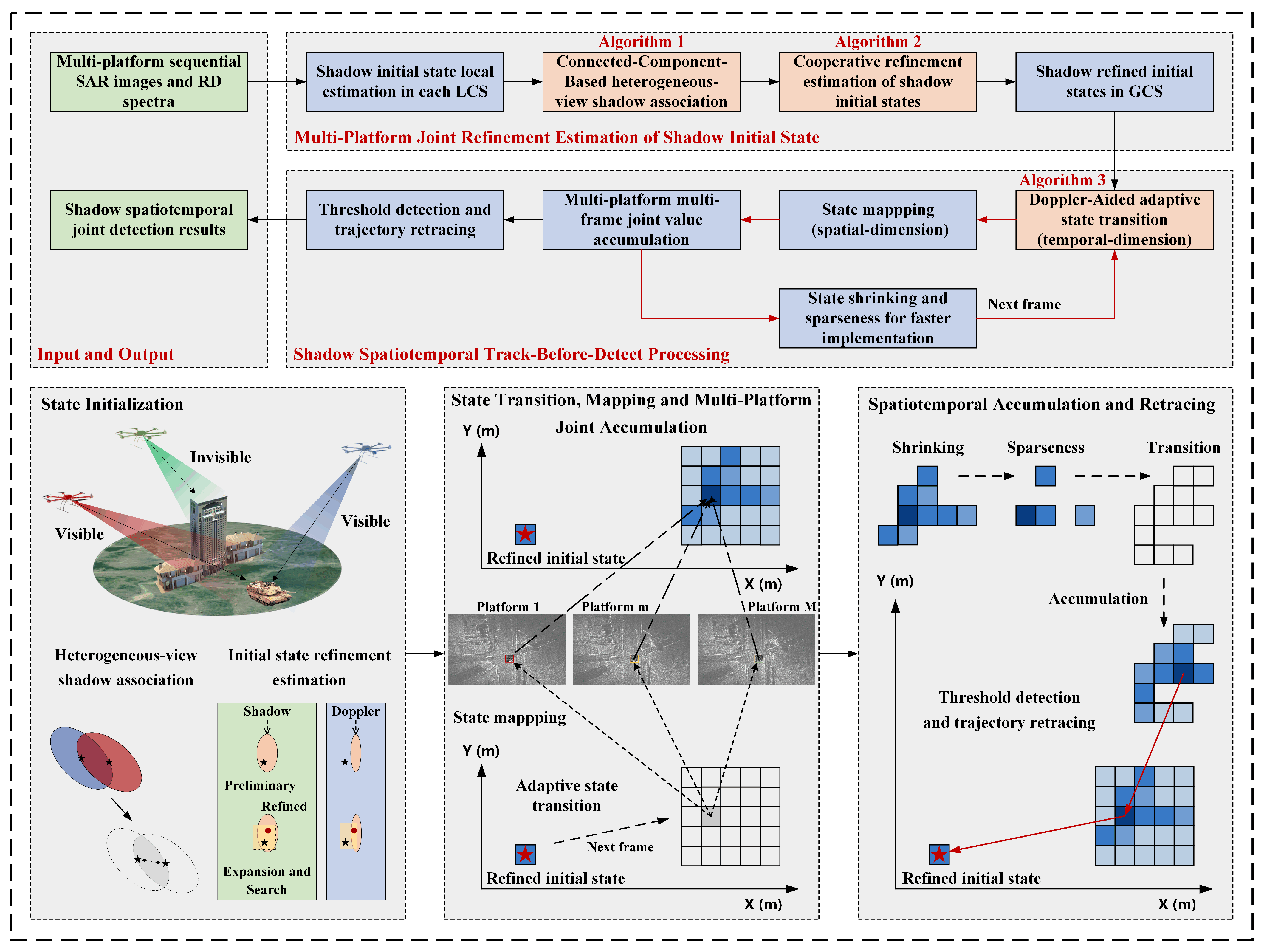
- A spatiotemporal cooperative shadow detection model is established based on a distributed video SAR system, including heterogeneous-view shadow association, Doppler-aided state-refined estimation and adaptive transition, and shrinking–sparseness strategy.
- The proposed approach overcomes the occlusion issue encountered with moving-target shadows in single-view detection. Moreover, through spatiotemporal accumulation, it reduces detection latency and alleviates the pressure of long-term state prediction for maneuvering targets.
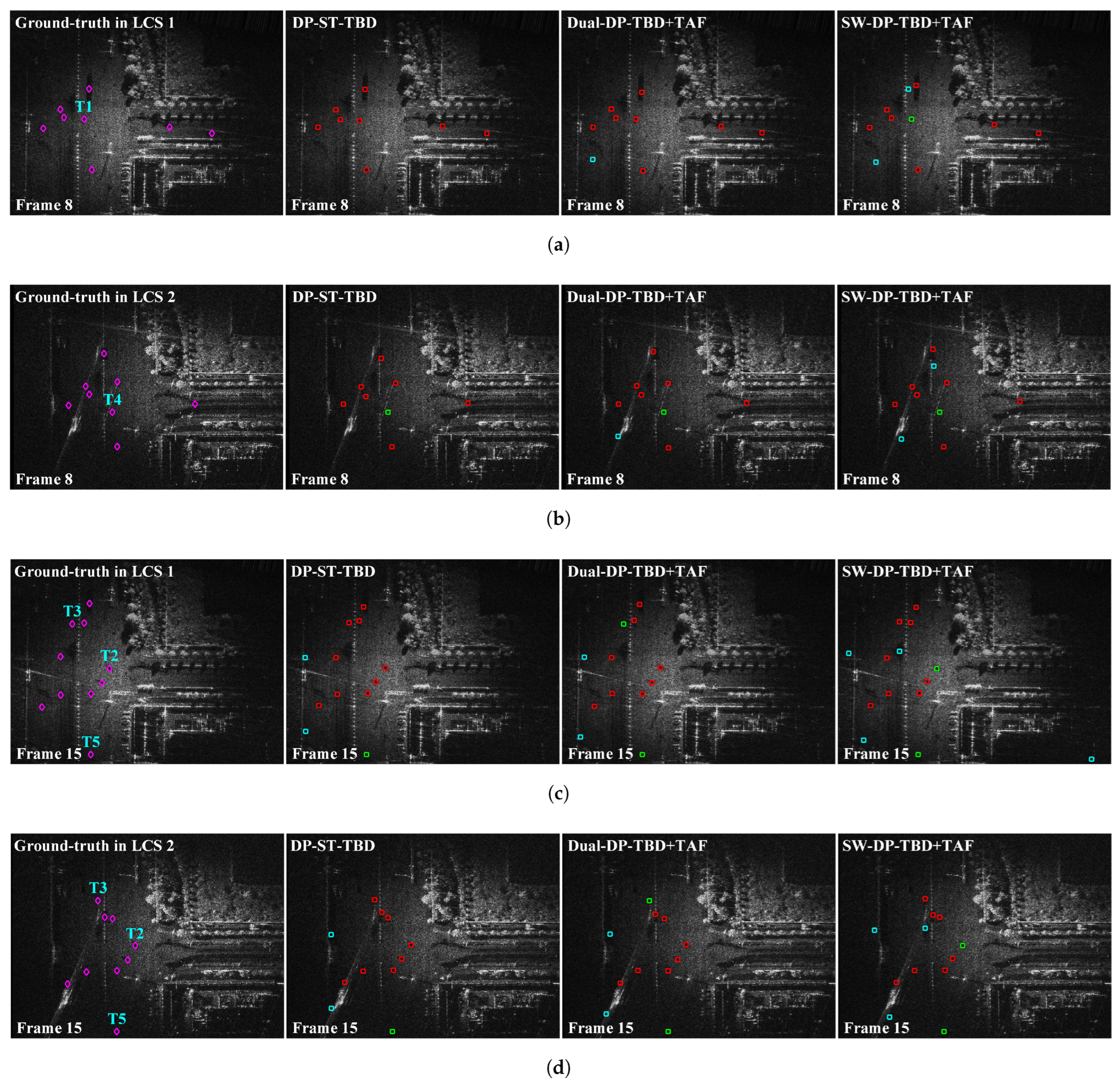
- The experimental results demonstrate that the DP-ST-TBD algorithm outperforms the compared methods in terms of detection rate, number of false detections, and computational time, leading to a substantial enhancement in video SAR GMTI performance.
Abstract
1. Introduction
- 1.
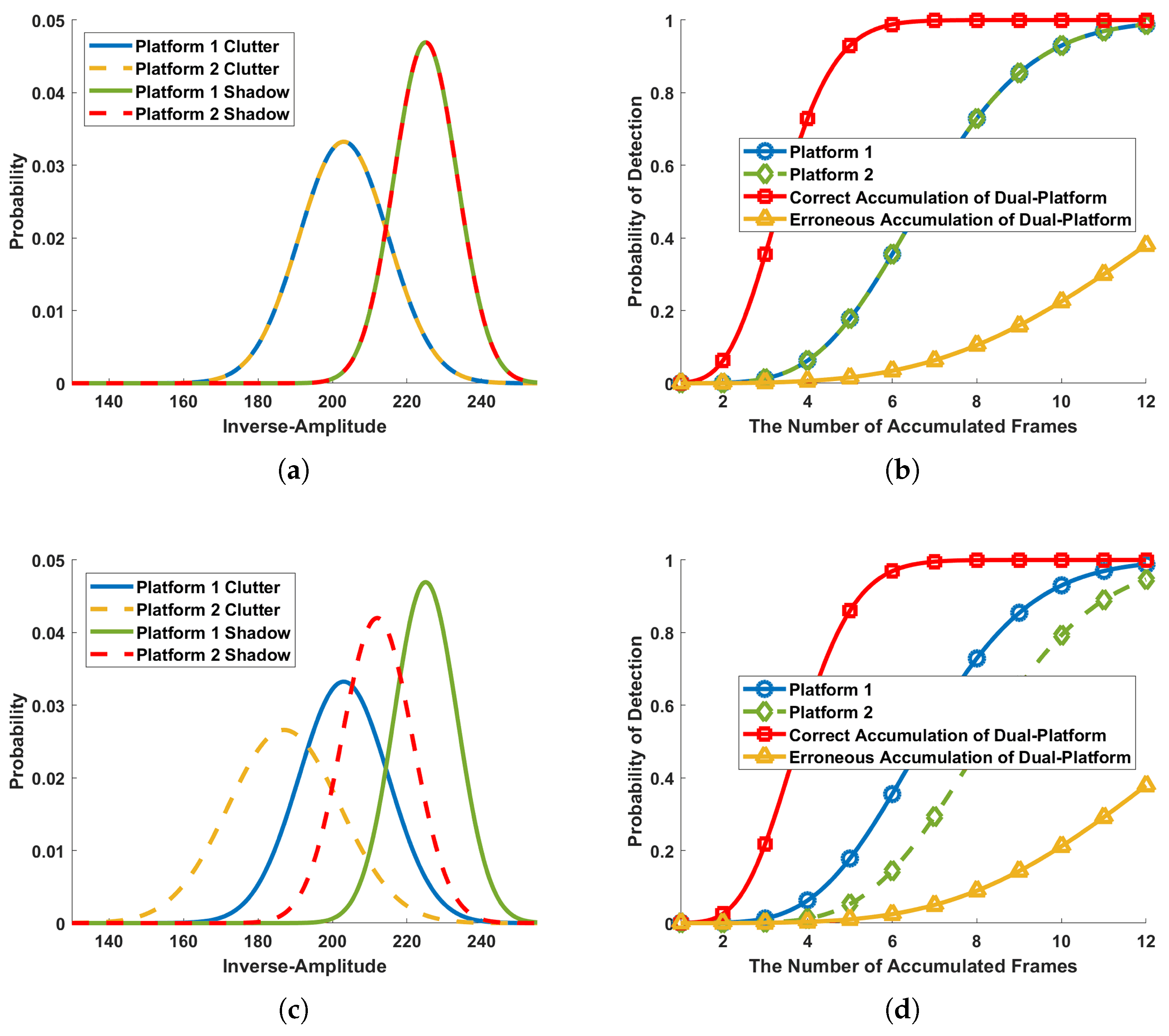
- Spatiotemporal cooperative shadow detection model: To overcome the limitations of single-platform shadow detection, this paper extends the conventional temporal dimension TBD framework into the spatiotemporal dimension. The proposed approach achieves multi-platform, multi-frame joint search and accumulation through state temporal transition and spatial mapping.
- 2.
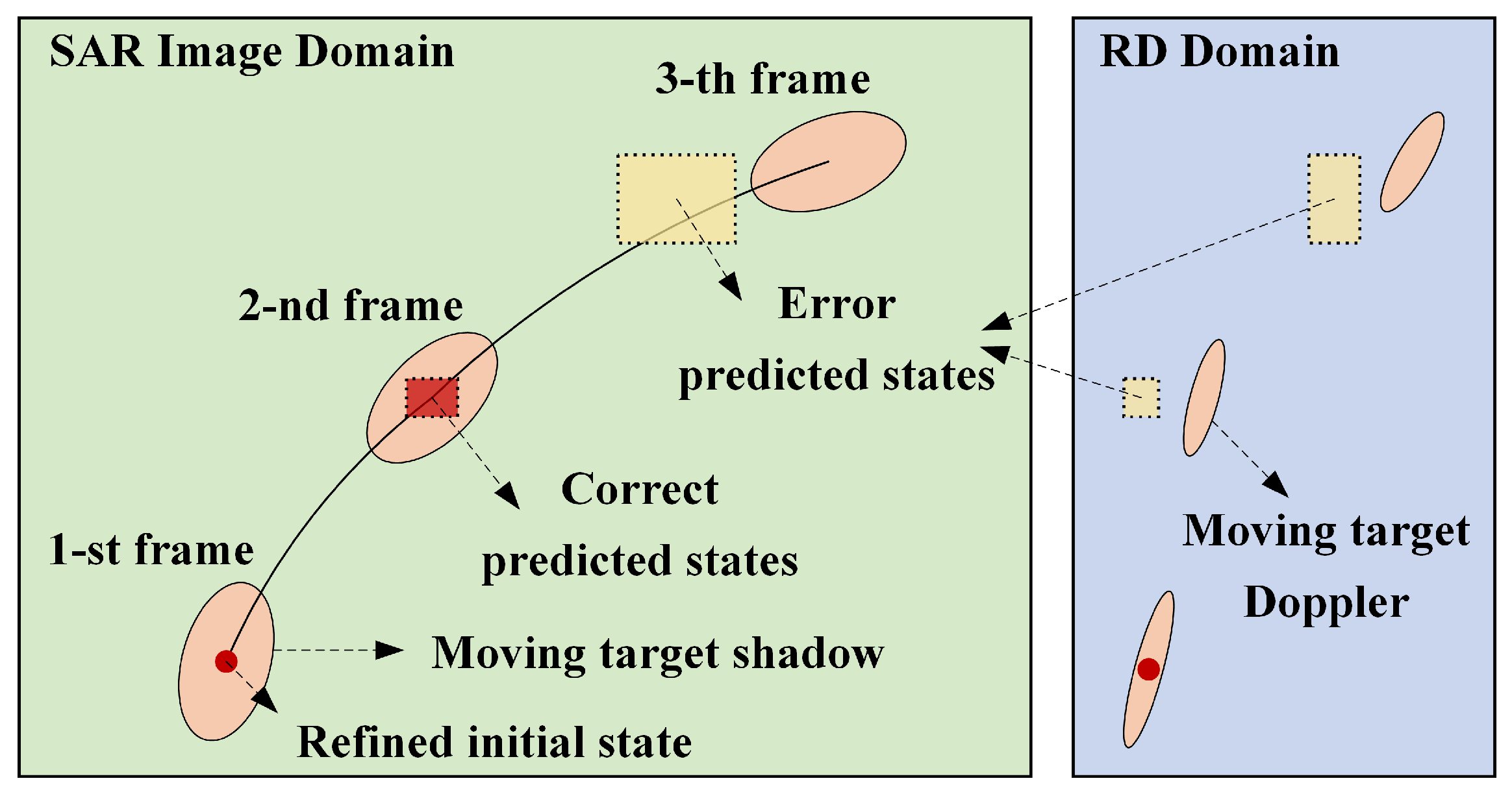
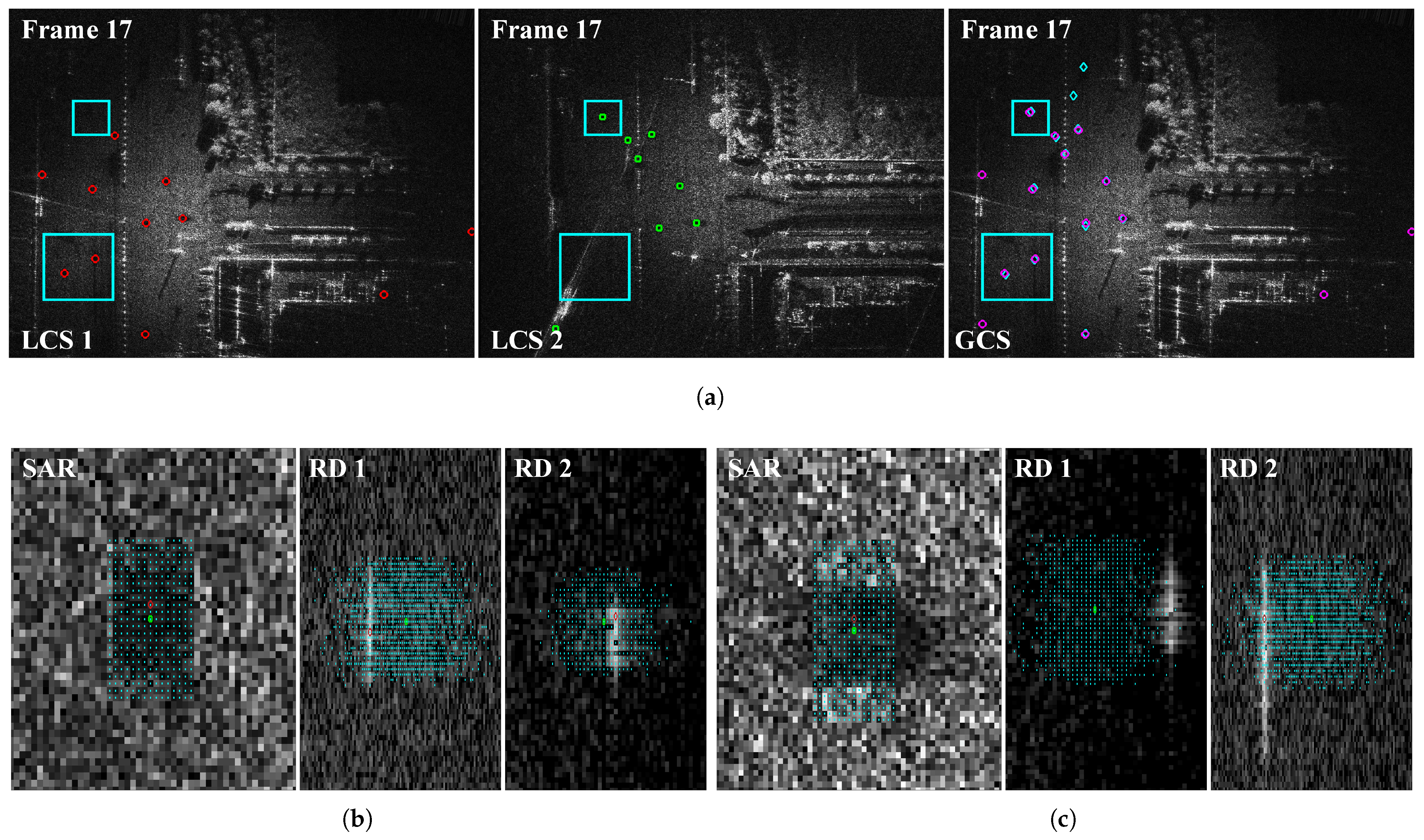
- Doppler-aided state-refined estimation and adaptive transition: This paper utilizes the moving target’s heterogeneous-view Doppler features to achieve two key improvements. First, it enables refined estimation of the shadow’s initial state. Second, it adaptively determines the required number of states in each search step, thereby solving the state insufficiency or redundancy issues due to fixed-state transition.
- 3.
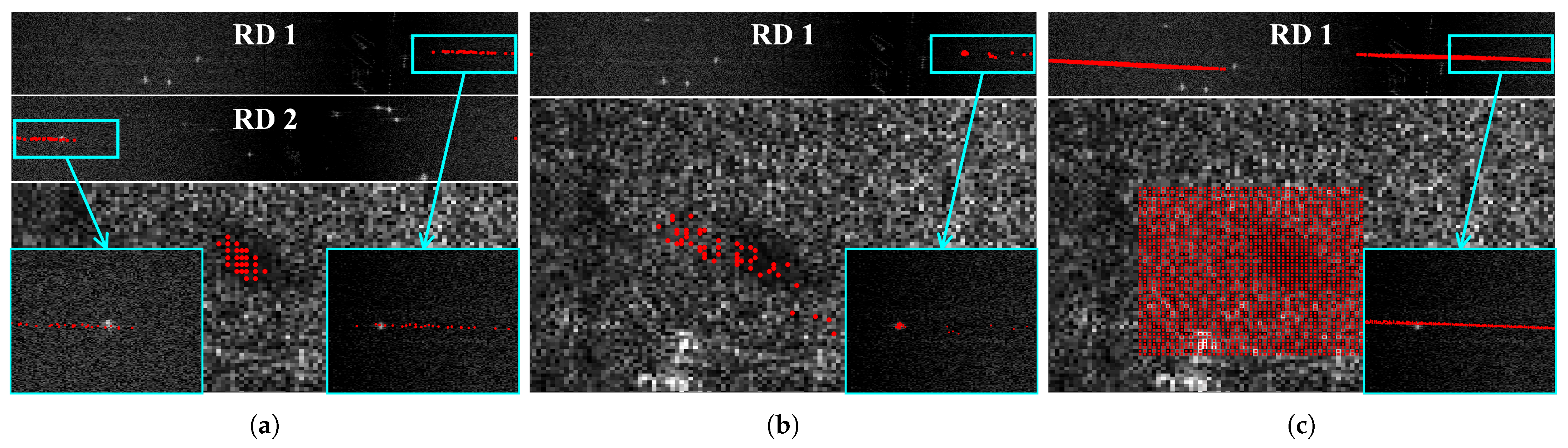
- State shrinking and sparseness strategy: To reduce the high computational complexity caused by dense states, this paper eliminates invalid and redundant states based on multi-platform, multi-frame detection thresholds, retaining only a small number of effective states for target search and accumulation along the spatiotemporal dimension.
2. Foundations of Single-Platform DP-TBD
2.1. Measurement and Target Dynamic Models
2.2. DP-TBD Implementation for Shadow Detection
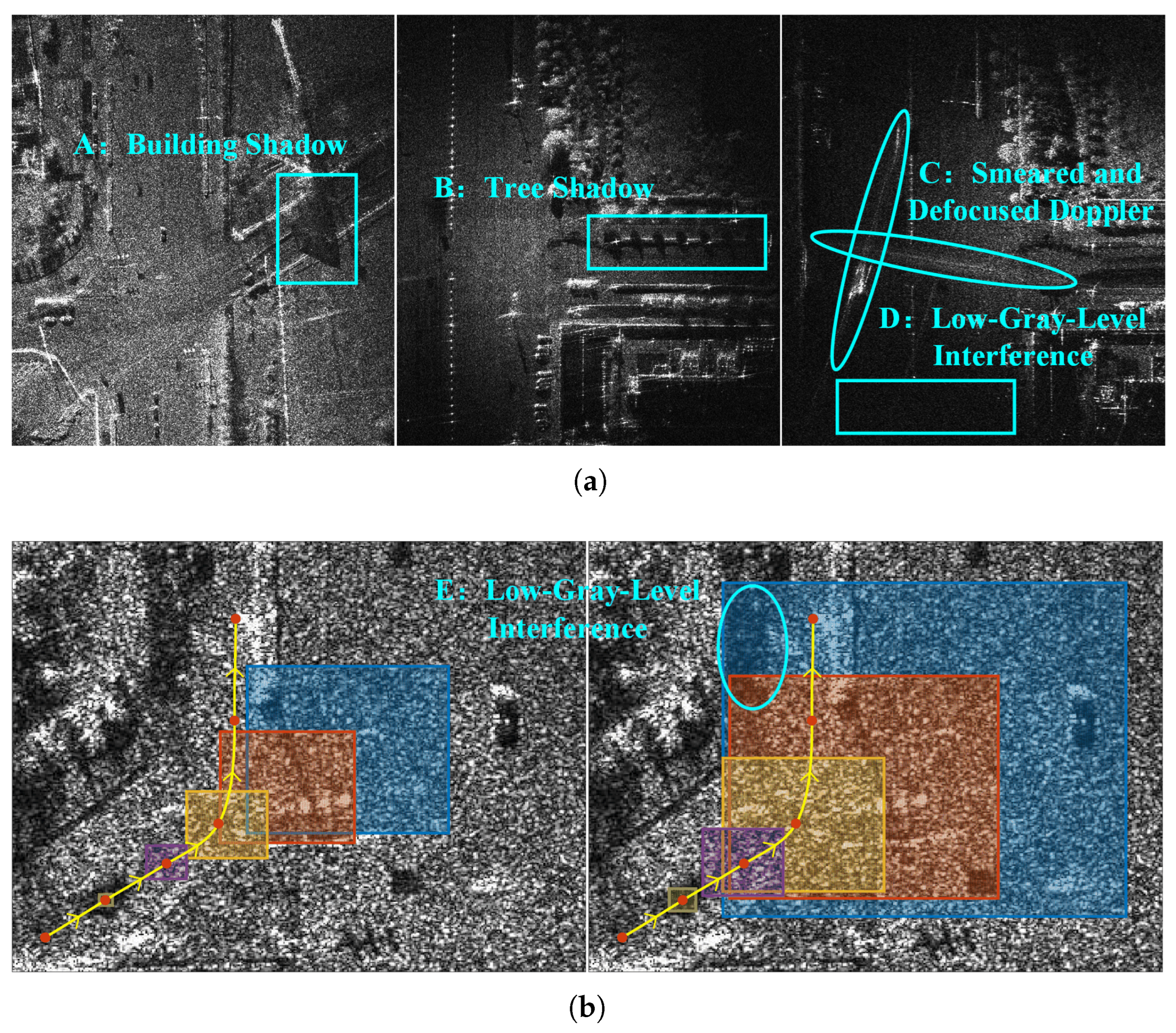
2.3. Limitations of the Single-Platform Shadow DP-TBD
3. Dynamic Programming-Based Spatiotemporal Track-Before-Detect
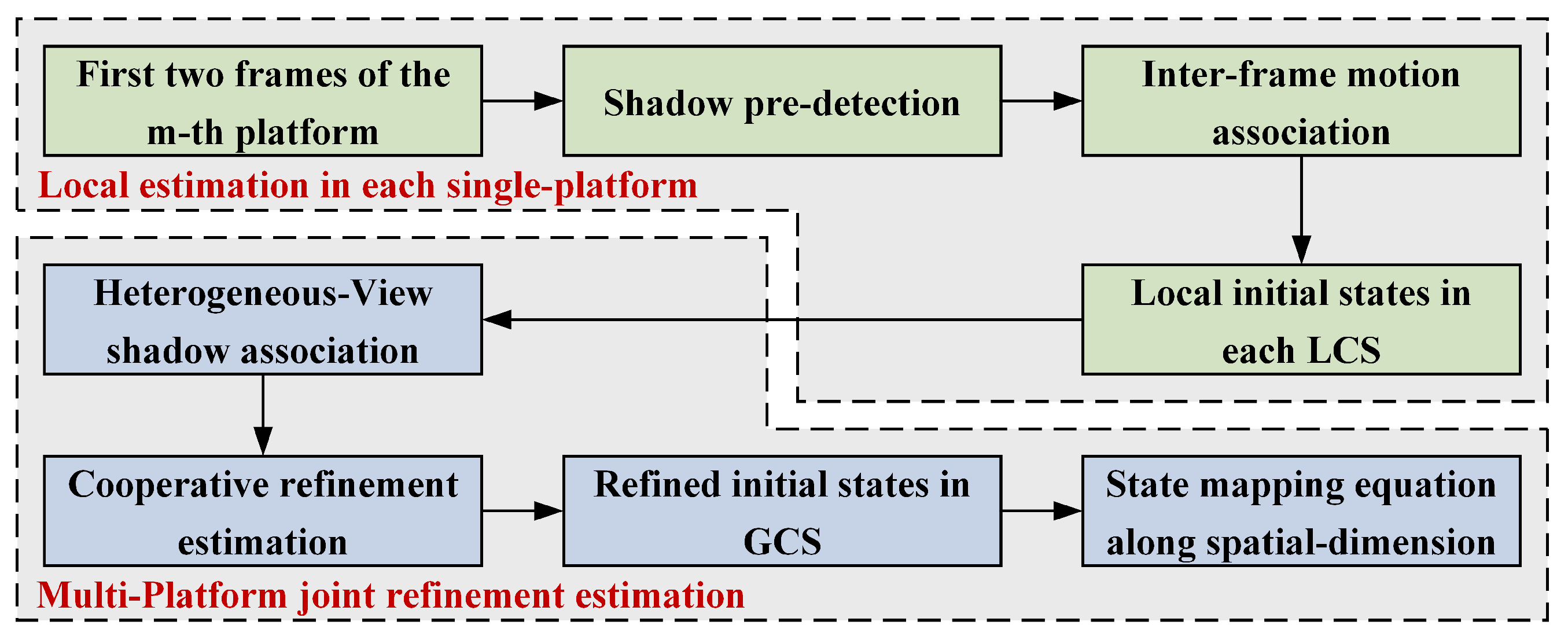
3.1. Multi-Platform Joint Refinement Estimation of Shadow Initial State
| Algorithm 1 Connected-component-based heterogeneous-view shadow association |
| Input: multi-platform local initial state set , . Output: global preliminary initial state set and label set . 1: Initialization: cluster set , , , . 2: for to M () do 3: Transform to the GCS using Equation (8). 4: for to do 5: Calculate the intersections between and all connected components in . 6: if q-th intersection exceeds the preset threshold then ← , ← m. 7: else if none of intersections exceed then new subset: ← , ← m. 8: end if 9: end for 10: end for 11: is obtained by calculating the mean state of each subset in . |
| Algorithm 2 Cooperative refinement estimation of shadow initial state |
| Input: global preliminary initial state set and label set . Output: global refined initial state set and filtered label set . 1: for to P do 2: Initialization: state set . 3: for to M do 4: Inversely transform to the m-th LCS using Equation (8). 5: Local state is randomly expanded and the expanded state set is mapped to the RD spectrum [27]. 6: A 2D CFAR detector centered on each expanded state is used to search for potential moving targets. 7: if i-th local expanded state covers the moving target then ← i-th expanded state in the GCS and continues to the next iteration. 8: end if 9: end for 10: if the number of states contained in exceeds the threshold () then refined initial state is obtained by calculating the mean state of and label . 11: end if 12: end for |
3.2. Multi-Platform, Multi-Frame Joint Accumulation Based on Adaptive State Transition
| Algorithm 3 Doppler-aided adaptive state transition |
| Input: predicted state set . Output: predicted state set . 1: Initialization: , , the maximum number H and threshold . 2: while and do 3: Initialization: . 4: Temporal dimension transition using Equations (3) and (11): → . 5: for to M do 6: Transform inversely to the m-th LCS using Equation (10). 7: Map local states to the RD spectrum [27]. 8: Calculate the local states’ range and Doppler coordinate intervals and . 9: Denote the 2D region formed by these coordinates as . 10: Search potential moving targets in using the two-stage detection (fixed-threshold and 2D CFAR detector) followed by morphological processing. 11: if detection point exists within then and continues to the next iteration. 12: end if 13: end for 14: can cover the Doppler component of the moving target in the u platforms. 15: if then . 16: else . 17: end if 18: end while |
3.3. Analysis of Spatiotemporal Joint Accumulation
3.3.1. Gaussian Distribution
3.3.2. Gamma Distribution
3.4. State Shrinking and Sparseness for Faster Implementation
| Algorithm 4 The proposed DP-ST-TBD algorithm |
| Input: SAR images and RD spectra , , . Output: Declared target trajectories. 1: Single-Platform local estimation → shadow local initial state set . 2: Heterogeneous-view shadow association based on Algorithm 1→ global preliminary initial state set . 3: Refinement estimation based on Algorithm 2→ global refined initial state set . 4: for to K do 5: At discrete time : initialization . 6: Determine the number of accumulated platforms and frames . 7: for to do 8: if then 9: Temporal dimension adaptive state transition based on Algorithm 3: . 10: else 11: State shrinking–sparseness and adaptive state transition: . 12: end if 13: Spatial dimension state mapping using Equation (10): . 14: Spatiotemporal joint accumulation using Equation (12). 15: end for 16: Detection using Equation (25). 17: if Equation (25) is satisfied then 18: Obtain declared state and retrace trajectory . 19: end if 20: end for |
4. Experiments
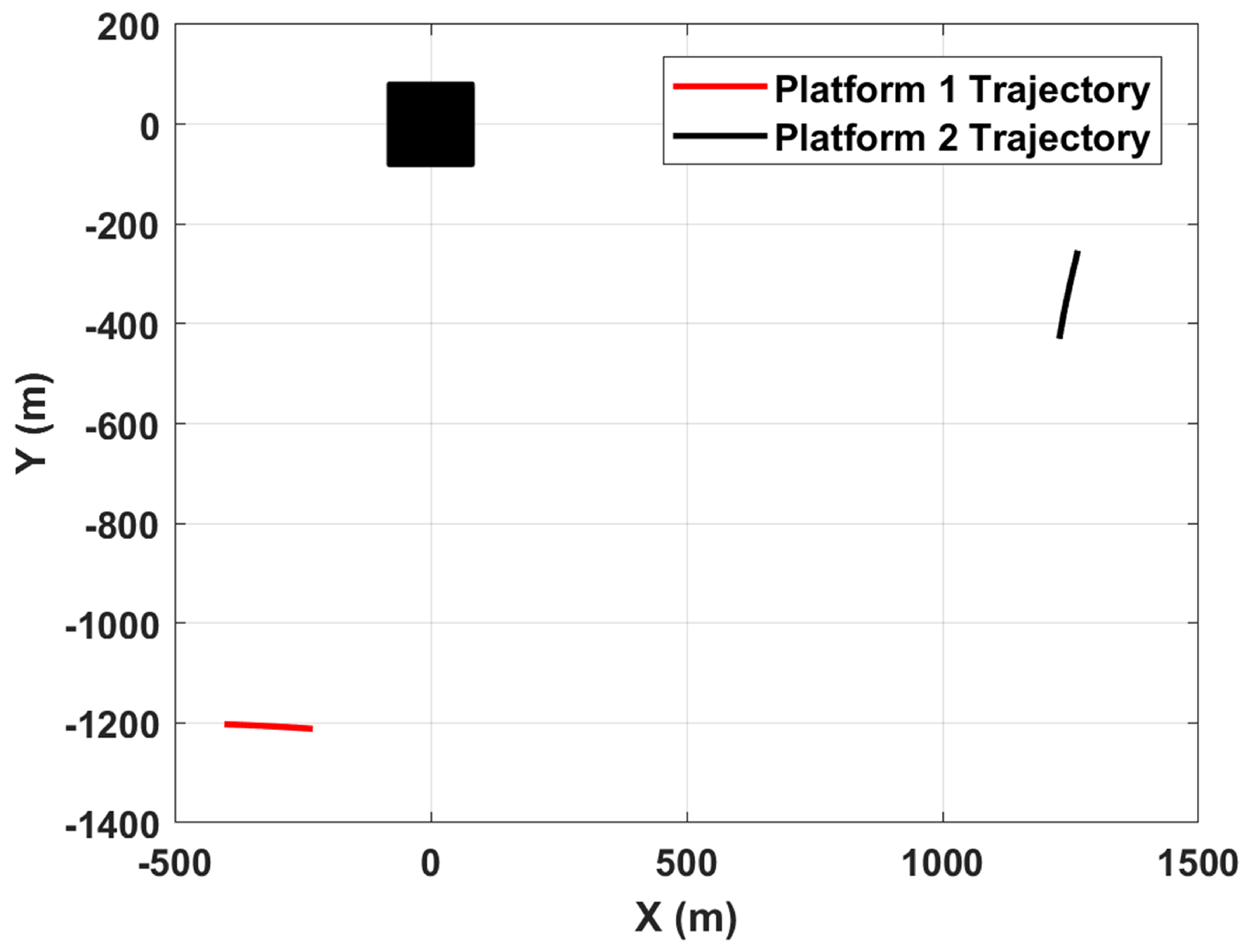
4.1. Introduction to Experimental Data
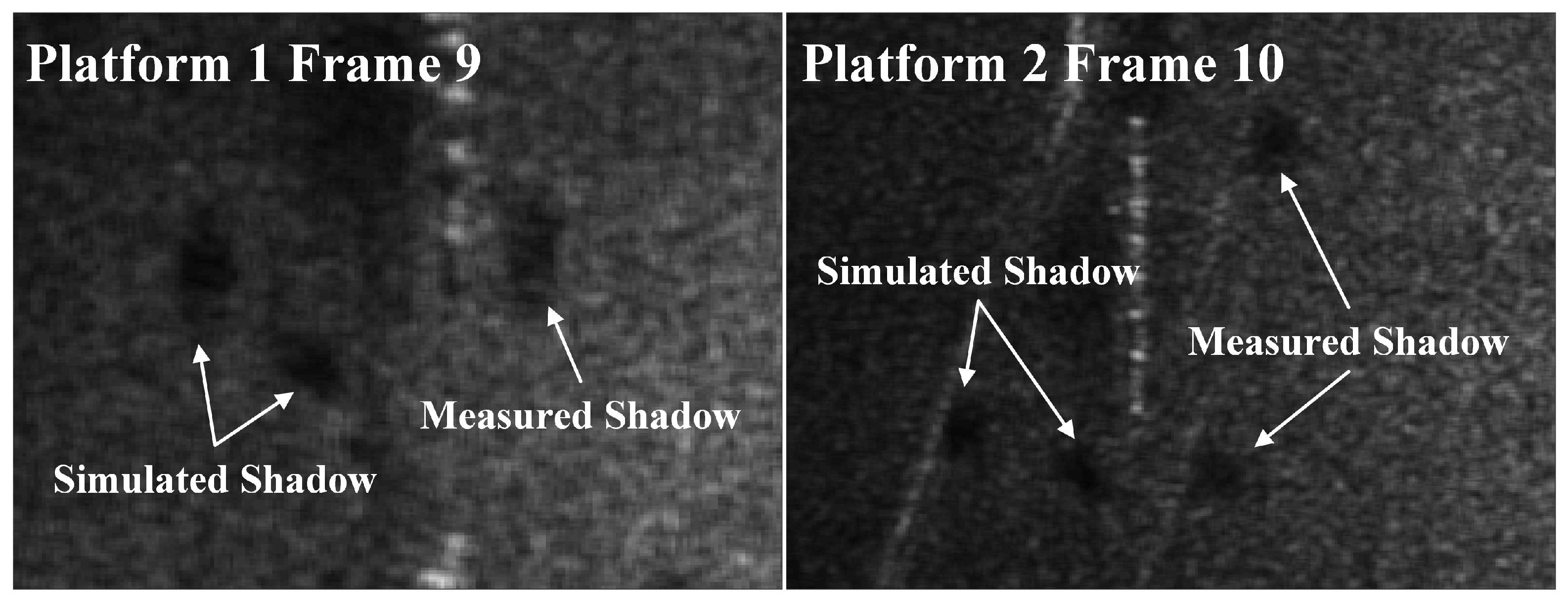
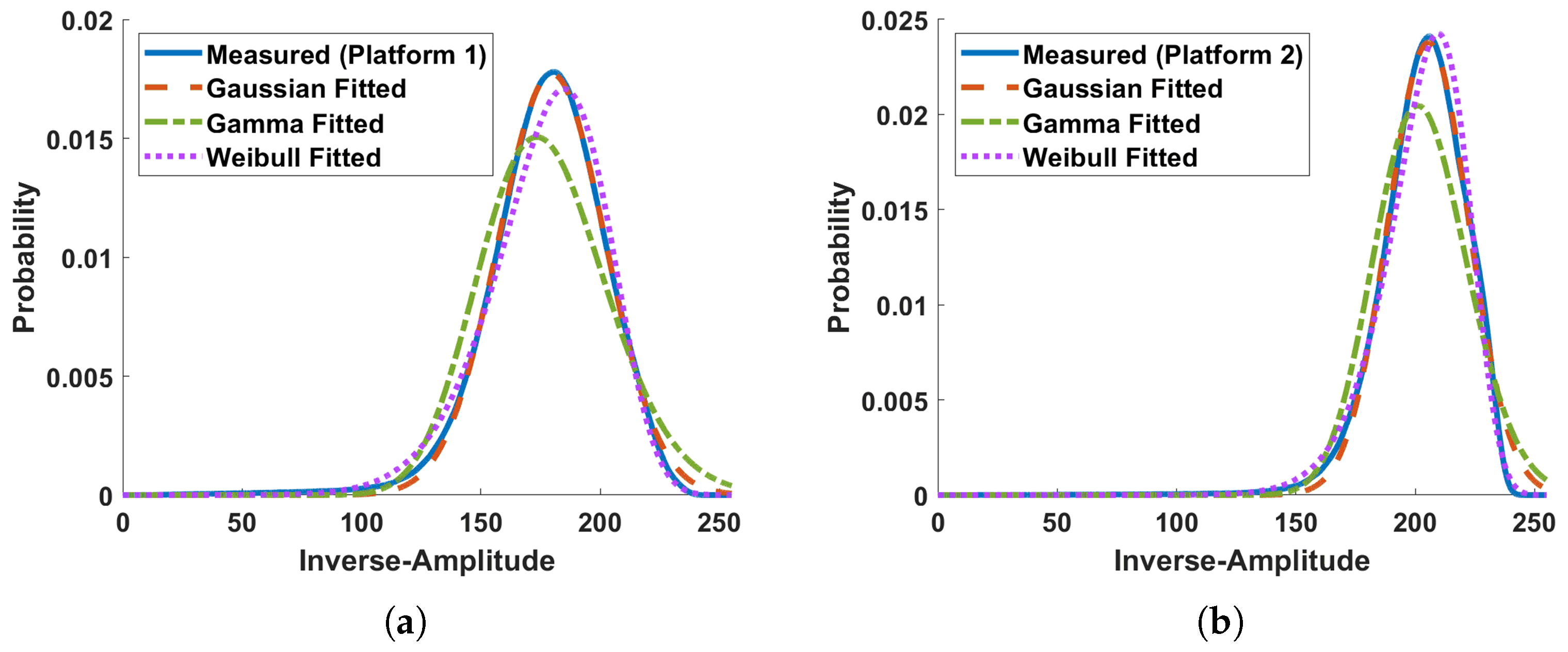
4.2. Verification of Spatiotemporal Joint Detection Performance
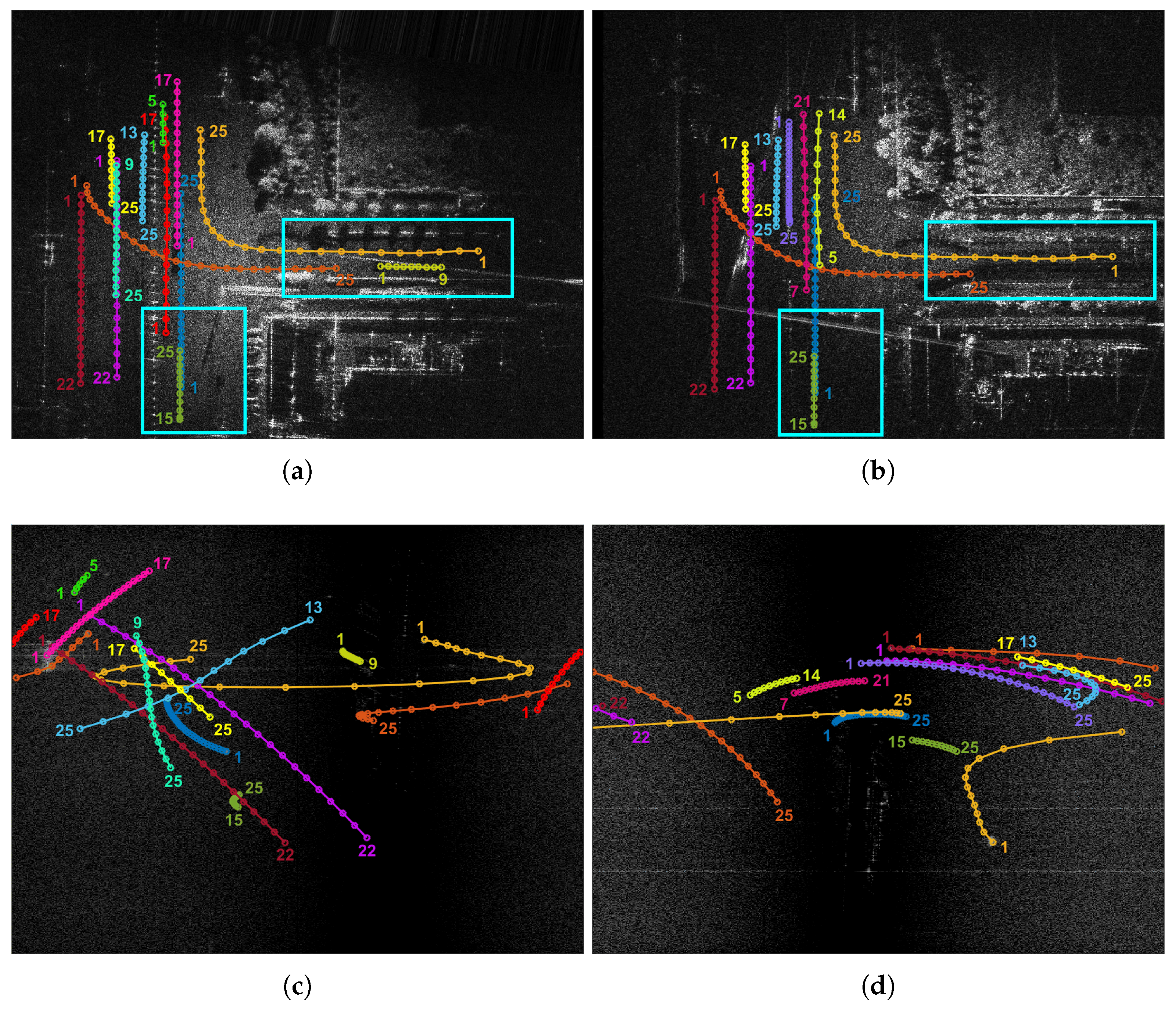
4.3. Results of the Proposed DP-ST-TBD Algorithm
5. Discussion
6. Conclusions
Author Contributions
Funding
Data Availability Statement
Conflicts of Interest
References
- Kim, S.H.; Fan, R.; Dominski, F. ViSAR: A 235 GHz radar for airborne applications. In Proceedings of the 2018 IEEE Radar Conference (RadarConf18), Oklahoma City, OK, USA, 23–27 April 2018; pp. 1549–1554. [Google Scholar]
- Palm, S.; Sommer, R.; Janssen, D.; Tessmann, A.; Stilla, U. Airborne Circular W-Band SAR for Multiple Aspect Urban Site Monitoring. IEEE Trans. Geosci. Remote Sens. 2019, 57, 6996–7016. [Google Scholar] [CrossRef]
- Kim, C.K.; Azim, M.T.; Singh, A.K.; Park, S.O. Doppler Shifting Technique for Generating Multi-Frames of Video SAR via Sub-Aperture Signal Processing. IEEE Trans. Signal Process. 2020, 68, 3990–4001. [Google Scholar] [CrossRef]
- Zhang, Y.; Zhu, D.; Mao, X.; Yu, X.; Zhang, J.; Li, Y. Multirotors Video Synthetic Aperture Radar: System Development and Signal Processing. IEEE Aerosp. Electron. Syst. Mag. 2020, 35, 32–43. [Google Scholar] [CrossRef]
- Gao, A.; Sun, B.; Li, J.; Li, C. A Parameter-Adjusting Autoregistration Imaging Algorithm for Video Synthetic Aperture Radar. IEEE Trans. Geosci. Remote Sens. 2022, 60, 5215414. [Google Scholar] [CrossRef]
- Pu, W.; Wu, J.; Huang, Y.; Yang, J. ORTP: A Video SAR Imaging Algorithm Based on Low-Tubal-Rank Tensor Recovery. IEEE J. Sel. Top. Appl. Earth Obs. Remote Sens. 2022, 15, 1293–1308. [Google Scholar] [CrossRef]
- An, H.; Wu, J.; Teh, K.C.; Sun, Z.; Li, Z.; Yang, J. Joint Low-Rank and Sparse Tensors Recovery for Video Synthetic Aperture Radar Imaging. IEEE Trans. Geosci. Remote Sens. 2022, 60, 5214913. [Google Scholar] [CrossRef]
- Cheng, Y.; Ding, J.; Sun, Z.; Zhong, C. Processing of Airborne Video SAR Data Using the Modified Back Projection Algorithm. IEEE Trans. Geosci. Remote Sens. 2022, 60, 5238013. [Google Scholar] [CrossRef]
- Huang, X.; Xu, Z.; Ding, J. Video SAR Image Despeckling by Unsupervised Learning. IEEE Trans. Geosci. Remote Sens. 2021, 59, 10151–10160. [Google Scholar] [CrossRef]
- Ai, J.; Wang, G.; Fan, G.; Wang, F.; Jia, L.; Wu, Y. A Trilateral Filter for Video SAR Speckle Noise Reduction. IEEE Geosci. Remote Sens. Lett. 2022, 19, 4508505. [Google Scholar] [CrossRef]
- Huang, X.; Ding, J.; Guo, Q. Unsupervised Image Registration for Video SAR. IEEE J. Sel. Top. Appl. Earth Obs. Remote Sens. 2021, 14, 1075–1083. [Google Scholar] [CrossRef]
- Tian, X.; Liu, J.; Mallick, M.; Huang, K. Simultaneous Detection and Tracking of Moving-Target Shadows in ViSAR Imagery. IEEE Trans. Geosci. Remote Sens. 2021, 59, 1182–1199. [Google Scholar] [CrossRef]
- Wu, Z.; Xie, H.; Gao, T.; Zhang, Y.; Liu, H. moving-target shadow Detection Method Based on Improved ViBe in VideoSAR Images. IEEE J. Sel. Top. Appl. Earth Obs. Remote Sens. 2024, 17, 14575–14587. [Google Scholar] [CrossRef]
- Sun, Z.; Wen, L.; Ding, J. Adaptive Frame-Rate Partitioned Video SAR. IEEE Trans. Radar Syst. 2025, 3, 576–590. [Google Scholar] [CrossRef]
- Zhao, B.; Han, Y.; Wang, H.; Tang, L.; Liu, X.; Wang, T. Robust Shadow Tracking for Video SAR. IEEE Geosci. Remote Sens. Lett. 2021, 18, 821–825. [Google Scholar] [CrossRef]
- Xu, Z.; Sun, J.; Wu, F. A Novel IMM Filter for VideoSAR Ground Moving Target Tracking. In Proceedings of the 2019 6th Asia-Pacific Conference on Synthetic Aperture Radar (APSAR), Xiamen, China, 26–29 November 2019; pp. 1–5. [Google Scholar]
- Liu, Z.; An, D.; Huang, X. moving-target shadow Detection and Global Background Reconstruction for VideoSAR Based on Single-Frame Imagery. IEEE Access 2019, 7, 42418–42425. [Google Scholar] [CrossRef]
- Ding, J.; Wen, L.; Zhong, C.; Loffeld, O. Video SAR Moving Target Indication Using Deep Neural Network. IEEE Trans. Geosci. Remote Sens. 2020, 58, 7194–7204. [Google Scholar] [CrossRef]
- Yang, X.; Shi, J.; Chen, T.; Hu, Y.; Zhou, Y.; Zhang, X. Fast Multi-Shadow Tracking for Video-SAR Using Triplet Attention Mechanism. IEEE Trans. Geosci. Remote Sens. 2022, 60, 5224212. [Google Scholar] [CrossRef]
- Yan, H.; Liu, H.; Xu, X.; Zhou, Y.; Cheng, L.; Li, Y.; Wu, D.; Zhang, J.; Wang, L.; Zhu, D. A New Method of Video SAR Ground Moving Target Detection and Tracking Based on the Interframe Amplitude Temporal Curve. IEEE Trans. Geosci. Remote Sens. 2023, 61, 5219217. [Google Scholar] [CrossRef]
- Bao, J.; Zhang, X.; Zhang, T.; Zeng, T.; Yang, Z.; Zhan, X.; Shi, J.; Wei, S. Shadow-Enhanced Self-Attention and Anchor-Adaptive Network for Video SAR Moving Target Tracking. IEEE Trans. Geosci. Remote Sens. 2023, 61, 5204913. [Google Scholar] [CrossRef]
- Fang, H.; Liao, G.; Liu, Y.; Zeng, C.; He, X.; Meng, Q. A Dual-Mode Framework for Robust Long-Term Tracking in Video SAR. IEEE Sens. J. 2024, 24, 13028–13042. [Google Scholar] [CrossRef]
- Zhang, W.; Zhang, X.; Xu, X.; Xu, Y.; Shao, Z.; Shi, J.; Wei, S.; Zeng, T. GNN-JFL: Graph Neural Network for Video SAR Shadow Tracking with Joint Motion-Appearance Feature Learning. IEEE Trans. Geosci. Remote Sens. 2024, 62, 5209117. [Google Scholar] [CrossRef]
- Fang, H.; Liao, G.; Liu, Y.; Zeng, C.; He, X.; Xu, M. A Joint Moving Target Detection Method in Video SAR via Low-Rank Sparse Decomposition and Transformer. IEEE J. Sel. Top. Appl. Earth Obs. Remote Sens. 2025, 18, 1007–1019. [Google Scholar] [CrossRef]
- Wen, L.; Ding, J.; Loffeld, O. Video SAR Moving Target Detection Using Dual Faster R-CNN. IEEE J. Sel. Top. Appl. Earth Obs. Remote Sens. 2021, 14, 2984–2994. [Google Scholar] [CrossRef]
- Qin, S.; Ding, J.; Wen, L.; Jiang, M. Joint Track-Before-Detect Algorithm for High-Maneuvering Target Indication in Video SAR. IEEE J. Sel. Top. Appl. Earth Obs. Remote Sens. 2021, 14, 8236–8248. [Google Scholar] [CrossRef]
- Wen, L.; Ding, J.; Cheng, Y.; Xu, Z. Dually Supervised Track-Before-Detect Processing of Multichannel Video SAR Data. IEEE Trans. Geosci. Remote Sens. 2022, 60, 5228713. [Google Scholar] [CrossRef]
- Zhong, C.; Ding, J.; Zhang, Y. Joint Tracking of Moving Target in Single-Channel Video SAR. IEEE Trans. Geosci. Remote Sens. 2022, 60, 5212718. [Google Scholar] [CrossRef]
- Zhong, C.; Ding, J.; Zhang, Y. Video SAR Moving Target Tracking Using Joint Kernelized Correlation Filter. IEEE J. Sel. Top. Appl. Earth Obs. Remote Sens. 2022, 15, 1481–1493. [Google Scholar] [CrossRef]
- Luan, J.; Wen, L.; Ding, J. Multifeature Joint Detection of Moving Target in Video SAR. IEEE Geosci. Remote Sens. Lett. 2022, 19, 4515805. [Google Scholar] [CrossRef]
- Wang, M.; Li, X.; Gao, L.; Sun, Z.; Cui, G.; Yeo, T.S. Signal Accumulation Method for High-Speed Maneuvering Target Detection Using Airborne Coherent MIMO Radar. IEEE Trans. Signal Process. 2023, 71, 2336–2351. [Google Scholar] [CrossRef]
- Gao, L.; Li, X.; Wang, M.; Sun, Z.; Cui, G.; Yeo, T.S. Multichannel Multiframe accumulation Detection Method for Weak Target with Coherent MIMO Radar. IEEE Trans. Aerosp. Electron. Syst. 2025, 61, 6518–6536. [Google Scholar] [CrossRef]
- Li, J.; Wen, L.; Yu, Z.; Ding, J. State Estimation of Moving Targets Using Sequential Range and Doppler Measurements with Swarm of UAV-Borne Radars. IEEE Trans. Aerosp. Electron. Syst. 2025, 61, 11904–11918. [Google Scholar] [CrossRef]
- Wang, Y.; Ding, Z.; Li, L.; Liu, M.; Ma, X.; Sun, Y.; Zeng, T.; Long, T. First Demonstration of Single-Pass Distributed SAR Tomographic Imaging with a P-Band UAV SAR Prototype. IEEE Trans. Geosci. Remote Sens. 2022, 60, 5238618. [Google Scholar] [CrossRef]
- Ren, H.; Sun, Z.; Yang, J.; Huang, C.; An, H.; Li, Z.; Wu, J. A Hybrid Resolution Enhancement Framework for Swarm UAV SAR Based on Cost-Effective Formation Strategy. IEEE Trans. Geosci. Remote Sens. 2024, 62, 5200216. [Google Scholar] [CrossRef]
- Ding, J.; Zhang, K.; Huang, X.; Xu, Z. High Frame-Rate Imaging Using Swarm of UAV-Borne Radars. IEEE Trans. Geosci. Remote Sens. 2024, 62, 5204912. [Google Scholar] [CrossRef]
- Yi, W.; Morelande, M.R.; Kong, L.; Yang, J. An Efficient Multi-Frame Track-Before-Detect Algorithm for Multi-Target Tracking. IEEE J. Sel. Top. Signal Process. 2013, 7, 421–434. [Google Scholar] [CrossRef]



| No. | Gaussian | Gamma | Weibull |
|---|---|---|---|
| Platform 1 | 0.0151 | 0.0964 | 0.0460 |
| Platform 2 | 0.0401 | 0.1144 | 0.0543 |
| Algorithm | Shadows | Correct Detection | Detection Rate | False Alarm | Time Cost (s) |
|---|---|---|---|---|---|
| SW-DP-TBD+TAF | 419 | 354 | 0.8449 | 78 | 80.53 |
| Dual-DP-TBD+TAF | 380 | 0.9069 | 36 | 24.91 | |
| DP-ST-TBD | 396 | 0.9451 | 17 | 18.35 |
| Method | Shadows | Correct Detection | Detection Rate | False Alarm | Time Cost (s) |
|---|---|---|---|---|---|
| Fixed-state transition ( = 3) | 419 | 361 | 0.8616 | 17 | 4.86 |
| Fixed-state transition ( = 9) | 398 | 0.9499 | 22 | 28.78 | |
| Adaptive state transition () | 396 | 0.9451 | 17 | 18.35 |
Disclaimer/Publisher’s Note: The statements, opinions and data contained in all publications are solely those of the individual author(s) and contributor(s) and not of MDPI and/or the editor(s). MDPI and/or the editor(s) disclaim responsibility for any injury to people or property resulting from any ideas, methods, instructions or products referred to in the content. |
© 2026 by the authors. Licensee MDPI, Basel, Switzerland. This article is an open access article distributed under the terms and conditions of the Creative Commons Attribution (CC BY) license.
Share and Cite
Wen, L.; Ke, M.; Jiang, M.; Ding, J.; Huang, X. Shadow Spatiotemporal Track-Before-Detect Approach for Distributed UAV-Borne Video SAR. Remote Sens. 2026, 18, 343. https://doi.org/10.3390/rs18020343
Wen L, Ke M, Jiang M, Ding J, Huang X. Shadow Spatiotemporal Track-Before-Detect Approach for Distributed UAV-Borne Video SAR. Remote Sensing. 2026; 18(2):343. https://doi.org/10.3390/rs18020343
Chicago/Turabian StyleWen, Liwu, Ming Ke, Ming Jiang, Jinshan Ding, and Xuejun Huang. 2026. "Shadow Spatiotemporal Track-Before-Detect Approach for Distributed UAV-Borne Video SAR" Remote Sensing 18, no. 2: 343. https://doi.org/10.3390/rs18020343
APA StyleWen, L., Ke, M., Jiang, M., Ding, J., & Huang, X. (2026). Shadow Spatiotemporal Track-Before-Detect Approach for Distributed UAV-Borne Video SAR. Remote Sensing, 18(2), 343. https://doi.org/10.3390/rs18020343