


Highlights
What are the main findings?
- We propose IC-GAP, an inscribed-circle-based geometric adaptive processor, to address the mismatch between training objectives and rotated NMS for elongated oriented object detection in remote sensing imagery.
- We introduce IC-IoU, a rotation-invariant pairwise overlap metric, to stabilize geometric optimization and reduce RIoU fluctuations caused by small angular deviations in high-aspect-ratio objects.
- We develop a polar aspect-stable (PAS) strategy to generate bounded, context-aware penalty weights from the pairwise geometry of objects, enabling adaptive geometry-aligned regularization.
- IC-GAP improves mAP at IoU 0.5 by 1.8 percentage points over the Rotated FCOS baseline on DOTA-v1.0, from 65.0% to 66.8%, and shows competitive cross-dataset performance on the SRSDD ship-detection benchmark.
What are the implications of the main findings?
- Rotation-invariant geometric regularization can reduce the mismatch between detector training and rotated NMS without introducing an additional prediction head during inference.
- The benefits are strongest for elongated or orientation-sensitive categories, while compact or cluttered categories may benefit less.
Abstract
Oriented object detection in remote sensing images has achieved substantial progress, yet non-maximum suppression (NMS) remains vulnerable to angular variation when the overlap of high-aspect-ratio objects is measured with rotated bounding boxes. To address this problem, the inscribed-circle-based geometric adaptive processor (IC-GAP), a training-time geometric regularization framework for elongated object detection, is proposed. First, inscribed-circle intersection over union (IC-IoU) is introduced, which uses a rotation-invariant geometric core to provide a stable pairwise optimization signal. This alleviates the susceptibility of IoU to slight angular misalignments, which are particularly pronounced for high-aspect-ratio objects. Second, the polar aspect-stable (PAS) strategy is designed to generate bounded context-aware penalty weights from relative geometric relationships between object pairs. Third, IC-IoU and PAS are integrated into IC-GAP, which embeds adaptive NMS-oriented constraints into training and encourages prediction distributions that are more compatible with post-processing. Experiments on the Dataset for Object Detection in Aerial Images (DOTA) demonstrate that IC-GAP improves the mean average precision (mAP) by 1.8% over the baseline under the reported protocol.
1. Introduction
Object detection is crucial for image understanding and is widely used in many fields, including autonomous driving [1,2], security surveillance [3], industrial quality inspection [4], medical image analysis [5], and remote sensing image processing [6]. However, high-resolution remote sensing imagery faces several challenges, such as complex backgrounds [7], rotated variation, and scaling variation.
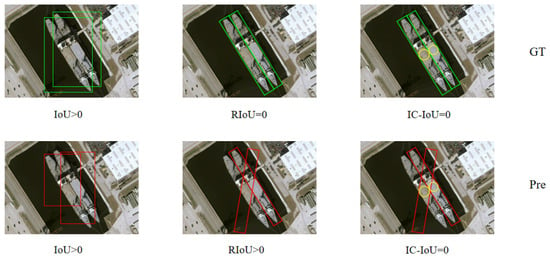
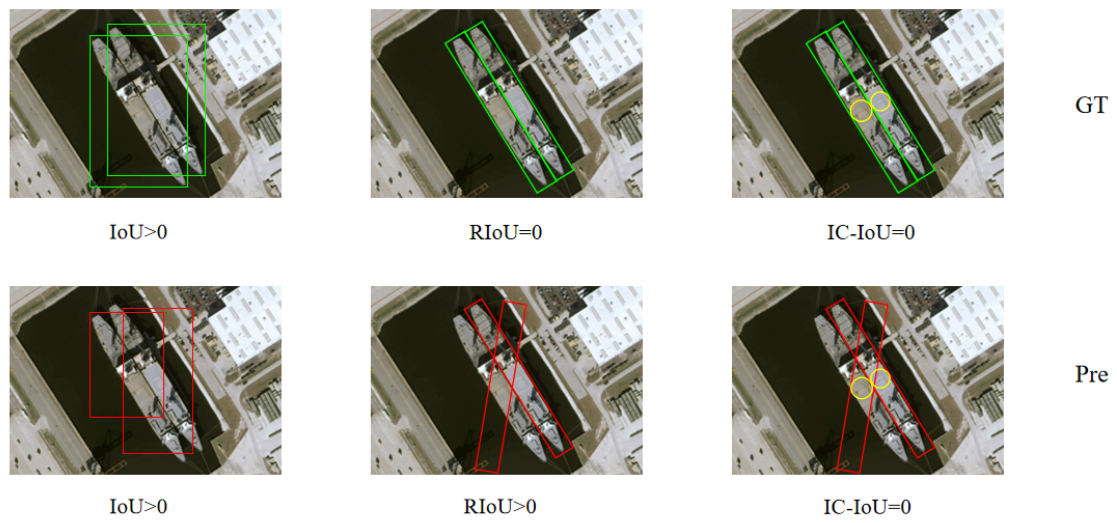
In remote sensing scenes, high-aspect-ratio objects such as bridges, ships, roads, and elongated buildings are often arbitrarily oriented and densely arranged. Existing bounding-box similarity measures are easily disturbed by object rotation, causing biased matching decisions. As shown in Figure 1, traditional horizontal bounding boxes (HBBs) are constrained by axis-aligned boundaries; when adjacent slender objects are densely distributed, their enclosing boxes can contain excessively large overlapping regions, leading to inflated intersection over union (IoU) values and ambiguous object boundaries. Oriented bounding boxes (OBBs) introduce angular degrees of freedom and better fit the real object contours, thereby reducing the redundant overlap caused by HBBs. However, the rotated IoU (RIoU) metric is still not sufficiently robust for high-aspect-ratio objects: small angular deviations or slight center shifts between a prediction and the ground truth may abnormally increase the IoU value, causing low-quality predictions to be treated as high-quality positive samples, and disturbing the gradient updates during training.
Figure 1.
Comparison of HBBs, RIoU, and IC-IoU for adjacent elongated objects. HBBs introduce excessive overlap, while angular deviations in oriented predictions can create unintended RIoU between neighboring objects. By representing each box with its inscribed circle, IC-IoU preserves their separation and provides a more stable pairwise geometric signal. The green and the red boxes denote the ground truths and predictions, respectively.
Deep learning has driven significant progress in oriented detection. Recent surveys emphasize rotation-aware representation, assignment, regression, and post-processing [8]. RICNN [9] and STN [10] learn rotation-invariant features, while FPN [11] and RetinaNet [12] improve multi-scale representation and background suppression. RoI Transformer [13] and Oriented R-CNN [14] predict rotated boxes. Gaussian-based methods using KLD [15] or GWD [16], together with ProbIoU [17], reduce angular discontinuity, while CSL [18] and PSC [19] address angle coding. However, these methods mainly improve representation, regression, or coding, leaving a mismatch between training-time pairwise geometry and NMS-based post-processing for dense, high-aspect-ratio predictions.
To address this mismatch, this paper proposes the inscribed-circle-based geometric adaptive processor (IC-GAP). Its rotation-invariant geometric core, IC-IoU, uses the inscribed circle of an oriented box to reduce spurious IoU increases caused by angular deviations and center shifts; circular-region IoU has also been used in CircleNet [20]. IC-GAP further introduces adaptive NMS-aware regularization: its polar aspect-stable (PAS) strategy dynamically weights pull and push penalties according to pairwise size, orientation, and shape. Thus, training-time geometric constraints are aligned with NMS while remaining sensitive to object context. Experiments on DOTA show that IC-GAP achieves competitive performance against representative methods for elongated object detection, improving the Rotated FCOS baseline by 1.8 percentage points in mAP.
2. Materials and Methods
This section elaborates on the complete framework of IC-GAP. IC-GAP is integrated into mainstream oriented object detectors and works in conjunction with the original classification and regression losses.
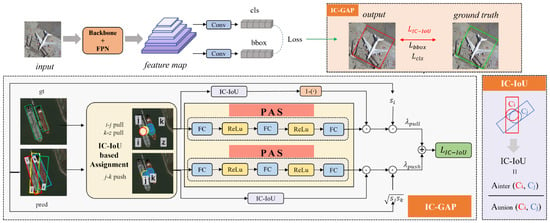
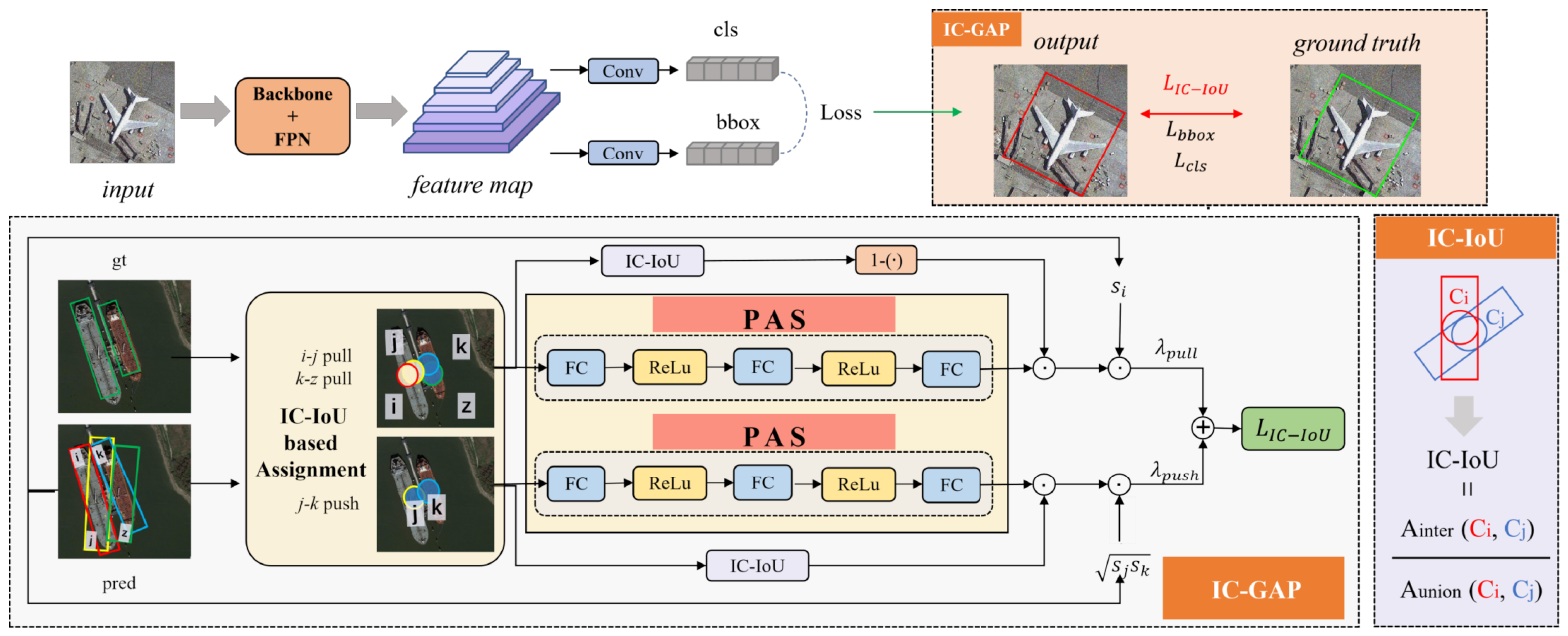
As illustrated in Figure 2, its core idea is to transform the implicit geometric decision logic within NMS post-processing into an explicit constraint that can be learned end-to-end during the training phase. To achieve this goal, three key components are sequentially constructed: first, the inscribed-circle intersection over union (IC-IoU) is introduced as an efficient and robust foundation for geometric measurement; second, PAS is designed to implement an adaptive penalty mechanism; and finally, based on the former two, a new adaptive pull-and-push loss is formulated. Algorithm 1 summarizes the complete information flow of one training iteration. The detector first generates oriented predictions and applies the original assignment rule. IC-GAP then constructs inscribed circles, computes pairwise IC-IoU values, generates PAS weights, forms the pull-and-push pair sets, and adds the resulting geometric regularization to the baseline losses. During inference, no additional prediction head is required; the trained detector outputs are processed by the standard rotated NMS procedure.
| Algorithm 1 Training procedure of IC-GAP | |
| Require: Image I, ground-truth boxes G, detector parameters , thresholds , , and | |
| Ensure: Updated parameters | |
| 1: | Generate oriented predictions , scores , and class labels from I. |
| 2: | Assign each prediction to a ground-truth object using the baseline assignment rule. |
| 3: | Construct an inscribed circle for each , where . |
| 4: | Compute pairwise IC-IoU values from the circle centers and radii. |
| 5: | Extract pairwise geometric features and obtain bounded PAS weights and . |
| 6: | Select the highest-confidence prediction for each ground-truth object and construct . |
| 7: | Construct from neighboring predictions assigned to different objects with IC-IoU . |
| 8: | Compute and using the IC-IoU values and PAS weights. |
| 9: | Compute . |
| 10: | Compute and update by back-propagation. |
| 11: | return Updated parameters |
Figure 2.
Overall framework of IC-GAP and its key components. The , , and denote the confidence scores of candidate boxes. The indices i and j correspond to the left ship, while k and z correspond to the right ship. The indices i and k are the most similar boxes to the two ships, respectively.
2.1. IC-IoU
2.1.1. Principle
The primary challenge of using RIoU in training lies in its instability with large-aspect-ratio objects. For slender objects, minor angle deviations cause drastic RIoU jumps, hindering stable optimization.
As illustrated in Figure 1, the two adjacent ground-truth objects are separate. However, angular deviations in the predicted boxes can introduce unintended overlap between neighboring predictions, resulting in a positive RIoU and potentially causing NMS to suppress a valid detection.
To address this, the IC-IoU principle is proposed. The core idea is to abstract the oriented bounding box into a rotation-invariant geometric primitive—the inscribed circle. As shown in Figure 1, despite the unintended bounding-box overlap caused by angular deviation, the corresponding inscribed circles remain separate (). For fixed box centers and side lengths, changing the orientation only rotates the box corners, whereas the circle center and radius remain unchanged. Thus, IC-IoU is governed mainly by center distance and semi-minor-axis scale, and it avoids abrupt changes caused by corner intersections while retaining sensitivity to spatial displacement. The circle-intersection operation itself is standard; the contribution here is to use the inscribed circle as the geometric core for NMS-aware training of oriented detectors. IC-IoU is used as an auxiliary regularizer rather than a replacement for oriented-box regression, so the baseline regression loss continues to learn the object angle and boundary details, while PAS restores relative shape and orientation information that the circle representation omits.
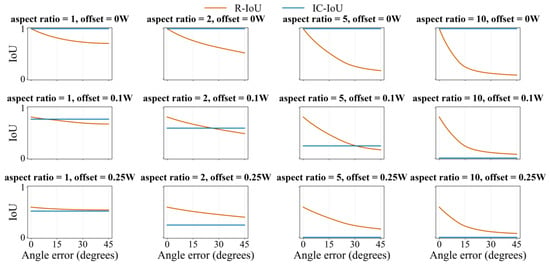
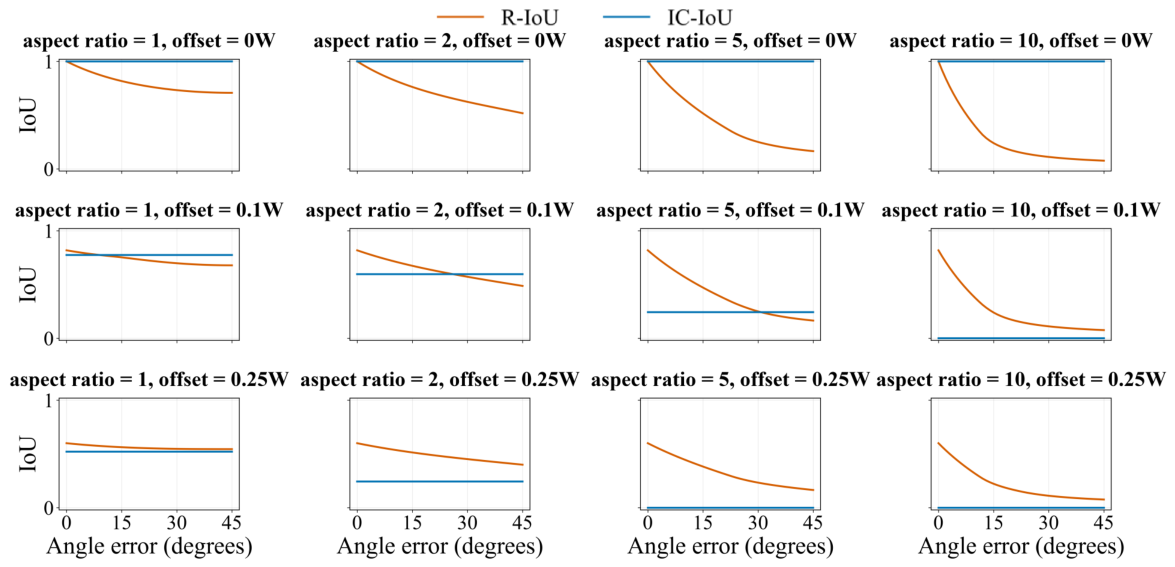
To quantitatively examine the geometric behavior illustrated above, a controlled comparison was conducted by varying the angle error from 0 to 45 degrees under four aspect ratios (1, 2, 5, and 10) and three normalized center offsets (0, 0.1w, and 0.25w). As shown in Figure 3, RIoU changes substantially with angular error, especially for elongated boxes and nonzero center offsets. In contrast, IC-IoU remains invariant to angle when the box centers and side lengths are fixed, while still responding to center displacement through the inscribed-circle geometry. This result supports the use of IC-IoU as a stable geometric signal for the proposed regularizer.
Figure 3.
Controlled comparison of RIoU and IC-IoU under different aspect ratios, angle errors, and normalized center offsets. RIoU varies with angle error, whereas IC-IoU remains angle-invariant for fixed centers and side lengths while responding to center displacement.
2.1.2. Implementation
For an oriented bounding box b parameterized by center , width w, height h, and angle , it is approximated using its inscribed circle . Here, denotes the circle center, and the radius is defined as the semi-minor axis of the box:
The IC-IoU between two boxes and is defined as the IoU of their corresponding inscribed circles and :
where . The calculation of the intersection area is determined by the Euclidean distance d between the centers of the two circles. This can be categorized into three cases:
- If , the circles do not overlap; thus, .
- If , one circle is contained within the other, so .
- If , the intersection is derived from the sum of two circular sectors minus the kite-shaped region formed by the centers and intersection points.
First, the sum of the areas of the two corresponding sectors is calculated:
Next, the area of the kite () formed by the two circle centers and the intersection points is calculated:
Finally, subtracting the kite area from the sector sum yields the true intersection area:
2.2. PAS Module
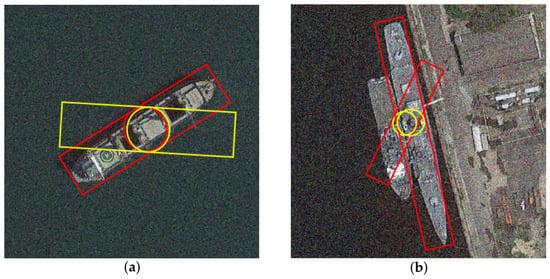
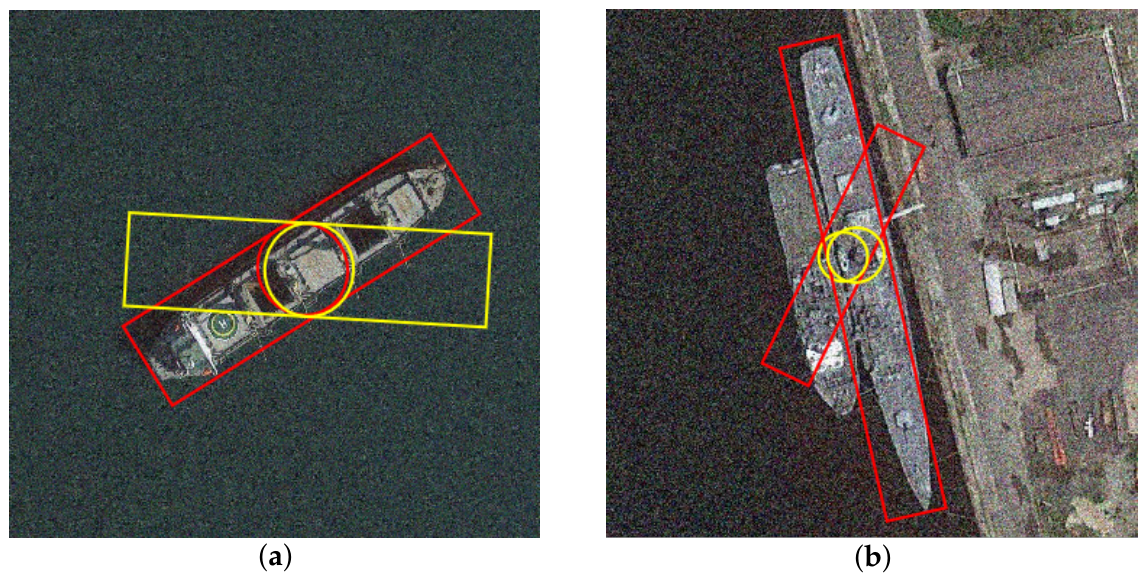
While IC-IoU stabilizes training, it inherently overlooks angular and shape details, limiting the loss function’s ability to perform fine-grained adjustments. This neglect leads to two primary failure scenarios:
- Ambiguous Perception: As shown in Figure 4a, a prediction (yellow) with a severe angular error relative to the ground truth (red) can yield a high IC-IoU, failing to penalize the inconsistency.Figure 4. Illustration of PAS motivation. (a) High IC-IoU despite significant shape discrepancy. (b) Overlapping inscribed circles for adjacent distinct objects.
- Neighboring Interference: As shown in Figure 4b, adjacent but distinct objects may have overlapping inscribed circles, causing confusion during NMS. Boxes and circles in different colors all denote predicted results.
To address this, the PAS loss is proposed. PAS acts as a complement to IC-IoU by re-incorporating geometric details through learnable dynamic weights. It identifies instances where high IC-IoU coexists with significant shape differences and applies stronger penalties. PAS evaluates the relationship between a pair of boxes by extracting a six-dimensional feature vector :
This vector captures relative dimensions, angles, and aspect ratios. It is processed by a small MLP to generate a scalar modulation factor. To avoid the degenerate solution in which the learned weights vanish and suppress the regularization term, the output is bounded away from zero:
where denotes the MLP, is the sigmoid function, and is a small positive lower bound. Thus, and can adapt the strength of pairwise penalties but cannot reduce the corresponding loss to zero independently of box quality. The main detector losses, and , are still optimized jointly with the proposed regularizer.
2.3. Inscribed-Circle-Based Geometric Adaptive Processor
Let be the ground-truth index assigned to prediction by the original detector assignment rule, and let be the classification confidence. For each ground-truth object g, the highest-confidence prediction assigned to g is selected as follows:
The same-object redundant pair set is defined as
and the different-object neighboring pair set as
Here, filters unrelated distant objects so that the push term focuses on potentially confusing neighboring detections.
The pull-closer loss is designed to reduce false positives from redundant predictions. To avoid the training collapse caused by RIoU’s angular sensitivity, is utilized as a rotation-invariant distance metric. Furthermore, the pulling magnitude is dynamically adjusted by the bounded adaptive weight generated by the IC-GAP module, which accounts for geometric context (e.g., overlap degree). The calculation is
This drives redundant boxes to align stably with the best prediction for effective NMS suppression.
The push-further loss, , aims to prevent false negatives in dense scenes. The pushing force is adaptively modulated by the bounded from the IC-GAP module to avoid crude penalties. The loss is calculated as follows:
Finally, these two components are combined to formulate the geometric regularization loss supervised by the IC-GAP module, denoted as follows:
By organically integrating IC-IoU within the IC-GAP, introduces “metric adaptation” and “weight adaptation.” This integration guides the detector toward a geometrically superior prediction distribution, systematically addressing geometric instability and resolving the limitations of traditional “push–pull” methods.
Overall Loss Function: The training objective with IC-GAP is formulated as a multi-task learning loss, combining classification, bounding-box regression, and the proposed geometric adaptation. The total loss is defined as follows:
where and represent the classification and oriented-box regression losses from the Rotated FCOS baseline, respectively. In this implementation, follows the original rotated detector setting used for the baseline; IC-GAP is added as an auxiliary geometric regularizer rather than replacing the baseline regression objective.
3. Results
3.1. Experimental Settings
Dataset and Metrics: DOTA-v1.0 [21] is used as the primary testbed, with mean average precision (mAP) [22] as the core metric. DOTA-v1.0 contains 2806 high-resolution aerial images, 188,282 annotated instances, and 15 object categories. Its official split consists of 1411 training images, 458 validation images, and 937 test images, with each instance annotated by an arbitrarily oriented quadrilateral. We use the training split for model optimization, the validation split for hyperparameter selection, and the official online test server for final evaluation. Because the original images have different spatial resolutions, they are tiled into fixed-size patches before inference; patch-level detections are then mapped back to the original image coordinates and merged before rotated NMS. Unless otherwise stated, all reported comparisons use the same single-scale testing protocol without test-time augmentation and follow the official DOTA evaluation procedure.
Implementation: Rotated FCOS [23] with ResNet-50 [24] is employed as the baseline. All ablation variants use the same detector, data pre-processing, training schedule, optimizer, and post-processing settings. Hyperparameters for IC-GAP are selected on the validation split rather than directly on the test benchmark. The final coefficients are and , as clarified by the log-scale sensitivity analysis in experiments.
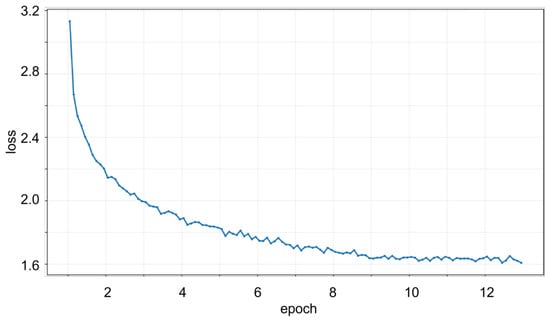
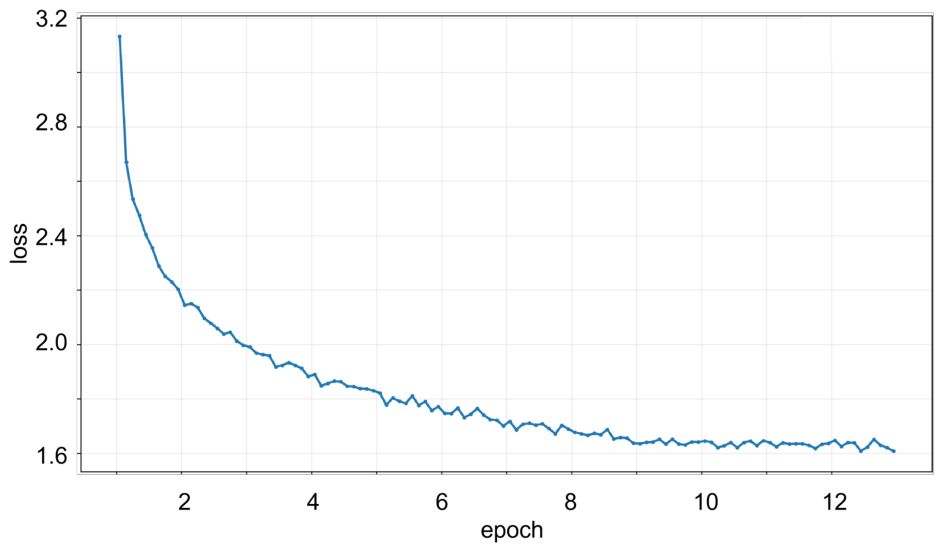
Figure 5 shows the training total loss of IC-GAP during optimization. The loss decreases rapidly in the early stage and gradually stabilizes in the later stage, with only small local fluctuations. This behavior indicates that the additional geometric regularization does not cause divergent optimization in the reported training run.
Figure 5.
Training total loss of IC-GAP during optimization.
3.2. Ablation Studies
The necessity of each component in IC-GAP is evaluated in Table 1. Values are reported as the mean ± standard deviation over repeated runs. The baseline achieves 65.2% mAP. Using either regularizer alone imposes a one-sided geometric constraint. The pull term only contracts predictions assigned to the same object and may over-concentrate redundant boxes when assignment or confidence estimates are imperfect, resulting in 65.1% mAP. The push term only penalizes high-overlap pairs assigned to different objects; in dense scenes, such pairs can include noisy assignments or legitimately neighboring objects, and no pull term is available to consolidate redundant predictions. This explains the larger decrease in the push-only variant to 62.6% mAP. When used together, the two terms provide complementary intra-object consolidation and inter-object separation, improving mAP to 65.8%. PAS further adapts their strengths to pairwise geometry and raises mAP to 66.5%.
Table 1.
Ablation study of IC-GAP components on DOTA (%).
PAS’s superiority is validated by comparing its dynamic weighting against fixed weights (Table 2). Performance is highly sensitive to fixed weights, peaking at 65.9% mAP with a weight of 1.2. PAS outperforms all fixed options, with 66.8% mAP (+0.9 percentage points), confirming the advantage of its adaptive approach.
Table 2.
Comparison: dynamic weighting (PAS) vs. fixed weights (%).
To demonstrate IC-IoU’s robustness inside the proposed pairwise regularizer, the metric used in the IC-GAP pull–push branch is compared while keeping the same detector and pair-mining strategy (Table 3). Values are reported as the mean ± standard deviation over repeated runs. After checking the original experimental record, the RIoU result without PAS is updated to 62.2%. The IC-IoU result reaches 65.6% without PAS, while the addition of PAS gives 64.5% with RIoU and 66.5% with IC-IoU. These results indicate that the stable core metric and the adaptive weighting are complementary.
Table 3.
Comparison of pairwise overlap metrics inside the IC-GAP regularizer (%).
The pull and push coefficients are tuned without PAS on the validation split. For readability, Table 4 reports each coefficient as , so an entry x denotes . Therefore, the best row, and , corresponds to and , respectively, and obtains 65.9% mAP. Table 5 identifies the optimal non-maximum suppression threshold () and IC-IoU threshold (0.3), also achieving 65.9% mAP.
Table 4.
Hyperparameter tuning for pull and push weights (%).
Table 5.
Hyperparameter tuning for NMS threshold () and IC-IoU threshold (%).
3.3. Cross-Dataset Validation on SRSDD-v1.0
To assess generalization beyond DOTA, we evaluated SRSDD-v1.0, introduced by Lei et al. [25]. It contains 666 images of pixels cropped from 30 Gaofen-3 panoramic scenes and 2884 rotated-box ships in six categories, many in nearshore clutter. Under its published 4:1 split, we compare IC-GAP with published Rotated FCOS, ROI Transformer, R3Det, and BBAVectors results as contextual references spanning two-stage, anchor-based, and anchor-free detectors.
As shown in Table 6, IC-GAP reaches 50.81% mAP, exceeding Rotated FCOS (49.49%), R3Det (39.12%), and BBAVectors (45.33%) but remaining below ROI Transformer (54.38%). It leads C2, C5, and C6, whereas ROI Transformer leads C1, C3, and C4. The backbone column clarifies the architectural context of these published comparisons, which remain contextual references rather than controlled reruns.
Table 6.
Per-category AP and mAP on SRSDD-v1.0 (%).
3.4. Comparison with Representative Methods
IC-GAP is compared with the Rotated FCOS baseline and representative oriented object detection methods (KLD, CSL, and PSC [19]) on DOTA (Table 7). Average precision at IoU 0.5 (AP50) is reported as a percentage for each object category. IC-GAP obtains an mAP of 66.8%, which is the highest value in this selected comparison and demonstrates competitive overall performance under the reported protocol. The category-level gains are not uniform, so the result should not be interpreted as a universal state-of-the-art claim; the differences are discussed below.
Table 7.
AP50 per category and overall mAP on DOTA (%).
3.5. Category-Level Analysis
IC-GAP gains are class-dependent. The largest improvements over Rotated FCOS occur for helicopter (HC, +0.143), ground track field (GTF, +0.050), bridge (BR, +0.042), and harbor (HA, +0.029). Ground track fields and bridges are elongated and directionally variable, while harbors combine dense structures with clutter, making angle-sensitive overlap less reliable; helicopters also benefit from orientation variation and clutter despite their nonuniform aspect ratio. Performance declines for small vehicle (SV), storage tank (ST), large vehicle (LV), ship (SH), tennis court (TC), and roundabout (RA): the semi-minor-axis circle can discard ships’ long-axis information, whereas compact vehicles, tanks, and courts are well handled by the baseline. Basketball court (BC) changes only slightly (0.633 to 0.637). Benefits therefore depend on aspect ratio, orientation variation, density, and background complexity, rather than being uniform across categories.
3.6. Qualitative Analysis
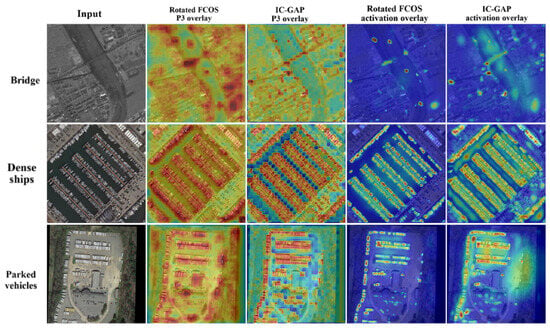
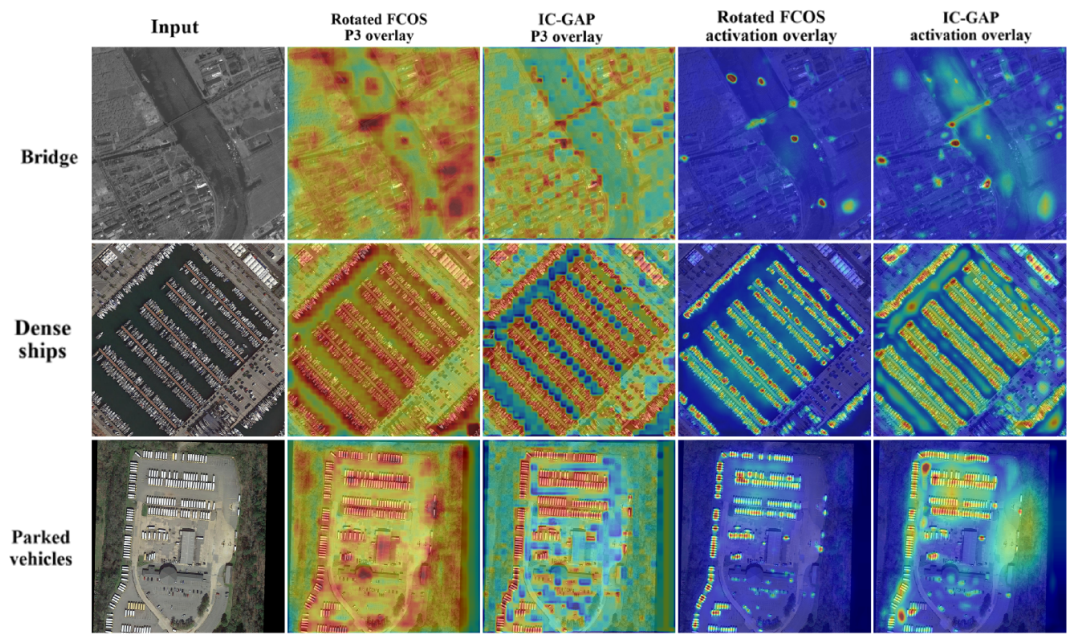
Figure 6 compares input images, P3-level overlays, and activation maps from Rotated FCOS and IC-GAP across four representative scenes.
Figure 6.
Different levels of feature map qualitative comparison. Rows show bridge, dense ships, and parked vehicles. Columns show the input image, Rotated FCOS P3 overlay, IC-GAP P3 overlay, Rotated FCOS P3-P7 activation overlay, and IC-GAP P3-P7 activation. Warm colors correspond to high activation values while cool colors correspond to low activation values.
For dense ships and parked vehicles, IC-GAP produces more structured responses along elongated and repeated arrangements. The less uniform differences in bridge and urban scenes indicate dependence on scale and background complexity; these visualizations complement the quantitative results.
4. Conclusions
IC-GAP resolves the training–NMS mismatch through IC-IoU, PAS, and their joint regularizer. On DOTA, it achieves competitive overall performance, with gains dependent on object geometry and scene context. Future work will adapt rotation-invariant priors to domains with different aspect-ratio distributions, including medical and industrial inspection.
Author Contributions
Conceptualization, H.F., H.J. and Y.Z. (Yuanlin Zhang); methodology, H.F., H.J. and Y.Z. (Yue Zhang); software, H.F. and H.J.; validation, H.F., H.J. and Y.Z. (Yue Zhang); formal analysis, H.F., H.J. and B.W.; investigation, H.F., H.J. and B.W.; resources, Y.Z. (Yuanlin Zhang); data curation, H.F. and H.J.; writing—original draft preparation, H.F. and H.J.; writing—review and editing, Y.Z. (Yue Zhang), Y.Z. (Yuanlin Zhang), and B.W.; visualization, H.F. and H.J.; supervision, Y.Z. (Yuanlin Zhang); project administration, Y.Z. (Yuanlin Zhang); funding acquisition, Y.Z. (Yuanlin Zhang). All authors have read and agreed to the published version of the manuscript.
Funding
This research was funded by the Youth Talent Support Program from Xi’an Association for Science and Technology, grant number 0959202513147; and the National Natural Science Foundation of China, grant number 62272383.
Institutional Review Board Statement
Not applicable.
Informed Consent Statement
Not applicable.
Data Availability Statement
The DOTA dataset analyzed in this study is publicly available from the dataset providers. Additional data supporting the reported results are available from the corresponding author upon reasonable request.
Acknowledgments
The authors thank the providers of the public DOTA benchmark and the open-source remote sensing object detection community. During the preparation of this manuscript, the authors used ChatGPT (OpenAI, GPT-5) for language polishing, grammar correction, and formatting checks. The authors have reviewed and edited the output and take full responsibility for the content of this publication.
Conflicts of Interest
The authors declare no conflicts of interest. The funders had no role in the design of the study; in the collection, analyses, or interpretation of data; in the writing of the manuscript; or in the decision to publish the results.
References
- Yurtsever, E.; Lambert, J.; Carballo, A.; Takeda, K. A survey of autonomous driving: Common practices and emerging technologies. IEEE Access 2020, 8, 58443–58469. [Google Scholar] [CrossRef] [Scilit]
- Levinson, J.; Askeland, J.; Becker, J.; Dolson, J.; Held, D.; Kammel, S.; Kolter, J.Z.; Langer, D.; Pink, O.; Pratt, V.; et al. Towards fully autonomous driving: Systems and algorithms. In Proceedings of the 2011 IEEE Intelligent Vehicles Symposium (IV), Baden-Baden, Germany, 5–9 June 2011; pp. 163–168. [Google Scholar]
- Burton, A.M.; Wilson, S.; Cowan, M.; Bruce, V. Face recognition in poor-quality video: Evidence from security surveillance. Psychol. Sci. 1999, 10, 243–248. [Google Scholar] [CrossRef] [Scilit]
- Wang, C.; Wei, X.; Jiang, X. An automated defect detection method for optimizing industrial quality inspection. Eng. Appl. Artif. Intell. 2024, 127, 107387. [Google Scholar] [CrossRef] [Scilit]
- Shen, D.; Wu, G.; Suk, H.I. Deep learning in medical image analysis. Annu. Rev. Biomed. Eng. 2017, 19, 221–248. [Google Scholar] [CrossRef] [Scilit]
- Zhong, Y.; Ma, A.; soon Ong, Y.; Zhu, Z.; Zhang, L. Computational intelligence in optical remote sensing image processing. Appl. Soft Comput. 2018, 64, 75–93. [Google Scholar] [CrossRef] [Scilit]
- Triesch, J.; Von Der Malsburg, C. Robust classification of hand postures against complex backgrounds. In Proceedings of the Second International Conference on Automatic Face and Gesture Recognition, Killington, VT, USA, 14–16 October 1996; pp. 170–175. [Google Scholar]
- Wang, K.; Wang, Z.; Li, Z.; Su, A.; Teng, X.; Liu, M.; Yu, Q. Oriented Object Detection in Remote Sensing Images: A Survey. Artif. Intell. Rev. 2025, 58, 350. [Google Scholar] [CrossRef] [Scilit]
- Cheng, G.; Zhou, P.; Han, J. Learning rotation-invariant convolutional neural networks for object detection in VHR optical remote sensing images. IEEE Trans. Geosci. Remote Sens. 2016, 54, 7405–7415. [Google Scholar] [CrossRef] [Scilit]
- Jaderberg, M.; Simonyan, K.; Zisserman, A.; Kavukcuoglu, K. Spatial transformer networks. In Proceedings of the Advances in Neural Information Processing Systems; Curran Associates, Inc.: Red Hook, NY, USA, 2015; pp. 2017–2025. [Google Scholar]
- Lin, T.Y.; Dollár, P.; Girshick, R.; He, K.; Hariharan, B.; Belongie, S. Feature pyramid networks for object detection. In Proceedings of the IEEE Conference on Computer Vision and Pattern Recognition, Honolulu, HI, USA, 21–26 July 2017; pp. 2117–2125. [Google Scholar]
- Lin, T.Y.; Goyal, P.; Girshick, R.; He, K.; Dollár, P. Focal loss for dense object detection. IEEE Trans. Pattern Anal. Mach. Intell. 2020, 42, 318–327. [Google Scholar] [CrossRef] [Scilit]
- Ding, J.; Xue, N.; Long, Y.; Xia, G.S.; Lu, Q. Learning RoI Transformer for Oriented Object Detection in Aerial Images. In Proceedings of the IEEE Conference on Computer Vision and Pattern Recognition, Long Beach, CA, USA, 15–20 June 2019; pp. 2849–2858. [Google Scholar]
- Xie, X.; Cheng, G.; Wang, J.; Yao, X.; Han, J. Oriented R-CNN for Object Detection. In Proceedings of the IEEE/CVF International Conference on Computer Vision (ICCV), Montreal, QC, Canada, 10–17 October 2021; pp. 3520–3529. [Google Scholar]
- Yang, X.; Yang, X.; Yang, J.; Ming, Q.; Wang, W.; Tian, Q.; Yan, J. Learning High-Precision Bounding Box for Rotated Object Detection via Kullback-Leibler Divergence. In Proceedings of the Advances in Neural Information Processing Systems; NeurIPS: San Diego, CA, USA, 2021. [Google Scholar]
- Yang, X.; Yan, J.; Ming, Q.; Wang, W.; Zhang, X.; Tian, Q. Rethinking rotated object detection with gaussian wasserstein distance loss. In Proceedings of the International Conference on Machine Learning; PMLR: Cambridge, MA, USA, 2021; pp. 11830–11841. [Google Scholar]
- Murrugarra-Llerena, J.; Zeni, L.F.; Jung, C.R. Probabilistic Intersection-Over-Union for Training and Evaluation of Oriented Object Detectors. IEEE Trans. Geosci. Remote Sens. 2024, 33, 671–681. [Google Scholar] [CrossRef] [Scilit]
- Yang, X.; Yan, J. Arbitrary-Oriented Object Detection with Circular Smooth Label. In Proceedings of the European Conference on Computer Vision; Springer: Cham, Switzerland, 2020; pp. 677–694. [Google Scholar]
- Yu, Y.; Da, F. Phase-Shifting Coder: Predicting Accurate Orientation in Oriented Object Detection. In Proceedings of the IEEE/CVF Conference on Computer Vision and Pattern Recognition (CVPR), Vancouver, BC, Canada, 17–24 June 2023. [Google Scholar]
- Yang, H.; Deng, R.; Lu, Y.; Zhu, Z.; Chen, Y.; Roland, J.; Lu, L.; Landman, B.A.; Fogo, A.B.; Huo, Y. CircleNet: Anchor-Free Glomerulus Detection with Circle Representation. In Proceedings of the Medical Image Computing and Computer Assisted Intervention—MICCAI 2020; Springer: Berlin/Heidelberg, Germany, 2020; pp. 35–44. [Google Scholar] [CrossRef] [Scilit]
- Xia, G.S.; Bai, X.; Ding, J.; Zhu, Z.; Belongie, S.; Luo, J.; Datcu, M.; Pelillo, M.; Zhang, L. DOTA: A large-scale dataset for object detection in aerial images. In Proceedings of the IEEE Conference on Computer Vision and Pattern Recognition; IEEE Computer Society: Los Alamitos, CA, USA, 2018; pp. 3974–3983. [Google Scholar]
- Lin, T.Y.; Maire, M.; Belongie, S.; Hays, J.; Perona, P.; Ramanan, D.; Dollár, P.; Zitnick, C.L. Microsoft coco: Common objects in context. In Proceedings of the European Conference on Computer Vision; Springer: Cham, Switzerland, 2014; pp. 740–755. [Google Scholar]
- Tian, Z.; Shen, C.; Chen, H.; He, T. FCOS: Fully convolutional one-stage object detection. arXiv 2019, arXiv:1904.01355. [Google Scholar]
- He, K.; Zhang, X.; Ren, S.; Sun, J. Deep residual learning for image recognition. In Proceedings of the IEEE Conference on Computer Vision and Pattern Recognition, Las Vegas, NV, USA, 27–30 June 2016; pp. 770–778. [Google Scholar]
- Lei, S.; Lu, D.; Qiu, X.; Ding, C. SRSDD-v1.0: A High-Resolution SAR Rotation Ship Detection Dataset. Remote Sens. 2021, 13, 5104. [Google Scholar] [CrossRef] [Scilit]

Disclaimer/Publisher’s Note: The statements, opinions and data contained in all publications are solely those of the individual author(s) and contributor(s) and not of MDPI and/or the editor(s). MDPI and/or the editor(s) disclaim responsibility for any injury to people or property resulting from any ideas, methods, instructions or products referred to in the content. |
© 2026 by the authors. Licensee MDPI, Basel, Switzerland. This article is an open access article distributed under the terms and conditions of the Creative Commons Attribution (CC BY) license.