


Highlights
What are the main findings?
- A new strategy based on dual-wavelength lidar observation is developed for the synergic retrieval of aerosol mass composition and aerosol optical profiles by inducing constraints between different wavelengths.
- The feasibility and practicality of this technique is validated by applying in simulated spaceborne lidar backscatter signals and CALIOP data.
What are the implications of the main findings?
- The study enables integrated quantitative retrieval of aerosol optical and composition profiles from dual-channel Mie lidar observations.
- It provides a robust retrieval strategy for aerosol vertical profiling, supporting research on atmospheric of radiation budget and climate effects.
Abstract
Mie lidar has been profoundly applied in the profiling of aerosol optical coefficients in atmosphere. However, few studies further explore quantitative strategies for the retrieval of aerosol mass profiles from lidar observation. To address the growing need for spatial and temporal aerosol mass data, a synergic retrieval algorithm for simultaneously profiling the aerosol extinction coefficient and mass composition from spaceborne dual-channel lidar data is proposed. By constructing the relationship between mixed aerosol mass profiles and extinction coefficients at different wavelengths by a forward model, additional constraints are induced to improve the accuracy of lidar ratio, which is a critical parameter for the retrieval of aerosol extinction coefficients by solving the lidar equation. Meanwhile, aerosol composition profiles can also be deduced based on the a priori estimation of aerosol compositions and intrinsic optical features of the aerosols. This method is first applied in simulated data with wavelengths at 532 nm and 1064 nm. The simulations are based on the reanalysis data of aerosol mass concentration profiles in Inner Mongolia, China. Compared with the classic Fernald method using empirically estimated lidar ratio, the proposed method improves the accuracy of column-integrated aerosol extinction coefficients (also known as aerosol optical depth, AOD) by 19.58% at 532 nm and 3.57% at 1064 nm. The accuracy for column dust and sulfate aerosols is enhanced by 12.46% and 17.58%, respectively. Further validation with CALIOP observations suggests that the proposed method produces improved extinction results and reliable aerosol composition information.
1. Introduction
Aerosols in the atmosphere originate from a wide range of sources with complex compositions and strong spatial and temporal variations. Dust, sulfate, sea salt, organic matter, and black carbon are common types of aerosols, which are of different optical properties, suggesting distinctive effects on radiation budget and climate systems. As the type and the concentration of aerosols reflect the apportionment of the pollution sources, global monitoring of the aerosol type and optical and concentration profiles is essential for research of these fields [1,2,3].
Nowadays, passive instruments have been widely used for measuring column-integrated aerosol optical properties. However, they have limitations in assessing the vertical distribution of aerosols. As Mie lidar provides aerosol optical information in layers, it has been deployed on aircraft and satellites for earth observation. For example, the Lidar In-space Technology Experiment (LITE), equipped on the Discovery Space Shuttle in September 1994, demonstrated the feasibility of spaceborne lidar for aerosol and cloud studies [4]. It was followed by the Geoscience Laser Altimeter System (GLAS) on-board the Ice, Cloud and Land Elevation Satellite (ICESat), which included a 532 nm lidar channel for vertical profiling of clouds and aerosols [5]. In 2006, NASA launched the Cloud-Aerosol Lidar with Orthogonal Polarization (CALIOP) on-board on NASA’s Cloud-Aerosol Lidar and Infrared Pathfinder Satellite Observations (CALIPSO) satellite [6]. As a two-wavelength (532 and 1064 nm) depolarization Mie lidar, CALIOP enables the profiling of the aerosol backscatter coefficient, extinction coefficient, particle depolarization ratio, and color ratio.
Several algorithms have been developed to retrieve aerosol parameters from lidar measurements. Since the lidar equation contains two unknowns, which are extinction and backscatter coefficients, the traditional strategy is to introduce an extinction-to-backscatter ratio (also known as the lidar ratio) to solve the problem [7,8,9]. The lidar ratio varies with aerosol types, and depends strongly on the wavelength of the incident light and the aerosol refractive index [10]. Over the past decades, various approaches have been proposed to classify aerosols and thereby improve the accuracy of lidar ratio estimation during retrieval. The most straightforward way is to distinguish aerosol types on the basis of the empirical wavelength-dependent optical properties of the aerosols [11]. With the development of depolarization lidar, the derived depolarization ratios are prominently applied in investigating the particle shapes of clouds and aerosols, which helps with the estimation of aerosol phase states and the corresponding lidar ratios [12,13,14]. Combining the two strategies mentioned above, Nishizawa et al. [15] established look-up tables of extinction and backscatter coefficients for two aerosol models at 532 nm and 1064 nm. Then, the study applied both the look-up tables and depolarization observations to determine the aerosol model and lidar ratio. For operational CALIOP data processing, aerosol types are classified based on the decision tree algorithm using 532 nm and 1064 nm attenuated backscatter, a 532 nm depolarization ratio, and underlying surface information, followed by the assignment of lidar ratios corresponding to each aerosol type [16]. However, such preset lidar ratios introduce intrinsic retrieval uncertainties of 30–50% for CALIOP Version 3 and approximately 20% for Version 4, especially for the dust aerosol, which can be greatly owed to the regional variability of composition and morphology [17]. Chang et al. [18] modified the estimation of the lidar ratio based on look-up tables which relate the lidar ratio to the Ångström exponent calculated using aerosol extinction from dual-channel observations. Case studies show that the mean absolute percentage error of retrieved aerosol extinction reduced to around 37% from 74% in comparison with the official CALIOP products. It suggested that comprehensively analyzing the optical properties of aerosols in channels is a reliable way to conduct aerosol type assessment and lidar ratio estimation. Nevertheless, few studies have further explored aerosol mass profiling quantitively from lidar observation.
Therefore, to meet the growing demand of spatial and temporal distribution of aerosol composition, the main goal of this study is to develop a new strategy based on dual-wavelength lidar observation for the synergic retrieval of the mixed aerosol mass composition and aerosol optical profiles. As lidar observations in two channels are supposed to correspond to the same aerosol mass profile, in this paper, the aerosol mass profile is induced to build constraints between the aerosol mass profile and extinction coefficients at different wavelengths in the retrieval process. During this process, a priori information of the mixed aerosol mass profile is first estimated. A forward model combined with Mie theory [19,20] and the complex refractive indices of different aerosol types is then used to calculate the corresponding extinction coefficients, backscattering coefficients and lidar ratios at both channels. Second, based on the estimated lidar ratio, the aerosol extinction coefficient can also be obtained by solving the lidar equation from lidar signals by a retrieval process. The extinction coefficients derived from retrieval at the two channels should be consistent with the same aerosol mass profile. Thus, dual-channel extinction coefficients at layers can provide effective constraints to optimize the estimation accuracy of aerosol composition and mass content. Finally, by iteration of the steps above, promising aerosol mass profiles can be obtained, as well as the aerosol extinction coefficients. The method is described in Section 2. Section 3 gives the application of the technique in a numerical simulation and actual cases. The findings are briefly summarized in Section 4.
2. Experimental Data and Methodology
2.1. Methodology
2.1.1. Forward Model
The forward model provides the simulated observation signals of lidar for the model accuracy assessment and facilitates the iteration process. It includes two steps: first, the aerosol extinction and backscatter coefficients are simulated from the mass profiles of different aerosol types based on Mie theory; then, the lidar backscatter signal is obtained based on the aerosol optical coefficients and elastic backscatter lidar equation.
In the step of aerosol extinction coefficient simulation, the extinction efficiency (Qi,ext) and the backscatter efficiency (Qi,back) are first calculated by Mie theory [19,21]. Then, the aerosol extinction coefficient (σa,i) and aerosol backscatter coefficient (βa,i) can be given by following equations:
where mi is the complex refraction index of the aerosol; i is the aerosol type; is the radius of each individual particle; and are the lower and upper limits of the particle sizes, which are taken as 0.005 μm and 20 μm, respectively, in this paper; λ is the wavelength; and n(r) is the number density distribution of particles, and is calculated by applying the lognormal distributions [19] as follows:
where rmodN,i and δi denote the median radius and the standard deviation of ni(r), respectively. Ni is the total particle number density of component i in particles per cubic centimeter, which can be calculated from the mass mixing ratio profiles of the aerosol, xa, based on the densities of the standard atmosphere and aerosol particles.
The extinction and backscatter coefficients of the aerosols, which assume an external mixture of different aerosol types, are approximately defined as follows [22]:
where n is the number of aerosol types.
The aerosol extinction-to-backscatter ratio (lidar ratio), Sa, can also be calculated as follows:
Then, within the calculated aerosol extinction coefficient (σa) and aerosol backscatter coefficient (βa), the simulation of the on-board lidar backscatter signal is obtained based on the Mie lidar equation [9,23]:
where P(R) is the detected backscatter signal from range R from the lidar; E0 is the laser energy; ξ is the lidar system parameter, where ξ = GAC, and GA is the amplifier gain; C is the lidar calibration factor; βm(R) is the molecular backscatter coefficient, proportional to the molecular number density profile; βa(R) is the aerosol backscatter coefficient; and Tm2 is the profile of the two-way transmittance between the lidar and range R:
Here, σm is the molecular extinction coefficient, and Sm is the molecular lidar ratio. Ta2 is the particulate two-way transmittance:
here τa(0,R) is the aerosol optical depth (AOD).
2.1.2. Retrieval Algorithm
Generally speaking, atmospheric aerosols are mostly composed of particles with different types and scales, including, but not limited to, organic matter, sulfate, sea salt and dust aerosols. Different aerosol types are expected to have various size distributions and refractive indices, which correspond to unique optical properties. A strategy is promoted to profile aerosol compositions according to the wavelength-dependent optical properties from the dual-channel lidar observation. As shown in Equations (7) and (8), the dual-wavelength lidar equation contains two unknowns (σa and βa), resulting in the retrieval being mathematically ill-posed. Although the algorithm promoted in this paper introduces the constraints by channels, new unknowns are induced. Given the limited number of channels in dual-channel lidar, the ill-posedness of the inversion system will be aggravated when retrieving all aerosol components. Thus, this study only considers two dominant aerosol components (type1 and type2). Other aerosol species with weak optical contributions or low mass fractions are neglected.
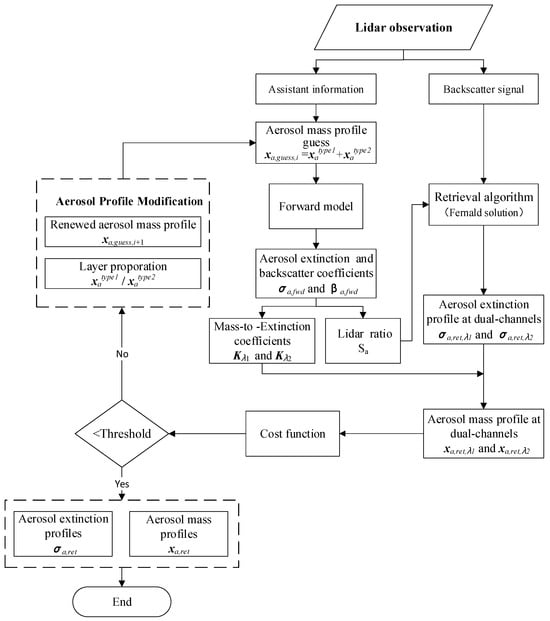
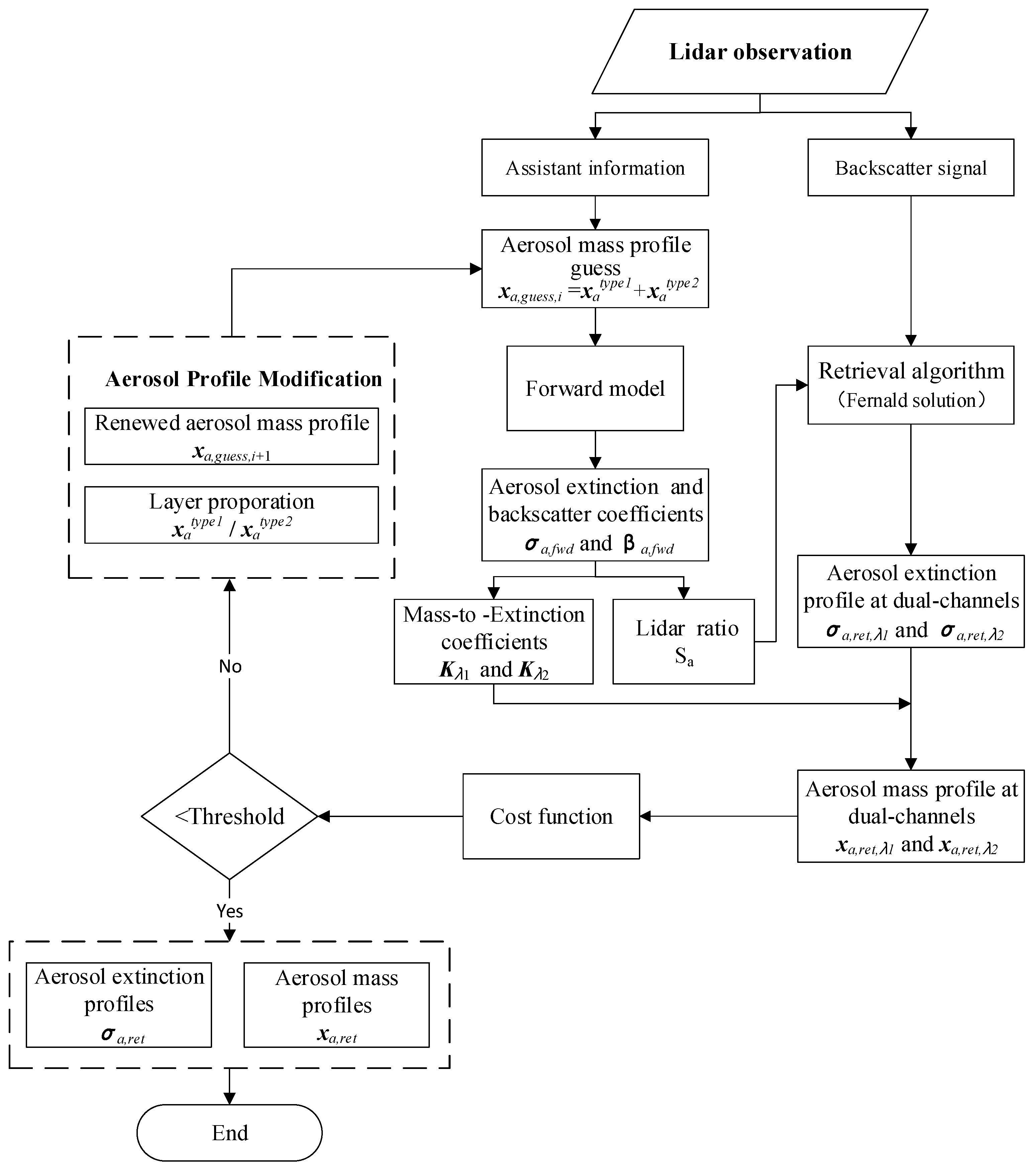
Therefore, in this paper, a two-type aerosol retrieval algorithm is constructed for the profiling of both optical properties and compositions of aerosol mixtures. First, the initial guess of the mixed aerosol mass profile is obtained based on the a priori information of the study area. To alleviate the convergence caused by ill-posed problems, region-specific seasonal aerosol models are constructed, which can build the feasible boundary and reduce non-unique solutions. Due to the forward model, the optical properties of the aerosol mass profile are simulated, and the relationship between the two properties is obtained. Then, the Fernald method is applied to retrieve the aerosol extinction coefficients from lidar signals. Additionally, the relationship built between the mass profile and the extinction coefficients are then used to inverse the aerosol mass profile. By further analyzing the differences in the guessed and retrieved results, the composition of the aerosol mass profile is adjusted at layers. Finally, iteration is induced to mitigate the differences and obtain desired ‘maximum likelihood’ analysis of the aerosol extinction coefficients and aerosol mass profile.
The details of the algorithm are addressed below and the scheme is shown in Figure 1.
Figure 1.
Flow of the two-type aerosol retrieval algorithm.
In the algorithm, the initial guess of the aerosol mass profile is obtained based on the a priori aerosol information in the local area and the corresponding optical properties; the extinction coefficients σa,fwd, backscatter coefficients βa,fwd, mass-optical model K and lidar ratios Sa at two channels are simulated by Mie theory. The lidar ratio Sa,λ can be given as follows:
Here, λ is referred to as the lidar observation channel. σa,fwd and βa,fwd in channel λ for aerosol type1 and type2 can be calculated based on the a priori estimation of the aerosol mass profile at one layer.
When the vertical mass mixing ratio profiles of two main dominant aerosols (which are denoted as xa,type and xa,type2) in the local area are known, the corresponding mass-to-extinction coefficients K can be built at layers based on the forward model, which reflects the relationship between the mixed aerosol and the corresponding extinction coefficients. K can be given as follows:
where Kλ is sensitive to the aerosol proportions and has distinguishable features at different channels.
Then, by applying the simulated lidar ratios, the extinction coefficients σa,ret of the two-type mixed aerosol in channel λ1 and λ2 are retrieved by the Fernald method. The Fernald method is the most widely used method to obtain aerosol extinction profiles from lidar observation, and in which the contributions of two components, molecular and aerosol scattering, to the lidar return signal are treated separately [9]. The method in the forward solution direction for on-board observation is described by the following equation:
Here, by neglecting the multi-scattering effect between the aerosol particles, σa,ret can be divided into the contribution of the two aerosol types as follows:
The normalized backscatter signal X(R) can be calculated by
Rf is known as the height where the boundary condition is applied, and is determined by screening high-altitude clean atmospheric layers with negligible aerosol loading, following the conventional lidar retrieval algorithm from the Fernald method and CALIOP operational algorithms. σa,(Rf) is the mixed aerosol extinction coefficient at the boundary. Here, Rf is obtained when βa(R)/βm(R) equals 0.01 [24].
The mass-to-extinction coefficient K is further applied to obtain xa,ret,λ1 and xa,ret,λ2 from σa,ret,λ1 and σa,ret,λ2, respectively. As lidar observations in two channels correspond to the same aerosol mass profile, xa,ret,λ1 and xa,ret,λ2 should be equal. However, due to the error induced by the estimation of aerosol composition, which directly affects the calculation of Sa and K, the results of xa,ret at the two channels are not coherent. As such, iterations are induced by comparing xa,ret at the two channels with xa,guess, and the cost function is given by
In the cost function, the layer-wise relative deviation of the aerosol mass ratio between dual channels is first obtained, then accumulated in the vertical direction to characterize the overall profile deviation. Here in this paper, the λ1 and λ2 of lidar signals are 532 and 1064 nm, respectively, and i is the number of iterations. When the value of the cost function is higher than a predetermined threshold, which is given as 20% of xa,guess based on typical retrieval uncertainty and convergence tests, the desired ‘maximum likelihood’ analysis xa,guess,i will be replaced by the following:
With the 20% threshold setting, the retrieved aerosol mass profiles from the dual channels agree well in most tropospheric layers. Only a small number of upper layers with extremely low aerosol loading show slight relative differences, but their absolute mass deviations are very small and the effect on the retrieval accuracy of dominant dust and sulfate aerosols is negligible. Additionally, the test results indicate that further reducing the threshold would trigger iterative divergence and prevent the inversion from completing convergence.
The proportions of aerosol types are then modified based on the mass-to-extinction coefficient K by the following equation:
Meanwhile, Sa is subsequently renewed based on the new xa,guess and the aerosol proportions. The iteration ends until the value of cost function is smaller than the threshold. At this point, xa,ret and σa,ret are the optimal retrieval results.
2.1.3. Accuracy and Uncertainty Evaluation
A commonly evaluation indicator, the root mean square errors (RMSEs) of the results, is calculated. The model accuracies of the aerosol extinction coefficients and AOD retrieval are calculated by the following:
Here, N is the number of samples. The extinction coefficients (σa) and AOD (τa) calculated by the forward model from the data of the ECMWF database are taken as true values, denoted by subscript . Similarly, the subscript indicates the retrieval results based on the proposed algorithm.
The model accuracies of the aerosol composition retrieval are calculated by
Here, the aerosol mass profile (xa) and vertically integrated mass (Ca) obtained from the ECMWF database are taken as true values, denoted by the subscript . The aerosol proportion (xp) is calculated from the aerosol mass profile (xa), which is given by the ratios of the mass concentration of the dust aerosol to the total of dust and sulfate aerosols at layers. As such, the xp based on xa,ture is also denoted by the subscript . Similarly, the subscript indicates the retrieval results based on the above algorithm.
The accuracy of the lidar ratios is calculated by
Here, Sa is the lidar ratio that is used in the method; Sa,ture is the true value of the lidar ratio.
The total retrieval uncertainty of the proposed algorithm is decomposed into four independent error sources. The two-component assumption error ranges from 5% to 10%, since the algorithm selects two dominant aerosol types and the neglected components contribute less than 10% to the total optical properties [15]. The non-spherical error ranges from 8% to 15% because dust particles are non-spherical, whereas the forward model applies Mie theory under the spherical particle assumption, leading to an 8–15% systematic error [10,12]. The multiple scattering error ranges from 3% to 7%, as only single scattering is considered in the lidar signal simulation, which introduces about 3–7% uncertainty under heavy aerosol load conditions [6,9]. Moreover, if on-board observation data are applied, a data matching error will be induced and range from 5% to 12%, because spatial–temporal deviations between observations and ECMWF reanalysis data bring a 5–12% random error [25]. By using the error propagation method [26], the total retrieval uncertainty of the proposed algorithm is quantitatively estimated based on the following:
Here, the maximum values of these individual uncertainties are adopted for comprehensive evaluation, which are 10%, 15%, 7% and 12% for the two-component assumption error (U2comp), non-spherical error (Unonsph), multiple scattering error (Umult) and data matching error (Umatch), respectively. Thus, total retrieval uncertainty denotes ±15% for simulated data and ±20% for on-board observations.
2.2. Experimental Data
2.2.1. Study Area and Background Information Analysis
Baotou, Inner Mongolia, China (40~41°N, 109~110°E), is selected as the study area in this paper to evaluate the proposed model. Regional aerosol compositions through the years 2016 to 2020 are analyzed based on the reanalysis data of aerosol mass profiles, column aerosol mass, and AOD from European Centre for Medium-Range Weather Forecasts (ECMWF) Atmospheric Composition Reanalysis 4 (EAC4) database [25,27]. The aerosol mass profile data are of 60 vertical layers up to 65 km, and all the aerosol reanalysis data are with a spatial resolution of 0.75° × 0.75° and a temporal resolution of 3 h. The aerosol profiles and the main aerosol compositions in the study area are the basis for the simulation of aerosol extinction coefficients and the on-board lidar observations. Moreover, they can provide an a priori estimation for the retrieval model.
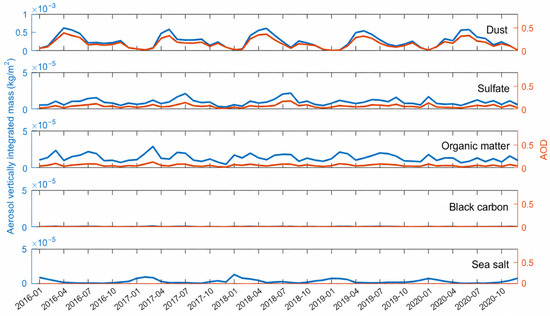
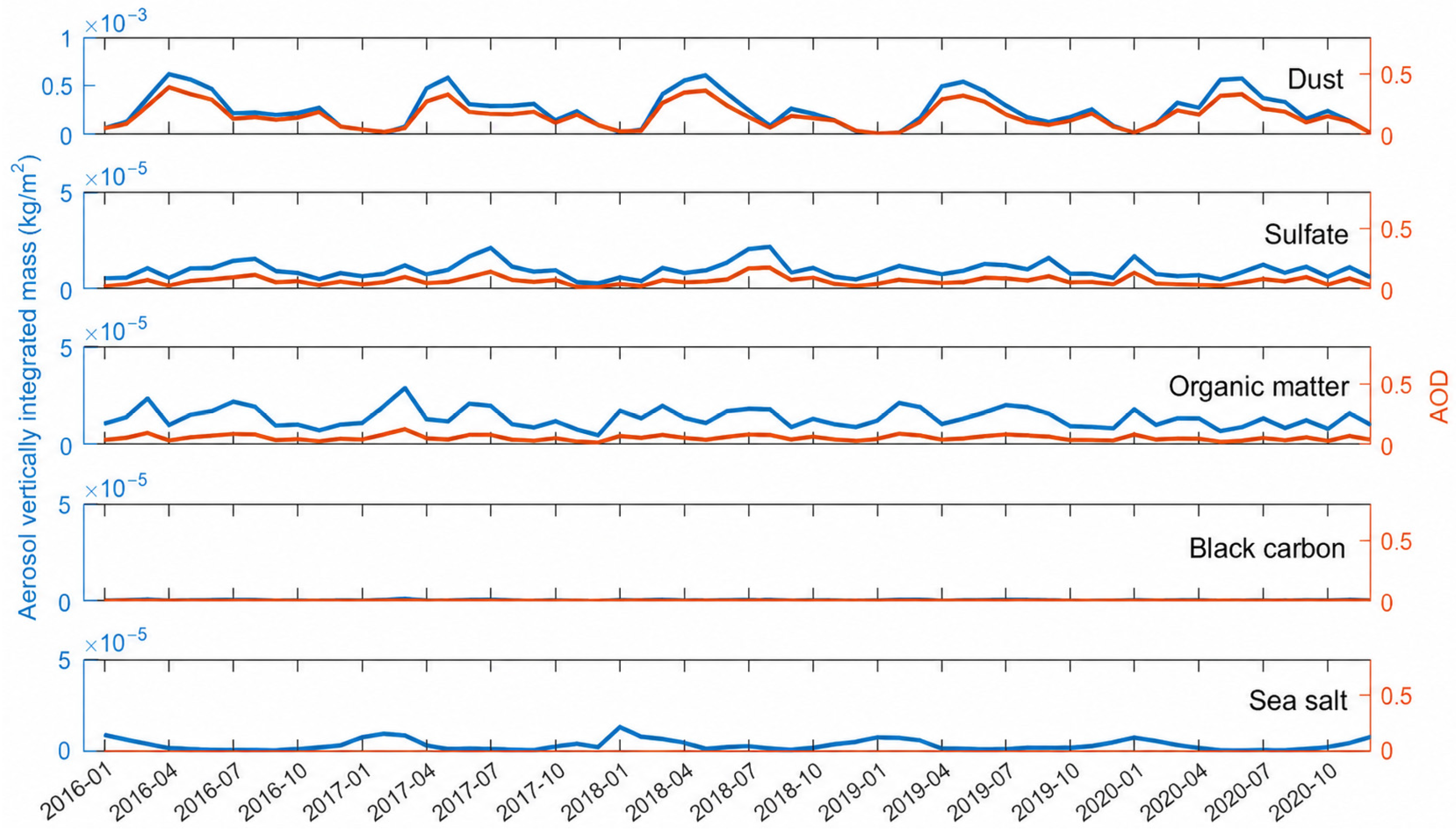
Due to human activity and climate change, the aerosol compositions of the study areas vary through the year. Based on the regional aerosol mass profiles and column aerosol mass of five aerosol types, including dust aerosol, sea salt aerosol, sulfate aerosol, organic matter aerosol, and black carbon aerosol, the dominant types and the monthly trends of the aerosols are analyzed, which are shown in Figure 2 and Table A1. The results illustrate that the aerosol mass concentrations follow regular interannual variations over the five years. Dust, sulfate and organic matter aerosols are the dominant aerosols in the region, which are likely to have a proportion of more than 80%. Dust aerosol in Baotou contributes the highest optical depth almost throughout the whole five years, especially during the season of spring. Although sulfate and organic matter aerosols have similar column mass loads in most months, sulfate aerosol exhibits higher column AOD values. These can be attributed to the relatively high scattering capacity of sulfate particles at 550 nm. Given the pronounced seasonal variations in regional aerosol compositions, four months with typical aerosol composition are selected for method evaluation and the details are shown in Table 1.
Figure 2.
Monthly mean vertically integrated mass and aerosol optical depth at 550 nm of five types of aerosols in Baotou, Inner Mongolia, China, through the 2016 to 2020 period. (The blue line represents aerosol vertically integrated mass, and the orange line represents AOD).
Table 1.
Typical aerosol models selected in Baotou for retrieval method evaluation.
2.2.2. Simulated On-Board Observation Data
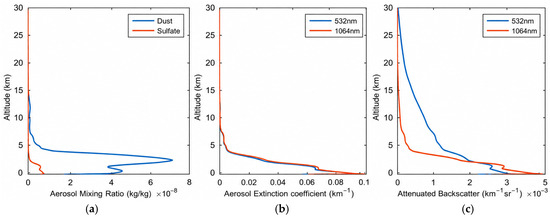
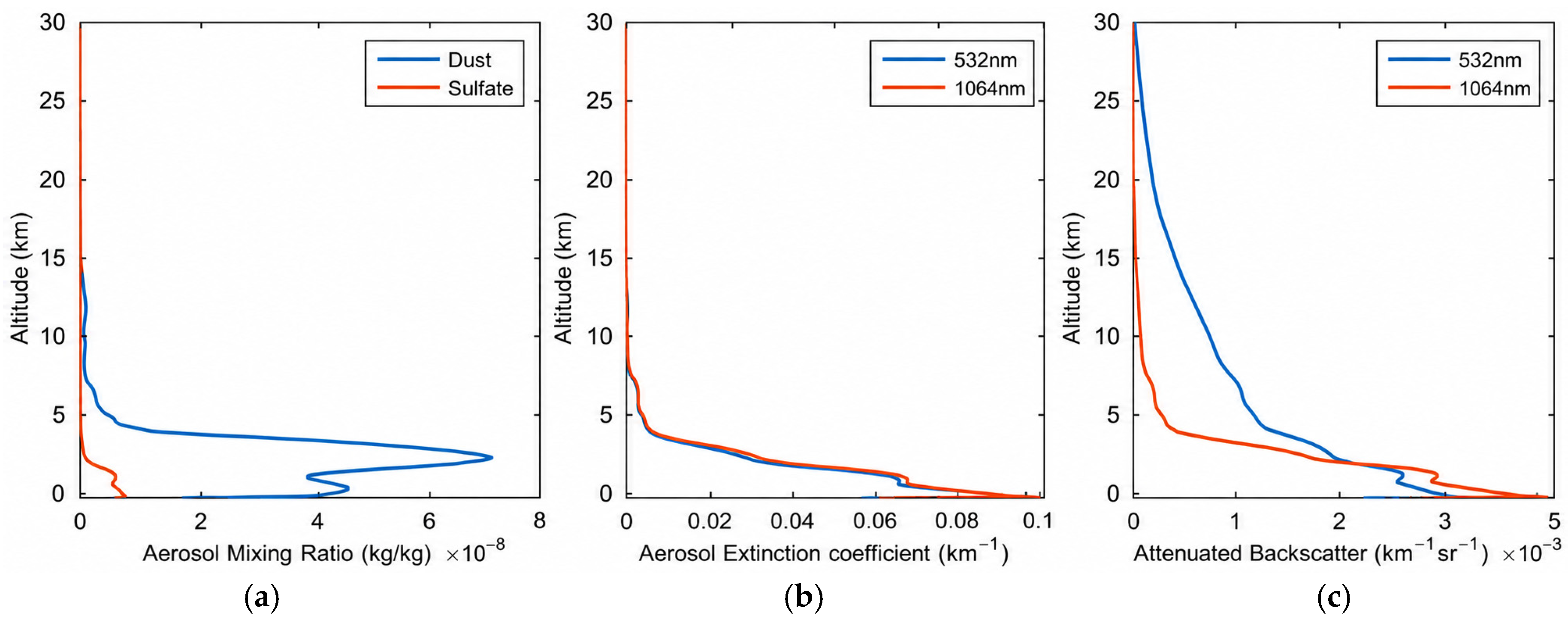
The simulated lidar data are obtained by the forward model based on the aerosol mass profiles, aerosol complex refractive indexes and Mie theory. The data is of two wavelengths at 532 nm and 1064 nm. Figure 3 presents an example of simulated aerosol extinction coefficients and lidar backscatter signals based on the reanalysis data of dust and sulfate aerosol mass profiles on 13 September 2016, in Baotou, Inner Mongolia, China. Here, forward simulation only focuses on atmospheric signals at the altitude range below 30 km above ground level with a vertical resolution of 30 m. Therefore, linear vertical interpolation is implemented based on the original ECMWF model layer information to convert the coarse grid into a 30 m vertical grid before the layer-wise calculation.
Figure 3.
(a) Dust and sulfate aerosol mass profiles, and the corresponding (b) simulated aerosol extinction coefficients and (c) simulated lidar backscatter signals on 13 September 2016, in Baotou, Inner Mongolia, China.
2.2.3. On-Board Observation Data
CALIOP provides the most complete set of global observations of vertical aerosol structure to date, which has generated a large, high-quality dataset. In this study, two products of CALIOP, the Level 1B Version 4.1 product and Level 2 5 km Aerosol profile Version 4.2 product, are used to verify the retrieval accuracy of the proposed method. As the uncertainty of CALIOP’s daytime aerosol products is high due to solar noise, only nighttime data products are used to ensure the reliability of the validation. To mitigate the influence of time-space gaps of the on-board data and the model built in the paper, the time difference in the selected synchronized data is controlled within one hour and the distance difference is within 0.15°. As such, the proposed methodology described in Section 2.1 is applied in two nighttime cases studies from CALIOP: the 13 September 2016 and the 30 May 2018 at around 18:50 UTC in Baotou. Among all data quality flags provided in the L2 dataset, a stringent quality control configuration is used by selecting only high-confidence estimates.
3. Results
3.1. The Model Accuracy of Aerosol Extinction Coefficient Retrieval
To illustrate the priorities of the proposed method, the classic Fernald method is used, along with the proposed method, to retrieve aerosol profiles from the simulated data. The lidar ratios used in classic Fernald retrievals are predefined based on the Forward model by using historical aerosol reanalysis profiles, which are as shown in Table A2. It can be noticed that the lidar ratios are quite lower than other reported results (around 50 sr) for Asian dust, which can be attributed to the much smaller lidar ratios (around 18 sr at 532 nm) for fine-mode dust near desert sources in the study area [28]. Additionally, the Mie theory with a spherical particle assumption adopted in the forward simulation also lowers the calculated lidar values to a certain degree. In this paper, the classic Fernald method is referred to as the empirical method in this paper, and the corresponding retrieval results are taken as the control group.
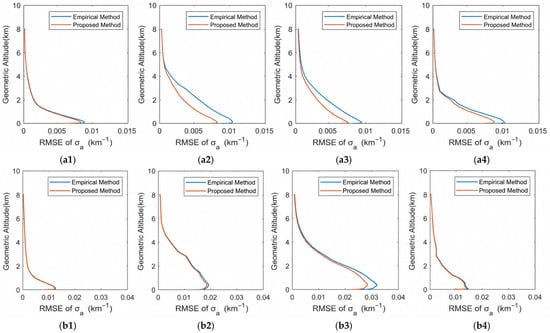
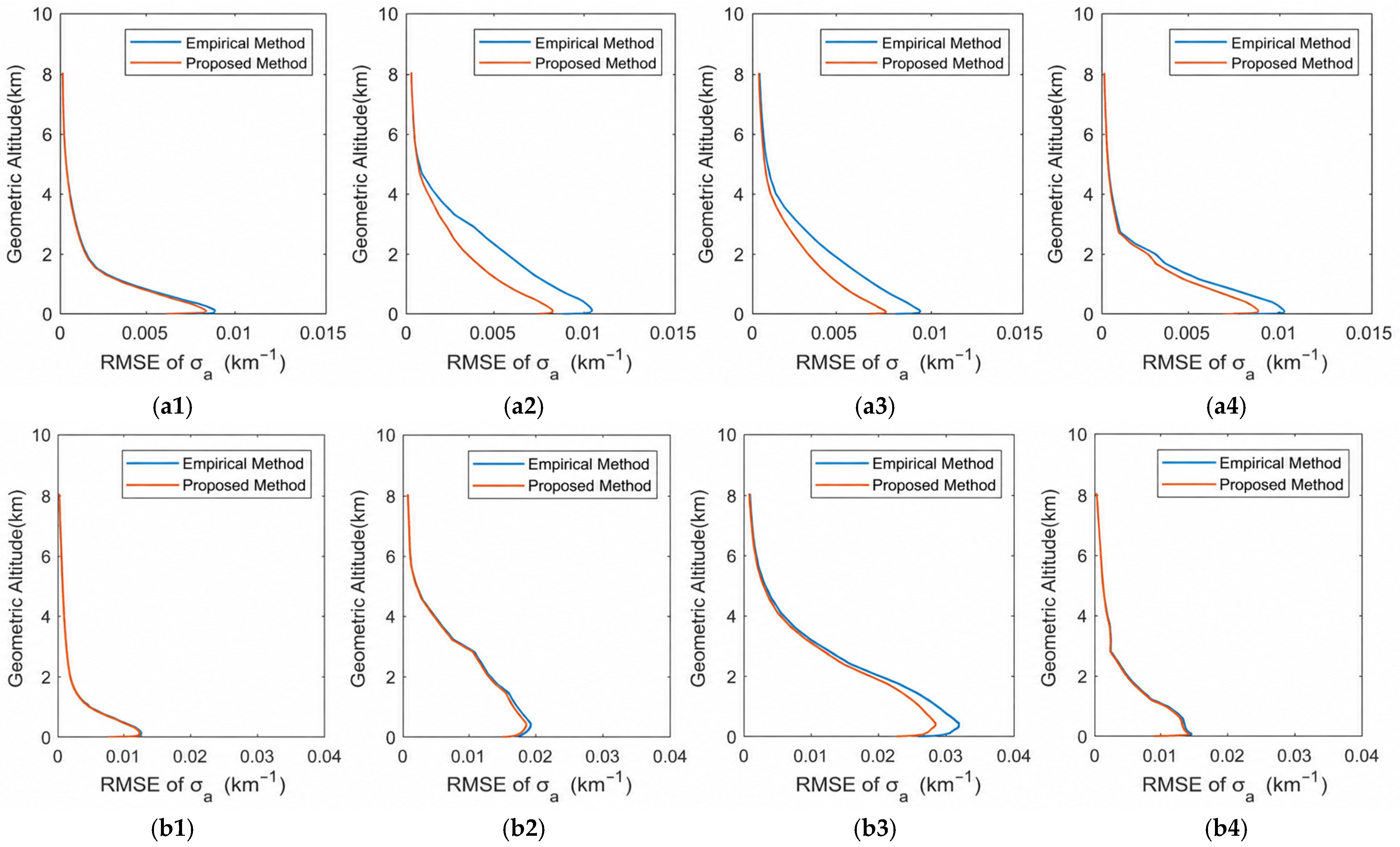
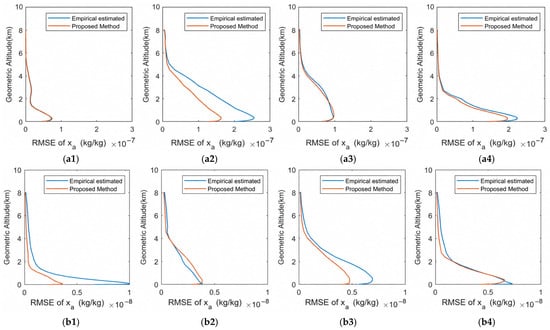
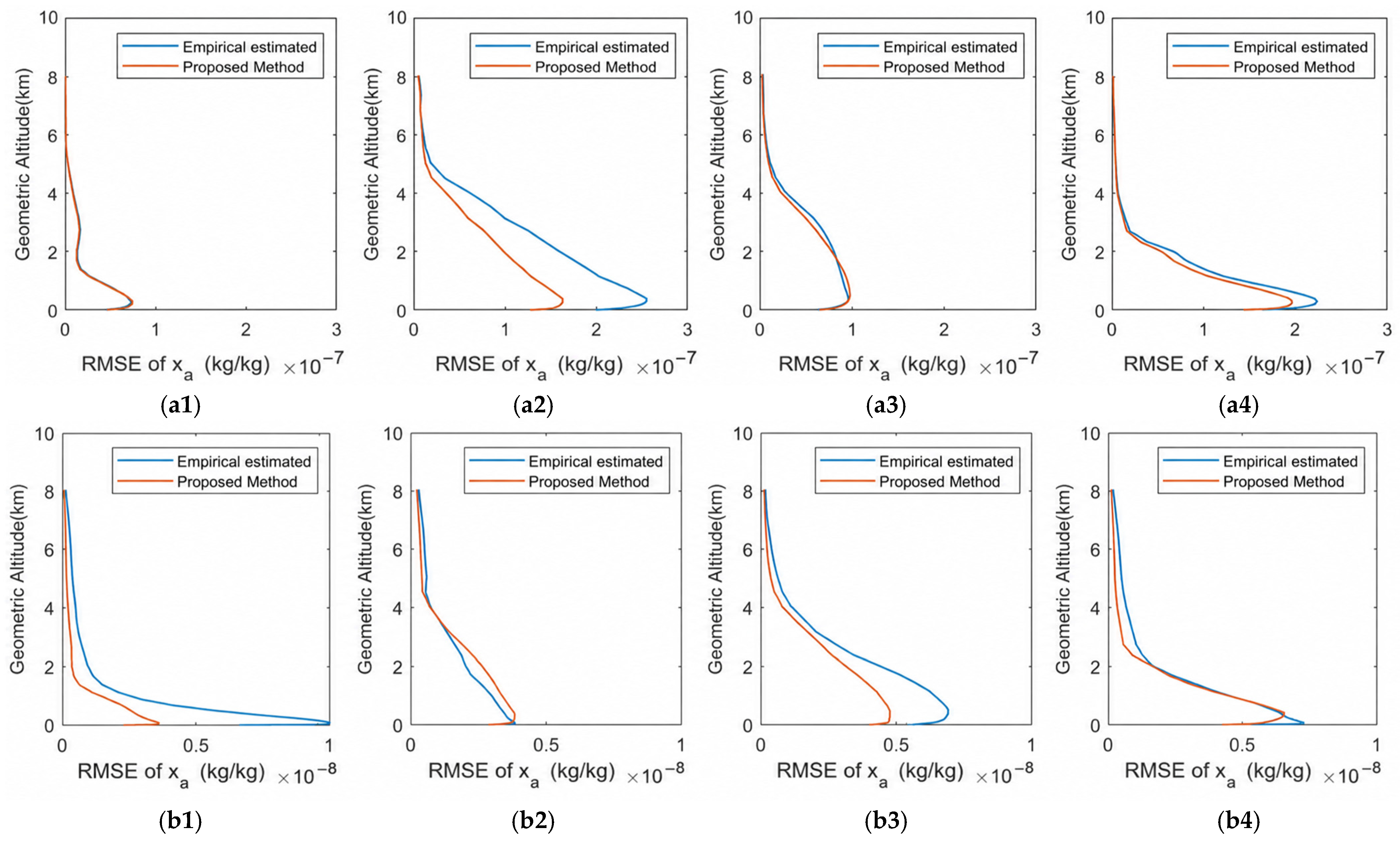
Figure 4 demonstrates the model accuracy of aerosol extinction coefficients at 532 nm and 1064 nm for the proposed method and the empirical method. A total of 770, 305, 256 and 461 aerosol profiles from January, April, July and October in the study area are respectively adopted for model accuracy analysis. The A aerosols are mainly concentrated in the lower troposphere; it can be observed that the RMSEs of the aerosol extinction coefficient are relatively high in the lower layers, both at 532 nm and 1064 nm for all the typical aerosol models in the Baotou area. For the results corresponding to the 532 nm channel, it shows that the improvement of the proposed method can be detected especially in April and July. This phenomenon can be attributed to the enhanced promotion effect of the method for retrieval under high-AOD background conditions, as shown in Table 1. Similar results can also be obtained for the 1064 nm channel. As the AOD at 1064 nm is always smaller than that at 532 nm, due to the fact that 1064 nm is a near-infrared wavelength and the extinction cross-section of atmospheric aerosol at this wavelength is small, the improvement of the promoted method for the 1064 nm channel is slightly weaker.
Figure 4.
Seasonal profile retrieval accuracy of aerosol extinction coefficients at wavelengths of (a1–a4) 532 nm and (b1–b4) 1064 nm. For each row (a,b), subplots 1 to 4 correspond to observation results in Baotou for January, April, July, and October, respectively.
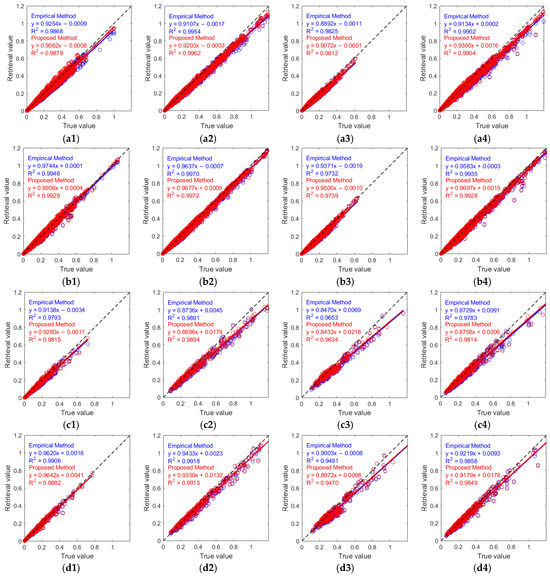
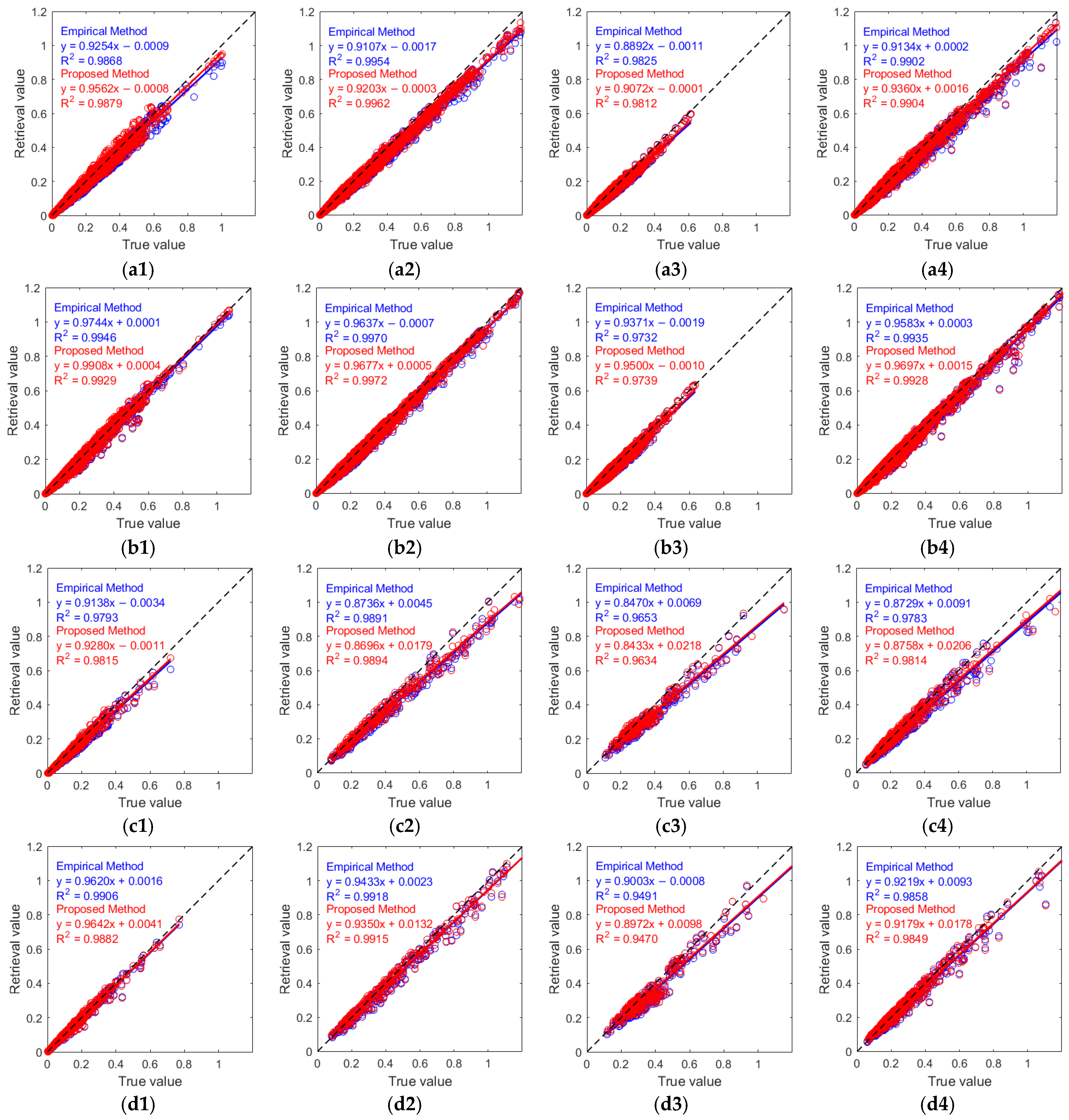
Moreover, Figure 5(a1–a4,b1–b4) compare the retrieved aerosol extinction coefficients with the empirical method and proposed method with true values. It can be seen that the retrieved aerosol extinction coefficients from both the empirical method and the proposed method suggest good correlation with true values, which implies the good performance of the key module and the Fernald method. Although both results underestimate the aerosol extinction coefficients, especially for July, this can be attributed to the neglect of aerosol types other than the two dominant ones. By inducing constriction of dual-band observation by the proposed method, the underestimation is slightly mitigated.
Figure 5.
Comparison of optical retrieval results vs. true values of (a1–a4) aerosol extinction coefficients at 532 nm, (b1–b4) aerosol extinction coefficients at 1064 nm, (c1–c4) AOD at 532 nm and (d1–d4) AOD at1064 nm. For each row (a–d), subplots 1 to 4 correspond to observation results in Baotou for January, April, July, and October, respectively.
The comparations of the retrieved AOD and true AOD values are also presented in Figure 5(c1–c4,d1–d4), and the corresponding RMSE results of the AOD by the two methods are shown in Table 2. It can be seen that the results are accordant with the accuracy assessment of the aerosol extinction coefficient. Notably, the slopes in the linear fitting result for the proposed method are relatively lower than the empirical method, suggesting a better total AOD correction at a low-AOD background. However, the proposed method has a slightly lower R2 value than the empirical model at 1064 nm, indicating a minor weakening in the linear correlation. Compared with 532 nm, the retrieval improvement at 1064 nm is inherently limited due to low aerosol extinction sensitivity at the near-infrared wavelength, which makes accuracy optimization for this band rather subtle. The retrieval accuracy of the AOD in the 532 nm channel is enhanced with a mean improvement of 19.58%, and it has the best improvement of 34.93% for the model based on the aerosol profiles in April. This is unsurprising given that the improvement in the 1064 nm channel has a mean accuracy improvement of only 3.57%.
Table 2.
Accuracy improvement of AOD for the retrieval models in different aerosol models.
3.2. The Model Accuracy of Aerosol Composition Retrieval
The Fernald method only yields extinction coefficients and cannot directly output mass mixing ratio profiles. To evaluate the accuracy of the aerosol composition retrieval by the proposed method, the results are compared with the mass mixing ratio profiles calculated from the extinction coefficients retrieved by empirical method mentioned above. These extinction coefficients are then converted into vertical mass mixing ratio profiles by using the mass-to-extinction coefficient K. The empirical estimate xa is the average of the two mass mixing ratio profiles, which is also known as xa,guess,2. The empirical estimates xa,type1 and xa,type2 are then calculated based on the layered composition of the two aerosol species under the initial guess. The model accuracy of the aerosol composition retrieval is presented in Figure 6 and Figure 7 and Table 3.
Figure 6.
Seasonal profile retrieval accuracy of (a1–a4) dust and (b1–b4) sulfate aerosols in the Baotou area.. For each row (a,b), subplots 1 to 4 correspond to observation results in Baotou for January, April, July, and October, respectively.
Figure 7.
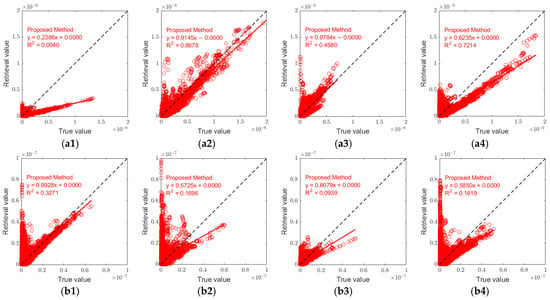
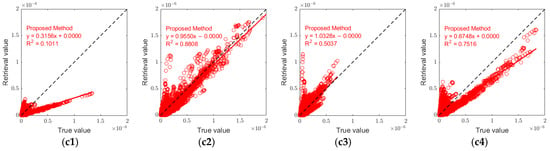
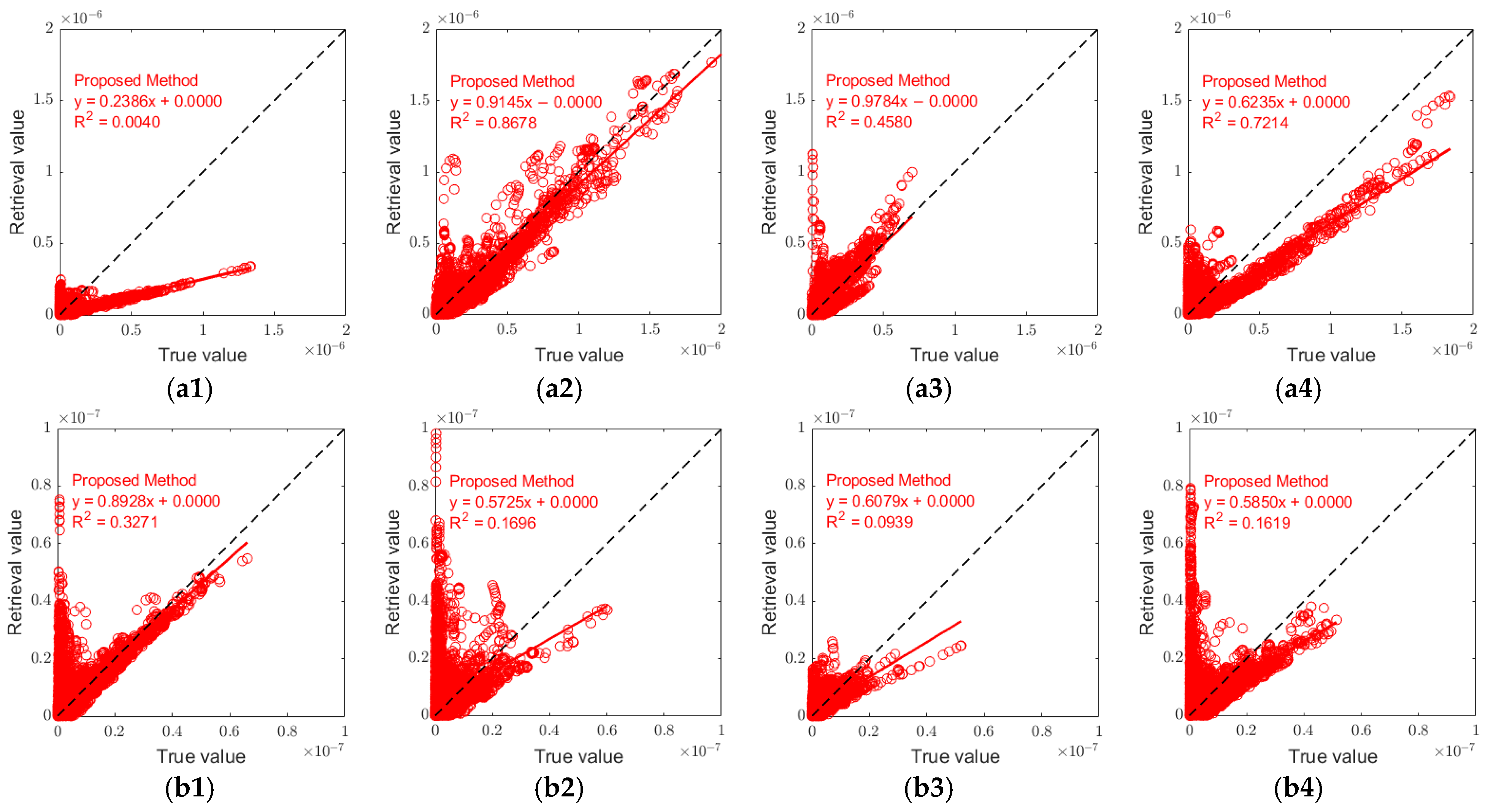
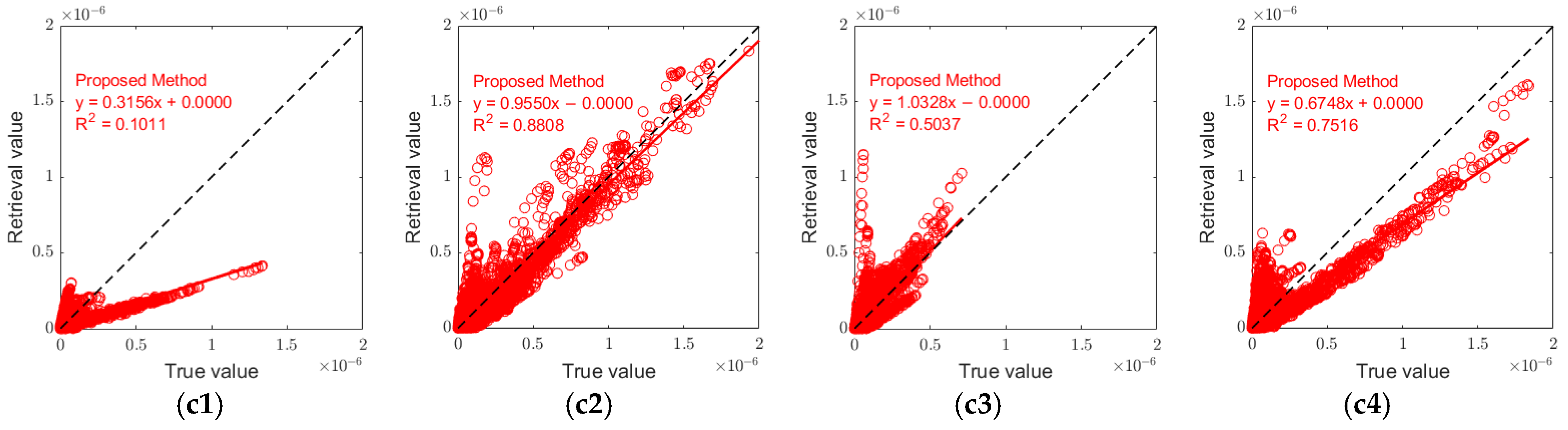
Comparison of aerosol concentration retrieval results by the proposed method vs. true value of (a1–a4) dust, (b1–b4) sulfate, and (c1–c4) total. For each row (a–c), subplots 1 to 4 correspond to observation results in Baotou for January, April, July, and October, respectively.
Table 3.
Accuracy improvement of aerosol column mass for the retrieval models in Baotou.
From Figure 6, as the aerosol mass concentration reduces with the increase in the altitude, the accuracy of the profile retrieval exhibits a similar trend in the vertical direction. Compared with empirically estimated results, the enhancement of the mass concentration accuracy of the retrieval profiles can be observed in almost all the months both for dust and sulfate aerosols. Due to the variation in the dust aerosol proportion over the year, the accuracy enhancement of the dust aerosol mass composition on the monthly scale exhibits differently, roughly showing a gradual enhancement from January to April and a decrease from July to October. Combined with the retrieval results of the aerosol extinction coefficient in Figure 3, a strong correlation can be observed between the accuracy improvement of the dust aerosol mass concentration and the total aerosol extinction coefficient. This can be owed to the predominance of dust aerosol in the study region. For sulfate aerosols, the method has a good performance in January and July when the mass fraction of the sulfate aerosol is relatively high. The results indicate that the improvement would be enhanced when the aerosol type yields a higher proportion.
Figure 7 compares dust, sulfate and total aerosol concentration retrieval results from the proposed method with true values. As the empirically estimated aerosol concentration results have no linear relationship with the true values, the figure only shows the fitted linear equations and corresponding coefficients of determination (R2) for the results of the proposed method. From Figure 7(a1–a4), it shows that April and January yield the best and worst correlations with the true dust aerosol concentration values, respectively. This can be due to the largest mass proportion of dust aerosol in April, whereas the smallest dust mass proportion is in January (Table A1). From the results of the sulfate aerosol in Figure 7(b1–b4), the best correlation is found in January, which is also accordant with the high sulfate proportion. The mass fraction of dust aerosol is more than three times that of sulfate aerosol (Table A1); the total aerosol results in Figure 7(c1–c4) exhibit similar phenomena as in Figure 7(a1–a4).
The accuracy of the column masses of dust and sulfate aerosols are then analyzed in Table 3. The accuracy of the retrieval model to obtain dust aerosol enhanced significantly in most of the year, especially in April, and has a mean improvement of 12.46%, and the best improvement is achieved in April with 37.36%. The mean improvement for sulfate aerosol retrieval is 17.58%, reaching 62.41% in January. The retrieval accuracy of the column mass of the total aerosol is then evaluated, and the results are similar to the accuracy improvement of the dust aerosol due to the large proportion of dust aerosol in the study region.
3.3. The Application of CALIOP Data
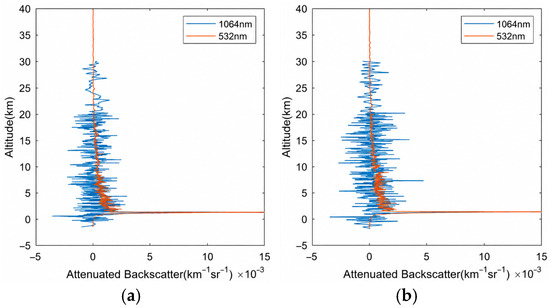
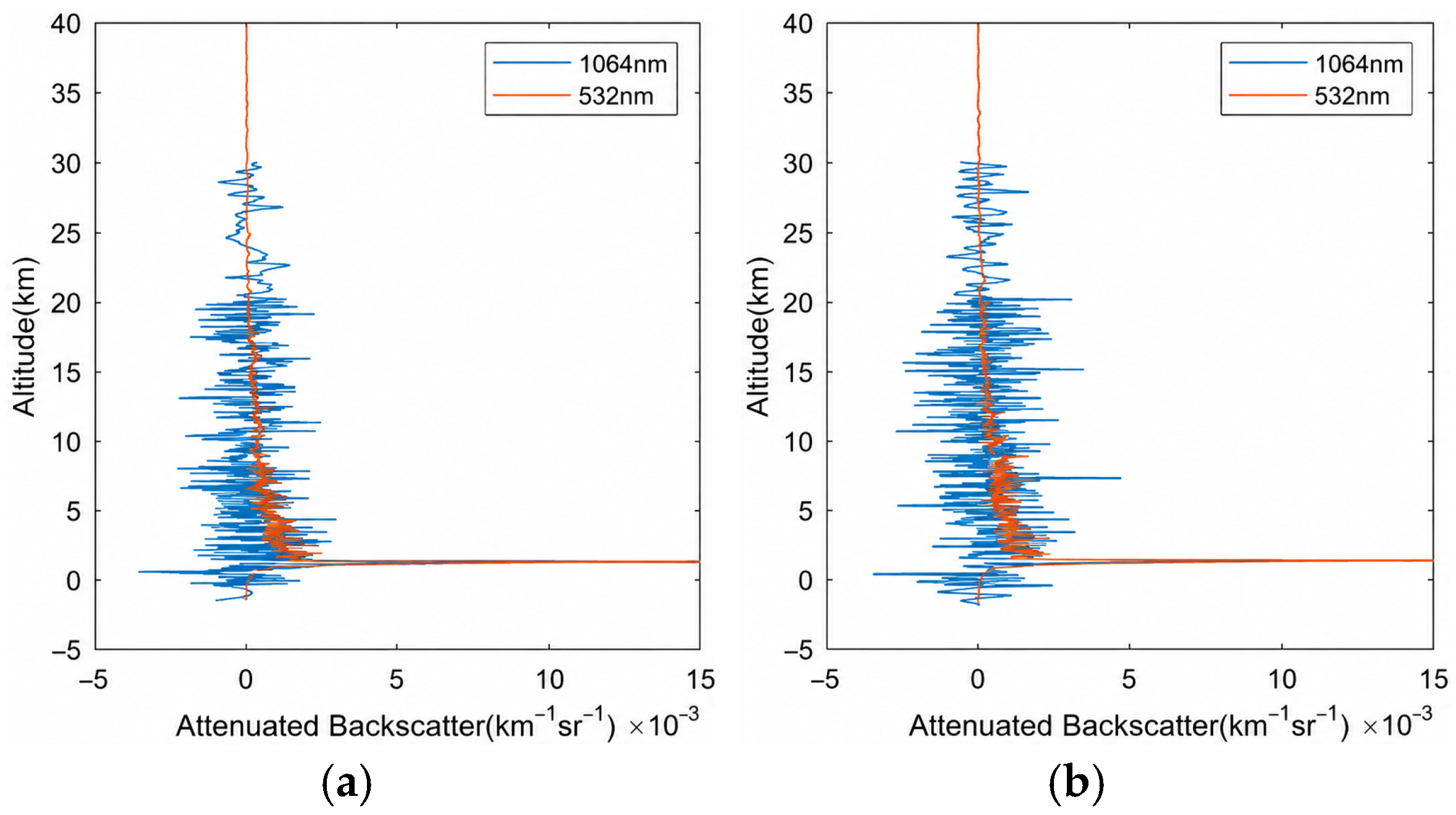
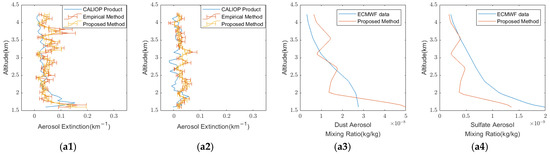
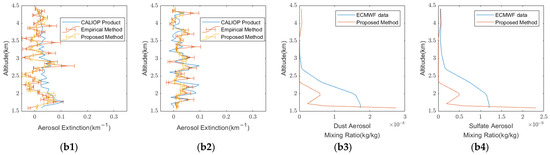
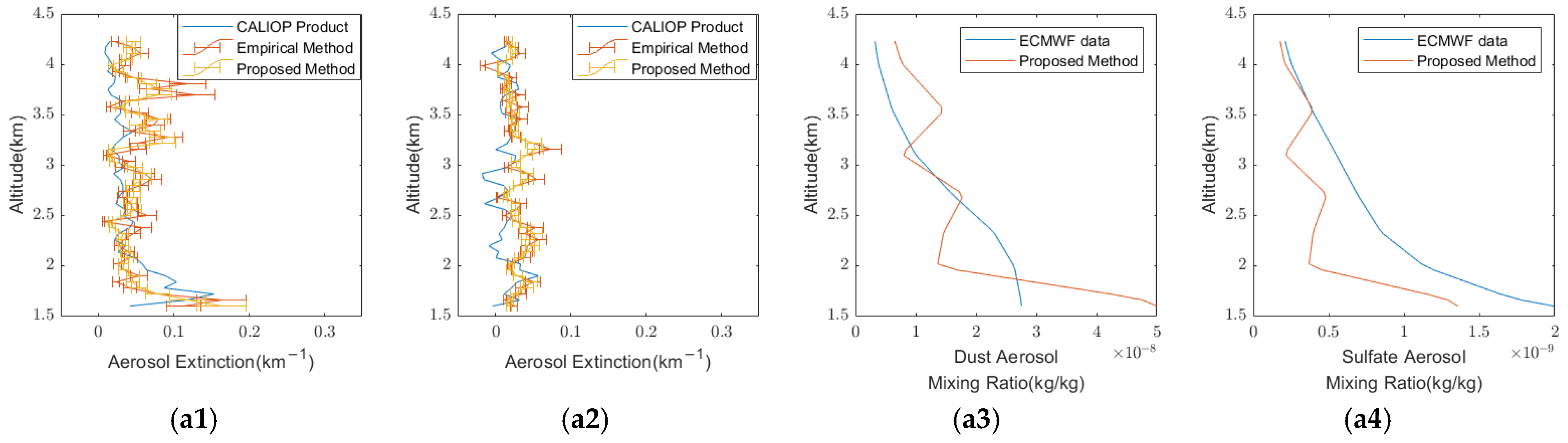
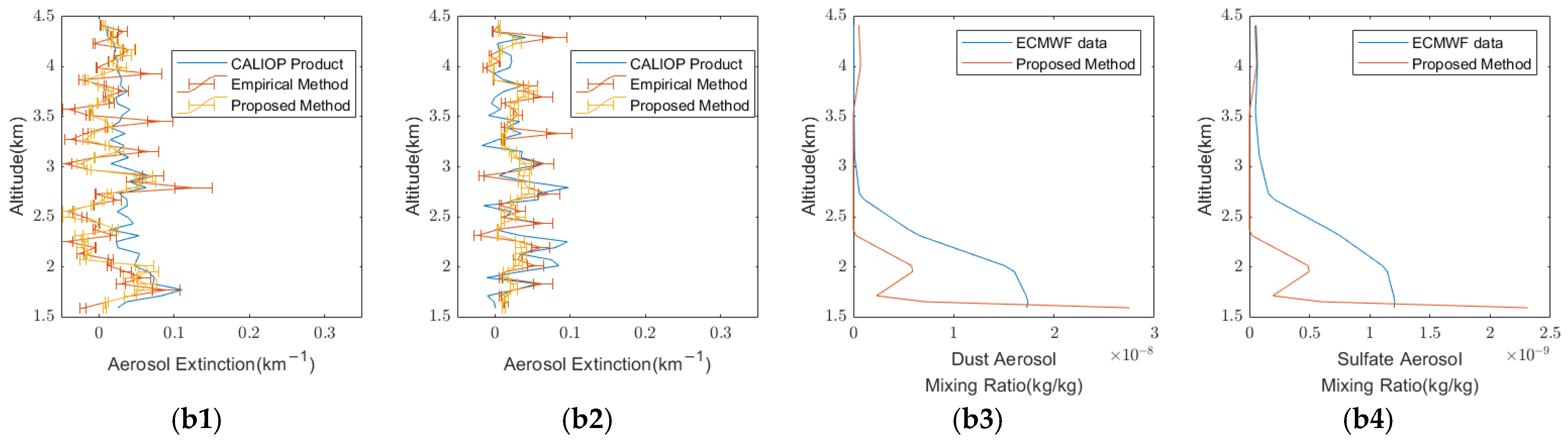
The proposed method is then verified by applying in the CALIOP observation data of the study area. Figure 8 shows the Level 1B attenuated backscatter profiles of two nighttime cases on 13 September 2016 and 30 May 2018. The retrieved aerosol extinction coefficients at 532 and 1064 nm and aerosol mass concentrations of dust and sulfate aerosols are presented in Figure 9. Both the retrieved aerosol extinction coefficients from the proposed method and empirical method suggest strong correlation with the CALIOP product. The AODs calculated based on the CALIOP product and the retrieved results obtained by the empirical method and proposed algorithm are 0.0991, 0.1087 and 0.1059 on 13 September 2016 and 0.1436, 0.1325 and 0.1477 on 30 May 2018, respectively. Also, information on the main types of aerosols in the study area can be obtained by applying the proposed method. The results are further compared with the ECMWF reanalysis data in Figure 9. Since the algorithm proposed in this paper assumes negligible optical effects of organic matter, black carbon and other aerosols, the lidar ratio estimated herein leads to errors in retrieval from the CALIOP data. Moreover, the orbit of CALIOP is not exactly the same for each transit; there is a certain distance and time difference between the CALIOP data for each acquisition and ECMWF aerosol profile data, leading to uncertainty in the retrieval accuracy.
Figure 8.
CALIOP Level 1B attenuated backscatter at dual wavelength on (a) 13 September 2016 and (b) 30 May 2018 in Baotou.
Figure 9.
Profile retrieval results of the aerosol extinction coefficients at dual-wavelength and aerosol mass concentrations for the CALIOP data on (a1–a4) 13 September 2016 and (b1–b4) 30 May 2018 in Baotou. For each row (a,b), subplots 1 to 4 correspond to results of aerosol extinction coefficients at 532 nm, aerosol extinction coefficients at 1064 nm, dust aerosol mass profile and sulfate aerosol mass profile, respectively.
4. Discussion
A methodology is described above for the retrieval of aerosol profiles, including the mixed content and optical properties, from dual-wavelength lidar observations. By constructing the relationship between the aerosol mass profile and optical properties at different wavelengths on the basis of Mie theory, this method can introduce new constraints to improve the estimation accuracy of the lidar ratio, as shown in Table A3, which facilitates the retrieval of confident aerosol composition and optical profiles. The feasibility and practicality of this technique is analyzed by applying it in simulated spaceborne lidar backscatter signals and CALIOP data. Compared with the retrieval results from the method based on the empirically estimated lidar ratio, the proposed method yields a mean accuracy improvement of the extinction coefficient at the 532 nm and 1064 nm channels of 19.58% and 3.57%. The overall AOD retrieval uncertainty of the proposed method is approximately 10% at 532 nm, superior to the inherent error from CALIOP’s preset lidar parameters. Beyond improved extinction retrieval accuracy, the strategy additionally resolves the mass profiles of two dominant aerosol components simultaneously, which is a capability absent from most existing retrieval approaches reported. The preliminary results for CALIOP data also confirm the feasibility of the method for on-board data applications.
The paper assesses the proposed method using the simulated data from the aerosol profiles with wide range of AOD values and different mixing ratios. It reveals that the method not only yields improved accuracy of extinction coefficient retrieval rather than that empirical method, especially for the profiles with high AOD values, but also achieves favorable accuracy compared with the CALIOP retrieval scheme on the lidar ratio estimation. The inherent behavior of the method in aerosol mass composition profiling is then discussed. Both the aerosol extinction coefficient accuracy and the proportion of the as-studied aerosol affect the retrieval accuracy. With the connection constructed in the proposed method by the lidar ratio, the accuracy of the aerosol extinction coefficient directly impacts the retrieval of aerosol mass profiles. Moreover, competition can be observed in the mass composition retrieval accuracy between the two aerosol types. The enhancement of accuracy is much more obvious for the aerosols which yield higher proportions. However, it can be observed that several retrieval results fail to converge, especially in spring and summer. This phenomenon is attributed to the fact that drastic aerosol variations significantly amplify deviations in initial guesses, which demonstrates that the algorithm is sensitive to the selection of initial values.
In general, for the simulated data, the algorithm developed in this paper is quite effective for the retrieval of aerosol extinction profiles and mass concentration profiles, especially in highly polluted regions with large AOD values and a relative dominant aerosol type among the others. However, several issues listed herein should be considered before application in on-board data. First, the forward model should be improved. In this study, single scattering is hypothesized and multiple scattering effects can be induced. Also, Mie theory works with the assumption of spherical particles, which induces errors for the optical property calculation for non-spherical particles, such as dust aerosol, mineral aerosol, etc. Future studies should include the errors of the spherical particle assumption or use optical properties of non-spherical aerosol particles instead of Mie calculation in the forward model. Further verification, as well as the extensive application of the proposed method for multiple aerosol models through long-term observations, is vital for the evaluation of the proposed method. In essence, comprehensive validation experiments need to be conducted under diverse atmospheric scenarios by synchronous in situ measurements to improve the applicability of the proposed algorithm.
5. Conclusions
In this paper, a synergic retrieval algorithm for aerosol optical properties and mass composition profiles is developed for dual-wavelength Mie lidar observations. Constraints between two observation channels are established based on the intrinsic relationship between aerosol mass and optical parameters. It facilitates a better estimation of the lidar ratio, making the proposed method outperform most existing retrieval methods relying on fixed lidar ratios.
Major results from model accuracy assessments and CALIOP data validation are summarized as follows:
- Compared with the Fernald method using empirically estimated lidar ratios, the AOD retrieval accuracy is improved by 19.58% at 532 nm and 3.57% at 1064 nm.
- The algorithm enables simultaneous retrieval of vertical mass profiles for dominant aerosol species, filling the research gap of quantitative aerosol composition retrieval directly from lidar measurements.
- Optimal performance is obtained in regions dominated by one aerosol type and under high-AOD conditions. Meanwhile, convergence failure may occur when aerosol properties vary drastically.
The proposed method provides an effective technical solution for simultaneous retrieval of aerosol optical and mass composition information, and presents good application potential for atmospheric environment monitoring and climate-related research.
Author Contributions
Conceptualization, W.Y. and N.W.; methodology, W.Y.; validation, R.Q., W.Y. and N.W.; formal analysis, R.Q. and W.Y.; investigation, W.Y.; resources, R.Q.; data curation, R.Q. and W.Y.; writing—original draft preparation, R.Q.; writing—review and editing, W.Y., S.Q. and Z.L.; visualization, R.Q.; supervision, W.Y. and N.W.; project administration, S.Q. and Z.L.; funding acquisition, S.Q. All authors have read and agreed to the published version of the manuscript.
Funding
This research was funded by the National Natural Science Foundation of China (Grant No. 42505131).
Data Availability Statement
The CALIOP Level 1B Version 4.1 product and Level 2 5 km Aerosol profile Version 4.2 product can be downloaded at https://search.earthdata.nasa.gov/search/, accessed on 6 April 2025. The CAMS global reanalysis (EAC4) dataset is available at https://ads.atmosphere.copernicus.eu/cdsapp#!/dataset/cams-global-reanalysis-eac4, accessed on 27 May 2025.
Conflicts of Interest
The authors declare no conflicts of interest. The funders had no role in the design of the study; in the collection, analyses, or interpretation of data; in the writing of the manuscript; or in the decision to publish the results.
Appendix A
Table A1.
Monthly mean aerosol column mass and optical depth in the study areas of Baotou for the 2016 to 2020 period.
Table A2.
The seasonal lidar ratio used in the empirical method.
Table A3.
Accuracy improvement of lidar ratio for the retrieval models in different aerosol models.
References
- Charlson, R.J.; Schwartz, S.E.; Hales, J.M.; Cess, R.D.; Coakley, J.A., Jr.; Hansen, J.E.; Hofmann, D.J. Climate forcing by anthropogenic aerosols. Science 1992, 255, 423–430. [Google Scholar] [CrossRef] [Scilit] [PubMed]
- Raut, J.-C.; Chazette, P. Radiative budget in the presence of multi-layered aerosol structures in the framework of AMMA SOP-0. Atmos. Chem. Phys. 2008, 8, 6839–6864. [Google Scholar] [CrossRef] [Scilit]
- Zhang, Z.; Meyer, K.; Yu, H.; Platnick, S.; Colarco, P.; Liu, Z.; Oreopoulos, L. Shortwave direct radiative effects of above-cloud aerosols over global oceans derived from 8 years of CALIOP and MODIS observations. Atmos. Chem. Phys. 2016, 16, 2877–2900. [Google Scholar] [CrossRef] [Scilit]
- Winker, D.M.; Couch, R.H.; McCormick, M.P. An overview of LITE: NASA’s lidar in-space technology experiment. Proc. IEEE 1996, 84, 164–180. [Google Scholar] [CrossRef] [Scilit]
- Zwally, H.J.; Schutz, B.; Abdalati, W.; Abshire, J.; Bentley, C.; Brenner, A.; Bufton, J.; Dezio, J.; Hancock, D.; Harding, D. ICESat’s laser measurements of polar ice, atmosphere, ocean, and land. J. Geodyn. 2002, 34, 405–445. [Google Scholar] [CrossRef] [Scilit]
- Winker, D.M.; Vaughan, M.A.; Omar, A.; Hu, Y.; Powell, K.A.; Liu, Z.; Hunt, W.H.; Young, S.A. Overview of the CALIPSO mission and CALIOP data processing algorithms. J. Atmos. Ocean. Technol. 2009, 26, 2310–2323. [Google Scholar] [CrossRef] [Scilit]
- Fernald, F.G.; Herman, B.M.; Reagan, J.A. Determination of aerosol height distributions by lidar. J. Appl. Meteorol. Clim. 1972, 11, 482–489. [Google Scholar] [CrossRef] [Scilit]
- Klett, J.D. Stable analytical inversion solution for processing lidar returns. Appl. Opt. 1981, 20, 211–220. [Google Scholar] [CrossRef] [Scilit] [PubMed]
- Fernald, F.G. Analysis of atmospheric lidar observations: Some comments. Appl. Opt. 1984, 23, 652–653. [Google Scholar] [CrossRef] [Scilit] [PubMed]
- Ackermann, J. The extinction-to-backscatter ratio of tropospheric aerosol: A numerical study. J. Atmos. Ocean. Technol. 1998, 15, 1043–1050. [Google Scholar] [CrossRef] [Scilit]
- Sasano, Y.; Browell, E.V. Light scattering characteristics of various aerosol types derived from multiple wavelength lidar observations. Appl. Opt. 1989, 28, 1670–1679. [Google Scholar] [CrossRef] [Scilit] [PubMed]
- Groß, S.; Esselborn, M.; Weinzierl, B.; Wirth, M.; Fix, A.; Petzold, A. Aerosol classification by airborne high spectral resolution lidar observations. Atmos. Chem. Phys. 2013, 13, 2487–2505. [Google Scholar] [CrossRef] [Scilit]
- Burton, S.P.; Ferrare, R.A.; Hostetler, C.A.; Hair, J.W.; Rogers, R.R.; Obland, M.D.; Butler, C.F.; Cook, A.L.; Harper, D.B.; Froyd, K.D. Aerosol classification using airborne High Spectral Resolution Lidar measurements–methodology and examples. Atmos. Meas. Tech. 2012, 5, 73–98. [Google Scholar] [CrossRef] [Scilit]
- Qi, S.; Huang, Z.; Ma, X.; Huang, J.; Zhou, T.; Zhang, S.; Dong, Q.; Bi, J.; Shi, J. Classification of atmospheric aerosols and clouds by use of dual-polarization lidar measurements. Opt. Express 2021, 29, 23461–23476. [Google Scholar] [CrossRef] [Scilit] [PubMed]
- Nishizawa, T.; Okamoto, H.; Sugimoto, N.; Matsui, I.; Shimizu, A.; Aoki, K. An algorithm that retrieves aerosol properties from dual-wavelength polarized lidar measurements. J. Geophys Res. 2007, 112, D06212. [Google Scholar] [CrossRef] [Scilit]
- Kim, M.H.; Omar, A.H.; Tackett, J.L.; Vaughan, M.A.; Winker, D.M.; Trepte, C.R.; Hu, Y.; Liu, Z.; Poole, L.R.; Pitts, M.C.; et al. The CALIPSO version 4 automated aerosol classification and lidar ratio selection algorithm. Atmos. Meas. Tech. 2018, 11, 6107–6135. [Google Scholar] [CrossRef] [Scilit] [PubMed]
- Kim, M.-H.; Kim, S.-W.; Omar, A.H. Dust lidar ratios retrieved from the CALIOP measurements using the MODIS AOD as a constraint. Remote Sens. 2020, 12, 251. [Google Scholar] [CrossRef] [Scilit]
- Chang, L.; Li, J.; Ren, J.; Xiong, C.; Zhang, L. An iterative algorithm to simultaneously retrieve aerosol extinction and effective radius profiles using CALIOP. Atmos. Meas. Tech. 2024, 17, 2637–2648. [Google Scholar] [CrossRef] [Scilit]
- Grainger, R.G.; Lucas, J.; Thomas, G.E.; Ewen, G.B.L. Calculation of Mie derivatives. Appl. Opt. 2004, 43, 5386–5393. [Google Scholar] [CrossRef] [Scilit] [PubMed]
- Dave, J.V. Scattering of visible light by large water spheres. Appl. Opt. 1969, 8, 155–164. [Google Scholar] [CrossRef] [Scilit]
- Bhandari, A.; Hamre, B.; Frette, Ø.; Stamnes, K.; Stamnes, J.J. Modeling optical properties of human skin using Mie theory for particles with different size distributions and refractive indices. Opt. Express 2011, 19, 14549–14567. [Google Scholar] [CrossRef] [Scilit] [PubMed]
- Dai, B.; Luo, X.; Chang, H. Study on calculating method of aerosol extinction coefficients. Environ. Sci. Technol. 2008, 31, 12–15. [Google Scholar]
- Collis, R.T.H.; Russell, P.B. Lidar measurement of particles and gases by elastic backscattering and differential absorption. In Laser Monitoring of the Atmosphere; Springer: Berlin/Heidelberg, Germany, 1976; pp. 71–151. [Google Scholar]
- Zhou, J.; Yue, G.; Qi, F.; Jin, C.; Wu, Y.; Xiong, L.; Chen, Y.; Dou, G.; Hu, H. Optical properties of aerosol derived from lidar measurements. Chin. J. Quantum Electron. 1998, 15, 140–148. [Google Scholar]
- Inness, A.; Ades, M.; Agustí-Panareda, A.; Barré, J.; Benedictow, A.; Blechschmidt, A.-M.; Dominguez, J.J.; Engelen, R.; Eskes, H.; Flemming, J. The CAMS reanalysis of atmospheric composition. Atmos. Chem. Phys. 2019, 19, 3515–3556. [Google Scholar] [CrossRef] [Scilit]
- Russell, P.B.; Swissler, T.J.; McCormick, M.P. Methodology for error analysis and simulation of lidar aerosol measurements. Appl. Opt. 1979, 18, 3783–3797. [Google Scholar] [CrossRef] [Scilit] [PubMed]
- Flemming, J.; Huijnen, V.; Arteta, J.; Bechtold, P.; Beljaars, A.; Blechschmidt, A.-M.; Diamantakis, M.; Engelen, R.J.; Gaudel, A.; Inness, A. Tropospheric chemistry in the Integrated Forecasting System of ECMWF. Geosci. Model Dev. 2015, 8, 975–1003. [Google Scholar] [CrossRef] [Scilit]
- Huang, Z.; Li, M.; Bi, J.; Shen, X.; Zhang, S.; Liu, Q. Small lidar ratio of dust aerosol observed by Raman-polarization lidar near desert sources. Opt. Express 2023, 31, 16909–16919. [Google Scholar] [CrossRef] [Scilit]

Disclaimer/Publisher’s Note: The statements, opinions and data contained in all publications are solely those of the individual author(s) and contributor(s) and not of MDPI and/or the editor(s). MDPI and/or the editor(s) disclaim responsibility for any injury to people or property resulting from any ideas, methods, instructions or products referred to in the content. |
© 2026 by the authors. Licensee MDPI, Basel, Switzerland. This article is an open access article distributed under the terms and conditions of the Creative Commons Attribution (CC BY) license.