


Highlights
What are the main findings?
- Revealed a critical evaluation gap in multimodal fusion: A nonlinear decoupling exists between traditional image-level fusion metrics and downstream detection performance, indicating that improvements in fusion quality do not necessarily translate into better detection accuracy.
- Proposed and validated a task-oriented fusion framework: The MSFE-Net effectively integrates optical and SAR representations to enhance task-relevant features, achieving more reliable detection performance across multiple scenarios and architectures.
What are the implications of the main findings?
- Suggested a paradigm shift toward task-oriented evaluation: Fusion effectiveness should be assessed based on downstream task performance rather than solely on statistical image quality.
- Demonstrated improved robustness in complex detection scenarios: Task-oriented fusion consistently enhances detection reliability, particularly for multi-scale, arbitrarily oriented, and weak targets in cluttered scenes.
Abstract
Object detection in high-resolution remote sensing images under complex industrial environments is fundamentally constrained by the inherent limitations of single-modality sensors. Optical imagery is prone to background confusion and pseudo-target interference, while synthetic aperture radar (SAR) imagery suffers from speckle noise and structural ambiguity. This work investigates a critical evaluation gap in multimodal fusion, where traditional image-level quality metrics do not consistently reflect downstream detection performance. To address this issue, we propose a task-oriented framework termed the Multi-Source Fusion for Enhanced Object Detection Network (MSFE-Net). The proposed method integrates pixel-level optical–SAR fusion with a YOLOv11-based detector, enabling the learning of task-relevant representations by exploiting complementary optical spectral cues and SAR scattering characteristics. Extensive experiments are conducted across multiple fusion strategies and representative detection architectures on two industrial datasets covering oil tanks and photovoltaic arrays. The results consistently reveal a nonlinear decoupling between image-level fusion metrics and detection accuracy, indicating that improvements in global statistical image quality do not necessarily lead to superior task performance. Furthermore, the proposed framework demonstrates improved robustness in complex scenarios involving multi-scale and weak targets. Specifically, MSFE-Net achieves 99.1% mAP@50 for oil tank detection (19.5% improvement over SAR-only baselines) and 90.2% mAP@50 for photovoltaic array detection, with stable performance across different evaluation settings. These results highlight the importance of task-oriented evaluation in multimodal remote sensing fusion and suggest that downstream detection performance provides a more reliable criterion than conventional image-quality metrics.
1. Introduction
Accurate target detection in high-resolution remote sensing imagery remains a fundamental yet challenging problem, particularly in complex industrial environments. Target detection is a major research focus in processing remote sensing images. Its primary goal is to locate objects rapidly and accurately and identify their categories, thereby supporting intelligent image interpretation for broad civil and military applications [1]. However, as spatial resolution continues to increase, complex backgrounds and variable imaging conditions pose significant challenges. Moreover, the inherent physical limitations of individual sensors often prevent a single data source from fully capturing target characteristics [2]. For example, optical imagery provides rich spectral details but is sensitive to adverse weather, while synthetic aperture radar (SAR) imagery offers all-weather penetration and unique scattering information despite being more challenging to interpret visually. Consequently, single-source detection methods face considerable constraints in practical, all-condition applications. In recent years, deep learning has greatly advanced object detection owing to its strong feature extraction capability. This field has primarily evolved through two distinct methodological paradigms: one-stage detectors (e.g., YOLO series [3] and SSD [4]), which feature lightweight structures and fast inferencing speeds, and two-stage detectors (e.g., Faster R-CNN [5]), which offer higher accuracy at the cost of greater computational complexity.
Although various improvement strategies have been proposed to handle the arbitrary orientations, multi-scale variations, and tiny or weak objects typical of remote sensing targets [6,7,8], false alarms and missed detections remain common in highly complex scenes. Despite the powerful feature extraction capabilities of state-of-the-art detectors like YOLOv11 (a recent variant of the YOLO family), their performance is inherently bounded by the physical limitations of single-modality sensors. For instance, in complex industrial monitoring, optical-only detectors are easily deceived by morphological pseudo-targets (e.g., circular ground traces mimicking oil tanks), while SAR-only detectors suffer from severe edge omissions due to speckle noise. These limitations highlight the necessity of leveraging cross-modal information to enhance detection robustness beyond single-modality constraints.
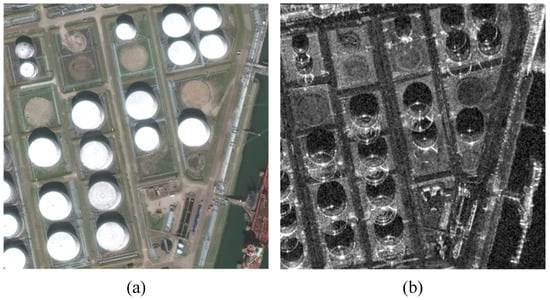
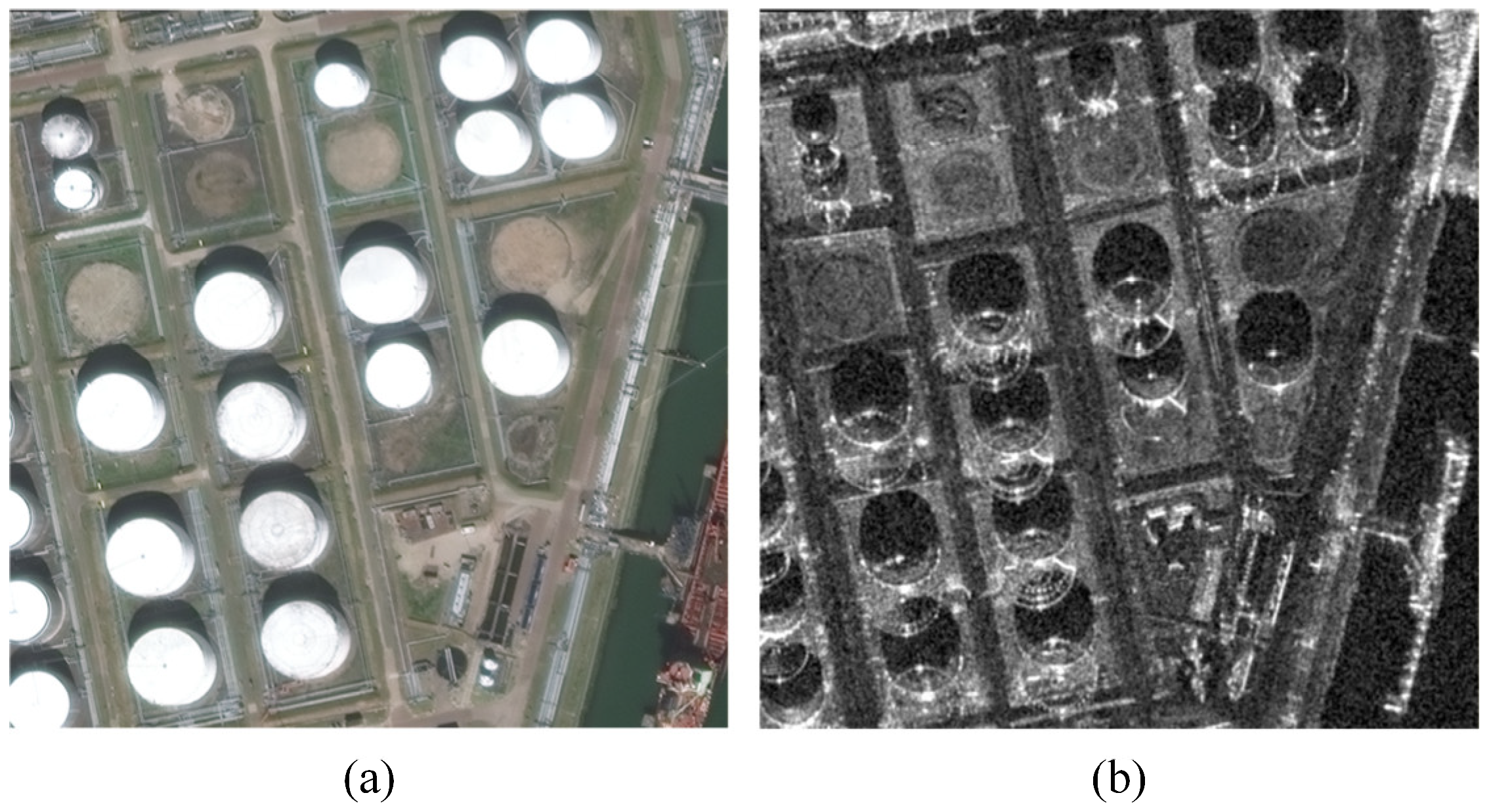
To address these domain-specific challenges, researchers have increasingly tailored architectures for particular industrial targets, such as photovoltaic (PV) panels and oil tanks. In PV panel recognition, while earlier studies achieved promising results using classic CNNs (e.g., AlexNet, VGG, ResNet) [9,10,11], the field has transitioned toward global-feature-driven architectures. For instance, the TransPV framework [12] introduces a vision transformer-based model to capture long-range dependencies, effectively extracting densely packed PV arrays within cluttered urban and mountainous environments. Similarly, in oil tank recognition, existing approaches perform well in scenarios with clear shapes and sparse layouts [13,14,15]. However, relying solely on optical imagery often leads to confusion between tanks and other circular objects. Conversely, while SAR imagery highlights tank structures via strong metal scattering, overlapping bright spots and shadow effects in densely populated areas blur object boundaries (as shown in Figure 1). Despite these target-specific advances, most existing approaches rely heavily on high-resolution RGB imagery, often overlooking the complementary potential of multi-modal data, such as leveraging multispectral responses for PV targets [16]. Recognizing this limitation, recent studies have increasingly explored multimodal fusion strategies, shifting from naive data stacking toward physically consistent and learning-driven integration frameworks [17]. These observations indicate that different modalities provide complementary yet incomplete representations, motivating the need for effective multimodal fusion strategies.
Figure 1.
Comparison of typical industrial targets in (a) optical and (b) SAR imagery, illustrating their complementary spectral and scattering characteristics.
Multi-source image fusion in remote sensing has been a research hotspot since the 1970s, with broad applications in infrared–visible, medical, and SAR domains. Traditional fusion algorithms are primarily categorized into multi-scale transforms [18,19,20], saliency detection, and sparse representation [21,22]. While hybrid strategies [23,24] initially improved performance, the field has rapidly shifted toward data-driven deep learning. Early milestones like CNN-based frameworks [25] and DenseFuse [26] established the foundation. Notably, to bridge the inherent physical domain gap between SAR and visible spectra, recent advances such as Retinex-guided SAR reconstruction [27] have introduced illumination-reflectance decomposition to align cross-modal features, effectively mitigating the visual inconsistencies caused by disparate imaging mechanisms. Concurrently, multimodal adaptive fusion emerged as a major research trajectory. Representative frameworks like U2Fusion [28] achieved robust unsupervised end-to-end fusion across diverse scenarios—including infrared–visible, multi-exposure, and multi-focus imagery—through adaptive information preservation. Subsequent innovations incorporated attention mechanisms and Transformers; for instance, SSAFNet [29] improved multimodal joint semantic segmentation via a dual-stream encoder–decoder architecture, while CMTFusion [30] leveraged multi-scale features and cross-domain interactions to efficiently extract complementary information. Currently, the state of the art in multimodal fusion has transcended these early architectures, with recent frameworks increasingly employing generative paradigms and advanced state-space models. VDMUFusion [31], for example, leverages diffusion models to capture intricate cross-modal distribution patterns, though at the cost of high computational overhead. To address the efficiency–accuracy trade-off, WEMFusion [32] introduced a wavelet-driven, discrepancy-aware Mamba framework, achieving superior long-range dependency modeling with linear-time complexity.
Despite these architectural leaps, image fusion technology fundamentally aims to integrate complementary information—such as preserving optical spectral context while extracting unique SAR scattering textures [20]—to enhance target feature representation. While studies have demonstrated fusion feasibility in land cover classification and ship detection [33], and models like FDFNet [34] have realized end-to-end joint modeling, most research remains heavily focused on the visible–infrared or multispectral domains [35,36,37]. Crucially, the existing literature predominantly emphasizes the visual quality of fused images, relying heavily on statistical metrics like structural similarity (SSIM) and entropy [38]. However, a profound “evaluation gap” persists: higher statistical scores do not necessarily translate into superior performance in downstream detection tasks [39]. This decoupling between fusion metrics and task efficacy limits the practical reliability of current methods, highlighting an urgent need for task-oriented approaches in next-generation detection systems [40,41].
To address this limitation, this work builds upon our preliminary study presented at IGARSS 2025 [42], where we initially demonstrated the feasibility of optical–SAR fusion for oil tank detection using a basic pixel-level fusion strategy. However, the prior study was limited to a single application scenario and did not systematically investigate the role of fusion quality in downstream detection, generalization across different industrial targets, or the relationship between fusion metrics and task-level performance. In contrast, the present work moves beyond preliminary validation and aims to provide a systematic investigation of how pixel-level fusion influences downstream object detection in complex industrial environments. More importantly, it establishes a task-oriented evaluation paradigm, explicitly examining the relationship between image-level fusion quality and detection performance.
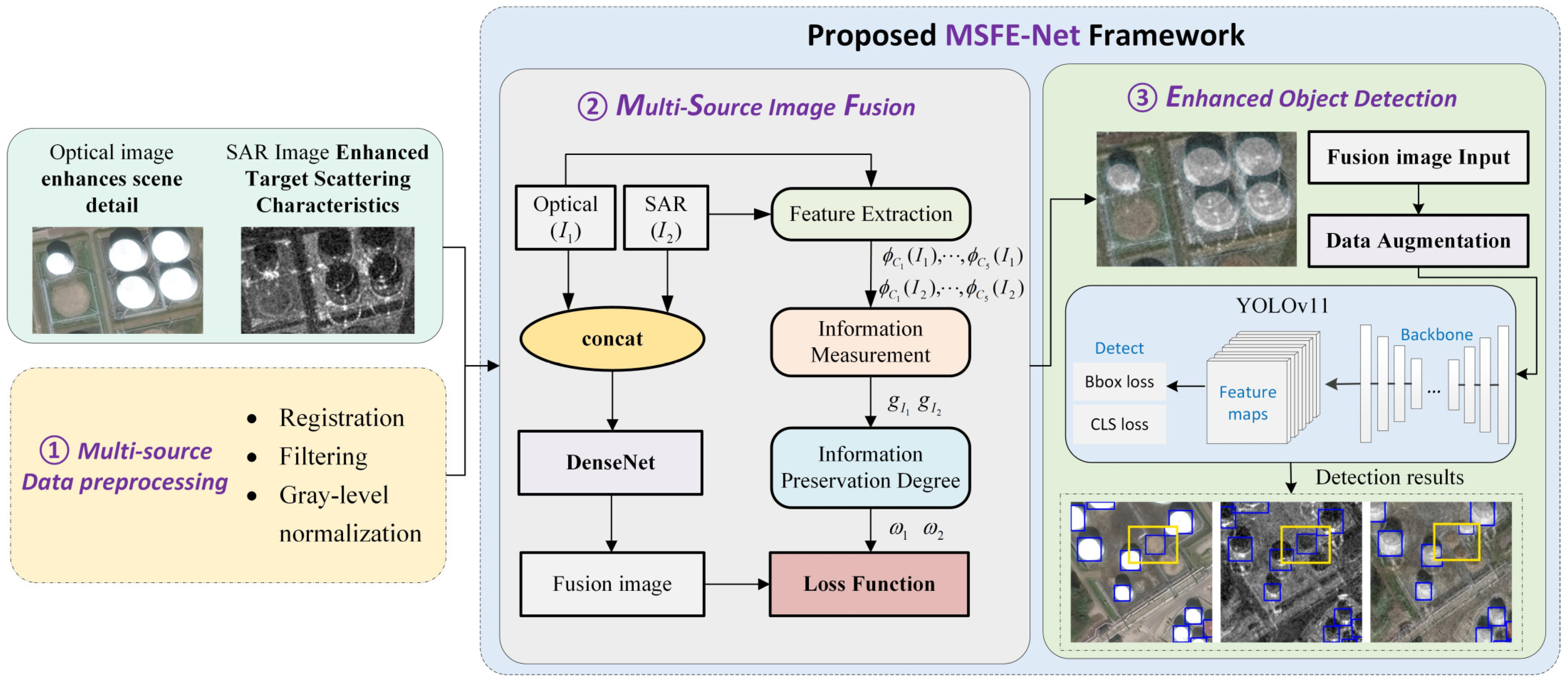
To this end, we propose a target-enhanced detection framework, termed the Multi-Source Fusion for Enhanced Object Detection Network (MSFE-Net). The framework leverages the U2Fusion [28] model to integrate registered optical and SAR images—preprocessed using techniques such as Lee Sigma filtering to ensure feature consistency—thereby generating fused imagery that preserves both optical scene details and SAR scattering characteristics. These fused representations are subsequently processed by a YOLOv11-based rotated object detector.
The main contributions of this paper are summarized as follows:
- Key Finding: An Evaluation Gap in Multimodal Fusion. We uncover a critical inconsistency between traditional image-level fusion metrics and downstream detection performance. Specifically, our analysis reveals a clear decoupling phenomenon, where improvements in global statistical image quality do not necessarily lead to better task-level accuracy, exposing a fundamental limitation in existing evaluation paradigms.
- Methodological Contribution: A Task-Oriented Optical–SAR Fusion Framework. To address this gap, we propose MSFE-Net, a unified framework that prioritizes task-relevant feature preservation over global perceptual enhancement. By integrating U2Fusion with a YOLOv11 detector, the framework effectively combines optical spectral information with SAR scattering characteristics to directly optimize downstream semantic representations.
- Experimental Contribution: Comprehensive Validation Across Multiple Scenarios and Architectures. We establish a multi-scenario optical–SAR dataset (PV-FusionData) and perform extensive evaluations across representative fusion methods and diverse detection architectures. The results consistently corroborate the identified decoupling phenomenon and demonstrate that task-oriented fusion leads to more reliable performance gains, particularly for multi-scale and weak targets in complex environments.
The remainder of this paper is organized as follows. Section 2 describes the proposed MSFE-Net framework, including the data pre-processing workflow, the U2Fusion-based feature integration, and the YOLOv11 detection architecture. Section 3 details the experimental setup, introducing the SpaceNet6 oil tank dataset and the newly constructed PV-FusionData benchmark, along with the evaluation metrics. Section 4 provides a comprehensive analysis of the experimental results, including both quantitative and qualitative comparisons, and discusses the decoupling between fusion metrics and detection performance. Finally, Section 5 concludes the paper by summarizing the key findings and suggesting directions for future research.
2. Methodology
2.1. Overview of the Proposed Method
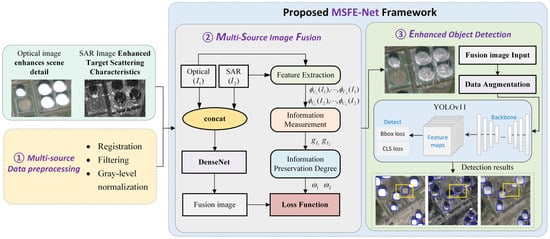
MSFE-Net is designed as a task-oriented detection framework specifically engineered to bridge the long-standing gap between low-level image fusion and high-level object recognition. While conventional fusion frameworks predominantly prioritize visual fidelity and statistical similarity, MSFE-Net shifts the focus toward the synergistic integration of spectral context from optical sensors and structural scattering characteristics from SAR. As illustrated in Figure 2, the framework is structured into three interdependent yet functionally distinct modules: systematic multi-source preprocessing, unsupervised deep feature fusion, and oriented object detection.
Figure 2.
Framework of the proposed MSFE-Net method.
To enhance generalization and suppress overfitting, varied augmentation—including random flipping and brightness/contrast adjustments—was applied to training patches to increase sample diversity. The core philosophy of MSFE-Net is to demonstrate that pixel-level deep fusion maintains semantic consistency more effectively than either late-fusion strategies or single-source methods, particularly in complex industrial environments. A defining characteristic of this framework is its modular evaluation design, separating the fusion and detection stages. By performing a comparative analysis across multiple fusion strategies and single-source benchmarks, MSFE-Net provides a robust platform to investigate the “evaluation gap”—the phenomenon where traditional image quality metrics (such as MI or SSIM) do not linearly correlate with downstream task performance. This architectural design enables us to validate a new task-driven evaluation paradigm, proving that the efficacy of fusion should be assessed through the lens of mission success rather than purely statistical indicators.
2.2. Multi-Source Data Preprocessing
The physical rationale for this multimodal integration lies in the complementary imaging mechanisms of optical and SAR sensors. Optical imagery captures high-resolution spectral reflectance and fine spatial textures, but it is intrinsically vulnerable to illumination variations, shadow interference, and visual mimics in cluttered backgrounds. In contrast, SAR operates as an active microwave sensor. Specifically, C-band SAR (with a wavelength of approximately 5 cm) is highly sensitive to the structural geometry and dielectric properties of industrial targets. Human-made metallic structures, such as the cylindrical shells of oil tanks or the rigid frameworks of PV panels, frequently induce strong corner-reflector effects (dihedral scattering). This yields highly stable and distinctive backscattering signatures regardless of ambient lighting or complex visual camouflage. Therefore, SAR’s physical scattering characteristics provide robust structural anchors that penetrate complex backgrounds, effectively compensating for the semantic ambiguity of optical sensors. To bridge the radiometric and geometric discrepancies between heterogeneous sensors, the input imagery undergoes a systematic preprocessing pipeline. The core objective is to ensure cross-modal feature consistency, providing a stable foundation for subsequent pixel-level fusion. For SAR imagery, we employ Lee Sigma filtering to suppress inherent speckle noise while preserving critical structural edges of targets. To align the diverse bit-depths, a dynamic range compression and normalization strategy is applied, mapping high-bit-depth radar backscatter to a standardized grayscale range compatible with deep learning encoders. Furthermore, a multi-stage registration strategy—combining coarse geometric correction with fine-grained mutual information alignment—is implemented to eliminate parallax errors, ensuring that the semantic information of targets is spatially coincident across both modalities.
2.3. Multi-Source Image Fusion via Adaptive Feature Representation
The fusion module in MSFE-Net leverages the U2Fusion framework, a unified unsupervised network designed to bridge the gap between heterogeneous imagery without requiring ground-truth references. The core philosophy is to treat fusion as a multi-source information measurement and preservation task, ensuring that the fused output retains the most salient features from both optical and SAR sensors. The feature extraction phase utilizes a hierarchical architecture to capture multi-scale representations. Specifically, shallow convolutional layers are responsible for capturing local textures and fine edges—predominantly present in optical spectral channels—while deeper layers extract structural and semantic content, which is critical for interpreting SAR scattering patterns. To quantify the relative importance of each modality, U2Fusion computes an information richness measure (G) based on the spatial gradient of the feature maps:
where denotes the gradient operator, and H, W, C represent the dimensions of the feature map F. This metric determines the adaptive information preservation degree (), which dynamically balances the contribution of optical and SAR inputs:
Here, is a smoothing constant to maintain numerical stability, and denotes the specific input modality. A higher forces the network to prioritize the spectral details of the optical image, whereas a higher ensures that the structural scattering intensity of the SAR data is preserved. This adaptive weighting is optimized through a DenseNet-based decoder using a structural similarity (SSIM) and pixel-intensity loss function:
The SSIM term ensures geometric and structural consistency, while the MSE term (weighted by α = 20) is adopted as a stable empirical setting to constrain radiometric distortion. The DenseNet backbone employs dense shortcuts between the first seven layers to mitigate gradient vanishing and enhance feature reuse, ultimately compressing 44 feature channels into a single information-enhanced fused output.
2.4. Task-Specific Object Detection via YOLOv11
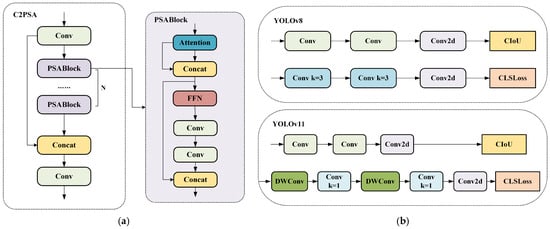
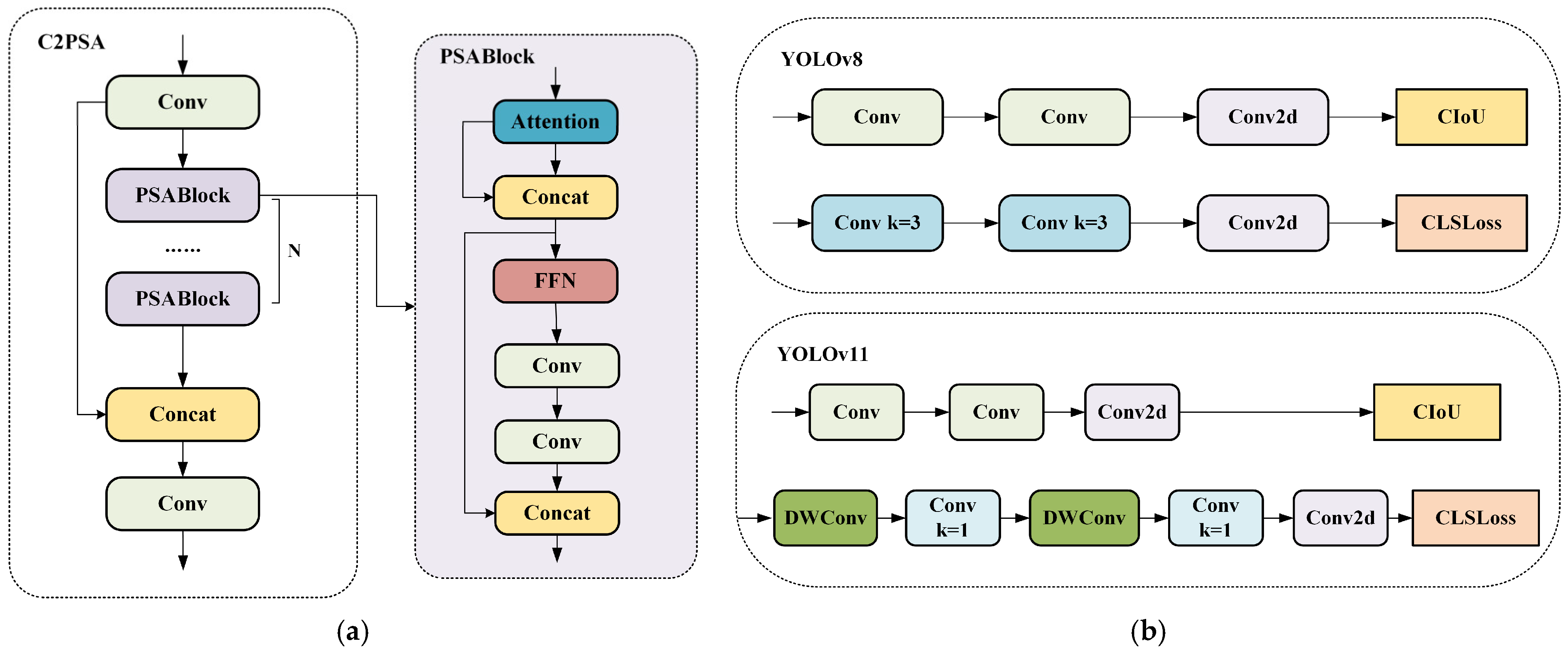
To translate the fused information into precise target localization, we adopt YOLOv11, implemented based on the Ultralytics framework. YOLOv11 represents a recent evolution within the YOLO series, emphasizing a balance between detection accuracy and computational efficiency. The architecture introduces two critical innovations (Figure 3). First, the C2PSA (Cross-Stage Partial with Self-Attention) module integrates a multi-head self-attention mechanism, allowing the network to focus on long-range spatial dependencies. This is vital for recognizing large-scale industrial structures like PV arrays in cluttered environments. Second, the classification head incorporates Depthwise Separable Convolutions (DWConv) to reduce computational overhead while maintaining discriminative power, directly addressing the processing efficiency required for practical remote sensing applications. The implementation used in this study is based on the official Ultralytics repository, ensuring reproducibility.
Figure 3.
Architecture of the key components in YOLOv11 adapted for multi-source industrial detection: (a) The C2PSA module which captures long-range spatial dependencies for large-scale PV arrays. (b) The optimized classification head utilizing DWConv to balance detection precision and computational efficiency in remote sensing scenarios.
The optimization objective is governed by a combined loss function focusing on classification accuracy and bounding box regression:
For classification, Binary Cross-Entropy (BCE) is employed to handle multi-category industrial targets. For regression, the framework utilizes Complete Intersection over Union (CIoU) loss and Distribution Focal Loss (DFL). Unlike traditional anchor-based methods, YOLOv11 adopts an anchor-free, center-based strategy that directly predicts distances from the object center to bounding box edges. The DFL term refines these distances by optimizing the probabilities of the values closest to the ground-truth (y):
where and represent the predicted probabilities of the adjacent discrete labels. This anchor-free formulation, combined with an angle regression term, may improve sensitivity to densely distributed and arbitrarily oriented targets, while also facilitating stable optimization in complex remote sensing scenarios.
3. Experimental Results and Analysis
This section evaluates the proposed multi-source fusion framework through a series of systematically designed experiments. The section is organized into data preparation, comparative experiments, performance analysis, and ablation studies. First, the datasets, preprocessing procedures, and experimental settings are described. Then, quantitative comparisons are conducted using multiple evaluation metrics. The detection performance is further analyzed with representative visualizations. Finally, ablation experiments are performed to examine the impact of different fusion strategies and to highlight the effectiveness and applicability of the proposed method. The specific software environment, hardware configuration, and hyperparameter settings used in all experiments are summarized in Table 1. All experiments were conducted using CUDA 11.1 in a Python 3.8.18 environment to ensure computational efficiency and reproducibility.
Table 1.
Hardware, software, and hyperparameter configurations.
3.1. Dataset and Experimental Settings
Two datasets were used to evaluate the performance of the proposed MSFE-Net framework. The statistical distribution of instances and the train–test splits are summarized in Table 2. To reduce the domain gap between natural images and remote sensing data while avoiding overfitting on small-scale datasets, the U2Fusion-based fusion module was trained from scratch using 3401 strictly co-registered optical–SAR image pairs derived from the SpaceNet dataset. A VGG16 network pre-trained on ImageNet was used as a fixed feature extractor for loss computation without fine-tuning.
Table 2.
Statistical distribution of the experimental datasets.
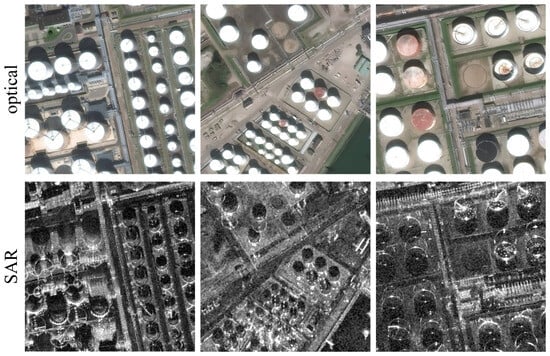
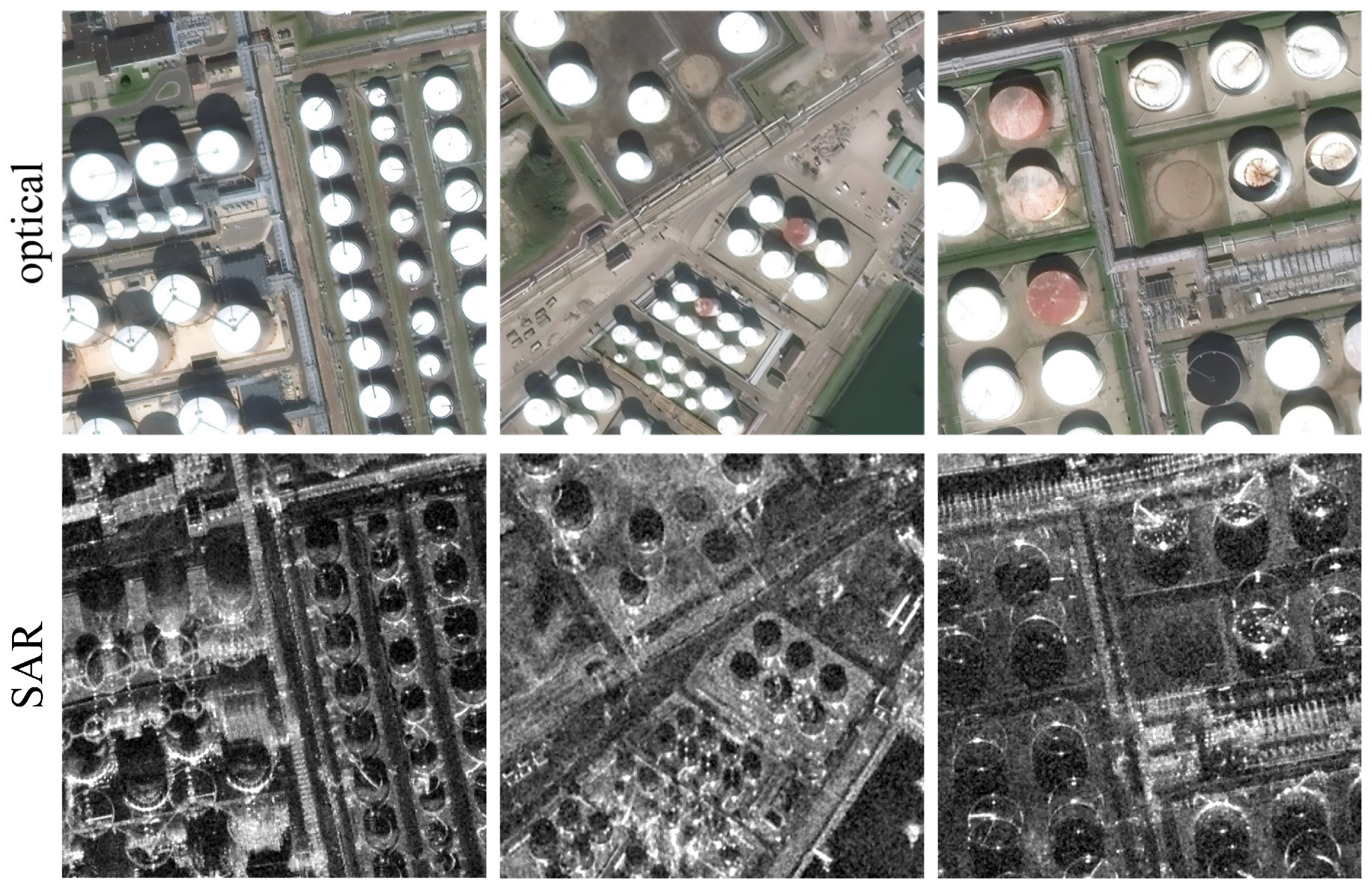
- SpaceNet6 Oil Tank Dataset: This dataset covers the Port of Rotterdam, Netherlands, providing strictly co-registered optical and multi-polarization SAR image pairs. For our experiments, 2348 oil tank instances were annotated. We employed the YOLOv11s-OBB paradigm for initial automated labeling, followed by rigorous manual correction to ensure geometric precision. The dataset was split into 1864 samples for training and 484 for testing (Figure 4).
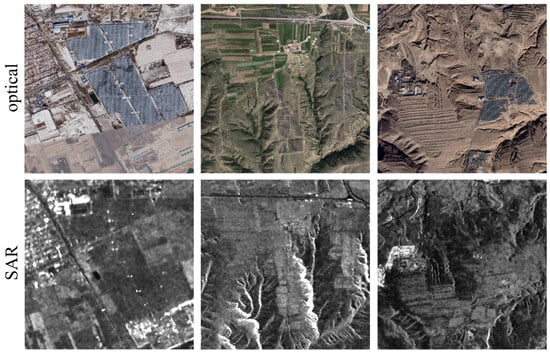
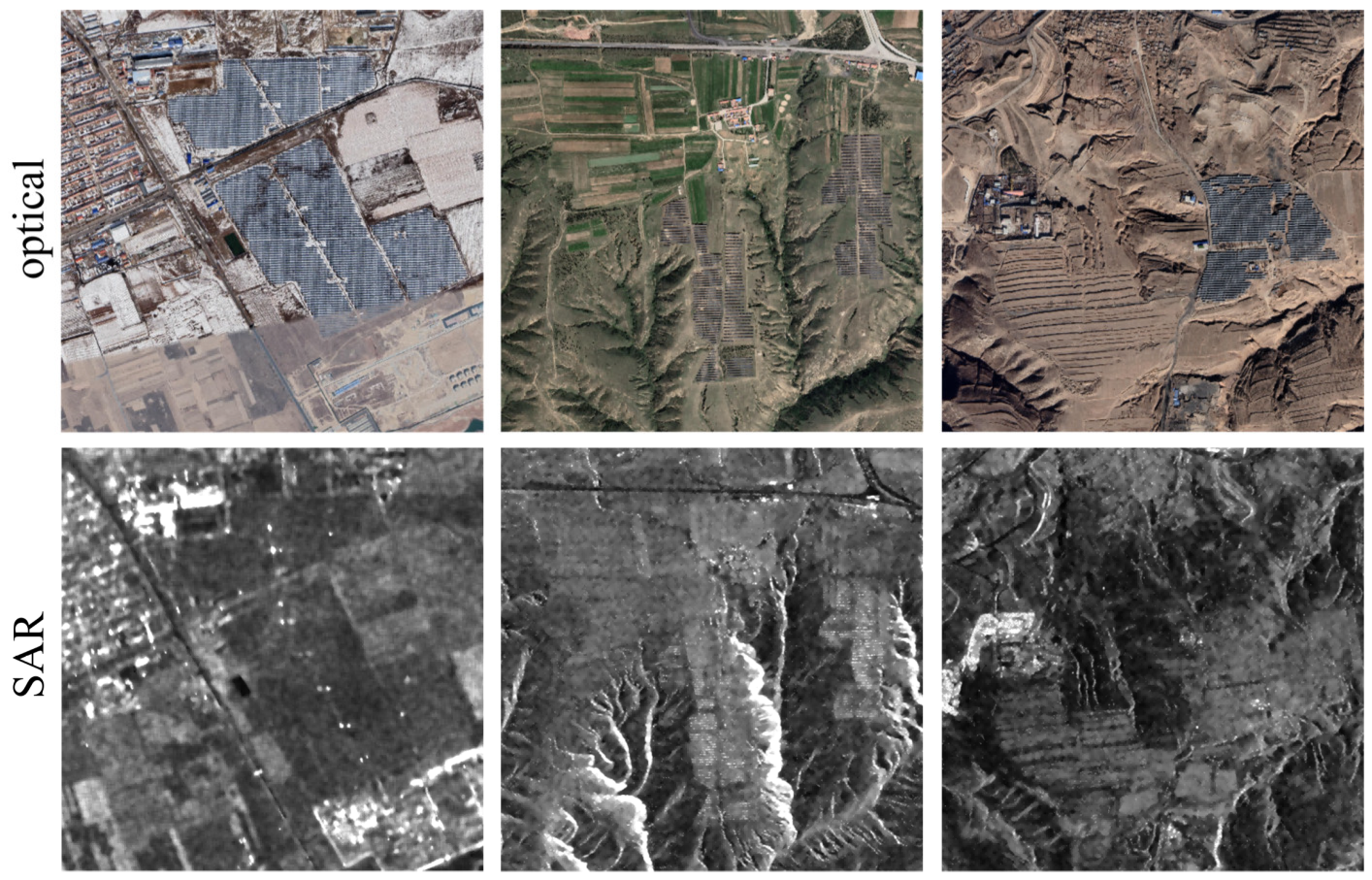
- PV-FusionData Benchmark: To address the lack of multi-source datasets in industrial monitoring scenarios, a PV-FusionData benchmark was constructed. This dataset integrates 1.5 m resolution optical imagery from the 91 Satellite Map platform and 3 m resolution C-band SAR imagery from the HISEA-1 satellite. The dataset contains 380 image pairs, including 235 positive and 145 negative samples, providing a testbed for evaluating multimodal fusion in complex environments (Figure 5).
Figure 4.
Sample visualization of the oil tank dataset: the first row shows optical images, and the second row shows the corresponding SAR images.
Figure 5.
Sample visualization of the PV-FusionData benchmark: the first row shows optical images, and the second row shows the corresponding SAR images.
The detailed preparation procedure for the PV-FusionData benchmark is executed as follows:
- Data Acquisition: High-resolution optical imagery corresponding to the coverage of the acquired SAR data was retrieved from the 91 Satellite Map platform to ensure temporal and spatial proximity.
- Radiometric Normalization and Denoising: SAR images were processed using a 3 × 3 Lee Sigma filter to suppress speckle noise, followed by dynamic range compression to map floating-point values to 8-bit grayscale.
- Spatial Co-registration: Image resampling was performed to unify the spatial resolution, followed by a multi-stage geometric registration process to eliminate parallax errors between the heterogeneous sensors.
- Patch Generation: The synchronized optical and SAR images were partitioned into paired 512 × 512 pixel patches and archived in TIFF format at a unified spatial resolution of 3 m, ensuring the integrity of the fused semantic information.
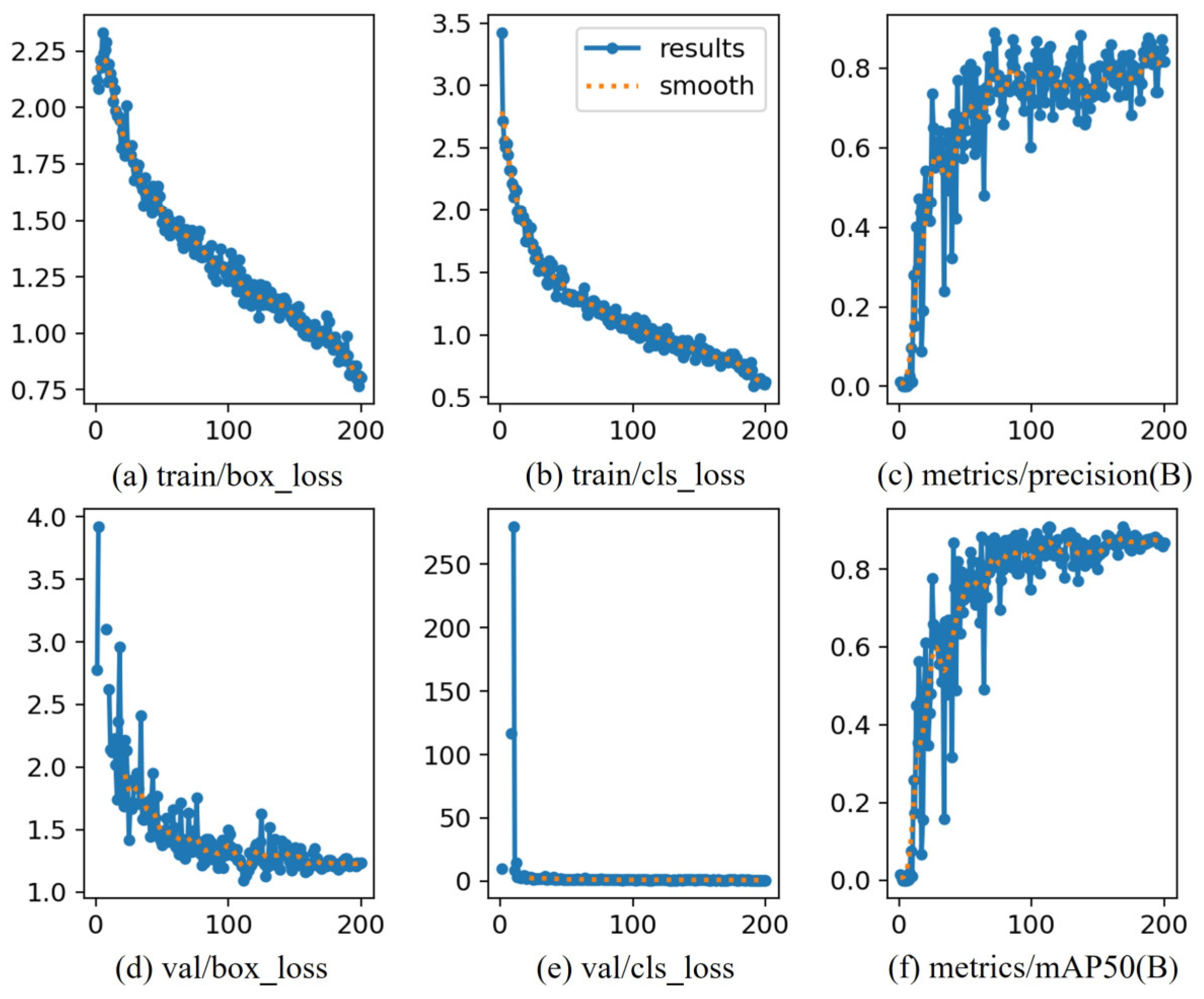
To mitigate overfitting on the relatively small PV-FusionData dataset, the YOLOv11 detector was fine-tuned using data augmentation techniques, including horizontal flipping, scaling, HSV adjustments, RandAugment, and random erasing. As shown in the learning curves in Appendix A, the validation performance follows the training trend without significant divergence, suggesting stable convergence and reasonable generalization.
3.2. Comparative Experiments and Evaluation Metrics
To validate the effectiveness of the proposed MSFE-Net and to examine the relationship between fusion quality and downstream detection performance, a structured evaluation framework is adopted. For quantitative comparison, three representative fusion methods—DenseFuse [26], CMTFusion [30], and VSFF [43]—are selected as baselines. To ensure fairness, all fusion results are evaluated within the same YOLOv11 detection framework using identical dataset splits and training settings. In addition, a systematic ablation study is conducted to analyze the contributions of different fusion strategies. Five configurations are considered: (i) optical-only input, (ii) SAR-only input, (iii) input-level channel stacking, (iv) decision-level late fusion, and (v) the proposed MSFE-Net (feature-level fusion). This setup enables a controlled comparison of different fusion paradigms.
To comprehensively evaluate model performance, three complementary perspectives are considered:
(1) Image-level fusion quality: Variance (Var), Entropy (EN), and Edge Intensity (EI) measure texture richness and structural detail. The no-reference metric NIQE [44] evaluates statistical naturalness. Mutual Information (MI) [45] and Visual Information Fidelity (VIFF) [46] assess information preservation. [47] evaluates edge transfer, and SCD [48] measures radiometric consistency.
(2) Task-level detection performance: Precision, Recall, and mAP@50 are used to evaluate localization and classification performance.
(3) Qualitative analysis: Representative visual results are provided to illustrate how different fusion strategies affect detection robustness under complex conditions.
This multi-perspective evaluation framework enables a systematic comparison between image-level fidelity and task-level performance and provides a basis for further analysis of their relationship in the subsequent sections.
3.3. Analysis of Fusion Quality and Detection Performance
The proposed method was systematically evaluated using multiple quantitative metrics across both oil tank and photovoltaic (PV) datasets to assess fusion quality and downstream detection performance. As summarized in Table 3, the fused images produced by the proposed framework achieve lower NIQE scores compared to single-source inputs, suggesting improved statistical naturalness and reduced distortion. In the oil tank dataset, although Entropy (EN) and Edge Intensity (EI) values are slightly lower than those of raw SAR images, they remain higher than those of optical images. This trend suggests that the fusion process suppresses part of the inherent speckle noise while retaining important structural information. Similarly, on the PV dataset, the NIQE of fused images is lower than that of either optical or SAR imagery, indicating improved perceptual quality. While slight reductions in Variance (Var) and EN imply a certain degree of detail smoothing, the EI metric remains comparable to SAR imagery, reflecting a balance between noise suppression and edge preservation. Overall, these results suggest that the proposed method maintains structural consistency while improving visual quality.
Table 3.
Quantitative comparison of image quality across experimental datasets.
To further examine how these image-level improvements relate to downstream tasks, detection performance is reported in Table 4. For the oil tank task, the fusion-based model achieves comparable Precision and Recall to the optical-only model, while reducing false positives in complex background regions. Compared with the SAR-only model, the proposed framework shows a substantial improvement, with an increase of 19.5% in mAP@50. Similarly, in PV panel detection, the fusion-based model improves Precision compared to single-modality baselines, indicating enhanced robustness under complex environmental conditions.
Table 4.
Comparison of detection performance using different multi-modal strategies.
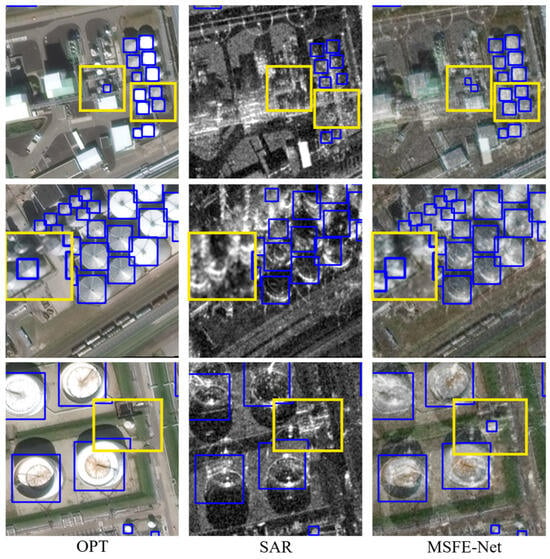
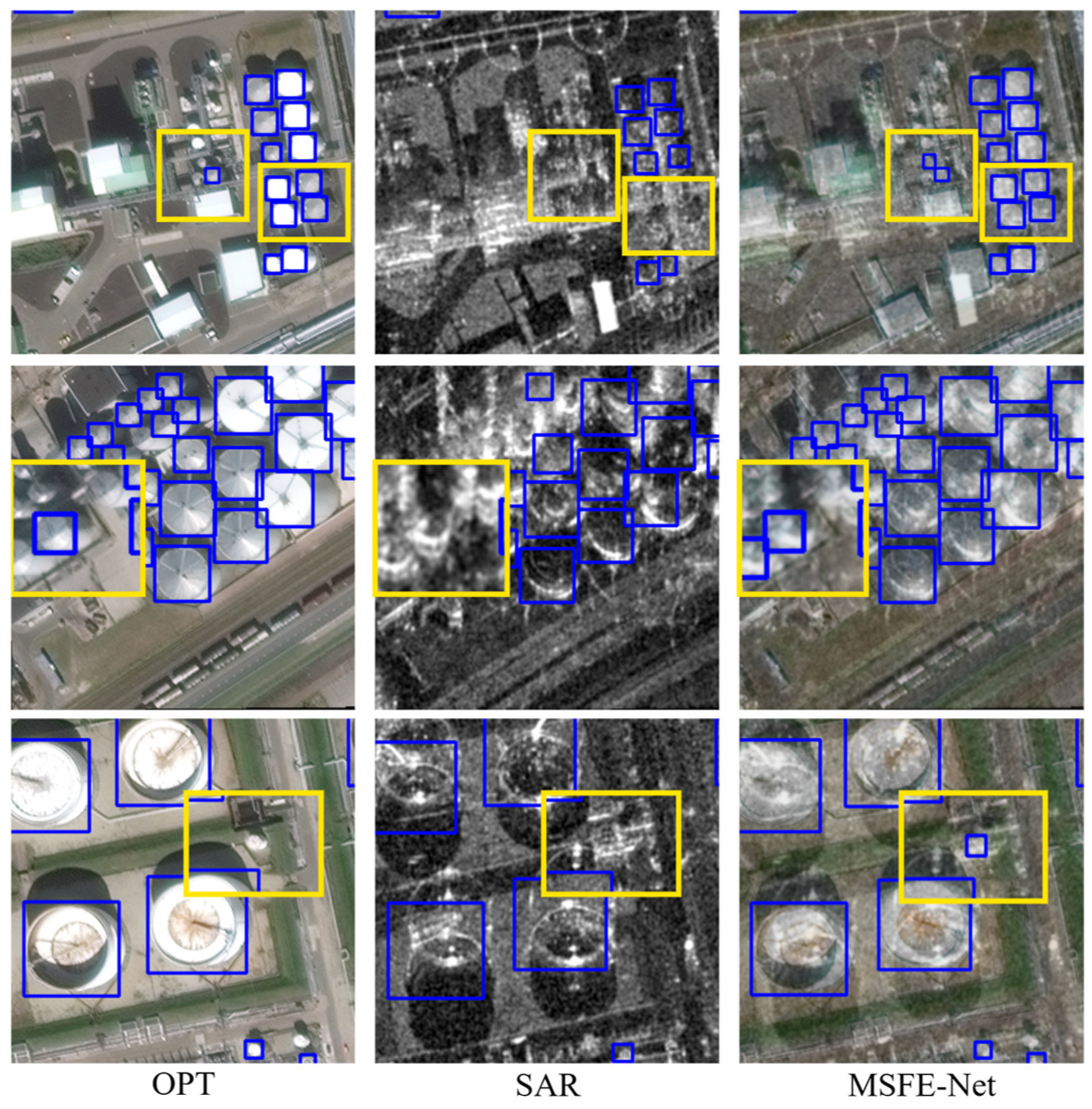
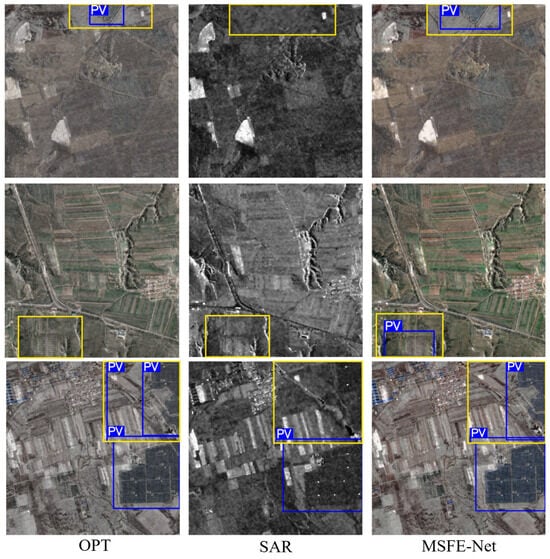
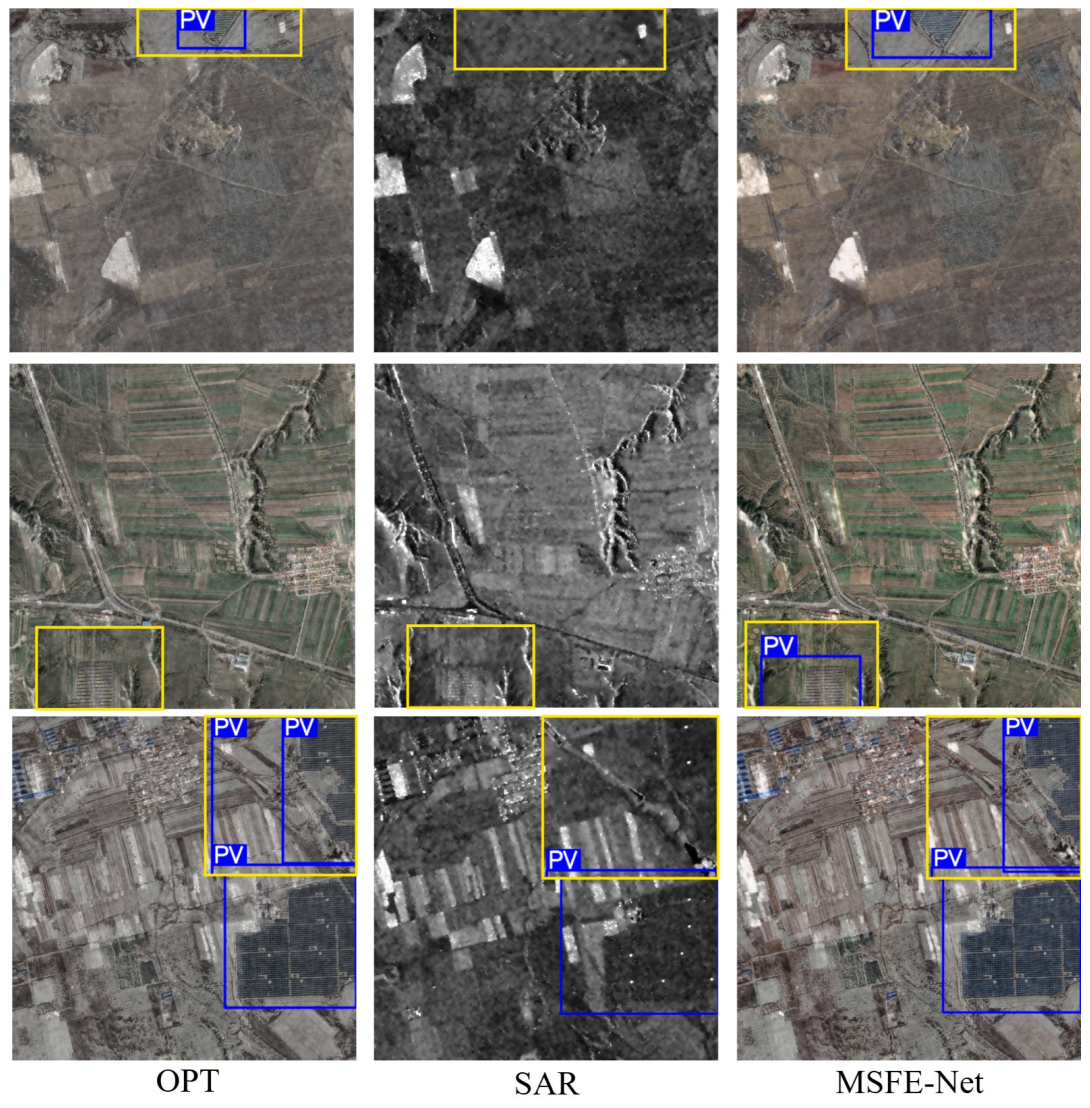
Qualitative results in Figure 6 and Figure 7 provide further insights. In the oil tank scenario (Figure 6), optical imagery tends to miss small or low-contrast targets and may introduce false detections in regions with similar geometric patterns. By incorporating SAR scattering information, MSFE-Net helps alleviate these issues, improving detection completeness and reducing confusion with background structures. In the PV panel scenario (Figure 7), SAR imagery often exhibits boundary omissions, whereas optical imagery may suffer from duplicate detections under complex urban backgrounds. The fusion-based approach mitigates these limitations by combining complementary information from both modalities, resulting in more consistent localization and improved detection stability.
Figure 6.
Qualitative results on oil tank detection. Yellow boxes denote optical false alarms and misses rectified by MSFE-Net through SAR scattering integration, while blue boxes indicate the final detection results produced by the proposed method.
Figure 7.
Qualitative results on PV panel detection. Yellow boxes highlight optical duplicates and SAR boundary omissions resolved by MSFE-Net’s feature fusion, while blue boxes indicate the final detection results produced by the proposed method.
Overall, these results suggest that integrating complementary features from optical and SAR data can enhance detection robustness compared to single-modality approaches. At the same time, the relationship between image quality improvements and detection performance is not strictly consistent, which motivates further analysis in the following sections.
3.4. Comparative Analysis and the Decoupling Phenomenon
To further evaluate the effectiveness of the proposed framework, comparative experiments were conducted against several representative fusion methods, including DenseFuse, CMTFusion, and VSFF, under identical experimental settings. As shown in Table 5, some methods (e.g., VSFF) achieve relatively high scores in image quality metrics such as SCD and MI. However, these improvements in image-level statistical metrics do not consistently correspond to superior detection performance, as evidenced by the discrepancies observed in Table 6. This result suggests a measurable inconsistency between traditional image quality evaluation criteria and downstream task performance.
Table 5.
Comparison of image quality evaluation results for different fusion methods.
Table 6.
Comparative detection performance of different fusion models.
To examine whether this observed decoupling is specific to YOLOv11 or reflects a more general phenomenon, we further extend the evaluation to two representative detection architectures: Faster R-CNN (two-stage, anchor-based) and RetinaNet (one-stage, anchor-based). The comprehensive results are summarized in Table 6. Under the YOLOv11 architecture, although VSFF achieves competitive image-level quality, the proposed MSFE-Net (based on the U2Fusion module) exhibits more stable detection performance across different scenarios. In particular, it achieves the highest mAP@50 of 99.1% for oil tank detection and competitive precision of 89.8% for PV panel detection. When extending the evaluation to Faster R-CNN and RetinaNet, a broadly consistent trend is observed across architectures. While different detectors exhibit varying sensitivities to fusion strategies (e.g., Faster R-CNN shows relatively better performance with VSFF, whereas RetinaNet performs better with U2Fusion-based fusion), the overall ranking of detection performance does not strictly follow the ranking of image-level quality metrics.
It is also worth noting that the oil tank dataset represents a challenging scenario characterized by densely distributed small-scale targets. Under such conditions, anchor-based detectors (Faster R-CNN and RetinaNet) tend to show relatively lower performance, which may be attributed to anchor-scale mismatch and increased sensitivity to non-maximum suppression. Nevertheless, despite these architectural differences, the core observation remains consistent: fusion methods achieving higher image-level statistical scores do not necessarily yield superior detection performance across different detectors.
Taken together, these results suggest that the observed decoupling is not detector-specific but may reflect a more fundamental mismatch between global statistical optimization and task-oriented feature representation. In contrast, the proposed framework places greater emphasis on preserving structurally and semantically informative features, which contributes to more robust downstream detection performance. This finding further supports the importance of evaluating multimodal fusion from a task-oriented perspective rather than relying solely on conventional image quality metrics.
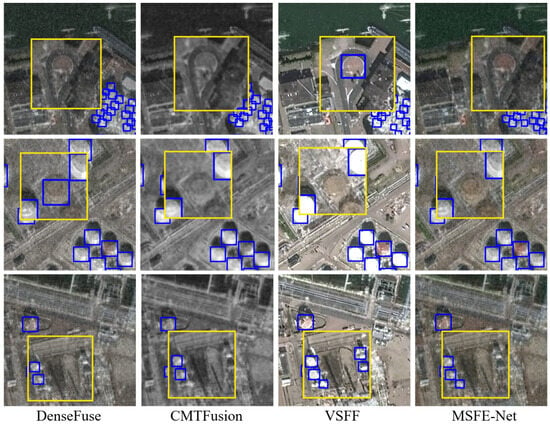
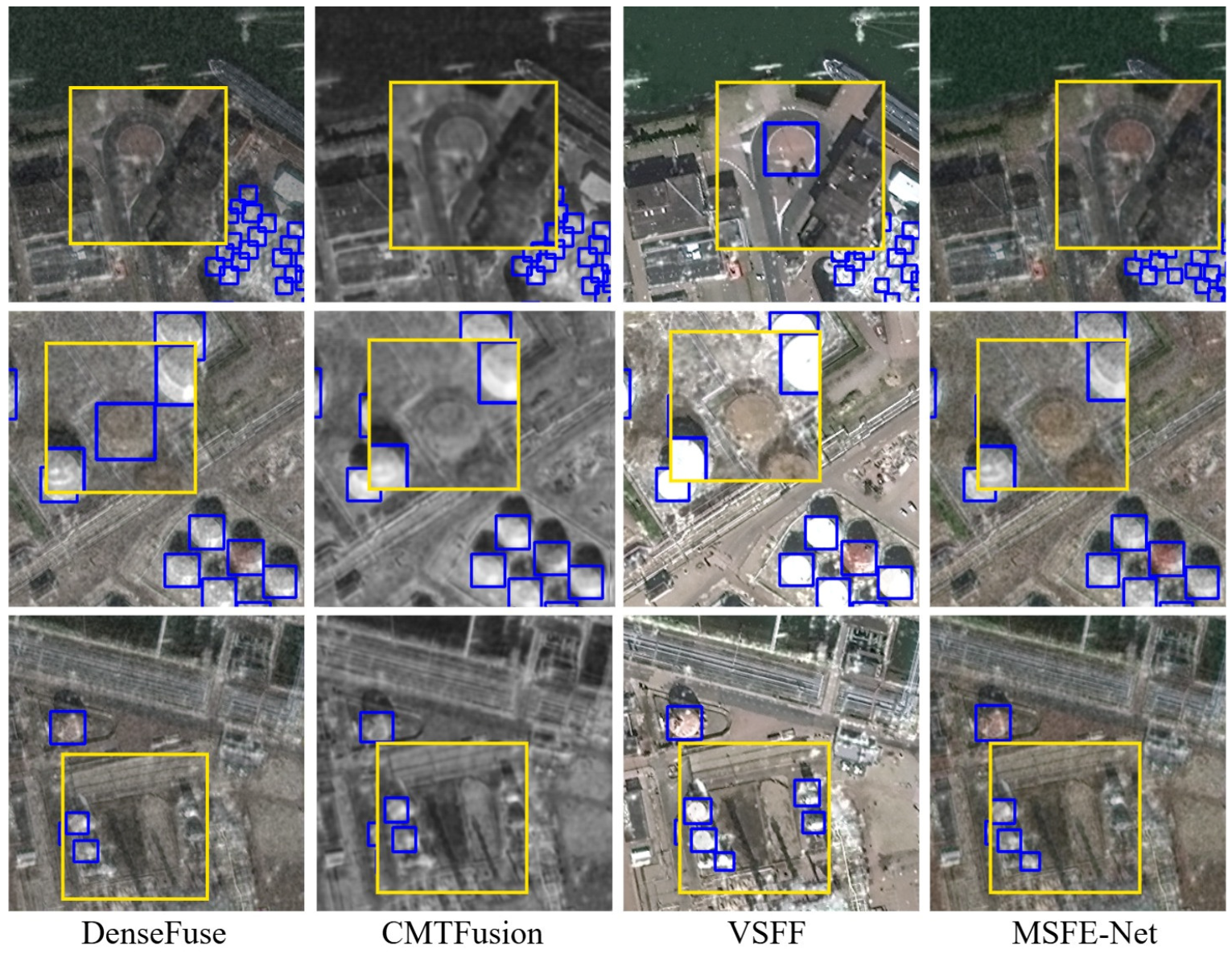
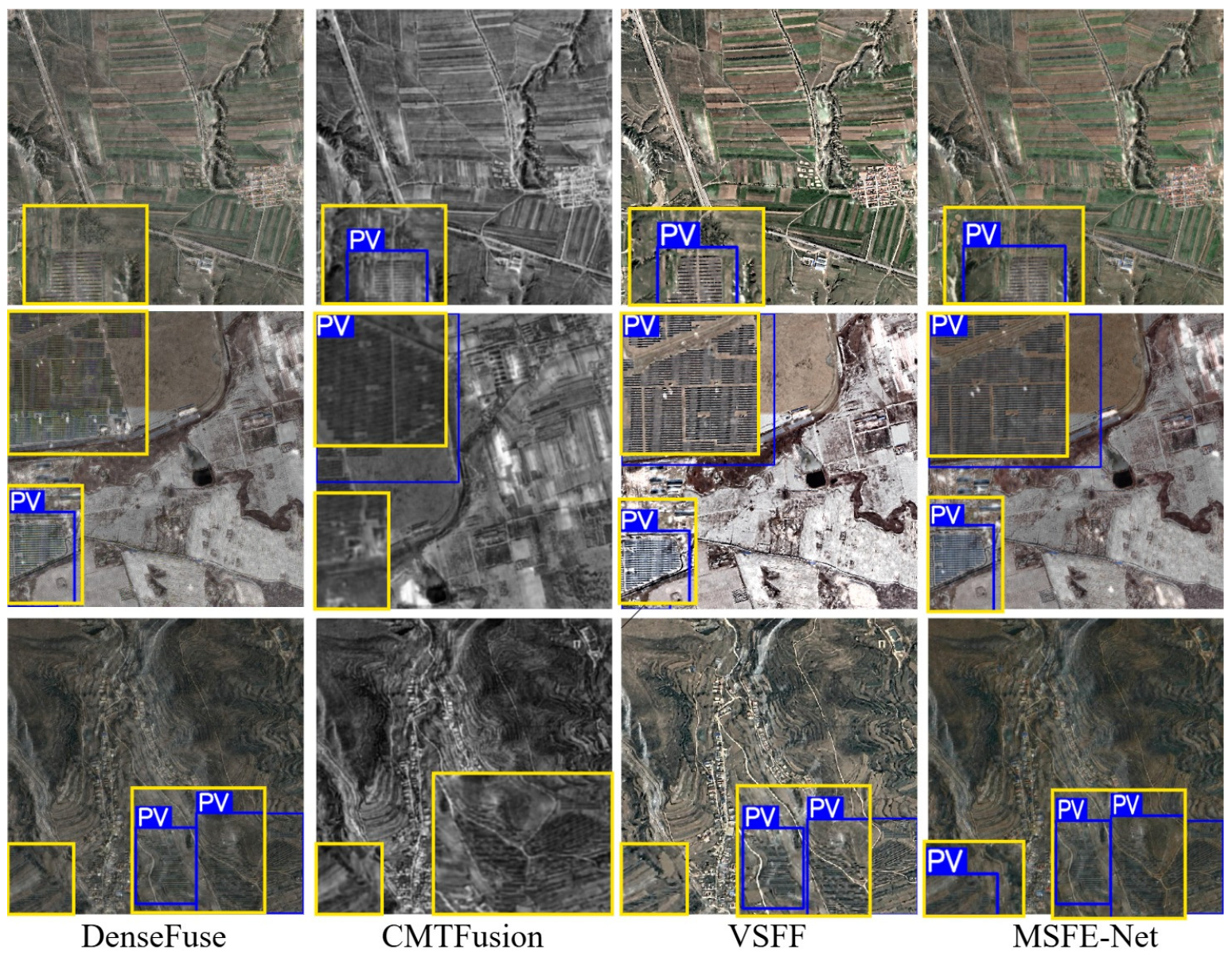
Qualitative results in Figure 8 and Figure 9 further support this observation. In the oil tank scenario (Figure 8), the proposed method integrates complementary information from optical and SAR modalities, improving the detection of small-scale or partially occluded targets, while reducing false detections in background regions with similar geometric structures. For PV panel detection (Figure 9), the proposed method achieves improved recall under complex environments and maintains more consistent localization in the presence of spectral ambiguity and terrain-induced distortions. Overall, these results indicate that a non-negligible gap exists between traditional image quality metrics and task-oriented performance. The proposed MSFE-Net helps alleviate this issue by enhancing task-relevant feature representation, thereby improving detection robustness.
Figure 8.
Typical detection errors across different fusion models on the oil tank dataset. Blue boxes indicate the final detected targets in each method for visual comparison. Yellow boxes highlight representative failure cases in baseline methods, including morphological similarity and ground imprint interference, while MSFE-Net effectively improves feature consistency and reduces false alarms.
Figure 9.
Typical detection errors across different fusion models on the PV panel dataset. Blue boxes indicate the final detected targets in each method for visual comparison. Yellow boxes highlight spectral confusion, edge omissions, and topographic interference in baseline methods, whereas MSFE-Net maintains more robust detection performance under complex conditions.
3.5. Performance Comparison and Ablation Analysis of Fusion Strategies
To evaluate the contributions of different fusion paradigms to detection performance, a systematic ablation study was conducted, including single-modality baselines, decision-level late fusion, input-level channel stacking, and the proposed image-level fusion framework (MSFE-Net). The quantitative results are summarized in Table 4. For single-modality baselines, the optical-only model achieves strong performance in oil tank detection (98.9% mAP@50), benefiting from clear structural features. However, its performance decreases on the photovoltaic (PV) dataset, particularly in terms of recall (85.2%), indicating sensitivity to background complexity and illumination variations. In contrast, the SAR-only model shows relatively limited performance on both datasets, with a notably low mAP@50 of 32.3% for PV detection, reflecting the difficulty of extracting discriminative semantic information from SAR data alone.
Regarding fusion strategies, different paradigms exhibit distinct characteristics. The decision-level late fusion approach improves performance compared to the SAR-only baseline, but remains inferior to more integrated fusion methods, achieving an mAP@50 of 93.8% for oil tank detection. This behavior may be attributed to the lack of feature-level interaction between modalities during representation learning. The input-level channel stacking approach achieves competitive performance on the PV dataset (90.4% mAP@50), slightly higher than MSFE-Net (90.2%). However, its precision for oil tank detection is significantly lower (83.4% vs. 97.2%), suggesting that simple concatenation may introduce cross-modal interference and noise, potentially leading to increased false positives.
Overall, MSFE-Net achieves strong and relatively balanced performance across different tasks. It attains the highest mAP@50 (99.1%) for oil tank detection and maintains competitive precision (89.8%) for PV detection. Compared with other fusion strategies, the proposed method places greater emphasis on preserving semantically relevant features and reducing cross-modal redundancy, which may contribute to more stable detection performance. These results suggest that feature-level fusion with a task-oriented design provides a practical trade-off between robustness and accuracy in complex industrial scenarios. Furthermore, to complement the performance analysis and assess practical feasibility, the computational overhead associated with the proposed framework is analyzed in Appendix B, including parameter counts, FLOPs, and inference speed. This analysis provides additional evidence regarding the applicability of the method for near-real-time deployment.
3.6. Parameter Sensitivity Analysis
To validate the empirical setting of the MSE loss weight α in Equation (3) and to further investigate the relationship between image fusion quality and downstream detection performance, a systematic parameter sensitivity analysis was conducted. Specifically, α was varied across {1, 5, 10, 20, 50, 200}. For each configuration, the fusion model was retrained under identical experimental settings. The resulting fused images were evaluated using both reference-based metrics (MI, VIFF, ), and SCD), no-reference metrics (EN and NIQE), and downstream detection performance (Precision, Recall, and mAP@50) on the oil tank dataset. The results are summarized in Table 7.
Table 7.
Parameter sensitivity analysis of α on fusion quality and detection performance.
As shown in Table 7, the image-level fusion metrics remain nearly invariant across different α values, with only negligible variations observed within the reported decimal precision. This behavior suggests that the SSIM term plays a dominant role in constraining global structural similarity, while variations in the MSE weight primarily influence local intensity distributions that are not fully captured by global statistical metrics. In contrast, the downstream detection performance exhibits more noticeable variations, particularly in mAP@50, which ranges from 84.9% to 93.0%.
These observations further support the decoupling phenomenon discussed in Section 3.4, suggesting that optimization with respect to traditional image quality metrics may not directly translate into improved task-level performance. It is also observed that although the highest mAP@50 is achieved at α = 50, the performance differences across α = 10–50 remain relatively moderate. In this work, α = 20 is selected as a balanced setting that provides stable training dynamics and consistently competitive performance across different configurations, rather than targeting a dataset-specific optimum. Overall, these results suggest that the MSE weight mainly affects task-relevant feature representation rather than global image statistics, further highlighting the importance of task-oriented evaluation in multi-source image fusion.
4. Discussion
This section evaluates the proposed MSFE-Net framework by analyzing various multi-modal fusion strategies. By comparing performance across different fusion stages—from input-level to decision-level—using oil tank and PV panel datasets, we elucidate how the depth of feature integration governs detection reliability and cross-modal robustness and emphasize the role of a task-oriented evaluation paradigm.
4.1. Comparative Efficacy of Fusion Paradigms
As shown in Table 4, MSFE-Net achieves the highest mAP@50 on the oil tank dataset (99.1%) and maintains competitive performance on the PV dataset (90.2%), outperforming SAR-only and decision-level fusion strategies while remaining comparable to input-level stacking. This trend suggests that feature-level fusion provides an effective mechanism for integrating complementary information from different modalities. From a task-specific perspective, the performance differences can be interpreted based on the complementary characteristics of optical and SAR data. In oil tank detection, optical-only models benefit from clear textural and geometric patterns but are prone to false alarms caused by visually similar background structures (e.g., residual ground traces). In contrast, SAR imagery provides more stable scattering responses but lacks fine structural detail. By integrating these complementary features at the representation level, MSFE-Net helps reduce pseudo-target responses and improve detection reliability, as reflected by the improvement in mAP@50.
A similar trend is observed in the PV dataset, where the fusion-based approach improves precision compared to single-modality baselines, indicating enhanced robustness under complex backgrounds and spectral ambiguity. Compared to decision-level late fusion, which aggregates predictions after independent processing, MSFE-Net performs information integration during feature learning. This design allows cross-modal interactions to occur before the detection head, which may contribute to more consistent feature representations and improved detection stability across different scenarios. To further evaluate the robustness of the proposed framework under spatial misalignment, additional experiments with synthetic pixel-level shifts are conducted, and the detailed results are provided in Appendix C (Table A2).
4.2. The “Metric Blind Spot” and Nonlinear Decoupling
An important observation in this study is the empirical identification of a nonlinear decoupling between traditional image quality metrics and downstream detection performance. As shown in Table 5 and Table 6, certain methods (e.g., VSFF) achieve relatively high scores in several statistical metrics (e.g., MI and SCD), yet do not consistently yield the best detection performance. This trend is observed across different detection architectures (e.g., YOLOv11, Faster R-CNN, and RetinaNet), suggesting that the phenomenon is not specific to a particular model.
This observation is further supported by the parameter sensitivity analysis in Section 3.6. When varying the MSE loss weight (α), the image-level fusion metrics exhibit only minor fluctuations at the decimal level, whereas the downstream detection performance (mAP@50) varies more noticeably, ranging from 84.9% to 93.0%. This discrepancy indicates that optimization changes may primarily affect task-relevant local feature representations, which are not fully reflected by global statistical metrics.
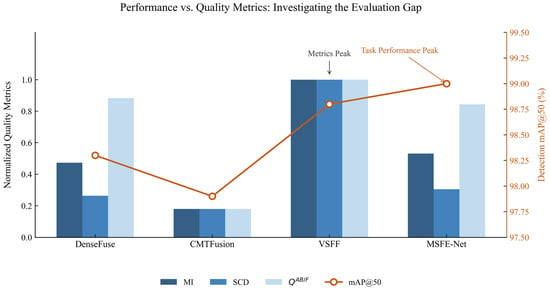
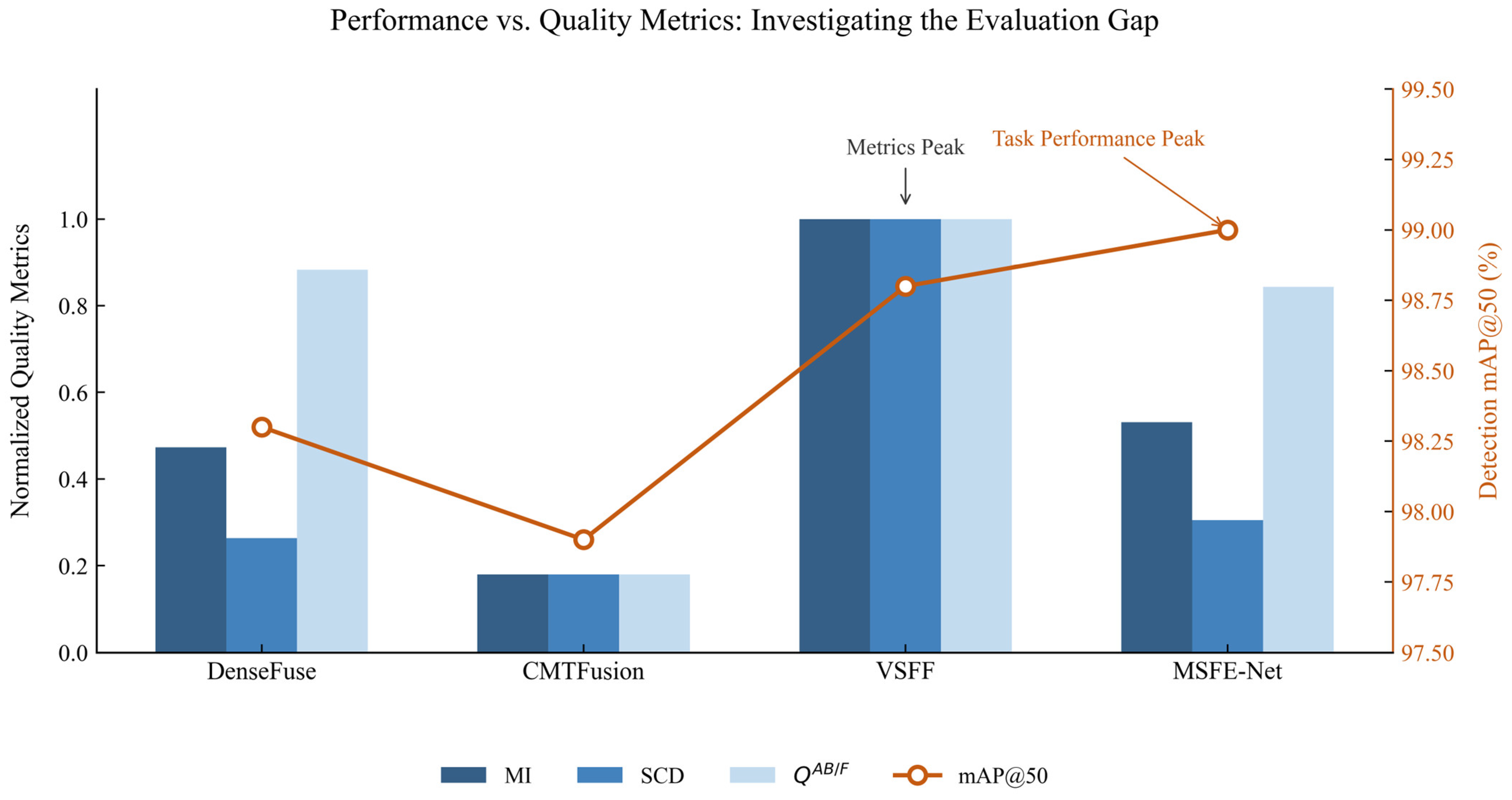
Taken together, these results suggest the presence of a “metric blind spot,” where improvements in global statistical fidelity do not necessarily translate into enhanced object discriminability. A possible explanation lies in the optimization objectives of traditional metrics: information-theoretic measures (e.g., MI, entropy) tend to emphasize global information preservation and contrast enhancement, without explicitly distinguishing between semantically meaningful structures and stochastic background variations. As a result, methods that strongly optimize these metrics may amplify high-frequency components indiscriminately, including both informative edges and irrelevant textures. As illustrated in Figure 10, this effect may lead to over-enhanced gradients and the emergence of pseudo-target patterns, which can interfere with the feature extraction process of downstream detectors.
Figure 10.
Visualization of the nonlinear decoupling between image quality metrics and task performance on the oil tank dataset. While the VSFF method achieves the peak values in statistical and perceptual metrics (MI, SCD, and ), its downstream detection accuracy (mAP@50) is notably lower than that of the proposed MSFE-Net, highlighting the critical “Metric Blind Spot”.
In contrast, the proposed MSFE-Net focuses on preserving structurally and semantically relevant features, leading to more stable detection performance even when not achieving the highest image-level metric scores. These observations suggest that effective multimodal fusion for object detection may benefit from prioritizing task-aligned feature representation rather than solely optimizing global statistical criteria.
4.3. Strategic Implications and Future Directions
The performance differences observed between oil tank and PV panel detection (Table 4 and Figure 6 and Figure 7) suggest that fusion strategies may need to be context-dependent. Oil tanks, characterized by relatively regular geometric structures and strong SAR backscattering, tend to benefit from improved structural consistency and enhanced target–background separation. In contrast, PV panels are often distributed in dense arrays within complex urban or mountainous environments, where detection performance is more sensitive to background clutter, boundary ambiguity, and scale variation. This difference is reflected in the experimental results, where MSFE-Net achieves near-saturated performance on oil tank detection (mAP@50 = 99.1%), while improvements on the PV dataset are more moderate and closely related to robustness under complex environmental conditions. These observations suggest that future multimodal fusion methods may benefit from more adaptive and task-driven feature integration strategies, which dynamically adjust modality contributions according to scene characteristics and detection requirements.
In practical remote sensing applications, SAR-based fusion systems may also be affected by signal-level degradations in complex or contested environments, such as electromagnetic interference or deceptive jamming. These effects may introduce artificial scattering patterns or distort backscatter consistency, potentially degrading pixel-level fusion quality. Although this study focuses on standard remote sensing conditions and does not explicitly model such interference, these factors represent an additional source of uncertainty that may further complicate the relationship between fusion quality and detection performance. Therefore, ensuring SAR signal integrity prior to fusion remains an important prerequisite for robust deployment. Advanced SAR interference suppression techniques, such as deceptive jammer localization and mitigation methods [49], provide a complementary direction for improving the reliability of multi-source fusion systems in real-world scenarios.
From a methodological perspective, these considerations further highlight the importance of how fusion representations are learned and optimized. The proposed MSFE-Net adopts a decoupled two-stage design, in which image fusion and object detection are optimized independently. This design enables a clear and controlled analysis of the “evaluation gap,” without the confounding effects of joint optimization. However, it also introduces a potential limitation: since the fusion module is not directly supervised by detection objectives, it may not fully adapt to task-specific feature requirements, potentially leading to suboptimal alignment between fused representations and detection performance. Building upon this observation, end-to-end joint optimization represents a promising direction for future research. By enabling gradient propagation from the detection network to the fusion module, such approaches may facilitate the learning of more task-aware and discriminative fusion representations. While this may not completely eliminate the evaluation gap, it is expected to improve the alignment between fusion outputs and downstream detection objectives.
5. Conclusions
This study investigates a critical evaluation issue in multimodal fusion, characterized by a nonlinear decoupling between conventional image-level quality metrics and downstream detection performance. Through extensive experiments across multiple representative detection architectures (YOLOv11, Faster R-CNN, and RetinaNet), as well as parameter sensitivity analyses, the results consistently suggest that this phenomenon is not specific to a particular model but instead reflects a broader mismatch between global statistical optimization and task-oriented feature representation. These observations highlight the limitation of evaluating fusion performance solely based on perceptual or information-theoretic criteria and support the need for a task-oriented evaluation paradigm that emphasizes discriminative feature learning. To address this issue, we propose MSFE-Net, a task-oriented deep fusion framework that integrates optical spectral information with SAR scattering characteristics for industrial object detection. By linking pixel-level fusion with task-level semantic representation, the proposed framework encourages the preservation of structurally and semantically informative features. Experimental results on oil tank and photovoltaic (PV) datasets show that MSFE-Net achieves strong and stable detection performance, with a peak mAP@50 of 99.1% on the oil tank dataset. In addition, comparative analyses indicate that feature-level fusion provides a more balanced trade-off between precision and recall compared with decision-level fusion and simple channel concatenation, particularly in reducing false positives in oil tank detection and improving recall for PV targets under complex backgrounds. Overall, this work provides both a practical framework and an empirical perspective on multimodal fusion in remote sensing, suggesting that task-oriented design and evaluation can offer a more reliable pathway for improving downstream performance.
Future work will investigate end-to-end joint optimization strategies to further align fusion representations with detection objectives. In addition, the integration of cross-modal attention mechanisms and the incorporation of additional sensing modalities (e.g., infrared and LiDAR) will be explored to enhance robustness and generalization in more complex operational environments.
Author Contributions
Conceptualization, R.G. (Rufeng Guo) and R.G. (Rong Gui); methodology, R.G. (Rufeng Guo), R.G. (Rong Gui), J.H. and P.T.; software, R.G. (Rufeng Guo); validation, R.G. (Rufeng Guo) and L.C.; formal analysis, R.G. (Rufeng Guo); investigation, R.G. (Rufeng Guo) and L.C.; resources, R.G. (Rong Gui) and J.H.; data curation, R.G. (Rufeng Guo); writing—original draft preparation, R.G. (Rufeng Guo); writing—review and editing, J.H., P.T., J.Z., L.C. and Q.J.; visualization, R.G. (Rufeng Guo) and L.C.; supervision, R.G. (Rong Gui), J.H. and P.T.; project administration, R.G. (Rong Gui); funding acquisition, R.G. (Rong Gui) and J.H. All authors have read and agreed to the published version of the manuscript.
Funding
This research was funded by the National Natural Science Foundation of China (No. 42201432), the Natural Science Foundation of Hunan Province (No. 2025JJ30013), the National Natural Science Foundation of China (No. 42388102), the Science and Technology Innovation Program of Hunan Province (No. 2024JC1005), and the Fundamental Research Funds for the Central Universities of Central South University (No. 1053320240652).
Data Availability Statement
The multi-modal photovoltaic (PV) panel dataset generated during this study is openly available on Google Drive at: https://drive.google.com/drive/folders/1geI0woDDijD0k8wcYS55FEGoFH0kwULA?usp=drive_link (accessed on 5 May 2026).
Acknowledgments
The authors would like to thank Spacety Aerospace Co., Ltd. (Changsha, China) for providing the SAR data and 91 Satellite Map (China) for the optical imagery used in this study. During the preparation of this manuscript, the authors used Gemini 2.0 for the purposes of language polishing and technical writing assistance. The authors have reviewed and edited the output and take full responsibility for the content of this publication. This paper is a significantly extended version of a preliminary study presented at the 2025 IEEE International Geoscience and Remote Sensing Symposium (IGARSS 2025) [42]. The authors have obtained the necessary copyright permission from IEEE to reuse the conference content in this article.
Conflicts of Interest
The authors declare no conflicts of interest. The funders had no role in the design of the study; in the collection, analyses, or interpretation of data; in the writing of the manuscript; or in the decision to publish the results.
Appendix A. Training Dynamics and Convergence Analysis
To evaluate the optimization stability and generalization capability of MSFE-Net on the PV-FusionData benchmark, detailed training and validation logs are provided. This analysis is intended to examine potential overfitting risks associated with the limited sample size. As shown in Figure A1, the validation losses (Figure A1d,e) closely follow the trends of the training losses (Figure A1a,b), without noticeable divergence or late-stage rebound. This behavior suggests stable convergence during the training process. In addition, the mAP@50 curve (Figure A1f) gradually stabilizes rather than exhibiting significant fluctuations, indicating consistent detection performance as training progresses. These observations provide strong evidence that no severe overfitting occurs under the current training configuration. This is also consistent with the use of data augmentation and regularization strategies commonly adopted in remote sensing detection tasks, which help improve generalization on limited datasets.
Figure A1.
Training and validation curves of the MSFE-Net framework over 200 epochs on the PV-FusionData benchmark. (a,b) Training bounding box and classification losses; (c) Evolution of the Precision metric; (d,e) Validation bounding box and classification losses; (f) Mean Average Precision (mAP@50) at IoU threshold 0.5. The consistent trends between training and validation losses, together with the stable plateauing of mAP@50, indicate stable convergence and suggest limited overfitting under the current experimental setting.
Appendix B. Computational Complexity Analysis
To evaluate the practical deployment capability of the proposed MSFE-Net framework, we conduct a comprehensive computational complexity analysis, including parameter count (Params), floating point operations (FLOPs), and inference speed measured in frames per second (FPS). All experiments are conducted on an NVIDIA RTX 3060 GPU using a fixed input resolution of 512 × 512. The results are summarized in Table A1.
Table A1.
Computational complexity comparison between single-modality baselines and the MSFE-Net pipeline.
As shown in Table A1, MSFE-Net introduces additional computational cost compared to the single-modality YOLOv11 due to the inclusion of the fusion module. Although U2Fusion contains relatively few parameters, it accounts for a substantial portion of FLOPs due to its dense feature reuse mechanism and continuous high-resolution feature processing (512 × 512). Despite this additional cost, the proposed pipeline achieves approximately 14 FPS, which satisfies the requirements of near-real-time remote sensing applications. Furthermore, this computational trade-off is well justified by the significant improvements in detection robustness in complex scenarios.
Appendix C. Robustness to Spatial Misalignment
In practical optical–SAR multimodal applications, minor spatial misalignment (e.g., parallax errors) is often unavoidable due to differences in sensor viewing geometries, even after rigorous multi-stage registration. As a result, pixel-level fusion models may introduce slight artificial ghosting or local boundary blurring when spatial alignment is imperfect. To quantitatively evaluate the robustness of the proposed framework to such registration errors, we conducted controlled stress tests on both the oil tank and PV datasets by introducing synthetic pixel-level shifts (1, 2, 4, and 8 pixels) to the SAR images relative to the optical images prior to fusion. The corresponding detection performance is summarized in Table A2.
Table A2.
Robustness evaluation of MSFE-Net under simulated spatial misalignment.
As shown in Table A2, the detection performance remains relatively stable across both scenarios. On the PV dataset, the mAP@50 varies within a narrow range (89.6–90.2%). On the oil tank dataset, although larger shifts lead to a gradual decrease compared to the baseline, the performance remains at a high level (above 96.5%) even under an 8-pixel misalignment. This behavior may be partly attributed to the inherent translation tolerance of the downstream object detection network. While pixel-level fusion under imperfect registration can introduce local artifacts, the detection model tends to mitigate their influence through multi-stage spatial downsampling and hierarchical feature aggregation. As a result, minor spatial misalignments are less likely to propagate as significant noise in the deep feature space. For example, slight spatial shifts may lead to marginal boundary thickening for structured targets such as PV arrays, while the strong SAR backscatter signatures of oil tanks are generally preserved in the learned representations. Overall, these results suggest that MSFE-Net exhibits a reasonable degree of robustness to typical real-world registration errors.
References
- Xu, S.; Zhang, H.; He, X.; Cao, X.; Hu, J. Oil Tank Detection with Improved EfficientDet Model. IEEE Geosci. Remote Sens. Lett. 2022, 19, 6511505. [Google Scholar] [CrossRef] [Scilit]
- Zhang, H.; Xu, H.; Tian, X.; Jiang, J.; Ma, J. Image fusion meets deep learning: A survey and perspective. Inf. Fusion 2021, 76, 323–336. [Google Scholar] [CrossRef] [Scilit]
- Ultralytics. YOLOv11. Available online: https://github.com/ultralytics/ultralytics (accessed on 28 April 2026).
- Liu, W.; Anguelov, D.; Erhan, D.; Szegedy, C.; Reed, S.; Fu, C.Y.; Berg, A.C. SSD: Single shot multibox detector. In Proceedings of the 14th European Conference on Computer Vision (ECCV 2016), Amsterdam, The Netherlands, 11–14 October 2016; Springer: Cham, Switzerland, 2016; pp. 21–37. [Google Scholar]
- Girshick, R. Fast R-CNN. In Proceedings of the 2015 IEEE International Conference on Computer Vision (ICCV), Santiago, Chile, 7–13 December 2015; pp. 1440–1448. [Google Scholar]
- Dai, L.; Liu, H.; Tang, H.; Wu, Z.; Song, P. AO2-DETR: Arbitrary-oriented object detection transformer. IEEE Trans. Circuits Syst. Video Technol. 2022, 33, 2342–2356. [Google Scholar] [CrossRef] [Scilit]
- Chalavadi, V.; Jeripothula, P.; Datla, R.; Babu, S.; Mohan, C.K. mSODANet: A Network for Multi-Scale Object Detection in Aerial Images Using Hierarchical Dilated Convolutions. Pattern Recognit. 2022, 126, 108548. [Google Scholar] [CrossRef] [Scilit]
- Zhu, Y.; Li, C.; Liu, Y.; Wang, X.; Tang, J.; Luo, B.; Huang, Z. Tiny object tracking: A large-scale dataset and a baseline. IEEE Trans. Neural Netw. Learn. Syst. 2023, 35, 10273–10287. [Google Scholar] [CrossRef] [Scilit] [PubMed]
- Kleebauer, M.; Horst, D.; Reudenbach, C. Semi-Automatic generation of training samples for detecting renewable energy plants in high-resolution aerial images. Remote Sens. 2021, 13, 4793. [Google Scholar] [CrossRef] [Scilit]
- Ronneberger, O.; Fischer, P.; Brox, T. U-Net: Convolutional Networks for Biomedical Image Segmentation. In Proceedings of the Medical Image Computing and Computer-Assisted Intervention (MICCAI 2015), Munich, Germany, 5–9 October 2015; Springer: Cham, Switzerland, 2015; pp. 234–241. [Google Scholar]
- Ren, S.; Malof, J.; Fetter, R.; Beach, R.; Rineer, J.; Bradbury, K. Utilizing geospatial data for assessing energy security: Mapping small solar home systems using unmanned aerial vehicles and deep learning. ISPRS Int. J. Geo-Inf. 2022, 11, 222. [Google Scholar] [CrossRef] [Scilit]
- Guo, Z.; Lu, J.; Chen, Q.; Liu, Z.; Song, C.; Tan, H.; Zhang, Y.; Yan, J. TransPV: Refining Photovoltaic Panel Detection Accuracy through a Vision Transformer-Based Deep Learning Model. Appl. Energy 2024, 355, 122282. [Google Scholar] [CrossRef] [Scilit]
- Tadros, A.; Drouyer, S.; von Gioi, R.G. A Contrario Oil Tank Detection with Patch Match Completion. In Proceedings of the 2021 IEEE International Geoscience and Remote Sensing Symposium (IGARSS), Brussels, Belgium, 11–16 July 2021; pp. 4900–4903. [Google Scholar]
- Zhang, R.; Guo, H.; Xu, F.; Yang, W.; Xia, G.; Li, W.; Li, J. Optical-Enhanced Oil Tank Detection in High-Resolution SAR Images. IEEE Trans. Geosci. Remote Sens. 2022, 60, 5237112. [Google Scholar] [CrossRef] [Scilit]
- Sun, W.; Hu, C.; Luo, N.; Zhao, Q. An optimization method of multiscale storage tank target detection introducing an attention mechanism. Geocarto Int. 2024, 39, 2339304. [Google Scholar] [CrossRef] [Scilit]
- Sun, T.; Shan, M.; Rong, X.; Yang, X. Estimating the spatial distribution of solar photovoltaic power generation potential on different types of rural rooftops using a deep learning network applied to satellite images. Appl. Energy 2022, 315, 119025. [Google Scholar] [CrossRef] [Scilit]
- Zhang, R.; Yang, Y.; Li, Z.; Li, P.; Wang, H. Optical and SAR Image Fusion: A Review of Theories, Methods, and Applications. Remote Sens. 2026, 18, 73. [Google Scholar] [CrossRef] [Scilit]
- Duysak, H.; Yiğit, E. Investigation of the performance of different wavelet-based fusions of SAR and optical images using Sentinel-1 and Sentinel-2 datasets. Int. J. Eng. Geosci. 2022, 7, 81–90. [Google Scholar] [CrossRef] [Scilit]
- Mi, S.; Zhang, L.; Peng, H.; Wang, J. Medical image fusion based on DTNP systems and Laplacian pyramid. J. Membr. Comput. 2021, 3, 284–295. [Google Scholar] [CrossRef] [Scilit]
- Chu, T.; Tan, Y.; Liu, Q.; Bai, B. Novel fusion method for SAR and optical images based on nonsubsampled shearlet transform. Int. J. Remote Sens. 2020, 41, 4590–4604. [Google Scholar] [CrossRef] [Scilit]
- Zong, J.; Qiu, T. Medical image fusion based on sparse representation of classified image patches. Biomed. Signal Process. Control 2017, 34, 195–205. [Google Scholar] [CrossRef] [Scilit]
- Zhang, Q.; Fu, Y.; Li, H.; Zou, J. Dictionary learning method for joint sparse representation-based image fusion. Opt. Eng. 2013, 52, 057006. [Google Scholar] [CrossRef] [Scilit]
- Li, W.; Wu, J.; Liu, Q.; Zhang, Y.; Cui, B.; Jia, Y.; Gui, G. An effective multimodal fusion method for SAR and optical remote sensing images. IEEE J. Sel. Top. Appl. Earth Obs. Remote Sens. 2023, 16, 5881–5892. [Google Scholar] [CrossRef] [Scilit]
- Zhang, H.; Shen, H.; Yuan, Q.; Guan, X. Multispectral and SAR image fusion based on Laplacian pyramid and sparse representation. Remote Sens. 2022, 14, 870. [Google Scholar] [CrossRef] [Scilit]
- Liu, Y.; Chen, X.; Peng, H.; Wang, Z. Multi-focus image fusion with a deep convolutional neural network. Inf. Fusion 2017, 36, 191–207. [Google Scholar] [CrossRef] [Scilit]
- Li, H.; Wu, X.J. DenseFuse: A fusion approach to infrared and visible images. IEEE Trans. Image Process. 2018, 28, 2614–2623. [Google Scholar] [CrossRef] [Scilit]
- Yuan, Y.; Deng, T.; Le, Y.; Bai, H.; Guo, S.; Sun, S.; Chen, Y. SAR and Visible Image Fusion via Retinex-Guided SAR Reconstruction. Remote Sens. 2026, 18, 111. [Google Scholar] [CrossRef] [Scilit]
- Xu, H.; Ma, J.; Jiang, J.; Guo, X.; Ling, H. U2Fusion: A unified unsupervised image fusion network. IEEE Trans. Pattern Anal. Mach. Intell. 2022, 44, 502–518. [Google Scholar] [CrossRef] [Scilit]
- Liu, X.; Zuo, X.; Li, M.; Cheng, C.; Huang, Z. Spectral-Spatial Attention Fusion Network for Semantic Segmentation of Optical and SAR Image. In Proceedings of the 2023 5th International Conference on Geoscience and Remote Sensing Mapping (GRSM), Lianyungang, China, 13–15 October 2023; pp. 182–185. [Google Scholar] [CrossRef] [Scilit]
- Park, S.; Vien, A.G.; Lee, C. Cross-modal transformers for infrared and visible image fusion. IEEE Trans. Circuits Syst. Video Technol. 2024, 34, 770–785. [Google Scholar] [CrossRef] [Scilit]
- Wang, Z.; Chen, J.; Liu, J.; Huang, J.; Fan, X.; Luo, Z.; Liu, R. VDMUFusion: A Versatile Diffusion Model-Based Unsupervised Framework for Image Fusion. Inf. Fusion 2024, 105, 102214. [Google Scholar]
- Wang, J.; Zhao, Y.; Ma, L.; Zhao, B.; Song, F.; Cai, Z. WEMFusion: Wavelet-Driven Hybrid-Modality Enhancement and Discrepancy-Aware Mamba for Optical–SAR Image Fusion. Remote Sens. 2026, 18, 612. [Google Scholar] [CrossRef] [Scilit]
- Zhang, Z.; Zhang, L.; Wu, J.; Guo, W. Optical and synthetic aperture radar image fusion for ship detection and recognition: Current state, challenges, and future prospects. IEEE Geosci. Remote Sens. Mag. 2024, 12, 132–168. [Google Scholar] [CrossRef] [Scilit]
- Xu, X.; Liu, G.; Bavirisetti, D.P.; Zhang, X.; Sun, B.; Xiao, G. Fast detection fusion network (FDFnet): An end to end object detection framework based on heterogeneous image fusion for power facility inspection. IEEE Trans. Power Deliv. 2022, 37, 4496–4505. [Google Scholar] [CrossRef] [Scilit]
- Xin, D.; Xu, L.; Chen, H.; Yang, X.; Zhang, R. A Vehicle Target Detection Method Based on Feature Level Fusion of Infrared and Visible Light Image. In Proceedings of the 34th Chinese Control and Decision Conference (CCDC), Hefei, China, 15–17 August 2022; pp. 469–474. [Google Scholar]
- Li, D.; Pang, B.; Lv, S.; Yin, Z.; Lian, X.; Sun, D. A double-layer feature fusion convolutional neural network for infrared small target detection. Int. J. Remote Sens. 2023, 44, 407–427. [Google Scholar] [CrossRef] [Scilit]
- Xu, S.; Chen, X.; Li, H.; Liu, T.; Chen, Z.; Gao, H.; Zhang, Y. Airborne small target detection method based on multimodal and adaptive feature fusion. IEEE Trans. Geosci. Remote Sens. 2024, 62, 5637215. [Google Scholar] [CrossRef] [Scilit]
- Li, G.; Shi, Z.; Gu, Z.; Zheng, B.; Zheng, H. Reference-then-supervision framework for infrared and visible image fusion. Pattern Recognit. 2025, 158, 110996. [Google Scholar] [CrossRef] [Scilit]
- Dong, L.; Wang, J. FusionPID: A PID control system for the fusion of infrared and visible light images. Measurement 2023, 217, 113015. [Google Scholar] [CrossRef] [Scilit]
- Liu, F.; Gao, C.; Chen, F.; Li, P.; Guo, J.; Meng, D. IVGF: The fusion-guided infrared and visible general framework. arXiv 2024, arXiv:2409.00973. [Google Scholar] [CrossRef] [Scilit]
- Yang, Z.; Zhang, Y.; Li, H.; Liu, Y. Instruction-Driven Fusion of Infrared–Visible Images: Tailoring for Diverse Downstream Tasks. Inf. Fusion 2025, 121, 103148. [Google Scholar] [CrossRef] [Scilit]
- Guo, R.; Gui, R.; Hu, J.; Tang, P.; Tan, L. Enhanced Target Detection Method Based on Optical and SAR Image Fusion. In Proceedings of the 2025 IEEE International Geoscience and Remote Sensing Symposium (IGARSS 2025), Brisbane, Australia, 7–12 July 2025; pp. 6947–6951. [Google Scholar] [CrossRef] [Scilit]
- Ye, Y.; Zhang, J.; Zhou, L.; Li, J.; Ren, X.; Fan, J. Optical and SAR Image Fusion Based on Complementary Feature Decomposition and Visual Saliency Features. IEEE Trans. Geosci. Remote Sens. 2024, 62, 5205315. [Google Scholar] [CrossRef] [Scilit]
- Mittal, A.; Soundararajan, R.; Bovik, A.C. Making a “completely blind” image quality analyzer. IEEE Signal Process. Lett. 2012, 20, 209–212. [Google Scholar] [CrossRef] [Scilit]
- Qu, G.; Zhang, D.; Yan, P. Information measure for performance of image fusion. Electron. Lett. 2002, 38, 313–315. [Google Scholar] [CrossRef] [Scilit]
- Han, Y.; Cai, Y.; Cao, Y.; Xu, X. A new image fusion performance metric based on visual information fidelity. Inf. Fusion 2013, 14, 127–135. [Google Scholar] [CrossRef] [Scilit]
- Xydeas, C.S.; Petrovic, V. Objective image fusion performance measure. Electron. Lett. 2000, 36, 308–309. [Google Scholar] [CrossRef] [Scilit]
- Aslantas, V.; Bendeş, E. A new image quality metric for image fusion: The sum of the correlations of differences. AEU-Int. J. Electron. Commun. 2015, 69, 1890–1896. [Google Scholar] [CrossRef] [Scilit]
- Chang, S.; Tang, S.; Deng, Y.; Zhang, H.; Liu, D.; Wang, W. An advanced scheme for deceptive jammer localization and suppression in elevation multichannel SAR for underdetermined scenarios. IEEE Trans. Aerosp. Electron. Syst. 2026, 62, 3952–3970. [Google Scholar] [CrossRef] [Scilit]

Disclaimer/Publisher’s Note: The statements, opinions and data contained in all publications are solely those of the individual author(s) and contributor(s) and not of MDPI and/or the editor(s). MDPI and/or the editor(s) disclaim responsibility for any injury to people or property resulting from any ideas, methods, instructions or products referred to in the content. |
© 2026 by the authors. Licensee MDPI, Basel, Switzerland. This article is an open access article distributed under the terms and conditions of the Creative Commons Attribution (CC BY) license.