Shifting from Trade-Offs to Synergies in Ecosystem Services Through Effective Ecosystem Management in Arid Areas



Abstract
1. Introduction
2. Materials and Methods
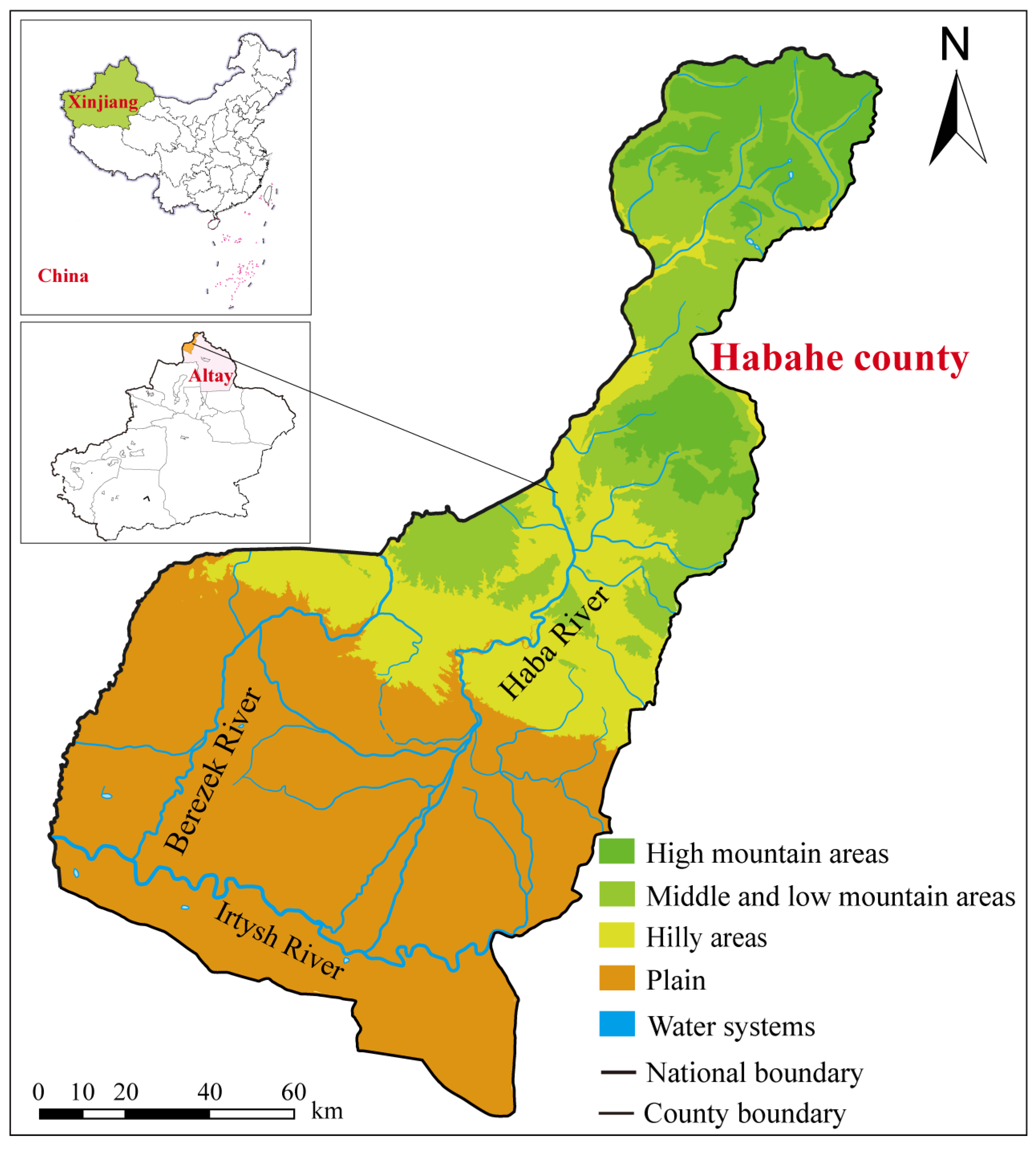
2.1. Study Area
2.2. Data Resources
2.3. Methods
2.3.1. ES Evaluation Methods
2.3.2. ES Trade-Offs and Synergies
- Hotspot Analysis Method
- Bivariate spatial correlation analysis
3. Results
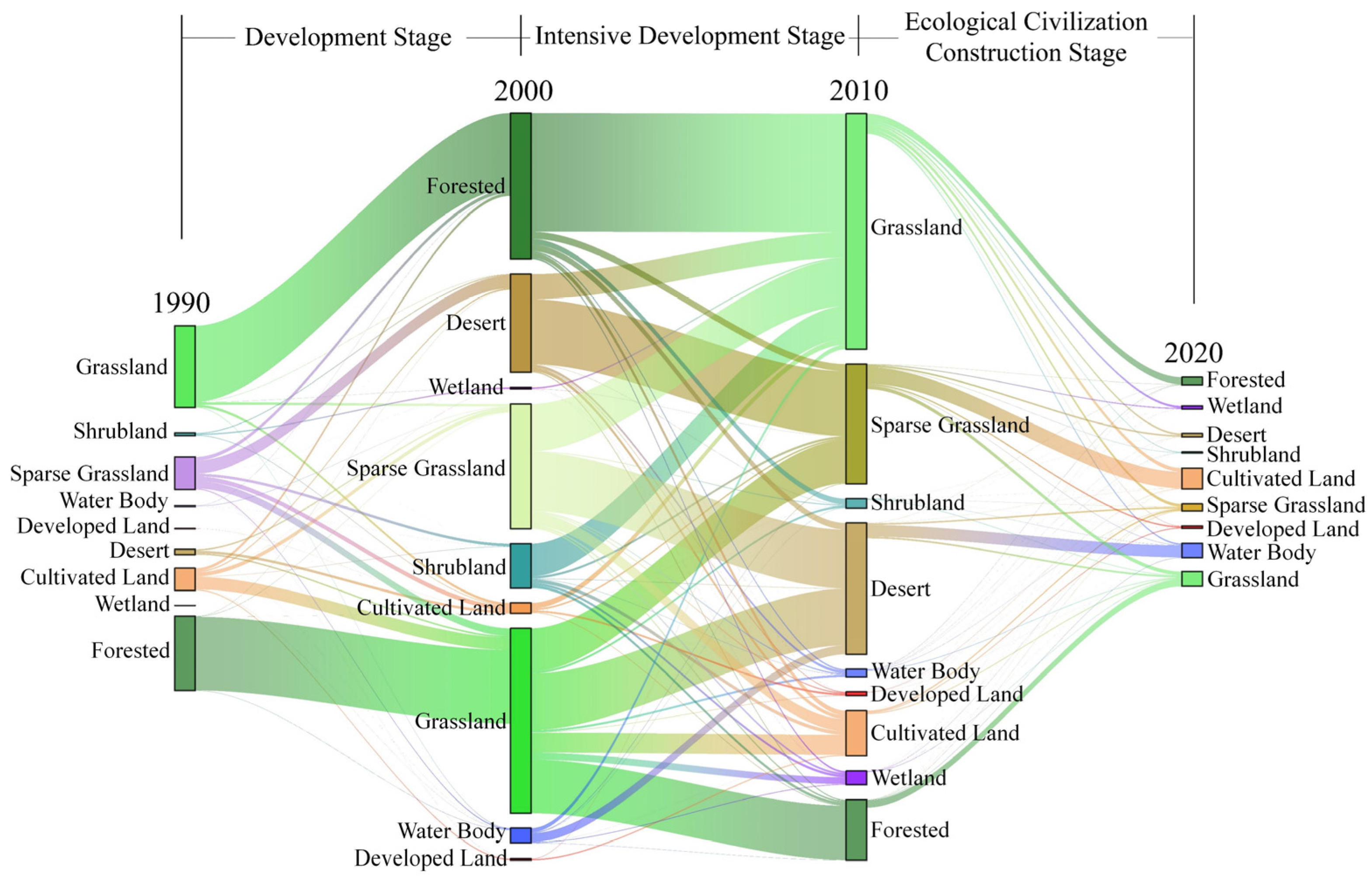
3.1. Land-Use Change and Transition
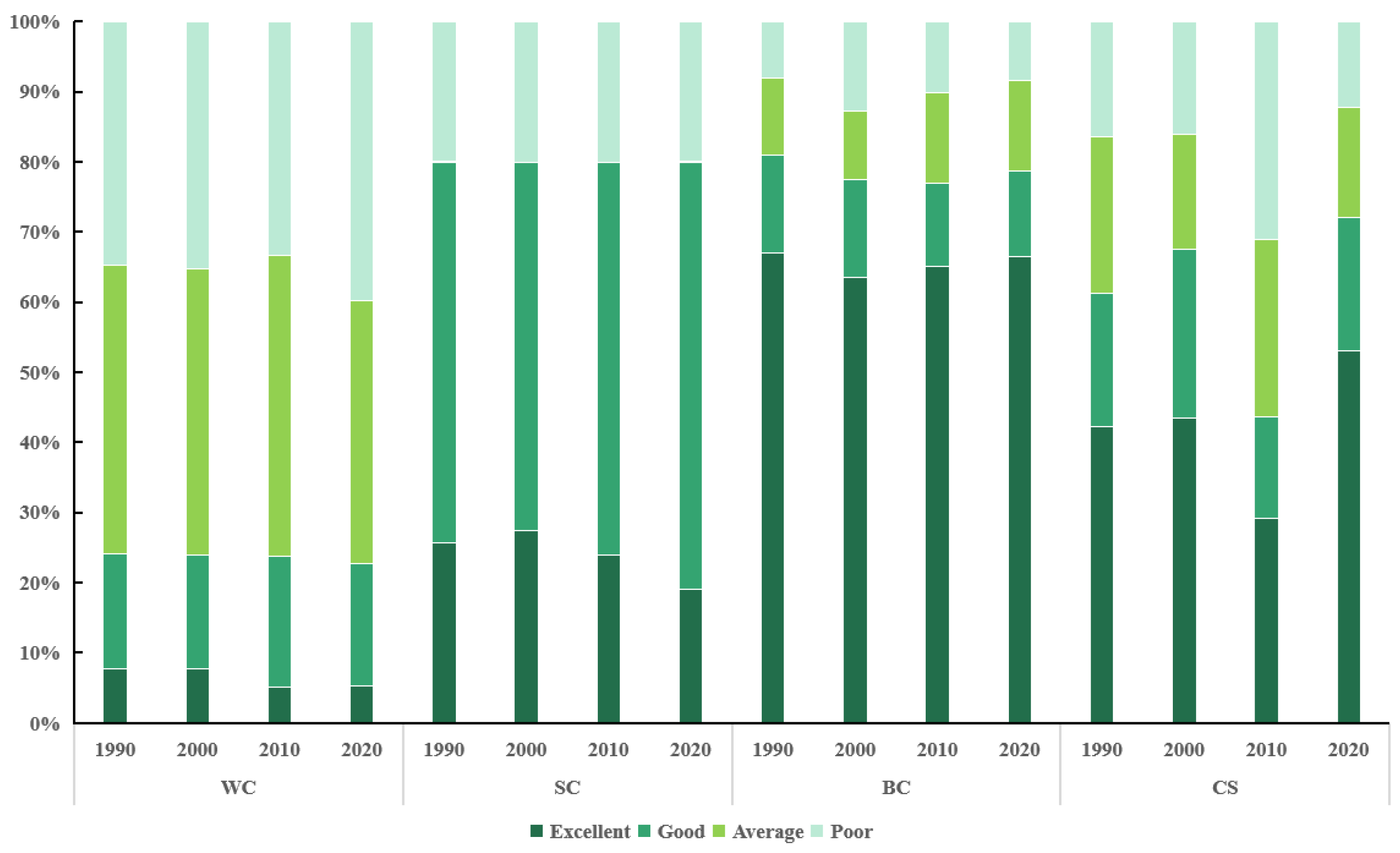
3.2. Spatiotemporal Heterogeneity of ES
3.3. Changes in ES Trade-Offs and Synergies
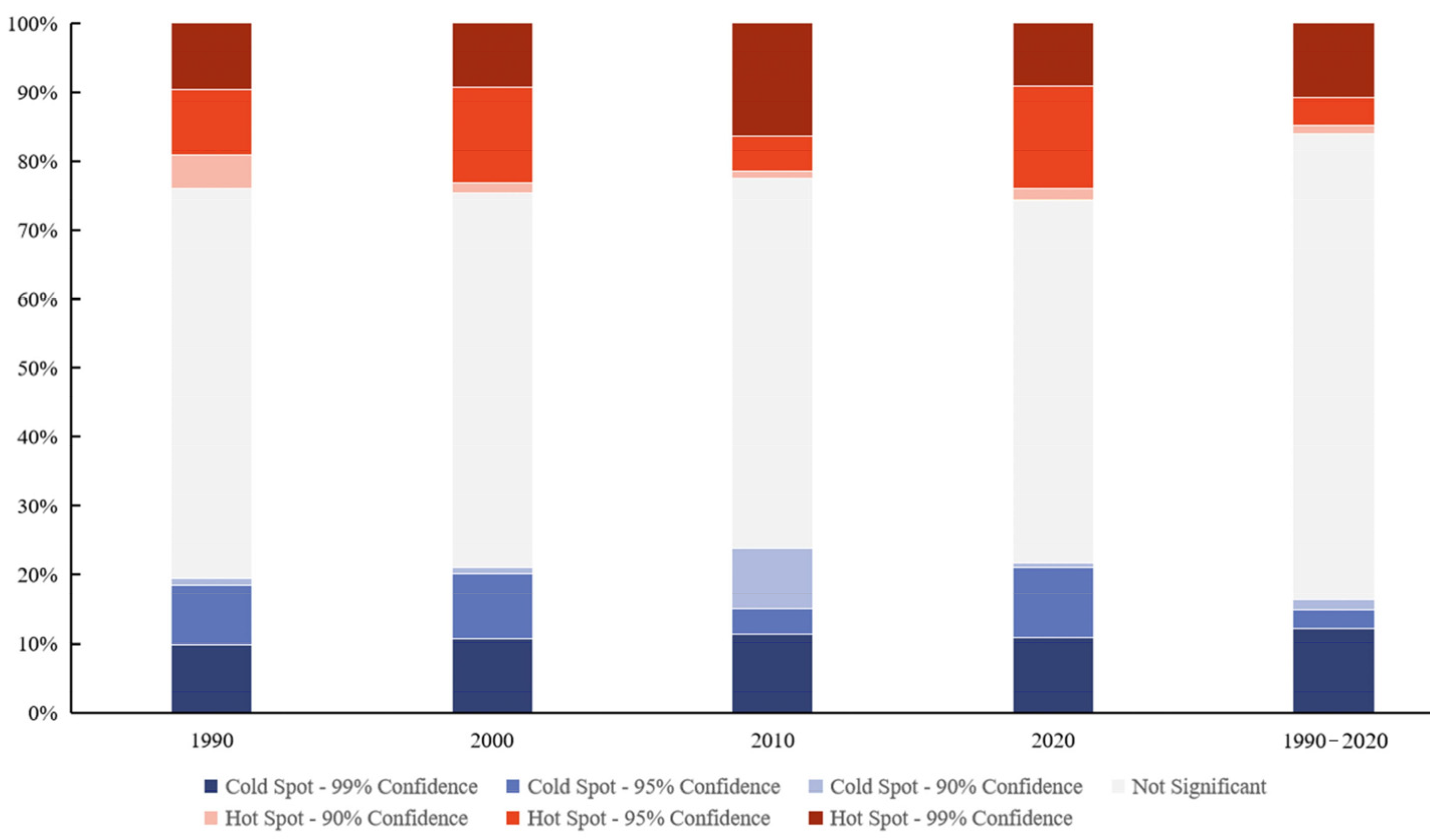
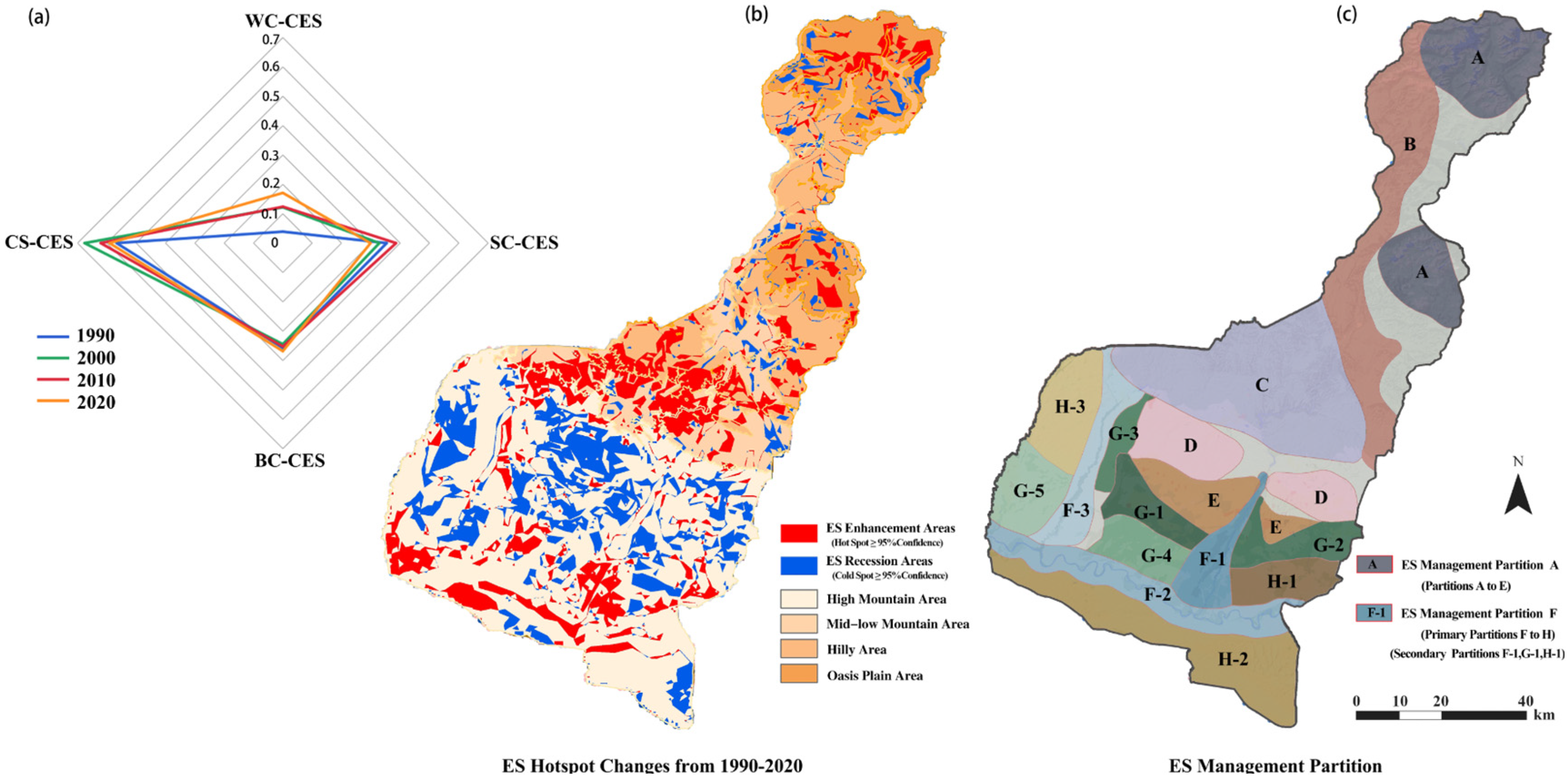
3.3.1. Changes in ES Cold and Hotspots
3.3.2. Spatiotemporal Divergence in Bivariate Trade-Offs and Synergies
- ES trade-offs and Synergies at the overall area scale
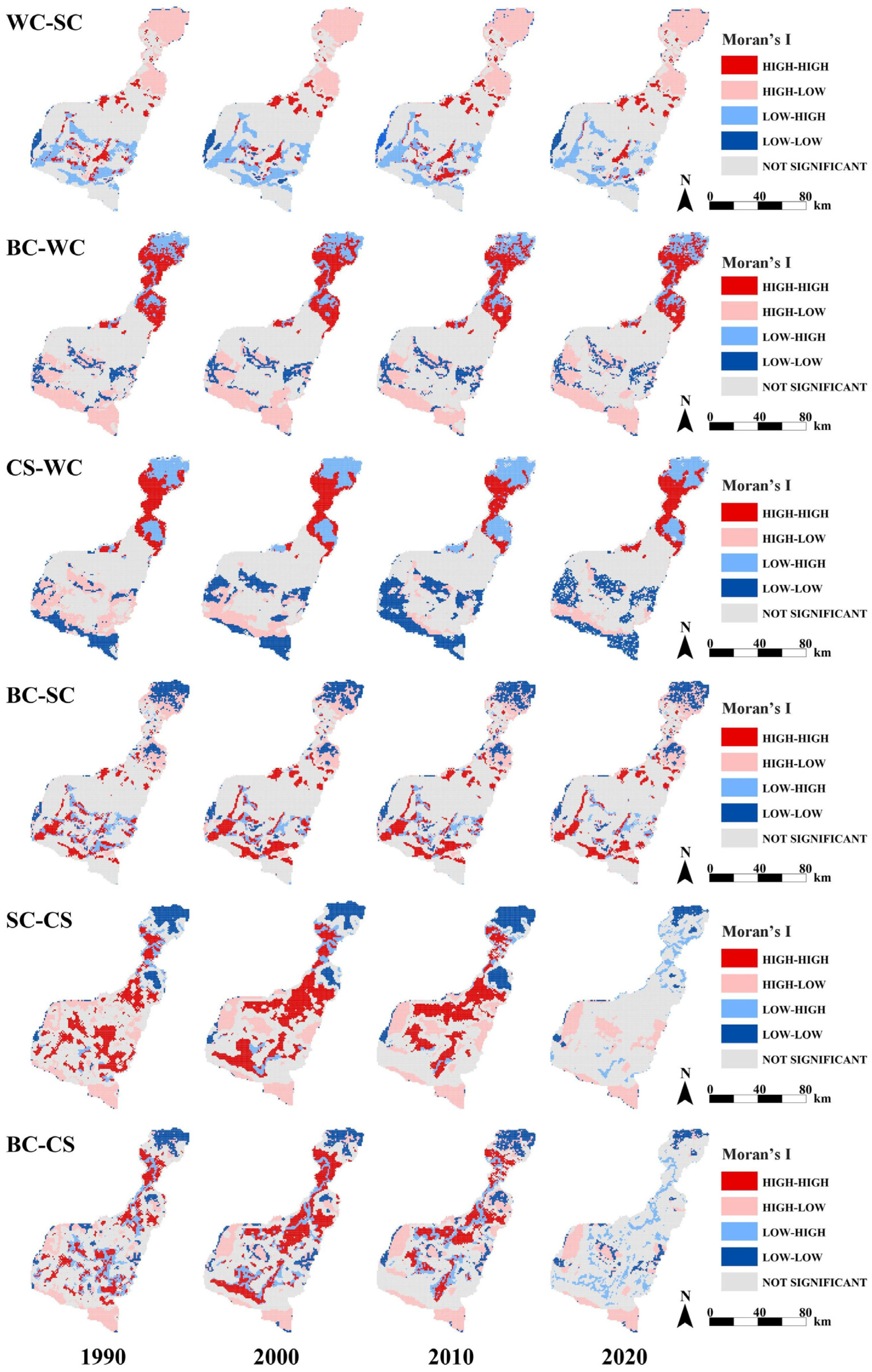
- ES Trade-offs and Synergies at the Grid Scale
4. Discussion
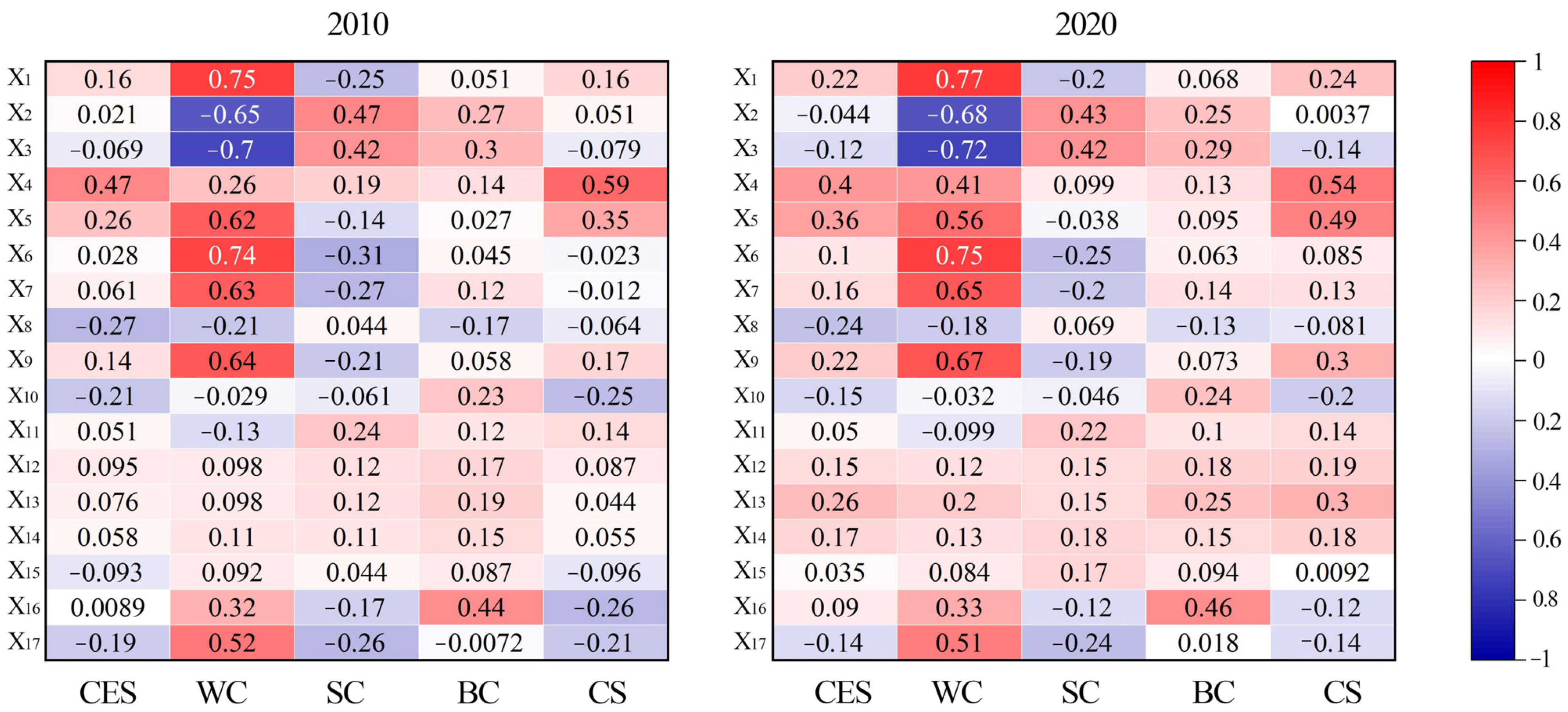
4.1. Driving Force Analysis of Spatiotemporal Differences in ES
4.2. Pathways and Guidance for Enhancing ESs
5. Conclusions
Supplementary Materials
Author Contributions
Funding
Data Availability Statement
Conflicts of Interest
References
- Finlayson, C.M. Millennium Ecosystem Assessment. In The Wetland Book; Finlayson, C.M., Everard, M., Irvine, K., McInnes, R.J., Middleton, B.A., Van Dam, A.A., Davidson, N.C., Eds.; Springer Netherlands: Dordrecht, The Netherlands, 2016; pp. 1–5. [Google Scholar] [CrossRef] [Scilit]
- Abson, D.J.; Von Wehrden, H.; Baumgärtner, S.; Fischer, J.; Hanspach, J.; Härdtle, W.; Heinrichs, H.; Klein, A.M.; Lang, D.J.; Martens, P.; et al. Ecosystem services as a boundary object for sustainability. Ecol. Econ. 2014, 103, 29–37. [Google Scholar] [CrossRef] [Scilit]
- Costanza, R.; d’Arge, R.; de Groot, R.; Farber, S.; Grasso, M.; Hannon, B.; Limburg, K.; Naeem, S.; O’Neill, R.V.; Paruelo, J.; et al. The value of the world’s ecosystem services and natural capital. Nature 1997, 387, 253–260. [Google Scholar] [CrossRef] [Scilit]
- Bateman, I.J.; Harwood, A.R.; Mace, G.M.; Watson, R.T.; Abson, D.J.; Andrews, B.; Binner, A.; Crowe, A.; Day, B.H.; Dugdale, S.; et al. Bringing Ecosystem Services into Economic Decision-Making: Land Use in the United Kingdom. Science 2013, 341, 45–50. [Google Scholar] [CrossRef] [Scilit] [PubMed]
- Srivathsa, A.; Vasudev, D.; Nair, T.; Chakrabarti, S.; Chanchani, P.; DeFries, R.; Deomurari, A.; Dutta, S.; Ghose, D.; Goswami, V.R.; et al. Prioritizing India’s landscapes for biodiversity, ecosystem services and human well-being. Nat. Sustain. 2023, 6, 568–577. [Google Scholar] [CrossRef] [Scilit]
- Lee, H.; Lautenbach, S. A quantitative review of relationships between ecosystem services. Ecol. Indic. 2016, 66, 340–351. [Google Scholar] [CrossRef] [Scilit]
- Foley, J.A.; DeFries, R.; Asner, G.P.; Barford, C.; Bonan, G.; Carpenter, S.R.; Chapin, F.S.; Coe, M.T.; Daily, G.C.; Gibbs, H.K.; et al. Global consequences of land use. Science 2005, 309, 570–574. [Google Scholar] [CrossRef] [Scilit]
- Qiu, J.; Carpenter, S.R.; Booth, E.G.; Motew, M.; Zipper, S.C.; Kucharik, C.J.; Loheide Ii, S.P.; Turner, M.G. Understanding relationships among ecosystem services across spatial scales and over time. Environ. Res. Lett. 2018, 13, 054020. [Google Scholar] [CrossRef] [Scilit]
- Seppelt, R.; Dormann, C.F.; Eppink, F.V.; Lautenbach, S.; Schmidt, S. A quantitative review of ecosystem service studies: Approaches, shortcomings and the road ahead. J. Appl. Ecol. 2011, 48, 630–636. [Google Scholar] [CrossRef] [Scilit]
- Liang, J.; Li, S.; Li, X.; Li, X.; Liu, Q.; Meng, Q.; Lin, A.; Li, J. Trade-off analyses and optimization of water-related ecosystem services (WRESs) based on land use change in a typical agricultural watershed, southern China. J. Clean. Prod. 2021, 279, 123851. [Google Scholar] [CrossRef] [Scilit]
- Frank, S.; Fürst, C.; Witt, A.; Koschke, L.; Makeschin, F. Making use of the ecosystem services concept in regional planning—Trade-offs from reducing water erosion. Landsc. Ecol 2014, 29, 1377–1391. [Google Scholar] [CrossRef] [Scilit]
- Feng, Q.; Zhao, W.; Fu, B.; Ding, J.; Wang, S. Ecosystem service trade-offs and their influencing factors: A case study in the Loess Plateau of China. Sci. Total Environ. 2017, 607–608, 1250–1263. [Google Scholar] [CrossRef] [Scilit] [PubMed]
- Lu, Y.; Yang, Y.; Sun, B.; Yuan, J.; Yu, M.; Stenseth, N.C.; Bullock, J.M.; Obersteiner, M. Spatial variation in biodiversity loss across China under multiple environmental stressors. Sci. Adv. 2020, 6, eabd0952. [Google Scholar] [CrossRef] [Scilit] [PubMed]
- Mbaabu, P.R.; Olago, D.; Gichaba, M.; Eckert, S.; Eschen, R.; Oriaso, S.; Choge, S.K.; Linders, T.E.W.; Schaffner, U. Restoration of degraded grasslands, but not invasion by Prosopis juliflora, avoids trade-offs between climate change mitigation and other ecosystem services. Sci. Rep. 2020, 10, 20391. [Google Scholar] [CrossRef] [Scilit] [PubMed]
- Berdugo, M.; Delgado-Baquerizo, M.; Soliveres, S.; Hernández-Clemente, R.; Zhao, Y.; Gaitán, J.J.; Gross, N.; Saiz, H.; Maire, V.; Lehmann, A.; et al. Global ecosystem thresholds driven by aridity. Science 2020, 367, 787–790. [Google Scholar] [CrossRef] [Scilit]
- DeFries, R.; Nagendra, H. Ecosystem management as a wicked problem. Science 2017, 356, 265–270. [Google Scholar] [CrossRef] [Scilit]
- Hou, Y.; Chen, Y.; Ding, J.; Li, Z.; Li, Y.; Sun, F. Ecological Impacts of Land Use Change in the Arid Tarim River Basin of China. Remote Sens. 2022, 14, 1894. [Google Scholar] [CrossRef] [Scilit]
- Tully, K.; Sullivan, C.; Weil, R.; Sanchez, P. The State of Soil Degradation in Sub-Saharan Africa: Baselines, Trajectories, and Solutions. Sustainability 2015, 7, 6523–6552. [Google Scholar] [CrossRef] [Scilit]
- Geng, W.; Li, Y.; Zhang, P.; Yang, D.; Jing, W.; Rong, T. Analyzing spatio-temporal changes and trade-offs/synergies among ecosystem services in the Yellow River Basin, China. Ecol. Indic. 2022, 138, 108825. [Google Scholar] [CrossRef] [Scilit]
- Locatelli, B.; Imbach, P.; Wunder, S. Synergies and trade-offs between ecosystem services in Costa Rica. Environ. Conserv. 2014, 41, 27–36. [Google Scholar] [CrossRef] [Scilit]
- Wang, Y.; Zhao, J.; Fu, J.; Wei, W. Effects of the Grain for Green Program on the water ecosystem services in an arid area of China—Using the Shiyang River Basin as an example. Ecol. Indic. 2019, 104, 659–668. [Google Scholar] [CrossRef] [Scilit]
- Bai, Y.; Ochuodho, T.O.; Yang, J. Impact of land use and climate change on water-related ecosystem services in Kentucky, USA. Ecol. Indic. 2019, 102, 51–64. [Google Scholar] [CrossRef] [Scilit]
- Fu, Q.; Li, B.; Hou, Y.; Bi, X.; Zhang, X. Effects of land use and climate change on ecosystem services in Central Asia’s arid regions: A case study in Altay Prefecture, China. Sci. Total Environ. 2017, 607–608, 633–646. [Google Scholar] [CrossRef] [Scilit] [PubMed]
- Raudsepp-Hearne, C.; Peterson, G.D.; Bennett, E.M. Ecosystem service bundles for analyzing tradeoffs in diverse landscapes. Proc. Natl. Acad. Sci. USA 2010, 107, 5242–5247. [Google Scholar] [CrossRef] [Scilit] [PubMed]
- Li, Y.; Luo, H. Trade-off/synergistic changes in ecosystem services and geographical detection of its driving factors in typical karst areas in southern China. Ecol. Indic. 2023, 154, 110811. [Google Scholar] [CrossRef] [Scilit]
- Fu, Q.; Li, B.; Yang, L.; Wu, Z.; Zhang, X. Ecosystem Services Evaluation and Its Spatial Characteristics in Central Asia’s Arid Regions: A Case Study in Altay Prefecture, China. Sustainability 2015, 7, 8335–8353. [Google Scholar] [CrossRef] [Scilit]
- White, K.D. Nature–Society Linkages in the Aral Sea Region. J. Eurasian Stud. 2013, 4, 18–33. [Google Scholar] [CrossRef] [Scilit]
- Wangai, P.W.; Burkhard, B.; Müller, F. A review of studies on ecosystem services in Africa. Int. J. Sustain. Built Environ. 2016, 5, 225–245. [Google Scholar] [CrossRef] [Scilit]
- Huang, W.; Duan, W.; Nover, D.; Sahu, N.; Chen, Y. An integrated assessment of surface water dynamics in the Irtysh River Basin during 1990–2019 and exploratory factor analyses. J. Hydrol. 2021, 593, 125905. [Google Scholar] [CrossRef] [Scilit]
- He, B.; Chang, J.; Wang, Y.; Wang, Y.; Zhou, S.; Chen, C. Spatio-temporal evolution and non-stationary characteristics of meteorological drought in inland arid areas. Ecol. Indic. 2021, 126, 107644. [Google Scholar] [CrossRef] [Scilit]
- Yang, Z.; Li, B.; Nan, B.; Dai, X.; Peng, C.; Bi, X. A methodological framework for assessing pastoral socio-ecological system vulnerability: A case study of Altay Prefecture in Central Asia. Sci. Total Environ. 2023, 862, 160828. [Google Scholar] [CrossRef] [Scilit]
- Zeng, Y.-F.; Zhang, J.-G.; Duan, A.-G.; Abuduhamiti, B. Genetic structure of Populus hybrid zone along the Irtysh River provides insight into plastid-nuclear incompatibility. Sci. Rep. 2016, 6, 28043. [Google Scholar] [CrossRef] [Scilit] [PubMed]
- Hanchu, L.; Jie, F.; Baoyin, L.; Li, W.; Qin, Q. Practical Exploration of Ecological Restoration and Management of the Mountains-Rivers-Forests-Farmlands-Lakes-Grasslands System in the Irtysh River Basin in Altay, Xinjiang. Jore 2021, 12, 766–776. [Google Scholar] [CrossRef] [Scilit]
- Xue, C.; Chen, X.; Xue, L.; Zhang, H.; Chen, J.; Li, D. Modeling the spatially heterogeneous relationships between tradeoffs and synergies among ecosystem services and potential drivers considering geographic scale in Bairin Left Banner, China. Sci. Total Environ. 2023, 855, 158834. [Google Scholar] [CrossRef] [Scilit] [PubMed]
- Duraiappah, A.K.; Naeem, S.; Agardy, T.; Ash, N.J.; Cooper, H.D.; Diaz, S.; Faith, D.P.; Mace, G.; McNeely, J.A.; Mooney, H.A.; et al. Ecosystems and Human Well-Being: Biodiversity Synthesis; A Report of the Millennium Ecosystem Assessment; World Resources Institute: Washington, DC, USA, 2005. [Google Scholar]
- Qin, H.; Chen, Y. Spatial non-stationarity of water conservation services and landscape patterns in Erhai Lake Basin, China. Ecol. Indic. 2023, 146, 109894. [Google Scholar] [CrossRef] [Scilit]
- Bai, J.; Zhou, Z.; Li, J.; Liu, T.; Zhu, Q.; Zheng, T. Predicting soil conservation service in the Jinghe River Basin under climate change. J. Hydrol. 2022, 615, 128646. [Google Scholar] [CrossRef] [Scilit]
- Kang, J.; Zhang, X.; Zhu, X.; Zhang, B. Ecological security pattern: A new idea for balancing regional development and ecological protection. A case study of the Jiaodong Peninsula, China. Glob. Ecol. Conserv. 2021, 26, e01472. [Google Scholar] [CrossRef] [Scilit]
- Zhang, T.; Cao, G.; Cao, S.; Zhang, X.; Zhang, J.; Han, G. Dynamic assessment of the value of vegetation carbon fixation and oxygen release services in Qinghai Lake basin. Acta Ecol. Sin. 2017, 37, 79–84. [Google Scholar] [CrossRef] [Scilit]
- Yang, L.; Suo, M.; Gao, S.; Jiao, H. Construction of an Ecological Network Based on an Integrated Approach and Circuit Theory: A Case Study of Panzhou in Guizhou Province. Sustainability 2022, 14, 9136. [Google Scholar] [CrossRef] [Scilit]
- Wu, L.; Fan, F. Assessment of ecosystem services in new perspective: A comprehensive ecosystem service index (CESI) as a proxy to integrate multiple ecosystem services. Ecol. Indic. 2022, 138, 108800. [Google Scholar] [CrossRef] [Scilit]
- Gong, S.H.; Xiao, Y.; Zheng, H.; Xiao, Y.; Ouyang, Z.Y. Spatial patterns of ecosystem water conservation in China and its impact factors analysis. Acta Ecol. Sin. 2017, 37, 2455–2462. [Google Scholar]
- Zhang, L.; Walker, G.R.; Dawes, W.R. Water balance modelling: Concepts and applications. In Handbook of Environmental Materials Management; Springer: Cham, Switzerland, 2002. [Google Scholar]
- Yu, K. Regional Ecological Security Patterns: The Beijing Case, 1st ed.; Zhongguo Jian Zhu Gong Ye Chu Ban She: Beijing, China, 2012. [Google Scholar]
- Yu, K. Landscape ecological security patterns in biological conservation. Acta Ecol. Sin. 1999, 19, 8–15. [Google Scholar]
- Lambeck, R.J. Focal Species: A Multi-Species Umbrella for Nature Conservation. Especies Focales: Una Sombrilla Multiespecifica para Conservar la Naturaleza. Conserv. Biol. 1997, 11, 849–856. [Google Scholar] [CrossRef] [Scilit]
- Lindenmayer, D.B.; Manning, A.D.; Smith, P.L.; Possingham, H.P.; Fischer, J.; Oliver, I.; McCarthy, M.A. The Focal-Species Approach and Landscape Restoration: A Critique. Conserv. Biol. 2002, 16, 338–345. [Google Scholar] [CrossRef] [Scilit]
- Erdenechimeg, B.; Purev-Ochir, G.; Gungaa, A.; Terbish, O.; Zhao, Y.; Guo, Y. Migration Pattern, Habitat Use, and Conservation Status of the Eastern Common Crane (Grus grus lilfordi) from Eastern Mongolia. Animals 2023, 13, 2287. [Google Scholar] [CrossRef] [Scilit] [PubMed]
- Månsson, J.; Nilsson, L.; Hake, M. Territory size and habitat selection of breeding Common Cranes (Grus grus) in a boreal landscape. Ornis Fenn. 2013, 90, 65–72. [Google Scholar] [CrossRef] [Scilit]
- Duan, Y.; Liu, Q.; Lei, Y.; Li, J.; Liu, W.; Li, Z.; Wang, R. Habitat selection of overwintering common crane (Grus grus) based on individuals tracking by satellite technology. Chin. J. Ecol. 2020, 39, 2392–2399. [Google Scholar] [CrossRef]
- Kong, D.; Luo, W.; Liu, Q.; Li, Z.; Huan, G.; Zhang, J.; Yang, X. Habitat use, preference, and utilization distribution of two crane species (Genus: Grus) in Huize National Nature Reserve, Yunnan–Guizhou Plateau, China. PeerJ 2018, 6, e5105. [Google Scholar] [CrossRef] [Scilit]
- Li, D.; Jiang, Z.; Wang, Z. Activity Patterns and Habitat Selection of the Przewalski’’s Gazelle (Procapra przewalskii) in the Qinghai Lake Region. Acta Theriol. Sin. 1999, 18–25. [Google Scholar] [CrossRef]
- Liang, D.; Li, C. Habitat Suitability, Distribution Modelling and GAP Analysis of Przewalski’’s Gazelle Conservation. Animals 2024, 14, 149. [Google Scholar] [CrossRef] [Scilit]
- Cornelis, D.; Kan, E.; Gond, V.; Cesaro, J.-D.; Peltier, R. Estimation of the red deer population and its impact on the Tugay forest ecosystem in the Lower Amu Darya State Biosphere Reserve, Uzbekistan. Bois For. Des Trop. 2020, 346, 65–78. [Google Scholar] [CrossRef] [Scilit]
- Tumur, A.; Abliz, D.; Halik, M. Habitat dynamics and its influence on the genetic diversity of Tarim red deer (Cervus elaphus yarkandensis) Xayar population of Xinjiang, China. Quat. Int. 2013, 311, 140–145. [Google Scholar] [CrossRef] [Scilit]
- Zhang, Y.; Zhang, C.; Wang, Z.; Chen, Y.; Gang, C.; An, R.; Li, J. Vegetation dynamics and its driving forces from climate change and human activities in the Three-River Source Region, China from 1982 to 2012. Sci. Total Environ. 2016, 563–564, 210–220. [Google Scholar] [CrossRef] [Scilit] [PubMed]
- Bai, B.; Li, N. Influence of habitat fragmentation on frugivores and their seed dispersal. Chin. J. Ecol. 2011, 30, 2613. [Google Scholar]
- Wu, Q.; Song, J.; Sun, H.; Huang, P.; Jing, K.; Xu, W.; Wang, H.; Liang, D. Spatiotemporal variations of water conservation function based on EOF analysis at multi time scales under different ecosystems of Heihe River Basin. J. Environ. Manag. 2023, 325, 116532. [Google Scholar] [CrossRef] [Scilit] [PubMed]
- Wischmeier, W.H.; Smith, D.D. Predicting Rainfall Erosion Losses: A Guide to Conservation Planning (No. 537); Department of Agriculture, Science and Education Administration: Canberra, Australia, 1978; XF2006179521. [Google Scholar]
- Cramer, W.; Kicklighter, D.W.; Bondeau, A.; Iii, B.M.; Churkina, G.; Nemry, B.; Ruimy, A.; Schloss, A.L.; ThE. Participants OF. ThE. Potsdam NpP. Model Intercomparison. Comparing global models of terrestrial net primary productivity (NPP): Overview and key results. Glob. Change Biol. 1999, 5, 1–15. [Google Scholar] [CrossRef] [Scilit]
- Ding, T.; Chen, J.; Fang, Z.; Chen, J. Assessment of coordinative relationship between comprehensive ecosystem service and urbanization: A case study of Yangtze River Delta urban Agglomerations, China. Ecol. Indic. 2021, 133, 108454. [Google Scholar] [CrossRef] [Scilit]
- Guo, J.; Xu, H.; Zhang, G.; Yuan, K.; Ling, H. The Enhanced Management of Water Resources Improves Ecosystem Services in a Typical Arid Basin. Sustainability 2020, 12, 8802. [Google Scholar] [CrossRef] [Scilit]
- Anselin, L.; Rey, S.J. Modern Spatial Econometrics in Practice: A Guide to GeoDa, GeoDaSpace and PySAL; GeoDa Press: Chicago, IL, USA, 2014. [Google Scholar]
- Huang, F.; Zuo, L.; Gao, J.; Jiang, Y.; Du, F.; Zhang, Y. Exploring the driving factors of trade-offs and synergies among ecological functional zones based on ecosystem service bundles. Ecol. Indic. 2023, 146, 109827. [Google Scholar] [CrossRef] [Scilit]
- Jing, H.; Liu, Y.; He, P.; Zhang, J.; Dong, J.; Wang, Y. Spatial heterogeneity of ecosystem services and it’s influencing factors in typical areas of the Qinghai-Tibet Plateau: A case study of Nagqu City. Acta Ecol. Sin. 2022, 42, 2657–2673. [Google Scholar]
- Zhuang, D.; Liu, J. Modeling of regional differentiation of land-use degree in China. Chin. Geograph.Sc. 1997, 7, 302–309. [Google Scholar] [CrossRef] [Scilit]
- Canelas, J.V.; Pereira, H.M. Impacts of land-use intensity on ecosystems stability. Ecol. Model. 2022, 472, 110093. [Google Scholar] [CrossRef] [Scilit]
- Liu, J.; Pei, X.; Zhu, W.; Jiao, J.; Wang, Z. Fine grid scale increases or decreases the trade-off effect between ES in mountain protected areas? Ecol. Indic. 2023, 155, 110905. [Google Scholar] [CrossRef] [Scilit]
- Hao, R.; Yu, D.; Wu, J.; Guo, Q.; Liu, Y. Constraint line methods and the applications in ecology. Chin. J. Plant Ecol. 2016, 40, 1100–1109. [Google Scholar] [CrossRef] [Scilit]
- Li, Y.; Liu, W.; Feng, Q.; Zhu, M.; Yang, L.; Zhang, J. Quantitative Assessment for the Spatiotemporal Changes of Ecosystem Services, Tradeoff–Synergy Relationships and Drivers in the Semi-Arid Regions of China. Remote Sens. 2022, 14, 239. [Google Scholar] [CrossRef] [Scilit]
- Wang, X.; Tan, K.; Chen, B.; Du, P. Assessing the Spatiotemporal Variation and Impact Factors of Net Primary Productivity in China. Sci. Rep. 2017, 7, 44415. [Google Scholar] [CrossRef] [Scilit]
- Chidwala, A.; Frimpong, S.; Raman, A. Effect of shelterbelts on the abundance and diversity of Earthworms in pastures in the Central-West Tablelands of New South Wales, Australia. Int. J. Ecol. Environ. Sci. 2014, 40, 123–130. [Google Scholar]
- Xia, N.; Hai, W.; Tang, M.; Song, J.; Quan, W.; Zhang, B.; Ma, Y. Spatiotemporal evolution law and driving mechanism of production–living–ecological space from 2000 to 2020 in Xinjiang, China. Ecol. Indic. 2023, 154, 110807. [Google Scholar] [CrossRef] [Scilit]
- Deng, M.; Huang, Q.; Chang, J.; Huang, S. Large-scale ecological operation research and practice. J. Hydraul. Eng. 2020, 51, 757–773. [Google Scholar] [CrossRef]





| Name | Spatial Resolution | Reference Year | Used for | Data Preprocessing | Data Sources |
|---|---|---|---|---|---|
| DEM | 30 m | - | SC/BC/CS | Extracting slope and aspect data through Arc GIS 10.8 | Geospatial Data Cloud (https://www.gscloud.cn, accessed on 20 April 2023) |
| LUCC | 30 m | 1990/2000/2010/2020 | WC/BC/CS | According to field investigations, the land-use types were reclassified into nine first-level types by Arc GIS 10.8 | Resources and Environmental Sciences, Chinese Academy of Sci-ences (RESDC) (https://www.resdc.cn, accessed on 6 April 2023) |
| PRE | 1 km | 1961–2020 | WC/SC/CS | The data from surrounding meteorological stations were extracted, and the precipitation data were interpolated by kriging in Arc GIS 10.8 | National Meteorological Science Data Center (http://data.cma.cn, accessed on 12 April 2023 |
| NDVI | 1 km | 1990/2000/2010/2020 | SC | Normalization by Arc GIS10.8 fuzzy membership degree | Geographic remote sensing ecological network platform (http://www.gisrs.cn/, accessed on 22 April 2023) |
| NPP | 1 km | 1990/2000/2010/2020 | CS | Normalization by Arc GIS10.8 fuzzy membership degree | National Ecosystem Science Data Center (http://www.nesdc.org.cn, accessed on 21 April 2023) |
| TEM | 1 km | 1990/2000/2010/2020 | CS | Annual average temperature data | National Meteorological Science Data Center (http://data.cma.cn, accessed on 12 April 2023) |
| ET | 1 km | 1990/2000/2010/2020 | WC/CS | Monthly data rasters were overlaid and calculated as annual evapotranspiration data | National Ecosystem Science Data Center (http://www.nesdc.org.cn/, accessed on 21 April 2023) |
| Soil data | 1 km | - | SC | Spatial distribution data of soil texture and soil type were reclassified | Resources and Environmental Sciences, Chinese Academy of Sci-ences (RESDC) (https://www.resdc.cn, accessed on 6 April 2023) |
| Socio-Economic data | 1950–2020 | Driving factors | Perform spatial statistics and make spatial grids | Field investigation, Habahe County Records, Habahe Yearbook |
| ESs | Methods | Evaluation Steps |
|---|---|---|
| WC | Water balance method [58] | The water balance equation: (1) is the total water conservation capacity (m), represents the annual average precipitation (mm), represents the annual average surface runoff (mm), represents the annual evapotranspiration (mm), represents the area of the nth type of ecosystem in the study area (km2), represents the type of ecosystem in the study area, and represents the number of ecosystem types in the study area. |
| SC | Soil conservation capacity evaluation [59] | Rainfall erosivity calculation: (2) Soil conservation capacity(RUSLE) (3) is the sensitivity index to soil erosion, represents rainfall erosivity, represents monthly rainfall (mm), represents soil texture factor, represents terrain undulation (m), and represents vegetation cover. Sorting and classifying soils of different textures based on their erosion resistance capabilities. |
| BC | Habitat suitability evaluation [45] | Focal species method According to the criteria of the focal species method [46,47], the common crane (Grus grus), Przewalski’s gazelle (Procapra przewalskii), and red deer (Cervus) were selected as representative focal species for typical ecosystem types in arid regions. Habitat suitability evaluation Clearly define the specific factors and weights of habitat preferences for each focal species [50], conduct suitability evaluations, and identify the “ecological source areas” for species (evaluation criteria can be found in Supplementary S1). MCR model Based on the spatial movement patterns of the selected focal species, by simulating their process of overcoming resistance to movement within the landscape, establish a resistance surface, and identify the species migration process using the minimum cumulative resistance (MCR) model: (4) MCR is the minimum cumulative resistance value required to travel from the source to the destination, reflecting the accessibility from the “source” landscape to the destination. A larger value indicates that the resistance the “source” landscape exerts, which needs to be overcome to reach the destination, is greater, making it more challenging to reach. |
| CS | NPP quantitative index method [60] | NPP quantitative index method: (5) is the biodiversity maintenance service capacity index, represents the average net primary productivity of vegetation over multiple years, represents the average annual rainfall over multiple years, represents the average annual temperature over multiple years, and represents the altitude factor High-quality vegetation evaluation Based on the vegetation ecosystem evaluation results, select high-quality vegetation (forests, grasslands, wetlands) as the “source” for the dispersion of plant genetic resources and assign different resistance values to them. MCR model Simulate the dispersion process of plant genetic resources using the MCR model: (6) |
| CES | Cumulative equation [61] | CES calculation After normalizing each ES, the ESs are reclassified into four levels: excellent, good, average, and poor. Then, the CES is calculated using the raster calculator in ArcGIS 10.8: CES = (ES1 + ES2 + ... + ESn)/n (7) CES is the comprehensive ecosystem service function, ES1 refers to the first type of ES function, and n represents a total of n types of ES functions. |
| Factor Type | Factors | Symbol | Description | |
|---|---|---|---|---|
| Natural factors | PRE | X1 | Precipitation | |
| TEM | X2 | Temperature | ||
| ET | X3 | Evaporation | ||
| NPP | X4 | Net primary productivity | ||
| NDVI | X5 | |||
| DEM | X6 | |||
| Slope | X7 | |||
| Surface runoff | X8 | |||
| Soil erosion | X9 | |||
| Soil type | X10 | |||
| Social and economic driving factors | Land use intensity | Comprehensive index of land use degree | X11 | % M represents the comprehensive index of land-use degree in study area, is the grade i land-use degree classification number, Ci and C are the grade i land-use area and the total area of land within the region, respectively, n is the grade of land-use degree classification (unused land = 1, woodland, grassland and water area = 2, cultivated land = 3, construction land = 4) (Van, 2015). |
| Population density | X12 | (people/100 hectares) | ||
| Per cultivated area | X13 | (people/hectare) | ||
| Livestock density | X14 | (head/100 hectares) | ||
| Regional economy | GDP | X15 | (RMB 10,000) | |
| Location factor | Distance to road | X16 | m | |
| Distance to river | X17 | m | ||
| Comprehensive ecosystem service | Water conservation | WC | ||
| Soil conservation | SC | |||
| Biodiversity conservation | BC | |||
| Carbon storage | CS | |||
| Comprehensive ecosystem service | CES | |||
| Moran’s I | 1990 | 2000 | 2010 | 2020 |
|---|---|---|---|---|
| WC–SC | −0.50 | −0.560 | −0.414 | −0.431 |
| BC–WC | −0.058 | −0.104 | −0.054 | −0.055 |
| CS–WC | −0.076 | 0.036 | 0.038 | 0.193 |
| BC–SC | 0.116 | 0.148 | 0.158 | 0.134 |
| SC–CS | 0.269 | 0.227 | 0.214 | 0.129 |
| BC–CS | 0.110 | 0.104 | 0.065 | 0.113 |
Disclaimer/Publisher’s Note: The statements, opinions and data contained in all publications are solely those of the individual author(s) and contributor(s) and not of MDPI and/or the editor(s). MDPI and/or the editor(s) disclaim responsibility for any injury to people or property resulting from any ideas, methods, instructions or products referred to in the content. |
© 2024 by the authors. Licensee MDPI, Basel, Switzerland. This article is an open access article distributed under the terms and conditions of the Creative Commons Attribution (CC BY) license (https://creativecommons.org/licenses/by/4.0/).
Share and Cite
Xu, Y.; Song, X.; Deng, M.; Bai, T.; Tao, W. Shifting from Trade-Offs to Synergies in Ecosystem Services Through Effective Ecosystem Management in Arid Areas. Remote Sens. 2024, 16, 4115. https://doi.org/10.3390/rs16214115
Xu Y, Song X, Deng M, Bai T, Tao W. Shifting from Trade-Offs to Synergies in Ecosystem Services Through Effective Ecosystem Management in Arid Areas. Remote Sensing. 2024; 16(21):4115. https://doi.org/10.3390/rs16214115
Chicago/Turabian StyleXu, Yan, Xiaoyun Song, Mingjiang Deng, Tao Bai, and Wanghai Tao. 2024. "Shifting from Trade-Offs to Synergies in Ecosystem Services Through Effective Ecosystem Management in Arid Areas" Remote Sensing 16, no. 21: 4115. https://doi.org/10.3390/rs16214115
APA StyleXu, Y., Song, X., Deng, M., Bai, T., & Tao, W. (2024). Shifting from Trade-Offs to Synergies in Ecosystem Services Through Effective Ecosystem Management in Arid Areas. Remote Sensing, 16(21), 4115. https://doi.org/10.3390/rs16214115