


Abstract
Nitrification is a key process governing nitrogen (N) loss and greenhouse gas emissions in agricultural soils, and its regulation is strongly influenced by both chemical inhibitors and soil properties. Copper (Cu), a metal cofactor that is crucial for the function of ammonia monooxygenase (AMO), plays an important role in ammonia oxidation, whereas dicyandiamide (DCD) suppresses nitrification and may interact with Cu to inhibit AMO activity. However, the extent to which Cu availability and soil organic matter (SOM) jointly regulate DCD efficiency remains poorly understood. In this study, an incubation experiment was conducted using tropical paddy soils with contrasting SOM contents to explore how varying Cu levels (10 and 200 mg Cu kg−1 soil) impact DCD efficiency in regulating the nitrification process and controlling nitrous oxide (N2O) and carbon dioxide (CO2) emissions. Our results showed that DCD generally suppressed nitrification, as indicated by reduced NO3− accumulation and lower NO3−/NH4+ ratios. However, the response to Cu was strongly SOM-dependent. Under low SOM, Cu addition was associated with a partial restoration of nitrification activity, suggesting a potential reduction in DCD efficiency, whereas under high SOM, this effect appeared to be attenuated, likely due to Cu complexation and reduced bioavailability. Increasing Cu levels further weakened DCD inhibition, particularly in low SOM soils. DCD significantly reduced N2O emissions, but this mitigation effect declined with Cu addition, suggesting a Cu-mediated influence on nitrification–denitrification pathways. On the other hand, CO2 emissions were reduced under DCD application and appeared to be further reduced under Cu treatments. Changes in enzyme activities and nitrifier gene abundances supported these patterns, suggesting distinct responses of AOA and AOB communities under varying SOM and Cu conditions. This study provided evidence that the interaction of Cu availability and SOM may play an important role in governing the efficacy of nitrification inhibitors. This highlights the importance of considering soil-specific chemical environments when optimizing N management strategies to reduce environmental N losses.
1. Introduction
Nitrogen (N) is an essential element for all living organisms and one of the key factors determining crop productivity [1,2]. Consequently, N fertilization is crucial for maintaining high agricultural production [2]. However, a relatively large portion of applied N (20–70%) may be lost through gaseous volatilization and/or leaching, leading to negative agronomic and environmental impacts [3,4]. Ammonium (NH4+) released during fertilization and derived from organic N mineralization can be oxidized to nitrate (NO3−) via the nitrification process [5,6,7]. The high mobility and low adsorption capacity of NO3− make it more prone to leaching, runoff, and denitrification [8,9]. Therefore, understanding the factors regulating nitrification is essential for increasing N efficiency and minimizing N losses [10,11,12].
Copper (Cu) is an important micronutrient that participates in various enzymatic processes in soil microbiomes. One of these processes is ammonia (NH3) oxidation, which is considered the first and rate-limiting step of nitrification. Specifically, NH3 monooxygenase (AMO)—a Cu-containing enzyme [11,13,14,15,16,17]—catalyzes this process. Previously published research suggested that Cu availability can affect nitrification rates [18,19,20,21,22]. In general, lower Cu concentrations have been reported to stimulate nitrification by enhancing microbial enzymatic reactions [18,19,20], whereas higher Cu levels may inhibit microbial metabolism due to toxic effects [21,22]. Based on these studies, it appears that Cu may influence nitrification rates in a concentration-dependent manner—shifting from stimulatory to inhibitory effects.
At the same time, Cu’s effect on nitrification depends not only on total Cu concentrations but also on bioavailable Cu levels in soils. Soil organic matter (SOM) is a key factor in determining Cu bioavailability [23]. SOM shows a high affinity for Cu and can alter its bioavailability by complexing with metal ions via carboxyl and hydroxyl groups [24,25]. This mechanism can either reduce Cu toxicity or limit microbial access to Cu [26,27,28]. Furthermore, SOM plays a role in shaping other aspects of microbial activity and biochemical transformations, such as substrate provision and N transformation processes. Thus, SOM may affect nitrification both by regulating Cu bioavailability and by creating a suitable biochemical environment for these processes. Overall, these factors suggest that SOM may act as a potential regulator of Cu-dependent changes in nitrification processes, although this interaction has not been thoroughly studied.
To minimize N losses from agricultural soils, several measures have been implemented. Nitrification inhibitors (NIs) represent an effective group of compounds used in this process [29]. Since the introduction of NIs in agriculture, multiple advantages of these agents have been reported, including improving N use efficiency, crop production and the mitigation of greenhouse gas emissions [30,31]. Among various NIs, dicyandiamide (DCD) is frequently used as a nitrification inhibitor that can increase NH4+ retention in soils while decreasing NO3− accumulation [32]. Several studies have shown that the addition of DCD is associated with increased NH4+-N concentrations [33], decreased NO3−-N concentrations [34], and reduced nitrous oxide (N2O) and carbon dioxide (CO2) emissions [35,36]. This was mainly due to its inhibitory effects on NH3-oxidizing microorganisms, especially NH3-oxidizing bacteria (AOB) [37,38,39,40].
However, the efficiency of DCD is not constant and may be influenced by soil properties such as SOM, pH, and texture [17,41,42]. Among these factors, the interaction between DCD and soil Cu has recently attracted considerable attention. It has been proposed that DCD may act, at least partly, through interactions with Cu associated with AMO activity, thereby potentially affecting nitrification processes [43]. Under this framework, Cu availability may play an important role in determining DCD inhibitory efficiency. Although previous studies have shown that DCD performance varies with soil properties (e.g., pH, SOM content, and clay percentage) [44], the extent to which Cu concentration directly affects the efficiency of a potentially Cu-interacting NI such as DCD remains unclear.
It is also important to note the importance of SOM in this interaction. By binding Cu and regulating its bioavailability, SOM may indirectly influence the Cu-DCD interaction. In addition, SOM can alter microbial activity, N transformation rates, and the chemical stability of DCD [17,41,42]. Therefore, SOM can simultaneously regulate Cu bioavailability and soil conditions that influence DCD efficiency. Although these factors are important for understanding DCD-Cu interactions, the role of SOM in modulating the interaction between Cu concentration and DCD efficiency has not yet been explicitly investigated.
This knowledge gap is particularly relevant given that Cu is not only involved in nitrification but may also play a role in broader N cycling processes and gaseous emissions. Apart from its involvement in nitrification, Cu is also an important component of enzymes involved in the denitrification process [45,46,47], and can therefore influence N2O production and conversion. In addition, soil processes such as nitrification, denitrification, and microbial respiration are closely linked to CO2 emissions, which can be influenced by both Cu availability and DCD application [33,41,48,49]. Thus, understanding the relationship between Cu concentration, DCD performance, and SOM content may provide important insights into the regulation of soil N transformation and gaseous emissions.
Thus, there are still some open questions concerning Cu’s influence on N transformation in soils. Specifically, how does Cu concentration affect DCD efficiency in regulating nitrification and greenhouse gas emissions? To what extent can SOM modulate these interactions? Addressing these questions is important for advancing our understanding of the effectiveness of NIs in different soils and for improving their use in sustainable agriculture practices.
Therefore, the aim of this study is to evaluate the effect of Cu concentration on DCD efficiency in regulating N availability and nitrification, as well as N2O and CO2 emissions in soils with differing SOM levels. The following hypotheses are proposed: (i) Cu availability may regulate nitrification in a concentration-dependent manner and consequently influence DCD inhibitory efficiency; (ii) SOM may regulate Cu-DCD interaction through its dual role in modulating Cu availability and soil biochemistry; and (iii) this interaction may influence N transformations and gaseous emissions from soils.
2. Materials and Methods
2.1. Soil Collection and Preparation
Soils were collected from two different locations. The soil with high SOM content was collected from Lincun (110°22′20″ N, 18°57′11″ E) and soil with low SOM content was collected from Shanniutian Village (110°22′29″ N, 19°0′7″ E), Wanning City, Hainan Province (Figure S1). Both sites are characterized by a tropical monsoon climate, with an average annual temperature, annual evaporation, and annual precipitation of 23.9 °C, 1872.7 mm, and 2400 mm, respectively. Soil samples were collected from a depth of 0–20 cm. Plant roots and visible organic residues were picked from the soil. Air-dried soil was sieved through a 2 mm mesh. The initial soil properties were analyzed (Table 1) following standard soil agrochemical analysis methods [50].
Table 1.
The initial physical and chemical properties of soils.
2.2. Experiment Design
Air-dried soil was pre-incubated at 60% of water holding capacity (WHC) at 25 °C for 7 days. Following the pre-incubation, urea (U), DCD, and Cu (applied as CuSO4.5H2O) were dissolved in distilled water, applied to soil and thoroughly mixed. Four treatments were applied on the two soils: U (200 mg N kg−1 soil), U_DCD (200 mg N kg−1 soil + 20 mg DCD kg−1 soil), U_DCD_Cu1 (200 mg N kg−1 soil + 20 mg DCD kg−1 soil + 10 mg Cu kg−1 soil), U_DCD_Cu2 (200 mg N kg−1 soil + 20 mg DCD kg−1 soil + 200 mg Cu kg−1 soil). The two Cu concentrations were selected based on established literature. The low Cu concentration (10 mg kg−1) represents an elevated but environmentally common level in tropical agricultural soils, falling within the typical background range of 2–50 mg Cu kg−1 reported for paddy soils and comparable to levels found in soils receiving Cu-based fungicides [23,27]. The high Cu concentration (200 mg kg−1) represents a severe contamination level that exceeds the critical threshold of 150 mg kg−1, above which significant nitrification inhibition has been reported [22]. This concentration has been used in a previous experiment to simulate Cu-contaminated conditions [21]. Thus, the two Cu rates allow distinction between Cu as an essential micronutrient (10 mg kg−1) and Cu as a contaminant (200 mg kg−1) in modulating DCD efficiency. Moreover, the application rate of DCD (10% of the N addition rate) was chosen because it represents a commonly used ratio in nitrification inhibition experiments and is deemed adequate in inhibiting nitrification without introducing unrealistically high amendment levels [41]. Each of the 4 treatments had 3 replicates. Treated soils were incubated in 1000 mL glass jars under controlled temperature of 25 °C in an automated dark chamber (HP-400S; Wuhan Ruihua Instrument & Equipment Co., Ltd., Wuhan, China) for 30 days. A thin plastic sheet containing small pin holes was placed on the jar tops to minimize moisture loss and provide gas exchange. Soil moisture content was checked every 2 days and maintained at 60% WHC by adding distilled water.
2.3. Measurement Indicators and Methods
2.3.1. Determination of Soil Mineral N, pH and Electric Conductivity (EC)
Soil extractable NH4+-N and NO3−-N and soil pH and EC were measured at various intervals (1, 5, 10, 15, 20, 25, and 30 days). Soil NH4+ and NO3− were extracted using 2 mol L−1 KCl at a soil-to-solution ratio of 1:5 (10 g soil: 50 mL KCl). The suspensions were agitated at 185 rpm for 60 min at room temperature and subsequently filtered through quantitative filter paper. The NH4+ content was determined using the indophenol blue colorimetry method (625 nm), while NO3− content was determined by ultraviolet dual wavelength spectrophotometry (220 and 275 nm) spectrophotometry.
Soil pH and EC were tested at a 1:2.5 (soil: water) ratio. Soil pH was determined using a pH meter (HANNA HI2221, Villafranca Padovana, Italy), and soil EC was determined using an EC meter (DDS-11A, Shanghai Yueping Scientific Instrument Co., Ltd., Shanghai, China) [50]. Total organic carbon (TOC) and total N were measured using a Carlo Erba NA-1500 analyzer (Carlo Erba Instrumentazione, Milan, Italy), and SOM was calculated as TOC × 1.724. Available potassium in the soil was extracted using 1 M ammonium acetate solution (NH4OAc; pH 7.0) and determined by flame photometry. Copper availability in the soil was determined using DTPA extraction followed by analysis using atomic absorption spectrophotometry (AAS). Soil bulk density was measured using the core method, where soil samples of known volume were collected, oven-dried at 105 °C until constant weight, and bulk density was calculated as the ratio of dry soil mass to core volume. Soil texture was determined using the hydrometer method based on particle size distribution (i.e., sand, silt, and clay fractions).
2.3.2. Determination of CO2 and N2O Emissions
Gas samples for CO2 and N2O emission measurements were collected on days 1, 5, 10, 15, 20, 25, and 30 after treatment application following the method described by [21]. Each 1000 mL glass incubation jar contained 100 g of dry soil, providing a headspace volume of approximately 900 mL. During gas sampling, jars were sealed airtight using rubber stoppers fitted with a three-way stopcock. Parafilm M was wrapped around the stopper to provide an additional seal. A thin plastic sheet with 5–8 small pin holes (diameter ~0.5 mm) was placed over the jar tops during incubation (non-sampling periods) to allow gas exchange while minimizing moisture loss. The jars were sealed for exactly 4 h (closure time, Δt) for each gas sampling event. This duration was chosen based on preliminary linearity tests, which showed that both N2O and CO2 accumulation remained linear over 0–6 h (R2 > 0.95 for both gases). At 0, 2, and 4 h after sealing, 20 mL of headspace gas was extracted using a 25 mL gas-tight syringe (Hamilton, Company, Reno, NV, USA). The 20 mL sample volume represented less than 2% of the total headspace volume (>900 mL), minimizing pressure disturbance. A 10 mL aliquot of each gas sample was then injected into a gas chromatograph (GC-2014, Shimadzu Corporation, Kyoto, Japan) equipped with a 63Ni electron capture detector (ECD) (Agilent Technologies, Santa Clara, CA, USA) for N2O analysis and a flame ionization detector (FID) (Agilent Technologies, Santa Clara, CA, USA) with a methanizer for CO2 analysis. The column and detector temperatures were set at 50 °C and 300 °C, respectively. High-purity N2 was used as the back-flushing gas, while the carrier gas consisted of 95% argon and 5% methane at a flow rate of 25 mL min−1. The N2O and CO2 emission rates (F) were calculated using the following equation [51]:
where F is the emission rate (μg N2O-N kg−1 h−1 or mg CO2-C kg−1 h−1), is the density of the corresponding gas at standard conditions (kg m−3), V is the jar volume (m3), m is the dry soil weight (kg), ΔC/Δt is the gas production rate during the 4 h closure period (μg kg−1 h−1 or mg kg−1 h−1), and T is the incubation temperature (25 °C). Cumulative gas emissions were calculated by integrating the emission rates over time using the trapezoidal integration method:
where M is the cumulative emission (μg N2O-N kg−1 or mg CO2-C kg−1), Fᵢ is the emission rate at sampling time i, and ti+1 − ti is the time interval between sampling days. A blank jar (without soil) was included as a control to correct for ambient gas concentrations. All treatments were sampled in triplicate.
2.3.3. Determination of Soil Enzyme Activities
The four soil enzyme activities investigated were β-1,4-glucosidase (BG), N-acetyl-β-D-glucosaminidase (NAG), leucine aminopeptidase (LAP), and acid phosphatase (AP) following [52,53]. BG belongs to the group of carbon-acquiring enzymes; NAG and LAP are N-acquiring enzymes, and AP is a phosphorus-acquiring enzyme. Soil samples (2.75 g) were suspended in 91 mL of sodium acetate buffer at pH 5.0 (50 mmol L−1) in a 250 mL beaker and shaken vigorously for 30 min at 210 rpm and 25 °C. Afterward, 200 µL of substrate solution (200 µmol L−1) and 800 µL of the soil extract were placed in each well of a 96-well black microplate. The substrates used for enzyme analysis were as follows: 4-methylumbelliferyl-β-D-glucoside for BG, 4-methylumbelliferyl-N-acetyl-β-D-glucosaminide for NAG, 4-methylumbelliferyl-phosphate for AP, and L-leucine-7-amino-4-methylcoumarin for LAP. As part of calibration, 200 µL of 4-methylumbelliferone (MUB) standard solutions (0–200 µmol L−1) and 800 µL of soil suspensions were added to the corresponding wells of the microplate. The microplates were then tightly covered and incubated at 25 °C with continuous shaking for 4 h. The incubation time was selected based on preliminary investigation demonstrating that product formation remained linear within 2–6 h (all R2 > 0.98). Next, the microplates were centrifuged at 4800 rpm for 3 min at 4 °C. From each well, 250 µL of supernatant was carefully transferred to the wells of another plate. Finally, fluorescence intensity was measured at excitation/emission wavelengths of 365 nm/450 nm using a microplate reader (Synergy HTX, BioTek Instruments, Winooski, VT, USA). All enzymatic activities were expressed as nmol g−1 h.
2.3.4. Determination of AOA and AOB Gene Abundances
DNA was extracted from soil samples (0.5 g) using the FastDNA Spin Kit for Soil (MP Biomedicals, Santa Ana, CA, USA) according to the manufacturer’s instructions. DNA quality and concentration were assessed using a NanoDrop ND-2000 spectrophotometer (Thermo Fisher Scientific, Wilmington, DE, USA), and DNA integrity was confirmed by 1% agarose gel electrophoresis.
The AmoA gene copy numbers were quantified using quantitative real-time PCR (qPCR) analysis on an ABI 7500 Real-Time PCR System (Applied Biosystems, Foster City, CA, USA). The primer sets used were AOA-23F/AOA-616R for AOA-amoA [54] and AOB-1F/AOB-2R for AOB-amoA [55]. The reactions were carried out in a 20 µL reaction mixture containing 10 µL of SYBR Green Premix Ex Taq II (Takara, Kusatsu, Shiga, Japan), 0.4 µL of each primer (10 µmol L−1), 0.4 µL of ROX reference dye, 2 µL of DNA template (10 ng µL−1) and 6.8 µL of RNase-free water. A total of 35 thermal cycles was performed; each consisting of denaturation at 95 °C for 30 s, annealing and elongation at 60 °C for 34 s, and extension at 72 °C for 30 s. The post-amplification step consisted of melting curve analysis (60–95 °C, with increments of 0.5 °C every 5 s).
Quality control and quantification were achieved through the generation of standard curves based on serial ten-fold dilutions (101–107 copies µL−1) of plasmid DNA containing amoA gene fragments. Plasmids carrying the amoA gene fragment were generated by cloning PCR products (629 bp for AOA-amoA; 491 bp for AOB-amoA) into the pMD19-T vector (Takara, Japan). Escherichia coli DH5α competent cells were transformed and positive clones were confirmed by Sanger Sequencing. Plasmid DNA was extracted using a Plasmid Mini Kit (Omega Bio-Tek, Norcross, GA, USA). Gene copy numbers were computed based on plasmid DNA concentration and molecular weight.
For AOA-amoA, the standard curve showed an R2 value of 0.998 and amplification efficiency of 92.3% (slope = −3.52). For AOB-amoA, the R2 value was 0.997 with an amplification efficiency of 95.1% (slope = −3.45). Melting curve analysis showed single peaks at 84.5 °C (AOA-amoA) and 86.2 °C (AOB-amoA), indicating high primer specificity. Cycle threshold (Ct) values ranged from 18 to 35 cycles. All reactions were performed in duplicate, and no-template controls (NTCs) were conducted to detect contamination. Gene copy numbers were reported in log10 (copies g−1 dry soil).
2.4. Statistical Analysis
The experimental data were organized using Microsoft Excel (version 2020), and statistical analyses were performed using SPSS version 18.0. All data were expressed as means ± standard error (SE). The Shapiro–Wilk test was performed to assess the normality of the data. Several variables did not meet the normality assumption despite the application of a square root transformation (Table S1). Nevertheless, homogeneity of variance was confirmed for all variables (Levene’s test, p > 0.05). Since ANOVA can tolerate moderate violations of normality, particularly in balanced experimental designs, the original data were used for further analysis. Data were analyzed using repeated measures ANOVA (mixed-effects model) to evaluate the effects of treatments over time. Post hoc comparisons were conducted using the least significant difference (LSD) test at a significant level of p < 0.05. Origin 2021 software (version 2021) was used to generate the graphs, and RStudio (version 4.5.2) was used to perform correlation analysis.
3. Results
3.1. Soil pH and EC
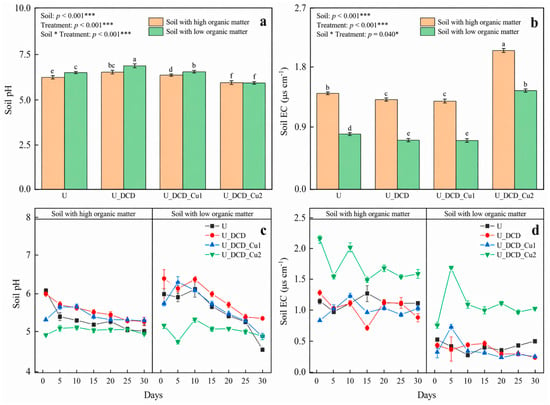
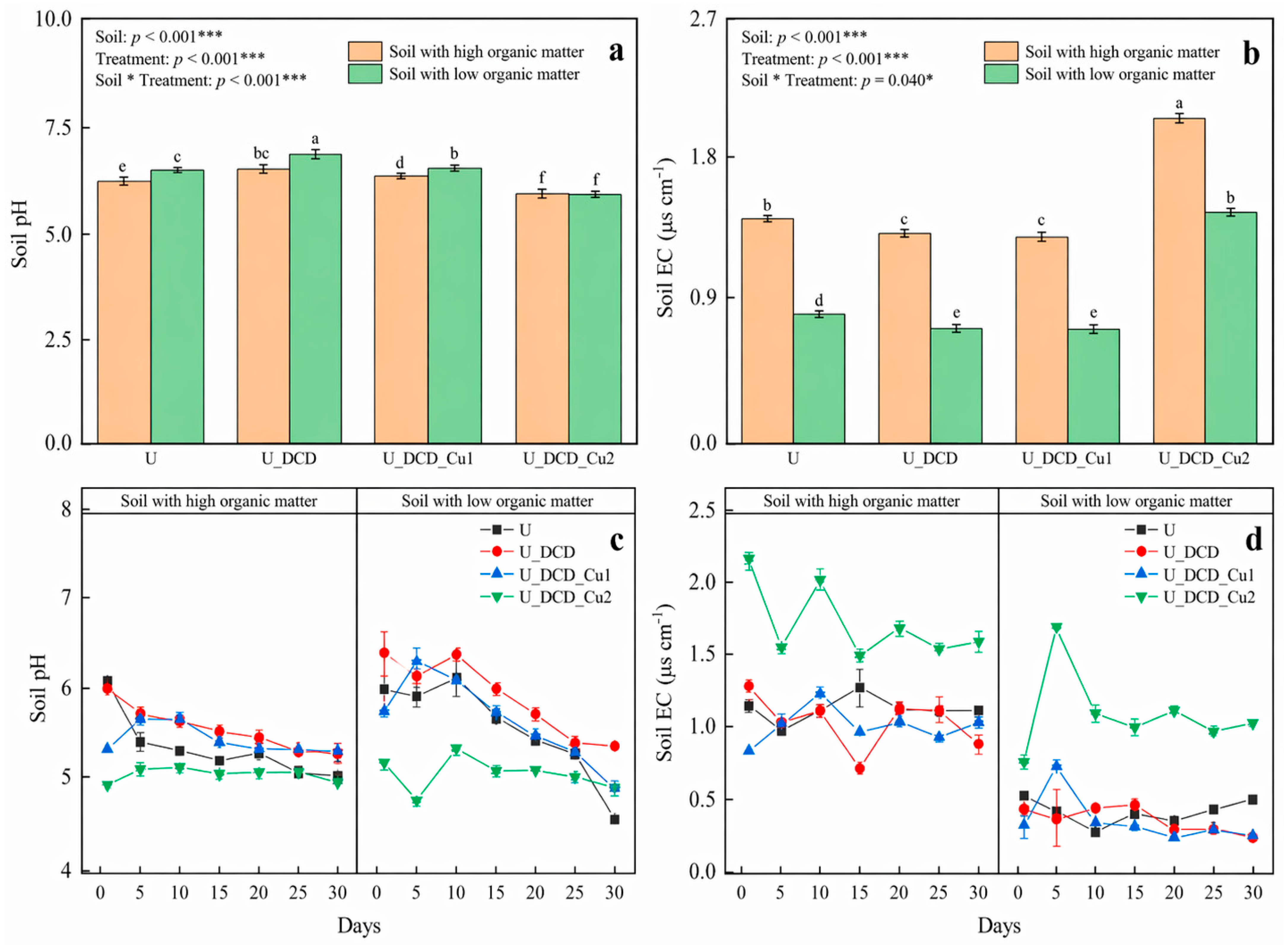
There was a significant influence of SOM on soil pH and EC (p < 0.001; Figure 1). Overall, soils with lower SOM content tended to exhibit higher soil pH, while soils with high SOM had higher soil EC. The effects of the treatments were also significant for both soil pH and EC (p < 0.001). In comparison with urea alone (U), application of DCD (U_DCD) and U + DCD + low Cu (U_DCD_Cu1) was associated with an increase in soil pH by approximately 0.2 to 0.4 units, regardless of SOM content. At the same time, these treatments were associated with lower soil EC compared with U alone. This pattern may be related to changes in soil ionic composition associated with nitrification inhibition. The response of the treatment with the highest Cu concentration (U_DCD_Cu2) differed from the other treatments. This treatment caused a significantly lower soil pH compared with all other treatments, regardless of SOM content (p < 0.05). Moreover, U_DCD_Cu2 was associated with a substantial increase in soil EC.
Figure 1.
Effects of urea, dicyandiamide (DCD), and copper (Cu) application on soil pH and electrical conductivity (EC) under soils with high and low soil organic matter (SOM) content. (a) cumulative soil pH, (b) cumulative soil EC, (c) temporal changes in soil pH during the incubation period, and (d) temporal changes in soil EC during the incubation period. Treatments included urea alone (U), urea + DCD (U_DCD), urea + DCD + low Cu (U_DCD_Cu1), and urea + DCD + high Cu (U_DCD_Cu2). Values represent mean ± standard error (SE), and error bars may be smaller than the symbols in some cases. * and *** indicate significant differences at p < 0.05 and p < 0.001, respectively. Different lowercase letters indicate significant differences among treatments according to Tukey’s HSD test at p < 0.05, whereas the same lowercase letters indicate no significant difference.
In soils with high SOM content, U_DCD_Cu2 showed markedly higher soil EC than other treatments, being 20–30% higher than U. In low-SOM soils, EC under U_DCD_Cu2 did not differ substantially from the other treatments, although a tendency toward increasing EC over time was observed. In addition to differences in the magnitude of pH and EC between the treatments, temporal changes over the 30-day incubation period revealed specific patterns. U_DCD generally showed a consistent increase in soil pH under both SOM conditions, particularly during the early-mid-incubation periods. In contrast, U_DCD_Cu2 consistently exhibited the lowest soil pH throughout the experiment. The highest EC values were recorded under U_DCD_Cu2 during the incubation period, especially in soils with high SOM content, where soil EC remained above the initial level (day 0).
3.2. Soil Extractable NH4+-N and NO3−-N Concentrations and Their Ratio
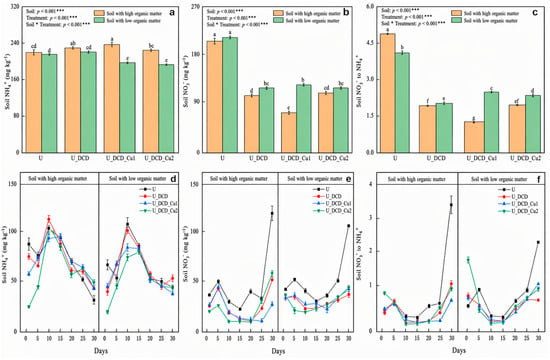
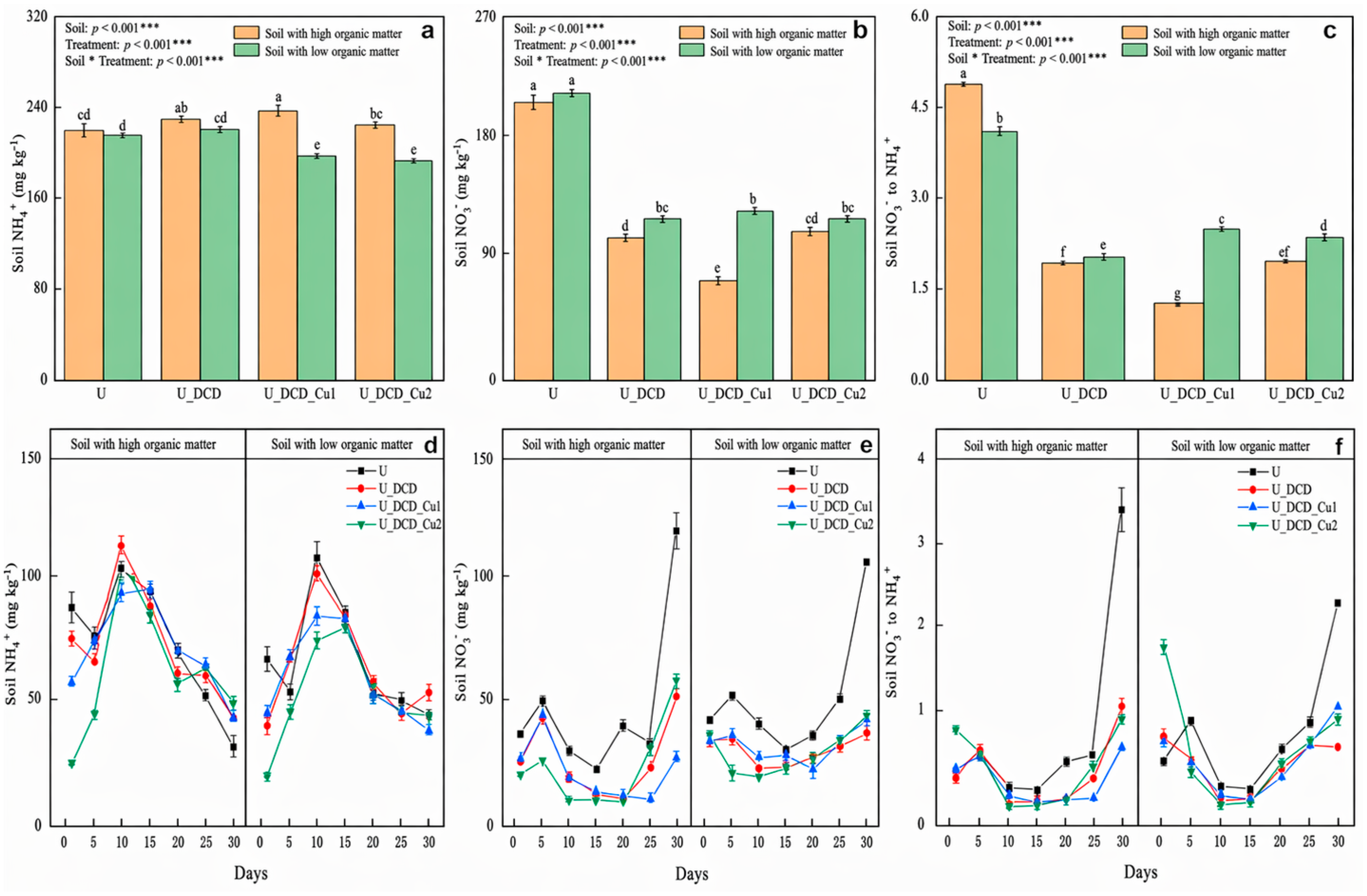
There was a significant impact of SOM on the extractable concentration of NH4+-N, NO3−-N, and NO3−/NH4+ ratio in all tested conditions (p < 0.001; Figure 2). Generally, soils with high SOM tended to have higher NH4+-N concentration (about 10–25%) compared with soils with low SOM; in contrast, soils with low SOM exhibited higher NO3−-N concentration (by about 15–30%). The effects of different treatments were statistically significant for all parameters (p < 0.001). In both SOM soils, the urea-only application resulted in the highest NO3−-N concentration and NO3−/NH4+ ratio, suggesting relatively higher nitrification activity. The treatment with DCD resulted in significant decreases of NO3−-N concentration (by 40–60%) and the NO3−/NH4+ ratio, along with increased NH4+-N concentrations compared with treatment U (p < 0.05), indicating effective nitrification inhibition. The presence of Cu in treatments with DCD also influenced these patterns. In high-SOM soils, the lowest NO3−-N concentration and NO3−/NH4+ ratio were observed in the U_DCD_Cu1 treatment. By contrast, in low-SOM soils, the effect of Cu addition appeared to be less pronounced for NH4+-N and NO3−-N concentration but was associated with a gradual increase in the NO3−/NH4+ ratio (p < 0.05) as Cu concentration increased.
Figure 2.
Effects of urea, dicyandiamide (DCD), and copper (Cu) application on soil extractable ammonium nitrogen (NH4+-N), nitrate nitrogen (NO3−-N), and their ratio (NO3−/NH4+) under soils with high and low soil organic matter (SOM) content. (a) cumulative NH4+-N, (b) cumulative NO3−-N, (c) NO3−/NH4+ ratio, (d) temporal changes in NH4+-N, (e) temporal changes in NO3−-N, and (f) temporal changes in NO3−/NH4+ ratio during the incubation period. Treatments included urea alone (U), urea + DCD (U_DCD), urea + DCD + low Cu (U_DCD_Cu1), and urea + DCD + high Cu (U_DCD_Cu2). Values represent mean ± standard error (SE). Different lowercase letters indicate significant differences among treatments within each soil type (p < 0.05). *** indicates significant differences at p < 0.001.
In all soils, NH4+-N concentrations were generally higher under treatments U and U_DCD than under treatments with Cu additions (U_DCD_Cu1 and U_DCD_Cu2); however, there was no significant difference between the Cu concentrations. This suggests that Cu may partially counteract the effect of DCD on nitrification processes. During the 30-day incubation, all parameters showed trends consistent with the observations described above. There were consistently high NO3−-N concentrations in soil under treatment U, whereas DCD-treated soils generally exhibited lower NO3−-N concentrations. At the same time, NO3−-N concentration tended to increase over time in soils treated with Cu additions, particularly under low SOM conditions.
3.3. Soil N2O and CO2 Emissions
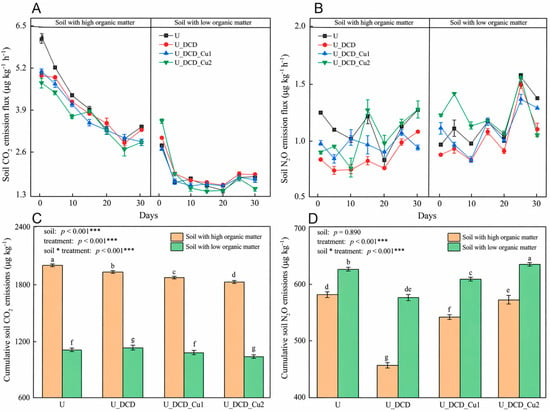
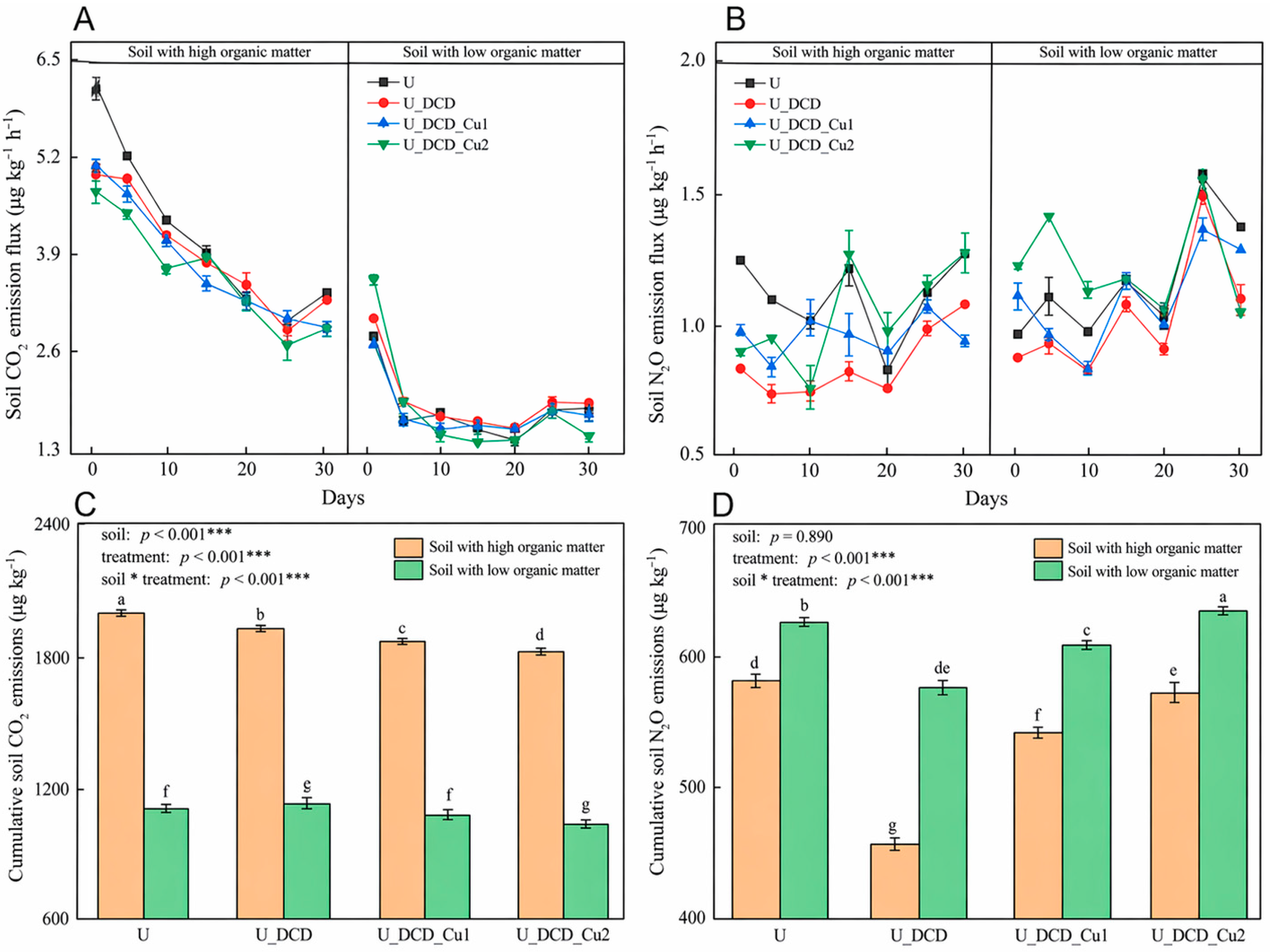
The impact of SOM on the cumulative emissions of CO2 was significant (p < 0.001), while its impact on the cumulative emissions of N2O was not significant (p = 0.890); however, soil × treatment interaction was found to be significant for both gases (p < 0.001; Figure 3). Cumulative emissions of CO2 under high SOM were substantially higher than under low SOM (approximately 2–3 times higher). In contrast, cumulative emissions of N2O were generally higher under low SOM. Significant differences in emissions were noted among treatments for both N2O and CO2 (p < 0.001). Under high SOM conditions, the highest emissions of CO2 were noted with treatment U, while emissions were reduced by approximately 5–10% following DCD addition (U_DCD). With further addition of Cu (U_DCD_Cu1 and U_DCD_Cu2), CO2 emissions tended to decrease further, with the lowest values observed under U_DCD_Cu2 (about 10–15% lower than U; p < 0.05).
Figure 3.
Soil N2O and CO2 emissions rate as affected by applications of urea, DCD, and Cu under soil with high and low SOM. (A) Soil CO2 emissions rate with different times during the incubation ratio, (B) Soil N2O emissions rate with different times during the incubation, (C) Accumulative data of soil CO2 emissions rate, and (D) Accumulative data of soil N2O emissions rate. Values represent mean ± standard error (SE). Error bars are shown for all measurements; however, in some cases, they may be smaller than the symbols due to low variability among replicates. Different lowercase letters indicate significant differences among treatments (LSD test, p < 0.05). Statistical results for soil type, treatment, and their interaction are presented within the panels. *** indicates significant differences at p < 0.001.
With regard to N2O emissions, a DCD application was associated with reduced emissions compared with U under high and low SOM levels. However, the addition of Cu to DCD was associated with an increase in N2O emissions, with emissions tending to increase progressively (p < 0.05) as Cu concentration increased from U_DCD to U_DCD_Cu2. A similar pattern was observed under low SOM conditions, U_DCD showed the lowest N2O emissions, while Cu addition (especially U_DCD_Cu2) was associated with higher emissions. These observations suggest that, under low SOM conditions, Cu addition may reduce the inhibitory effect of DCD on N2O emissions. Moreover, cumulative N2O emissions were consistently higher under low SOM compared with high SOM conditions. In contrast, CO2 emissions under low SOM showed a different pattern, with the highest emissions observed under U_DCD and the lowest under U_DCD_Cu2. No significant difference was found between U and U_DCD_Cu1, suggesting that the effect of Cu on CO2 emissions under low SOM was less pronounced than under high SOM. As seen in temporal patterns, emissions of CO2 under high SOM were highest in the initial measurement period and gradually decreased over time. On the other hand, N2O emissions exhibited different temporal patterns depending on SOM conditions.
3.4. Soil Enzymatic Activities
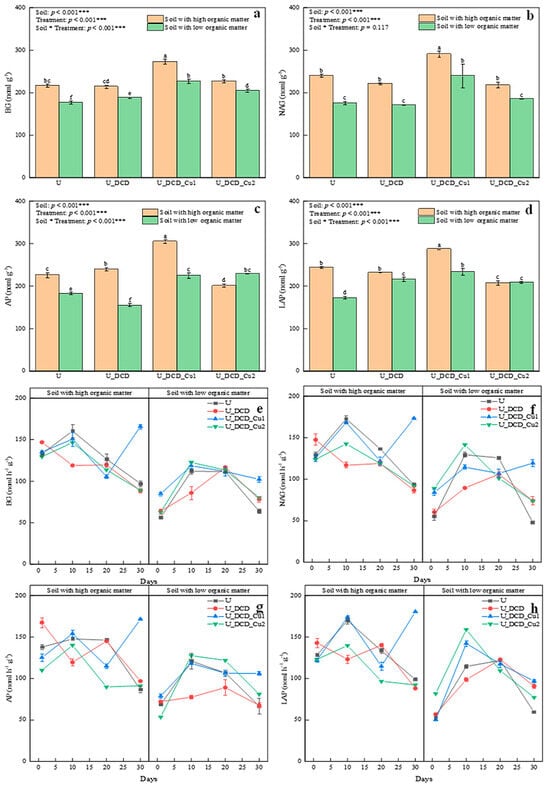
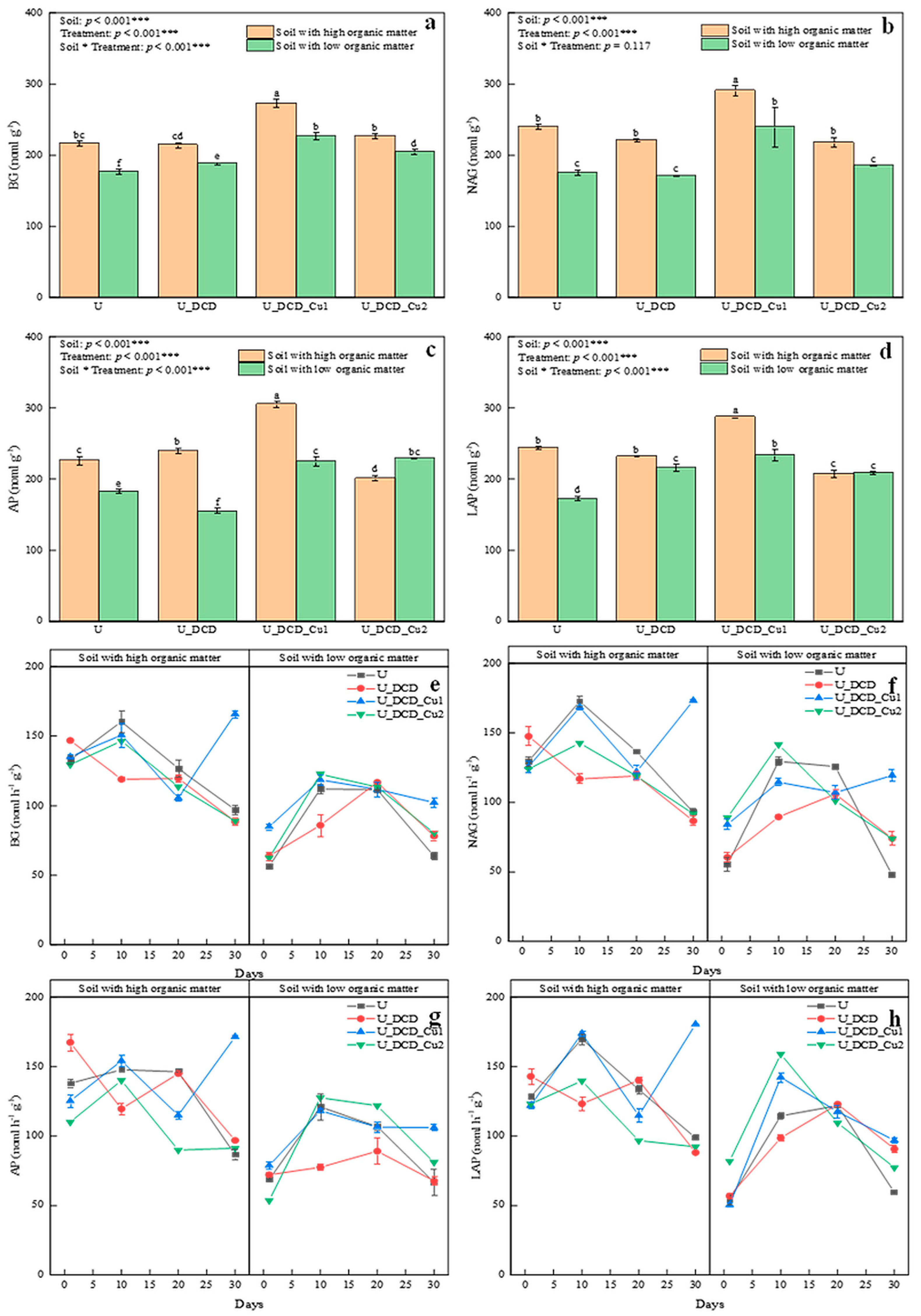
SOM had a significant effect on soil enzyme activities, including BG, NAG, AP, and LAP; all activities increased significantly in soils with high organic matter content compared to those with low organic matter content (p < 0.001; Figure 4). The effects of treatments were significant for all studied enzymes under both high and low SOM conditions (p < 0.001). The treatment combining DCD with Cu (U_DCD_Cu1) was associated with the highest activities of BG, NAG, and LAP under high-SOM conditions, increasing enzyme activities by approximately 15–30% compared to the urea-only treatment. The lowest enzyme activities under high-SOM conditions were observed in the U treatment, where no nitrification inhibitor was applied. In low-SOM soils, a similar trend was observed, with U_DCD_Cu1 showing the highest activities of BG, NAG, and LAP. In the case of AP, the highest activity was observed under the U_DCD_Cu2 treatment, while the lowest activities of BG, NAG, and LAP under low-SOM conditions were observed under U and U_DCD treatments, respectively.
Figure 4.
Effects of urea, dicyandiamide (DCD), and copper (Cu) application on soil enzyme activities under soils with high and low soil organic matter (SOM) content. (a–d) cumulative enzyme activities of β-glucosidase (BG), N-acetyl-β-D-glucosaminidase (NAG), acid phosphatase (AP), and leucine aminopeptidase (LAP), respectively; (e–h) temporal changes in BG, NAG, AP, and LAP activities during the incubation period. Treatments included urea alone (U), urea + DCD (U_DCD), urea + DCD + low Cu (U_DCD_Cu1), and urea + DCD + high Cu (U_DCD_Cu2). Values represent mean ± standard error (SE). Different lowercase letters indicate significant differences among treatments within each soil type (p < 0.05). *** indicates significant differences at p < 0.001.
Regardless of soil type, the effect of DCD alone on enzyme activities appeared to be less pronounced compared to the DCD–Cu combinations. These patterns suggest that Cu addition may enhance microbial activity associated with enzyme production. Enzyme activities increased over time, with different temporal dynamics under both high- and low-SOM conditions. The highest enzyme activities were observed during the first half of the incubation period, followed by a declining trend thereafter. The highest activities at any point during incubation were generally observed under the U_DCD_Cu1 treatment.
3.5. AOA-amoA and AOB-amoA Gene Abundance
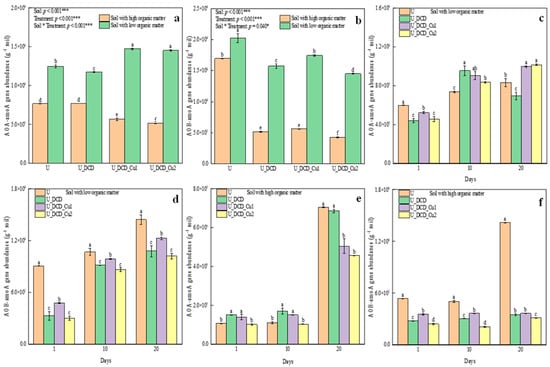
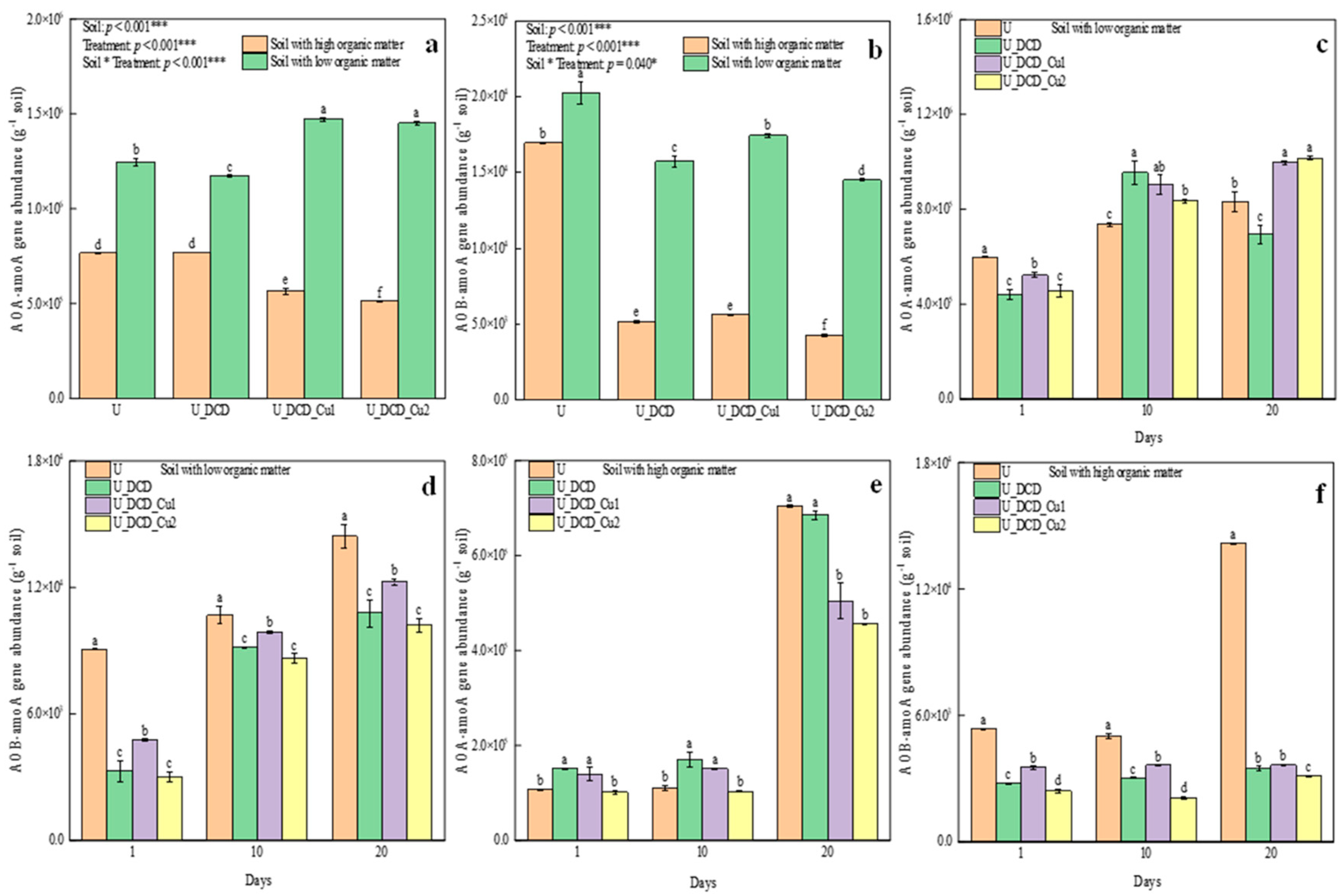
The presence of SOM had a significant effect on the abundance of both amoA-archaea (AOA-amoA) and amoA-bacteria (AOB-amoA) genes (p < 0.001; Figure 5). In general, soils with lower SOM tended to exhibit higher abundances of these genes compared with high SOM samples. Similarly, treatment effects were also statistically significant for both AOA and AOB abundances (p < 0.001). In soils with high SOM, the highest abundances of AOA-amoA and AOB-amoA were recorded under urea alone (U), while the lowest abundances were recorded under U_DCD_Cu2, which resulted in a reduction of approximately 31–49% compared to U (p < 0.05), suggesting inhibitory effects on ammonia oxidizers under DCD and high Cu levels. However, in soils with low SOM, AOA and AOB showed different responses to treatment. The abundance of AOA-amoA tended to increase with Cu addition (U_DCD_Cu1 and U_DCD_Cu2), with the highest values being found in the latter case. In contrast, AOB-amoA abundance showed limited variation among treatments, although the highest values were observed under U, and DCD-containing treatments were associated with lower AOB-amoA abundance, particularly when combined with Cu (p < 0.05). As expected, in soils with both high and low SOM contents, the application of DCD (either without or with Cu) was associated with reduced AOB abundance compared with U. However, AOA responded differently depending on SOM level, with Cu application associated with increased AOA abundance in soils with low SOM, but reduced abundance in soils with high SOM, along with the DCD application. In low SOM soils, there were no significant differences in AOA abundance between U_DCD_Cu1 and U_DCD_Cu2 samples, suggesting a limited dose-dependent response to Cu under these conditions.
Figure 5.
Effects of urea, dicyandiamide (DCD), and copper (Cu) on the abundance of ammonia-oxidizing archaea (AOA-amoA) and ammonia-oxidizing bacteria (AOB-amoA) in soils with high and low soil organic matter (SOM) content. The figure shows the gene abundance under different treatments in both soils. Cumulative abundances of AOA (a) and AOB (b). Temporal changes in the abundance of AOA (c,e) and AOB (d,f) during the incubation period in soils with low and high organic matter contents, respectively. Urea, urea + DCD, urea + DCD + low Cu, and urea + DCD + high Cu were used in both soils as treatments. The results are shown as mean ± SE. Different lowercase letters indicate significant differences between treatments within each soil group (p < 0.05). * and *** indicate significant differences at p < 0.05 and p < 0.001, respectively.
3.6. Relationships Among Studied Variables
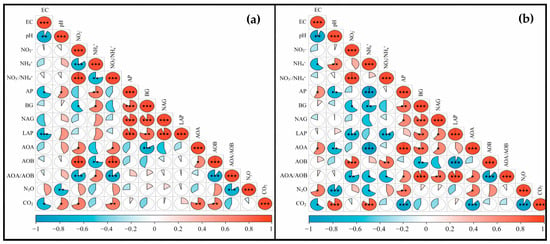
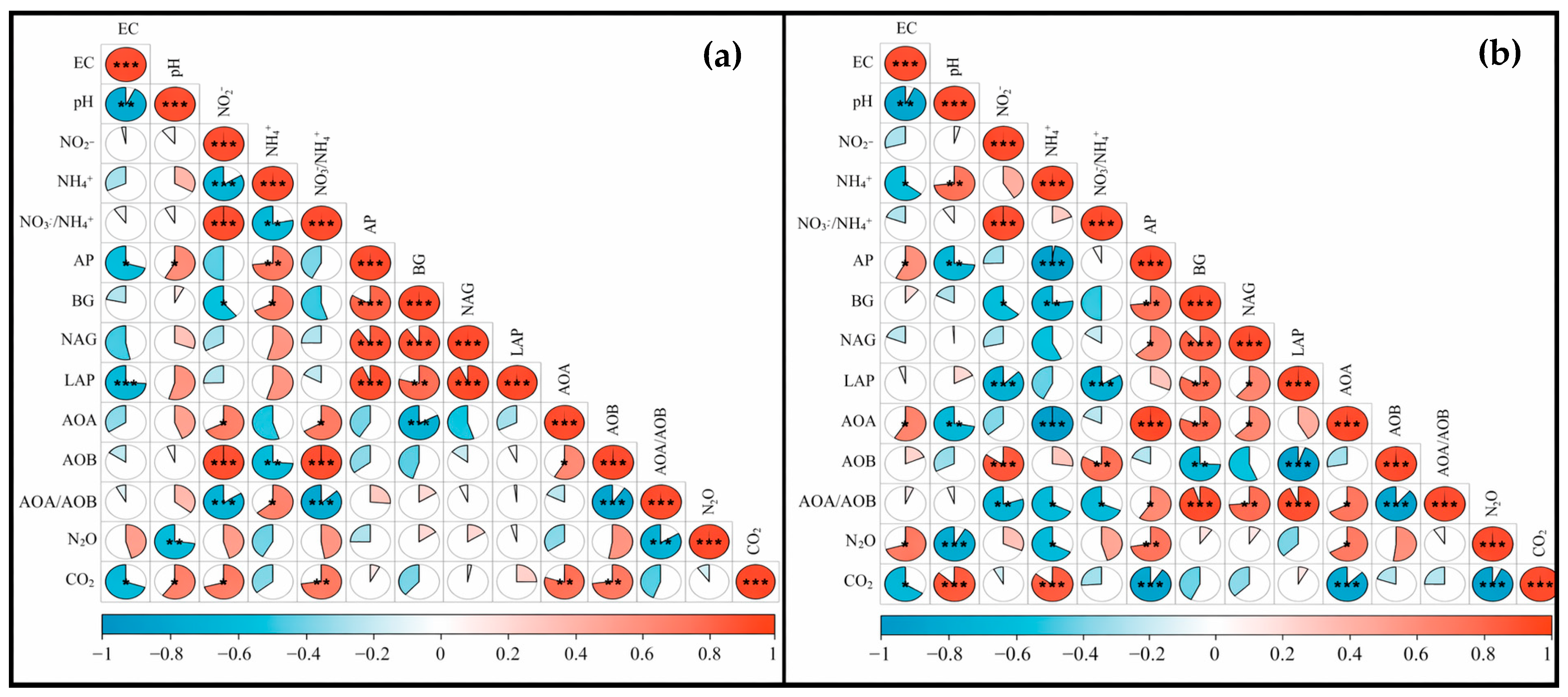
The relationships between the variables under high and low SOM content are shown in Figure 6 and Tables S2 and S3. Different correlation relationships were observed for these soils, suggesting SOM-dependent differences in N transformations and microbial activities. Soil pH under high SOM content showed a positive relationship with CO2 emissions (r = 0.608, p < 0.05) and a negative relationship with N2O emissions (r = −0.734, p < 0.01). These relationships may reflect links between soil pH, microbial activity, and gaseous emissions. Soil NH4+ concentration was strongly negatively correlated with NO3− (r = −0.827, p < 0.001) and positively correlated with enzyme activities such as BG (r = 0.678, p < 0.05) and AP (r = 0.734, p < 0.01), suggesting an association between N availability and microbial activity. Soil NO3− concentration was positively correlated with the abundance of AOB (r = 0.978, p < 0.001) and CO2 emissions (r = 0.704, p < 0.05), indicating a potential linkage with nitrification-related processes and microbial respiration. The BG activity was negatively correlated with AOA abundance (r = −0.825, p < 0.001).
Figure 6.
Pearson correlation analysis of soil properties, enzyme activities, and nitrification-related indicators under soils with high and low soil organic matter (SOM) content, generated using R software (version 4.5.2). Color gradients from red to blue represent positive to negative correlations, respectively, for high SOM (a) and low SOM (b) soils. Asterisks indicate statistical significance at * p < 0.05, ** p < 0.01, and *** p < 0.001.
In soils with low SOM content, the soil pH showed a positive correlation with NH4+ concentration (r = 0.732, p < 0.01) and CO2 emissions (r = 0.868, p < 0.001) and a negative correlation with N2O emissions (r = −0.902, p < 0.001) and AOA abundance (r = −0.718, p < 0.01). Soil NH4+ concentration showed negative relationships with NO3− (r = −0.980, p < 0.001), AOA (r = −0.986, p < 0.001), and AOB abundance (r = −0.765, p < 0.01), suggesting an association between NH4+ availability and nitrification-related processes. Soil NO3− concentration revealed strong positive relationships with the abundance of AOB (r = 0.843, p < 0.001) and NO3−/NH4+ ratio (r = 0.980, p < 0.001). It should be noted that enzyme activities were affected by SOM differently. In case of low SOM, BG activity showed a positive correlation with the AOA/AOB ratio (r = 0.959, p < 0.001), and negative relationships with NH4+ (r = −0.765, p < 0.01), NO3− (r = −0.627, p < 0.05), and AOB abundance (r = −0.750, p < 0.01). Similarly, AP activity had a positive relationship with the AOA/AOB ratio (r = 0.597, p < 0.05) and N2O emissions (r = 0.730, p < 0.01), and a negative relationships with NH4+ (r = −0.980, p < 0.001), CO2 (r = −0.912, p < 0.001), and pH (r = −0.739, p < 0.01). NAG activity had positive relationships with AOA abundance (r = 0.621, p < 0.05) and the AOA/AOB ratio (r = 0.758, p < 0.01).
4. Discussion
As the primary source of N and the main component of plant nutrients, SOM is a key regulator of nitrification through its influence on substrate accessibility, composition of the microbial community, and soil physicochemical properties [56,57,58]. Based on the results obtained, an accumulation of NH4+ ions and a simultaneous reduction of NO3− ions under conditions of high SOM indicate an inhibition of nitrification, whereas opposite trends are associated with an increase in the rate of nitrification. It should be noted that these patterns are not solely substrate-driven and may also reflect biological regulation, as higher abundances of AOA and AOB were observed under low SOM conditions. The negative correlation between NH4+ and NO3−, along with the positive one between NO3− and AOB abundance, indicates a close association between nitrification processes and NH3-oxidizing microorganisms [59,60].
On a mechanistic level, SOM is an environmental factor affecting nitrification through several interconnected processes. Specifically, high SOM content is associated with increased microbial activity and the production of extracellular enzymes, such as BG, NAG, AP, and LAP, which showed positive correlations with NH4+-N concentrations and negative correlations with NO3−-N concentrations [61,62,63,64,65]. This suggests that immobilization and biochemical transformations of organic substrates favor the reduced form of N [3,66,67]. Secondly, SOM-related acidification may contribute to reduced activity of AOB, which are known to be sensitive to lower pH levels [68,69,70,71]. And thirdly, SOM can act as a competitive ligand for Cu ions, potentially reducing Cu available as a cofactor for AMO [9,72,73,74]. Thus, these findings suggest that SOM may regulate nitrification not only through direct effects on substrate availability and microbial activity, but also through modulation of metal–enzyme interactions that influence nitrification intensity [66,67,68,69,70,71,72,73,74,75]. The link between nitrification suppression and SOM is described earlier [75,76]; however, unlike previous works, the presented results provide insights into the potential underlying mechanisms.
One of the key mechanisms of the discussed phenomena may involve the interplay between DCD efficiency and Cu availability. Under low SOM conditions, low concentrations of Cu resulted in the improvement of the inhibitory impact of DCD on nitrification. It was demonstrated by a decrease in NO3− concentration and retention of more NH4+. In other words, under low SOM, there is a synergic limitation of activity of ammonia-oxidizing microorganisms due to Cu and DCD action [14,72,73,77]. The effectiveness of this effect is supported by the observed decrease in AOB abundance in this experiment. Thus, Cu, being an inhibitor of nitrification in small quantities [18,22], turns out to be an enhancement factor for DCD under the specified conditions. The results suggest that Cu may act as an additional limiting factor, particularly under conditions of low SOM.
The described pattern was less pronounced under conditions of high SOM, which may be related to the intense binding of Cu by SOM, potentially reducing its bioavailability and limiting its interaction with DCD [72,73]. The presented results suggest that SOM may influence the efficiency of inhibition not only through direct biochemical mechanisms, but also via metal speciation. In this context, SOM may exert a dual role in regulating nitrification by acting as both a limiting and modulating factor [66,67,75,76].
High Cu concentrations result in decreased efficiency of DCD on nitrification under conditions of low SOM. At the same time, the decrease in the efficiency of the inhibitor may be associated with changes in the sensitivity of the AOB to Cu or partial restoration of the enzymatic activity of AMO [22,44,74]. Additionally, the observed reduction in enzyme activity and microbial indicators may be associated with the toxic effects of Cu on soil microbiota [78,79,80]. Therefore, a transition from Cu limitation at low concentrations to Cu toxicity is one of the factors determining the response of nitrification to Cu.
The influence of Cu on N2O emissions revealed additional aspects of the problem. Similar to its effect on nitrification, DCD reduced N2O emissions due to limiting substrate production [33,41]. However, the increase in Cu concentration was associated with an increase in N2O emissions. Given that the content of denitrification functional genes was not measured, it can be hypothesized that Cu may influence the process at different steps. Since Cu is one of the essential components of N2O reductase, Cu deficiency or toxicity may inhibit the last stage of denitrification [81]. In this context, the observed increase in N2O emissions may be attributed to the decoupling of these processes. Additionally, incomplete inhibition of nitrification results in the accumulation of substrates, such as nitrite ions (NO2−) and hydroxylamine (NH2OH), causing an increase in N2O emissions [22].
Unlike N2O, CO2 emissions showed a significant dependence on Cu concentrations. Specifically, DCD reduced CO2 emissions, and its impact on this process increased with a rise in Cu concentration. It was found that a high concentration of this metal suppressed microbial activity, reducing the rate of microbial respiration [78,82]. The positive correlation between CO2 emissions and enzyme activities suggests that the process is determined by microbial activity. Thus, under high Cu content, microbial activity was decreased, and the corresponding reduction in emissions occurred [22,78,82]. The results suggest that Cu may inhibit nitrification and potentially affect denitrifying microorganisms, which could contribute to increased N2O emissions.
From the general viewpoint, the results indicate that the efficiency of NIs is greatly dependent on soil biochemical properties, and should not be assessed without taking into account SOM content and the availability of various elements. These findings suggest that a “one-size-fits-all” approach to N management in agriculture may be hardly applicable, given its strong dependence on site-specific soil and environmental conditions. To obtain maximum efficiency and minimize greenhouse gas emissions, it is necessary to conduct a site-specific assessment of SOM content and metal availability and microbial community composition.
Within this framework, the hypotheses proposed in this study can be critically evaluated. The first hypothesis, that Cu availability regulates nitrification in a concentration-dependent manner and consequently affects DCD inhibitory efficiency, is supported. The results indicate that Cu likely exerts a concentration-dependent effect, where low Cu enhanced DCD efficiency under low SOM conditions, while high Cu reduced its inhibitory effect, indicating that Cu availability could modulate the nitrification process and the performance of DCD. The second hypothesis, that SOM regulates Cu–DCD interaction through its dual role in modulating Cu availability and soil biochemistry, is supported by the observed trends. Our findings indicate that SOM may influence nitrification through microbial and enzymatic pathways, while also affecting Cu bioavailability via complexation, thereby modulating the interaction between Cu and DCD. This dual mechanism explains the contrasting responses observed between high and low SOM soils. The third hypothesis, that the interaction between Cu and DCD affects N transformations and gaseous emissions, is supported, although further evidence would be needed for full mechanistic confirmation. The combined effects of Cu and DCD significantly altered NH4+ and NO3− dynamics, as well as N2O and CO2 emissions, suggesting that their interaction could play an important role in regulating nitrification processes and associated greenhouse gas fluxes.
These results have several implications for improving N management practices from a sustainability standpoint. First, while the application of NIs such as DCD has shown promise in mitigating greenhouse gas emissions, their effectiveness may vary depending on soil conditions, specifically SOM content and Cu availability. The findings indicate the importance of site-specific soil management approaches, including the adjustment of nutrient inputs based on soil conditions. For example, in soils with a low level of organic matter, an improvement in the efficiency of DCD by manipulating Cu concentration could enhance N utilization and minimize the loss of NO3−, thereby preventing pollution. On the other hand, for soils with high SOM concentrations, the effectiveness of DCD in reducing greenhouse gas emissions may be limited due to enhanced microbial activity and substrate availability. Second, the study underscores the importance of considering multiple effects of various soil management practices. While the application of DCD and Cu significantly reduces CO2 emissions due to the inhibition of microbial activity, it can also negatively impact the ability of DCD to suppress N2O emissions, creating a trade-off between two processes. The findings suggest that soil management policies must consider multiple factors to ensure sustainability. Lastly, the research suggests that the concentration of trace metals and SOM in soil can affect the effectiveness of NIs and minimize soil NO3− losses.
While this study provides important insights, several limitations should be acknowledged. For example, the limited data on the speciation of Cu in soil hinders a more mechanistic approach to understanding the interactions between Cu bioavailability and DCD under varying levels of SOM. Future studies could therefore focus on characterizing Cu fractionation (e.g., exchangeable and organic-bound forms) and its dynamic interactions with NIs. Furthermore, it is important to point out that the two soils used in the experiment were sourced from different sites, and in addition to contrasting SOM contents, differed in other physicochemical properties, such as CEC and NO3−-N content. Therefore, the observed differences may reflect the combined effects of SOM and inherent soil properties, making it difficult to fully isolate the effects of SOM alone. In addition, the absence of Cu only and U + Cu control treatments represents a limitation of the experimental design, as it constrains the ability to isolate the independent effects of Cu on N transformations. Thus, the reported response was mainly related to the interaction of Cu with DCD rather than the independent action of added Cu. Former studies indicated the independent influence of Cu on the nitrification process and microbial activity [21,22]; therefore, the lack of these control treatments may influence the interpretation of the results obtained in this study, especially when discussing the impact of Cu-DCD interactions on N transformations and gaseous fluxes.
5. Conclusions
This study suggests that Cu availability may play an important role in modulating the efficiency of DCD as an NI, particularly in interaction with SOM. The results indicate that under low SOM conditions, low Cu availability was associated with enhanced DCD performance in suppressing nitrification, whereas increasing Cu concentrations tended to reduce its inhibitory effect, suggesting a concentration-dependent and soil-specific response. In contrast, under high SOM conditions, the influence of Cu on DCD efficiency appeared to be less pronounced, likely due to reduced Cu bioavailability associated with SOM complexation. The interaction between Cu and DCD also appears to influence gaseous emissions. While DCD generally reduced N2O emissions, the addition of Cu may diminish this mitigation effect under both SOM conditions, suggesting that Cu availability may influence processes controlling N2O production and reduction. In contrast, CO2 emissions were generally reduced under DCD application and appeared to be further suppressed at higher Cu levels, which may be associated with reduced microbial activity. Overall, these findings suggest that the effectiveness of DCD may not be fixed but may depend on soil chemical conditions, particularly SOM content and Cu availability. This suggests that soil-specific management strategies may be needed to better optimize the use of NIs for improving N use efficiency and reducing environmental impacts. However, it is important to note that this study was conducted under controlled incubation conditions. Factors such as soil moisture dynamics, temperature fluctuations, plant–soil interactions, and root activity in field environments may influence Cu availability, microbial processes, and the performance of DCD. Therefore, these findings should be interpreted with caution, and further studies under field-based systems are needed to validate these findings.
Supplementary Materials
The following supporting information can be downloaded at: https://www.mdpi.com/article/10.3390/su18094513/s1, Figure S1: A map of the sampling sites; Table S1: Results of normality (Shapiro–Wilk test) and homogeneity of variance (Levene’s test) for the studied variables; Table S2: Significant Pearson correlation coefficients among measured variables in soil with high SOM content; Table S3: Significant Pearson correlation coefficients among measured variables in soil with low SOM content.
Author Contributions
Conceptualization, Y.W. (Yuhong Wen), M. and A.S.E.; methodology, Y.W. (Yuhong Wen), A.S.E., T.O. and M.J.; software, Z.D. and Q.Z.; validation, Y.W. (Yanzheng Wu), L.M. and N.S.; formal analysis, Y.W. (Yuhong Wen), M. and T.O.; investigation, Y.W. (Yanzheng Wu), A.S.E. and M.J.; resources, L.M. and A.S.E.; data curation, Z.D. and Q.Z.; writing—original draft preparation, Y.W. (Yuhong Wen), M. and T.O.; writing—review and editing, A.S.E., M., L.M. and N.S.; visualization, Q.Z. and Y.W. (Yanzheng Wu); supervision, L.M. and A.S.E. All authors have read and agreed to the published version of the manuscript.
Funding
This work was supported by the National Natural Science Foundation of China (grant no. 42067008 (L.M.)).
Institutional Review Board Statement
Not applicable.
Informed Consent Statement
Not applicable.
Data Availability Statement
Data will be made available on request.
Conflicts of Interest
The authors declare no competing interests.
References
- Gruber, N.; Galloway, J.N. An Earth-system perspective of the global nitrogen cycle. Nature 2008, 451, 293–296. [Google Scholar] [CrossRef] [Scilit]
- Andrews, M.; Raven, J.A.; Lea, P.J. Do plants need nitrate? The mechanisms by which nitrogen form affects plants. Ann. Appl. Biol. 2013, 163, 174–199. [Google Scholar] [CrossRef] [Scilit]
- Zheng, J.; Zhou, M.; Zhu, B.; Fan, J.; Lin, H.; Ren, B.; Zhang, F. Drip fertigation sustains crop productivity while mitigating reactive nitrogen losses in Chinese agricultural systems: Evidence from a meta-analysis. Sci. Total Environ. 2023, 886, 163804. [Google Scholar] [CrossRef] [Scilit]
- Bowles, T.M.; Atallah, S.S.; Campbell, E.E.; Gaudin, A.C.M.; Wieder, W.R.; Grandy, A.S. Addressing agricultural nitrogen losses in a changing climate. Nat. Sustain. 2018, 1, 399–408. [Google Scholar] [CrossRef] [Scilit]
- Li, S.X.; Wang, Z.-H.; Stewart, B.A. Chapter Five—Responses of crop plants to ammonium and nitrate N. Adv. Agron. 2013, 118, 205–397. [Google Scholar] [CrossRef] [Scilit]
- Neemisha; Sharma, S. Soil enzymes and their role in nutrient cycling. In Structure and Functions of Pedosphere; Springer Nature: Singapore, 2022; pp. 173–188. [Google Scholar] [CrossRef] [Scilit]
- Popoviciu, D.R. Cycles of matter in soil, nitrogen cycle. In Soil Biology & Ecology: The Basics; Bentham Science Publishers: Singapore, 2024; pp. 77–87. [Google Scholar] [CrossRef] [Scilit]
- Recous, S.; Mary, B.; Faurie, G. Microbial immobilization of ammonium and nitrate in cultivated soils. Soil Biol. Biochem. 1990, 22, 913–922. [Google Scholar] [CrossRef] [Scilit]
- Elrys, A.S.; Desoky, E.S.M.; Zhu, Q.; Liu, L.; Yun, X.W.; Wang, C.; Shuirong, T.; Yanzheng, W.; Meng, L.; Zhang, J.; et al. Climate controls on nitrate dynamics and gross nitrogen cycling response to nitrogen deposition in global forest soils. Sci. Total Environ. 2024, 920, 171006. [Google Scholar] [CrossRef] [Scilit]
- Govindasamy, P.; Muthusamy, S.K.; Bagavathiannan, M.; Mowrer, J.; Jagannadham, P.T.K.; Maity, A.; Halli, H.M.; Sujayanand, G.K.; Vadivel, R.; Das, T.K.; et al. Nitrogen use efficiency—A key to enhance crop productivity under a changing climate. Front. Plant Sci. 2023, 14, 1121073. [Google Scholar] [CrossRef] [Scilit]
- Norton, J.; Ouyang, Y. Controls and adaptive management of nitrification in agricultural soils. Front. Microbiol. 2019, 10, 1931. [Google Scholar] [CrossRef] [Scilit] [PubMed]
- Zhang, H.; Liao, F.; Li, W.; Li, Y.; Yang, S.; Zhang, H.; Yang, Y.; Shan, Y. Rhizosphere soil nitrification ability controls nitrogen-use efficiency in rice growth period. Food Energy Secur. 2023, 12, e429. [Google Scholar] [CrossRef] [Scilit]
- Lu, S.; Liu, X.; Liu, C.; Cheng, G.; Shen, H. Influence of photoinhibition on nitrification by ammonia-oxidizing microorganisms in aquatic ecosystems. Rev. Environ. Sci. Bio/Technol. 2020, 19, 531–542. [Google Scholar] [CrossRef] [Scilit]
- Matse, D.T.; Jeyakumar, P.; Bishop, P.; Anderson, C.W.N. Copper induces nitrification by ammonia-oxidizing bacteria and archaea in pastoral soils. J. Environ. Qual. 2023, 52, 49–63. [Google Scholar] [CrossRef] [Scilit] [PubMed]
- Daims, H.; Lebedeva, E.V.; Pjevac, P.; Han, P.; Herbold, C.; Albertsen, M.; Jehmlich, N.; Palatinszky, M.; Vierheilig, J.; Bulaev, A.; et al. Complete nitrification by Nitrospira bacteria. Nature 2015, 528, 504–509. [Google Scholar] [CrossRef] [Scilit]
- Lin, Y.; Ye, G.; Ding, W.; Hu, H.-W.; Zheng, Y.; Fan, J.; Wan, S.; Duan, C.; He, J.-Z. Niche differentiation of comammox Nitrospira and canonical ammonia oxidizers in soil aggregate fractions following 27-year fertilizations. Agric. Ecosyst. Environ. 2020, 304, 107147. [Google Scholar] [CrossRef] [Scilit]
- Beeckman, F.; Annetta, L.; Corrochano-Monsalve, M.; Beeckman, T.; Motte, H. Enhancing agroecosystem nitrogen management: Microbial insights for improved nitrification inhibition. Trends Microbiol. 2024, 32, 590–601. [Google Scholar] [CrossRef] [Scilit]
- Matse, D.T.; Jeyakumar, P.; Bishop, P.; Anderson, C.W.N. Bioavailable Cu can influence nitrification rate in New Zealand dairy farm soils. J. Soils Sediments 2022, 22, 916–930. [Google Scholar] [CrossRef] [Scilit]
- Zhao, S.; Su, X.; Wang, Y.; Yang, X.; Bi, M.; He, Q.; Chen, Y. Copper oxide nanoparticles inhibited denitrifying enzymes and electron transport system activities to influence soil denitrification and N2O emission. Chemosphere 2020, 245, 125394. [Google Scholar] [CrossRef] [Scilit] [PubMed]
- McBride Murray, B.; Richards Brian, K.; Steenhuis Tammo Russo John, J.; Sauvé, S. Mobility and solubility of toxic metals and nutrients in soil fifteen years after sludge application. Soil Sci. 1997, 162, 487–500. [Google Scholar] [CrossRef] [Scilit]
- Shaaban, M.; Peng, Q.; Bashir, S.; Wu, Y.; Younas, A.; Xu, X.; Rashti, M.R.; Abid, M.; Zafar-ul-Hye, M.; Núñez-Delgado, A.; et al. Restoring effect of soil acidity and Cu on N2O emissions from an acidic soil. J. Environ. Manag. 2019, 250, 109535. [Google Scholar] [CrossRef] [Scilit]
- Elrys, A.S.; Wen, Y.; Qin, X.; Chen, Y.; Zhu, Q.; Eltahawy, A.M.; Dan, X.; Tang, S.; Wu, Y.; Zhu, T.; et al. Initial evidence on the effect of copper on global cropland nitrogen cycling: A meta-analysis. Environ. Int. 2024, 184, 108491. [Google Scholar] [CrossRef] [Scilit]
- Zandi, P.; Yang, J.; Możdżeń, K.; Barabasz-Krasny, B. Chapter Five—A review of copper speciation and transformation in plant and soil/wetland systems. Adv. Agron. 2020, 161, 249–293. [Google Scholar] [CrossRef] [Scilit]
- Ondrasek, G.; Rengel, Z. The role of soil organic matter in trace element bioavailability and toxicity. In Abiotic Stress Responses in Plants; Springer: New York, NY, USA, 2012; pp. 403–423. [Google Scholar] [CrossRef] [Scilit]
- Qi, Y.; Zhu, J.; Fu, Q.; Hu, H.; Huang, Q.; Violante, A. Sorption of Cu by organic matter from the decomposition of rice straw. J. Soils Sediments 2016, 16, 2203–2210. [Google Scholar] [CrossRef] [Scilit]
- Antoniadis, V.; Levizou, E.; Shaheen, S.M.; Ok, Y.S.; Sebastian, A.; Baum, C.; Prasad, M.N.V.; Wenzel, W.W.; Rinklebe, J. Trace elements in the soil-plant interface: Phytoavailability, translocation, and phytoremediation—A review. Earth-Sci. Rev. 2017, 171, 621–645. [Google Scholar] [CrossRef] [Scilit]
- Jeon, D.; Robinson, B.; Dickinson, N. Organic matter mitigates biotic impact of copper in fruit orchard soil. Environ. Pollut. 2024, 363, 125145. [Google Scholar] [CrossRef] [Scilit]
- Kaplan, D.I.; Xu, C.; Huang, S.; Lin, Y.; Tolić, N.; Roscioli-Johnson, K.M.; Santschi, P.H.; Jaffé, P.R. Unique organic matter and microbial properties in the rhizosphere of a wetland soil. Environ. Sci. Technol. 2016, 50, 4169–4177. [Google Scholar] [CrossRef] [Scilit]
- Meng, Y.; Wang, J.J.; Wei, Z.; Dodla, S.K.; Fultz, L.M.; Gaston, L.A.; Xiao, R.; Park, J.; Scaglia, G. Nitrification inhibitors reduce nitrogen losses and improve soil health in a subtropical pastureland. Geoderma 2021, 388, 114947. [Google Scholar] [CrossRef] [Scilit]
- Liu, S.Y.; Wu, D.; Ju, X.T.; Shen, J.P.; Cheng, Y.; Deng, N.; Song, X.T.; Di, H.J.; Li, P.P.; Han Lli Ge, A.H.; et al. Nitrification inhibitor induced microbial NH4+-N immobilization improves maize nitrogen use efficiency in strong ammonia oxidation soil. Soil Biol. Biochem. 2025, 202, 109687. [Google Scholar] [CrossRef] [Scilit]
- Elrys, A.S.; Wang, J.; Meng, L.; Zhu, Q.; El-Sawy, M.M.; Chen, Z.; Tu, X.; El-Saadony, M.T.; Zhang, Y.; Zhang, J.; et al. Integrative knowledge-based nitrogen management practices can provide positive effects on ecosystem nitrogen retention. Nat. Food 2023, 4, 1075–1089. [Google Scholar] [CrossRef] [Scilit] [PubMed]
- Ning, J.; Ai, S.; Cui, L. Dicyandiamide has more inhibitory activities on nitrification than thiosulfate. PLoS ONE 2018, 13, e0200598. [Google Scholar] [CrossRef] [Scilit]
- Raza, S.; Chen, Z.; Ahmed, M.; Afzal, M.R.; Aziz, T.; Zhou, J. Dicyandiamide application improved nitrogen use efficiency and decreased nitrogen losses in wheat-maize crop rotation in Loess Plateau. Arch. Agron. Soil Sci. 2019, 65, 450–464. [Google Scholar] [CrossRef] [Scilit]
- Di, H.J.; Cameron, K.C. The use of a nitrification inhibitor, dicyandiamide (DCD), to decrease nitrate leaching and nitrous oxide emissions in a simulated grazed and irrigated grassland. Soil Use Manag. 2002, 18, 395–403. [Google Scholar] [CrossRef] [Scilit]
- Wang, H.; Köbke, S.; Dittert, K. Use of urease and nitrification inhibitors to reduce gaseous nitrogen emissions from fertilizers containing ammonium nitrate and urea. Glob. Ecol. Conserv. 2020, 22, e00933. [Google Scholar] [CrossRef] [Scilit]
- Zhang, S.; Li, L.; Shang, J.; Li, D.; Shi, Q.; Xin, H.; Sun, Z.; Liu, L. Effects of additives on compost quality and cbbL-containing autotrophic microbial community of watermelon straw composting. J. Environ. Chem. Eng. 2024, 12, 114132. [Google Scholar] [CrossRef] [Scilit]
- Chen, H.; Yin, C.; Fan, X.; Ye, M.; Peng, H.; Li, T.; Zhao, Y.; Wakelin, S.A.; Chu, G.; Liang, Y. Reduction of N2O emission by biochar and/or 3,4-dimethylpyrazole phosphate (DMPP) is closely linked to soil ammonia oxidizing bacteria and nosZI-N2O reducer populations. Sci. Total Environ. 2019, 694, 133658. [Google Scholar] [CrossRef] [Scilit]
- Fan, X.; Yin, C.; Chen, H.; Ye, M.; Zhao, Y.; Li, T.; Wakelin, S.A.; Liang, Y. The efficacy of 3,4-dimethylpyrazole phosphate on N2O emissions is linked to niche differentiation of ammonia oxidizing archaea and bacteria across four arable soils. Soil Biol. Biochem. 2019, 130, 82–93. [Google Scholar] [CrossRef] [Scilit]
- Shi, X.; Hu, H.; Zhu-Barker, X.; Hayden, H.; Wang, J.; Suter, H.; Chen, D.; He, J. Nitrifier-induced denitrification is an important source of soil nitrous oxide and can be inhibited by a nitrification inhibitor 3,4-dimethylpyrazole phosphate. Environ. Microbiol. 2017, 19, 4851–4865. [Google Scholar] [CrossRef] [Scilit]
- Zhou, X.; Wang, S.; Ma, S.; Zheng, X.; Wang, Z.; Lu, C. Effects of commonly used nitrification inhibitors—Dicyandiamide (DCD), 3,4-dimethylpyrazole phosphate (DMPP), and nitrapyrin—On soil nitrogen dynamics and nitrifiers in three typical paddy soils. Geoderma 2020, 380, 114637. [Google Scholar] [CrossRef] [Scilit]
- Elrys, A.S.; Raza, S.; Elnahal, A.S.M.; Na, M.; Ahmed, M.; Zhou, J.; Chen, Z. Do soil property variations affect dicyandiamide efficiency in inhibiting nitrification and minimizing carbon dioxide emissions? Ecotoxicol. Environ. Saf. 2020, 202, 110875. [Google Scholar] [CrossRef] [Scilit] [PubMed]
- Raza, S.; Jiang, Y.; Elrys, A.S.; Tao, J.; Liu, Z.; Li, Z.; Chen, Z.; Zhou, J. Dicyandiamide efficacy of inhibiting nitrification and carbon dioxide emission from calcareous soil depends on temperature and moisture contents. Arch. Agron. Soil Sci. 2022, 68, 1413–1429. [Google Scholar] [CrossRef] [Scilit]
- Rodrigues, J.M.; Cruz, C.; Tenreiro, R.; Gouveia, C.A.; Lasa, B. Activity of ammonia-oxidizing bacteria in enriched cultures exposed to 3,4-dimethyl-1H-pyrazole dihydrogen phosphate nitrification inhibitor. Eur. J. Agron. 2023, 150, 126946. [Google Scholar] [CrossRef] [Scilit]
- McGeough, K.L.; Watson, C.J.; Müller, C.; Laughlin, R.J.; Chadwick, D.R. Evidence that the efficacy of the nitrification inhibitor dicyandiamide (DCD) is affected by soil properties in UK soils. Soil Biol. Biochem. 2016, 94, 222–232. [Google Scholar] [CrossRef] [Scilit]
- Helen, D.; Kim, H.; Tytgat, B.; Anne, W. Highly diverse nirK genes comprise two major clades that harbour ammonium-producing denitrifiers. BMC Genom. 2016, 17, 155. [Google Scholar] [CrossRef] [Scilit]
- Pomowski, A.; Zumft, W.G.; Kroneck, P.M.H.; Einsle, O. N2O binding at a [4Cu:2S] copper--sulphur cluster in nitrous oxide reductase. Nature 2011, 477, 234–237. [Google Scholar] [CrossRef] [Scilit]
- Zumft, W.G.; Kroneck, P.M.H. Respiratory transformation of nitrous oxide (N2O) to dinitrogen by bacteria and archaea. Adv. Microb. Physiol. 2006, 52, 107–227. [Google Scholar] [CrossRef] [Scilit]
- Rehman, M.; Liu, L.; Wang, Q.; Saleem, M.H.; Bashir, S.; Ullah, S.; Peng, D. Copper environmental toxicology, recent advances, and future outlook: A review. Environ. Sci. Pollut. Res. 2019, 26, 18003–18016. [Google Scholar] [CrossRef] [Scilit] [PubMed]
- Sereni, L.; Guenet, B.; Lamy, I. Does copper contamination affect soil CO2 emissions? A literature review. Front. Environ. Sci. 2021, 9, 585677. [Google Scholar] [CrossRef] [Scilit]
- Lu, R.K. Soil and Agricultural Chemical Analysis Methods; China Agricultural Science and Technology Press: Beijing, China, 2000. [Google Scholar]
- Shaaban, M.; Peng, Q.; Hu, R.; Wu, Y.; Lin, S.; Zhao, J. Dolomite application to acidic soils: A promising option for mitigating N2O emissions. Environ. Sci. Pollut. Res. 2015, 22, 19961–19970. [Google Scholar] [CrossRef] [Scilit]
- Han, M.; Zhu, B. Changes in soil greenhouse gas fluxes by land use change from primary forest. Glob. Change Biol. 2020, 26, 2656–2667. [Google Scholar] [CrossRef] [Scilit]
- Moorhead, D.L.; Sinsabaugh, R.L.; Hill, B.H.; Weintraub, M.N. Vector analysis of ecoenzyme activities reveal constraints on coupled C., N and P dynamics. Soil Biol. Biochem. 2016, 93, 1–7. [Google Scholar] [CrossRef] [Scilit]
- Leininger, S.; Urich, T.; Schloter, M.; Schwark, L.; Qi, J.; Nicol, G.W.; Prosser, J.I.; Schuster, S.C.; Schleper, C. Archaea predominate among ammonia-oxidizing prokaryotes in soils. Nature 2006, 442, 806–809. [Google Scholar] [CrossRef] [Scilit]
- Rotthauwe, J.H.; Witzel, K.P.; Liesack, W. The ammonia monooxygenase structural gene amoA as a functional marker: Molecular fine-scale analysis of natural ammonia-oxidizing populations. Appl. Environ. Microbiol. 1997, 63, 4704–4712. [Google Scholar] [CrossRef] [Scilit]
- Bu, R.; Han, S.; Cheng, W.; Wu, Y.; Tang, S.; Li, M.; Wang, H.; Ge, Z.; Wu, J. Deciphering the role of particulate organic matter in soil nitrogen transformation in rice-rapeseed and rice-wheat rotation systems. Appl. Soil Ecol. 2024, 193, 105146. [Google Scholar] [CrossRef] [Scilit]
- Sahrawat, K.L. Factors affecting nitrification in soils. Commun. Soil Sci. Plant Anal. 2008, 39, 1436–1446. [Google Scholar] [CrossRef] [Scilit]
- St Luce, M.; Whalen, J.K.; Ziadi, N.; Zebarth, B.J.; Chantigny, M.H. Labile organic nitrogen transformations in clay and sandy-loam soils amended with 15N-labelled faba bean and wheat residues. Soil Biol. Biochem. 2014, 68, 208–218. [Google Scholar] [CrossRef] [Scilit]
- Singh, S.; Tamboli, B.D.; Kumar, S.; Palwe, C.R. Release pattern of ammonical and nitrate nitrogen in Inceptisol by the use of different organic manures. Int. J. Curr. Microbiol. Appl. Sci. 2020, 9, 1260–1265. [Google Scholar] [CrossRef] [Scilit]
- Zhang, X.; Shan, X.; Fu, H.; Sun, Z. Effects of artificially-simulated acidification on potential soil nitrification activity and ammonia oxidizing microbial communities in greenhouse conditions. PeerJ 2022, 10, e14088. [Google Scholar] [CrossRef] [Scilit]
- Weintraub, S.R.; Wieder, W.R.; Cleveland, C.C.; Townsend, A.R. Organic matter inputs shift soil enzyme activity and allocation patterns in a wet tropical forest. Biogeochemistry 2013, 114, 313–326. [Google Scholar] [CrossRef] [Scilit]
- Liu, X.; Chen, Q.; Zhang, H.; Zhang, J.; Chen, Y.; Yao, F.; Chen, Y. Effects of exogenous organic matter addition on agricultural soil microbial communities and relevant enzyme activities in southern China. Sci. Rep. 2023, 13, 8045. [Google Scholar] [CrossRef] [Scilit] [PubMed]
- Sinsabaugh, R.L.; Lauber, C.L.; Weintraub, M.N.; Ahmed, B.; Allison, S.D.; Crenshaw, C.; Contosta, A.R.; Cusack, D.; Frey, S.; Gallo, M.E.; et al. Stoichiometry of soil enzyme activity at global scale. Ecol. Lett. 2008, 11, 1252–1264. [Google Scholar] [CrossRef] [Scilit]
- Gu, C.; Zhang, S.; Han, P.; Hu, X.; Xie, L.; Li, Y.; Brooks, M.; Liao, X.; Qin, L. Soil enzyme activity in soils subjected to flooding and the effect on nitrogen and phosphorus uptake by oilseed rape. Front. Plant Sci. 2019, 10, 368. [Google Scholar] [CrossRef] [Scilit]
- Liu, C.; Song, Y.; Dong, X.; Wang, X.; Ma, X.; Zhao, G.; Zang, S. Soil enzyme activities and their relationships with soil C, N, and P in peatlands from different types of permafrost regions, Northeast China. Front. Environ. Sci. 2021, 9, 670769. [Google Scholar] [CrossRef] [Scilit]
- Mousavi, H.; Cottis, T.; Solberg, S.Ø. Nitrogen Enriched Organic fertilizer (NEO) elevates nitrification rates shortly after application but has no lasting effect on nitrification in agricultural soils. Agric. Food Sci. 2023, 32, 179–194. [Google Scholar] [CrossRef] [Scilit]
- Daly, A.B.; Jilling, A.; Bowles, T.M.; Buchkowski, R.W.; Frey, S.D.; Kallenbach, C.M.; Keiluweit, M.; Mooshammer, M.; Schimel, J.P.; Grandy, A.S. A holistic framework integrating plant-microbe-mineral regulation of soil bioavailable nitrogen. Biogeochemistry 2021, 154, 211–229. [Google Scholar] [CrossRef] [Scilit]
- Wang, C.; Kuzyakov, Y. Soil organic matter priming: The pH effects. Glob. Change Biol. 2024, 30, e17349. [Google Scholar] [CrossRef] [Scilit]
- Song, H.; Che, Z.; Cao, W.; Huang, T.; Wang, J.; Dong, Z. Changing roles of ammonia-oxidizing bacteria and archaea in a continuously acidifying soil caused by over-fertilization with nitrogen. Environ. Sci. Pollut. Res. 2016, 23, 11964–11974. [Google Scholar] [CrossRef] [Scilit]
- Ye, H.; Tang, C.; Cao, Y.; Li, X.; Huang, P. Contribution of ammonia-oxidizing archaea and bacteria to nitrification under different biogeochemical factors in acidic soils. Environ. Sci. Pollut. Res. 2022, 29, 17209–17222. [Google Scholar] [CrossRef] [Scilit]
- Ying, J.; Li, X.; Wang, N.; Lan, Z.; He, J.; Bai, Y. Contrasting effects of nitrogen forms and soil pH on ammonia oxidizing microorganisms and their responses to long-term nitrogen fertilization in a typical steppe ecosystem. Soil Biol. Biochem. 2017, 107, 10–18. [Google Scholar] [CrossRef] [Scilit]
- Slimani, I.; Doane, T.; Zhu-Barker, X.; Lazicki, P.; Lybrand, R.A.; Zaharescu, D.G.; Horwath, W. Iron-organic carbon coprecipitates reduce nitrification by restricting molybdenum in agricultural soils. Front. Mater. 2024, 11, 1346112. [Google Scholar] [CrossRef] [Scilit]
- Mathur, S.P.; Preston, C.M. The effect of residual fertilizer copper on ammonification, nitrification and proteolytic population in some organic soils. Can. J. Soil Sci. 1981, 61, 445–450. [Google Scholar] [CrossRef] [Scilit]
- Mukherjee, P.; Roy, P. Copper enhanced monooxygenase activity and FT-IR spectroscopic characterisation of biotransformation products in trichloroethylene degrading bacterium: Stenotrophomonas maltophilia PM102. BioMed Res. Int. 2013, 2013, 723680. [Google Scholar] [CrossRef] [Scilit]
- Figueiredo, V.; Enrich-Prast, A.; Rütting, T. Soil organic matter content controls gross nitrogen dynamics and N2O production in riparian and upland boreal soil. Eur. J. Soil Sci. 2016, 67, 782–791. [Google Scholar] [CrossRef] [Scilit]
- Zhao, X.; Cai, Y.; Peng, C.; Zhao, S.; Li, Y. Regulation of nitrification in latosolic red soils by organic amendment. Environ. Earth Sci. 2014, 71, 3865–3878. [Google Scholar] [CrossRef] [Scilit]
- Guo, Y.J.; Di, H.J.; Cameron, K.C.; Li, B. Effect of application rate of a nitrification inhibitor, dicyandiamide (DCD), on nitrification rate, and ammonia-oxidizing bacteria and archaea growth in a grazed pasture soil: An incubation study. J. Soils Sediments 2014, 14, 897–903. [Google Scholar] [CrossRef] [Scilit]
- El-Ghamry, A.M.; Subhani, A.; Mohd, W.; Changyong, H.; Zhengmiao, X. Effects of copper toxicity on soil microbial biomass. Pak. J. Biol. Sci. 2000, 3, 907–910. [Google Scholar] [CrossRef] [Scilit]
- Feng, D.; Teng, Y.; Wang, J.; Wu, J. The combined effect of Cu, Zn and Pb on enzyme activities in soil from the vicinity of a wellhead protection area. Soil Sediment Contam. Int. J. 2016, 25, 279–295. [Google Scholar] [CrossRef] [Scilit]
- Wyszkowska, J.; Kucharski, J.; Lajszner, W. Enzymatic activities in different soils contaminated with copper. Pol. J. Environ. Stud. 2005, 14, 659–664. [Google Scholar]
- Shen, W.; Xue, H.; Gao, N.; Shiratori, Y.; Kamiya, T.; Fujiwara, T.; Isobe, K.; Senoo, K. Effects of copper on nitrous oxide (N2O) reduction in denitrifiers and N2O emissions from agricultural soils. Biol. Fertil. Soils 2020, 56, 39–51. [Google Scholar] [CrossRef] [Scilit]
- Trevors, J.T.; Cotter, C.M. Copper toxicity and uptake in microorganisms. J. Ind. Microbiol. 1990, 6, 77–84. [Google Scholar] [CrossRef] [Scilit]

Disclaimer/Publisher’s Note: The statements, opinions and data contained in all publications are solely those of the individual author(s) and contributor(s) and not of MDPI and/or the editor(s). MDPI and/or the editor(s) disclaim responsibility for any injury to people or property resulting from any ideas, methods, instructions or products referred to in the content. |
© 2026 by the authors. Licensee MDPI, Basel, Switzerland. This article is an open access article distributed under the terms and conditions of the Creative Commons Attribution (CC BY) license.