


Abstract
Corporate social responsibility (CSR) is increasingly adopted as a strategic tool to enhance firms’ sustainability and financial performance (CFP). However, despite extensive research, evidence on the underlying factors influencing CSR and CFP remains scarce. This study addresses this gap by exploring the role of employee engagement as one possible mechanism through which CSR initiatives may translate into CFP. Adopting a systematic literature review on papers published in 2019–2024 and a comparative case study methodology, the paper analyzes two Italian firms characterized by different configurations of CSR practices, including varying degrees of formalization and integration into organizational culture. The study leverages semi-structured interviews with management, employee surveys capturing perceptions of CSR and engagement, and firm-level financial indicators. The findings suggest that CSR contributes to CFP through some dimensions of higher engagement and only when CSR is perceived by employees as authentic and embedded in everyday organizational practices. The paper contributes to the literature on the factors influencing the relationship between firms’ CSR activities and CFP and the role played by employee engagement. Moreover, it offers implications for managers to design CSR strategies that create both sustainable and financial value.
1. Introduction
Corporate social responsibility (CSR) has become a central element of contemporary corporate strategies, driven by increasing pressure from stakeholders, regulators, and society at large for more sustainable and socially responsible business practices [1]. Beyond its ethical dimension, CSR has progressively been framed as a strategic tool potentially capable of enhancing firms’ economic outcomes and long-term competitiveness [2]. As a consequence, the relationship between CSR and corporate financial performance (CFP) has attracted sustained scholarly attention for decades [3,4].
Despite the extensive body of research, empirical evidence on the CSR-CFP relationship remains mixed. Specifically, while a substantial number of studies report a positive association between CSR engagement and CFP (e.g., [5]), others identify non-significant (e.g., [6]), negative (e.g., [7]), or non-linear relationships (e.g., [8]). In the literature, several factors have been identified that contribute to the variation and inconsistency in the results obtained [1]. These factors include differences in methodological approaches [9] and CSR measurement [10], sectoral differences (Bartolacci et al., 2020) [9], country contexts [11], and time horizons [12]. However, these explanations remain dispersed across studies and lack integration into a coherent account. As a result, there is a gap in the coherent understanding of the conditions under which CSR translates into increased or decreased CFP. This limits cumulative knowledge and contributes to the persistence of apparently contradictory findings. As such, the first objective of this study is to provide a structured understanding of the literature regarding the nature of the relationship between CSR and CFP, verifying the nature of the variability in results and identifying the main factors characterizing such variability.
Moreover, the recent literature has highlighted that the lack of focus on appropriate contingent factors through which CSR translates into CFP are still insufficiently understood [13]. In this regard, growing attention has been devoted to the role of employees as important actors operating in the CSR-CFP relationship [14,15]. Employees represent a critical channel through which CSR initiatives can be internalized and transformed into tangible outcomes. CSR practices oriented toward employee well-being, participation, and development may foster employees’ work engagement [16], especially when CSR activities are perceived to be genuine and substantial [17]. Work engagement drives employees to higher commitment and, in turn, enhances their productivity. Such a positive effect of CSR practices on employee performance, in turn, enhances the firm’s overall financial performance. Despite this preliminary evidence, empirical research explicitly examining employee engagement as a micro-level mechanism linking CSR to CFP remains underexplored. As such, the second objective of this study is to analyze the role of employees’ engagement within the CSR-CFP relationship in order to understand whether employee perceptions regarding CSR activities translate into greater productivity in their work and, in turn, whether this can have a positive effect on CFP.
To achieve the first objective, a systematic literature review is conducted by analyzing the most recent studies regarding the relationship between CSR and CFP. To achieve the second objective, a comparative case study is performed by analyzing two Italian companies operating in different industries and characterized by distinct approaches to formalizing CSR into their strategies [18]. By combining data from management interviews, employee surveys, and firm-level financial indicators, the study provides a comparative and exploratory examination of the relationship between CSR initiatives and CFP economics by focusing on the contingent influence of employee engagement.
This study contributes to the CSR-CFP literature by providing a comprehensive account of their relationship and of the sources of their heterogeneity. Moreover, it provides exploratory evidence of the role of employee engagement as a key enabling factor through which CSR initiatives translate into CFP.
The study also provides managerial insights by highlighting how CSR is more likely to generate employee engagement when a firm’s CSR commitments are embedded into green human resource management (HRM) practices (e.g., training, cultural initiatives, and incentive-compatible performance systems) and when there is effective communication that supports employee perceptions of CSR [15,19,20].
2. Materials and Methods
This study adopts a mixed-methods research design combining a systematic literature review and a comparative case study. The methodological approach is structured to address the two main objectives of the research.
First, a systematic literature review (SLR) was conducted to analyze the most recent empirical evidence concerning the relationship between corporate social responsibility (CSR) and corporate financial performance (CFP). The review aims to identify the dominant patterns reported in the literature and the main sources of heterogeneity explaining divergent empirical findings.
Second, a qualitative comparative case study was performed to investigate employee engagement as a potential micro-level mechanism linking CSR initiatives to financial performance outcomes. The empirical analysis focuses on two Italian companies operating in different industries and characterized by different degrees of CSR formalization and integration within organizational strategies [18].
By combining evidence from the literature with primary data collected through managerial interviews, employee surveys, and firm-level financial indicators, the study provides a comparative analysis of how CSR practices may influence financial performance through the contingent role of employee engagement.
2.1. Systematic Literature Review
2.1.1. Search Strategy and Article Selection
For the first part of this study, a systematic literature review (SLR) was conducted using the Scopus database and applying the following filters. The search strategy focused on the keywords “corporate social responsibility” and “corporate financial performance” to ensure alignment with the core research question and comparability across studies. This choice is consistent with evidence that CSR remains the most widely used term in the literature to describe the relationship between corporations and employees as stakeholders [21]. The search was restricted to publications from 2019 through the end of 2025 in order to capture the most recent developments in the field, and only English-language journal articles were included. To ensure the quality of the evidence base, the review considered only papers published in journals meeting quality criteria in the field of management engineering. Specifically, journals were required to meet at least one of the following criteria: a score of 4 or higher in Web of Science (WoS), Scopus, and Academic Journal Guide (ABS) or Journal ranking in Economics and Management (CNRS) within the relevant disciplinary boundaries, where a score of 4 corresponds to the top quartile in WoS (based on the Article Influence Score, AIS), the top decile in Scopus (based on the SCImago Journal Rank, SJR), or the highest class of merit in ABS or CNRS; at least one score of 3 in these repertoires (corresponding to the second quartile/decile/class of merit); or a score of 2 across all repertoires (corresponding to the third quartile/decile/class of merit). The initial search returned 189 records. A screening process was then conducted in two stages. First, titles and abstracts were examined to exclude articles not directly addressing the CSR–CFP relationship. Second, when necessary, the full texts were reviewed to further verify such focus. The final sample comprised 89 relevant papers: 81 empirical studies and 8 literature reviews.
2.1.2. Articles Clustering and Analysis
Papers were clustered according to the observed form of the CSR–CFP association (positive, null/non-significant, negative, U-shaped, inverted U-shaped, mixed/contingent). Each cluster was analyzed by tracing the recurrent sources of heterogeneity emphasized across the corpus, namely differences in CSR and CFP operationalization, contextual conditions (e.g., industry), temporal horizon (lags and shock periods), and the inclusion of mediators/moderators. This choice is aligned with the conclusions of existing reviews, which converge on an overall positive association but highlight substantial dispersion due to methodological fragmentation and limited attention to mechanisms and boundary conditions [4,9,10,12,13,22].
The full list of articles divided by clusters is provided in Appendix A.
2.2. Comparative Case Studies
2.2.1. Case Selection
The second part of this study adopts a qualitative comparative case study method, used to investigate how employee engagement operates as a micro-level mechanism linking CSR to CFP. This approach is particularly appropriate given the study’s focus on identifying the unknown mechanisms underlying employee engagement as a micro-level link between CSR and CFP instead of testing predefined causal relationships.
A comparative logic guided the selection of two Italian firms characterized by different configurations of CSR practices. The cases differ along three key dimensions central to the research questions: (i) the degree of formalization of CSR practices [23], (ii) the integration of CSR into organizational culture and management systems [24], and (iii) the visibility of sustainability commitments [25]. These three aspects are expected to have different effects in the relationship between CSR and employee perception and engagement.
2.2.2. Data Collection
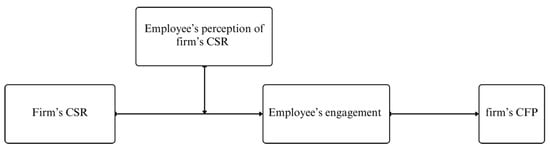
Multiple sources of data were collected to perform the triangulation. The data employed are both quantitative and qualitative data, allowing for a holistic understanding of the phenomenon studied [26] and enabling the operationalization of each construct included in the conceptual framework (Figure 1).
Figure 1.
Framework.
The independent variable, firm-level CSR, was measured through semi-structured interviews with managers in both firms, which combined open-ended questions with a structured rating section. These interviews documented each firm’s CSR practices and initiatives (e.g., environmental actions, employee well-being programs) and elicited managerial assessments of financial performance dynamics (e.g., changes in revenues, profits, ROA, and ROE), thereby operationalizing the dependent variable of the framework, CFP. Managers also completed a structured set of Likert-type items assessing both the firms’ CSR activities using two scales: CSR activities [27] and green human resource management practices [20] (see Appendix B for the structured part of the interview).
The moderating variable, employee perceptions of CSR, was captured through a structured survey administered to all employees in both companies (12 respondents per firm). This ad hoc survey, developed by the research team, measured two main dimensions. First, employee perceptions of the firms’ CSR initiatives toward key stakeholder groups (e.g., employees, customers, and the broader community) were adapted from Turker’s CSR scale [27]. Second, green human resource management practices (e.g., environmentally oriented recruitment, training, and performance management) were derived from Cesário et al. (2022) [20]. Employees rated all items on Likert-type scales. Responses were aggregated at the firm level to identify overall patterns and operationalize the moderating effect of employee perception on the relationship between firm-level CSR and employee engagement.
The mediating construct, employee engagement, was also assessed via the employee survey using scales for environmental citizenship behavior [28], work engagement [29], and organizational commitment [30]. These measures collectively capture the mediating mechanism linking CSR practices to CFP.
Finally, the dependent variable, CFP, was further quantified using firm-level financial data collected from Leanus, a database covering complete financial statements and indexes of Italian companies. Data on revenues, profit, ROA, and ROE from 2020 to 2023 were analyzed, as these metrics are frequently used in CSR-performance research [31] to operationalize CFP.
2.2.3. Data Analysis
The data were analyzed using a qualitative interpretive approach to explore the relationship shown in the framework presented in Figure 1. First, within-case analyses examined how managerial accounts, employee data, and financial performance indicators relate within each firm. Then, a cross-case comparison identified convergences and divergences, highlighting how different CSR configurations shape employee engagement. The cross-case analysis specifically considered the role of (i) CSR formalization, (ii) integration into organizational culture and management systems, and (iii) the visibility of sustainability commitments.
2.2.4. Cases
Graficonsul S.r.l is an Italian company founded in 1992 and based in Sansepolcro, Tuscany, specializing in the design and manufacturing of POP (Point-of-Purchase) materials. CSR is deeply integrated into firm operations via continuous R&D investments and a strong focus on sustainability in processes and materials, as well as a strong connection with the local community. Major clients include large national and multinational companies, operating mainly in the food, beverage, cosmetics and pharmaceutical industries, with customers very sensitive to the issues of ecological transition, who therefore have strong persuasion power towards Graficonsul in terms of sustainable initiatives. The company’s sustainability is managed by Stefano Innocenti. This aspect was strongly consolidated during 2023. The company demonstrates high formalization of CSR through its 2023 B-Corp certification, a certification issued by the nonprofit organization B Lab, attesting companies’ commitment to the well-being of people, community and environment, thus recognizing its commitment to high social and environmental standards, such as using 100 percent electricity from renewable and sustainable sources and implementing practices to reduce emissions. Moreover, the company’s suppliers are mostly located in their vicinity. CSR visibility is strong both externally (B-Corp certification, major multinational clients) and internally (community connections, supplier proximity).
Tenuta Rapitalà is a wine company located in Camporeale, Sicily, founded in 1968. Tenuta Rapitalà’s core business is related to the production of high-quality wines that reflect the soul of the Sicilian territory, with a French-inspired winemaking style, introducing both native and international varieties. The winery exports its wines internationally, even reaching overseas to the United States. Formalization of CSR is medium, evidenced by organic certification for some vineyards and collaboration with the SOStain foundation, promoting ethical Sicilian wine standards. Integration of CSR into firm operations is limited, primarily through selective sustainable vineyard management and new technologies under family leadership continuing the founders’ mission, and it is currently managed by Laurent de la Gatinais, the son of the founders. Visibility of CSR practices is also medium, enabled by collaborations with SOStain, a foundation that aims to promote ethical and sustainable development in the Sicilian wine sector.
An overview of the main characteristics of the case study firms is provided in Table 1.
Table 1.
Case study dimensions.
3. Results
3.1. Literature Review Results
3.1.1. Evidence from Literature Reviews
Within the sample of articles, the literature reviews converge on an average positive CSR-CFP association, but they also show that this conclusion is highly contingent and weakened by fragmentation in methods, measures, and theory. do Prado et al. (2020) [13] document substantial dispersion (39 positive, 21 non-significant, 7 negative) and link it to limited methodological robustness and insufficient modeling of mediators/moderators (Table A1, Appendix A). Focusing on SMEs, Bartolacci et al. (2020) [9] similarly report mostly positive findings but emphasize that results vary across industries and approaches, challenging one-size-fits-all interpretations. Two meta-analytic contributions sharpen the boundary-condition problem: Huang et al. (2020) [4] find an overall positive effect yet show that macroeconomic fluctuations significantly condition the relationship, while Vishwanathan et al. (2020) [22] identify four mechanisms (reputation, risk mitigation, stakeholder reciprocation, innovation capacity) but note that they explain only ~20% of the link, suggesting that much of the evidence remains a black-box correlation, with under-tested micro-channels such as employee commitment and productivity. Measurement choices further complicate synthesis: Huang et al. (2021) [12] confirm positive results for ESG-based studies but stress that financial payoffs may be non-immediate and that metric inconsistency fragments the field; Barauskaite and Streimikiene (2021) [10] likewise attribute variability to non-uniform CSR/CFP definitions and evaluation methods and note that negative and non-linear findings, while less frequent, are not negligible.
Recent contributions further reinforce the role of moderating factors and cross-study heterogeneity. Cardillo and Basso (2025) [32] identify a wide set of moderators, i.e., governance structures, cultural norms, technological readiness, market maturity, economic conditions, industry characteristics, and firm strategy They show that their uneven treatment across studies contributes to persistent inconsistencies in the CSR–CFP relationship. Similarly, Li et al. (2025) [33], in a large-scale meta-analysis, confirm a generally positive relationship but show that effect size varies with measurement choices and institutional context, with it being stronger in developing economies, weaker financial systems, and settings with voluntary CSR disclosure.
Taken together, these reviews suggest that the central objective of this synthesis is not to further corroborate an average positive association, but to identify the conditions under which CSR translates into improved financial outcomes (e.g., contextual factors and time horizon) and the mechanisms through which this occurs, thereby motivating the cluster-based approach adopted in this study.
3.1.2. Cluster 1—Positive Linear CSR-CFP Relationship
A large share of empirical studies report a positive CSR–CFP association across multiple contexts, industries, and operationalizations (Table A2, Appendix A). Positive effects are found using accounting indicators such as ROA/ROE/ROI, profits, margins, and sales growth [34,35,36,37,38,39], as well as market-oriented metrics such as Tobin’s Q, valuation proxies, stock prices and returns [5,14,40,41,42,43,44,45,46]. These results appear in sector-focused studies like banking [34,35], oil and gas [38,47], manufacturing (Javed et al., 2020; Luo et al., 2022) [36,37], energy/manufacturing [39], tourism and hospitality [48,49], automotive [49], utilities/water management [50], and in multi-industry and multi-country settings [51,52]. Positive effects are also reported for CSR-linked certifications and corporate forms, including certified Spanish firms and B-Corp settings [42,53]. Several studies interpret these results through channels such as improved strategic positioning and stakeholder responses [14,36,54], managerial/CEO effects that amplify CSR value creation [40,44], and the relevance of firm size [52].
A notable substream links positive effects to risk mitigation and resilience, especially under adverse macro-conditions. Evidence supports CSR’s protective role around crises and shocks [55,56,57] and its association with lower default risk through improved performance [58]. In emerging markets, positive findings are frequent but also shaped by institutional forces such as government and policy-driven CSR or ownership and competition structures [45,59,60,61,62].
3.1.3. Cluster 2—Null or Non-Significant CSR-CFP Relationship
A smaller set of studies report neutral or non-significant CSR–CFP relationships (Table A3, Appendix A). These findings appear in tourism [63], the energy sector [6], Brazilian comparisons between sustainability index and conventional market samples [64], and recent evidence from the UK retail sector using female board representation as a proxy for CSR [65]. These results are typically interpreted as reflecting stakeholder indifference, insufficient monetization of CSR benefits, or misalignment between CSR activity and the financial outcome window/metric [6,63,64].
3.1.4. Cluster 3—Negative CSR-CFP Relationship
Only one study in the sample reports a negative linear association (Table A4, Appendix A), where CSR rating negatively affects CFP measured through EPS [7]. This isolated result reinforces the need to model costs, measurement choices, and time horizons when interpreting dispersion in findings [7,10,13]. Interestingly, a recent study suggests that the intangible and difficult-to-measure nature of CSR, combined with reputational spillovers across products, industries, and countries, creates uncertainty that can negatively influence observed CSR–CFP relationships [66].
3.1.5. Cluster 4—U-Shaped CSR-CFP Relationship
Several studies describe a U-shaped association, implying that moderate levels or early stages of CSR may reduce performance, while higher levels (or later periods) are associated with improved outcomes (Table A5, Appendix A). This pattern is found in UK evidence [67], German index samples [68], and worldwide analyses where curvature depends on firm characteristics [69]. Sector-specific applications also support U-shaped effects in hospitality [70], airlines with time-dependent implementation dynamics [71], and automotive settings, where advantages appear after reaching a CSR threshold [8]. In this cluster, explanatory narratives emphasize implementation and adjustment costs, learning and embedding processes, and interaction effects with operational systems such as quality management [8,67,70,71].
3.1.6. Cluster 5—Inverted U-Shaped CSR-CFP Relationship
A parallel stream identifies an inverted U-shaped association, suggesting that CSR increases CFP only up to an optimal point, beyond which marginal costs dominate (Table A6, Appendix A). This is shown in automotive firms with differentiation as a moderator [72], construction in China with a cost–benefit competitiveness framing [73], global energy samples [74], US Fortune 500 firms during COVID-19-era conditions [75], and broader US samples [76]. Cross-country European evidence also supports threshold effects and highlights that turning points may vary by country; in the cited study, Germany is reported as non-significant [77]. Similar inverted-U results are also reported in China [78]. Overall, this cluster suggests a performance frontier where CSR can become inefficient when intensity exceeds absorptive capacity or when marginal benefits decline relative to marginal costs.
3.1.7. Cluster 6—Mixed and Factor-Contingent CSR-CFP Relationship
A large and conceptually rich cluster where the most recent research is included reports mixed findings and/or that the direction and magnitude is contingent on boundary factors (Table A7, Appendix A). First, results vary across institutional contexts, often contrasting developed and emerging markets: positive effects in developed settings but negative or weaker effects in emerging ones are reported in some cross-country studies [79], while other evidence reports the opposite pattern [80] or links outcomes to institutional environmental sensitivity [81]. Investment-focused comparisons also show regional variation [82].
Moreover, mixed results emerge when CSR is disaggregated into E/S/G dimensions. Evidence in banking shows that environmental, social, and governance components can have different signs and significance across samples [83,84,85], and oil and gas findings point to stronger effects from environmental and governance dimensions [47].
Additionally, outcomes vary across industries, as shown by multi-industry work where CSR improves CFP in finance but is weakly negative in tourism and non-significant in healthcare [86].
Another factor procuring mixed evidence is temporal dynamics: CSR may be costly in the short term but beneficial in the long term [87] or appear significant only in specific years within the observation window [88]. Moreover, business-cycle phases can further moderate outcomes, with expansion periods sometimes showing negative effects and recession periods showing none [89].
Results are often influenced by the moderation effect of organizational factors, including CSR committees [86], firm size [90], governance attributes [91], innovation/R&D intensity [92], strategic orientation such as customer- vs. competitor-oriented market strategies [15], mechanisms attributed to reputation and stakeholder engagement [93], integration with strategic capabilities such as organizational learning [94] and green innovation [95].
Additional moderating factors include macroeconomic conditions and financial policies, such as interest rates amplifying the effects of environmental and social initiatives in hospitality [96], and firm-level configurations combining responsible and irresponsible practices to sustain performance [97]. Social enterprises and microfinance institutions further demonstrate that total factor productivity can mediate the CSR–CFP relationship, translating initiatives into tangible financial outcomes while enhancing stakeholder trust [98].
3.1.8. The Role of Employees in the CSR-CFP Relationship
Building on Cluster 6, mixed and contingent findings may reflect not only macro- and firm-level boundary conditions but also micro-level internal factors. Among these, employee engagement is theorized as a central value-creation channel. However, from the SLR it emerges that only a few studies directly test this factor in the CSR-CFP relationship. The underlying argument is that CSR can enhance employee well-being and satisfaction, which may increase productivity and reduce turnover, thereby improving efficiency and lowering costs [36]. Empirical evidence is consistent with this logic in multiple settings. In the European banking sector (2009–2015), Gangi et al. (2019) [99] distinguish internal CSR (employee-oriented) from external CSR (clients, community, environment) and find that internal CSR positively affects external CSR, which in turn strengthens CFP; internal CSR is interpreted as fostering employee motivation and performance, while external CSR supports reputation. Similarly, Adams et al. (2022) [100], analyzing 52 multinational African petrol companies, show that the CSR–CFP relationship depends on the CSR dimension considered, with employee well-being (e.g., salaries and occupation) exhibiting the strongest effect. Panicker et al. (2024) [101] report aligned results for Indian EMNCs (2014–2019), finding that both internal CSR investments (e.g., working conditions, employee rights, equal opportunities and related recognition) and external CSR investments are positively associated with ROE, supporting the relevance of employee-oriented CSR for financial performance. Evidence also indicates that employee engagement may operate as a boundary condition: Kim et al. (2023) [15] find that work engagement positively affects CFP and strengthens the CSR-CFP relationship by supporting in-role and extra-role behavior [16]. Finally, Havlinova et al. (2023) [14] similarly argue that socially responsible practices are associated with higher employee satisfaction, which may translate into improved financial results.
The most recent studies extend and refine these mechanisms. Kim et al. (2025) [102] demonstrate that CSR indirectly enhances financial performance through organizational trust, with past performance moderating the effect, highlighting micro-level relational mechanisms in banking. Wang and Fujioka (2025) [103] show that CSR effects vary by dimension in Chinese heritage tourism firms: shareholder-focused CSR may reduce financial performance, while employee and social CSR initiatives enhance it, reflecting the differing costs, benefits, and contextual constraints of each CSR type. Li et al. (2025) [104] find that deviations in internal CSR (employee protection) negatively affect firm performance, whereas external CSR (charitable donations) positively influences it, with interactions mitigating adverse effects under extreme conditions like COVID-19. Finally, Hung et al. (2025) [105] show that CSR investments support knowledge capital accumulation and R&D, which can temporarily reduce profitability but ultimately sustain future competitive advantage.
Overall, from this SLR it emerges that, to date, only Kim (2023) [15] has directly examined work engagement as a mechanism through which employee-oriented CSR influences CFP, showing that engagement mediates the CSR–financial performance relationship in a large South Korean bank, with effects contingent on strategic coherence (customer- vs. competitor-oriented strategies). Other micro-level mechanisms, such as trust [102] or knowledge investment [105] and employee satisfaction [14], have been suggested as plausible channels, but they do not explicitly test engagement as the mediating link between CSR and financial outcomes. While these studies indicate that employee-focused CSR may explain heterogeneity in CSR–CFP results, the evidence remains scarce and context-limited, offering promising open questions to address the role of employee-related factors in the CSR-CFP relationship.
3.2. Comparative Case Studies Results
3.2.1. CSR from Management Evidence
Management interviews, combined with a structured section based on perceived CSR activities [27] and green human resources management practices [20], indicate a clear divergence in how sustainability is embedded across the two cases (Table 2). Scores represent managerial assessments on a Likert scale of 1–5, where higher values indicate higher firm CSR. Graficonsul reports consistently higher scores across all dimensions, particularly those aligned with green HRM and cultural embedding: green training (4.67), green sustainable culture (4.00), and sustainability-related performance management and rewards (3.50). Managers describe sustainability as increasingly structured over time and integrated into employee development and evaluation practices. They also link the strengthening of sustainability commitments to external stakeholder pressure, especially customer requirements, and report that revenues have more than doubled since the introduction of sustainability initiatives (since 2020).
Table 2.
Management interview results.
By contrast, Rapitalà shows lower scores on most dimensions and a markedly weaker institutionalization of sustainability in internal systems, especially regarding sustainability-related performance management and rewards (1.00), sustainability culture (2), and green training (2.33). While managers recognize CSR activities directed at broader stakeholders, which is reflected in their level of environmental initiatives (environment and society: 2.83), they frame sustainability as partly inherent to the sector and the firm’s core activity, which is perceived as already characterized by limited polluting factors. Sustainability practices have been underway since 2017, but managers report that organic products are not sold at a premium price; accordingly, they do not associate sustainability adoption with a significant revenue increase.
In sum, the management evidence points to two distinct CSR configurations: Graficonsul reflects a more systematized approach, supported by stronger green HRM practices and higher external salience, whereas Rapitalà reflects a more selective approach, with weaker integration into training and incentive systems.
3.2.2. CSR from Employee Evidence
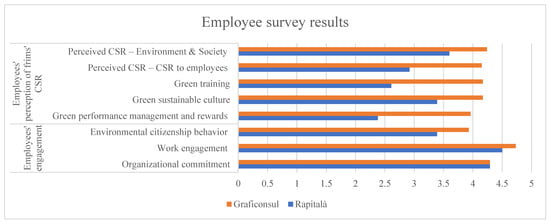
The employee responses are informative in terms of employee perceptions of the firms’ CSR and HRM practices emerging from the management data (Figure 2). These scores reflect employee perceptions of the CSR practices identified at the management level, which represents the framework’s factor moderating the relationship between firms CSR and employee engagement. First, on CSR directed to environment and society (Turker, 2009) [27], employees in Graficonsul report higher perceived commitment (4.24) than employees in Rapitalà (3.60), suggesting that sustainability initiatives are more clearly perceived in the former. Second, the largest perception gap concerns CSR directed to employees [27]: Graficonsul scores 4.15 versus 2.92 in Rapitalà, indicating that employee-oriented CSR (e.g., support for development, fairness, work–life balance, encouragement of voluntary activities) is perceived as substantially stronger in Graficonsul. Third, differences are even more pronounced on the green HRM levers [20] that capture integration into management systems: perceived green training is 4.17 in Graficonsul versus 2.61 in Rapitalà, and green sustainable culture is 4.17 versus 3.39. Finally, employees also perceive a clear gap in the extent to which sustainability is connected to performance management and rewards (3.96 vs. 2.38), which is consistent with the view that sustainability is more embedded into routines and HR practices in Graficonsul.
Figure 2.
Employee survey results.
Overall, these results suggest that CSR is not only more visible at Graficonsul but also perceived as more consistently embedded in HR routines and organizational culture, whereas at Rapitalà, CSR is perceived as more uneven, stronger on environmental aspects and weaker on employee-oriented and system-level practices. Moreover, coherently with the management’s survey, the results show that green performance management is the dimension in which the highest difference is present, which is also reflected in employee opinions.
The employee responses are also informative in terms of employee engagement. These responses measure employee engagement as the mediating factor between the firms’ CSR and CFP. In this dimension, differences are less pronounced and characterize fewer dimensions. The most pronounced difference is in environmental citizenship behavior, which is higher in Graficonsul (3.93) than in Rapitalà (3.39), consistent with the stronger perceived CSR and green HRM profile in the former [28]. However, contrary to expectations, work engagement is very high in both firms, with only a small advantage for Graficonsul (4.73 vs. 4.50) [29], while organizational commitment is identical across cases (4.29 in both firms) [30]. Overall, this evidence reveals that, in the case of Graficonsul, which has a more systematized CSR configuration, only environmental citizenship behavior is slightly higher among the three dimensions of employee engagement compared to Rapitalà, which has less structured CSR embeddedness. Work engagement and organizational commitment appear to be high in both contexts and are therefore likely influenced by additional organizational features beyond CSR.
3.2.3. CFP
Complementing the employee survey, firm-level financial evidence complements the interview and survey results by situating the two CSR configurations against the firms’ performance data. These CFP measures represent the dependent variable of the framework. For Rapitalà, revenues display a slight decline over time, with only a modest recovery in 2023, while profit, ROA, and ROE follow a similar pattern, improving up to 2022 and then decreasing in 2023. Management attributes the 2023 deterioration primarily to adverse industry conditions: 2023 is described as the lowest wine production year in the last 60 years, driven by weather-related shocks (low rainfall and intense spring rains), with organic vineyards reported as particularly exposed to fungal attacks. Managers also point to a gradual contraction in market volumes linked to changing consumption habits, especially among younger cohorts. In addition, the firm reports a sharp increase in net financial expenses (€278 k in 2023 vs. €73 k in 2022), associated with rising Euribor reference rates and a shift toward more costly short-term debt (short-term debt rising from €6.66 m to €7.59 m; long-term debt declining from €2.34 m to €1.48 m), which further compressed performance indicators. Consistently with these dynamics, management also notes that, despite sustainability initiatives since 2017, organic products are not sold at a premium price, and therefore sustainability is not associated with a significant revenue uplift.
For Graficonsul, financial data show a markedly different trajectory. Revenues more than doubled relative to the 2020 baseline, and profitability and returns (profit, ROA, ROE) increased strongly by 2023, with a temporary weakening in 2022. Management explains the 2022 decline mainly through the energy and commodity crisis that affected the paper and graphics industry and reduced competitiveness relative to foreign firms with lower energy costs; they also note that an equity increase (from €2.14 m to €2.71 m) mechanically influenced return ratios.
Overall, these financial trends should be read as contextual rather than causal evidence. Nonetheless, the comparison indicates that the firm with more formalized and internally institutionalized sustainability practices also displays the strongest growth over 2020–2023, whereas Rapitalà’s performance appears largely shaped by sector-specific shocks and financial cost dynamics.
4. Discussion
The comparative evidence is exploratory in its nature. The case comparison draws attention to the fact that variation in the CSR–CFP relationship may be related less with the mere adoption of sustainability initiatives and more with the configuration through which CSR is formalized, embedded, and rendered salient within the organization. The cases were purposefully selected to differ along three dimensions, (i) formalization of CSR practices, (ii) integration into organizational culture and management systems, and (iii) visibility of sustainability commitments, and the results reveal a positive correspondence between these aspects that shape employee perceptions of CSR and selected employee engagement responses, particularly green citizenship behavior, while they show no correspondence in the dimension of organizational commitment.
The most pronounced contrast between the cases concerns integration into internal systems. In Graficonsul, CSR appears more strongly institutionalized through HR-related practices, particularly green training and the incorporation of sustainability criteria into performance management and reward structures, as reflected in both managerial self-assessments and employee perceptions. This convergence across sources is consistent with the idea that CSR is operationalized through routines that are observable in everyday work. In Rapitalà, by contrast, sustainability is framed more as a feature of sectoral activity and incremental environmental initiatives, with comparatively limited embedding into training and incentive systems. Correspondingly, employees report weaker perceptions of CSR directed to employees and of green HRM practices.
Moreover, the employee outcomes focus attention on a possible mediation pathway linking CSR to CFP. Specifically, the case characterized by stronger internal embedding and higher visibility of CSR also reports higher environmental citizenship behavior, suggesting a closer alignment between CSR perceptions and sustainability engagement and behavior. At the same time, work engagement and organizational commitment are high in both organizations and show only limited differentiation across cases. This pattern implies that general employee engagement may be shaped by a broader set of organizational conditions (e.g., work organization, relational climate, employment practices) beyond CSR per se, whereas CSR-related variation appears more clearly associated with domain-specific sustainability behavior.
Finally, the CFP evidence underscores the relevance of contextual constraints and temporal dynamics for interpreting CSR–CFP patterns. Over 2020–2023, Graficonsul displayed a markedly stronger growth trajectory, while Rapitalà’s financial outcomes were strongly conditioned by exogenous factors, most notably sectoral shocks affecting production and demand, as well as financing conditions that increased financial expenses. These contextual influences show an example where even where employee engagement is significant, the observable CFP gains may be attenuated when industry-level dynamics dominate performance drivers.
5. Conclusions
This study contributes to the CSR-CFP literature by shifting the emphasis from re-stating an average association to explaining why results diverge and through which pathways CSR can translate into financial outcomes, with a focus on employee-related mechanisms.
First, the SLR offers an integrative synthesis of recent evidence by organizing studies according to the observed form of the CSR–CFP relationship and then tracing the recurrent sources of heterogeneity, namely measurement choices, contextual contingencies (industry and institutional setting), time horizon and shock periods, and the inconsistent modeling of mediators and moderators [4,9,10,12,13]. In doing so, it responds to calls to move beyond fragmented findings and to build cumulative explanations around boundary conditions and mechanisms, rather than treating mixed results as noise [13,22].
Second, the comparative case study addresses the “black box” highlighted in prior reviews by exploring an under-tested micro-level channel, i.e., employee engagement [15], through a triangulated design that links (i) how CSR is configured and institutionalized (formalization, integration into management systems and culture, and visibility), (ii) employee perceptions of CSR and green HRM practices, and (iii) employee engagement and pro-environmental behavior [20,27,28,29,30]. The case evidence suggests a pattern whereby employee perceptions of CSR are more highly perceived when more embedded in the firm’s HRM practices, and employee environmental citizenship behavior and work engagement are slightly higher these cases. This is consistent with theorizing and emerging evidence that CSR can shape engagement especially when perceived as substantive [15,16,17] and with work linking CSR to employee satisfaction and productivity-related outcomes [14,36,99,100,101]. However, this evidence suggests that only some aspects of employee engagement may be associated with higher CSR perceptions. This leaves room for further research disentangling which dimensions of work engagement are more closely related to employee CSR perceptions and to firms’ CSR profile more broadly.
Overall, this study’s contribution lies in bringing together two relationships that have largely been studied separately: CSR and employee engagement, and employee engagement and CFP. While the study does not directly demonstrate employee engagement as the mediating channel linking CSR to CFP, its limited empirical findings are consistent with prior evidence (e.g., [106,107]), documenting a positive association between employee engagement and CFP, and provide initial insight into their coexistence within CSR-embedded organizational contexts. Moreover, this study approaches the relationship from the novel perspective that CSR may contribute to financial performance not simply through its formal presence but through the way it is embedded in internal organizational practices and perceived by employees, thus offering an angle on this relationship. Finally, by jointly examining the perception and integration of CSR, the study contributes by innovatively comparing managerial and employee perspectives within the same analytical framework.
From a managerial standpoint, the findings imply that CSR is less likely to generate organizational returns when it remains weakly embedded or primarily compliance-driven; conversely, firms seeking performance-related benefits should prioritize internal institutionalization, translating sustainability commitments into green HRM practices (e.g., training, cultural initiatives, and incentive-compatible performance systems) and coherent communication that supports employees’ understanding of CSR as meaningful and actionable [15,20]. At the same time, the study points attention toward the fact that that translating employee-level responses into CFP might depend on industry contexts, constraints, and time horizons, echoing prior evidence that payoffs may be non-immediate and that external shocks or sector dynamics can dominate financial outcomes even when internal engagement is high [4,12].
Finally, the study is explicitly exploratory and does not claim causal attribution. Given the small sample as the main limitation of the study, the findings should be read as ok, pattern observations rather than causal proof. Our study therefore calls for replication with larger, more representative samples, ideally through longitudinal or quasi-experimental designs that would allow for causal inference. Large-sample studies should test whether more system-embedded CSR consistently predicts stronger employee responses and, over appropriate time horizons, better CFP outcomes [4,13] while also enabling more precise identification of which dimensions of employee engagement are most sensitive to CSR operationalization. A further limitation concerns the comparability of the cases, attributable to their difference in industry conditions and exposure to external shocks, such as weather variability, market contraction, and financing costs. These factors exerted a strong influence on CFP, making it difficult to isolate the role of CSR from broader contextual pressures. Future research should therefore prioritize designs controlling for industry-level and macroeconomic variation.
Author Contributions
Conceptualization, G.L.N., E.R. and F.P.; methodology, G.L.N., E.R. and F.P.; software, E.R.; validation, E.R. and F.M.; formal analysis, E.R. and F.P.; investigation, E.R. and F.M.; resources, G.L.N. and F.P.; data curation, E.R. and F.M.; writing—original draft preparation, E.R., G.L.N. and F.P.; writing—review and editing, E.R. and F.M.; visualization, E.R. and F.M.; supervision, G.L.N. and F.P.; project administration, G.L.N. and F.P.; funding acquisition, F.P. All authors have read and agreed to the published version of the manuscript.
Funding
This research was carried out thanks to the support of the University of Palermo, through a specific funding scheme entitled ‘INCENTIVI AD ATTIVITA’ DI RICERCA INTERDISCIPLINARE’ (CdA resolution n.07/01 of 04.04.2023).
Institutional Review Board Statement
The study was conducted in accordance with the Declaration of Helsinki, and approved by the Bioethics Committee of the University of Palermo (protocol code 347/2025 and date of approval 25 September 2025).
Informed Consent Statement
Informed consent was obtained from all subjects involved in the study.
Data Availability Statement
The data presented in this study are available on request from the corresponding author due to privacy reasons.
Conflicts of Interest
The authors declare no conflict of interest.
Appendix A
Table A1.
Literature review studies.
Table A2.
Studies reporting positive CSR–CFP relationship.
Table A3.
Studies reporting negative CSR–CFP relationship.
Table A4.
Studies reporting no CSR–CFP relationship.
Table A5.
Studies reporting a U-shaped relationship.
Table A6.
Studies reporting an inverted U-shaped relationship.
Table A7.
Studies reporting mixed CSR–CFP relationship.
Appendix B
| Employee’s perception of CSR firm’s activities (for the management and the employees) Corporate Social Responsibility ([27]) From 1 = completely disagree to 5 = completely agree CSR—Environment & Society
CSR—Employees
Green Human Resources Management Practices ([20]) From 1 = never to 5 = always Green training
Green sustainable culture
Green performance management and rewards
Employee work engagement (for the employees only) Environmental Citizenship Behaviors ([28]) From 1 = strongly disagree to 5 = strongly agree At work, even though I am not required to…
Work engagement ([29]) From 1 = never to 6 = always
Organizational Commitment ([30]) From 1 = strongly disagree to 7 = strongly agree
|
References
- Grewatsch, S.; Kleindienst, I. When Does It Pay to be Good? Moderators and Mediators in the Corporate Sustainability–Corporate Financial Performance Relationship: A Critical Review. J. Bus. Ethics 2017, 145, 383–416. [Google Scholar] [CrossRef] [Scilit]
- Vilanova, M.; Lozano, J.M.; Arenas, D. Exploring the Nature of the Relationship Between CSR and Competitiveness. J. Bus. Ethics 2009, 87, 57–69. [Google Scholar] [CrossRef] [Scilit]
- McWilliams, A.; Siegel, D. Corporate social responsibility and financial performance: Correlation or misspecification? Strateg. Manag. J. 2000, 21, 603–609. [Google Scholar] [CrossRef]
- Huang, K.; Sim, N.; Zhao, H. Corporate social responsibility, corporate financial performance and the confounding effects of economic fluctuations: A meta-analysis. Int. Rev. Financ. Anal. 2020, 70, 101504. [Google Scholar] [CrossRef] [Scilit]
- Tsai, H.J.; Wu, Y. Changes in Corporate Social Responsibility and Stock Performance. J. Bus. Ethics 2022, 178, 735–755. [Google Scholar] [CrossRef] [Scilit]
- Shahbaz, M.; Karaman, A.S.; Kilic, M.; Uyar, A. Board attributes, CSR engagement, and corporate performance: What is the nexus in the energy sector? Energy Policy 2020, 143, 111582. [Google Scholar] [CrossRef] [Scilit]
- Abid, R. Corporate social (ir)responsibility towards employees and financial performance: Using time to solve the chicken-egg problem. Rev. Manag. Sci. 2023, 17, 635–659. [Google Scholar] [CrossRef] [Scilit]
- Lin, W.L. Too little of a good thing? Curvilinear effects of corporate social responsibility on corporate financial performance. Rev. Manag. Sci. 2024, 18, 2197–2228. [Google Scholar] [CrossRef] [Scilit]
- Bartolacci, F.; Caputo, A.; Soverchia, M. Sustainability and financial performance of small and medium sized enterprises: A bibliometric and systematic literature review. Bus. Strategy Environ. 2020, 29, 1297–1309. [Google Scholar] [CrossRef] [Scilit]
- Barauskaite, G.; Streimikiene, D. Corporate social responsibility and financial performance of companies: The puzzle of concepts, definitions and assessment methods. Corp. Soc. Responsib. Environ. Manag. 2021, 28, 278–287. [Google Scholar] [CrossRef] [Scilit]
- Hojer, A.; Mataigne, V. CSR in the banking industry: A longitudinal analysis of the impact on financial performance and risk-taking. Financ. Res. Lett. 2024, 64, 105497. [Google Scholar] [CrossRef] [Scilit]
- Huang, D.Z.X. Environmental, social and governance (ESG) activity and firm performance: A review and consolidation. Account. Financ. 2021, 61, 335–360. [Google Scholar] [CrossRef] [Scilit]
- do Prado, G.F.; Piekarski, C.M.; da Luz, L.M.; de Souza, J.T.; Salvador, R.; de Francisco, A.C. Sustainable development and economic performance: Gaps and trends for future research. Sustain. Dev. 2020, 28, 368–384. [Google Scholar] [CrossRef] [Scilit]
- Havlinova, A.; Kukacka, J. Corporate Social Responsibility and Stock Prices After the Financial Crisis: The Role of Strategic CSR Activities. J. Bus. Ethics 2023, 182, 223–242. [Google Scholar] [CrossRef] [Scilit]
- Kim, B.J.; Chang, Y.; Kim, T.H. Translating corporate social responsibility into financial performance: Exploring roles of work engagement and strategic coherence. Corp. Soc. Responsib. Environ. Manag. 2023, 30, 2555–2573. [Google Scholar] [CrossRef] [Scilit]
- Farooq, M.; Farooq, O.; Jasimuddin, S.M. ‘Employees response to corporate social responsibility: Exploring the role of employees’ collectivist orientation’. Eur. Manag. J. 2014, 32, 916–927. [Google Scholar] [CrossRef] [Scilit]
- Rodrigues, S.; Proença, T.; Ferreira, M.R. Insights into employee perspectives on corporate social responsibility policies and practices: Embeddedness, participation, and meaningfulness through work. Corp. Soc. Responsib. Environ. Manag. 2024, 31, 3502–3516. [Google Scholar] [CrossRef] [Scilit]
- Maccarrone, P.; Contri, A.M. Integrating Corporate Social Responsibility into Corporate Strategy: The Role of Formal Tools. Sustainability 2021, 13, 12551. [Google Scholar] [CrossRef] [Scilit]
- Stahl, G.K.; Brewster, C.J.; Collings, D.G.; Hajro, A. Enhancing the role of human resource management in corporate sustainability and social responsibility: A multi-stakeholder, multidimensional approach to HRM. Hum. Resour. Manag. Rev. 2020, 30, 100708. [Google Scholar] [CrossRef] [Scilit]
- Cesário, F.; Sabino, A.; Palma-Moreira, A.; Azevedo, T. Green Human Resources Practices and Person-Organization Fit: The Moderating Role of the Personal Environmental Commitment. Emerg. Sci. J. 2022, 6, 938–951. [Google Scholar] [CrossRef] [Scilit]
- Montiel, I. Corporate Social Responsibility and Corporate Sustainability: Separate Pasts, Common Futures. Organ. Environ. 2008, 21, 245–269. [Google Scholar] [CrossRef] [Scilit]
- Vishwanathan, P.; van Oosterhout, H.; Heugens, P.P.M.A.R.; Duran, P.; van Essen, M. Strategic CSR: A Concept Building Meta-Analysis. J. Manag. Stud. 2020, 57, 314–350. [Google Scholar] [CrossRef] [Scilit]
- Elgin, C. Corporate social responsibility: Formal versus informal firms. Corp. Soc. Responsib. Environ. Manag. 2024, 31, 776–783. [Google Scholar] [CrossRef] [Scilit]
- Kucharska, W.; Kowalczyk, R. How to achieve sustainability?—Employee’s point of view on company’s culture and CSR practice. Corp. Soc. Responsib. Environ. Manag. 2019, 26, 453–467. [Google Scholar] [CrossRef] [Scilit]
- Shahzadi, G.; John, A.; Qadeer, F.; Jia, F.; Yan, J. CSR beyond symbolism: The importance of substantive attributions for employee CSR engagement. J. Clean. Prod. 2024, 436, 140440. [Google Scholar] [CrossRef] [Scilit]
- Eisenhardt, K.M. Building Theories from Case Study Research. Acad. Manag. Rev. 1989, 14, 532–550. [Google Scholar] [CrossRef] [Scilit]
- Turker, D. Measuring Corporate Social Responsibility: A Scale Development Study. J. Bus. Ethics 2009, 85, 411–427. [Google Scholar] [CrossRef] [Scilit]
- Boiral, O.; Paillé, P. Organizational Citizenship Behaviour for the Environment: Measurement and Validation. J. Bus. Ethics 2012, 109, 431–445. [Google Scholar] [CrossRef] [Scilit]
- Balducci, C.; Fraccaroli, F.; Schaufeli, W.B. Psychometric Properties of the Italian Version of the Utrecht Work Engagement Scale (UWES-9). Eur. J. Psychol. Assess. 2010, 26, 143–149. [Google Scholar] [CrossRef] [Scilit]
- Mowday, R.T.; Porter, L.W.; Steers, R.M. Employee—Organization Linkages: The Psychology of Commitment, Absenteeism, and Turnover; Academic Press: Cambridge, MA, USA, 2013; 264p, ISBN 978-1-4832-6739-5. [Google Scholar]
- Coelho, R.; Jayantilal, S.; Ferreira, J.J. The impact of social responsibility on corporate financial performance: A systematic literature review. Corp. Soc. Responsib. Environ. Manag. 2023, 30, 1535–1560. [Google Scholar] [CrossRef] [Scilit]
- Cardillo, M.A.d.R.; Basso, L.F.C. Revisiting knowledge on ESG/CSR and financial performance: A bibliometric and systematic review of moderating variables. J. Innov. Knowl. 2025, 10, 100648. [Google Scholar] [CrossRef] [Scilit]
- Li, W.; Yan, T.; Li, Y. Corporate social responsibility and financial performance in a cross-country context: A meta-analysis. J. Bus. Res. 2025, 190, 115218. [Google Scholar] [CrossRef] [Scilit]
- Siueia, T.T.; Wang, J.; Deladem, T.G. Corporate Social Responsibility and financial performance: A comparative study in the Sub-Saharan Africa banking sector. J. Clean. Prod. 2019, 226, 658–668. [Google Scholar] [CrossRef] [Scilit]
- Laguir, I.; Stekelorum, R.; Laguir, L.; Staglianò, R. Managing corporate social responsibility in the bank sector: A fuzzy and disaggregated approach. Corp. Soc. Responsib. Environ. Manag. 2021, 28, 1324–1334. [Google Scholar] [CrossRef] [Scilit]
- Javed, M.; Rashid, M.A.; Hussain, G.; Ali, H.Y. The effects of corporate social responsibility on corporate reputation and firm financial performance: Moderating role of responsible leadership. Corp. Soc. Responsib. Environ. Manag. 2020, 27, 1395–1409. [Google Scholar] [CrossRef] [Scilit]
- Luo, W.; Zhang, C.; Li, M. The influence of corporate social responsibilities on sustainable financial performance: Mediating role of shared vision capabilities and moderating role of entrepreneurship. Corp. Soc. Responsib. Environ. Manag. 2022, 29, 1266–1282. [Google Scholar] [CrossRef] [Scilit]
- Esposito, P.; Ahmad, Z.; Riso, V.; Mustafa, N. Beyond the business case? Retracing the walk of Corporate social responsibility and financial performance relationship in the Oil and Gas sector. Corp. Soc. Responsib. Environ. Manag. 2024, 31, 2211–2224. [Google Scholar] [CrossRef] [Scilit]
- Liao, H.; Su, L.; Tang, T.; Shang, Z. Green initiatives and stakeholder engagement: Unveiling the impact of green strategies and CSR on financial performance from descriptive-normative perspectives of stakeholder theory. Sustain. Dev. 2024, 32, 4800–4811. [Google Scholar] [CrossRef] [Scilit]
- Cho, S.Y.; Lee, C. Managerial Efficiency, Corporate Social Performance, and Corporate Financial Performance. J. Bus. Ethics 2019, 158, 467–486. [Google Scholar] [CrossRef] [Scilit]
- Awaysheh, A.; Heron, R.A.; Perry, T.; Wilson, J.I. On the relation between corporate social responsibility and financial performance. Strateg. Manag. J. 2020, 41, 965–987. [Google Scholar] [CrossRef] [Scilit]
- Brotons, J.M.; Sansalvador, M.E. The relation between corporate social responsibility certification and financial performance: An empirical study in Spain. Corp. Soc. Responsib. Environ. Manag. 2020, 27, 1465–1477. [Google Scholar] [CrossRef] [Scilit]
- Candio, P. The effect of ESG and CSR attitude on financial performance in Europe: A quantitative re-examination. J. Environ. Manag. 2024, 354, 120390. [Google Scholar] [CrossRef] [Scilit]
- García-Sánchez, I.-M.; Martínez-Ferrero, J. Chief executive officer ability, corporate social responsibility, and financial performance: The moderating role of the environment. Bus. Strategy Environ. 2019, 28, 542–555. [Google Scholar] [CrossRef] [Scilit]
- Long, W.; Li, S.; Wu, H.; Song, X. Corporate social responsibility and financial performance: The roles of government intervention and market competition. Corp. Soc. Responsib. Environ. Manag. 2020, 27, 525–541. [Google Scholar] [CrossRef] [Scilit]
- Hou, T.C.T. The relationship between corporate social responsibility and sustainable financial performance: Firm-level evidence from Taiwan. Corp. Soc. Responsib. Environ. Manag. 2019, 26, 19–28. [Google Scholar] [CrossRef] [Scilit]
- Ramírez-Orellana, A.; Martínez-Victoria, M.; García-Amate, A.; Rojo-Ramírez, A.A. Is the corporate financial strategy in the oil and gas sector affected by ESG dimensions? Resour. Policy 2023, 81, 103303. [Google Scholar] [CrossRef] [Scilit]
- Sakshi; Shashi; Cerchione, R.; Bansal, H. Measuring the impact of sustainability policy and practices in tourism and hospitality industry. Bus. Strategy Environ. 2020, 29, 1109–1126. [Google Scholar] [CrossRef] [Scilit]
- González-Rodríguez, M.R.; Díaz-Fernández, M.C.; Shi, F.; Okumus, F. Exploring the links among corporate social responsibility, reputation, and performance from a multi-dimensional perspective. Int. J. Hosp. Manag. 2021, 99, 103079. [Google Scholar] [CrossRef] [Scilit]
- Weber, O.; Saunders-Hogberg, G. Corporate social responsibility, water management, and financial performance in the food and beverage industry. Corp. Soc. Responsib. Environ. Manag. 2020, 27, 1937–1946. [Google Scholar] [CrossRef] [Scilit]
- Busch, T.; Johnson, M.P.; Schnippering, M. A Change Will Do You Good: Does Continuous Environmental Improvement Matter? Organ. Environ. 2022, 35, 551–578. [Google Scholar] [CrossRef] [Scilit]
- Chen, S.; Song, Y.; Gao, P. Environmental, social, and governance (ESG) performance and financial outcomes: Analyzing the impact of ESG on financial performance. J. Environ. Manag. 2023, 345, 118829. [Google Scholar] [CrossRef] [Scilit] [PubMed]
- Ferioli, M.; Gazzola, P.; Grechi, D.; Vătămănescu, E.M. Sustainable behaviour of B Corps fashion companies during Covid-19: A quantitative economic analysis. J. Clean. Prod. 2022, 374, 134010. [Google Scholar] [CrossRef] [Scilit]
- Ali, H.Y.; Danish, R.Q.; Asrar-ul-Haq, M. How corporate social responsibility boosts firm financial performance: The mediating role of corporate image and customer satisfaction. Corp. Soc. Responsib. Environ. Manag. 2020, 27, 166–177. [Google Scholar] [CrossRef] [Scilit]
- Hannah, S.T.; Sayari, N.; Harris, F.H.d.B.; Cain, C.L. The Direct and Moderating Effects of Endogenous Corporate Social Responsibility on Firm Valuation: Theoretical and Empirical Evidence from the Global Financial Crisis. J. Manag. Stud. 2021, 58, 421–456. [Google Scholar] [CrossRef] [Scilit]
- Jahmane, A.; Gaies, B. Corporate social responsibility, financial instability and corporate financial performance: Linear, non-linear and spillover effects—The case of the CAC 40 companies. Financ. Res. Lett. 2020, 34, 101483. [Google Scholar] [CrossRef] [Scilit]
- Zhang, J.; Zhang, Y.; Sun, Y. Restart economy in a resilient way: The value of corporate social responsibility to firms in COVID-19. Financ. Res. Lett. 2022, 47, 102683. [Google Scholar] [CrossRef] [Scilit]
- Mushafiq, M.; Prusak, B.; Markiewicz, M. Corporate social responsibility and forward default risk mediated by financial performance and goodwill. J. Clean. Prod. 2023, 428, 139396. [Google Scholar] [CrossRef] [Scilit]
- Ramzan, I.; Ali, K. Going green, growing strong: How climate policy boosts US companies performance. Clim. Policy 2025, 25, 593–611. [Google Scholar] [CrossRef] [Scilit]
- Ang, R.; Shao, Z.; Liu, C.; Yang, C.; Zheng, Q. The relationship between CSR and financial performance and the moderating effect of ownership structure: Evidence from Chinese heavily polluting listed enterprises. Sustain. Prod. Consum. 2022, 30, 117–129. [Google Scholar] [CrossRef] [Scilit]
- Zhou, G.; Liu, L.; Luo, S. Sustainable development, ESG performance and company market value: Mediating effect of financial performance. Bus. Strategy Environ. 2022, 31, 3371–3387. [Google Scholar] [CrossRef] [Scilit]
- Liu, W.; Shao, X.; De Sisto, M.; Li, W.H. A new approach for addressing endogeneity issues in the relationship between corporate social responsibility and corporate financial performance. Financ. Res. Lett. 2021, 39, 101623. [Google Scholar] [CrossRef] [Scilit]
- Moneva, J.M.; Bonilla-Priego, M.J.; Ortas, E. Corporate social responsibility and organisational performance in the tourism sector. J. Sustain. Tour. 2020, 28, 853–872. [Google Scholar] [CrossRef] [Scilit]
- de Castro Sobrosa Neto, R.; de Lima, C.R.M.; Bazil, D.G.; de Oliveira Veras, M.; de Andrade Guerra, J.B.S.O. Sustainable development and corporate financial performance: A study based on the Brazilian Corporate Sustainability Index (ISE). Sustain. Dev. 2020, 28, 960–977. [Google Scholar] [CrossRef] [Scilit]
- Izadi, J.; Shetra, M.K.; Foroudi, P.; Palazzo, M. The effect of CSR on corporate financial performance, considering the role of female representation in the retail industry. Corp. Soc. Responsib. Environ. Manag. 2025, 32, 1863–1878. [Google Scholar] [CrossRef] [Scilit]
- Ricordel, P.; Majláth, M. Imperfect information and the reputational proximity spillovers issue in the product-related CSR–CFP relationship: A study of 125 major listed European companies from 2010 to 2018. J. Clean. Prod. 2025, 525, 146578. [Google Scholar] [CrossRef] [Scilit]
- Adegbite, E.; Guney, Y.; Kwabi, F.; Tahir, S. Financial and corporate social performance in the UK listed firms: The relevance of non-linearity and lag effects. Rev. Quant. Finan. Acc. 2019, 52, 105–158. [Google Scholar] [CrossRef] [Scilit]
- Nuber, C.; Velte, P.; Hörisch, J. The curvilinear and time-lagging impact of sustainability performance on financial performance: Evidence from Germany. Corp. Soc. Responsib. Environ. Manag. 2020, 27, 232–243. [Google Scholar] [CrossRef] [Scilit]
- Kalaitzoglou, I.; Pan, H.; Niklewski, J. Corporate social responsibility: How much is enough? A higher dimension perspective of the relationship between financial and social performance. Ann. Oper. Res. 2021, 306, 209–245. [Google Scholar] [CrossRef] [Scilit]
- Franco, S.; Caroli, M.G.; Cappa, F.; Del Chiappa, G. Are you good enough? CSR, quality management and corporate financial performance in the hospitality industry. Int. J. Hosp. Manag. 2020, 88, 102395. [Google Scholar] [CrossRef] [Scilit]
- Kuo, T.C.; Chen, H.M.; Meng, H.M. Do corporate social responsibility practices improve financial performance? A case study of airline companies. J. Clean. Prod. 2021, 310, 127380. [Google Scholar] [CrossRef] [Scilit]
- Lin, W.L.; Ho, J.A.; Lee, C.; Ng, S.I. Impact of positive and negative corporate social responsibility on automotive firms’ financial performance: A market-based asset perspective. Corp. Soc. Responsib. Environ. Manag. 2020, 27, 1761–1773. [Google Scholar] [CrossRef] [Scilit]
- Guo, H.; Lu, W. The inverse U-shaped relationship between corporate social responsibility and competitiveness: Evidence from Chinese international construction companies. J. Clean. Prod. 2021, 295, 126374. [Google Scholar] [CrossRef] [Scilit]
- Kumar, A.; Gupta, J.; Das, N. Revisiting the influence of corporate sustainability practices on corporate financial performance: An evidence from the global energy sector. Bus. Strategy Environ. 2022, 31, 3231–3253. [Google Scholar] [CrossRef] [Scilit]
- Hsu, B.-X.; Chen, Y.-M. Does corporate social responsibility influence performance persistence? A signal extraction approach with evidence from Fortune 500 companies. Technol. Forecast. Soc. Change 2024, 200, 123154. [Google Scholar] [CrossRef] [Scilit]
- Lopatta, K.; Canitz, F.; Tideman, S.A. Abnormal CSR and Financial Performance. Eur. Account. Rev. 2024, 33, 49–75. [Google Scholar] [CrossRef] [Scilit]
- Ben Lahouel, B.; Ben Zaied, Y.; Managi, S.; Taleb, L. Re-thinking about U: The relevance of regime-switching model in the relationship between environmental corporate social responsibility and financial performance. J. Bus. Res. 2022, 140, 498–519. [Google Scholar] [CrossRef] [Scilit]
- Ma, C.; Yasir, L. Carrot or Stick? CSR and Firm Financial Performance. J. Bus. Ethics 2023, 188, 349–365. [Google Scholar] [CrossRef] [Scilit]
- Garcia, A.S.; Orsato, R.J. Testing the institutional difference hypothesis: A study about environmental, social, governance, and financial performance. Bus. Strategy Environ. 2020, 29, 3261–3272. [Google Scholar] [CrossRef] [Scilit]
- Mutuc, E.B.; Cabrilo, S. Corporate social responsibility, intellectual capital and financial performance: Evidence from developed and developing Asian economies. Rev. Manag. Sci. 2022, 16, 1227–1267. [Google Scholar] [CrossRef] [Scilit]
- Rintala, O.; Laari, S.; Solakivi, T.; Töyli, J. Fulfilling expectations or overachieving: The role of market values in the linkage between environmental and financial performance. Bus. Strategy Environ. 2022, 31, 768–781. [Google Scholar] [CrossRef] [Scilit]
- Badía, G.; Ferruz, L.; Cortez, M.C. The performance of social responsible investing from retail investors’ perspective: International evidence. Int. J. Financ. Econ. 2021, 26, 6074–6088. [Google Scholar] [CrossRef] [Scilit]
- Zahid, M.; Rahman, H.U.; Khan, M.; Ali, W.; Shad, F. Addressing endogeneity by proposing novel instrumental variables in the nexus of sustainability reporting and firm financial performance: A step-by-step procedure for non-experts. Bus. Strategy Environ. 2020, 29, 3086–3103. [Google Scholar] [CrossRef] [Scilit]
- Bătae, O.M.; Dragomir, V.D.; Feleagă, L. The relationship between environmental, social, and financial performance in the banking sector: A European study. J. Clean. Prod. 2021, 290, 125791. [Google Scholar] [CrossRef] [Scilit]
- Moufty, S.; Clark, E.; Al-Najjar, B. The different dimensions of sustainability and bank performance: Evidence from the EU and the USA. J. Int. Account. Audit. Tax. 2021, 43, 100381. [Google Scholar] [CrossRef] [Scilit]
- Kuzey, C.; Uyar, A.; Nizaeva, M.; Karaman, A.S. CSR performance and firm performance in the tourism, healthcare, and financial sectors: Do metrics and CSR committees matter? J. Clean. Prod. 2021, 319, 128802. [Google Scholar] [CrossRef] [Scilit]
- Zhou, G.; Sun, Y.; Luo, S.; Liao, J. Corporate social responsibility and bank financial performance in China: The moderating role of green credit. Energy Econ. 2021, 97, 105190. [Google Scholar] [CrossRef] [Scilit]
- Adamkaite, J.; Streimikiene, D.; Rudzioniene, K. The impact of social responsibility on corporate financial performance in the energy sector: Evidence from Lithuania. Corp. Soc. Responsib. Environ. Manag. 2023, 30, 91–104. [Google Scholar] [CrossRef] [Scilit]
- Mir, U.A.; Shah, F.A.; Singh, P. Impact of Changing Business Cycles on Corporate Social Responsibility–Financial Performance Relationship. Corp. Soc. Responsib. Environ. Manag. 2025, 1–13. [Google Scholar] [CrossRef] [Scilit]
- Ting, P.H. Do large firms just talk corporate social responsibility?—The evidence from CSR report disclosure. Financ. Res. Lett. 2021, 38, 101476. [Google Scholar] [CrossRef] [Scilit]
- Pekovic, S.; Vogt, S. The fit between corporate social responsibility and corporate governance: The impact on a firm’s financial performance. Rev. Manag. Sci. 2021, 15, 1095–1125. [Google Scholar] [CrossRef] [Scilit]
- Doni, F.; Fiameni, M. Can innovation affect the relationship between Environmental, Social, and Governance issues and financial performance? Empirical evidence from the STOXX200 index. Bus. Strategy Environ. 2024, 33, 546–574. [Google Scholar] [CrossRef] [Scilit]
- Tien, N.H.; Anh, D.B.H.; Ngoc, N.M. Corporate financial performance due to sustainable development in Vietnam. Corp. Soc. Responsib. Environ. Manag. 2020, 27, 694–705. [Google Scholar] [CrossRef] [Scilit]
- Tahtamoni, T.; Kabir Hassan, M.; Sohag, K. Impact of ESG practices and economic volatility on firm performance in the US IT Sector: Evidence from 2010–2022. J. Environ. Manag. 2025, 393, 127048. [Google Scholar] [CrossRef] [Scilit]
- Le, T.T.; Nguyen Ngoc, B.; Tran Ho Phuong, K.; Luong Hoang, M.; Phan Kim, N.; Le Thi Cam, L. Driving corporate social responsibility, organizational learning and financial performance on sustainable corporate performance in family enterprises. J. Asia Bus. Stud. 2025. [Google Scholar] [CrossRef] [Scilit]
- Shin, H.; Song, H.J.; Kang, K.H. The moderating effect of interest rates on the relationship between ESG and firm performance in the US restaurant industry. J. Sustain. Tour. 2025, 33, 1553–1570. [Google Scholar] [CrossRef] [Scilit]
- Nguyen, T.M.N.; Brion, S.; Chauvet, V. Does It Pay to be Both Responsible and Irresponsible? A Longitudinal Configurational Analysis on the Largest US Firms. Corp. Soc. Responsib. Environ. Manag. 2025, 32, 5382–5400. [Google Scholar] [CrossRef] [Scilit]
- Wejesiri, M.; Park, C.; Wanke, P.; Tan, Y.; Searcy, C. Exploring the link between corporate social responsibility and financial performance in social enterprises: The mediating role of productivity. Corp. Soc. Responsib. Environ. Manag. 2025, 32, 2697–2709. [Google Scholar] [CrossRef] [Scilit]
- Gangi, F.; Mustilli, M.; Varrone, N. The impact of corporate social responsibility (CSR) knowledge on corporate financial performance: Evidence from the European banking industry. J. Knowl. Manag. 2018, 23, 110–134. [Google Scholar] [CrossRef] [Scilit]
- Adams, D.; Adams, K.; Attah-Boakye, R.; Ullah, S.; Rodgers, W.; Kimani, D. Social and environmental practices and corporate financial performance of multinational corporations in emerging markets: Evidence from 20 oil-rich African countries. Resour. Policy 2022, 78, 102756. [Google Scholar] [CrossRef] [Scilit]
- Panicker, V.S.; Georgiadou, E.; Hodgkinson, I.R. Generous to a fault: Differential impact of CSR investments on financial gains in Indian market multinationals. J. Int. Manag. 2024, 30, 101142. [Google Scholar] [CrossRef] [Scilit]
- Kim, B.J.; Kim, M.J.; Kim, T.H. Trust in Sustainability: Unraveling the CSR-Performance Nexus Through Organizational Trust and Past Performance in the Banking Sector. Sustain. Dev. 2025, 33, 3576–3595. [Google Scholar] [CrossRef] [Scilit]
- Wang, B.; Fujioka, Y. Impact of Corporate Social Responsibility on the Financial Performance of Tourism Enterprises in Provinces Hosting China’s Mixed World Heritage Sites: A Data-Driven Machine Learning Approach. Corp. Soc. Responsib. Environ. Manag. 2025, 32, 8428–8441. [Google Scholar] [CrossRef] [Scilit]
- Li, Y.; Shen, R.; Guo, H. Doing good by doing differently? Assessing the impact of internal and external CSR deviations on firm performance in extreme contexts. Asia Pac. J. Manag. 2025. [Google Scholar] [CrossRef] [Scilit]
- Hung, S.W. Corporate social responsibility and knowledge capital: Does corporate social responsibility promote accumulating knowledge capital? Rev. Quant. Finan. Acc. 2025, 64, 1431–1452. [Google Scholar] [CrossRef] [Scilit]
- Harter, J.K.; Schmidt, F.L.; Hayes, T.L. Business-unit-level relationship between employee satisfaction, employee engagement, and business outcomes: A meta-analysis. J. Appl. Psychol. 2002, 87, 268–279. [Google Scholar] [CrossRef] [Scilit] [PubMed]
- Gallup Inc. The Relationship Between Engagement at Work and Organizational Outcomes. 2024. Available online: https://www.gallup.com/workplace/321725/gallup-q12-meta-analysis-report.aspx (accessed on 10 March 2026).

Disclaimer/Publisher’s Note: The statements, opinions and data contained in all publications are solely those of the individual author(s) and contributor(s) and not of MDPI and/or the editor(s). MDPI and/or the editor(s) disclaim responsibility for any injury to people or property resulting from any ideas, methods, instructions or products referred to in the content. |
© 2026 by the authors. Licensee MDPI, Basel, Switzerland. This article is an open access article distributed under the terms and conditions of the Creative Commons Attribution (CC BY) license.