


Abstract
In recent years, sustainability reporting has taken on an increasingly important role in corporate strategy discussions. Initially a voluntary tool, it has become a benchmark for measuring and communicating the environmental, social, and economic impacts of organizations in a structured way. In light of the Corporate Sustainability Reporting Directive (CSRD), the research assumes that reporting is a lever for change and organizational innovation. To test the hypothesis, the authors chose to use what is known as a ‘natural experiment’: they observed the experience of a particular type of company, benefit corporations, which are required to publish an annual impact report. The empirical investigation was conducted using content analysis methodology to read the impact reports, websites, and social media channels of the companies, as well as case studies through semi-structured interviews. The findings of this study suggest that sustainability reporting can play a role that goes beyond transparency and compliance. In the cases analyzed, the preparation of the sustainability or impact report appears to function as an organizational coordination mechanism that mobilizes internal and external stakeholders. Through this process, companies progressively develop shared interpretations of sustainability objectives, experiment with measurement practices and introduce organizational changes affecting work organization, production processes and value-chain relationships.
1. Introduction and Research Hypotheses
Despite the rapid diffusion of sustainability reporting practices, the role that reporting plays in promoting sustainability-oriented organizational change remains insufficiently explored in the literature. While regulatory frameworks increasingly emphasize disclosure and measurement [1,2,3,4,5], less attention has been devoted to understanding whether reporting can act as a driver of organizational innovation rather than merely a compliance requirement. This raises an important empirical question: through which mechanisms might sustainability reporting influence organizational change and innovation?
For sustainability reporting in Europe, the new Corporate Sustainability Reporting Directive (CSRD) is a major turning point [1,6]. It has some substantial implications. On the one hand, it pushes companies to broaden their corporate mission to include new environmental, social, and governance (ESG) objectives, going beyond the mere pursuit of profit; on the other hand, it introduces defined and comparable sustainability measurement standards.
Recent proposals for regulatory revision and simplification—such as the so-called Omnibus package—which redefine the timing, scope, and methods of application of the CSRD, particularly for companies that were not yet subject to reporting requirements, will significantly slow down the transition to sustainability. However, in this paper, we consider the medium- and long-term trend of change, which is independent of these slowdowns.
From this perspective, we can see how any European small and medium enterprise (SME) is forced to position itself in relation to the changes brought about by European regulations.
Our hypothesis assigns a key role to reporting, whose quality and methods of construction would not only be a consequence of sustainability positioning, but could instead be a cause of it, contributing to the organizational and cultural transformation required to align with substantive environmental, social, and governance sustainability. In particular, the process of preparing the report would play a decisive role. In accordance with European regulations and practices for promoting innovation, this would require companies to assign a specific role to stakeholder engagement—primarily employees and customers—and to improving work practices and processes.
Verifying our hypothesis would be important because the idea that sustainability reporting is merely a requirement imposed by European and national legislation, and therefore a heavy burden for companies, especially small ones, aimed at control and retrospective reporting, is still widespread in political and business debate.
2. Theoretical Framework
In Europe and the United States, the first sustainability reporting date back to the 1960s and 1970s, when some companies began to understand that they had a social responsibility that went beyond maximizing profits [7].
Over time, growing stakeholder expectations have fueled the demand for more transparent and reliable sustainability reporting [8]. Without stakeholder involvement, sustainability information can be irrelevant, and there is a tendency not to report information that could threaten the company’s reputation [9]. More generally, the emergence over the last two decades of theories and practices where corporate social responsibility has become a guiding principle for a group of more sensitive and innovative companies has also led to the recognition of the importance of internal and external stakeholders [10,11,12]. Responsible companies should take their interests into account and promote them as part of their development and, to do so, they must necessarily build meaningful relationships and ongoing collaboration with them [13].
At the same time, research into innovation in businesses has identified for at least two decades that the most innovative organizations are characterized by common traits, among which the growing involvement and active role of stakeholders is particularly important. Here too, in the most innovative companies, employees, social partners, and customers play a new role, indicating a gradual overcoming of the hierarchical, bureaucratic, and mechanistic traits of traditional organizations. The common traits of organizations capable of innovation, referred to by the Organisation for Economic Co-operation and Development (OECD) as ‘High performance work systems’ [14], include increased employee involvement, greater focus on customers and continuous improvement, the importance of collaborative work practices and social relationships, working groups, delegation, learning, training, incentives, and motivation. The most important organizational models increasingly adopted by innovative companies over the last twenty years, particularly lean organizations and agile organizations, give particular importance on employee and customer involvement in order to promote innovation and continuous improvement, also introducing forms of systematic measurement of improvement within work processes.
From this perspective, our hypothesis regarding the role of sustainability reporting as a lever for change would be consistent with developments in corporate social responsibility theory and with the organizational changes implemented by the most innovative companies. We therefore choose to evaluate the position of SMEs with regard to sustainability taking into account the two key dimensions mentioned above, which are directly influenced by the legislation itself.
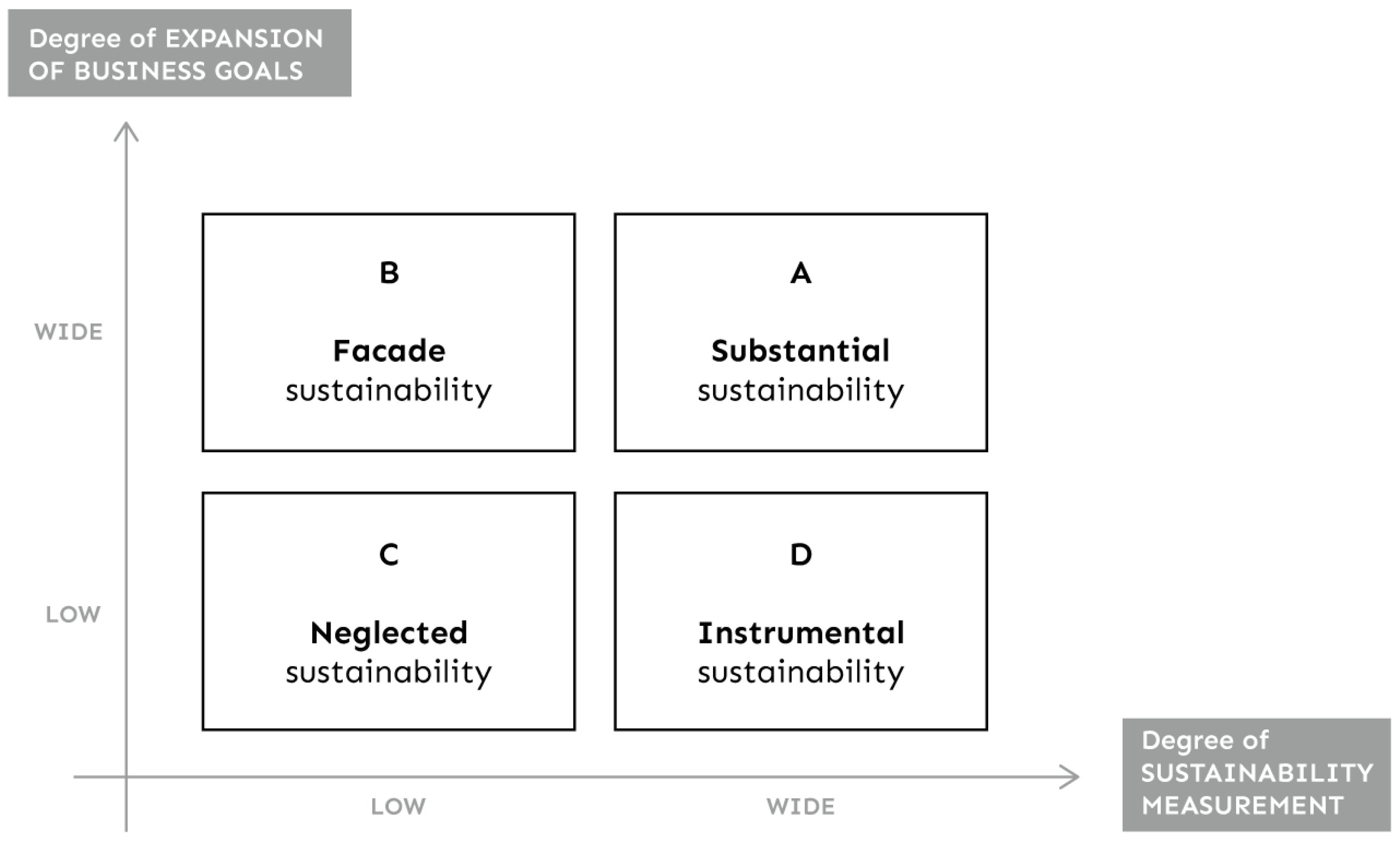
Firstly, the legislation pushes companies towards broadening their mission and objectives. Secondly, it requires the adoption of rigorous and comparable methods for measuring sustainability impact. These two drivers, or directions of change that every company must necessarily position itself on, can be represented on a Cartesian plane, creating four quadrants, which we propose as four positions for observing any company’s response to the drive towards change for sustainability (Figure 1).
- Quadrant C, bottom left
Companies characterized by limited expansion of objectives and limited use of sustainability measures. These companies neglect sustainability. Their positioning stems from the company’s inertia and traditional distance from sustainability practices. These companies limit their vision to profit and do not measure the impact of their activities on sustainability. SMEs positioned in this quadrant would limit themselves to a few bureaucratic and formal adjustments in response to external reporting requests from companies in the supply chain, institutions, or consumers.
- Quadrant B, top left
Companies characterized by broad objectives and limited use of sustainability measures. For these companies, sustainability is merely a choice of image, a facade. Companies in this quadrant focus on sustainability narratives without introducing substantial changes. Declarations of broadening their mission and objectives in the direction of sustainability are not matched by actions that generate a positive impact, let alone measures to detect this impact. These are declarations of idealistic adherence–sustainability rhetoric [15,16] to the implementation of systematic greenwashing strategies [17].
- Quadrant D, bottom right
Companies that show little expansion of objectives, but extensive use of sustainability measures. For these companies, sustainability practices are aimed solely at increasing efficiency and achieving economic benefits. Companies in this quadrant implement actions that evoke sustainability, but without a broad and integrated vision capable of generating economic, social, and environmental value. Improvement actions, such as energy efficiency, waste reduction and recovery, etc., measured through specific indicators, would only be instrumental in reducing costs and streamlining processes to generate economic margins, including by exploiting new financing opportunities.
- Quadrant A, top right
Companies that choose to broaden their objectives and make extensive use of sustainability impact measures. For these companies, sustainability is a fundamental choice. Companies in this quadrant focus on broadening their mission and objectives in the direction of environmental, social, and economic sustainability and on the introduction and rigorous systematization of processes for measuring sustainability in social, environmental, and economic terms.
As is well known, positioning SMEs in quadrant A is the goal of European sustainability policies. These policies also attach great importance to reporting and include it in the financial statements, under the responsibility of the company. This choice means that reporting would play a central role in the CSRD’s theory of change: it would not only be a communication or accountability tool but would also be a lever for promoting cultural change and organizational innovation. Following this approach, sustainability reporting would play a role in the causal chain between (a) broadening objectives, (b) generating consistent actions, and, consequently, (c) producing measurable impacts on the various aspects of sustainability relevant to corporate transparency and social responsibility [18].
With regard to the other positions, we note that for companies in quadrant C—neglected sustainability—sustainability reporting would be merely a bureaucratic obligation, imposed by regulations, either directly or indirectly depending on the size of the company. It would therefore be a pure cost to be incurred in order to operate, to be eliminated as soon as the pressure for change and the related obligations were reduced [19].
For companies in quadrants B—facade sustainability—and D—sustainability as an efficiency advantage—reporting would be used instrumentally as a marketing and communication vehicle, or as an illustration of the efficiency gains achieved.
3. Materials and Methods
To verify our hypothesis, we used what is known as a ‘natural experiment’. Specifically, we studied the experience of a particular type of company, benefit corporations (BCs), introduced into Italian law by Law No. 208 of 28 December 2015. When the CSRD legislation did not yet exist, these companies found themselves in a unique situation, which was very useful for our verification.
On the one hand, in order to comply with the legislation that had established them, these companies had to amend their articles of association and declare that they were pursuing common benefit objectives, i.e., broadening their business objectives towards sustainability. In addition, they had to introduce ways of defining their concrete objectives in terms of sustainability and measuring their periodic achievement. They were therefore in a similar situation to companies now subject to European legislation, considering the two qualifying dimensions we have assumed in this work.
On the other hand, these benefit corporations were fairly free to manage their reporting, which was not strictly codified and only had to be included in an annual document attached to the financial statements, the content and form of which were largely discretionary. This room for interpretation therefore allowed companies to manage their reporting and, above all, the process of preparing it, guided by their own strategic and organizational guidelines.
As of 30 September 2025, there were more than 5300 BCs in Italy, accounting for approximately 1.6‰ of all companies, and they continue to grow (+22% annually) [20].
To conduct the analysis, tools (analysis grids) were prepared for two levels of observation.
The first level concerned two dimensions: the analysis of how these benefit corporations (1) had effectively expanded their corporate objectives (Common Benefit Purposes) and (2) had developed and applied sustainability measurement and impact assessment methodologies.
The second level concerned the analysis of reporting, with particular attention to the processes it triggered, the construction of new collaborative relationships, with particular attention to stakeholder involvement, and the coordinated introduction of forms of organizational innovation.
With regard to the two dimensions of the first level, the grid first analyzed the Common Benefit Purposes (CBPs) declared by the company in order to broaden its objectives beyond the economic sphere. In fact, pursuant to paragraph 378 of Article 1 of Law No. 208 of 28 December 2015, CBPs may consist of “one or more positive effects, or the reduction in negative effects” on “people, communities, territories and the environment, cultural and social assets and activities, entities and associations, and other stakeholders,” such as workers, customers, suppliers, financiers, creditors, public administration, and civil society. The legislation gives companies considerable freedom to define how many and which activities may be considered to be for the common good, setting limits without establishing whether the positive effect pursued (or the reduction in negative effects) must be an objective related to the activities provided for in the company’s corporate purpose, or whether it can also be identified in areas not strictly related to the core business.
In particular, the CBPs were analyzed according to two criteria: (1a) breadth of the objectives; (1b) intentionality of verification of these objectives. For point (1a), it was verified whether the CBPs make explicit reference to the following dimensions of sustainability: environmental sustainability, employee community, value chain (suppliers, customers, and beneficiaries), territory and community, human rights, corporate conduct, and economic sustainability. For point (1b), we verified whether and how the CBPs are broken down into specific, measurable, and measured objectives for the years 2024 and 2025 within the impact report.
The observation grid for the first level considered the methodologies used to measure impact as a second dimension. Annex 4 relating to Article 1, paragraph 378, of Law No. 208 of 28 December 2015, specifies that the assessment standard used by BCs to measure their impact must be comprehensive and detailed, developed by a body that is not controlled by the company, credible, and transparent. However, it is not required that the assessment be carried out by a third party, so the BC can do so independently using a known standard.
With regard to the second level of observation, the grid examined how the sustainability reporting was produced, bearing in mind the four possible approaches to sustainability outlined at the beginning. Essentially, the analysis looks at the report and the process of its construction to distinguish between approaches that view the report as a bureaucratic task (quadrant C, Figure 1), or as a tool for presenting economic savings (quadrant D, Figure 1), or as a tool for promoting the company’s sustainable image (quadrant B, Figure 1), but disregarding the cultural and organizational change processes that have taken place within the organization. Finally, the analysis aims to verify the presence of companies already positioned towards substantial sustainability (quadrant A, Figure 1).
Figure 1.
Possible scenarios for the push toward sustainability among SMEs.
It is important to note that in this case, according to our hypothesis, the report would perform a function that goes far beyond the document itself, because it would involve real processes of mobilization and involvement of stakeholders and a move towards the learning and continuous improvement processes that characterize innovative companies. In the context of BCs, this would mean drawing up and updating a map of internal and external stakeholders, developing a dialog and a path with them, working on the materiality matrix, and preparing and applying tools to advance organizational and cultural change towards sustainability together with stakeholders. In these cases, the document would serve as a sort of guide to change, reflecting the significant work carried out within the organization, and its drafting would develop over time. In essence, the document would become the living reference point for a social process, awareness of which would be widespread among the company’s stakeholders.
Selecting BCs as the reference sample for the natural experiment could introduce a sampling bias, since these companies voluntarily chose to adopt BC status and, consequently, to subject themselves to legal requirements. While the voluntary decision to bind to these standards may indicate a strong commitment to sustainability, it could also be perceived as a marketing and communication strategy. In fact, through observation of the natural experiment, we expect that, even though there is an obligation in place, not the entire sample but only a portion—albeit a majority—will actually articulate their corporate objectives in a credible and meaningful way, monitor them regularly, and identify robust impact measurement methodologies. At the same time, through the natural experiment, which in the past created a situation of positioning tension similar to that present today, we will observe how BCs use reporting, what internal processes they trigger, and how these processes can be interpreted in light of what we now know organizations need to do to engage stakeholders and foster organizational innovation.
To carry out the research, a sample of companies was identified (Appendix A), consisting of the 54 BCs belonging to the Turin Social Impact ecosystem (39) and the Turin Industrial Union (15) as of 31 December 2023. Exactly 43% of the cluster (23 companies) works in the field of consulting, training, and communication, 18.5% of companies (10 out of 54) operate in the manufacturing and industrial production sector, and 13% (7 companies) are in the field of finance and insurance (investment funds, banking, and insurance). This sectoral breakdown is not very different from the picture at the national level, where the sectors with the highest presence of BCs are professional activities (30%), information services (19%), and manufacturing (12%) [21].
The empirical investigation was carried out primarily on documents, namely impact reports that were found directly on websites or requested from companies if not published. In addition to these, the websites and social media channels of the companies in the cluster were examined. The total number of reports analyzed is 40. For the remaining 14 cases, it was not possible to examine the impact report because no response was received to the request to share that document. The 40 reports acquired were examined using the content analysis methodology [22], with a manual approach, which allowed for an in-depth analysis of the texts, identifying not only the explicit themes, but also the implicit ones that emerge from reading ‘between the lines’ [23]. The analysis was conducted between February and April 2024, paying particular attention to the following aspects: (a) the homogeneity between the texts in order to develop an effective comparison (b) the selection of specific objects of analysis such as the description of the CBPs; the impact assessment methodology used; the processes, timing, and tools for drafting the reports, the stakeholder map, and the materiality analysis. The impact report for the most recent available year (2022) was analyzed; where possible, impact reports from previous years were also reviewed.
Secondly, an in-depth study was carried out using semi-structured interviews with a sample of 15 companies [24], chosen from among the 40 companies whose impact reports were examined, with a focus on manufacturing SMEs from different sectors. The interviews were conducted between May and August 2024, mainly in person at the company’s headquarters, or otherwise online. Thanks to the interviews, it was also possible to acquire some highlights from 2023. This phase of the research allowed the BCs to present and describe their reference contexts, the business choices made, the tools used, and the changes encountered. It also allowed the motivations and assessments formulated to emerge and be discussed, enabling the research to reconstruct the different representations and nuances of sustainability from the perspective of the BCs, also in relation to the positioning hypotheses illustrated in the quadrants. It was therefore possible to relate the company’s vision and action on sustainability and innovation to the representation of the cultural and organizational dimension of the company itself. The role assigned to reporting in the path towards sustainability was reconstructed in order to highlight the chronology of the paths and causal relationships that had led first to the mobilization of stakeholders and subsequently to changes in work processes and practices.
4. Results
Observation on the first level, dimension 1: broadening of corporate objectives and measurement. Although not mandatory, 65% of companies publicly disclose their CBPs in documents and on their websites, as well as in their articles of association, where they must be stated by law. Three other BCs shared their CBPs during the interview. It was therefore possible to analyze the CBPs in 29 out of 40 cases (73%). We verified that the CBPs explicitly refer to the following keywords, in order of frequency: environmental sustainability, employee communities, value chain (suppliers, customers, and beneficiaries), territory and community, human rights, corporate conduct, and economic sustainability. We also defined the extent of the broadening of objectives based on the number of keywords present in the CBPs of each BC company (Table 1): from four to seven keywords, the broadening of objectives is considered complete (7/7) or almost complete (4/7); the presence of three keywords indicates a significant broadening; one or two words indicate a minimal broadening. The analysis showed that only 14% of companies (four cases) did not report any expansion, while 86% introduced sustainability objectives (complete expansion in 34% of cases, significant in 28%, minimal in 24%).
Table 1.
Broadening of corporative objectives of the sample companies.
With regard to the measurement of CBPs, it was found that in 63% of BCs CBPs are broken down into specific, measurable objectives and measured within the sustainability reporting (58% for the current year and the following year and 5% for the current year only). Some companies limit themselves to making commitments for the future (8%), while the rest do not measure specific objectives (30%).
The analysis indicates that there is a close correlation between companies that expand their objectives the most and those that measure them, just as the lack of expansion or minimal expansion concerns companies that do not adopt or implement measures.
The BCs group was therefore divided into two subgroups. The most change-oriented group in quadrant A, representing two-thirds of the BCs in the sample, and the least sustainability-focused group, representing one-third of the sample. Faced with the shared need for positioning with respect to sustainability, as is the case today, the group exhibits very different situations.
Observation on the first level, dimension 2: impact measurement methodology. With regard to the second dimension, an analysis of the impact methodologies used was carried out (Table 2). There is no single definition of “impact” in the regulations governing BCs, so different methodologies can be used to measure it. There are more than a hundred, ranging from general analysis frameworks to specific assessment methodologies and the use of reporting standards [25]. For the purposes of the experiment, this verification is important because it allows us to assess whether there is a link between the role of reporting and the methodology adopted.
Table 2.
Impact measurement methodology used by SMEs in the sample.
Overall, the methodology most used by the sample is the B Impact Assessment (BIA), adopted by 25 out of 40 companies (65%). The BIA is an international standard developed for the certification of B Corp companies. It is a questionnaire of about 200 questions organized into five different impact areas (workers, customers, community, environment, governance). It is a free online assessment tool, periodically improved, at the service of businesses.
Exactly 17 companies (43%) used the Global Reporting Initiative (GRI) standard, one of the most widely used internationally recognized reporting standards, characterized by a modular and interdependent structure for creating integrated economic, social, and environmental reports. It also provides guidance on the type of information to be included in the financial statements in order to meet the expectations of different categories of stakeholders (materiality matrix).
Nine companies (23%) referred to the European Sustainability Reporting Standards (ESRS), which were developed with a multi-stakeholder approach and take into account internationally recognized principles and frameworks on business ethics, social responsibility, and sustainable development (e.g., GRI, UN Guiding Principles on Business and Human Rights, ISO 26000 [26], etc.).
In addition, four companies (10%) chose to adopt the Theory of Change methodology [27], another four use the Good Impact Self-Assessment Tool (SABI), and two companies use Social Return On Investment (SROI). Finally, 10 companies have drawn up an integrated document that serves both as a sustainability report, prepared with reference to the GRI Standards and, in some cases, also to the ESRS Exposure Drafts, and as an annual report providing information on the pursuit of the CBPs mentioned in the articles of association. It is important to note that the companies examined often used multiple methodologies. 63% of BCs (25) use more than one methodology, showing a strong orientation towards research and experimentation in the field of measurement, which is very consistent with our hypothesis that reporting develops the processes of experimentation, as well as change and innovation.
Moving on to the second level of observation, which concerns the use of reporting and innovation processes, we note on the basis of the cases analyzed that there are numerous examples of structured involvement of internal and external stakeholders and of changes and innovations in the organization of work and production, respectively. Furthermore, these experiences are closely intertwined with reporting, as the construction of the sustainability report is not interpreted and managed as a bureaucratic or descriptive action based on the collection and presentation of data carried out by the relevant offices, but rather as a substantial cultural and organizational change based on the involvement of stakeholders and their actions carried out in a shared and progressive manner over time. The texts and interviews reveal a close chronological and causal relationship between the reporting process and the progress of organizational change. In particular, we highlight the following three points.
4.1. Involvement of Internal Stakeholders and Changes in Organizational Work Practices
Exactly 55% of companies (16 out of 29) dedicate at least one CBP to the community of employees, expressing the company’s commitment to making the workplace and the work experience itself enjoyable and rewarding.
The following examples are taken from the interviews.
“To meet Common Benefit Objective number 3, relating to well-being at work, we have chosen to dedicate 2022 to a process of internal reorganization following a consultation with an occupational psychologist aimed at defining more clearly the roles and responsibilities of each individual in order to meet their needs.”(Vanni, interview on 20 May 2024).
Expanding corporate objectives beyond profit (such as promoting employee well-being), communicating and sharing this objective through reporting, and identifying verifiable annual targets involves implementing changes in work processes and introducing innovations in the organization. These have been implemented at economic and emotional cost, as highlighted by eight out of 15 companies surveyed, such as implementing and strengthening corporate welfare or generating increased expectations among employees through engagement.
The interviews reveal different types of actions, through which involvement is structured in organizational change and innovation. For example, extensive sharing with stakeholders of the key values (corporate vision) underlying the company and its strategic objectives:
“In 2023, we worked on spreading a sense of responsibility and awareness within the organization through group meetings and internal communication of the sustainable choices made”(Vanni, interview on 20 May 2024).
“The staff has been trained on what it means to be beneficial and what the common benefit goals are. Being a small company, everyone is involved, because the benefit projects are cross-cutting and linked to production activities”(Sargomma, interview on 6 June 2024).
Involvement sometimes starts with the entire corporate community jointly defining key values, objectives, and their implementation. For example,
“Involving everyone in defining benefit objectives and strategies, as well as in their implementation, allows us to structure open benefit governance. We are also open with regard to economic performance, strategy, and agency communication: the Board of Directors makes the decisions, of course, but it does so after a plenary discussion with employees to gather feedback and comments from everyone.”(Amapola, interview on 27 May 2024).
A second type of action that demonstrates organizational change and innovation, starting with greater involvement of the entire employee community, concerns training, understood not only as mandatory training, but as experience in specific training courses on sustainability. For example:
“Initially, training on social and environmental responsibility was aimed only at managers. Subsequently, events were introduced throughout the year, with various workshops on what it means to be a B Corp, aimed at all staff; or team-building events such as cleaning up the park near the headquarters; finally, a contest was launched for the ‘most sustainable employee’”(Costadoro, interview on 10 June 2024).
Furthermore, it is possible to see how training activities are not limited to specific, isolated moments but tend to be part of a process of continuous professional growth, aimed at collective and lasting learning. For example:
“The first Monday of every month is dedicated to training, personal growth, and soft skills”(Uomo e Ambiente, interview on 28 May 2024).
A third type of action concerns the promotion of a culture of openness and dialog in which workers feel empowered and encouraged to contribute their skills, thanks in part to the creation of well-defined tools, spaces, places, and times, such as corporate bodies responsible for innovation and continuous improvement. For example,
“Our company attaches great importance to the continuous search for new ideas, improvements, and innovative solutions, to the extent that it has set up two specific bodies: the innovation committee and the improvement committee. Involving workers in these committees gives them the opportunity to share their knowledge, skills, and ideas to promote innovation and operational excellence”(Uomo e Ambiente, interview on 28 May 2024).
Finally, a fourth type of action that demonstrates the organizational change underway, in this case aimed at the greater involvement, empowerment, and loyalty of the employee community, concerns the activation of incentive reward systems that incorporate socio-environmental performance indicators. For example:
“We have everything ready to activate an incentive plan through the distribution of stock options upon the achievement of socio-environmental objectives, as a loyalty reward for our employees. The plan has been approved by the shareholders’ meeting and is currently being implemented. The goal is to retain the resources we have developed”(Biova, interview on 7 June 2024).
What characterizes the four types of actions described is that the change primarily observed is a change in people’s behavior, which translates into organizational change.
4.2. Involvement of External Stakeholders and Changes in Production Organization
Among the cases studied, we found a widespread effort to implement changes and innovations in production organization, especially in manufacturing companies, following greater involvement of stakeholders in the value chain. For example,
“Becoming a benefit corporation, accounting for our impact, listening to and involving our stakeholders has forced us to think more rigorously about the sustainability of our production process”(Vanni, interview on 20 May 2024).
In 2023, this enterprise created new collections of DryBlock acetate and bioacetate eyewear to limit the use of chemicals in the production process, which account for 20% of total acetate eyewear production. In addition, the same company has limited the impact of CO2 emissions related to the production of eyewear cases, both through the use of recycled materials (cardboard for the case and polyamide and polyester for the eyewear cleaning cloths and the fabric pouch for sunglasses) and through improved shipping logistics.
Meanwhile, Sargomma is investing in rubber recycling processes, establishing contacts with a Turin-based company specializing in rubber recycling and holder of a patent on the process of producing, through devulcanization, an elastomer obtained entirely from recycled industrial waste.
Torrefazione Costadoro, on the other hand, has undertaken an infrastructural innovation in the construction of a new plant from both a social and environmental point of view: all architectural barriers have been eliminated and the energy-saving approach extends to every aspect of the structure, starting with the materials used, through to the zenithal lighting system (twilight lights) in the warehouse, and the photovoltaic systems on the roofs and new-generation systems that optimize energy consumption (there are no air conditioning systems and heat from the roasters is recovered). In addition, it has replaced its coffee packaging, switching from a poly-laminate (PET and aluminum) to a single plastic material (HDPE), thus ensuring that the packaging can be recycled at the end of its life. Furthermore, it has entered into commercial partnerships to make use of various production waste products: it sells silver foil from coffee beans as a by-product to a company in Castellazzo Bormida to be converted into biogas, and it has started marketing a new product, an infusion made from cascara, the skin of the coffee bean.
Furthermore, in recent years, Costadoro has begun to adhere to fair trade practices, certified by the Fairtrade mark, working directly with each of the key players in the supply chain in the countries where the highest quality Arabica coffee is grown. In fact,
“Overall, Costadoro’s goal is to control and guarantee the sustainable quality of the raw material, through traceability and long-lasting, direct collaboration with the players in the green coffee supply chain; a process that involves the direct involvement of producers and the transfer of knowledge, facilitated by training and built on the basis of locally identified needs and requirements”(Costadoro, interview on 10 June 2024).
Further empirical confirmation of experimental and organizational innovations in the production process can be found in the activation of commercial partnerships between different supply chains. Biova, which was created to make use of unsold bread to produce beer, experimented in 2023 with beers made from recovered pasta and rice and added them to its range, launching a research and development initiative to patent the new system.
“We have begun collaborating with new local producers, including Turin’s oldest brewery and an industrial pasta manufacturer in Carmagnola, and have strengthened our partnerships with bakery and food distribution groups”(Biova, interview on 7 June 2024).
Dual Sanity, a market leader in Italy in the health and wellness sector, with a particular focus on orthopedic medical devices, has decided to donate unused production materials to cooperative enterprises and social tailoring workshops (Sustainability Report 2022, p.31).
Furthermore, Reynaldi, a cosmetics company, decided in 2021 to support a socially oriented start-up, becoming its industrial partner and investor. Vortex recovers the by-product of fruit juice processing, transforming this food waste into a raw material that it uses to produce natural cosmetics. The project also relies on the Dalla Stessa Parte Social Cooperative to promote the integration of disadvantaged people into the workforce (2021 Sustainability Report, p. 20).
As in the case of employees, the involvement of external stakeholders takes on a structural and permanent meaning and allows for the development of shared projects, where the process of building sustainability reporting becomes the basis for designing, measuring, and narrating experiences of collaboration and change.
In short, we have identified three challenges in managing stakeholder relations regarding sustainability: strengthening stakeholders’ specific interests in sustainability, creating shared interests in sustainability based on those specific interests, and enabling stakeholders to act as intermediaries for nature and sustainable development. These challenges are addressed through three interconnected mechanisms, as identified also by Hörisch, J. et al. [13]: education, regulation, and the creation of sustainability-based value for stakeholders.
On the other hand, these findings are consistent with those who have demonstrated how mechanisms for reporting, reliable fiscal investments, and organizational culture are the three primary areas that improve shaping employee engagement, work experience, and sustainability [28].
In addition, as Subbiah et al. point out [29], coordination among the various stakeholders and the resulting organizational innovation extend not only to products and processes, but also to operational risk management.
4.3. Change and Incremental Innovation
The case studies analyzed reveal a close relationship between the preparation of reports and the progress of organizational change, including from other perspectives. It can be observed that when the corporate mission is broadened, specific verifiable and verified objectives are defined, in light of a process of listening to and involving stakeholders, the sustainability reporting becomes a tool for the social construction of change, a sort of guide and system for the collective observation of change, which is set in motion and translates into incremental innovations that involve continuous involvement and learning. For example:
“Having to report and measure impact objectives requires greater efficiency and planning on the part of the group”((Ri)Generiamo, interview on 22 May 2024).
In particular, lifelong learning often involves choosing to experiment with one or more impact measurement methodologies in order to more accurately account for the change generated. Here too, the social dimension of change emerges, linked to the implementation of shared processes that refer to reporting as the place where they will find meaning, be narrated, and documented. For example:
“The BIA methodology fails to account for the change achieved over time; SABI, on the other hand, gives a more accurate idea of the value generated over time for all stakeholders. We are also considering using the Theory of Change.”(Futura Law, interview 28 May 2024).
Furthermore, the choice of methodology for reporting impact and measuring sustainability, necessary for the purposes of drafting the impact report, influences the company’s posture in terms of how to account for ongoing continuous improvement. For example:
“The GRI standard was selected because of its widespread use and in order to compare ourselves, with a view to continuous improvement, with a more complex and comprehensive standard than the one used in the past.”(Sargomma, interview on 6 June 2024).
“Another small change has taken place in the maturation of our reporting process: we are trying to be more precise in our assessment, gathering more and more quantitative and qualitative information, without assimilating the concept of impact with that of outcome, and approaching the entire analysis and collection process with objectivity and transparency.”(Synesthesia, Impact Report 2023, p. 12).
Overall, the results indicate that, with regard to the first level of observation, the impact reports and semi-structured interviews made it possible to verify that more than two-thirds of the sample had broadly expanded their corporate mission to include ESG objectives and had worked to verify their impact. With regard to the second level of observation, the same companies interpreted the reporting as a guide for a process and recognized their stakeholders, with whom they developed engagement processes. These processes generated changes in organizational work practices and production organization.
5. Conclusions
The findings of this study suggest that sustainability reporting can play a role that goes beyond transparency and compliance. In the cases analyzed, the preparation of the sustainability or impact report appears to function as an organizational coordination mechanism that mobilizes internal and external stakeholders. Through this process, companies progressively develop shared interpretations of sustainability objectives, experiment with measurement practices and introduce organizational changes affecting work organization, production processes and value-chain relationships.
Following the logic of the natural experiment, benefit corporations that have chosen to broaden their mission through CBPs and have implemented impact measures have found reporting to be a fundamental tool for mobilizing and engaging stakeholders. The sample examined also includes some companies that have not made public the CBPs indicated in their articles of association and have not used solid and structured forms of measurement. In this case, not only were sustainability reports brief and very poor in information, but above all, they were not at the center of a social process of change: reporting becomes symbolic rather than stimulating innovation, or being deemed to be transformative (quadrant B and C, Figure 1).
As we have emphasized, the key elements that attest to the presence of organizational changes and innovations are: sharing the core values underlying the company and its strategic objectives; launching training programs, including specific ones on sustainability and reflection on work practices; the promotion of a culture of openness and dialog in which workers feel empowered and encouraged to contribute their skills; the implementation of incentive systems that incorporate socio-environmental performance indicators; the contamination of the value chain within the production process; the launch and testing of commercial partnerships between different supply chains to make use of production waste.
These results are consistent with theoretical perspectives that interpret innovation as a socially embedded process involving learning, collaboration and continuous improvement. When reporting becomes integrated into organizational routines and supported by stakeholder engagement, it acts as a platform for collective learning and strategic reflection rather than a purely administrative exercise.
However, this research presents several limitations. First, the empirical analysis focuses on a relatively small sample of benefit corporations located in a specific territorial ecosystem. Although the cases analyzed provide valuable insights, the results cannot be generalized to all SMEs or to all forms of sustainability reporting. Second, the study relies mainly on qualitative methods such as document analysis and semi-structured interviews. Future studies could complement these approaches with quantitative analyses. Third, the research may be affected by a potential subjective bias in the data collected through interviews, with a tendency to overestimate the positive changes reported and a reluctance to mention difficulties in implementing sustainability practices and unintended effects. Finally, benefit corporations represent a specific institutional context characterized by an explicit commitment to social and environmental objectives, and the dynamics observed may differ in firms adopting sustainability reporting without this institutional framework. Future research could extend this work in several directions. Comparative studies across different countries or regulatory contexts could clarify how institutional environments influence the relationship between reporting and organizational innovation. Longitudinal studies could observe how reporting practices evolve over time and how they influence strategic and organizational decisions. Finally, quantitative research could explore the relationship between sustainability reporting, innovation outcomes and firm performance across larger samples of companies.
Author Contributions
Conceptualization, N.L. and R.D.M.; Methodology, R.D.M.; Formal analysis, N.L. and R.D.M.; Data curation, N.L.; Writing—review & editing, N.L. and R.D.M.; Supervision, R.D.M. All authors have read and agreed to the published version of the manuscript.
Funding
This research was funded by the project ‘Ecosistema dell’Innovazione “NODES—Nord Ovest Digitale E Sostenibile” finanziato con fondi PNRR Missione 4, Componente 2, Investimento 1.5 Proposte di intervento per la creazione e il rafforzamento di “ecosistemi dell’innovazione”—Decreto di concessione del finanziamento n. 1054 del 23 giugno 2022, inviato dal MUR con prot. 13307—del 29 July 2022, codice MUR ECS00000036, CUP D17G22000150001.
Institutional Review Board Statement
The study was conducted in accordance with the principles of the Declaration of Helsinki. Ethical review and approval were waived by the Institutional Review Board of the University of Turin because the research involved exclusively publicly available data (from company websites and sustainability reports) and unstructured interviews with company representatives, during which no sensitive personal data of employees or customers were collected, no intervention was performed on participants, and no foreseeable risks to participants’ rights or well-being were identified. All procedures complied with the applicable Italian and European data protection regulations (GDPR 2016/679).
Informed Consent Statement
Informed consent was obtained from all subjects involved in the study.
Data Availability Statement
The original contributions presented in this study are included in the article. Further inquiries can be directed to the corresponding author.
Acknowledgments
The authors thank the entrepreneurs and managers who participated in the interviews and allowed visits to the companies. The authors have reviewed and edited the output and take full responsibility for the content of this publication.
Conflicts of Interest
The authors declare no conflicts of interest.
Abbreviations
The following abbreviations are used in this manuscript:
| BCs | Benefit Corporations |
| BIA | B Impact Assesment |
| CBPs | Common Benefit Purposes |
| CSRD | Corporate Sustainability Reporting Directive |
| ESRS | European Sustainability Reporting Standards |
| GRI | Global Reporting Initiative |
| SABI | Strumento di Autovalutazione del Buon Impatto (Good Impact Self-Assessment Tool) |
| OECD | Organisation for Economic Co-operation and Development |
| SMEs | Small and medium-sized enterprises |
Appendix A
Table A1.
List of 39 Benefit corporations affiliated with Torino Social Impact as of 31 December 2023.
Table A2.
List of 15 Benefit corporations affiliated with Unione Industriali of Turin as of 31 December 2023.
References
- Sjåfjell, B.; Bruner, C. (Eds.) The Cambridge Handbook of Corporate Law, Corporate Governance and Sustainability; Cambridge University Press: Cambridge, UK, 2019. [Google Scholar]
- Monciardini, D.; Mähönen, J.; Tsagas, G. Rethinking non-financial reporting: A blueprint for structural regulatory changes. Account. Econ. Law A Conviv. 2020, 10, 20200092–20200132. [Google Scholar] [CrossRef] [Scilit]
- Hahn, R.; Reimsbach, D.; Wickert, C. Nonfinancial reporting and real sustainable change: Relationship status—It’s complicated. Organ. Environ. 2023, 36, 3–16. [Google Scholar] [CrossRef] [Scilit]
- Barker, R.; Mayer, C. Seeing double corporate reporting through the materiality lenses of both investors and nature. Account. Forum 2024, 49, 259–289. [Google Scholar] [CrossRef] [Scilit]
- Vollmer, H. Accounting and the shifting spheres: The economic, the public, the planet. Account. Organ. Soc. 2024, 113, 101574. [Google Scholar] [CrossRef] [Scilit]
- Hoffman, A. Why Management Research Needs a Radical Rethink. Financial Times, 2023. Available online: https://www.ft.com/content/0500d456-6c2d-4bc9-af85-e4be5c9ae5d1 (accessed on 6 March 2026).
- Bosi, M.K.; Lajuni, N.; Wellfren, A.C.; Lim, T.S. Sustainability Reporting through Environmental, Social, and Governance: A Bibliometric Review. Sustainability 2022, 14, 12071. [Google Scholar] [CrossRef] [Scilit]
- Clarkson, M.B.E. A Stakeholder Framework for Analyzing and Evaluating Corporate Social Performance. Acad. Manag. Rev. 1995, 20, 92–117. [Google Scholar] [CrossRef] [Scilit] [PubMed]
- Adhariani, D.; du Toit, E. Readability of sustainability reports: Evidence from Indonesia. J. Account. Emerg. Econ. 2020, 10, 621–636. [Google Scholar] [CrossRef] [Scilit]
- Freeman, R.E.; Wicks, A.C.; Parmar, B. Stakeholder theory and “The corporate objective revisited”. Organ. Sci. 2004, 15, 364–369. [Google Scholar] [CrossRef] [Scilit]
- Garvare, R.; Johansson, P. Management for sustainability: A stakeholder theory. Total Qual. Manag. Bus. Excell. 2010, 21, 737–744. [Google Scholar] [CrossRef] [Scilit]
- Marques, P.; Bernardo, M.; Presas, P.; Simon, A. Corporate social responsibility in a local subsidiary: Internal and external stakeholders’ power. EuroMed J. Bus. 2020, 15, 377–393. [Google Scholar] [CrossRef] [Scilit]
- Hörisch, J.; Freeman, R.; Schaltegger, S. Applying stakeholder theory in sustainability management: Links, similarities, dissimilarities, and conceptual framework. Organ. Environ. 2014, 27, 328–346. [Google Scholar] [CrossRef] [Scilit]
- Toner, P. Workforce Skills and Innovation: An Overview of Major Themes in the Literature, OECD Education Working Papers; OECD Publishing: Paris, France, 2011. [Google Scholar] [CrossRef]
- Gray, R. Social, environmental and sustainability reporting and organisational value creation? Whose value? Whose creation? Account. Audit. Account. J. 2006, 19, 793–819. [Google Scholar] [CrossRef] [Scilit]
- Cho, C.H.; Kajüter, P.; Stacchezzini, R. The future of corporate reporting. Account. Eur. 2022, 19, 1–6. [Google Scholar] [CrossRef] [Scilit]
- Christensen, H.B.; Hail, L.; Leuz, C. Mandatory CSR and sustainability reporting: Economic analysis and literature review. Rev. Account. Stud. 2021, 26, 1176–1248. [Google Scholar] [CrossRef] [Scilit]
- Patten, D.M. Environmental Disclosure as Legitimation: Is It in the Public Interest? In Accounting for the Public Interest; Mintz, S., Ed.; Advances in Business Ethics Research; Springer: Dordrecht, The Netherlands, 2014; Volume 4, pp. 201–215. [Google Scholar] [CrossRef] [Scilit]
- Verrecchia, R.E. Discretionary disclosure. J. Account. Econ. 1983, 5, 179–194. [Google Scholar] [CrossRef] [Scilit]
- Benefit Corporation Observatory, Brindisi–Taranto Chamber of Commerce, and InfoCamere. 2025. Available online: https://www.brta.camcom.it/dashboard-osservatorio-societa-benefit (accessed on 6 March 2026).
- Assobenefit. Ricerca Nazionale Sulle Società Benefit 2024. Parte 1 Risultati Analisi Descrittiva e di Redditività. 2024. Available online: https://www.societabenefit.net/ricerca-nazionale-sulle-societa-benefit-2024/ (accessed on 6 March 2026).
- Stemler, S.E. Content analysis. In Emerging Trends in the Social and Behavioral Sciences; Scott, R., Kosslyn, S., Eds.; John Wiley & Sons, Inc.: Hoboken, NJ, USA, 2015. [Google Scholar] [CrossRef] [Scilit]
- Twedt, B.; Rees, L. Reading between the lines: An empirical examination of qualitative attributes of financial analysts’ reports. J. Account. Public Policy 2012, 31, 1–21. [Google Scholar] [CrossRef] [Scilit]
- Chiucchi, M.S. Il Metodo Dello Studio Di Caso Nel Management Accounting; Giappichelli Editore: Torino, Italy, 2015. [Google Scholar]
- Biancone, P.; Secinaro, S. La Valutazione Dell’impatto Sociale; Aspetti Metodologici: Pearson, GA, USA, 2020. [Google Scholar]
- ISO 26000:2010; Guidance on Social Responsibility. International Organization for Standardization: Geneva, Switzerland, 2010.
- Weiss, C.H. Nothing as practical as good theory: Exploring theory-based evaluation for comprehensive community initiatives for children and families. In New Approaches to Evaluating Comprehensive Community Initiatives; Connell, J., Kubisch, A., Schorr, L., Weiss, C., Eds.; The Aspen Roundtable Institute: New York, NY, USA, 1995; pp. 65–92. [Google Scholar]
- DeBusschere, G.; Byrne, H.; Augustino, V.; Granberg, R.; Pearson, S.; Verble, R. Consequences of facilities, vehicle, and equipment failures in United States federal wildland firefighter retention and morale. J. Saf. Sustain. 2025, 2, 142–146. [Google Scholar] [CrossRef] [Scilit]
- Subbiah, A.; Subbiah, S.; Muthukrishnan, S.; Pandey, S.; Anand, P. Mitigating road risks in the oil & gas industry: A comprehensive approach through journey risk management plans. J. Saf. Sustain. 2025, 2, 127–133. [Google Scholar] [CrossRef] [Scilit]

Disclaimer/Publisher’s Note: The statements, opinions and data contained in all publications are solely those of the individual author(s) and contributor(s) and not of MDPI and/or the editor(s). MDPI and/or the editor(s) disclaim responsibility for any injury to people or property resulting from any ideas, methods, instructions or products referred to in the content. |
© 2026 by the authors. Licensee MDPI, Basel, Switzerland. This article is an open access article distributed under the terms and conditions of the Creative Commons Attribution (CC BY) license.