


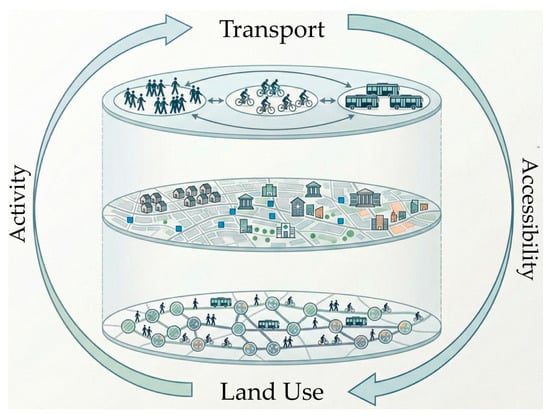
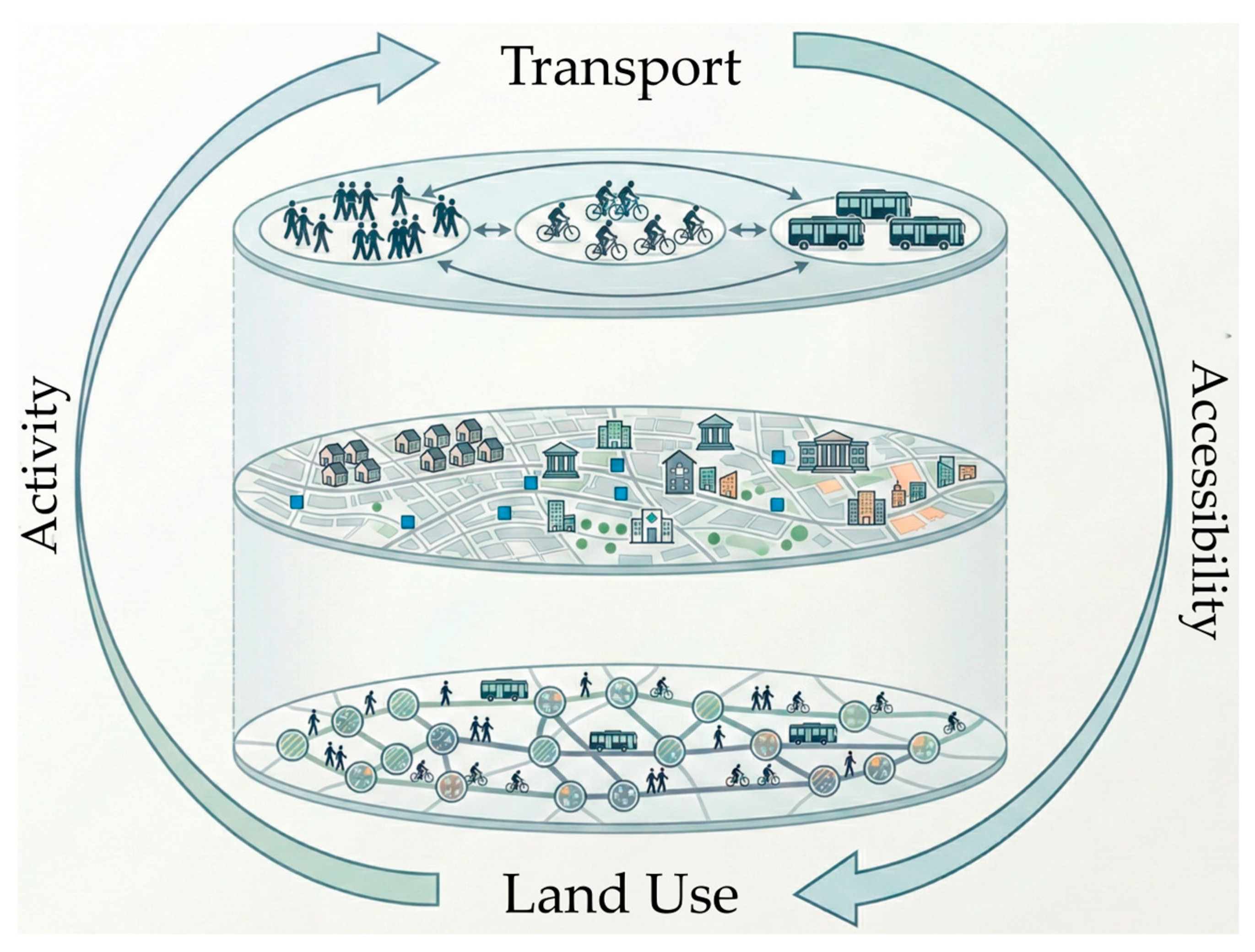
In line with the United Nations’ Sustainable Development Goals, the pursuit of sustainable transport and land use is essential to advancing urban sustainability [1]. The interdependence between transport and land use constitutes a fundamental nexus shaping the physical, social, and economic fabric of cities and human settlements. It is widely recognized that transport influences land use by shaping accessibility [2,3], whereas land use affects transport through the spatial distribution of human activities (Figure 1). More specifically, land use acts as a catalyst for activity demand, profoundly influencing residents’ trip generation, destination choice, spatial distribution of trips, and mode choice [4,5]. Conversely, transport systems alter patterns of accessibility and stimulate urban development. The evolving dynamics of urban space, accelerated by technological advancements and shifting societal norms, underscore the need for innovative and sustainable solutions in land use planning and transport systems. In this context, effective geovisualization can improve the communication and interpretation of complex geospatial information, thereby supporting more informed planning and decision-making [6].
Figure 1.
Conventional transport-land use interaction loop.
This Special Issue, published in the “Sustainable Urban and Rural Development” section of Sustainability, is closely aligned with the United Nations’ Sustainable Development Goals. It provides a platform for original and interdisciplinary research that advances understanding of travel behavior, active and shared mobility, the built environment, urban form, risk-informed planning, and related topics. The guest editorial team for this Special Issue consists of four early-career scholars: Linchuan Yang (Southwest Jiaotong University), Wei Lv (Wuhan University of Technology), Hongliang Ding (Southwest Jiaotong University), and Hongtai Yang (Southwest Jiaotong University).
This Special Issue includes ten papers. They cover a wide geographical scope, including China, Australia, Spain, Thailand, South Africa, and Japan. Methodologically, these papers employ a diverse set of analytical approaches, including spatial analysis, cluster analysis, structural equation modeling, spatial econometrics, discrete choice modeling, and machine learning. They can be broadly categorized into four themes: green travel, travel demand under disruptions, disaster-resilient infrastructure, and urban spatial dynamics.
Green travel has become a central theme in contemporary sustainability research, reflecting growing concerns over climate change, urban livability, and public health [7]. Yuan et al. (Contribution 1) evaluated cycling greenway potential in Chengdu, China, by integrating large-scale dockless bike-sharing data with multiscale geographically weighted regression analysis. Their findings highlighted the importance of mixed land use and human-scale design in promoting leisure cycling. This study underscores the value of evidence-based decision-making in prioritizing infrastructure improvements to enhance urban green mobility. Shifting from network potential to user experience, Du et al. (Contribution 2) examined the influences of built environment attributes on the travel satisfaction of bike-sharing users accessing public transit in first-/last-mile trips during winter in Shenyang, China. Using machine learning and asymmetric impact-performance analysis, they proposed a strategic framework for enhancing green mobility and resilience in cities with harsh winter climates and identified 19 key attributes. Vichiensan et al. (Contribution 3) conducted a willingness-to-pay analysis in Bangkok, Thailand, revealing that first-/last-mile travelers place substantial value not only on time savings, but also on safety and comfort attributes.
Understanding travel demand under disruptions, such as the COVID-19 pandemic, is essential for developing resilient urban transport systems. Chalabi and Dia (Contribution 4) demonstrated that remote work and attitudinal shifts have reduced commuting frequency and altered the use of both public transport and private cars. They indicated that the pandemic has reshaped behavioral habits in ways that may persist, necessitating a comprehensive revision of travel demand forecasting models for the post-pandemic era. González-Escobar et al. (Contribution 5) traced the decline and uneven recovery of bus demand using GIS and ticketing data, revealing differentiated recovery patterns across routes as well as between urban and interurban services. Wang et al. (Contribution 6) found that ride-sharing intention is positively associated with subjective norms, perceived behavioral control, and service satisfaction, whereas concerns related to COVID-19 continue to suppress both intention and actual usage.
Disaster-resilient infrastructure is pivotal to urban sustainability because it protects lives, property, critical services, and broader societal functions. Jing et al. (Contribution 7) assessed flood risk in Wuhan, China, by integrating natural, social, and economic indicators within a framework encompassing hazard, exposure, vulnerability, and disaster prevention and mitigation capacity. Their analysis further demonstrated clear spatial autocorrelation and differentiation in flood risk levels. Yang et al. (Contribution 8) evaluated emergency shelter accessibility in Shenzhen using a Gaussian-based two-step floating catchment area method combined with clustering analysis, showing that supply-demand relationships vary significantly across service radii and that population density strongly shapes patterns of mismatch.
Understanding urban spatial dynamics is important for aligning transport infrastructure with land use outcomes in support of sustainable urban development. Mokhele (Contribution 9) examined the value of land accommodating logistics facilities in Cape Town, South Africa, using geographically weighted regression. This study highlighted the importance of road access, the seaport, and the central business district in shaping land values. It also revealed a weak relationship with rail-oriented locations, indicating a disconnect between logistics planning and broader spatial planning. Shu et al. (Contribution 10) investigated the correlates of urban vitality in Guiyang, China, using social media and geospatial big data from 2019 to 2024 and multiscale geographically and temporally weighted regression models.
A key direction for future research is the application of artificial intelligence (AI) to transport and land use planning. Recent studies have demonstrated the potential of AI-related methods in algorithmic urban planning, infrastructure optimization, and built-environment analysis [8,9,10]. Technologies such as machine learning and large language models hold considerable promise for enhancing planning processes, analytical capabilities, and decision-support systems. By integrating diverse data sources, AI can support the exploration of complex mechanisms and the simulation of built environments and urban dynamics. These capabilities can help planners and policymakers gain deeper insights, improve predictive accuracy, and optimize strategies aimed at enhancing living environments and residents’ quality of life. Nevertheless, the integration of AI into transport and land use planning remains at a developmental stage, and continued research is needed to fully realize the potential of AI in sustainable urban development. A wide range of related topics warrants further exploration, including new AI frameworks, tools, and platforms for integration with transport and land use planning; AI-enhanced analysis of the role of built environments; transport and land use planning under human–AI interaction; AI-driven urban disaster risk assessment and emergency response systems; and the optimization of urban traffic flow and infrastructure planning using AI.
Funding
This research received no external funding.
Institutional Review Board Statement
Not applicable.
Informed Consent Statement
Not applicable.
Data Availability Statement
Not applicable.
Acknowledgments
The author would like to express his sincere gratitude to Yisheng Peng and Hualong Qiu, PhD students at the School of Architecture, Southwest Jiaotong University, for their constructive comments and valuable suggestions. The author would also like to express his sincere gratitude to the other guest editors (Wei Lv, Hongliang Ding, and Hongtai Yang) for their valuable support.
Conflicts of Interest
The author declares no conflict of interest.
List of Contributions
- Yuan, S.; Dai, W.; Zhang, Y.; Yang, J. Cycling Greenway Planning towards Sustainable Leisure and Recreation: Assessing Network Potential in the Built Environment of Chengdu. Sustainability 2024, 16, 6185.
- Du, Y.; Ji, X.; Dou, C.; Wang, R. Boosting Winter Green Travel: Prioritizing Built Environment Enhancements for Shared Bike Users Accessing Public Transit in the First/Last Mile Using Machine Learning and Grounded Theory. Sustainability 2024, 16, 9843.
- Vichiensan, V.; Wasuntarasook, V.; Malaitham, S.; Fukuda, A.; Rujopakarn, W. Willingness to Pay for Station Access Transport: A Mixed Logit Model with Heterogeneous Travel Time Valuation. Sustainability 2025, 17, 6715.
- Chalabi, G.; Dia, H. The Impacts of Remote Work and Attitudinal Shifts on Commuting Reductions in Post-COVID Melbourne, Australia. Sustainability 2024, 16, 7289.
- González-Escobar, R.; Vega Naranjo, J.M.; Jiménez-Espada, M.; Vivas, J.G. Exploring the Footprint of COVID-19 on the Evolution of Public Bus Transport Demand Using GIS. Sustainability 2024, 16, 10901.
- Wang, K.; Qi, L.; Yang, S.; Wang, C.; Zhou, R.; Liu, J. Towards Sustainable Mobility: Factors Influencing the Intention to Use Ride-Sharing in the Post-Pandemic Era. Sustainability 2025, 17, 8343.
- Jing, W.; Song, Y.; Lv, W.; Yang, J. Risk Assessment of Flood Disasters with Multi-Source Data and Its Spatial Differentiation Characteristics. Sustainability 2025, 17, 7149.
- Yang, Q.; Liu, Y.; Duan, Z.; Liu, X. An Accessibility Analysis of Emergency Shelters in Shenzhen Using the Gaussian-Based Two-Step Floating Catchment Area Method and Clustering. Sustainability 2025, 17, 5250.
- Mokhele, M. Analysing the Market Value of Land Accommodating Logistics Facilities in the City of Cape Town Municipality, South Africa. Sustainability 2025, 17, 5776.
- Shu, M.; Tang, H.; Wang, S. Spatiotemporal Evolution and Maintenance Mechanisms of Urban Vitality in Mountainous Cities Using Multiscale Geographically and Temporally Weighted Regression. Sustainability 2026, 18, 1059.
References
- Banister, D. The sustainable mobility paradigm. Transp. Policy 2008, 15, 73–80. [Google Scholar] [CrossRef] [Scilit]
- Geurs, K.T.; van Wee, B. Accessibility evaluation of land-use and transport strategies: Review and research directions. J. Transp. Geogr. 2004, 12, 127–140. [Google Scholar] [CrossRef] [Scilit]
- Cervero, R. Linking urban transport and land use in developing countries. J. Transp. Land Use 2013, 6, 7–24. [Google Scholar] [CrossRef] [Scilit]
- Ewing, R.; Cervero, R. Travel and the built environment: A meta-analysis. J. Am. Plan. Assoc. 2010, 76, 265–294. [Google Scholar] [CrossRef] [Scilit]
- Yang, L.; Ao, Y.; Ke, J.; Lu, Y.; Liang, Y. To walk or not to walk? Examining non-linear effects of streetscape greenery on walking propensity of older adults. J. Transp. Geogr. 2021, 94, 103099. [Google Scholar] [CrossRef] [Scilit]
- Li, W.; Zhu, J.; Fu, L.; Zhu, Q.; Xie, Y.; Hu, Y. An augmented representation method of debris flow scenes to improve public perception. Int. J. Geogr. Inf. Sci. 2021, 35, 1521–1544. [Google Scholar] [CrossRef] [Scilit]
- Qiu, N.; Li, W.; Han, X.; Jiang, Y.; Zhang, Z.; Du, M. Active commuting: An alternative source of health-promoting physical activity in job–housing imbalance contexts. Humanit. Soc. Sci. Commun. 2025, 12, 1990. [Google Scholar] [CrossRef] [Scilit]
- Son, T.H.; Weedon, Z.; Yigitcanlar, T.; Sanchez, T.; Corchado, J.M.; Mehmood, R. Algorithmic urban planning for smart and sustainable development: Systematic review of the literature. Sustain. Cities Soc. 2023, 94, 104562. [Google Scholar] [CrossRef] [Scilit]
- Wu, X.; Wang, J.; Feng, Z.; Chen, H.; Li, T.; Liu, Y. Multisource information fusion for real-time prediction and multiobjective optimization of large-diameter slurry shield attitude. Reliab. Eng. Syst. Saf. 2024, 250, 110305. [Google Scholar] [CrossRef] [Scilit]
- Yang, L.; Yu, B.; Liang, Y.; Lu, Y.; Li, W. Time-varying and non-linear associations between metro ridership and the built environment. Tunn. Undergr. Space Technol. 2023, 132, 104931. [Google Scholar]
Disclaimer/Publisher’s Note: The statements, opinions and data contained in all publications are solely those of the individual author(s) and contributor(s) and not of MDPI and/or the editor(s). MDPI and/or the editor(s) disclaim responsibility for any injury to people or property resulting from any ideas, methods, instructions or products referred to in the content. |
© 2026 by the author. Licensee MDPI, Basel, Switzerland. This article is an open access article distributed under the terms and conditions of the Creative Commons Attribution (CC BY) license.