


Abstract
As work–life balance (WLB) is considered the main premise of a sustainable workforce, organizations and policymakers direct their efforts toward helping employees attain it. However, there is a lack of research on organizational efforts to sustain WLB across different work arrangements. This study, therefore, explores the relationships among WLB culture, boundary control, and WLB among teleworkers and on-site workers. A two-wave survey with a six-month time lag involved 379 white-collar employees from various industries. The results showed that WLB culture was associated with greater boundary control over time. Moreover, this effect was significant only among office workers but not among teleworkers, suggesting that WLB culture is more important when working on site. Additionally, greater boundary control was related to a higher affective dimension of WLB, but not with the effectiveness dimension, six months later. Practical and empirical implications for organizational practices that enhance work–life balance across various settings are discussed.
1. Introduction
Given that work–life balance is considered a critical prerequisite for a sustainable workforce and personal well-being by researchers [1] and policymakers [2], considerable organizational effort has been devoted to implementing work–life policies and programs. Although some research on the organizational benefits of implementing work–life balance programs and policies has produced mixed results [3], most studies show that these programs benefit individuals and organizations alike. For instance, work–life balance programs and policies have been shown to enhance positive attitudes, improve job performance, and retain employees [4,5] as well as reduce work–life conflict [6]. While there are numerous advantages to work–life balance policies, researchers consistently note that having formal policies in place does not ensure their effective implementation [7]. As noted by Weale et al. [8] in their scoping review, the sole availability of policy does not appear to be related to improved work–life interaction. Not surprisingly, most of the research examining the underutilization of work–life balance policies and programs focuses on organizational culture [9].
Work–life balance (WLB) culture refers to a set of behaviors, norms, beliefs, and values shared by organizational members [5] that may encourage or hinder work–life integration [10]. While the impact of organizational cultures on work–life boundary management has been emphasized theoretically [11], it has been largely neglected in empirical research, aside from a few studies [12]. We contend that understanding the influence of organizational cultures on employees’ capacity to implement their boundary management preferences and achieve a work–life balance is crucial, both in theory and practice, particularly because this issue carries significant consequences for sustainable human resource management. Furthermore, although the relationship between boundary control and work–life balance has been established [13], the longitudinal nature of this relationship remains unclear.
To address the aforementioned gaps, we posit that WLB culture serves as a resource that strengthens boundary control, while boundary control, in turn, enhances different types of work–life balance over time.
With this study, we make several timely and relevant contributions. Firstly, drawing on boundary theory [14,15], we demonstrate that WLB culture is associated with greater boundary control. In this manner, we provide empirical evidence of the relationship, which to date has been emphasized theoretically [11] but neglected in empirical studies. Moreover, we strengthen the findings of existing studies, which predominantly rely on cross-sectional data [16].
Secondly, the relationship between WLB culture and boundary control was found among office workers but not among teleworkers, thereby suggesting that sustaining WLB culture is more important for office workers than for teleworkers. As the mere form of telework can serve as a family-friendly and flexible resource [17], on-site workers need an organizational culture that supports boundary management behaviors [18].
Thirdly, we explore the long-term connections between boundary control and two aspects of work–life balance, addressing the request made by Allen and French [19] for longitudinal studies in the work-family domain. Moreover, by demonstrating a longitudinal relationship between boundary control and affective balance, but not effectiveness balance, we empirically confirm Wayne et al.’s [20] prediction that different aspects of work–life balance might indeed have different antecedents.
Finally, our study offers practical implications for the importance of organizational support in strengthening employees’ perceptions of their ability to control work and life boundaries among office workers and enhancing affective work–life balance.
2. Theory and Hypotheses Development
2.1. Work–Life Balance Culture and Boundary Control
In general, organizational culture is defined as a set of shared beliefs and assumptions that a group develops as it adapts to the external environment and integrates internally. These beliefs have proven effective enough to be regarded as valid, and they are therefore transmitted to new members as the proper way to perceive, think, and feel about these challenges [21]. The concept of work–life balance culture has been developed by building upon the idea of work-family culture. Thompson et al. [5] defined work-family culture as “the shared assumptions, beliefs, and values regarding the extent to which an organization supports and values the integration of employees’ work and family lives” (p. 394). These assumptions, beliefs, and values outline the organization’s expectations concerning the allocation of time between work and family responsibilities, the potential career consequences of using family-friendly benefits, and the level of managerial support for employees’ family obligations. Relying on this definition, Nitzsche et al. [22] introduced the concept of work–life balance culture. They emphasized that, in today’s world, personal life and responsibilities extend beyond the traditional notion of family. Therefore, the concepts of balance and balance culture should encompass the alignment of work roles not only with family duties but also with a wider range of personal life obligations.
Research consistently shows that a supportive WLB culture is crucial because it determines whether formal policies are trusted, utilized, and translated into meaningful outcomes. While organizations may formally provide WLB benefits, employees often hesitate to use them if prevailing norms signal potential career penalties or lack of managerial support [5,9]. Thus, policies alone are insufficient; their effectiveness depends on a culture in which leaders, supervisors, and colleagues genuinely endorse integrating work and non-work roles [22]. Empirical evidence demonstrates that policy availability, accessibility, supervisor behavior, and cultural alignment jointly shape employee well-being and satisfaction, but without cultural support, formal practices tend to underperform [5,23,24]. Consequently, a strong WLB culture is essential, as it legitimizes the use of these policies, reduces fears of negative repercussions, and ultimately enhances employee well-being and organizational performance across various sectors. For this reason, we anticipate that boundary control will be the most proximal outcome of WLB culture. Boundary control refers to an individual’s perceived ability to determine when, where, and how the demands of work and non-work roles intersect. It is a key psychological mechanism that links structural work conditions to individuals’ experiences of work–life balance [7]. Although the concepts of WLB and integration between different life domains are commonly discussed in the public domain, empirical research shows that work–life balance is more about the autonomy employees have in choosing their own strategies for managing work and personal life rather than the flexibility of boundaries between these domains—especially when such flexibility is externally imposed [7]. This is because employees adopt various strategies to achieve balance [25]. According to boundary theory, different life domains are defined by boundaries that clarify when, where, and how roles within these domains are performed [14,15]. Importantly, these boundaries can vary in terms of flexibility and permeability, and individual preferences regarding them can be placed on a continuum from segmentation to integration [26]. At one end of this continuum are “integrators,” who prefer flexibility and permeability between work and personal life, allowing them to make need-based choices about when to engage in work-related and personal tasks. At the other end are “segmentators,” who prefer to keep these areas separate to prevent interference when issues in one domain affect role performance in another [26,27]. Given these individual differences, only organizational measures that empower employees to adopt their preferred work–life balance strategies will be effective [7,27]. Thus, we expect that an organizational culture conducive to work–life balance will predict greater employees’ perceived boundary control and raise our first hypothesis:
H1.
WLB culture will be positively related to boundary control over time.
2.2. The Role of Working Mode in the Relationship Between Work–Life Balance Culture and Boundary Control
While this study proposed that WLB culture is positively associated with higher boundary control, we also expect that this relationship may vary between teleworkers and on-site workers. Our assumption is grounded in two arguments.
First, teleworkers often have more flexible schedules and greater autonomy over their work environments [28], which can lead to a different approach to managing boundaries between work and personal life than on-site workers. Additionally, physical separation from the workplace may empower teleworkers to create clearer boundaries, whereas on-site workers may face challenges delineating work time from personal time in a traditional office environment.
Second, on-site employees are more readily available to witness organizational culture firsthand. On-site workers observe how their colleagues are treated, whether managers model healthy boundaries, and whether organizational policies for work–life balance are translated into practice. This visibility makes their reaction to these cultural elements more visceral and personally relevant.
Finally, while telework itself can serve as a family-friendly and flexible resource [17], on-site workers might react more intensely to organizational cues that support their boundary management behaviors [18]. Thus, the relationship between WLB culture and boundary control may manifest differently across these two groups, warranting further investigation. Based on this reasoning, we raise our second hypothesis:
H2.
The cross-lagged effect of WLB culture on latter boundary control will be significant only among office (and not hybrid) employees.
2.3. The Relationship Between Boundary Control and Work–Life Balance
Work–life balance is an employee’s overall evaluation of how well their work and non-work roles fit together in a way that feels positive and meaningful. According to Casper et al. [29], balance is achieved when individuals perceive that their emotional experiences, level of involvement, and effectiveness across work and personal roles align with the importance they assign to those roles. Building on this idea, Wayne et al. [20] developed a multidimensional framework that distinguishes three key aspects of balance: affective, involvement, and effectiveness balance. Affective balance concerns experiencing positive emotions in both work and personal life; involvement balance concerns feeling appropriately engaged in different roles in line with their personal values; and effectiveness balance reflects the perception of performing well across these roles. Together, these dimensions are linked to important outcomes, including employee engagement, organizational commitment, turnover intentions, and emotional exhaustion [20].
Boundary control is a central factor in achieving work–life balance, as it reflects an individual’s perceived capacity to decide when, where, and how work and non-work demands intersect [7]. As a psychological mechanism, it connects structural aspects of work—such as flexibility and expectations of availability—to personal experiences of balance. Empirical research demonstrates that higher perceived boundary control is associated with lower work–family conflict, reduced psychological strain, and greater satisfaction with work–life balance [13,30]. When individuals feel they have autonomy over temporal and spatial boundaries—for example, the ability to disconnect from work communications after hours or organize tasks around family responsibilities—they are better able to prevent unwanted role intrusions [13,30]. In contrast, low boundary control intensifies work–family conflict, particularly when actual boundary arrangements do not align with personal preferences [31,32], thereby undermining sustainable work–life balance. Based on this reasoning, we raise our final hypothesis.
H3.
Boundary control will be positively related to WLB over time. More specifically:
H4.
There will be a positive cross-lagged effect between initial (T1) boundary control and latter (T2) involvement balance.
H5.
There will be a positive cross-lagged effect between initial (T1) boundary control and latter (T2) effectiveness balance.
H6.
There will be a positive cross-lagged effect between initial (T1) boundary control and latter (T2) affective balance.
3. Materials and Methods
3.1. Sample and Procedure
A two-wave survey was conducted in March–April 2024 (T1) and September-October 2024 (T2). Thus, the interval between the study phases (ΔT) was 6 months. Participants were recruited through network sampling, assisted by student research assistants.
An initial heterogeneous sample of 911 employees from Lithuania participated in the first wave. After completing the online questionnaire, they were asked to consent to longitudinal surveying by providing a contact e-mail address. In total, 379 emails were received (a positive response rate 41.6%). After sending invitations to participate in the second wave, 169 respondents completed the questionnaire again (longitudinal response rate: 44.6%). We conducted a dropout analysis by comparing participants who participated in both study waves with those who dropped out, using sociodemographic and psychological variables. Most differences between the groups were non-significant, except that dropped-out participants were somewhat more likely to work exclusively in the office (60.5% vs. 47.9%; χ2 = 5.954, df = 1, p = 0.015). Given that the dropout analysis did not provide a basis for assessing systematic attrition bias, the hypotheses were tested on the full longitudinal sample (n = 379) using the Full Information Maximum Likelihood (FIML) estimator to account for missing data.
The longitudinal sample consisted of 294 women and 85 men, aged 19 to 74 years (M = 39.0; SD = 12.5). Most participants were married (50.4%) or living with a partner (20.3%); 41.2% had underage children, and 11.9% had relatives living with them who needed medical care. The average tenure of participants was 8.2 years (SD = 9.6); 22.7% of the subjects held management positions. Regarding work arrangements, 54.9% worked exclusively in the office, while the remaining 45.1% worked remotely or in a hybrid model.
3.2. Measures
At both time points, the respondents provided demographic data and completed a questionnaire that included items assessing work–life balance, work–life balance culture, and boundary control.
Work–life balance was measured by the 15-item scale developed by Wayne et al. [20]. This scale measures three distinct facets of WLB. Involvement balance refers to the perception that one’s involvement in roles across both domains is compatible with the value attached to those roles (sample item: “I spend enough time on important work and nonwork activities”). Effectiveness balance means satisfaction with one’s performance in various roles when the personal value of those roles is considered (sample item: “I perform well in the life roles that I really value”). Affective balance signifies pleasant emotions experienced when performing highly valued roles (sample item: “I am happy in the work and nonwork roles that are most important to me”). All items were rated on a 5-point Likert-type scale (1—totally disagree, 5—totally agree). Internal consistency (Cronbach’s alpha) of this and subsequent scales is presented in Table 1.
Table 1.
Descriptive statistics and correlations among the main variables.
WLB culture was measured by the 5-item scale developed by Nitzsche et al. [22]. All items were rated on a 5-point Likert-type scale (1—totally disagree, 5—totally agree). Sample item: “Our company supports employees in balancing their professional and private lives”.
The 3-item scale, based on Kossek et al. [30], measured boundary control. All items were rated on a 5-point Likert-type scale (1—totally disagree, 5—totally agree). Sample item: “I control whether I am able to keep my work and personal life separate.”
3.3. Data Analysis
Before testing the hypotheses, we evaluated the measurement model of our study using confirmatory factor analysis (CFA) with maximum likelihood (ML) estimation. This analysis confirmed the five-factor structure of our items, indicating that items from different sub-scales measure distinct constructs (see Table A1). We also examined the longitudinal (T1 and T2) and cross-group (office and telework) invariance of the scales. Specifically, we assessed configural, metric, and scalar invariance [33] to establish the equivalence of the model form, factor loadings, and intercepts across the two time points and employee groups. Invariance was confirmed if the Comparative Fit Index (CFI) decreased by less than 0.01, the Root Mean Square Error of Approximation (RMSEA) increased by less than 0.015, and the chi-square increased only insignificantly after imposing additional constraints on either factor loadings or intercepts [34]. The results of these analyses are presented in Table A2 and Table A3. We had to relax the constraint on the second-item slope to confirm partial metric longitudinal invariance of the effectiveness WLB scale. We also had to relax the slope restriction for the fourth item of this scale to confirm partial longitudinal multigroup metric invariance. Finally, we had to relax the constraint on the intercept for the first item of the WLB culture scale to confirm partial scalar longitudinal multigroup invariance. In all other cases, the scales were fully scalar invariant both longitudinally and across employee groups.
We used structural equation modeling (ML estimator) in AMOS 20.0 to estimate the autoregressive and cross-lagged relationships among our main study variables. In all cases, we included only two variables, each assessed at two time points, in each model. Structural equation modeling allows the simultaneous estimation of multiple regression equations while accounting for measurement error, and the maximum likelihood estimator derives parameter estimates by minimizing the discrepancy between the observed covariance matrix and the model-implied covariance matrix under the assumption of multivariate normality. Estimating autoregressive and cross-lagged effects within the same model is advantageous because it allows for disentangling stability effects from directional influences between variables over time, thereby providing a more rigorous test of temporal precedence.
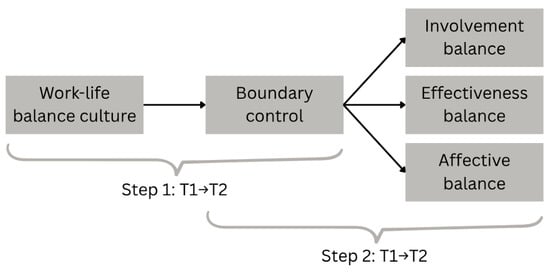
The conceptual research model is presented in Figure 1. To evaluate our first hypothesis, regarding the cross-lagged effect of WLB culture and boundary control, we compared several cross-lagged models, ranging from the fully reciprocal model (which has the fewest degrees of freedom) to the most parsimonious model. First, we estimated a full model that included all possible autoregressive and cross-lagged paths as a reference for subsequent models. Next, we tested a normal causation model, which included only the autoregressive paths and a hypothesized cross-lagged path. Following that, we examined a reversed-causation model that featured only the autoregressive paths along with a cross-lagged path that contradicted the hypothesis (i.e., boundary control --> WLB culture). Finally, we assessed an autoregressive model that excluded any cross-lagged relationships between the study variables. Model comparisons were based on global fit indices (e.g., χ2, CFI, RMSEA), which evaluate how well the hypothesized covariance structure reproduces the observed data, with nested models assessed via chi-square difference testing. According to the principle of parsimony, when competing structural models equally fit the data well, the simplest model should be selected [35].
Figure 1.
Conceptual research model.
To test H2, we utilized multigroup autoregressive cross-lagged models. More specifically, we included WLB culture and boundary control in the normal causation model, which was confirmed in the previous step. We then compared the fit indices of this model across two scenarios: when the cross-lagged effect was unconstrained and when it was constrained to 0 in the teleworkers sample. In this multigroup framework, equality constraints enable formal testing of whether specific structural paths differ across groups by comparing constrained and unconstrained models. We consider the hypothesis confirmed if the constrained path model shows better fit indices than the unconstrained model.
Finally, we tested the H3 hypothesis by incorporating boundary control and various aspects of work–life balance (WLB), specifically involvement, effectiveness, and affective WLB, into separate autoregressive cross-lagged models.
4. Results
The correlations between the study variables at both time points are presented in Table 1. As expected, almost all of the variables were significantly related. The exception was effectiveness WLB, which was related to WLB culture only cross-sectionally on Time 1. Similarly, WLB culture at Time 1 was not significantly related to later affective WLB. Not surprisingly, the strongest correlations were observed between the same variables assessed at T1 and T2 (especially WLB culture, which appears to be relatively stable) and between different WLB facets.
To test our H1 hypothesis regarding the cross-lagged effect between WLB culture and boundary control, we conducted a series of autoregressive cross-lagged models using SEM. The results presented in Table 2 showed that the normal causation model was superior to the other models (i.e., full, reversed causation, and autoregressive). All paths in this model were significant, and it had better fit indices than the reversed-causation and autoregressive models. The fit indices of the normal causation model were almost identical to those of the full model, but the latter had fewer degrees of freedom, and thus was less preferable according to the principle of parsimony [35] (Preacher, 2006). Therefore, our first hypothesis was supported.
Table 2.
Model comparison results for H1.
Next, we tested hypothesis H2, which predicted that the cross-lagged relationship between WLB culture and boundary control would be observed only among office-based employees. To do this, we compared two multigroup autoregressive cross-lagged models: unconstrained and constrained. In both models, we included a cross-lagged path from T1 WLB culture to T2 boundary control, but in the constrained model, this path was fixed to 0 among fully or partially remote employees. The fit indices (Table 3) between the models did not differ significantly, but the constrained model had more degrees of freedom, and all of its paths were significant, so it should be considered superior to the unconstrained model. Thus, our H2 was supported.
Table 3.
Model comparison results for H2.
Finally, we tested the H3 hypothesis regarding cross-lagged effects between boundary control and different facets of WLB: involvement WLB (H4), effectiveness WLB (H5), and affective WLB (H6). For this purpose, we again used autoregressive cross-lagged modeling. The path coefficients and fit indices of all tested models are presented for each hypothesis separately in Table 4, Table 5 and Table 6.
Table 4.
Model comparison results for H4.
Table 5.
Model comparison results for H5.
Table 6.
Model comparison results for H6.
In the case of Involvement WLB (Table 4), the fit indices of all the tested models were similar, and none of the cross-lagged paths were statistically significant. Therefore, and based on the principle of parsimony, we must consider the autoregressive model, according to which involvement WLB and boundary control are not longitudinally related, to be the best fit to the data. Thus, our hypothesis H4 was not confirmed.
Table 5 presents the results we obtained when testing hypothesis H5 about the relationship between the effectiveness of WLB and boundary control. The results were the opposite of what we expected. The best fit to the data was a reversed causation model, according to which T1 effectiveness WLB predicted T2 boundary control, and not vice versa. In other words, employees who felt able to function effectively in their work and personal lives at the beginning of the study were more likely to feel in control of the boundaries between their work and personal lives after 6 months. Therefore, H5 was not supported.
The results obtained when testing hypothesis H6 are presented in Table 6. In this case, the normal causation model, according to which boundary control predicts later affective WLB, but not vice versa, was the best fit to the data. Subjects who felt better able to control the boundaries between work and personal life at the beginning of the study were more satisfied with the emotions they experienced in these domains. Thus, hypothesis H6 was supported.
To sum up, the results of our study show WLB culture to be positively related to boundary control over time. Moreover, this relationship was significant only among office employees but not among teleworkers. Finally, employees who had higher boundary control had higher affective WLB six months later.
5. Discussion
The current study investigates whether and how an organizational balance culture promotes work-home boundary control and whether greater boundary control subsequently translates into work–life balance over time. We further test how these relationships differ between office-based and hybrid workers, shedding light on how work arrangements may shape the pathways through which organizations enable healthier, more sustainable working lives.
The topic of work-home interface has received increasing scholarly attention, particularly in the context of expanded flexibility and remote/hybrid work arrangements. However, beyond formal policies, it is important to understand how informal aspects, such as those reflected in organizational culture and norms, may help employees maintain functional boundaries between work and home. Our findings address this knowledge gap in several ways. First, in the current study, balance culture was found to be a positive predictor of boundary control over time. This pattern aligns with the existing literature, which shows that boundary control occurs not only due to individual preferences or skills but also relies on resources collectively available through the work environment. For instance, prior research has shown that managerial support (e.g., family-supportive supervisor behaviors) is linked to more favorable work-home outcomes [36] and that the use of work-family practices offered by the organization can shape the work-family relationship partly through boundary control [31]. Extending this evidence, our findings suggest that balance culture may function as a normative mechanism that strengthens employees’ capacity to enact boundaries in their work and home lives.
Second, our results contribute to a discussion about why work–life balance supportive strategies sometimes yield inconsistent effects. Recent literature reviews emphasize that the benefits of flexibility and organizational work–life balance policies largely depend on implementation, that is, on whether employees feel able to use organizational supports and whether the surrounding norms reinforce boundary control [7]. Balance culture can be particularly important here because it reflects the informal atmosphere in which employees interpret formal rhetoric. It thus determines whether the flexibility offered by the organization is perceived as genuine and may help translate organizational support initiatives into individual action [37]. This reasoning contributes to a better theoretical understanding of mechanisms supporting work–life balance. For instance, within the boundary theory framework, it encourages scholars and practitioners to view boundary management not only as an individual strategy but also as a meso-level (i.e., organizational) phenomenon, in which, through balance culture, the organization establishes a normative basis for boundary enactment.
Our analyses also highlight the role of work arrangements in the above relationships. After the COVID-19 outbreak and the forced shift to working from home, the work–life interface literature has understandably focused on remote and hybrid work modes, identifying both their benefits and risks. For instance, research shows that availability pressures can shape the effect of boundary management on recovery in telework [38], whereas flexibility associated with working from home can compensate for lower autonomy and reduce the negative spillover of work into private life [39]. However, such studies typically focus on teleworking samples without comparing them to on-site workers. Our findings contribute to the literature by providing a comparative perspective. Notably, we demonstrate that balance culture is particularly important for office-based workers, whereas its longitudinal effect on boundary control is weaker for hybrid workers. Such findings may be interpreted in several ways. Presumably, the hybrid work arrangement itself provides workers with more discretion (e.g., through autonomy over working time and location or less face-to-face work monitoring), which, at the same time, supports boundary control. In other words, the very possibility of hybrid work may reflect a job design that supports balance, and therefore, employees need to rely less on organizational culture cues. By contrast, for office-based workers, boundary management may depend more on expectations of availability and the organization’s responsiveness to their needs. In such a case, balance culture becomes the primary guide for whether, and to what extent, boundary control is possible. From a theoretical perspective, this suggests an interesting mechanism whereby structural aspects of work organization (such as hybrid work) may partly compensate for the psychosocial support for work–life balance, and vice versa.
However, we should not dismiss an alternative interpretation of the observed differences between hybrid and office-based workers linked to a selection effect. It is possible that those who use hybrid work arrangements are already in a somewhat more favorable work situation than those who do not have that option. Earlier studies suggest that telework is unequally distributed, with it more common among highly educated, white-collar, and better-paid employees [40,41,42]. A better position in the labor market may already provide workers with higher autonomy, more flexibility, and a better fit with their individual needs or boundary preferences. Therefore, it should be noted that, in addition to directly affecting boundary control, hybrid work may also reflect pre-existing differences between workers who do and do not have access to such working arrangements. Future research should test these mechanisms in more detail.
Finally, contrary to our expectations, we did not find strong support for the assumption that boundary control would be associated with higher work–life balance over time. Of the three tested aspects, only affective balance (but not involvement or effectiveness balance) was longitudinally predicted by boundary control. Prior empirical evidence generally supports the view that boundary control is an important factor in promoting better work–life outcomes, including work–life balance and related indicators of well-being [7,31,43]. Yet, our findings highlight the importance of differentiating these outcomes. As suggested by Wayne et al. [20], different aspects of work-nonwork balance may have distinct antecedents, and our study at least partly supports this claim. Specifically, affective balance refers to “feeling good” about one’s work and nonwork lives and may be considered the most proximal outcome of being able to control boundaries across domains. When workers feel they can decide for themselves to what extent work can spill into their home lives (and vice versa), this is likely to lead to a more positive emotional evaluation of the overall situation. However, engagement and effectiveness of WLB may require additional favorable conditions (such as energy, time, partner or supervisor support, compatible work and home demands, etc.). It is therefore possible that while boundary control is a first step towards improving felt balance, it does not necessarily guarantee balanced functioning across domains. This calls for more research on the multidimensionality of work–life balance to better understand how healthier working lives can be promoted over time. Future studies could also explore whether the balance among affective, involvement, and effectiveness unfolds in a specific sequence. It may simply take more time or additional skill to become equally effective and involved in both domains. This assumption aligns with recent work suggesting that work-nonwork balance outcomes are multidimensional and cannot be reduced to a single experience, as their facets may relate differently to antecedents and outcomes [20,44]. More sophisticated longitudinal designs, ideally with more than two waves, would be needed to test whether these aspects of balance indeed develop in a temporal sequence and under what conditions boundary control may extend beyond affective balance.
5.1. Study Limitations and Future Directions
The findings of the present study should be interpreted in light of several methodological considerations. First, although the dropout analysis generally did not indicate systematic attrition, a statistically significant difference was observed in work arrangement: participants who discontinued participation were somewhat more likely to work exclusively on-site. While this difference was modest, it may have affected the composition of groups used in the multigroup analyses for H2. At the same time, given that most other differences were non-significant, the overall risk of substantial bias appears limited.
Second, the two-wave longitudinal design provides a useful basis for examining temporal associations, yet it also entails limitations. Although autoregressive cross-lagged models allow for testing directional hypotheses, two measurement occasions do not permit a more fine-grained assessment of developmental trajectories or stronger causal inference. Future studies employing three or more waves could further strengthen conclusions by capturing more complex temporal dynamics.
Third, the structural equation models did not include additional control variables that might act as confounders. Factors such as age, gender, number of children, job position, or work schedule may be associated with both work–life balance and boundary management, particularly in hybrid work contexts. While the use of a longitudinal design and autoregressive controls partially mitigates this concern, incorporating such variables in future research would provide a more comprehensive understanding of the observed relationships.
Finally, the relatively high autoregressive coefficients (β ≈ 0.77–0.83) indicate that the constructs under study are quite stable over time. Although this stability supports the reliability of the measures, it also leaves less variance to be explained by cross-lagged effects, potentially leading to more conservative estimates of these relationships. It is noteworthy that the time interval between measurements was chosen rather arbitrarily. Since the size of the autoregressive effect depends on both the stability of the phenomena and the elapsed time, a longer time interval would be valuable in future studies, allowing for a more long-term assessment of the mutual effect of the variables.
5.2. Practical Implications
The results of our study offer meaningful insights that can be effectively utilized in practical applications. First, the results of our study show the importance of a work–life balance culture. Organizations can support a work–life balance culture by implementing flexible working arrangements, limiting excessive working hours, and fostering supportive leadership. The latter measures would be especially important for office-based workers, as for them, stronger organizational support is related to higher boundary control.
Second, while work–life balance policies have become a central element of organizational and public policies [45,46], one way to implement policies related to a work–life balance culture is through managerial support, which has been shown to be an effective strategy for achieving WLB through various mechanisms [47]. Managers should enhance their awareness of their role as role models for their employees. They must approach the topic of work–life balance with care and demonstrate that they regard it as significant. One effective way to achieve this is by regularly meeting with employees to discuss their work–life balance needs. Such initiatives can serve as an initial step toward enhancing boundary control and promoting work–life balance.
Second, according to our study, work–life balance, or at least certain types of it, is related to employees’ beliefs about their ability to maintain boundaries between professional and personal life. The boundaries between work and life are influenced by specific habits [48]; thus, employees ought to consider their daily practices, whether at work or during leisure time, and assess whether those habits help or hinder the establishment and maintenance of boundaries between their professional and personal lives.
Finally, managers and human resources staff should analyze the types of employee behaviors that are recognized and promoted within the organization to ensure work–life balance.
Author Contributions
Conceptualization, R.J., J.L.-Z., I.U., and A.Ž.; methodology, A.Ž.; formal analysis, A.Ž.; investigation, R.J., J.L.-Z., A.Ž., and J.M.; data curation, J.L.-Z. and A.Ž.; writing—original draft preparation, A.Ž., J.L.-Z., and I.U.; writing—review and editing, R.J., J.L.-Z., A.Ž., I.U., and J.M.; visualization, R.J.; supervision, J.L.-Z., and A.Ž.; project administration, J.L.-Z.; funding acquisition, J.L.-Z. All authors have read and agreed to the published version of the manuscript.
Funding
This research was funded by a grant (No. S-MIP-23-11) from the Research Council of Lithuania.
Institutional Review Board Statement
Ethical review and approval were waived for this study by the Institutional Committee due to Legal Regulations (https://www.e-tar.lt/rs/actualedition/2c05c6603d4011ec992fe4cdfceb5666/yFgWpOSkij/format/OO3_ODT/, accessed on 25 October 2026), as the approval of an institutional review board is not required for the type of research conducted in this study.
Informed Consent Statement
Informed consent was obtained from all subjects involved in the study.
Data Availability Statement
The raw data supporting the conclusions of this article will be made available by the authors on request.
Conflicts of Interest
The authors declare that they have no conflicts of interest. The funders had no role in the design of the study, in the collection, analysis, or interpretation of data, in the writing of the manuscript, or in the decision to publish the results.
Abbreviations
The following abbreviations are used in this manuscript:
| WLB | Work–Life Balance |
Appendix A
Table A1.
Model fit indices for the T1 confirmatory factor analysis (measurement) models.
Table A2.
Model fit indices for the longitudinal measurement invariance models.
Table A3.
Model fit indices for the multigroup longitudinal measurement invariance models.
References
- Kossek, E.E.; Valcour, M.; Lirio, P. Organizational strategies for promoting work–life balance and wellbeing. In Work and Wellbeing: A Complete Reference Guide; Peter, Y.C., Carry, L.C., Eds.; John Wiley & Sons, Ltd.: West Sussex, UK, 2014; Volume 3, pp. 295–319. [Google Scholar]
- European Commission. EU Strategic Framework on Health and Safety at Work 2021–2027. Available online: https://eur-lex.europa.eu/legal-content/EN/ALL/?uri=CELEX:52021DC0323 (accessed on 20 February 2026).
- Lee, B.; Kim, J. Is family-friendly management good for firms? The diffusion and performance of family-friendly workplaces in South Korea. J. Ind. Relat. 2010, 52, 459–475. [Google Scholar] [CrossRef] [Scilit]
- Kelly, E.L.; Kossek, E.E.; Hammer, L.B.; Durham, M.; Bray, J.; Chermack, K.; Murphy, L.A.; Kaskubar, D. Getting there from here: Research on the effects of work–family initiatives on work–family conflict and business outcomes. Acad. Manag. Ann. 2008, 2, 305–349. [Google Scholar] [CrossRef]
- Thompson, C.A.; Beauvais, L.L.; Lyness, K.S. When work–family benefits are not enough: The influence of work–family culture on benefit utilization, organizational attachment, and work–family conflict. J. Vocat. Behav. 1999, 54, 392–415. [Google Scholar] [CrossRef] [Scilit]
- van Steenbergen, E.F.; Ellemers, N. Is managing the work-family interface worthwhile? Benefits for employee health and performance. J. Organ. Behav. 2009, 30, 617–642. [Google Scholar] [CrossRef] [Scilit]
- Kossek, E.E.; Perrigino, M.B.; Lautsch, B.A. Work-life flexibility policies from a boundary control and implementation perspective: A review and research framework. J. Manag. 2023, 49, 2062–2108. [Google Scholar] [CrossRef] [Scilit]
- Weale, V.; Oakman, J.; Wells, Y. Can organisational work–life policies improve work–life interaction? A scoping review. Aust. Psychol. 2020, 55, 425–439. [Google Scholar] [CrossRef] [Scilit]
- Brown, H.; Kim, J.; Faerman, S. The influence of societal and organizational culture on the use of work-life balance programs: A comparative analysis of the United States and the Republic of Korea. Soc. Sci. J. 2020, 58, 62–76. [Google Scholar] [CrossRef] [Scilit]
- McDonald, P.; Pini, B.; Bradley, L. Freedom or fallout in local government? How work–life culture impacts employees using flexible work practices. Int. J. Hum. Resour. Manag. 2007, 18, 602–622. [Google Scholar] [CrossRef] [Scilit]
- Kossek, E.E.; Lautsch, B.A. Work–family boundary management styles in organizations: A cross-level model: A cross-level model. Organ. Psychol. Rev. 2012, 2, 152–171. [Google Scholar] [CrossRef] [Scilit]
- Park, Y.; Jex, S.M. Work-home boundary management using communication and information technology. Int. J. Stress Manag. 2011, 18, 133–152. [Google Scholar] [CrossRef] [Scilit]
- Cook, P.; Sawhney, G. Boundary Control and Work-Life Balance: The Mediating Role of Interruptions and Moderating Effect of an Office Space. J. Career Assess. 2025, 33, 10690727251344611. [Google Scholar] [CrossRef] [Scilit]
- Ashforth, B.E.; Kreiner, G.E.; Fugate, M. All in a Day’s Work: Boundaries and Micro Role Transitions. Acad. Manag. Rev. 2000, 25, 472–491. [Google Scholar] [CrossRef] [Scilit]
- Clark, S.C. Work/Family Border Theory: A New Theory of Work/Family Balance. Hum. Relat. 2000, 53, 747–770. [Google Scholar] [CrossRef] [Scilit]
- Rothbard, N.P.; Phillips, K.W.; Dumas, T.L. Managing Multiple Roles: Work-Family Policies and Individuals’ Desires for Segmentation. Organ. Sci. 2005, 16, 243–258. [Google Scholar] [CrossRef] [Scilit]
- Chung, H. National family policies and the association between flexible working arrangements and work-to-family conflict across Europe. J. Fam. Res. 2024, 36, 229–249. [Google Scholar] [CrossRef] [Scilit]
- Foucreault, A.; Ollier-Malaterre, A.; Ménard, J. Organizational culture and work–life integration: A barrier to employees’ respite? J. Hum. Resour. Manag. 2018, 29, 2378–2398. [Google Scholar] [CrossRef] [Scilit]
- Allen, T.D.; French, K.A. Work-family research: A review and next steps. Pers. Psychol. 2023, 76, 437–471. [Google Scholar] [CrossRef] [Scilit]
- Wayne, J.H.; Vaziri, H.; Casper, W.J. Work-nonwork balance: Development and validation of a global and multidimensional measure. J. Vocat. Behav. 2021, 127, 103565. [Google Scholar] [CrossRef] [Scilit]
- Schein, E.H. Organizational Culture and Leadership, 4th ed.; Jossey-Bass: San Francisco, CA, USA, 2010. [Google Scholar]
- Nitzsche, A.; Jung, J.; Kowalski, C.; Pfaff, H. Validation of the Work-Life Balance CultureScale (WLBCS). Work A J. Prev. Assess. Rehabil. 2014, 49, 133–142. [Google Scholar] [CrossRef] [Scilit]
- Casper, W.; Hyde, S.; Smith, S.; Amirkamali, F.; Wayne, J. How Effective Are Work-Life Balance Policies? The Importance of Inclusion. Annu. Rev. Organ. Psychol. Organ. Behav. 2024, 12, 73–108. [Google Scholar] [CrossRef] [Scilit]
- Geraldes, D.; Chambel, M.J.; Carvalho, V.S. Supervisor Support and Work-Family Practices: A Systematic Review. Societies 2024, 14, 272. [Google Scholar] [CrossRef] [Scilit]
- Kossek, E.E.; Lautsch, B.A.; Eaton, S.C. Telecommuting, control, and boundary management: Correlates of policy use and practice, job control, and work-family effectiveness. J. Vocat. Behav. 2006, 68, 347–367. [Google Scholar] [CrossRef] [Scilit]
- Kreiner, G.E. Consequences of Work-Home Segmentation or Integration: A Person-Environment Fit Perspective. J. Organ. Behav. 2006, 27, 485–507. [Google Scholar] [CrossRef] [Scilit]
- Allen, T.D.; Cho, E.; Meier, L.L. Work–family boundary dynamics. Annu. Rev. Organ. Psychol. Organ. Behav. 2014, 1, 99–121. [Google Scholar] [CrossRef] [Scilit]
- Laß, I.; Wooden, M. Weekend work and work–family conflict: Evidence from Australian panel data. J. Marriage Fam. 2022, 84, 250–272. [Google Scholar] [CrossRef] [Scilit]
- Casper, W.J.; Vaziri, H.; Wayne, J.H.; DeHauw, S.; Greenhaus, J. The jingle-jangle of work–nonwork balance: A comprehensive and meta-analytic review of its meaning and measurement. J. Appl. Psychol. 2018, 103, 182–214. [Google Scholar] [CrossRef] [Scilit]
- Kossek, E.; Ruderman, M.; Braddy, P.; Hannum, K. Work-nonwork boundary management profiles: A person-centered approach. J. Vocat. Behav. 2012, 81, 112–128. [Google Scholar] [CrossRef] [Scilit]
- Geraldes, D.; Chambel, M.; Carvalho, V. Work-family practices and work-family relationship: The role of boundary management. BMC Public Health 2025, 25, 1343. [Google Scholar] [CrossRef] [Scilit]
- Mellner, C.; Peters, P.; Dragt, M.; Toivanen, S. Predicting Work-Life Conflict: Types and Levels of Enacted and Preferred Work-Nonwork Boundary (In)Congruence and Perceived Boundary Control. Front. Psychol. 2021, 12, 772537. [Google Scholar] [CrossRef] [Scilit] [PubMed]
- Putnick, D.L.; Bornstein, M.H. Measurement invariance conventions and reporting: The state of the art and future directions for psychological research. Dev. Rev. 2016, 41, 71–90. [Google Scholar] [CrossRef] [Scilit] [PubMed]
- Chen, F.F. Sensitivity of goodness of fit indexes to lack of measurement invariance. Struct. Equ. Model. 2007, 14, 464–504. [Google Scholar] [CrossRef] [Scilit]
- Preacher, K.J.; Curran, P.J.; Bauer, D.J. Computational tools for probing interactions in multiple linear regression, multilevel modeling, and latent curve analysis. J. Educ. Behav. Stat. 2006, 31, 437–448. [Google Scholar] [CrossRef] [Scilit]
- Carvalho, V.S.; Imam, H.; Chambel, M.J.; Santos, M. Family supportive supervisor behavior and work-family boundary control in teleworkers during a lockdown: Portugal and Pakistan comparison. Front. Psychol. 2022, 13, 1008992. [Google Scholar] [CrossRef] [Scilit] [PubMed]
- Allen, T.D. Family-supportive work environments: The role of organizational perceptions. J. Vocat. Behav. 2001, 58, 414–435. [Google Scholar] [CrossRef] [Scilit]
- Haun, V.C.; Remmel, C.; Haun, S. Boundary management and recovery when working from home: The moderating roles of segmentation preference and availability demands. Ger. J. Hum. Resour. Manag. 2022, 36, 270–299. [Google Scholar] [CrossRef] [Scilit]
- Baum, L.; Rau, R. Balancing work and private life: When does workplace flexibility really help? New insights into the interaction effect of working from home and job autonomy. Front. Psychol. 2024, 2, 1271726. [Google Scholar] [CrossRef] [Scilit]
- Baruffini, M.; Rossi, F. Who was more likely to work from home during the COVID-19 pandemic? A gender perspective in Switzerland. Reg. Stud. Reg. Sci. 2024, 11, 236–254. [Google Scholar] [CrossRef] [Scilit]
- Cetrulo, A.; Guarascio, D.; Virgillito, M.E. Working from home and the explosion of enduring divides: Income, employment and safety risks. Econ. Polit. 2022, 39, 345–402. [Google Scholar] [CrossRef] [Scilit]
- Holgersen, H.; Jia, Z.; Svenkerud, S. Who and how many can work from home? Evidence from task descriptions. J. Labour Mark. Res. 2021, 55, 4. [Google Scholar] [CrossRef] [Scilit]
- Boccoli, G.; Tims, M.; Gastaldi, L.; Corso, M. The psychological experience of flexibility in the workplace: How psychological job control and boundary control profiles relate to the wellbeing of flexible workers. J. Vocat. Behav. 2024, 155, 104059. [Google Scholar] [CrossRef] [Scilit]
- Hildenbrand, K.; Daher, P.; Topakas, A.; Gan, X. Multidimensional work-nonwork balance: Are balanced employees productive at work and satisfied with life? Int. J. Hum. Resour. Manag. 2024, 35, 1048–1087. [Google Scholar] [CrossRef] [Scilit]
- Eurofound. Striking a Balance: Reconciling Work and Life in the EU; Publications Office of the European Union: Luxembourg, 2013; Available online: https://assets.eurofound.europa.eu/f/279033/14c6fad29b/ef18065en.pdf (accessed on 25 February 2026).
- International Labour Organization. Working Time and Work–Life Balance Around the World. Available online: https://www.ilo.org/global/publications/books/WCMS_864222/lang--en/index.htm (accessed on 23 February 2026).
- Clark, M.A.; Rudolph, C.W.; Zhdanova, L.; Michel, J.S.; Baltes, B.B. Organizational Support Factors and Work–Family Outcomes: Exploring Gender Differences. J. Fam. Issues 2015, 38, 1520–1545. [Google Scholar] [CrossRef] [Scilit]
- Rosengren, C.; Bäcklander, G.; Palm, K. Daily Habits and Work-life Boundary Control: Telework in the Era of COVID-19. Nord. J. Work. Life Stud. 2024, 14, 146338. [Google Scholar] [CrossRef] [Scilit]

Disclaimer/Publisher’s Note: The statements, opinions and data contained in all publications are solely those of the individual author(s) and contributor(s) and not of MDPI and/or the editor(s). MDPI and/or the editor(s) disclaim responsibility for any injury to people or property resulting from any ideas, methods, instructions or products referred to in the content. |
© 2026 by the authors. Licensee MDPI, Basel, Switzerland. This article is an open access article distributed under the terms and conditions of the Creative Commons Attribution (CC BY) license.