


Abstract
In light of China’s dual national strategies of Healthy China and the Big Food View, this study examines the relationship between digital inclusive finance and residents’ dietary nutrition, with a focus on healthier and more sustainable dietary patterns. Using panel data from 31 Chinese provinces over the period 2015–2022, we employ a two-way fixed effects model to evaluate how digital inclusive finance is associated with food intake diversity and dietary structure balance. The empirical findings show that digital inclusive finance is positively associated with increased consumption of both plant-based foods (e.g., cereals) and animal-based foods (e.g., meat, milk and aquatic products), contributing to improved dietary structure balance. These findings remain robust after addressing potential endogeneity concerns and conducting a series of multiple robustness checks. Further heterogeneity analysis indicates that the depth of use and degree of digitization are significantly associated with dietary quality, while the breadth of coverage shows no significant effect. Moreover, the positive associations are more pronounced among rural residents, upper-middle income groups, and households with lower levels of human capital, groups with high e-commerce development and high levels of digitalization. These findings highlight the potential role of digital inclusive finance as a policy tool for promoting healthier and more sustainable dietary patterns, particularly among disadvantaged populations in rural China.
1. Introduction
As an important component of human capital, health is an essential requirement for improving living standards, safeguarding national security and social stability, and achieving a moderately affluent society [1,2]. In 2017, General Secretary Jinping Xi announced the implementation the ‘Healthy China’ strategy in his report to the 19th National Congress, elevating the maintenance of people’s health to the level of a national strategy. The Outline of the ‘Healthy China 2030’ Plan, released and implemented in October of that year, emphasized the need to popularize knowledge of diet and nutrition, and advocated scientific and reasonable dietary structures, encouraged healthy eating habits and improved the physical health of the Chinese population. Furthermore, the 20th Party Congress report proposes the establishment of a comprehensive food concept. From the perspective of meeting people’s growing needs for a better life, it encourages consumers to optimize and adjust the structure of their food consumption according to nutritional and health needs. This involves increasing the intake of various foods, such as fruit, vegetables, aquatic products and dairy products, to improve dietary quality and nutritional health [3]. Clearly, paying attention to structural changes in residents’ food consumption and improving the balance of dietary structure is an urgent issue at this stage of national economic development.
Adopting healthy and rational dietary patterns can reduce the incidence of cardiovascular and chronic diseases such as hypertension [4]. Studies have shown that a healthy diet consists of a variety of plant-based foods such as nuts, fruits, vegetables, and legumes, as well as a limited amount of animal products containing unsaturated fats, and a small intake of refined grains, highly processed foods, and added sugars [5]. According to the Food and Agriculture Organization of the United Nations (FAO), China has achieved remarkable results in reducing hunger and undernutrition, among other achievements, and the quality of diets has improved significantly [6]. However, compared with the recommended food intake of reasonable dietary patterns in the 2022 Dietary Guidelines for Chinese Residents, Chinese residents consume too many cereals, especially refined cereals, and too much meat, while their intake of fruits, vegetables, aquatic products, and dairy products is insufficient [7,8]. The national diet still faces new structural imbalances and nutritional deficiencies [9]. Therefore, exploring the new dynamics driving the improvement of the nutritional balance of the national diet is becoming an important issue of concern to the academic community.
Digital inclusive finance is a new financial model that uses digital technology and financial innovation to provide more convenient financial services to a wider range of people. On the one hand, the development of digital inclusive finance can effectively alleviate liquidity constraints and provide financial support for the ‘long-tail population’ excluded by traditional financial institutions. It can also reduce the budget constraints on food consumption [10,11]. On the other hand, the development of digital inclusive finance has led to the creation of mobile payment methods. It has also increased the popularity of mobile payments, improving the convenience for residents and effectively extending the food consumption scene [12]. Residents can purchase food via online e-commerce platforms and offline mobile payments, significantly improving their participation efficiency in the food consumption market. The development of digital inclusive finance is therefore expected to empower sustainable and healthy dietary enhancement, although its effectiveness still requires systematic theoretical and empirical analysis.
From the existing literature, it is clear that the current academic focus is primarily on the impact of risk preferences and financial services on household food consumption decisions [13]. For instance, traditional financial services such as credit, insurance, savings, and payments have been shown to influence residents’ food consumption behavior [14,15,16,17,18]. Beyond conventional financial services, recent studies have increasingly examined the role of digital inclusive finance in shaping dietary outcomes. Using provincial data from China, Lin et al. show that digital inclusive finance is positively associated with food security, supporting more stable and diversified dietary patterns [19]. Tan et al. further find that digital inclusive finance improves multiple aspects of food security, including availability, accessibility, and utilization [20]. At the household level, Awaluddin et al. report that digital financial literacy and the use of digital finance applications influence consumption choices, including food expenditures [21]. Additionally, Tian et al. provide evidence that digital inclusive finance is associated with better health outcomes, indirectly supporting its role in improving nutrition [22].
However, few studies have directly examined the link between digital inclusive finance and the dietary structure or nutrient intake of residents, which motivates the present study to explore how digital inclusive finance is associated with dietary diversity and dietary structure balance among Chinese residents. Based on this, using the panel data from 31 provinces over the period 2015–2022, a time–individual fixed effects model is employed to analyze its effects on dietary nutrition. This paper has two main contributions: (1) it links digital inclusive finance to dietary structure and nutritional outcomes, extending traditional financial inclusion theory; (2) it highlights the unique role of digital finance (depth of use, coverage, and digitization) beyond conventional financial services. In addition, the rationale for conducting this analysis in the Chinese context is as follows: China provides a particularly relevant case due to its rapid digital financial development, widespread mobile payment adoption, and ongoing national strategies such as Healthy China and the Big Food View, which create a natural context to study the intersection of digital finance and nutrition.
2. Theoretical Analysis and Research Hypotheses
In theory, the development of digital inclusive finance affects changes in residents’ food consumption through two primary channels, which can be further grounded in established economic theories.
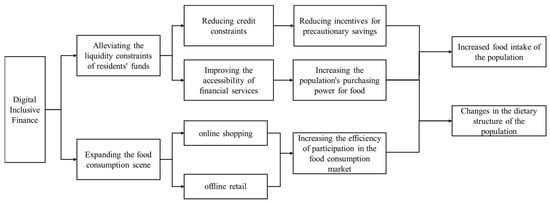
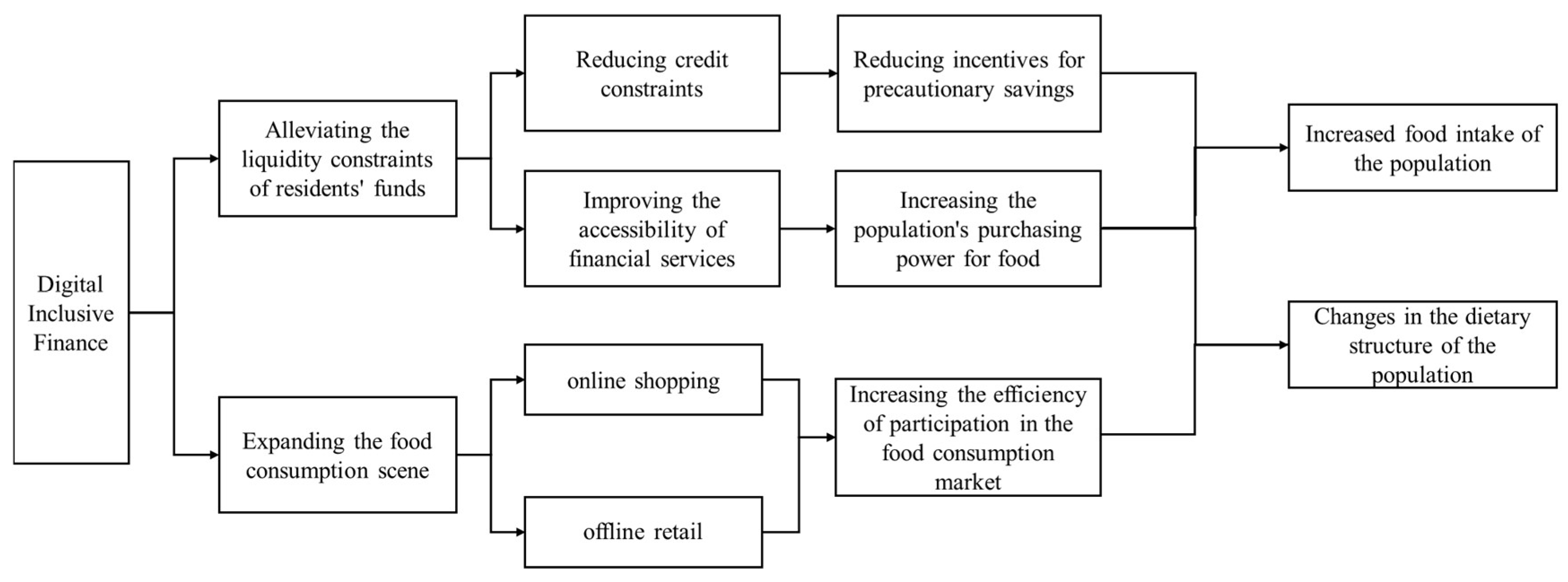
First, digital inclusive finance alleviates liquidity constraints by expanding the coverage, availability and accessibility of financial services [23]. The rapid development of mobile payments, internet credit, and other industry forms provides residents, especially those in rural and low-income groups, with more convenient access to financial resources. From the perspective of consumer demand theory, this relaxation of budget enables households to shift from subsistence-oriented consumption toward more diverse and higher-quality diets. Meanwhile, household consumption smoothing theory suggests that improved access to financial services helps households cope with income volatility, reduces precautionary savings motives, and stabilizes food consumption, thereby contributing to improved dietary balance.
Second, digital inclusive finance extends residents’ food consumption scenarios by facilitating online purchasing and integrating online and offline markets. This reduces transaction costs and improvs households’ participation efficiency in both local and non-local food markets. From a behavioral economics perspective, digital payment technologies lower transaction frictions and the “pain of paying” while digital platforms enhance information access and reshape consumption decisions, thereby promoting dietary diversification.
Based on these mechanisms, this paper constructs a theoretical analysis framework linking digital inclusive finance to the changes in residents’ dietary intake and dietary balance, as illustrated in Figure 1.
Figure 1.
A theoretical framework for exploring the impact of digital inclusion on residents’ dietary nutrition.
2.1. Alleviating the Financial Liquidity Constraints on Residents’ Food Consumption
From a practical point of view, traditional financial institutions incur significant capital costs during the setup process. At the same time, information asymmetry between the two sides of the credit market makes it difficult for financial institutions to assess borrowers’ creditworthiness and repayment ability effectively. This increases financial constraints for residents in traditional financial scenarios. Remote areas and low-income populations, with their limited ability to pay and credit conditions, often find it difficult to access formal financial services. To prevent future risks due to unforeseen events, they choose to save a portion of their income. This excludes them from traditional financial services and causes strong financial liquidity constraints during long-term development [24]. Studies have shown that financial constraints can significantly inhibit household consumption [25]. Financial liquidity constraints can significantly impact residents’ food consumption, negatively affecting their dietary structure [26].
In this context, the development of digital inclusive finance can significantly alleviate residents’ liquidity constraints and thus improve their food consumption budgets. On the one hand, digital inclusive finance has changed the credit assessment methods of traditional finance, using residents’ daily online shopping and social network information as the basis for credit ratings and the provision of internet financial products, loan services and other services. At the same time, it grants users different levels of consumption quotas, relying on Ant Credit Pay, Jing Dong Baitiao and other accounts associated with consumer credit functions. This rapidly increases residents’ current disposable income, thus stimulating food consumption [27].
At the same time, the ‘buy now, pay later’ consumption mode matches consumption demand with purchasing power. This effectively reduces liquidity constraints [28] and releases consumption potential constrained by financial liquidity. It also increases household food expenditure [29]. According to Maslow’s hierarchy of needs theory, food is one of the most basic and important components of residents’ consumption and tends to be characterized by high demand and potential. As residents’ consumption expenditure increases, the purchasing power of food rises, and it becomes possible to satisfy the demand for more nutritious, healthier and safer food by increasing expenditure on food in the first place [30].
On the other hand, digital inclusive finance is a new form of financial service that improves the access to internet financial services [31]. It enhances residents’ ability to avoid risk and optimize resource allocation, while reducing the incentive for precautionary savings in the face of uncertainty [32]. Studies have shown that some low-income groups are often limited by factors such as wages, income and consumption budgets. These groups tend to consume less animal food, particularly low-quality meat such as meat, eggs and shrimp, and more cereals [33]. According to the current trend of changes in the dietary patterns of Chinese residents, and in the context of digital inclusive finance empowering the food consumption market, it can be seen that residents may tend to increase their consumption of more nutritious animal-based foods. This will lead to changes in the balance of the dietary structure [34].
2.2. Expanding the Scene of Residents’ Food Consumption
Due to its convenience and accessibility, mobile payment promotes the use of basic financial services and is the optimal channel for the development of digital inclusive finance [35]. Mobile payments combine financial institutions, mobile terminals, and the internet to provide residents with a new online and offline payment method, offering a different consumption experience [28].
Firstly, consumer transaction data from e-commerce platforms can be processed using internet technology to accurately match consumer preferences. The system can then filter out the goods that consumers want to buy, providing accurate recommendations and greatly reducing consumers’ search costs [36]. Studies have shown that the demand for food information remains high in China and that expanding food information sources and improving information credibility can effectively boost residents’ food consumption potential [37]. At the same time, accurate delivery makes it more convenient for consumers to access a variety of food information, which can increase consumers’ demand for more nutritious food and encourage healthier eating habits [38].
Secondly, mobile payments can overcome the limitations of traditional shopping methods in terms of time and space. On the one hand, residents can purchase food without leaving home via online shopping platforms such as Jing Dong and Taobao. This effectively solves the problem of the insufficient development of local markets caused by food resource endowment [39]. On the other hand, fresh food e-commerce platforms promote the effective matching of agricultural product supply and demand, enhancing sales efficiency [40]. At the same time, micro-payments, particularly in the context of small P2B consumption scenarios in residents’ daily lives, reduce the need for physical money and eliminate the risk of consumption being affected by not carrying enough cash [41]. However, it should be noted that consumers are currently reluctant to migrate from offline to online channels for fresh produce such as meat, eggs, vegetables and fish [42], and offline retailing still dominates this sector. Nevertheless, mobile payments play a significant role in enabling residents to purchase food via offline retail methods [43]. Thus, innovative payment methods based on digital inclusive finance could increase residents’ intake of energy, protein and fat, shifting the main sources of these nutrients from plant-based to a combination of plant- and animal-based foods [44]. This could lead to changes in residents’ dietary structure.
Finally, the low transparency and connectivity of mobile payments makes consumers less sensitive to the transaction price of digitized payments. This significantly reduces the psychological pain of monetary payments and contributes to faster consumption decisions [45]. However, while e-commerce platforms have broadened consumers’ food consumption markets and increased online food purchasing behaviors among residents [39], they have also led to an increase in the impulsive consumption of unhealthy food products, such as high-calorie and high-fat items [18,46]. This has resulted in an imbalance.
In summary, the development of digital inclusive finance primarily affects the food consumption market. It does this by alleviating residents’ financial liquidity constraints and extending food consumption scenarios. This leads to changes in the equilibrium of dietary structure. Based on this, the following hypotheses are put forward in this paper:
Hypothesis H1.
Digital inclusive finance is positively associated with residents’ food intake, with a stronger association observed for animal-based foods than for plant-based foods.
Hypothesis H2.
Digital inclusive finance is positively associated with the improvements in the balance of residents’ dietary structure.
3. Materials and Methods
3.1. Regression Model
This paper establishes a baseline regression model to identify the relationship between digital inclusive finance and residents’ dietary nutrition. The model considers the attributes of food intake and dietary structure balance variables, and is set up as follows:
In Equation (1), represents the level of nutrition in residents’ diets, which is quantified in terms of the absolute amount and structural balance. The absolute amount of intake is characterized by the intake of different types of plant foods and animal foods in the households, and the balance of dietary structure is characterized by the dietary structure index [47]. represents the level of development of digital inclusive finance; represents other control variables, including the level of economic development, income, education, etc., represents the random perturbation variables.
It should be noted that a balanced dietary structure should keep food consumption within a reasonable range while also guaranteeing diversity in food intake. Based on this, this paper refers to the balanced dietary pattern recommended in the 2022 Dietary Guidelines for Chinese Residents and selects eight food groups: cereals; vegetables and edible mushrooms; fruits and melons; edible vegetable oils; poultry and meat; aquatic products; eggs and milk. These are classified as either plant foods (including cereals, vegetables, fruits, and edible vegetable oils) or animal foods (including meat, eggs, aquatic products, and milk). These two major categories are used to analyze the absolute level of dietary intake of the residents [48,49].
In addition, following the approaches used in relevant studies [50,51], we constructed a dietary structure index encompassing three dimensions, including overall dietary structure, animal-based foods, and plant-based foods, to assess residents’ dietary balance. Considering the multi-indicator and dynamic evaluation characteristics of the dietary structure index, and avoiding the subjective weighting biases associated with methods such as the Analytic Hierarchy Process or Principal Component Analysis, The calculation steps are as follows:
- Indicator weighting. the entropy-based weights are assigned to the vector matrix , thereby constructing the weighted normalized matrix , where , represents the weighted indicator value. denotes the standardized value of the indicator; is the weight determined by the entropy weight method.
- The positive ideal solution and the negative ideal solution are determined. In this study, the positive ideal solution is defined as the maximum value of each indicator after the first calculation step, while the negative ideal solution is the minimum value. That is, the positive ideal solution and the negative ideal solution respectively are and , where and represent the research units and research indicators, respectively.
- The Dietary Structure Index (DSI) of Chinese residents is calculated. Based on the positive and negative ideal solutions for each indicator, the Euclidean distance formulas in Equations (2) and (3) are used to compute the distances and between each alternative and the positive and negative ideal solutions, respectively. The relative closeness of each alternative to the positive ideal solution is then calculated.
The Equation for calculating the Euclidean distance is as follows:
In essence, as Dietary Structure Index (DSI) approaches 1, it indicates that residents’ food intake closely aligns with the balanced dietary pattern recommended in the dietary guidelines, reflecting a more balanced dietary structure. Conversely, as the DSI approaches 0, residents’ intake of various food categories significantly deviates from the recommended pattern, indicating a less balanced dietary structure.
3.2. Variable Definitions and Descriptive Statistics
Dependent variables. This paper examines the impact of the development of digital inclusive finance on residents’ dietary nutrition. Following the recommendations of the Chinese Dietary Guidelines (2016) and prior empirical studies [50,51], the study focuses on household per capita consumption of four types of plant-based food (cereals, vegetables, fruits, oil) and four types of animal-based food (meat, aquatic products, eggs, milk), which together capture both the quantity and nutritional quality of dietary intake. The per capita consumption of eight types of food across households in 31 provinces of China is used to represent absolute dietary intake [50]. To capture the balance of dietary structure, we calculate a dietary structure index using the entropy weighting method, which assigns weights to food categories based on consumption variability and has been widely applied to measure dietary diversity and balance [47,51].
Independent variables. In this paper, digital inclusive finance is measured using the Peking University Digital inclusive finance Index of China (PKU-DFIIC). This index captures the development of digital financial services at the provincial level and has been widely adopted in empirical studies [52,53,54]. The index includes three dimensions: breadth of coverage, depth of use, and degree of digitization, which respectively reflect the accessibility, usage intensity, and digitalization level of financial services. These sub-indices are constructed from multiple indicators and aggregated using standardized methods [55]. A higher value indicates a higher level of digital inclusive finance. Furthermore, to ensure comparability across variables with different magnitudes, the original digital inclusive finance and its sub-dimension indices by 100 [56]. Meanwhile, to mitigate the effects of multicollinearity, the independent variables were standardized by subtracting their means (mean-centering).
Controlled variables. In order to further control other interfering factors affecting residents’ dietary nutrition and identify the impact of the development of digital inclusive finance on residents’ food intake and dietary structure balance, this paper incorporates following into the baseline model: Economic Development Index, the level of education, the level of urbanization, the degree of openness, and the infrastructure conditions. These factors are drawn from relevant studies [34,57,58,59,60]. To mitigate multicollinearity and comprehensively capture regional economic conditions, this study combines per capita income and per capita GDP into a composite indicator, termed EDI. The DEI is then constructed as the first principal component derived from principal component analysis (PCA). This approach reduces multicollinearity while providing a more holistic measure of regional economic development [61,62]. The level of education is measured by the per capita number of years of education (years) of each province. The level of urbanization is measured by the proportion of the population residing in urban areas to the total population. The degree of openness is measured by the proportion of the total import and export trade in each province’s GDP. The infrastructure conditions are measured by cargo turnover (billion tones/km) in each province.
Instrumental variables. In order to resolve the endogeneity problem that may result from omitted variables and reverse causality, this paper employs the one-period lag of Digital Inclusive Finance as an instrumental variable. The relevance condition is satisfied because the development of digital financial infrastructure, user adoption, and platform participation exhibits strong path dependence. As a result, the level of digital inclusive finance in the previous period is highly predictive its current level, which ensures that the lagged variable is significantly correlated with the endogenous explanatory variable, as supported by existing studies [63]. In addition, the exclusion restriction is plausibly satisfied because the lagged digital finance index is unlikely to directly affect the current outcome variable, except through its influence on current digital financial development. Since the dependent variable reflects contemporaneous behavioral outcomes, past digital inclusive finance is less likely to exert a direct effect once current digital conditions are controlled for [64]. In addition, a rich set of control variables and fixed effects are included to further mitigate potential omitted variable bias.
The definitional description and descriptive statistics of the relevant variables are shown in Table 1.
Table 1.
Variable selection and descriptive statistics results.
3.3. Characteristic Analysis of the Evolution of Residents’ Dietary Intake and the Balance of Dietary Structure
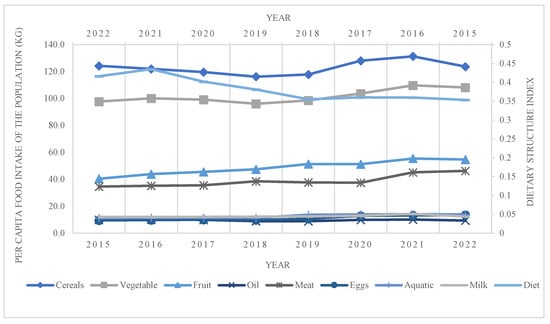
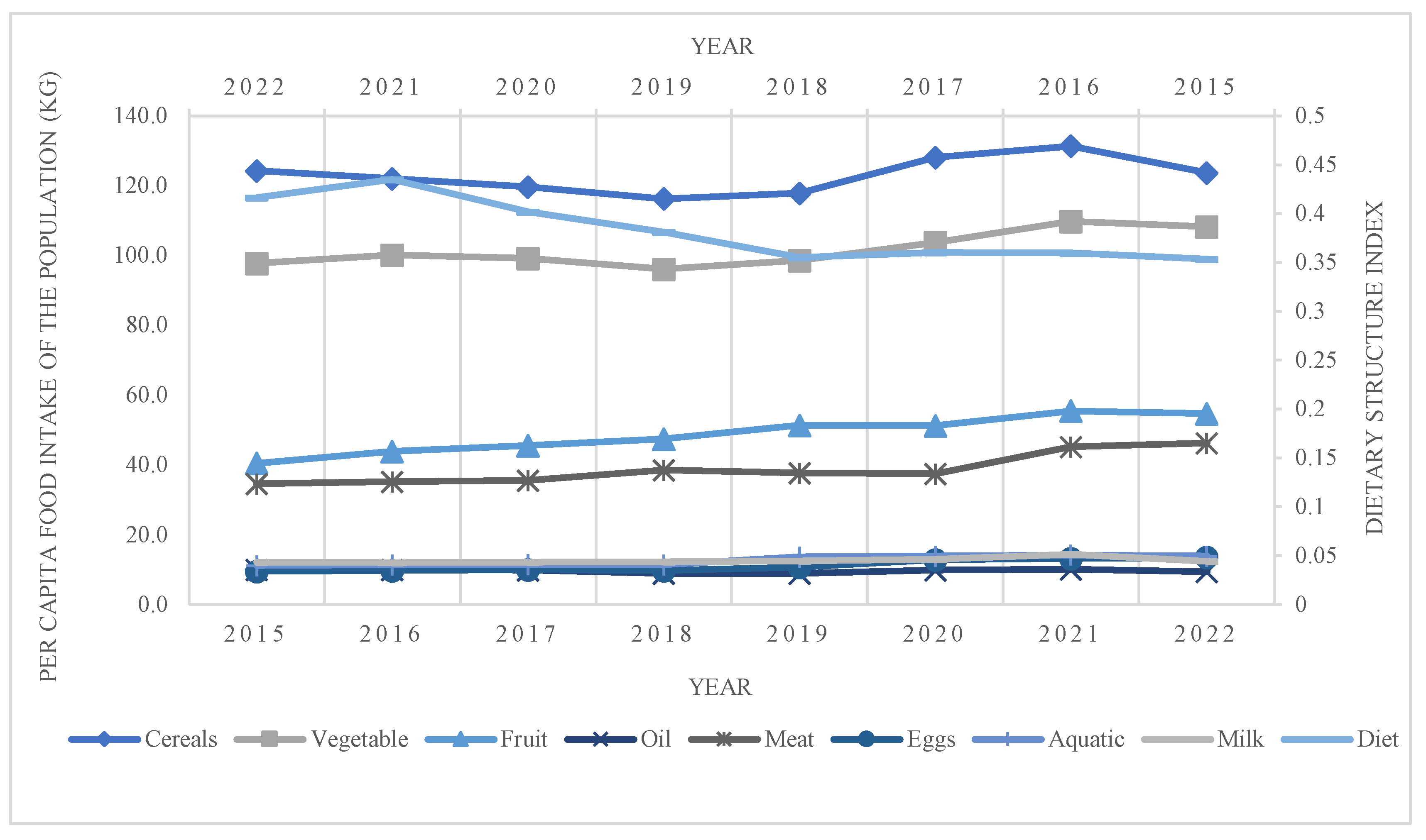
Figure 2 illustrates the trends in per capita food intake and the residents’ dietary balance structure in the country’s 31 provinces from 2015 to 2022. A decline in the per capita consumption of cereal and edible vegetable oils was observed among plant-based foods. As demonstrated in Figure 2, the total per capita consumption of cereals and edible vegetable oils among China’s residents was 124.3 kg and 10.0 kg in 2015, and decreased to 123.7 kg and 9.4 kg in 2018, representing a decrease of 0.48% and 6.00%, respectively. Conversely, there was an upward trend in vegetable and fruit consumption, with per capita consumption of vegetables and fruits reaching 97.8 kg and 40.5 kg in 2015, respectively, compared with 108.2 kg and 54.7 kg in 2022, representing an increase of 10.63% and 35.06%, respectively. A decline in the proportion of plant-based food intake in total food intake was observed, from 80.18% in 2015 to 77.47% in 2022.
Figure 2.
Trends in per capita food intake and changes in the dietary structure index from 2015 to 2022.
In 2022, the total per capita consumption of animal foods by China’s residents was 67.4 kg, compared with 86.1 kg in 2015, accounting for 27.74%. It is evident that there has been a notable increase in the per capita consumption of poultry meat and eggs, with figures rising from 34.6 kg and 9.5 kg in 2015 to 46.3 kg and 13.5 kg in 2022, representing increases of 33.82% and 42.11%, respectively. In contrast, the intake of animal food such as aquatic products and milk has remained relatively stable, with an increase of only about 11%. The data indicates increase in the consumption of aquatic products and milk, from 11.2 kg and 12.1 kg in 2015 to 13.9 kg and 12.4 kg in 2022, respectively. However, the increase in intake is not significant when analyzed over the same period, from 2015 to 2022. The increase in intake was 24.11% and 2.48%, respectively. Moreover, the changes in the intake of plant foods and animal foods have led to a shift in the residents’ dietary structure balance, which has exhibited an upward trend from 0.354 in 2015 to 0.416 in 2022.
Overall, from 2015 to 2022, the proportion of plant-based food intake of residents in the 31 provinces nationwide exhibited a downward trend, whilst the proportion of animal-based food intake demonstrated an upward trend. Concurrently, the balance of residents’ dietary structure improved.
3.4. Data Sources
Considering the accessibility of data for the core variables, this paper selects 31 provinces (municipalities and autonomous regions) other than Hong Kong, Macao, and Taiwan as the study sample, with a timeframe covering 2015 to 2022. In this paper, except for the digital inclusive finance data, the raw data for all other variables is sourced from the annual provincial data in the China Statistical Yearbook for the corresponding years, as well as the annual data in the statistical yearbooks of provinces, autonomous regions, and municipalities directly under the Central Government of the People’s Republic of China for the same period. The digital inclusive finance data, conversely, are derived from the China Digital inclusive finance Index, a composite index developed collaboratively by the Digital Finance Research Centre of Peking University and Ant Financial Services Group. This index encompasses three levels—provincial, municipal, and county levels—from 2011 to 2022. In this paper, provincial-level digital inclusive finance data are selected and then matched with the provincial panel data.
The primary rationale for selecting the period from 2015 to 2022 is that, while the ‘Peking University Digital inclusive finance Index’ covers the years from 2011 to 2022, the National Bureau of Statistics only began publishing data on per capita food consumption of residents at the national and provincial levels in 2016. Therefore, the present study combines the 2015–2022 Digital inclusive finance Development Index and other variables collated from various statistical yearbooks to form the 2015–2022 panel data set, which serves as the dataset for the empirical analysis. The three control variables—Economic Development Index, the degree of openness and the infrastructure conditions—were collated and calculated by the author. Concurrently, to enhance the stability of the data, the author employed logarithmic transformations of infrastructure conditions, and the degree of openness.
4. Empirical Results and Analysis
4.1. Fitting Scatterplot Analysis
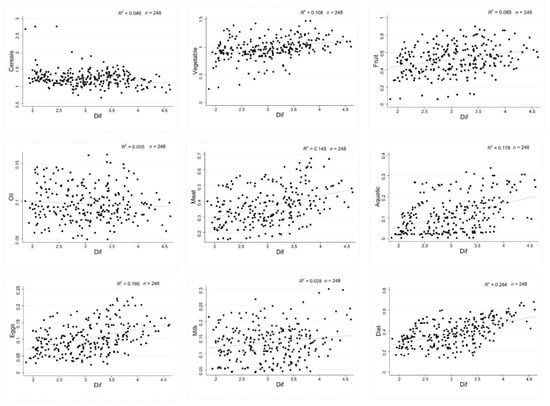
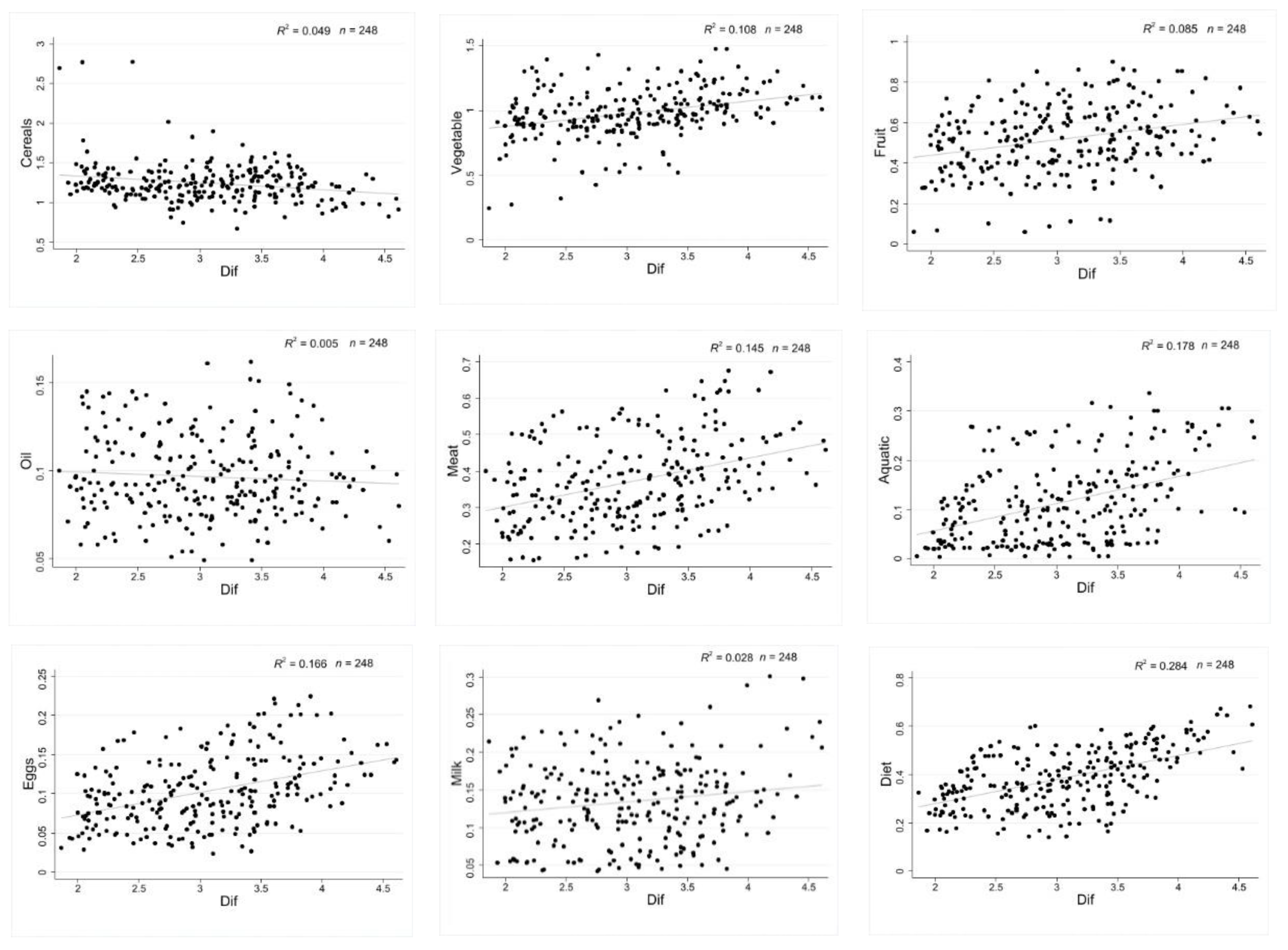
To determine whether there is a statistically significant correlation between digital inclusive finance and residents’ dietary nutrition, this paper fits scatterplots of digital inclusive finance against the eight food categories and the balance of dietary structure, respectively, as shown in Figure 3. The results of the analysis revealed that, among plant-based foods, the digital inclusive finance shows a positive relationship with the intake of all other plant-based foods except for an inverse relationship with residents’ per capita cereal intake. However, the degree of fit is relatively lower.
Figure 3.
The fitted relationship between digital inclusive finance and the residents’ intake of different food categories and dietary structure balance.
Among animal-based foods, the digital inclusive finance shows a stronger positive correlation with the residents’ intake of meat, eggs, and aquatic products. Although there is a positive relationship, the correlation with residents’ milk intake is weak. At the same time, there is an obvious positive correlation between digital inclusive finance and the residents’ dietary structure balance, and the fit is relatively better. This indicates that, to a certain extent, the development of digital inclusive finance improves the balance of the residents’ dietary structure. However, it should be noted that, without including relevant control variables, this fitted relationship does not accurately reflect the true relationship between digital inclusive finance and residents’ dietary nutrition. Further exploration using econometric analyses that control for other variables is required.
4.2. Benchmark Regression Results and Analysis
To test for multicollinearity, we compute the variance inflation factor (VIF) for all explanatory variables. The results in Table 2 indicate that the VIF values are well below the threshold of 10, suggesting that multicollinearity does not pose a serious threat to the reliability of the regression estimates.
Table 2.
Results of multicollinearity test.
According to the benchmark regression model set out in the previous section, this paper first conducts a Hausman test. The test yields a statistic of 30.85, which is significant at the 1% level, indicating that the fixed effects model is more suitable than the random-effects model. Based on this result, all regressions in this study employ a two-way fixed effects specification, controlling for both province and year effects. Meanwhile, the robust standard errors are reported with clustering at the province level in order to mitigate the effects of heteroskedasticity and multicollinearity, and the regression results are shown in Table 3.
Table 3.
Benchmark regression results.
Among plant-based foods, digital inclusive finance is positively associated with the intake of grains, vegetables, fruits, and edible vegetable oils in residents’ households, although only the association with grain intake is statistically significant at the 5% level. According to the fixed effects model, the estimated coefficient for cereals is 0.368, suggesting that a one-unit increase in the digital inclusive finance index is associated with an average increase of 0.368 units in per capita cereal intake at the provincial level, after controlling for time-invariant characteristics and common time trends.
Among animal-based foods, digital inclusive finance is positively associated with residents’ intake of meat, aquatic products, and milk, with these associations being statistically at the 5% level. According to the fixed effects model, the estimated coefficients for meat, aquatic products, and milk are 0.151, 0.037 and 0.047, respectively. These coefficients indicate that, on average within a province over time, a one-unit increase in the digital inclusive finance index is associated with an average increase of 0.151 units in per capita meat intake, 0.037 units in aquatic products intake, and 0.047 units in milk intake at the provincial level, after controlling for time-invariant characteristics and common time trends. In addition, digital inclusive finance is positively associated with dietary balance, with the association being statistically significant at the 1% level. According to the fixed effects model, the estimated coefficient is 0.126, indicating that a one-unit increase in the digital inclusive finance index is associated with an average increase of 0.126 units in the dietary balance index at the provincial level, after controlling for time-invariant characteristics and common time trends.
Overall, the empirical results indicate that digital inclusive finance plays a significant role in shaping residents’ dietary patterns. Digital inclusive finance is positively associated with residents’ intake of both plant-based foods (cereals) and animal-based foods (meat, aquatic products and milk), with a relatively stronger effect on animal-based foods, thereby supporting Hypothesis H1. Moreover, digital inclusive finance is positively associated with residents’ dietary structure balance, with this association being significant at the 1% level. This finding suggests that digital inclusive finance contributes to a more balanced overall dietary structure, thus confirming Hypothesis H2.
4.3. Endogeneity Test
According to the existing studies, the endogeneity problem in the relationship between digital inclusive finance and dietary nutrition may be caused by reverse causality and unobserved omitted variables. Based on this, this paper employs the one-period lag of Digital Inclusive Finance as an instrumental variable as suggested by existing studies [63,64]. The baseline model is then re-estimated using the two-stage least squares (2SLS), and the results are shown in Table 4. The first-stage regression results indicate that the regression coefficient of the instrumental variable on digital inclusive finance is significantly positive, satisfying the relevance condition.
Table 4.
Results of instrumental variable regression.
To further assess the validity of the instrumental variable, a series of identification tests are conducted. The Kleibergen–Paaprk LM statistic for under-identification is 14.737 (p = 0.001), rejecting the null hypothesis at the 1% significance level, which indicates that the model is identified. In addition, the Kleibergen–Paaprk Wald F statistic is 333.975, which substantially exceeds the Stock–Yogo critical value of 16.38 at the 10% level, suggesting that the instrument is not weak. Regarding the exogeneity condition, the lagged digital inclusive finance variable is unlikely to directly affect current dietary outcomes, except through its impact on current digital financial development. Combined with the inclusion of extensive control variables, this supports the plausibility of the exclusion restriction.
It should be noted that, since the equations fitted with endogenous variables and instrumental variables in this paper meet the ‘just enough identification’ condition, an over-identification test has not been conducted. Based on this, the results of the second stage of instrumental variable regression can be used for interpretation. The results of the second stage of the estimation show that digital inclusive finance significantly increases the intake of plant-based foods (such as cereals) and animal-based foods (such as meat, aquatic products, and milk) in households, and improves the overall balance of residents’ dietary structure. Overall, the findings of this paper remain robust after addressing potential endogeneity concerns.
4.4. Robustness Tests
To further test the robustness of the above findings, this paper follows the approaches used in the relevant literature and conducts robustness checks by applying sample exclusion, winsorization, and one-period lagging.
4.4.1. Sample Exclusion
The development of digital inclusive finance in the four municipalities directly under the central government (Beijing, Shanghai, Tianjin, and Chongqing) is at the forefront of the country, and benefits from strong national policy support. This gives them an advantage in developing digital inclusive finance, which may impact the regression results. To avoid bias in the research conclusions caused by these special samples, this paper excludes the four municipalities directly from the sample and conducts regression analysis on the remaining 27 provincial (autonomous region) samples. The specific results are shown in Table 5. The sign and significance of the estimated coefficients for digital inclusive finance have not changed significantly and are consistent with the benchmark regression results.
Table 5.
Results of excluding observations from municipalities.
4.4.2. Winsorized at the 1% Level
To eliminate the impact of outliers on the regression results, this paper re-estimates the benchmark model after winsorizing the main variables at the 1% level. The specific results are shown in Table 6. The sign and significance of the coefficients for digital inclusive finance do not change significantly, remaining consistent with the baseline results, and thus verifying robustness of the regression results.
Table 6.
Results of winsorizing at the 1% level.
4.4.3. Lagged Explanatory and Control Variables
This paper includes the one-period lagged explanatory and control variables in the model for re-estimation, and the results are shown in Table 7. The regression results clearly show that digital inclusive finance has significantly increased the intake of plant-based foods (such as cereals) and animal foods (such as meat, eggs, aquatic products and milk) among households, thereby improving the overall balance of the residents’ dietary structure. As can be seen, this finding remains robust.
Table 7.
Results of one-period lagged explanatory and control variables.
4.5. Heterogeneity Analysis
4.5.1. Heterogeneity of the Various Dimensions of Digital Inclusive Finance
In order to explore whether the impact of the various dimensions of digital inclusive finance on the residents’ dietary intake and dietary structure balance is heterogeneous, this paper employs a two-way fixed effects model to regress the three dimensions separately. The results are presented in Table 8. The results of the model estimation show that the breadth of digital inclusive finance has no significant effect on the intake of plant-based foods and animal-based foods or dietary balance structure of households. However, the depth of digital inclusive finance and the degree of digitization significantly increases the intake of plant-based foods (such as cereals) and animal-based foods (such as meat and aquatic products), thereby improving dietary balance structure. This shows that there is heterogeneity in the nutritional effects of the various dimensions of digital inclusive finance. The main reason for this is that the breadth of digital inclusive finance coverage reflects the accessibility of digital financial services and online financial services in a region [65].
Table 8.
Results for different dimensions of digital inclusive finance.
However, driven by the national strategies, such as ‘Broadband China’ and ‘Digital Countryside’, digital infrastructure has already achieved near-universal coverage in most regions. As a result, the marginal effect of further expanding coverage on household food consumption becomes limited. Additionally, as the concept of the digital divide evolves, with the evolution of the digital divide from “access gaps” to “usage gaps”, the constraints on consumers’ participation in the food consumption market are shifting from digital infrastructure to the extent to which digital information is applied and the ability to apply it [66]. This may be a significant factor in the nutritional impact of the depth of use and the degree of digitization.
4.5.2. Urban–Rural Heterogeneity
China’s unique urban–rural dual economic structure has led to an imbalance in the level of digital inclusive finance in urban and rural areas. On the one hand, an ‘education gap’ exists in the cultivation of financial literacy between urban and rural residents. This has led to the lagging development of the financial education system in rural areas, limited mastery of the financial knowledge and skills among rural residents, and informal rural financial education. These factors seriously restrict rural residents’ access to formal, effective financial services [67]. On the other hand, rural households have poorer access to financial services than urban households, and financial exclusion are more common.
This paper therefore investigates the impact of digital inclusive finance on the dietary nutrition of residents in urban and rural areas, and the results are shown in Table 9. The results show that digital inclusive finance significantly increases the intake of animal-based foods (such as eggs and milk) in rural households, thereby improving the dietary structure balance of the rural residents. In contrast, digital inclusive finance only significantly increases the intake of cereals and meat in urban households, and digital inclusive finance has no significant impact on the balance of urban residents’ dietary structure. Overall, the nutritional effect of digital inclusive finance varies between urban and rural areas.
Table 9.
Results for urban and rural groups.
Based on a comparison of theory and practice, this paper argues that the reasons for this urban–rural heterogeneity are reflected primarily in two areas. First, digital inclusive finance improves the financial literacy of rural residents [68], thereby alleviating their liquidity constraints to a significantly greater extent than those of urban residents. This leads to a substantial increase in subsistence consumption in terms of food expenditure [69]. Second, the development of regional agricultural markets in rural areas lags behind that in urban areas, and the diversity and availability of food in offline consumer markets are insufficient. This means that the effect of digital inclusive financial development in extending food consumption scenarios is significantly larger in rural areas than in urban areas.
However, digital inclusive finance is not significantly associated with improvements in the dietary structure balance of urban residents. This pattern may be partly explained by the increasing prevalence of eating out in urban areas. Existing studies show that urban residents have a higher frequency of food-away-from-home consumption than rural residents, and such consumption is associated with higher intake of energy-dense foods [70,71,72,73]. Moreover, eating out behavior is often linked to a higher intake of energy-dense and high-fat foods, while the consumption of healthier items such as whole grains, vegetables, and eggs may be relatively lower.
4.5.3. Income Heterogeneity
Related studies have shown significant heterogeneity in food consumption among different income groups [74]. To explore the impact of digital inclusive finance on the dietary nutrition at different income levels, this paper defines the households below the average income level as low-income level households, and those above the average income level are categorized as upper-middle households, based on national per capita disposable income between 2015 and 2022 [75]. The impact of digital inclusive finance on the consumption of plant-based foods and animal-based foods, as well as the dietary structure balance of households at both income levels, is analyzed in Table 10.
Table 10.
Results for groups at low and upper-middle income level.
The results show that digital inclusive finance significantly increases the intake of animal-based foods (such as meat and aquatic products) among low-income households and improves the balance of their dietary structure. At the same time, the effects on upper-middle households are more obvious. Digital inclusive finance significantly increases the intake of plant-based foods (such as cereals and vegetables) and animal-based foods (such as meat and aquatic products) among upper-middle income households and improves the balance of their dietary structure.
This may be because the food consumption decisions of low-income households are constrained by both income and uncertainty, leading them to choose low-quality, low-nutrient foods. Consequently, they are more likely to have a homogeneous food consumption structure. In contrast, the food consumption of upper-middle income households is less constrained, giving them a higher propensity and willingness to purchase higher-quality, more nutritious foods [33]. According to this logic, the development of digital inclusive finance can provide low-income households with more convenient financial services, alleviating their financial liquidity constraints and reducing their motivation to save for emergencies. This improves their consumption levels [32], thus alleviating budgetary constraints on food consumption, particularly for more nutritious animal-based foods. This, in turn, effectively improves the balance of their dietary structure. In addition, upper-middle income households are more likely to engage in diversified and high-quality food consumption, making them more responsive to improvements in financial access and information availability, which may be the reason why the effect of digital inclusive finance on dietary nutrition is more pronounced among upper-middle income households.
4.5.4. Human Capital Heterogeneity
As an important way of shaping individual values and behavioral perceptions, human capital accumulation provides residents with a reserve of dietary knowledge and skills that directly impact the optimization of dietary structure. Theoretically, the higher the education level of residents, the greater their nutritional knowledge and dietary skills are likely to be, and the greater their contribution to their own health [76], which leads to a more balanced dietary structure.
Based on this, this paper explores the heterogeneous impact of digital inclusive finance on residents’ dietary nutrition. Specifically, per capita years of education are calculated for the period 2015–2022. Households with fewer than the average number of years of education are defined as having low levels of human capital, while those with more than the average are defined as having high levels of human capital. The impact of digital inclusive finance on the dietary nutrition of different household groups is analyzed, and the results are shown in Table 11. The results show that digital inclusive finance significantly increases the residents’ intake of plant-based foods (such as cereals, vegetables and fruits) and animal-based foods (such as meat, eggs, aquatic products and milk) among households with low levels of human capital, and improves their dietary structure balance. However, the effect on the intake, such as fruits and eggs is negative significantly among households with a high levels of human capital. Furthermore, digital inclusive finance has no significant effect on their dietary structure balance.
Table 11.
Results for groups at low and high levels of human capital.
There are two possible reasons for this heterogeneity. First, family members with middle and high levels of human capital have a greater acceptance of nutritional knowledge. They already have a strong awareness of healthy diets and a balanced dietary structure, which is not significantly altered by digital inclusive finance. In contrast, household members with low levels of human capital lack knowledge about diet and nutrition. The development of e-commerce associated with digital inclusive finance has provided them with a new platform for obtaining food and nutritional information, as well as knowledge about balanced diets. This effectively reduces the cost of searching for diversified, high-quality food and enhances the acquisition of dietary information [77]. Moreover, this raises awareness of healthy dietary intake and encourages people to pay more attention to consuming nutrient-rich foods, such as vegetables, fruits, and animal products, thereby improving their dietary structure balance.
Second, digital economic development has a more obvious pulling effect on the consumption of households with low levels of human capital than on those with high levels of human capital [67]. Focusing on food consumption behavior, households with low levels of human capital may have stronger liquidity constraints than those with high levels of human capital [78]. However, digital inclusive financial development alleviates the consumption budget constraints of households with low levels of human capital, thereby unleashing their food consumption potential.
4.5.5. E-Commerce Development Heterogeneity
Given that e-commerce serves as a key channel linking digital inclusive finance to food consumption, it is necessary to examine the heterogeneity of this relationship from the perspective of e-commerce development. On the one hand, e-commerce platforms expand food availability by breaking geographical constraints, particularly for high-quality and perishable foods [79,80]. On the other hand, they reduce information search costs and improve access to nutritional information, thereby influencing dietary choices [81]. However, due to regional disparities in e-commerce development, the effectiveness of digital inclusive finance in improving dietary nutrition may vary.
This paper measures the level of regional e-commerce development by the number of e-commerce enterprises. Regions with a number of e-commerce enterprises above the national average are classified as the high e-commerce development group, while those below the national average are classified as the low e-commerce development group. Based on this, this paper explores the heterogeneous impact of digital inclusive finance on residents’ dietary nutrition between groups with high e-commerce development and groups with low e-commerce development, and the results are shown in Table 12.
Table 12.
Results for groups at low and high e-commerce development.
The results show that digital inclusive finance significantly increases the intake of plant-based foods (such as cereals, vegetables and fruits) and animal-based foods (such as meat, eggs, aquatic products and milk), as well as improves the balance of dietary structure in the high e-commerce development group. In contrast, digital inclusive finance has no significant effect on food intake or dietary structure balance in the low e-commerce development group. This indicates that in regions with more developed e-commerce infrastructure, digital financial services are more likely to be translated into actual food consumption, while in less developed areas, the lack of digital consumption scenarios may weaken this effect.
4.5.6. Digitalization Heterogeneity
In the context of digital inclusive finance, unequal digital capabilities may lead to heterogeneous impacts on consumption behavior and welfare outcomes [82]. Furthermore, digital technologies and e-commerce have been shown to significantly improve dietary diversity and food consumption structure [79]. Therefore, differences in digital access, skills and usage may play a crucial role in shaping the heterogeneous effects of digital inclusive finance on dietary nutrition. This paper classifies regions with digitalization levels above the national average as the high-digitalization group, and those below the national average as the low-digitalization group. Based on this classification, it examines whether the impact of digital inclusive finance on residents’ dietary nutrition exhibits heterogeneity arising from the digital divide. The results are presented in Table 13.
Table 13.
Results for groups at high and low level of digitalization.
The results show that digital inclusive finance significantly increases the intake of animal-based foods (such as meat and aquatic products) and improves the balance of dietary structure in the high-digitalization group. In contrast, digital inclusive finance has no significant effect on food intake or dietary structure balance in the low-digitalization group.
5. Conclusions and Implications
5.1. Conclusions and Policy Recommendations
This study examines the role of digital inclusive finance in shaping residents’ dietary patterns in China, using panel data from 31 provinces from 2015 to 2022 and a two-way fixed effects model. The findings provide empirical evidence that residents’ dietary patterns in China show a declining proportion of plant-based foods and an increasing proportion of animal-based foods, resulting in a modest improvement in overall dietary balance. However, significant challenges remain, including excessive intake of oil, insufficient consumption of vegetables and fruits, overconsumption of poultry and meat, and inadequate intake of aquatic products, eggs, and milk, indicating that residents’ dietary structure continues to be suboptimal.
In addition, digital inclusive finance is positively associated with the intake of both plant-based foods (e.g., cereals) and animal-based foods (e.g., meat aquatic products and milk), with a relatively stronger effect on animal-based foods, and contributes to improved dietary structure balance. Heterogeneity analysis indicates that the positive effects are more pronounced among rural households, households within upper-middle income groups, households with lower levels of human capital, groups with high e-commerce development and high levels of digitalization. These results highlight the potential of digital inclusive finance as a policy tool to promote healthier and more balanced diets, particularly in disadvantaged populations.
Based on these findings, this paper offers three policy recommendations:
- (1)
- Promote healthy and balanced diets through targeted nutrition guidance. Relevant authorities should optimize the Dietary Guidelines for Chinese Residents for different regions and strengthen public education on healthy eating. Efforts should focus on raising awareness about excessive consumption of animal products and encouraging greater intake of plant-based foods such as vegetables, fruits, whole grains, and beans. These measures are particularly important for rural and low-income populations to achieve diversified and balanced dietary structures.
- (2)
- Strengthen the role of digital inclusive finance in improving dietary nutrition. Policies should support the development of digital financial services that alleviate liquidity constraints and expand access to both online and offline food markets. Investments in digital infrastructure, mobile payment coverage, and electronic identity authentication systems are necessary to enhance the depth and efficiency of digital financial use, which can help reduce nutritional disparities across regions and population groups.
- (3)
- Integrate agricultural market development with digital platforms to improve food availability. Local and regional agricultural markets should be coordinated with e-commerce and mobile payment systems to optimize food supply, particularly for under-consumed items such as eggs and milk. Efforts should include adjusting local production structures to meet dietary needs, expanding online and community-based sales channels, and improving logistics infrastructure, including cold-chain systems, to ensure the quality and freshness of vegetables, fruits, and animal products.
Overall, these findings underscore the importance of digital inclusive finance not only as a financial tool but also as a means to promote sustainable, healthy, and equitable dietary patterns across China.
5.2. Limitations
Despite the findings, this study has several limitations. First, it relies on provincial-level data, which may mask heterogeneity within provinces and limits household- or individual-level interpretation. Second, due to data constraints, the mechanisms through which digital inclusive finance affects dietary intake, such as liquidity changes, online food purchases, or household financial behavior, cannot be directly quantified, leaving the pathways largely theoretical. Third, the use of aggregate data may introduce measurement and aggregation biases, and the estimated coefficients represent provincial-level associations rather than precise causal effects for individual residents. Nonetheless, the findings provide robust descriptive evidence on trends in dietary structure and the role of digital inclusive finance in shaping dietary patterns at the provincial level. In future research, we will use micro-level household survey data to address these limitations by capturing intra-provincial heterogeneity, reducing aggregation bias, estimating policy-relevant elasticities, and exploring the mechanisms through which digital inclusive finance influence dietary behavior.
Author Contributions
Conceptualization, C.Z.; Methodology, C.Z. and J.J.; Software, J.J.; Validation, J.J.; Formal analysis, C.Z. and J.J.; Data curation, J.J.; Writing—original draft, C.Z. and J.J.; Writing—review and editing, C.Z. and J.J.; Funding acquisition, C.Z. All authors have read and agreed to the published version of the manuscript.
Funding
This paper was supported by the National Natural Science Foundation of China, grant numbers 72103169 and 72303168.
Institutional Review Board Statement
Not applicable.
Informed Consent Statement
Not applicable.
Data Availability Statement
The data are available from the corresponding author upon reasonable request.
Conflicts of Interest
The authors declare no conflicts of interest.
References
- Bleakley, H. Health, human capital, and development. Annu. Rev. Econ. 2010, 2, 283–310. [Google Scholar] [CrossRef] [Scilit] [PubMed]
- Xu, X. On the National Fitness Strategy in the Context of Completing the Building a Moderately Prosperous Society in All Respects. J. Hum. Rights 2020, 19, 587. [Google Scholar]
- Dai, C. Connotation, Generative Logic and Practice Path of Big Food Concept. J. Yunnan Agric. Univ. 2023, 17, 146–151. [Google Scholar]
- Neuhouser, M.L. The importance of healthy dietary patterns in chronic disease prevention. Nutr. Res. 2019, 70, 3–6. [Google Scholar] [CrossRef] [Scilit]
- Millen, B.E.; Abrams, S.; Adams-Campbell, L.; Anderson, C.A.; Brenna, J.T.; Campbell, W.W.; Clinton, S.; Hu, F.; Nelson, M.; Neuhouser, M.L.; et al. The 2015 Dietary Guidelines Advisory Committee Scientific Report: Development and Major Conclusions. Adv. Nutr. 2016, 7, 438–444. [Google Scholar] [CrossRef] [Scilit]
- Institute for Global Food Economics and Policy Research. China and Global Food Policy Report; Institute for Global Food Economics and Policy Research: Beijing, China, 2021. [Google Scholar]
- Zhao, L.; Fang, Y.; He, Y.; Yu, D.; Guo, Q.; Yu, W.; Fang, H.; Wang, X.; Zhao, W. Trends of food consumption among Chinese population in 1992–2012. J. Hyg. Res. 2016, 45, 522–526. [Google Scholar]
- Zhao, L.Y.; Liu, D.; Yu, D.M.; Zhang, J.; Wang, J.Z.; Zhao, W.H. Challenges brought about by rapid changes in Chinese Diets: Comparison with developed countries and implications for further improvement. Biomed. Environ. Sci. 2018, 31, 781–786. [Google Scholar]
- Institute for Global Food Economics and Policy Research. China and Global Food Policy Report; Institute for Global Food Economics and Policy Research: Beijing, China, 2022. [Google Scholar]
- Li, J.; Wu, Y.; Xiao, J.J. The impact of digital finance on household consumption: Evidence from China. Econ. Model. 2020, 86, 317–326. [Google Scholar] [CrossRef] [Scilit]
- Jiang, W.; Hu, Y.; Cao, H. Does digital inclusive finance increase the household consumption? Evidence from China. J. Knowl. Econ. 2024, 15, 17333–17364. [Google Scholar] [CrossRef] [Scilit]
- Hu, N.; Hou, G. Mobile payment, digital inclusive finance, and residents’ consumption behavior research. PLoS ONE 2024, 19, E0288679. [Google Scholar] [CrossRef] [Scilit]
- Annim, S.K.; Dasmani, I.; Armah, M. Does Access and Use of Financial Service Smoothen Household Food Consumption? University Library of Munich: Munich, Germany, 2011. [Google Scholar]
- Bidisha, S.H.; Khan, A.; Imran, K.; Khondker, B.H.; Suhrawardy, G.M. Role of credit in food security and dietary diversity in Bangladesh. Econ. Anal. Policy 2017, 53, 33–45. [Google Scholar] [CrossRef] [Scilit]
- Phan, C.T.; Sun, S.; Zhou, Z.Y.; Beg, R. Does microcredit increase household food consumption? A study of rural Vietnam. J. Asian Econ. 2019, 62, 39–51. [Google Scholar] [CrossRef] [Scilit]
- Iziga, J.I.; Takagi, S. Food Consumption–Production Adjustments to Economic Crises under Credit Constraints in Nigeria. Sustainability 2022, 14, 8955. [Google Scholar] [CrossRef] [Scilit]
- Timu, A.G.; Gustafson, C.R.; Mieno, T. The gendered impacts of index-insurance on food-consumption: Evidence from southern Ethiopia. Clim. Serv. 2023, 30, 100355. [Google Scholar] [CrossRef] [Scilit]
- Park, J.; Lee, C.; Thomas, M. Why do cashless payments increase unhealthy consumption? The decision-risk inattention hypothesis. J. Assoc. Consum. Res. 2021, 6, 21–32. [Google Scholar] [CrossRef] [Scilit]
- Lin, Q.; Dai, X.; Cheng, Q.; Lin, W. Can digital inclusive finance promote food security? Evidence from China. Sustainability 2022, 14, 13160. [Google Scholar] [CrossRef] [Scilit]
- Tan, Y.; Cheng, Q.; Ren, X.; Huang, X.; Chen, Q.; Zhang, Q. A study of the impact of digital financial inclusion on multidimensional food security in China. Front. Sustain. Food Syst 2024, 8, 1325898. [Google Scholar] [CrossRef] [Scilit]
- Awaluddin, S.P.; Khair, A.U.; Paula, E.W.; Zainal, F.R.; Sutomo, D.A. The Impact of Financial Literacy and Digital Finance Applications on Household Consumption Patterns in the Digital Age: Evidence from Makassar. J. Inf. Dan Teknol. 2025, 7, 86–93. [Google Scholar] [CrossRef] [Scilit]
- Tian, L.; Han, W.; Tian, W. Digital financial inclusion and residents’ health: Evidence from rural China. Discov. Soc. Sci. Health 2024, 4, 45. [Google Scholar] [CrossRef] [Scilit]
- Li, W.Q.; Fan, J.J.; Zhao, J.W. A study on the impact of digital inclusive financial development on the welfare differences between urban and rural residents. J. Knowl. Econ. 2024, 15, 9001–9028. [Google Scholar] [CrossRef] [Scilit]
- Lv, C.C.; Song, J.; Lee, C.-C. Can digital finance narrow the regional disparities in the quality of economic growth? Evidence from China. Econ. Anal. Policy 2022, 76, 502–521. [Google Scholar] [CrossRef] [Scilit]
- Huang, F.M. Empirical analysis of the effect of financial restraint policy on Chinese residents’ consumption. China Financ. Rev. Int. 2019, 9, 208–234. [Google Scholar] [CrossRef] [Scilit]
- Power, M.; Pybus, K.J.; Pickett, K.E.; Doherty, B. The reality is that on Universal Credit I cannot provide the recommended amount of fresh fruit and vegetables per day for my children: Moving from a behavioral to a systemic understanding of food practices. Emerald Open Res. 2023, 1. [Google Scholar] [CrossRef] [Scilit]
- Yang, J.; Wu, Y.; Huang, B. Digital finance and financial literacy: Evidence from Chinese households. J. Bank. Financ. 2023, 156, 107005. [Google Scholar] [CrossRef] [Scilit]
- Huang, Y.; Xu, T.; Yin, Y.; Zhou, Z. Analysis of the Impact of Digital Finance Development on Household Consumption of Urban and Rural Residents in China-Microscopic Evidence from Chinese Families. Front. Humanit. Soc. Sci. 2022, 2, 194–202. [Google Scholar]
- Li, J.; Song, Q.; Wu, Y.; Huang, B. The effects of online consumer credit on household consumption level and structure: Evidence from China. J. Consum. Aff. 2021, 55, 1614–1632. [Google Scholar] [CrossRef] [Scilit]
- Kearney, J. Food consumption trends and drivers. Philos. Trans. R. Soc. B Biol. Sci. 2010, 365, 2793–2807. [Google Scholar] [CrossRef] [Scilit]
- Liu, L.; Wang, Y.; Li, B.; Peng, Y. Digital Inclusive Finance and Residents’ Consumption Level: Analysis Based on Mediating Effect Test. Acad. J. Bus. Manag. 2023, 5, 23–30. [Google Scholar] [CrossRef] [Scilit]
- Yang, B.; Ma, F.; Deng, W.; Pi, Y. Digital inclusive finance and rural household subsistence consumption in China. Econ. Anal. Policy 2022, 76, 627–642. [Google Scholar] [CrossRef] [Scilit]
- Darmon, N.; Drewnowski, A. Does social class predict diet quality? Am. J. Clin. Nutr. 2008, 87, 1107–1117. [Google Scholar] [CrossRef] [Scilit]
- Burggraf, C.; Kuhn, L.; Zhao, Q.; Teuber, R.; Glauben, T. Economic growth and nutrition transition: An empirical analysis comparing demand elasticities for foods in China and Russia. J. Integr. Agric. 2015, 14, 1008–1022. [Google Scholar] [CrossRef] [Scilit]
- Donovan, K. Mobile money for financial inclusion. Inf. Commun. Dev. 2012, 61, 61–73. [Google Scholar]
- Rosário, A.; Raimundo, R. Consumer marketing strategy and E-commerce in the last decade: A literature review. J. Theor. Appl. Electron. Commer. Res. 2021, 16, 3003–3024. [Google Scholar] [CrossRef] [Scilit]
- Visschers, V.H.M.; Hartmann, C.; Leins-Hess, R.; Dohle, S.; Siegrist, M. A consumer segmentation of nutrition information use and its relation to food consumption behaviour. Food Policy 2013, 42, 71–80. [Google Scholar] [CrossRef] [Scilit]
- Grunert, K.G.; Ramus, K. Consumers’ willingness to buy food through the internet: A review of the literature and a model for future research. Br. Food J. 2005, 107, 381–403. [Google Scholar] [CrossRef] [Scilit]
- Ma, W.; Vatsa, P.; Zheng, H.; Guo, Y. Does online food shopping boost dietary diversity? Application of an endogenous switching model with a count outcome variable. Agric. Food Econ. 2022, 10, 30. [Google Scholar] [CrossRef] [Scilit]
- Zheng, Q.; Wang, M.; Yang, F. Optimal channel strategy for a fresh produce E-commerce supply chain. Sustainability 2021, 13, 6057. [Google Scholar] [CrossRef] [Scilit]
- Mallat, N. Exploring consumer adoption of mobile payments–A qualitative study. J. Strateg. Inf. Syst. 2007, 16, 413–432. [Google Scholar] [CrossRef] [Scilit]
- Wang, O.; Somogyi, S. Consumer adoption of online food shopping in China. Br. Food J. 2018, 120, 2868–2884. [Google Scholar] [CrossRef] [Scilit]
- Maran, K.; Priyadarshini, P.; Jenifa, L.; Senthilnathan, C.; Venkatesh, P. Data Analysis on Mobile Payment Technology with Reference to Users’Behaviour of Retail Goods in India. In 2021 4th International Conference on Computing and Communications Technologies (ICCCT); IEEE: Piscataway, NJ, USA, 2021. [Google Scholar]
- Khan, A.A.; Mei, B.; Khan, S.U.; Ali, M.A.S.; Luo, J. Agri-food evolution and carbon emissions in Chinese residential consumption: A life cycle analysis of urban-rural disparities and socioeconomic influences. Environ. Impact Assess. Rev. 2024, 105, 107387. [Google Scholar] [CrossRef] [Scilit]
- Liu, Y.; Luo, J.; Zhang, L. The effects of mobile payment on consumer behavior. J. Consum. Behav. 2021, 20, 512–520. [Google Scholar] [CrossRef] [Scilit]
- Thomas, M.; Desai, K.K.; Seenivasan, S. How credit card payments increase unhealthy food purchases: Visceral regulation of vices. J. Consum. Res. 2011, 38, 126–139. [Google Scholar] [CrossRef] [Scilit]
- Wang, Z.Y.; Zhao, W.J.; Wang, Y.X.; Jin, X.; Song, C. The spatiotemporal differentiation and influencing factors of dietary structure index among rural residents in China. Econ. Geogr. 2023, 43, 165–172. [Google Scholar]
- Hemler, E.C.; Hu, F.B. Plant-based diets for cardiovascular disease prevention: All plant foods are not created equal. Curr. Atheroscler. Rep. 2019, 21, 18. [Google Scholar] [CrossRef] [Scilit]
- Scanes, C.G.; Toukhsati, S.R. (Eds.) Chapter 3: Animal Products and Human Nutrition. In Animals and Human Society: The Contribution of Animal Science to a Sustainable Future; Academic Press: Cambridge, MA, USA; pp. 41–64. ISBN 978-0-12-805247-1.
- Wang, L.; Huang, W.; Zhao, C.; Hu, Y.; Cui, S. Exploring the environment-nutrition-obesity effects associated with food consumption in different groups in China. J. Environ. Manag. 2022, 317, 115287. [Google Scholar] [CrossRef] [Scilit]
- Chen, T.; Guo, Z.; Chen, S.S.; Kattel, G.R.; Yao, S. Spatiotemporal differences and influencing factors of the dietary structure index in Chinese urban residents. Front. Sustain. Food Syst. 2025, 9, 1548702. [Google Scholar] [CrossRef] [Scilit]
- Zhang, X.; Yang, L.; Wang, Y. Digital inclusive finance and household consumption: Evidence from China. China Econ. Rev. 2020, 64, 101412. [Google Scholar]
- Song, Y.; Wang, R.; Wang, S. Does digital inclusive finance narrow the urban–rural income gap? Emerg. Mark. Financ. Trade 2020, 56, 1–16. [Google Scholar]
- Ahmad, M.; Majeed, A.; Khan, M.A.; Sohaib, M.; Shehzad, K. Digital inclusive finance and economic growth: Provincial data analysis of China. China Econ. J. 2021, 14, 291–310. [Google Scholar] [CrossRef] [Scilit]
- Guo, F.; Wang, J.; Wang, F.; Kong, T.; Zhang, X.; Cheng, Z. Measuring the development of digital inclusive finance in China: Index compilation and spatial characteristics. Q. J. Econ. 2020, 19, 1401–1418. (In Chinese) [Google Scholar]
- Fan, S.; Huang, H.; Mbanyele, W.; Zhao, X. A step toward inclusive green growth: Can digital finance be the main engine? Environ. Sci. Pollut. Res. 2023, 30, 96075–96097. [Google Scholar] [CrossRef] [Scilit]
- Wang, D.D.; Leung, C.W.; Li, Y.; Ding, E.L.; Chiuve, S.E.; Hu, F.B.; Willett, W.C. Trends in dietary quality among adults inthe United States 1999 through 2010. JAMA Intern. Med. 2014, 174, 1587–1595. [Google Scholar] [CrossRef] [Scilit] [PubMed]
- Thow, A.M. Trade liberalisation and the nutrition transition: Mapping the pathways for public health nutritionists. Public Health Nutr. 2009, 12, 2150–2158. [Google Scholar] [CrossRef] [Scilit] [PubMed]
- Pandey, B.; Reba, M.; Joshi, P.K.; Seto, K.C. Urbanization and food consumption in India. Sci. Rep. 2020, 10, 17241. [Google Scholar] [CrossRef] [Scilit] [PubMed]
- Böge, S. Freight Transport, Food Production and Consumption in the United States and Europe. Wupp. Pap. 1996, 56, 17. [Google Scholar]
- Gujarati, D.N.; Porter, D.C. Basic Econometrics, 5th ed.; McGraw-Hill: New York, NY, USA, 2009. [Google Scholar]
- Wooldridge, J.M. Econometric Analysis of Cross Section and Panel Data, 2nd ed.; MIT Press: Cambridge, MA, USA, 2010. [Google Scholar]
- Fang, Y.; Wen, G. How does digital finance influence urban inclusive green growth? Empirical evidence from China. Sustain. Financ. Green Growth 2025, 9, 100737. [Google Scholar] [CrossRef] [Scilit]
- Meng, F.; Xiao, Y. The Impact of Digital Finance on the Development of Cross-Border E-Commerce. J. Theor. Appl. Electron. Commer. Res. 2025, 20, 180. [Google Scholar] [CrossRef] [Scilit]
- Zhang, C.; Zhu, Y.; Zhang, L. Effect of digital inclusive finance on common prosperity and the underlying mechanisms. Int. Rev. Financ. Anal. 2024, 91, 102940. [Google Scholar] [CrossRef] [Scilit]
- Liu, Y.; Luan, L.; Wu, W.; Zhang, Z.; Hsu, Y. Can digital inclusive finance promote China’s economic growth? Int. Rev. Financ. Anal. 2021, 78, 101889. [Google Scholar] [CrossRef] [Scilit]
- Van Dijk, J.A.G.M. The evolution of the digital divide-the digital divide turns to inequality of skills and usage. In Digital Enlightenment Yearbook; IOS Press: Amsterdam, The Netherlands, 2012; pp. 57–75. [Google Scholar]
- Zhang, X. A Study on the Impact of Financial Literacy on the Urban-Rural Income Gap. Int. J. Glob. Econ. Manag. 2024, 3, 242–248. [Google Scholar] [CrossRef] [Scilit]
- Zhang, C.; Li, Y.; Yang, L.; Wang, Z. Does the development of digital inclusive finance promote the construction of digital villages?—An empirical study based on the Chinese experience. Agriculture 2023, 13, 1616. [Google Scholar] [CrossRef] [Scilit]
- Zhai, F.Y.; Du, S.F.; Wang, Z.H.; Zhang, J.G.; Du, W.W.; Popkin, B.M. Dynamics of the Chinese diet and the role of urbanicity 1991–2011. Obes. Rev. 2014, 15, 16–26. [Google Scholar] [CrossRef] [Scilit] [PubMed]
- Zeng, Q.Y.; Zeng, Y.C. Eating out and getting fat? A comparative study between urban and rural China. Appetite 2018, 120, 409–415. [Google Scholar] [CrossRef] [Scilit] [PubMed]
- Jia, X.; Liu, J.; Chen, B.; Jin, D.; Fu, Z.; Liu, H.; Du, S.; Popkin, B.M.; Mendez, M.A. Differences in nutrient and energy contents of commonly consumed dishes prepared in restaurants vs. at home in Hunan Province, China. Public Health Nutr. 2018, 21, 1307–1318. [Google Scholar] [CrossRef] [Scilit]
- Wu, H.; Zhang, Z.; Xu, J.; Song, J.; Han, J.; Zhang, J.; Mei, Q.; Cheng, F.; Zhuang, H.; Li, S. Food consumption away from home had divergent impacts on diet nutrition quality across urban and rural China. Food Secur. 2024, 17, 41–56. [Google Scholar] [CrossRef] [Scilit]
- Li, X.; Li, X.; Liao, Y.; Zhu, G.; Yu, G. Analysis of residents’ food safety satisfaction from the perspective of income heterogeneity. Sci. Rep. 2021, 11, 6666. [Google Scholar] [CrossRef] [Scilit]
- Li, P.L.; Zhang, Y. The Size, Identity, and Social Attitudes of the Chinese Middle Class. Society 2008, 2, 220. (In Chinese) [Google Scholar]
- Wang, Y.; Wen, X.; Liang, W.; Lin, X. Capital endowment, health information literacy and healthy dietary behaviors: Evidence from a survey of Chinese rural residents. Food Qual. Prefer. 2023, 105, 104766. [Google Scholar] [CrossRef] [Scilit]
- Yang, M.; Zhang, Z.; Wang, Z. Does Internet use connect smallholder farmers to a healthy diet? Evidence from rural China. Front. Nutr. 2023, 10, 1122677. [Google Scholar] [CrossRef] [Scilit]
- Yi, X.J.; Wei, X.T.; Yang, B.Y.; Zhang, L.S. Does the Digital Economy significantly Promote “Common Prosperity”: Microeconomic Evidence from an Income Inequality Perspective. China J. Econom. 2023, 3, 660–682. [Google Scholar]
- Zheng, H.; Ma, W.; Rahut, D.B. Digital technology, e-commerce, and dietary diversity: Evidence from rural China. World Dev. 2019, 120, 170–183. [Google Scholar]
- Shen, J.; Zhu, Z.; Qaim, M.; Fan, S.; Tian, X. E-commerce improves dietary quality of rural households in China. Agribusiness 2023, 39, 1495–1511. [Google Scholar] [CrossRef] [Scilit]
- Olzenak, K.J.; French, S.A.; Sherwood, N.E.; Redden, J.P.; Harnack, L.J. How online grocery stores support consumer nutrition information needs. J. Nutr. Educ. Behav. 2020, 52, 952–957. [Google Scholar] [CrossRef] [Scilit]
- Suri, T.; Jack, W. The long-run poverty and gender impacts of mobile money. Science 2016, 354, 1288–1292. [Google Scholar] [CrossRef] [Scilit]

Disclaimer/Publisher’s Note: The statements, opinions and data contained in all publications are solely those of the individual author(s) and contributor(s) and not of MDPI and/or the editor(s). MDPI and/or the editor(s) disclaim responsibility for any injury to people or property resulting from any ideas, methods, instructions or products referred to in the content. |
© 2026 by the authors. Licensee MDPI, Basel, Switzerland. This article is an open access article distributed under the terms and conditions of the Creative Commons Attribution (CC BY) license.