


Abstract
Chitosan-coated sand has been developed as a sustainable, environmentally friendly, and cost-effective water treatment method for removing nitrate anions, leveraging the adsorption properties of chitosan. When applied to sand using glutaraldehyde as a cross-linking agent, this adsorbent removes nitrate anions with an adsorption capacity (q_e) of 154.41 mg g−1. This approach is particularly advantageous due to its low cost, high adsorption capacity, and effectiveness over a wide range of pH and temperatures, although its performance is optimal under slightly acidic to neutral conditions (pH = 6) due to electrostatic attraction and ion exchange, as the positively charged amino groups of chitosan bind to the negatively charged nitrate ions. Nitrate adsorption is also described by the Langmuir isotherm and follows the pseudo-second-order model. Furthermore, the adsorbent remains highly stable even after five regeneration cycles, demonstrating its long-term effectiveness and durability, while offering a cost-effective and environmentally friendly solution in accordance with the principles of sustainable development.
1. Introduction
Nitrate ion (NO3−) adsorption is a fast-growing field of research, not least because of the environmental and health problems associated with nitrate pollution of water [1]. Nitrates are nitrogen compounds that are highly soluble in water, originating mainly from anthropogenic sources such as the intensive use of agricultural fertilizers, industrial discharges, and domestic wastewater [2,3]. Their accumulation in surface and groundwater poses major problems, notably the eutrophication of aquatic ecosystems, leading to algal blooms and degraded water quality [4]. In addition, consumption of nitrate-contaminated water can have adverse effects on human health, such as methemoglobinemia (or “blue baby syndrome”), particularly in infants, as well as potential cancer risks due to the formation of nitrosamines [5]. In view of these health concerns, the World Health Organization (WHO) recommends maintaining the nitrate anion concentration limit at 40 mg/L [6].
In response to these challenges, several treatment methods have been developed to remove nitrates from contaminated water, including biological denitrification [7,8], electrodialysis [9,10], reverse osmosis [11], electrochemical reduction [12,13], ion exchange [14,15], and co-precipitation [16]. Unfortunately, most of these techniques have drawbacks, including environmental damage and complicated, costly operations. Consequently, given its high efficiency, low cost, simplicity, and environmental friendliness, adsorption has become the most appropriate approach for treating contaminated water. In this sense, several adsorbents have been developed to remove nitrates, including activated charcoal [17], zeolites [18,19], clay materials [20], and organic-inorganic hybrid bio-composites [21,22,23,24,25]. It is essential to highlight that the above-mentioned adsorbents have numerous limitations in their use. Firstly, it requires the utilization and/or production of toxic chemicals causing other environmental and health concerns, and secondly, it has a high economic cost and limited capacity for removing nitrate anions. To overcome these limitations, polymeric materials has proven to be a promising starting point for removing anions [26]. Among polymers, chitosan has been extensively studied for nitrate removal from water due to its numerous amino (–NH2) and hydroxyl (–OH) groups, which act as active adsorption sites [27,28]. In addition to these structural properties, it is biocompatible, non-toxic, and inexpensive, making it an attractive candidate for water treatment [29].
However, natural chitosan has some significant limitations: low specific surface area, low adsorption capacity, and solubility in acidic environments, conditions that are particularly favorable for nitrate adsorption [30]. These constraints reduce its direct effectiveness and justify the use of chemical modifications. Several strategies have been successfully developed. Cross-linking with epichlorohydrin improves stability and increases adsorption capacity from 90.7 to 104.0 mg g−1 [30]. Quaternization of the amino groups strengthens electrostatic interactions with nitrate anions, reaching up to 138.40 mg g−1 [31]. Other chitosan-based composites with minerals such as zeolites or bentonite, thereby increasing the specific surface area and available active sites of the adsorbent, have also been developed [32,33].
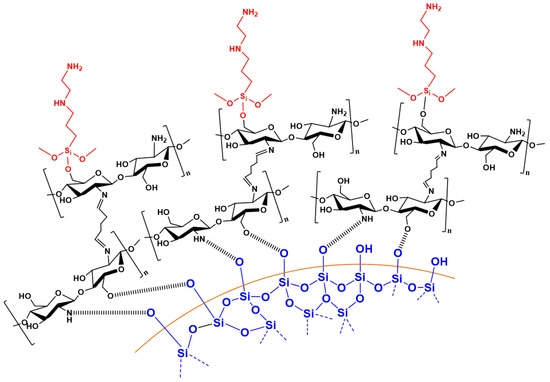
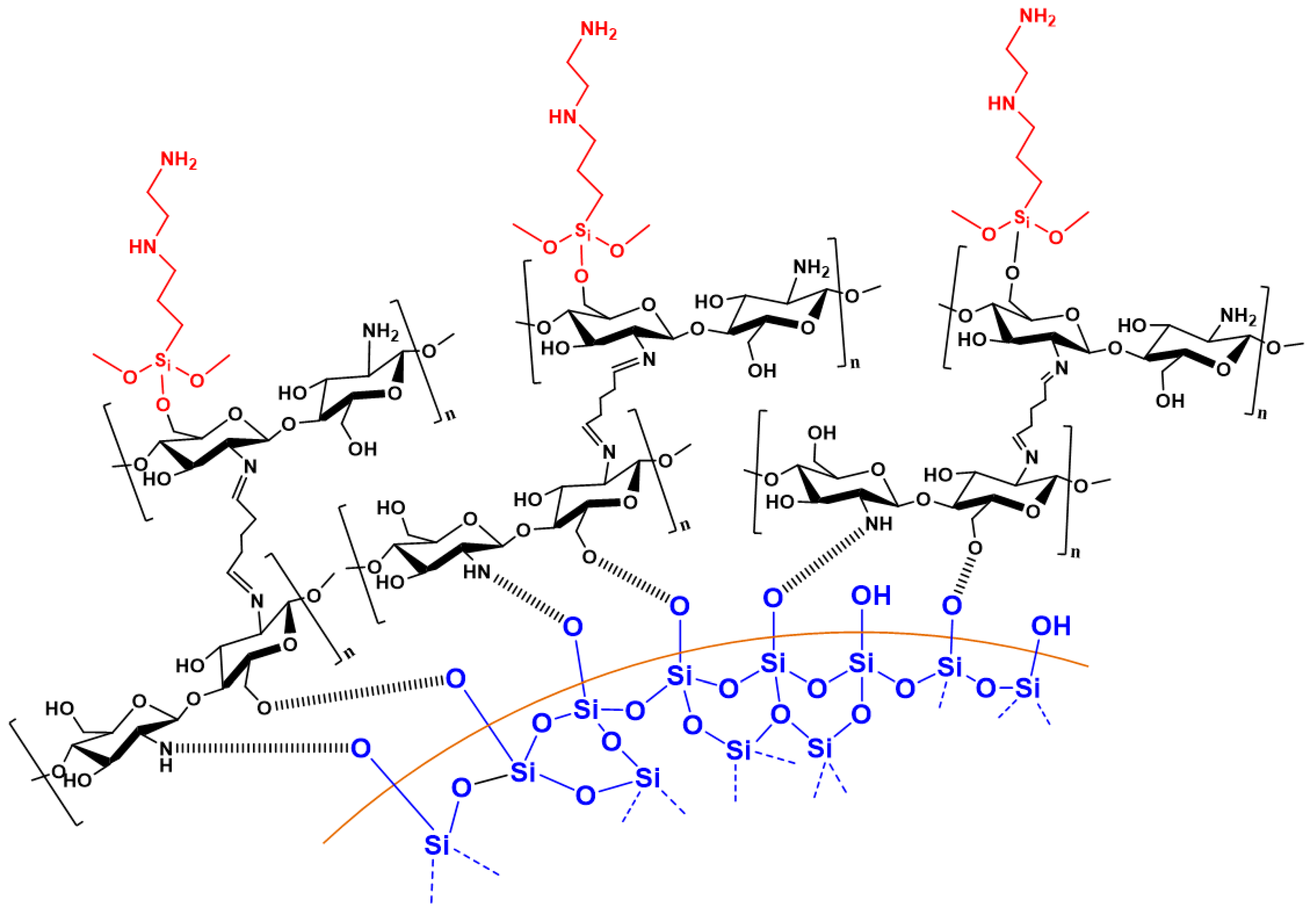
Hence, in this study, a novel strategy was developed to significantly improve the efficiency of chitosan-coated sand-based adsorbents in removing nitrate anions. This approach is based on a double chemical modification. Glutaraldehyde was used as a cross-linking agent, a crucial step in strengthening the polymer structure and ensuring its stability on the sandy support. On the other hand, chitosan was grafted with [3-(2-aminoethylamino) propyl] trimethoxysilane (AEAPTS) (Figure 1). This modification aims to enrich the surface of chitosan with amine functions, which are particularly reactive sites for capturing nitrate anions, thereby significantly increasing the adsorption capacity. Sand was chosen as the mineral support because it is widely available in Morocco. By coating its surface with amine-rich chitosan, a common material is transformed into a high-performance and durable adsorbent. Although the use of chitosan to functionalize sand for the removal of various chemical pollutants has been documented in the literature [34,35,36,37,38], to date, no study has reported functionalization specifically enriched with amine functions via AEAPTS for removal of nitrate. The main objective of this approach is to develop a durable and sustainable adsorbent that combines high performance with a low environmental footprint, using natural and biodegradable components. Chitosan is a biopolymer derived from crustacean waste that is biodegradable, biocompatible, and non-toxic, while sand is an abundant and inexpensive natural mineral carrier that requires no energy-intensive processing. Although glutaraldehyde—used as a cross-linking agent—is a reactive chemical, it is used in small quantities and reacts completely with the amino groups of chitosan to form stable imine bonds (C=N), as can be confirmed by the disappearance of the aldehyde C=O peak (~1730 cm−1) in the FTIR spectrum of the final composite. Excess glutaraldehyde is thoroughly removed by repeated washing with distilled water and ethanol prior to drying, ensuring that no free glutaraldehyde remains in the final material, thereby rendering any risk of leaching into treated water negligible. The resulting composite thus combines high adsorption performance with a composition based on naturally occurring and biodegradable materials, as well as a synthesis process that leaves no toxic residues in the final adsorbent.
Figure 1.
Structure of sand/glu/chit/AEAPTS composite.
2. Materials and Methods
2.1. Preparation of Sand/Glu/Chit
The sand is initially purified to remove any organic or mineral residues by rinsing abundantly with distilled water and drying at 60–80 °C for 24 h. Then, the sand is sieved to select a uniform particle size. In this study, a particle size of 100–300 µm was chosen. In parallel, the chitosan is dissolved in a acetic acid solution (1%) under magnetic stirring for 2 h, after which the solution is filtered to remove undissolved aggregates. The coating is applied by mixing dry sand (10 g) with chitosan solution (50 mL) and slowly stirring for 1 h to ensure homogeneous distribution of the biopolymer around the sand particles. The solvent is then partially evaporated at 50–60 °C with stirring until a uniform deposit is obtained. Next, 10 mL of glutaraldehyde solution (2%) is added to the wet sand–chitosan mixture, the reaction being maintained under light agitation for 4 h at room temperature to allow the formation of covalent bonds between the amino groups of the chitosan and the aldehyde functions of the glutaraldehyde, thus stabilizing the coating. Finally, after cross-linking, excess glutaraldehyde is removed by several washes with distilled water and ethanol, and the coated sand is dried at 60 °C for 24 h or in a vacuum to remove any residual moisture.
2.2. Preparing of Sand/Glu/Chit/AEAPTS
The sand/glu/chit/AEAPTS composite was prepared by mixing sand/glu/chit and AEAPES (2/1: w/w) in a mixture of ethanol-deionized water (4/1: v/v), and the mixture was heated to reflux at 90 °C for 5 h under mechanical stirring. The modified material was then washed with ethanol and dried at 60 °C for 24 h to obtain sand/glu/chit/AEAPTS.
2.3. Preparing Nitrate Solutions and Measuring Their Concentration
The nitrate stock solution is prepared by dissolving KNO3 (1.629 g, 99.5%) in 100 mL of distilled water, which yields a stock solution containing 1 g·L−1 of NO3. This solution is then diluted as needed. Nitrate concentrations in the aqueous solution were measured using the ultraviolet screen method using an UV-6000 UV Visible Spectrophotometer (Shanghai Metash Instruments Co., Ltd., Shanghai, China) at 275 [39]. To determine the nitrate ion concentration, HCl (1 mL, 1 M) was added to the water sample (50 mL) to exclude interfering ions, particularly carbonates and bicarbonates, which absorb UV radiation at wavelengths similar to those of nitrate. The addition of HCl converts them into CO2, which escapes. On the other hand, acidifying the sample to a controlled pH ensures constant ionic conditions for measurement with the spectrophotometer. The deionized water served as a control during analysis. Additionally, before the adsorption measurements, the adsorbent powder is filtered out of the solutions and the absorbance of the solution was measured at 275 nm to check for any interference caused by organic substances.
2.4. Adsorption and Desorption Study
The adsorption and desorption studies of NO3− anions using the sand/glu/chit/AEAPTS composite were investigated as a function of the controllable parameters, including solution pH, contact time, amount of adsorbent, and anion concentration at different temperatures according to the procedures reported in Supplementary Materials.
3. Results
3.1. Characterization of Materials
3.1.1. FTIR Spectroscopy
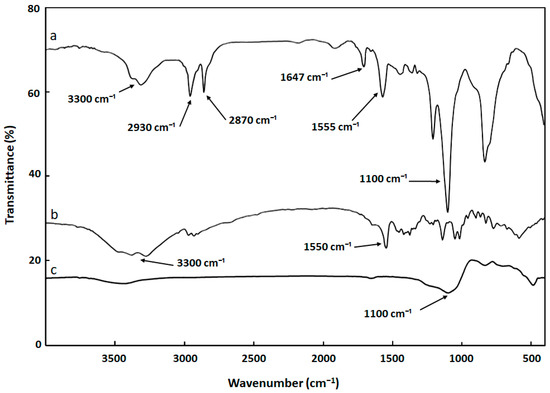
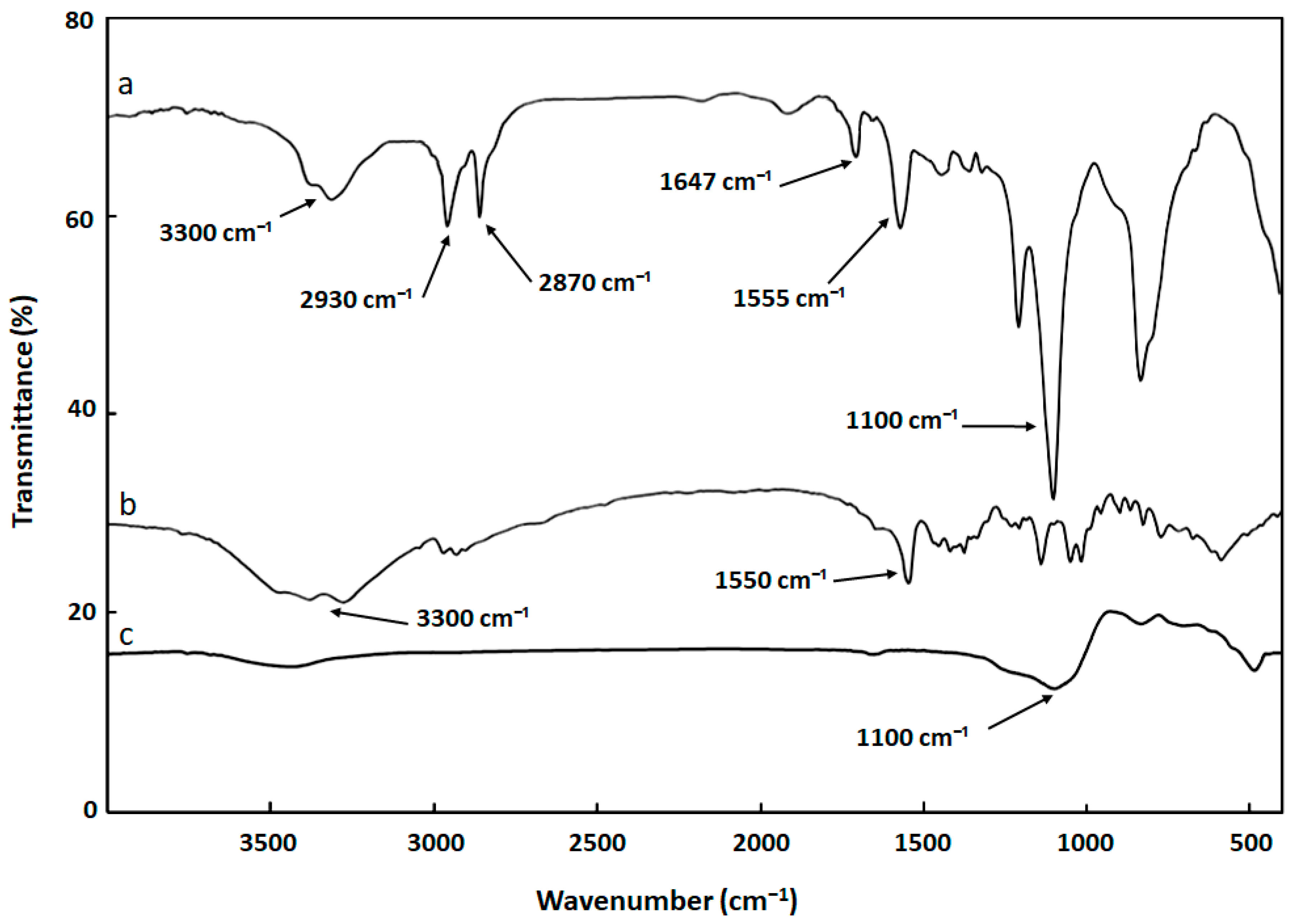
As reported in Figure 2, the FTIR spectrum of sand shows an intense peak characteristic of sand at around 1100 cm−1, which corresponds to the antisymmetric stretching vibration of Si-O-Si (Figure 2c). Chitosan shows a peak at 1550 cm−1 corresponding to the in-plane bending vibrations of the –NH2 group, as well as a broad band around 3300 cm−1 corresponding to free N-H elongation (Figure 2b). FTIR analysis of composite sand/glu/chit/AEAPTS (Figure 2a) reveals an intensification of the band around 1100 cm−1 corresponding to Si-O-C vibration due to AEAPTS and the Si-O-Si vibration of sand. The appearance of double peaks at 2930 and 2870 cm−1 confirms the presence of organic methylene chains derived from chitosan, AEAPTS and glutaraldehyde. The key evidence for glutaraldehyde cross-linking in this system is the disappearance of the C=O peak of the aldehyde (generally around 1730 cm−1) and the appearance of a distinct peak at approximately 1647 cm−1, characteristic of the stretching vibration of the imine bond (C=N) formed between the amines of chitosan and the aldehyde groups of glutaraldehyde. Furthermore, the N-H stretching around 1555 cm−1 shows a complex mass, distinct from the single peak of the primary amine of free chitosan, as well as the primary and secondary amines of AEAPTS.
Figure 2.
FTIR spectra of (a) sand/glu/chit/AEAPTS composite, (b) chitosan, and (c) sand.
3.1.2. EDX Characterization
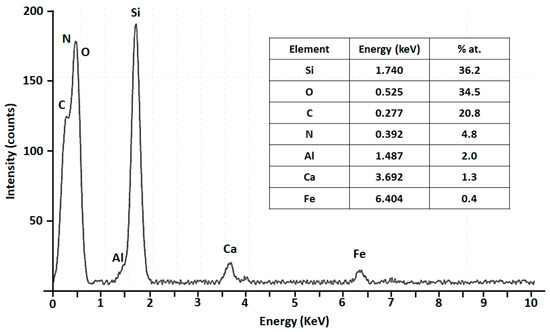
The EDX spectrum of the sand/glu/chit/AEAPTS composite (Figure 3) shows major peaks for silicon at 1.740 keV and oxygen at 0.525 keV, corresponding to 36.2% and 34.5% atomic content, respectively, confirming the dominant presence of the siliceous matrix (SiO2) constituting the sand substrate. The presence of carbon at 0.277 keV with a significant concentration of 20.8% atomic and nitrogen at 0.392 keV with a concentration of 4.8% clearly confirms the presence of the organic coating phase. The low-intensity peaks of aluminum, calcium and iron, representing 2.0%, 1.3% and 0.4%, respectively, correspond to mineral impurities naturally present in the sand and do not affect the structure of the composite. All of this EDX data confirms the successful preparation of the sand/glu/chit/AEAPTS composite in which sand constitutes the inorganic support, chitosan and AEAPTS provide the functionalized organic coating, and glutaraldehyde acts as a cross-linking agent, creating a stable three-dimensional network through the formation of imine bonds between the various organic components of the system.
Figure 3.
EDX spectra of sand/glu/chit/AEAPTS composite.
3.1.3. Zeta Potential
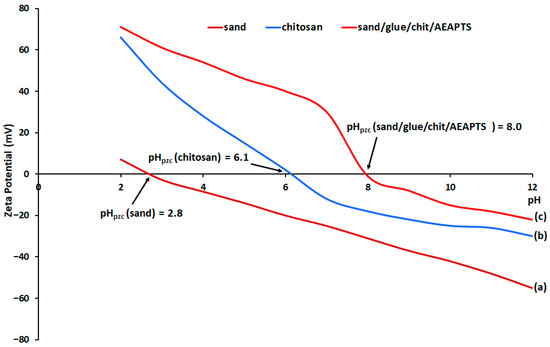
The three curves of the zeta potential as a function of pH show the distinct electrokinetic behaviors of the three materials: sand, chitosan and composite (Figure 4). Sand exhibited a strongly negative zeta potential in the pH range studied (2 to 12), varying around −60 mV. This indicates a stable negative surface charge and good electrostatic repulsion between particles, promoting colloidal stability regardless of pH. Conversely, chitosan retains a positive zeta potential at low pH (approximately +40 mV at pH 2), but lower than that of the composite. It reaches its isoelectric point at pH 6. At higher pH values, it acquires a negative charge, but without reaching the strongly negative values of sand. The composite combines the properties of both components. The curve shows behavior typical of a polycationic polymer. At an acidic pH (pH 2), its zeta potential is very positive (approximately +80 mV) due to the protonation of the amino groups. As the pH increases, this positive charge gradually decreases, passing through a zero-charge point at pH 8, to become negative in a basic environment. This charge reversal reflects the deprotonation of the amine functions. This charge reversal at low pH, which is not possible for sand alone, as well as the shift in the isoelectric point to a more acidic region than that of pure chitosan, clearly demonstrates that the sand particles are coated with a layer of chitosan/AEAPTS. This coating creates a hybrid surface with modulated amphoteric properties, confirming the successful synthesis of a composite material with surface characteristics distinct from those of its individual components.
Figure 4.
zeta potential of (a) sand, (b) chitosan, and (c) sand/glu/chit/AEAPTS composite.
3.2. Study of Nitrate Adsorption Capacity
3.2.1. Effect of Sand/Glu/Chit/AEAPTS on Nitrate Ion Adsorption
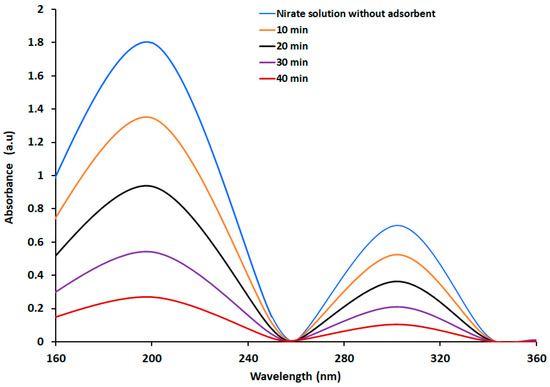
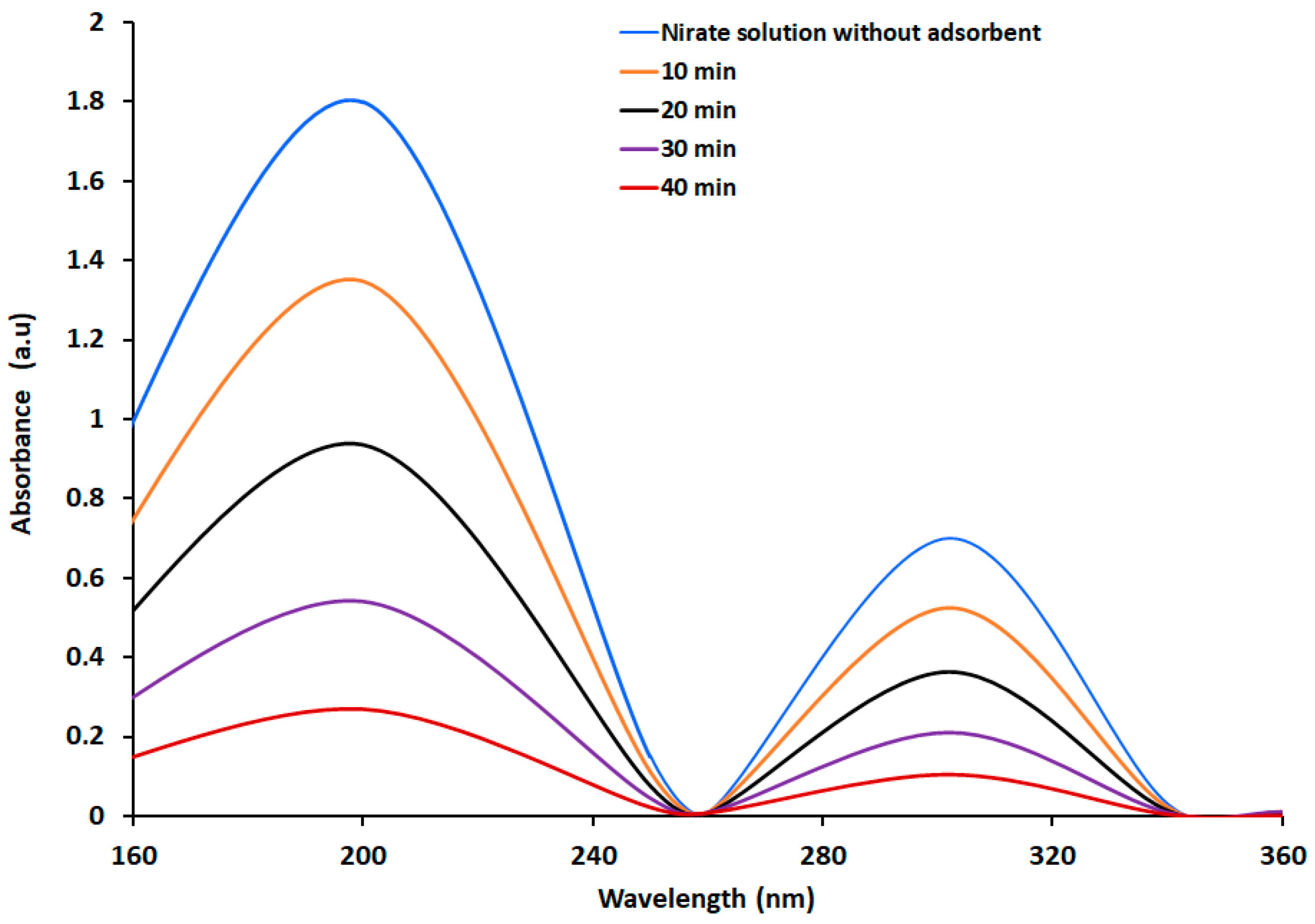
Prior to conducting the adsorption experiments, the effect of the presence of sand/glu/chit/AEAPTS on nitrate ion removal was investigated at a pH of 6—as indicated in our previous study—for various contact times. Figure 5 shows the UV–Visible absorption spectra of nitrate solutions recorded at different exposure times in contact with the adsorbent sand/glu/chit/AEAPTS. Two absorption bands characteristic of nitrate ions (NO3−) are clearly observed: a dominant peak at approximately 200 nm, attributed to the π → π* electronic transition, and a secondary peak around 302 nm, corresponding to the n → π* transition.
Figure 5.
UV-visible absorption spectra of NO3− ions recorded at different exposure times with the adsorbent sand/glu/chit/AEAPTS at pH6.
The blue curve, representing the nitrate solution without adsorbent, serves as the reference and exhibits the highest absorbance (~1.80 u.a. at 200 nm). As the exposure time increases from 10 to 40 min, a gradual and significant decrease in absorbance is observed for both peaks, in the following order: 10 min > 20 min > 30 min > 40 min. This systematic reduction in absorbance directly reflects the decrease in the concentration of nitrates remaining in solution, in accordance with Beer-Lambert’s principle, and thus confirms the effective removal of nitrate ions by the adsorbent over time. These results demonstrate that the presence of sand/glu/chit/AEAPTS in a nitrate solution effectively reduces the concentration of nitrate ions
3.2.2. Initial pH Effect
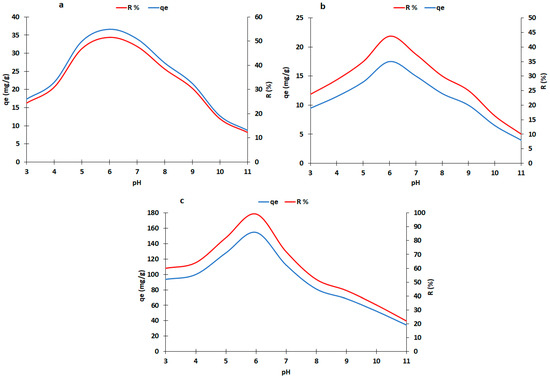
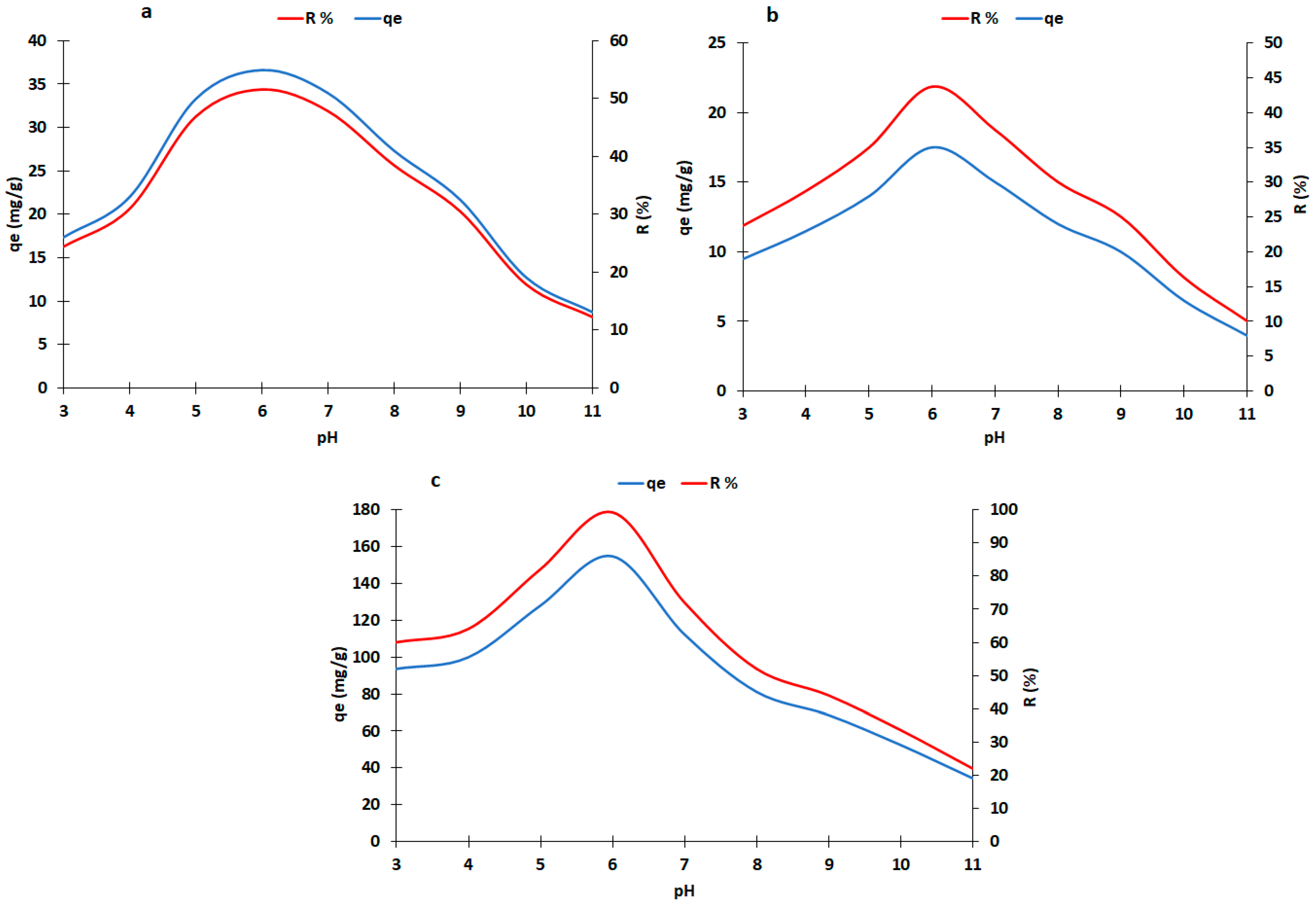
Analysis of the effect of pH on nitrate adsorption by Sand/glu/chit (Figure 6a), chitosan (Figure 6b) and sand/glu/chit/AEAPTS composite (Figure 6c) show that chitosan and Sand/glu/chit are capable of adsorbing nitrates, but with overall performance inferior to that obtained with the sand/glu/chit/AEAPTS composite, thus demonstrating the interest of grafting AEAPTS onto the surface of Sand/glu/chit. The study of the effect of pH, ranging from 3 to 11, on the absorption capacity (qe) and removal efficiency (R%) of nitrate ions using a sand/glu/chit/AEAPTS composite during a contact time of 120 min reveals characteristic behavior closely linked to the zero-charge point (pHpzc) of the adsorbent, which is 8. The results of Figure 6c show that adsorption capacity and efficiency exhibit similar changes with pH, reaching optimal performance at a slightly acidic pH of 6. At pH 3, the initial values of qe and R% are approximately 80 mg g−1 and 50%, respectively. When the pH gradually increases from 3 to 6, a significant increase in both parameters is observed, reaching their maximum values around pH 6, with an adsorption capacity of approximately 155 mg g−1 and an efficiency approaching 99% (R%). This improvement in adsorption in an acidic environment can be explained by the fact that at pH values below pHpzc (pH < 8), the surface of the adsorbent is positively charged, which promotes electrostatic attraction with negatively charged nitrate ions (NO3−). At the same time, the sharp decrease in the sorption of nitrates, which also occur at low pH, may be due to the competitive effect between NO3- ions and Cl− ions resulting from the addition of HCl to adjust the pH, as well as from possible over-protonation of the amine groups, which may reduce their accessibility.
Figure 6.
pH effect on the adsorption of nitrates by (a) Sand/glu/chit (b) chitosan and (c) sand/glu/chit/AEAPTS composite.
At pH values above 6, the adsorption capacity and efficiency decrease gradually but significantly. At pH 8, which corresponds to the isoelectric point of the adsorbent, the surface becomes electrically neutral, thereby reducing favorable electrostatic interactions. This decrease continues significantly as the pH further increases to basic values. At pH 11, the values drop dramatically to around 35 mg g−1 for qe and only 20% for R%. This sharp decline in a basic environment can be explained by the fact that above pHpzc, the surface of the adsorbent becomes negatively charged, creating electrostatic repulsion with nitrate ions. In addition, the increased presence of hydroxyl ions (OH−) in a basic environment intensifies competition with nitrate ions for available adsorption sites. In summary, it can be concluded that the optimum pH for nitrate ion adsorption is around 6 in a slightly acidic environment, where the electrostatic interactions between the positively charged surface of the adsorbent and the nitrate ions are at their maximum, thus achieving the best removal efficiency. For this reason, a pH of 6 was chosen for the rest of the study.
3.2.3. Contact Time Effect
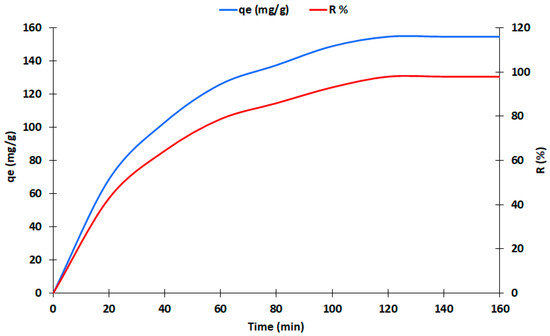
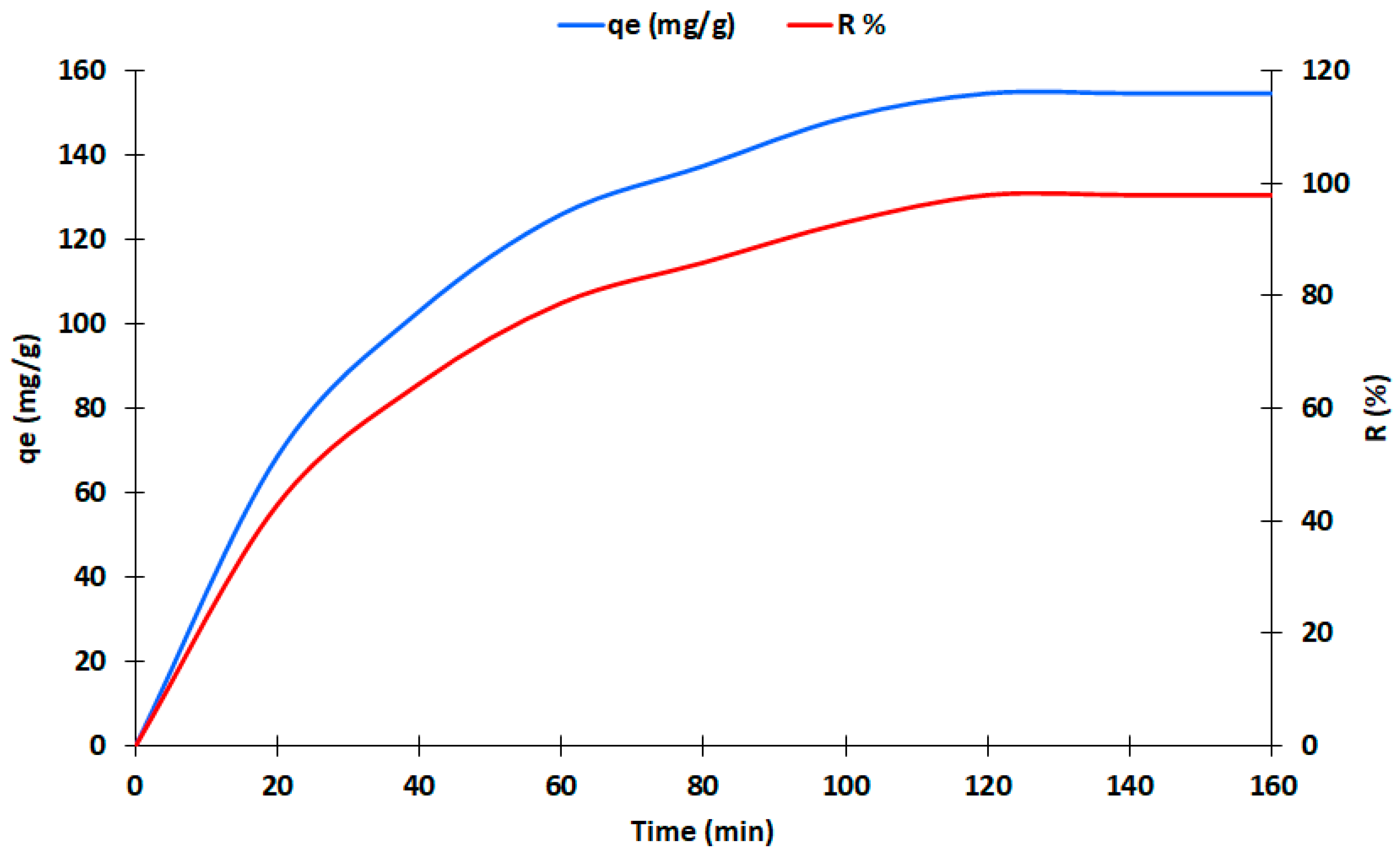
The study of the effect of contact time (Figure 7) on nitrate adsorption by the sand/glu/chit/AEAPTS composite reveals a three-phase process resulting in the near-total elimination of pollutants. The process initially involves an extremely rapid adsorption phase during the first 60 min, during which the adsorption capacity reaches 126.12 mg g−1, corresponding to 78.82% nitrate removal. This initial rapid kinetics, with a maximum rate of 3.43 mg g−1 min−1 observed in the first 20 min, can be explained by the immediate electrostatic attraction between the positively charged surface of the adsorbent (protonated amino groups -NH3+ in a slightly acidic environment at pH 5.5) and the negatively charged nitrate ions. The easily accessible active sites on the surface are quickly saturated during this period. The second phase, extending from 60 to 120 min, is characterized by a gradual decrease in adsorption, with the rate gradually decreasing from 2.10 to 1.28 mg g−1 min−1. During this period, nitrate ions must reach the less accessible internal sites by penetrating further into the porous structure of the adsorbent, which reduces the mass transfer rate. After 120 min, thermodynamic equilibrium is reached, with a maximum adsorption capacity of 154.79 mg g−1 and a removal efficiency of 98%, indicating complete saturation of all available active sites. The third phase, observed between 120 and 160 min, shows a fully stable plateau with no variation in adsorption capacity or removal efficiency. This stabilization indicates that equilibrium has been reached with no further adsorption possible.
Figure 7.
Contact time effect on the adsorption of nitrates by sand/glu/chit/AEAPTS composite.
3.2.4. Effect of Adsorbent Dose
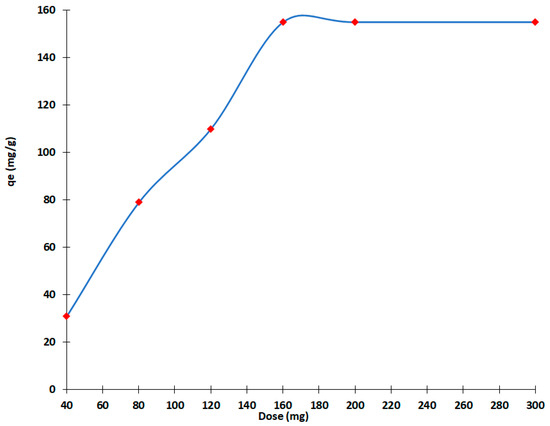
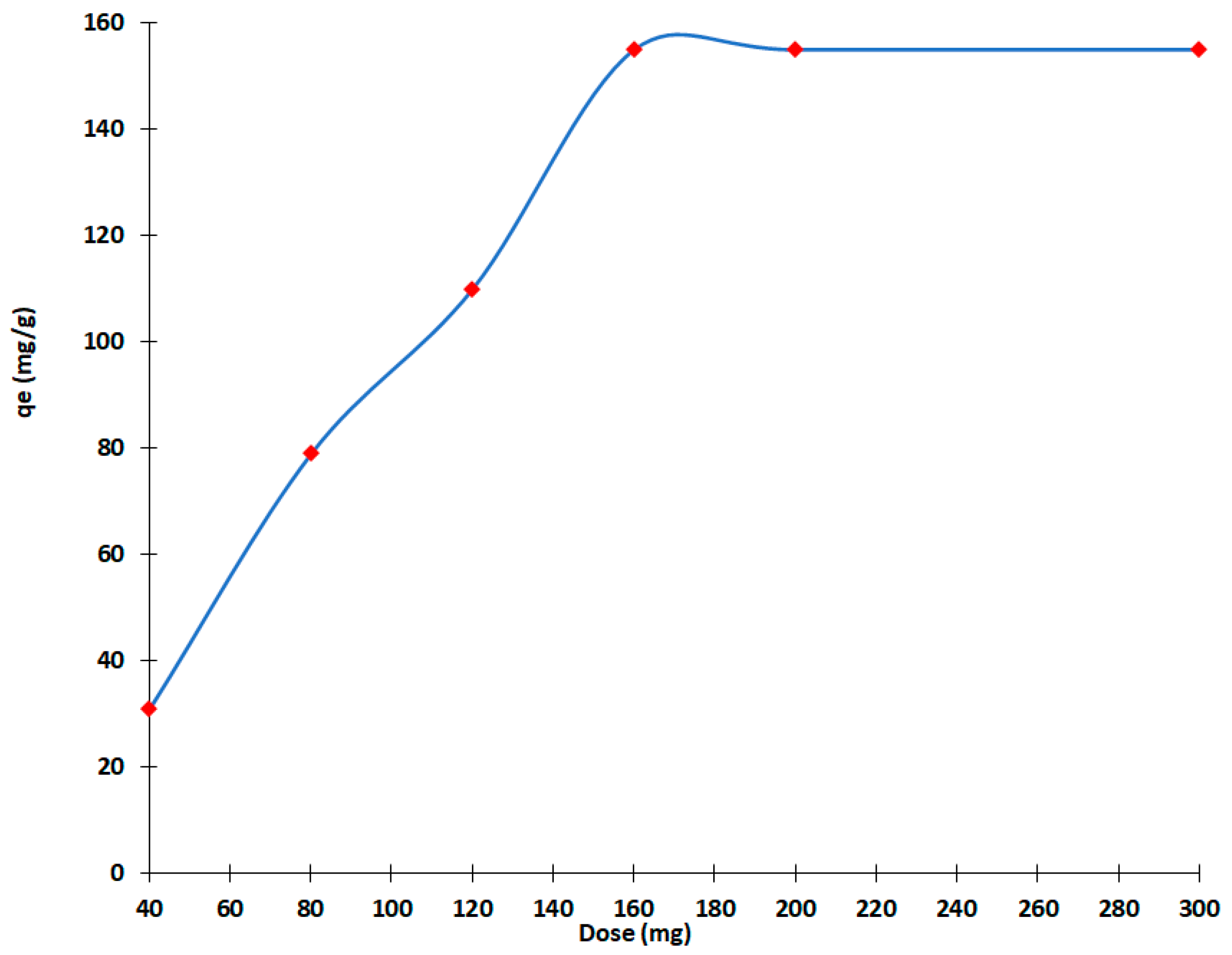
Analyzing the effects of dosage on nitrate ion removal shows that the adsorption coefficient (qe) for nitrate varies considerably depending on the amount of adsorbent used. As shown in Figure 8, at low doses, on the order of 40 mg of adsorbent, the adsorption capacity is relatively modest, on the order of 30 mg g−1. This value then increases gradually and markedly as the adsorbent dose increases, reaching approximately 80 mg g−1 at a dose of 80 mg, then 110 mg g−1 at 120 mg. The most significant increase occurs in this initial range, characterized by a steep slope of the curve, indicating increasing efficiency of the adsorption process. A critical inflection point is reached at around 160 mg of adsorbent dose. In this stage, the adsorption capacity reaches approximately 155 mg g−1, indicating that the adsorption capacity has reached a saturation plateau.
Figure 8.
Effect of Adsorbent Dose on the adsorption of nitrates by sand/glu/chit/AEAPTS composite.
Exceeding this optimal dose, further increases in the amount of adsorbent do not result in any significant changes in adsorption capacity. In fact, for both 200 mg and 300 mg doses, the qe value remains stable at around 155–156 mg g−1, reaching a plateau and thus indicating that the system is saturated. This behavior can be explained by the fact that, initially, increasing the adsorbent dose increases the number of active sites available for nitrate ion binding, thereby promoting adsorption. However, when the optimal dose is reached, all available nitrate ions in solution are adsorbed, and adding more adsorbent becomes ineffective, as the additional sites remain unoccupied. This optimal dose of 160 mg therefore represents the balance between maximum efficiency and material economy, beyond which no further increase in adsorption is observed.
3.2.5. Effect of the Contact Time and Initial Concentration of Nitrate
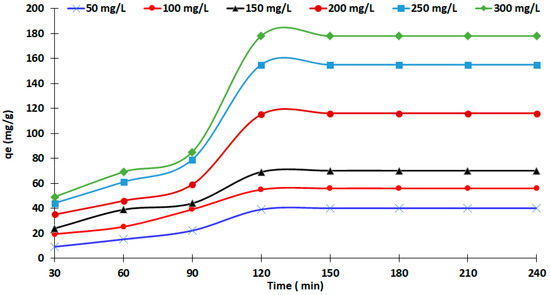
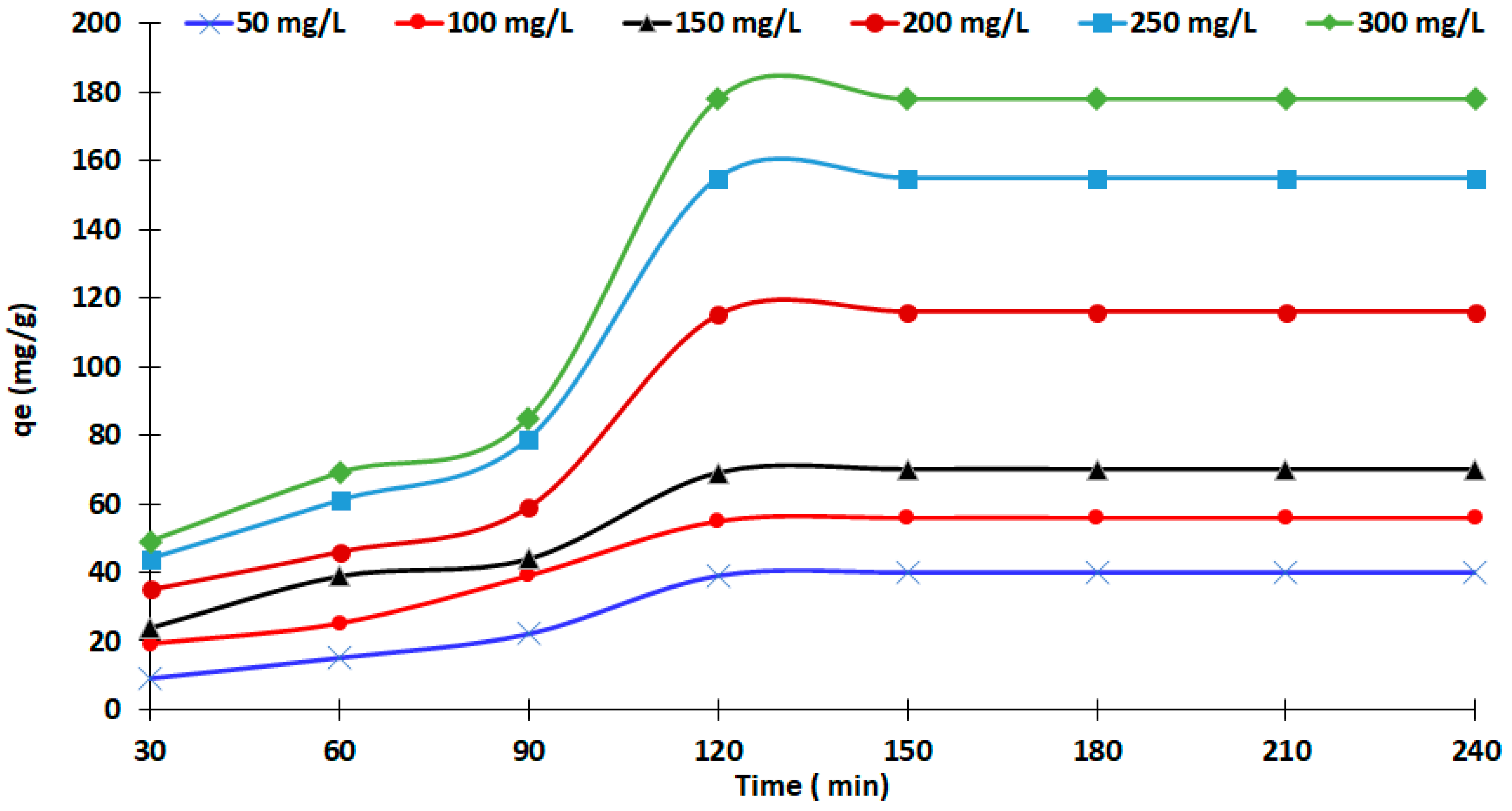
Figure 9 illustrates the evolution of nitrate ion adsorption capacity as a function of contact time and initial concentration. Analysis of the six concentrations tested (ranging from 50 to 300 mg/L) reveals a similar kinetic behavior occurring in three successive phases. The first phase, occurring between 15 and 45 min, shows a slow and gradual increase in adsorption with relatively low qe values. This period corresponds to the initial contact phase, where the adsorption process begins without reaching full capacity. The second phase, between 45 and 60 min, is the most significant stage of the process, with a very rapid increase in adsorption capacity. The curves exhibit steep slopes, indicating that the majority of adsorption occurs during this short 15 min period. It is at this point that nitrate ions are captured in large quantities by the active sites of the adsorbent. The third phase begins after 60 min and is characterized by the establishment of a plateau where the qe values stabilize completely. This stabilization indicates that adsorption equilibrium has been reached, with the active sites being saturated or the residual concentration becoming insufficient to continue adsorption. The maintenance of this plateau up to 180 min confirms that 60 min represents the optimal contact time. The impact of the initial concentration is also very significant. There is a directly proportional correlation between the initial concentration and the final adsorption capacity. Low concentrations of 50 mg L−1 and 100 mg L−1 result in modest capacities of around 30 and 55 mg g−1, while high concentrations of 250 mg L−1 and 300 mg L−1 reach 155 and 178 mg g−1, respectively. This increase can be explained by a higher concentration gradient, which promotes mass transfer and increases the probability of collision between nitrate ions and the active sites of the adsorbent.
Figure 9.
Effect of the contact time and initial concentration of nitrate on the adsorption of nitrates by sand/glu/chit/AEAPTS composite.
3.2.6. Effect of Temperature
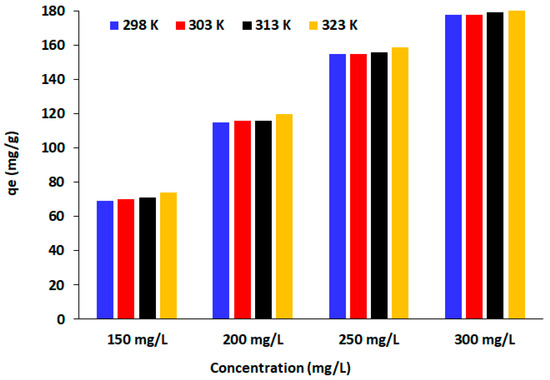
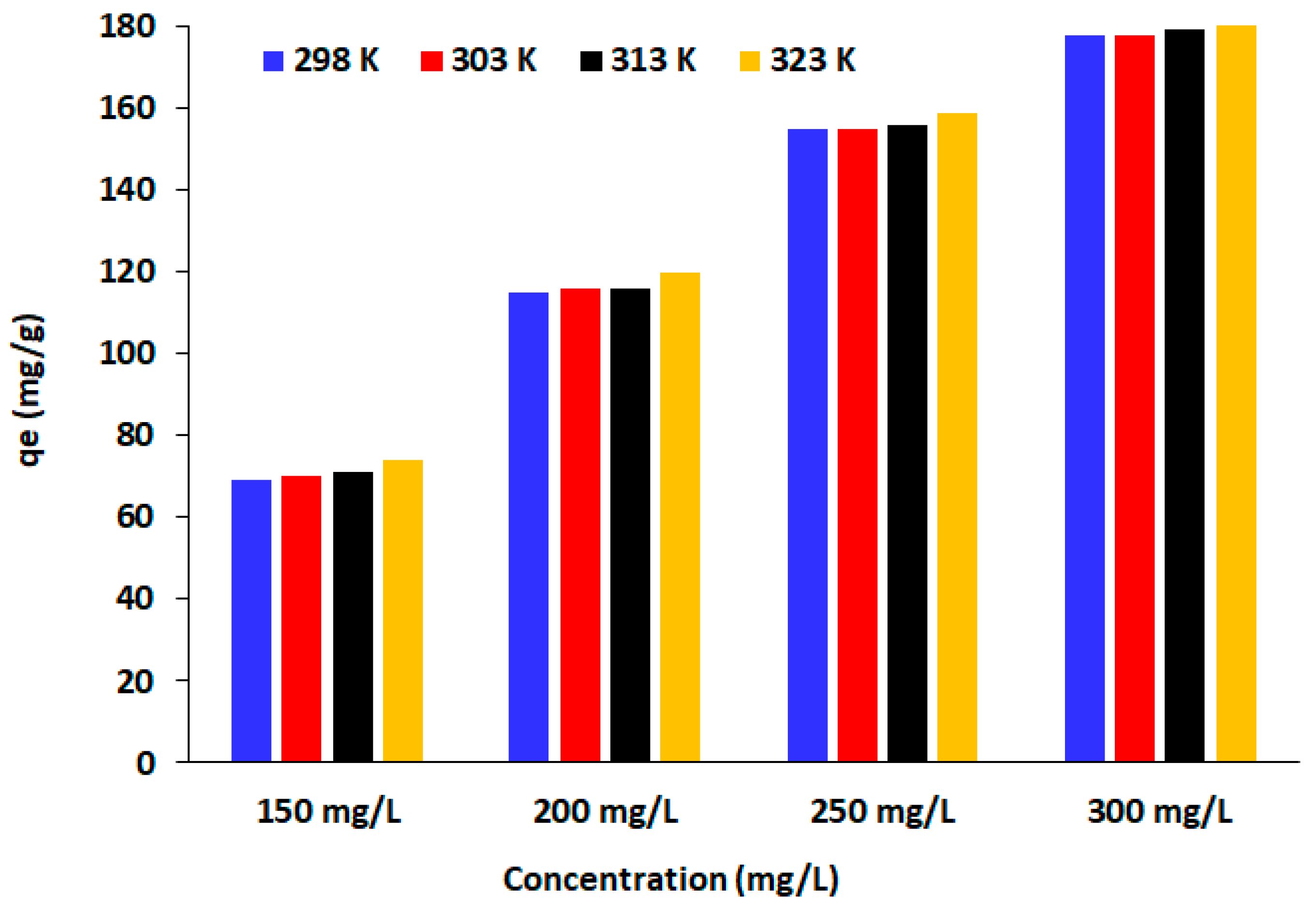
The study of the effect of temperature on nitrate ion adsorption (Figure 10) reveals that the influence of temperature on adsorption capacity is relatively low. For all concentrations tested, the increase in temperature from 298 K to 323 K results in only a modest improvement in adsorption capacity, not exceeding 5 to 7 mg g−1. For example, at 150 mg L−1, the values increase from 68 to 75 mg g−1, while at 300 mg L−1, they increase from 177 to 182 mg g−1, representing a variation of less than 5% in both cases. This small increase with temperature suggests a weakly endothermic process. Temperature promotes ion mobility and improves their diffusion to the active sites of the adsorbent. However, the effect of initial concentration remains the dominant factor, with a dramatic increase in adsorption capacity when moving from 150 to 300 mg L−1, regardless of temperature. This low thermal dependency offers a significant practical advantage, as the system can operate efficiently at varying ambient temperatures without requiring strict thermal control, which opens up new possibilities for industrial applications. In summary, although temperature has a slightly positive effect, it is not a critical parameter in the nitrate ion adsorption process.
Figure 10.
Effect of the temperature on the adsorption of nitrates by sand/glu/chit/AEAPTS composite.
3.2.7. Effect of Aggressive Co-Anions
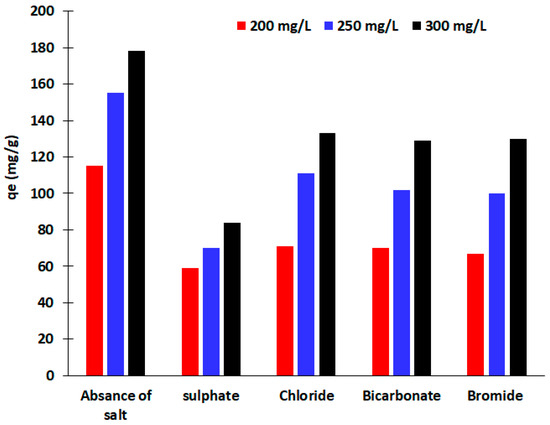
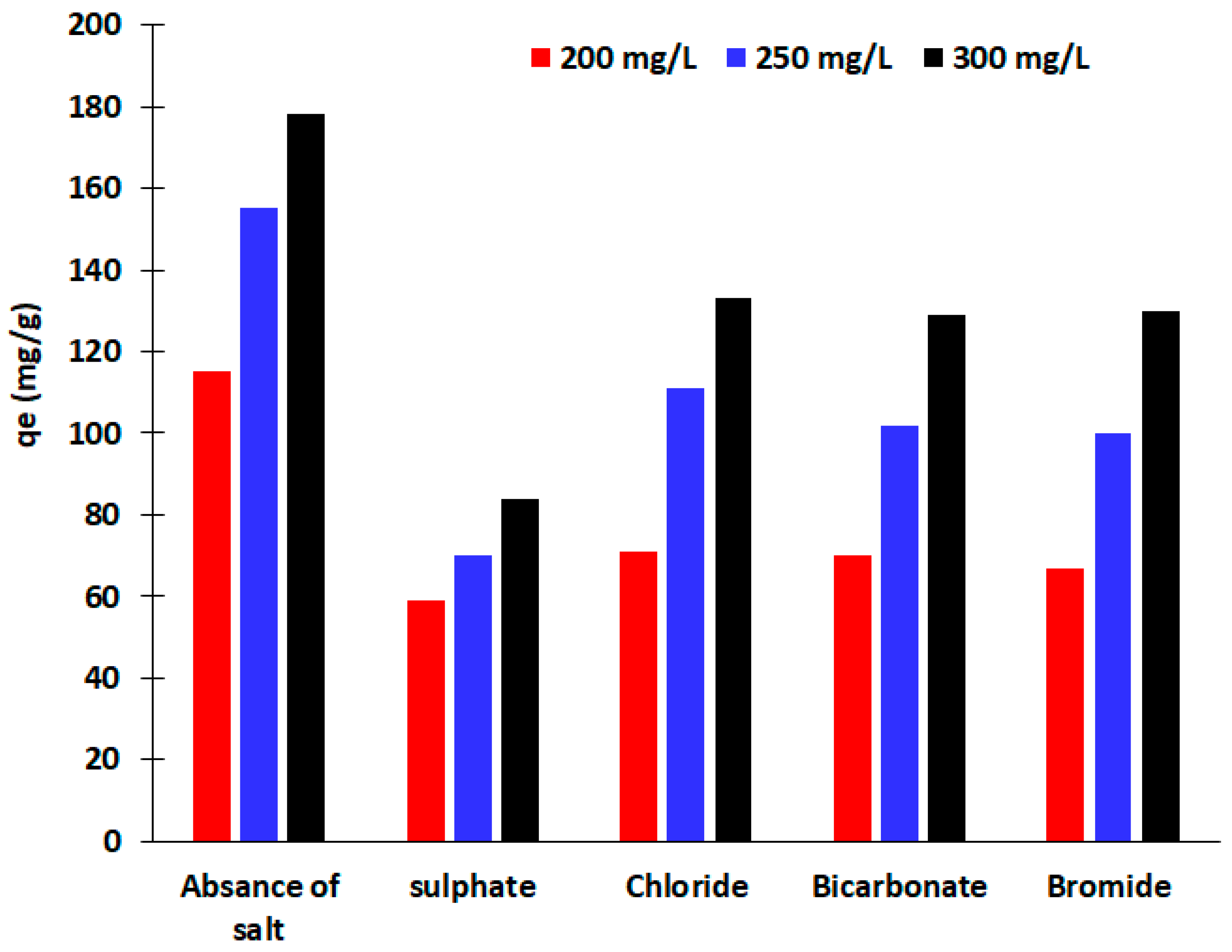
The influence of competing ions on nitrate adsorption was studied by adding separately sulfate, chloride, bicarbonate, or bromide salts at an equimolar concentration of 5 mM. The tests were conducted at three initial nitrate concentrations (200, 250, and 300 mg L−1), and the results were compared with those obtained in the absence of competing ions. As reported in Figure 11, in the absence of salts, the system achieves maximum performance with adsorption capacities of 115.33, 155.12 and 178.27 mg g−1 for the three respective concentrations. The addition of counterions systematically causes a significant decrease in these capacities. Sulphate ions have the most severe inhibitory effect, reducing adsorption capacity by approximately 50% for all concentrations. This strong inhibition can be explained by their bivalent nature (SO42−), which gives them a higher affinity for the active sites of the adsorbent, thus blocking access to monovalent nitrate ions. Chloride, bicarbonate and bromide ions have moderate and similar competitive effects, reducing adsorption capacity by 25 to 40%. Although monovalent like nitrates, they compete directly for the same adsorption sites. The order of influence observed is sulphate > bicarbonate ≈ chloride ≈ bromide. These results are crucial for practical applications because natural waters generally contain a mixture of anions. The presence of these competing ions, particularly sulfates, significantly reduces the efficiency of nitrate removal by sand/glu/chit/AEAPTS and requires strategies to address this effect under real-world water conditions. In this regard, three operational strategies are proposed: optimizing the pH to slightly acidic values to maximize the protonation of amine groups and increase the density of available binding sites; designing sequential treatment systems incorporating a selective sulfate pretreatment step upstream of the nitrate adsorption unit (nanofiltration, ion exchange, or controlled precipitation); and the use of fixed-bed column configurations that allow for the optimization of operational parameters and selective regeneration cycles, in which alkaline or high-ionic-strength solutions preferentially desorb sulfates and restore surface sites for subsequent nitrate capture.
Figure 11.
Effect of the aggressive co-anions on the adsorption of nitrates by sand/glu/chit/AEAPTS composite.
3.3. Bibliographic Comparison of the Performance of Sand/Glu/Chit/AEAPTS Composite
The adsorption capacity of the sand/glu/chitin/AEAPTS composite was compared to that of several adsorbents reported in the literature for the removal of nitrate ions. As shown in Table 1, the sand/glu/chit/AEAPTS composite achieved a qe value of 155 mg g−1, which is among the highest values reported under comparable operating conditions. We note that a quantitative comparison of qe values of different materials is inherently limited. This is because adsorption performance depends on a combination of factors, including surface chemistry, the density of functional groups, and textural properties such as porosity and specific surface area, as well as experimental conditions such as pH, initial pollutant concentration, and contact time. The comparison presented in Table 1 is therefore not intended to establish an absolute ranking, but rather to provide a general reference based on similar operating conditions, particularly the pH range (acidic to neutral, pH 5–7), which is a key parameter governing nitrate adsorption. In this context, the relatively high adsorption capacity of the sand/glu/chit/AEAPTS composite can be attributed primarily to the presence of AEAPTS functional groups on its surface, which provide a high density of amine sites capable of forming strong electrostatic interactions with nitrate ions, rather than to an exclusive reliance on the material’s textural properties. These results suggest that surface functionalization has a major role in the adsorption performance of the developed composite.
Table 1.
Comparison of Nitrate Adsorption Capacities of sand/glu/chit/AEAPTS composite with Other Reported Adsorbents.
3.4. Adsorption Isotherms
The parameters of the isotherms of adsorption were realized at three different temperatures (303 K, 313 K and 323 K) by applying five classical isotherm models. As reported in Table 2, comparative analysis of the coefficients of determination (R2) reveals that the Langmuir model provides the best fit to the experimental data, with the highest values of R2 ranging from 0.998 to 0.999. This excellent correlation strongly suggests that nitrate adsorption occurs mainly in a monolayer on homogeneous sites of the adsorbent, with progressive saturation until a well-defined maximum capacity is reached. Furthermore, the increase in maximum adsorption capacity (qmax) from 155.123 to 158.851 mg g−1 and in the Langmuir constant (KL) from 0.045 to 0.052 L mg−1 with rising temperature clearly indicates that the adsorption process is endothermic in nature, i.e., favored by the input of heat. The Freundlich model, which describes adsorption on heterogeneous surfaces, also shows a good fit with R2 values ranging from 0.951 to 0.964, but remains inferior to Langmuir. Nevertheless, nF parameter values around 4.6 confirm that adsorption is favorable. However, the slightly lower performance of this model compared to Langmuir suggests that surface heterogeneity is not the dominant factor in this system. The Temkin and Sips models show average fits with respective R2 values of 0.885–0.895 and 0.912–0.938, indicating that they are less suitable for describing this specific adsorption system. In addition, the application of the Dubinin–Radushkevich model provides important information about the nature of the adsorption mechanism. The calculated adsorption energies, ranging from 3.985 to 4.352 kJ mol−1, are all less than 8 kJ mol−1, which clearly indicates physical adsorption (physisorption) rather than chemisorption. This result implies that the interactions between nitrate ions and the adsorbent are mainly Van der Waals forces and weak electrostatic interactions, making the process reversible and requiring little energy. In summary, this study demonstrates that nitrate ion adsorption mainly follows the Langmuir model, characterizing an endothermic physisorption process in a monolayer on homogeneous sites. The adsorbent has an excellent maximum adsorption capacity of approximately 156–159 mg g−1, which improves with increasing temperature. These results suggest that this adsorbent could be effectively used for the removal of nitrates in solution, particularly at moderately high temperatures where performance is optimal. We note that the high adsorption capacity of the composite can be attributed to its dual functionalization. In fact, the grafting of AEAPTS introduces additional primary and secondary amine groups (–NH2, –NH–) which, at pH 6, protonate to form high-density cationic sites ((–NH2+–, –NH3+) exhibiting a strong electrostatic affinity for NO3−. This is supported by EDX data (N content: 4.8% by weight) and by the excellent fit of the Langmuir curve (R2 = 0.998–0.999, qmax = 155–159 mg g−1).
Table 2.
Isotherms of sand/glu/chit/AEAPTS composite for Nitrate Adsorption.
3.5. Adsorption Kinetics
The kinetic study of nitrate ion adsorption on functionalized chitosan, carried out at three initial concentrations (200, 250 and 300 mg L−1), reveals a complex multi-step process whose mechanism has been explained by applying four kinetic models (Table 3). The equilibrium adsorption capacities logically increase with the initial concentration, rising from 115.33 to 178.27 mg g−1, reflecting a gradual saturation of the available active sites. Comparative analysis of the models clearly shows that the pseudo-second-order model best describes the adsorption kinetics, with high coefficients of determination above 0.99 and calculated capacities corresponding to the experimental values with less than 1% of difference. This excellent correlation indicates that the adsorption rate is controlled by the specific interaction between nitrate ions and the ammonium groups of chitosan and grafted ethylenediamine, probably involving partial dehydration and the formation of electrostatic bonds as the limiting process. The decrease in K2 with increasing initial concentration supports this interpretation, because it reflects a gradual occupation of high-affinity sites, which is physically significant. On the other hand, the pseudo-first-order model performs significantly lower, with moderate correlation coefficients of approximately 0.95 and calculated capacities underestimated by 35–40% compared to experimental values, confirming that the simple occupation of surface sites is insufficient to explain the observed kinetics. The Elo-vich model yields intermediate results with R2 values of approximately 0.91, revealing that surface energy heterogeneity plays a secondary role, while the increase in the α parameter with concentration confirms that higher concentrations initially accelerate the process due to a larger concentration gradient. Analysis using the Weber–Morris intraparticle diffusion model reveals the existence of two distinct kinetic phases: an initial rapid phase of adsorption at external sites and within the macropores, characterized by high-rate constants Kᵢd and accounting for approximately 60% of the total adsorption capacity, followed by a second, much slower phase of diffusion within the internal micropores of the adsorbent, approximately 25 to 40 times slower than the first phase.
Table 3.
Kinetics parameters of sand/glu/chit/AEAPTS composite for nitrate adsorption.
This biphasic nature of the process implies that initial adsorption is rapid and allows a significant fraction of the capacity to be reached in a few minutes, but that complete equilibrium requires much longer contact times, potentially lasting for several hours, due to slow diffusion in the tortuous pores of the swollen polymer. The small decrease in the pseudo-second-order rate constant K2 with increasing concentration suggests a progressive saturation effect where high-affinity sites are preferentially occupied, forcing adsorption onto less energetically favorable sites with slower kinetics. All of these kinetic results are perfectly consistent with previous thermodynamic data showing an entropy-controlled endothermic process, confirming that the overall adsorption mechanism involves partial dehydration of nitrate ions followed by specific electrostatic interactions with ammonium groups, with a kinetic limitation imposed by intra-particle diffusion for reaching final equilibrium.
3.6. Adsorption Thermodynamics
The thermodynamic study of nitrate ion adsorption on the sand/glu/chit/AEAPTS composite reveals a spontaneous and thermodynamically favorable process at all temperatures studied (Table 4), as confirmed by the negative values of Gibbs free energy, ranging from −6.34 kJ mol−1 at 303 K to −7.21 kJ mol−1 at 323 K. This gradual increase in spontaneity with temperature is characteristic of a process in which entropy plays a decisive and dominant role. The positive enthalpy of 6.94 kJ mol−1 classifies this process as an endothermic reaction, indicating that the adsorption requires a net energy input. This enthalpic cost is primarily attributable to the partial dehydration of nitrate ions prior to surface complexation: the structured water molecules constituting the NO3− hydration layer must be progressively displaced before the ion can access the protonated ammonium groups (―NH3+) of the chitosan backbone and the grafted ethylenediamine, and coordinate with them. The moderate magnitude of this value (< 20 kJ mol−1) is consistent with a non-covalent adsorption mechanism in which no electron transfer or formation of strong chemical bonds occurs. While both statements are true, they describe different aspects of the same mechanism: the low ΔH° reflects the reversible, non-covalent nature of the nitrate–surface interaction, whereas the chemical specificity of the process is encoded in the identity of the binding partners—protonated ammonium groups and nitrate ions—rather than in the magnitude of the enthalpy alone. It would therefore be simplistic to interpret this low ΔH° value as indicative of purely non-specific physisorption induced by weak Van der Waals forces. The calculated enthalpy represents the net thermodynamic result of a multi-step process—including endothermic dehydration, exothermic electrostatic bonding between nitrate and ammonium groups, and partial restructuring of the surface hydration layer—rather than a direct measure of the nitrate–surface bond energy alone. Therefore, this low value reflects a partial enthalpic compensation between these competing contributions, rather than the weakness of the interaction itself. This interpretation is supported by the high adsorption capacities obtained (up to 178.27 mg g−1), the marked selectivity for nitrate ions, and the excellent agreement between the experimental data and the pseudo-second-order kinetic model—all of which are incompatible with a purely nonspecific physical process. The most significant thermodynamic result of this study is the strongly positive adsorption entropy of 43.65 J·mol−1·K−1, which reflects a substantial increase in molecular disorder during the adsorption process. This entropy gain results primarily from the release of water molecules from the nitrate ion’s solvation sphere: as they move out of the structured hydration layer, these molecules are released as bulk-free water, generating a considerable increase in the system’s degrees of translational and rotational freedom. The increase in disorder associated with this release largely compensates for the loss of configurational entropy that accompanies the immobilization of nitrate ions on the adsorbent surface. The resulting entropic driving term TΔS°, which ranges from 13.23 to 14.10 kJ mol−1 over the studied temperature range, far exceeds the enthalpic penalty of 6.94 kJ mol−1, which explains the overall spontaneity of the process despite its endothermic nature. The increasing predominance of the entropic contribution with rising temperature provides a thermodynamically consistent explanation for the progressive improvement in adsorption favorability observed at high temperatures and is fully consistent with the endothermic nature of the partial dehydration step identified as the rate-determining energy barrier. In general, the thermodynamic parameters point to a unified mechanistic model: the adsorption of nitrates onto the sand/glue/chitin/AEAPTS composite is an entropy-driven process governed by specific electrostatic interactions between partially dehydrated nitrate ions and protonated amine groups present on the functionalized surface. This process is non-covalent and reversible—which is consistent with the low value of ΔH°—but chemically specific and energetically significant, as evidenced by the system’s high capacity, selectivity, and kinetic behavior. This characterization resolves the apparent tension between the low enthalpy and the high performance of the adsorbent, and provides a rigorous thermodynamic basis for the mechanistic interpretation.
Table 4.
Thermodynamic parameters of sand/glu/chit/AEAPTS composite for nitrate adsorption.
3.7. Adsorption Mechanism
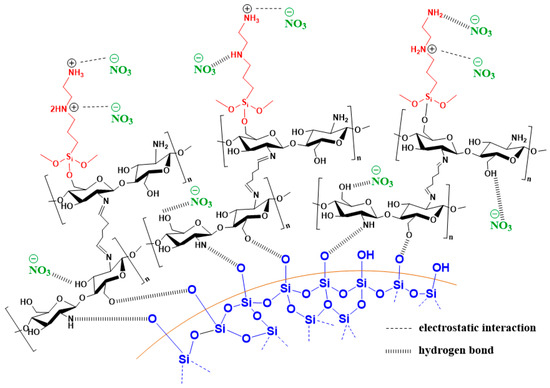
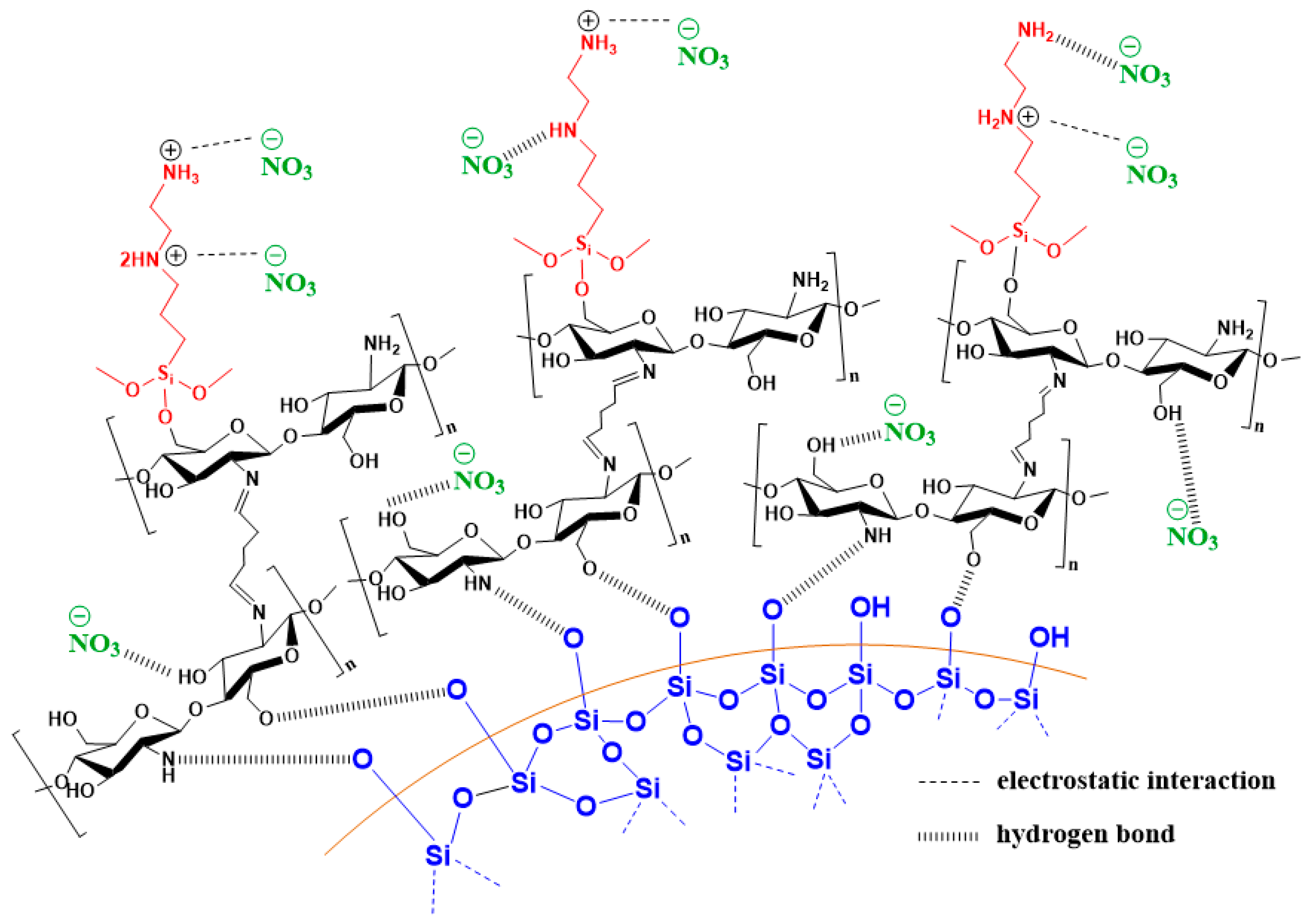
The mechanism of nitrate ion adsorption on the sand/glu/chit/AEAPTS composite involves a series of interconnected physicochemical steps (Figure 12). In an aqueous environment, the amino groups of chitosan and grafted ethylenediamine protonate to form positively charged ammonium groups (―NH3+ and ―NH2+―), creating a cationic surface that electrostatically attracts negatively charged nitrate ions. The process begins with the diffusion of hydrated nitrate ions from the bulk solution to the adsorbent surface, followed by the critical step of partial dehydration, during which the water molecules surrounding the nitrate ion are progressively displaced. This step consumes energy corresponding to the positive endothermic enthalpy of 6.94 kJ mol−1. Once partially dehydrated, the nitrate ion establishes direct electrostatic interactions with surface ammonium groups according to the ―NH3+···−O3N scheme, supplemented by secondary hydrogen bonds with unprotonated amino groups and hydroxyl functions of chitosan. The water molecules released during dehydration disperse freely into the bulk solution, generating a considerable entropic gain of 43.65 J mol−1 K−1, which constitutes the main thermodynamic driving force behind the spontaneity of the process despite its endothermic nature. This entropic contribution far exceeds the enthalpic cost and becomes increasingly dominant as the temperature rises, which consistently explains the gradual increase in adsorption tendency observed at high temperatures. The adsorption energies calculated from the Dubinin–Radushkevich (D–R) model (E = 3.98–4.35 kJ mol−1) are below the 8 kJ mol−1 threshold usually associated with physisorption, which may seem incompatible with the specific electrostatic mechanism described above. However, this apparent contradiction is resolved when the intrinsic limitations of the D–R model in aqueous ionic systems are properly taken into account. This model was initially developed for gas-phase adsorption on microporous solids, and its average free energy threshold loses all mechanistic significance when applied to ionic systems in solution, where it systematically underestimates the actual interaction energies. The low E values obtained here therefore reflect the non-covalent and reversible nature of the nitrate-ammonium interaction—confirming the absence of covalent bond formation or electron transfer—rather than the weakness or non-specificity of the bond. It is precisely this reversibility that allows for efficient desorption through variations in pH or ionic strength, making the adsorbent regenerable over multiple cycles. Furthermore, the trigonal planar geometry of the nitrate ion (D3h symmetry) allows for simultaneous interactions with several adjacent cationic sites via its three oxygen atoms, improving bond stability while keeping the interaction energies within the physisorption range as defined by the D–R model.
Figure 12.
Possible mechanism of nitrate adsorption by sand/glu/chit/AEAPTS composite.
The dominant adsorption mechanism is therefore a specific, directional electrostatic attraction between protonated ammonium groups (―NH3+) and nitrate anions (NO3−), supported by four sets of converging experimental data: (i) maximum adsorption at pH 6 (zeta potential ≈ +80 mV) with a sharp decline beyond pH_pzc = 8, demonstrating the electrostatic control of the process; (ii) systematic competitive inhibition by co-anions, particularly SO42− (approximately 50% reduction in capacity), characteristic of electrostatic competition for sites; (iii) pseudo-second-order kinetics (R2 > 0.99), indicating site-specific sharing as the rate-limiting step; (iv) entropy-driven thermodynamics (ΔS° = +43.65 J mol−1 K−1), consistent with ion dehydration prior to surface complexation. This mechanism is non-covalent and reversible in nature—hence the low D–R energy and the effective regeneration maintained over 5 consecutive cycles—but chemically specific and energetically significant, as evidenced by the high adsorption capacity, the marked selectivity for anions, and the excellent agreement with kinetic and isothermal models.
3.8. Adsorption/Desorption Cycles
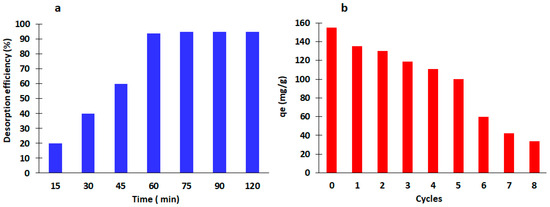
The reuse of the sand/glu/chit/AEAPTS composite was evaluated through 8 consecutive adsorption–desorption cycles using a 0.25 M NaOH solution as the regenerant, on the basis of our previous work demonstrating its high effectiveness for desorbing nitrates from chitosan-based adsorbents functionalized with ethylenediamine. As reported in Figure 13, the desorption kinetics are highly efficient: the desorption efficiency increases rapidly from 20% at 15 min to 40% at 30 min, then 60% at 45 min, before reaching a stable plateau above 95% at 60 min. This rapid and complete desorption confirms the reversibility of the electrostatic adsorption process through deprotonation of the ammonium and imine groups of the composite surface under alkaline conditions.
Figure 13.
Effectiveness of nitrate desorption by NaOH (a) and change in adsorption capacity during regeneration cycles (b).
Regarding the evolution of adsorption performance over successive cycles, the data reveal a clear biphasic behavior (Figure 13b). During the first five cycles, the adsorption capacity decreases gradually and moderately from 155 mg g−1 (initial) to 135, 128, 118, 110, and 98 mg g−1 at cycles 1–5, respectively, corresponding to an average loss of approximately 11.4 mg g−1 per cycle, a cumulative loss of ~37%, and a retention of 63% of the initial capacity. However, after cycle 5, the degradation accelerates significantly, capacity drops sharply to 60 mg g−1 in cycle 6 (a decrease of 38 mg g−1 in a single cycle), then to 42 mg g−1 in cycle 7 and to 32 mg g−1 in cycle 8, resulting in a total cumulative loss of 79% after 8 cycles. The significant discontinuity observed between cycles 5 and 6 strongly suggests a threshold effect in the structural integrity of the composite under repeated alkaline exposure, beyond which degradation self-accelerates.
This biphasic degradation pattern can be attributed to two concurring mechanisms. The primary and dominant cause is the cumulative and progressively irreversible deprotonation of the –NH3+ active sites by OH− ions supplied by the NaOH regenerant, which reduces the density of positively charged surface sites available for electrostatic interaction with nitrate anions with each successive cycle. A secondary but structurally significant factor is the partial hydrolysis of the imine bonds (C=N) cross-linking chitosan to glutaraldehyde under repeated alkaline exposure at pH > 12, which progressively weakens the cross-linked polymer network and may cause partial detachment of the chitosan–AEAPTS coating from the sand surface, further reducing the number of accessible active sites. Despite this performance loss, the composite retains 63% of its initial adsorption capacity after 5 operational cycles, which is considered satisfactory for a material based on low-cost, naturally derived, and biodegradable components. The sand/glu/chit/AEAPTS composite can therefore be effectively used for nitrate removal over at least 5 regeneration cycles without major loss of performance.
3.9. Field Tests
The applicability of the sand/glu/chit/AEAPTS composite for treating real water sample was demonstrated using samples collected in the Casablanca region (Morocco) from a textile dyeing company, that were simultaneously contaminated with nitrate ions. The initial measured concentration of nitrate ions was 20.54 mg L−1. The initial water quality is summarized in Table 5.
Table 5.
Field tests of sand/glu/chit/AEAPTS composite.
Table 5 shows that the treatment of 100 mL of the real sample with 160 mg of the composite resulted in almost complete removal of nitrate anions in just 10 min, reducing their concentrations to negligible levels. This remarkable efficiency can be explained by the strong electrostatic affinity between the abundant protonated amino groups on the surface of the composite and the polluting anions. Interestingly, the material also significantly reduced the concentrations of chloride and sulfate ions and the total hardness of the water, parameters characteristic of complex natural aqueous matrices. These results demonstrate that the sand/glu/chit/AEAPTS composite is a versatile and effective adsorbent, perfectly suited to the treatment of real water with complex ionic compositions, thus opening up promising prospects for its application on an industrial scale.
4. Conclusions
This study presents the development and comprehensive characterization of an innovative sand/glu/chit/AEAPTS composite designed for the effective removal of nitrate ions from contaminated water. In-depth characterization of the material using FTIR infrared spectroscopy confirmed the success of the synthesis by revealing the formation of characteristic imine bonds at 1647 cm−1 attesting to the cross-linking between chitosan and glutaraldehyde, the intensification of the band at 1100 cm−1 confirming the simultaneous presence of the mineral support and the AEAPTS graft, and the appearance of double peaks at 2930 and 2870 cm−1 indicating organic methylene chains. EDX spectroscopy analysis provided an elemental composition of 36.2% silicon and 34.5% oxygen for the silica matrix, with 20.8% carbon and 4.8% nitrogen confirming the functionalized organic coating. The zeta potential study demonstrated amphoteric behavior with an isoelectric point at pH 8, with the composite exhibiting a strongly positive charge (+80 mV) in an acidic environment, promoting the electrostatic attraction of negatively charged nitrate ions. The composite demonstrated an exceptional maximum adsorption capacity of 154.41 mg g−1, ranking among the most effective adsorbents reported in the literature. Analysis of the isotherms at different temperatures shows that the Langmuir model provides the best fit (R2 = 0.998–0.999), which indicates monolayer adsorption on homogeneous sites, while the kinetic study reveals that the pseudo-second-order model best describes the process with coefficients greater than 0.99, confirming that the specific interaction between nitrate ions and ammonium groups constitutes the rate-limiting step. The thermodynamic analysis reveals a spontaneous process with a negative Gibbs free energy ranging from −6.34 to −7.21 kJ mol−1, a positive enthalpy of 6.94 kJ mol−1 characterizing an endothermic process, and, most notably, a remarkable positive entropy of 43.65 J mol−1, which is the primary driving force explaining the spontaneity despite the energy cost. This entropic gain stems from the massive release of water molecules from the hydration sphere of the nitrates. The adsorption mechanism involves the protonation of amino groups in an aqueous medium, forming positively charged ammonium groups, followed by the diffusion of hydrated nitrate ions—whose partial dehydration consumes endothermic energy—and then the establishment of direct electrostatic interactions between the ammonium and nitrate ions, supplemented by secondary hydrogen bonds. The optimal adsorption conditions established are a pH of 6, allowing 99% efficiency, a contact time of 120 min to reach equilibrium, an adsorbent dose of 160 mg representing the economic optimum, and sufficient ambient temperature, although the process is slightly favored by heat. The composite retains approximately 71% of its initial capacity after 5 regeneration cycles using a 0.25 M NaOH solution, demonstrating its durability and economic viability for practical applications in the treatment of nitrate-contaminated water.
Supplementary Materials
The following supporting information can be downloaded at: https://www.mdpi.com/article/10.3390/su18073500/s1, File S1. References [49,50,51,52,53,54,55,56,57,58,59] are cited in Supplementary Materials.
Author Contributions
Conceptualization, J.I.; methodology, J.I.; software, J.I.; validation, J.I.; formal analysis, J.I. and M.A.; investigation, J.I.; resources, J.I.; data curation, M.A.; writing—original draft preparation, J.I. and M.A.; writing—review and editing, J.I.; visualization, J.I.; supervision, J.I.; project administration, J.I. All authors have read and agreed to the published version of the manuscript.
Funding
This research received no external funding.
Institutional Review Board Statement
Not applicable.
Informed Consent Statement
Not applicable.
Data Availability Statement
The data presented in this study are available on request from the corresponding author.
Conflicts of Interest
The authors declare no conflicts of interest.
References
- Verma, A.; Sharma, A.; Kumar, R.; Sharma, P. Nitrate contamination in groundwater and associated health risk assessment for Indo-Gangetic Plain, India. Groundw. Sustain. Dev. 2023, 23, 100978. [Google Scholar] [CrossRef] [Scilit]
- Bijay-Singh; Craswell, E. Fertilizers and nitrate pollution of surface and ground water: An increasingly pervasive global problem. SN Appl. Sci. 2021, 3, 518. [Google Scholar] [CrossRef] [Scilit]
- Kadach, S.; Piknova, B.; Black, M.I.; Park, J.W.; Wylie, L.J.; Stoyanov, Z.; Thomas, S.M.; McMahon, N.F.; Vanhatalo, A.; Schechter, A.N.; et al. Time course of human skeletal muscle nitrate and nitrite concentration changes following dietary nitrate ingestion. Nitric Oxide 2022, 112, 1–10. [Google Scholar] [CrossRef] [Scilit] [PubMed]
- Singh, S.; Anil, A.M.; Kumar, V.; Kapoor, D.; Subramanian, S.; Singh, J.; Ramamurthy, P.C. Nitrates in the environment: A critical review of their distribution, sensing techniques, ecological effects and remediation. Chemosphere 2022, 287, 131996. [Google Scholar] [CrossRef] [Scilit]
- Picetti, R.; Deeney, M.; Pastorino, S.; Miller, M.R.; Shah, S.; Leon, D.A.; Dangour, A.D.; Green, R. Nitrate and nitrite contamination in drinking water and cancer risk: A systematic review with meta-analysis. Environ. Res. 2022, 210, 112988. [Google Scholar] [CrossRef] [Scilit]
- Edition, F. Guidelines for drinking-water quality. WHO Chron. 2011, 38, 104–108. [Google Scholar]
- Ye, Y.; Zhang, K.; Peng, X.; Zhou, Q.; Pan, Z.; Xing, B.; Liu, X. Research Progress on Biological Denitrification Process in Wastewater Treatment. Water 2025, 17, 520. [Google Scholar] [CrossRef] [Scilit]
- Zhang, J.; Fan, C.; Zhao, M.; Wang, Z.; Jiang, S.; Jin, Z.; Bei, K.; Zheng, X.; Wu, S.; Lin, P.; et al. A comprehensive review on mixotrophic denitrification processes for biological nitrogen removal. Chemosphere 2023, 313, 137474. [Google Scholar] [CrossRef] [Scilit]
- Turki, T.; Hamdouni, A. Study of nitrate removal from aqueous solution by electrodialysis. Arab. J. Geosci. 2022, 15, 780. [Google Scholar] [CrossRef] [Scilit]
- Guo, J.; Liu, M.J.; Laguna, C.; Miller, D.M.; Williams, K.S.; Clark, B.D.; Muñoz, C.; Blair, S.J.; Nielander, A.C.; Jaramillo, T.F.; et al. Electrodialysis and nitrate reduction (EDNR) to enable distributed ammonia manufacturing from wastewaters. Energy Environ. Sci. 2024, 17, 8787–8800. [Google Scholar] [CrossRef] [Scilit]
- Shelly, Y.; Kuk, M.; Menashe, O.; Zeira, G.; Azerrad, S.; Kurzbaum, E. Nitrate removal from a nitrate-rich reverse osmosis concentrate: Superior efficiency using the bioaugmentation of an Acinetobacter biofilm. J. Water Process. Eng. 2021, 44, 102425. [Google Scholar] [CrossRef] [Scilit]
- Ma, M.; Li, M.; Feng, C.; He, Z. Electrochemical nitrate removal with simultaneous magnesium recovery from a mimicked RO brine assisted by in situ chloride ions. J. Hazard. Mater 2020, 388, 122085. [Google Scholar] [CrossRef] [Scilit] [PubMed]
- Min, B.; Gao, Q.; Yan, Z.; Han, X.; Hosmer, K.; Campbell, A.; Zhu, H. Powering the Remediation of the Nitrogen Cycle: Progress and Perspectives of Electrochemical Nitrate Reduction. Ind. Eng. Chem. Res 2021, 60, 14635–14650. [Google Scholar] [CrossRef] [Scilit]
- Hassan, M.M.; Carr, C.M. A critical review on recent advancements of the removal of reactive dyes from dyehouse effluent by ion-exchange adsorbents. Chemosphere 2018, 209, 201–219. [Google Scholar] [CrossRef] [Scilit] [PubMed]
- Dong, H.; Chen, H.; SenGupta, A.K. CO2 utilization for water treatment: Ion exchange nitrate removal driven by CO2 without producing spent brine regenerant. ACS EST Water 2021, 1, 2275–2283. [Google Scholar] [CrossRef] [Scilit]
- Kamranifar, M.; Naghizadeh, A.; Masoudi, F.; Osmani, F.; Davoodi, M.; Nabavian, M.R. Nitrate removal from aqueous solutions by cobalt ferrite nanoparticles synthesized by co-precipitation method: Isotherm, kinetic and thermodynamic studies. Water Sci. Technol. 2020, 82, 2250–2258. [Google Scholar] [CrossRef] [Scilit]
- Ahmed, M.J.; Hameed, B.H.; Khan, M.A. Recent advances on activated carbon-based materials for nitrate adsorption: A review. J. Anal. Appl. Pyrolysis 2023, 169, 105856. [Google Scholar] [CrossRef] [Scilit]
- Chung, Y.C.; Son, D.H.; Ahn, D.H. Nitrogen and organics removal from industrial wastewater using natural zeolite media. Water Sci. Technol. 2000, 42, 127–134. [Google Scholar] [CrossRef] [Scilit]
- Liu, J.; Cheng, X.; Zhang, Y.; Wang, X.; Zou, Q.; Fu, L. Zeolite modification for adsorptive removal of nitrite from aqueous solutions. Micropor. Mesopor. Mat. 2017, 252, 179–187. [Google Scholar] [CrossRef] [Scilit]
- Masoudi, H.; Ravari, F.; Mosaddeghi, H. Removal of nitrate from water by modified nano-clay and comparison with nano-graphene, nano-Fe3O4 and nano-clay-isotherm and kinetic studies. Desalin. Water Treat. 2019, 167, 218–230. [Google Scholar] [CrossRef] [Scilit]
- Karthikeyan, P.; Meenakshi, S. In-situ fabrication of zirconium entrenched biopolymeric hybrid membrane for the removal of toxic anions from aqueous medium. Int. J. Biol. Macromol. 2019, 141, 1199–1209. [Google Scholar] [CrossRef] [Scilit]
- Anannaz, M.; Tafraout, F.; Laghlimi, C.; Ouaabou, R.; Isaad, J. A New Generation of Porous Polymer Materials from Polystyrene Waste: Synthesis and Adsorption of Nitrate Anions in Aqueous Media. Organics 2024, 5, 561–574. [Google Scholar] [CrossRef] [Scilit]
- Alagha, O.; Manzar, M.S.; Zubair, M.; Anil, I.; Mu’azu, N.D.; Qureshi, A. Comparative adsorptive removal of phosphate and nitrate from wastewater using biochar-MgAl LDH nanocomposites: Coexisting anions effect and mechanistic studies. Nanomaterials 2020, 10, 336. [Google Scholar] [CrossRef] [Scilit] [PubMed]
- Tafraout, F.; Isaad, J. Recent research landscape on chitosan-mineral-based composites for wastewater treatment: A comprehensive bibliometric analysis (2014–2024). Environ. Sci. Pollut. Res. 2025, 32, 11815–11837. [Google Scholar] [CrossRef] [Scilit] [PubMed]
- Abbach, W.; Laghlimi, C.; Isaad, J. Amine-Grafted Pomegranate Peels for the Simultaneous Removal of Nitrate and Phosphate Anions from Wastewater. Sustainability 2023, 15, 13991. [Google Scholar] [CrossRef] [Scilit]
- Crispi, S.; Filice, S.; Scuderi, V.; Zimbone, M.; Iannazzo, D.; Celesti, C.; Scalese, S. Kinetic and Isotherm Studies of Organic and Inorganic Anions Adsorption from Water by Quaternized Pentablock Copolymeric Film (PTBr). Polymers 2025, 17, 1624. [Google Scholar] [CrossRef] [Scilit]
- Karthikeyan, P.; Meenakshi, S. Fabrication of hybrid chitosan encapsulated magnetic-kaolin beads for adsorption of phosphate and nitrate ions from aqueous solutions. Int. J. Biol. Macromol. 2021, 168, 750–759. [Google Scholar] [CrossRef] [Scilit]
- Keshvardoostchokami, M.; Majidi, M.; Zamani, A.; Liu, B. A review on the use of chitosan and chitosan derivatives as the bio-adsorbents for the water treatment: Removal of nitrogen-containing pollutants. Carbohydr. Polym. 2021, 273, 118625. [Google Scholar] [CrossRef] [Scilit]
- Abdelazeem Eltaweil, S.; Ahmed Omer, M.; Hisham El-Aqapa, G.; Nourhan Gaber, M.; Nour Attia, F.; Gehan El-Subruiti, M.; Mohamed Mohy-Eldin, S.; Eman Abd El-Monaem, M. Chitosan based adsorbents for the removal of phosphate and nitrate: A critical review. Carbohydr. Polym. 2021, 274, 118671. [Google Scholar] [CrossRef] [Scilit]
- Chatterjee, S.; Dae Lee, S.; Min Lee, W.; Seung Woo, H. Nitrate removal from aqueous solutions by cross-linked chitosan beads conditioned with sodium bisulfate. J. Hazard. Mater 2009, 166, 508–513. [Google Scholar] [CrossRef] [Scilit]
- Hyder Thagira Banu, A.; Karthikeyan, P.; Meenakshi, S. Removal of nitrate and phosphate ions from aqueous solution using zirconium encapsulated chitosan quaternized beads: Preparation, characterization and mechanistic performance. Results Surf. Interf. 2021, 3, 100010. [Google Scholar] [CrossRef] [Scilit]
- Italiya, G.; Subramanian, S. Role of emerging chitosan and zeolite-modified adsorbents in the removal of nitrate and phosphate from an aqueous medium: A comprehensive perspective. Water Sci. Technol. 2022, 86, 2658–2684. [Google Scholar] [CrossRef] [Scilit] [PubMed]
- Zhang, B.; Zhu, W.; Hou, R.; Yue, Y.; Feng, J.; Ishag, A.; Wang, X.; Qin, Y.; Sun, Y. Recent advances of application of bentonite-based composites in the environmental remediation. Recent advances of application of bentonite-based composites in the environmental remediation. J. Environ. Manag. 2024, 362, 121341. [Google Scholar] [CrossRef] [Scilit] [PubMed]
- Camara, A.S.; Lütke, S.F.; Pinheiro, C.P.; Garcia Vieira, M.L.; Cadaval, R.S.A., Jr.; De Almeida Pinto, L.A. Chitosan-coated sand and its application in a fixed-bed column to remove dyes in simple, binary, and real systems. Environ. Sci. Pollut. Res. 2020, 27, 37938–37945. [Google Scholar] [CrossRef] [Scilit] [PubMed]
- Gupta, A.; Yunus, M.; Sankararamakrishnan, N. Chitosan- and Iron–Chitosan-Coated Sand Filters: A Cost-Effective Approach for Enhanced Arsenic Removal. Ind. Eng. Chem. Res. 2013, 52, 2066–2072. [Google Scholar] [CrossRef] [Scilit]
- Pal, P.; Banat, F. Comparison of heavy metal ions removal from industrial lean amine solvent using ion exchange resins and sand coated with chitosan. J. Nat. Gas Eng. 2014, 18, 227–236. [Google Scholar] [CrossRef] [Scilit]
- Zhao, B.; Zhang, Z.; Dou, C.; Han, R. Adsorption property of methyl orange by chitosan coated on quartz sand in batch mode. Desalin Water Treat. 2015, 55, 1598–1608. [Google Scholar] [CrossRef] [Scilit]
- Futalan, C.M.; Huang, Y.S.; Chen, J.H.; Wan, M.W. Arsenate removal from aqueous solution using chitosan-coated bentonite, chitosan-coated kaolinite and chitosan-coated sand: Parametric, isotherm and thermodynamic studies. Water Sci. Technol. 2018, 78, 676–689. [Google Scholar] [CrossRef] [Scilit]
- Association APH; Association AWW. Standard Methods for the Examination of Water and Wastewater; American Public Health Association: New York, NY, USA, 1989. [Google Scholar]
- Yang, W.; Wang, J.; Shi, X.; Tang, H.; Wang, X.; Wang, S.; Zhang, W.; Lu, J. Preferential nitrate removal from water using a new recyclable polystyrene adsorbent functionalized with triethylamine groups. Ind. Eng. Chem. Res. 2020, 59, 5194–5201. [Google Scholar] [CrossRef] [Scilit]
- Wang, L.; Liu, S.; Xuan, W.; Li, S.; Wei, A. Efficient Nitrate Adsorption from Groundwater by Biochar-Supported Al-Substituted Goethite. Sustainability 2022, 14, 7824. [Google Scholar] [CrossRef] [Scilit]
- Isaad, J.; El Achari, A. Preparation of aminated magnetite/SiO2/chitosan core-shell nanoparticles for efficient adsorption of nitrate and phosphate anions in water. Int. J. Environ. Anal. Chem. 2021, 104, 43–72. [Google Scholar] [CrossRef] [Scilit]
- Karthikeyan, P.; Sirajudheen, P.; Nikitha, M.R.; Meenakshi, S. Removal of phosphate and nitrate via a zinc ferrite@activated carbon hybrid composite under batch experiments: Study of isotherm and kinetic equilibriums. Environ. Nanotechnol. Monit. Manag. 2020, 14, 100378. [Google Scholar] [CrossRef] [Scilit]
- Aswin Kumar, I.; Viswanathan, N. Development and Reuse of Amine-Grafted Chitosan Hybrid Beads in the Retention of Nitrate and Phosphate. J. Chem. Eng. Data 2018, 63, 147–158. [Google Scholar] [CrossRef] [Scilit]
- Stjepanovic, M.; Velic, N.; Habuda-Stanic, M. Modified Hazelnut Shells as a Novel Adsorbent for the Removal of Nitrate from Wastewater. Water 2022, 14, 816. [Google Scholar] [CrossRef] [Scilit]
- Nguyen, T.T.; Le, T.T.; Phan, P.T.; Nguyen, N.H. Preparation, Characterization, and Application of Novel FerricOxide-Amine Material for Removal of Nitrate and Phosphate in Water. J. Chem. 2020, 2020, 8583543. [Google Scholar]
- Bozorgpour, F.; Ramandi, H.F.; Jafari, P.; Samadi, S.; Yazd, S.S.; Aliabadi, M. Removal of nitrate and phosphate using chitosan/Al2O3/Fe3O4 composite nanofibrous adsorbent: Comparison with chitosan/Al2O3/Fe3O4 beads. Int. J. Biol. Macromol. 2016, 93, 557–565. [Google Scholar] [CrossRef] [Scilit]
- Song, H.; Zhou, Y.; Li, A.; Mueller, M. Selective removal of nitrate from water by a macroporous strong basic anion exchange resin. Desalination 2012, 296, 53–60. [Google Scholar] [CrossRef] [Scilit]
- Sowmya, A.; Meenakshi, S. A novel quaternized resin with acrylonitrile/divinylbenzene/vinylbenzyl chloride skeleton for the removal of nitrate and phosphate. Chem. Eng. J. 2014, 257, 45–55. [Google Scholar] [CrossRef] [Scilit]
- Barrow, N.J. The description of sorption curves. Eur. J. Soil Sci. 2008, 59, 900–910. [Google Scholar] [CrossRef] [Scilit]
- Zhang, H.; Zhang, F.; Huang, Q. Highly effective removal of malachite green from aqueous solution by hydrochar derived from phycocyanin-extracted algal bloom residues through hydrothermal carbonization. RSC Adv. 2017, 7, 5790–5799. [Google Scholar] [CrossRef] [Scilit]
- Freundlich, H.M.H. Over the adsorption in solution. J. Phys. Chem. 1906, 57, 384. [Google Scholar]
- Tempkin, M.I.; Pyzhev, V. Kinetics of ammonia synthesis on promoted iron catalyst. Acta Phys. Chim. USSR 1940, 12, 327–356. [Google Scholar]
- Aharoni, C.; Ungarish, M. Kinetics of activated chemisorption. Part 2. Theoretical models. J. Chem. Soc. Faraday Trans. 1977, 73, 456–464. [Google Scholar] [CrossRef] [Scilit]
- Gunay, A.; Arslankaya, E.; Tosun, I. Lead removal from aqueous solution by natural and pretreated clinoptilolite: Adsorption equilibrium and kinetics. J. Hazard. Mater 2007, 146, 362–371. [Google Scholar] [CrossRef] [Scilit] [PubMed]
- Dabrowski, A. Adsorption—From theory to practice. Adv. Colloid Interface Sci. 2001, 93, 135–224. [Google Scholar] [CrossRef] [Scilit] [PubMed]
- Dubinin, M.M. The potential theory of adsorption of gases and vapors for adsorbents with energetically non-uniform surface. Chem. Rev. 1960, 60, 235–266. [Google Scholar] [CrossRef] [Scilit]
- Hobson, J.P. Physical adsorption isotherms extending from ultra-high vacuum to vapor pressure. J. Phys. Chem. 1969, 73, 2720–2727. [Google Scholar] [CrossRef] [Scilit]
- Tzabar, N.; ter Brake, H.J.M. Adsorption isotherms and Sips models of nitrogen, methane, ethane, and propane on commercial activated carbons and polyvinylidene chloride. Adsorption 2016, 22, 901–914. [Google Scholar] [CrossRef] [Scilit]

Disclaimer/Publisher’s Note: The statements, opinions and data contained in all publications are solely those of the individual author(s) and contributor(s) and not of MDPI and/or the editor(s). MDPI and/or the editor(s) disclaim responsibility for any injury to people or property resulting from any ideas, methods, instructions or products referred to in the content. |
© 2026 by the authors. Licensee MDPI, Basel, Switzerland. This article is an open access article distributed under the terms and conditions of the Creative Commons Attribution (CC BY) license.