


Abstract
Southern Europe is a climate change hotspot, with rising temperatures threatening the region’s tourism industry. While existing research has focused on supply-side adaptations and macro-level demand shifts, this study examines the demand side—tourist experience and adaptive behaviors at the micro-experiential level, with implications for broader discussions of resilience and adaptive capacity. The study analyzed 6466 TripAdvisor reviews from 11 open-air heritage sites in Italy, Greece, Spain, and Malta, linking reviews to site-relative thermal exposure tertiles and applying dictionary-based text matching with mixed-effects models. Under hotter conditions, tourists were significantly more likely to mention heat, thermal discomfort, and coping resources such as shade and drinking water, with co-occurrence patterns indicating that discomfort and relief-oriented infrastructure are narrated together. Yet overall satisfaction ratings remained uniformly high and statistically unaffected by temperature, revealing a paradox wherein experiential strain intensifies while evaluative scores stay stable. These findings suggest patterns consistent with behavioral and cognitive adaptive responses, whereby positive evaluations are maintained despite heightened thermal stress, and indicate that narrative-based indicators may capture experiential shifts that conventional satisfaction metrics miss.
1. Introduction
Climate change is intensifying across the globe, with Southern Europe standing out as a particularly vulnerable climate hotspot. Over recent decades, this area has warmed at a rate approximately 20% faster than the global average [1,2,3]. In recent years, countries throughout Southern Europe have experienced record-breaking heat-waves, severe droughts, and large wildfires, with extreme temperatures and weather impacts particularly notable in Southern European destinations [4]. Globally, 2024 was the warmest year on record and the first year with a global average temperature exceeding 1.5 °C above pre-industrial levels, following a trend where the last ten years have been the warmest decade on record [5]. Future climate projections indicate a continuation and intensification of these trends, including longer and more frequent heatwaves and increased aridity [6].
Tourism in Southern Europe is a vital economic sector, particularly in coastal destinations, attracting millions of domestic and international visitors each year [7]. The region’s traditional appeal has long been based on its climatic allure—reliable sunshine, warm temperatures, and outdoor recreational conditions. However, as summer temperatures increasingly exceed comfort thresholds, the sustainability of Southern Europe’s tourism offer comes into question. Heat stress not only threatens visitor enjoyment but also puts pressure on local infrastructure, natural resources, and the health and safety of tourism employees [8]. Recent cases of wildfires and heat-waves in Greece, Italy, Portugal, and Spain highlight how the climate crisis is already disrupting tourism operations and affecting visitor perceptions of safety and comfort [7].
As the climate crisis threat intensifies, there is an urgent need to understand tourist experiences, adaptive behaviors, and resilience-related responses under heat stress. Much of the climate–tourism literature has approached this challenge through macro-level demand modeling, estimating the sensitivity of tourism outcomes to deteriorating climatic conditions using metrics such as arrivals, bed nights, or length of stay [9,10,11,12,13]. While these approaches offer valuable projections, they often overlook the experiential dimensions of tourism—namely, how tourists perceive, respond, and adapt to climatic discomfort at the micro level of the visit itself. In particular, limited attention has been given to how heat is reflected in tourists’ own narratives at open-air heritage sites, how coping resources are articulated in these narratives, and whether such experiential patterns are also reflected in tourists’ overall satisfaction level.
The current study seeks to address this gap by examining how rising temperatures affect tourist experience at Southern European open-air heritage sites. More specifically, it investigates whether higher thermal exposure is associated with increased mentions of heat and heat-related discomfort, greater attention to coping resources such as shade and drinking water, changes in overall visitor satisfaction, and tourists’ micro-level adaptive responses. By doing so, the study contributes to a more experience-based understanding of climate adaptation in tourism, with direct relevance for sustainable destination management under warming conditions. It also contributes scientifically by extending climate–tourism research beyond macro-level demand indicators and by linking thermal exposure, user-generated narratives, and evaluative outcomes within a unified analytical framework. Drawing on user-generated content from TripAdvisor reviews, the study analyzes tourists’ own narratives about heat, adaptive behaviors, and coping resources, shedding new light on how resilience may be reflected in tourist experiences, adaptive responses, and evaluative patterns under warming conditions.
2. Literature Review
2.1. Tourism Resilience and Adaptive Capacity
Since the early 2000s, resilience has emerged as a central concept in tourism research, emphasizing the capacity of destinations, communities, and systems to adapt effectively to shocks, change, or external stressors [14]. Originating in ecological theory in the 1970s, resilience evolved to describe the ability of systems to absorb disturbances, reorganize, and continue functioning under new conditions [15,16]. Within tourism, resilience is defined as a destination’s ability to withstand critical changes, reorganize, and enhance preparedness for future challenges through continuous adaptation. Resilience is not an end state but rather a dynamic process, reflecting the complex, non-linear, and interconnected nature of tourism systems [14].
Closely linked to resilience is adaptive capacity, which denotes a system’s ability to respond and reorganize under changing conditions; this capacity arises from nonlinear interactions among system components, leading to emergent, self-organizing responses [17,18]. In tourism, high adaptive capacity—supported by agile leadership, innovation, and responsiveness—enables destinations to adjust structurally and behaviorally to stressors such as climate change, thereby sustaining competitiveness and functionality [17,19]. In tourism systems, adaptive capacity can take place on the supply side, as destinations and tourism organizations reorganize in response to external stressors. Alternatively, there is also the adaptive capacity of tourism demand, as tourists alter their behaviors, travel considerations, and trip planning in response to change [19].
2.2. Adaptive Capacity and Tourist Behavior
Adaptive capacity in tourism demand manifests across multiple scales. At the macro level, tourism systems demonstrate adaptive behavior through the redistribution of demand across destinations, regions, and seasons. Rather than merely “bouncing back” after disruption, tourism often “bounces forward,” evolving through behavioral and structural adjustments [14]. This adaptability reflects tourists’ capability to reorganize and adjust their travel plans in response to environmental, geopolitical, and health-related challenges [4,11]. At this level, adaptive capacity is expressed in tourists’ behavioral and cognitive flexibility. Travelers confronted with uncertainty or stressors—such as pandemics, political instability, or extreme weather—adjust by modifying itineraries, substituting destinations, rescheduling trips, or making changes in how they travel [20,21]. The COVID-19 pandemic vividly demonstrated this flexibility: tourists favored outdoor and nature-based experiences, prioritized flexible and refundable bookings, and embraced wellness-oriented travel to support both mental and physical wellbeing [19]. Similarly, in contexts of terror or political instability, demand is often redirected toward perceived safer destinations, illustrating how individual risk perceptions aggregate into broader market-level substitution effects [22].
At the micro level, tourists conduct two major types of adaptations. Firstly, tourists demonstrate behavioral flexibility by adjusting on-site activities [23] and by shifting daily schedules to maintain comfort. For example, this may include preferring beach-based leisure over urban sightseeing under hot conditions, or changing visiting time to morning hours to avoid excessive heat [24]. Secondly, cognitive flexibility allows travelers to redefine what they consider “comfort” or “preferred weather”; for instance, many continue to choose Southern Europe as a holiday destination even as climatic conditions change, accepting higher temperatures as an integral part of the destination experience [18]. These adaptations reflect the resilience of travel demand, which can be understood as a complex adaptive system that learns and reorganizes in the face of climate change [13,14,19]. Furthermore, micro-level adaptations accumulate to systemic responses at larger scales, underscoring the multi-layered nature of tourism demand resilience, in which satisfaction and meaning are maintained despite intensifying environmental pressures [20].
2.3. Climate Change and Adaptation
Southern Europe is widely recognized as a climate change hotspot, with warming rates exceeding the global average and an increasing frequency and severity of heatwaves, droughts, and other extremes [6,25]. Under high-emission scenarios, summer temperatures in parts of the region may rise by 5–6 °C by the end of the century [2]. These transformations challenge the tourism economy—strongly oriented towards summer seasonality and outdoor leisure—while intensified heat stress increases risks to visitor comfort, visitor experience, and visitors’ health and safety [7,8]. As climate-related disruptions become more common across Southern Europe, understanding how tourism systems adapt—behaviorally and institutionally—becomes central to sustaining destination competitiveness [13].
Examining the tourism demand system, at the macro level, tourism demand often adapts through spatial and temporal substitution, redistributing trips across destinations and seasons to preserve comfort and experience quality and supporting emerging “coolcation” patterns [9,11,26]. In this view, a recent study by the European Travel Commission found a decrease in travel intentions to visit Southern European destinations during the summer months, and an increase in travel intentions to visit this area in the autumn months, reflecting a major change in tourism seasonality and the well-established pattern of taking sea and sun holidays at the peak summer months [4]. In parallel, climate suitability research from Greece indicates a decline in summer tourism suitability, particularly in urban destinations, with further deterioration projected under future warming scenarios [27].
At the micro level, adaptation is expressed primarily through in situ coping strategies—small-scale behavioral adjustments made during the visit to manage thermal stress and maintain the viability of planned activities. Empirical evidence shows that tourists respond to uncomfortable weather by modifying the timing and structure of daily activities (e.g., shifting sightseeing to mornings or evenings), [24] selecting cooler routes or shaded spaces [23,28], increasing time spent indoors or in air-conditioned attractions, and substituting strenuous outdoor activities with water-based or indoor alternatives [29,30]. Micro-adaptations also include embodied coping routines such as adjusting clothing, hydration practices, and rest patterns [30], as well as opportunistic use of local cooling resources like fountains, cafés, or shaded queues. When aggregated, these micro-level responses can scale into broader demand shifts by reshaping visitor flows within destinations and influencing how destinations and sites evolve under sustained warming [9].
Concluding the literature review, existing climate–tourism research has generated strong evidence that warming affects destination suitability and can trigger demand redistribution across space and time. However, much of this literature relies on macro indicators—such as suitability indices, visitation totals, or seasonal flow projections—and therefore provides limited insight into how heat is actually experienced and managed by tourists on the ground [9,10,11,12,13]. In particular, there is an evident knowledge gap about how visitors perceive thermal stress in open-air heritage settings, which coping resources they foreground in their accounts, and whether experiential strain is reflected in users’ satisfaction. The current study addresses this gap by examining tourist-generated narratives as a behavioral trace of micro-adaptation: linking TripAdvisor reviews to site-relative thermal exposure and assessing how heat-related discourse, coping resources, and overall satisfaction shift under heat conditions. In doing so, the study advances a more human-centered understanding of tourism resilience in the climate crisis era and offers practical signals for targeted micro-climate adaptation at heritage sites.
3. Materials and Methods
3.1. Research Question
Aiming to shed new light on the micro-experiential dimensions relevant to discussions of tourism demand resilience and adaptive capacity in a warming climate, the current study investigates how rising temperatures associated with the climate crisis shape tourists’ experiences at Southern European open-air heritage destinations. More specifically, the study asks whether higher thermal exposure is associated with changes in two key dimensions of the tourist experience: (i) the content of reviews—particularly mentions of heat, heat-related discomfort, and infrastructure relevant to thermal mitigation (e.g., shade, water, rest areas); and (ii) overall satisfaction, proxied by TripAdvisor ratings. Rising temperatures were operationalized at the site–month level using within-site tertiles of monthly maximum temperature, capturing relative thermal exposure within each site. The tourism experience is examined through user-generated reviews collected from TripAdvisor in the months of April–September, 2022–2025, across 11 open-air sites. All data processing and statistical analyses were conducted in R (version 4.4.1; R Foundation for Statistical Computing, Vienna, Austria).
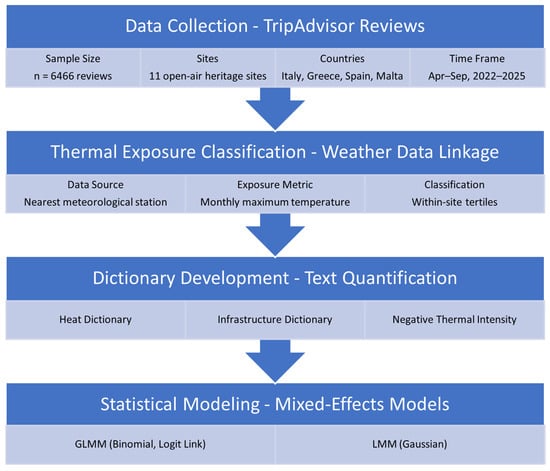
To examine this research question, the study followed a structured design linking site-relative thermal exposure to tourists’ narratives and evaluations, exemplified in Figure 1. First, in the Data Collection phase, TripAdvisor reviews were collected and structured to retain a harmonized analytic sample with complete text, valid ratings, and resolvable visit month/year. Second, in the Thermal Exposure Classification phase, each review was assigned a site–month thermal exposure level by matching visits to the nearest meteorological station and computing within-site tertiles of monthly maximum temperature, enabling comparisons across destinations without imposing absolute thresholds. Third, in the Dictionary Development phase, review content was quantified using three domain dictionaries capturing heat expressions, thermally relevant infrastructure, and negative thermal intensity, supporting consistent detection of themes and cross-dictionary co-occurrence patterns. Finally, in the Statistical Modeling phase, mixed-effects models (GLMM and LMM) estimated how thermal exposure predicts (i) single-theme presence, (ii) co-occurrences such as Heat × Infrastructure, and (iii) overall satisfaction, while accounting for site-level clustering via random intercepts.
Figure 1.
The study’s research design.
3.2. Data Collection
The analysis draws on Volunteered Geographic Information (VGI). To examine tourists’ responses to heat, the study analyzed publicly available TripAdvisor reviews, a widely used and text-rich source of online review data in tourism analytics due to their comparatively rich informational content and established suitability for review-based analysis [31]. Reviews were sampled April–September 2022–2025, across 11 open-air tourism sites in Southern Europe (Table 1) that met two criteria: (i) ≥10,000 total TripAdvisor reviews and (ii) exposure to outdoor elements (rather than air-conditioned environments). These sites were selected purposively rather than randomly in order to focus the analysis on major open-air heritage destinations where thermal exposure is directly relevant to the visitor experience and where sufficient review volume allows stable comparison across sites. Accordingly, the findings should be interpreted in relation to this specific category of sites rather than generalized to all tourism locations in Southern Europe. Retained fields included site name, an anonymized reviewer identifier (sequential code only), location, rating, review title, visit month and year, trip type, full review text, and review publication date. Eligibility required non-empty text (title and/or body), a valid 1–5 rating, and a resolvable visit month/year within the April–September window.
Table 1.
Characteristics of the selected open-air heritage sites.
Reviews were collected through a semi-automated procedure. Review pages were accessed manually on TripAdvisor, and the visible review content from each page was copied into an R script designed to parse the recurring review structure and extract the data into a tabular format. The script was used to organize only anonymized review information. Reviews were not restricted by original language; rather, the corpus was constructed from the review text as displayed in the TripAdvisor interface at the time of collection. In practice, this meant that some non-English reviews appeared in platform-translated form within the interface and were retained as such in the collected material. The translations were therefore not produced by the authors, but reflected the version displayed by TripAdvisor during data collection. Because the review rating is displayed on TripAdvisor as an image rather than plain text, a second validation step was conducted manually, and rating values were checked and added to the dataset by hand. However, not all contextual fields were incorporated into the analytical models. Variables such as trip type and reviewer location were not consistently available in a standardized form across all reviews, and potentially relevant characteristics such as length of stay were not systematically reported in the TripAdvisor data. In addition, some fields that could indirectly reflect personal background, including reviewer nationality proxies, were not used analytically following the anonymization procedure adopted to minimize the use of potentially identifying information. Dates were harmonized, text was lowercased for matching, and exact duplicates were removed using a deterministic signature based on site, text, written date, and rating. The final analytic sample comprises n = 6466 reviews distributed across four countries: Italy (4 sites), Greece (4 sites), Spain (2 sites), and Malta (1 site).
3.3. Thermal Exposure Classification
For each heritage site, reviews were matched to the nearest meteorological station at the site–year–month level using historical weather data from Weather Underground (The Weather Company, LLC, Brookhaven, GA, USA; available online: https://www.wunderground.com/history) (accessed on 2 January 2026). Because TripAdvisor reports only the month of visit, daily alignment was not possible; exposure was therefore defined using monthly maximum temperature. Within each site, April–September monthly maximum temperatures from 2022–2025 were ranked and split into three equal-frequency groups (tertiles), creating lower-, intermediate-, and upper-tertile (site-relative) thermal exposure. Each review inherited the tertile corresponding to its site and visit month, as detailed in Table 2, ensuring balanced representation without imposing absolute temperature thresholds [9]. Tertile ranking was coded as an ordered predictor in the GLMMs, with calendar year included as a four-level fixed-effects factor to control for temporal trends, and as a three-level factor in the rating model, while site-level clustering was handled via random effects. Reviews lacking a valid site–month match were excluded to ensure consistent temperature assignment. This quantile-based mapping standardizes exposure within sites and facilitates direct comparisons of tourist responses across destinations.
Table 2.
Distribution of Reviews Across Thermal Exposure Tertiles per Site.
3.4. Dictionary Development
To analyze reviews quantitatively, the research used three domain dictionaries. Dictionary-based approaches are well established in tourism text analytics and sentiment mining, and provide a solid foundation for quantitative research [32]. Two dictionaries were developed through a structured process: (i) a Heat dictionary capturing direct thermal descriptors and experiential phrases, using Liu et al.’s [33] validated climatic adjective framework as a foundational source, then expanded with additional heat-related terms and multi-word expressions relevant to the tourism context; and (ii) an Infrastructure dictionary organized into six categories—Shade & Shelter; Paths & Accessibility; Facilities & Toilets; Vegetation & Greenery; Water & Drinking; and Lighting & Safety—with seed terms drawn from heritage tourism review literature [31] and expanded through manual identification of multi-word variants. Thermal Intensity was operationalized using Liu et al.’s [33] validated polarity ratings, retaining only terms with intensity ratings ≥60% to focus on expressions of thermal discomfort. Dictionary construction and refinement were conducted in two stages: the initial term selection and categorization were performed by the first author, and the resulting dictionaries were then independently reviewed and revised by the second author. Ambiguous terms and category assignments were discussed jointly until agreement was reached on the final structure. All dictionaries were normalized, de-duplicated, and manually screened to ensure domain relevance. Matching used case-folded tokens and phrase-pattern normalization to ensure consistent detection. To avoid tautological co-occurrence tests, pairs were defined only between conceptually non-overlapping dictionaries.
3.5. Review Analysis: Modeling Framework
To analyze the relationship between thermal exposure and review content, we employed Generalized Linear Mixed Models (GLMMs) with a binomial error structure and logit link [34]. Outcomes included individual themes (e.g., Heat) and theme co-occurrences (e.g., Heat × Infrastructure). Each model included thermal exposure tertile (coded as an ordered numeric predictor, 1–3) and calendar year (as a four-level fixed-effects factor: 2022–2025) as fixed effects, and a random intercept for site to account for spatial clustering and unobserved heterogeneity. The inclusion of year as a fixed effect was intended to account for possible temporal shifts across the 2022–2025 study period, including broader tourism-system transitions such as post-pandemic recovery patterns and increasing public awareness of climate-related discourse, which could otherwise confound the observed temperature associations. The models did not include additional visitor-level covariates such as trip type, length of stay, or reviewer nationality, because such information was either not systematically available across reviews or was excluded following data anonymization procedures. Statistical significance for the thermal exposure predictor was determined via Likelihood-Ratio Tests (LRT), comparing the full model (tertile + year + site random intercept) to a null model retaining year and the site random intercept but omitting tertile.
To ensure model reliability and substantive interpretability, categories with fewer than 20 positive cases were flagged as sparse and excluded from inferential analysis. Given the large overall sample size, the study did not rely on statistical significance alone, since very low-frequency categories may yield unstable estimates or apparently significant effects that are not meaningful in practical terms. These sparse categories were therefore retained for descriptive transparency but not interpreted as robust inferential results. Remaining models were fitted by maximum likelihood using the bobyqa optimizer in the lme4 package (version 1.1.38) [35]. Results were reported as Odds Ratios (OR) and Hot–Cool contrasts with 95% confidence intervals, derived from the tertile coefficient and its standard error. To assess differences in overall satisfaction, TripAdvisor ratings (1–5) were modeled with a Linear Mixed-Effects Model (LMM). The model included temperature tertile as a fixed effect and a random intercept for site, and was estimated using the lmerTest package (version 3.2.1) [36] with the bobyqa optimizer. Fixed-effect inferences utilized Satterthwaite degrees of freedom. Estimated Marginal Means (EMMs) for each tertile and Tukey-adjusted pairwise contrasts were obtained via the emmeans package (version 2.0.2) [37]. Model fit and clustering were summarized using marginal/conditional R2 and the intraclass correlation (ICC) [38], computed with the performance package [39]. The full modeling framework is summarized in Table 3.
Table 3.
Summary of the Analytical Framework and Modeling Specifications.
4. Results
The current study examines how rising temperatures shape tourist experience at Southern European open-air destinations, with implications for discussions of tourism demand resilience and adaptive capacity. The analysis draws on 6466 TripAdvisor reviews collected from 11 major open-air sites across Italy, Greece, Spain, and Malta during April–September 2022–2025. Reviews were classified into site-relative thermal exposure tertiles based on within-site monthly maximum temperatures, enabling comparison of tourist narratives and satisfaction ratings across relative heat conditions while controlling for local climatology. Using GLMMs with dictionary-based text matching and LMMs for rating analysis, the study investigates two central dimensions of tourist experience: (i) textual content—mentions of heat, thermal discomfort, and infrastructure relevant to thermal mitigation—and (ii) overall satisfaction as reflected in 1–5-star ratings on TripAdvisor.
4.1. Effects of Rising Temperatures on Tourist Experience
4.1.1. Summary of Statistical Models
The analysis examined how rising temperatures influence tourist narratives regarding heat-related expressions and thermal relief infrastructure. Five analytical categories were examined, encompassing both single-term and co-occurrence models: (1) single heat dictionary, (2) single thermal intensity, (3) single infrastructure effects, (4) infrastructure–heat co-occurrences, and (5) infrastructure–thermal intensity co-occurrences. Results revealed that as temperatures increased, tourists were significantly more likely to mention heat terms and relief infrastructure, such as Shade & Shelter and Water & Drinking. Conversely, mentions of Paths & Accessibility significantly decreased, suggesting that heat shifts attention away from walking-related features. In total, nine GLMMs showed statistically significant results. To ensure reliability, models were fit only for categories meeting a minimum threshold of 20 positive cases; categories below this threshold were excluded from inferential analysis and are reported separately with other non-significant or sparse results in Supplementary Table S1. As shown in Table 4, significant effects were concentrated in categories directly tied to heat experience and thermal mitigation, whereas non-significant findings were largely limited to non-thermal site attributes and sparse co-occurrence categories.
Table 4.
Significant GLMM results across temperature tertiles.
4.1.2. Thermal Experience: Heat and Discomfort
Consistent with the research hypothesis, tourists’ mentions of heat and thermal discomfort increased systematically with thermal exposure. Reviews from the hot tertile were 2.36 times more likely to contain Heat dictionary matches than reviews from the cooler tertile (OR = 2.36, 95% CI [1.99, 2.80], p < 0.001), with a monotonic stepwise pattern evident across tertiles. Similarly, mentions of Thermal Intensity—capturing negative thermal affect—were 2.21 times more prevalent in hot conditions (OR = 2.21, 95% CI [1.45, 3.37], p < 0.001). These effects were consistent across all 11 sites and robust to model specification, including controls for temporal trends across the 2022–2025 study window, confirming that elevated thermal exposure significantly increases the salience of heat in tourist narratives.
4.1.3. Infrastructure for Thermal Relief
In parallel to heat-focused content, hotter conditions produced significant increases in mentions of infrastructure associated with thermal mitigation. Reviews from the hot tertile were 3.34 times more likely to mention Water & Drinking facilities (OR = 3.34, 95% CI [1.63, 6.82], p < 0.001) and 2.15 times more likely to mention Shade & Shelter (OR = 2.15, 95% CI [1.61, 2.86], p < 0.001), compared to cooler conditions. Notably, mentions of Paths & Accessibility showed a significant decrease in hot conditions (OR = 0.76, 95% CI [0.61, 0.95], p = 0.014), suggesting that heat may reduce visitors’ willingness to walk and, in turn, shift attention away from walking-related features—possibly reflecting expectations to limit walking when conditions are hotter.
4.1.4. Co-Occurrence Patterns: Heat and Infrastructure
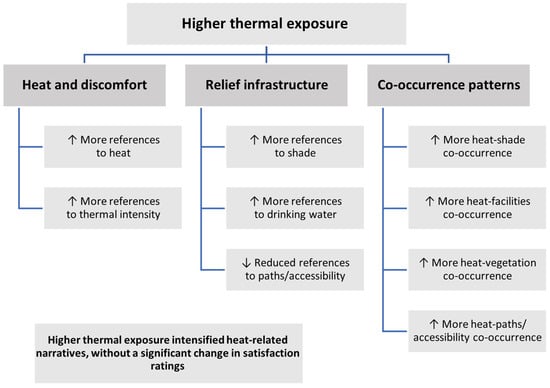
Crucially, thermal exposure not only elevated single-theme mentions but also amplified co-occurrence structures, indicating that heat and relief-oriented infrastructure were discussed together more frequently as temperatures rose. Co-mentions of Heat × Shade/Shelter increased 2.83-fold from lower to upper temperature tertiles (OR = 2.83, 95% CI [1.92, 4.16], p < 0.001). Heat × Facilities/Toilets showed a 2.54-fold increase (OR = 2.54, 95% CI [1.60, 4.02], p < 0.001), while Heat × Vegetation rose 1.75-fold (OR = 1.75, 95% CI [1.05, 2.91], p = 0.028). Even Heat × Paths—despite the overall decline in general path mentions—showed a 1.61-fold increase in co-occurrence (OR = 1.61, 95% CI [1.06, 2.44], p = 0.038). These patterns demonstrate that thermal exposure strengthens the textual association between themes, reflecting a heightened linkage in tourist narratives between thermal discomfort and the specific adaptive resources required to mitigate it. Figure 2 provides a visual summary of the main patterns identified across Section 4.1.2, Section 4.1.3 and Section 4.1.4, illustrating how higher thermal exposure was associated with changes in heat-related expressions, relief-oriented infrastructure mentions, and co-occurrence patterns in tourist narratives.
Figure 2.
Summary of thermal exposure effects on tourist perceptions.
4.1.5. Selective Effects: Non-Significant Categories
Some infrastructure categories showed no statistically significant association with thermal exposure, including Lighting & Safety (OR = 1.00, p = 0.974), Facilities & Toilets (OR = 1.07, p = 0.577), Seating & Rest (OR = 1.15, p = 0.688), and Waste & Cleanliness (OR = 1.05, p = 0.761). Similarly, when Vegetation & Greenery was analyzed as an aggregated theme, its association with temperature attenuated and became non-significant (OR = 0.98, p = 0.866), although specific vegetation subcomponents showed modest increases in co-mention tests with heat. Co-occurrences of Infrastructure with Intensity, as well as Lighting, Seating, Waste, and Paths, were likewise non-significant: no pairwise model reached p < 0.05, and only Shade × Intensity showed a marginal trend (p ≈ 0.05–0.06). The pattern of nine significant GLMMs concentrated in thermal and relief-oriented categories, alongside non-significant models spanning non-thermal site attributes, demonstrates that temperature’s textual signal is robust yet focused: heat-related and thermally adaptive content rises with thermal exposure, while most other experiential dimensions remain statistically unchanged.
4.2. Effect on Review Scores
In contrast to the research hypothesis, the analysis of TripAdvisor ratings revealed no significant effect of temperature on visitors’ overall evaluations. Ratings remained consistently high across all conditions, and the linear mixed-effects model showed that temperature tertile did not significantly predict the 1–5 score. Both the linear (p = 0.280) and quadratic (p = 0.383) contrasts were non-significant, and model fit indicated that temperature explained a negligible share of variance (marginal R2 < 0.001), with the random site intercept accounting for substantially more variation (ICC = 0.066). Estimated marginal means showed only minimal fluctuations across tertiles (lower M = 4.26, intermediate M = 4.30, upper M = 4.29), and Tukey-adjusted pairwise tests confirmed that none of these differences were significant (all p > 0.39). Descriptive comparisons supported the same conclusion: ratings were tightly clustered at the upper end of the scale across all sites and conditions, with no systematic directional trend. These results concern evaluative ratings within the reviewed sample and should not be interpreted as evidence about tourist numbers, visitation flows, or demand volume under hotter conditions.
5. Discussion
5.1. Rising Temperatures and Tourist Adaptive Response
The current study examined how rising temperatures shape tourist experience at open-air heritage sites in Southern Europe, focusing on how heat is articulated, managed, and integrated into visitors’ narratives. The findings indicate a clear and systematic pattern: as temperatures increased, tourists mentioned heat, thermal discomfort, and coping infrastructure—most notably shade and water—significantly more frequently [23,28]. Importantly, these mentions did not occur in isolation. Co-occurrence patterns reveal that references to discomfort and relief resources are frequently narrated together, indicating that tourists experience heat and adaptation as intertwined elements of the visit rather than as separate phenomena. At the same time, overall satisfaction ratings remained uniformly high and statistically unaffected by temperature, even under the hottest conditions. This divergence between experiential strain and evaluative outcomes reveals a paradoxical dynamic: while thermal stress becomes increasingly salient in narrative descriptions, it does not translate into lower overall ratings. Instead, tourists appear capable of sustaining positive evaluations despite heightened physical discomfort. This pattern may suggest that conventional satisfaction metrics can mask important experiential tensions, highlighting the value of narrative-based approaches for capturing how climate stress is actually lived and interpreted during tourism encounters.
The study findings align with climate–tourism research that conceptualizes temperature as both a physiological and emotional stressor influencing tourist behavior and perception [4,13,33]. However, the narratives analyzed here reveal a form of selective sensitivity rather than generalized experiential deterioration. As thermal exposure increases, tourists’ attention is disproportionately drawn to heat, bodily discomfort, and the resources that enable coping, while other experiential dimensions recede in narrative salience. This pattern indicates that heat does not simply degrade the tourism experience in a uniform way. Instead, tourists actively reorganize how they recount and interpret their visits. Reviewers consistently frame thermal strain alongside the features that made the experience manageable, such as shaded areas, water access, or moments of relief [23,28]. In doing so, they construct a narrative balance between challenge, mitigation, and maintained positive evaluation. Adaptation, therefore, is not merely a behavioral response enacted during the visit, but also a narrative process through which tourists retrospectively make sense of discomfort. This narrative reconstruction is consistent with an interpretive form of resilience at the experiential level, whereby tourists may renegotiate what aspects of the experience matter most, foregrounding coping and recovery in order to preserve perceived value under challenging climatic conditions [19].
From the perspective of resilience and adaptive capacity, destinations can be understood as complex adaptive systems that must reorganize under stress while maintaining core functions and identities [17,18,19]. The patterns observed in this study suggest that tourists mirror this adaptive logic at the experiential level. As thermal exposure increases, visitors reorient their attention toward conditions that are most immediately relevant for coping, particularly the availability of shade, water, and sheltered spaces [29,30]. The strong co-occurrence patterns—especially between Heat and Shade, and Heat and Facilities—indicate that coping infrastructure becomes cognitively coupled with thermal exposure. While the co-occurrence of heat and water mentions could not be tested due to sparse observations, the strong single-theme effect for drinking water confirms its salience under heat stress. These elements form experiential “bundles” that structure how the visit is remembered and described. Within this framing, adaptation is not peripheral to the experience but becomes a defining feature of it. Drawing on Ketter’s [14] distinction between “bouncing back” and “bouncing forward,” the heat-related narratives observed here align more closely with a bouncing-forward logic. Sustaining experience quality under rising temperatures increasingly depends on visible, accessible, and tangible micro-adaptation infrastructures that are incorporated into the lived experience of the destination [28].
5.2. Paradox of Positive Experience Amid Discomfort
A central paradox emerges in the findings: although heat-related discourse increases sharply under higher thermal exposure, overall satisfaction remains remarkably stable. TripAdvisor ratings showed no significant relationship with thermal exposure tertile, and descriptive statistics confirm that scores remain consistently high across lower, intermediate, and upper exposure conditions. This tension between discomfort in narratives and stable scores has important implications for understanding how visitors evaluate open-air heritage sites. The pattern suggests that the symbolic and experiential value of high-value cultural tourism may buffer the impact of physical discomfort, where symbolic and experiential significance may buffer the impact of physical discomfort. Reviewers of iconic open-air heritage destinations may maintain positive evaluations because the cultural value of the experience outweighs temporary physical strain, suggesting that meaning and significance serve as psychological buffers against environmental stressors.
Research on online review systems has documented positivity bias and ceiling effects that compress scores toward the high end and reduce sensitivity to moderate stressors [31]. The decoupling between discomfort and ratings observed in this study may reflect these dynamics. As a result, textual reviews may function as a more responsive indicator of experiential change than numeric ratings alone. The rising prominence of heat, shade, water access, and coping infrastructure in narrative accounts demonstrates that thermal stress alters the experiential texture of visits even when ratings remain unaffected. Taken together, these results raise questions about reliance on macro-level metrics such as visitation rates or climate suitability indices [13,40], which may overlook experiential strain until it manifests in demand changes. Rating metrics may mask meaningful experiential transformations that carry long-term consequences for visitor behavior, timing, or repeat visitation—highlighting the need to integrate narrative-based indicators into assessments of tourism resilience.
5.3. Theoretical Contribution
These findings make several scientific contributions to climate–tourism research. First, they bring resilience and adaptive capacity discussions into closer dialog with the individual tourist experience, suggesting that adaptive processes may also be observable at the micro-experiential level through narrative and perceptual processes, namely the ways tourists perceive, narrate, and evaluate their visits [14,17,18,19]. Second, the study demonstrates that user-generated content and tourists’ reviews can detect experiential shifts that remain invisible in conventional satisfaction metrics, addressing a gap in the literature; research has relied on macro indicators with limited insight into how heat is actually experienced by tourists [13,33,40]. Third, the finding that satisfaction remains stable while heat-related narratives s consistent with the view that resilience may involve not only the absence of negative impacts, but also processes of meaning-making—aligning with Ketter’s [14] conceptualization of resilience as a dynamic process. Fourth, the co-occurrence patterns between heat and infrastructure offer empirical support for the theoretical link between micro-adaptations and destination-level adaptation measures, demonstrating that tourists’ coping behaviors are connected to and shaped by the adaptive infrastructure that destinations provide [10,30,31,32,33].
Furthermore, the findings offer an indirect empirical basis for informing extensions of Ketter and Spiegel’s [19] model of tourism demand resilience to incorporate climate change as a distinct stressor. Their framework conceptualizes tourism demand as a complex adaptive system responding to disruptions through behavioral and cognitive adjustments. The present study provides indirect evidence of adaptive responses under rising temperatures that are relevant to tourism demand resilience, suggesting a two-pathway interpretation of tourist adaptation to climate stress [13]. The first pathway involves behavioral micro-adaptations: tourists modify on-site conduct by seeking shade [23,28], adjusting visit timing [24], and prioritizing thermally supportive infrastructure [23,28]—extending the concept of embodied coping routines [29,30]. These responses are evident in the significant rise in heat-infrastructure co-occurrences under hotter conditions. The second pathway involves expectation recalibration: tourists adjust their cognitive benchmarks, incorporating heat as an expected component of Southern Europe summer tourism rather than a deficiency [19]. This two-pathway interpretation helps explain the observed paradox—why experiential strain intensifies while satisfaction remains stable. Behavioral adaptations address immediate discomfort, while expectation adjustment protects overall evaluations. Methodologically, the study also demonstrates the value of integrating site-relative thermal exposure, dictionary-based narrative analysis, and mixed-effects modeling to examine climate-related experiential patterns at the review level. Together, these pathways position climate change not as a background condition but as an active stressor shaping tourist behavior in measurable ways. Importantly, such micro-level responses may scale into broader demand patterns over time [9], reinforcing the need to distinguish experiential content from evaluative outcomes when assessing tourism resilience under sustained climate pressure [13].
5.4. Policy and Management Contribution
The findings also have practical implications for heritage open-air site managers operating under increasingly hot conditions and the growing impact of the climate crisis on the travel and tourism industry. Tourists’ narratives reveal clear priorities: water availability and shaded spaces emerged as the most salient coping resources under heat stress, signaling where infrastructure investment should focus. Managers should prioritize installing accessible drinking water stations along visitor routes and expanding shaded rest areas through permanent structures, canopies, or strategic vegetation. The decreased attention to paths and walking-related features under hotter conditions suggests that visitors seek to minimize physical exertion; sites should consider offering shorter route options, shaded pathways, or cooling stations at key intervals. Beyond infrastructure, operational adaptations—such as extended morning hours, midday closure periods, and real-time heat advisories—can help visitors self-regulate thermal exposure. These measures translate tourist coping needs, as revealed in their own narratives, into tangible site-level interventions that sustain experience quality while protecting visitors’ health and safety.
5.5. Limitations and Future Research
Whereas the study findings focus on the demand side, an important limitation is that they do not directly capture the supply-side conditions that shape thermal coping at heritage sites. The analysis is based on tourists’ narratives, which indicate that visitors evaluate heat partly through the availability of coping resources, yet the study does not independently measure the presence, quality, or spatial distribution of shade, potable water, resting points, or other heat-mitigation features on-site. A related limitation concerns the operationalization of thermal exposure. Because TripAdvisor reviews provide only the month and year of visit rather than the exact date, time, or duration of exposure, the study relied on within-site tertiles of monthly maximum temperature as a site-level proxy for relative thermal conditions rather than a direct measure of the heat actually experienced by each visitor. Accordingly, the analysis could not account for potentially important sources of variation such as microclimatic differences within sites, time of day, humidity, apparent temperature, or short-term weather fluctuations at the moment of the visit. Nor could it directly control for seasonal crowding or peak tourist flows, which may also shape comfort, movement, and evaluative responses.
Additionally, the study relies on user-generated content collected without explicit consent from reviewers. Although only publicly accessible reviews were analyzed and personally identifiable information was anonymized using sequential codes, users may not have anticipated their content being used for research purposes [41]. A further limitation is that the analysis did not incorporate potentially relevant visitor-level characteristics such as type of travel, length of stay, or reviewer nationality, all of which may shape thermal perception, coping behavior, and evaluative responses. In the TripAdvisor data, such information was not consistently available across reviews, and some fields that could indirectly indicate personal background were not used analytically following the anonymization procedure adopted to protect user privacy. An additional limitation concerns language standardization, as some non-English reviews were included in the form displayed in the TripAdvisor interface, including platform-translated versions, which may introduce some variation in wording and expression. In addition, the study does not directly measure resilience or adaptive capacity as behavioral or psychological constructs; rather, these concepts are interpreted indirectly from observed patterns in review narratives, co-occurrence structures, and the relative stability of evaluative ratings under higher thermal exposure. The study also does not directly measure tourist numbers, visitation flows, or demand volume. Accordingly, the findings should not be interpreted as evidence that hotter conditions do not affect the number of tourists, but rather as evidence that, within the reviewed sample, higher thermal exposure was associated with changes in narrative content without a corresponding decline in reported satisfaction.
Future research should integrate review-based evidence with objective audits of micro-climate adaptation infrastructure, as well as with finer-grained thermal indicators at the site level. Where possible, future designs could also use more precise exposure measures, including daily or hourly weather conditions, humidity-sensitive indices, and visitor-timing information, in order to better approximate experienced heat and disentangle thermal effects from crowding-related pressures. Longitudinal designs could test whether upgrades in heat-mitigation infrastructure are associated with measurable shifts in heat-related discourse and satisfaction outcomes. Beyond visitors, future research should also examine how climate change affects tourism workers, including their heat exposure, wellbeing, and adaptation strategies. A further methodological consideration concerns the potential influence of temporal trends across the 2022–2025 study window. Although the within-site tertile design mitigates year-level confounding—since temperature rankings are computed within each site across all four years and reviews from any single year can appear across all tertiles—systematic changes in review behavior (e.g., post-pandemic recovery in 2022–2023 or growing public awareness of climate discourse) could potentially interact with temperature associations. To address this, all GLMMs were re-estimated with calendar year included as a four-level fixed-effects factor. The results were substantively unchanged: all nine previously significant associations retained their significance and direction, with odds ratios differing by no more than 0.10 from the original estimates (e.g., Heat: OR = 2.36 vs. 2.31; Shade & Shelter: OR = 2.15 vs. 2.15; Water & Drinking: OR = 3.34 vs. 3.31). This robustness check confirms that the observed thermal effects are not attributable to year-to-year shifts in tourism patterns during the study period.
5.6. Conclusions
This study provides clear evidence that rising temperatures are reshaping the experiential landscape of Southern European open-air heritage tourism. As thermal exposure increases, tourists foreground heat, discomfort, shade, and hydration in their narratives, revealing patterns suggestive of adaptive responses that reorient attention toward coping resources during the visit itself. At the same time, overall satisfaction ratings remain largely stable, indicating that experiential strain becomes more visible in narrative content than in conventional evaluative metrics. This divergence between what tourists describe and how they score their experiences is one of the study’s central insights. It suggests that climate change is not merely a background environmental condition, but an active stressor shaping how tourists experience, interpret, and narrate their visits. More broadly, the findings show that visitors do not simply passively endure hotter conditions; rather, they actively register, negotiate, and incorporate thermal challenges into their accounts of place, comfort, and value. In this sense, climate-related stress is becoming embedded in the ordinary experiential fabric of summer tourism in Southern Europe, highlighting a growing challenge for the long-term sustainability of open-air heritage destinations under climate change. These findings relate to review narratives and evaluative ratings rather than to tourist numbers or visitation volume.
The study contributes theoretically by extending discussion of resilience and adaptive capacity to the micro-experiential level, supporting the interpretation that adaptation may operate through both behavioral adjustments and narrative meaning-making. Scientifically, it contributes by showing that climate-related experiential change can be captured through review narratives even when conventional evaluative indicators such as ratings remain stable. More broadly, it advances climate–tourism research by linking environmental exposure, textual expression, and visitor evaluation within a single analytical design. Practically, the findings provide site managers with clear signals about visitor priorities—particularly the salience of shade, water access, and reduced walking under heat stress—and point to the importance of visible and accessible micro-adaptation infrastructure in sustaining experience quality under warming conditions. Open-air heritage destinations may therefore need to rethink not only how they protect visitors physically, but also how they design and communicate coping resources as part of the visitor experience itself. It is hoped that this research, together with future studies in this domain, will help open-air tourism sites better navigate the challenges and threats of the climate crisis era, while also supporting more sustainable destination management and the continued development of science in this field.
Supplementary Materials
The following supporting information can be downloaded at: https://www.mdpi.com/article/10.3390/su18073454/s1, Table S1: Non-significant and sparse GLMM results across temperature tertiles.
Author Contributions
Conceptualization, E.K. and D.F.; Methodology, D.F.; Software, D.F.; Validation, E.K. and D.F.; Formal analysis, D.F.; Investigation, D.F.; Data curation, D.F.; Writing—original draft preparation, D.F.; Writing—review and editing, E.K.; Visualization, D.F.; Supervision, E.K.; Project administration, E.K. All authors have read and agreed to the published version of the manuscript.
Funding
This research received no external funding.
Institutional Review Board Statement
Not applicable.
Informed Consent Statement
Not applicable.
Data Availability Statement
The data presented in this study were derived from publicly available online reviews (TripAdvisor). Restrictions apply to the availability of the raw textual data due to third-party terms of service. Aggregated/processed data and analysis code can be made available by the corresponding author upon reasonable request, subject to these restrictions.
Conflicts of Interest
The authors declare no conflicts of interest.
References
- Ali, E.; Cramer, W.; Carnicer, J.; Georgopoulou, E.; Hilmi, N.J.M.; Le Cozannet, G.; Lionello, P. Cross-Chapter Paper 4: Mediterranean Region. In Climate Change 2022: Impacts, Adaptation and Vulnerability; Pörtner, H.-O., Roberts, D.C., Tignor, M., Poloczanska, E.S., Mintenbeck, K., Alegría, A., Craig, M., Langsdorf, S., Löschke, S., Möller, V., et al., Eds.; Cambridge University Press: Cambridge, UK, 2022; pp. 2233–2272. [Google Scholar] [CrossRef] [Scilit]
- Cos, J.; Doblas-Reyes, F.; Jury, M.; Marcos, R.; Bretonnière, P.A.; Samsó, M. The Mediterranean climate change hotspot in the CMIP5 and CMIP6 projections. Earth Syst. Dyn. 2022, 13, 321–340. [Google Scholar] [CrossRef] [Scilit]
- Cramer, W.; Guiot, J.; Fader, M.; Garrabou, J.; Gattuso, J.P.; Iglesias, A.; Lange, M.A.; Lionello, P.; Llasat, M.C.; Paz, S.; et al. Climate change and interconnected risks to sustainable development in the Mediterranean. Nat. Clim. Change 2018, 8, 972–980. [Google Scholar] [CrossRef] [Scilit]
- European Travel Commission. Climate Change & Tourism in Europe: Travelsat Special Report; European Travel Commission: Brussels, Belgium, 2024; Available online: https://etc-corporate.org/reports/climate-change-tourism-in-europe/ (accessed on 21 January 2026).
- Copernicus Climate Change Service. European State of the Climate 2024: Summary; European Centre for Medium-Range Weather Forecasts: Reading, UK, 2025; Available online: https://climate.copernicus.eu/esotc/2024 (accessed on 21 January 2026).
- Intergovernmental Panel on Climate Change. AR6 Synthesis Report: Climate Change 2023; Intergovernmental Panel on Climate Change: Geneva, Switzerland, 2023; Available online: https://www.ipcc.ch/report/sixth-assessment-report-cycle/ (accessed on 21 January 2026).
- World Tourism Organization. Glasgow Declaration Implementation Report 2023: Advancing Climate Action; UN Tourism: Madrid, Spain, 2024. [Google Scholar] [CrossRef] [Scilit]
- Agulles, M.; Melo-Aguilar, C.; Jordà, G. Risk of loss of tourism attractiveness in the western Mediterranean under climate change. Front. Clim. 2022, 4, 1019892. [Google Scholar] [CrossRef] [Scilit]
- Zhou, W.; Faturay, F.; Driml, S.; Sun, Y.Y. Meta-analysis of the climate change–tourism demand relationship. J. Sustain. Tour. 2024, 32, 1762–1783. [Google Scholar] [CrossRef] [Scilit]
- Ghosh, A.; Kayal, P.; Bagchi, P. Climate change and tourism: Assessing the nexus and climate-related disasters in diverse economies. J. Clean. Prod. 2024, 443, 141097. [Google Scholar] [CrossRef] [Scilit]
- Matei, N.-A.; García-León, D.; Dosio, A.; Batista e Silva, F.; Ribeiro Barranco, R.; Císcar Martínez, J.-C. Regional Impact of Climate Change on European Tourism Demand; Publications Office of the European Union: Luxembourg, 2023; Available online: https://publications.jrc.ec.europa.eu/repository/handle/JRC131508 (accessed on 21 January 2026).
- Scott, D.; Gössling, S. A review of research into tourism and climate change-Launching the annals of tourism research curated collection on tourism and climate change. Ann. Tour. Res. 2022, 95, 103409. [Google Scholar] [CrossRef] [Scilit]
- Scott, D.; Hall, C.M.; Gössling, S. Global tourism vulnerability to climate change. Ann. Tour. Res. 2019, 77, 49–61. [Google Scholar] [CrossRef] [Scilit]
- Ketter, E. Bouncing back or bouncing forward? Tourism destinations’ crisis resilience and crisis management tactics. Eur. J. Tour. Res. 2022, 31, 3103. [Google Scholar] [CrossRef] [Scilit]
- Cochrane, J. The sphere of tourism resilience. Tour. Recreat. Res. 2010, 35, 173–185. [Google Scholar] [CrossRef] [Scilit]
- Walker, B.; Holling, C.S.; Carpenter, S.R.; Kinzig, A. Resilience, adaptability and transformability in social–ecological systems. Ecol. Soc. 2004, 9, 5. [Google Scholar] [CrossRef] [Scilit]
- Hartman, S. Resilient tourism destinations? Governance implications of bringing theories of resilience and adaptive capacity to tourism practice. In Destination Resilience, 1st ed.; Pechlaner, H., Innerhofer, E., Fontanari, M., Eds.; Routledge: London, UK, 2018; pp. 66–76. [Google Scholar] [CrossRef] [Scilit]
- Hartman, S. Adaptive tourism areas in times of change. Ann. Tour. Res. 2021, 87, 102987. [Google Scholar] [CrossRef] [Scilit]
- Ketter, E.; Spiegel, Y. The resilience of travel demand: The case of Europeans’ travel sentiment during the COVID-19 pandemic. Tour. Rev. Int. 2024, 28, 1–13. [Google Scholar] [CrossRef] [Scilit]
- Beirman, D. Restoring Tourism Destinations in Crisis: A Strategic Marketing Approach; Routledge: London, UK, 2020. [Google Scholar] [CrossRef] [Scilit]
- Avraham, E.; Ketter, E. Media Strategies for Marketing Places in Crises: Improving the Image of Cities, Countries, and Tourist Destinations; Routledge: London, UK, 2008. [Google Scholar] [CrossRef] [Scilit]
- Avraham, E.; Ketter, E. Destination marketing during and following crises: Combating negative images in Asia. J. Travel Tour. Mark. 2017, 34, 709–718. [Google Scholar] [CrossRef] [Scilit]
- Zhang, J.; Wang, N. Study on the relationship between summer microclimate and human thermal comfort in urban waterfront parks–Longzi Lake Park in Zhengzhou city as an example. Landsc. Ecol. Eng. 2025, 21, 341–356. [Google Scholar] [CrossRef] [Scilit]
- Kirschner, V.; Urban, A.; Chlapcová, L.; Řezáčová, V. Thermal comfort perception among park users in Prague, Central Europe on hot summer days—A comparison of thermal indices. PLoS ONE 2025, 20, e0299377. [Google Scholar] [CrossRef] [Scilit]
- World Meteorological Organization. State of the Global Climate 2024; WMO-No. 1368; World Meteorological Organization: Geneva, Switzerland, 2025; Available online: https://library.wmo.int/idurl/4/69455 (accessed on 21 January 2026).
- Hidalgo-Garcia, D.; Founda, D.; Rezapouraghdam, H. Spatiotemporal variability of the Universal Thermal Climate Index during heat waves using the UrbClim climate model: Implications for tourism destinations. Urban Clim. 2025, 59, 102281. [Google Scholar] [CrossRef] [Scilit]
- Petrou, I.; Kassomenos, P. Spatiotemporal analysis of Holiday Climate Index for urban and beach destinations in Greece. Theor. Appl. Climatol. 2025, 156, 27. [Google Scholar] [CrossRef] [Scilit]
- Shen, X.; Guo, Y.; Yang, Q.; Cheng, W.; Chen, M.; Gao, X.; Cheng, S.; Wang, L. Assessing thermal comfort in a landmark urban park: A case study and methodological framework of Alamo Square in San Francisco, USA. Ecol. Indic. 2025, 180, 114206. [Google Scholar] [CrossRef] [Scilit]
- Ngxongo, N. The impact of climate change on visitor destination selection: A case study of the Central Drakensberg Region in KwaZulu-Natal. Jàmbá J. Disaster Risk Stud. 2021, 13, a1161. [Google Scholar] [CrossRef] [Scilit]
- Wilkins, E.J.; Horne, L. Effects and perceptions of weather, climate, and climate change on outdoor recreation and nature-based tourism in the United States: A systematic review. PLoS Clim. 2024, 3, e0000266. [Google Scholar] [CrossRef] [Scilit]
- Xiang, Z.; Du, Q.; Ma, Y.; Fan, W. A comparative analysis of major online review platforms: Implications for social media analytics in hospitality and tourism. Tour. Manag. 2017, 58, 51–65. [Google Scholar] [CrossRef] [Scilit]
- Alaei, A.R.; Becken, S.; Stantic, B. Sentiment analysis in tourism: Capitalizing on big data. J. Travel Res. 2019, 58, 175–191. [Google Scholar] [CrossRef] [Scilit]
- Liu, S.; Nazarian, N.; Niu, J.; Hart, M.A.; de Dear, R. From thermal sensation to thermal affect: A multi-dimensional semantic space to assess outdoor thermal comfort. Build. Environ. 2020, 182, 107112. [Google Scholar] [CrossRef] [Scilit]
- Bolker, B.M.; Brooks, M.E.; Clark, C.J.; Geange, S.W.; Poulsen, J.R.; Stevens, M.H.H.; White, J.S.S. Generalized linear mixed models: A practical guide for ecology and evolution. Trends Ecol. Evol. 2009, 24, 127–135. [Google Scholar] [CrossRef] [Scilit] [PubMed]
- Bates, D.; Mächler, M.; Bolker, B.; Walker, S. Fitting linear mixed-effects models using lme4. J. Stat. Softw. 2015, 67, 1–48. [Google Scholar] [CrossRef] [Scilit]
- Kuznetsova, A.; Brockhoff, P.B.; Christensen, R.H.B. lmerTest package: Tests in linear mixed effects models. J. Stat. Softw. 2017, 82, 1–26. [Google Scholar] [CrossRef] [Scilit]
- Lenth, R.V. Emmeans: Estimated Marginal Means, aka Least-Squares Means [R Package]. 2020. Available online: https://CRAN.R-project.org/package=emmeans (accessed on 21 January 2026).
- Nakagawa, S.; Schielzeth, H. A general and simple method for obtaining R2 from generalized linear mixed-effects models. Methods Ecol. Evol. 2013, 4, 133–142. [Google Scholar] [CrossRef] [Scilit]
- Lüdecke, D.; Ben-Shachar, M.S.; Patil, I.; Waggoner, P.; Makowski, D. Performance: An R package for assessment, comparison and testing of statistical models. J. Open Source Softw. 2021, 6, 3139. [Google Scholar] [CrossRef] [Scilit]
- Barnett-Itzhaki, Z.; Sar-Shalom, A.; Cohn, L.; Chen, L.; Steinitz, O. The effect of heatwaves on the number of visits to national parks and reserves. PLoS ONE 2023, 18, e0289201. [Google Scholar] [CrossRef] [Scilit]
- Franz, D.; Marsh, H.E.; Chen, J.I.; Teo, A.R. Using Facebook for qualitative research: A brief primer. J. Med. Internet Res. 2019, 21, e13544. [Google Scholar] [CrossRef] [Scilit]

Disclaimer/Publisher’s Note: The statements, opinions and data contained in all publications are solely those of the individual author(s) and contributor(s) and not of MDPI and/or the editor(s). MDPI and/or the editor(s) disclaim responsibility for any injury to people or property resulting from any ideas, methods, instructions or products referred to in the content. |
© 2026 by the authors. Licensee MDPI, Basel, Switzerland. This article is an open access article distributed under the terms and conditions of the Creative Commons Attribution (CC BY) license.