


Abstract
Promoting digital governance is a key direction for the Chinese government’s governance reform. Based on panel data from 280 prefecture-level and above cities spanning 2008–2023, this study treats the “National Pilot Policy for Information Benefiting the People” as a quasi-natural experiment. Employing a difference-in-differences model, it examines the impact of government digital governance on urban innovation and its underlying mechanisms. Findings indicate that digital governance significantly enhances urban innovation, with conclusions remaining robust after rigorous stability tests and endogeneity treatments. Mechanism tests reveal that digital governance enhances urban innovation by cultivating innovation entities, improving the innovation environment, and optimizing the allocation of innovation elements. Further analysis indicates that the impact of digital governance on urban innovation is influenced by city location and development level. In eastern regions, areas with lower government fiscal pressure, and regions with higher levels of informatization, government digital transformation is more effective in boosting urban innovation. In addition, digital governance has significantly promoted sustainable and strategic innovation in cities and can influence innovation in neighboring areas through spillover effects. These findings can provide valuable insights for promoting urban innovation.
1. Introduction
At present, the world stands at a critical historical juncture of a new round of technological revolution and industrial transformation. Facing the significant opportunities and challenges brought by this new wave of technological revolution and industrial transformation, innovation-driven development has become the core strategic objective for economic growth across nations (Liu & Feng, 2022) [1]. The report of the 19th National Congress of the Communist Party of China (NPC) explicitly states that “innovation is the primary driving force for development and a strategic pillar for building a modernized economic system.” This crucial exposition on building an innovation-driven nation charts the course for China’s scientific and technological innovation. Enhancing innovation capabilities is vital for China’s high-quality economic development, with its importance further underscored amid the current complex domestic and international landscape. According to data from the 2024 Global Innovation Index Report jointly released by the World Intellectual Property Organization (WIPO) and related institutions, China’s innovation capability has risen globally to rank 11th, making it one of the regions with the most rapid improvement in innovation levels over the past decade. However, challenges persist, including uneven distribution of innovation factors, low levels of fundamental innovation, and low conversion rates of innovation outcomes. Structural barriers also remain in transitioning from element-driven to innovation-driven growth (Gong et al., 2017) [2]. Therefore, reshaping the national innovation system, accelerating the development of an innovation-driven nation, and promoting scientific and technological innovation hold significant theoretical value and practical significance for enhancing regional innovation levels and advancing China’s high-quality economic development.
With the rapid development and application of next-generation digital technologies such as big data, artificial intelligence, and cloud computing, global government governance models are undergoing a digital transformation. The Chinese government is also progressively advancing to a new level of digital governance. According to the United Nations E-Government Survey 2024, China’s e-government development index has risen from 0.8119 in 2022 to 0.8718 in 2024, with its global ranking climbing to 35th place. Government digital transformation not only plays a vital role in enhancing public service delivery, promoting collaborative governance across different levels and departments, and facilitating rational decision-making, but also makes significant contributions to advancing the “streamlining administration, delegating power, and improving government services” reform, optimizing the institutional environment, and providing convenience for citizens and businesses (Li et al., 2023) [3]. However, challenges persist, including insufficient innovation in applications, high data barriers, and inconsistent standards.
In 2014, to further accelerate the modernization of the national governance system and governance capabilities, the National Development and Reform Commission (NDRC), the Ministry of Finance (NOF), the Ministry of Human Resources and Social Security (MHRSS), and 11 other relevant departments jointly launched the National Pilot Policy for Information Benefiting the People. This policy aims to enhance public service levels, explore the use of information technology to optimize the allocation of public resources, and innovate social management. Existing research has begun examining the policy’s impact on urban employment quality, urban-rural income disparities, and urban digital transformation. However, a critical question remains under-explored: Can the National Pilot Policy for Information Benefiting the People effectively drive urban innovation? If so, what are its underlying mechanisms? Research on this question helps clarify the relationship between government digital transformation and urban innovation. Therefore, this study aims to promote the modernization of the national governance system and governance capacity, accelerate the transformation of government functions, and accelerate the construction of an innovation-driven country by analyzing the relationship between digital governance and urban innovation. The research results will provide empirical evidence for policymakers to optimize and expand such pilot measures.
2. Literature Review
Urban innovation refers to a city’s ability to generate new knowledge and apply this knowledge to develop new technologies, processes, and services (Li et al., 2020) [4]. The literature most relevant to this study can be broadly categorized into the following strands: The first strand focuses on identifying the driving forces behind urban innovation. Existing research on factors influencing urban innovation broadly categorizes them into internal and external factors. Regarding internal factors, scholars suggest that transportation infrastructure, urban educational resources, and city size significantly impact innovation (Ma et al., 2023; Ferraris et al., 2020; Gao & Yuan, 2021) [5,6,7]. Some scholars contend that converting counties into districts can effectively mitigate fiscal decentralization incentives, alleviate administrative friction between regions, promote regional market integration, enhance resource allocation efficiency, and further stimulate urban innovation vitality (Lu et al., 2023) [8]. Other scholars contend that fiscal expenditures significantly promote urban innovation, with local and spatial effects of government spending on innovation being more pronounced within urban clusters (Zhang & Luo, 2024) [9]. Additionally, some scholars adopting an external urban perspective have found that economic policies and institutional environments significantly influence both the quantity and quality of urban innovation (Wang & Deng, 2022; Huang et al., 2023) [10,11]. Some scholars focus on local intellectual property protection, arguing that designating intellectual property demonstration cities can effectively enhance urban innovation (Ji & Gu, 2021) [12]. Furthermore, some scholars believe that digital technology can enhance the innovation of cities (Tang et al., 2026) [13]; the second document delves into innovation measurement metrics. Most innovation measures are derived from the micro-level perspective of enterprises. Some scholars use the number of invention patent applications to gauge substantive innovation that drives technological progress and competitive advantage, while employing non-invention patent applications to measure strategic innovation (Li & Zheng, 2016) [14]. Given that patent applications for inventions effectively reflect innovation capabilities and satisfy the requirements of “novelty, inventiveness, and utility,” this metric has been widely adopted by many scholars (Wu & Liu, 2020) [15]. Other researchers focus on the knowledge complexity embedded in patents, using the number of IPC patent classification codes and knowledge breadth to represent innovation quality (Zhang & Zheng, 2018) [16]. Additionally, scholars have employed machine learning and semantic citation methods to measure innovation quality, concluding that supportive technological incentive policies significantly enhance both the quantity and quality of corporate innovation (Chen et al., 2020) [17]. However, no unified consensus has been reached on measuring regional innovation levels, with most scholars relying on patent volume and structure. Some researchers use patents granted per 10,000 population to gauge urban innovation and found that the impact of human capital on urban innovation exhibits spatial non-stationarity (Gu et al., 2025) [18]. Another approach measures substantive, sustainable, and collaborative innovation in cities by analyzing the proportions of invention patent applications, green patent applications, and industry-academia-research patent applications relative to total patent applications (Jin et al., 2019) [19]; a third body of literature focuses on the socioeconomic impacts of government digital transformation. Some scholars have conducted macro-level analyses of the economic effects generated by government digital transformation, arguing that it can break down information barriers between regions to enhance capital allocation efficiency (Li & Chen, 2024) [20] and promote high-quality regional economic development by increasing total factor productivity (Ding & Yang, 2024) [21]. Additionally, some scholars argue that government digital transformation can play a significant role in enhancing the quality of export products, promoting foreign direct investment, and optimizing the business environment (Liu et al., 2024; Li & Zhang, 2024; Fan et al., 2022) [22,23,24]. At the micro-enterprise level, digital governance can reduce institutional transaction costs, thereby enhancing corporate innovation levels (Wang et al., 2021) [25], and also improve investment efficiency (Gao et al., 2026) [26]. Regarding the societal impacts of government digital transformation, some scholars argue that it enhances urban governance by increasing the clearance rate of theft and robbery cases (Chen et al., 2024) [27]. From a household micro-level perspective, some scholars argue that interdepartmental information sharing can enhance residents’ well-being by improving public service quality (Huang & Zhao, 2023) [28], while also stimulating entrepreneurial activity through the reduction in “relationship” effects and regulatory mitigation (Wang & Li, 2020) [29].
Although existing literature provides rich theoretical references for this study, several limitations remain: (1) while research on digital governance and urban innovation is abundant, few studies have conducted in-depth analyses at the prefecture-level city level regarding the impact of digital governance on urban innovation, and there are also few studies on the spillover effects of digital governance; (2) although a limited number of studies have examined the impact of digital governance on urban innovation, significant debate persists regarding the underlying pathways of influence; (3) There is little literature that further explores the impact of digital governance on sustainable and strategic innovation in cities. In light of these limitations, this study employs panel data from 280 prefecture-level and above cities across China spanning 2008–2023. Treat the National Pilot Policy for Information Benefiting the People as a quasi-natural experiment, it applies a difference-in-differences (DID) approach to examine the impact of digital governance on urban innovation and its underlying mechanisms.
This paper may make key contributions in the following areas: First, it enriches existing research on the drivers of urban innovation from the perspective of government digital governance, thereby enhancing the evaluation of the effectiveness of the National Pilot Policy for Information Benefiting the People. Compared to policies related to government digital transformation, such as Smart Cities and E-government pilot programs, the National Pilot Policy for Information Benefiting the People focuses more on accessibility, convenience, and equalization levels in the field of livelihood services. And Smart Cities Pilot Policy is a systematic extension and upgrade of information benefiting the people; Second, it further analyzes the pathways through which digital governance influences urban innovation, focusing on the impacts of innovation entity cultivation, innovation environments, and innovation element allocation. This contributes to a multidimensional understanding of the implementation outcomes of the National Pilot Policy for Information Benefiting the People. Additionally, it delves into the effects of digital governance on sustainable and strategic innovation in cities, providing valuable empirical insights for comprehending the innovation-driving effects and operational mechanisms of digital governance, thereby broadening the research perspective; Third, examining the relationship through the lens of government digital transformation, analyzing the heterogeneity of effects across different samples enables deeper insights into the effects of both capable and effective governments on urban innovation. Digital governance represents a key objective for the nation in modernizing its governance systems and capabilities, while urban innovation serves as a vital driver for sustainable economic development. Integrating digital governance with innovation facilitates a multidimensional understanding of the socioeconomic benefits generated by digital governance.
The remainder of this paper is organized as follows: Section 2 presents the policy context and theoretical mechanism analysis; Section 3 outlines the empirical research design and variable specifications; Section 4 reports empirical findings and robustness tests; Section 5 further analyzes the potential mechanisms, sample heterogeneity, and spillover effects of the impact of government digital transformation on urban innovation; and the concluding section synthesizes the findings and derives corresponding policy implications.
3. Policy Context and Theoretical Mechanism
3.1. Policy Context
The report to the 19th CPC National Congress explicitly stated that “China’s economy is at a critical juncture of transforming its development model and shifting its growth drivers,” and for the first time established “Digital China” as a national strategic goal. To further accelerate the modernization of the national governance system and governance capabilities, in 2014, 12 relevant departments, including the National Development and Reform Commission (NDRC), the Ministry of Finance (MOF), and the Ministry of Human Resources and Social Security (MHRSS), jointly issued the “Notice on Accelerating the Implementation of the Information for the Benefit of the People Project” (hereinafter referred to as the “Notice”). The Notice designated 80 Chinese cities as national pilot policy cities for the National Pilot Policy for Information Benefiting the People Project. The pilot policy adopted an approach of advance funding followed by performance-based incentives and penalties. The Ministry of Finance (MOF) provided partial start-up funding to eligible cities, with subsequent performance evaluations and acceptance inspections conducted by relevant departments. In 2015, the National Development and Reform Commission (NDRC), Ministry of Finance (MOF), Ministry of Human Resources and Social Security (MHRSS), and other relevant departments jointly issued the Opinions on Conducting Evaluations of National Pilot Cities for Information-Based Public Welfare Initiatives (hereinafter referred to as the Opinions). This document established evaluation indicators and procedures for the pilot projects and outlined comprehensive assessment arrangements. In 2016, the General Office of the State Council forwarded the “Implementation Plan for Advancing ‘Internet Plus Government Services’ and Conducting Information-Based Public Welfare Pilot Programs” (hereinafter referred to as the ‘Plan’) issued by 10 relevant departments, including the National Development and Reform Commission (NDRC), Ministry of Finance (MOF), and Ministry of Public Security (MOPC). The Plan proposed accelerating the advancement of “Internet Plus Government Services” and deepening the implementation of information-based public welfare projects. The implementation of the national pilot policy for information-based public welfare aims to enhance coordination among various levels and departments, achieve data sharing, optimize business processes, and innovate service models. This will establish an open, transparent, convenient, efficient, and high-quality government service system, ultimately benefiting both citizens and enterprises. This specific policy is a comprehensive proxy for “Government digital transformation”.
3.2. Theoretical Analysis and Research Hypotheses
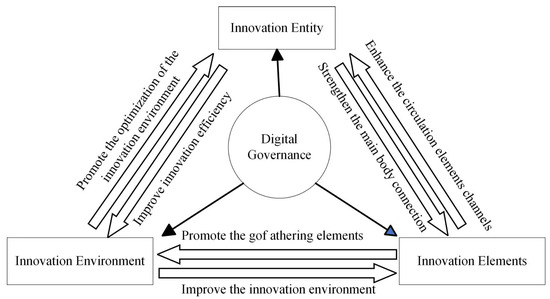
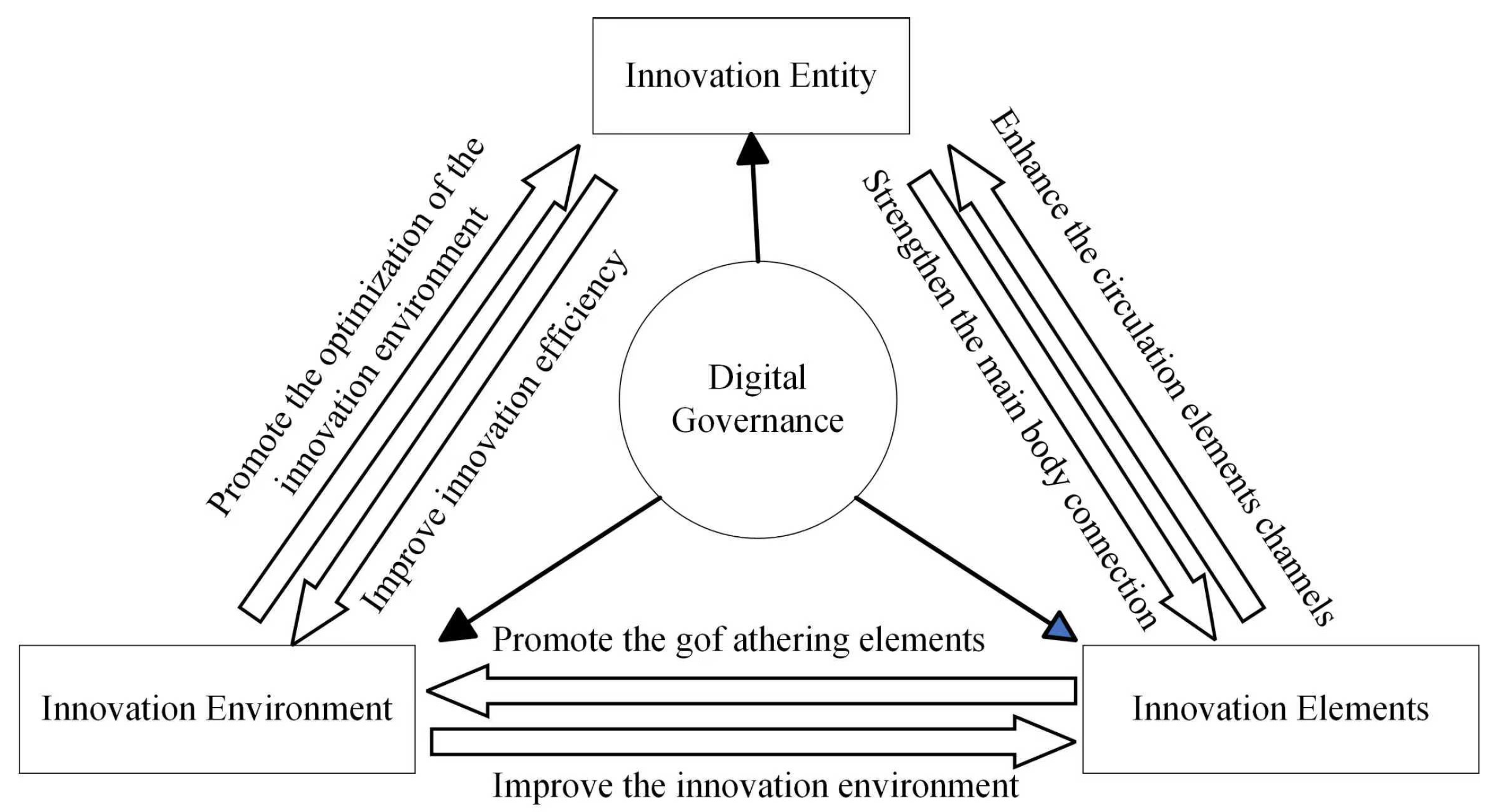
The National Pilot Policy for Information Benefiting the People was established to enhance the government’s digital governance capabilities more effectively. Digital governance can elevate a city’s innovation through its interaction with the cultivation of innovation entities, the innovation environment, and innovation elements (shown in Figure 1). In the theory of new institutional economics, the innovation environment is a key institutional infrastructure, and its optimization is directly related to the efficiency of element allocation and the improvement of total element productivity. At the same time, a good innovation environment can attract and efficiently allocate high-end global resources, promoting the concentration of various market entities. Therefore, there is a close relationship between optimizing the innovation environment, allocating innovation elements, and cultivating innovation entities. The mechanism of its impact on urban innovation is manifested in the three-mechanism framework:
Figure 1.
The Interaction Between Digital Governance and Urban Innovation Systems.
3.2.1. Innovation Entity Cultivation Mechanism
Regarding the mechanism by which digital governance influences urban entrepreneurship, there are three-level transmission mechanisms, including administrative efficiency, information symmetry, and resource accessibility: Firstly, the National Pilot Policy for Information Benefiting the People effectively drives innovation in government service models, optimizes business processes, and enhance government administrative efficiency and public service levels. Shifting government functions toward service orientation enhances service efficiency, reduces ineffective interventions, and consequently lowers institutional transaction costs. Institutional transaction costs refer to the time, money, and other expenses incurred by enterprises as microeconomic entities in operating in compliance with various government-established systems, regulations, and policies (He et al., 2024) [30]. According to institutional quality and governance capacity theories (Fan et al., 2025) [31], effective institutions decline uncertain factors and transaction expenses. Transaction costs are considered a key factor affecting regional entrepreneurialism (La Porta et al., 1999) [32]. The high transaction costs are an important factor hindering entrepreneurial activities (Agostino et al., 2020) [33]; secondly, the pilot policy enhances administrative information transparency and reduces entrepreneurs’ uncertainty perception (Hu, 2024) [34]. Timely government releases of policies, investment channels, tax incentives, and other startup-related information mitigate pre-launch uncertainty. Government information disclosure effectively reduces business uncertainties, further improving enterprises’ external investment efficiency (Yu et al., 2020) [35]. At the same time, under the guidance of the National Pilot Policy for Information Benefiting the People, enterprises will seize the opportunity and use the incentives provided by this measure to enhance market competitiveness, pursue green innovation capabilities, and obtain financial support, government subsidies, and external recognition. Thirdly, through departmental integration, optimization, and restructuring, they promote information sharing across hierarchical levels and agencies. This further streamlines business registration approvals by reducing required documentation, waiting times, and administrative visits. The consolidation and sharing of information data provide essential support for innovation activities. Additionally, policies for online service platforms drive the efficiency and accessibility of intellectual property protection mechanisms. The policy plays a key role in reducing expenses and uncertain factors about intellectual property rights through digitizing processes for patent usages, status tracking, and rights management. The online intellectual property protection system motivates companies to invest in innovation on the research and development, leading to more innovative activities.
Regarding the mechanism by which entrepreneurial activity influences urban innovation, enterprises possess strong market demand and policy guidance while serving as the most dynamic vehicles for innovation. They can transform innovative R&D outcomes into market-driven products while simultaneously relaying shifts in market demand back to R&D departments. Regional innovation levels are primarily determined by both internal and external drivers. As the primary agents of innovation, enterprises influence regional innovation levels and high-quality economic development through technological push, market pull, and the business environment (Chen, 2007) [36]. Furthermore, as urban entrepreneurial activity intensifies and more entrepreneurs enter the market, local governments often refine policies to create a more supportive institutional environment. By strengthening support for entrepreneurial endeavors, they effectively stimulate innovators’ motivation, injecting sustained momentum into enhancing urban innovation levels (Zheng et al., 2025) [37].
3.2.2. Innovation Environment Improving Mechanism
In terms of the impact of the National Pilot Policy for Information Benefiting the People on the innovation environment. Firstly, supported by digital technologies, it enables better coordination among various departments, enhances the governance efficiency of government agencies, and consequently elevates the overall level of public services (Chen, 2021) [38]. It can also reduce ineffective interventions and further lower the institutional transaction costs in the entrepreneurial process (He et al., 2024) [30]. Secondly, government digital transformation can forge closer ties between government and citizens, fostering communication and interaction. It strengthens public participation and expands opportunities for citizens to create public value, enabling proactive responses to evolving social needs; Thirdly, a digital government can more flexibly formulate innovative incentive policies to encourage and support innovation activities by enterprises and research institutions, foster the incubation of innovative outcomes, and drive the formation and development of an innovation ecosystem. It can also establish technology and information exchange networks, build innovation practice bases and service platforms, provide a foundation for international cooperation, and offer impetus and support for the R&D activities of innovation entities (Fan et al., 2025) [31]. This mobilizes their enthusiasm for invention and creation, thereby optimizing the city’s innovation environment.
In terms of the impact of the innovation environment on urban innovation. On one hand, the new institutional economics profoundly reveals the decisive impact of institutions on economic performance. As the core institutional carrier of economic operation, the innovation environment can effectively reduce institutional transaction costs, reduce uncertainty in market activities, and provide stable expectations for the free flow and efficient combination of various production elements by constructing a market-oriented, rule-of-law, and international rule system. A favorable innovation environment provides fundamental safeguards for innovation entities. Moreover, a significant positive relationship exists between the policy environment for innovation and the quality of corporate innovation (Wang et al., 2015) [39]. In regions with higher levels of market legal systems, the market value of invention and design patents is greater (Long et al., 2018) [40]. On the other hand, the theory of innovative ecosystems emphasizes that the improvement of total factor productivity cannot rely on isolated inputs of a single factor but on the collaborative evolution mechanism formed by multiple subjects in benign interactions. The innovation environment is precisely the “climate” and “soil” of this ecosystem, with its core function being to promote non-linear connections and deep collaboration between entities such as enterprises, universities, research institutions, governments, and social capital. A sound market institutional environment enhances the expected returns on R&D investments for innovation entities, encouraging them to engage in innovative activities. This facilitates their participation in research domains characterized by higher technological complexity and greater innovation breakthroughs, significantly stimulating urban innovation quality and boosting innovation efficiency (Xiao et al., 2026) [41]. Moreover, a favorable innovation environment is crucial for attracting corporate talent in scientific and technological innovation, playing a vital role in transforming enterprises from traditional development models to innovation-driven ones (Sun & Jia, 2025) [42]. Improving the innovation environment is a profound institutional transformation whose core logic lies in building a first-class “institutional infrastructure”, continuously reducing institutional transaction costs, optimizing element allocation, and ultimately driving the fundamental shift of total factor productivity from factor-driven to innovation-driven.
3.2.3. Innovation Elements Allocation Mechanism
The allocation of innovative resource elements mainly includes innovative talents, innovative funds, innovative technologies, and other aspects. The innovative element allocation effects of the National Pilot Policy for Information Benefiting the People are manifested in the following aspects: (1) Inflow of innovative elements. With the continuous implementation of pilot policies, the innovation environment continues to improve. Investors, seeking to mitigate risks associated with innovation activities and enhance expected returns, increasingly favor conducting such activities within pilot cities. The government’s timely release of policies supporting talent development, financing and lending, and tax incentives—all relevant to innovation activities—effectively communicates governmental actions to innovation entities. This helps innovative talent understand relevant policies and anticipate future policy directions. Simultaneously, government digital transformation not only effectively promotes the openness of government data but also enhances communication between urban and rural residents and the government. This increases public participation in politics and trust in the government (Liu et al., 2023) [43], thereby facilitating the inflow of innovative talent and capital. On one hand, the continuous influx of innovative factors complements existing local resources, further optimizing the structure of innovation elements. On the other hand, the influx of local innovation factors heightens competition, prompting inefficient innovation entities to exit the market and thereby elevating the city’s overall innovation quality (Cheng & Zhong, 2023) [44]; (2) Reduced innovation costs. The clustering of innovation factors lowers the difficulty and cost for innovation entities to access resources, and these reduced costs incentivize them to allocate more resources toward R&D. At the same time, from the perspective of governance theory and innovation ecosystem, it is emphasized that the improvement of total factor productivity depends on the collaborative evolution of multiple subjects in a positive interaction and (3) improved innovation structure. After fully considering their own economic development levels and innovation capabilities, cities will form patent invention quantities and structures that match their own conditions. This helps reduce innovation activities that pursue quantity and speed alone, enabling innovation entities to devote more resources and energy to substantive innovation that drives technological progress and achieves competitive advantages.
Based on the above, we propose the following hypotheses:
H1.
Digital governance enhances urban innovation by attracting new enterprises and fostering innovative entities.
H2.
Digital governance can enhance a city’s innovation by improving the innovation environment.
H3.
Digital governance can enhance urban innovation by optimizing the allocation of innovation elements.
4. Research Design
4.1. Empirical Model
To examine the impact of digital governance on urban innovation, this study employs a approach for analysis, using the implementation timing of the National Pilot Policy for Information Benefiting the People as an exogenous shock. Cities included in the pilot policy will be designated as the treatment group, while non-pilot cities form the control group. The regression model is constructed as follows:
In this equations, represents the city innovation during the period ; denotes the policy dummy variable indicating whether the city is a National Pilot Policy for Information Benefiting the People initiative, valued as 1 if the city was included in the pilot list during the period and 0 otherwise; represents the time dummy variable indicating whether the city began implementing the National Pilot Policy for Information Benefiting the People during the period , valued as 1 in the year of implementation and thereafter, and 0 otherwise; represents the core explanatory variable of primary interest. A positive estimated coefficient indicates that digital governance promotes urban innovation. denotes a set of control variables potentially influencing urban innovation. and denote city fixed effects and time fixed effects, respectively. is the random error term.
4.2. Variable Descriptions and Data Sources
4.2.1. Digital Governance ()
The digital governance dummy indicates whether a city was designated as a National Pilot Policy for the Information Benefiting the People initiative in a given year . It is assigned values based on the official list of designated cities and their approval dates. If a city was included in the pilot policy list for a specific year, it is assigned a value of 1 for that year and all subsequent years; otherwise, it is assigned a value of 0.
4.2.2. Urban Innovation (Innov)
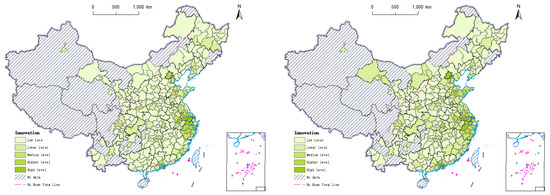
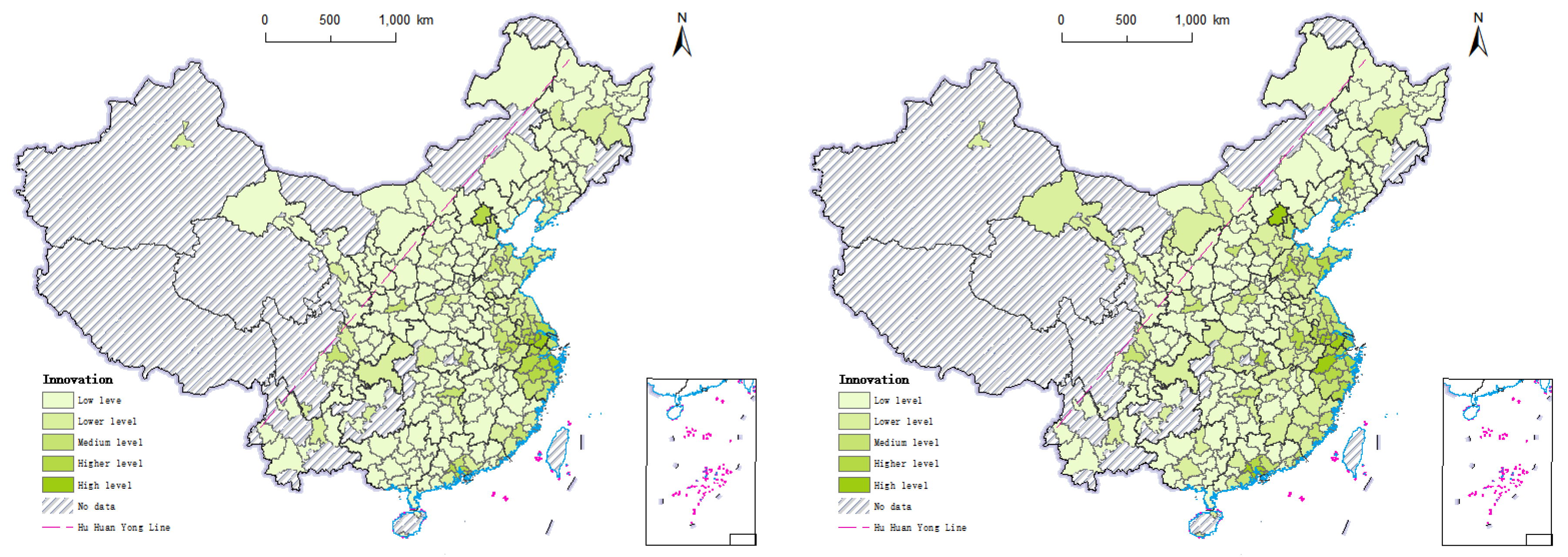
Patents are categorized into invention patents, utility model patents, and design patents. Although invention patents did not capture non-patent innovation, their applications underwent rigorous examination of their “practicality, innovation, and originality,” requiring significant improvements and distinct substantive features compared to existing products or technologies. At the same time, compared to other patent types, it possesses the highest technical content and value and also has the longest R&D cycle. Therefore, the number of invention patent applications effectively reflects a region’s innovation quality; a higher number indicates greater possession of new technologies and products. This study thus employs invention patent applications per 10,000 people to measure urban innovation. The feasibility of using invention patent applications for this purpose lies in: First, patent application data is publicly released on government websites, ensuring transparency; Second, using tangible innovation outcomes as a metric effectively overcomes the limitations of indicators like innovation investment or R&D expenditure, which fail to capture a city’s actual innovation level. It also avoids biases caused by local governments concealing information due to performance evaluation pressures; Third, due to the lengthy application cycle for patents, the use of patent grant figures inherently involves a certain degree of time lag. Since the pilot policy was first implemented in 2014, the urban innovation levels before and after the policy implementation in 2013 and 2023 were selected, and their spatiotemporal evolution characteristics were depicted as shown in Figure 2.
Figure 2.
Urban Innovation In 2013 & 2023. Note: This map is based on the standard map with approval number GS (2024) 0650.
4.2.3. Control Variables
To accurately estimate the impact of digital governance on urban innovation, it is necessary to control for other factors that may influence urban innovation. This study selected the following control variables: (1) Human Capital (Hum), represented by the ratio of full-time students in regular higher education institutions to the total population; regions with high levels of human capital possess richer knowledge reserves; (2) Population Density (Pdens), measured by the ratio of registered residents to administrative area; areas with higher population density tend to have a greater concentration of innovative talent; (3) Economic development level (Eco), using per capita GDP of cities as a measure; regions with higher levels of economic development tend to have higher levels of innovation investment; (4) Level of openness (Open), characterized by the ratio of actual foreign direct investment to GDP; regions with a higher degree of openness to the outside world are more likely to absorb external knowledge; (5) Industrial structure (Istru), measured by the ratio of tertiary industry value-added to secondary industry value-added. However, it is important to explain this variable with caution. In the Chinese background, the secondary sector serves as the key vehicle for the application and transformation of innovation outcomes, while the development of the tertiary sector directly promotes the aggregation and conversion of innovation factors. (6) Financial development level (Finance), represented by the ratio of financial institutions’ deposit and loan balances to GDP; regions with higher levels of financial development are able to provide financial support for innovation; (7) Science and technology expenditure level (Tech), measured by the ratio of science and technology expenditure to GDP.
4.2.4. Sample Selection and Data Sources
This study selected sample data from 2008 to 2023, covering 4 municipalities directly under the central government, 15 sub-provincial cities, and prefecture-level cities as the research subjects. The data underwent the following processing: First, exclude city samples with severe data missingness during the study period (Figure 2 for details); second, cities undergoing administrative restructuring between 2008 and 2023 were removed; Third, missing values were imputed using linear interpolation. This process yielded balanced panel data covering 16 years across 280 cities for analysis. Patent data originated from the China National Intellectual Property Administration (CNIPA) patent database. Control variables were primarily sourced from the Statistical Yearbook of Chinese Cities, Statistical Yearbook of Chinese Urban Construction, and Statistical Yearbook of Regional Economy in China. Partially missing values were supplemented through manual collection of local statistical annual reports and data from the National Bureau of Statistics of China. Table 1 presents descriptive statistics of main variables.
Table 1.
Descriptive Statistics of Main Variables.
5. Analyses for Emrrical Results
5.1. Baseline Results
To assess the impact of digital governance on urban innovation quality, we estimate the baseline mode (1). Column (1) in Table 2 presents the result with only city and year fixed effects. Column (2) adds control variables including economic development, industrial structure, and openness. In both specifications, the estimated coefficient of the interaction term is positive and statistically significant at the 1% level, indicating that the National Pilot Policy for Information Benefiting the People significantly improves urban innovation. This result aligns with our theoretical expectations and suggests a substantial economic impact.
Table 2.
Baseline Results.
5.2. Robustness Checks
5.2.1. Parallel Trends Test
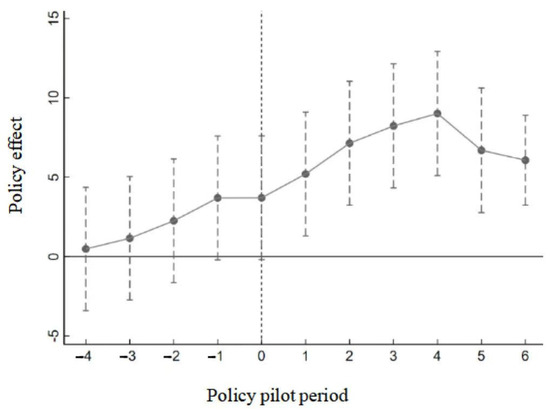
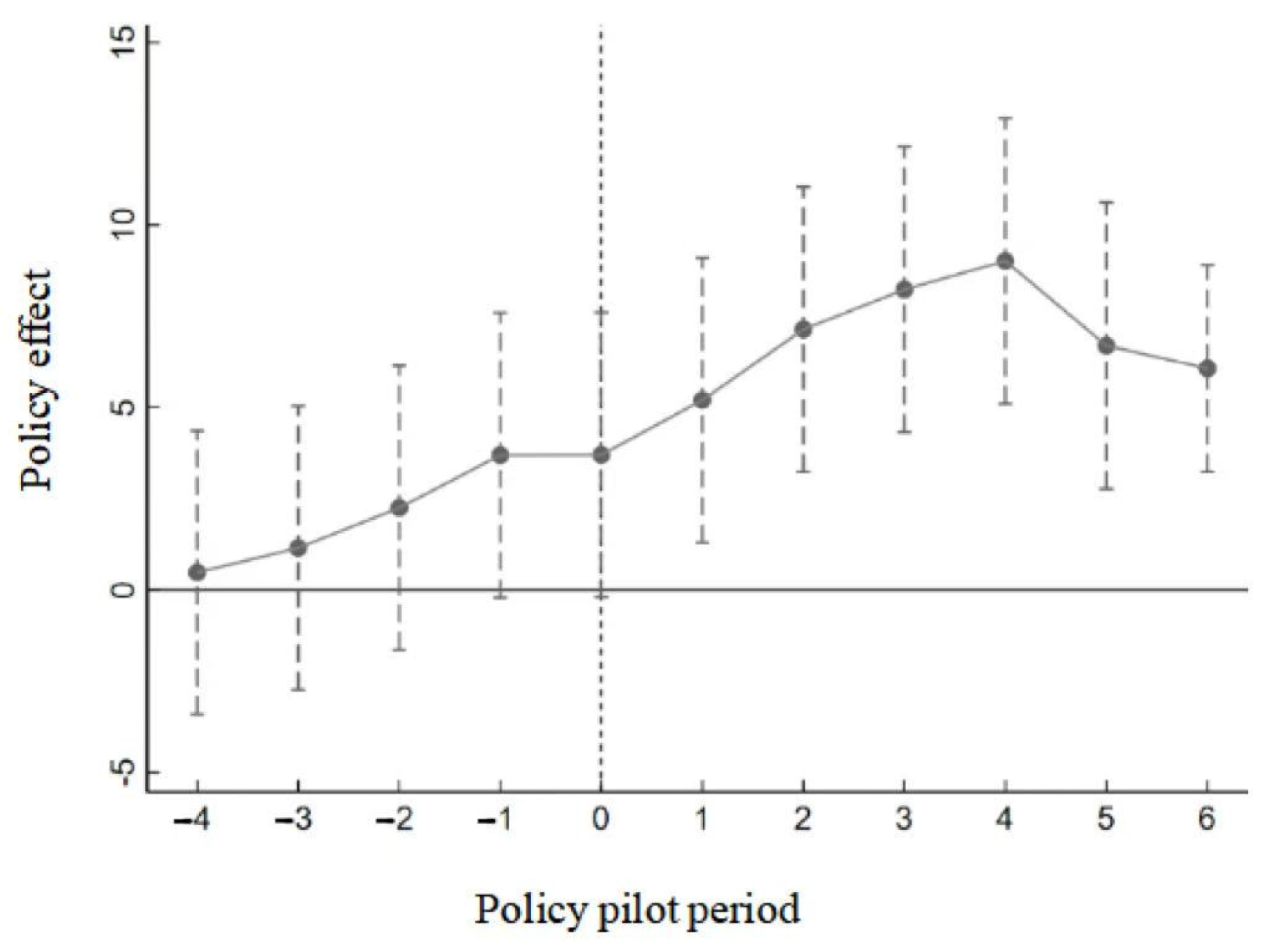
A key assumption of the DID model is the parallel trends assumption, which requires that in the absence of the policy, the treatment and control groups would have followed similar trends in innovation. We use an event study approach to test this assumption. The dynamic DID model is specified as:
where and denote the policy dummy variables for the year before and the year after the implementation of the National Pilot Policy for Information Benefiting the People, respectively; and denote the degree of difference in innovation between pilot cities and non-pilot cities in the year before and the year after the program’s implementation, respectively; the meanings of the other variables remain consistent with the preceding text. Figure 3 plots the estimated coefficients and 99% confidence intervals. The results show no significant difference between treatment and control groups before the policy implementation, while significant positive effects emerge after the policy. This confirms the validity of the parallel trends assumption. Meanwhile, the innovative impact of pilot policies on urban innovation has diminished over time. Additionally, in Figure 3, after the fourth year of implementation, the innovative influence of the pilot policy declines because the rapid iteration rate of digital technologies is beyond the governance capacity. As service platforms and policies can’t adapt to new environments, it is necessary to update to match new trends of institutional innovation and innovative technologies. Dynamic adaptive adjustment can motivate digital governance activities to maintain sustainable efficiency.
Figure 3.
Parallel Trends Test Results.
5.2.2. Placebo Test
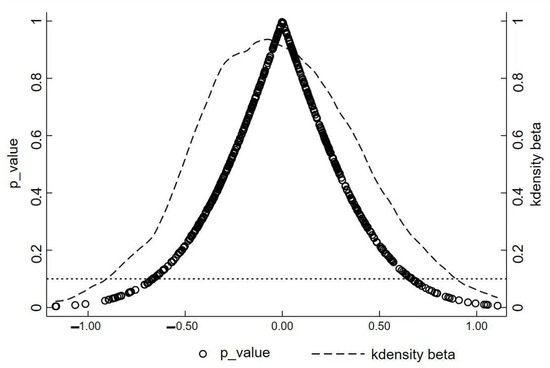
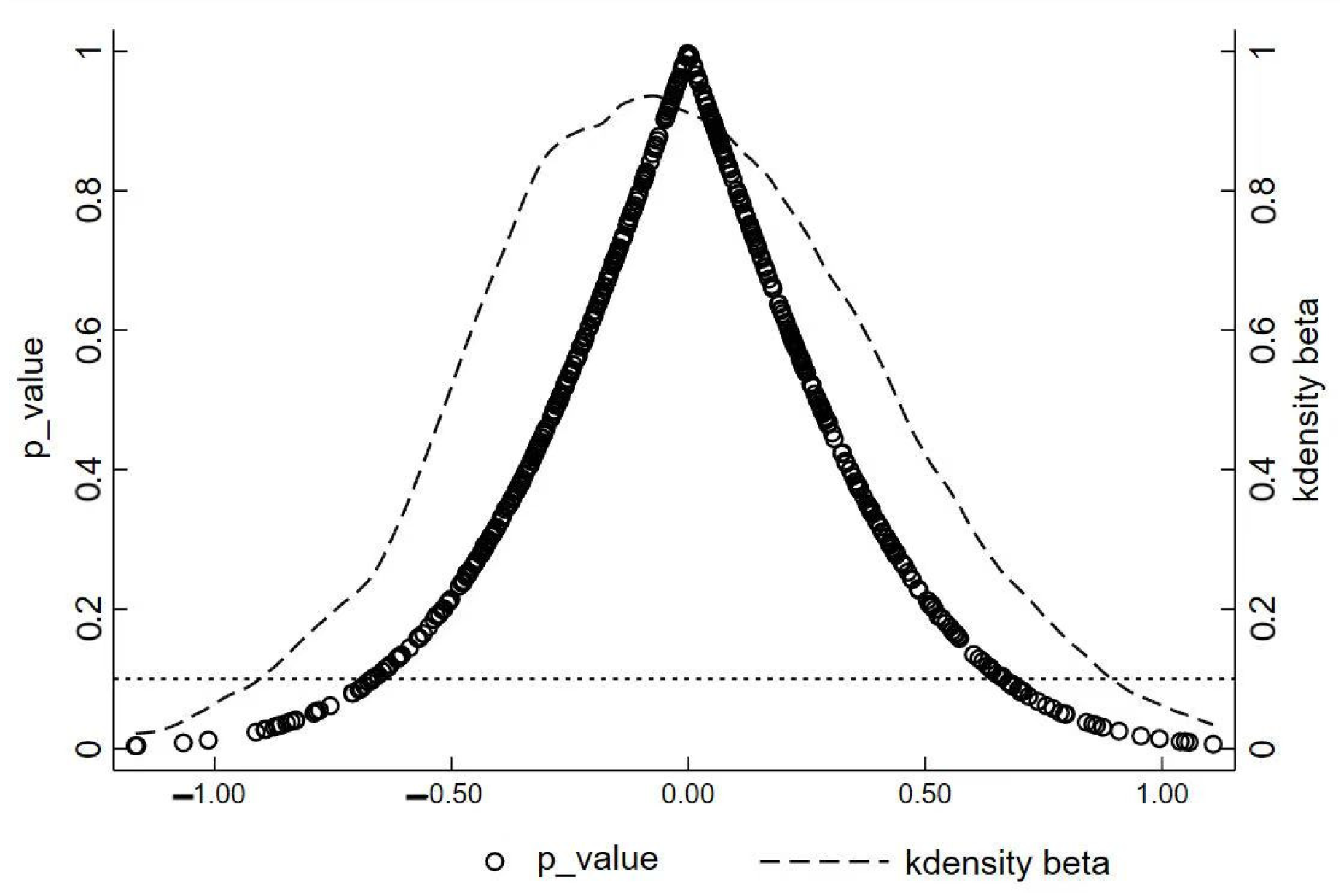
To rule out the possibility that the results are driven by random chance, we conduct a placebo test by randomly assigning “fake” treatment status to cities and re-estimating the model 1000 times. Figure 4 shows the distribution of the estimated coefficients and their p-values. Most of the placebo estimates are centered around zero, and the majority of p-values are greater than 0.1, indicating that the actual policy effect is not due to random variation.
Figure 4.
Urban Placebo Test Results.
5.2.3. Controlling for Concurrent Policies
During the sample period, other policies such as Broadband China, Innovative Cities, and Science-Finance Integration pilots may also affect urban innovation. To isolate the effect of the National Pilot Policy for Information Benefiting the People, we include dummy variables for these concurrent policies in the regression. The model is set as follows:
In this equations, , , and represent the dummy variables for the Broadband China Pilot Policy, Innovative City Pilot Policy, and Science and Technology Finance Integration Pilot Policy, respectively. Table 3 shows that the coefficient of our policy variable remains positive and significant at the 1% level, confirming that our results are not confounded by other interventions.
Table 3.
Controlling for Concurrent Policies.
5.2.4. Other Robustness Tests
First, replace the dependent variable. The urban innovation index from the 2017 China Urban and Industrial Innovation Report is adopted as a proxy for innovation. This index accounts for the value of patents. Missing annual data are estimated using the average annual growth rate of the index to measure urban innovation output. Regression results are reported in columns (1) in Table 4. It can be observed that the regression coefficients remain significantly positive at the 1% level after replacing the dependent variable, indicating that the estimation results in this paper are not affected by the methodology used to measure urban innovation. Second, we excluded samples from the four municipalities directly under the central government. Given the significant disparities in economic development, administrative status, and resource endowments between Beijing, Shanghai, Chongqing, Tianjin and other cities, we removed these four municipalities from the sample and re-entered them into the model. The results are presented in Column (2) in Table 4. The findings indicate that the impact of digital governance on urban innovation is not influenced by these special municipalities; third, altering the sample time range. Estimation results may be affected by the COVID-19 pandemic, so the sample period was adjusted to 2008–2018 and the regression rerun. Table 4 Column (3) reports these results. The estimated coefficients remain significantly positive after changing the sample period, indicating the robustness of the conclusion that digital governance effectively enhances urban innovation. Fourth, we added an interaction fixed effect. The regression model was further controlled for the interaction fixed effect between city and year. Table 4, Column (4) reports the corresponding results. It can be seen that after controlling for the joint fixed effect of city and year, the estimated coefficient for digital governance on urban innovation remains significantly positive, corroborating the conclusions above; fifth, tail trimming. In Table 1, the allocation of urban innovation is highly right-skewed. The dependent variable is winsorized at the 1st and 99th percentiles in the baseline regression to reduce the possible bias by extreme outliers. The re-estimated results are reported in column (5) of Table 4. It can be observed that the estimated coefficients remain significantly positively correlated after tail trimming, indicating the robustness of the results.
Table 4.
Additional Robustness Tests.
5.2.5. Endogeneity Analyses
Although the DID approach effectively measures the impact of the National Pilot Policy for Information Benefiting the People for urban innovation, selection bias renders the experimental and control groups incomparable. Therefore, to mitigate endogeneity issues arising from sample selection bias, this study further employs PSM-DID for endogeneity testing. Using the control variables as the baseline and applying K-nearest neighbor matching with a 1:3 sample ratio, the matched samples exhibit covariate bias below 20% after matching, passing the balance test. The matched sample data is then re-estimated using the baseline model (1), with the results of the nearest neighbor 1:3 matching presented in Column (1) in Table 5. The results indicate that the National Pilot Policy for Information Benefiting the People still exerts a significant positive impact on urban innovation, confirming the robustness of the earlier conclusions.
Table 5.
Endogeneity Analyses Results.
Additionally, following the approach (Wang & Xu, 2024) [45], the dummy variable for the e-government pilot policy was used as a proxy for digital governance and reintroduced into the baseline model for regression. The estimation results are presented in Column (2) in Table 5. It is evident that the estimated coefficients remain significant after replacing the core explanatory variable for digital governance, demonstrating the reliability of the research conclusions.
6. Further Analysis
6.1. Analyses of Mechanism
While we have confirmed that the National Pilot Policy for Information Benefiting the People significantly enhances urban innovation, the channels through which this effect operates remain to be explored. Based on our theoretical framework, we examine three potential mechanisms: cultivating innovation entities, improving the innovation environment, and optimizing the allocation of innovation elements. We construct the following mediation effect models:
In this equations, is the mediator variable; captures the effect of digital governance on the mediator; captures the effect of the mediator on innovation; and the meanings of the remaining variables remain consistent with the preceding text.
6.1.1. Inspection of the Innovation Entity Cultivation Mechanism
Measured by the number of newly registered enterprises per 10,000 people, data sourced from the Industrial and Commercial New Enterprise Registration database. Column (1) and Column (2) in Table 6 report the regression estimation results. It is evident that the National Pilot Policy for Information Benefiting the People can indeed attract new enterprises and foster innovative entities. After re-running the regression with both innovation entity cultivation and the dummy variable for the pilot policy included in Model (4), all the parameter estimates show a significant positive correlation at the 1% level. Moreover, the coefficient for the pilot policy is reduced compared to the baseline model, indicating that innovation entity cultivation is a crucial pathway through which digital governance influences urban innovation. Hypothesis H1 holds.
Table 6.
Mechanism Test Results.
6.1.2. Inspection of the Innovation Environment Improving Mechanism
Using the China Urban Commercial Credit Environment Index (CEI) from the Blue Book covering 2010–2023. This index is derived from surveys of 15,000 enterprise managers across 31 provinces (municipalities) and autonomous regions nationwide, with missing annual data filled via interpolation. Regression estimation results are reported in columns (3) and (4) in Table 6. It can be observed that the National Pilot Policy for Information Benefiting the People can improve the innovation environment. After re-running the regression with both the innovation environment and the dummy variable for the pilot policy included in Model (4), all the estimated values show a significant positive correlation at the 1% level. Moreover, the coefficient for the pilot policy is reduced compared to the baseline model’s estimated coefficient, indicating that the innovation environment serves as the mediating mechanism through which digital governance influences urban innovation. Hypothesis H2 is thus supported.
6.1.3. Inspection of the Innovation Elements Allocation Mechanism
Measured by the ratio of a city’s internal R&D funding to its permanent resident population, data is compiled from the City Statistical Yearbook, local statistical yearbooks, and statistical bulletins. Column (5) and Column (6) in Table 6 report the regression estimation results. The findings indicate that the National Pilot Policy for Information Benefiting the People optimized the allocation of innovation elements. When both factors were incorporated into Model (4) for re-regression, all the estimated coefficients for the pilot policy decreased compared to the baseline model, confirming that optimizing innovation element allocation is a channel through which digital governance influences urban innovation. Hypothesis H3 is thus validated.
6.2. Heterogeneity Analysis
6.2.1. Urban Location Heterogeneity
Based on the “Opinions of the Central Committee of the Communist Party of China and the State Council on Promoting the Rise of the Central Region” and the “Implementation Opinions of the State Council on Several Policy Measures for the Development of the Western Region”, the samples were categorized into three urban types—eastern, northeastern, and central-western—for analysis. The regression results are presented in columns (1) to (3) in Table 7. It can be observed that the National Pilot Policy for Information Benefiting the People in the eastern region has the most pronounced effect on enhancing urban innovation, followed by the central-western and northeastern regions. This may be attributed to factors such as the eastern region’s stronger industrial foundation, higher economic level, and advanced technology, which better leverage the innovation-driving effects of digital governance.
Table 7.
Results of Heterogeneity Tests.
6.2.2. Fiscal Pressure Levels Heterogeneity
Following the methodology (Huang & Zhao, 2023) [28], the ratio of the difference between general public budget expenditures and public budget revenues to urban GDP is used as a proxy variable for fiscal pressure levels. The sample is divided into low and high fiscal pressure groups based on the median value, and regression is performed by substituting these groups into the baseline model. The results are shown in columns (4) and (5) in Table 7. The results indicate that the National Pilot Policy for Information Benefiting the People demonstrates a more pronounced effect on enhancing urban innovation in regions with lower fiscal pressure. Conversely, in regions with higher fiscal pressure, the innovation effect of this policy is weaker. This disparity may stem from government departments in less fiscally constrained areas having greater resources to drive policy implementation. Thus, government fiscal pressure weakens the effectiveness of the pilot policy in improving urban innovation.
6.2.3. Information Technology Adoption Heterogeneity
Using internet penetration rate as a measure of urban information technology adoption, regions were divided into high-level and low-level groups based on the median. Column (6) and Column (7) in Table 7 present the test results. Findings indicate that in regions with high information technology adoption, the estimated coefficient shows a significant positive correlation at the 1% level. Conversely, in regions with low information technology adoption, the estimated coefficient for the innovation-driven effect is significantly positive at the 1% level but smaller than that in high information technology adoption regions. This demonstrates that the National Pilot Policy for Information Benefiting the People has a stronger promotional effect on urban innovation in regions with high information technology adoption.
6.3. Innovation Heterogeneity Test
Following the methodology (Meng & Zhu, 2025) [46], this study employs the more technically sophisticated metric of green invention patent applications per 10,000 population to measure a city’s sustainable innovation. Green utility model patent applications per 10,000 population serve as a proxy variable for strategic innovation, enabling further examination of urban innovation behavior. Results are presented in Column (1) to Column (4) in Table 8. Specifically, Column (1) to Column (2) in Table 8 show the impact of the National Pilot Policy for Information Benefiting the People on sustainable innovation, while Column (3) and Column (4) in Table 8 reveal the policy’s effect on strategic innovation. Column (1) and Column (4) in Table 8 exclude city characteristic control variables. It can be observed that without control variables, the regression coefficients are significantly positive at the 1% level. Even after incorporating control variables, the coefficients remain significantly positive at the 1% level. This indicates that the pilot policy accessibility effectively promotes both sustainable innovation and strategic innovation in cities.
Table 8.
Sustainable vs. Strategic Innovation.
6.4. Spatial Effect Test
In order to examine the impact of digital governance on the innovation of neighboring regions, this paper constructed a spatial econometric model for empirical testing. The model form set is:
In the formula, represents a series of control variables; used to represent the spatial weight matrix; used to represent spatial autoregressive coefficients; and they, respectively, represent the elasticity coefficients of spatial interaction terms for digital governance and control variables; used to represent spatial error coefficients; and used to represent a random error vector that follows a normal distribution pattern. The meanings of other variables are consistent with the above.
6.4.1. Spatial Autocorrelation Test
This article uses a spatial geographic distance weight matrix for spatial correlation analysis, and the specific regression results are shown in Table 9. From the results, it can be seen that there is a significant spatial autocorrelation in the level of urban innovation, which meets the basic conditions for spatial econometric analysis.
Table 9.
Moran’S I of Urban Innovation.
6.4.2. Spatial Spillover Effect Test
The LM test, Hausman test, and LR test were used to select the Spatial Durbin Model (SDM) with bidirectional fixed effects to analyze the spatial effects of digital governance on urban innovation. The specific results are shown in Table 5. It can be seen that the spatial regression coefficient in column (1) is 0.892, which is significant at the 1% level, indicating that digital governance can promote the innovation of neighboring cities. Meanwhile, although the regression coefficient can reflect the impact of variables well, it cannot show the marginal effects generated by each variable. Therefore, further decomposition of spatial effects is carried out, and columns (2)–(4) of Table 10 show the direct, indirect, and total effects of each variable on the urban innovation, respectively. It can be seen that the impact of digital governance on urban innovation is generally positively correlated and significant at the 1% level. The indirect effect regression coefficient is 100.044, which is significant at the 5% level, indicating that digital governance can not only promote the improvement of local urban innovation but also enhance the innovation of neighboring cities through spillover effects.
Table 10.
Spatial Regression Results.
7. Conclusions
7.1. Research Findings
Currently, the digital economy is flourishing worldwide, and China is accelerating the development of Digital China. Scholars have reached a consensus that digital infrastructure, digital technology innovation, and digital finance can effectively promote socioeconomic development. However, the extent to which digital governance enhances urban innovation remains a topic worthy of in-depth exploration. Given this, this paper utilizes panel data from 280 prefecture-level and above cities spanning 2008–2023. Treating the National Pilot Policy for Information Benefiting the People as a quasi-natural experiment, the study employs a difference-in-differences approach to examine the impact of digital governance on urban innovation and its underlying mechanisms. First, core findings reveal that digital governance significantly promotes urban innovation. This conclusion holds up after multiple rigorous robustness tests, including parallel trend verification, placebo tests, and controlling for major concurrent policy impacts. Second, mechanism analysis reveals that the pilot policy primarily drives urban innovation through three interrelated channels: (1) Cultivating Innovation Actors—Enhancing government administrative efficiency and public service delivery while stimulating entrepreneurial activities; (2) Improving the Innovation Environment—Encouraging and supporting innovation activities among enterprises and research institutions; (3) Optimizing the Allocation of Innovation Factors—Facilitating the inflow of innovation factors, reducing innovation costs, and improving the innovation structure to stimulate urban innovation. Third, further analysis reveals that the impact of digital governance on urban innovation is influenced by a city’s geographical location and level of development. In eastern regions, areas with higher levels of informatization, and local governments facing less fiscal pressure, digital transformation is more conducive to enhancing the quality of innovation within those cities. Additionally, digital governance can influence the innovation level of neighboring regions through spillover effects.
7.2. Policy Implications
Based on the findings above, this paper draws the following policy implications: First, as digital governance can enhance the level of urban innovation, therefore the experience of the National Pilot Policy for Information Benefiting the People should be widely promoted to comprehensively improve government governance efficiency and public service standards and implement policies in a way that suits local conditions, thereby establishing an efficient government service system. On the one hand, from the perspective of short-term governance reform, efforts should be made to promote fair public services in all regions. Comprehensively enhance equitable access to public services in areas such as tax oversight, public infrastructure connectivity, healthcare, and social security, safeguarding citizens’ rights to essential public services; On the other hand, from the perspective of long-term institutional reform, efforts should be made to improve the quality of government public services and build an efficient and convenient public service system. This involves optimizing administrative services, improving government governance efficiency, strengthening process design, and emphasizing the dual incentives of reform-driven innovation and digital empowerment. It needs to highlight data-driven methods and business process optimization to promote the convenience and intelligence of services, advance the integration of online and offline services, achieve diversified service modes, simplify processes, and minimize costs. This maximizes the convenience for citizens and businesses while stimulating social innovation and development momentum.
Secondly, due to the National Pilot Policy for Information Benefiting the People, urban innovation can be promoted by cultivating innovative entities, optimizing the innovation environment, and promoting the allocation of innovation elements. Therefore, a collaborative government system and service platform should be established to provide basic support for urban innovation. On the one hand, from the perspective of short-term governance, local governments should make full use of the Internet, big data, artificial intelligence, and other advanced technologies to transform government services from manual mode to human-computer interaction mode. This will increase the frequency and quality of communication between the government and citizens, as well as between the government and businesses, enabling innovative entities and talents to understand policy directions and local regulations, thereby enhancing confidence in innovation. On the other hand, from the perspective of long-term governance, we should strengthen the digital empowerment of government services, deepen innovation in service delivery models, and promote more online, one-stop, and fast processing. This will help innovative entities and talents better understand market conditions and government policies. At the same time, promoting the application of emerging technologies in specific government service scenarios, optimizing application methods, review processes, and intelligent question answering systems, and providing more efficient services for enterprises and the public.
Thirdly, as digital governance can enhance the innovation level of neighboring regions through spillover effects, on the one hand, it is necessary to deepen government data disclosure and public platform construction, promote government information disclosure by improving the timeliness and accuracy of data sharing, and help innovators better understand the local business environment, policy direction, and decision-making motivation. Strengthen the construction of government service platforms, unify regional platform standards, improve service coordination and efficiency, and enhance public platform support capabilities and application innovation levels. At the same time, it can optimize communication between the government and innovation entities, ensuring smooth channels for information exchange. On the other hand, as government departments promote digital governance, policies supporting innovative talents should be improved and implemented to promote talent mobility between different regions and innovation cooperation between different cities.
7.3. Limitations and Recommendations for Future Research
While this research has provided valuable evidence on the relationship between digital governance and urban innovation, there are still some limitations. Firstly, using a single agent (invention patent) to measure innovation quality, invention patent applications as a single proxy for innovation quality may ignore non-patent innovations such as process innovations and variables in patent value. And the possibility of omitting variable bias voltage; secondly, focus on innovation output rather than the ultimate economic impact; thirdly, although this paper emphasizes macro-level urban data, it lacks the impacts of policies on the micro-level mechanisms in the long term.
Future research can explore long-term impacts, the effects on different types of innovators (such as small and medium-sized enterprises versus large corporations), or the quality of green patents.
Author Contributions
Conceptualization, H.M. and N.O.; methodology, H.M.; software, H.M.; validation, X.Z.; formal analysis, H.M.; investigation, H.M.; resources, B.Z.; data curation, H.M.; writing—original draft preparation, H.M.; writing—review and editing, H.M.; visualization, H.M. and N.O.; supervision, B.Z.; funding acquisition, B.Z. All authors have read and agreed to the published version of the manuscript.
Funding
National Social Science Fund General Project “Research on Data Silos Breakdown Mechanisms and Data Assetization Pathways for China’s Manufacturing Enterprises” (23BJL087); Jilin Provincial Philosophy and Social Sciences Planning Key Project: “Research on High-Quality Development of Jilin Province’s Manufacturing Industry” (2021A120).
Institutional Review Board Statement
Not applicable.
Informed Consent Statement
Not applicable.
Data Availability Statement
The data presented in this study are available on request from the corresponding author.
Conflicts of Interest
The authors declare no conflicts of interest.
References
- Liu, Y.; Feng, H. Mechanism Analysis and Empirical Test of How Entrepreneurial Incubation Drives Innovation-Led Economic Development. Sci. Technol. Prog. Policy 2022, 39, 31–41. [Google Scholar]
- Gong, G.; Wei, X.; Yang, X.; Zhao, L. Building a National Innovation System with Chinese Characteristics to Overcome the Middle-Income Trap. Soc. Sci. China 2017, 8, 61–86+205. [Google Scholar]
- Li, W.; Zhai, W.; Liu, W. How Does the “Streamlining Administration, Delegating Powers, and Improving Services” Reform Optimize the Business Environment?—A Governance Structure Perspective. Manag. World 2023, 39, 104–124. [Google Scholar]
- Li, B.; Tian, X.; Zhang, S.; Zhao, H. Evaluation of Urban Innovation Capability and Research on Spatiotemporal Pattern Evolution. Math. Stat. Manag. 2020, 39, 139–153. [Google Scholar]
- Ma, C.; Tan, K.; He, J. The impact of opening a high-speed railway on urban innovation: A comparative perspective of traditional innovation and green innovation. Land 2023, 12, 1671. [Google Scholar] [CrossRef] [Scilit]
- Ferraris, A.; Belyaeva, Z.; Bresciani, S. The role of universities in the Smart City innovation: Multistakeholder integration and engagement perspectives. J. Bus. Res. 2020, 119, 163–171. [Google Scholar] [CrossRef] [Scilit]
- Gao, K.; Yuan, Y. The effect of innovation-driven development on pollution reduction: Empirical evidence from a quasi-natural experiment in China. Technol. Forecast. Soc. Change 2021, 172, 121047. [Google Scholar] [CrossRef] [Scilit]
- Lu, X.X.; Xu, C.; Zhang, F. The impact of county-to-district conversion on urban economic resilience. J. Financ. Res. 2023, 3, 63–77. [Google Scholar] [CrossRef]
- Zhang, H.X.; Luo, D. The impact of fiscal science and technology expenditure on urban innovation: Effects and mechanisms. J. Financ. Econ. Res. 2024, 3, 67–80. [Google Scholar] [CrossRef]
- Huang, Y.; Li, K.; Li, P. Innovation ecosystems and national talent competitiveness: A country-based comparison using fsQCA. Technol. Forecast. Soc. Change 2023, 194, 122733. [Google Scholar] [CrossRef] [Scilit]
- Wang, J.; Deng, K. Impact and mechanism analysis of smart city policy on urban innovation: Evidence from China. Econ. Anal. Policy 2022, 73, 574–587. [Google Scholar] [CrossRef] [Scilit]
- Ji, X.; Gu, N. Does the designation of intellectual property demonstration cities affect innovation quality? J. Financ. Econ. 2021, 47, 49–63. [Google Scholar]
- Tang, K.; Cai, X.; Wang, H. Research on the Impact of Digital Technology on Urban Innovation Capacity. Econ. Manag. Res. 2026, 47, 83–99. [Google Scholar]
- Li, W.; Zheng, M. Substantive Innovation or Strategic Innovation?—The Impact of Macro Industrial Policy on Micro Enterprise Innovation. Econ. Res. J. 2016, 51, 60–73. [Google Scholar]
- Wu, W.; Liu, Y. Government Procurement and Enterprise Innovation: Protection Effects and Spillover Effects. J. Financ. Econ. 2020, 46, 17–36. [Google Scholar]
- Zhang, J.; Zheng, W. Does Innovation Catch-up Strategy Suppress Patent Quality in China? Econ. Res. J. 2018, 53, 28–41. [Google Scholar]
- Chen, Q.; Lin, S.; Zhang, X. China’s Technological Innovation Incentive Policies: Stimulating Quantity or Quality? China Ind. Econ. 2020, 4, 79–96. [Google Scholar] [CrossRef]
- Gu, H.; Zhang, Y.; Han, X.; Li, Y. Spatial Non-Stationary Mechanisms of China’s Human Capital on Urban Innovation Impacts. Adv. Geogr. Sci. 2025, 44, 240–255. [Google Scholar]
- Jin, P.; Yin, D.; Jin, Z. Urban Heterogeneity, Institutional Supply, and Innovation Quality. World Econ. 2019, 42, 99–123. [Google Scholar]
- Li, M.; Chen, A. Reshaping Economic Geography: Digital Government and Interregional Capital Flow—A Perspective Based on Enterprise Cross-regional Investment. J. Shanxi Univ. Financ. Econ. 2024, 46, 57–72. [Google Scholar]
- Ding, X.; Yang, M. Digital Government Boosting High-Quality Development of the Digital Economy: Mechanisms and Pathways. Shanghai Econ. Res. 2024, 33–42. [Google Scholar]
- Liu, W.; Geng, J.; Du, M. Strengthening Trade Through Digital Governance: Digital Government Development and Quality Upgrading of China’s Export Products. J. Quant. Econ. Tech. Econ. 2024, 41, 67–87. [Google Scholar]
- Li, M.; Zhang, N. Digital Government Development and Corporate Foreign Direct Investment: Empirical Evidence from the Guomai E-Government Network. Int. Econ. Trade Explor. 2024, 40, 56–74. [Google Scholar]
- Fan, H.; Wu, T.; He, S. How Does the “Internet Plus Government Services” Platform Optimize the Urban Business Environment?—An Interactive Governance Perspective. Manag. World 2022, 38, 126–153. [Google Scholar]
- Wang, X.; Huang, H.; Xia, Y. Digital Government Development and Corporate Innovation. Sci. Financ. Econ. 2021, 118–132. [Google Scholar]
- Gao, L.; Li, F. Host Country Digital Economic Development and the Performance of Chinese Enterprises’ Foreign Direct Investment. Int. Econ. Trade Explor. 2026, 42, 90–107. [Google Scholar]
- Chen, Q.; Cui, Y.; Cai, W. Digital Government Development and Urban Governance Quality: Evidence from Public Security Departments. J. Quant. Econ. Tech. Econ. 2024, 41, 132–154. [Google Scholar]
- Huang, S.; Zhao, Y. Informatization of Government Services and Basic Public Service Levels. World Econ. 2023, 46, 32–54. [Google Scholar]
- Wang, K.; Li, L. Effect Measurement Analysis of China’s “Internet Plus Government Services”. J. Quant. Econ. Tech. Econ. 2020, 37, 105–124. [Google Scholar]
- He, Y.; Niu, G.; Lu, J.; Zhao, G. Digital Governance and Urban Entrepreneurial Vitality: Evidence from the “National Pilot Program for Information Benefits for the People” Policy. J. Quant. Econ. Tech. Econ. 2024, 41, 47–66. [Google Scholar]
- Fan, R.; Qi, Y.; Wang, Y.; Zhu, C. Network dynamics of inter-firm innovation in China’s digital economy: A two-layer network perspective. Technol. Anal. Strateg. Manag. 2025, 1–20. [Google Scholar] [CrossRef] [Scilit]
- La, P.R.; Lopez-de-Silanes, F.; Shleifer, A.; Vishny, R. The quality of government. J. Law Econ. Organ. 1999, 15, 222–279. [Google Scholar]
- Agostino, M.; Nifo, A.; Trivieri, F.; Vecchione, G.; Agostino, M.; Vecchione, G. Rule of law and regulatory quality as drivers of entrepreneurship. Reg. Stud. 2020, 54, 814–826. [Google Scholar] [CrossRef] [Scilit]
- Hu, X. Digital Transformation of Government Governance and Household Entrepreneurial Behavior: Evidence from the “National Pilot Program for Information Benefits for the People” Policy. J. Guizhou Univ. Financ. Econ. 2024, 6, 10–17. [Google Scholar]
- Yu, W.; Liang, P.; Gao, N. Does Openness Bring Efficiency? Empirical Research on the Impact of Government Information Disclosure on Corporate Investment Efficiency. Economics 2020, 19, 1041–1058. [Google Scholar]
- Chen, L. Analysis of the Triple Helix Model in Regional Innovation Systems. Stat. Decis. Mak. 2007, 10, 122–124. [Google Scholar]
- Zheng, Z.; Li, X. Data Element Sharing, Entrepreneurial Activity, and Urban Innovation Development. Forum Stat. Inf. 2025, 40, 102–113. [Google Scholar]
- Chen, S. Operational Logic of Platform Governance in the Digital Age: The Case of Shanghai’s “One-Network-for-All-Management”. E-Government 2021, 10, 2–14. [Google Scholar]
- Wang, Y.; Shi, P. Research on the Mechanism and Countermeasures of Innovation Environment’s Impact on Innovation Capacity and Performance. Res. Sci. Manag. 2015, 33, 17–20. [Google Scholar]
- Long, X.; Yi, W.; Lin, Z. How Valuable Is Intellectual Property Protection? Empirical Evidence from Patent Data of Chinese Listed Companies. Res. J. Financ. 2018, 458, 120–136. [Google Scholar]
- Xiao, R.; Gao, Q.; Wang, Z.; Qiao, L. Multifaceted Pathways of Business Environment Driving Urban Green Innovation Efficiency Improvement. Sci. Technol. Prog. Policy 2026, 43, 44–55. [Google Scholar]
- Sun, B.; Jia, J. Research on the Pathways of Business Environment Driving the Aggregation of Enterprise Science and Technology Innovation Talents. Sci. Technol. Manag. 2026, 47, 155–164. [Google Scholar]
- Liu, B.F.; Zhao, Y.L.; Liang, P.H.; Zhang, J. Government New Media and Local Government Trust: Evidence from the Launch of Government Weibo Accounts. World Econ. 2023, 46, 177–200. [Google Scholar]
- Cheng, C.; Zhong, Y. Pathways Through Which Science and Technology Talent Policies Influence Urban Innovation. Res. Manag. 2023, 44, 95–101. [Google Scholar]
- Wang, L.; Xu, J. Digital Government Empowering Industrial Structure Upgrading: A Quasi-Natural Experiment Based on Comprehensive E-Government Pilot Programs. J. Financ. Econ. 2024, 05, 28–38. [Google Scholar] [CrossRef]
- Meng, X.; Zhu, P. Effects and Mechanisms of Digital Infrastructure Driving Green Innovation: A Policy Experiment Based on the “Broadband China” Strategy. Res. Econ. Manag. 2025, 46, 90–108. [Google Scholar]

Disclaimer/Publisher’s Note: The statements, opinions and data contained in all publications are solely those of the individual author(s) and contributor(s) and not of MDPI and/or the editor(s). MDPI and/or the editor(s) disclaim responsibility for any injury to people or property resulting from any ideas, methods, instructions or products referred to in the content. |
© 2026 by the authors. Licensee MDPI, Basel, Switzerland. This article is an open access article distributed under the terms and conditions of the Creative Commons Attribution (CC BY) license.