


Abstract
Strengthening transparency has emerged as a pivotal issue in promoting the responsible development of artificial intelligence (AI). As the prevailing framework for corporate information disclosure, Environmental, Social, and Governance (ESG) reporting shares an inherent synergy with AI governance; both are rooted in the pursuit of sustainable development and the disclosure of specific matters to investors and broader stakeholders. This study analyzes the status of artificial intelligence (AI) information disclosure in the ESG (Environmental, Social, and Governance) reports of listed companies across the United States, Europe, and China, finding that: (1) ESG reports have emerged as a primary channel for business organizations to disclose AI-related information; (2) significant disparities exist in disclosure levels across four key AI-related domains—development, application, manufacturing, and consumption; and (3) disclosure density varies considerably across E, S, and G dimensions, with the Governance (G) pillar exhibiting the most comprehensive information. Based on an empirical analysis of the ESG-AI disclosure framework, this study proposes an optimization scheme for ESG-AI reporting, clearly defining mandatory ESG-AI disclosure obligations for listed companies and employing the “comply or explain” mechanism to balance corporate transparency with operational efficiency while adhering to the “Double Materiality” principle by disclosing model training energy consumption and ecological impacts under Environmental (E) matters, addressing employment, employee training, marketing labeling, and customer privacy under Social (S) matters, and elaborating on corporate AI strategies, risk management protocols, and governance policies under Governance (G) matters. Regarding procedural safeguards, taking China as a case study, centralized disclosure could be implemented through the National Enterprise Credit Information Publicity System, complemented by an assurance system for listed company reports to enhance the accessibility and accuracy of information disclosure.
1. Introduction
In recent years, propelled by the escalation of computational power, the abundant supply of big data, and algorithmic refinements, deep learning technology has significantly catalyzed the advancement and commercialization of generative AI [1]. As AI technology becomes deeply embedded in social production and public life, global safety concerns regarding artificial intelligence (AI) products have intensified; consequently, nations worldwide are continuously strengthening the regulatory oversight of AI technologies. Whether through the United States’ scenario-based regulatory model, the European Union’s risk-based approach, or China’s subject-responsibility-based framework [2], the establishment of transparency has consistently emerged as a central theme in promoting the responsible development of AI. Although commercial organizations serve as the primary developers and adopters of AI technology, a dedicated information disclosure mechanism for corporate AI research and application is currently lacking. In July 2023, seven leading tech giants, including OpenAI and Google, jointly issued voluntary commitments to ensure “safe, secure, and trustworthy AI” [3], pledging to share AI risk management information with industry partners, governments, civil society, and academia. While these voluntary commitments reflect a proactive effort by commercial organizations to fulfill their social responsibilities, historical precedent suggests that tech giants often engage in “races to the bottom” when addressing risks such as privacy protection and antitrust issues [4]. Particularly since the launch of generative AI products, frequent controversies surrounding copyright infringement and data privacy have demonstrated that voluntary commitments alone are insufficient to guarantee the responsible development of AI technology. There is yet to be a unified consensus on the disclosure models for AI-related matters. Article 50 of the AI Act mandates AI disclosure obligations for providers and deployers of specific AI systems, while California’s recently passed ‘Transparency in Frontier AI Act’ (SB 53) aims to enhance transparency for companies developing frontier AI models. In terms of disclosure models, establishing an independent framework specifically for AI scenarios is one option [5]; however, legislation such as the AI Act primarily focuses on ‘technical transparency,’ with disclosure channels typically directed toward regulatory authorities or consumers, leaving a ‘compliance black box’ for investors.
Under the dual drivers of increasingly stringent global regulation and the ascent of value investing, ESG disclosure has evolved into a strategic pivot for enterprises to demonstrate their long-term resilience and legitimacy. Empirical data from KPMG indicates that 69% of CEOs worldwide have deeply embedded ESG objectives into their core business logic [6]. Against this backdrop, high-quality ESG disclosure has become the primary channel for capital markets to evaluate corporate non-financial risks, and its scope continues to expand alongside technological advancements. The academic community generally maintains that high-quality ESG information disclosure can effectively mitigate information asymmetry and reduce agency costs, thereby generating significant innovation benefits for enterprises while benefiting interdependent stakeholders [7]. While major standard-setting bodies have released various disclosure models—including ESG reports, sustainability reports, and corporate social responsibility (CSR) reports—the discrepancies between evaluation frameworks and standards have posed substantial challenges to internal and external decision-makers, as well as the broader social community [8]. In recent years, global regulatory requirements for corporate social responsibility (CSR) disclosure have become increasingly stringent. For instance, the European Union’s Corporate Sustainability Reporting Directive (CSRD) mandates that specific organizations disclose information regarding environmental matters, social affairs, employee treatment, human rights protections, anti-corruption, anti-bribery, and board diversity [9]. Although academic debates persist regarding the specific connotations and boundaries of these models, their core elements have converged as disclosure systems have matured. Consequently, this paper adopts the widely recognized term “ESG Report” as the primary framework for corporate information disclosure.
Compared to the ‘technical transparency’ information released to regulatory authorities and consumers under AI regulatory frameworks, AI disclosure within the ESG framework emphasizes ‘Governance Transparency,’ aiming to translate complex technical risks into the quantifiable language of capital markets. Artificial intelligence is intricately linked to a firm’s Environmental, Social, and Governance (ESG) performance [10]. As AI technology undergoes exponential diffusion, the limitations of traditional ESG frameworks in characterizing ‘technology-driven sustainability’ have become increasingly apparent. Recent research suggests that global industry is transitioning from Industry 4.0, which pursued pure automation, toward Industry 5.0, which emphasizes ‘human-centricity’ and ‘environmental restoration.’ Within this context, AI is regarded as the catalyst for this paradigm shift [11]. The relationship between AI and the ESG framework is one of mutual empowerment in achieving sustainability goals [12]. On one hand, the integration of AI and ESG frameworks assists enterprises in reaching their targets, as the deployment of AI technology has a significant impact on enhancing corporate ESG levels [13]. On the other hand, Generative AI (GenAI) itself consumes substantial energy, making ESG reporting an essential instrument for strengthening AI governance [14]. Specifically, within the Environmental (E) dimension, AI significantly improves corporate carbon efficiency by empowering green innovation and optimizing energy systems. In the Social and Governance (S & G) dimensions, distinct from traditional efficiency-driven logic, AI governance from an Industry 5.0 perspective emphasizes the fairness and ethical boundaries of ‘human–machine collaboration.’ In particular, algorithmic transparency and accountability have emerged as core dimensions for evaluating corporate ‘Digital Social Responsibility’. Despite AI’s immense potential, academia maintains a critical stance regarding the ‘materiality’ of corporate disclosures, particularly concerning the risk of ‘Technological Greenwashing’ resulting from improper ESG reporting [15]. In the fields of AI development and application, this risk manifests as companies utilizing grandiose AI visions to obscure specific risks related to algorithmic bias, data privacy, or high computational energy consumption. Currently, debates persist regarding how AI investment translates into financial performance and social value, an uncertainty that is particularly pronounced across different regions and regulatory systems [16]. Synthesizing existing literature, it is evident that while macro-level discourses on AI-enabled sustainable development are abundant, research on the ESG-AI nexus faces three primary challenges: (1) discussions on the interaction between ESG and AI are numerous, yet they lack verification based on text mining of real-world ESG reports; (2) existing studies predominantly focus on single markets such as China or the U.S., with scant research providing a comparative analysis of the disclosure strategies among the three core economies—the U.S. (S&P 500), China (CSI 300), and Europe (STOXX 50)—following the surge of generative AI; and (3) current research often treats AI as a single variable, overlooking the significant heterogeneity of AI narrative logic across the E, S, and G dimensions. In view of this, this study selects the ESG reports of 60 global benchmark enterprises from the 2023–2025 period, utilizing Natural Language Processing (NLP) technology to quantitatively analyze the density and depth of their AI governance disclosures. This paper aims to reveal how enterprises manifest their social responsibility through ESG narratives amidst the wave of AI technology and proposes a feasible AI-ESG disclosure scheme.
2. Discussion on the Relationship Between Stakeholder Theory, ESG Frameworks, and AI
2.1. The Impact of Stakeholder Theory on the Operations of Business Organizations
Since Freeman proposed stakeholder theory, the traditional logic of “shareholder primacy” has been fundamentally revolutionized. This theory asserts that a corporation is not merely an economic unit chasing profits, but an organization embedded within a complex social network, aimed at creating multifaceted value for diverse stakeholders [17]. Stakeholders are defined as any group or individual who can affect or is affected by the achievement of the organization’s objectives; the theory posits that a firm’s success depends on its capacity to manage these stakeholder relationships [18]. Stakeholders involved with business organizations primarily fall into two categories: The first is those who can influence the company’s interests and performance, such as major partners and investors. ESG information disclosure is intrinsically linked to investor returns. By promptly disclosing ESG matters closely related to business conduct, organizations ensure that investors can understand and participate in corporate governance, enabling them to exercise shareholder rights to deter reckless corporate behavior. The second category comprises those who are affected by the organization’s business activities. This category has a broad scope. Beyond consumers directly associated with business transactions, as organizations increasingly prioritize brand reputation and corporate social responsibility (CSR), the general public has also emerged as a stakeholder group affected by specific corporate actions. In this sense, the ESG framework serves as a vital carrier for public supervision of corporate behavior. Generally, the disclosure expectations of investors and other stakeholders encompass the business model, development strategy, corporate governance, risks and challenges, and the protection of interests for consumers and other subjects [19]. Stakeholder theory maintains that an organization’s survival and success hinge on its ability to identify and satisfy the needs of all stakeholders—including shareholders, employees, customers, suppliers, communities, regulators, and the environment. Its core impact lies in establishing the concept of the “social contract of operation,” emphasizing that corporate value creation is not isolated financial growth, but is achieved through collaboration and value flow among all stakeholders [20].
2.2. The Role of the ESG Framework Under Stakeholder Theory
With the implementation of the concept of corporate governance citizenship, the scope of information disclosure for business organizations has expanded from purely financial data to comprehensive risk reporting [21], ultimately evolving into the ESG framework as a representative disclosure mechanism. ESG is the collective term for Environmental, Social, and Governance matters related to business conduct. As a modern governance paradigm following the introduction of the corporate social responsibility (CSR) concept in the 1950s, ESG has become the primary benchmark and implementation pathway for business organizations to achieve Sustainable Development Goals [22]. ESG encapsulates three core dimensions of corporate responsibility: sustainability, general social responsibility, and the corresponding corporate governance systems required to support them [23].
Stakeholder theory provides a profound legitimacy theory foundation for the ESG framework. If the stakeholder model represents a corporation’s strategic vision, then ESG indicators serve as the ‘yardstick’ to measure the implementation effectiveness of that vision [24]. First, the ESG framework mitigates information asymmetry among stakeholders. Through ESG disclosure, enterprises can transmit positive signals regarding environmental protection (E), social responsibility (S), and corporate governance (G) to external stakeholders, thereby reducing agency costs. Second, it enables a substantive response to materiality: the ESG framework allows stakeholders to evaluate a firm’s vulnerability and resilience concerning non-financial risks. Stakeholders no longer focus solely on financial statements; instead, they utilize ESG data to determine whether a firm is depleting social or environmental capital in exchange for short-term profits. The ESG framework aims to achieve the Sustainable Development Goals (SDGs) for both business organizations and society. As the primary subjects of commercial activity, business organizations are influenced by an ecosystem composed of the political, economic, and social environments of a specific period. Conversely, the activities of these organizations impact these sub-environments, creating a dynamic, reciprocal system of internal and external influence [25]. The three pillars of ESG—Environment, Social, and Governance—are closely related to the efforts of business organizations to promote the sustainable operation and development of this circulatory system. Based on the ESG framework, business organizations can promptly adjust their commercial conduct according to specific environmental and social governance policies, assess their governance capacity in response to political, economic, and environmental shifts, and achieve sustainable development. Furthermore, the collective implementation of ESG principles by business organizations contributes to the attainment of broader societal goals for sustainable development.
2.3. AI-Generated Risks and Their Impact on Stakeholders
Against the backdrop of the dual drivers of digital transformation and sustainable development, artificial intelligence (AI) and ESG have collectively emerged as top-tier priorities on the agendas of global CEOs, constituting the most critical investment domains [26]. AI is no longer merely a technical tool; it has evolved into a ‘systemic factor’ that profoundly affects the well-being of stakeholders [27]. Enterprises play a pivotal role in the research, development, and deployment of artificial intelligence, exerting a far-reaching influence on society. Consequently, strengthening corporate AI governance necessitates collaborative consultation between internal stakeholders—such as managers, employees, and investors—and external participants, including business partners, industry alliances, non-profit organizations, the public, the media, and government authorities [28].
The iterative development and governance of AI are inextricably linked to the realization of the Sustainable Development Goals (SDGs). Under a regulated framework, AI technological iterations can significantly advance the 17 SDGs collectively established by global leaders. For instance, AI’s superior efficiency in mRNA design and disease screening facilitates the goal of Good Health and Well-being (SDG 3). Machine learning and advanced algorithms enhance our understanding of climate change, thereby supporting Climate Action (SDG 13) and enabling the transition to sustainable transportation systems, which accelerates the development of Sustainable Cities and Communities (SDG 11). Furthermore, AI-driven agricultural innovations can help address food shortages and malnutrition, contributing to the goal of Zero Hunger (SDG 2) [29]. It is undeniable, however, that AI development may also exert a countervailing effect on these objectives [30]. The deep integration of AI into social governance, in particular, has disrupted existing human rights frameworks and labor systems, exacerbating issues of inequality. These adverse effects may impede the overall progress of the SDGs. A viable path to preventing AI applications from obstructing global sustainability is to integrate the “Sustainability Philosophy” into AI governance frameworks. This involves strengthening AI risk management and implementing “braking mechanisms” to prevent the technology from spiraling out of control.
The deployment of AI is inextricably linked to these three pillars, providing the structural feasibility for its integration into ESG. The training of AI models, particularly large-scale models, is accompanied by immense energy efficiency challenges and substantial carbon footprints. Disclosing the energy performance of AI has become an imperative requirement for enterprises to fulfill their environmental responsibilities and respond to concerns regarding Green Innovation [31]. Regarding Environmental (E) factors, AI’s impact is threefold: first, AI iterations aid in achieving energy-saving and emission-reduction targets through high-precision atmospheric monitoring. Second, AI-driven process optimization enhances operational efficiency, reducing overall environmental footprints [32]. Third, the training and deployment of large-scale AI models consumes massive computational resources, raising significant sustainability concerns as energy demand scales rapidly [33].
In terms of Social (S) factors, AI-driven labor automation has inevitably triggered waves of displacement. Balancing employee retention with technological optimization has become a critical organizational challenge. Furthermore, the large-scale deployment of AI in human resources has introduced “algorithmic management” issues. For instance, algorithmic control over delivery personnel on food platforms has sparked widespread controversy. Additionally, using predictive tools to screen job applicants can systematically entrench or amplify existing data biases; Amazon’s automated recruitment tool, which was found to discriminate against female applicants for technical roles, serves as a poignant example [34]. As data-driven entities, AI-oriented companies must also address customer privacy, a domain where their responsibilities overlap significantly with traditional ESG requirements [35].
Within the Governance (G) dimension, stakeholder theory emphasizes transparency in decision-making. In recent years, incidents of algorithmic discrimination have become frequent, such as the use of algorithms for credit scoring which has led to issues like customer discrimination. In terms of corporate governance, the introduction of AI technology has driven enterprises toward decentralized structures, algorithmic-driven decision-making in management models, and the evolution of AI as a new form of organizational capital. Business organizations must ensure organizational safety and effectively regulate algorithmic decision-making while improving operational efficiency, thereby preventing algorithmic governance from escaping managerial control and ensuring that shareholder interests are not compromised. The introduction of AI has altered traditional internal control logic [36]. As AI may weaken the effectiveness of internal controls, investors and regulatory agencies urgently need to understand how corporate boards oversee AI risks and how they ensure transparency and explainability through algorithmic auditing.
3. Empirical Analysis of AI Information Disclosure in Corporate ESG Reports
3.1. Research Design and Sample Selection
This section aims to examine the quality of artificial intelligence (AI)-related information disclosure across major global capital markets through quantitative methods.
This study employs a stratified sampling method, selecting 60 listed companies with sectoral representativeness worldwide as empirical samples. The samples are evenly distributed across three core capital markets—China (CSI 300), the United States (S&P 500), and Europe (STOXX 50)—with each group comprising 20 enterprises. The rationale behind this sample design is that these three jurisdictions represent three distinct ESG disclosure regulatory environments: ‘policy-driven,’ ‘market-driven,’ and ‘stringently standardized.’ Consequently, they provide a highly valuable institutional ‘comparative laboratory’ for exploring the standardized pathways of ESG-AI information disclosure.
To ensure the validity of the heterogeneity analysis, the sample encompasses four key domains: Development (DEV), Application (APP), Manufacturing (MAN), and Terminal Consumption (CON). The raw data are derived from officially published annual ESG reports, sustainability reports, or corporate social responsibility (CSR) reports. Through empirical observation of these 60 listed companies, this study seeks to clarify how enterprises transmit the ‘non-financial value’ of their AI governance to investors via ESG channels—amidst the increasing density of specialized AI legislation (such as the EU AI Act)—thereby demonstrating the independent and complementary value of ESG disclosure mechanisms beyond specialized regulation.
3.2. Empirical Analysis Based on Text Mining
3.2.1. Research Design
This study utilizes Natural Language Processing (NLP) technology to construct a specialized AI-ESG thematic corpus. The specific workflow comprises three distinct phases: keyword library construction, text preprocessing, and standardized measurement, as detailed below:
3.2.2. Construction of the Keyword Library
In this phase, a multilingual keyword library was developed, covering three core dimensions: Environmental (Energy Efficiency), Social (Digital Human Rights), and Governance (Algorithmic Governance). The primary keywords are presented in Table 1. The Environmental dimension transcends the boundaries of traditional environmental disclosure by extending its perspective to the energy efficiency of data centers and the carbon efficiency of computing power. The Social dimension centers on ‘Digital Human Rights,’ with a primary focus on algorithmic fairness and safeguards for labor transition. Finally, the Governance dimension concentrates on the governance of algorithmic explainability and the internal accountability structures within enterprises.
Table 1.
ESG-AI keyword library for text mining analysis.
3.2.3. Text Preprocessing
The study utilized Python 3.9.6 scripts to parse the collected reports. For English-language samples, Porter Stemming was performed to reduce words to their root forms (e.g., “governing” and “governance” to “govern”). For Chinese-language samples, normalization was conducted to unify Simplified and Traditional Chinese characters, ensuring consistency in keyword matching across different regional jurisdictions.
3.2.4. Standardized Measurement
To eliminate the bias caused by varying report lengths, “Disclosure Density” was adopted as the core observational variable. This is defined as the frequency of AI-related ESG indicators per 10,000 characters. The calculation formula is as follows:
3.3. Empirical Results and Visual Analysis
Through a deep scanning of the 60 sample enterprises, this study has yielded the following key findings:
3.3.1. Significant Regional Heterogeneity
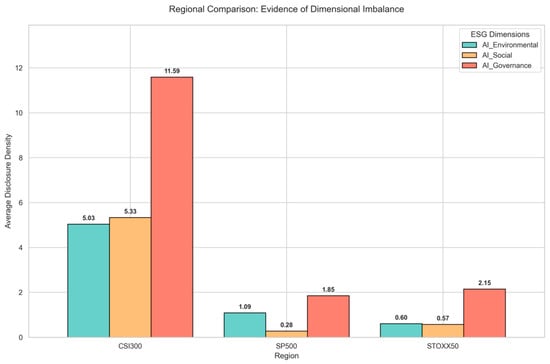
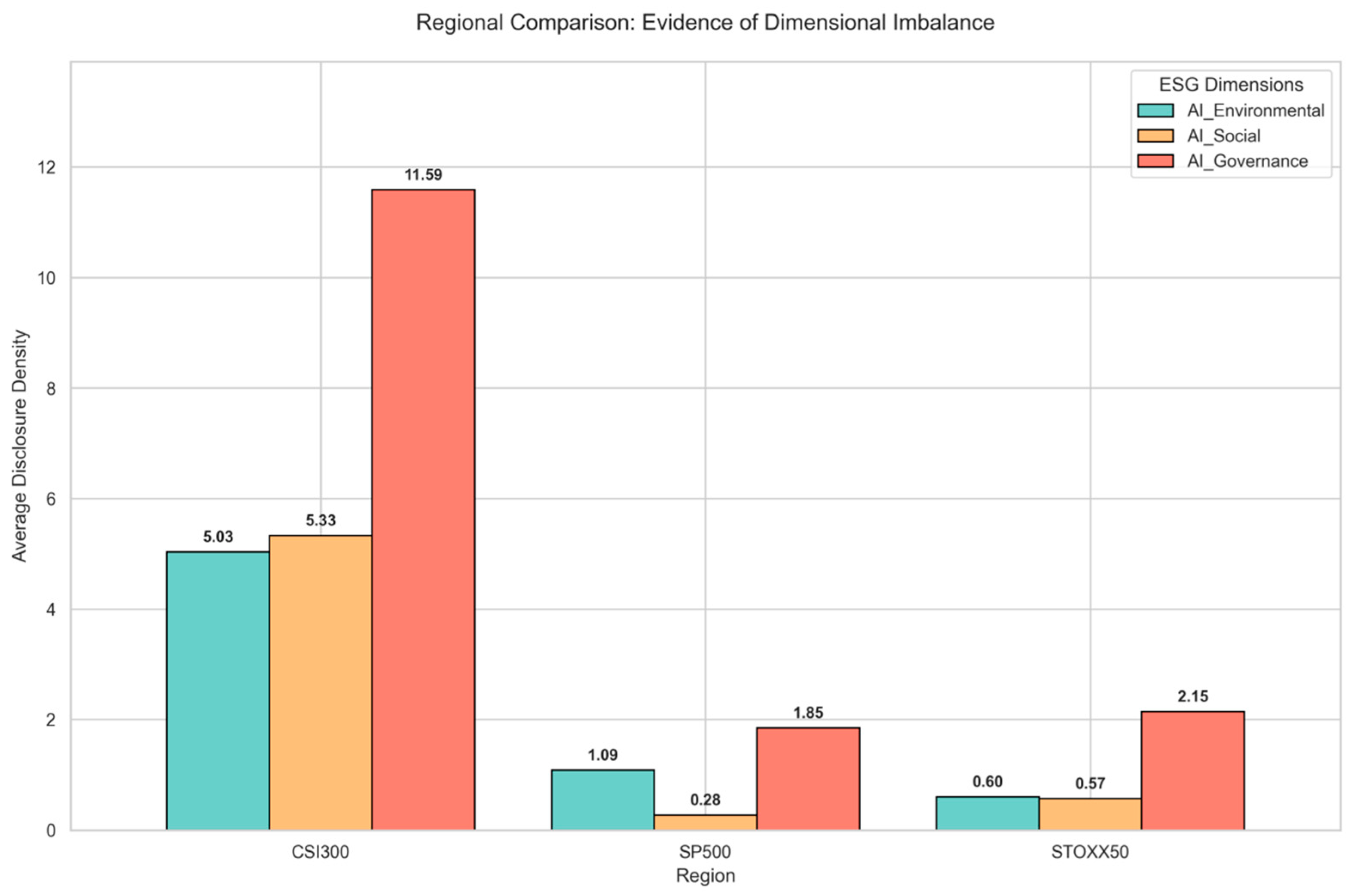
As shown in Figure 1, The Chinese sample’s disclosure density in the AI_Governance dimension (11.59) not only leads the world but also significantly outperforms the U.S. and Europe in the Environmental (5.03) and Social (5.33) dimensions. The substantial disparities in AI information disclosure among the three major regions may be attributed to several factors:
Figure 1.
Regional comparison of AI-ESG disclosure density.
- (1)
- Divergent Disclosure Models. Based on the degree of regulatory compulsion, ESG disclosure is categorized into voluntary and mandatory models. The United States typically follows a voluntary disclosure model; with the exception of specific state-level regulations like those in California, most regions still adhere to voluntary standards. Conversely, the European Union’s Corporate Sustainability Reporting Directive (CSRD) has established a mandatory ESG disclosure system, strengthening oversight of enterprises within its jurisdiction. China has also transitioned from voluntary to mandatory ESG disclosure, intensifying its regulatory grip on ESG reporting.
- (2)
- Differences in Disclosure Scope. Current disclosure scopes primarily follow two standards: Single Materiality and Double Materiality. The United States adopts a “Single Materiality” framework, focusing on matters critical to the company’s financial performance and its shareholders. In contrast, the European Union and China have adopted “Double Materiality” standards. This requires enterprises to disclose not only the impact of external environmental and social factors on their financial performance (Financial Materiality) but also the actual or potential significant impacts of their business activities on the environment and society (Impact Materiality).
- (3)
- Differences in AI Governance. In recent years, China has vigorously promoted the “AI+” strategy. Since 2021, it has successively issued regulations such as the Administrative Provisions on Algorithm Recommendation for Internet Information Services, the Administrative Provisions on Deep Synthesis for Internet Information Services, and the Interim Measures for the Management of Generative Artificial Intelligence Services. These policies have enforced strong oversight regarding algorithm filing and AI safety management. Driven by these regulatory requirements, as well as considerations for corporate branding and business expansion, Chinese enterprises treat AI governance as a core compliance indicator.
3.3.2. Sectoral Polarization Characteristics
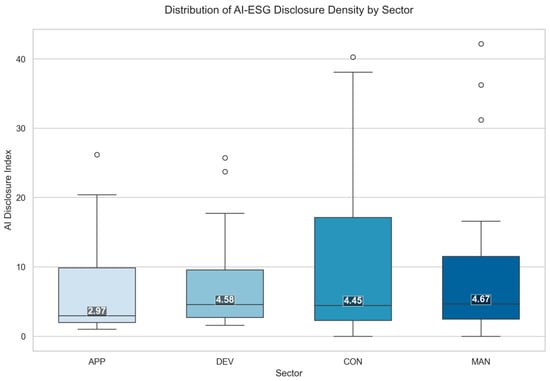
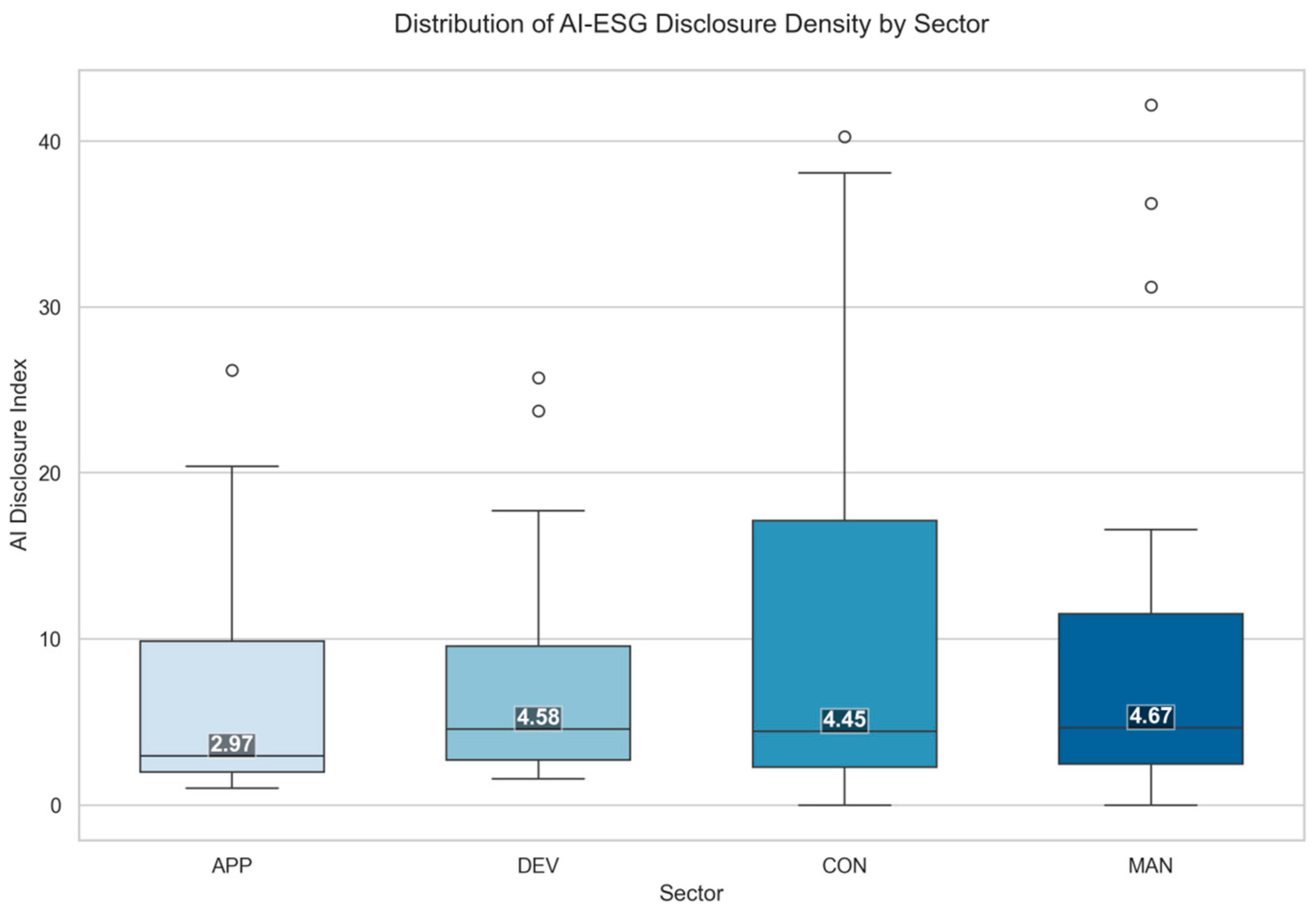
As illustrated in Figure 2, AI-related ESG information disclosure does not follow a normal distribution. Across the Development (DEV), Application (APP), Consumption (CON), and Manufacturing (MAN) sectors, the median disclosure density for the vast majority of listed companies ranges between 2.97 and 4.67. This suggests that most firms are currently in a state of “compliance silence.” However, a small number of mega-cap technology leaders appear as significant outliers, with disclosure densities soaring above 40. This phenomenon indicates that even within the same or closely related industries, there is a massive disparity in how different enterprises approach the disclosure of AI-related information.
Figure 2.
Distribution of AI-ESG disclosure density by sector.
3.3.3. Substantive Validation
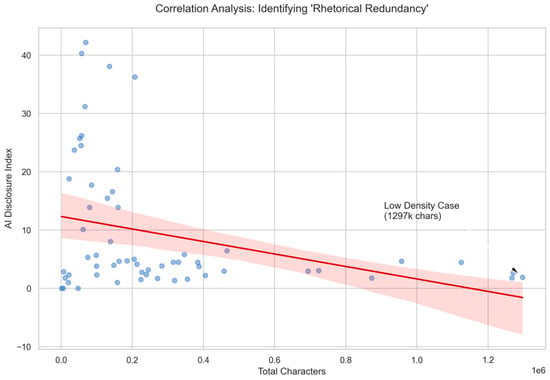
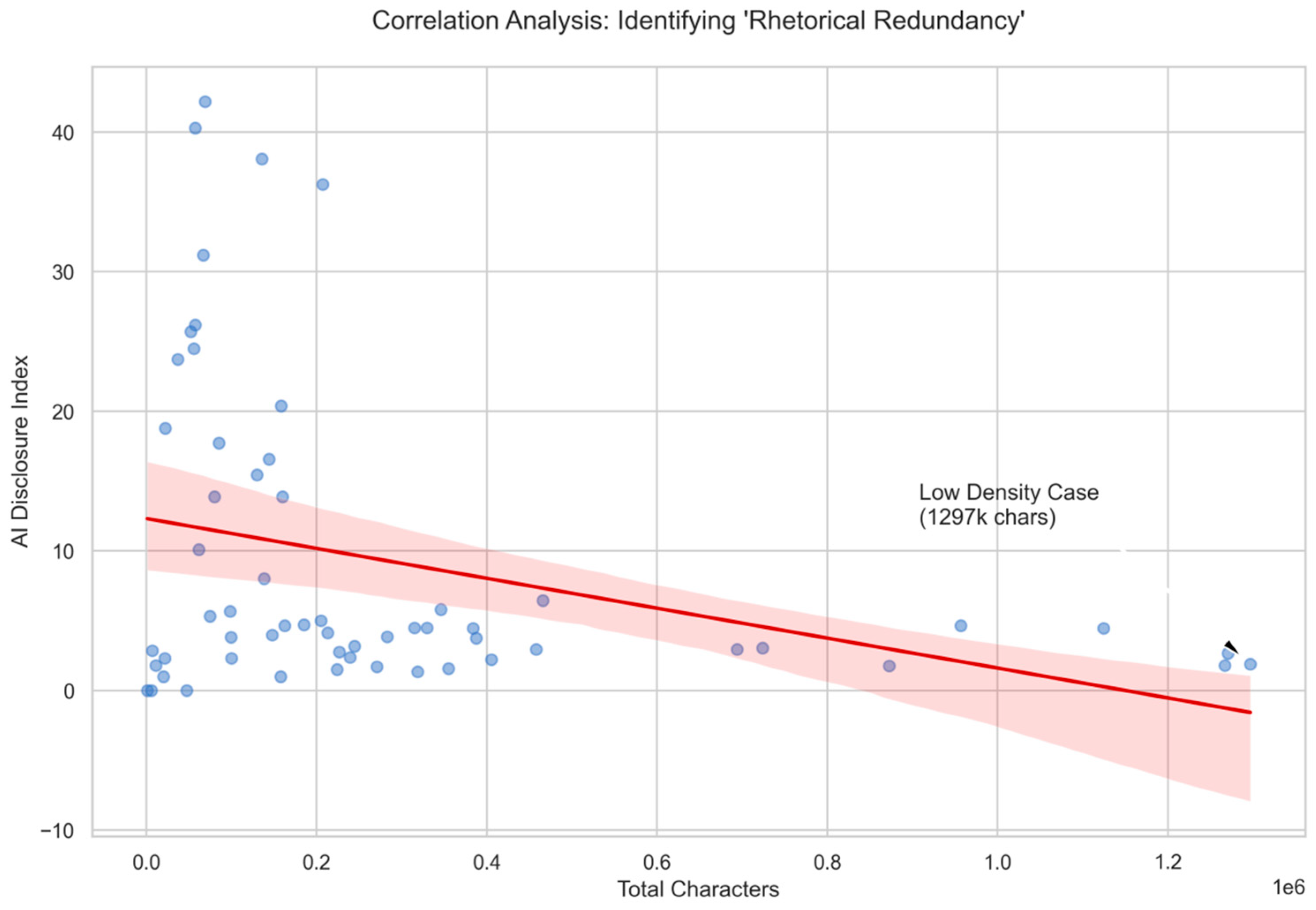
As illustrated in Figure 3, high-scoring enterprises (Index > 20) are almost exclusively concentrated in reports with lower word counts (under 0.2 million characters), whereas extremely lengthy reports exhibit significantly lower AI indices. This demonstrates that in this sample analysis, a greater volume of text does not equate to a higher information load. On the contrary, high-density AI governance information tends to appear in reports of moderate length, while over-lengthy reports show a notable lack of materiality regarding key AI issues. This divergence between length and quality proves that, in the absence of standardized reporting frameworks, listed companies risk utilizing “redundant narratives” to mask a “governance vacuum.”
Figure 3.
Correlation analysis.
4. Institutional Implementation of AI Information Disclosure Within the ESG Framework
Through text mining of the ESG reports of 60 globally representative enterprises, this study finds that current ESG-AI disclosure is characterized by significant disparities among different firms and a notable imbalance across the Environmental, Social, and Governance dimensions. The root cause of these discrepancies is the lack of standardization in ESG-AI disclosure. On one hand, this prevents investors, consumers, and the public from fully understanding a company’s AI development and application status. On the other hand, it leads companies to prioritize AI information under the G (Governance) dimension—which is closely tied to traditional investor interests—while providing limited disclosure on the E (Environmental) and S (Social) dimensions, which carry stronger non-financial implications. Taking China as a case study, this section proposes a concrete scheme for ESG-AI information disclosure.
4.1. General Design of AI Information Disclosure Under the ESG
4.1.1. Establishing AI Disclosure Standards Based on the ‘Double Materiality Principle’
Regarding the scope and types of information in ESG reporting, two paradigms have emerged in practice: the ‘Single Materiality’ and ‘Double Materiality’ principles. Disclosure based on ‘Single Materiality’ focuses exclusively on how environmental and social factors impact a company’s business operations, emphasizing Financial Materiality and catering primarily to the information needs of investors [18]. In contrast, “Double Materiality” requires the disclosure of both external impacts on the business and the company’s internal business conduct’s impact on the environment and society. This approach balances the information requirements of investors with those of other stakeholders [37], thereby ensuring the public’s ability to hold corporations accountable. In practice, Singapore has adopted the ‘Single Materiality’ model, whereas the EU’s Corporate Sustainability Reporting Directive (CSRD) has introduced ‘Double Materiality.’ Under the EU framework, commercial organizations must disclose both how their activities affect ESG matters and how those ESG matters affect the organization’s development. Article 91, Paragraph 1 of China’s Code of Corporate Governance for Listed Companies identifies both shareholders and other stakeholders as the intended recipients of disclosure, reflecting, to some extent, the logic of Double Materiality. From the perspective of the disruptive impact brought by AI technology and the objectives of AI governance, adopting the ‘Double Materiality’ principle is more justifiable. The empirical results (see Section 2.3) reveal a ‘structural imbalance’ in current global AI disclosures. Although the sample enterprises across various regions perform acceptably in the Governance (G) dimension, their disclosure in the Environmental (E) and Social (S) dimensions remains in a state of collective silence. This tends to mask the negative externalities of AI regarding labor rights and environmental footprints. The disruptive application of AI exerts an immeasurable influence on key industries and social governance. In particular, a small number of tech giants have acquired technological power through AI; ensuring their R&D and applications adhere to societal ethical requirements is a paramount issue for an AI-integrated society. Requiring AI firms to promptly disclose technical R&D and applications in public-facing domains enhances public oversight, which is consistent with the goal of public governance in ESG. Therefore, AI information disclosure should encompass two dimensions: first, providing information to stakeholders beyond just investors; and second, providing timely and accurate disclosure of the opportunities and risks that AI R&D and commercial applications pose to the environment and social governance, thereby safeguarding the public’s right to know.
4.1.2. Mandating the Disclosure of AI-Related ESG Information for Listed Companies
From a cost perspective, mandatory disclosure inevitably increases operational overhead. The empirical study of the sample companies’ ESG reports (see Section 3.3) reveals an extreme imbalance in AI governance capabilities among listed firms. Given the tenfold gap in AI disclosure density between the majority of listed companies (with a median of 4.67) and the leading tech giants (outliers > 40), a universal mandatory disclosure model would inevitably impose unbearable compliance costs on the ordinary firms that constitute the bulk of the market. Compared to large listed corporations, SMEs face greater capital constraints, and their AI deployment capabilities are significantly lower than those of tech giants; thus, the negative social externalities generated by their AI use are considerably smaller. From an R&D perspective, the development of AI models depends on intensive capital investment, high-quality data “feeding,” and robust algorithmic support. The monopoly held by tech giants over data and information resources further restricts the R&D potential of SMEs. Encouraging SMEs to participate in AI research and deployment helps mitigate technological monopolization. Therefore, adopting an incentivized rather than mandatory disclosure approach for SMEs better aligns with cost-efficiency principles and the overarching requirements of AI social governance. Therefore, at the current stage, the mandatory disclosure of ESG-AI information should remain restricted to listed companies.
4.1.3. Adopting a ‘Comply or Explain’ Framework for AI-Related Disclosures
As the range of AI disclosure requirements expands alongside business activities, requiring entities to disclose every relevant AI matter with absolute precision may compromise operational efficiency. Furthermore, from the perspective of materiality, the urgency and necessity of disclosure vary significantly across different categories. For platform-based enterprises, the accurate disclosure of Social (S) factors—specifically customer privacy and data security—is of paramount importance. In contrast, for enterprises that do not engage in primary AI research and development, the necessity of disclosing Environmental (E) factors, such as energy consumption and environmental mitigation effects, is relatively diminished. Consequently, allowing disclosing entities to select specific matters for reporting based on their unique operational circumstances and AI deployment strategies aligns with corporate realities. However, if an entity elects not to disclose a particular AI-related matter, it must provide a detailed explanation within the report, outlining the rationale for non-disclosure and any alternative measures taken. To prevent entities from intentionally evading their disclosure obligations, regulatory authorities should be tasked with reviewing the reasonableness of these explanations for non-disclosure. Based on current AI application practices and the empirical status of ESG-AI disclosure identified in the sample pool, this study proposes the following judgment dimensions, as detailed in Table 2.
Table 2.
Primary circumstances for non-disclosure of ESG-AI information.
4.2. Primary Dimensions of ESG-AI Information Disclosure
4.2.1. AI Information Disclosure Based on the Environmental (E) Dimension
As presented in Table 3, this paper establishes the primary dimensions of AI information disclosure within the ESG framework. The environmental impact of AI research and development (R&D) and its applications is primarily reflected in the environmental footprint of its hardware infrastructure. According to the core GRI (Global Reporting Initiative) indicators, the impact of AI manifests across three dimensions: energy, emissions, and waste. Within the context of machine learning, AI model training is immensely energy-intensive. Research indicates that the carbon emissions generated by training a single AI model can be equivalent to the lifetime emissions of five automobiles [38]. As tech companies enter a hyper-competitive stage of AI model training, energy consumption is expected to escalate further. However, the energy-efficiency ratio of AI training can be optimized by mimicking the sparsity of human brain functions or utilizing structured data. Consequently, incorporating AI model training energy consumption into ESG disclosure can incentivize tech companies to refine their training paradigms. Regarding AI application, the inherent learning and predictive capabilities of AI can efficiently bridge different production stages, further reducing energy consumption, waste generation, and gas emissions. For example, during the transition to low-carbon energy systems, which rely on the coordination and integration capabilities of networked and transactional power grids, AI technology can create an “intelligent coordination layer” spanning energy generation, transmission, and consumption. This helps improve system performance while predicting and modeling potential outcomes in complex, multi-variable scenarios [39]. Therefore, disclosing the impact of AI technology on the achievement of environmental protection goals can strengthen public awareness of AI’s potential applications and its role in helping enterprises can reduce costs and increase efficiency.
Table 3.
Primary dimensions of AI information disclosure within the ESG framework.
4.2.2. AI Information Disclosure Based on the Social Responsibility (S) Dimension
Although the integration of AI into organizational management and business processes facilitates the automation of administrative workflows and enhances the precision of customer behavior prediction, the involvement of algorithms in human resource management complicates the protection of labor rights. This shift exerts a significant impact on social factors such as employment, employee training, and education. Mandating that commercial organizations disclose their AI deployment in these areas would empower employees and third-party organizations to strengthen their oversight of corporate human resource management, thereby further safeguarding labor rights. In business operations, the adoption of AI further augments customer management capabilities, refines marketing strategies, and improves the precision of consumer matching. However, achieving these objectives relies heavily on the analysis of historical consumer behavior data. The storage and analysis of such data inherently elevate the risks of customer privacy breaches and data leakage. Consequently, by requiring commercial organizations to disclose non-compliance incidents regarding product and service labeling, as well as complaints or litigation involving violations of customer privacy and data misuse, stakeholders can better assess the organization’s performance in privacy and data protection. Such transparency incentivizes commercial organizations to strengthen their internal self-regulatory mechanisms.
4.2.3. AI Information Disclosure Based on the Corporate Governance (G) Dimension
AI technology exerts a profound influence on the innovation of corporate organizational forms and operational mechanisms, which in turn impacts organizational efficiency. Strengthening the disclosure of AI applications within operational processes is essential for robust AI governance. AI-related information within the corporate governance dimension primarily includes the following: (1) Strategies, policies, and specific practices of the commercial organization regarding AI technology. (2) Impacts, risks, and opportunities that AI technology poses to the industry and the specific organization. (3) The influence of AI technology on organizational management methodologies. (4) AI Ethics and Moral Governance. The objective of disclosing information in categories (1) and (2) is to enable investors to obtain a timely and accurate understanding of the organization’s future development plans, thereby enhancing their ability to evaluate the organization’s investment value. Information in category (3) specifically encompasses the effectiveness of risk management processes for data and algorithms, the methodology of algorithm training, and the degree of algorithmic explainability. Disclosing this information allows investors to understand how AI influences organizational structure and management while strengthening their oversight of algorithms involved in decision-making and predictive analytics. Finally, category (4) requires companies to elucidate their AI ethical guidelines and their regulatory models for AI conduct in specific business practices to both investors and other stakeholders. This indicator represents a distinctive feature of AI governance that differentiates it from ESG disclosure in the traditional industrial economy. Accurately disclosing these governance philosophies ensures that the organization’s AI R&D and applications remain aligned with the broader societal framework for AI governance.
4.3. Supporting Safeguard Measures for AI Information Disclosure
4.3.1. Utilizing the Enterprise Credit Information Publicity System as a Disclosure Vehicle
Currently, ESG information disclosure channels in China are highly fragmented. Listed companies primarily submit and publish interim and annual reports via the State Council’s securities regulatory authorities and stock exchanges, while non-listed companies typically publish reports on their own websites. This complexity hinders the ability of investors and other stakeholders to stay informed about ESG matters in a timely manner. Therefore, establishing a unified publicity platform is essential for strengthening ESG disclosure, particularly concerning the deployment and proliferation of AI.
Regarding platform architecture, the existing National Enterprise Credit Information Publicity System of PRC offers a viable solution [40]. Based on its institutional positioning, this system serves as the primary vehicle for corporate information transparency. According to the Interim Regulations on Enterprise Information Disclosure, companies are required to submit their annual operational reports to the administration for market regulation and the public via this platform, alongside data uploaded by various government departments. Consequently, there is a high degree of synergy between AI information disclosure and this system. Utilizing this platform to directly publicize AI deployment information to society would significantly reduce the costs associated with constructing and maintaining a new, independent infrastructure. From the perspective of data circulation and utilization, the system also functions as a critical channel for corporate data sharing. By disclosing ESG reports (including AI-related matters) through this centralized system, companies can leverage its collaborative sharing channels. This provides other enterprises, public institutions, and the general public with quantifiable indicators to accurately evaluate an organization’s operational status, technological sophistication, and degree of social responsibility fulfillment.
4.3.2. Introduction of a Reporting Assurance System for Listed Companies
Pursuant to the Interim Regulations on the Administration of Issuance and Trading of Shares of PRC, listed companies are required to disclose information to relevant authorities and the public by submitting interim and annual reports to the China Securities Regulatory Commission (CSRC) and stock exchanges; furthermore, such information must be audited by third-party institutions. However, these disclosure requirements primarily pertain to financial data, while the disclosure of non-financial information, such as ESG metrics, remains largely non-mandatory. As previously discussed, establishing a “mandatory” disclosure framework has become a prevailing consensus. Introducing a reporting assurance system to strengthen third-party auditing of ESG matters is of profound significance for ensuring the accuracy of AI-related disclosures by listed companies. Through such a system, investors and other stakeholders can obtain timely and precise insights into a company’s ESG performance—including the deployment and proliferation of AI technology. This transparency facilitates informed adjustments to investment strategies and enables effective oversight of the company’s fulfillment of its social responsibilities. To address the challenges of “difficulty in quantification and auditing” in AI disclosure, this study proposes the construction of a collaborative mechanism centered on “technical standards + audit evidencing”. At the measurement level, priority should be given to internationally recognized technical standards; for instance, regarding environmental footprints, enterprises should be required to disclose real-time carbon intensity during the training phase based on “software energy tracking protocols,” while for governance efficacy, quantitative indicators such as “bias test pass rates” should be introduced to transform vague “risk management” concepts into quantifiable technical parameters. At the auditing level, “data-through verification” should be promoted, shifting the responsibility of auditing institutions beyond mere textual verification toward “evidencing reviews” of underlying computing logs, algorithm test reports, and automated risk monitoring records. This transition from “textual auditing” to “technical assurance” constitutes the core barrier for ensuring the accuracy of AI information disclosure.
5. Conclusions and Discussion
By conducting text mining and empirical analysis of 60 representative listed companies across three global jurisdictions, this study reveals the current state and deficiencies of ESG-AI information disclosure: namely, the disparity in disclosure capabilities among entities and the structural imbalance across disclosure dimensions. These findings demonstrate that relying on voluntary disclosure or a ‘one-size-fits-all’ model is no longer sufficient to address the complex externalities brought by AI technology. Consequently, this paper constructs a standardized ESG-AI disclosure framework. The core of this system lies in combining mandatory disclosure for listed companies with encouraged voluntary disclosure for non-listed entities, utilizing the ‘comply or explain’ principle to achieve a precise balance between compliance costs and public interests while leveraging the ‘double materiality principle’ to bridge the governance gaps in environmental and social responsibilities. To facilitate institutional implementation, this paper offers three recommendations to policymakers: (1) Regulatory bodies should establish a ‘rationality determination matrix’ to implement mandatory indicators for high-risk and high-impact entities; (2) in the process of AI information disclosure and report assurance, energy-tracking tools and fairness metrics should be employed to transform vague governance commitments into auditable ‘computing logs’ and ‘risk-testing working papers,’ thereby suppressing ‘rhetorical greenwashing’ at its source; (3) given the globalized nature of AI developers, an equivalence recognition mechanism should be established to encourage alignment with international standards such as the EU AI Act and ISSB, reducing the multiple compliance burdens on multinational entities.
While this study provides a standardized pathway, certain limitations remain. The empirical sample primarily focuses on high-market-cap listed companies; future research should further explore how to extend this framework to unlisted startups and unicorn companies with lower transparency. Furthermore, as generative AI evolves, disclosure standards must seek a balance between ‘static compliance’ and ‘dynamic governance.’ In the future, utilizing Regulatory Technology to achieve real-time, automated disclosure of AI governance information will remain a long-term challenge for both academia and practitioners.
Funding
This research received no external funding.
Institutional Review Board Statement
Not applicable.
Informed Consent Statement
Not applicable.
Data Availability Statement
The original contributions presented in this study are included in the article. Further inquiries can be directed to the corresponding author.
Conflicts of Interest
The author declares no conflicts of interest.
Abbreviations
The following abbreviations are used in this manuscript:
| AI | Artificial intelligence |
| ESG | Environmental, Social, and Governance |
References
- Zhang, L.; Lin, Y.; Yang, X.; Chen, T.; Cheng, X.; Cheng, W. From Sample Poverty to Rich Feature Learning: A New Metric Learning Method for Few-Shot Classification. IEEE Access 2024, 12, 124990–125002. [Google Scholar] [CrossRef] [Scilit]
- Dong, H.; Chen, J. Meta-regulation: An ideal alternative to the primary responsibility as the regulatory model of generative AI in China. Comput. Law Secur. Rev. 2024, 54, 106016. [Google Scholar] [CrossRef] [Scilit]
- The White House. FACT SHEET: Biden-Harris Administration Secures Voluntary Commitments from Leading Artificial Intelligence Companies to Manage the Risks Posed by AI. Available online: https://www.presidency.ucsb.edu/documents/fact-sheet-biden-harris-administration-secures-voluntary-commitments-from-leading (accessed on 1 August 2025).
- Business & Human Rights Resource Centre. Poland: ChatGPT Faces Complaint for Alleged Privacy Violations. Available online: https://www.business-humanrights.org/en/latest-news/poland-chatgpt-faces-complaint-for-alleged-privacy-violations/ (accessed on 14 September 2025).
- Chen, J.K. Research on the Construction of Information Disclosure Mechanism for Artificial Intelligence Generated Content. Forum Sci. Technol. 2024, 3, 160–167+176. (In Chinese) [Google Scholar] [CrossRef]
- KPMG. ESG in the Age of AI; KPMG: Mumbai, India, 2024; Available online: https://kpmg.com/in/en/insights/2024/08/esg-in-the-age-of-ai.html (accessed on 12 January 2026).
- Awa, H.O.; Etim, W.; Ogbonda, E. Stakeholders, stakeholder theory and Corporate Social Responsibility (CSR). Int. J. Corp. Soc. Responsib. 2024, 9, 11. [Google Scholar] [CrossRef] [Scilit]
- Davies, P.A.; Dudek, P.M.; Wyatt, K.S. Recent Developments in ESG Reporting. In Values at Work: Sustainable Investing and ESG Reporting; Esty, D.C., Cort, T., Eds.; Palgrave Macmillan: Cham, Switzerland, 2020; pp. 161–179. [Google Scholar] [CrossRef] [Scilit]
- European Commission. Corporate Sustainability Reporting. Available online: https://finance.ec.europa.eu/capital-markets-union-and-financial-markets/company-reporting-and-auditing/company-reporting/corporate-sustainability-reporting_en (accessed on 15 December 2025).
- Liu, Y.; Song, J.; Zhou, B.; Liu, J. Artificial intelligence applications and corporate ESG performance. Int. Rev. Econ. Financ. 2025, 104, 104559. [Google Scholar] [CrossRef] [Scilit]
- Yan, J.; Liu, Z.; Leng, J.; Zhao, J.L.; Chen, C.; Zhang, D.; Tao, Y.; Wang, Y.; Liu, T.; Zhang, C.; et al. Human-centric artificial intelligence towards Industry 5.0: Retrospect and prospect. J. Ind. Inf. Integr. 2025, 47, 100903. [Google Scholar] [CrossRef] [Scilit]
- Wu, Q.; Khattak, M.S.; Anwar, M.; Nevries, P. Artificial Intelligence and Environmental, Social, and Governance: A Hybrid Bibliometric Approach. Bus. Strat. Environ. 2025, 1–27. [Google Scholar] [CrossRef] [Scilit]
- Zhang, C.; Yang, J. Artificial intelligence and corporate ESG performance. Int. Rev. Econ. Financ. 2024, 96, 103713. [Google Scholar] [CrossRef] [Scilit]
- Ding, Z.; Wang, J.; Song, Y.; Zheng, X.; He, G.; Chen, X.; Zhang, T.; Lee, W.-J.; Song, J. Tracking the carbon footprint of global generative artificial intelligence. Innovation 2025, 6, 100866. [Google Scholar] [CrossRef] [Scilit]
- Yu, E.P.; Luu, B.V.; Chen, C.H. Greenwashing in environmental, social and governance disclosures. Res. Int. Bus. Financ. 2020, 52, 101192. [Google Scholar] [CrossRef] [Scilit]
- Elkmash, M.A.; El-Halaby, S.; Mohamed, S.N. The mediating role of Artificial Intelligence on the relationship between intangible assets and equity market value: Evidence from global context. Humanit. Soc. Sci. Commun. 2025, 12, 1827. [Google Scholar] [CrossRef] [Scilit]
- Freeman, R.E. Strategic Management: A Stakeholder Approach; Cambridge University Press: Cambridge, UK, 1984. [Google Scholar]
- Li, S.; Huang, S.Z. The Evolution from CSR to ESG: Literature Review and Future Prospect. Financ. Res. 2022, 4, 13–25. (In Chinese) [Google Scholar]
- Liu, J.H. On the institutional design of corporate ESG information disclosure: A new perspective of protecting stakeholders such as consumers. Law Appl. 2023, 5, 18–31. (In Chinese) [Google Scholar]
- Attanasio, G.; Preghenella, N.; De Toni, A.F.; Battistella, C. Stakeholder engagement in business models for sustainability: The stakeholder value flow model for sustainable development. Bus. Strategy Environ. 2022, 31, 860–874. [Google Scholar] [CrossRef] [Scilit]
- Yuan, L.P. Research on the soft law construction of corporate social responsibility information disclosure. J. Political Sci. Law 2020, 2, 149–160. (In Chinese) [Google Scholar]
- Zhu, C.Y.; Lyu, C.L. The Rise of ESG and the Active Response of Modern Company Law. Peking Univ. Law J. 2022, 34, 1241–1259. (In Chinese) [Google Scholar]
- Hazen, T.L. Social Issues in the Spotlight: The Increasing Need to Improve Publicly-Held Companies’ CSR and ESG Disclosures. Univ. Pa. J. Bus. Law 2021, 23, 740. [Google Scholar]
- Pay Governance LLC. The Stakeholder Model and ESG. The Harvard Law School Forum on Corporate Governance. 2020. Available online: https://corpgov.law.harvard.edu/2020/09/14/the-stakeholder-model-and-esg/ (accessed on 12 January 2026).
- Hou, D.D.; Wei, Y.J. Construction of ESG Information Disclosure Framework for Listed Companies: Based on the Perspective of New Development Philosophy. Law Bus. Econ. 2023, 5, 3–17. (In Chinese) [Google Scholar]
- Zhu, N.; Kong, L. Corporate ESG performance and artificial intelligence adoption: Mediating role based on financing constraints. Total Qual. Manag. Bus. Excell. 2025, 36, 1551–1565. [Google Scholar] [CrossRef] [Scilit]
- Sklavos, G.; Theodossiou, G.; Papanikolaou, Z.; Karelakis, C.; Ragazou, K. Environmental, Social, and Governance-Based Artificial Intelligence Governance: Digitalizing Firms’ Leadership and Human Resources Management. Sustainability 2024, 16, 7154. [Google Scholar] [CrossRef] [Scilit]
- Cihon, P.; Schuett, J.; Baum, S.D. Corporate Governance of Artificial Intelligence in the Public Interest. Information 2021, 12, 275. [Google Scholar] [CrossRef] [Scilit]
- World Economic Forum. Why Artificial Intelligence Is Vital in the Race to Meet the SDGs. Available online: https://www.weforum.org/agenda/2022/05/artificial-intelligence-sustainable-development-goals/ (accessed on 14 September 2025).
- Zhou, S.; Zhu, X.F.; Liang, Z. International Governance of Artificial Intelligence from the Perspective of Global Sustainable Development. Forum Sci. Technol. 2022, 9, 163–169. (In Chinese) [Google Scholar]
- Xiao, Y.; Xiao, L. The impact of artificial intelligence-driven ESG performance on sustainable development of central state-owned enterprises listed companies. Sci. Rep. 2025, 15, 8548. [Google Scholar] [CrossRef] [Scilit]
- Editorial Department of Zhangjiang Technology Review. Constructing a New Normal of Sustainable Development with Artificial Intelligence. Zhangjiang Technol. Rev. 2020, 4, 38–41. (In Chinese) [Google Scholar]
- OECD. Measuring the Environmental Impacts of Artificial Intelligence Compute and Applications; OECD Digital Economy Papers No. 341; OECD Publishing: Paris, France, 2022. [Google Scholar]
- Dastin, J.; ACLU. Why Amazon’s Automated Hiring Tool Discriminated Against Women. Available online: https://www.aclu.org/news/womens-rights/why-amazons-automated-hiring-tool-discriminated-against (accessed on 12 January 2026).
- Brusseau, J. AI human impact: Toward a model for ethical investing in AI-intensive companies. J. Sustain. Financ. Invest. 2023, 13, 1030–1057. [Google Scholar] [CrossRef] [Scilit]
- Petrin, M. AI in Listed Companies. In Oxford Intersections: AI in Society; Hacker, P., Ed.; Oxford University Press: Oxford, UK, 2025. [Google Scholar]
- Peng, Y. Legal Justification and Rule Construction of Mandatory ESG Information Disclosure System. East. Forum 2023, 4, 152–164. [Google Scholar] [CrossRef]
- Strubell, E.; Ganesh, A.; McCallum, A. Energy and Policy Considerations for Deep Learning in NLP. In Proceedings of the 57th Annual Meeting of the Association for Computational Linguistics, Florence, Italy, 8 July–2 August 2019; Association for Computational Linguistics: Florence, Italy, 2019; pp. 3645–3650. [Google Scholar] [CrossRef] [Scilit]
- World Economic Forum. This Is How AI Will Accelerate the Energy Transition. Available online: https://www.weforum.org/agenda/2021/09/this-is-how-ai-will-accelerate-the-energy-transition/ (accessed on 20 September 2025).
- Feng, G. Analysis of the legal path of corporate social responsibility information disclosure system. Soc. Sci. Res. 2020, 1, 11–20. [Google Scholar]

Disclaimer/Publisher’s Note: The statements, opinions and data contained in all publications are solely those of the individual author(s) and contributor(s) and not of MDPI and/or the editor(s). MDPI and/or the editor(s) disclaim responsibility for any injury to people or property resulting from any ideas, methods, instructions or products referred to in the content. |
© 2026 by the author. Licensee MDPI, Basel, Switzerland. This article is an open access article distributed under the terms and conditions of the Creative Commons Attribution (CC BY) license.