


Abstract
Despite the known importance of Supply Chain Dynamic Capabilities (SCDC) in the face of shocks and sustainability pressures in construction, its translation into resilience (SCR) and performance (SSCP) remains unclear. Thus, we examine Sustainable Supply Chain Management (SSCM) practices as a mediator and firm size as a moderator within this relationship. Drawing on the Dynamic Capabilities View, the study analyzed survey data from 525 construction industry professionals in China using Structural Equation Modeling (SEM). Bootstrapping techniques and multi-group analysis were employed to systematically test mediation and moderation hypotheses. The findings indicate that SCDC positively influences both SCR and SSCP. Mediation analysis confirms that SSCM serves as a significant partial mediator, suggesting that dynamic capabilities are most effective when operationalized through specific sustainable practices. Additionally, a strategic divergence was observed: large enterprises leverage internal dynamic capabilities to a greater extent to drive resilience, while small and medium-sized enterprises (SMEs) rely more heavily on the implementation of SSCM practices to navigate supply chain challenges. The study empirically validates the operational link between dynamic capabilities and sustainable performance. The findings offer a tailored framework for practitioners, highlighting that resilience strategies must align with organizational scale, particularly for resource-constrained SMEs relying on external collaboration.
1. Introduction
Supply chains in the construction industry are uniquely vulnerable to exogenous shocks, as evidenced by the severe disruptions caused by the COVID-19 pandemic and the ongoing volatility in global material flows [1]. In this volatile environment, a firm’s ability to merely bounce back, or its resilience, is insufficient. It must also adhere to increasingly stringent sustainability mandates, such as China’s 14th Five-Year Plan targets for carbon peaking by 2030 [2]. While the literature acknowledges that Supply Chain Dynamic Capabilities (SCDC) are critical for navigating these uncertainties [3] and that Sustainable Supply Chain Management (SSCM) drives environmental performance [4], the precise mechanism connecting these three domains remains underexplored. Specifically, it is unclear whether SCDC directly fosters resilience or if it requires the mediation of concrete SSCM practices to translate strategic potential into operational reality [5].
Furthermore, the construction sector is not monolithic. A significant gap exists in understanding how this mechanism varies by firm size. Do resource-rich large enterprises leverage dynamic capabilities differently than agile but resource-constrained small and medium-sized enterprises (SMEs)? Prior research has largely treated firm size as a control variable rather than a critical moderator determining the strategic pathway to resilience [6]. Addressing this oversight is particularly important in the Chinese context, where the industrial landscape is bifurcated between massive state-owned conglomerates and a fragmented ecosystem of private SMEs.
This study addresses these gaps by examining the interplay between SCDC, SSCM, and Resilience/Performance within the Chinese construction industry, a sector contributing 31% of global carbon emissions and facing intense regulatory pressure for green transformation [7]. Leveraging a survey of 525 professionals, we make three distinct contributions to the literature. First, we empirically validate SSCM as a critical mediator, showing that dynamic capabilities alone are insufficient for resilience without the operational bridge of sustainable practices. Second, we integrate Operational Performance as a distinct dimension of the Triple Bottom Line (TBL), providing a more granular validation of how sustainability initiatives drive efficiency before they drive profit [8]. Third, we uncover a strategic divergence based on firm size: while large firms capitalize on internal dynamic capabilities, SMEs rely heavily on the execution of SSCM practices to achieve resilience. These findings offer a tailored roadmap for managers navigating the trade-offs between agility, sustainability, and scale.
2. Literature Review and Hypothesis Development
2.1. Supply Chain Dynamic Capabilities and Sustainable Supply Chain Management
While Silva et al. [9] frame sustainability as a dynamic capability requiring adaptation, the mechanism for systematically developing these capabilities to manage sustainable practices remains elusive. Drawing on Teece’s [3] taxonomy, validated in the construction context by Ekanayake et al. [10], we define SCDC as the capacity to sense environmental shifts, seize opportunities through green technologies, and reconfigure core operations to enhance resilience [5,11].
This progression establishes a complete logical loop: SCDC is not merely a passive response tool but a strategic engine [3]. Specifically, sensing and seizing constitute the essential prerequisites for identifying the strategic value of sustainability, while reconfiguration transforms these external pressures into internalized, standardized SSCM processes [11]. Therefore, we posit that SCDC is the fundamental driver for the successful deployment of SSCM practices.
Hypothesis H1.
SCDC positively influences SSCM.
2.2. Supply Chain Resilience (SCR)
The ability to respond rapidly to disruptions is not a matter of chance but a manifestation of deep-seated corporate capabilities [3]. Consequently, we conceptualize supply chain resilience as the concrete projection of dynamic capabilities within crisis contexts [12]. SCDC endows firms with the strategic agility to rapidly reconfigure their resource base in volatile environments.
While existing research links dynamic capabilities to pandemic resilience [12], there remains a lack of clarity regarding the specific resources that strengthen these competencies [13]. Most studies focus on identifying vulnerabilities [14] or reactive measures, leaving a gap in understanding how relational competencies [15] and adaptive perspectives [16] can be systematically developed for long-term recovery.
Current literature divides SCR into engineering and social-ecological resilience (see Table 1) [17]. Engineering resilience prioritizes stability and efficiency through real-time monitoring and resource redistribution [10,18]. Studies confirm that integrating information processing capabilities, such as blockchain and digital twins, significantly reduces recovery times [18,19]. Similarly, strategic digitalization and knowledge integration have been empirically proven to bolster resilience against upstream and downstream disruptions [1,20]. Social–ecological resilience, conversely, supports long-term adaptation [4]. Operationally, this involves flexible production and supplier diversification enabled by sensing environmental changes [16]. Strategically, it reflects an evolutionary process where firms reconfigure relationships and product designs based on disruption learning [1]. Please refer to the Supplementary Material for specific details on SCR measurement factors.
Table 1.
Definitions, theoretical perspectives, and key references of resilience concepts.
Synthesizing these perspectives, SCDC serves as the underlying force that propels both the swift restoration of stability (engineering resilience) [18] and the long-term evolutionary adaptation (social–ecological resilience) [17]. By systematically enabling the sensing of disruptions and the seizing of reconfiguration opportunities, SCDC directly fortifies the supply chain’s ability to withstand and recover from shocks.
Hypothesis H2.
SCDC positively influences SCR.
Beyond the endogenous agility provided by SCDC, the quality of external relationships is equally pivotal. In this context, SSCM functions as a risk mitigation mechanism; the information transparency and deep supplier collaboration it advocates accumulate substantial supply chain social capital [4,19]. This relational asset transforms into critical mutual aid and information sharing during crises, thereby significantly enhancing the system’s overall resilience [17].
Specifically, SSCM operationalizes these benefits by creating a robust information network to monitor performance and address vulnerabilities [4]. By fostering trust and shared values, these practices enhance working conditions and tighter partner integration, which improves risk awareness and preparedness [19,21]. Furthermore, direct engagement with suppliers through training and collaborative development is crucial [4], as these ongoing efforts significantly boost the supply chain’s recovery capabilities [17].
Hypothesis H3.
SSCM positively influences SCR.
2.3. Sustainable Supply Chain Performance (SSCP)
In China’s construction sector, sustainable practices are critical for managing vast environmental footprints and meeting stringent regulatory standards [2,22]. Beyond tackling specific challenges like carbon emissions from concrete and steel [7], firms must navigate complex economic risks to foster long-term value [4]. Consequently, adoption of the TBL enables firms to align with stakeholder expectations and compliance demands [21]. Crucially, we argue that green innovations, such as advanced materials and energy-efficient technologies, are not merely environmental responses but strategic measures to enhance operational efficiency (Subsuming ‘Operational Performance’ (OPEP) under ‘Economic Performance’ (EcoP), as done in some other studies, can be inadequate to disentangle and capture the nuanced impacts of sustainability initiatives. We propose incorporating operational performance as a distinct component of sustainable supply chain performance (alongside EcoP, EnvP and SocP) to evaluate the effects of sustainable practices. Operational performance focuses on efficiency metrics such as improved capacity utilization and inventory management, which are often overlooked by traditional economic or market assessments but are crucial for capturing the practical benefits of sustainability initiatives [23]). This fourth dimension of performance reflects immediate efficiencies in capacity and inventory utilization, highlighting the effectiveness of optimizing resource use within the supply chain [8].
SCDC acts as the catalyst for achieving these multidimensional performance goals. Specifically, ‘Sensing’ enables firms to anticipate regulatory shifts and market demands, ensuring alignment with green building standards [11,24]. ‘Seizing’ facilitates the rapid implementation of green technologies and sustainable materials, which enhances both environmental outcomes and social welfare through better working conditions [3,11]. Finally, ‘Reconfiguration’ synchronizes logistics and project management, reducing inefficiencies and boosting economic performance [20].
In essence, static resource advantages are inevitably eroded by market shifts; only dynamic capabilities can secure enduring competitiveness [25]. Building on this logic, we posit that SCDC, by continuously updating and optimizing supply chain resource allocation, prevents the ossification of core competencies, thereby ensuring sustained operational efficiency and environmental adaptability. This mechanism of dynamic resource renewal directly constitutes the wellspring of superior SSCP.
Hypothesis H4.
SCDC positively influences SSCP.
SSCM operationalizes sustainability by enforcing robust environmental protocols and promoting social responsibility [26], while economically fostering risk management and supplier diversity to create value [23]. Adherence to international standards ensures that supply chains not only respond to challenges but also proactively contribute to sustainability goals [21,26].
Crucially, this suggests that sustainability is no longer merely a compliance cost but a central locus of value creation [4]. Specifically, systematic SSCM practices convert environmental and social responsibilities into tangible economic benefits and operational advantages by reducing emissions, mitigating risks, and enhancing reputation [20,27]. This holistic approach acts as a pivotal driver for multidimensional SSCP, securing a sustainable competitive edge [4,26].
Hypothesis H5.
SSCM positively influences SSCP.
2.4. Mediating Effects
Previous studies have primarily concentrated on the direct effects of SCDC on SCR and SSCP, often overlooking how these capabilities are systematically transformed into operational strategies through SSCM [9,28,29]. For instance, while sensing identifies sustainability opportunities, the operational seizing and reconfiguring of these opportunities through SSCM practices remain under-researched [30]. Crucially, Kitsis and Chen [31] identify SSCM as the pivotal mechanism through which antecedent organizational motives influence performance.
While SCDC provides the potential for adaptation, this potential requires concrete levers to translate into tangible risk resistance [9,29]. Consequently, we infer that SSCM plays a critical mediating role between SCDC and SCR. Dynamic capabilities must be ‘operationalized’ through specific, institutionalized sustainable management practices, such as diversified procurement protocols and transparent information platforms, to physically construct a resilient supply chain network characterized by high redundancy and responsiveness [1,15].
Hypothesis H6.
SSCM mediates the relationship between SCDC and SCR.
Regarding performance, SSCP requires a strategic deployment of the TBL approach augmented by operational efficiencies [26,27]. Achieving these goals necessitates strict compliance and ethical sourcing, which are core functions of SSCM [21]. SCDC acts as the trigger: sensing capabilities integrate environmental standards into daily operations [11], while seizing manifests through the adoption of green technologies that directly boost operational metrics [20]. This optimization of resources contributes to both economic and environmental sustainability [23]. Furthermore, within the Chinese construction context, dynamic reconfiguration is essential for adapting to rapid regulatory shifts [32].
By the same token, the conversion path from capability to performance is rarely direct; it often requires specific management routines as carriers. Logically, we view SSCM as the bridge connecting abstract capabilities with concrete performance [31]. As a transformation mechanism, it converts the strategic acumen inherent in SCDC into measurable environmental and economic outcomes, thereby allowing the promotional effect of dynamic capabilities on sustainable performance to be fully manifested [20].
Hypothesis H7.
SSCM mediates the relationship between SCDC and SSCP.
2.5. Moderating Effects
The concept of dynamic capabilities in organizations has been extensively studied with a focus predominantly on large corporations [6]. However, the relevance and types of dynamic capabilities for SMEs remain less understood. From a managerial perspective, dynamic capabilities are significantly influenced by the actions and decisions of owners and managers [33]. We would argue that despite similar external conditions, there is considerable variance in the decisions made by managers across large firms and SMEs concerning which dynamic capabilities to develop further. Smaller companies, constrained by resources, exploit their agility and capacity to tailor solutions to specific needs, rapidly adapting to market changes with minimal bureaucratic delay [33,34]. This agility not only facilitates the swift execution of sustainable practices but also reflects a higher risk tolerance and a propensity for innovation, as the lower absolute costs of failure encourage bolder decision-making [34]. These characteristics enable small firms to integrate environmental and social considerations into their operations effectively, using sustainability as a competitive differentiator. In contrast, larger firms, while possessing ample resources to invest in sustainable technologies and processes, often face challenges in rapid implementation due to their scale and complexity. Nevertheless, their risk-averse nature, stemming from higher stakes associated with failures [6], complements their ability to undertake large-scale sustainability projects such as efficient energy use and global supply chain optimization [30]. Hence, we also investigate how firm size may moderate the impact not only of dynamic capabilities on sustainable performance but also across the intricate relationships involving the other hypothesized constructs (SSCM, SCR and SSCP) that may also be affected by firm size, reflecting varying managerial decisions and attributes.
Hypothesis H8.
Firm size moderates the structural relationships in the SCDC–SSCM–Resilience model.
Hypothesis H8a.
Firm size moderates the relationship between SSCM and SCDC.
Hypothesis H8b.
Firm size moderates the relationship between SCDC and SCR.
Hypothesis H8c.
Firm size moderates the relationship between SSCM and SCR.
Hypothesis H8d.
Firm size moderates the relationship between SCDC and SSCP.
Hypothesis H8e.
Firm size moderates the relationship between SSCM and SSCP.
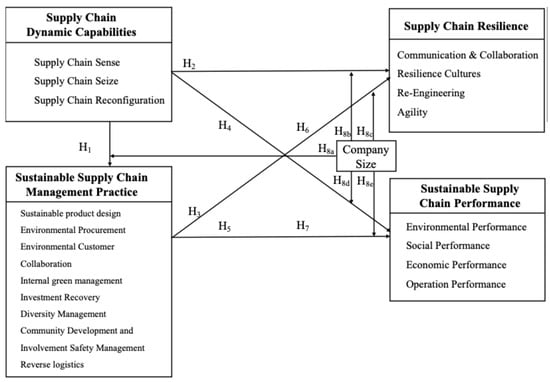
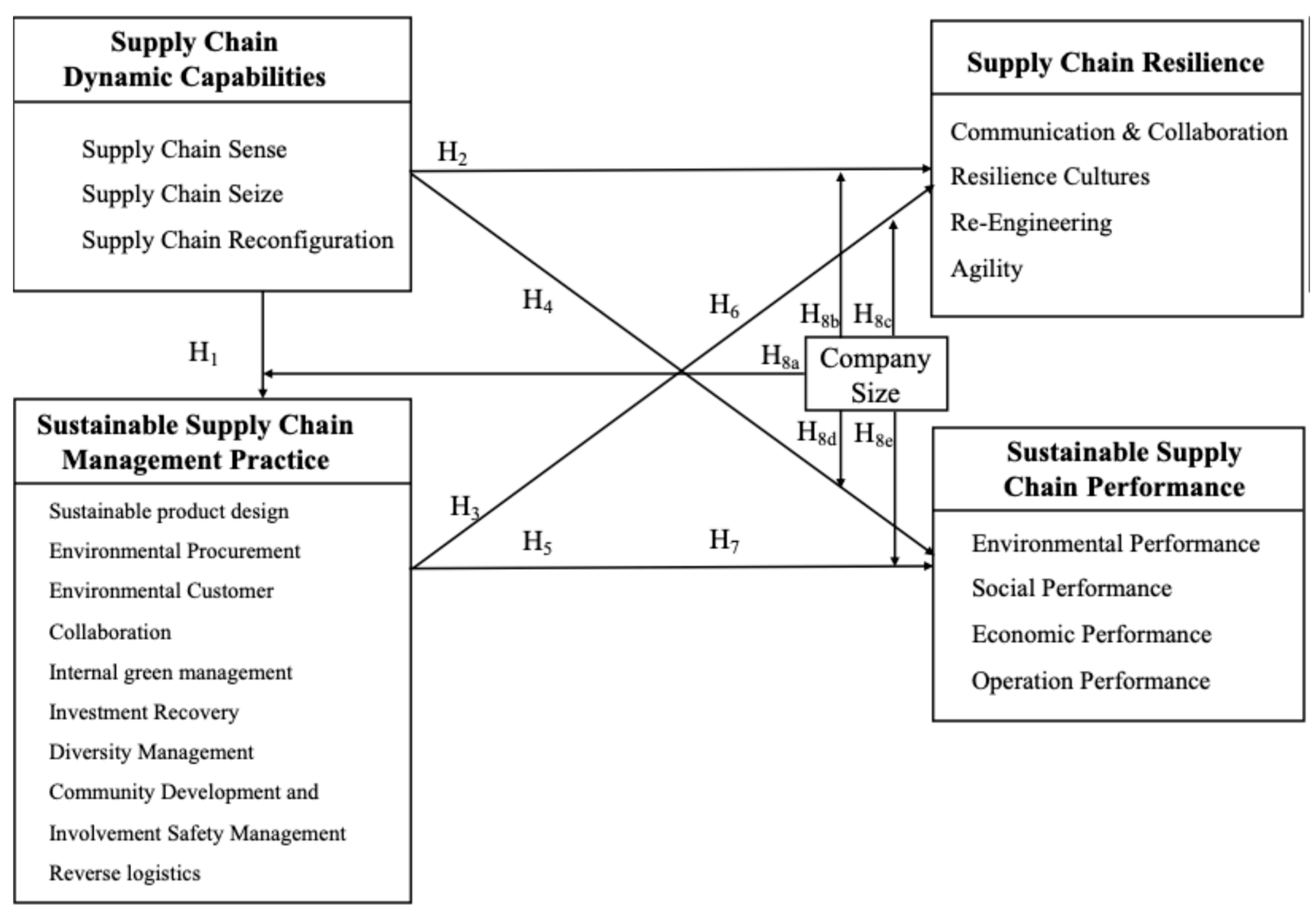
The conceptual framework that we propose alongside the related hypotheses rationalized above is illustrated in Figure 1. This conceptual framework illustrates a logical progression rooted in the Dynamic Capabilities View (DCV), moving from Potential (SCDC: the capacity to sense and seize opportunities) to Action (SSCM: the deployment of specific collaborative and sustainable practices) and finally to Outcome (Resilience and Sustainable Performance). We posit that while dynamic capabilities are a prerequisite, they are insufficient in isolation. They require the operational mechanism of SSCM practices to materialize into tangible resilience and performance. For instance, the capability to sense a disruption provides minimal value unless it triggers the practice of communicating with alternative suppliers. Furthermore, the model incorporates Firm Size as a critical moderator. We hypothesize that the resource constraints inherent to SMEs necessitate a stronger reliance on agile SSCM practices as a survival mechanism, whereas large firms may rely more on internal asset redundancy. This hierarchical structure allows for a dual assessment of both direct operational impacts and strategic mediation pathways.
Figure 1.
Research framework: the role of supply chain dynamic capabilities.
3. Methodology
3.1. Measurements
To ensure methodological rigor and content validity, the survey instrument was developed through a comprehensive three-stage process established in advance. First, constructs were adapted from established scales (summarized in Table 2): SCDC was measured using items grounded in Teece [3] and Heldt and Beske-Janssen [5], focusing on sensing, seizing, and reconfiguring, while SSCM practices were operationalized based on Eggert and Hartmann [4]. To capture the complexity of these higher-order constructs and the multi-dimensional nature of resilience, the initial item pool was comprehensive. This pool underwent a rigorous review by a focus group consisting of two senior managers from the Chinese construction sector and four supply chain experts. Based on their feedback, we revised the wording to enhance comprehension; for instance, ‘green technology adoption’ was clarified to ‘introduction of low-carbon building materials.’ Subsequently, the instrument was validated through a pilot test with industry practitioners, achieving a Content Validity Index (CVI) of 0.83. The final instrument comprised 85 items; while extensive, this volume was deemed methodologically necessary to ensure the structural integrity of the second-order constructs, though the full list of items and validity tables have been moved to Supplementary Materials to maintain conciseness.
Crucially, regarding SSCP, we expanded the traditional TBL framework to include Operational Performance as a fourth, distinct dimension. This design choice is grounded in the “antecedent-outcome” theoretical perspective [23]. Operational metrics, such as capacity utilization and inventory efficiency, serve as the immediate, tangible outcomes of supply chain interventions. These act as necessary antecedents to broader financial (economic) performance. Subsuming operational metrics under economic performance would mask the immediate efficiency gains, which is particularly critical in the construction sector where financial returns often lag behind process improvements.
The questionnaire was divided into three sections. The first section provided background information. The second section captured firm profiles. Specifically, the classification of firm size was strictly based on the official asset criteria defined by the National Bureau of Statistics of China [35], ensuring that the distinction between large enterprises and SMEs was determined by established regulatory standards rather than post-hoc selection. The third section utilized a five-point Likert scale (ranging from 1, ‘strongly agree’, to 5, ‘strongly disagree’) to measure the constructs.
Table 2.
Constructs, sources, and representative scale items.
3.2. Data Collection
The survey was administered across various Chinese regions. It targeted different firm types within the construction sector’s supply chain. The population comprised large enterprises (with assets over 800 million RMB), medium-sized enterprises (with assets between 50 million and 800 million RMB), small enterprises (with assets under 50 million RMB), and micro-enterprises (with assets under 3 million RMB) in the Chinese construction industry, drawn from a membership list of over 2000 enterprises registered with the construction association. The classification of firm sizes was based on asset criteria defined in the National Bureau of Statistics [35] database. Using stratified random sampling based on firm asset size, we selected 1500 firms from this list to ensure representation across firm scales and regions. Respondents were required to have at least three years of experience in supply chain management within the construction industry and direct involvement in sustainable supply chain projects, verified through association-provided job titles and professional credentials. In total, 1200 questionnaires were disseminated. Within one month, 772 completed questionnaires were returned. The profiles of respondents are reported in Table 3. Such responses were screened to remove questionnaires with invalid data, including incomplete participant information, homogenous/uniform responses, and systematic errors. Approximately 15% of the initial 772 responses contained missing values, primarily single-item omissions. To prevent bias, questionnaires with missing information in more than one question were excluded from the sample using SPSS (version 28). The remaining missing values were estimated through the Maximum Likelihood (ML) method (known to be the least biased). Following this data cleaning process, we were left with 525 valid questionnaires. The response rate of 43.75% is higher than that found in other papers, attesting to the value of our efforts to boost responses via reminder emails sent over additional e-mailing rounds while offering participants a summary of the findings to encourage participation. Based on the total number (population) of construction firms reported by the National Bureau of Statistics [35], Kotrlik et al. [46] would suggest a minimum sample size of 383. By significantly exceeding the advised sample size threshold, we can safely proceed to conduct factor analysis using SEM.
Table 3.
Respondents’ demographic information.
3.3. Common Method Variance, Variance Inflation Factors and Respondent Selection Criteria
Mindful of Flynn et al.’s [47] arguments regarding why, at the organizational level, single respondent surveys can suffer from major biases, we paid particular attention to attempting to minimize potential causes of Common Method Variance (CMV). The measures adopted related to issues such as scale items’ complexity, item ambiguity, double-barreled items, and the order of scale items (see Craighead et al. [48]; Podsakoff et al. [49]). Stringent respondent selection criteria were applied to ensure the sample was appropriate (see Montabon et al. [50]) in terms of the respondents’ experience with and/or involvement in the topic. We utilized a list obtained from the construction association to contact relevant companies, ensuring that our survey was distributed directly to managerial staff. The choice of these respondents was also based on their registration with relevant associations, which provided verifiable information about their professional credentials, thus allowing us to corroborate the validity of our data source. Finally, we implemented strict quality control measures (e.g., by eliminating any respondents whose job titles did not meet our criteria for knowledgeable participants and filtering out invalid data).
Harman’s single-factor test was employed to detect the potential presence of CMV. The test helps ascertain whether a significant portion of the variability in the data could be attributed to a single factor (Podsakoff et al. [49]). In our analysis of the covariance-based SEM in AMOS, the unrotated one-factor solution accounted for only 30.58% of the variance (safely below the 50% threshold), suggesting that CMV was not problematic.
To further investigate this result, we conducted a confirmatory factor analysis (CFA) following Flynn et al. [51]. We estimated a single-factor CFA model, with all indicators loaded onto a common latent factor. The analysis revealed a poor model fit: χ2 = 1260.276 with 170 df, resulting in a normed χ2 of 7.413. The additional fit indices were RMSEA = 0.111, CFI = 0.851, NNFI = 0.833. Hence, a single unmeasured factor does not sufficiently account for the variance observed in the data.
To further ensure the robustness of our results against common method variance (CMV), we examined the Variance Inflation Factors (VIF) as a complementary assessment. High VIF values can indicate pathological collinearity, which is often a sign of CMV. As shown in Table 4, all VIF values ranged from 1.49 to 4.30. These values are well below the threshold of 5.0 [52], suggesting that the model is not significantly contaminated by common method bias.
Table 4.
Convergent validity of constructs.
To justify the use of covariance-based SEM with AMOS (We constructed a theory-driven higher-order model, where all constructs (both higher-order and first-order) are reflective. Accordingly, using CB-SEM (AMOS) is more appropriate for our research needs focused on theory testing. Additionally, as CB-SEM is best-suited to factor-based models and reflective constructs, it aligns with the theoretical validation goals of our study. CB-SEM is particularly suited for examining model fit in higher-order structures and allows for rigorous testing of path relationships, making it a better choice than PLS-SEM for our model constructs (on this point, see also Dash and Paul [53])), it is important to meet several eligibility criteria: the sample size should be adequate, data should follow a multivariate normal distribution, and there should be a theoretical justification for expecting the relationships between variables to be linear [54]. Our study adhered to these criteria, thus ensuring the robustness of the analysis.
3.4. Methods of Analysis
To analyze the relations among SCR, DC and SSCP, the first crucial step is to verify the internal consistency of the variables. The application of SEM has proven to be a robust methodological approach in construction industry research for disentangling complex latent variable relationships (e.g., Fu et al. [55]). We then test our research model in four distinct stages (see Figure 1): (1) verifying that measurement indicators properly align with the constructs; (2) appraising the relationships among SCDC, SCR, SSCM, and SSCP; (3) testing the possible mediating effect of SSCM; and (4) examining whether the size of the firm is critical to the interactions within the aforementioned relationships.
We used second-order CFA for the initial testing stage. The initial second-order CFA model showed a good fit (χ2/df = 1.657), and no path adjustments were made since all constructs were based on the theoretical definitions from Teece [3] and Wieland [29]. Regarding testing the mediation hypotheses, indirect effects were analyzed using Preacher and Hayes’ [56] bootstrapping SEM approach. Beyond addressing theoretical considerations of mediation, this study incorporates invariance analysis to establish the statistical significance of firm size and type on the model.
4. Results and Analysis
4.1. Reliability and Discriminant Validity
Composite reliability (CR) accounts for the loadings of each indicator in determining their weights [57]. Our results in Table 4 confirm that for all constructs, the CR values exceed 0.7, which is considered an acceptable threshold [57].
Table 4 also reassures with respect to convergent validity. All factor loadings (p < 0.001) exceed 0.50, with all T-values above 2 [57]. All Average Variance Extracted (AVE) values exceed the customary threshold level (0.50), thus offering additional evidence in favor of convergent validity [58].
In the assessment of discriminant validity, we follow Fornell and Larcker’s [58] criterion, which mandates the comparison of the square root of AVE for each construct with its Pearson correlations with other constructs. Table 5 confirms that, for the most part, the square root of the AVE for each construct surpasses its Pearson correlation coefficients with other constructs. However, an exception is noted in the case of the SSCM construct, where the correlation with SSCP is 0.847, marginally exceeding the square root of its AVE value (0.803). Nevertheless, this slight excess does not significantly compromise discriminant validity, and such a finding provides a pertinent benchmark for future studies in this domain. The correlation is still below the threshold of 0.90, which Hair et al. [57] suggest is a possible sign of collinearity. The theoretical closeness between SSCM and SSCP reflects this study’s innovative approach to expanding the traditional Triple Bottom Line concept by including operational performance, thereby offering a more comprehensive and hence precise measure of sustainability performance. This slight deviation aligns with existing literature on supply chain sustainability (e.g., [8]) and is considered reasonable within the strong indications of the model’s overall validity (For the sake of comprehensiveness, we also re-estimated the model by excluding OPEP as a measure of sustainability performance (alternative model 2) and by subsuming OPEP within EcoP (alternative model 3), as done, for example, by Akhimien and Adekunle [59]. The results (not reported to save space), show that despite the removal of operational performance (OPEP), the model fit of alternative model 2 did not show the significant improvement that would typically be expected (as simplifying the model usually leads to a noticeable enhancement in fit indices). Indeed, despite a strong overall fit using GFI, AGFI and CFI, our chosen model that includes OPEP separately in the measurement of SP has a slightly better Chi-square/Df ratio and the lowest RMSEA, which are important indicators of model fit. Hence, our model choice may be considered preferable to alternative model 2 and alternative model 3 if RMSEA and Chi-square/Df are prioritized. Furthermore, retaining our operational performance (OPEP) measurement approach provides a richer and more comprehensive evaluation of the model that allows us to gain more detailed insights, thereby enhancing the depth of the analysis). We also performed the HTMT test (see Table 6), with all values below 0.85 [60]. These results indicate satisfactory discriminant validity among the constructs, confirming they are sufficiently distinct from one another.
Table 5.
Discriminant validity of constructs.
Table 6.
Heterotrait–monotrait ratio (HTMT).
4.2. Model Comparison to Build High-Order Model
Although the second-order model provides a more succinct explanation of the covariance among first-order factors, it may not fully account for variations within those factors. This is the reason the fit indices of a higher-level model are, sometimes, marginally inferior to those of the analogous first-order model [61]. In essence, the first-order model acts as a yardstick with which to appraise higher-order models. To test for this, the target (T) ratio is used, with the formula T = first-order χ2/second-order χ2. If the T-value is close to one, then the second-order CFA can safely replace the first-order CFA, allowing for a more streamlined model [62]. As shown in Table 7, the T-value for SCDC is 0.99; hence the single first-order model is already very well-developed. For SCR, SSCM, and SSCP, the T-values are 0.98, 0.93, and 0.99, respectively. These results suggest that second-order models ought to be favored over the corresponding first-order models to reflect the model’s structure more precisely.
Table 7.
Fit indices for the first- and second-order models.
4.3. Hypothesis Testing
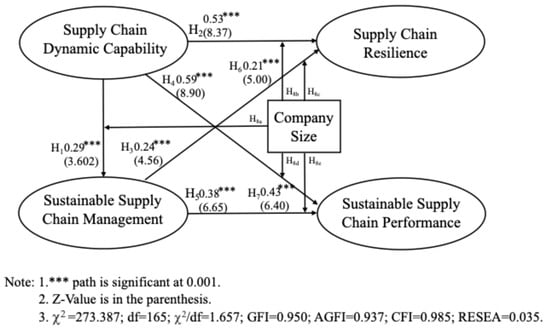
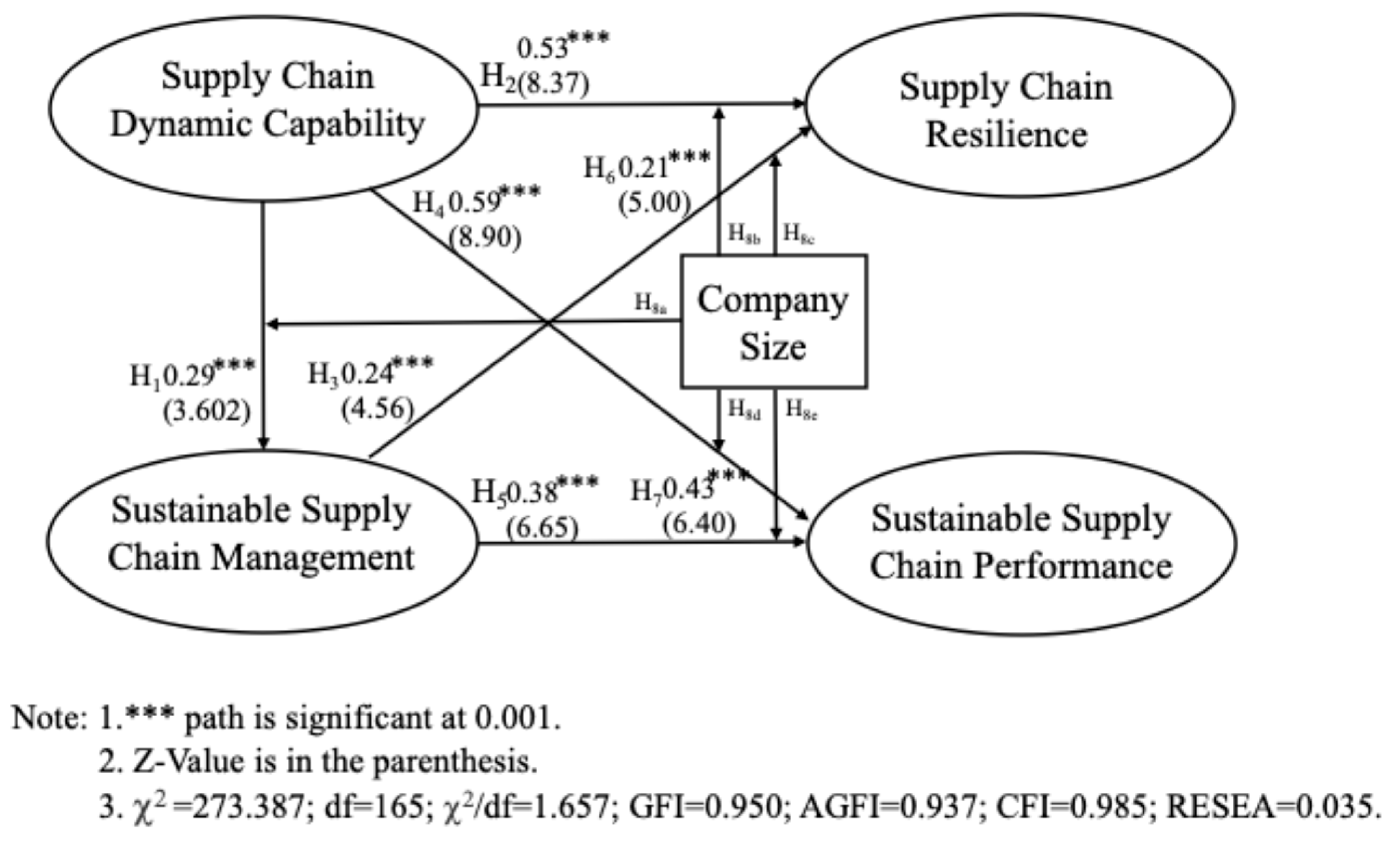
In the application of SEM, our analysis rigorously assessed the congruity between the conceptual model and the empirical data, as depicted in Figure 2’s path diagram. The computed chi-square value of 273.378 with 165 degrees of freedom (df), culminating in a chi-square/df ratio of 1.657, signifies a satisfactory model fit. This result is substantiated by a suite of indices, namely GFI = 0.950, AGFI = 0.937, CFI = 0.985, and RMSEA = 0.035, which corroborate a robust fit (see Dash and Paul [53]).
Figure 2.
Hypotheses tested using structural equation model (path and measurement).
4.3.1. Testing for Direct Effects
Figure 2 supports H1, demonstrating a positive, significant relationship between SCDC and SSCM, evidenced by an AMOS path coefficient of 0.677 (Z = 12.946) at the 0.001 significance level, highlighting dynamic capabilities’ importance in SSCM. H2 through H5 are also empirically substantiated, with path coefficients indicating significant positive relationships: SCDC to SCR at 0.375 (Z = 5.797), SSCM to SCR at 0.406 (Z = 6.719), SCDC to SSCP at 0.297 (Z = 6.061), and SSCM to SSCP, similarly at 0.647 (Z = 11.964), all significant at the 0.001 level.
4.3.2. Testing for Mediating Effects
To elucidate the mediation effects in SSCM, we employed both bias-corrected (BC) and percentile bootstrap methods, with a 95% confidence interval (CI) based on 5000 bootstrap replications. Consistent with Preacher and Hayes [56], the CI bounds are critically examined to verify the statistical significance of the indirect effects. Table 8 illustrates that for the mediation pathway from SCDC to SCR, both the percentile and BC CIs for indirect effects (0.127 to 0.289 and 0.135 to 0.300, respectively) exclude zero, confirming a statistically significant mediation. Consequently, H6 is supported. The data, therefore, supports the notion that SCDC meaningfully translates into SSCP through the mechanisms of SSCM. The strength of the indirect effects (Z = 5.00) considerably exceeds that of the direct effects (Z = 3.62), underscoring the significance of SSCM as a mediator in the SCDC-SCR relationship and affirming the transformative role of SCDC in achieving SSCM outcomes.
Table 8.
Mediation of the effect of sustainable supply chain management.
In accordance with the results presented in Table 8, H7, the mediating effect of SSCM on the SCDC-SSCP relationship can be statistically corroborated by examining the indirect effects. With a point estimate of 0.429 for the indirect effects between SCDC and SSCP, and the accompanying 95% CIs obtained via bootstrapping (percentile CI ranging from 0.304 to 0.569 and BC CI from 0.308 to 0.576) not crossing zero, the data robustly supports the mediating role of SSCM. The statistical strength of this mediation is further emphasized by the Z-value of 6.403, which is substantially higher than that of the direct effects (Z = 3.893). The higher magnitude of the Z-value for indirect effects in comparison to the direct effects provides empirical support for H7. This result empirically validates the theoretical assertion that SSCM practices are an essential condition for enhancing SSCP, stemming from the foundational qualities embodied in SCDC.
4.3.3. Testing for Invariance Analysis
Although the analysis confirms the support of all hypotheses, further investigation is needed regarding their applicability across all firm sizes. To this end, a multi-group analysis is conducted to test for structural invariance. We use AMOS for this test [54]. Firms with total assets of less than 800 million CNY, and greater than 800 million CNY are categorized as ‘Small & Medium’ (n = 422) and ‘Large’ (n = 97), respectively. This consolidation was performed to ensure sufficient sample sizes for robust multi-group structural equation modeling, as the individual sub-samples for micro and small enterprises were insufficient for independent invariance testing. The analysis begins by examining the baseline model (pattern; Model 1 in Table 9). Next, we evaluate equal factor loadings (lambda; Model 2 in Table 9), equal factor inter-correlations (phi; Model 3 in Table 9), equal measurement errors (theta–delta and theta–epsilon; Model 4 in Table 9), and equal structural coefficients (gamma and beta; Model 5 in Table 9 and Table 10).
Table 9.
The moderation effect of firm size: results using multi-group analysis in AMOS.
Table 10.
The moderation effect by firm size.
The baseline model for firm size (see Model 1 in Table 9) presents normalized χ2/df, CFI, NNFI, and RMSEA values of 1.433, 0.980, 0.977, and 0.029, respectively. These values denote an adequate fit of the model. In order to obtain Model 2, each factor loading (represented by lambda) must remain consistent across the three distinct groups. The difference in χ2 values between Model 2 and Model 1 is estimated to be 13.999, with 16 df. A statistically insignificant p-value of 0.599 points towards the consistency of factor loadings among the three categorized groups. In a similar vein, the χ2 difference between Model 3 and Model 2 stands at 27.206 (with 20 df). The insignificant outcome (p = 0.130) implies that both factor loadings and inter-correlations are consistent across the trio of groups. Moreover, the χ2 discrepancy between Model 4 and Model 3 amounts to 27.206 (20 df). The statistically insignificant result (p = 0.574) underscores that factors such as inter-correlations as well as measurement errors maintain their invariance. Analogously, with regard to firm size (see Table 9), χ2 differences across these models are consistent with those pertaining to firm size. The result validates inferences from our invariance analysis, confirming the consistency of the survey instrument across all participants.
As detailed in Table 10, the analysis demonstrates that firm size significantly moderates the relationships between SCDC, SSCM, SCR, and SSCP. For H8a, a notable difference exists between large enterprises and SMEs in the impact of SCDC on SSCM, with path coefficients of 0.85 and 0.65, respectively, and a statistically significant Path Comparison Z-value of −2.783 supports the hypothesis. The influence of SCDC on SCR (H8b) also shows significant differences, with large enterprises recording a path coefficient of 0.78 compared to 0.34 for SMEs, confirmed by a Path Comparison Z-value of −1.978. In SSCM’s effect on SCR (H8c), SMEs exhibit a strong positive correlation (path coefficient of 0.45, Z-value of 6.975) unlike the slight negative correlation in large enterprises, with the divergence further substantiated by the Path Comparison Z-value. The impact of SCDC on SSCP (H8d) reveals a substantial path coefficient of 2.565 for large firms versus 0.26 for SMEs (with a significant negative Path Comparison Z-value of −1.748), while the relationship between SSCM and SSCP (H8e) varies considerably; large enterprises show a weaker, non-significant relationship (path coefficient of 0.19), in contrast to the significant positive relationship in SMEs (path coefficient of 0.69) supported by a Path Comparison Z-value of 2.793.
5. Discussion
The primary objective of this study was to examine the interrelationships among SCDC, SSCM, and SCR within the Chinese construction industry. Our analysis using SEM provides empirical evidence consistent with the theoretical framework that SCDC serves as a foundational antecedent to both sustainability and resilience. However, the results suggest that this relationship is complex and significantly mediated by the adoption of SSCM practices. This section interprets these findings within the broader context of the literature, highlighting theoretical advancements and acknowledging specific industry dynamics.
5.1. The Mediating Role of SSCM: Operationalizing Capabilities
A key contribution of this research is the empirical support for SSCM as a pivotal mediator between dynamic capabilities and resilience. While previous scholarship has established direct links between dynamic capabilities and supply chain performance (e.g., Irfan et al. [1]; Kähkönen et al. [14]; Li et al. [63]), our findings indicate that SCDC is most effective when channeled through specific sustainable management practices. This aligns with the resilient agility perspective [64], suggesting that the operational routines of SSCM, such as collaborative planning, environmental monitoring, and ethical sourcing, act as the mechanism through which abstract capabilities (sensing, seizing, reconfiguring) are translated into tangible resilience outcomes.
In the context of the Chinese construction industry, this mediation is particularly salient. The sector faces dual pressures from rapid urbanization and stringent environmental mandates, such as the “Dual Carbon” goals [2]. Our results suggest that firms possessing strong dynamic capabilities are better positioned to sense these regulatory shifts and seize opportunities by implementing robust SSCM frameworks. These SSCM practices, in turn, appear to enhance resilience by fostering deeper supply chain visibility and stronger collaborative networks, which are critical buffers against disruptions [17]. This challenges the traditional view that sustainability and resilience are competing objectives; instead, our model supports the notion of a synergistic relationship where environmental and social responsibility strengthens the structural integrity of the supply chain against external shocks.
5.2. Strategic Divergence: Firm Size and Implementation
Our multi-group analysis reveals a distinct divergence in how large enterprises and SMEs leverage these capabilities, addressing a significant gap in the literature regarding firm size [6].
For large enterprises, the results indicate a stronger direct association between internal SCDC and performance outcomes. This supports the Resource-Based View (RBV), suggesting that larger firms utilize their substantial resource slack and organizational depth to internalize dynamic capabilities [33]. Their resilience appears to stem from robust internal systems and the ability to reconfigure large-scale operations in response to disruptions, such as those experienced during the COVID-19 pandemic.
In contrast, SMEs demonstrate a stronger reliance on the mediating role of SSCM. Lacking the internal buffers of their larger counterparts, SMEs appear to achieve resilience through the agility and flexibility inherent in their supply chain relationships. This finding resonates with the view that SMEs leverage “nimbleness” as a strategic asset [34]. For these firms, SSCM is not merely a compliance activity but a strategic lever that enhances network responsiveness. The strong positive path from SSCM to SCR in the SME group suggests that investing in sustainable, collaborative relationships provides a critical survival mechanism, allowing them to navigate volatility with limited internal resources.
5.3. Limitations and Future Research
First, the research employs a cross-sectional survey design, capturing data at a single point in time. Consequently, while the Structural Equation Modeling (SEM) analysis supports the hypothesized directional paths, it cannot definitively establish causality or temporal precedence between dynamic capabilities and resilience. Reverse causality remains a theoretical possibility; for instance, highly resilient firms may have more resources to invest in dynamic capabilities. Future research should employ longitudinal designs to track how SCDC evolution directly impacts resilience over time, particularly following specific disruption events.
Second, the data relies on self-reported measures from single respondents within each firm. Although procedural remedies were applied to minimize Common Method Bias (CMB) and statistical tests (Harman’s single-factor test) indicated no critical issues [49], the potential for social desirability bias, especially regarding sustainability practices, cannot be entirely eliminated. Respondents may unconsciously align their answers with perceived industry best practices rather than actual operational realities [47]. Future studies could benefit from multi-respondent surveys or the inclusion of objective secondary data to triangulate findings [50].
Third, the study is contextually bound to the Chinese construction industry. While this sector is globally significant due to its size and environmental impact [7], its unique regulatory environment (government-led infrastructure projects), market structure, and cultural dynamics may limit the generalizability of the results to other countries or industries. Comparative studies across different economies or sectors would be valuable to determine the universality of the SCDC–SSCM–Resilience nexus.
Finally, regarding future research directions, there is a pressing need to explore the role of specific digital technologies (e.g., Blockchain, AI, BIM) as moderators in this relationship. Recent literature suggests that digitalization significantly enhances supply chain transparency and responsiveness [18,20]. Investigating how digital transformation capabilities interact with traditional dynamic capabilities to foster resilience would be fertile ground for future inquiry [5]. Additionally, examining the specific types of “green” innovations that yield the highest resilience dividends could provide more granular guidance for practitioners [11].
6. Conclusions
This study set out to disentangle the complex mechanisms linking SCDC, SSCM, and SCR. The analysis moves beyond the direct effects often reported in the literature (e.g., Heldt and Beske-Janssen [5]), uncovering a more nuanced reality: sustainability is not merely an outcome of dynamic capabilities but a critical conduit for resilience [4]. Our findings extend the DCV [3] by integrating it with the TBL framework in a novel way [26]. We demonstrate that for dynamic capabilities to effectively translate into resilience, they must be ‘operationalized’ through robust SSCM practices. This effectively bridges the gap between high-level strategic potential, specifically sensing and seizing [11], and ground-level operational robustness. The study confirms that environmental and social responsibility practices are not peripheral add-ons, but central to the structural resilience of modern supply chains. Furthermore, the identification of “strategic divergence” based on firm size enriches the RBV, suggesting that the pathway to resilience is contingent on organizational scale, a critical nuance often overlooked in generalized supply chain models [6,33]. For practitioners, the findings offer a tailored roadmap for building resilience. For managers of large enterprises the focus should be on leveraging scale to deepen internal dynamic capabilities. Investments should prioritize the structural integration of sustainability into core supply chain strategy [10]. Given the findings, large enterprises must be wary of treating SSCM as a siloed compliance function, as this may lead to weak or negative impacts on resilience. Instead, they should utilize their resources to drive the systemic “reconfiguration” of the supply chain [32], using digital tools to enhance visibility and control [20,27]. For SME owners and managers, the results underscore the critical importance of agility and relational practices. Lacking the resources for massive internal systems, SMEs should view SSCM as a strategic tool for network integration [34]. By adopting flexible, “nimble” sustainability practices such as localized sourcing and close collaboration with key partners [64], SMEs can build a resilient network that compensates for their lack of internal slack. The path to resilience for SMEs lies not in emulating the heavy infrastructure of large firms, but in maximizing the responsiveness of their sustainable supply chain partnerships [15].
In an era marked by volatility, from pandemics to climate crises, the ability to adapt is paramount. This study suggests that the convergence of dynamic capabilities and sustainability offers a powerful blueprint for resilience. By recognizing the distinct pathways for different firm sizes and the mediating power of sustainable practices, organizations can better navigate the uncertainties of the future, turning sustainability from a constraint into a cornerstone of competitive advantage.
Supplementary Materials
The following supporting information can be downloaded at https://www.mdpi.com/article/10.3390/su18052258/s1, Table S1: Measurements of Supply Chain Resilience; Table S2: Measurements of Sustainable Supply Chain Performance; Table S3: Measurements of Supply Chain Dynamic Capabilities; Table S4: Measurement of Sustainable Supply Chain Management; Supplementary S1. Survey Instrument [65,66,67,68,69,70,71,72,73,74,75,76,77,78,79,80,81,82,83,84,85,86,87,88].
Author Contributions
Conceptualization, K.L.; Methodology, K.L., G.D.V. and Y.L.; Software, K.L.; Validation, K.L., G.D.V. and M.B.; Formal analysis, K.L. and M.B.; Investigation, K.L.; Resources, K.L.; Data curation, K.L.; Writing—original draft, K.L. and G.D.V.; Writing—review & editing, G.D.V., M.B., Y.L. and K.S.K.; Visualization, K.L., Y.L. and K.S.K.; Supervision, G.D.V., M.B., Y.L. and K.S.K.; Project administration, G.D.V. and K.S.K. All authors have read and agreed to the published version of the manuscript.
Funding
This research received no external funding.
Institutional Review Board Statement
The study was conducted in accordance with the Declaration of Helsinki and approved by the Institutional Review Board of Coventry University (protocol code P116539 and date of approval 7 May 2021).
Informed Consent Statement
Informed consent was obtained from all subjects involved in the study.
Data Availability Statement
Data are available from the corresponding author upon request.
Conflicts of Interest
The authors declare no conflict of interest.
References
- Irfan, I.; Sumbal, M.S.U.K.; Khurshid, F.; Chan, F.T. Toward a resilient supply chain model: Critical role of knowledge management and dynamic capabilities. Ind. Manag. Data Syst. 2022, 122, 1153–1182. [Google Scholar] [CrossRef] [Scilit]
- Liu, Y.; Gan, L.; Cai, W.; Li, R. Decomposition and decoupling analysis of carbon emissions in China’s construction industry using the generalized Divisia index method. Environ. Impact Assess. Rev. 2024, 104, 107321. [Google Scholar] [CrossRef] [Scilit]
- Teece, D.J. Business models and dynamic capabilities. Long Range Plan. 2018, 51, 40–49. [Google Scholar] [CrossRef] [Scilit]
- Eggert, J.; Hartmann, J. Sustainable supply chain management–a key to resilience in the global pandemic. Supply Chain Manag. Int. J. 2023, 28, 486–507. [Google Scholar] [CrossRef] [Scilit]
- Heldt, L.; Beske-Janssen, P. Solutions from space? A dynamic capabilities perspective on the growing use of satellite technology for managing sustainability in multi-tier supply chains. Int. J. Prod. Econ. 2023, 260, 108864. [Google Scholar] [CrossRef] [Scilit]
- Wang, W.; Lin, W.; Bao, Z.; Dai, X.; Lin, Q. Study on the influence of COVID-19 on the growth of China’s small and medium-sized construction enterprises. PLoS ONE 2022, 17, e0266315. [Google Scholar] [CrossRef] [Scilit]
- Xu, C.; Yang, F.; Zhou, B.; Xu, Y.; Jiang, J.; Chen, X.; Song, M. Total-factor CO2 performance in China’s construction sector: Spatiotemporal trend, driver and future pathway. Environ. Impact Assess. Rev. 2024, 104, 107346. [Google Scholar] [CrossRef] [Scilit]
- Sudusinghe, J.I.; Seuring, S. Supply chain collaboration and sustainability performance in circular economy: A systematic literature review. Int. J. Prod. Econ. 2022, 245, 108402. [Google Scholar] [CrossRef] [Scilit]
- Silva, M.E.; Pereira, M.M.; Hendry, L.C. Embracing change in tandem: Resilience and sustainability together transforming supply chains. Int. J. Oper. Prod. Manag. 2023, 43, 166–196. [Google Scholar] [CrossRef] [Scilit]
- Ekanayake, E.; Shen, G.Q.; Kumaraswamy, M.M. Identifying supply chain capabilities of construction firms in industrialized construction. Prod. Plan. Control 2021, 32, 303–321. [Google Scholar] [CrossRef] [Scilit]
- Santa-Maria, T.; Vermeulen, W.J.; Baumgartner, R.J. How do incumbent firms innovate their business models for the circular economy? Identifying micro-foundations of dynamic capabilities. Bus. Strategy Environ. 2022, 31, 1308–1333. [Google Scholar] [CrossRef] [Scilit]
- Queiroz, M.M.; Fosso Wamba, S.; Branski, R.M. Supply chain resilience during the COVID-19: Empirical evidence from an emerging economy. Benchmarking Int. J. 2022, 29, 1999–2018. [Google Scholar] [CrossRef] [Scilit]
- Chowdhury, M.M.H.; Quaddus, M. Supply chain resilience: Conceptualization and scale development using dynamic capability theory. Int. J. Prod. Econ. 2017, 188, 185–204. [Google Scholar] [CrossRef] [Scilit]
- Kähkönen, A.-K.; Evangelista, P.; Hallikas, J.; Immonen, M.; Lintukangas, K. COVID-19 as a trigger for dynamic capability development and supply chain resilience improvement. Int. J. Prod. Res. 2023, 61, 2696–2715. [Google Scholar] [CrossRef] [Scilit]
- Wieland, A.; Wallenburg, C.M. The influence of relational competencies on supply chain resilience: A relational view. Int. J. Phys. Distrib. Logist. Manag. 2013, 43, 300–320. [Google Scholar] [CrossRef] [Scilit]
- Novak, D.C.; Wu, Z.; Dooley, K.J. Whose resilience matters? Addressing issues of scale in supply chain resilience. J. Bus. Logist. 2021, 42, 323–335. [Google Scholar] [CrossRef] [Scilit]
- Wieland, A.; Durach, C.F. Two perspectives on supply chain resilience. J. Bus. Logist. 2021, 42, 315–322. [Google Scholar] [CrossRef] [Scilit]
- Ivanov, D.; Dolgui, A. A digital supply chain twin for managing the disruption risks and resilience in the era of Industry 4.0. Prod. Plan. Control 2021, 32, 775–788. [Google Scholar] [CrossRef] [Scilit]
- Dubey, R.; Gunasekaran, A.; Bryde, D.J.; Dwivedi, Y.K.; Papadopoulos, T. Blockchain technology for enhancing swift-trust, collaboration and resilience within a humanitarian supply chain setting. Int. J. Prod. Res. 2020, 58, 3381–3398. [Google Scholar] [CrossRef] [Scilit]
- El Baz, J.; Ruel, S. Achieving social performance through digitalization and supply chain resilience in the COVID-19 disruption era: An empirical examination based on a stakeholder dynamic capabilities view. Technol. Forecast. Soc. Change 2024, 201, 123209. [Google Scholar] [CrossRef] [Scilit]
- Chiarini, A.; Vagnoni, E. Differences in implementing corporate social responsibility through SA8000 and ISO 26000 standards: Research from European manufacturing. J. Manuf. Technol. Manag. 2017, 28, 438–457. [Google Scholar] [CrossRef] [Scilit]
- Li, B.; Han, S.; Wang, Y.; Li, J.; Wang, Y. Feasibility assessment of the carbon emissions peak in China’s construction industry: Factor decomposition and peak forecast. Sci. Total Environ. 2020, 706, 135716. [Google Scholar] [CrossRef] [Scilit]
- Zhu, Q.; Sarkis, J.; Lai, K.-H. Institutional-based antecedents and performance outcomes of internal and external green supply chain management practices. J. Purch. Supply Manag. 2013, 19, 106–117. [Google Scholar] [CrossRef] [Scilit]
- Gruchmann, T.; Timmer, V.; Gold, S.; Geßner, C. Dynamic capabilities for sustainable change in the food processing industry: A multilevel perspective. J. Clean. Prod. 2021, 311, 127534. [Google Scholar] [CrossRef] [Scilit]
- Eisenhardt, K.M.; Martin, J.A. Dynamic capabilities: What are they? In The SMS Blackwell Handbook of Organizational Capabilities; Wiley: Hoboken, NJ, USA, 2017; pp. 341–363. [Google Scholar]
- Elkington, J. 25 years ago I coined the phrase “triple bottom line.” Here’s why it’s time to rethink it. Harv. Bus. Rev. 2018, 25, 6. [Google Scholar]
- Ma, W.; Hao, J.L. Enhancing a circular economy for construction and demolition waste management in China: A stakeholder engagement and key strategy approach. J. Clean. Prod. 2024, 450, 141763. [Google Scholar] [CrossRef] [Scilit]
- Negri, M.; Cagno, E.; Colicchia, C.; Sarkis, J. Integrating sustainability and resilience in the supply chain: A systematic literature review and a research agenda. Bus. Strategy Environ. 2021, 30, 2858–2886. [Google Scholar] [CrossRef] [Scilit]
- Wieland, A. Dancing the supply chain: Toward transformative supply chain management. J. Supply Chain Manag. 2021, 57, 58–73. [Google Scholar] [CrossRef] [Scilit]
- Huang, Y.-C.; Huang, C.-H. Exploring institutional pressure, the top management team’s response, green innovation adoption, and firm performance: Evidence from Taiwan’s electrical and electronics industry. Eur. J. Innov. Manag. 2024, 27, 800–824. [Google Scholar] [CrossRef] [Scilit]
- Kitsis, A.M.; Chen, I.J. Do motives matter? Examining the relationships between motives, SSCM practices and TBL performance. Supply Chain Manag. Int. J. 2020, 25, 325–341. [Google Scholar] [CrossRef] [Scilit]
- Zhang, X.; Fan, X.; He, M. Analysis on the effects of global supply chain reconfiguration on China’s high-end equipment manufacturing industry. Int. J. Phys. Distrib. Logist. Manag. 2024, 54, 1–39. [Google Scholar] [CrossRef] [Scilit]
- Augier, M.; Teece, D.J. Dynamic capabilities and the role of managers in business strategy and economic performance. Organ. Sci. 2009, 20, 410–421. [Google Scholar] [CrossRef] [Scilit]
- Jeng, D.J.-F.; Pak, A. The variable effects of dynamic capability by firm size: The interaction of innovation and marketing capabilities in competitive industries. Int. Entrep. Manag. J. 2016, 12, 115–130. [Google Scholar] [CrossRef] [Scilit]
- National Bureau of Statistics of China. China Statistical Yearbook 2019. Available online: https://www.stats.gov.cn/sj/ndsj/2019/indexeh.htm (accessed on 8 February 2026).
- Teece, D.J. Explicating dynamic capabilities: The nature and microfoundations of (sustainable) enterprise performance. Strateg. Manag. J. 2007, 28, 1319–1350. [Google Scholar] [CrossRef] [Scilit]
- Pavlou, P.A.; El Sawy, O.A. Understanding the elusive black box of dynamic capabilities. Decis. Sci. 2011, 42, 239–273. [Google Scholar] [CrossRef] [Scilit]
- Li, D.-Y.; Liu, J. Dynamic capabilities, environmental dynamism, and competitive advantage: Evidence from China. J. Bus. Res. 2014, 67, 2793–2799. [Google Scholar] [CrossRef] [Scilit]
- Esfahbodi, A.; Zhang, Y.; Watson, G. Sustainable supply chain management in emerging economies: Trade-offs between environmental and cost performance. Int. J. Prod. Econ. 2016, 181, 350–366. [Google Scholar] [CrossRef] [Scilit]
- Wu, C.-L.; Fang, D.-P.; Liao, P.-C.; Xue, J.-W.; Li, Y.; Wang, T. Perception of corporate social responsibility: The case of Chinese international contractors. J. Clean. Prod. 2015, 107, 185–194. [Google Scholar] [CrossRef] [Scilit]
- Zhang, M.; Tse, Y.K.; Doherty, B.; Li, S.; Akhtar, P. Sustainable supply chain management: Confirmation of a higher-order model. Resour. Conserv. Recycl. 2018, 128, 206–221. [Google Scholar] [CrossRef] [Scilit]
- Christopher, M.; Peck, H. Building the resilient supply chain. Int. J. Logist. Manag. 2004, 15, 1–13. [Google Scholar] [CrossRef] [Scilit]
- Sheffi, Y.; Rice, J.B., Jr. A supply chain view of the resilient enterprise. MIT Sloan Manag. Rev. 2005, 47, 41–48. [Google Scholar]
- Lai, K.-H.; Wu, S.J.; Wong, C.W. Did reverse logistics practices hit the triple bottom line of Chinese manufacturers? Int. J. Prod. Econ. 2013, 146, 106–117. [Google Scholar] [CrossRef] [Scilit]
- Das, D. The impact of Sustainable Supply Chain Management practices on firm performance: Lessons from Indian organizations. J. Clean. Prod. 2018, 203, 179–196. [Google Scholar] [CrossRef] [Scilit]
- Kotrlik, J.; Higgins, C. Organizational research: Determining appropriate sample size in survey research appropriate sample size in survey research. Inf. Technol. Learn. Perform. J. 2001, 19, 43. [Google Scholar]
- Flynn, B.; Pagell, M.; Fugate, B. Survey research design in supply chain management: The need for evolution in our expectations. J. Supply Chain. Manag. 2018, 54, 1–15. [Google Scholar] [CrossRef] [Scilit]
- Craighead, C.W.; Ketchen, D.J.; Dunn, K.S.; Hult, G.T.M. Addressing common method variance: Guidelines for survey research on information technology, operations, and supply chain management. IEEE Trans. Eng. Manag. 2011, 58, 578–588. [Google Scholar] [CrossRef] [Scilit]
- Podsakoff, P.M.; MacKenzie, S.B.; Lee, J.-Y.; Podsakoff, N.P. Common method biases in behavioral research: A critical review of the literature and recommended remedies. J. Appl. Psychol. 2003, 88, 879. [Google Scholar] [CrossRef] [Scilit] [PubMed]
- Montabon, F.; Daugherty, P.J.; Chen, H. Setting standards for single respondent survey design. J. Supply Chain Manag. 2018, 54, 35–41. [Google Scholar] [CrossRef] [Scilit]
- Flynn, B.B.; Huo, B.; Zhao, X. The impact of supply chain integration on performance: A contingency and configuration approach. J. Oper. Manag. 2010, 28, 58–71. [Google Scholar] [CrossRef] [Scilit]
- Hair, J.F. A Primer on Partial Least Squares Structural Equation Modeling (PLS-SEM); Sage: Thousand Oaks, CA, USA, 2014. [Google Scholar]
- Dash, G.; Paul, J. CB-SEM vs PLS-SEM methods for research in social sciences and technology forecasting. Technol. Forecast. Soc. Change 2021, 173, 121092. [Google Scholar] [CrossRef] [Scilit]
- Byrne, B.M. Structural Equation Modeling with Mplus: Basic Concepts, Applications, and Programming; Routledge: Abingdon, UK, 2013. [Google Scholar]
- Fu, C.; Wang, J.; Qu, Z.; Skitmore, M.; Yi, J.; Sun, Z.; Chen, J. Structural equation modeling in technology adoption and use in the construction industry: A scientometric analysis and qualitative review. Sustainability 2024, 16, 3824. [Google Scholar] [CrossRef] [Scilit]
- Preacher, K.J.; Hayes, A.F. Asymptotic and resampling strategies for assessing and comparing indirect effects in multiple mediator models. Behav. Res. Methods 2008, 40, 879–891. [Google Scholar] [CrossRef] [Scilit]
- Hair, J.F.; Black, W.C.; Babin, B.J.; Anderson, R.E. Multivariate Data Analysis; Prentice Hall: Upper Saddle River, NJ, USA, 2009. [Google Scholar]
- Fornell, C.; Larcker, D.F. Structural equation models with unobservable variables and measurement error: Algebra and statistics. J. Mark. Res. 1981, 18, 382–388. [Google Scholar] [CrossRef] [Scilit]
- Akhimien, O.G.; Adekunle, S.A. Technological environment and sustainable performance of oil and gas firms: A structural equation modelling approach. Future Bus. J. 2023, 9, 24. [Google Scholar] [CrossRef] [Scilit]
- Henseler, J.; Ringle, C.M.; Sarstedt, M. A new criterion for assessing discriminant validity in variance-based structural equation modeling. J. Acad. Mark. Sci. 2015, 43, 115–135. [Google Scholar] [CrossRef] [Scilit]
- Cao, M.; Zhang, Q. Supply chain collaboration: Impact on collaborative advantage and firm performance. J. Oper. Manag. 2011, 29, 163–180. [Google Scholar] [CrossRef] [Scilit]
- Lai, C.-S.; Chiu, C.-J.; Yang, C.-F.; Pai, D.-C. The effects of corporate social responsibility on brand performance: The mediating effect of industrial brand equity and corporate reputation. J. Bus. Ethics 2010, 95, 457–469. [Google Scholar] [CrossRef] [Scilit]
- Li, K.; Bashiri, M.; Lim, M.K.; Akpobi, T. How to improve supply chain sustainable performance by resilience practices through dynamic capability view: Evidence from Chinese construction. Resour. Conserv. Recycl. 2025, 212, 107965. [Google Scholar] [CrossRef] [Scilit]
- Lotfi, M.; Sodhi, M.S. Resilient agility under the practice-based view. Prod. Plan. Control 2024, 35, 670–682. [Google Scholar] [CrossRef] [Scilit]
- Adobor, H.; McMullen, R.S. Supply chain resilience: A dynamic and multidimensional approach. Int. J. Logist. Manag. 2018, 29, 1451–1471. [Google Scholar] [CrossRef] [Scilit]
- Altay, N.; Gunasekaran, A.; Dubey, R.; Childe, S.J. Agility and resilience as antecedents of supply chain performance under moderating effects of organizational culture within the humanitarian setting: A dynamic capability view. Prod. Plan. Control 2018, 29, 1158–1174. [Google Scholar] [CrossRef] [Scilit]
- Aman, S.; Seuring, S.; Khalid, R.U. Sustainability performance measurement in risk and uncertainty management: An analysis of base of the pyramid supply chain literature. Bus. Strateg. Environ. 2023, 32, 2373–2398. [Google Scholar] [CrossRef] [Scilit]
- Ambulkar, S.; Blackhurst, J.; Grawe, S. Firm’s resilience to supply chain disruptions: Scale development and empirical examination. J. Oper. Manag. 2015, 33, 111–122. [Google Scholar] [CrossRef] [Scilit]
- Beske, P. Dynamic capabilities and sustainable supply chain management. Int. J. Phys. Distrib. Logist. Manag. 2012, 42, 372–387. [Google Scholar] [CrossRef] [Scilit]
- Beske, P.; Land, A.; Seuring, S. Sustainable supply chain management practices and dynamic capabilities in the food industry: A critical analysis of the literature. Int. J. Prod. Econ. 2014, 152, 131–143. [Google Scholar] [CrossRef] [Scilit]
- Blackhurst, J.; Dunn, K.S.; Craighead, C.W. An empirically derived framework of global supply resiliency. J. Bus. Logist. 2011, 32, 374–391. [Google Scholar] [CrossRef] [Scilit]
- Carter, C.R.; Jennings, M.M. The role of purchasing in corporate social responsibility: A structural equation analysis. J. Bus. Logist. 2004, 25, 145–186. [Google Scholar] [CrossRef] [Scilit]
- Coppola, C.; Vollero, A.; Siano, A. Developing dynamic capabilities for the circular economy in the textile and clothing industry in Italy: A natural-resource-based view. Bus. Strateg. Environ. 2023, 32, 3373–3388. [Google Scholar] [CrossRef] [Scilit]
- Dadhich, P.; Genovese, A.; Kumar, N.; Acquaye, A. Developing sustainable supply chains in the UK construction industry: A case study. Int. J. Prod. Econ. 2015, 164, 271–284. [Google Scholar] [CrossRef] [Scilit]
- de Moura, G.B.; Saroli, L.G. Sustainable value chain management based on dynamic capabilities in small and medium-sized enterprises (SMEs). Int. J. Logist. Manag. 2021, 32, 168–189. [Google Scholar] [CrossRef] [Scilit]
- Esfahbodi, A.; Zhang, Y.; Watson, G.; Zhang, T. Governance pressures and performance outcomes of sustainable supply chain management—An empirical analysis of UK manufacturing industry. J. Clean. Prod. 2017, 155, 66–78. [Google Scholar] [CrossRef] [Scilit]
- Gölgeci, I.; Ponomarov, S.Y. How does firm innovativeness enable supply chain resilience? The moderating role of supply uncertainty and interdependence. Technol. Anal. Strateg. Manag. 2015, 27, 267–282. [Google Scholar] [CrossRef] [Scilit]
- Huang, K.; Wang, K.; Lee, P.K.; Yeung, A.C. The impact of Industry 4.0 on supply chain capability and supply chain resilience: A resource-based view. Int. J. Prod. Econ. 2023, 262, 108913. [Google Scholar] [CrossRef] [Scilit]
- Kumar, G.; Subramanian, N.; Arputham, R.M. Missing link between sustainability collaborative strategy and supply chain performance: Role of dynamic capability. Int. J. Prod. Econ. 2018, 203, 96–109. [Google Scholar] [CrossRef] [Scilit]
- Lee, S.M.; Rha, J.S. Ambidextrous supply chain as a dynamic capability: Building a resilient supply chain. Manag. Decis. 2016, 54, 2–33. [Google Scholar] [CrossRef] [Scilit]
- Lohmer, J.; Bugert, N.; Lasch, R. Analysis of resilience strategies and ripple effect in blockchain-coordinated supply chains: An agent-based simulation study. Int. J. Prod. Econ. 2020, 228, 107882. [Google Scholar] [CrossRef] [Scilit] [PubMed]
- Mariadoss, B.J.; Chi, T.; Tansuhaj, P.; Pomirleanu, N. Influences of firm orientations on sustainable supply chain management. J. Bus. Res. 2016, 69, 3406–3414. [Google Scholar] [CrossRef] [Scilit]
- Pettit, T.J.; Fiksel, J.; Croxton, K.L. Ensuring supply chain resilience: Development of a conceptual framework. J. Bus. Logist. 2010, 31, 1–21. [Google Scholar] [CrossRef] [Scilit]
- Seifert, R. Dynamic capabilities in sustainable supply chain management: A theoretical framework. Supply Chain Forum Int. J. 2015, 16, 2–15. [Google Scholar]
- Zhao, N.; Hong, J.; Lau, K.H. Impact of supply chain digitalization on supply chain resilience and performance: A multi-mediation model. Int. J. Prod. Econ. 2023, 259, 108817. [Google Scholar] [CrossRef] [Scilit]
- Zhu, Q.; Sarkis, J. Relationships between operational practices and performance among early adopters of green supply chain management practices in Chinese manufacturing enterprises. J. Oper. Manag. 2004, 22, 265–289. [Google Scholar] [CrossRef]
- Zhu, Q.; Sarkis, J. The moderating effects of institutional pressures on emergent green supply chain practices and performance. Int. J. Prod. Res. 2007, 45, 4333–4355. [Google Scholar] [CrossRef] [Scilit]
- Zhu, Q.; Sarkis, J.; Lai, K.H. Confirmation of a measurement model for green supply chain management practices implementation. Int. J. Prod. Econ. 2008, 111, 261–273. [Google Scholar] [CrossRef] [Scilit]

Disclaimer/Publisher’s Note: The statements, opinions and data contained in all publications are solely those of the individual author(s) and contributor(s) and not of MDPI and/or the editor(s). MDPI and/or the editor(s) disclaim responsibility for any injury to people or property resulting from any ideas, methods, instructions or products referred to in the content. |
© 2026 by the authors. Licensee MDPI, Basel, Switzerland. This article is an open access article distributed under the terms and conditions of the Creative Commons Attribution (CC BY) license.