


Abstract
Global climate change challenges pastoral livelihoods in arid and semi-arid areas, and financial exclusion has further weakened their ability to adapt to environmental and economic shocks. This study focuses on the survey data of 650 households in Xinjiang, China, based on the “exposure-sensitivity-adaptive capacity” framework, and the endogenous switching regression was employed to analyze whether household borrowing mitigates livelihood vulnerability. Results reveal that borrowing significantly mitigates livelihood vulnerability, reducing the index by approximately 14.84%; And borrowing exhibits a “pro-poor” effect, and its mitigation effect is enhanced with the improvement of the vulnerability level of pastoralists. The study recommends innovating the integration model of “an integrated model combining credit, insurance, and industrial support” and establishing a differentiated credit support system for highly vulnerable groups to reduce the livelihood vulnerability of pastoral households.
1. Introduction
Global climate change has exacerbated the frequency of extreme weather events such as droughts and snowstorms, posing a threat to the livelihood of pastoralists in arid and semi-arid areas around the world. Therefore, reducing the livelihood vulnerability of pastoralists is a major practical issue to realize the high-quality economic development of pastoral areas [1]. In addition, climate-related risks could cause economic losses [2]: Owing to climate change, grasslands are severely degraded, which leads to the leasing of land at a low price, exacerbated by poor livestock growth [3]. Pastoral households are prone to falling into the shock-asset loss dilemma, and it is difficult for families to re-shock their asset level [4]. As an important animal husbandry base in China, animal husbandry accounts for 21.43% of the primary industry output value in this region [5], and animal husbandry plays an important role in people’s livelihood [6]. However, in many developing areas, pastoralists often face the double pressure of climate change and economic transformation. There are more prominent livelihood vulnerability challenges for pastoralists: on the one hand, the ecological environment in arid areas is fragile, water resource constraints are increasingly tightened [7], and traditional animal husbandry is facing the double constraints of resources and the environment [8]; on the other hand, with the acceleration of the economic transformation of pastoral areas, the capital needs of pastoral households in terms of disaster resistance and livestock protection, breed improvement and scale expansion are constantly expanding. Due to the lack of diversified income channels and sufficient asset buffers, pastoral farmers with traditional animal husbandry as the core source of livelihood are prone to falling into the dilemma of “external shock-asset loss-increased livelihood vulnerability” in the face of natural disasters and market price fluctuations. Against this background, it is of great practical significance to explore the intervention of external resources that can effectively alleviate the vulnerability of livelihood and mitigate pastoral livelihood vulnerability.
Scholars around the world have conducted a lot of research on the influencing factors, analysis methods, and research frameworks of livelihood vulnerability [9], but the existing literature focuses on individual characteristics and external environmental dimensions to analyze its causes [10,11], and relatively ignores the core role of financial capital in the inter-temporal allocation of resources. In fact, credit is one of the most crucial green financial tools [12]. Specifically, household borrowing can not only alleviate the constraints of capital liquidity but also support pastoralists to upgrade production facilities. Grade and variety improvement to cope with livelihood pressure by expanding production investment and increasing income sources [13]. It can also help pastoralists smooth consumption fluctuations and avoid being forced to sell production materials at low prices due to disasters, thus reducing the sensitivity of the livelihood system. However, the existing research focuses on the direct impact of borrowing and investment decision-making on income [14]. There is a lack of systematic analysis of the comprehensive indicator of “livelihood vulnerability”, and there is little literature that deeply analyzes the impact of borrowing on livelihood vulnerability.
Based on this, this paper uses the micro-research data of 650 pastoral households in Xinjiang pastoral areas to build a comprehensive livelihood vulnerability assessment framework covering the natural, social, and economic dimensions. By using the endogenous switching regression to eliminate sample selection bias, empirically test the impact of household borrowing on the livelihood vulnerability of pastoral households. The marginal contributions of this study are as follows: (1) Expand the research perspective from a single “income effect” to “vulnerability governance”, build a multi-dimensional index system, and accurately depict the analysis of the effect of household borrowing on the livelihood vulnerability of pastoralists. (2) Analyze, in-depth, the differential performance of formal borrowing and informal borrowing in reducing the vulnerability of livelihood at the theoretical and empirical levels, and provide a basis for the optimization of the rural financial supply structure. (3) Focus on the pastoral areas of Xinjiang, where ecological fragility and economic transformation coexist, and provide certain experience support for border ethnic areas to consolidate the achievements of poverty alleviation through inclusive finance.
2. Theoretical Analysis and Research Hypothesis
2.1. Mechanism of Borrowing on Livelihood Vulnerability
The concept of vulnerability originally originated from the background of natural disasters [15]. Timmerman, P., first proposed that the degree of disaster impact of the system depends not only on the intensity of external interference, but also on the vulnerability characteristics of the system itself [16]. Focusing on the pastoral areas of Xinjiang, livelihood vulnerability is not only a passive reflection of pastoralists to sudden shocks, but also a comprehensive performance under long-term pressure and structural constraints: due to financial exclusion and uneven distribution of public services, the ability of pastoralists to obtain production factors is limited, making them in a vulnerable cycle of low capital accumulation for a long time; at the same time, Xinjiang pastoral areas not only Facing sudden meteorological disasters, it is also under the threat of water shortage and long-term degradation of grassland under the influence of climate.
Especially during the economic transition period, credit constraints and lack of funds have become the core bottlenecks that restrict pastoralists from optimizing their livelihood strategies and improving their risk resistance. Based on this, this study integrates the sustainable livelihood framework formulated by the British Department for International Development (DFID), adopts the “exposure-sensitive-adaptation” framework proposed by IPCC to assess the vulnerability of livelihood, and builds a livelihood vulnerability assessment system for pastoralists. Among them, exposure refers to the external risks encountered by pastoral families. The frequency and degree of impact. Sensitivity is the corresponding degree of impact of the livelihood system, while adaptability refers to the family’s ability to respond to external interference.
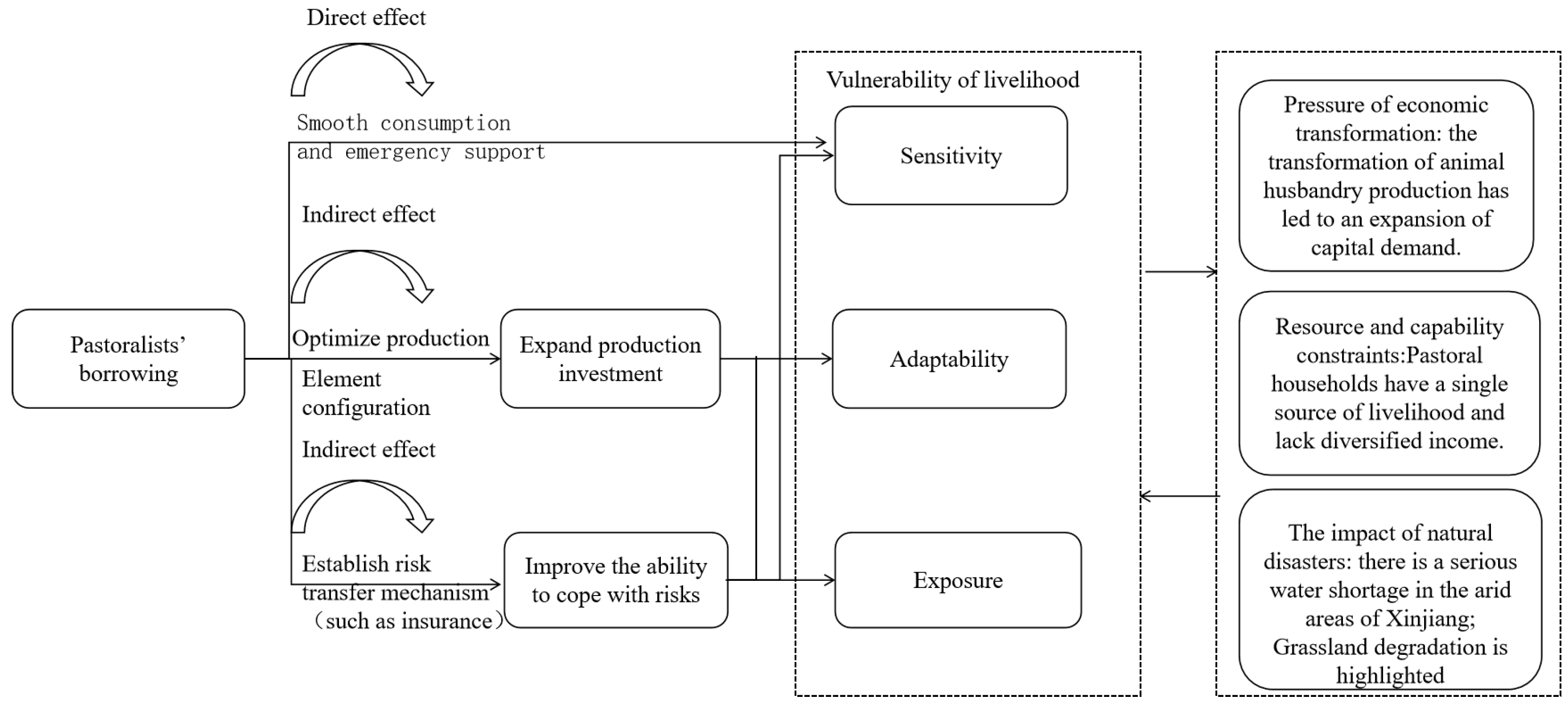
This article regards financial capital as a key element of the capital allocation of pastoral households’ livelihood. In combination with the theory of credit constraints and the theory of risk response, as a key external resource, borrowing capital can break down the liquidity constraints and cross-border allocation barriers of pastoralists. The impact path on the vulnerability of pastoral households can be summarized into the following three dimensions:
- (1)
- Reduce livelihood sensitivity by smoothing consumption: When climate shocks and market fluctuations occur, pastoralists usually face a sharp decline in income, while borrowing can give full play to the function of resource allocation. Borrowing can make up for the current basic living consumption, medical and education expenditure, etc. This gap prevents herdsmen from selling livestock and other assets at low prices to maintain their livelihood, in order to survive. Through the smooth consumption supported by borrowing, the sensitivity of pastoralists to the impact is significantly reduced, thus enhancing the vulnerability of pastoral households’ livelihood.
- (2)
- Strengthen livelihood adaptability through productive investment: The credit constraint theory points out that the lack of resources will lead to a balance of production behavior at a low level. Borrowing allows pastoralists to improve variety and upgrade production facilities, and directly improve their adaptability to risks.
- (3)
- Reduce the exposure of livelihood: Improving the ability of pastoral households to cope with risks, the availability of loans enables pastoralists to adopt modern animal husbandry technology, which reduces the dependence on natural pastures, thus reducing exposure to extreme weather.
Based on the above analysis, build a framework diagram of borrowing–resource allocation optimization–alleviating the vulnerability of livelihood, as shown in Figure 1.
Figure 1.
Mechanism of the impact of pastoral borrowing on livelihood vulnerability.
Existing studies have shown that borrowing behavior has a certain regulating effect on the negative impact of risk shock on the sustainable livelihood of farmers [17]. When pastoral areas face external shocks such as natural disasters or market price fluctuations, the income of pastoralists often faces a temporary sharp decline. The adverse effects of climate change have exacerbated financial exclusion and seriously weakened agricultural productivity and livelihood security [18]. As one of the important means of alleviating poverty [19], household borrowing plays the function of inter-temporal: on the one hand, it provides necessary liquidity support to help pastoral households maintain basic living consumption and education and medical expenditure, and avoid being forced to adopt short-sighted survival strategies such as selling productive livestock at low prices due to the breakage of the capital chain. On the other hand, for pastoralists in the transition period, credit support enables them to expand the scale of production, directly increase the stock of material capital and improve the production efficiency of animal husbandry; at the same time, capital injection also helps pastoralists to carry out part-time operations or participate in skills training, promote livelihood diversification, and fundamentally enhance the response to the adaptability and resilience of the risk. Therefore, the function of household borrowing in pastoral areas in Xinjiang is mainly reflected in alleviating risk problems by improving the level of risk response of rural families, which in turn has a positive impact on reducing their vulnerability [20], and Wu, X. (2020) pointed out that there is also a significant positive correlation between the scale of borrowing and agricultural productive investment [21], pastoral households can make productive investments by obtaining credit funds, which further consolidates the livelihood foundation.
Based on this, hypothesis H1 is put forward: borrowing can significantly reduce the livelihood vulnerability of pastoral households.
2.2. Heterogeneous Effects Across Vulnerability Levels
Mengistu, N.A.(2022) pointed out that the vulnerability situation of different farmers is different. It depends on the sensitivity, adaptability, exposure to natural disasters, and the differences in coping strategies of the family [22]. According to the law of diminishing marginal remuneration of capital, the marginal utility of funds decreases with the increase in stock. For highly vulnerable pastoralists, due to the lack of their own capital, their livelihood system often struggles with food and clothing. At this time, borrowed funds mainly play the function of survival security, alleviate the liquidity constraints of funds, and prevent pastoralists from being forced to sell livestock at a low price due to a lack of turnover when they encounter disasters or price shocks. In contrast, low vulnerability Pastoral households have relatively abundant funds and are easier to borrow from because of their high income. After borrowing, pastoral families can improve their income level through various productive investments [23], but the marginal contribution rate in reducing livelihood vulnerability is obviously lower than that of high-vulnerable groups. Therefore, household borrowing has a stronger risk blocking effect on highly vulnerable groups, showing distinct characteristics of a pro-poor nature.
Based on this, hypothesis H2 is put forward: there are differences in the impact of borrowing on pastoralists with different livelihood vulnerabilities.
3. Study Areas and Data Sources
3.1. Overview of the Study Area
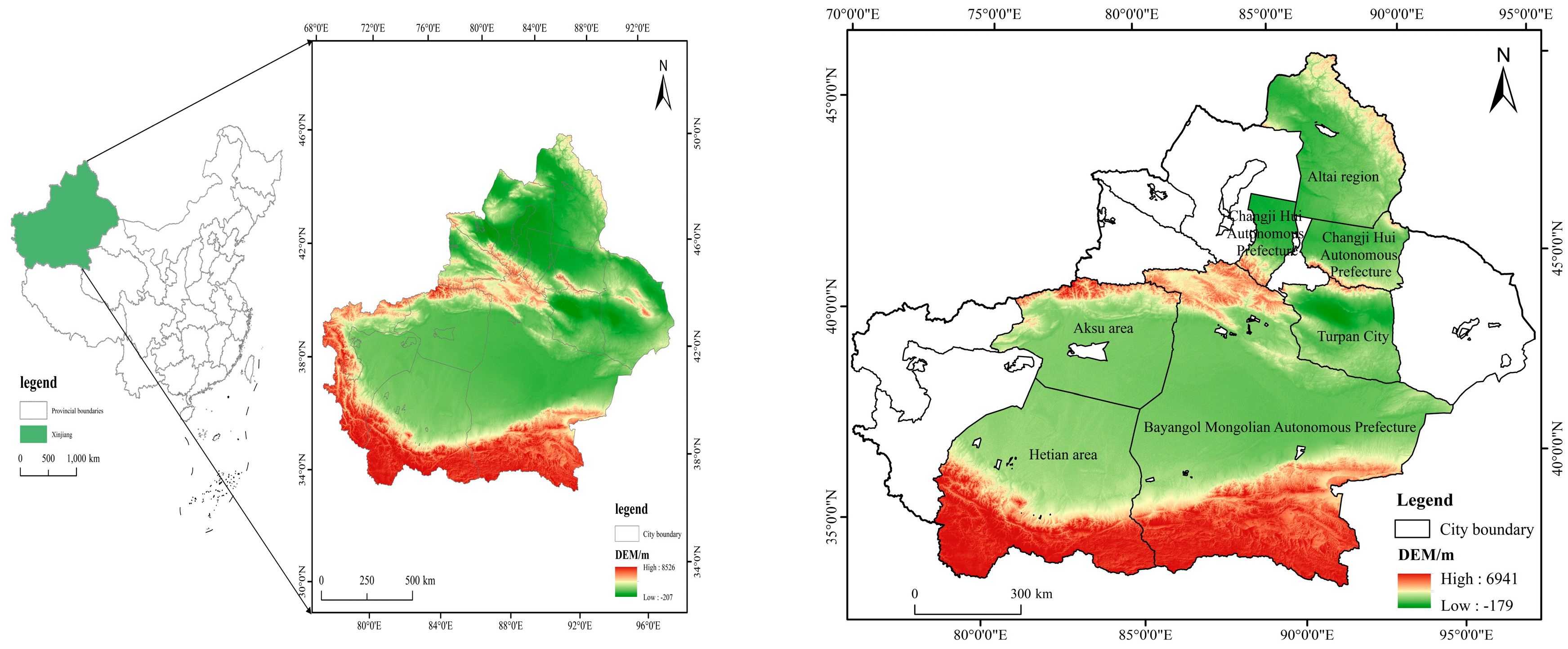
This article selects Xinjiang Uygur Autonomous Region as the research area. As shown in Figure 2, it is located in the northwest of China, with a vast area, with a maximum length of 2000 km from east to west, with a span of about 22°50; the widest width of about 1600 km from north to south, with a span of nearly 14°30. As one of the five major pastoral areas in China, Xinjiang has a total of 37 pastoral and semi-pastoral industries in the region. According to the data of the third national land survey of the autonomous region, the grassland area in Xinjiang is 779,789,700 mu, of which 59,971,300 mu is natural pasture, accounting for 76.17% of the grassland in Xinjiang. Therefore, Xinjiang has rich natural resources and pastoral development potential. However, Xinjiang’s climate is a typical temperate continental climate, with remarkable characteristics of little precipitation, strong evaporation, and large daily temperature difference. This special geographical and climatic environment makes local animal husbandry production extremely dependent on natural resources, and the ecosystem shows high vulnerability due to its weak resilience.
Figure 2.
Overview of the study area.
Specifically, the geographical location and climate in the study area show significant differences between the north and the south. First, the sample area of the northern Xinjiang (Altai region, Changji Hui Autonomous Prefecture, and Turpan City): this area has lush mountain grasslands and is the core area of traditional grassland animal husbandry. However, the winter in this area is long and cold. The second is the sample area of the southern Xinjiang (Bayangol Mongolian Autonomous Prefecture, Hetian area, and Aksu area): the area is mainly distributed on the edge of the Tarim Basin, and the Turpan Basin, and the topography is mainly desert oases and agricultural and animal husbandry staggered zones. The climate here is extremely dry, and the main threat is persistent drought. The shortage of water resources leads to high costs of artificial planting, and the capacity of pastures to carry livestock fluctuates greatly.
3.2. Data Collection and Processing
The data of this research comes from the field research carried out by the project group in the pastoral areas of Xinjiang in 2024. The research adopts the layered sampling method and selects a total of six typical pastoral areas (states and cities) in the Altai region, Changji Hui Autonomous Prefecture, Bayangol Mongolian Autonomous Prefecture, Hetian region, Aksu region, and Turpan City as sample areas. As shown in Figure 2, two representative pastoral counties are selected for household interviews in each region. The research process overcame multiple difficulties, such as the scattered residences of pastoral households, language communication barriers, and limited willingness to disclose sensitive information, yet still ensured high-quality data. In the end, 650 questionnaires were recovered. After removing the invalid questionnaires, 615 valid questionnaires were finally obtained, and the efficiency of the questionnaires was 94.62%. In addition, this article also matches the macrostatistics of relevant counties, such as the number of outlets of financial institutions and the balance of agricultural borrowing, and the continuous variables are reduced at a 1% level to avoid abnormal value interference.
4. Methodology and Variable Specification
4.1. Variable Selection and Measurement
4.1.1. Dependent Variables
The core explanatory variable of this article is livelihood vulnerability, which is the ability to bear the damage caused by unexpected events in the process of economic development [24]. Combined with the reality of animal husbandry in Xinjiang pastoral areas, this article refers to Venus, T.E. (2022) [25] and Qiao, H. (2025) [26] research, build an index system including three dimensions of livelihood exposure, livelihood sensitivity and livelihood adaptability (as shown in Table 1), livelihood exposure: select indicators such as natural disaster susceptibility, consumption risk exposure, income exposure, etc.; livelihood sensitivity: choose family health Indicators such as status, medical resource distance, dependence on animal husbandry; livelihood adaptability: select indicators such as per capita annual income, social network, livelihood diversity, disaster prevention measures, etc.
Table 1.
Construction of a livelihood vulnerability indicator system.
Drawing on the calculation of the weight of livelihood vulnerability indicators by Wang, J. (2020) [27] and Feng, X. (2024) [28], first standardize the data, use the entropy value method to calculate the indicators of various dimensions of livelihood vulnerability, then calculate the comprehensive index of birth vulnerability, and finally use the natural breakpoint method to grade the livelihood vulnerability.
First, all indicator data need to be standardized to eliminate the impact of different properties and units of indicators. The specific data standardization process is shown in Formulas (1) and (2).
In Formulas (1) and (2), represents the index value of item j of the i th pastoral household.
Second, the weight of each indicator is measured.
In the process of calculating the weight of indicators, the weight of the i-th evaluation object of the j-th indicator should be calculated first (see Formula (3)).
Then, the entropy of the index is calculated (see Formula (4)).
In Formula (3), , n is the number of samples.
Finally, the weight of the index is calculated (see Formula (5)).
Referring to the research of Frazier, T.G. (2014) [29], the calculation formula for livelihood vulnerability adopted is
V = [E + S] − AC
Among them, V indicates the score of livelihood vulnerability, E is exposure, S is sensitivity, AC represents adaptability, and S indicates the score of the i dimension of livelihood vulnerability. If the livelihood vulnerability score is positive, it indicates that the risk faced by pastoral households is greater. On the contrary, if the low score of livelihood vulnerability is negative, it indicates that pastoral households have strong adaptability and that pastoral households are not vulnerable.
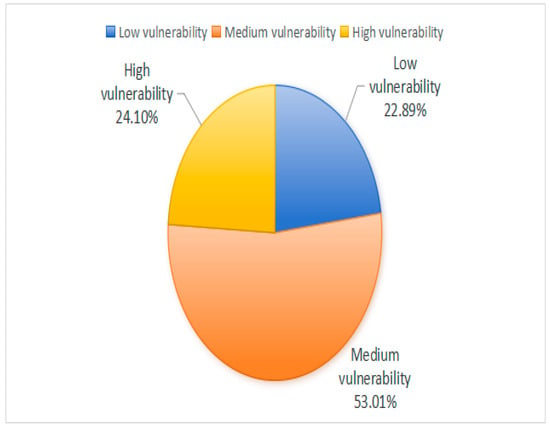
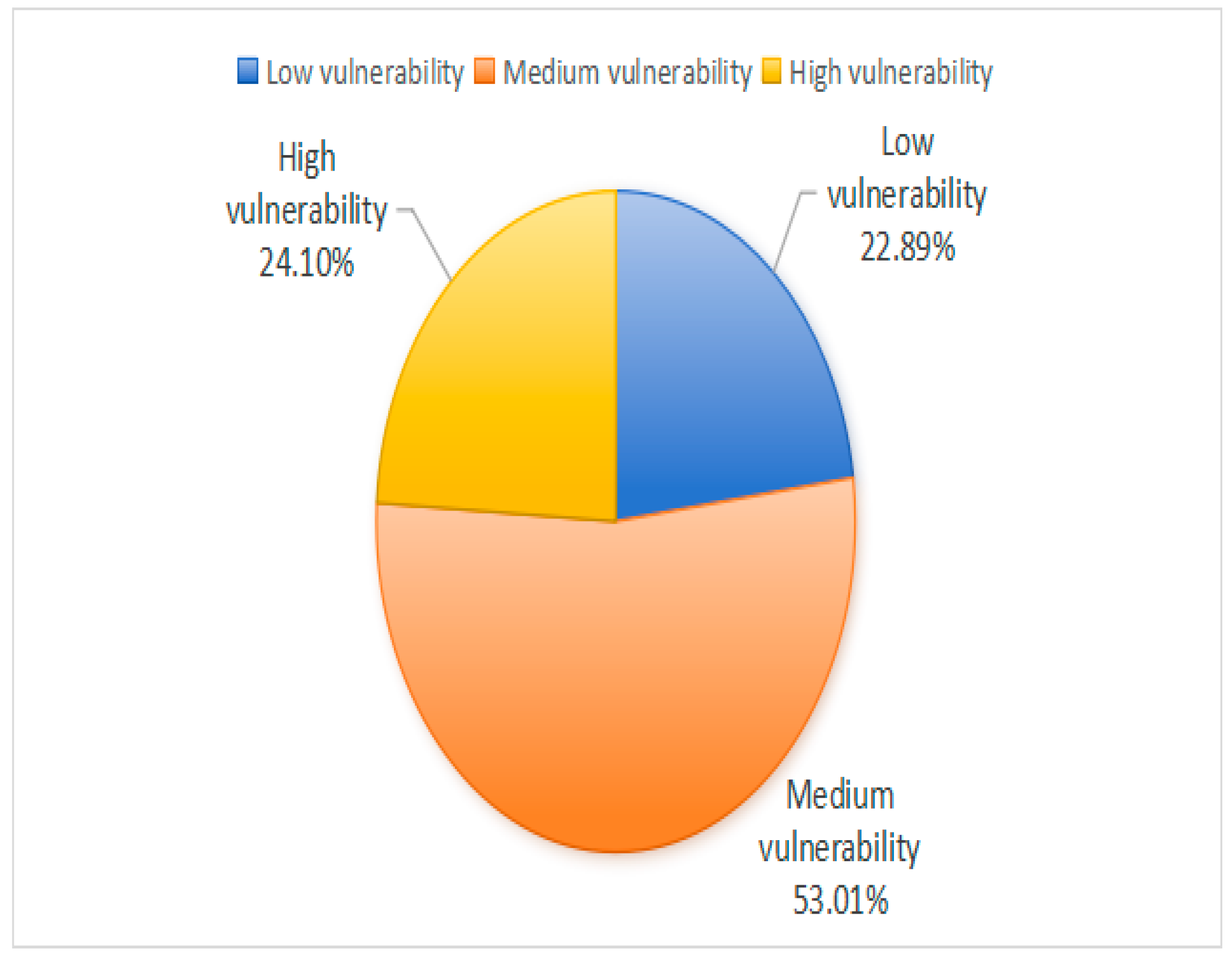
According to calculations, the average value of the livelihood vulnerability of pastoral households is 0.292. In terms of sub-dimensionality, the average value of livelihood sensitivity is 0.343, the average value of livelihood adaptability is 0.340, and the average value of livelihood exposure is 0.289. It can be seen from Figure 3 that about 22.89% of pastoralists have low livelihood vulnerability [−1, 0166], 53.01% have medium livelihood vulnerability [0.166, 0.418], and 24.10% have high livelihood vulnerability [0.418, 1].
Figure 3.
Distribution of samples across different levels of livelihood vulnerability.
4.1.2. Validation of the Indicator System
In order to ensure the rigor of the method, this part verifies the inherent consistency and structural validity of the selected indicators within the framework of “exposure-sensitivity-adaptation”. This verification process is carried out before the construction of exponential synthesis and econometric models to ensure the accuracy and reliability of analytical input.
- (1)
- Internal consistency test
In this study, Cronbach’s Alpha coefficient was measured on 615 sample data through SPSS 26.0 software. The results are shown in Table 2. In terms of dimensions, the Alpha coefficients of livelihood exposure, livelihood sensitivity, and livelihood adaptability are 0.725, 0.768, and 0.814, respectively, all of which are higher than the statistical threshold of 0.7. This confirms that the 15 evaluated indicators selected have good stability in capturing the characteristics of pastoral livelihoods and can effectively overcome the interference of random errors on the comprehensive livelihood vulnerability index.
Table 2.
Reliability test results for livelihood vulnerability indicators.
- (2)
- Structural validity test
At the same time, SPSS 26.0 software is used to analyze the logical relationship between exposure, sensitivity and adaptability and livelihood vulnerability: correlation analysis shows that there is a negative correlation between livelihood adaptability and the total index of livelihood vulnerability (correlation coefficient −0.684, p < 0.01), indicating that the stronger the individual adaptability, the more stable the livelihood system; livelihood exposure and sensitivity are significantly positively correlated with the total index (correlation coefficients are 0.542 and 0.617, p < 0.01 respectively), which is in line with the theoretical expectations of the livelihood vulnerability calculation framework.
In order to verify the statistical premise of the composite index of multi-dimensional indicators, the Kaiser–Meyer–Olkin (KMO) and Bartlett tests were carried out. The measurement results show that the KMO value is 0.716, and the Bartlett test corresponds to p < 0.001, indicating that the sample size is sufficient and the information overlap between variables is high, which is suitable for extracting common information.
Statistical verification results show that various indicators can accurately and effectively reflect the potential magnitude of the vulnerability of livelihood in Xinjiang pastoral areas.
4.1.3. Explanatory Variables
The core explanatory variable of this article is household borrowing, which is set as a binary dummy variable: if a pastoralist borrows, it is recorded as 1, and otherwise, it is recorded as 0. At the same time, referring to the research of Zhao, L. (2021) [30], household borrowing is further subdivided into formal borrowing and informal borrowing. From the survey questionnaire data, it can be seen that the borrowing status of pastoral households is shown in Table 3:
Table 3.
Borrowing status of pastoralists.
4.1.4. Control Variables
In order to reduce the deviation of missing variables, refer to the research of Li, Y. (2025) [10]; the four dimensions to select control variables are as follows: characteristics of the head of the household (age and education level), family characteristics (number of family members and years of years of animal husbandry), production and operation characteristics (number of livestock, breeding type, and pasture contract area), and regional characteristics (financial institution quantity, as well as village and county distance).
4.1.5. Tool Variables
Considering the possible endogenous problems such as reverse cause and effect and omission variables between household borrowing and the livelihood vulnerability of pastoralists, drawing on the idea of Xu, J. (2024) [31], the “borrowing cognitive level of pastoral households” is selected as the tool variable, which measures the borrowing policy and process of pastoral households for formal credit policies. The degree of solution, the basis for selection, is that the level of credit awareness of pastoral households directly affects their credit decision-making and the difficulty of obtaining credit, which is more related to whether they can obtain household borrowing, but the level of credit awareness will not directly affect the vulnerability of livelihood, and meet the exogenous conditions.
4.2. Model Design
In view of the characteristics of large fluctuations in livelihoods and widespread borrowing in pastoral areas in Xinjiang, in order to accurately identify the borrowing effect and correct the sample selection bias, this article refers to the research of Mustafa, N.M. (2023) [32] and uses the edogenous switching regression (ESR) to analyze the impact of household borrowing on the livelihood vulnerability of pastoral households, which is divided into two stages.
(1) The first stage is as follows:
Among them, Formula (7) is a selection equation, in which indicates whether pastoralists have household borrowing, which is a binary variable, are identified variables, and are the corresponding parameters, respectively, and represents random error.
(2) The second stage is as follows:
Formula (8) represents the estimation equation of the vulnerability of the livelihood of pastoral households by participating in household borrowing. Formula (9) represents the result equation of the vulnerability of the livelihood of pastoral households without participating in household borrowing, where is a vector of exogenous variables, and and are error terms.
The actual and counterfactual welfare outcomes (FCS) are defined as follows:
Formulas (10) and (11) represent the actual expectations observed; Formulas (12) and (13) represent the counterfactual results.
We could calculate the average treatment effect on the treated (ATT) individual, is as follows:
Similarly, the average treatment effect on the untreated (ATU) individual is as follows:
4.3. Robustness Check Strategy
In order to ensure that the mitigation effect of the identified borrowing on livelihood vulnerability can stably reflect the socio-economic reality, rather than the product of specific weighting methods, model function forms, or extreme sample distribution, we have implemented a multi-dimensional robustness framework.
4.3.1. Methodological Cross-Verification of Weighting
The entropy value method is used to determine the weight of the livelihood vulnerability evaluation index. Although this method is objective, it may be greatly interfered with by the extreme value of the data. In order to exclude the potential impact of the specific weight assignment method on the empirical results, this article refers to the research ideas of Chen, W. (2023) use the principal component analysis method to re-measure the livelihood vulnerability index of pastoralists [33]. The specific steps are as follows.
1. Factor extraction, according to the principle that the eigenvalue is greater than, is a process that extracts four main components, generates a load coefficient matrix according to the calculation results, and finds the square root of the eigenvalue of the main component, 2. Calculate the score coefficient matrix of the principal component. The specific calculation formula is as follows:
3. Calculate the comprehensive score coefficient:
4. Calculate the weight of the comprehensive index:
Spielman’s rank correlation coefficient was used to evaluate the consistency of the entropy value method and the principal component analysis method between family rankings. An important coefficient close to uniformity (1.0) will show that the measurement of vulnerability by different objective weighting methods is robust.
4.3.2. Counterfactual Model Equivalence: Propensity Score Matching
In order to verify the robustness of the result to the model setting, this article refers to the research of Wang, R. (2025) [34], uses the nonlinear propensity score matching method for re-examination, and performs re-testing by building a counterfactual framework. Two algorithms, nearest neighbor matching (k = 4) and radial matching (r = 0.01), were used to estimate the impact of borrowing on livelihood vulnerability.
By applying various algorithms, such as nearest neighbor matching (k = 4) and radius matching (r = 0.01), we re-estimated the average processing effect (ATT) of the object receiving the processing measure. Comparing the PSM results with the ESR results helps us verify whether the borrowing effect still exists in the case of relaxing the parametric function form assumptions, so as to ensure the robustness of the counterfactual framework in econometrics.
4.3.3. Sample Sensitivity and Outlier Influence Control
Based on the micro-research data, there may be measurement errors and extreme values. The extreme value samples of some special hardship households or large-scale breeding households may have a leverage effect on the regression results, resulting in estimated deviation.
Without ensuring the universality of the research conclusions and eliminating the interference of extreme outliers, this paper adopts a double-tailed strategy.
First, all continuous variables are normalized at a [3% and 97%] level. This limits the impact of extreme anomalies without excluding potentially valuable information.
Second, households situated at the upper and lower fifth percentiles of per capita net income are excluded to form a trimmed sub-sample. Re-estimating the ESR model on this subset ensures that the identified borrowing-vulnerability nexus represents a generalized law for the majority of pastoralists in Xinjiang, rather than being a statistical artifact driven by specialized extreme cases.
5. Empirical Results and Analysis
5.1. Descriptive Statistics
In order to intuitively present the two dimensions of the distribution characteristics and regional heterogeneity of research samples and core variables, the descriptive analysis of this research sample is distributed in the region (48.16% in southern Xinjiang, 51.84% in northern Xinjiang), pastoralist types (65.92% of pure pastoralists, part-time pastoralists 34.08%) and the characteristics of the head of the household (average age 48.2 years old, junior high school and below account for 72.3%), which is in line with the current situation of livelihood in Xinjiang pastoral areas, which is mainly pastoral and part-time, and provides realistic support at the individual and regional levels to explain the impact of household borrowing on the livelihood vulnerability of pastoralists, the variable definition is shown in Table 4.
Table 4.
Variable explanation.
The descriptive statistical information of the core variables (including the overall sample, borrowing group, and non-borrowing group) is listed in Table 5. It can be seen that the average livelihood vulnerability of the borrowing group (0.24) is significantly lower than that of the non-borrowing group (0.34), and the difference between the two is statistically significant, reaching the level of 1% (T = −6.88 ***).
Table 5.
Descriptive statistics for variables.
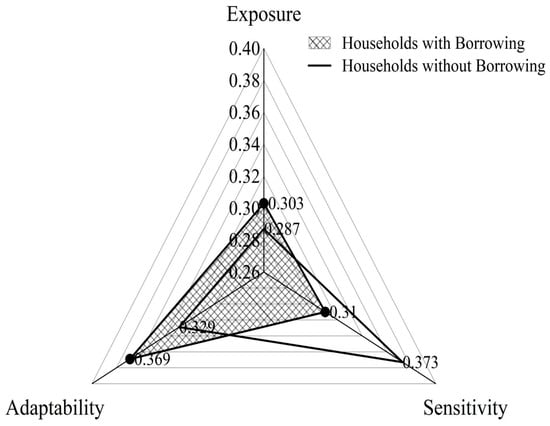
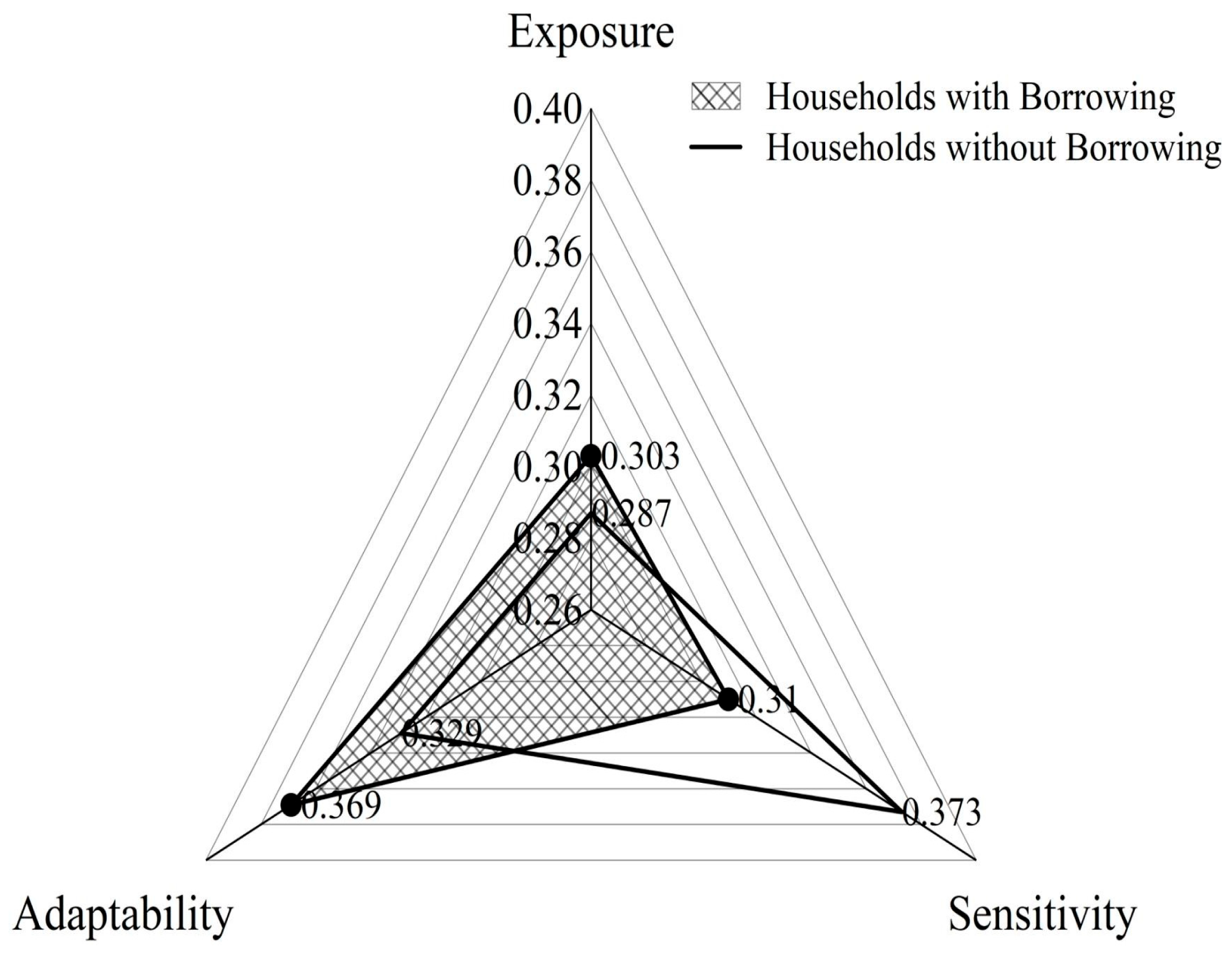
Further analysis of the differences between different borrowing groups in the three sub-dimensions of livelihood vulnerability, it can be seen that the performance of pastoral households participating in household borrowing is significantly better than that of pastoral households who participate in borrowing (non-borrowing group) in the dimension of livelihood adaptability, while the scores in the dimensions of livelihood sensitivity and livelihood exposure are relatively low, the comparison results are shown in Figure 4.
Figure 4.
Comparison of livelihood vulnerability indicators across dimensions for borrowing and non-borrowing households.
5.2. Baseline Regression Results
Analysis of the Impact of Borrowing on the Livelihood Vulnerability of Pastoral Households
According to the endogenous switching regression set above, Stata 16.0 software is used for joint estimation. Table 6 shows the estimation of the model result:
Table 6.
Model estimation results.
From the analysis of the selection equation in Table 6, it can be seen that the level of borrowing awareness of pastoral households is significantly positive at the 1% level, with a coefficient of 0.594, which indicates that financial borrowing awareness is the key threshold that restricts the credit availability of pastoral households. In addition, the education level of the head of the household (β = 0.217), the number of livestock (β = 0.314), the contracted area of the pasture (β = 0.129), and other variables have a significant positive impact on the borrowing behavior of pastoralists. As the core collateral of pastoralists, livestock and pastures, the larger their scale, the stronger their repayment ability, so that the easier it is to get credit support. However, the influence coefficients of the householder’s age (β = −0.013) and the village–county distance (β = −0.006) are negative, indicating that the householder’s age and the village-county distance negatively affect the borrowing behavior of pastoralists. This finding is in line with the life cycle theory. With age, the risk aversion of pastoralists increases, and they gradually withdraw. Large-scale production and operation, so the demand for credit is weakened. Regarding the negative significance of the distance between villages and counties, it reveals the “financial exclusion” caused by geographical distance. The farther away from the county, the higher the time cost and transportation cost for herdsmen to go to financial institutions, resulting in a decrease in credit availability.
The analysis of the result equation shows that there are significant structural differences in the impact of the livelihood vulnerability of pastoral households participating in household borrowing and pastoral households that do not participate in household borrowing. The correlation coefficient of the error term, rhol, is significantly negative, indicating that there is a selective deviation in the sample. The significant negative sign in the rho1 indicator indicates that there is a positive selection effect, which means that those herdsmen who perform better in unobservable dimensions are more likely to participate in lending activities. Among them, the coefficient of reducing vulnerability in the borrower’s education level in the borrowing group is significantly greater than that in the non-borrowing group, which means that when pastoralists receive financial support, human capital can be converted into financial capital more efficiently; the number of livestock in the borrowing group has the same inhibitory effect in the non-borrowing group. It shows that the expansion of reproduction or technological upgrading with the help of credit funds can produce economies of scale for original livestock assets, thus significantly reducing the livelihood vulnerability of herdsmen.
Based on the above results, the average processing effect is further calculated, that is, comparing the livelihood vulnerability of pastoral households in the case of actual participation in borrowing with their livelihood vulnerability under the hypothetical scenario of non-borrowing. The results are shown in Table 7. It can be seen that the average processing effect of the impact of household borrowing on the livelihood vulnerability of pastoral households is −0.042. This shows that after controlling for other variables and selective biases, household borrowing behavior significantly reduces the livelihood vulnerability of pastoral households by about 14.84%, which strongly supports hypothesis H1.
Table 7.
The average treatment effect of pastoral borrowing on livelihood vulnerability.
5.3. Robustness Test Results and Stability Discussion
Following the methodological framework established in Section 4.3, this section reports the empirical results of robustness inspection and discusses the stability of the vulnerability mitigation effect of borrowing.
5.3.1. Outcomes of Weighting Stability
The cross-validation between the entropy weight method (EWM) and the principal component analysis method (PCA) confirms that the measurement results of livelihood vulnerability are not sensitive to weighting algorithms.
The Spearman level correlation coefficient between EWM-based LVI and PCA-based LVI is 0.912 (p < 0.01), which shows that the family vulnerability ranking results maintain a high degree of consistency, whether information entropy or structural variance is used as the weight calculation method.
Using the PCA weighted index to re-estimate the ESR model, the ATT obtained is −0.039 (p < 0.01), which is highly consistent with the baseline result −0.042.
5.3.2. Outcomes of Model Specification Stability
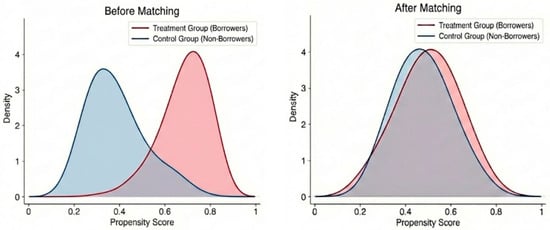
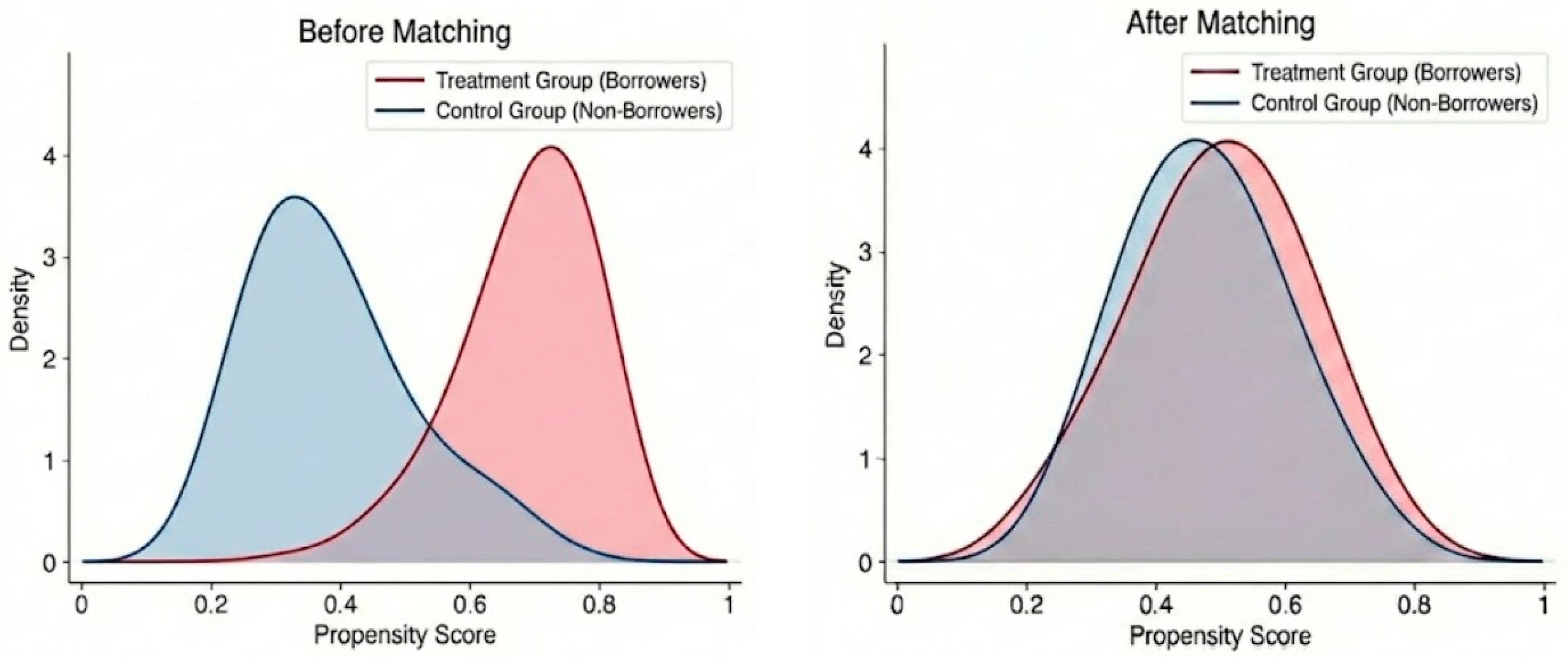
The results of tendency value matching (PSM) confirm the anti-factual research conclusion of the ESR model. As shown in the kernel density diagram (Figure 5), after matching, the probability density curves of borrowers and non-borrowers overlap significantly, successfully eliminating the systemic differences in initial resource endowment.
Figure 5.
Comparison of kernel densities before and after propensity score matching.
The ATT obtained by the PSM method (using k = 4 nearest neighbor matching) is −0.045 (p < 0.05). When the joint normality assumption of the ESR model is relaxed, this mitigation effect can still persist. It has been proven that the identified borrowing vulnerability association is consistent in econometrics in different functional forms.
5.3.3. Outcomes of Sample Sensitivity and Outlier Control
The sub-sample test shows that the core discovery is not driven by extreme observations or measurement errors.
After applying 3% bidirectional Winsorization to all continuous variables, ATT is still significant at −0.038 (p < 0.01).
Following the procedure in Section 4.3.3, households within the top and bottom 5% of the income distribution are excluded. The ATT re-estimated for this screened sub-sample is highly consistent with the baseline data, indicating that the borrowing effect is a common phenomenon among most pastoral groups in Xinjiang, rather than a statistical product driven by specific extreme cases at the end of wealth distribution.
5.3.4. Discussion on the Stability of the Mitigation Effect
The main empirical results of this study show that household borrowing can reduce the livelihood vulnerability index by about 14.84% (baseline ATT = −0.042). The robustness test summarized in Table 8 provides conclusive evidence for the stability of this amplitude.
Table 8.
Robustness test results.
In various stress tests, the ATT values estimated from recalculating weights to model replacement and sample reduction one by one fluctuate in a narrow range, between −0.038 and −0.045. More importantly, when converting these absolute effects into relative reduction rates, the mitigation effect consistently falls within the range of 13.43% to 15.90%. This highly consistent convergence result in different test dimensions confirms that the 14.84% mitigation index is a reliable and stable estimate of the impact of financial capital. This further supports the conclusion that credit support, as a stable institutional tool, helps to strengthen the resilience of pastoralists’ families to environmental and economic shocks.
5.4. Heterogeneity Analysis
5.4.1. Heterogeneity Analysis of the Vulnerability of Different Borrowing Channels to the Livelihood of Shepherds
Through the above analysis, it has been confirmed that household borrowing can significantly reduce the livelihood vulnerability of pastoralists, but there are differences in the amount, term, and use of different types of household borrowing. Formal borrowing (mainly from banks) usually has the characteristics of large amounts and long terms, and it is easy to support farmers to make productive investments such as livestock breed improvement; informal borrowing (mainly from relatives and friends and private borrowing) is mostly small and short-term, and is often used for smooth consumption. After eliminating the abnormal values, 189 regular borrowers and 123 irregular borrowers were identified, and their average processing effect (ATT) was measured, respectively. The results are shown in Table 9.
Table 9.
Average processing effect of different borrowing behavior.
Empirical results show that the poverty alleviation effect of formal household borrowing is stronger, and its average processing effect is −0.071, which means that the livelihood vulnerability of pastoral households who obtain borrowing through formal channels is about 23.2% lower than that of the counterfactual state. Although informal household borrowing also reduces the livelihood vulnerability of pastoralists (ATT = −0.019), its effect is significantly weaker than that of formal borrowing.
At the same time, the data shows that compared with the emergency function of informal borrowing, formal borrowing, with its capital scale advantages, can empower pastoralists to realize the transformation of production methods, thus playing a more core role in reducing livelihood vulnerability. This result also reflects the limitations of informal finance in reducing vulnerability. Although informal channels such as borrowing for relatives and friends have the advantages of flexibility, such as convenient procedures and no mortgage, which can effectively solve the sudden needs of pastoral households, their capital sources are usually unstable, with the characteristics of dispersion, small amount, and short term. When pastoral households face the demand for large and long-term productive funds, such as buying livestock and repairing pens, informal finance is often incompetent and difficult to support pastoral households in achieving a fundamental transformation of livelihood mode. Therefore, its effect on the alleviation of livelihood vulnerability is weaker than that of regular finance.
5.4.2. Analysis of the Heterogeneity of Household Borrowing to Different Livelihood Vulnerabilities of Pastoral Households
In order to deeply study the differential impact of household borrowing on pastoral households with different levels of vulnerability, this paper measures the average treatment effect of each group of pastoral households participating in household borrowing based on the three vulnerability levels of low, medium, and high, divided by the above natural breakpoint method. This analysis aims to examine whether household borrowing has different effects on pastoral households with different livelihood vulnerabilities.
As shown in Table 10, through the grouping test of pastoral households with borrowing, it is found that household borrowing has had a significant improvement effect on the livelihood of pastoral households at the three vulnerable levels, and its marginal effect has shown a tendency to increase with the deepening of the degree of vulnerability. Specifically, in the borrowing sample of 312 households, household borrowing was directed to the high brittle weak group. The absolute value of the average treatment effect is the largest among 49 households (ATT = −0. 086), such that pastoralists face serious capital shortages or external shocks. Credit funds have effectively alleviated the survival crisis, greatly reducing their anti-factual vulnerability of up to 0.565; the vulnerable group (165 households) has played a significant stabilizing role, and borrowing (ATT = −0. 045) mainly by smoothing consumption fluctuations to prevent it from slipping into a high-vulnerability state; and the effect on the low-vulnerability group (98 households) is relatively weak, which strongly supports the hypothesis H2.
Table 10.
Differences in the treatment effect of pastoral households with different livelihood vulnerability levels.
In order to further support the conclusion that borrowing shows a stable and “pro-poor” effect, and to ensure that this finding is not driven by a specific weighting method (entropy weight method), we conducted a comparative analysis. We used the index based on principal component analysis (PCA) constructed in Section 4.3.1 to re-estimate the average processing effect (ATT) of three vulnerable groups. Table 11 shows the comparison of the mitigation effect between the main result (EWM) and the stable result (PCA).
Table 11.
Comparison of the mitigation effect across vulnerability groups using EWM and PCA methods.
The comparative analysis reveals high consistency between EWM and PCA methods. Both show that the mitigation effect intensifies as vulnerability rises, peaking in the high-vulnerability group (EWM: −0.086; PCA: −0.081). This cross-verification confirms that the “pro-poor” nature of borrowing is a robust causal finding, serving as a critical safety net for the most vulnerable.
6. Conclusions
Based on the sustainable livelihood framework, this paper uses the research data of 650 households in pastoral areas in Xinjiang. On the basis of building a multi-dimensional livelihood vulnerability evaluation index system, it uses the endogenous conversion model to empirically verify the governance effect of borrowing on the livelihood vulnerability of pastoral households. The main research conclusions are as follows.
First, borrowing can significantly reduce the livelihood vulnerability of pastoral households. Empirical results show that under the counterfactual hypothesis, participation in borrowing reduces the livelihood vulnerability index of pastoral residents by an average of about 14.84%, which means that external capital injection effectively alleviates the liquidity constraints of pastoral farmers in production transformation and living consumption, and enhances the ability of pastoral households to cope with external risk shocks.
Second, there are significant structural differences in the mitigation effect of different credit channels. The alleviation effect of formal borrowing on livelihood vulnerability is significantly better than that of informal borrowing. Compared with private borrowing of relatives and friends, which is mainly used for smooth consumption, formal borrowing, with its advantages of large capital scale and long-term, can better support pastoralists to make productive investment, thus promoting the structural optimization of livelihood strategies.
Third, borrowing contributes the most to the marginal contribution of highly vulnerable pastoral households, and its mitigation effect increases with the improvement of the vulnerability level. This shows that credit funds are a key external thrust compared with pastoralist groups with scarce resources and weak risk resistance.
6.1. Limitation
The livelihood vulnerability of pastoral households has significant temporal dynamic characteristics, which are greatly affected by the climate cycle and macroeconomic fluctuations. This article is based on the cross-sectional research data from 2024. Although it can reflect the current state, it is difficult to capture the long-term evolution trend of the livelihood vulnerability of pastoral households and the lagging effect of borrowing behavior. In the future, we can try to establish a pastoral panel database to dynamically examine the long-term smoothing effect of credit support from the time dimension.
Although this paper constructs a three-dimensional framework of “exposure-sensitivity-adaptive capacity” and adopts the entropy value method to objectively empower, some indicators depend on the subjective review of pastoralists, and there may be some deviations. In addition, limited by the design of the questionnaire, some qualitative indicators (0/1 variable) may not be able to accurately depict the subtlety of the risk impact. Future research can consider introducing more objective remote sensing data to supplement.
This article verifies that borrowing has significantly reduced the vulnerability of livelihood, but the specific portrayal of how borrowing funds can transform their risk resistance is not detailed enough. Due to the lack of detailed account data for the specific use of funds, the study failed to accurately distinguish what proportion of credit funds is used for productive investment and how much is used for consumer expenditure. Future research can further refine the investigation of the use of funds, reveal the specific mechanism of the vulnerability of pastoral households’ borrowing to livelihood, and provide a more detailed basis for precise credit policies.
6.2. Suggestions
Based on the above conclusions, this article puts forward the following policy inspirations:
First, in view of the practical pain points of scattered pastoral households and the difficulty of full coverage of bank outlets, financial institutions are encouraged to develop online exclusive products such as “mobile pastoral borrowing” and build an integrated support service system of “an integrated model combining credit, insurance, and industrial support”. In view of the current situation that the mitigation effect of formal finance is more significant but the threshold is high, it is recommended that financial institutions innovate and develop financial products that meet the characteristics of pastoral areas: promote the credit model of “live livestock mortgage + agricultural insurance”, and reduce the geographical cost and transaction cost of pastoral residents to obtain financial services.
Second, strengthen the deep integration of credit capital and the animal husbandry industry, and improve the efficiency of the productive allocation of assets. It is suggested that the policy focus should be shifted from simple capital investment to capital use to ensure that credit funds really flow into the production field.
Third, strengthen the inclusive orientation of inclusive finance, and focus on credit resources for highly vulnerable groups. Policy formulation should avoid the flow of funds only to large households and focus on the truly vulnerable groups. It is recommended to establish a dynamic monitoring and early warning system for the livelihood vulnerability of pastoralists, establish special credit files for identified highly vulnerable and low-income pastoralists, and provide differentiated support for small credit borrowing, discounted borrowing, etc.
Author Contributions
K.M., conceptualization, data curation, investigation, data curation, methodology, software, formal analysis, writing—original draft preparation; H.Y., funding acquisition, resources, supervision, writing—review and editing. All authors have read and agreed to the published version of the manuscript.
Funding
This research is supported by the National Social Science Fund of China (grant number: 23BJY157).
Institutional Review Board Statement
Ethical review and approval were waived for this study by College of Economics and Management, Xinjiang Agricultural University because this study adopts an anonymous questionnaire survey method; during the research process, only anonymous data is collected, and no personally identifiable information is collected; this study is a non-interventional and non-experimental investigation, and there is no predictable risk to the participants.
Informed Consent Statement
Informed consent was obtained from all subjects involved in the study.
Data Availability Statement
The raw data supporting the conclusions of this article will be made available by the authors on request.
Conflicts of Interest
The authors declare no conflicts of interest.
References
- Ghazali, S.; Zibaei, M.; Keshavarz, M. The effectiveness of livelihood management strategies in mitigating drought impacts and improving livability of pastoralist households. Int. J. Disaster Risk Reduct. 2022, 77, 103063. [Google Scholar] [CrossRef] [Scilit]
- Campiglio, E.; Daumas, L.; Monnin, P.; von Jagow, A. Climate-related risks in financial assets. J. Econ. Surv. 2023, 37, 950–992. [Google Scholar] [CrossRef] [Scilit]
- Dong, H.; Jimoh, S.O.; Jiang, Q.; Liu, S.; Yin, Y.; Hou, X. Livelihood risks impact livestock reduction behavior of herders: Evidence from Inner Mongolia, China. Front. Sustain. Food Syst. 2023, 7, 1186899. [Google Scholar] [CrossRef] [Scilit]
- Lind, J.; Sabates-Wheeler, R.; Kohnstamm, S. Changes in the Drylands of Eastern Africa: Understanding and Mapping Livelihood Dynamics and Resilience Within Pastoralist Systems; Institute of Development Studies: Brighton, UK, 2016. Available online: https://assets.publishing.service.gov.uk/media/57a0895aed915d3cfd0001d2/61651_FINAL_Changes-in-eastern-Africa-drylands_Main-Report.pdf (accessed on 20 September 2025).
- Lv, Y.; Xia, Y.; Li, X.; Wang, F.; Zhao, L.; Ding, N. Spatial Effects of Producer Services on the Ecological Efficiency of Animal Husbandry: A Case Study of Xinjiang. Acta Prataculturae Sin. 2025, 34, 1–16. (In Chinese) [Google Scholar] [CrossRef]
- Yitbarek, M.B.; Berhane, G. Livestock Production Systems Analysis: Review. Available online: https://www.scribd.com/document/482338139/Livestock-production-systems-and-analysi-pdf (accessed on 15 November 2025).
- Chen, Y.; Li, Z.; Xu, J.; Shen, Y.; Xing, X.; Xie, T.; Li, Z.; Yang, L.; Xi, H.; Zhu, C.; et al. Water Resources and Ecological Environment Changes and Protection Suggestions in the Arid Region of Northwest China. Bull. Chin. Acad. Sci. 2023, 38, 385–393. (In Chinese) [Google Scholar] [CrossRef]
- Yu, F.; Huang, X.; Wang, G. High-quality Development of Animal Husbandry: Theoretical Interpretation and Realization Path. Chin. Rural. Econ. 2021, 4, 85–99. (In Chinese) [Google Scholar] [CrossRef]
- Tasnuva, A.; Yang, X.; Guo, S.; Deng, X. Study on Livelihood Vulnerability and Adaptation Strategies of Farmers in Areas Threatened by Different Disaster Types under Climate Change. Agriculture 2021, 11, 1088. [Google Scholar] [CrossRef] [Scilit]
- Li, Y.; Zuo, W.; Cheng, W.; Monika, S.; Du, G. Livelihood Vulnerability and Influencing Factors of Farmers Under Drought Stress in the Agro-Pastoral Ecotone of Northern China: A Case Study of Yuyang District, Shaanxi Province. J. Agric. Resour. Environ. 2025, 42, 1115–1124. (In Chinese) [Google Scholar] [CrossRef]
- Gong, J. Climate Disaster Agricultural Product Price Strategy and Farmers’ Livelihood Vulnerability: An Investigation from Ecological Relocation Resettlement Areas. Prices Mon. 2024, 22–32. (In Chinese) [Google Scholar] [CrossRef]
- Udeagha, M.C.; Muchapondwa, E. Green finance, fintech, and environmental sustainability: Fresh policy insights from the BRICS nations. Int. J. Sustain. Dev. World Ecol. 2023, 30, 633–649. [Google Scholar] [CrossRef] [Scilit]
- Zhao, X.; Jie, Y.; He, X.; Mu, F.; Su, H.; Lan, H.; Xue, B. Livelihood Adaptability of Farmers in Key Ecological Function Areas Under Multiple Pressures: A Case Study of Gannan Yellow River Water Supply Area. China Popul. Resour. Environ. 2020, 30, 140–149. (In Chinese). Available online: https://cssd1992.org/issue_info.aspx?ID=388 (accessed on 12 November 2025).
- Twumasi, M.A.; Jiang, Y.; Ding, Z.; Wang, P.; Abgenyo, W. The mediating role of access to financial services in the effect of financial literacy on household income: The case of rural Ghana. Sage Open 2022, 12, 21582440221079921. [Google Scholar] [CrossRef] [Scilit]
- Su, F.; Ying, R.; Li, B. Visualization Analysis of the Hot Topics and Frontier on Livelihood Vulnerability Research. Sci. Geogr. Sin. 2016, 36, 1073–1080. [Google Scholar] [CrossRef]
- Timmerman, P. Vulnerability Resilience and the Collapse of Society: A Review of Models and Possible Climatic Applications; Institute for Environmental Studies, University of Toronto: Toronto, ON, Canada, 1981; Volume 1, p. 396. [Google Scholar] [CrossRef] [Scilit]
- Zhang, C.; Wang, W. Risk Shocks, Financial Behavior and Sustainable Livelihood of Farmers. J. Shanxi Univ. Financ. Econ. 2024, 46, 53–67. (In Chinese) [Google Scholar] [CrossRef]
- Pienaah, C.K.A.; Luginaah, I. The impact of village savings and loan associations as a financial and climate resilience strategy for mitigating food insecurity in Northern Ghana. Risks 2024, 12, 58. [Google Scholar] [CrossRef] [Scilit]
- Wang, Q.; Zhang, N. Social Network and Income Diversification: The Mediating Role of Informal borrowing and Employment. J. Agrotech. Econ. 2022, 50–66. (In Chinese) [Google Scholar] [CrossRef]
- Zhang, D.; Yin, Z. Financial Inclusion, Risk Coping and Rural Household Poverty Vulnerability. Chin. Rural. Econ. 2018, 54–73. (In Chinese) [Google Scholar] [CrossRef]
- Wu, X.; Jiang, Y. Social Networks, Scale of Rural Household Borrowing and Agricultural Productive Investment: Empirical Evidence Based on CHFS Database. Rural. Econ. 2020, 104–112. (In Chinese) [Google Scholar] [CrossRef]
- Mengistu, N.A. Rural livelihood vulnerabilities, contributing factors and coping strategies in Takusa Woreda, North Western Ethiopia. Cogent Soc. Sci. 2022, 8, 2095746. [Google Scholar] [CrossRef] [Scilit]
- Li, X.; Song, W.; Ye, C. Impact of Expansion of New Rural Financial Institutions on Rural Household Income. Econ. Geogr. 2025, 45, 152–164. (In Chinese) [Google Scholar] [CrossRef]
- Xiang, W.; Xie, J.; Li, J. Vulnerability Assessment of China’s Real Estate Market: Evidence from Housing Price Fluctuations. Reform 2022, 87–100. Available online: https://qikan.cqvip.com/Qikan/Article/Detail?id=7106839531 (accessed on 12 November 2025). (In Chinese)
- Venus, T.E.; Bilgram, S.; Sauer, J.; Khatri-Chettri, A. Livelihood vulnerability and climate change: A comparative analysis of smallholders in the Indo-Gangetic plains. Environ. Dev. Sustain. 2022, 24, 1981–2009. [Google Scholar] [CrossRef] [Scilit]
- Qiao, H.; Liu, R.; Zhang, Y.; Xu, M.; Xie, S. Identification and Evaluation of Livelihood Vulnerable Farmers in Rural Tourism Destinations in Enshi Prefecture Based on AF Method. J. Cent. China Norm. Univ. (Nat. Sci.) 2025, 1–16. Available online: https://link.cnki.net/urlid/42.1178.N.20251111.1815.002 (accessed on 12 November 2025). (In Chinese)
- Wang, J.; Li, L.; Xia, S.; Mao, X. Evaluation of Livelihood Sustainability of Poverty-Alleviated Households and Policy Effects under Institutional Cooperation Mechanism. J. Southwest Univ. (Soc. Sci. Ed.) 2020, 46, 68–76+192. (In Chinese) [Google Scholar] [CrossRef]
- Feng, X.; Shi, X.; Zhao, Z. Impact of Geographical Indication Agricultural Products on Farmers’ Livelihood Vulnerability and Well-being: A Case Study of the Arid Tableland in the Yellow River Basin. Geogr. Res. 2024, 43, 2702–2720. (In Chinese) [Google Scholar] [CrossRef]
- Frazier, T.G.; Thompson, C.M.; Dezzani, R.J. A framework for the development of the SERV model: A Spatially Explicit Resilience-Vulnerability model. Appl. Geogr. 2014, 51, 158–172. [Google Scholar] [CrossRef] [Scilit]
- Zhao, L.; Zhao, L.; Kang, X. The Impact of Financial borrowing on Farmers’ Poverty Vulnerability: Also on the Mediating Effect of Agricultural Production Investment. Wuhan Financ. 2021, 54–61. (In Chinese) [Google Scholar] [CrossRef]
- Xu, J.; Yan, X. Can Credit Support Improve the Livelihood Resilience of Farmers Relocated for Poverty Alleviation? China Econ. Stud. 2024, 4, 80–96. (In Chinese) [Google Scholar] [CrossRef]
- Mustafa, N.M.; Asfaw, F.F.; Endris, E.A.; Bojago, E. Evaluating the impact of productive safety net program on rural household food security achievement: Endogenous switching regression modeling approach. J. Agric. Food Res. 2023, 14, 100674. [Google Scholar] [CrossRef] [Scilit]
- Chen, W.; Zhang, C.; Li, C. Research on the Measurement of Return-to-Poverty Risk and Construction of Early Warning Mechanism for Rural Poverty-Alleviated Families: Based on the Analytical Framework of Livelihood Vulnerability. J. Guizhou Univ. Financ. Econ. 2023, 41, 73. (In Chinese) [Google Scholar] [CrossRef]
- Wang, R.; Liu, Y.; Liao, H.; Li, Z. The Effect and Mechanism of Agriculture-Tourism Integration Empowering Farmers’ Income Increase in Southwest Mountainous Areas. J. Southwest Univ. (Nat. Sci. Ed.) 2025, 47, 17–29. (In Chinese) [Google Scholar] [CrossRef]

Disclaimer/Publisher’s Note: The statements, opinions and data contained in all publications are solely those of the individual author(s) and contributor(s) and not of MDPI and/or the editor(s). MDPI and/or the editor(s) disclaim responsibility for any injury to people or property resulting from any ideas, methods, instructions or products referred to in the content. |
© 2026 by the authors. Licensee MDPI, Basel, Switzerland. This article is an open access article distributed under the terms and conditions of the Creative Commons Attribution (CC BY) license.