


Abstract
To address the new dispatching characteristics and increasingly complex operational requirements of hydropower station operation, including large installed capacity, large-scale units, and prohibited operating zones for multiple types of units, an intra-plant economic operation model is established with the objectives of safe, stable, and economic operation, thereby achieving optimal load allocation among units under various operating conditions. The optimal output ranges of individual units under different heads are analyzed, the load allocation rules of the station are investigated, and the intra-plant economic operation model is formulated. Based on this model, an optimal load allocation table is designed, and the optimal load allocation result tables for different loads, heads, and start–stop combinations are proposed to guide real-time intra-plant economic dispatch. The application at Maerdang Hydropower Station demonstrates that the optimization model can reasonably determine the start–stop sequence and the number of units in operation according to real-time load commands, and can provide real-time start-up and shut-down recommendations. Moreover, it can obtain the optimal load allocation combination of units under various operating conditions, reducing the monthly average water consumption rate of the power station by 5.03% and the low-efficiency operation time of units by 61.37% during the dry season and reducing the monthly average water consumption rate of the power station by 1.57% and the low-efficiency operation time of units by 64.71% during the flood season, thereby ensuring high-efficiency unit operation and improving the economic benefits of the station.
1. Introduction
In-plant economic operation, as one mode of economic operation for hydropower stations, has the advantages of low cost and high benefit, and is one of the best methods for optimizing the utilization of hydropower resources [1]. In practice, however, the economic-operation benefit of a station is often limited because load allocation among units does not adequately account for differences in the actual operating conditions of individual units. In the new era, hydropower station dispatching is characterized by large capacity, large generating units, and diverse unit water-consumption characteristics, requiring comprehensive consideration of objectives such as station water consumption and power-generation benefits [2], while also satisfying real-time dispatching requirements. Moreover, with the expansion of power systems, the large-scale integration of wind and solar energy, and the continuous deepening of electricity market reform in recent years, major changes have occurred in hydropower system scale, operating conditions, and hydroelectric coordination relationships. Establishing scientific and rational economic-operation models and developing efficient solution algorithms for complex multidimensional problems have therefore become increasingly important requirements for the economic and safe operation of hydropower stations. On the other hand, the volatility, uncertainty, and intermittency of renewable energy have had considerable impacts on the stable operation of power systems [3,4], leading to uncertainty in grid load demand for hydropower stations [5]. This affects the accuracy and timeliness of economic-operation optimization calculations for hydropower stations, increases the difficulty of economic operation to some extent, and places higher demands on hydropower station economic operation. Therefore, more reasonable and practical optimization strategies are needed to meet the requirements of stable, safe, and economic operation of hydropower systems.
Research on in-plant economic operation originated in the 1920s. With the acceleration of global hydropower development and supported by operations research, computer technology, and related fields, in-plant economic-operation technologies for hydropower stations have continued to develop, with research mainly focusing on operating-boundary identification, research objectives, and solution algorithms. Operating-boundary studies examine how water level, generation head, plant load, unit status, and water-consumption characteristics alter the feasible region and high-efficiency operating range [6,7,8]. Chang et al. [9] developed a multidimensional framework for Longyangxia Hydropower Station to evaluate efficiency under different water levels, heads, outputs, and unit states. Yang et al. [10] introduced information entropy to quantify the temporal and spatial information associated with economic operation and developed an integrated spatiotemporal optimization model for a large hydropower plant. Li et al. [11] optimized cascade small-hydropower operation using a one-dimensional hydrodynamic model, highlighting the importance of hydraulic constraints and coordinated plant operation. Pan et al. [12] combined an improved long short-term memory (LSTM) model with random forests to extract unit water-consumption features and identify low-consumption strategies. These studies show that economic operation requires not only load allocation within prescribed constraints but also an explicit representation of operating boundaries that vary with head, load, and unit state.
From the perspective of research objectives, existing studies mainly focus on optimizing unit commitment, unit loading, and power-generation benefits. Pérez-Díaz et al. [13] optimized short-term hydropower operation in a competitive electricity market, while Finardi and Scuzziato [14] integrated unit commitment and loading decisions for day-ahead operation. For cascade and diversion hydropower systems, Wu et al. [15] considered complex hydraulic and electrical connections in short-term load distribution, and Liao et al. [16] studied load dispatching for diversion hydropower plants.
Existing solution methods can be grouped into mathematical programming and its extensions, metaheuristic algorithms, and machine-learning-based methods [17]. Mathematical approaches exploit stage-wise or decomposable problem structures to obtain stable and interpretable solutions. Cheng et al. [18] compared dynamic programming (DP) with particle swarm optimization (PSO) for large-scale hydro unit load dispatch and showed that classical recursion is stable, although its computational burden grows rapidly with the number of units and discretization resolution. DP handles multistage decisions through discretized states and recursive transitions, whereas the dynamic programming successive approximations (DPSA) method decomposes high-dimensional states to alleviate the curse of dimensionality [19,20]. Finardi and da Silva [21] coordinated discrete commitment and continuous loading subproblems using dual decomposition and sequential quadratic programming. Paredes et al. [22] addressed nonconvexity through semidefinite relaxation, and Amani and Alizadeh [23] used sequential mixed-integer linear programming to approximate nonlinear generation characteristics. Metaheuristic approaches, including an improved whale algorithm [24] and a multi-agent glowworm swarm algorithm [25], can search non-smooth and nonconvex feasible regions, but their stability, parameter sensitivity, and optimality verification remain case dependent. A PSO-based unit-commitment study also demonstrates the applicability of heuristic search to generation scheduling problems [26]. Zeng et al. [27] formulated real-time load dispatch as a state-action problem and applied a double dueling deep Q-network with prioritized experience replay (D3QN-PER), improving online response speed while leaving sample coverage, cross-condition generalization, and engineering interpretability as open issues. In general, mathematical programming is well suited to planning problems with explicit constraints and verifiable solutions, metaheuristics are effective for complex nonconvex search, and machine-learning-based methods emphasize online decision speed.
Lookup-table-based load dispatch, including incremental water-rate curves, precomputed operating tables, and load-allocation tables, has long been used to support rapid in-plant economic operation. Existing studies have applied online measurement-based allocation methods [28], identified feasible unit combinations and operating regions under varying heads before dynamic-programming-based load allocation [29], and constructed optimal load-distribution tables indexed by head, station load, and unit-commitment combinations [30]. Therefore, the use of a lookup table or offline dynamic programming alone is not claimed as a methodological novelty in this study.
The practical limitation of a static load-allocation table lies in its role as a steady-state mapping between operating descriptors and precomputed allocation results. When a table entry is directly used as a dispatch command, it does not, by itself, assess whether the allocation remains preferable after considering the preceding unit status and the operational consequences of a unit start-up, shutdown, or prohibited-zone crossing. This issue is particularly relevant for heterogeneous large hydropower stations, where the NQH characteristics differ among units, feasible output regions are discontinuous, and frequent load adjustments may lead to undesirable transition actions. Consequently, a table can improve online response speed, but an additional state-aware selection mechanism is needed to translate static results into transition-feasible real-time recommendations.
Accordingly, the contribution of this study is an engineering-oriented offline–online coordination framework rather than a new lookup-table architecture. First, the offline table is constructed from unit-specific NQH data through cubic-spline interpolation and is indexed by net head, station load, and allowable unit-commitment combinations after prohibited operating ranges are excluded. Second, the table is used online as a feasible-candidate generator rather than as a direct dispatch command. Candidate schemes are evaluated over the dispatch horizon using the current and preceding unit states, together with equivalent discharge penalties for start-up, shutdown, and prohibited-zone crossing. Third, the framework is implemented and evaluated at Maerdang Hydropower Station, which contains heterogeneous units, under actual dry-season and flood-season operating data. Thus, the study contributes a state-aware deployment mechanism that combines precomputed hydraulic feasibility with transition-aware real-time selection.
2. Methods
The basic task of real-time optimal load allocation for a hydropower station is to determine the operating unit combination within the plant and optimally allocate the load among units according to the characteristics of the station and its units, while satisfying the requirements of safe production and grid load demand, with the objective of minimizing the total plant water consumption. This reduces the power-generation cost of the station and ensures its economic benefits. This project adopts a technical route of “offline calculation + online optimization.” With the minimization of total plant water consumption as the objective function, an optimization system combining a static load-allocation table and a dynamic load-allocation model is constructed to provide technical support for real-time in-plant load allocation.
2.1. In-Plant Economic Operation Model
According to the current engineering operating data and operating rules of Maerdang Hydropower Station, fixed prohibited operating ranges were specified for dispatching within the investigated net-head range of 152–195.5 m. Accordingly, the present model applies these ranges as fixed operational constraints for all discretized head levels within this range: 0 < P1 ≤ 25 MW for Unit #1 and 0 < Pi ≤ 80 MW for Units #2–#5. The zero-output condition, Pi = 0, represents an offline unit and is retained as a feasible state. This treatment does not imply that the underlying hydraulic vibration, cavitation, or draft-tube pulsation boundaries are physically invariant with net head. Rather, it reflects the current station-level operating rule used for dispatching. The head dependence of unit discharge is still represented through the unit-specific NQH curves. Head-sensitive prohibited or restricted zones have been reported in previous hydropower scheduling studies [29,31]; however, detailed multi-head vibration-test data were not available for separately updating the prohibited-zone boundaries in the present study. Therefore, the applicability of the present fixed-zone setting is limited to the investigated head range and the current operating rules of Maerdang Hydropower Station.
where Qk is the generation discharge of Maerdang Hydropower Station in period k (m3/s); n is the number of units; Xi,k is the on/off state of unit i in period k (1 for on and 0 for off); Qi,k(Pi,k,Hk) is the discharge of unit i at output Pi,k and head Hk (m3/s); Qopen,i and Qclose,i are the water-consumption penalties associated with starting and stopping unit i, respectively (m3/s); ci,k is the number of prohibited-zone crossing events of unit i between dispatch points k − 1 and k, calculated according to Equation (5); ci,k = QCROSSci,k is the corresponding equivalent discharge penalty.
The transition penalties are expressed in a common unit of equivalent discharge so that generation discharge and transition-related operating effects can be evaluated within one objective function. The start-up and shutdown penalties, QSU and QSD, were assigned a value of 30 m3/s based on the representative equivalent additional discharge observed from actual unit start-up and shutdown records at Maerdang Hydropower Station. In contrast, the prohibited-zone-crossing penalty, Qcross, is not interpreted as a directly measured hydraulic loss. It is an engineering surrogate used to represent the additional operational burden, control action, and equipment-risk implication associated with a transient passage through a vibration zone. A common baseline value of QSU = QSD = Qcross = 30 m3/s was adopted to provide a unified decision scale when detailed event-specific measurements for independently identifying the crossing penalty were unavailable. This common value does not imply that unit start-up, shutdown, and prohibited-zone crossing have identical physical mechanisms or identical actual water losses. Instead, it represents a practical compromise between reducing excessive transition actions and avoiding prolonged low-efficiency operation. The influence of this modeling simplification is examined through the sensitivity analysis in Section 4.3. The use of transition-related penalties to discourage undesirable operating actions is consistent with vibration-zone-aware hydropower dispatch practice. To represent the short-term water-use loss associated with operational transitions in a consistent manner, a common penalty discharge was adopted for one unit start-up, one unit shut-down, and one prohibited-zone crossing. Accordingly, Qopen = Qclose = Qfa = 30 m3/s. These terms are treated as equivalent discharge rates in Equation (1) and are multiplied by the dispatch interval when total water use is calculated.
The generation discharge of each unit was calculated using its unit-specific NQH characteristic data, where N (denoted as P in this study), Q, and H represent unit output, turbine discharge, and net head, respectively. The discrete NQH data were interpolated using a cubic-spline method to establish the continuous relationship fi(Pi,H) [32]. Thus, for each dispatch point, the unit output and net head were used to obtain the corresponding generation discharge. The associated water-consumption rate was calculated as qi/Pi when Pi > 0. This procedure preserves the head-dependent variation in unit performance and does not use a fixed polynomial or linear approximation. According to the engineering operating data of Maerdang Hydropower Station, the prohibited operating ranges were treated as head-invariant within the investigated net-head range of 152–195.5 m. For Unit #1, with a rated capacity of 120 MW, the prohibited online-output range was 0 < P1,k < 25 MW. For Units #2–#5, each with a rated capacity of 550 MW, the prohibited online-output range was 0 < P1,k < 80 MW, i = 2,...,5. The zero-output condition, P1,k = 0, represents an offline unit and is therefore retained as a feasible operating state. Accordingly, the feasible online-output ranges were 25 ≤ P1,k < P1.max for Unit #1 and 80 ≤ Pi,k < Pi,max for Units #2–#5.
The principal constraints include plant power balance, unit output limits, prohibited operating zones, the minimum number of online units, water balance, release limits, reservoir storage limits, and initial and terminal water-level targets. The formulation of the minimum-discharge objective with unit-commitment-related operating penalties is consistent with previous hydropower load-allocation and vibration-zone-aware dispatch studies.
(1) Plant power-balance constraint [33]
where Pk is the plant load demand in period k (MW), Pi,k is the output of unit i in period k (MW), and n is the number of units.
(2) Unit output constraint [34]
where Pi,min and Pi,max are the minimum and maximum permissible outputs of unit i, respectively (MW).
Pi,min ≤ Pi,k ≤ Pi,max
(3) Prohibited operating-zone constraint
where denotes the vibration or restricted operating zone of unit i, and denotes the m-th prohibited output interval. The prohibited-zone constraint is enforced at every dispatch point. Therefore, the scheduled output Pi,k must not lie within any prohibited interval; however, a unit is allowed to pass through a prohibited zone during the transition between two consecutive dispatch points.
To distinguish steady operation in a prohibited zone from a transition across that zone, the prohibited-zone crossing indicator is defined as
where is an indicator function that equals 1 when the condition in brackets is satisfied and 0 otherwise. Thus, ci,k equals the number of prohibited zones crossed by unit i between dispatch points k − 1 and k. No dispatch point is assigned within a prohibited zone.
The corresponding equivalent discharge penalty is calculated as
where Qcross = 30 m3/s is an equivalent dispatch penalty rather than a directly measured physical water loss. It translates the operational preference to avoid transient vibration-zone passage into the same discharge-based objective used for generation water consumption. The crossing penalty is distinct from the start-up and shutdown penalties in Equation (1). When a start-up or shutdown also requires crossing a prohibited zone, both the corresponding start-up/shutdown penalty and the crossing penalty are included because they represent different operational effects.
ci,k = Qcrossci,k
(4) Minimum-online-unit constraint
where Nmin is the minimum number of online units.
(5) Water-balance constraint
where Vk and Vk+1 are the reservoir storage volumes at the beginning and end of period k, respectively (m3); Ik and Qk are the reservoir inflow and generation discharge in period k, respectively (m3/s).
Vk+1 = Vk + (Ik − Qk)Δt
(6) Downstream water level–discharge relationship constraint
where Zxy,t is the average downstream water level during period t (m); Qck,t is the average outflow during period t, and fZQ(*) denotes the downstream water level–discharge relationship function.
Zxy,t = fZQ[Qck,t]
(7) Reservoir-storage constraint
where Vmin is the dead storage volume (m3), and Vmax is the maximum permissible storage in period k (m3). Because the station has no flood-control obligation, Vmax corresponds to the normal storage level.
Vmin ≤ Vk ≤ Vmax
(8) Reservoir-release constraint
where Qmin is the minimum reservoir release, set here to the minimum ecological flow (m3/s), and Qmax is the maximum release (m3/s).
Qmin ≤ Qk ≤ Qmax
(9) Operating head constraint
where Hmin and Hmax are the minimum and maximum operating heads, respectively.
Hmin ≤ Hk ≤ Hmax
(10) Initial water-level constraints
where Zini is the initial reservoir level over the study horizon (m).
Zini = Zini,R
2.2. Solution Method
2.2.1. Static Optimal Load-Allocation Table
In-plant economic operation is a complex high-dimensional, nonconvex, discrete, nonlinear, and multi-constraint problem [35]. It must not only satisfy hard constraints at the levels of the power grid, station, and units, including water level, flow, and output, but also account for the need to avoid unit vibration zones. In addition, the real-time requirements of dispatching place higher demands on the solution method of the model. Therefore, it is of great significance to seek an economic, safe, and real-time solution method.
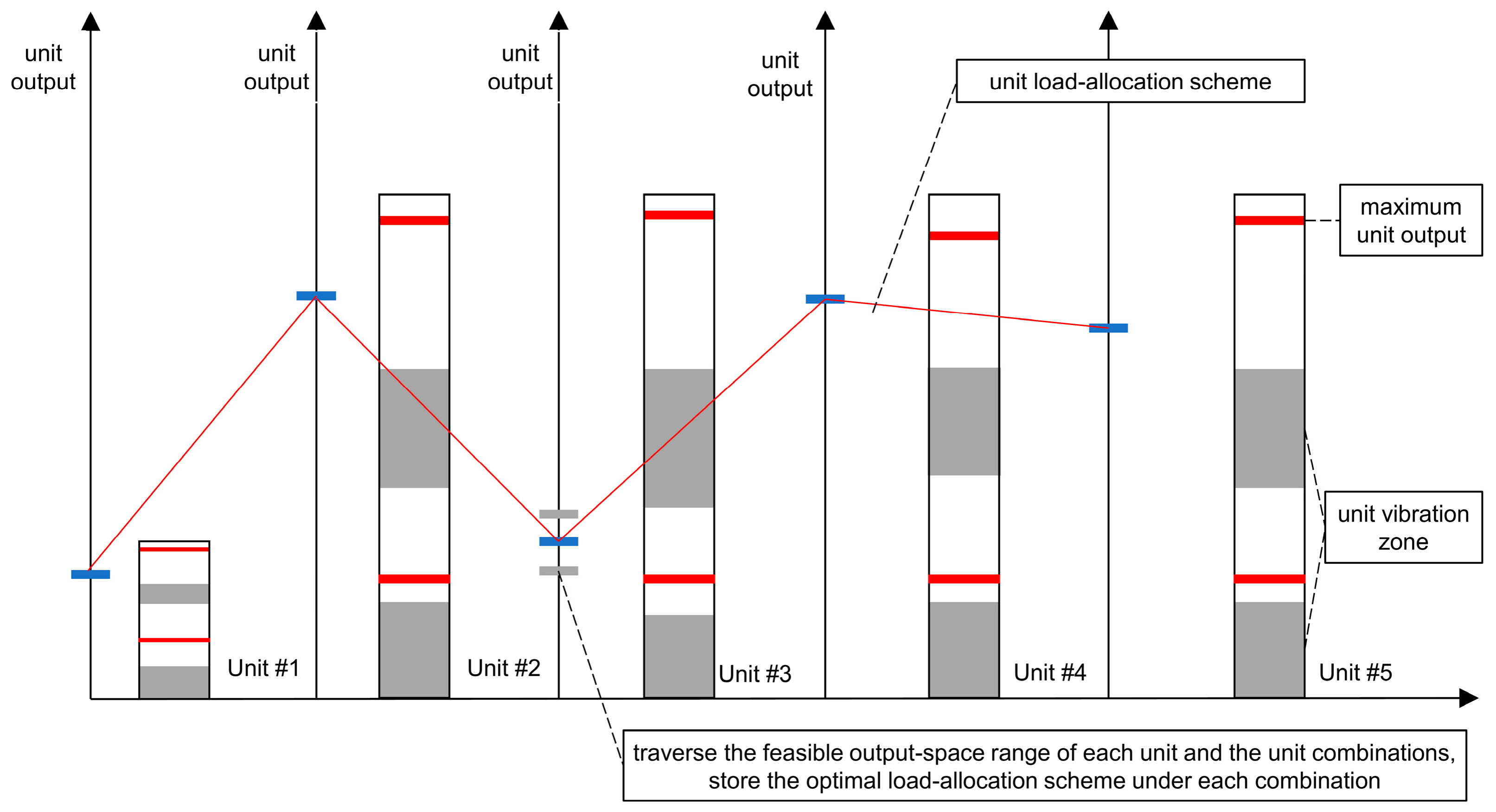
The parallel dynamic programming procedure is used solely in the offline phase to generate the static optimal load-allocation table; it is not executed during real-time dispatch. For each allowable unit-commitment combination, the discretized net-head level, and the discretized station-load level, an independent optimization subproblem is constructed [36]. These subproblems are solved in parallel to obtain the minimum-discharge unit-load-allocation scheme, and the results are stored in the static table. The algorithm flowchart is shown in Figure 1.
Figure 1.
Schematic diagram of static load allocation scheme solved by dynamic programming algorithm.
In the present case, 31 allowable unit-commitment combinations are considered. The net head is discretized with a step size of 1 m, and the station load is discretized with a step size of 1 MW. Parallelization is performed across independent combinations of unit commitment, net head, and station load, thereby reducing the wall-clock time required for offline table generation.
For each offline subproblem, the unit-commitment combination, net head, and total station load are fixed. The dynamic programming state variable, Ri, represents the remaining station load to be allocated when unit i is processed. The decision variable is the output Pi assigned to the current unit. At each stage, Pi is selected from the feasible output range after excluding the prohibited operating zones, and the remaining load is updated until the total station load has been fully allocated.
Step 1: Determine the different output ranges of the station and all allowable unit start–stop combinations according to different heads. When a unit is online, its status is marked as “1”; when it is offline, its status is marked as “0”.
Step 2: Select a single fixed unit combination. Traverse the station generation head with a step size of 1 m, determine the feasible output space of the current station according to the head range, and traverse the feasible total station load range with a step size of 1 MW.
Step 3: For the current net head, determine the prohibited operating-zone boundaries of each unit from the corresponding head-dependent unit operating data. The output intervals within the prohibited zones are removed from the feasible output range. The unit generation discharge at each remaining feasible output is then calculated from the cubic-spline-interpolated NQH relationship.
Step 4: Traverse the feasible output space of the currently online units, allocate the total station load among the units, and generate a set of different unit load-allocation schemes under the specified unit combination, total station load, and head.
Step 5: Compare different load-allocation schemes. With minimum water consumption as the objective, use the parallel dynamic programming algorithm to search for the optimal load-allocation scheme from unit #N to unit #1.
Step 6: For the current unit combination, solve and save the optimal load-allocation schemes under different heads and total station loads, thereby generating the static load-allocation table.
The proposed method was implemented in the IntelliJ IDEA 2024.1 (Ultimate Edition) development environment and executed on a server (Lenovo, Beijing, China) equipped with a 14-core, 20-thread CPU with a base clock frequency of 2.30 GHz. Because the offline dynamic programming procedure is a deterministic finite-state search rather than an iterative metaheuristic algorithm, no convergence tolerance is required. The calculation for a table entry is completed after all feasible discretized states associated with the specified unit combination, net head, and station load have been traversed, and the minimum-discharge scheme is retained. Let NC, NH, and NL denote the numbers of unit-commitment combinations, head levels, and load levels, respectively. The offline calculation consists of NC × NH × NL independent table-entry subproblems, which can be distributed among parallel computing workers.
2.2.2. Dynamic Load Allocation
The main strategies for dynamic load allocation while avoiding frequent unit start–stop operations and vibration zones are as follows:
- After the station status is updated, all feasible unit start–stop states for each period are determined according to the total station load in each period within the forecast horizon. Then, all feasible unit output combinations under the current head and current total load are retrieved from the overall load-allocation table. The unit allocation results for each period within the forecast horizon are combined to form several load-allocation schemes for the forecast horizon.
- Based on the output allocation in the previous period and the unit output combinations in each load-allocation scheme, the unit water consumption, penalty discharge for crossing vibration zones, and penalty discharge for unit start–stop operations within the forecast horizon are determined. These are then summed to obtain the total discharge of each load-allocation scheme within the forecast horizon, and the scheme with the minimum discharge is selected. The penalty settings used in the dynamic load-allocation procedure are identical to those defined in Equation (1).
- During real-time dispatch, the parallel dynamic programming procedure is not re-executed. Instead, the current net head, station load, and feasible unit-commitment states are used to retrieve candidate unit-load-allocation schemes from the precomputed static table. The candidate schemes are then evaluated by considering the previous operating state and the penalty discharges associated with unit start-up, shut-down, and prohibited-zone crossings. Under the 5 min dispatch interval adopted in this study, the table-lookup-based procedure completes one real-time load-allocation calculation in approximately 0.5 s, which is substantially shorter than one dispatch interval. The offline table-generation process is not repeated during each regulation interval; it is performed only when the unit performance data, operating constraints, or table discretization settings are updated. Thus, the proposed framework can provide a load-allocation recommendation within the required dispatch time window.
This scheme can effectively prevent units from frequently crossing vibration zones or undergoing frequent start–stop operations.
3. Results
3.1. Study Area and Data
Maerdang Hydropower Station is located on the main stem of the Yellow River, approximately 5 km upstream of Lajia Town, Maqin County, Golog Tibetan Autonomous Prefecture, Qinghai Province. It is the ninth cascade hydropower station on the Yellow River reach between the Longyangxia reservoir area and the Erduo River and is an important clean-energy source for west-to-east power transmission and the Qinghai-to-Henan transmission project. The main parameters are listed in Table 1. The normal and dead water levels are 3275 and 3240 m, respectively; total storage is 1.622 billion m3 and regulating storage is 0.706 billion m3, providing seasonal regulation. The station has an installed capacity of 2320 MW, comprising four 550 MW units (allowable maximum generation capacity: 520 MW) and one 120 MW unit. Unit 1 is the small-capacity unit, and Units 2–5 are the large-capacity units. As a main power source for peak regulation and frequency regulation in the Northwest China Power Grid, the station receives very frequent load-adjustment instructions from the grid.
Table 1.
Main parameters of Maerdang Hydropower Station.
3.2. Static Load-Allocation Table of the Hydropower Station
Maerdang Hydropower Station has five generating units, consisting of one turbine-generator unit with a unit capacity of 120 MW (Unit #1) and four units each with a unit capacity of 550 MW (Units #2, #3, #4, and #5). Unit #2 is equipped with a pressurized-water phase-modulation function. When Unit #2 performs pressurized-water phase modulation, it provides reactive power output, and its operating status is marked as 0.
There are 31 unit-combination modes for Maerdang Hydropower Station, with the combination modes numbered from No. 1 to No. 31. Among them, No. 1 is converted into the binary code “00001,” indicating that Units #2, #3, #4, and #5 are offline while Unit #1 is online. No. 15 is converted into the binary code “01111,” indicating that Unit #5 is offline while Units #1, #2, #3, and #4 are online. No. 31 is converted into the binary code “11111,” indicating that all five units are online.
Based on the operating-head range of 152–195.5 m and the discretized water-level and load ranges corresponding to the station’s maximum generation capacity of 2200 MW, a schematic static unit load-allocation table is constructed. Taking a head of 161 m and a total load of 899 MW as an example, the optimal load-allocation results of the station under different online-unit combinations are shown in Table 2.
Table 2.
Results of the static load-allocation table (partial).
Analysis of the static optimal load-allocation table shows that, under high-load conditions, when both two-unit and three-unit operation are feasible, fewer online units do not necessarily lead to lower water consumption. For example, at a head of 161 m and a total station load of 899 MW, the water consumption of two online units is 622.51 m3/s, whereas that of three online units is 612.95 m3/s.
3.3. Analysis of the Application Effect of the Load-Allocation Table
Taking each month of 2025 as the study period, the optimal load-allocation table of the station is used to simulate the actual operation process of the station, optimize the unit start–stop combinations and load-allocation strategy, and compare the results with the actual operation process.
3.3.1. Typical Scenario in the Dry Season
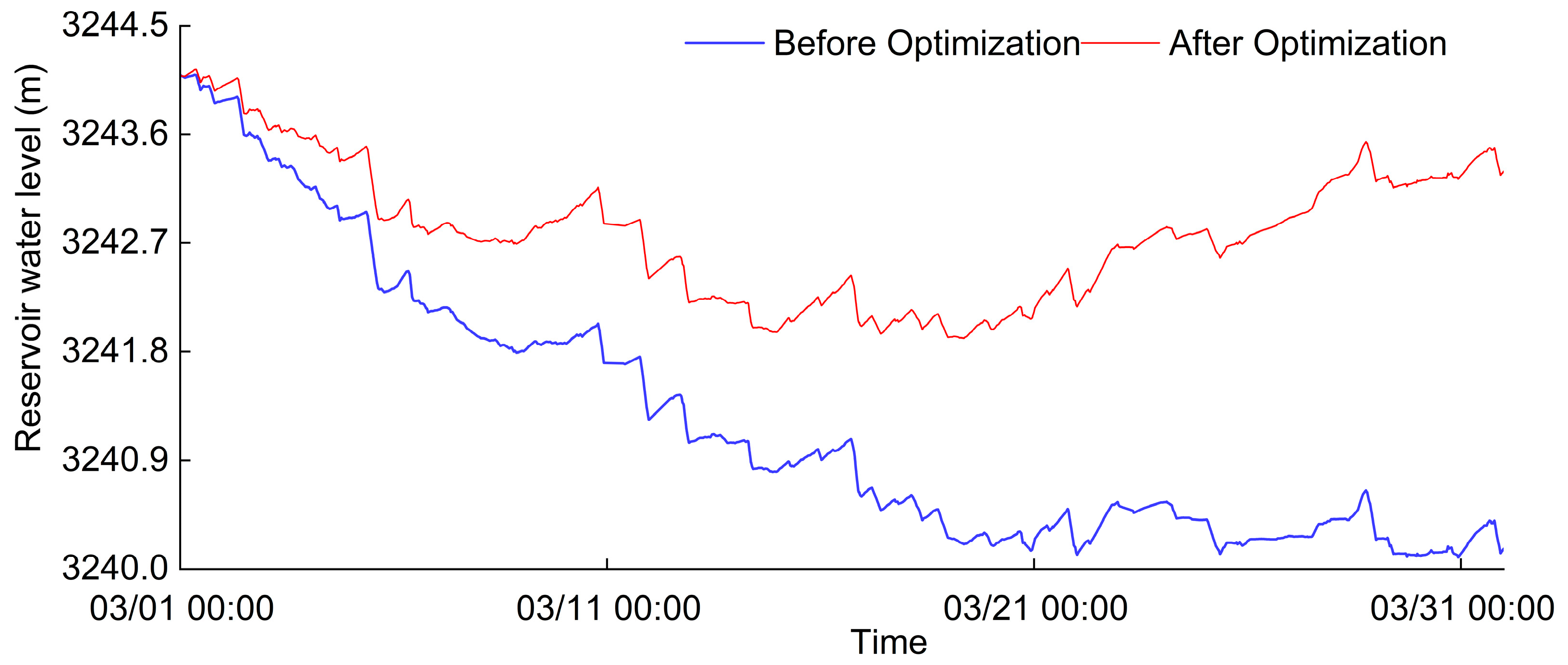
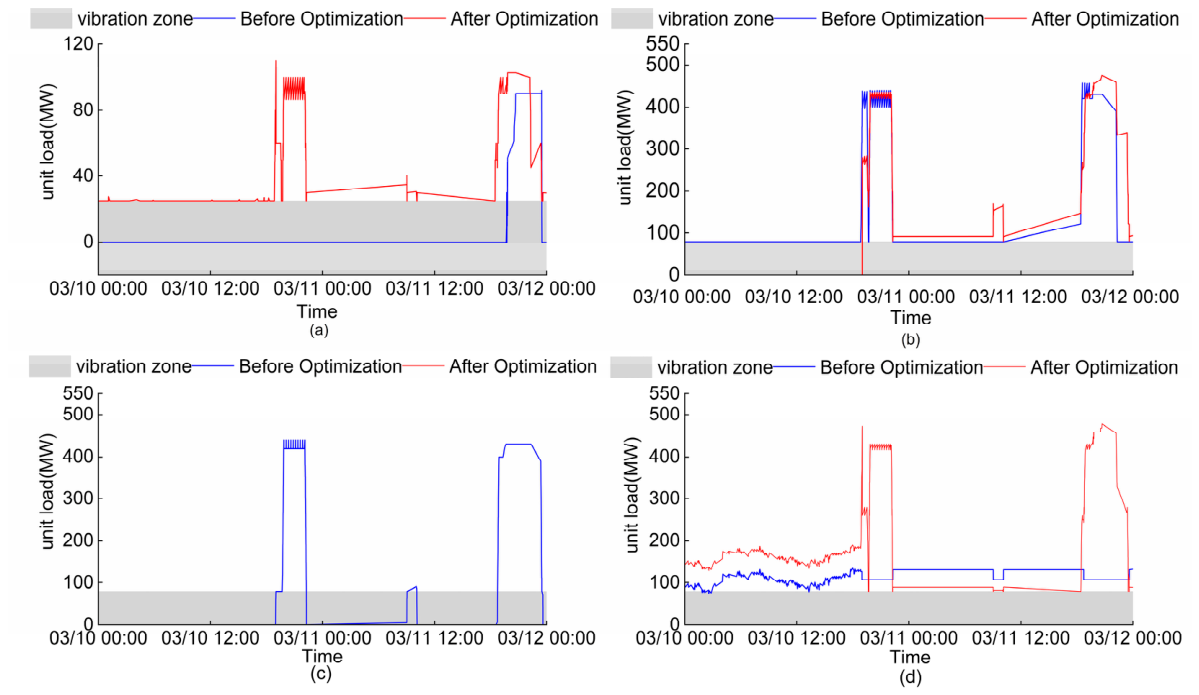
Taking the dry season, namely March, as an example, Maerdang Hydropower Station operated under low-water-level and low-load conditions during this period. The optimal load-allocation table of the station was used to simulate the actual operation process, optimize the unit start–stop combinations and load-allocation strategy, and compare the results with the actual operation process. The water-level processes and typical-day unit output processes before and after optimization are shown in Figure 2 and Figure 3.
Figure 2.
Water-level variation process of Maerdang Hydropower Station in a typical dry-season month.
Figure 3.
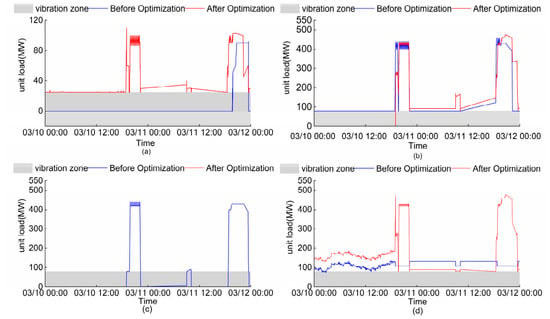
Unit output curves before and after optimization on a typical dry-season day at Maerdang Hydropower Station: (a) Unit 1; (b) Unit 3; (c) Unit 4; and (d) Unit 5. Unit 2 is not shown because it was not in operation on the selected dry-season day.
As shown in the water-level variations before and after optimization in Figure 2, during actual operation, the upstream water level decreased by 3.926 m, and the average water-consumption rate of the station was 2.882 m3/kW·h. After optimization, the water level decreased by 1.078 m, and the water-consumption rate was 2.737 m3/kW·h, representing a 5.03% decrease compared with the actual operation.
The unit operation processes shown in Figure 3 indicate clear differences in unit start–stop states and load allocation before and after optimization. In actual operation, when daytime load was relatively low, two large units were put into operation; during the evening peak period, three large units were put into operation. During this period, the three large units often operated with two units at high output and one unit at low output. After optimization, one small unit and one large unit were put into operation when daytime load was relatively low, while one small unit and two large units were put into operation during the evening peak period.
Taking the daytime period as an example, when one small unit and one large unit were in operation, the station’s water-consumption rate was significantly lower than that under the combination of two large units. Overall, during this period, the actual operation selected two large units during valley-load periods and three large units during peak-load periods, whereas the optimized unit-combination scheme preferentially selected one small unit plus one large unit during valley-load periods and one small unit plus two large units during peak-load periods. Under the same output conditions, the small unit had lower unit water consumption, and the optimized scheme effectively reduced the total plant water-consumption rate.
The unit operating conditions before and after optimization are shown in Table 3. In the actual operation of the station, there were 89 unit start–stop operations and 208 crossings of vibration zones. After optimization, the number of unit start–stop operations decreased to 40, and the number of vibration-zone crossings decreased to 42. Correspondingly, the low-efficiency operation time of units was reduced by 61.37% during the dry-season scenario.
Table 3.
Comparison of adverse operating conditions before and after optimization for Maerdang Hydropower Station in a typical dry-season month.
When high load peaks occurred during actual operation, the station met the load demand by starting an additional large unit. As a result, when the station operated at low output during the daytime, the additionally started unit frequently crossed the vibration zone and even shut down. In particular, Unit #5 operated under low-output conditions for a long period.
After optimization, the recommended scheme was to start one small unit and two large units. When the station load decreased during the daytime, all three units operated under low-output conditions, causing a slight increase in the water-consumption rate. However, when the load increased at night, the current unit combination could meet the sharply fluctuating load demand of the station, reduce the number of unit start–stop operations and vibration-zone crossings, decrease the water consumption caused by unit start–stop operations, and ensure the safe operation of the units.
3.3.2. Typical Scenario in the Flood Season
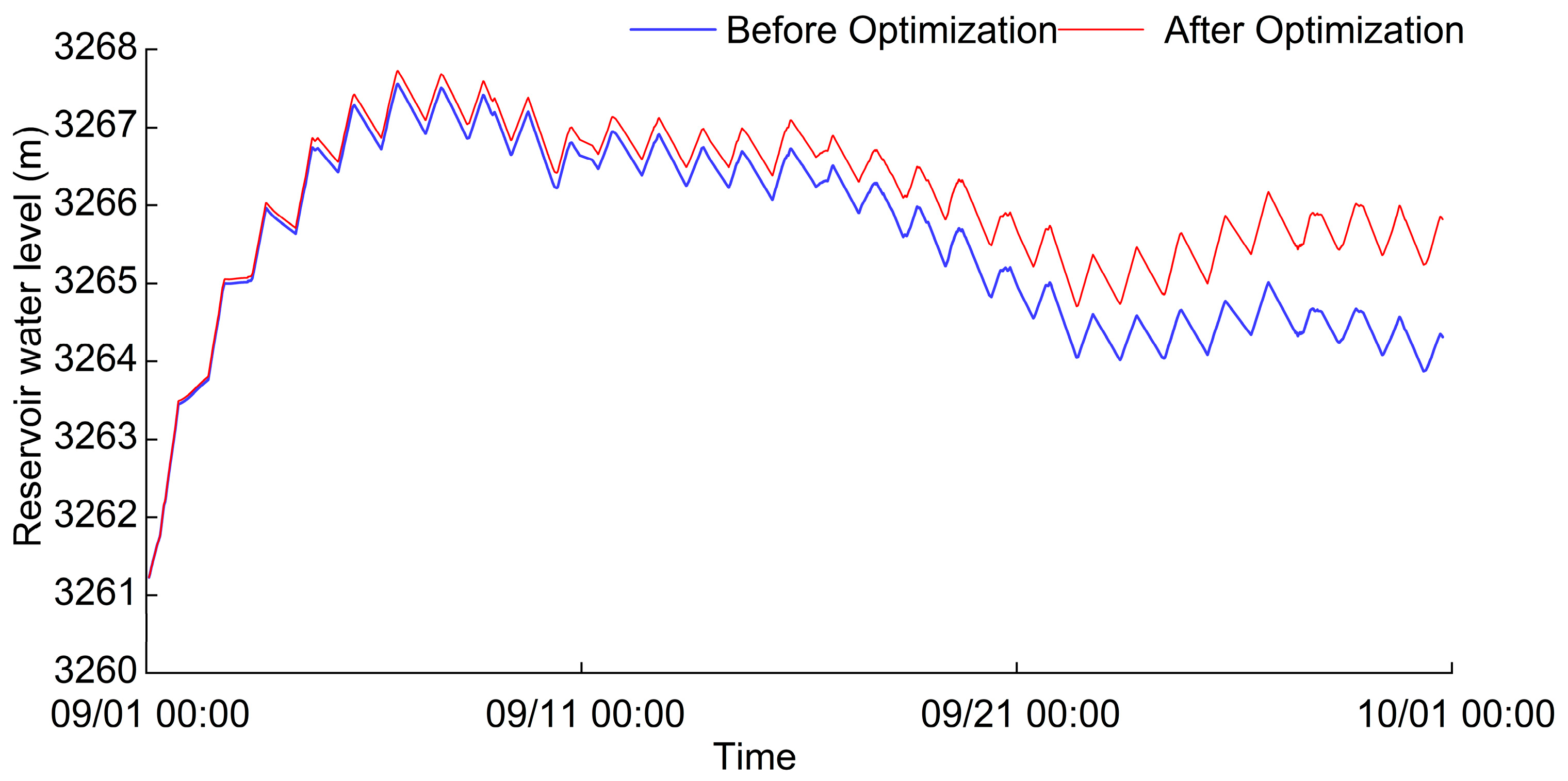
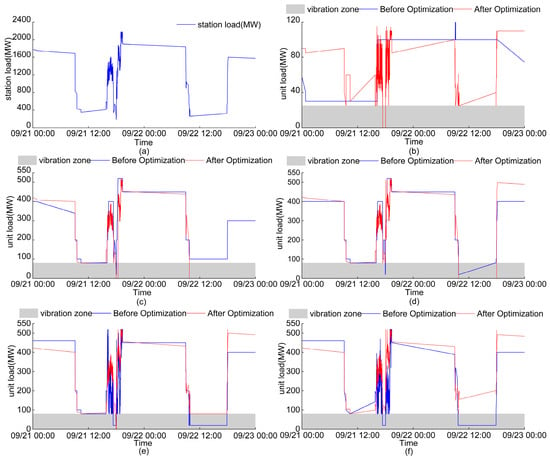
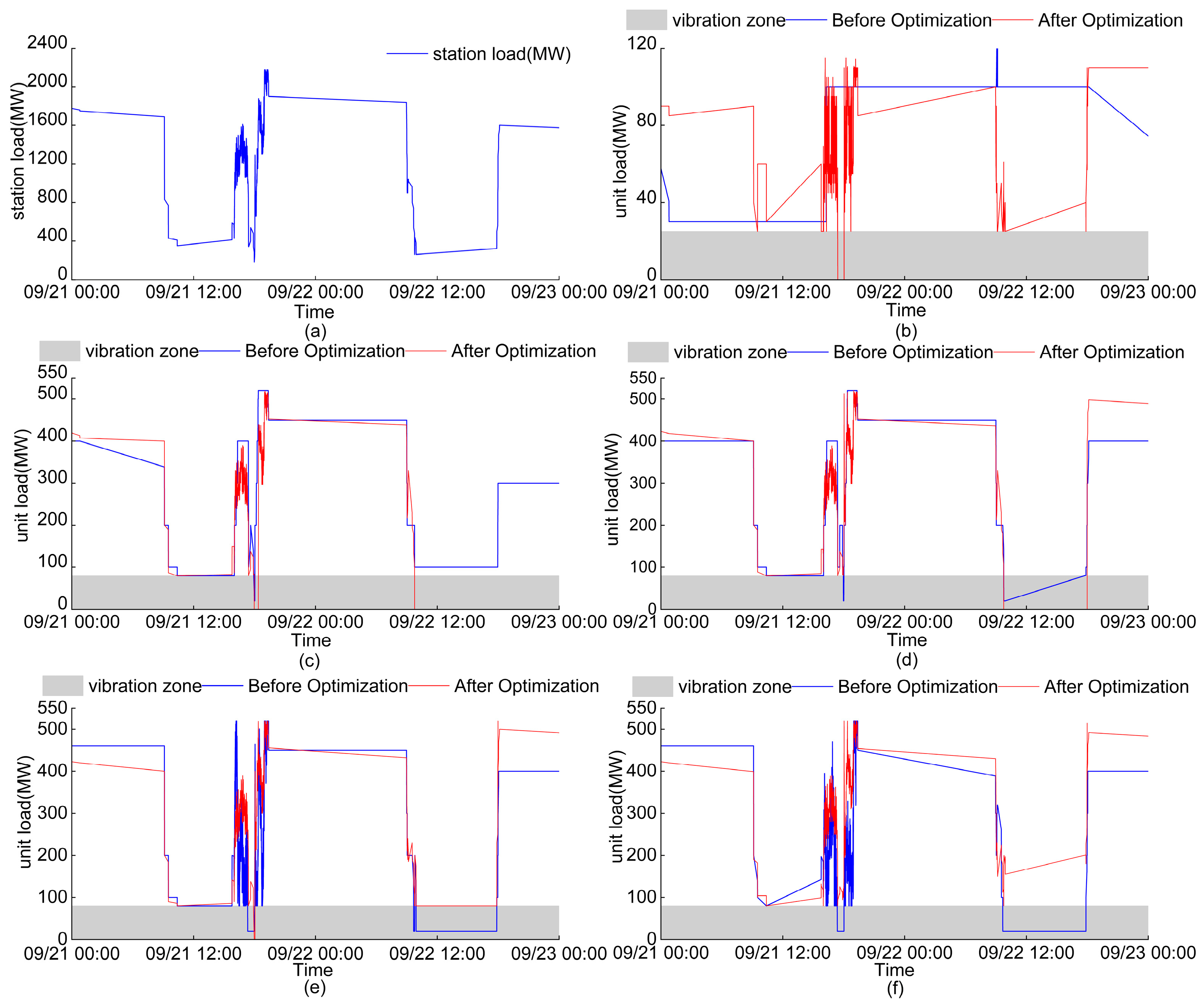
Taking the flood season, namely September, as an example, Maerdang Hydropower Station operated under high-water-level and high-load conditions during this period. The optimal load-allocation table of the station was used to simulate the actual operation process, optimize the unit start–stop combinations and load-allocation strategy, and compare the results with the actual operation process. The water-level processes and typical-day unit output processes before and after optimization are shown in Figure 4 and Figure 5.
Figure 4.
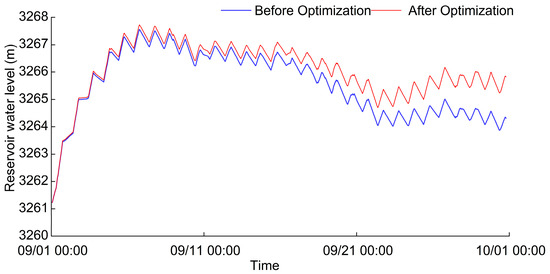
Water-level variation process of Maerdang Hydropower Station in a typical flood-season month.
Figure 5.
Output curves before and after optimization on a typical flood-season day at Maerdang Hydropower Station: (a) total station output; (b) Unit 1; (c) Unit 2; (d) Unit 3; (e) Unit 4; and (f) Unit 5.
During actual operation, the upstream water level increased by 3.08 m before optimization, and the average water-consumption rate of the station was 2.171 m3/kW·h. After optimization, the water level increased by 4.59 m, and the water-consumption rate was 2.137 m3/kW·h, representing a 1.57% decrease compared with the actual operation.
As shown in Figure 4, during this period, both nighttime inflow and load were relatively high. In actual operation, all five units were online, and the units operated with high efficiency. However, during the daytime valley-load period, the fully online unit combination entered a low-efficiency operating zone, and the generation water-consumption rate became higher than that at night. After optimization, one or two large units were preferentially shut down during low-load periods, ensuring that the online units still operated in the high-efficiency zone. Even after comprehensively considering the additional water consumption caused by unit start–stop operations, the optimized water-consumption rate remained lower than that of the actual operation.
The unit operating conditions before and after optimization are shown in Table 4. In actual operation, when the daytime load decreased to about 400 MW, the station reduced the output of all units to the low-efficiency zone to satisfy the output variation, causing the units to operate in the low-efficiency zone for a long time. The optimized unit-combination scheme recommended starting or stopping one or two large units to meet load-variation demands. Although the number of unit start–stop operations increased, the number of vibration-zone crossings and the water-consumption rate decreased significantly compared with the actual operation. Correspondingly, the low-efficiency operation time of units was reduced by 64.71% during the flood-season scenario.
Table 4.
Comparison of adverse operating conditions before and after optimization for Maerdang Hydropower Station in a typical flood-season month.
4. Discussion
4.1. Comparison with Existing Load-Dispatch Approaches
The proposed method is an offline–online decision framework rather than a new lookup-table architecture or a replacement for existing hydropower dispatch approaches. In contrast to approaches that use precomputed allocation results as direct operating recommendations, the static table in this study serves only as a generator of hydraulically feasible candidates; the final online recommendation is selected after considering the preceding unit state and the transition penalties associated with start-up, shutdown, and prohibited-zone crossing. Traditional dynamic programming (DP) yields transparent load allocation solutions, yet its computational burden rises rapidly with more units, head levels, load levels and operating states. This limitation is addressed by offline pre-solving load allocation under diverse net heads and station loads to build an optimal allocation table. During online operation, feasible candidates are retrieved from the precomputed table considering unit status and transition penalties, enabling real-time allocation within 0.5 s.
Mixed-integer linear programming (MILP) [37,38] systematically handles multiple operational constraints for unit commitment and dispatch. Nevertheless, nonlinear NQH characteristics and prohibited operating zones require linear approximation for MILP implementation [39]. In contrast, our method uses cubic spline interpolation for NQH data and excludes prohibited zones during table construction, better retaining the nonlinear operating features of hydropower units.
Data-driven and reinforcement learning methods enable fast real-time dispatch after training [40], but their performance strongly depends on training data quality, operating condition stability and model generalization. Compared with these approaches, the lookup-table strategy is more transparent and easier for operators to verify, as all candidate schemes follow explicit hydraulic constraints. This study does not claim universal superiority over MILP or reinforcement learning.
Benchmark tests under identical constraints and datasets for dry- and flood-season typical cases are conducted to quantify optimality and computational performance. Three approaches are compared: the proposed offline–online table-driven DP, a piecewise-linear MILP formulation, and an improved PSO metaheuristic. A state-of-the-art commercial MILP solver is adopted to obtain near-global-optimum reference solutions for the piecewise-linear MILP. For the MILP, cubic-spline-interpolated NQH curves are converted into piecewise-linear segments. The improved PSO adopts a population size of 80 and a maximum of 200 iterations; ten independent runs are performed and the best-found solution is retained. Key metrics are summarized in Table 5.
Table 5.
Performance comparison among three optimization approaches under typical dry- and flood-season scenarios.
As shown in Table 5, MILP provides the best objective values as a near-globally optimal reference. However, its online computation time of 18.2–26.7 s cannot satisfy the sub-second real-time requirement of the Maerdang Hydropower Station. The improved PSO has moderate computation speed but yields larger discharge values due to heuristic randomness. Our method achieves objective results within 0.3% of the MILP benchmark, with online lookup completed in ~0.5 s. Note that one-time offline computation is required to generate the allocation table; once ready, no heavy optimization runs are needed online. This trade-off between one-off offline overhead and ultra-fast online response fits practical engineering deployment well.
4.2. Practical Application and Applicability
The proposed method has been implemented in the self-developed Economic Operation Application System for Maerdang Hydropower Station (version 1.0), which has been deployed at the station. The main implementation challenges involved restricted access to the production system and coordination among multiple stakeholders, since system updates and tests required authorized on-site personnel and stakeholder feedback led to several rounds of modification. Practical deployment should therefore also consider interface compatibility, access control, version management, and consistency between precomputed results and current unit conditions. The method is not limited to a specific turbine type or head range and can also be applied to low-head units, such as Kaplan and bulb turbines, by incorporating their characteristic curves and operating constraints. For units with significant dynamic-response characteristics, ramp-rate limits, response delays, minimum startup and shutdown times, and hydraulic transient effects should also be considered through transition penalties or explicit dynamic constraints [41].
4.3. Sensitivity Analysis of Empirical Transition Penalty Parameters
The baseline model uses a common equivalent transition penalty of 30 m3/s for unit start-up, shutdown, and prohibited-zone crossing. This setting is an engineering simplification rather than an assertion that the three transition processes have identical physical water losses. The 30 m3/s value for start-up and shutdown was selected from field-observed representative equivalent additional discharge, whereas the same value for prohibited-zone crossing was adopted as a surrogate decision weight to discourage unnecessary transient passage through vibration zones. To examine the effect of this common-weight assumption on dispatch behavior, a sensitivity test over penalty values from 10 m3/s to 100 m3/s was performed using the September flood-season dataset. Table 6 summarizes the resulting total unit start-up counts, prohibited-zone-crossing counts, and low-efficiency operating hours.
Table 6.
Sensitivity of dispatch performance under different equivalent transition penalty values (September flood-season scenario).
As illustrated in Table 6, penalty magnitude imposes clear trade-offs between unit transition actions and low-efficiency operation duration. When penalty values are low (10–30 m3/s), the optimization model bears low costs for start–stop and zone-crossing actions. Consequently, the model tends to adopt frequent unit switching to reduce low-efficiency runtime; however, frequent transitions will aggravate mechanical wear and fatigue risk of generating units [42]. As penalty increases from 10 m3/s to 30 m3/s, total start-up events and prohibited-zone crossings decrease gradually, while low-efficiency operating hours rise. When penalty reaches or exceeds 40 m3/s, further increases in penalty bring almost no change to the output indices. Under large penalty weights, the model tends to suppress unit start–stop and prohibited-zone-crossing behaviors as much as possible, even at the cost of accepting longer low-efficiency operation periods.
For Maerdang Hydropower Station, excessive start–stop and vibration-zone-crossing events should be restrained to protect large-capacity units, whereas prolonged low-efficiency operation increases generation discharge. As shown in Table 6, increasing the common penalty from 20 m3/s to 30 m3/s reduces both the total start-up count and prohibited-zone-crossing count from 224 to 200. Increasing the penalty further to 40 m3/s does not reduce these transition counts further, but increases low-efficiency operating time from 128.44 h to 129.02 h. Therefore, 30 m3/s was retained as the baseline common penalty because it provides the lowest tested penalty level that achieves the stabilized transition count without unnecessarily increasing low-efficiency operation.
This sensitivity analysis evaluates the robustness of the common-penalty assumption; it does not establish physical equivalence among start-up, shutdown, and prohibited-zone crossing. Where detailed event-specific monitoring data are available, future implementations may use differentiated values of QSU, QSD, and Qcross calibrated separately for the target hydropower station.
4.4. Limitations and Future Research
Several limitations should be acknowledged. First, the proposed method was validated using one hydropower station with five units; its applicability to stations with different unit types, larger unit numbers, or cascade-reservoir systems requires further verification. Second, the NQH curves, prohibited operating zones, and penalty discharge parameters were treated as predetermined inputs. In particular, the prohibited operating zones were represented by fixed output intervals over the investigated net-head range in accordance with the current station operating rules. This simplification may not fully capture shifts in vibration, cavitation, or pressure-pulsation boundaries caused by changes in net head, tailwater level, unit condition, or maintenance status. In practice, these characteristics may vary because of unit aging, maintenance conditions, sediment effects, or changes in operating rules. Third, the current framework focuses on unit-level load allocation and does not explicitly consider uncertainties in inflow, load forecasting, electricity prices, or ancillary-service requirements [43,44].
Future work should therefore: (1) validate the method at additional hydropower stations and under more diverse operating scenarios; (2) develop head-resolved prohibited-zone boundaries using multi-head vibration tests, condition-monitoring data, and online updating mechanisms for NQH curves and transition-penalty parameters; (3) incorporate uncertainty in reservoir inflow, grid demand, renewable generation, ancillary-service requests, and hydraulic conditions through robust, stochastic, or model-predictive optimization, and evaluate dispatch performance under forecast-error scenarios; (4) extend the framework to coordinate unit dispatch with reservoir operation, cascade scheduling [45], and ancillary-service requirements, while explicitly representing unit ramp-rate limits, minimum up and down times, response delays, and hydraulic-transient effects, including water hammer.
5. Conclusions
This study addresses the real-time dispatching challenge of economic operation for large hydropower stations. An in-plant economic-operation model considering both water-consumption rate and operating conditions is constructed, and an optimal load-allocation result table under different loads, heads, and unit start–stop combinations is proposed to guide real-time in-plant economic operation and achieve optimal operational benefits of the station. The results show that:
- (1)
- Under low-water-level and low-load conditions in March, the actual water-consumption rate of the station was relatively high, at 2.882 m3/kW·h. The optimization model preferentially increased the operating duration of the small unit and reduced the operating time of large units in low-efficiency zones, further reducing the water-consumption rate to 2.737 m3/kW·h, a decrease of 5.03% compared with the actual operation. Meanwhile, the low-efficiency operation time of units was reduced by 61.37%.
- (2)
- Under medium-to-high-water-level and high-load conditions in September, the average water-consumption rate of the station during actual operation was 2.171 m3/kW·h. By optimizing the unit combination and reducing the operating time of units in low-efficiency zones, the optimization model reduced the water-consumption rate to 2.137 m3/kW·h, a decrease of 1.57% compared with the actual operation. Meanwhile, the low-efficiency operation time of units was reduced by 64.71%.
- (3)
- The proposed optimization model can adjust operation strategies according to different hydrological and load conditions. By optimizing unit combinations and reducing low-efficiency operating time, it effectively lowers the generation water-consumption rate of the station, improves operational economy, and provides support for economic-operation decision-making for large hydropower stations under different operating conditions.
Author Contributions
Conceptualization, H.L.; methodology, F.G.; software, Y.H. and E.W.; data curation, W.W. and D.L.; writing—original draft preparation, F.G. and S.J.; writing—review and editing, Q.J. and Z.W.; supervision, Y.L. and H.L. All authors have read and agreed to the published version of the manuscript.
Funding
This research was funded by the National Natural Science Foundation of China (grant number 52509013), Basic Research Program of Jiangsu (grant number BK20251494), and National Energy Group’s Science and Technology Innovation Project (GNQH-2025-02).
Institutional Review Board Statement
Not Applicable.
Informed Consent Statement
Not Applicable.
Data Availability Statement
This study used third party data made available under license that the authors do not have permission to share.
Conflicts of Interest
Authors Faying Gu, Yongsheng Liu, Yongwei Han, Qingsong Jiang, Enzhong Wang, Hongxu Liu, Wenji Wang, Shuai Jin, Donghang Li and Zhenni Wang were employed by the company National Energy Group Qinghai Electric Power Co., Ltd. All authors declare that the research was conducted in the absence of any commercial or financial relationships that could be construed as a potential conflict of interest.
References
- Bortoni, E.C.; Bastos, G.S.; Souza, L.E. Optimal load distribution between units in a power plant. ISA Trans. 2007, 46, 533–539. [Google Scholar] [CrossRef] [Scilit] [PubMed]
- Liu, F.S.; Huang, K.; Shi, X.Y.; Zhao, L.Q.; Yu, Y.X.; Ai, X.S. Study on the peak shaving operation of cascade hydropower stations based on the plant-wide optimal curve. Int. J. Electr. Power Energy Syst. 2025, 170, 110920. [Google Scholar] [CrossRef] [Scilit]
- Gernaat, D.E.H.J.; de Boer, H.S.; Daioglou, V.; Yalew, S.G.; Muller, C.; van Vuuren, D.P. Climate change impacts on renewable energy supply. Nat. Clim. Chang. 2021, 11, 119–125, Correction in Nat. Clim. Chang. 2021, 11, 362. https://doi.org/10.1038/s41558-021-01005-w. [Google Scholar] [CrossRef] [Scilit]
- Huang, K.; Liu, P.; Ming, B.; Kim, J.S.; Gong, Y. Economic operation of a wind-solar-hydro complementary system considering risks of output shortage, power curtailment and spilled water. Appl. Energy 2021, 290, 116805. [Google Scholar] [CrossRef] [Scilit]
- Ming, B.; Liu, P.; Guo, S.; Cheng, L.; Zhou, Y.; Gao, S.; Li, H. Robust hydroelectric unit commitment considering integration of large-scale photovoltaic power: A case study in China. Appl. Energy 2018, 228, 1341–1352. [Google Scholar] [CrossRef] [Scilit]
- Liu, P.; Nguyen, T.D.; Cai, X.; Jiang, X. Finding multiple optimal solutions to optimal load distribution problem in hydropower plant. Energies 2012, 5, 1413–1432. [Google Scholar] [CrossRef] [Scilit]
- Lee, E.; Ji, J.; Yi, S.; Yoon, J.; Yi, J. A specific energy-based operational strategy for improving hydropower generation efficiency. Water 2026, 18, 1114. [Google Scholar] [CrossRef] [Scilit]
- Wu, X.; Wu, Y.; Cheng, X.; Cheng, C.; Li, Z.; Wu, Y. A mixed-integer linear programming model for hydro unit commitment considering operation constraint priorities. Renew. Energy 2023, 204, 507–520. [Google Scholar] [CrossRef] [Scilit]
- Chang, J.X.; Li, Y.Y.; Yuan, M.; Wang, Y.M. Efficiency evaluation of hydropower station operation: A case study of Longyangxia station in the Yellow River, China. Energy 2017, 135, 23–31. [Google Scholar] [CrossRef] [Scilit]
- Yang, L.; Yang, K.; Chen, L. Application research of the improved overall temporal and spatial economic operation model based on information entropy in large-scale hydropower station. Water Resour. Manag. 2018, 32, 2437–2456. [Google Scholar] [CrossRef] [Scilit]
- Li, R.; Xiao, K.; Lan, J.; Cai, L.; Huang, X. Optimization of cascade small hydropower station operation in the Jianhe River Basin using a one-dimensional hydrodynamic model. Sustainability 2023, 15, 12138. [Google Scholar] [CrossRef] [Scilit]
- Pan, H.; Yang, J.; Yu, Y.; Zheng, Y.; Zheng, X.N.; Hang, C.Y. Intelligent low-consumption optimization strategies: Economic operation of hydropower stations based on improved LSTM and random forest machine learning algorithm. Mathematics 2024, 12, 1292. [Google Scholar] [CrossRef] [Scilit]
- Perez-Diaz, J.I.; Wilhelmi, J.R.; Arevalo, L.A. Optimal short-term operation schedule of a hydropower plant in a competitive electricity market. Energy Convers. Manag. 2010, 51, 2955–2966. [Google Scholar] [CrossRef] [Scilit]
- Finardi, E.C.; Scuzziato, M.R. Hydro unit commitment and loading problem for day-ahead operation planning problem. Int. J. Electr. Power Energy Syst. 2013, 44, 7–16. [Google Scholar] [CrossRef] [Scilit]
- Wu, Y.; Liao, S.; Liu, B.; Cheng, C.; Zhao, H.; Fang, Z.; Lu, J. Short-term load distribution model for cascade giant hydropower stations with complex hydraulic and electrical connections. Renew. Energy 2024, 232, 121067. [Google Scholar] [CrossRef] [Scilit]
- Liao, S.; Yang, H.; Liu, B.; Zhao, H.; Liu, H.; Ma, X.; Wu, H. Short-term load dispatching method for a diversion hydropower plant. Energies 2019, 12, 1476. [Google Scholar] [CrossRef] [Scilit]
- Parvez, I.; Shen, J.; Khan, M.; Cheng, C. Modeling and solution techniques used for hydro generation scheduling. Water 2019, 11, 1392. [Google Scholar] [CrossRef] [Scilit]
- Cheng, C.T.; Liao, S.L.; Tang, Z.T.; Zhao, M.Y. Comparison of particle swarm optimization and dynamic programming for large-scale hydro unit load dispatch. Energy Convers. Manag. 2009, 50, 3007–3014. [Google Scholar] [CrossRef] [Scilit]
- Bellman, R.E.; Dreyfus, S.E. Applied Dynamic Programming; Princeton University Press: Princeton, NJ, USA, 1962. [Google Scholar]
- Larson, R.E.; Korsak, A.J. A dynamic programming successive approximations technique with convergence proofs. Automatica 1970, 6, 245–252. [Google Scholar] [CrossRef] [Scilit]
- Finardi, E.C.; da Silva, E.L. Solving the hydro unit commitment problem via dual decomposition and sequential quadratic programming. IEEE Trans. Power Syst. 2006, 21, 835–844. [Google Scholar] [CrossRef] [Scilit]
- Paredes, M.; Martins, L.S.A.; Soares, S. Using semidefinite relaxation to solve the day-ahead hydro unit commitment problem. IEEE Trans. Power Syst. 2015, 30, 2695–2705. [Google Scholar] [CrossRef] [Scilit]
- Amani, A.; Alizadeh, H. Solving hydropower unit commitment problem using a novel sequential mixed integer linear programming approach. Water Resour. Manag. 2021, 35, 1711–1729. [Google Scholar] [CrossRef] [Scilit]
- Yang, K.; Yang, K. Improved whale algorithm for economic load dispatch problem in hydropower plants and comprehensive performance evaluation. Water Resour. Manag. 2022, 36, 5823–5838. [Google Scholar] [CrossRef] [Scilit]
- Wang, X.Y.; Yang, K. Economic load dispatch of renewable energy-based power systems with high penetration of large-scale hydropower station based on multi-agent glowworm swarm optimization. Energy Strategy Rev. 2019, 26, 100425. [Google Scholar] [CrossRef] [Scilit]
- Khorasani, J. A new heuristic approach for unit commitment problem using particle swarm optimization. Arab J. Sci. Eng. 2012, 37, 1033–1042. [Google Scholar] [CrossRef] [Scilit]
- Zeng, Y.; Wen, X.; Tan, Q.; Liu, Y.; Chen, X. Real-time load dispatch in hydropower plant based on D3QN-PER. J. Hydrol. 2023, 625, 130019. [Google Scholar] [CrossRef] [Scilit]
- Bortoni, E.C.; Bastos, G.S.; Abreu, T.M.; Kawkabani, B. Online optimal power distribution between units of a hydro power plant. Renew. Energy 2015, 75, 30–36. [Google Scholar] [CrossRef] [Scilit]
- Shen, J.; Hu, L.; Cheng, C.; Wang, S. Automatic Generation Control of a Large Hydropower Plant with Head-Sensitive Forbidden and Restricted Zones. IET Renew. Power Gener. 2020, 14, 1113–1123. [Google Scholar] [CrossRef] [Scilit]
- Gao, Y.; Xu, W.; Wang, Y.-L.; Wen, X. Study on Internal Economic Operation of Large Hydropower Station Based on Load Optimal Distribution Table. Water Resour. Power 2023, 41, 197–201. [Google Scholar] [CrossRef]
- Zhao, Z.; Cheng, C.; Jin, X.; Liu, L.; Yan, L. A MILP model for hydro unit commitment with irregular vibration zones based on the constrained Delaunay triangulation method. Int. J. Electr. Power Energy Syst. 2020, 123, 106241. [Google Scholar] [CrossRef] [Scilit]
- de Boor, C. A Practical Guide to Splines; Springer: New York, NY, USA, 2001; Volume 27. [Google Scholar]
- Borghetti, A.; D’Ambrosio, C.; Lodi, A.; Martello, S. An MILP Approach for Short-Term Hydro Scheduling and Unit Commitment with Head-Dependent Reservoir. IEEE Trans. Power Syst. 2008, 23, 1115–1124. [Google Scholar] [CrossRef] [Scilit]
- Cheng, C.T.; Wang, J.Y.; Wu, X.Y. Hydro Unit Commitment with a Head-Sensitive Reservoir and Multiple Vibration Zones Using MILP. IEEE Trans. Power Syst. 2016, 31, 4842–4852. [Google Scholar] [CrossRef] [Scilit]
- Liu, S.; Wang, P.; Xu, Z.; Feng, Z.; Zhang, C.; Wang, J.; Chen, C. Hydropower unit commitment using a genetic algorithm with dynamic programming. Energies 2023, 16, 5842. [Google Scholar] [CrossRef] [Scilit]
- Feng, Z.K.; Niu, W.J.; Cheng, C.T.; Wu, X.Y. Optimization of hydropower system operation by uniform dynamic programming for dimensionality reduction. Energy 2017, 134, 718–730. [Google Scholar] [CrossRef] [Scilit]
- Cheng, X.; Feng, S.; Zheng, H.; Wang, J.; Liu, S. A hierarchical model in short-term hydro scheduling with unit commitment and head-dependency. Energy 2022, 251, 123908. [Google Scholar] [CrossRef] [Scilit]
- Huang, J.; Qin, H.; Yang, X.; Shen, K.; Yao, H.; Chang, X.; Li, G.; Gao, Y. Framework for short-term hydropower cascade–station–unit integrated multi-objective scheduling: Considering unit safety and economic efficiency. J. Hydrol. 2025, 653, 132756. [Google Scholar] [CrossRef] [Scilit]
- Heintzmann, A.; Artigues, C.; Bendotti, P.; Ngueveu, S.U.; Rottner, C. A comparison of alternative models for solving a non-linear single plant Hydro Unit Commitment problem. Comput. Oper. Res. 2024, 165, 106591. [Google Scholar] [CrossRef] [Scilit]
- Liu, D.; Lv, J.; Yue, X.; Malik, O.P. Intelligent algorithm-assisted short-term load economic distribution at the unit level of a cascaded hydropower station. Energy Convers. Manag. 2025, 343, 120185. [Google Scholar] [CrossRef] [Scilit]
- Cheng, F.; Wang, P.; Gu, Y.; Guo, J.; Zhang, F.; Yuan, F.; Hu, C. Coordinated scheduling of hydropower units: Risk-aware day-ahead planning and performance-driven intra-day regulation allocation. Energy 2025, 340, 139218. [Google Scholar] [CrossRef] [Scilit]
- Cheng, F.; Wang, P.; Gu, Y.; Yuan, F.; Guo, J.; Zhang, F.; Hu, C. A segmented optimization HUC model considering refined vibration zone characteristics and predictive risk control strategy. Energy 2025, 337, 138553. [Google Scholar] [CrossRef] [Scilit]
- Jia, R.; He, M.; Zhang, X.; Zhao, Z.; Han, S.; Jurasz, J.; Chen, D.; Xu, B. Optimal operation of cascade hydro-wind-photovoltaic complementary generation system with vibration avoidance strategy. Appl. Energy 2022, 324, 119735. [Google Scholar] [CrossRef] [Scilit]
- Yan, M.; Huang, X.; Fang, G.; Ding, Z.; Li, X. Assessing the adjustment flexibility of hydropower plant precisely and optimizing its load distribution considering the constraint of flexible margin. Renew. Energy 2026, 256, 124219. [Google Scholar] [CrossRef] [Scilit]
- Zhao, Z.; Han, Y.; Liu, B.; Tang, J.; Wang, J.; Cheng, C.; Feng, Z. Day-ahead optimal scheduling for cascade hydropower units to mitigate vibration zone crossing induced by intra-day flexibility response. Appl. Energy 2026, 415, 127946. [Google Scholar] [CrossRef] [Scilit]

Disclaimer/Publisher’s Note: The statements, opinions and data contained in all publications are solely those of the individual author(s) and contributor(s) and not of MDPI and/or the editor(s). MDPI and/or the editor(s) disclaim responsibility for any injury to people or property resulting from any ideas, methods, instructions or products referred to in the content. |
© 2026 by the authors. Licensee MDPI, Basel, Switzerland. This article is an open access article distributed under the terms and conditions of the Creative Commons Attribution (CC BY) license.