


Abstract
Soil water deficiency is an important constraint on agricultural productivity and ecological restoration in loess regions. This study investigated the effects of red mud iron-separation residue (RMR), an industrial solid waste, and biochar (BC), applied individually and in combination, on the water-retention and hydraulic properties of loess through laboratory column experiments. Twenty-five treatments were evaluated by measuring cumulative soil-water evaporation, field water capacity, and saturated hydraulic conductivity. Evaporation dynamics were described using the empirical evaporation model , where S is the linear-time coefficient, and A is the square-root-of-time coefficient. Among the individual treatments, 1% and 1.5% RMR produced the lowest cumulative evaporation (21.78 mm) within the RMR-only groups, while 4% BC produced the lowest value (20.04 mm) within the BC-only groups. The combination of 1.5% RMR and 3% BC produced the lowest observed cumulative evaporation (17.48 mm), representing a reduction of approximately 28% relative to the control. Under this treatment, field water capacity increased by 12 percentage points (approximately 73% relative to the control), while saturated hydraulic conductivity decreased by approximately 46%. Model fitting showed a 57% decrease in S and a 14% increase in A relative to the control. These findings demonstrate treatment-dependent changes in soil-water behaviour under laboratory conditions. However, the effects of combined RMR–BC application on amended-soil chemistry, plant-available water, crop performance, and environmental safety remain to be established.
1. Introduction
Water scarcity is a critical limiting factor for agricultural production and ecosystem stability in arid and semiarid regions [1]. The Loess Plateau is one of the most representative loess regions worldwide, where soils are highly susceptible to water loss due to their loose structure, weak aggregation, and low organic matter content [2]. Degraded loess landscapes in arid and semiarid regions are particularly vulnerable to soil moisture deficits due to limited precipitation, substantial evaporative losses, and water uptake by vegetation. These conditions can constrain vegetation establishment and persistence, making it difficult to maintain ecological restoration over time [3,4,5]. Improving the water-retention capacity of degraded loess is essential for sustainable land use, soil and water conservation, and ecological restoration [6].
Various organic and inorganic amendments have been investigated to improve soil physical properties. Organic amendments include biochar, compost, animal manure, and sewage sludge, while inorganic amendments include gypsum, phosphogypsum, and lime [7]. Industrial by-products such as fly ash have also been investigated, either individually or in combination with other amendments, for soil amelioration [8]. Among these materials, biochar has attracted considerable attention because of its potential to modify soil physical and hydraulic properties. A meta-analysis by Edeh et al. [9] demonstrated that biochar application can increase field capacity and available water content, although its effects on saturated hydraulic conductivity vary with soil texture, biochar characteristics, and application rate. Other studies have also demonstrated that biochar application can improve soil water-holding capacity and modify soil physical properties [10,11,12,13]. However, these findings are not specific to arid and semiarid loess environments, where soil characteristics and environmental conditions may influence amendment responses.
The potential reuse of red mud iron-separation residue (RMR) as a soil amendment warrants investigation because it could connect industrial waste utilization with soil improvement. Red mud is a highly alkaline solid waste generated during alumina production via the Bayer process [14]. Following iron extraction, the remaining RMR retains mineral components, including aluminosilicate phases [15,16]. However, the alkaline characteristics and chemical composition of RMR require careful consideration when evaluating its suitability for soil application [17,18]. The effects of RMR on soil-water retention and hydraulic behaviour in degraded loess therefore require experimental investigation. Combining RMR with biochar provides an opportunity to examine the soil-water response of an inorganic industrial residue and an organic amendment applied together.
Previous studies have investigated the combined application of organic and inorganic amendments for soil improvement [7,8]. Research has also demonstrated that interactions between biochar (BC) and soil minerals can influence soil aggregate stability [19], while biochar application can modify soil aggregation, water retention, and other physical properties [10]. However, the effects of combining RMR, obtained after iron extraction, with BC on the water-retention properties of degraded loess remain insufficiently understood. In particular, the responses of cumulative soil-water evaporation, field water capacity, and saturated hydraulic conductivity to different RMR–BC application combinations require further investigation. This study therefore evaluates the individual and combined effects of RMR and BC across different application rates to characterize their effects on these soil-water properties.
The temporal dynamics of soil-water evaporation provide information beyond cumulative evaporation measurements at a single time point. In the present study, cumulative evaporation was described using the empirical model , comprising linear-time and square-root-of-time components [20]. This model enables the evaporation trajectories of individual and combined amendment treatments to be summarized and compared using fitted coefficients. The coefficients describe the mathematical relationship between cumulative evaporation and elapsed time and should not be interpreted as independently measured soil hydraulic properties.
Therefore, this study aimed to (1) evaluate and compare the effects of individual and combined applications of red mud iron-separation residue (RMR) and biochar (BC) at different application rates on cumulative soil-water evaporation, field water capacity, and saturated hydraulic conductivity of degraded loess and (2) characterize the temporal dynamics of cumulative soil-water evaporation under different amendment treatments using the Rose empirical model [20].
Based on previous evidence concerning the effects of biochar and mineral amendments on soil-water behaviour, we hypothesized that RMR and BC application would reduce cumulative soil-water evaporation and increase field water capacity relative to untreated loess. We further hypothesized that saturated hydraulic conductivity would respond to amendment application rate and that some combined RMR–BC treatments would produce greater reductions in evaporation and greater increases in field water capacity than the corresponding individual amendment treatments. These hypotheses were evaluated by comparing the measured soil-water responses across the 25 experimental treatments.
2. Materials and Methods
2.1. Experimental Materials
2.1.1. Loess Soil
The soil used in this experiment was a loessial soil (Huangmian soil, classified as a Calcaric Regosol in the WRB system) collected from Jinyuan District, Taiyuan City, Shanxi Province, China (37°41′27.65″ N, 112°29′46.43″ E). At an undisturbed, relatively flat sampling site, soil was collected using a five-point sampling approach. The 20–60 cm soil layer was selected to minimize the direct influence of surface environmental conditions, including solar radiation, temperature fluctuations, and surface disturbances. By excluding the upper 0–20 cm layer, the study aimed to obtain subsurface loess that was less directly affected by short-term surface environmental variations, providing a relatively consistent starting material for the laboratory soil-column experiments. Rock fragments, plant roots, dead leaves, and other visible impurities were manually removed. The soil was then air-dried in a cool, well-ventilated indoor environment and passed through a 10-mesh sieve (nominal opening: 2.00 mm) before experimental preparation.
The physicochemical properties of the soil were determined using the analytic procedures described below [21] supplemented by established methodological references. Soil pH was measured potentiometrically using a soil–water suspension at a ratio of 1:5 after stirring for 30 min, using a PHS-3E pH meter (INESA, Shanghai, China). Available phosphorus was extracted using sodium bicarbonate (NaHCO3) solution and determined by molybdenum–antimony colorimetry using a UV-5100B spectrophotometer (METASH, Shanghai, China), following the general methodological approach described by Olsen and Sommers [22]. Alkaline hydrolysable nitrogen was determined using the alkaline hydrolysis–diffusion method, consistent with the analytical approach by Zhu et al. [23]. Available potassium was extracted using NaHCO3 solution and quantified using an FP640 flame photometer (Shanghai Yidian, China). Sodium bicarbonate extraction of soil potassium has been investigated by Bar-Yosef and Akiri [24], while the laboratory analytical procedure was based on Bao [21]. Soil organic matter was determined using the potassium dichromate volumetric method, consistent with the analytical principle described by Walkley and Black [25].
Soil bulk density was determined using the core-ring method, with methodological reference to Grossman and Reinsch [26]. Field water capacity was determined using soil sampling rings, following NY/T 1121.22-2010 [27]. Saturated hydraulic conductivity was determined using a custom-built soil-column permeameter (laboratory-built apparatus, China), with methodological reference to Reynolds et al. [28].
2.1.2. Iron-Separation Residue from Red Mud
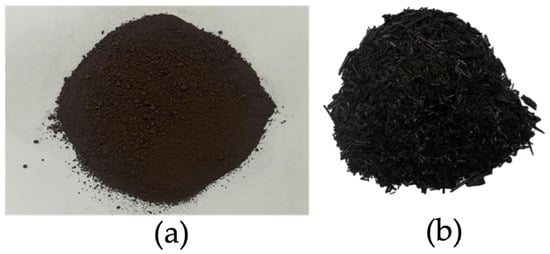
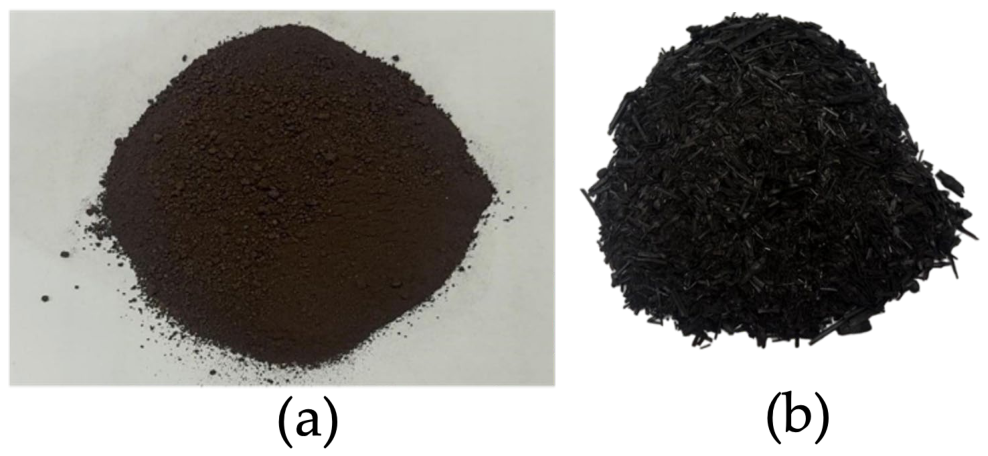
The red mud iron-separation residue (RMR) used in this study was obtained from high-iron Bayer-process red mud provided by an aluminium mining company in Shanxi Province, China. The residue was produced using an iron extraction process described by Wang et al. [29], with a coal-to-red mud mixing ratio of 35:100, a roasting temperature of 1100 °C, and a roasting time of 120 min. The solid residue remaining after iron extraction was designated as RMR, as shown in Figure 1a.
Figure 1.
Photographs of the amendment materials used in this study: (a) red mud iron-separation residue (RMR) and (b) corn-straw-derived biochar (BC).
The chemical composition of red mud iron-separation residue (RMR) was determined using wavelength-dispersive X-ray fluorescence spectroscopy (WD-XRF; ZSX Primus IV, Rigaku, Japan). The samples were dried, ground, sieved, and prepared by lithium tetraborate fusion before quantitative analysis, consistent with established fused-sample XRF approaches for geological materials [30].
The mineralogical composition of RMR was characterized using X-ray diffraction (XRD; D8 ADVANCE, Bruker, Germany). The diffractometer was operated with Cu Kα radiation (λ = 1.5406 Å) at 40 kV and 40 mA. Diffraction patterns were collected over a 2θ range of 10–70°, with a step size of 0.02° and a scanning speed of 2°/min. XRD was used to identify crystalline mineral phases, consistent with the mineral-characterization approach discussed by Ali et al. [31].
The surface morphology of RMR was examined using scanning electron microscopy (SEM; SU5000, Hitachi, Japan). Dried powder samples were mounted on conductive adhesive and gold-coated before imaging. SEM observations were conducted at an accelerating voltage of 5 kV and a working distance of approximately 8 mm. The specimen preparation approach is consistent with general SEM characterization practices discussed by Ali et al. [32].
The pH of the RMR aqueous extract was measured using an INESA PHSJ-4F pH meter (Shanghai INESA Scientific Instrument Co., Ltd., Shanghai, China). The extract was prepared by mixing RMR with deionized water at a solid-to-liquid mass ratio of 1:2.5, followed by shaking for 30 min. Measurements were performed at 25 ± 1 °C. The potentiometric measurement principle is consistent with HJ 962-2018 [33], although the extraction conditions were specific to the RMR material.
2.1.3. Biochar
The biochar (BC) used in this experiment was prepared from corn straw using slow pyrolysis under oxygen-free conditions. The corn straw was first cut into small pieces and then placed in a reactor. The temperature was raised to 400 °C at a heating rate of 8.5 °C/min and maintained for approximately 8 h until no further smoke was released from the gas outlet. Before application, the biochar was further crushed and passed through a 2 mm sieve. The surface morphology of the prepared biochar was examined using scanning electron microscopy (SEM).
2.2. Experimental Design and Procedures
Soil-Column Experimental Design and Procedures
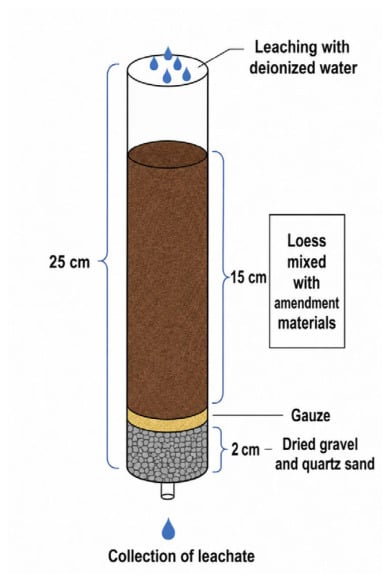
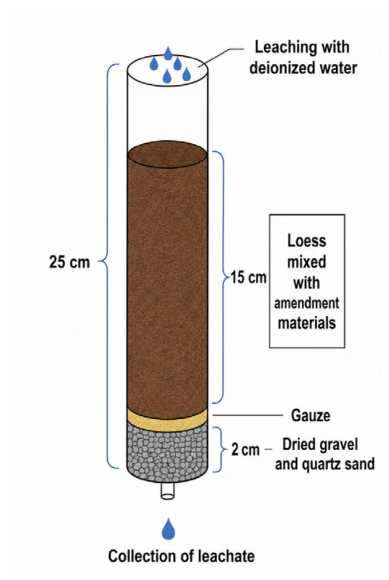
The soil-column apparatus consisted of polycarbonate (PC) tubes, 20 cm long and 3 cm in internal diameter (Figure 2). Two layers of nylon mesh with a nominal pore size of 150 µm (approximately 100 mesh), together with a 2 cm layer of quartz sand and gravel, were placed at the base of each column to retain soil particles and facilitate drainage during leaching. RMR and BC were uniformly mixed with the air-dried loess according to the designated amendment application rates. The RMR application rates were 0.5%, 1%, 1.5%, and 2%, while the BC application rates were 1%, 2%, 3%, and 4%. The experimental design comprised one untreated control (CK), four RMR-only treatments, four BC-only treatments, and 16 combined RMR–BC treatments, giving 25 treatments in total. Each treatment was conducted with three replicates (n = 3). The complete treatment matrix is presented in Table 1.
Figure 2.
Schematic diagram of the soil-column apparatus used in the laboratory leaching and evaporation experiments.
Table 1.
Experimental treatment groups and application rates of red mud iron-separation residue (RMR) and biochar (BC).
The prepared soil mixtures were then gradually introduced into the PC columns to obtain a packed-soil height of 15 cm and a target dry bulk density of approximately 1.3 g/cm3. The packing density was controlled by adjusting the dry mass of the soil mixture according to the internal column dimensions and designated packing height. For a column diameter of 3 cm and a packed-soil height of 15 cm, the calculated soil volume was approximately 106.03 cm3, corresponding to a target dry mixture mass of approximately 137.84 g. The soil mixtures were introduced gradually to achieve the designated packing height while avoiding excessive compaction [34]. After packing, deionized water was added to moisten the soil columns, which were subsequently allowed to equilibrate for 12 h before the leaching experiment. The precise volume of water used for initial moistening and the corresponding initial moisture contents were not quantified in the experimental records.
Ternary compound fertilizer was applied at an equivalent rate of 74.98 g/m2, corresponding to 0.053 g per column based on the column’s internal diameter of 3 cm [35]. The daily irrigation volume was selected with reference to the irrigation rate used in spinach fields (25 m3/mu), the average annual precipitation from 2020 to 2024 (482.8 mm), and sample-collection requirements. Accordingly, 12 mL of deionized water was added to each soil column daily for 30 days. Water was introduced slowly along the column wall to minimize disturbance of the soil surface. Leachate was collected at five-day intervals and stored in clean plastic bottles. Although the experimental procedure included leachate collection, this study focuses on soil-water evaporation and hydraulic properties; leachate chemical indicators and their corresponding results are therefore excluded.
The relationship between cumulative soil-water evaporation and evaporation time was described using the empirical evaporation model [20].
Here, (Y) is cumulative soil-water evaporation (mm), (t) is evaporation time (days), (S) is the linear-time coefficient representing the modelled asymptotic evaporation-rate parameter (mm day−1), and (A) is the coefficient of the square-root-of-time component (mm day−1/2). The instantaneous evaporation rate represented by the empirical model was obtained by differentiating cumulative evaporation with respect to time:
The contribution of the square-root-of-time component decreases with increasing time, and the modelled evaporation rate approaches S asymptotically. Following the 30-day evaporation experiment, the soil columns were destructively sampled at 5 cm depth intervals. The collected soil samples were used to determine field water capacity and saturated hydraulic conductivity. Field water capacity was determined in accordance with the procedure referenced in NY/T 1121.22-2010, while saturated hydraulic conductivity was determined according to GB 50827-99.
During the evaporation experiment, changes in soil-column mass were recorded at 2-day intervals. The mass loss during each measurement interval was converted into an equivalent evaporation depth (mm) using the cross-sectional area of the soil column and the density of water. The interval evaporation depth was calculated as
where ΔE is the water-equivalent evaporation depth (mm), ΔM is the mass loss during the measurement interval (g), is the density of water (g/cm3), and r is the internal radius of the soil column (cm). The column’s cross-sectional area was calculated from the internal radius (1.5 cm) using A = πr2, giving approximately 7.07 cm2. Cumulative evaporation was calculated by summing the water-equivalent evaporation depths over successive measurement intervals.
2.3. Data Processing and Statistical Analysis
All experimental data were organized and summarized using Microsoft Excel 2019. Origin 2024 was used for graphical presentation and least-squares regression fitting, while statistical analyses were performed using SPSS 27. Each treatment had three replicates (n = 3), and results are expressed as mean ± standard deviation (SD). Differences among treatments were evaluated using one-way analysis of variance (ANOVA), followed by Fisher’s least significant difference (LSD) test. Results were considered statistically significant at p < 0.05.
3. Results
3.1. Physicochemical Characteristics of Experimental Materials
3.1.1. Initial Physicochemical Properties of Loess
The initial physicochemical properties of the loess are summarized in Table 2. The soil was alkaline (pH approximately 8.1) and had a reported organic matter content of 1.85 g/kg (Table 2). Soil organic matter was determined using the potassium dichromate volumetric method described in Section 2.1.1, with methodological support from Bao [21] and Walkley and Black [25]. Available phosphorus, alkaline hydrolysable nitrogen, and available potassium were measured to characterize the initial nutrient status of the soil. Field water capacity, saturated hydraulic conductivity, and bulk density provided the initial physical and hydraulic characteristics. Overall, the results characterize the experimental loess as alkaline, with a measured organic matter content of 1.85 g/kg and establish the baseline soil conditions for evaluating subsequent amendment responses. However, these measurements alone do not establish a formal soil-fertility or degradation classification.
Table 2.
Initial physicochemical properties of the experimental loess.
3.1.2. Physicochemical and Morphological Characteristics of RMR and BC
The physical appearance of the amendment materials is presented in Figure 1. RMR exhibited a reddish-brown, powdery granular appearance, whereas BC consisted of dark, irregularly sized particles. The chemical composition of RMR is presented in Table 3, with total iron (TFe), Al2O3, and SiO2 representing the major reported constituents. Total iron was expressed on an elemental basis, while the remaining constituents were reported as oxide-equivalent concentrations. The RMR aqueous extract had a pH of approximately 10.03, indicating alkaline conditions under the specified extraction procedure.
Table 3.
Chemical composition of red mud iron-separation residue (RMR) (wt%).
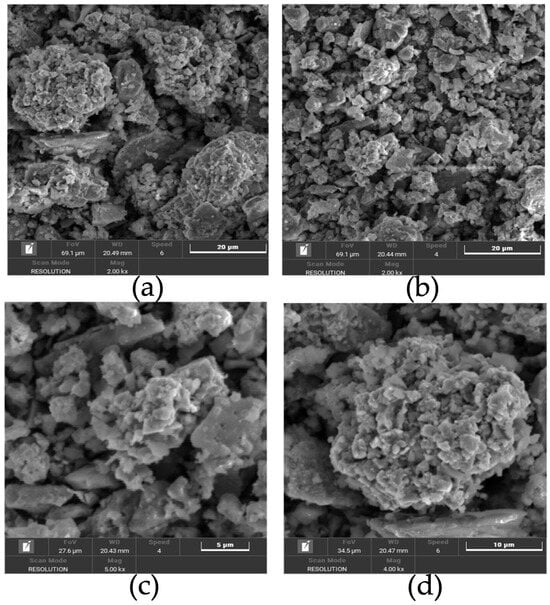
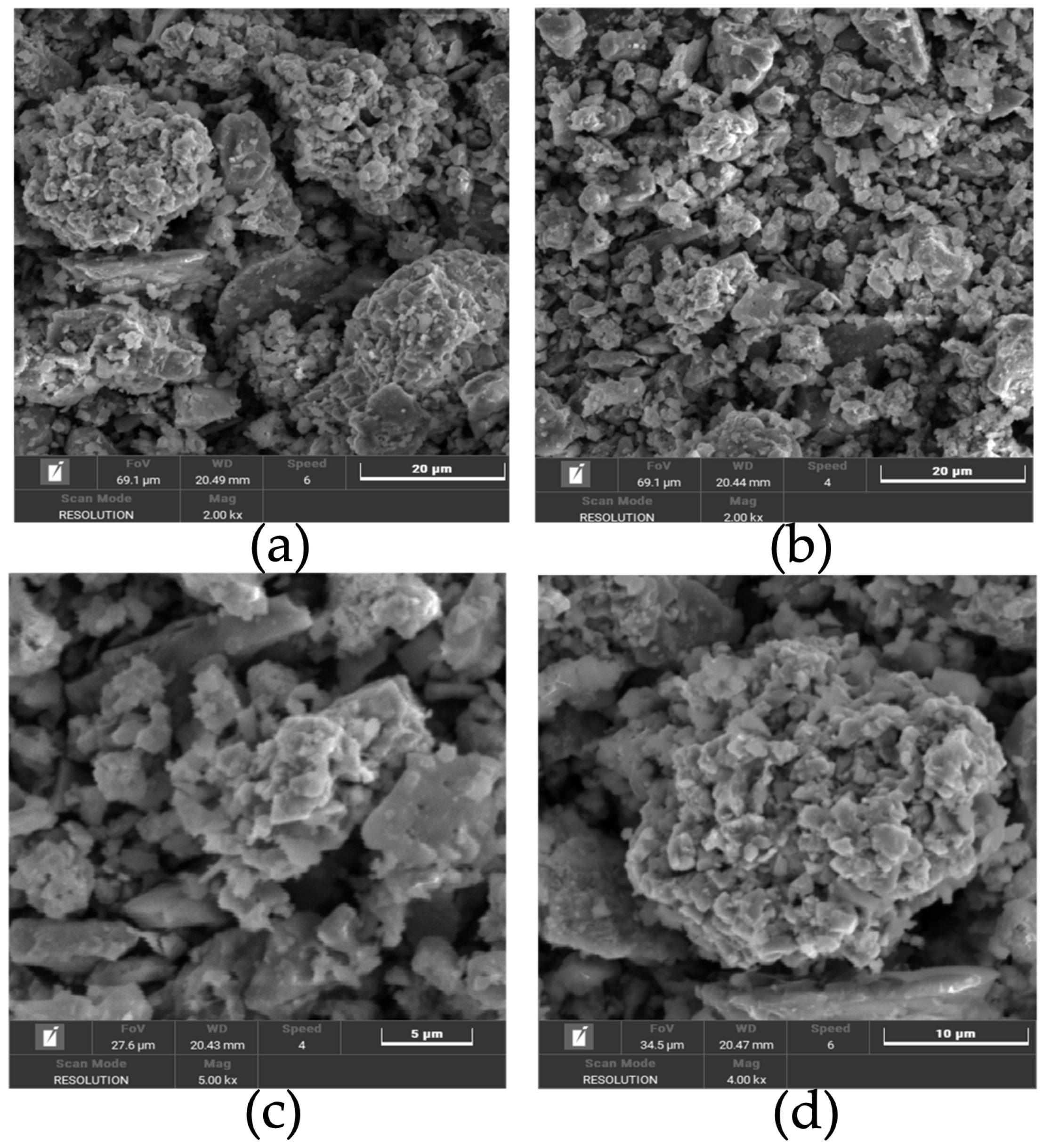
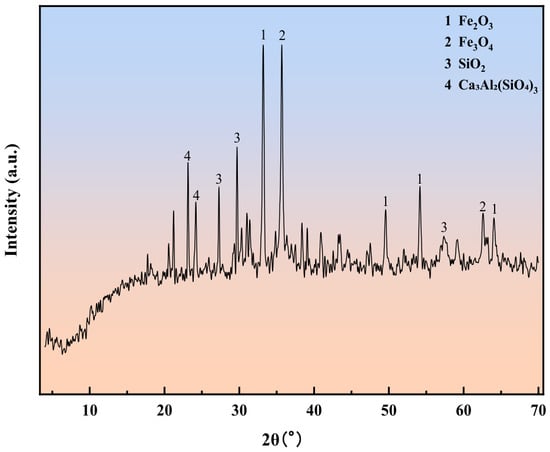
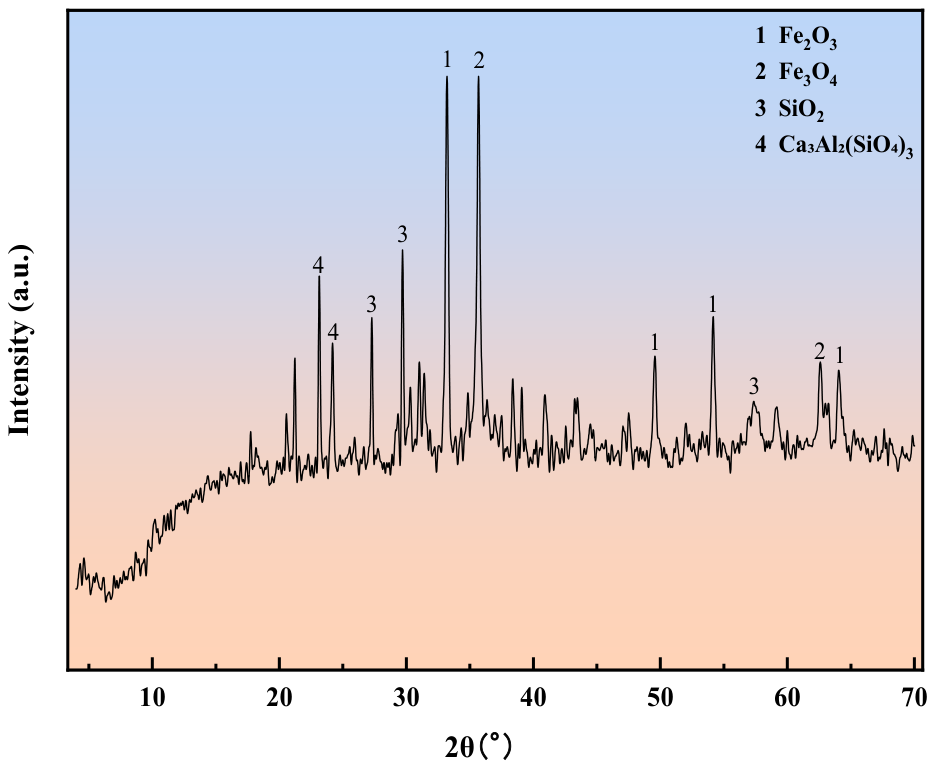
The SEM micrographs of RMR (Figure 3) revealed heterogeneous particle morphology, including irregular granular, angular, and block-like particles with rough and uneven surfaces. Aggregation of smaller particles was also observed. The XRD pattern (Figure 4) showed diffraction reflections assigned to hematite (Fe2O3), magnetite (Fe3O4), quartz (SiO2), and Ca3Al2(SiO4)3, providing additional information on the mineralogical composition of RMR.
Figure 3.
Scanning electron microscopy (SEM) micrographs of red mud iron-separation residue (RMR) at different magnifications: (a,b) 2000×, (c) 5000×, and (d) 4000×. The images illustrate heterogeneous particle morphology, rough surfaces, and aggregates of fine particles. Scale bars: (a,b) 20 µm, (c) 5 µm, and (d) 10 µm.
Figure 4.
X-ray diffraction (XRD) pattern of red mud iron-separation residue (RMR), showing reflections assigned to (1) hematite (Fe2O3), (2) magnetite (Fe3O4), (3) quartz (SiO2), and (4) Ca3Al2(SiO4)3.
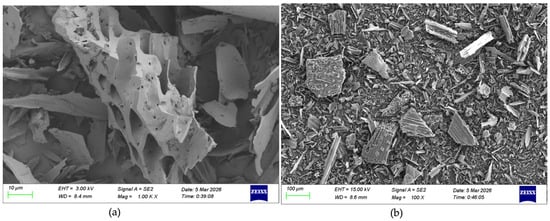
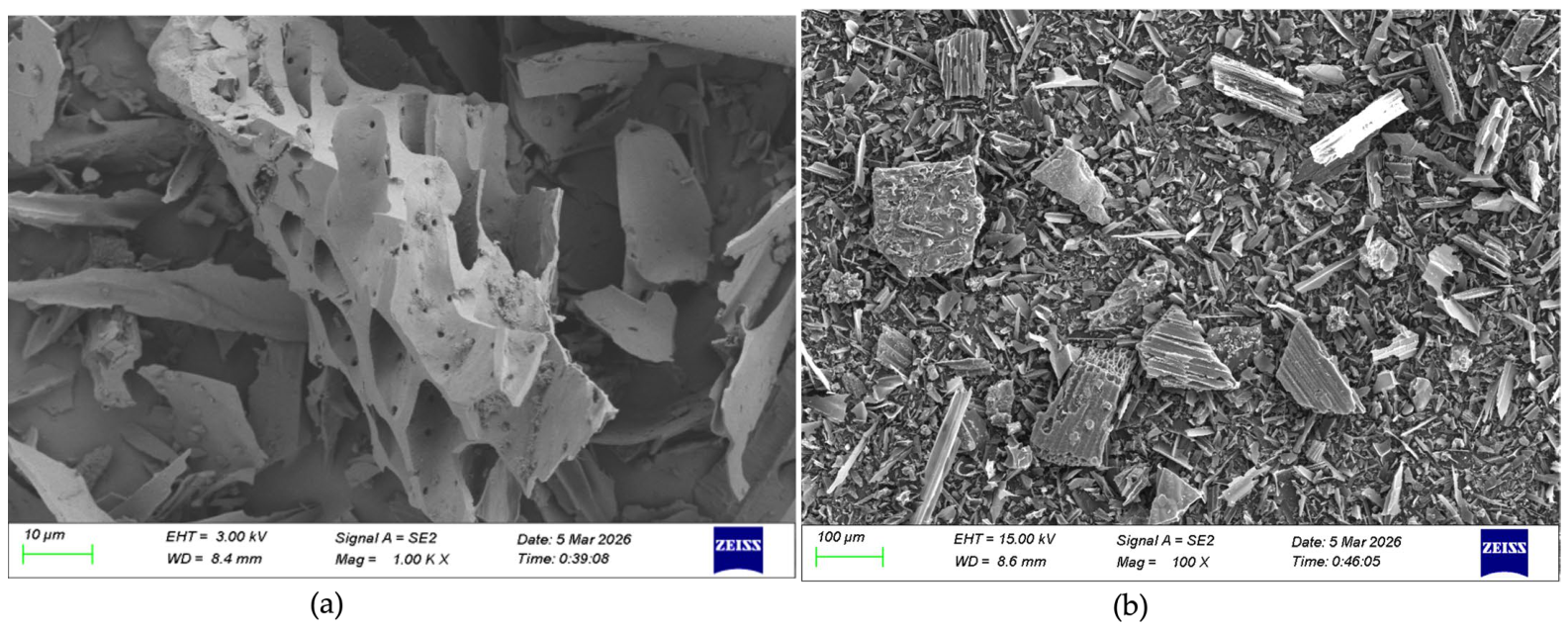
The corn-straw-derived biochar used in this study consisted of fine particles and irregularly sized fragments, as shown in Figure 1b. The physicochemical properties of BC are presented in Table 4. The material was alkaline and contained a relatively high proportion of carbon compared with the other reported elemental constituents. The SEM micrographs (Figure 5) revealed heterogeneous particle morphology, including irregular sheet-like structures with visible cavities and elongated openings. Fragmented and fibrous particles of varying shapes and sizes were also observed. These observations characterize the morphology of the biochar used in the experiment but do not independently quantify its pore structure or water-retention capacity.
Table 4.
Basic physical and chemical properties of the tested BC.
Figure 5.
Scanning electron microscopy (SEM) micrographs of corn-straw-derived biochar (BC) at different magnifications: (a) 1000× and (b) 100×. The micrographs show irregular carbonaceous structures with visible cavities and elongated openings, together with fragmented and fibrous particles of varying sizes. Scale bars: (a) 10 µm and (b) 100 µm.
3.2. Effect of RMR and BC on Soil-Water Evaporation
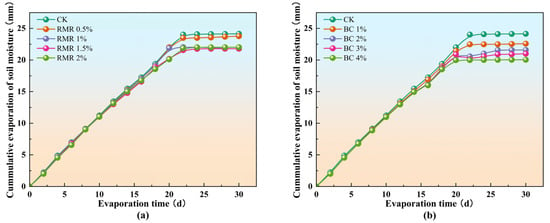
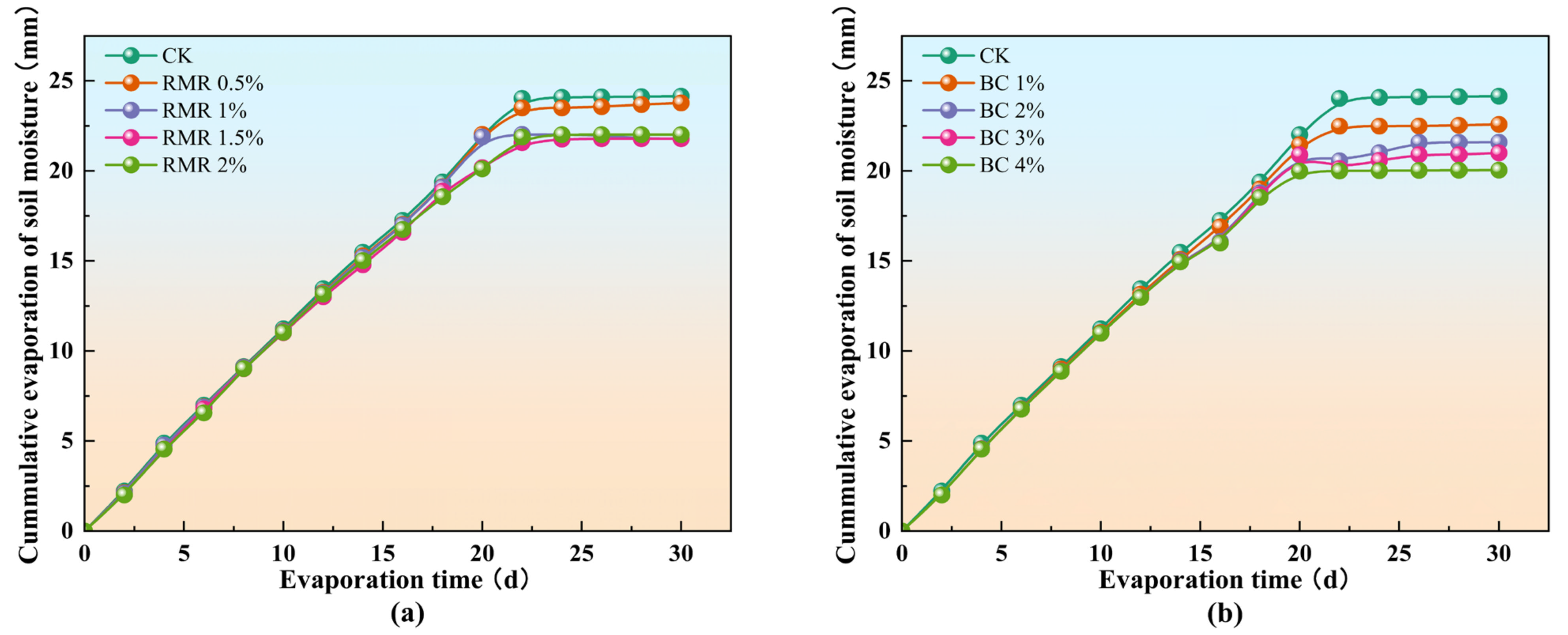
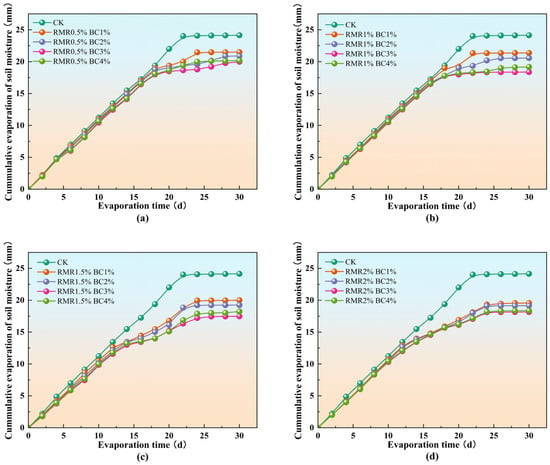
Figure 6 and Figure 7 show the temporal changes in cumulative soil-water evaporation under individual and combined RMR–BC amendment treatments over the 30-day experimental period. Under the individual amendment treatments (Figure 6), differences in cumulative evaporation were relatively small during the early stage but became more pronounced as evaporation progressed. At day 30, the untreated control (CK) exhibited cumulative evaporation of 24.14 mm. Among the RMR-only treatments, the lowest cumulative evaporation was recorded at both 1% and 1.5% RMR (21.78 mm), representing a reduction of 9.78% relative to CK, whereas the 2% RMR treatment recorded 22.01 mm. Under the BC-only treatments, cumulative evaporation decreased with increasing application rate, reaching 20.04 mm at 4% BC, corresponding to a reduction of 16.98% relative to CK.
Figure 6.
Cumulative soil-water evaporation under individual RMR and BC treatments: (a) RMR application rates of 0.5%, 1%, 1.5%, and 2%; (b) BC application rates of 1%, 2%, 3%, and 4%, compared with the untreated control (CK). Cumulative evaporation (mm) is plotted against evaporation time (d) over the 30-day experimental period.
Figure 7.
Cumulative soil-water evaporation under combined RMR–BC treatments: (a) 0.5% RMR with 1–4% BC; (b) 1% RMR with 1–4% BC; (c) 1.5% RMR with 1–4% BC; (d) 2% RMR with 1–4% BC. CK denotes the untreated control. Cumulative evaporation (mm) is plotted against evaporation time (days) over the 30-day experimental period.
Combined RMR–BC treatments produced different cumulative evaporation responses depending on the amendment application rates (Figure 7). Relative to CK, cumulative evaporation decreased by 10.94–27.59% across the combined treatments. The lowest observed cumulative evaporation was recorded under the RMR 1.5% + BC 3% treatment, reaching 17.48 mm at day 30, compared with 24.14 mm under CK. This corresponds to a reduction of approximately 28%. At a fixed RMR application rate of 1.5%, cumulative evaporation decreased from 20.01 mm at 1% BC to 17.48 mm at 3% BC before increasing to 18.23 mm at 4% BC. This indicates a non-monotonic response to increasing BC application rate within this treatment series. The day-30 cumulative evaporation values for all treatments are summarized in Table 5.
Table 5.
Cumulative evaporation after 30 days under different red mud iron residue (RMR) and biochar (BC) treatments.
The empirical evaporation model was fitted to the cumulative evaporation records for all 25 treatments, with the estimated parameters and coefficients of determination presented in Table 6. Compared with CK, the RMR 1.5% + BC 3% treatment exhibited a lower linear-time coefficient (S) and a higher square-root-of-time coefficient (A), indicating treatment-dependent differences in the fitted temporal evaporation pattern. These empirical coefficients should not be interpreted as direct measurements of soil-water diffusivity or pore-scale processes.
Table 6.
Empirical soil-water evaporation model under different experimental treatments.
Model residuals were calculated as the differences between the observed cumulative evaporation values and those predicted by the fitted empirical evaporation model at each measurement time. Residual diagnostics revealed positive serial dependence in the fitted residuals across all experimental treatments (Table 7), indicating that the assumption of independent regression errors was not satisfied. Although the empirical models provided relatively good fits to the cumulative evaporation data (Table 6), the presence of residual autocorrelation suggests that the models did not fully capture the temporal structure of the observations. Consequently, the conventional least-squares standard errors of the fitted parameters should be interpreted cautiously.
Table 7.
Descriptive statistics and residual diagnostics for the empirical cumulative evaporation model under different experimental treatments.
3.3. Effects of RMR and BC on Field Water Capacity
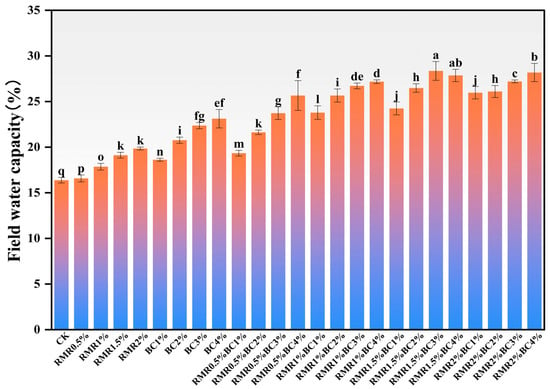
The field water capacity of loess under the different amendment treatments is presented in Figure 8. The untreated control (CK) exhibited a field water capacity of 16.38%. Under the individual RMR treatments, field water capacity ranged from 16.57% to 19.85%, corresponding to increases of 0.19–3.47 percentage points relative to CK. The individual BC treatments exhibited field water capacity values ranging from 18.62% to 23.12%, representing increases of 2.24–6.74 percentage points relative to CK. The combined RMR-BC treatments generally produced higher field water capacity values than the individual amendment treatments. The highest observed field water capacity was recorded under the RMR 1.5% + BC 3% treatment (28.35%), representing an increase of 11.97 percentage points, or approximately 73%, relative to CK. These findings indicate that field water capacity varied according to amendment type and application rate, with the largest observed increase occurring under the RMR 1.5% + BC 3% combination.
Figure 8.
Field water capacity of loess under individual and combined applications of red mud iron-separation residue (RMR) and biochar (BC). CK represents the untreated control. Values are presented as means ± standard deviation (n = 3). Different lowercase letters indicate statistically significant differences among treatments at p < 0.05.
3.4. Effect of RMR and BC on Saturated Hydraulic Conductivity
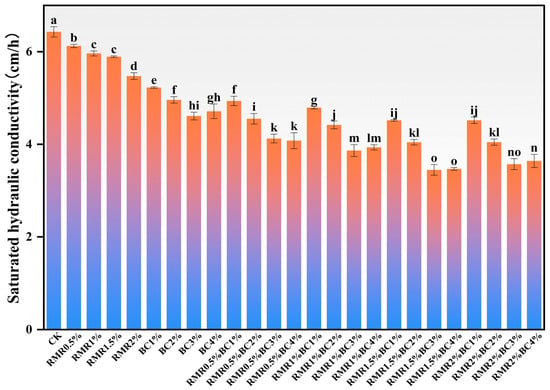
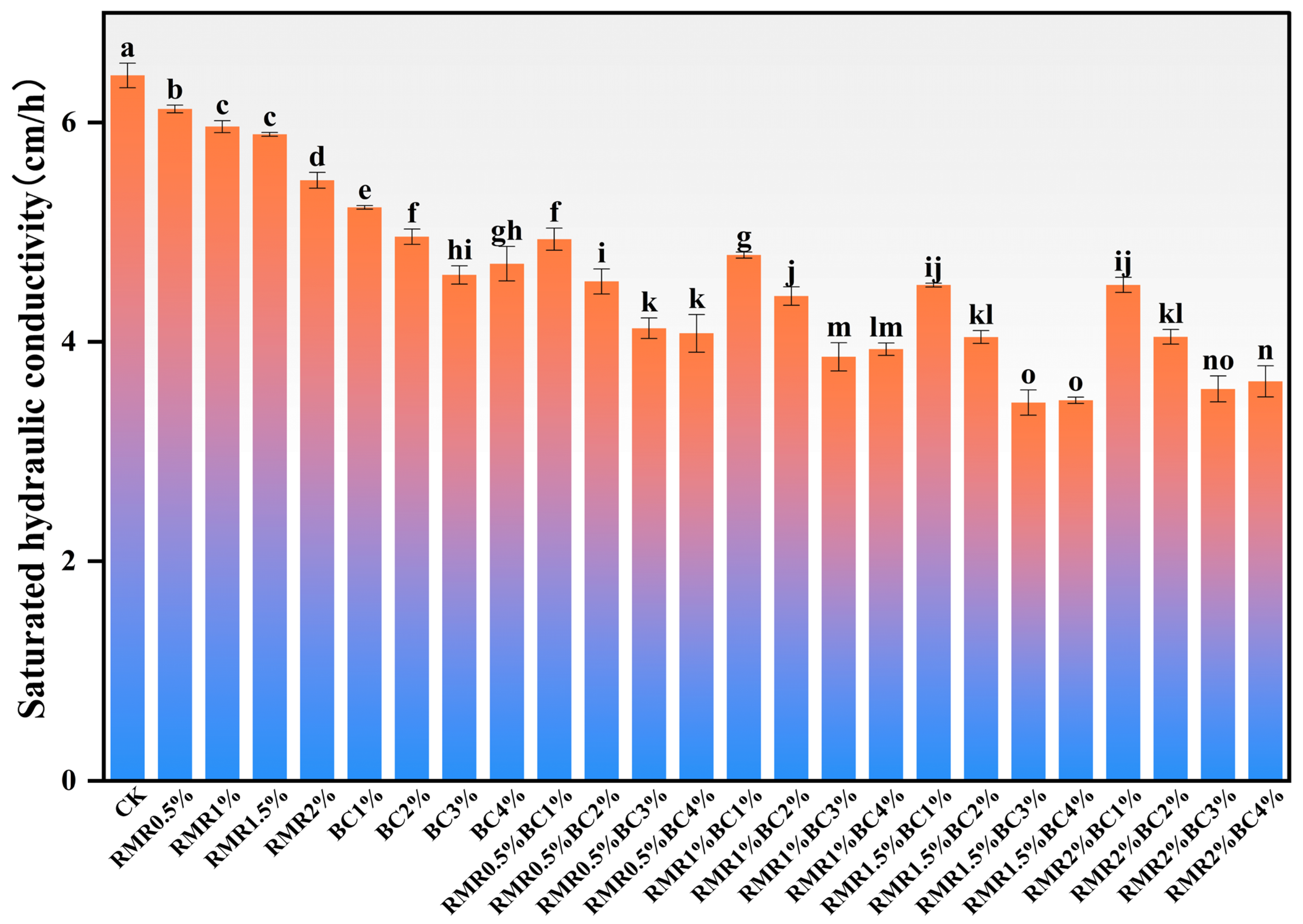
The saturated hydraulic conductivity of loess under different RMR and BC amendment treatments is presented in Figure 9. The untreated control (CK) exhibited a saturated hydraulic conductivity of 6.43 ± 0.11 cm/h, which was significantly higher than that of the amended treatments (p < 0.05). Under the individual RMR treatments, saturated hydraulic conductivity decreased with increasing application rates, ranging from 6.12 to 5.47 cm/h. Similarly, the individual BC treatments generally exhibited decreasing saturated hydraulic conductivity with increasing application rates, although a slight increase was observed at the 4% BC application rate. The measured values ranged from 4.61 to 5.23 cm/h.
Figure 9.
Saturated hydraulic conductivity of loess under individual and combined applications of RMR and BC amendment treatments. Values are presented as means ± standard deviation (n = 3). Different lowercase letters indicate statistically significant differences among treatments at p < 0.05.
The combined RMR-BC treatments generally exhibited lower saturated hydraulic conductivity than the individual amendment treatments (p < 0.05). Among all treatments, the lowest observed saturated hydraulic conductivity was recorded under RMR 1.5% + BC 3% (3.45 ± 0.12 cm/h), representing a reduction of approximately 46% relative to CK. These results indicate that RMR and BC applications altered the saturated water-transmission characteristics of the tested loess, with the lowest observed conductivity occurring under the RMR 1.5% + BC 3% treatment.
4. Discussion
Soil-water retention and transmission are important considerations for managing degraded loess, particularly in regions where limited precipitation and evaporative losses constrain soil moisture availability [3,4,5]. Previous studies have shown that biochar can modify soil-water retention and hydraulic properties, although the magnitude and direction of these responses depend on soil characteristics, amendment properties, and application rates [9,10,11,12]. In the present study, individual and combined RMR–BC applications produced treatment-dependent changes in cumulative evaporation, field water capacity, and saturated hydraulic conductivity. These findings highlight the importance of considering water retention and transmission together when evaluating the hydraulic responses of amended loess.
The increase in field water capacity is consistent with previous research demonstrating that biochar can improve soil-water retention, although responses vary considerably among soils. In a meta-analysis, Edeh et al. [9] examined the influence of biochar on field capacity, plant-available water, saturated hydraulic conductivity, and other soil-water properties, emphasizing the importance of amendment and soil characteristics. Wang et al. [11] reported improved water retention following biochar application to coarse-textured soil, whereas no comparable improvement was observed in their long-term field experiment on silty clay loam, highlighting the influence of soil characteristics and experimental conditions. Similarly, Yang and Lu [10] reported increased soil-water retention following the application of five different biochars to paddy soil. At an application rate of 22.5 t/ha, plant-available water content increased by 15.2–42.4%, depending on biochar feedstock. Although these studies support the potential of biochar to influence soil-water storage, direct quantitative comparisons with the present study are limited by differences in soil characteristics, amendment materials, application rates, and measurement procedures. In particular, increased field water capacity does not independently establish an increase in plant-available water.
More directly comparable evidence has been reported for biochar-amended loess. Yang et al. [36] investigated the effects of biochar application rate and particle size on the physicochemical and hydraulic properties of loess. They observed increased saturated water content and reduced saturated permeability following biochar addition, with the responses depending on amendment characteristics and experimental conditions. Sun et al. [34] examined the soil-water retention behaviour of compacted loess amended with apple-tree biochar and demonstrated the importance of biochar content, specimen preparation conditions, and soil-water retention characteristics. Using corn-straw biochar in semiarid loess, Zhang et al. [37] investigated how pyrolysis temperature, particle size, and application rate influenced water absorption and retention. Chang et al. [38] further demonstrated that modified corn-straw biochars produced treatment-dependent changes in saturated hydraulic conductivity, cumulative evaporation, and soil-water content in hilly loess soils. Notably, their results showed that the responses of evaporation and hydraulic conductivity were not necessarily parallel. These findings collectively demonstrate that biochar-related soil-water responses depend on material properties and treatment conditions. The present study extends this evidence by examining corn-straw biochar together with iron-extraction red mud residue across individual and combined amendment rates. Nevertheless, differences in biochar preparation, soil conditions, experimental design, and measurement endpoints prevent direct attribution of the observed differences to the presence of RMR alone.
The reduction in saturated hydraulic conductivity provides further evidence that the amendments influenced soil-water movement. Blanco-Canqui [12] reported that biochar generally reduced saturated hydraulic conductivity in coarse-textured soils but could increase it in finer-textured soils, demonstrating that hydraulic responses are dependent on soil characteristics. The observed reduction in saturated hydraulic conductivity indicates that amendment application restricted saturated water transmission under the experimental conditions. However, this response should not automatically be interpreted as an improvement in overall soil hydraulic functioning, because reduced conductivity may also affect infiltration and drainage. The practical implications therefore depend on the balance between water retention and water transmission. SEM observations showed that RMR and BC possessed heterogeneous particle morphologies, including rough RMR surfaces, aggregates of smaller RMR particles, and visible cavities in BC. These characteristics may be relevant to interactions between the amendments and soil particles, although their effects on the hydraulic behaviour of the amended loess were not directly established. Liu et al. [39] showed that biochar particle size, shape, and porosity jointly influence soil-water properties, while Trifunovic et al. [40] demonstrated that biochar concentration and particle size can produce contrasting changes in hydraulic conductivity. These findings provide possible explanations for the treatment-dependent hydraulic behaviour observed in the present study. However, because amended-soil pore structure, pore connectivity, and aggregate stability were not measured, the observed hydraulic responses cannot be attributed to a specific structural mechanism.
The evaporation responses were dependent on amendment application rate, with higher amendment rates not consistently producing greater reductions in cumulative evaporation. This non-monotonic behaviour indicates that the effects of combined RMR–BC application cannot be represented by a simple dose-dependent trend. Differences in the fitted empirical coefficients further suggest that amendment treatments influenced the temporal pattern of cumulative evaporation. However, these coefficients describe the mathematical behaviour of the fitted evaporation curves and do not independently establish changes in soil-water diffusivity or specific evaporation mechanisms. Furthermore, although the combined treatment responses differed across amendment rates, the observed differences do not independently establish a synergistic interaction between RMR and BC or identify a universally optimal application rate.
Several limitations should be considered when interpreting the findings. The experiment was conducted using laboratory soil columns, and the persistence of the observed hydraulic responses under field conditions remains uncertain. Although cumulative evaporation, field water capacity, and saturated hydraulic conductivity were evaluated, these measurements do not fully characterize soil-water dynamics or the physical processes governing the observed responses. Treatment-specific initial and final soil-water contents, quantitative soil texture, amendment particle-size distributions, and final bulk densities were not established. Furthermore, changes in amended-soil pore structure, pore connectivity, and aggregate stability were not directly evaluated, limiting the identification of the mechanisms responsible for the observed hydraulic behaviour. Previous studies have highlighted the importance of pore-scale characterization for understanding biochar-related soil-water retention [41] and demonstrated that long-term hydraulic responses depend on soil characteristics, amendment properties, and application duration [42]. These considerations highlight the need for more comprehensive physical characterization and longer-term evaluation of amendment performance.
The environmental suitability of the combined amendments also requires further investigation. The RMR used in this study was alkaline (pH approximately 10.03) and contained sodium- and chromium-bearing constituents, while BC was also alkaline. Although the amendment materials were characterized before application, treatment-specific amended-soil pH, electrical conductivity, soluble sodium and chromium concentrations, and contaminant leaching were not evaluated in the present soil-column experiment. Furthermore, plant-available water, crop growth, yield, and harvested-product quality were not assessed. Consequently, the observed changes in soil-water properties do not establish the environmental safety or agronomic suitability of the combined RMR–BC treatment. Further soil chemical assessments, contaminant mobility investigations, plant-response experiments, and long-term field evaluations are necessary before practical agricultural application can be recommended.
5. Conclusions
The individual and combined applications of red mud iron-separation residue (RMR) and biochar (BC) altered the soil-water properties of loess under laboratory conditions. Among the 25 treatments, RMR 1.5% + BC 3% exhibited the lowest cumulative evaporation, with an approximately 28% reduction relative to the control. This treatment also increased field water capacity by approximately 12 percentage points and reduced saturated hydraulic conductivity by approximately 46%. These findings demonstrate treatment-dependent changes in soil-water retention and transmission, although their long-term performance and environmental safety require further investigation before practical application.
Author Contributions
Conceptualization, Y.H. and Y.G.; methodology, Y.H., Y.G. and H.W.; formal analysis, Y.H., Z.S. and J.X.; investigation, Y.H., Y.G., H.W., Z.S., D.A.F. and J.X.; writing—original draft preparation, Y.H.; writing—review and editing, Y.G., D.A.F. and J.X.; supervision, Y.G. and J.X.; project administration, Y.H. and Y.G. All authors have read and agreed to the published version of the manuscript.
Funding
This research was funded by the “Key Technology Research on Green Mining and Pit Closure Rehabilitation of Slope Open-Pit Coal Mines”, grant number 2025210078; the General Program of the National Natural Science Foundation of China, grant number 52474151; and the Cultivation Program of the Joint Fund of the National Natural Science Foundation of China, grant number U2003103.
Institutional Review Board Statement
Not applicable.
Informed Consent Statement
Not applicable.
Data Availability Statement
The data supporting the reported results can be provided upon request from the corresponding author.
Conflicts of Interest
Authors Yongliang Hao and Hengheng Wang were employed by Shuiquan Open-Pit Coal Mine, Guoneng Baotou Energy Co., Ltd. The remaining authors declare that the research was conducted in the absence of any commercial or financial relationship that could be constructed as a potential conflict of interest.
References
- Fitton, N.; Alexander, P.; Arnell, N.; Bajzelj, B.; Calvin, K.; Doelman, J.; Gerber, J.S.; Havlik, P.; Hasegawa, T.; Herrero, M.; et al. The vulnerabilities of agricultural land and food production to future water scarcity. Glob. Environ. Change 2019, 58, 101944. [Google Scholar] [CrossRef] [Scilit]
- Zhao, D.; Xu, M.; Liu, G.; Ma, L.; Zhang, S.; Xiao, T.; Peng, G. Effect of vegetation type on microstructure of soil aggregates on the Loess Plateau, China. Agric. Ecosyst. Environ. 2017, 242, 1–8. [Google Scholar] [CrossRef] [Scilit]
- Shao, M.; Wang, Y.; Xia, Y.; Jia, X. Soil drought and water carrying capacity for vegetation in the critical zone of the Loess Plateau: A review. Vadose Zone J. 2018, 17, 1–8. [Google Scholar] [CrossRef] [Scilit]
- Li, B.-B.; Li, P.-P.; Zhang, W.-T.; Ji, J.-Y.; Liu, G.-B.; Xu, M.-X. Deep soil moisture limits the sustainable vegetation restoration in arid and semi-arid Loess Plateau. Geoderma 2021, 399, 115122. [Google Scholar] [CrossRef] [Scilit]
- Huang, L.; Shao, M. Advances and perspectives on soil water research in China’s Loess Plateau. Earth-Sci. Rev. 2019, 199, 102962. [Google Scholar] [CrossRef] [Scilit]
- Lal, R. Restoring Soil Quality to Mitigate Soil Degradation. Sustainability 2015, 7, 5875–5895. [Google Scholar] [CrossRef] [Scilit]
- Elmeknassi, M.; Elghali, A.; de Carvalho, H.W.P.; Laamrani, A.; Benzaazoua, M. A review of organic and inorganic amendments to treat saline-sodic soils: Emphasis on waste valorization for a circular economy approach. Sci. Total Environ. 2024, 921, 171087. [Google Scholar] [CrossRef] [Scilit]
- Ram, L.C.; Masto, R.E. Fly ash for soil amelioration: A review on the influence of ash blending with inorganic and organic amendments. Earth-Sci. Rev. 2014, 128, 52–74. [Google Scholar] [CrossRef] [Scilit]
- Edeh, I.G.; Mašek, O.; Buss, W. A meta-analysis on biochar’s effects on soil water properties—New insights and future research challenges. Sci. Total Environ. 2020, 714, 136857. [Google Scholar] [CrossRef] [Scilit]
- Yang, C.D.; Lu, S.G. Effects of five different biochars on aggregation, water retention and mechanical properties of paddy soil: A field experiment of three-season crops. Soil Tillage Res. 2021, 205, 104798. [Google Scholar] [CrossRef] [Scilit]
- Wang, D.; Li, C.; Parikh, S.J.; Scow, K.M. Impact of biochar on water retention of two agricultural soils—A multi-scale analysis. Geoderma 2019, 340, 185–191. [Google Scholar] [CrossRef] [Scilit]
- Blanco-Canqui, H. Biochar and Soil Physical Properties. Soil Sci. Soc. Am. J. 2017, 81, 687–711. [Google Scholar] [CrossRef] [Scilit]
- Liu, C.; Wang, H.; Tang, X.; Guan, Z.; Reid, B.J.; Rajapaksha, A.U.; Ok, Y.S.; Sun, H. Biochar increased water holding capacity but accelerated organic carbon leaching from a sloping farmland soil in China. Environ. Sci. Pollut. Res. 2016, 23, 995–1006. [Google Scholar] [CrossRef] [Scilit]
- Power, G.; Gräfe, M.; Klauber, C. Bauxite residue issues: I. Current management, disposal and storage practices. Hydrometallurgy 2011, 108, 33–45. [Google Scholar] [CrossRef] [Scilit]
- Liu, W.; Yang, J.; Xiao, B. Application of Bayer red mud for iron recovery and building material production from alumosilicate residues. J. Hazard. Mater. 2009, 161, 474–478. [Google Scholar] [CrossRef] [Scilit]
- Samouhos, M.; Taxiarchou, M.; Pilatos, G.; Tsakiridis, P.E.; Devlin, E.; Pissas, M. Controlled reduction of red mud by H2 followed by magnetic separation. Miner. Eng. 2017, 105, 36–43. [Google Scholar] [CrossRef] [Scilit]
- Liu, Y.; Naidu, R.; Ming, H. Red mud as an amendment for pollutants in solid and liquid phases. Geoderma 2011, 163, 1–12. [Google Scholar] [CrossRef] [Scilit]
- Hua, Y.; Heal, K.V.; Friesl-Hanl, W. The use of red mud as an immobiliser for metal/metalloid-contaminated soil: A review. J. Hazard. Mater. 2017, 325, 17–30. [Google Scholar] [CrossRef] [Scilit]
- Kelly, C.N.; Benjamin, J.; CalderÓN, F.C.; Mikha, M.M.; Rutherford, D.W.; Rostad, C.E. Incorporation of Biochar Carbon into Stable Soil Aggregates: The Role of Clay Mineralogy and Other Soil Characteristics. Pedosphere 2017, 27, 694–704. [Google Scholar] [CrossRef] [Scilit]
- Rose, C.W. Agricultural Physics, 1st ed.; Pergamon Press: Oxford, UK, 1966; pp. 150–175. [Google Scholar]
- Bao, S.D. Soil and Agricultural Chemistry Analysis, 3rd ed.; China Agriculture Press: Beijing, China, 2000. [Google Scholar]
- Olsen, S.R.; Sommers, L.E. Phosphorus. In Methods of Soil Analysis; Agronomy Monographs; John Wiley & Sons, Inc.: Hoboken, NJ, USA, 1983; pp. 403–430. [Google Scholar]
- Zhu, J.; Yang, Z.; Qin, F.; Guo, J.; Zhang, T.; Miao, P. Soil Quality Assessment of Several Kinds of Typical Artificial Forestlands in the Inner Mongolia Basin of the Yellow River. Land 2023, 12, 1024. [Google Scholar] [CrossRef] [Scilit]
- Bar-Yosef, B.; Akiri, B. Sodium Bicarbonate Extraction to Estimate Nitrogen, Phosphorus, and Potassium Availability in Soils. Soil Sci. Soc. Am. J. 1978, 42, 319–323. [Google Scholar] [CrossRef] [Scilit]
- Walkley, A.; Black, I. An Examination of the Degtjareff Method for Determining Soil Organic Matter, and a Proposed Modification of the Chromic Acid Titration Method. Soil Sci. 1934, 37, 29–38. [Google Scholar] [CrossRef] [Scilit]
- Grossman, R.B.; Reinsch, T.G. 2.1 Bulk Density and Linear Extensibility. In Methods of Soil Analysis; SSSA Book Series; John Wiley & Sons, Inc.: Hoboken, NJ, USA, 2002; pp. 201–228. [Google Scholar]
- NY/T 1121.22-2010; Soil Testing—Part 22: Cutting-Ring Method for Determination of Field Water-Holding Capacity in Soil. Ministry of Agriculture (MOA) of China: Beijing, China, 2010.
- Reynolds, W.D.; Elrick, D.E.; Youngs, E.G.; Booltink, H.W.G.; Bouma, J. 3.4.2 Laboratory Methods. In Methods of Soil Analysis; SSSA Book Series; John Wiley & Sons, Inc.: Hoboken, NJ, USA, 2002; pp. 802–816. [Google Scholar]
- Wang, K.; Liu, Y.; Dou, Z.; Lu, G.; Li, X.; Zhang, T.-A. A Novel Method of Extracting Iron from High-Iron Red Mud and Preparing Low-Carbon Cement Clinker from Tailings. JOM 2022, 74, 2750–2759. [Google Scholar] [CrossRef] [Scilit]
- Strasheim, A.; Brandt, M.P. A quantitative X-ray fluorescence method of analysis for geological samples using a correction technique for the matrix effects. Spectrochim. Acta Part B At. Spectrosc. 1967, 23, 183–196. [Google Scholar] [CrossRef] [Scilit]
- Ali, A.; Chiang, Y.W.; Santos, R.M. X-ray Diffraction Techniques for Mineral Characterization: A Review for Engineers of the Fundamentals, Applications, and Research Directions. Minerals 2022, 12, 205. [Google Scholar] [CrossRef] [Scilit]
- Ali, A.; Zhang, N.; Santos, R.M. Mineral Characterization Using Scanning Electron Microscopy (SEM): A Review of the Fundamentals, Advancements, and Research Directions. Appl. Sci. 2023, 13, 12600. [Google Scholar] [CrossRef] [Scilit]
- HJ 962-2018; Soil—Determination of pH—Potentiometry. Ministry of Ecology and Environment of the People’s Republic of China: Beijing, China, 2018.
- Sun, L.; Li, P.; Fei, W.; Wang, J. Influence of biochar on the soil-water retention behavior of compacted loess in man-made earth structures in loess regions. J. Soils Sediments 2024, 24, 1103–1123. [Google Scholar] [CrossRef] [Scilit]
- Wang, Z.; Li, D.; Gruda, N.S.; Duan, Z.; Li, X. Fertilizer application rate and nutrient use efficiency in Chinese greenhouse vegetable production. Resour. Conserv. Recycl. 2024, 203, 107431. [Google Scholar] [CrossRef] [Scilit]
- Yang, X.; Fan, H.; Du, Y.; Zhang, L. Effect of Biochar Application on Physicochemical and Hydraulic Properties of Loess. Adv. Civ. Eng. 2020, 2020, 4592092. [Google Scholar] [CrossRef] [Scilit]
- Zhang, P.; Chang, F.; Huo, L.; Yao, Z.; Luo, J. Impacts of Biochar Pyrolysis Temperature, Particle Size, and Application Rate on Water Retention of Loess in the Semiarid Region. Water 2025, 17, 69. [Google Scholar] [CrossRef] [Scilit]
- Chang, F.L.; Zhang, P.Z.; Yao, Z.L.; Luo, J.; Zhao, L.X.; Huo, L.L.; Liu, F.W. Effects of Different Modified Corn Straw Biochar on Soil Hydraulic Properties in Hilly Loess Areas. Huan Jing KE Xue 2024, 45, 6546–6554. [Google Scholar] [CrossRef] [Scilit]
- Liu, Z.; Dugan, B.; Masiello, C.A.; Gonnermann, H.M. Biochar particle size, shape, and porosity act together to influence soil water properties. PLoS ONE 2017, 12, e0179079. [Google Scholar] [CrossRef] [Scilit]
- Trifunovic, B.; Gonzales, H.; Ravi, S.; Sharratt, B.; Mohanty, S. Dynamic Effects of Biochar Concentration and Particle Size on Hydraulic Properties of Sand. Land Degrad. Dev. 2018, 29, 884–893. [Google Scholar] [CrossRef] [Scilit]
- Rasa, K.; Heikkinen, J.; Hannula, M.; Arstila, K.; Kulju, S.; Hyväluoma, J. How and why does willow biochar increase a clay soil water retention capacity? Biomass Bioenergy 2018, 119, 346–353. [Google Scholar] [CrossRef] [Scilit]
- Jiang, Z.; Huang, S.; Meng, Z. Long-term effects of biochar on the hydraulic properties of soil: A meta-analysis based on 1–10 years field experiments. Geoderma 2025, 458, 117318. [Google Scholar] [CrossRef] [Scilit]

Disclaimer/Publisher’s Note: The statements, opinions and data contained in all publications are solely those of the individual author(s) and contributor(s) and not of MDPI and/or the editor(s). MDPI and/or the editor(s) disclaim responsibility for any injury to people or property resulting from any ideas, methods, instructions or products referred to in the content. |
© 2026 by the authors. Licensee MDPI, Basel, Switzerland. This article is an open access article distributed under the terms and conditions of the Creative Commons Attribution (CC BY) license.