


Abstract
Road infrastructure is a carbon-intensive segment of the transport sector, while steel slag remains substantially underutilized despite its potential to substitute natural aggregates and reduce emissions. Distorted pricing, spatial transport costs, and information asymmetry constrain its large-scale deployment. This study develops a government-subsidized two-echelon Stackelberg game comprising a steel producer as the leader and a road contractor as the follower. The carbon-reduction coefficient is calibrated using published life-cycle assessment results, yielding approximately 2.18 kg CO2e per tonne of steel slag. Equilibrium pricing, procurement, carbon reduction, supply chain profits, and social welfare are derived under no-subsidy and per-unit-subsidy regimes, and the model is extended to an incomplete-information setting with Bayesian conjugate learning. The results show that a per-unit subsidy simultaneously raises the equilibrium steel slag price and procurement quantity, with gains shared between upstream and downstream firms but disproportionately favoring the leader. The subsidy enhances carbon reduction and extends the economically viable transport radius, and the economic critical distance is close to the LCA-based environmental critical distance. Carbon price and technology adaptation cost substantially moderate subsidy effectiveness. When environmental value is fully internalized through carbon markets, the welfare-maximizing subsidy may be small or even negative; when carbon markets are incomplete, subsidies remain a necessary corrective instrument. Under incomplete information, an initial overestimation of hidden costs suppresses procurement and abatement, but Bayesian learning converges to the complete-information equilibrium within about 5–10 periods, reducing belief variance by approximately 96.9%. These findings provide a quantitative framework for designing subsidy, carbon-pricing, information-disclosure, and supply chain coordination policies for low-carbon road materials.
1. Introduction
Since the Industrial Revolution, large-scale infrastructure development and urbanization have consumed vast quantities of fossil fuels. Within the transport sector, life-cycle carbon emissions from road infrastructure account for 10–20% of the sector’s total emissions [1]. In China, highway construction consumes more than 50 million tonnes of steel and 320 million tonnes of cement annually, while the extraction, processing, and long-distance transport of natural aggregates such as sand and gravel further exacerbate energy consumption and ecological degradation [2,3]. Steel slag, a by-product of steelmaking, is generated at over 160 million tonnes per year, with cumulative stockpiles of approximately 1.8 billion tonnes and a comprehensive utilization rate of only about 30% [4]. Using steel slag as a substitute for natural aggregates in road construction therefore offers synergistic benefits in solid-waste valorization, resource conservation, and carbon emission reduction. However, the transition of steel slag from “industrial waste” to “low-carbon construction material” remains constrained by the absence of market mechanisms. Existing steel slag pricing primarily covers pretreatment and transportation costs but fails to reflect the carbon-reduction value generated by substituting for natural aggregates, resulting in distorted price signals; when transport distances are long, logistics costs may offset carbon-reduction benefits. From a supply chain perspective, steel slag utilization involves interactive decisions between upstream steel plants and downstream road construction firms.
Existing studies provide a solid foundation for understanding these issues. First, the technical properties and comprehensive utilization of steel slag have been extensively examined. The construction sector—encompassing cement production, building construction, and road and bridge engineering—is the principal avenue for large-scale steel slag utilization [5]. Owing to its chemical constituents and hydraulic phases, steel slag can partially replace limestone in cement production, act as a binder in low-clinker or clinker-free cements and serve as a mineral admixture in concrete [6,7,8,9,10]. Its high density, hardness, compressive strength, and wear resistance also make it suitable as an aggregate substitute in road construction [11,12]. Second, life-cycle assessment (LCA) studies have quantified the environmental benefits of steel slag road paving. Previous LCA research has shown that substituting steel slag for natural aggregates can reduce project-level carbon emissions, but the advantage depends critically on transport distance, because transportation-stage emissions rise linearly with distance and may offset production-stage savings [13,14,15]. Third, Stackelberg game models have been widely applied to low-carbon supply chains, including financing strategy design, carbon quota trading path selection, pricing of complementary goods under information asymmetry, and coordination of sustainable supply chains [16,17,18]. This demonstrates the analytical power of Stackelberg games in capturing leader–follower interactions, subsidy pass-through, and information asymmetry. However, research that integrates LCA-based carbon-reduction coefficients, spatially explicit transport costs, government subsidies, and incomplete information into a unified Stackelberg game for the steel slag road-material supply chain remains scarce. In particular, the combined effects of transport distance, carbon pricing, and quantity-based subsidies have not been adequately quantified, and the role of Bayesian learning in overcoming hidden compatibility-cost uncertainty has not been systematically examined.
The significance of this study for sustainability is threefold. Environmentally, substituting steel slag for natural aggregates avoids primary resource extraction, reduces emissions from limestone calcination and aggregate processing, and valorizes an industrial by-product that would otherwise be stockpiled; the carbon-reduction coefficient calibrated in this study therefore represents a measurable environmental sustainability outcome. Economically, steel slag utilization must be commercially viable for both the steel plant and the road contractor, and the subsidy, transport distance, and carbon price jointly determine whether the substitution is economically sustainable. Socially, large-scale steel slag utilization reduces land occupation and environmental risk associated with stockpiles, supports low-carbon road infrastructure, and improves the environmental performance of public infrastructure investment. The Stackelberg game developed here therefore links the three dimensions of sustainability—environmental benefits, economic viability, and social welfare—within a single analytical framework.
To address the aforementioned research gaps, this study focuses on the steel slag supply chain for road materials and develops a Stackelberg game model under government subsidies, aiming to answer the following core questions:
(1) When the government subsidizes the construction firm based on the quantity of steel slag used, how do the optimal pricing and procurement decisions of the upstream and downstream actors change?
(2) What are the quantitative effects of the subsidy on steel slag application volume, carbon emission reductions, and supply chain profits?
(3) From the perspective of social welfare maximization, and accounting for the marginal cost of public funds, how should the optimal subsidy level be determined?
(4) How do parameters such as transport distance and carbon price moderate the effectiveness of the subsidy policy?
2. Literature Review
2.1. Technical Properties and Comprehensive Utilization of Steel Slag
Steel slag possesses mechanical properties comparable to those of natural aggregates and, owing to its hydraulic mineral phases, exhibits cementitious activity, making it suitable as a substitute material in road bases, asphalt mixtures, and cement concrete [5,7,12]. Compared with natural aggregates, steel slag substitution reduces primary resource extraction and emissions associated with cement and limestone calcination, thereby offering substantial carbon-reduction potential [13,14]. Published life-cycle assessment (LCA) studies show that the net emission reduction of steel slag road paving depends heavily on transport distance: the environmental advantage is pronounced at short distances, whereas transport-stage emissions may offset production-stage savings at long distances, giving rise to an environmental break-even distance [19]. However, existing steel slag pricing mainly covers pretreatment and transportation costs and does not internalize the carbon-reduction value generated by substituting for natural aggregates, resulting in distorted price signals. Moreover, steel slag utilization involves cross-agent interaction between upstream steel plants and downstream road contractors, and its economic feasibility is jointly shaped by transport costs, carbon prices, and government subsidies. The steel slag road-material problem is therefore essentially a supply chain coordination problem characterized by spatial transport and policy intervention, rather than a purely material–technical issue. This provides the practical basis for the Stackelberg game developed in the subsequent sections.
In addition to the studies reviewed above, a growing body of LCA and material-performance research has examined steel slag substitution under different system boundaries, substitution rates, and transport conditions. Several studies show that the net carbon benefit of steel slag depends not only on the substitution rate but also on pretreatment energy, quality stabilization, and transport distance, with higher substitution rates not necessarily yielding proportional emission savings because of additional processing and quality-control requirements [20,21,22]. Other studies examine the long-term durability, volume stability, and freeze–thaw performance of steel slag road materials, which affect maintenance frequency and therefore life-cycle emissions [20,23]. They also indicate that steel slag utilization is not a purely technical substitution problem, but a supply chain decision problem in which transport distance, quality uncertainty, and policy instruments jointly determine economic and environmental outcomes.
From a sustainability perspective, these LCA studies show that the environmental pillar of steel slag utilization is conditional rather than unconditional: net emission savings depend on transport distance, pretreatment energy, and substitution rate, and may be offset when transport distances are long. This conditional nature is precisely why an integrated economic–environmental–social assessment is needed, and it motivates the sustainability-oriented modeling in this study.
2.2. Applications of Stackelberg Games in Supply Chains
(1) Subsidies and carbon taxes/prices. Government subsidies lower downstream effective procurement costs and increase green procurement and abatement, but distribute gains unevenly: the Stackelberg leader often captures a larger share by raising wholesale prices [24,25]. Carbon taxes or prices create abatement incentives by raising emission costs, with effectiveness depending on environmental-value internalization and carbon market maturity [26]. However, these studies rarely consider spatial transport heterogeneity or embed project-level LCA coefficients into pricing and procurement.
(2) Carbon trading and carbon quotas. Carbon quota trading paths and internal versus external carbon markets significantly affect abatement decisions and profit allocation [27,28]. When carbon markets fully internalize externalities, carbon prices alone can provide incentives, and subsidies may become unnecessary or even welfare-reducing; when markets are incomplete, subsidies remain a necessary corrective instrument. Yet carbon prices are typically treated as exogenous constants and not coupled with project-level LCA coefficients.
Recent studies further examine the interaction between carbon quotas, carbon trading, and green subsidies, and show that the welfare effect of subsidies depends on whether the carbon price reflects the true social value of carbon [29,30,31]. However, carbon prices are typically treated as exogenous constants and not coupled with project-level LCA coefficients, and the joint effect of carbon pricing, transport distance, and quantity-based subsidies on equilibrium outcomes remains insufficiently quantified.
(3) Symmetric versus asymmetric information. Most Stackelberg supply chain studies assume complete and symmetric information and focus on pricing, ordering, and coordination contracts [17,32]. A smaller strand introduces information asymmetry, risk preferences, deteriorating inventory, security games, and Q-learning to examine information sharing, risk coordination, and strategic interaction [18,26,32,33,34,35]. In steel slag utilization, downstream contractors cannot accurately observe hidden compatibility costs-quality inspection, mix adjustment, delivery coordination, and quality risk-before procurement, which suppresses procurement willingness and abatement. The existing literature has not systematically analyzed how Bayesian learning affects the equilibrium and convergence speed of the steel slag supply chain.
2.3. Research Gap
The literature review confirms that steel slag performance, LCA-based environmental benefits, and Stackelberg game applications have each been extensively studied. Nevertheless, three specific gaps remain at their intersection. Although the technical performance and environmental benefits of steel slag have been extensively studied, and Stackelberg games have been widely applied to low-carbon supply chains, three aspects warrant further investigation. First, few studies explicitly connect project-level LCA-derived carbon-reduction coefficients with pricing and procurement decisions in the steel slag road-material supply chain. Second, the joint effects of transport distance, carbon pricing, and quantity-based subsidies on equilibrium outcomes and social welfare remain insufficiently quantified. Third, incomplete information and Bayesian learning in steel slag procurement decisions have received limited attention. This study complements and extends this literature by embedding published LCA results into a government-subsidized Stackelberg game and further extending the analysis to an incomplete-information setting.
2.4. Research Design and Philosophical Underpinning
This study adopts a quantitative, analytical modeling research design. It is not an empirical survey-based study; rather, it develops a government-subsidized two-echelon Stackelberg game, derives equilibrium outcomes by backward induction, calibrates environmental parameters using published LCA results, and examines comparative statics and policy scenarios through numerical simulation. Ontologically, the study adopts a critical–realist position: steel slag supply chains, transport costs, carbon-reduction coefficients, hidden compatibility costs, and policy instruments are treated as real mechanisms that exist independently of the researcher, while some of these mechanisms—especially the contractor’s hidden compatibility cost—are only imperfectly observable and must be represented through beliefs and signals. Epistemologically, the study follows a deductive-mathematical logic: knowledge is generated by specifying behavioral assumptions and institutional constraints, solving the game analytically, calibrating parameters with project-level and published evidence, and testing the robustness of equilibrium outcomes through sensitivity analysis and Bayesian learning simulations. Axiologically, the study is policy-oriented and therefore not value-free in a strict sense: the social-welfare function, the marginal cost of public funds, the degree of environmental-value internalization, and the carbon price embed normative and institutional judgements. These value judgements are made explicit as exogenous parameters, and their influence is examined through sensitivity analyses rather than concealed in the model. This philosophical positioning is consistent with analytical modeling in operations research and supply chain management. A generic empirical research-design framework such as the Saunders Research Onion is therefore not adopted, because its layers—research philosophy, approach, strategy, time horizon, and data-collection and analysis choices—are primarily designed for empirical social-science inquiries (e.g., surveys, interviews, case studies), whereas the present study is a deductive game-theoretic model with calibration and simulation rather than a data collection-based empirical design.
3. Materials and Methods
3.1. Calibration of Carbon Emission Reduction Parameters Based on Published LCA Results
This section calibrates the environmental parameters using our published LCA results for the HTGJSJ-3 section of the G30 Expressway [19]. To avoid duplication, the LCA system boundary, life-cycle inventory, construction-machinery energy consumption, transportation-emission calculations, and sensitivity analysis are not repeated; only the key parameters required by the Stackelberg game are extracted. Under 30% steel slag substitution, total carbon emissions are ES = 14,653.7 kgCO2e for the steel slag scenario and EA = 21,371.9 kgCO2e for the conventional natural aggregate scenario, yielding a net project-scale reduction of ΔE = EA − ES = 6718.2 kgCO2e, or approximately 31.4%. With steel slag consumption Q0 = 3081.7482t, the unit carbon reduction is:
This coefficient enters the contractor’s payoff as ηveq, where v is the carbon price, η is the degree of environmental-value internalization, and q is the steel slag procurement quantity. The LCA-based break-even transport distance is dLCA = 77.95 km, which serves as the environmental benchmark for comparison with the economic break-even distance derived from the Stackelberg game.
The calibrated coefficient e = 2.18 kg CO2e/t lies at the conservative end of the published range for steel slag substitution, which typically spans approximately 2–50 kg CO2e/t depending on system boundary, substitution rate, transport distance, and allocation method. Three features explain the relatively low value. First, it is a net project-level coefficient that includes transport-stage emissions over the baseline distance of 50 km and construction-stage energy consumption; studies reporting higher values often exclude transport or adopt a cradle-to-gate boundary. Second, it is specific to a 30% substitution rate; higher substitution rates may yield non-linear emission savings because of additional processing, quality adjustment, and logistics constraints. Third, it is expressed per tonne of steel slag used rather than per tonne of natural aggregate displaced; when expressed as per tonne of aggregate replaced, the coefficient would be higher. To examine the robustness of our conclusions, we vary e from 0.5 to 10 kg CO2e/t. As shown in Table 1, the equilibrium price and quantity change linearly with e, the economic critical distance increases modestly with e, and the welfare-optimal subsidy increases with e. The qualitative conclusions—that the subsidy raises price and quantity, that gains disproportionately favor the leader, and that the economic critical distance is close to the LCA-based distance—remain valid across the entire plausible range. The closeness of the two critical distances is particularly robust because the carbon value ve is small relative to the economic cost terms at the baseline carbon price.
Table 1.
Sensitivity of equilibrium outcomes to the unit carbon-reduction coefficient e.
Relationship to Prior Work and Incremental Contribution
This study is closely related to, but distinct from our previous LCA study [19]. Reference [19] developed a life-cycle carbon emission accounting framework and multi-objective analysis for steel slag road paving in Xinjiang, with its primary contribution being project-level environmental accounting. The present study does not duplicate that LCA work. Instead, it treats the published LCA results as exogenous environmental parameters and develops a government-subsidized two-echelon Stackelberg game between a steel plant and a road contractor. The incremental contributions of this study are fourfold. First, it couples project-level LCA-derived carbon-reduction coefficients with supply chain pricing and procurement decisions. Second, it derives equilibrium steel slag prices, procurement quantities, carbon reductions, supply chain profits, and social welfare under no-subsidy and per-unit-subsidy regimes, and identifies the economic and environmental break-even transport distances. Third, it quantifies how carbon prices and technology adaptation costs moderate subsidy effectiveness and welfare-maximizing subsidy levels. Fourth, it extends the complete-information benchmark to an incomplete-information setting with Bayesian conjugate learning, showing how hidden compatibility costs affect procurement, abatement, and convergence to the full-information equilibrium. All model formulations, equilibrium derivations, numerical simulations, and policy analyses presented here are original to this study and were not reported in Ref. [19].
3.2. Baseline Model Without Subsidies
3.2.1. Problem Description and Model Assumptions
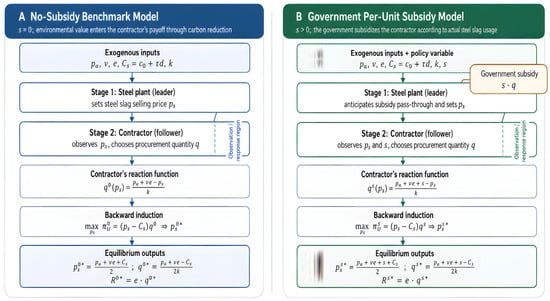
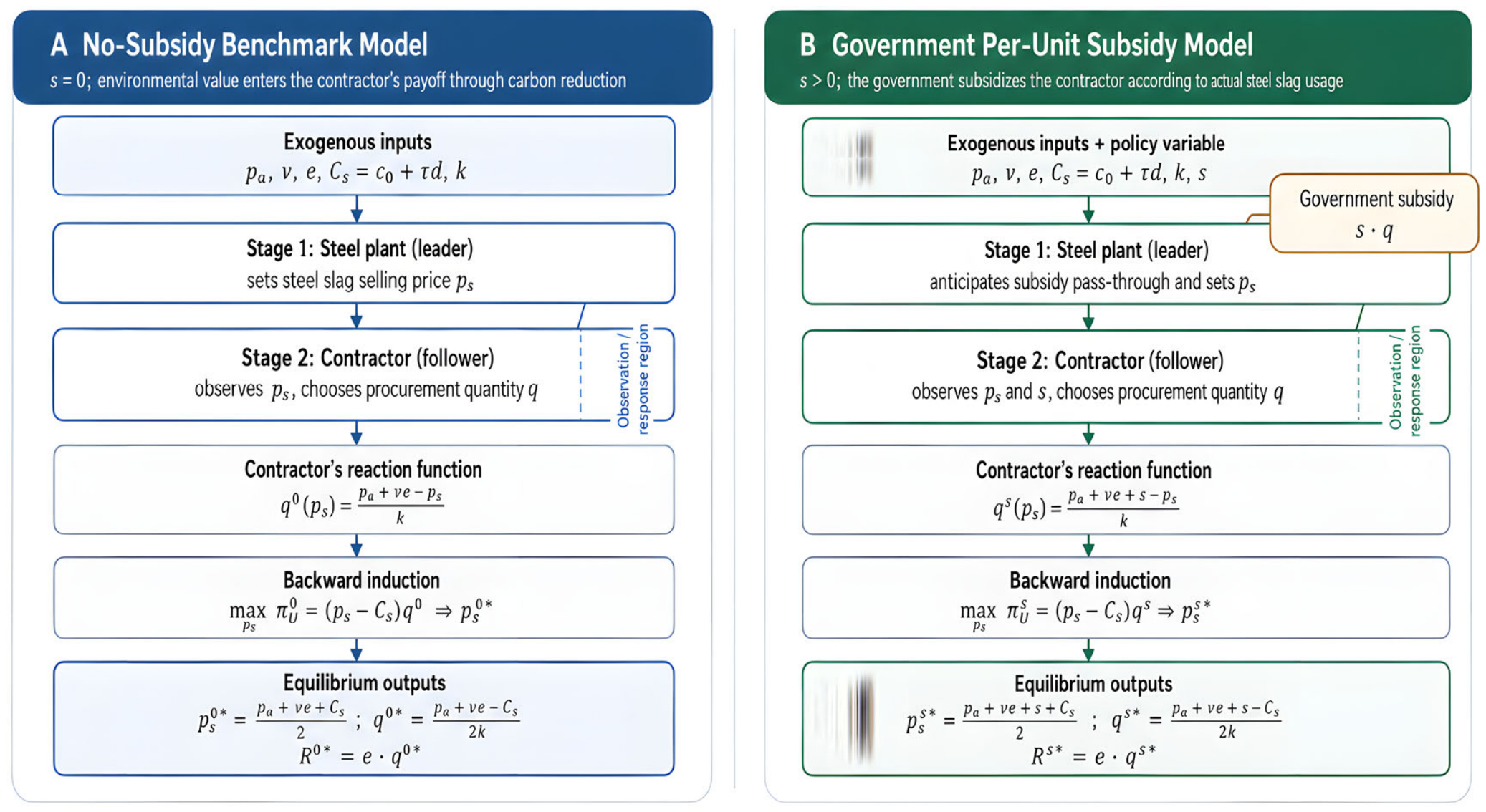
Consider a two-echelon supply chain consisting of a steel plant (leader) and a road construction firm (follower). The steel plant pre-treats steel slag and sells it to the construction firm, which substitutes steel slag for natural aggregates. The government grants the construction firm a unit subsidy s based on the actual quantity of steel slag used. The steel plant first sets the steel slag price ps, after which the construction firm observes the price and determines its procurement quantity q. Figure 1 presents the detailed procedure of the game considered in this study.
Figure 1.
Flowchart of the Stackelberg game.
To facilitate the modeling analysis, the relevant parameters are specified below, and the following assumptions are proposed:
(1) An upstream-led Stackelberg game is considered, with the steel plant moving first and the construction firm moving second.
(2) The natural aggregate price pa(CNY/t) is exogenous, and steel slag is perfectly substitutable for natural aggregates.
(3) The unit cost of steel slag consists of the pretreatment cost c0 and the transport cost ct = τd, so Cs = c0 + τd, where τ is the transport cost per unit distance (CNY/(t·km)) and d is the transport distance (km).
(4) The carbon emission reduction per unit of steel slag is e (t CO2e/t), and the carbon market price is v (CNY/t CO2e); the construction firm obtains an environmental benefit of ηveq (CNY). η denotes the degree to which the environmental value of carbon reduction is internalized by the contractor. The baseline value η = 1 represents a mature carbon market in which the carbon price fully reflects the social value of carbon reduction. In some simulations, η > 1 is allowed to represent institutional settings in which the government or a green procurement mandate values carbon reductions above the market carbon price-for example, dual-carbon policy targets, green credit preferences, ESG investment criteria, or local environmental performance assessments. It can also be interpreted as a shadow price of carbon that exceeds the traded price because of carbon market incompleteness or non-carbon co-benefits such as air-quality improvement and solid-waste valorization. This parameterization does not alter the analytical structure of the model; it only changes the magnitude of the environmental benefit term ηveq. If η ≤ 1 is imposed, the qualitative conclusions remain unchanged—the subsidy still raises the equilibrium price and procurement quantity, the leader still captures a larger share of the gains, and the economic critical distance remains close to the LCA-based environmental critical distance—while the environmental benefit, the welfare-optimal subsidy, and the welfare gain are proportionally smaller.
(5) The technical adaptation cost takes a convex quadratic form, , with k > 0.
(6) The government provides a quantity-based subsidy s, financed by fiscal revenue.
(7) All agents are risk-neutral; for the baseline models in Section 3.1, Section 3.2 and Section 3.3, information is complete and symmetric. This assumption is relaxed in Section 3.5.
The model is explicitly structured around the three pillars of sustainability. The environmental pillar enters through the carbon-reduction term ηveq; the economic pillar enters through the profits of the steel plant and the contractor and through the subsidy and transport costs; and the social pillar enters through the social-welfare function, which accounts for the fiscal cost of public funds and the environmental externality. This structure allows the sustainability implications of subsidy and carbon-pricing policies to be evaluated jointly rather than in isolation.
3.2.2. Decision Model of the Supply Chain Member
(1) Construction Firm
The construction firm chooses the steel slag procurement quantity q to maximize its net payoff:
Solving the first-order condition yields the construction firm’s optimal procurement quantity reaction function:
This expression indicates that the steel slag procurement quantity increases with the natural aggregate price and environmental value, while decreasing with the steel slag price and technical adaptation cost. The incorporation of environmental value effectively raises the perceived benefit of steel slag, thereby stimulating demand.
(2) Steel Plant
The steel plant determines the steel slag price ps so as to maximize its profit:
Substituting the reaction function q(ps) into the steel plant’s profit function yields:
Differentiating with respect to ps and setting the derivative to zero yields:
Solving the first-order condition yields the optimal steel slag price:
Substituting into Equation (2), the equilibrium procurement quantity is obtained as:
Analysis based on the proposed model leads to the following: The optimal steel slag price is jointly determined by the natural aggregate price, environmental value, pretreatment cost, and transport cost. Incorporating environmental value allows the steel plant to charge a higher price for steel slag without suppressing demand, since the construction firm also obtains environmental benefits. Changes in the environmental value coefficient v thus have dual supply chain effects: for the steel plant, a higher v raises the optimal price and profit; for the construction firm, a higher v directly increases environmental benefits and stimulates procurement. Accordingly, rationally assessing and monetizing the carbon-reduction value of steel slag is essential for stimulating market vitality. Internalizing this environmental value through carbon markets or green subsidies can effectively promote the large-scale application of steel slag.
3.3. Supply Chain Game Model Under Government Subsidies
A direct government subsidy is considered, granted to the construction firm according to its steel slag usage at a unit rate of s. This instrument is easy to implement and directly lowers the construction firm’s effective procurement cost, thereby boosting demand.
(1) Decision-Making of the Construction Firm
The construction firm’s profit function is formulated as:
Solving the first-order condition yields the construction firm’s reaction function:
Relative to the no-subsidy benchmark, the subsidy s directly raises the intercept of the reaction function, meaning that the construction firm is willing to purchase more steel slag at a given steel slag price.
(2) Decision-Making of the Steel Plant
Anticipating the construction firm’s reaction, the steel plant determines the steel slag price ps by solving:
The first-order condition with respect to ps is obtained by setting the derivative to zero:
Solving gives the optimal steel slag price as:
Substituting ps into Equation (9) gives the equilibrium procurement quantity as:
3.4. Subsidy Effect Analysis
(1) Impact of Subsidies on Pricing and Procurement Decisions
Equations (12) and (13) indicate that the subsidy s increases both the steel slag price and the procurement quantity. The higher procurement quantity reflects a larger scale of steel slag substitution for natural aggregates, leading to greater carbon emission reductions. Let the carbon emission reduction be defined as R = eq**, then:
(2) Effects of Subsidies on Supply Chain Profits
The steel plant’s profit is given by:
The construction firm’s profit inclusive of the subsidy is given by:
According to the first-order condition:
Substituting this into Equation (16) yields:
Evidently, the subsidy raises both parties’ profits, and the steel plant gains more than the construction firm (its profit being twice that of the latter), reflecting the first-mover advantage of the steel plant as the Stackelberg leader.
3.5. Game Model Formulation Under Incomplete and Asymmetric Information
The preceding Section 3.1, Section 3.2 and Section 3.3 develop the complete-information benchmark under assumption (7), namely that all agents are risk-neutral and information is complete and symmetric. In this section, we relax and extend assumption (7) by introducing incomplete and asymmetric information into the steel slag road-material supply chain. Specifically, the road contractor cannot accurately observe the hidden compatibility cost ϕ before procurement; instead, it forms a prior belief about ϕ and updates this belief through Bayesian conjugate learning after observing transaction-based cost signals. The steel plant, as the Stackelberg leader, anticipates the contractor’s Bayesian reaction when setting the steel slag price. All other assumptions, (1)–(6), remain unchanged. Thus, the complete-information equilibrium derived in Section 3.1, Section 3.2 and Section 3.3 serves as the rational-expectations benchmark against which the incomplete-information equilibrium and the convergence of Bayesian learning are evaluated.
3.5.1. Parameter Settings
As shown in Table 2, we build on the previously defined notation, we introduce the following additional variables:
Table 2.
Notation and definitions of model parameters.
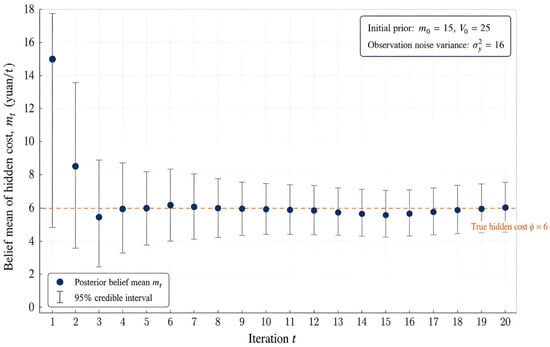
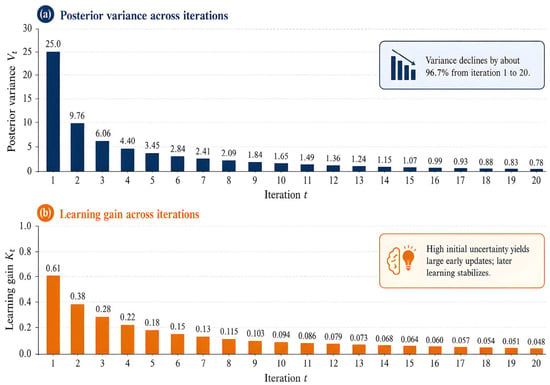
The numerical analysis uses m0 = 15 CNY/t, V0 = 25 (CNY/t)2, and . The true hidden cost is ϕ = 6CNY/t. These values imply that the contractor initially overestimates the hidden cost by a factor of 2.5 and that the prior standard deviation (5 CNY/t) is comparable to the signal noise (4 CNY/t). The Bayesian updating formulas are , and Vt = (1 − Kt)Vt−1. Figure 12 shows the posterior mean converging from 15 to 6 within about five periods, and Figure 12 shows the posterior variance declining from 25.00 to 0.78 by t = 20, a reduction of 96.9%. The claim of convergence within 5–10 periods refers to the procurement quantity and price converging within 1% of the full-information benchmark, as shown in Figure 14. We have added the prior and signal parameters to Section 3.5., included the corresponding plots in Figures 11–13, and harmonized the variance-reduction figure to 96.9% throughout the paper.
3.5.2. Bayesian Belief Model Under Incomplete and Asymmetric Information
Under incomplete and asymmetric information, the construction firm cannot accurately observe the hidden cost ϕ before procurement and can only form subjective beliefs based on historical transaction experience. Let the construction firm’s belief about the mean hidden cost μϕ before trading in period t follow a normal prior distribution:
After trading in period t, the construction firm observes a hidden-cost signal:
where
Thus,
Because the normal distribution is conjugate when the mean is unknown and the variance is known, the posterior distribution remains normal:
where the posterior variance is:
and the posterior mean is:
Equivalently, this can be written as:
where
Here, Kt is the Bayesian learning gain. When the construction firm’s initial uncertainty Vt−1 is high, Kt is large, indicating that new observations exert a stronger corrective effect on its beliefs. As the number of transactions increases, Vt gradually declines and Kt decreases accordingly, indicating that the construction firm’s beliefs become progressively stable.
3.5.3. Supply Chain Member’s Reaction Function Under Incomplete and Asymmetric Information
(1) Construction Firm
Before trading in period t, the construction firm cannot accurately observe the true hidden cost ϕ and can only make decisions based on its subjective expectation mt−1. Therefore, the construction firm’s expected profit function is:
The construction firm’s Bayesian reaction function is:
After incorporating the engineering usage constraint, this becomes:
Compared with the full-information reaction function, the difference under incomplete information lies in that the construction firm uses the Bayesian prior mean mt−1 rather than the true hidden cost ϕ.
(2) Pricing Decision of the Steel Plant
As the leader, the steel plant can anticipate that the construction firm will base its procurement response on mt−1. Therefore, the steel plant’s profit function in period t is:
Under an interior solution, substituting the construction firm’s reaction function into the steel plant’s profit function yields:
Differentiating with respect to ps,t and setting the derivative to zero yields the Bayesian equilibrium price under incomplete and asymmetric information:
The equilibrium procurement quantity is:
After incorporating the engineering usage constraint, this becomes:
Therefore, if
that is, if the construction firm’s willingness to procure is insufficient, the scale of steel slag application is underestimated.
If
that is, if the construction firm underestimates the hidden cost of steel slag, then:
In this case, over-procurement and subsequent cost overruns in adaptation may occur.
When Bayesian learning drives:
it follows that:
Therefore, information disclosure, quality certification, and the accumulation of historical transaction data can improve the accuracy of the construction firm’s beliefs, thereby enabling its steel slag procurement decisions to gradually approach the full-information equilibrium.
3.5.4. Profits and Social Welfare Under Incomplete and Asymmetric Information
Under incomplete information, the steel plant’s expected profit is:
The construction firm’s expected profit at the decision-making stage is:
However, after the transaction is completed, the construction firm’s realized profit depends on the true hidden cost ϕ:
Therefore, incomplete information affects not only the procurement quantity but also creates a discrepancy between expected and realized profits:
When the construction firm overestimates the hidden cost, its realized profit exceeds its expected profit, but its procurement quantity is too low. When it underestimates the hidden cost, its realized profit is lower than expected, which may reduce its willingness to procure in subsequent periods.
If social welfare is measured on a net transfer basis, it can be written as:
where μ is the marginal cost of public funds and Vc is the true social value of carbon.
If the carbon price fully reflects the true social value of carbon, then:
In this case:
Compared with the full-information case, incomplete information alters through mt−1, thereby affecting carbon emission reductions:
Therefore, Bayesian learning affects not only prices and profits but also the scale of emission reductions achieved by substituting steel slag for natural aggregates.
3.5.5. Effects of Subsidies on Social Welfare
Social welfare conventionally consists of producer surplus, consumer surplus, net government expenditure, and environmental externalities. Since the final product (roads) generates no additional consumer surplus in this model, social welfare W can be expressed as:
where λ is the marginal cost of public funds (typically 1.3 [36]), capturing the deadweight loss of taxation, and E is the environmental externality value of carbon emission reductions. If the carbon market has fully internalized environmental value (the construction firm has already received veq), then E = veq is already included in and is therefore not listed separately to avoid double counting. If, however, the true social environmental value may diverge from the carbon price, or the carbon market is incomplete, E must be redefined. For simplicity, assuming that the carbon price fully reflects social value, E is internalized. For clarity, we distinguish two cases below.
It is worth emphasizing that the social-welfare function adopted here is a sustainability-oriented criterion rather than a purely economic one. It aggregates producer surplus, the fiscal cost of public funds, and the environmental externality, and therefore captures the trade-off between economic viability and environmental performance that is central to sustainable development. When the carbon market fully internalizes the environmental value, the welfare criterion reduces to an economic–fiscal trade-off; when the carbon market is incomplete, the environmental externality must be corrected by policy, which is precisely the sustainability rationale for subsidies.
Case A: Environmental value fully internalized.
In this case, E is already included in πd, and the social-welfare function reduces to:
where −λsq** represents the additional social cost of the subsidy. Substituting the profit expressions gives:
Let A = pa + ve − c0 − ct, then:
To maximize W(s), the government selects the optimal subsidy s*. Taking the first derivative with respect to s gives:
Upon rearrangement, we obtain:
Solving gives the optimal subsidy as:
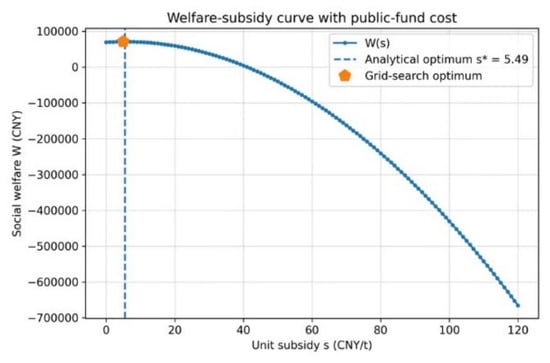
Equation (49) must be interpreted with care because the second-order condition changes sign at λ = 3/4. Differentiating Equation (47) twice gives d2W/ds2 = (3 − 4λ)/(4k). Three regimes therefore arise. (i) For λ ∈ (0, 3/4), the stationary point s* < 0 is a welfare minimum, not a maximum; since dW/ds > 0 at s = 0, welfare increases with the subsidy and the constrained welfare-maximizing subsidy is at the upper bound (the engineering usage cap or the government budget limit). (ii) For λ ∈ (3/4, 3/2), the stationary point s* > 0 is an interior welfare maximum; the baseline λ = 1.3 falls in this regime, yielding s* = 5.49 CNY/t. (iii) For λ > 3/2, the stationary point s* < 0 is an interior welfare maximum, corresponding to a Pigouvian tax on steel slag use; with the non-negativity constraint s > 0, the constrained optimum is s = 0. At λ = 3/4, welfare is linear and increasing in s, so no interior optimum exists; at λ = 3/2, s* = 0 is the optimum. Table 3 summarizes the sign, second-order condition, and policy interpretation. Accordingly, the statement that the welfare-maximizing subsidy may be small or even negative should be understood as follows: for λ ∈ (3/4, 3/2), the subsidy is positive but small; for λ > 3/2, the unconstrained optimum is negative, but the constrained optimum is zero; for λ < 3/4, the negative stationary point is not welfare-maximizing, and the constrained optimum is at the upper bound.
Table 3.
Regimes of the welfare-optimal subsidy s*.
Case B: Environmental value not internalized (incomplete carbon market).
The reaction function becomes q = (pa − ps + s)/k. The steel plant’s optimal price is ps = (pa + s + c0 + ct)/2, and the procurement quantity is q = (pa + s − c0 − ct)/(2k). Letting A′ = pa − c0 − ct, social welfare is:
The first-order condition is:
Solving gives:
Compared with Case A, the term −2ve in the numerator reflects the environmental value that has not yet been internalized: when the carbon market is incomplete, the subsidy must additionally correct the environmental externality, so s* is higher (less negative or more positive) than under full internalization. This is precisely the theoretical basis for subsidies as a corrective instrument and shows that carbon market maturity directly determines the necessity and intensity of subsidies.
Three points warrant emphasis. First, the baseline numerical simulations in this study adopt λ = 1.3 (see Table 4), and the welfare-subsidy curve in Figure 9 is also plotted under this marginal cost of public funds; the numerical analysis is therefore fully consistent with the derivation in this subsection. Second, λ = 0 serves only as a theoretical reference case to illustrate boundary, behavior without tax-financing costs; it is not used in the baseline numerical analysis and does not contradict the main conclusions. Third, in practice, environmental value may be only partially internalized (e.g., firms bear carbon-reduction obligations but receive no direct benefits); in such cases, the internalization coefficient η and the environmental externality E should be adjusted according to the actual institutional setting. This study focuses on revealing the mechanism through which subsidies operate; specific applications should recalibrate institutional parameters accordingly.
Table 4.
Symbols and definitions of relevant parameters.
4. Results and Discussion
4.1. Numerical Simulation Under Complete Information
4.1.1. Parameter Settings
According to the project case requirements, the baseline values of the relevant parameters are determined and summarized in Table 4. The specific details are as follows:
Calibration of the technical adaptation cost coefficient k. The technical adaptation cost captures the convex adaptation costs incurred by the contractor in mix-proportion adjustment, process adaptation, and quality control during steel slag substitution. The value of k is back-calibrated by matching the equilibrium procurement quantity under the full-information benchmark. Substituting pa = 120, c0 = 35, τ = 1.1, d = 50, e = 0.00218, v = 80, η = 1.30, s = 5.4863, and the true hidden cost ϕ = 6 from Table 4 into the full-information equilibrium procurement quantity:
Setting q* = 3029.285 t (the full-information benchmark in Table 5) yields:
Table 5.
Comparison of coordination mechanisms.
4.1.2. Equilibrium Outcomes Under Different Subsidy Levels
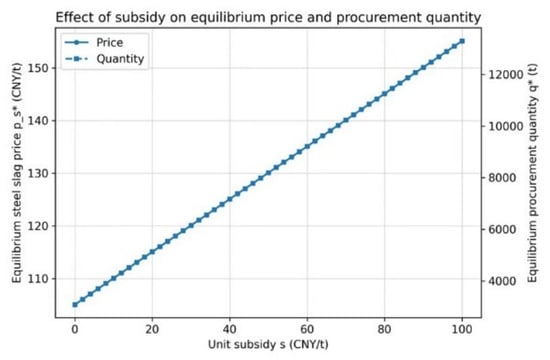
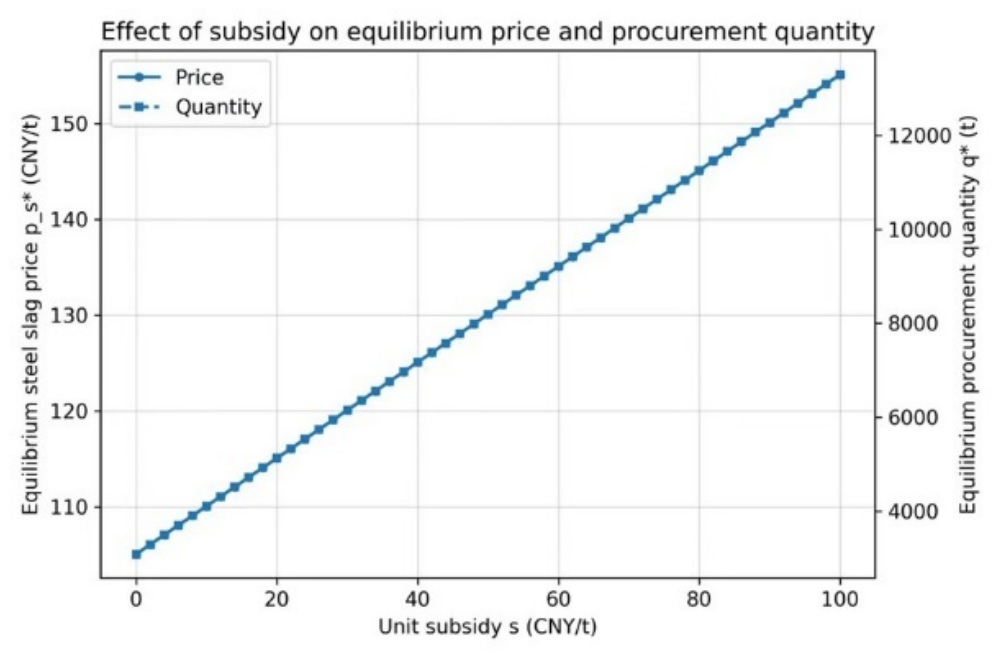
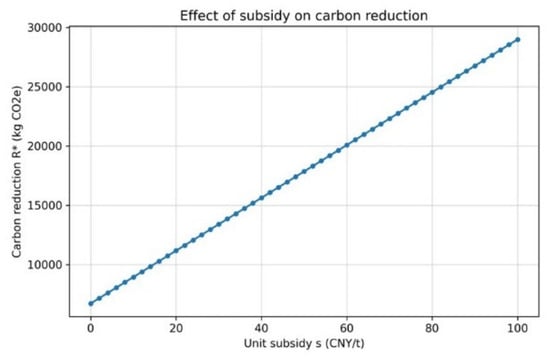
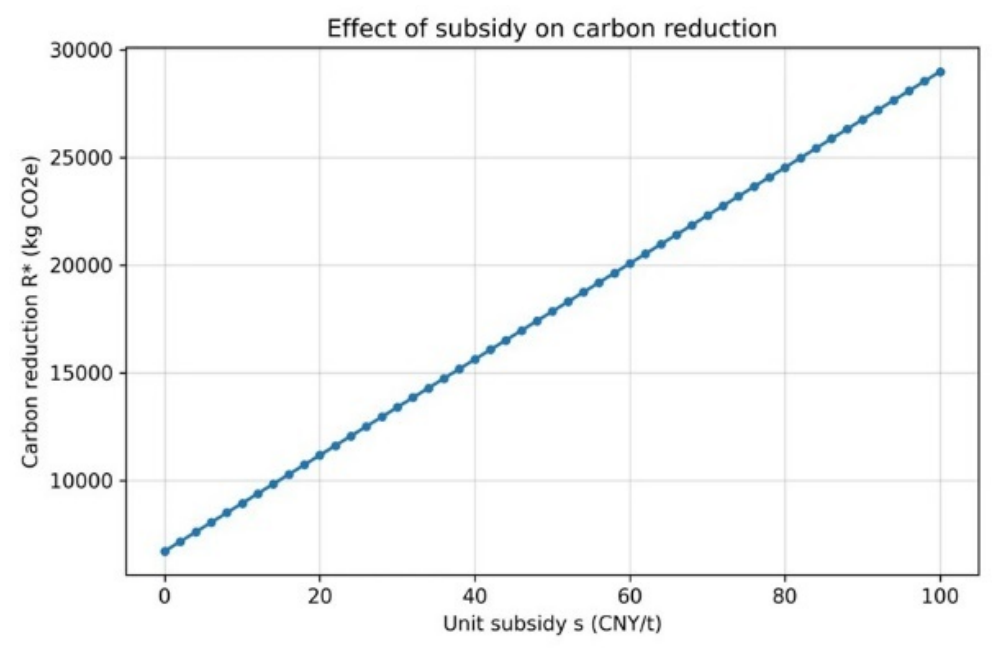
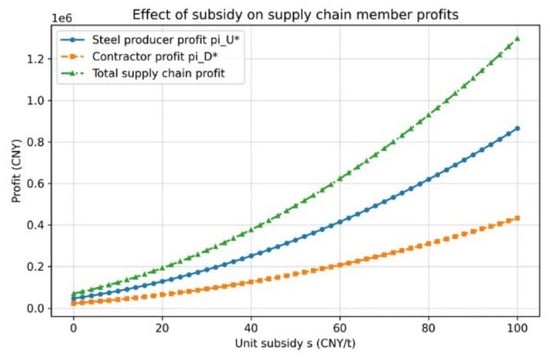
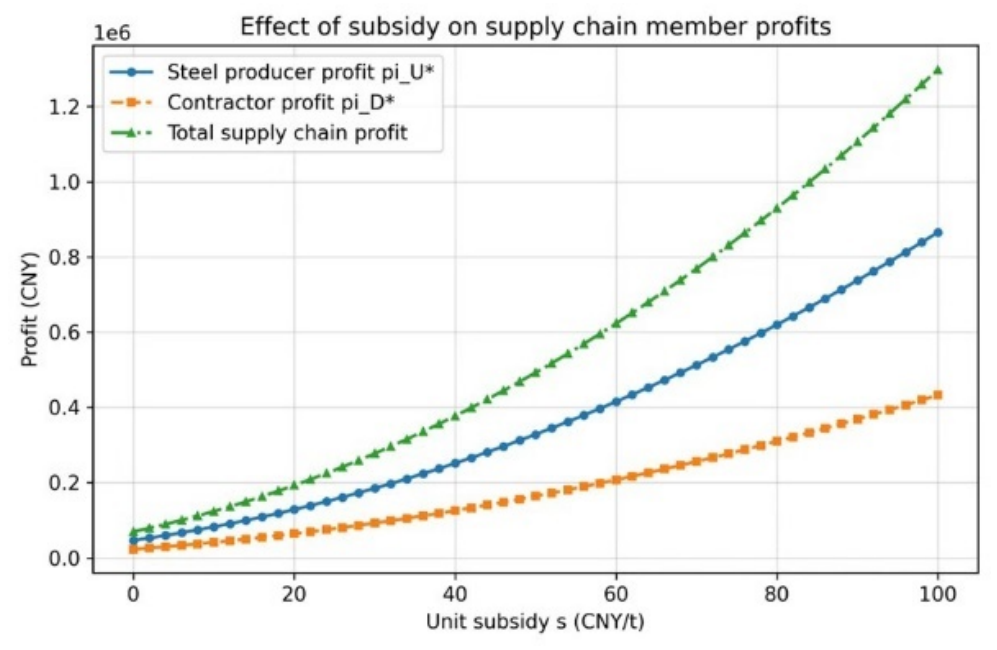
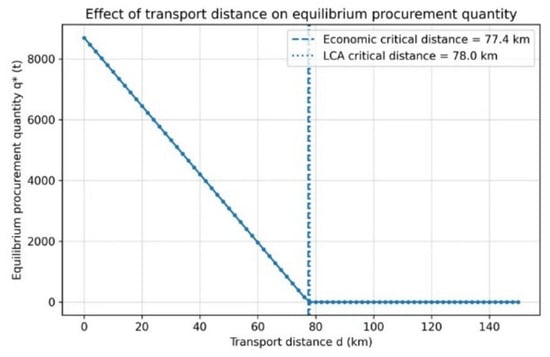
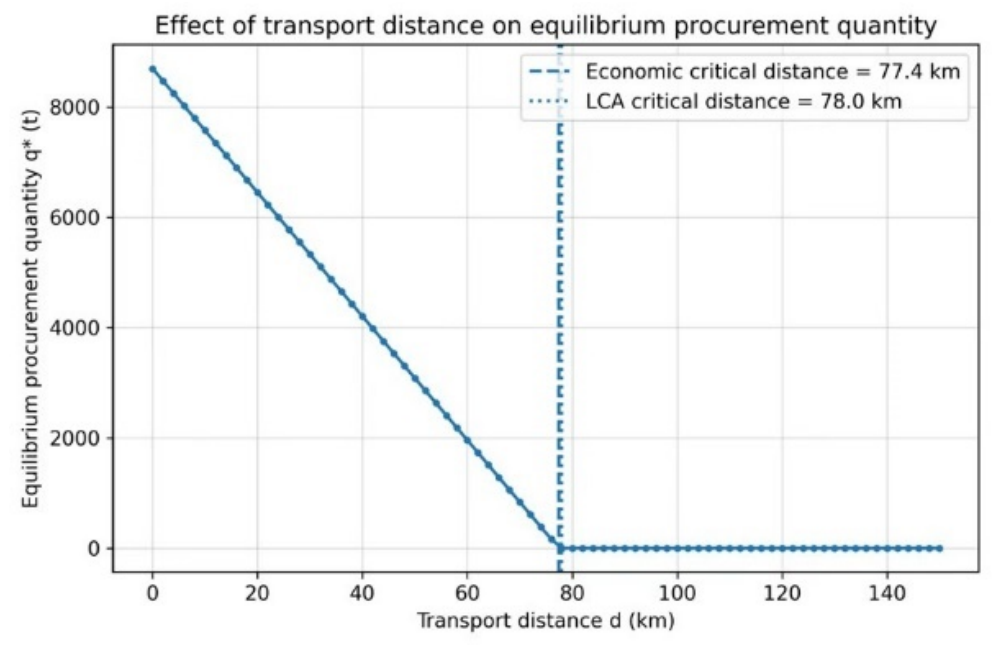
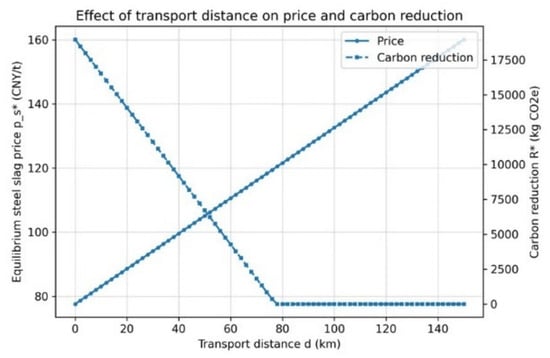
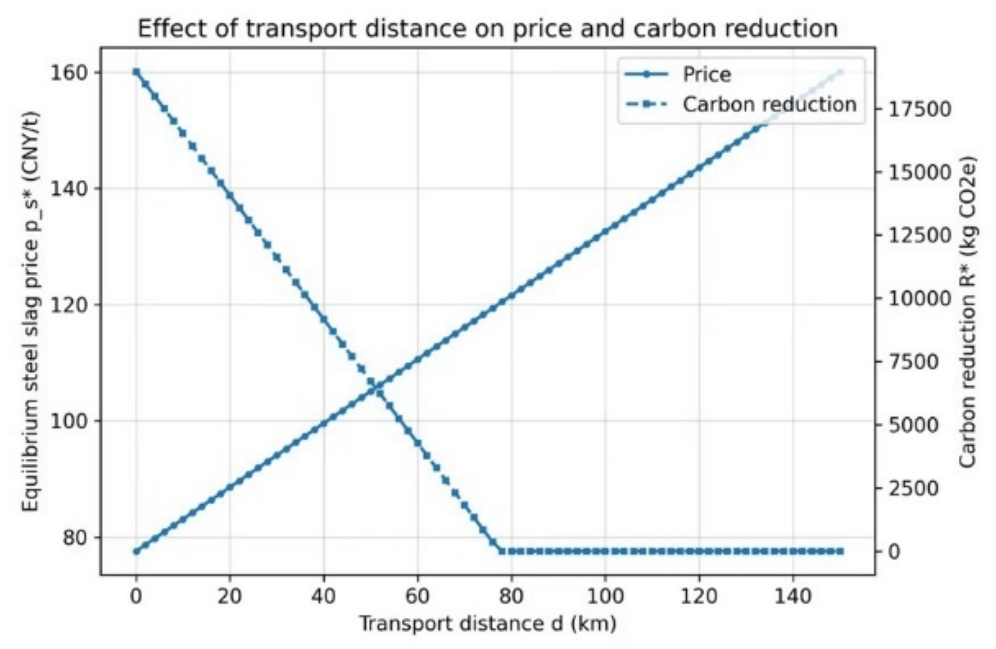
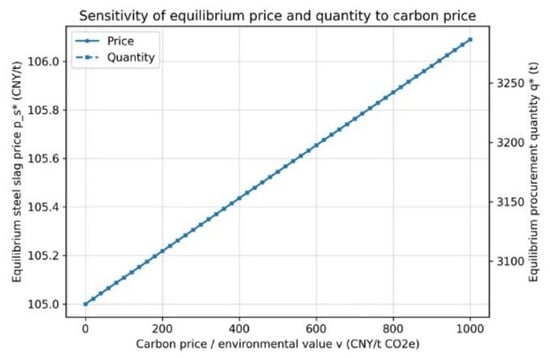
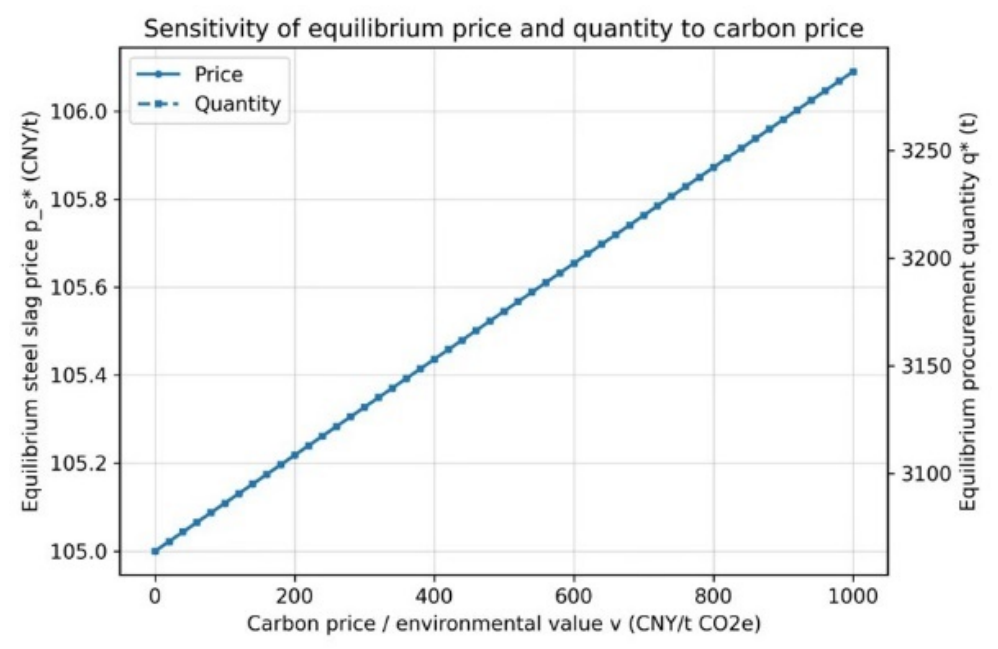
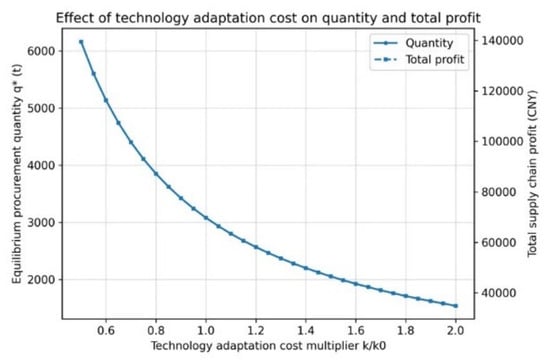
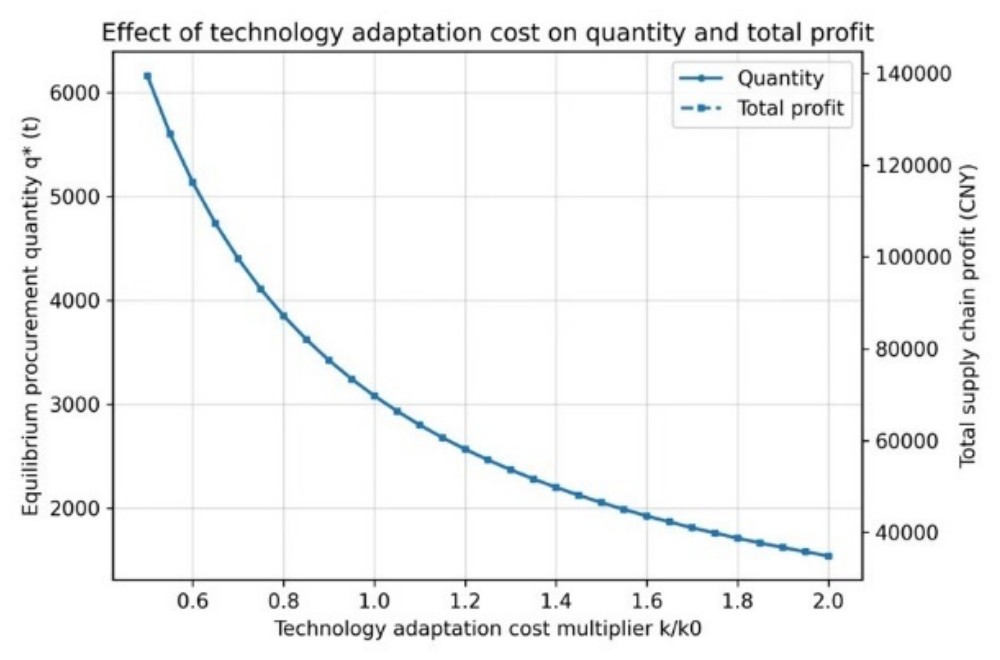
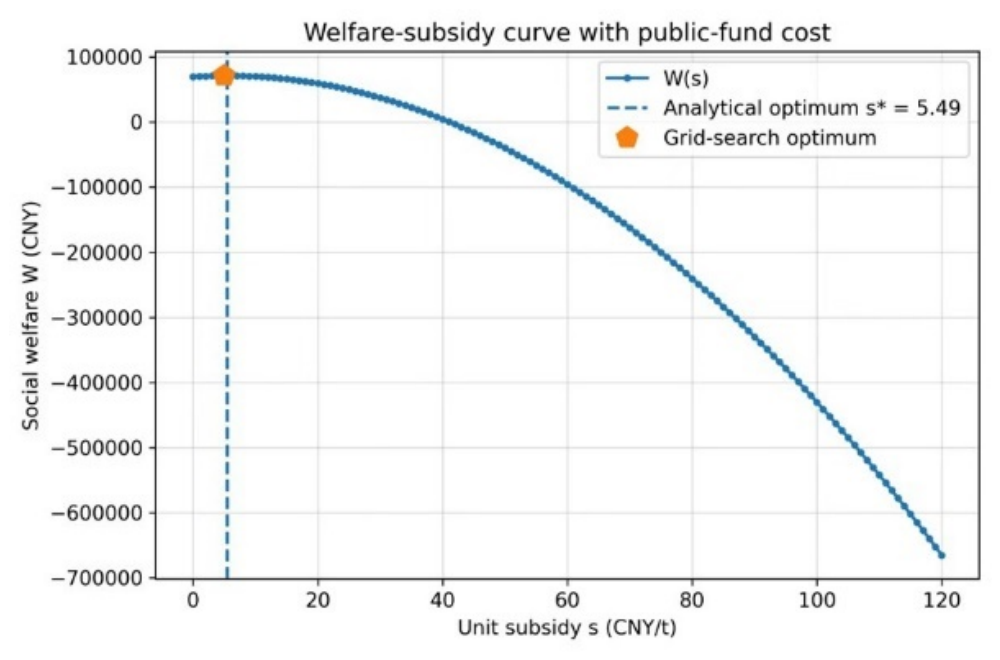
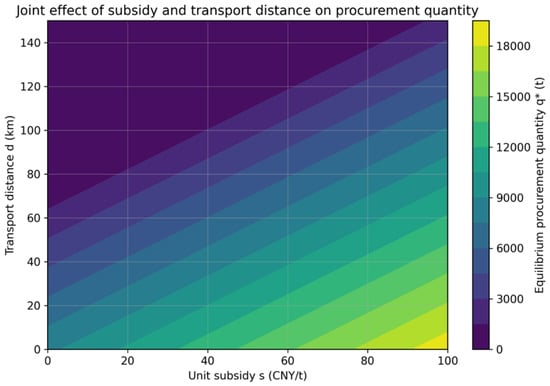
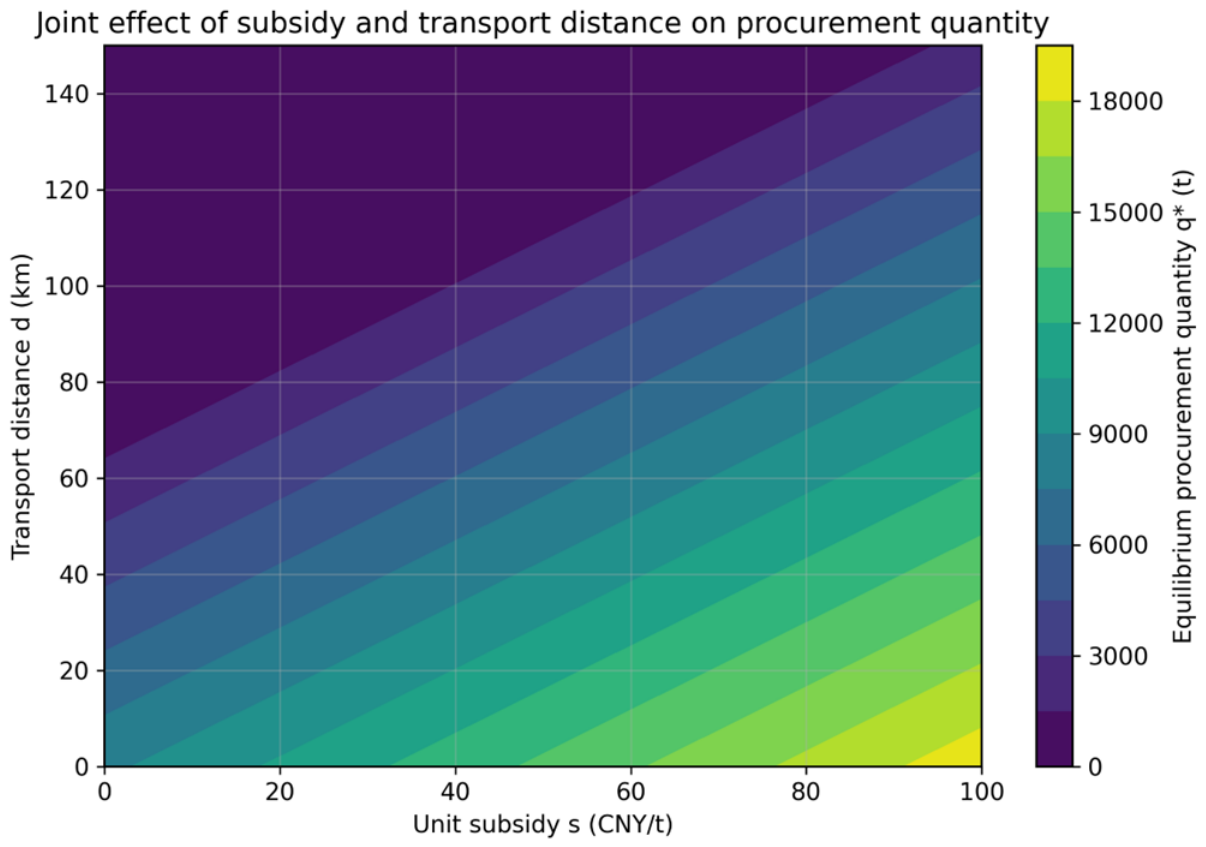
This subsection employs MATLABR2026a for sensitivity analysis and numerical simulation. Figure 2, Figure 3, Figure 4, Figure 5, Figure 6, Figure 7, Figure 8, Figure 9 and Figure 10 report equilibrium outcomes. Specifically, they are as follows: A per-unit subsidy raises both the equilibrium steel slag price and procurement quantity (Figure 2), and carbon reduction increases linearly with the subsidy (Figure 3). These results have direct sustainability implications. The subsidy simultaneously improves the environmental pillar (higher carbon reduction), the economic pillar (higher profits for both parties), and the social pillar (higher social welfare up to the optimal subsidy), but the distribution of gains is uneven and the fiscal cost of public funds constrains the socially optimal level. Sustainability is therefore not automatically achieved by increasing the subsidy; it requires a subsidy level that balances environmental gains against the social cost of taxation, and it requires complementary carbon market and information policies. Supply chain profits rise for both parties, with the steel plant benefiting more due to first-mover advantage (Figure 4). Transport distance reduces procurement and carbon reduction; the economic critical distance is approximately 77.4 km, The economic critical distance is obtained from the equilibrium procurement quantity by setting q* = 0, which gives d* = (pa + ηve + s − ϕ − c0)/τ. The value of 77.4 km reported in Figure 5 and Figure 6 corresponds to the no-subsidy benchmark (S = 0), full internalization (η = 1), and zero hidden cost (ϕ = 0), with the baseline parameters in Table 2. Under the welfare-optimal subsidy s* = 5.49 CNY/t, the critical distance extends to d* = (120 + 0.1744 + 5.49 − 35)/1.1 = 82.4 km. The LCA-based environmental critical distance of 77.95 km is computed from the LCA model without subsidy and with the same transport-cost parameter; the two distances are close because the environmental benefit per tonne is small, relative to the economic cost terms at the baseline carbon price. This comparison is therefore internally consistent: both distances are evaluated under the same no-subsidy, full-internalization benchmark, close to the LCA-based environmental critical distance of 77.95 km (Figure 5 and Figure 6). A higher carbon price raises both price and quantity, but the effect is mild because the unit carbon reduction is only 2.18 kg CO2e/t (Figure 7). A higher technology adaptation cost reduces procurement and total profit (Figure 8). When the marginal cost of public funds is included, social welfare is maximized at a finite subsidy s* = 5.49 CNY/t; beyond this level, welfare declines (Figure 9). The joint effect of subsidy and transport distance shows that higher subsidies expand the feasible procurement region, while longer distances suppress demand (Figure 10).
Figure 2.
Effect of subsidy on equilibrium price and procurement quantity.
Figure 3.
Effect of subsidy on carbon reduction.
Figure 4.
Effect of subsidy on supply chain member profits.
Figure 5.
Effect of transport distance on equilibrium procurement quantity.
Figure 6.
Effect of transport distance on price and carbon reduction.
Figure 7.
Sensitivity of equilibrium price and quantity to carbon price.
Figure 8.
Effect of technology adaptation cost on quantity and total profit fund cost.
Figure 9.
Welfare-subsidy curve with public-fund cost.
Figure 10.
Joint effect of subsidy and transport distance on procurement quantity.
4.2. Numerical Simulation Under Incomplete Information
To examine how the decision-maker’s belief mean regarding hidden costs evolves, Figure 11 shows the initial Bayesian learning phase (t = 1 to 3). Under high prior uncertainty and initial overestimation, the belief mean falls rapidly from 15 to near the true value of 6, while the credible interval narrows and stabilizes by t ≈ 10, confirming that Bayesian learning effectively converges to unknown parameters under incomplete information.
Figure 11.
Bayesian updating of hidden-cost belief under incomplete information.
Figure 12 presents the posterior variance Vt and the learning gain Kt, over iterations. Vt, measuring uncertainty in the hidden-cost estimate, decreases monotonically from 25.00 to 9.76 after the first update and to 1.15 by t = 14; Kt, reflecting the marginal contribution of new observations, declines from 0.61 to about 0.10. These coordinated trends indicate that high initial uncertainty induces large early belief revisions, whereas subsequent learning saturates as belief precision improves.
Figure 12.
Posterior uncertainty reduction and learning gain under Bayesian updating.
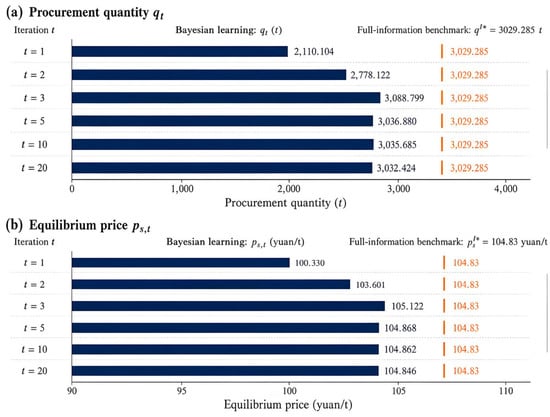
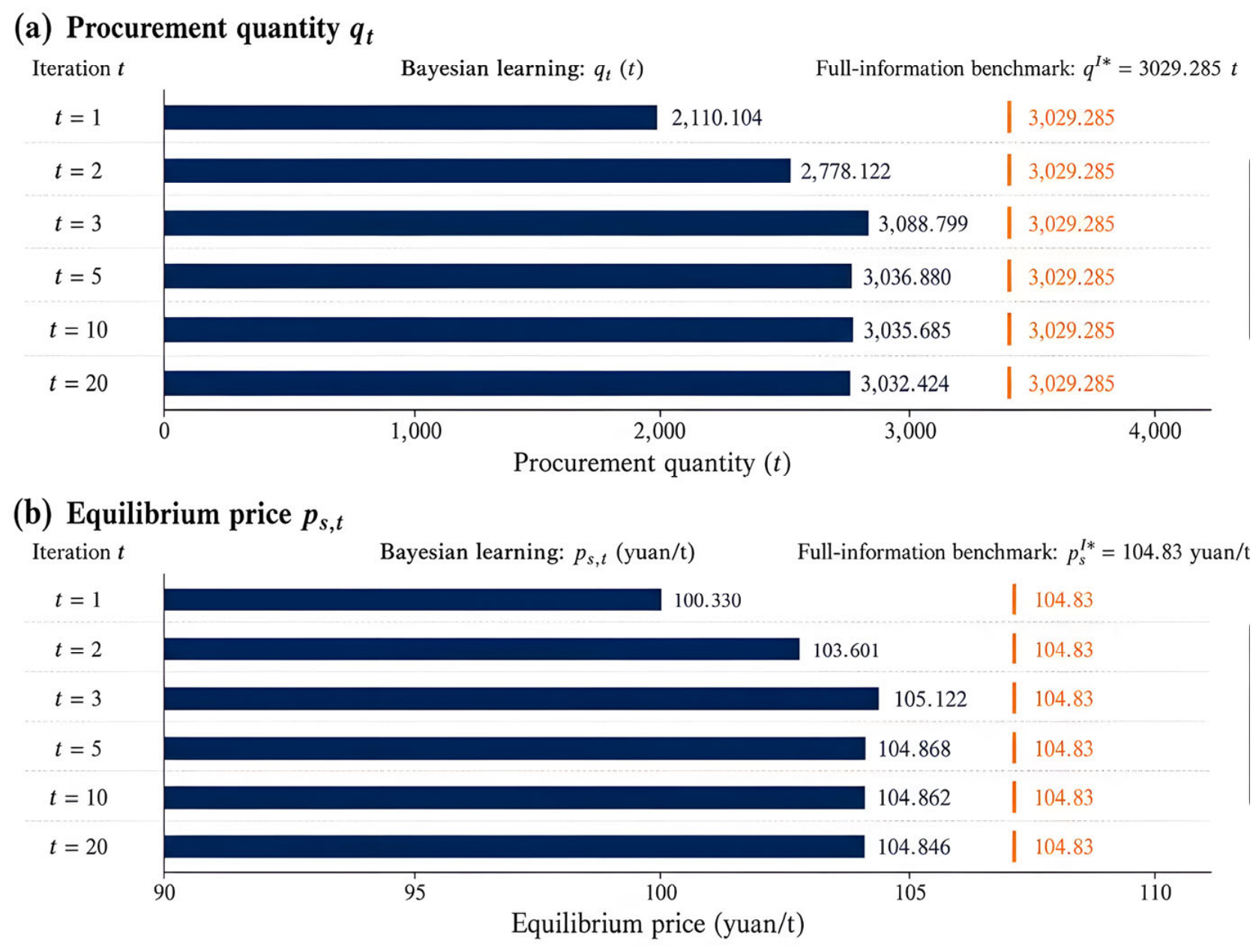
Figure 13 shows the convergence of procurement quantity qt and equilibrium price ps,t toward the full-information benchmark under Bayesian learning. In Figure 13a, qt starts at 2110.104 at t = 1 due to severe cost overestimation, rises to 2778.122 at t = 2, exceeds the benchmark of 3029.285 at t = 3 (3088.799), and stabilizes within 3032–3091 from t = 5 onward. In Figure 13b, the price starts below the benchmark of 104.83 CNY/t at 100.33 CNY/t, rises to 105.122 CNY/t at t = 3, and stabilizes within 104.85–105.137 CNY/t from t = 5 onward, closely matching the full-information benchmark.
Figure 13.
Convergence of equilibrium quantity and price toward the full-information benchmark.
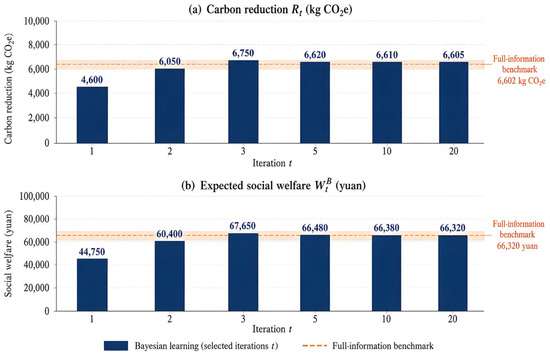
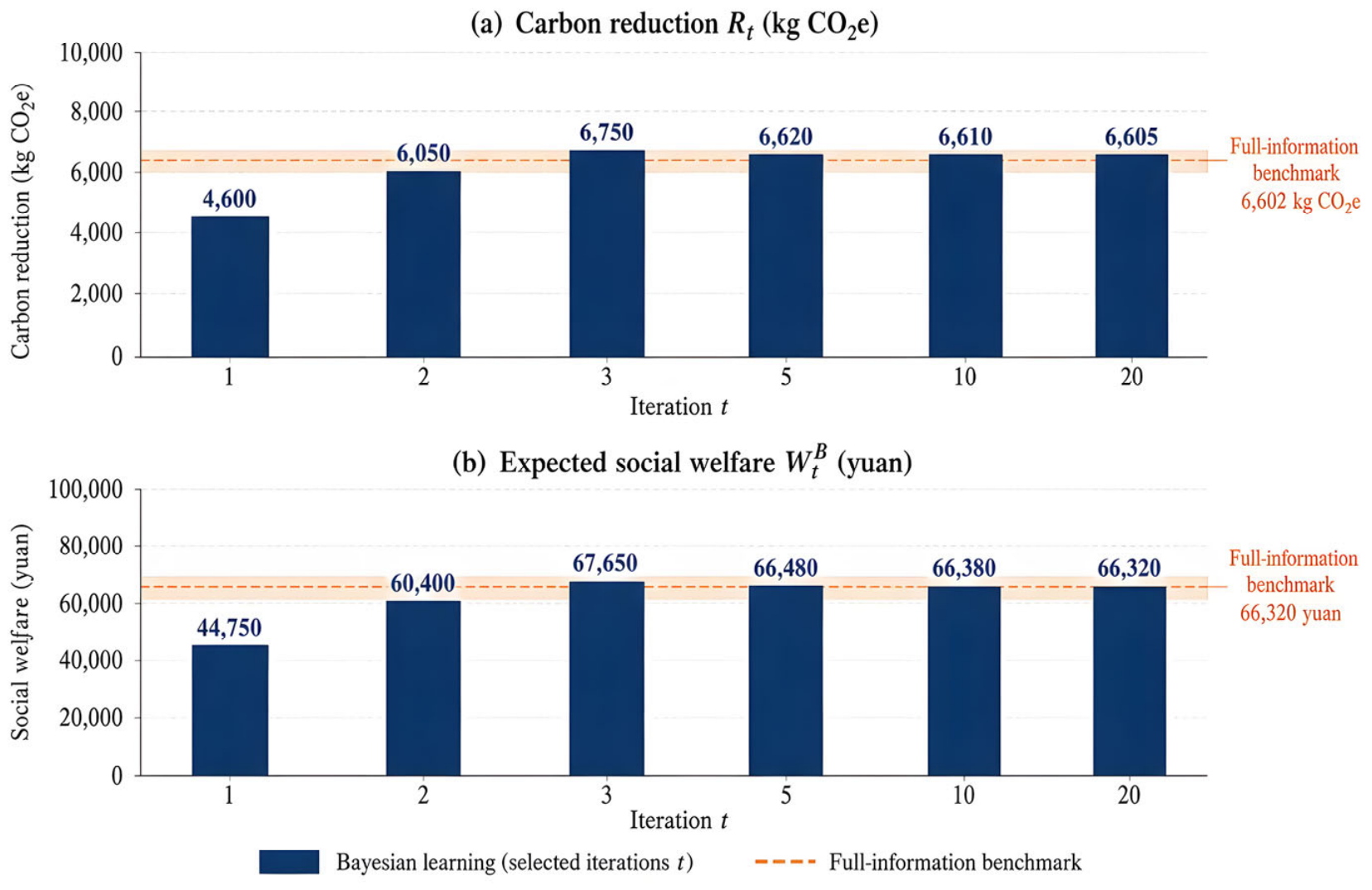
Figure 14 reports the evolution of carbon reduction and social welfare under Bayesian learning relative to the full-information benchmark. Carbon reduction follows a three-stage pattern: underperformance at t = 1 (4600 vs. 6602 kg CO2e), overshoot at t = 3 (6750 kg CO2e), and convergence from t = 5 onward (6620, 6610, and 6605 kg CO2e at t = 5, 10, and 20), with deviations below 1% by t = 10. Social welfare similarly exhibits initial loss (44,750 CNY at t = 1 vs. 66,320 CNY), rapid rise and overshoot (60,400 and 67,650 CNY at t = 2 and 3), and stabilization around 66,480 CNY from t = 5, reaching 66,320 CNY at t = 20. These results confirm that Bayesian learning rapidly corrects initial cognitive bias, bringing environmental and welfare performance close to the full-information optimum within about 5–10 periods.
Figure 14.
Dynamic evolution of carbon reduction and social welfare under Bayesian learning.
4.3. Comparison with Alternative Coordination Mechanisms
We compare the per-unit subsidy with three alternative coordination mechanisms: a two-part tariff, revenue sharing, and a combined tax-rebate scheme. Under a two-part tariff, the steel plant charges a fixed fee F plus a wholesale price w. The contract can achieve channel coordination, with the procurement quantity equal to the integrated-channel optimum, and the fixed fee allocates surplus between the parties. The government may still need to provide a subsidy if the fixed fee is too high for the contractor, but the welfare loss from double marginalization is eliminated. Under revenue sharing, the contractor shares a fraction 1 − θ of its revenue with the steel plant. The contract coordinates the channel when 0 is set appropriately, and the leader’s pricing power is moderated; subsidy pass-through depends on 0. Under a combined tax-rebate scheme, the government imposes a carbon tax tc on emissions and rebates per unit of steel slag used. The net instrument is equivalent to a per-unit subsidy s = r − tce, but the fiscal cost is lower because the tax generates revenue, and the scheme is revenue-neutral when r = tce. Table 5 compares the mechanisms in terms of welfare, surplus split, fiscal cost, and information requirements. The per-unit subsidy is simple and transparent but fiscally costly and disproportionately favors the leader. Two-part tariffs and revenue sharing can achieve higher welfare and fairer surplus splits but require more information and contracting sophistication. Tax-rebate schemes can be revenue-neutral and are preferable when carbon markets are incomplete. These comparisons suggest that the per-unit subsidy should be viewed as one instrument in a broader policy mix rather than as a stand-alone solution.
5. Conclusions
From a sustainability perspective, this study makes three contributions. First, it quantifies the environmental sustainability benefit of steel slag substitution using a project-level LCA coefficient and shows that this benefit is conditional on transport distance, with an economic critical distance close to the environmental critical distance. Second, it shows that economic sustainability—the profitability of both supply chain members—can be improved by a quantity-based subsidy, but that the gains are unevenly distributed and the fiscal cost of public funds limits the socially optimal subsidy. Third, it shows that social sustainability, measured by social welfare including the environmental externality and the fiscal cost of public funds, is maximized at a finite subsidy when the carbon market is incomplete, whereas a mature carbon market may make the subsidy small or even unnecessary. Together, these results provide a quantitative basis for designing subsidy, carbon-pricing, and information-disclosure policies that align environmental, economic, and social sustainability objectives in low-carbon road materials.
This study develops a government-subsidized Stackelberg game for the steel slag road-material supply chain, with a steel plant as the leader and a road contractor as the follower, and calibrates the carbon-reduction coefficient using published LCA results. The main findings are: (1) A quantity-based subsidy simultaneously raises the equilibrium steel slag price and procurement quantity, with gains shared between upstream and downstream but disproportionately favoring the steel plant due to first-mover advantage. (2) The subsidy enhances carbon reduction and extends the economic transport radius; the economic break-even distance (77.4 km) is close to the LCA-based environmental break-even distance (77.95 km). (3) Carbon price and technology adaptation cost moderate subsidy effectiveness; a higher carbon price strengthens subsidy leverage. (4) When environmental value is fully internalized by the carbon market, the welfare-maximizing subsidy may be small or even negative after accounting for the marginal cost of public funds; when the carbon market is incomplete, subsidies remain an effective corrective instrument. (5) Under the prior and signal specifications adopted in this simulation, an initial overestimation of hidden costs suppresses procurement and abatement; however, Bayesian learning converges to the full-information equilibrium within approximately 5–10 periods and reduces belief variance by about 96.9%. These simulation-based findings provide a quantitative framework for exploring subsidy, carbon-pricing, information-disclosure, and supply chain coordination policies for low-carbon road materials, while their generality remains to be examined under alternative prior and signal structures.
5.1. Policy Recommendations
Several policy recommendations follow from the model. First, quantity-based subsidies should be designed as a transitional and differentiated instrument rather than a uniform permanent transfer. Because the subsidy raises both the equilibrium steel slag price and procurement quantity, and the gains are disproportionately captured by the upstream steel plant, subsidy contracts should be combined with price-monitoring or benefit-sharing mechanisms-such as price-cap, rebate, or cost-sharing clauses—to prevent the Stackelberg leader from appropriating too large a share of public funds. Second, subsidy intensity should be coordinated with carbon market development. When the carbon market fully internalizes the environmental value, the welfare-maximizing subsidy may be small or even negative after accounting for the marginal cost of public funds; in this case, the policy priority should shift from direct subsidy to carbon pricing and market-based internalization. When the carbon market is incomplete, quantity-based subsidies remain a necessary corrective instrument, and the subsidy level should be calibrated to the degree of environmental-value internalization. Third, because the economic break-even transport distance (77.4 km) is close to the LCA-based environmental break-even distance (77.95 km), policy should encourage local and regional matching between steel plants and road projects, support short-radius collection and distribution networks, and avoid long-distance transport that erodes both economic and environmental benefits. Fourth, because technology adaptation cost substantially moderates subsidy effectiveness, subsidies should be bundled with technical support—mix-proportion design, quality certification, and adaptation-cost sharing—especially for contractors with high adaptation costs. Fifth, information disclosure, quality certification, and the accumulation of historical transaction data should be promoted to reduce hidden compatibility-cost uncertainty; Bayesian learning converges to the complete-information equilibrium within about 5–10 periods, so early-stage information interventions can shorten the learning process and reduce initial under-procurement or over-procurement. Finally, subsidy policy should be dynamic and phased: as carbon markets mature, information transparency improves, and adaptation costs decline, the subsidy can be gradually reduced and eventually replaced by carbon pricing and supply chain coordination contracts.
5.2. Limitations and Future Research
This study has several limitations that open avenues for further research. First, the model assumes a two-echelon supply chain with one steel plant and one contractor; future research could extend it to multi-supplier, multi-contractor, and multi-regional networks with heterogeneous transport distances and competition. Second, the carbon-reduction coefficient is calibrated from a single project-level LCA case; although this ensures project relevance, future studies could incorporate region-specific and technology-specific LCA coefficients, uncertainty distributions, and different system boundaries. Third, the carbon price and the degree of environmental-value internalization are treated as exogenous parameters; future research could endogenize carbon pricing and carbon market equilibrium, and examine the interaction between carbon quotas, carbon trading and subsidies. Fourth, the incomplete-information analysis adopts a normal prior and a conjugate Bayesian learning structure; future research could examine alternative prior distributions, non-conjugate learning, reference-dependent beliefs, and overconfidence or risk aversion. Fifth, the model is static in the complete-information benchmark and periodic in the Bayesian extension; dynamic Stackelberg games, repeated procurement, learning-by-doing, and investment in adaptation technology could be incorporated. Sixth, social welfare is measured under a net-transfer framework with a given marginal cost of public funds; future research could adopt a more comprehensive welfare analysis including consumer surplus, fiscal budget constraints, distributional effects, and regional employment. Finally, empirical validation using field data from steel slag road projects—procurement records, actual compatibility costs, and realized emission reductions—would strengthen the policy conclusions and allow structural estimation of key parameters.
Author Contributions
Conceptualization, L.F.; methodology, L.F. and E.U.; software, L.F. and E.U.; validation, L.F. and E.U.; formal analysis, L.F. and X.D.; investigation, L.F. and E.U.; resources, E.U.; data curation, L.F. and E.U.; writing—original draft preparation, L.F.; writing—review and editing, L.F.; visualization, L.F.; supervision, X.D.; project administration, E.U.; funding acquisition, E.U. and X.D. All authors have read and agreed to the published version of the manuscript.
Funding
This research was funded by the Science and Technology R&D Program of Xinjiang Transportation Investment (Group) Co., Ltd. (ZKXFWCG-202211-011) and (ZKXFWCG-202211-010).
Institutional Review Board Statement
Not applicable.
Informed Consent Statement
Not applicable.
Data Availability Statement
The original contributions presented in the study are included in the article; further inquiries can be directed to the corresponding author.
Acknowledgments
We are grateful to our family members, friends and laboratory colleagues for their unwavering understanding and encouragement.
Conflicts of Interest
Author Ershat Ubulqasim was employed by the company Xinjiang Jiaotou Construction Management Co., Ltd. The remaining authors declare that the research was conducted in the absence of any commercial or financial relationships that could be construed as a potential conflict of interest.
References
- China Academy of Transportation Sciences. Interpretation of Knowledge on Carbon Peaking and Carbon Neutrality in Transportation; China Communications Press: Beijing, China, 2021; pp. 21–39. [Google Scholar]
- Zhang, J.X.; Su, C.; Wang, C.; Jing, P.; Hou, Y. Review of energy-saving and emission-reduction issues and technologies in the construction of road infrastructure. J. Beijing Univ. Technol. 2022, 48, 243–260. [Google Scholar]
- Liu, X.L.; Wang, H.T.; Chen, J.; He, Q. Method and basic model for development of Chinese reference life cycle database. Acta Sci. Circumstantiae 2010, 30, 2136–2144. [Google Scholar]
- Ningxia Transportation Construction Co., Ltd.; Ningxia Communications Investment Group Co., Ltd. The pivotaltechnology for the cascading utilization of full-grain steel slag inroad construction. J. Transp. Energy Conserv. Environ. Prot. 2024, 20. [Google Scholar]
- O’cOnnor, J.; Nguyen, T.B.T.; Honeyands, T.; Monaghan, B.; O’dEa, D.; Rinklebe, J.; Vinu, A.; Hoang, S.A.; Singh, G.; Kirkham, M.; et al. Production, characterisation, utilisation, and beneficial soil application of steel slag: A review. J. Hazard. Mater. 2021, 419, 126478. [Google Scholar] [CrossRef] [Scilit] [PubMed]
- Tong, Q.; Wei, X.; Qin, X. Research on breakthrough low-carbon technologies in China’s cement and steel industries. Shanghai Energy Conserv. 2020, 380–385. [Google Scholar] [CrossRef]
- Yan, R.; Li, Y.; Zhao, X. A brief discussion on the concept of steel slag as cement clinker. Ind. Heat. 2017, 46, 65–68. [Google Scholar]
- Ling, J.; Xie, H.; Zhuang, S. Experimental study on water stability of cement-lime soil. J. Tongji Univ. (Nat. Sci.) 2001, 29, 733–737. [Google Scholar]
- Yu, C.; Cui, C.; Wang, Y.; Zhao, J.; Wu, Y. Strength performance and microstructural evolution of carbonated steel slag stabilized soils in the laboratory scale. Eng. Geol. 2021, 295, 106410. [Google Scholar] [CrossRef] [Scilit]
- Zhang, Y.; Liu, C.; Zhang, Y.; Wu, X.; Zhang, F.; Zhang, J.; Li, X. The mechanical strength, microstructure, and transport properties of steel slag reinforced loess soil system. Case Stud. Constr. Mater. 2024, 20, e02702. [Google Scholar] [CrossRef] [Scilit]
- Mostazid, M.I.; Sakai, Y. Effect of heat treatment on mechanical behavior and scaling resistance of slag impregnated low strength recycled compacted concrete. J. Build. Eng. 2023, 68, 106084. [Google Scholar] [CrossRef] [Scilit]
- Liu, Q.; Xue, G.; Tan, J. Study on impact resistance of steel slag fine aggregate concrete based on drop weight impact test. Bull. Chin. Ceram. Soc. 2023, 42, 4399–4407. [Google Scholar]
- Liu, X.; Yan, F.; Wang, W. Discussion on the synergistic effect of pollution reduction and carbon reduction in comprehensive utilization of steel slag. Environ. Sci. Technol. 2025, 38, 61–65, 80. [Google Scholar]
- Maharaj, C.; White, D.; Maharaj, R.; Morin, C. Re-use of steel slag as an aggregate to asphaltic road pavement surface. Cogent Eng. 2017, 4, 1416889. [Google Scholar] [CrossRef] [Scilit]
- Yuan, X.; Sun, Z.; Peng, F. Suggestions for the development of comprehensive utilization of steel solid waste under the background of carbon neutrality. Metall. Econ. Manag. 2023, 6, 9–11. [Google Scholar]
- Yang, L.; Li, L.; Yang, R. New development, new thinking: Research on the synergy of pollution reduction and carbon reduction. Environ. Prot. Sci. 2024, 50, 58–66. [Google Scholar]
- Kuang, Y.; Wang, X.; Wang, J.; Peng, Q.; Zhao, H.; Wang, X. Virtual power plant energy sharing mechanism based on Stackelberg game. Power Syst. Technol. 2020, 44, 4556–4564. [Google Scholar]
- Hao, L.; Liu, J.; Chen, S. Risk coordination strategies for sustainable supply chains under risk preferences based on Stackelberg game theory. Sci. Technol. Ind. 2022, 22, 19–28. [Google Scholar]
- Liu, D.; Fan, L.; Zhang, L.; Dai, X. Carbon Emission Accounting and Multi-Objective Analysis for Steel Slag Road Paving: A Case Study from Xinjiang. Processes 2026, 14, 1075. [Google Scholar] [CrossRef] [Scilit]
- Zhang, F.; Wang, W. Technical application of steel slag recycled aggregate in highway base maintenance and analysis of carbon reduction potential. Transp. Eng. 2026, 26, 41–45. [Google Scholar]
- Ren, X.; Du, L.; Luan, Z. Research progress on the application of calcium-rich solid waste in cement and analysis of carbon reduction potential of calcined clinker. J. Chin. Ceram. Soc. 2026, 1–12. [Google Scholar] [CrossRef]
- Hou, Z.; Wang, A.; Ni, J. Study on life cycle emission reduction accounting methodology for steel slag mineralization CO2 sequestration and utilization. Shanghai Energy Conserv. 2026, 44, 717–723. [Google Scholar]
- Du, L.; Ren, X.; Zhang, H. Cement carbon accounting method under different steel slag treatment modes based on material genes. Bull. Chin. Ceram. Soc. 2026, 45, 2368–2378. [Google Scholar]
- Wang, L.; Zhang, L.; Zhang, X.L. Optimal financing strategies for low-carbon supply chains: A Stackelberg game perspective. Manag. Decis. Econ. 2025, 46, 666–680. [Google Scholar] [CrossRef] [Scilit]
- Huang, C.; Zhu, X.; Xiong, B.; Zhang, P. Competition structure and decision analysis of a retailer-led low-carbon supply chain. J. Ind. Technol. Econ. 2025, 44, 36–45. [Google Scholar]
- Khanlarzade, N.; Farughi, H. Modeling the Stackelberg game with a boundedly rational follower in deterioration supply chain-based interaction with the leader’s hybrid pricing strategy. Expert Syst. Appl. 2024, 237, 121302. [Google Scholar] [CrossRef] [Scilit]
- Wan, Y.; Hou, H.; Ge, X. Two-stage hybrid game win-win strategy for integrated energy systems considering multi-level utilization of carbon emissions. Autom. Electr. Power Syst. 2025, 49, 69–79. [Google Scholar]
- Wang, D.; Yin, Y.; Zhu, M. Research on supply chain emission reduction decisions based on different carbon quota trading paths. Oper. Res. Manag. Sci. 2024, 33, 35–41. [Google Scholar]
- Liu, Z.; Zhang, Y.; Tang, J. Research on digital technology and emission reduction investment decisions in low-carbon supply chains under hybrid carbon trading. J. Syst. Sci. Math. Sci. 2026, 1–22. [Google Scholar]
- Guo, J.; Ma, X.; Yu, C.; Zhou, Y. Research on emission reduction decisions and combined financing methods of dual-channel low-carbon supply chains considering government subsidies. Chin. J. Manag. Sci. 2026, 34, 336–346. [Google Scholar]
- Zhu, Y. Research on Low-Carbon Supply Chain Decisions Considering Government Subsidies and Corporate Social Responsibility. Master’s Thesis, Henan Polytechnic University, Jiaozuo, China, 2025. [Google Scholar]
- Mukhopadhyay, S.K.; Yue, X.; Zhu, X. A Stackelberg model of pricing of complementary goods under information asymmetry. Int. J. Prod. Econ. 2009, 134, 424–433. [Google Scholar]
- Bustamante-Faúndez, P.; Bucarey, V.; Labbé, M.; Marianov, V.; Ordoñez, F. Playing Stackelberg Security Games in perfect formulations. Omega 2024, 126, 103068. [Google Scholar] [CrossRef] [Scilit]
- Yu, J.; Li, M.; Liu, D. Logistics scheduling of steel coil inbound and outbound warehouse based on Stackelberg game. Comput. Integr. Manuf. Syst. 2025, 1–22. [Google Scholar] [CrossRef]
- Finus, M.; Furini, F.; Rohrer, A.V. The Stackelberg vs. Nash-Cournot Folk-theorem in international environmental agreements. Econ. Lett. 2024, 234, 111481. [Google Scholar] [CrossRef] [Scilit]
- Ouyang, H.; Liu, M. Dynamic CGE model estimation of the marginal cost of public funds and the welfare effects of tax reduction in China. Contemp. Finance Econ. 2013, 36–46. [Google Scholar]

Disclaimer/Publisher’s Note: The statements, opinions and data contained in all publications are solely those of the individual author(s) and contributor(s) and not of MDPI and/or the editor(s). MDPI and/or the editor(s) disclaim responsibility for any injury to people or property resulting from any ideas, methods, instructions or products referred to in the content. |
© 2026 by the authors. Licensee MDPI, Basel, Switzerland. This article is an open access article distributed under the terms and conditions of the Creative Commons Attribution (CC BY) license.