


Abstract
Lime is widely used to ameliorate acidified and heavy metal-contaminated paddy soils, yet the sustainability of this practice hinges on how repeated lime application over time affects soil quality, particularly the mineral-associated organic carbon (MAOC) pool and its calcium-associated organic carbon (Ca-OC) and iron-associated organic carbon (Fe-OC) fractions, and this linkage remains poorly understood. We conducted a gradient lime experiment (0, 0.5, 1 and 2%, w/w) over four rice seasons on a Cd-contaminated acid red paddy soil from the Poyang Lake basin, and combined density fractionation, sequential extraction, Fourier-transform infrared (FTIR) spectroscopy and multivariate statistics to characterize the content, proportion and selected spectral features of MAOC subfractions and their links to Cd mobility. Liming reshaped MAOC composition: rising pH and exchangeable Ca coincided with an expanded operationally defined Ca-OC pool and a declining complexed Fe-OC pool, although this covariation does not demonstrate inter-fraction carbon transfer or a validated mass balance. The 1% treatment showed the highest MAOC content and the lowest labile Cd, whereas higher rates depleted Fe-OC and reduced MAOC without further Cd immobilization. The overall FTIR spectral profiles were similar between MAOC and non-Ca-OC, while the relative areas of selected bands varied with lime rate. These patterns are consistent with reorganization of mineral–organic associations rather than pronounced shifts in molecular functional-group signals. These findings define a lime-rate trade-off between Ca-associated carbon accrual and Fe-associated carbon loss, and thus inform sustainable liming practices that combine Cd immobilization with MAOC retention and sustained rice productivity in acidic contaminated paddy soils.
1. Introduction
Subtropical red-derived paddy soils are widely distributed across the Poyang Lake watershed in China. These soils generally suffer from soil acidification, and some cultivated lands are simultaneously contaminated by cadmium (Cd), threatening farmland productivity and rice food safety [1,2]. Due to its low cost and easy operation, liming is a prevailing in situ remediation technology for acidified and Cd-polluted paddy fields in this region and has been extensively applied [3,4,5]. Lime amendment can rapidly raise soil pH and increase exchangeable calcium ions (Ca2+) to achieve soil acid amelioration and heavy-metal immobilization [5,6]. However, drastic shifts in soil pH and calcium conditions disturb mineral–organic carbon interactions and alter the transformation, sequestration and partitioning of mineral-associated organic carbon (MAOC) [7,8,9]. Recent studies indicate that mineral–organic association is the most critical mechanism for the long-term stabilization of non-pyrogenic organic carbon, with even stronger protective effects than physical aggregate protection [9,10,11,12]. To date, there is no unified consensus on how liming affects soil organic carbon (SOC) pools. Some studies have shown that liming promotes SOC retention [8], whereas other observations report that lime may accelerate mineralization and loss of native SOC [13]. These conflicting observations largely stem from a poorly resolved dose-dependent trade-off: lime simultaneously stimulates Ca-mediated carbon retention and weakens the stability of Fe–organic associations within MAOC. How this competing relationship shifts along lime gradients remains unclear. Therefore, the stabilization mechanisms of MAOC and the evolution of its internal fractions under liming in paddy soils remain to be clarified. For sustainable farmland management, liming in these soils therefore needs to be assessed not only as a metal-immobilization measure but also as a practice that governs the size and composition of the MAOC pool on which long-term soil carbon retention and soil fertility depend.
MAOC is a core carrier of long-term soil carbon sequestration. Globally, MAOC accounts for an average of 65% of total SOC, with values ranging from <25% to >90% across diverse ecosystems [14,15,16]. OC is long-term protected mainly through adsorption–coprecipitation by Fe-oxides [17], Ca2+ cation-bridging [8], and clay-mineral adsorption [11,18]. In acidic red-derived paddy soils, Fe-oxides play a prominent role in OC retention. Poorly crystalline Fe-oxides have large specific surface areas and exhibit strong adsorption and coprecipitation capacity for organic matter [19]. Elevated pH drives poorly crystalline Fe-oxides to transform into crystalline forms, reduces reactive surface sites of minerals, and thereby weakens mineral protection for OC [20,21]. Meanwhile, Ca2+ can bridge organic matter and mineral particles to form Ca-associated organic carbon (Ca-OC), which represents an important MAOC fraction in neutral and calcareous soils. Nevertheless, subtropical red-derived paddy soils experience intensive base-cation leaching and have inherently low exchangeable-Ca, so the Ca-mediated OC-stabilizing effect is frequently overlooked [22].
Previous studies have reported a consistent pattern in which Ca-OC increases while iron-associated organic carbon (Fe-OC) decreases under liming, indicating that lime reshapes Fe- and Ca-mediated OC stabilization pathways [23,24]. Sowers et al. [25] found that exogenous Ca2+ input improves soil adsorption capacity for water-soluble OC and enhances OC retention by ferrihydrite. Under acidic conditions, Fe-OC-Ca ternary complexes may form to strengthen chelation between Fe-oxides and OC. Furthermore, lime-induced pH rise weakens strong inner-sphere complexation between reactive Fe-(Al-) oxides and organic ligands, and interactions are dominated by weaker outer-sphere surface associations instead [20,26]. Significant linear correlations have been observed between Fe-OC/Ca-OC and soil pH, but the positive or negative signs of correlation coefficients vary with soil types and pH ranges [27,28]. Most existing studies treat Fe-OC as a single pooled index without further differentiating three sub-fractions: complexed Fe-associated OC (ComFe-OC), poorly crystalline Fe-oxide-associated OC (AFe-OC), and crystalline Fe-oxide-associated OC (CFe-OC). Limited experiments on upland red soils show that AFe-OC is highly sensitive to pH changes, while CFe-OC responds sluggishly to environmental perturbations [19,20]. However, paddy soils are regulated by alternating oxic–anoxic processes driven by flooding–drying cycles, and systematic pot-experimental evidence for responses of diverse Fe-OC sub-fractions to liming gradients is still lacking.
Beyond quantitative changes in OC fractions, the molecular functional-group composition also determines the stability of SOC pools [11,18]. Controversy remains regarding how liming modulates OC molecular structures. Some studies suggest that lime accelerates the decomposition of labile polysaccharide-derived carbon, increases the relative proportions of aromatic and aliphatic carbon, and enhances the biodegradation resistance of OC [29,30]. In contrast, other viewpoints propose that liming mainly alters mineral binding carriers of OC rather than intrinsically changing the functional-group characteristics of OC itself [20]. This raises key scientific questions: how does the functional-group composition of non-Ca-OC (residual MAOC after removing the Ca-OC fraction) respond to liming gradients? Do Ca-bound components dominate molecular variation in bulk MAOC? Relevant empirical data remain scarce [31].
In summary, for Cd-contaminated subtropical red-derived paddy soils, the quantitative trade-offs among Ca-OC, ComFe-OC, AFe-OC and CFe-OC within MAOC under gradient liming are still unclear. Sensitivity differences in various crystalline Fe-OC sub-fractions to lime amendment need further verification. Whether liming reshapes functional-group molecular signatures of MAOC and its sub-pools remains to be deciphered [31,32]. Moreover, the regulatory effects of two key environmental factors (soil pH and exchangeable-Ca) on individual mineral-associated OC fractions require further discrimination. Specifically, it is unknown whether there exists an optimal lime dosage to balance Ca-OC accumulation and Fe-OC loss. In Cd-contaminated paddy soils, Cd retained by Fe oxides and organic complexes may also compete with Ca and OC for the same binding sites, and how this competition responds to liming has rarely been examined.
We hypothesized that the trade-off between Ca-mediated carbon retention and Fe–organic association disruption is dose-dependent. Moderate lime addition may offset Fe-OC loss through Ca-OC formation, maximizing MAOC retention, whereas excessive lime will induce continuous Fe-OC depletion that cannot be offset by newly produced Ca-OC, resulting in a net reduction in MAOC. We also hypothesized that liming alters the partitioning of MAOC fractions rather than fundamentally changing the intrinsic functional group skeleton of MAOC.
Accordingly, this study conducted a pot experiment with gradient lime application. Density fractionation combined with sequential chemical extraction was employed to isolate MAOC, Ca-OC, Fe-OC and its Fe-related sub-fractions ComFe-OC, AFe-OC and CFe-OC. Fourier-transform infrared spectroscopy (FT-IR) was used to characterize OC functional-group features. The specific objectives were: (1) to reveal concentration variations in mineral-associated OC fractions along liming gradients and illustrate trade-offs between Ca-OC and different Fe-OC sub-fractions; (2) to clarify the effects of liming on functional-group composition of MAOC and non-Ca-OC; (3) to discriminate regulatory roles of soil pH and exchangeable-Ca on mineral-associated OC fractions. The findings can provide theoretical references for OC retention mechanisms under lime amendment in acidified Cd-polluted paddy soils, support safe and sustainable utilization of paddy soils in the Poyang Lake watershed, and achieve multiple co-benefits including soil fertility improvement, carbon retention and Cd immobilization.
2. Materials and Methods
2.1. Study Site and Experimental Materials
The pot experiment was conducted at the Red Soil Ecological Experimental Station, Chinese Academy of Sciences, Yujiang County, Jiangxi Province, China (E 116°55′30″, N 28°15′20″). Potting soil was sampled from a nearby cadmium-contaminated paddy field, where soil Cd accumulation was primarily attributed to long-term sewage irrigation and atmospheric heavy metal deposition. Twenty geo-referenced subsamples were collected using an auger from the 0–20 cm soil layer across a 0.3 ha paddy field. Equal portions of soil from these subsamples were homogenized to prepare a composite bulk sample (~200 kg). Visible plant debris and stones were removed from the composite soil, which was then spread thinly and air-dried in shade at ambient temperature. After air-drying, the soil was crushed, sieved through a 5 mm mesh, thoroughly homogenized, and stored in dark plastic containers at room temperature prior to the pot experiment.
Six aliquots (approximately 100 g each) were randomly taken from the homogenized bulk substrate to determine the initial soil physicochemical properties. Measurements on these aliquots yielded a total Cd concentration of 0.57 ± 0.05 mg·kg−1, SOC of 20.79 ± 1.12 g·kg−1, pH of 5.38 ± 0.15, total N of 1.90 ± 0.15 g·kg−1, total P of 0.55 ± 0.08 g·kg−1, and total K of 12.02 ± 1.51 g·kg−1 (mean ± SD, n = 6). The soil was derived from Quaternary red clay and classified as a clay loam.
The chemical composition of the lime used in this study is shown in Table 1.
Table 1.
A brief introduction of the lime.
2.2. Pot Experiment Design and Experimental Treatments
Polyvinyl chloride (PVC) pots (18 cm in diameter and 20 cm in height) were each filled with 5.0 kg of dry soil. Quicklime powder (Table 1) was thoroughly incorporated into the soil at rates of 0% (L0), 0.5% (L0.5), 1% (L1), and 2% (L2) based on dry soil weight at each liming event. Each treatment was established with six replicates. All pots were randomly arranged on the outdoor experimental platform and re-randomized weekly during the rice growing season to minimize positional effects. After pot filling, all pots were flooded with tap water to maintain a continuous 2–3 cm water layer and pre-incubated for seven days; pH dynamics were not continuously monitored during this period. After that, basal fertilizers were uniformly applied at rates of 0.20 g·kg−1 N (urea, CO(NH2)2), 0.15 g·kg−1 P2O5 (calcium dihydrogen phosphate, Ca(H2PO4)2·H2O), and 0.20 g·kg−1 K2O (potassium chloride, KCl), following the fertilization protocol described by Huang et al. [33]. Fertilizers were gently mixed into the topsoil layer without disturbing the subsoil. The soil was maintained under flooded conditions for another week before transplanting. Two uniformly sized rice seedlings (cultivar: Shaoxiang 100) were planted in each pot. Topdressing was further applied at the rice booting stage, consisting of 0.15 g·kg−1 N, 0.15 g·kg−1 P2O5, and 0.15 g·kg−1 K2O. Throughout each rice growing period, a continuous 2–3 cm ponding water layer was maintained over the soil surface. Tap water was supplemented daily to compensate for evapotranspiration and maintain stable flooding. Pots were naturally drained after rice maturity before sampling.
The experiment was conducted from July 2022 to October 2025, during which four consecutive late rice seasons were cultivated. Between rice seasons, all pots were kept under drained fallow without tillage. The fertilization regime was identical in every rice season: one basal application before transplanting and one topdressing at the booting stage, as described above.
Lime was applied twice, in early July 2022 and in early July 2024, at a 2-year interval. At each liming event, the quicklime addition was 0, 25, 50, and 100 g per pot (5.0 kg dry soil), corresponding to L0, L0.5, L1, and L2, respectively. These rates were deliberately set above common field liming doses (0.1–0.5%, w/w) so as to simulate a cumulative alkaline reserve under repeated liming; the gradient is therefore a mechanistic treatment series rather than a simulation of routine agronomic practice.
Soil samples were collected after rice maturity in mid-October 2025.
2.3. Soil Sampling and Properties Analyses
Soil subsamples were collected from three separate positions within each pot from the 0–20 cm soil layer using a stainless-steel soil auger, and thoroughly combined to form one composite analytical sample per pot. Each pot was treated as an independent replicate, and the six replicates corresponded to six individual pots. The soil samples were transported to the laboratory, air-dried, and crushed. Visible root debris was manually removed, after which the soils were passed through a 2-mm sieve prior to storage for subsequent laboratory analyses.
Soil samples were finely ground and sieved through a 0.149 mm mesh. After acidification with dilute HCl to remove inorganic carbon residues, total soil organic carbon (TOC) was determined using a Vario EL Cube elemental analyzer (Elementar GmbH, Langenselbold, Germany) via high-temperature combustion. Soil pH was determined potentiometrically with a pH electrode. Soil exchangeable Ca2+ (Ex-Ca) was extracted with 1 mol·L−1 ammonium acetate (pH 7.0), then the Ca in the supernatant was measured by inductively coupled plasma optical emission spectrometry (ICP-OES, 5110, Agilent Technologies Inc., Santa Clara, CA, USA). The total Cd concentration in soil was determined by HNO3-HClO4 digestion. Exchangeable Cd, which reflects the mobility and bioavailability of soil Cd2+, was extracted with 0.01 M CaCl2 solution. Both digested and extracted solutions were analyzed using a NexION 2000 inductively coupled plasma mass spectrometer (ICP-MS; PerkinElmer, Waltham, MA, USA).
Quality control measures were applied across all analytical runs. Each batch contained reagent blanks, and duplicate subsamples were analyzed every 10 samples, with a threshold of <15% for the relative standard deviation (RSD) of elemental results. For soil total element determination, certified reference materials GBW07405 and GBW07407 were used for batch recovery assessment. GBW10010 was included for quality control of plant sample analyses. Recoveries of all reference materials fell within the acceptable range of 85–115%.
2.4. Mineral-Associated Organic Carbon
Soil particles were separated into light fraction (<1.8 g·cm−3, containing particulate organic carbon, POC) and heavy fraction (>1.8 g·cm−3, bearing MAOC) via NaI density fractionation [34] to distinguish soil organic carbon pools with different protection mechanisms. This density fractionation approach is widely adopted in soil carbon research, and heavy-fraction organic carbon is commonly used as an operational proxy for mineral-associated organic carbon (MAOC). However, without controlled aggregate dispersion, the heavy fraction may also contain organic matter occluded within aggregates. In detail, 5.00 g of freeze-dried soil (<2 mm) was placed in a 50 mL centrifuge tube and mixed with 15 mL of 1.8 g·cm−3 NaI heavy liquid. The mixture was shaken at 300 r·min−1 and 25 °C for 3 h, followed by centrifugation at 4000× g for 10 min. The supernatant was vacuum-filtered through a 0.7 μm glass fiber filter to collect light-fraction POC. The residual pellet was re-extracted and centrifuged 2–3 times to fully recover light-fraction organic matter. The heavy-fraction (HF) pellet was repeatedly rinsed with deionized water to completely remove residual NaI. Finally, the purified HF was freeze-dried and ground, and the OC contained in HF was determined as heavy-fraction organic carbon (operationally defined MAOC). The OC content was determined following the TOC measurement described in Section 2.3.
The Ca-OC was determined by 0.5 mol·L−1 Na2SO4 extraction method [35,36]. Briefly, a 2.0000 g freeze-dried HF subsample (<0.25 mm) was weighed into a 50 mL screw-cap centrifuge tube, and 20 mL of 0.5 mol·L−1 Na2SO4 solution (pH adjusted to 7.0 with NaOH) was added. The tube was capped, homogenized, and shaken on an orbital shaker at 180 r·min−1 and 25 °C for 2 h. The suspension was centrifuged at 4000× g for 20 min to separate the supernatant from the residual sediment. The extraction procedure was repeated several times until the Ca concentration in the supernatant fell below the detection limit of inductively coupled plasma optical emission spectrometry (ICP-OES). Afterwards, the sediment was washed repeatedly with 20 mL of 10 g·L−1 Na2SO4 solution in each washing cycle, by shaking and centrifuging, until the washing solution became colourless; a colourless filtrate was used only as an auxiliary indicator, as it does not guarantee complete removal of dissolved organic carbon. The remaining sediment was freeze-dried, and its OC (namely non-Ca-associated OC) content was measured following the TOC analytical procedure described in Section 2.3. The concentration of Ca-OC (g·kg−1 soil) was subsequently calculated according to Equation (1).
where OCMAOC (g·kg−1 HF) is the OC content of the HF subsample prior to Na2SO4 extraction; the OCNa2SO4 (g·kg−1 HF) is OC content of residual sample after Na2SO4 extraction, namely non-Ca-associated OC (Non-Ca-OC); the msoil is equal to 5 g, and the mMAOC is the weight of HF yielded by 5 g soil.
Ca-OC = (OCMAOC − OCNa2SO4) × (mMAOC/msoil)
This calculation follows the operational protocol reported in Wan et al. [36]. This simplified approach assumes negligible mineral mass loss during extraction and rinsing. This Na2SO4 extraction procedure was originally validated by Wan et al. [36] for targeting Ca-associated organic carbon in agricultural soils. However, we acknowledge that Na2SO4 treatment may trigger non-specific organic matter desorption, and carbon loss could occur during repeated washing. Neither mass nor carbon recovery during fractionation was quantified; all fractions are therefore reported on an operational basis and are not additive. Accordingly, the Ca-OC reported herein is operationally defined, and we interpret the results cautiously across lime application treatments.
Fe-OC was obtained by the DCB reductive-dissolution extraction method [19]. Briefly, 0.5000 g of soil subsample (sieved through a 0.25 mm mesh) was weighed into a 50 mL screw-cap centrifuge tube. A volume of 30 mL extractant (mixed solution of 0.27 mol·L−1 trisodium citrate and 0.11 mol·L−1 sodium bicarbonate, pH = 7.3) was added, and the suspension was pre-heated in an 80 °C water bath for 15 min. Exactly 0.5 g sodium dithionite powder was then added, and the suspension was kept at 80 °C for 15 min with continuous shaking. Afterwards, the suspension was centrifuged at 4000× g for 20 min, and the supernatant was transferred to a 100 mL volumetric flask. The solid residue was washed five times with 5 mL ultrapure water each time; after each washing–centrifugation step, the supernatant was poured into the same volumetric flask. The final residual sediment was freeze-dried and ground. A control experiment was conducted to correct for water-soluble organic carbon released during water-bath heating. For the control, 30 mL control solution (1.6 mol·L−1 sodium chloride and 0.11 mol·L−1 sodium bicarbonate, pH = 7.3) was added to the soil subsample, followed by pre-heating at 80 °C for 15 min. Subsequently, 0.44 g solid sodium chloride was supplemented, and the mixture was incubated with shaking at 80 °C for another 15 min before centrifugation at 4000× g for 20 min. The residue was washed five times using 5 mL ultrapure water, freeze-dried, and ground. The residual sediments from both DCB treatment and NaCl-control treatment were measured for organic carbon following the TOC analytical procedure described in Section 2.3. The concentration of Fe-OC (g·kg−1 soil) was calculated according to Equation (2).
where OCNaCl is OC content of residual samples after NaCl extraction; the OCDCB is OC content of residual samples after DCB extraction.
Fe-OC = OCNaCl − OCDCB
Sequential fractionation of HF (MAOC-containing fraction) was performed using sodium pyrophosphate, hydroxylamine-hydrochloride, and sodium dithionite solutions to obtain ComFe-OC, AFe-OC, and CFe-OC [37]. Briefly, 0.5 g of HF subsample was weighed into a 50 mL screw-cap centrifuge tube. Firstly, 30 mL of 0.1 mol·L−1 sodium pyrophosphate solution (pH = 10) was added. After mixing, the tube was shaken on an orbital shaker at 25 °C and 180 r·min−1 for 16 h, and the suspension was centrifuged at 40,000× g for 10 min. The supernatant was filtered through a 0.22 μm membrane filter for ComFe-OC measurement, and the dissolved organic carbon (DOC) concentration was determined using a TOC analyzer (vario TOC, Elementar, Germany). Secondly, 30 mL of 0.25 mol·L−1 hydroxylamine-hydrochloride solution was added to the residual sediment remaining in the centrifuge tube. The mixture was shaken at 25 °C and 180 r·min−1 for 16 h, followed by centrifugation at 40,000× g for 10 min. The supernatant was filtered through a 0.22 μm filter membrane to obtain AFe-OC, and the DOC concentration was measured with the same TOC analyzer. Thirdly, 30 mL of 0.0574 mol·L−1 sodium dithionite solution was added to the residual sediment. The suspension was shaken at 25 °C and 180 r·min−1 for 16 h and then centrifuged at 40,000× g for 10 min. The supernatant was filtered through a 0.22 μm membrane filter for CFe-OC, and the DOC concentration was quantified using the identical TOC analyzer.
2.5. FTIR Analysis
The spectral characteristics of OC in the HF samples and solid residues after Na2SO4 extraction were analyzed by an FTIR-7600 spectrometer (Lambda Scientific Pty Ltd., Adelaide, Australia) [36]. Approximately 1 mg solid sample was mixed with 80 mg spectra-grade KBr in an agate mortar. The mixture was pressed to a pellet before scanning. Each spectrum was obtained from 32 co-added scans at 4 cm−1 resolution over the range of 4000–400 cm−1. All spectra were normalized to the mass of solid sample in each KBr pellet. Curve fitting was performed over the range of 3000–800 cm−1, with five Gaussian sub-peaks assigned as follows: 2930 cm−1 (aliphatic −CH2− stretching), 1720 cm−1 (carboxyl C=O), 1640 cm−1 (aromatic C=C/bound water), 1420 cm−1 (carboxylate −COO−), and 1030 cm−1 (polysaccharide C−O/silicate Si−O). Peak positions were constrained within literature-reported band ranges for soil organic functional groups, and the full width at half maximum (FWHM) was restricted between 10 and 45 cm−1. The goodness of fit was evaluated by the coefficient of determination (R2) and visual inspection of residual curves; only fits with R2 > 0.95 were retained for interpretation. Spectra were acquired for each of the six replicate samples, inspected individually and then averaged before curve fitting. Data collection, baseline correction, and spectrum fit were accomplished using OriginPro 2021 software (OriginLab Corporation, Northampton, MA, USA).
2.6. Statistical Analysis
The Shapiro–Wilk test was used to check the normality of each group before analysis. One-way ANOVA was used to examine differences among lime treatments in soil pH, Ex-Ca, TOC, MAOC, Ca-OC, Fe-OC, ComFe-OC, AFe-OC and CFe-OC, as well as in the relative abundances of the OC functional groups derived from FTIR peak fitting; means were separated by the LSD test where variances were homogeneous and by Tamhane’s T2 test otherwise, with homogeneity of variance checked by Levene’s test. Pearson correlation analysis was used to describe the relationships between lime-induced changes in soil pH, exchangeable Ca and the MAOC fractions. Redundancy analysis (RDA) was further used to examine the associations of soil pH and exchangeable Ca with the distribution of MAOC fractions under different lime treatments; the marginal effects of each explanatory variable were tested with 999 permutations using the vegan package in R 4.5.2 (R Foundation for Statistical Computing, Vienna, Austria). All remaining statistical analyses and graph plotting were performed using OriginPro 2021 (OriginLab Corporation, Northampton, MA, USA).
3. Results
3.1. Changes in Mineral-Associated Organic Carbon Fractions Along Liming Gradients
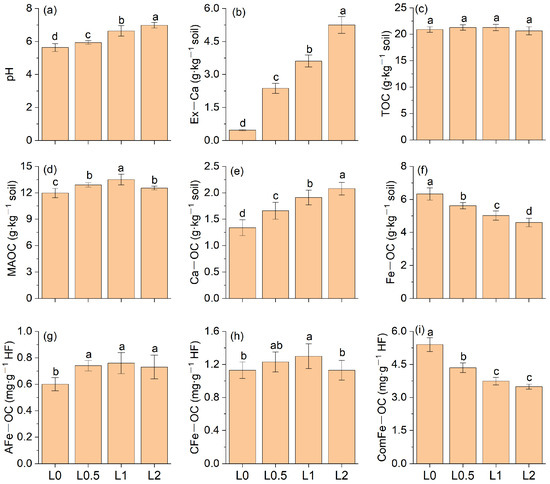
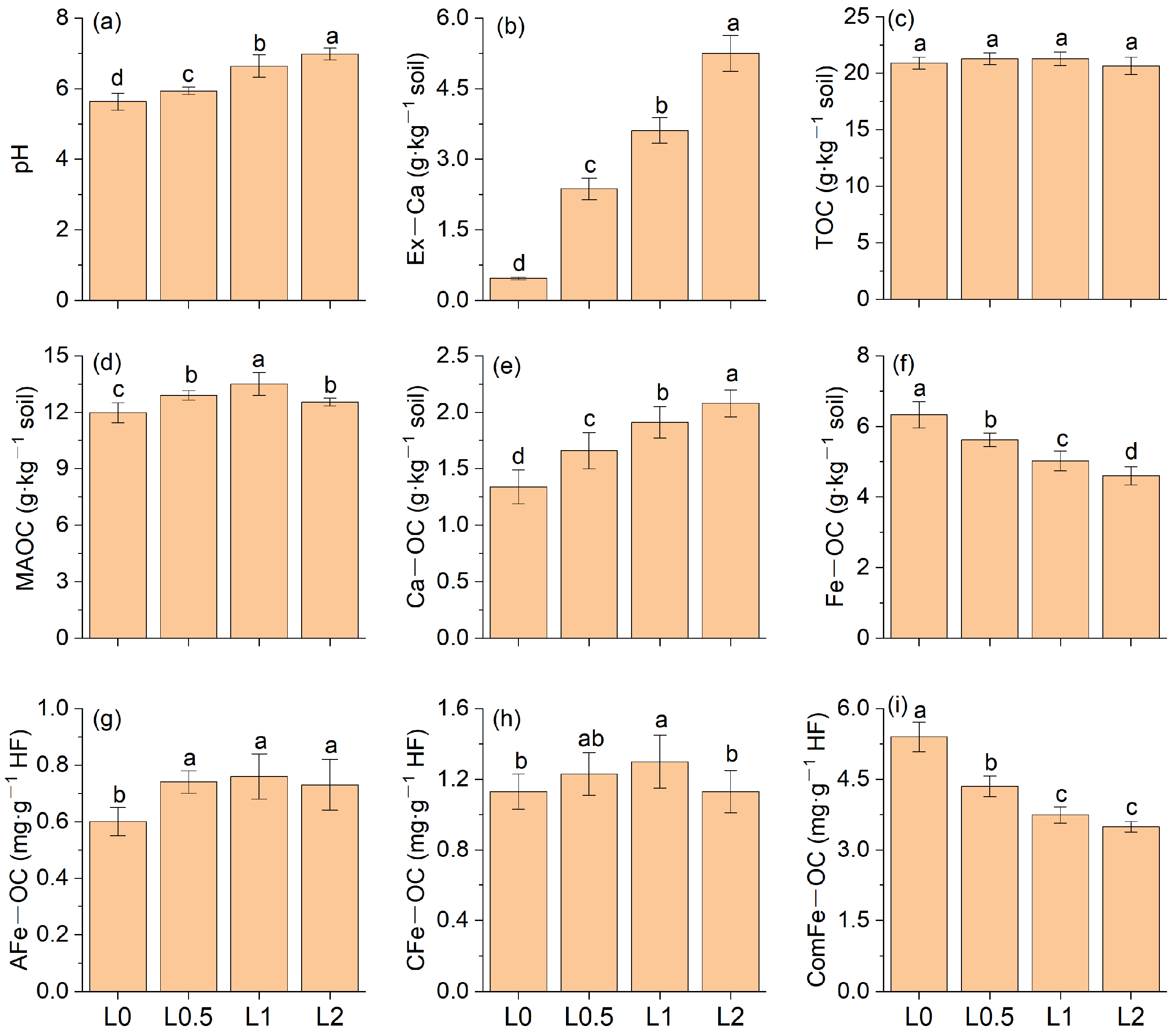
Soil pH and exchangeable calcium (Ex-Ca) increased significantly with elevated lime application (p < 0.05), whereas no significant difference in total organic carbon (TOC) was observed across treatments (p > 0.05) (Figure 1). Lime addition significantly altered the mineral-associated organic carbon (MAOC) content and its sub-fractions. MAOC, amorphous iron-associated organic carbon (AFe-OC) and crystalline iron-associated organic carbon (CFe-OC) all increased along the lime gradient and then declined, with maximum contents in L1, although not every pairwise difference was statistically significant. By contrast, iron-associated organic carbon (Fe-OC) and complexed iron-associated organic carbon (ComFe-OC) decreased continuously with increasing lime application rate (p < 0.05). Calcium-associated organic carbon (Ca-OC) exhibited the strongest response to lime amendment, continuously increasing along the lime gradient and reaching a 55.55% increase in L2 relative to L0 (p < 0.05). MAOC reached its maximum increase (12.73%) in L1. AFe-OC was significantly higher than in L0 under all lime treatments (p < 0.05), with the largest increase (26.26%) in L1. CFe-OC increased under low and moderate lime addition (L0.5 and L1), but did not differ significantly from L0 at the highest lime rate (L2) (p > 0.05). AFe-OC, CFe-OC and ComFe-OC are operationally defined sub-fractions of Fe-associated OC from sequential extraction. Although conceptually grouped within total Fe-OC, each sub-fraction was extracted and measured independently and thus does not form a strict mass balance, as total Fe-OC was determined on bulk soil whereas the three sub-fractions were determined on the heavy fraction.
Figure 1.
Concentrations of soil pH, exchangeable Ca, TOC, MAOC and its associated organic carbon fractions along a lime amendment gradient. L0, 0% lime (w/w, based on dry soil mass); L0.5, 0.5% lime; L1, 1% lime; L2, 2% lime. Ex-Ca, exchangeable calcium; TOC, total soil organic carbon; MAOC, mineral-associated organic carbon; Ca-OC, calcium-associated organic carbon; Fe-OC, iron-associated organic carbon; AFe-OC, amorphous iron-associated organic carbon; CFe-OC, crystalline iron-associated organic carbon; ComFe-OC, complexed iron-associated organic carbon; HF, heavy fraction. Bars represent mean ± standard error. Different lowercase letters (a, b, c, d) above bars indicate significant differences among treatments (p < 0.05).
Lime application significantly altered the proportions of MAOC and its subfractions (Table 2). Numerically, the fMAOC (MAOC/TOC) increased first and then decreased along the lime gradient, peaking at 63.44% under L1 treatment. fMAOC in L0.5, L1 and L2 was significantly higher than in L0 (p < 0.05). The fCa-OC (Ca-OC/MAOC) continuously and significantly increased relative to L0 as lime dosage rose (p < 0.05), reaching its maximum value (16.60%) at L2. By contrast, fFe-OC (Fe-OC/MAOC) declined numerically with increasing lime rate. Within iron-associated carbon fractions, fAFe-OC (AFe-OC/MAOC) and fCFe-OC (CFe-OC/MAOC) showed no significant differences across all treatments (p > 0.05). However, fComFe-OC (ComFe-OC/MAOC) declined significantly after lime amendment, falling to approximately 23% of MAOC in L1 and L2, which was significantly lower than L0 (p < 0.05) (Table 2).
Table 2.
Proportions of MAOC and its subfractions under different lime application rates.
3.2. Variation in CaCl2-Extractable Cd Along the Lime Gradient
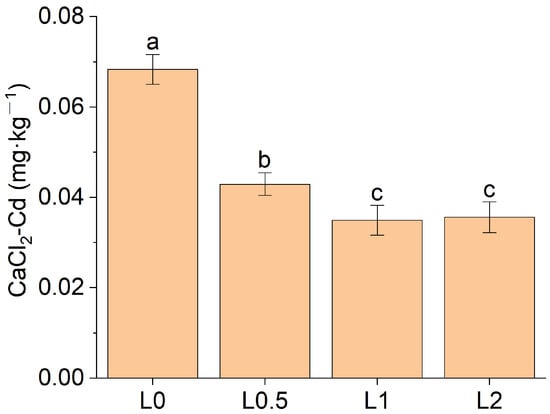
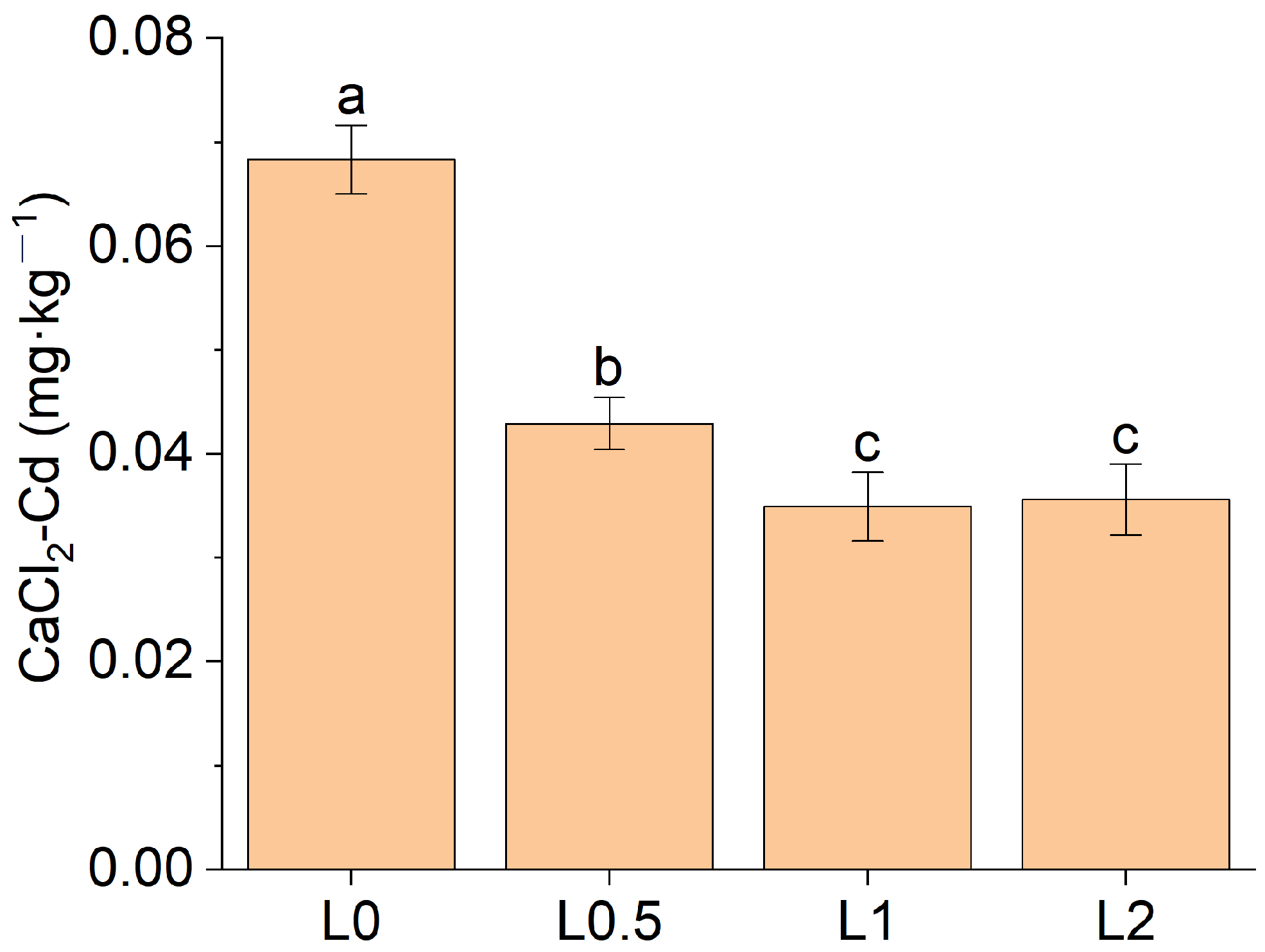
Lime treatments also significantly altered soil CaCl2-extractable Cd (CaCl2-Cd) concentrations (Figure 2). CaCl2-Cd decreased markedly following lime application (p < 0.05). Compared with L0, CaCl2-Cd was reduced by 37.28%, 48.99% and 47.87% in L0.5, L1 and L2, respectively. The lowest CaCl2-Cd was observed in the L1 treatment, and no significant difference was detected between L1 and L2 (p > 0.05), indicating that CaCl2-extractable Cd did not decline further when the lime application rate exceeded 1%.
Figure 2.
CaCl2-extractable Cd concentrations under different lime treatments (mean ± SD, n = 6). Different lowercase letters (a, b, c) above bars indicate significant differences among treatments (p < 0.05).
3.3. Correlation Analysis Between Soil Environmental Variables and Organic Carbon Fractions
Pearson correlation analysis showed that both pH and Ex-Ca were significantly negatively correlated with CaCl2-Cd (p < 0.01) (Table 3). Ca-OC exhibited a strong, significant positive association with pH and Ex-Ca (p < 0.01). Fe-OC and ComFe-OC showed strong significant negative associations with pH and Ex-Ca (p < 0.01). AFe-OC was significantly positively associated with pH and Ex-Ca (p < 0.05), whereas CFe-OC showed no significant association with either variable, and no significant association was observed between total MAOC and pH or Ex-Ca (p > 0.05) (Table 3).
Table 3.
Pearson’s correlation coefficients between soil environmental variables and mineral-associated organic-carbon fractions.
These correlations were calculated using pooled data across all lime treatments. Such associations may arise from the coordinated responses of these variables to lime dosage and should not be interpreted as independent causal effects of pH or Ex-Ca on organic carbon fractions.
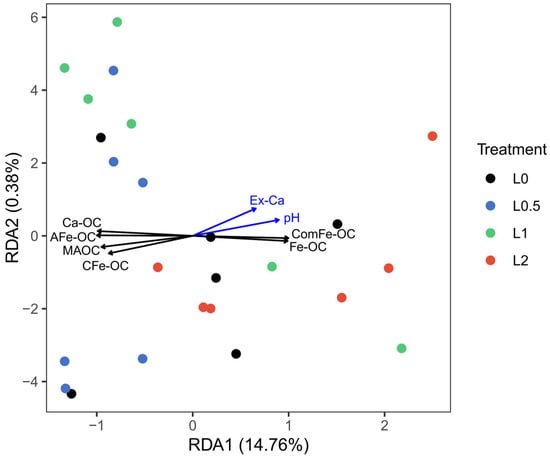
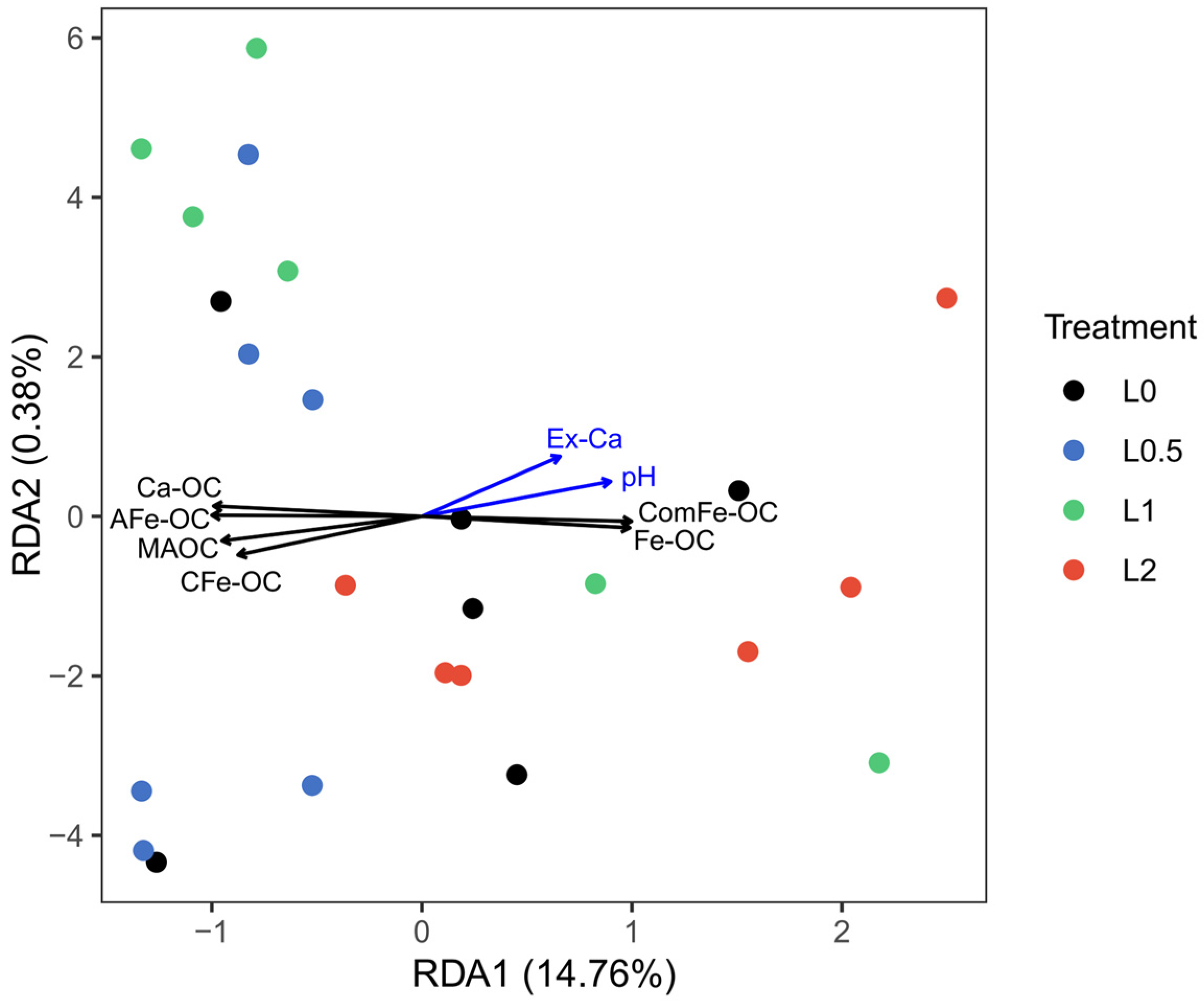
RDA was performed to explore the relationships between mineral-associated organic carbon fractions and soil properties (Figure 3). The first two axes of the RDA together explained 15.14% of the total variation in mineral-associated organic carbon fractions, with RDA1 and RDA2 accounting for 14.76% and 0.38%, respectively. Marginal permutation tests revealed that pH, Ex-Ca, and CaCl2-Cd were all significantly correlated with the variation in mineral-associated organic carbon fractions (p < 0.01) (Table 4). Among them, pH exhibited the strongest explanatory capacity, followed by Ex-Ca and CaCl2-Cd. Because pH and Ex-Ca together captured most of the explained variance, only these two variables were retained as constraints; their strong collinearity nevertheless prevents separation of their individual effects, and the constrained axes explained only a modest share of the total variation. The ordination plot showed that pH and Ex-Ca pointed toward the direction of ComFe-OC and Fe-OC, whereas Ca-OC, AFe-OC, MAOC and CFe-OC were distributed in the opposite direction, indicating divergent responses of different mineral-associated organic carbon fractions to increasing pH and exchangeable Ca under liming.
Figure 3.
Redundancy analysis (RDA) illustrating the relationships between mineral-associated organic carbon fractions and selected soil properties (soil pH and Ex-Ca). Treatments and abbreviations are the same as Figure 1. Symbols indicate individual samples under four liming treatments. Blue arrows represent environmental variables, and black arrows represent mineral-associated organic carbon fractions. RDA1 and RDA2 are the first and second constrained ordination axes of the RDA.
Table 4.
Marginal permutation tests for the associations of soil properties with the variation in mineral-associated organic carbon fractions.
3.4. Responses of Relative FTIR Band Areas to Liming Gradients
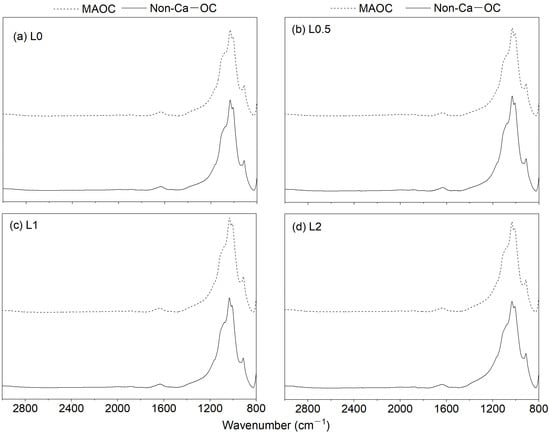
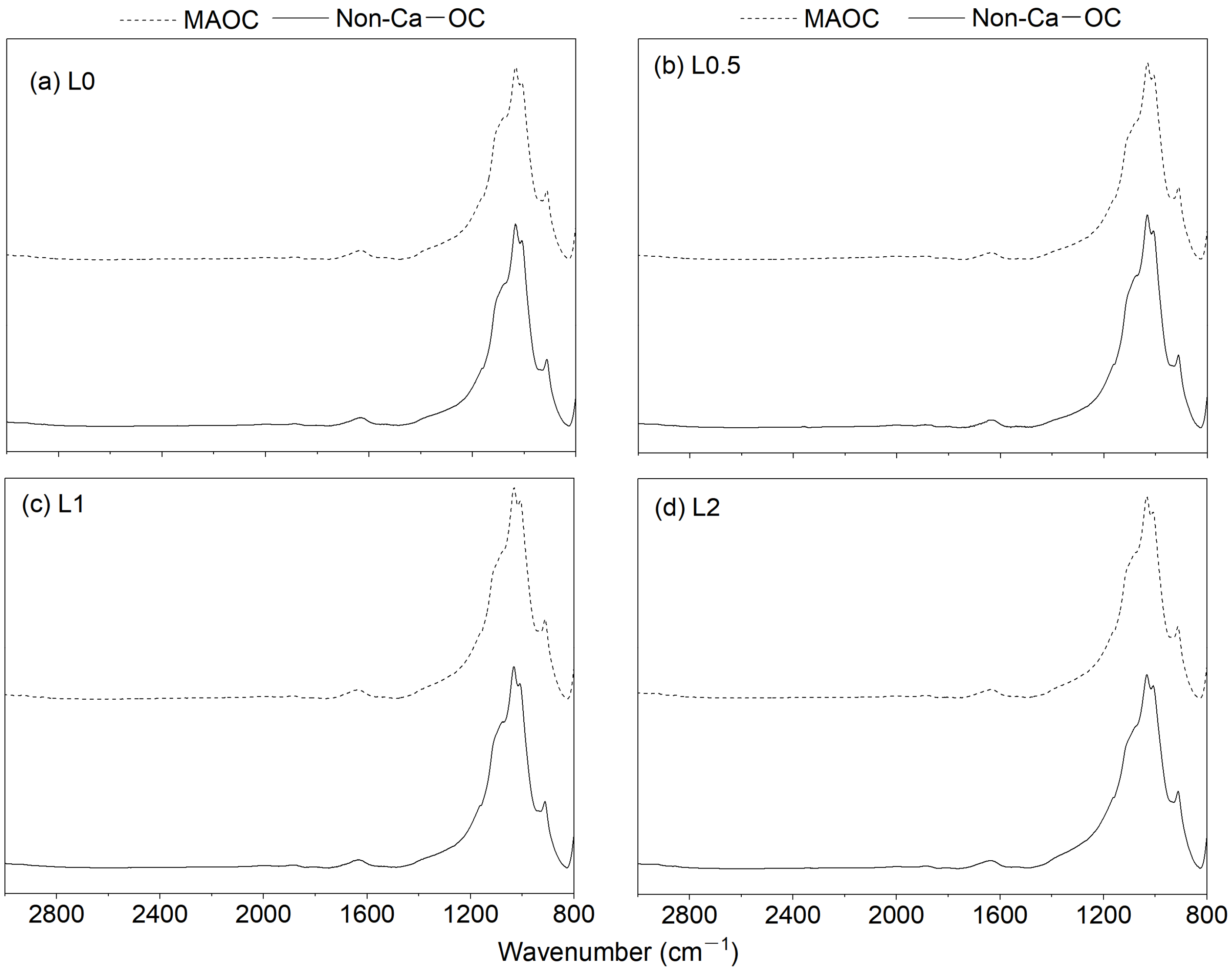
FT-IR was applied to characterize the chemical composition of MAOC and non-calcium-associated organic carbon (non-Ca-OC) under different lime-application treatments (Figure 4). Relatively few distinct organic-carbon-related characteristic peaks were observed for these samples, which can be partly attributed to the low organic carbon concentration of the isolated fractions as well as inherent technical limitations of FT-IR for soil particle analysis [38,39]. Overall, the shapes of FT-IR spectra were similar across the four lime treatments within the wavenumber range of 3000–800 cm−1. A broad band at 850–1200 cm−1 includes contributions from polysaccharide C–OH stretching and strong interference from Si–O stretching of silicate minerals. The weak band near 1640 cm−1 arises from overlapping signals, including aromatic C=C, amide groups and adsorbed water bending. The weak peak near 2930 cm−1 is attributed to asymmetric stretching of aliphatic –CH2–. Visual comparison of overlaid spectra indicated that MAOC and non-Ca-OC exhibited similar spectral profiles within each lime treatment. Since visual inspection cannot quantify spectral differences, peak-fitting was further conducted to compare relative band areas (Table 5).
Figure 4.
Fourier-transform infrared spectroscopy (FTIR) analysis of mineral-associated organic carbon (MAOC, dashed line) and non-Ca-OC (the residual MAOC after removal of Ca-associated organic carbon, solid line) under four lime-application treatments. (a) L0 treatment; (b) L0.5 treatment; (c) L1 treatment; (d) L2 treatment. Treatments and abbreviations are the same as in Figure 1. Spectra were vertically offset for clearer visual comparison, and y-axis intensity is not used for quantitative analysis.
Table 5.
Relative band areas of the three selected FTIR spectral regions derived from peak-fitting for MAOC and Non-Ca-OC under four lime-application treatments.
Following published band assignments [19,37,38], three spectral regions centered at 1030 cm−1, 1640 cm−1 and 2930 cm−1 were selected for peak fitting. These bands are often linked to polysaccharide-related signals, aromatic/amide–water overlapped signals, and aliphatic –CH2– signals, respectively. We calculated the relative band area fractions from peak fitting (Table 5). Note that these relative band areas do not represent absolute proportions of organic carbon functional groups, because absorption coefficients differ among groups and mineral matrix interference (especially Si–O in the 1030 cm−1 region) cannot be fully separated in this analysis. The relative band area fractions of the three selected regions showed consistent trends along the lime gradient in both MAOC and non-Ca-OC. The relative area of the 1030 cm−1 band increased significantly under L0.5 (0.5% lime, p < 0.05) and peaked at this dosage, then gradually declined with higher lime rates in both MAOC and non-Ca-OC. Conversely, the relative area of the 1640 cm−1 band decreased sharply under L0.5 and rebounded at L1 and L2. For MAOC, the relative area of the 2930 cm−1 band decreased from L0 to L0.5 and then increased slightly with higher lime rates; this band area remained relatively stable in non-Ca-OC across all treatments.
Paired-sample t-tests were used to compare the relative band areas of the three fitted spectral regions between MAOC and non-Ca-OC within each lime treatment (Table 5). No significant differences were found for any of these band areas (p > 0.05). This observation only describes the similarity of FTIR spectral signals between the two operationally defined fractions, and we cannot attribute this similarity directly to the removal of Ca-associated OC, because the extraction procedure may alter mineral matrix properties and spectral features.
4. Discussion
4.1. Mechanisms of Lime Regulating the Partitioning of Mineral-Associated Organic Carbon Fractions
Lime application is a common in-situ remediation strategy for acidified and Cd-contaminated subtropical red paddy soils. It rapidly increases soil pH and Ex-Ca concentration [3,5], immobilizes labile Cd, and alters mineral–organic associations, thereby modulating the accumulation of MAOC [40,41]. Our results showed that gradient lime amendment substantially modified the concentrations and relative composition of MAOC and its internal Ca- and Fe-associated operationally defined subfractions, while the selected FTIR spectral features of MAOC changed only modestly.
Lime addition significantly promoted the accumulation of Ca-OC and continuously reduced ComFe-OC and total Fe-OC. This covariation aligns with prior work proposing that Ca2+ may bridge organic matter and mineral particles to form Ca-associated organic carbon pools, an important MAOC fraction in neutral and calcareous soils [40]. With increasing lime rates, higher Ex-Ca co-occurred with the expansion of this operationally defined Ca-OC pool and its relative contribution within MAOC [23]. In contrast, pH elevation may destabilize Fe–organic associations and weaken the capacity of Fe phases to protect OC [23,28]. The continuous decline of ComFe-OC, together with stable relative proportions of AFe-OC and CFe-OC in MAOC, suggests that ComFe-OC is the Fe-associated OC fraction most susceptible to pH shifts. We note that stable proportional contributions do not guarantee constant absolute content or protective capacity of Fe phases, and mineral stability does not equate to the stability of associated OC. Increased pH reduces the positive charge on iron oxide surfaces and weakens ligand exchange reactions of carboxyl groups, which offers a plausible pathway for preferential loss of ComFe-OC, though our data cannot confirm selective degradation of this fraction. By comparison, CFe-OC remained stable along the gradient, consistent with published evidence that crystalline Fe oxides are less pH-sensitive [41,42]. AFe-OC, however, increased under liming, a response that cannot be explained by dissolution of poorly crystalline oxides alone and may instead reflect reprecipitation of amorphous Fe phases or redistribution of OC toward them; our data do not resolve this.
Notably, these shifts in MAOC fractions were closely coupled with changes in Cd mobility. Our CaCl2-extractable Cd results showed that liming markedly reduced labile Cd, with the lowest Cd availability achieved at the moderate lime rate (L1, 1%); further increasing lime dosage did not produce additional Cd immobilization. Pearson correlation and RDA revealed covariation: pH and Ex-Ca were negatively correlated with CaCl2-Cd, and CaCl2-Cd represented a significant explanatory variable associated with MAOC fraction variation. We note that pH and Ex-Ca are strongly collinear along the lime gradient, so these analyses cannot separate their independent effects [43]. Within our tested lime gradient, the depletion of ComFe-OC (the organically complexed Fe-associated fraction, and Fe–organic complexes are important hosts for co-immobilized Cd) did not trigger a rebound of labile Cd [44]. This interpretation suggests that Cd immobilization via pH elevation and Ca-associated OC formation may partly offset the potential Cd release risk originating from altered poorly crystalline Fe–organic associations in this soil. Even so, field application should avoid extremely rapid and excessive pH increases, since substantial modification of poorly crystalline Fe phases beyond our experimental pH range may still induce Cd remobilization [45].
The maximum MAOC accumulation was observed under moderate lime addition (L1), and MAOC decreased at the highest lime rate, revealing a dose-dependent response of MAOC to liming. At L2, ongoing Fe-OC losses were no longer offset by gains in Ca-OC, which partly explains the decline in total MAOC. At low-to-moderate lime levels, the concurrent rise in Ca-OC and decline in Fe-associated OC together shaped the net change in MAOC and increased the proportion of MAOC in TOC. A higher MAOC proportion within TOC does not necessarily indicate enhanced carbon sequestration, as such a pattern can also arise from faster loss of other OC pools.
Sequential extraction yields operationally defined fractions with potential overlap, so the offsetting relationship between Ca-OC gain and Fe-OC loss should be viewed as an interpretive pattern rather than a strictly validated mass balance. Previous studies have reported Ca-OC peaking and subsequently declining under liming, whereas our observations show continuous Ca-OC accumulation across the tested gradient, highlighting context-dependent responses of Ca-OC [23,24]. Acidic red paddy soils inherently have low background Ex-Ca, and Ca-linked carbon retention has long been overlooked. Our results show that shifts in this operationally defined Ca-associated OC pool accompanied the reshaping of internal MAOC composition under long-term lime amendment in red paddy soils [23].
4.2. Effects of Lime on Relative FTIR Band Areas of Mineral-Associated Organic Carbon
FTIR results showed that liming did not change the overall spectral profiles of MAOC and Non-Ca-OC, but the relative areas of the selected absorption bands varied regularly along the lime gradient. We emphasize that these bands are non-specific: the 1030 cm−1 region overlaps with Si–O vibrations in mineral matrices alongside polysaccharide-like signals, while the aromatic band is confounded by amide and water absorption. In addition, relative band areas normalized to the sum of the three selected bands are mathematically interdependent, so apparent changes may partly reflect this normalization artifact rather than true changes in individual functional groups. Low-dose lime (L0.5) increased the relative area of the 1030 cm−1 band and decreased the relative areas of the aromatic/amide-overlapped and aliphatic bands. This trend reversed at higher lime rates: the relative area of this 1030 cm−1 band declined while the aromatic/amide-overlapped band signal gradually recovered. This 1030 cm−1 signal can derive from both plant-derived polysaccharides and microbial metabolites, and its response is sensitive to environmental changes. One speculative interpretation is that low-dose lime may have alleviated acidification and stimulated microbial activity, thereby promoting the accumulation of polysaccharide-rich organic matter and thus raising the relative contribution of this spectral signal within mineral-associated carbon [46]. With further lime addition and sustained pH increase, it is hypothesized that shifts in microbial community composition and metabolic processes could contribute to the reduced relative area of this 1030 cm−1 band and the concurrent recovery of the aromatic/amide-overlapped signal [29,41]. Residual sulfate from the Na2SO4 wash may contribute to absorption near 1100–1200 cm−1, so spectral differences between HF and post-extraction residues cannot be attributed solely to Ca-OC removal.
No significant differences in the relative distribution of these FTIR band areas were observed between MAOC and Non-Ca-OC at the same lime dosage. We note that this comparison is descriptive only: the extraction procedure used to isolate Ca-associated OC may alter mineral matrix properties and spectral features, so we cannot unambiguously attribute this similarity solely to the removal of operationally defined Ca-associated OC.
This observation contributes to the ongoing debate regarding how liming modifies OC spectral characteristics. Some studies reported that liming alters organic functional group composition and increases the proportion of aromatic carbon [30,31], whereas other studies proposed that liming mainly changes mineral–organic binding associations rather than the intrinsic spectral features of OC [20]. Aromaticity alone does not control the residence time of soil organic matter, so the 1640 cm−1 band is not treated here as an index of recalcitrance. Our FTIR observations are most consistent with pH- and Ca2+-mediated reorganization of mineral–organic associations, rather than pronounced shifts in the relative distribution of these selected spectral signals; they do not establish that any single stabilization mechanism dominates.
4.3. Implications and Management Recommendations for Paddy Soils
Although the findings of this study are limited to a single soil and four rice seasons in pots, they still provide valuable implications. In acid red paddy soils of the Poyang Lake basin, lime amendment coincides with the expansion of the operationally defined Ca-OC pool alongside rising Ex-Ca, and this covariation may partly offset the loss of complexed Fe-OC; we emphasize that this offsetting trend represents an interpretive pattern rather than a rigorously validated mass balance. Within the tested rates, 1% (w/w) lime yielded the highest MAOC content and the lowest labile Cd. However, liming exerted only modest effects on the selected FTIR spectral features of MAOC. Importantly, this shift from Fe-associated to Ca-associated MAOC may reflect a rearrangement of mineral–organic interaction pathways, and this Ca-associated OC pool does not guarantee long-term stabilization; this operationally defined Ca-OC pool is susceptible to subsequent pH fluctuation, Ca leaching and microbial decomposition. From a sustainability perspective, this trade-off implies that liming programmes should be built around the rate that maximizes MAOC retention while still meeting the target level of Cd immobilization, so that remediation does not exchange long-term soil carbon storage for short-term metal control.
We note that our observations are limited to changes in MAOC fractions, and we did not measure whole-soil carbon fluxes (CO2, CH4) or bulk carbon stock dynamics. Therefore, we avoid inferring a net enhancement of soil carbon sequestration at the ecosystem scale. When lime is used for in-situ remediation of acidified and Cd-contaminated paddy soils, application rates should be carefully balanced to achieve soil acid amelioration and heavy metal immobilization while sustaining the soil capacity for MAOC retention. Within our tested gradient, moderate lime effectively reduced labile Cd, and further lime addition brought no additional benefit for Cd immobilization while continuing to deplete Fe-OC pools. Rapid, excessive pH elevation should be avoided in field practice to reduce the potential risk of Cd remobilization linked to poorly crystalline Fe oxide transformation. We note that this 1% lime dosage is site-specific. The core trade-off mechanism is likely applicable to acidic red paddy soils, but this quantitative rate requires further validation across soils with different textures, iron oxide contents and Cd pollution levels before it can be adopted as a universal environmental safety guideline.
Notably, our results were obtained from air-dried and rewetted soil with a 7-day flooding pre-incubation. Even with pre-incubation to restore anaerobic paddy soil conditions, air-drying may alter iron speciation and iron-associated organic carbon pools. Therefore, caution should be taken when extrapolating these findings to continuously flooded paddy fields in situ.
5. Conclusions
Lime amendment shifted MAOC composition from complexed Fe-associated OC toward an operationally defined Ca-associated pool, and this shift coincided with lower labile Cd. Within the tested gradient, 1% (w/w) lime produced the highest MAOC content and the lowest CaCl2-extractable Cd, whereas higher rates depleted Fe-OC and reduced MAOC without additional Cd immobilization. Bulk FTIR spectra of MAOC and non-Ca-OC remained largely unchanged, indicating that liming acted mainly through reorganization of mineral–organic associations rather than through pronounced changes in molecular functional groups. Because the fractions are operationally defined and the experiment was short-term, these results describe MAOC redistribution in this soil rather than long-term carbon stabilization, and the 1% rate is a site-specific trade-off requiring validation across soils and over longer periods.
Author Contributions
Conceptualization, X.W. and H.Y.; methodology, X.W.; software, L.L.; validation, L.L. and Z.X.; formal analysis, X.L.; investigation, X.W. and L.L.; resources, Z.X.; data curation, T.Z.; writing—original draft preparation, X.W.; writing—review and editing, X.W. and F.M.; visualization, L.L.; supervision, F.M.; project administration, H.Y. and F.M.; funding acquisition, X.W., X.L. and H.Y. All authors have read and agreed to the published version of the manuscript.
Funding
This work was supported by the Natural Science Foundation of Jiangxi Province (20232BAB213081, 20252BAC230006); the Key Research and Development Program of Jiangxi Province (20243BBH81035); the Key Research and Development Project of Jiangxi Academy of Sciences (2022YSBG21008, 2023YSBG21006), and the National Natural Science Foundation of China (52260025).
Institutional Review Board Statement
Not applicable.
Informed Consent Statement
Not applicable.
Data Availability Statement
The original contributions presented in this study are included in the article. Further inquiries can be directed to the corresponding authors.
Conflicts of Interest
The authors declare no conflicts of interest.
Abbreviations
The following abbreviations are used in this manuscript:
| SOC | soil organic carbon |
| TOC | total organic carbon |
| Ex-Ca | exchangeable calcium |
| MAOC | mineral-associated organic carbon |
| Ca-OC | calcium-associated organic carbon |
| Fe-OC | iron-associated organic carbon |
| AFe-OC | amorphous iron-associated organic carbon |
| CFe-OC | crystalline iron-associated organic carbon |
| ComFe-OC | complexed iron-associated organic carbon |
| CaCl2-Cd | CaCl2-extractable Cd |
| HF | heavy fraction |
| Non-Ca-OC | non-calcium-associated organic carbon (SOC of residual sample after Na2SO4 extraction) |
References
- Guo, X.; Li, H.; Yu, H.; Li, W.; Ye, Y.; Biswas, A. Drivers of spatio-temporal changes in paddy soil pH in Jiangxi Province, China from 1980 to 2010. Sci. Rep. 2018, 8, 2702. [Google Scholar] [CrossRef] [Scilit] [PubMed]
- Zou, M.; Zhou, S.; Zhou, Y.; Jia, Z.; Guo, T.; Wang, J. Cadmium pollution of soil-rice ecosystems in rice cultivation dominated regions in China: A review. Environ. Pollut. 2021, 280, 116965. [Google Scholar] [CrossRef] [Scilit] [PubMed]
- Liu, L.; Li, W.; Song, W.; Guo, M. Remediation techniques for heavy metal-contaminated soils: Principles and applicability. Sci. Total Environ. 2018, 633, 206–219. [Google Scholar] [CrossRef] [Scilit] [PubMed]
- Liu, K.; Fang, L.; Li, F.; Hou, D.; Liu, C.; Song, Y.; Ran, Q.; Pang, Y.; Du, Y.; Yuan, Y.; et al. Sustainability assessment and carbon budget of chemical stabilization based multi-objective remediation of Cd contaminated paddy field. Sci. Total Environ. 2022, 819, 152022. [Google Scholar] [CrossRef] [Scilit] [PubMed]
- Yu, Q.; Li, W.; Zhang, N.; Zhao, L.; Wang, Y.; Song, J.; Ma, W.; Zhang, G.; Dong, H.; Yu, W.; et al. Present pollution status and safe utilization technologies of heavy metal-polluted farmland soil: A review. Soils 2024, 56, 229–241. (In Chinese) [Google Scholar]
- Zhu, H.; Chen, C.; Xu, C.; Zhu, Q.; Huang, D. Effects of soil acidification and liming on the phytoavailability of cadmium in paddy soils of central subtropical China. Environ. Pollut. 2016, 219, 99–106. [Google Scholar] [CrossRef] [Scilit] [PubMed]
- von Lützow, M.; Kögel-Knabner, I.; Ekschmitt, K.; Matzner, E.; Guggenberger, G.; Marschner, B.; Flessa, H. Stabilization of organic matter in temperate soils: Mechanisms and their relevance under different soil conditions—A review. Eur. J. Soil Sci. 2006, 57, 426–445. [Google Scholar] [CrossRef] [Scilit]
- Inagaki, T.M.; de Moraes Sá, J.C.; Caires, E.F.; Gonçalves, D.R.P. Why does carbon increase in highly weathered soil under no-till upon lime and gypsum use? Sci. Total Environ. 2017, 599–600, 523–532. [Google Scholar] [CrossRef] [Scilit] [PubMed]
- Carmeis Filho, A.C.A.; Penn, C.J.; Crusciol, C.A.C.; Calonego, J.C. Lime and phosphogypsum impacts on soil organic matter pools in a tropical oxisol under long-term no-till conditions. Agric. Ecosyst. Environ. 2017, 241, 11–23. [Google Scholar] [CrossRef] [Scilit]
- Schrumpf, M.; Kaiser, K.; Guggenberger, G.; Michalik, M.; Amelung, W.; Polyzou, M. Storage and stability of organic carbon in soils as related to depth, occlusion within aggregates, and attachment to minerals. Biogeosciences 2013, 10, 1675–1691. [Google Scholar] [CrossRef] [Scilit]
- Angst, G.; Pokorný, J.; Mueller, C.W.; Prater, I.; Preusser, S.; Kandeler, E.; Meador, T.; Straková, P.; Hájek, T.; van Buiten, G.; et al. Soil texture affects the coupling of litter decomposition and soil organic matter formation. Soil Biol. Biochem. 2021, 159, 108302. [Google Scholar] [CrossRef] [Scilit]
- Liu, H.; Thompson, C.; Mao, H.; Liang, C.; McKenna, A.M.; Chen, F.; Schuur, E.; Jilling, A.; Zhu, M. Soluble and insoluble fractions of mineral-associated organic carbon differ in composition, accumulation patterns, and environmental controls. Soil Biol. Biochem. 2026, 222, 110287. [Google Scholar] [CrossRef] [Scilit]
- Li, Y.; Wang, T.; Camps-Arbestain, M.; Suárez-Abelenda, M.; Whitby, C.P. Lime and/or Phosphate Application Affects the Stability of Soil Organic Carbon: Evidence from Changes in Quantity and Chemistry of the Soil Water-Extractable Organic Matter. Environ. Sci. Technol. 2020, 54, 13908–13916. [Google Scholar] [CrossRef] [Scilit] [PubMed]
- Chang, Y.; Sokol, N.W.; van Groenigen, K.J.; Bradford, M.A.; Ji, D.; Crowther, T.W.; Liang, C.; Luo, Y.; Kuzyakov, Y.; Wang, J.; et al. A stoichiometric approach to estimate sources of mineral-associated soil organic matter. Glob. Change Biol. 2023, 30, e17092. [Google Scholar] [CrossRef] [Scilit] [PubMed]
- Liu, T.; Wang, X.; Wang, S.; Zhu, E.; Hall, S.J.; Feng, X. Iron-driven fast decomposition of soil carbon under periodic anoxia. Glob. Change Biol. 2025, 31, e70184. [Google Scholar] [CrossRef] [Scilit] [PubMed]
- Jia, J.; Feng, X. Global Change Impacts on Mineral-Associated Organic Matter: Consequences for Soil Carbon Persistence. Glob. Change Biol. 2026, 32, e71037. [Google Scholar] [CrossRef] [Scilit] [PubMed]
- Riedel, T.; Biester, H.; Dittmar, T. Molecular fractionation of dissolved organic matter with metal salts. Environ. Sci. Technol. 2012, 46, 4419–4426. [Google Scholar] [CrossRef] [Scilit] [PubMed]
- Kan, Z.-R.; Liu, W.-X.; Liu, W.-S.; Lal, R.; Dang, Y.P.; Zhao, X.; Zhang, H.-L. Mechanisms of soil organic carbon stability and its response to no-till: A global synthesis and perspective. Glob. Change Biol. 2022, 28, 693–710. [Google Scholar] [CrossRef] [Scilit] [PubMed]
- Wan, D.; Ye, T.; Lu, Y.; Chen, W.; Cai, P.; Huang, Q. Iron oxides selectively stabilize plant-derived polysaccharides and aliphatic compounds in agricultural soils. Eur. J. Soil Sci. 2019, 70, 1153–1163. [Google Scholar] [CrossRef] [Scilit]
- Kleber, M.; Eusterhues, K.; Keiluweit, M.; Mikutta, C.; Mikutta, R.; Nico, P.S. Chapter One-Mineral-Organic Associations: Formation, Properties, and Relevance in Soil Environments. In Advances in Agronomy; Donald, L.S., Ed.; Academic Press: New York, NY, USA, 2015; Volume 130, pp. 1–140. [Google Scholar]
- Tian, Y.; Xu, Y.; Hou, J.; Huang, C.; Tan, W. Advances in understanding the interaction between soil iron oxides and organic carbon and its effect on carbon stabilization. Acta Pedol. Sin. 2026, 63, 676–690. (In Chinese) [Google Scholar]
- Rowley, M.; Grand, S.; Verrecchia, É.P. Calcium-mediated stabilisation of soil organic carbon. Biogeochemistry 2018, 137, 27–49. [Google Scholar] [CrossRef] [Scilit]
- Wu, B.; Xu, J.; Cheng, Y.; Ye, C.; Hu, S. Effects of liming on formation of mineral-associated organic carbon in acidic soil. Chin. Agric. Sci. Bull. 2021, 37, 98–105. (In Chinese) [Google Scholar]
- Ye, C.; Huang, W.; Hall, S.J.; Li, J. Association of organic carbon with reactive iron oxides driven by soil pH at the global scale. Glob. Biogeochem. Cycles 2022, 36, e2021GB007128. [Google Scholar] [CrossRef] [Scilit]
- Sowers, T.D.; Stuckey, J.W.; Sparks, D.L. The synergistic effect of calcium on organic carbon sequestration to ferrihydrite. Geochem. Trans. 2018, 19, 4. [Google Scholar] [CrossRef] [Scilit] [PubMed]
- Ramesh, T.; Bolan, N.S.; Kirkham, M.B.; Wijesekara, H.; Kanchikerimath, M.; Rao, C.S.; Sandeep, S.; Rinklebe, J.; Ok, Y.S.; Choudhury, B.U. Soil organic carbon dynamics: Impact of land use changes and management practices: A review. Adv. Agron. 2019, 159, 1−107. [Google Scholar]
- Yang, Y.; Wu, F.; Wu, Q.; Zhu, J.; Ni, X. Soil organic carbon associated with iron oxides in terrestrial ecosystems: Content, distribution and control. Sci. China Earth Sci. 2023, 68, 695–704. (In Chinese) [Google Scholar] [CrossRef] [Scilit]
- Wen, H.; Yang, F.; Sun, Z.; Miao, Z.; Hu, J.; Zhang, G. Asymmetric responses of soil organic carbon stability to shifting dominance of pH-mediated metal-bound organic carbon. Commun. Earth Environ. 2025, 6, 574. [Google Scholar] [CrossRef] [Scilit]
- Wang, X.; Tang, C.; Baldock, J.A.; Butterly, C.R.; Gazey, C. Long-term effect of lime application on the chemical composition of soil organic carbon in acid soils varying in texture and liming history. Biol. Fertil. Soils 2016, 52, 295–306. [Google Scholar] [CrossRef] [Scilit]
- Xiao, Q.; Zhang, W.; Wu, L.; Huang, Y.; Cai, Z.; Li, D.; Xu, X.; Hartley, I.P. Long-term liming mitigates the positive responses of soil carbon mineralization to warming and labile carbon input. J. Environ. Manag. 2024, 354, 120498. [Google Scholar] [CrossRef] [Scilit] [PubMed]
- Audette, Y.; Congreves, K.A.; Zaro, G.C.; Nunes, A.L.P.; Zhang, H.; Voroney, R.P. The effect of agroecosystem management on the distribution of C functional groups in soil organic matter: A review. Biol. Fertil. Soils 2021, 57, 881–894. [Google Scholar] [CrossRef] [Scilit] [PubMed]
- Abdelaziz, M.; Shen, Z.; Li, D.; Zhang, L.; Ai, D.; Yan, J.; Tadesse, K.; Ahmed, I.; Zhang, C.; Wu, C.; et al. Chemical fertilizer and liming-induced changes in aluminum, iron oxides and soil organic carbon fractions: Implications for carbon sequestration in an upland red soil. J. Integr. Agric. 2026, 25, 3412–3426. [Google Scholar] [CrossRef] [Scilit]
- Huang, G.; Ding, C.; Ma, Y.; Wang, Y.; Zhou, Z.; Zheng, S.; Wang, X. Rice (Oryza sativa L.) seedlings enriched with zinc or manganese: Their impacts on cadmium accumulation and expression of related genes. Pedosphere 2021, 31, 849–858. [Google Scholar] [CrossRef] [Scilit]
- Plaza, C.; Giannetta, B.; Benavente, I.; Vischetti, C.; Zaccone, C. Density-based fractionation of soil organic matter: Effects of heavy liquid and heavy fraction washing. Sci. Rep. 2019, 9, 10146. [Google Scholar] [CrossRef] [Scilit] [PubMed]
- Xu, J.; Yuan, K. Dissolution and Fractionation of Calcium—Bound and Iron—And Aluminum—Bound Humus in Soils. Pedosphere 1993, 3, 75–80. [Google Scholar]
- Wan, D.; Ma, M.K.; Peng, N.; Luo, X.S.; Chen, W.L.; Cai, P.; Wu, L.H.; Pan, H.B.; Chen, J.B.; Yu, G.H.; et al. Effects of long-term fertilization on calcium-associated soil organic carbon: Implications for C sequestration in agricultural soils. Sci. Total Environ. 2021, 772, 145037. [Google Scholar] [CrossRef] [Scilit] [PubMed]
- Heckman, K.; Lawrence, C.R.; Harden, J.W.A. Sequential selective dissolution method to quantify storage and stability of organic carbon associated with Al and Fe hydroxide phases. Geoderma 2018, 312, 24–35. [Google Scholar] [CrossRef] [Scilit]
- Calderón, F.J.; Reeves, J.B.; Collins, H.P.; Paul, E.A. Chemical differences in soil organic matter fractions determined by diffuse-reflectance mid-infrared spectroscopy. Soil Sci. Soc. Am. J. 2011, 75, 568–579. [Google Scholar] [CrossRef] [Scilit]
- Simonetti, G.; Francioso, O.; Nardi, S.; Berti, A.; Brugnoli, E.; Francesco Morari, E.L. Characterization of humic carbon in soil aggregates in a long-term experiment with manure and mineral fertilization. Soil Sci. Soc. Am. J. 2012, 76, 880–890. [Google Scholar] [CrossRef] [Scilit]
- Briedis, C.; de Moraes Sá, J.C.; Caires, E.F.; Navarro, J.F.; Inagaki, T.M.; Boer, A.; Quadros Neto, C.; de Oliveira Ferreira, A.; Canalli, L.B.; dos Santos, J.B. Soil organic matter pools and carbon-protection mechanisms in aggregate classes influenced by surface liming in a no-till system. Geoderma 2012, 170, 80–88. [Google Scholar] [CrossRef] [Scilit]
- Shen, Z.; Han, T.; Huang, J.; Li, J.; Daba, N.A.; Gilbert, N.; Khan, M.N.; Shah, A.; Zhang, H. Soil organic carbon regulation by pH in acidic red soil subjected to long-term liming and straw incorporation. J. Environ. Manag. 2024, 367, 122063. [Google Scholar] [CrossRef] [Scilit] [PubMed]
- Li, B.; Huang, J.; Liu, L.; Li, D.; Duan, Y.; Xu, M. Straw return promotes soil organic carbon sequestration through aggregate protection and chemical bonding mediated by iron oxides. Agric. Ecosyst. Environ. 2026, 2, e018. [Google Scholar] [CrossRef] [Scilit]
- Wang, S.; Jia, Y.; Liu, T.; Wang, Y.; Liu, Z.; Feng, X. Delineating the role of calcium in the large-scale distribution of metal-bound organic carbon in soils. Geophys. Res. Lett. 2021, 48, e2021GL092391. [Google Scholar] [CrossRef] [Scilit]
- Li, S.; Chen, S.; Wang, M.; Lei, X.; Zheng, H.; Sun, X.; Wang, L.; Han, Y. Iron fractions responsible for the variation of Cd bioavailability in paddy soil under variable pe+pH conditions. Chemosphere 2020, 251, 126355. [Google Scholar] [CrossRef] [Scilit] [PubMed]
- Tian, Q.; Gong, J.; Huang, D.; Zhu, H.; Liu, D.; Zhu, Q. Mineral phase transformations constrain the long-term effectiveness of liming in Cd-contaminated paddy soils. Chin. Sci. Bull. 2026; advance online publication. (In Chinese) [CrossRef] [Scilit]
- Yang, J.; Geng, S.; Shi, X.; Zhang, Q.; Yang, C. The effects of co-application of organic fertilizer and limestone powder on soil organic carbon and its fractions in rubber plantations: Associations with microbial necromass carbon and Fe/Al oxides. Front. Microbiol. 2026, 17, 1970224. [Google Scholar] [CrossRef] [Scilit] [PubMed]

Disclaimer/Publisher’s Note: The statements, opinions and data contained in all publications are solely those of the individual author(s) and contributor(s) and not of MDPI and/or the editor(s). MDPI and/or the editor(s) disclaim responsibility for any injury to people or property resulting from any ideas, methods, instructions or products referred to in the content. |
© 2026 by the authors. Licensee MDPI, Basel, Switzerland. This article is an open access article distributed under the terms and conditions of the Creative Commons Attribution (CC BY) license.