


Abstract
Educational technologies are often described as sustainable because they extend access or improve efficiency, yet sustainability also depends on enduring learning, inclusion, rights, institutional feasibility, and resource use. This concept-driven integrative review examines how generative artificial intelligence (GenAI) can support reflective learning in higher education while preserving learner reasoning and agency. We interpret 49 selected scholarly and policy sources across five conceptual domains: AI-enabled educational practice, reflection and self-regulation, inclusive design, ethics and governance, and environmental and institutional sustainability. Rather than estimating the prevalence of study outcomes, the review identifies the need to consider these interdependent dimensions together. We propose SAREL (Sustainable AI-Supported Reflective Education and Learning), an iterative five-stage framework: specify learning purpose; allocate agency and accessibility; require reflection and verification; evaluate learning, equity, rights, workload, and resources; and loop evidence into redesign. SAREL’s contribution is the integration of established concerns into a task-level design-and-audit logic, not the discovery of new standalone principles. Its rubric and sustainability-adjusted learning value construct are provisional, have not been empirically validated, and require reliability and effectiveness testing. Sustainable AI use is therefore posed as a comparative design question, not an assumed benefit of adoption.
1. Introduction
Digital technology has become inseparable from contemporary higher education. Learning management systems, video platforms, analytics, adaptive systems, and generative artificial intelligence (GenAI) are used to extend access, personalise support, automate feedback, and reorganise teaching work. These developments are often connected to Sustainable Development Goal 4, which calls for inclusive and equitable quality education and lifelong learning, as well as to goals concerning innovation, inequality, and partnerships [1,2,3]. However, the presence of technology does not itself demonstrate educational sustainability. The 2023 Global Education Monitoring Report warned that robust independent evidence for educational technology remains limited, that technology can exclude as well as include, and that adoption is often driven faster than systems can evaluate its consequences [2].
A sustainable educational technology should remain educationally valuable over time, be accessible to diverse learners, preserve meaningful human agency, operate under trustworthy governance, and use financial, material, and environmental resources proportionately. This definition is wider than technology acceptance or short-term satisfaction. It also differs from a narrow “green IT” interpretation because social, pedagogical, ethical, institutional, and ecological conditions are interdependent. A tool that saves instructor time but encourages shallow processing, excludes students with limited connectivity, or transfers sensitive learning data to opaque systems cannot be considered sustainable merely because it is convenient or scalable [3,4].
In this study, sustainable learning is understood as the development and continued independent use of meaningful, transferable knowledge and reflective capabilities under conditions that protect learner agency, equitable participation, responsible governance, and proportionate use of educational resources. This is an integrative conceptual definition developed by the authors, not a universally established measure. Durability refers to what learners retain and can apply over time; environmental sustainability concerns the material and energy implications of supporting that learning. Both are relevant but analytically distinct [1,2,3,5,6,7,8,9,10,11,12,13,14,15,16,17,18,19,20,21,22].
The need for a multidimensional perspective has become urgent with the rapid diffusion of GenAI. Research on AI in higher education has expanded from profiling and prediction to tutoring, assessment, personalisation, feedback, and content generation [23,24,25,26,27,28,29,30]. Reviews consistently identify opportunities for individualised assistance and immediate feedback, but they also identify gaps in educator involvement, theory, ethics, methodological rigour, and longitudinal evidence [23,28,29,30]. GenAI intensifies these tensions because it can generate plausible explanations and drafts at negligible marginal effort while obscuring provenance, uncertainty, and the boundary between assistance and substitution [31,32,33,34,35,36].
Existing responsible and human-centred AI approaches address transparency, fairness, privacy, accountability, and human oversight, while inclusive educational design and digital sufficiency provide established principles concerning access and resource use [3,14,18,35,37,38]. These approaches differ in scope and primary unit of analysis. The specific conceptual gap addressed here concerns how pedagogical value, reflective learner agency, ethical governance, institutional viability, and resource proportionality may be considered together when designing and reviewing AI-supported reflective tasks in higher education. SAREL does not claim these principles as individually novel; the proposed contribution is their integration into a task-oriented, iterative design-and-audit framework.
Reflective learning offers a productive test case for sustainable AI use. Reflection links experience, interpretation, judgment, emotion, and future action. It can strengthen metacognition, professional identity, critical thinking, and self-regulated learning, but it is demanding for students and instructors and can become formulaic when reduced to compliance writing [5,6,7,8,9,10,11,12,13]. AI can prompt questions, challenge assumptions, compare perspectives, and support iterative feedback. It can also short-circuit the very cognitive work reflection is intended to cultivate if students outsource interpretation or accept fluent responses without verification.
Reflective learning makes this design problem particularly visible: the intended outcome is learners’ capacity to interpret experience, challenge assumptions, appraise evidence, and reconsider future action—not simply to produce a fluent reflective account [5,6,7,8,9,10,11,12,13]. Generative AI may scaffold these processes, but it can also generate plausible reflective narratives that are not accompanied by equivalent reasoning. Evidence added during manuscript revision from recent meta-analyses further indicates that AI-related learning effects vary across outcomes and pedagogical contexts, with metacognitive gains not consistently established [39,40]. Thus, the relationship between assistance and cognitive substitution is central to the present conceptual synthesis. These later sources contextualise the rationale but were not used to derive the original five-stage SAREL sequence.
This paper therefore moves the question from “Can AI support learning?” to “Under what design and governance conditions does AI-supported reflection constitute sustainable learning?” It addresses three research questions: (RQ1) Which pedagogical, social, ethical, institutional, and environmental conditions make AI-supported reflective learning sustainable? (RQ2) How can these conditions be integrated into a coherent design framework for higher education? (RQ3) Which observable indicators can guide implementation and empirical evaluation? The contribution is the SAREL framework, a design and audit model that positions learning purpose, learner agency, responsible verification, multidimensional evaluation, and iterative redesign as mutually dependent stages.
2. Materials and Methods
This study used a concept-driven integrative review to bring together heterogeneous theoretical, empirical, review-level, and policy sources. Integrative reviews can synthesise diverse evidence and develop conceptual interpretations, provided that the identification, appraisal, analysis, and presentation of sources are sufficiently transparent [41,42]. The purpose was to propose a theoretical design framework rather than estimate intervention effects. The review was not intended as an exhaustive systematic review or meta-analysis, and its findings should not be interpreted as estimates of the prevalence of particular practices across all relevant publications. No formal review protocol was registered, and no PRISMA-based systematic-review flow diagram was prepared. The available sources, search concepts, eligibility decisions, and analytical boundaries are therefore reported while explicitly acknowledging the limitations of the recoverable documentation.
The five search-concept groups were selected as a theoretically informed organising framework rather than a validated taxonomy: educational sustainability draws on SDG 4 and digital sufficiency [1,2,3,4,18,19,20,21,22]; AI in higher education on reviews of educational applications and their evaluation [23,24,25,26,27,28,29,30,31,32,33,34,35,36]; reflective learning on metacognition and self-regulation [5,6,7,8,9,10,11,12,13,43,44]; accessibility on Universal Design for Learning and digital inequality [14,15,16,17]; and ethics and institutional responsibility on human oversight, learning-data governance, and responsible AI [3,34,35,36,45,46,47,48,49]. The groups correspond to the research questions and were used to sensitise the conceptual synthesis; their selection does not imply exhaustive capture of each literature.
The literature was identified iteratively during June and July 2026 through academic databases: EBSCO, Scopus, Web of Science Core Collection, and ERIC (Education Resources Information Center). Google Scholar was used as a supplementary search engine to identify additional relevant publications and trace references. Searches were further complemented by backward reference checking and consultation of official repositories of international organisations, including UNESCO, the European Commission, the United Nations, and CAST, to identify relevant policy documents, ethical guidelines, and educational design frameworks. Search concepts were organised into five thematic clusters: (a) sustainable education, sustainable educational technology, SDG 4, and digital sufficiency; (b) artificial intelligence, generative AI, learning analytics, and higher education; (c) reflection, reflective learning, metacognition, and self-regulated learning; (d) inclusion, universal design for learning, accessibility, and the digital divide; and (e) AI ethics, privacy, human agency, Green AI, ICT emissions, and resource use.
The search strategy combined related terms using Boolean operators (AND, OR) to identify literature addressing intersections between these domains. Representative search strings included the following.
(“artificial intelligence” OR “generative AI” OR “learning analytics”) AND (“higher education” OR “university”) AND (“reflective learning” OR “reflection” OR “metacognition” OR “self-regulated learning”);
(“sustainable education” OR “sustainable educational technology” OR “digital sufficiency” OR “SDG 4”) AND (“artificial intelligence” OR “educational technology”);
(“artificial intelligence” OR “generative AI”) AND (“inclusion” OR “universal design for learning” OR “accessibility” OR “digital divide”);
(“AI ethics” OR “privacy” OR “human agency” OR “Green AI” OR “ICT emissions” OR “resource use”) AND (“higher education” OR “educational technology”).
Sources were considered eligible when they contributed directly to at least one of the three research questions and provided (a) relevant theoretical or conceptual foundations, (b) empirical findings concerning educational practices or outcomes, (c) systematic or integrative research syntheses, (d) authoritative policy or ethical guidance, or (e) indicators relevant to evaluating the sustainability of AI-supported learning. Both recent publications and seminal theoretical works were considered to ensure coverage of emerging AI developments and established educational concepts. All sources included in the synthesis were English-language publications; this describes the linguistic scope of the selected literature rather than a systematic evaluation of publications in other languages. No fixed publication-year cut-off was applied, allowing both recent research and seminal theoretical contributions to be considered.
Sources were excluded when they lacked a clear connection to the research questions, provided insufficient theoretical or empirical justification, duplicated previously identified publications, or consisted primarily of promotional or unsupported opinion-based material. Source selection was guided by conceptual relevance and the potential contribution of each publication to understanding relationships among pedagogical value, learner agency, inclusion, ethical governance, institutional viability, and environmental sustainability. Consistent with the integrative and concept-driven nature of the review, the selection process prioritised analytical relevance rather than exhaustive coverage of all publications in the field.
The original concept-driven synthesis drew on 49 selected sources, including peer-reviewed reviews and empirical articles, seminal theoretical texts, and policy or design guidance. Theoretical texts were retained where they established enduring constructs related to reflection, self-regulation, cognitive load, learning analytics ethics, technology acceptance, and resource sufficiency; more recent sources provided context for GenAI and educational governance. Selection was purposive and based on conceptual and analytical relevance, not on a formal sample intended to represent all publications in the field. Subsequent references added during manuscript revision serve to update and contextualise the discussion; they do not retroactively alter the 49-source synthesis or establish new source-screening counts. The selection and appraisal of literature sources followed a two-stage review process involving all four authors. Initially, two authors assessed the identified sources against the predefined eligibility criteria and their conceptual relevance to the research questions. Subsequently, the other two authors reviewed the proposed selection, considering the relevance and contribution of the sources to the conceptual synthesis. Any differences in assessment were discussed collectively, and final decisions regarding source inclusion were reached by consensus among all four authors. The source-selection sequence described above is based on the authors’ account of the review process.
For descriptive transparency, the 49 original references were retrospectively grouped by their primary publication type: 11 empirical or computational studies ([9,10,20,22,32,43,50,51,52,53,54]), 13 research reviews or evidence syntheses ([5,12,13,15,21,23,24,26,28,29,30,33,55]), 20 theoretical, conceptual, or methodological contributions ([4,6,7,8,11,16,17,18,19,25,27,31,34,35,36,44,45,46,47,49]), and 5 policy or practice guidance documents ([1,2,3,14,48]). Categories are mutually exclusive for this descriptive summary, based on each source’s primary role in the review; several publications could legitimately contribute to more than one analytical domain. This retrospective bibliography classification is not a formal methodological-quality appraisal. No source-by-source risk-of-bias scores or quality-based weighting were calculated, and the evidence-to-framework mapping should not be read as demonstrating equal evidentiary strength across source types. In interpreting these sources, empirical studies informed context-specific findings, reviews supported broader research patterns, theoretical contributions provided conceptual foundations, and policy documents informed normative considerations. Accordingly, the strength and scope of claims were differentiated by source type. This classification was conducted retrospectively and is reproduced with bibliography-matched identifiers in Table S1; the categories and counts have been reconciled with the 49 references listed in the original synthesis.
The five provisional domains were established as an a priori organising structure from the research questions and the paper’s multidimensional understanding of sustainability, rather than generated through inductive frequency counts. The synthesis subsequently compared theoretical arguments, empirical findings, and normative guidance within and across these domains. The source-selection procedure should be distinguished from formal independent source coding and the calculation of inter-coder agreement, neither of which is claimed in this review. The review distinguished empirical findings from conceptual arguments and normative guidance by considering each publication’s primary contribution and limiting outcome claims to the empirical contexts reported. No retrospective formal quality scores or reliability coefficients were assigned.
The analytical account comprises three interpretive moves. First, selected sources were considered in relation to five a priori domains: pedagogical value, agency and inclusion, ethics and rights, institutional viability, and environmental or digital-resource sufficiency. Second, the synthesis compared conceptual tensions across source types, including personalisation versus dependence, efficiency versus shallow processing, scale versus equity, analytics versus surveillance, and innovation versus resource escalation. Third, an abductive synthesis proposed the SAREL sequence and provisional audit questions as design choices. The mapping of source domains to SAREL stages and proposed review indicators serves as a retrospective explanatory framework rather than evidence that a fixed two-domain retention rule was applied.
Abductive synthesis connected the recurrent conceptual tensions to design questions about when, how, and under which conditions AI should be used for reflective learning. The five sustainability domains informed the content of the framework, whereas the S–A–R–E–L sequence represents an author-developed design decision rather than five empirically discovered stages. The ordering is intended to place learning purpose before tool choice; learner agency and accessibility before participation requirements; reflective reasoning and verification before uncritical reliance on output; multidimensional evaluation before decisions on continuation; and accumulated evidence before redesign. The translation of literature-informed considerations into the proposed five-stage sequence is grounded in a theoretical rationale. However, the ordering remains a theoretical proposition requiring empirical assessment, as the supporting sources do not inde-pendently validate the proposed sequence.
The proposed framework was examined conceptually across pedagogical, social, ethical, institutional, and environmental studies, and distinctions were maintained between empirical findings, theoretical interpretations, and normative design proposals. However, the available manuscript record does not permit claims about independently coded duplicate datasets, calculated agreement statistics, or a completely recoverable search pathway. This limits methodological auditability and warrants explicit acknowledgement. The SAREL framework and its rapid audit rubric are theoretically informed design proposals, not validated measurement instruments. Carbon and water effects are addressed through proxies for resource intensity, not direct life-cycle estimates at the course level. Claims concerning sustainability are made about the wider learning arrangement, not about technology vendors in isolation.
Use of Generative Artificial Intelligence. During manuscript preparation and revision, ChatGPT (OpenAI, GPT-6) was used to support language editing, improve textual clarity and coherence, and refine academic phrasing, and assist in the creation and visual refinement of Figure 1. All AI-assisted revisions were reviewed and edited by the authors, who retained full responsibility for the manuscript’s scientific content and final wording.
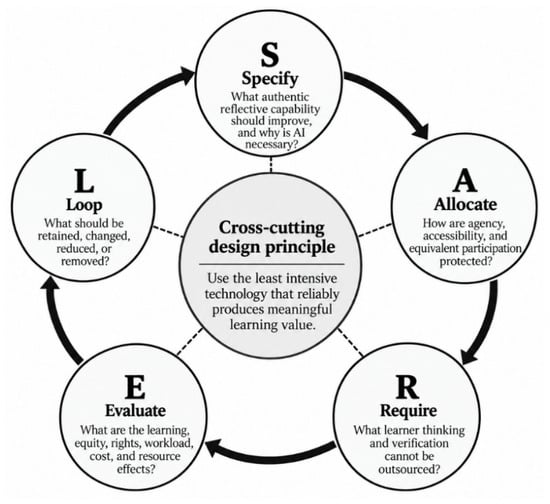
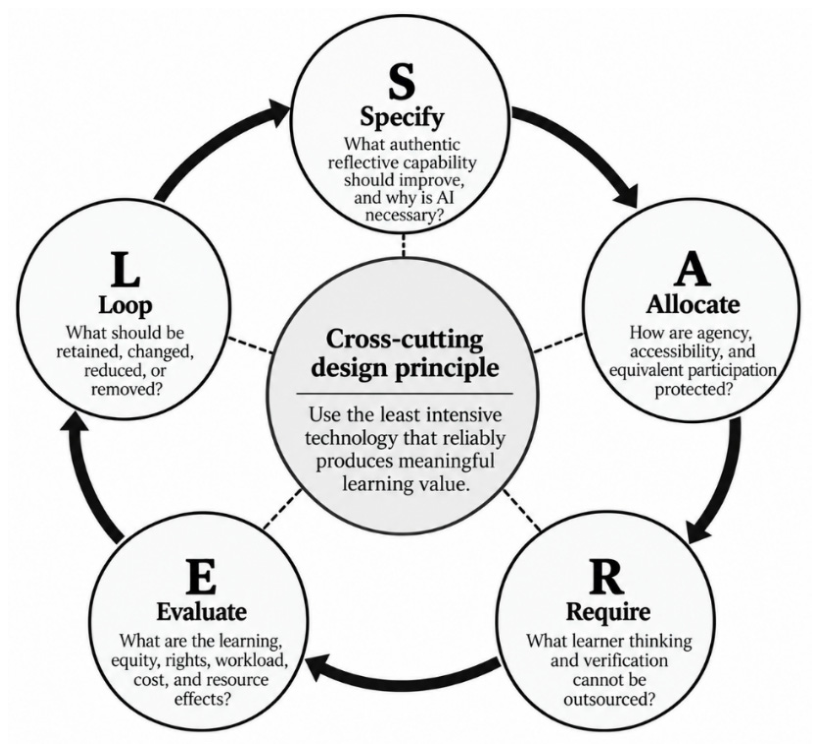
Figure 1.
The SAREL design and audit cycle.
3. Results
3.1. An Evaluation Imbalance in Educational Technology
Across the literature, technology adoption is commonly justified through access, flexibility, personalisation, efficiency, and user acceptance. The Technology Acceptance Model and related models have made perceived usefulness and ease of use central to adoption research [51,52]. These constructs are valuable for explaining behaviour, but they do not establish that a tool creates durable learning or sustainable institutional value. A technology may be easy to use, frequently used, and positively perceived while producing limited transfer, increasing instructor monitoring work, or displacing deeper forms of learner effort.
Reviews of online learning and educational technology emphasise that outcomes depend on pedagogy, course design, teacher presence, and context rather than on the digital medium alone [24,25,26,27]. Reviews of AI in higher education identify uneven attention to educational theory, educator roles, methodological rigour, and longitudinal evidence [23,28,29,30]. In our interpretation, these discussions justify assessing lasting learning, inclusion, governance, workload, and resource intensity together, rather than treating adoption, convenience, or perceived usefulness as sufficient evidence of sustainability. This is a synthesis of prior reviews and an authors’ conceptual argument, not an outcome-frequency count conducted across the 49 selected sources.
The potential gap in integrated evaluation matters because sustainability concerns the socio-technical learning arrangement rather than an isolated tool. Its appraisal can consider the task, learners, instructors, institution, platform, data practices, and supporting infrastructure. The design question is not only whether an AI intervention works, but what kinds of learner capabilities it promotes or displaces, which groups can participate, how work and risk are redistributed, and whether comparable learning can be achieved using a less resource-intensive alternative. This is a conceptual implication of the synthesis, not an empirical ranking of existing evaluation practices.
3.2. Pedagogical Sustainability: Reflection Must Remain Learner Work
Reflective learning is more than producing a reflective text. It is a recursive process in which learners revisit experience, identify assumptions, interpret evidence, connect theory and practice, regulate emotion and motivation, and decide how future action should change [5,6,7,8,9,10,11,12,13]. Self-regulated learning models similarly emphasise cycles of forethought, performance, monitoring, and adaptation [5,6]. The educational value lies in these cognitive and metacognitive operations, not in the fluency of the final narrative.
AI can support this process when it functions as a prompt, mirror, challenger, or feedback partner. For example, it can ask a learner to justify a conclusion, generate counterexamples, identify missing evidence, compare an account with a rubric, or suggest questions for further inquiry. Early randomised field experiments in undergraduate computer science courses (N = 145 and N = 112), with short follow-up periods, suggest that structured LLM-supported reflection can improve confidence and subsequent assessment performance; comparable gains were sometimes achieved using well-designed non-AI questionnaires [53]. These results do not establish longer-term retention or transfer. This comparison is crucial: the sustainable design question is whether AI adds value beyond a simpler reflective scaffold. This learner-first sequence is a candidate design proposition, not a universally necessary condition. It may be adapted for learners who benefit from early accessibility support, for novice learners who need guided examples, or for tasks whose objective is AI-supported exploration rather than unaided interpretation. Its comparative effectiveness should be tested against AI-first scaffolding and well-designed non-AI alternatives, with the learning objective and accessibility requirements specified in advance.
The main pedagogical risk is cognitive substitution. GenAI can provide interpretations before learners have articulated their own, generate polished reflective text without equivalent independent analysis, and reduce forms of effort that may be important for learning. Cognitive load theory and multimedia learning scholarship distinguish useful reductions in extraneous processing from the removal of generative cognitive activity [43,44]. However, empirical comparisons do not justify a simple claim that AI-generated support is inferior to human-authored support: in a randomised study of mathematics hints, ChatGPT-generated and human tutor-authored help produced no statistically significant differences in learning gains, although quality control of generated hints remained a concern [54]. AI-supported reflection should therefore be compared with strong non-AI alternatives [53] while testing whether it adds educational value beyond task completion.
For reflective tasks intended to develop independent reasoning, three provisional design implications follow. First, learners may be encouraged to create an initial account, judgment, or evidence map before consulting AI. Second, AI outputs can be treated as objects for critique rather than as authoritative answers. Third, the learning design may document a visible transformation between the learner’s first position and final position, including the evidence or reasoning that produced the change. This preserves reflection as learner work while using AI to increase feedback frequency and perspective diversity. Together, these findings provide a conceptual rationale for the “Require” stage of SAREL: the critical question is whether assistance preserves observable learner interpretation, verification, and revision, not whether an AI-generated reflective product appears fluent.
3.3. Social Sustainability: Agency, Accessibility, and Relational Support
Educational sustainability depends on who can participate and on the quality of participation. Digital inequality is not limited to device ownership; it includes connectivity, skills, confidence, language, disability access, privacy, household conditions, and the ability to convert access into valued outcomes [14,15,16,17]. GenAI may reduce some barriers through translation, simplification, multimodal explanation, or asynchronous support. It may also widen inequality when advanced features require payment, high-bandwidth access, recent hardware, dominant-language proficiency, or sophisticated prompt literacy.
Universal Design for Learning (UDL) provides a useful starting point because it emphasises multiple means of engagement, representation, and action or expression [14,15]. Applied to AI-supported reflection, UDL implies that students should have meaningful options: text or audio reflection; AI-assisted or non-AI pathways; synchronous human support; accessible formats; adjustable pacing; and transparent criteria that do not reward technical fluency unrelated to the learning objective. An inclusive design does not force students to disclose disability, financial limitation, or objection to a commercial system in order to receive an equivalent pathway.
Agency is equally important. Human-centred guidance emphasises that AI should augment rather than replace human judgment [3,34,35]. In reflective learning, agency means that learners understand when AI is used, can decline or modify its role, can contest outputs, and remain responsible for claims submitted as their work. It also means that instructors retain professional judgment rather than being compelled to follow automated classifications or feedback. Relational support remains important in reflective learning, particularly when students engage with experiences involving uncertainty, emotions, and professional identity [11,13]. Such considerations should inform the design of AI-supported reflective activities.
Social sustainability therefore requires an “equivalence without sameness” principle: alternative pathways may use different media or levels of automation, but they should offer comparable opportunities to meet the same learning outcomes. Institutions should audit participation patterns and outcome gaps across learner groups rather than assume that availability equals accessibility. The implications for framework development are that access, meaningful alternatives, and learner control must be addressed at the design stage rather than treated as optional accommodations after AI adoption. This literature-informed concern motivates the “Allocate” stage of SAREL.
When accessibility support requires more computationally intensive modalities, accessibility and the possibility of equivalent learning participation should not be traded away for a lower resource footprint. SAREL proposes a contextual, non-compensatory decision process: first satisfy applicable rights, learner agency, and essential accessibility requirements; then compare feasible alternatives for demonstrated learning value, workload, cost, and resource intensity. This is a proposed decision principle, not an empirically validated weighting formula. In applying this proposed principle, applicable rights, meaningful learner choice, and essential accessibility are treated as prerequisites, not as scores that can be offset by high performance on other criteria.
3.4. Ethical and Institutional Sustainability: Rights, Trust, and Workload
AI-supported education depends on data, models, and institutional arrangements that are frequently invisible to learners. Learning analytics research has long identified concerns about informed consent, privacy, classification, surveillance, power, and the persistence of student profiles [45,46,47]. GenAI adds further issues: uncertain training-data provenance, hallucinated content, embedded bias, third-party retention of prompts, intellectual-property ambiguity, and rapid model changes that can alter behaviour during a course [31,32,33,34,35,36].
Ethical sustainability therefore requires more than a generic warning. Students need task-level disclosure of what system is permitted, what data must not be entered, what outputs require citation or acknowledgement, how errors should be checked, and how responsibility is assigned. Sensitive personal reflection should not be required to pass through a commercial model. Where AI is used to analyse student writing or engagement, the purpose, data lifecycle, access rights, and appeal route should be explicit. Human review is essential for consequential judgments.
Institutional viability also depends on workload and capability. Automation can reduce repetitive feedback, but it can create new work in prompt design, output checking, exception handling, academic-integrity redesign, staff training, procurement, and student support. Sustainable implementation includes these hidden costs. A pilot that appears efficient because instructor verification time is excluded may shift risk rather than reduce cost.
The evidence suggests that governance should operate at three levels. At the course level, teachers define acceptable use and verification procedures. At the programme level, teams align assessment and support so students encounter coherent expectations. At the institutional level, procurement, privacy, accessibility, security, and model monitoring are coordinated. This layered governance prevents each teacher from independently solving complex legal and technical questions while preserving pedagogical discretion, consistent with educator-facing ethical guidance and risk-management approaches [48,49]. SAREL does not introduce human oversight, fairness, privacy, transparency, or accountability as new ethical principles. These concerns are already addressed in human-centred guidance and general-purpose risk-management approaches, including the NIST AI Risk Management Framework and updated European Commission guidance for educators [3,35,37,38,48]. The proposed contribution of SAREL is to connect existing governance requirements to a reflective learning task, explicit learner reasoning, a viable non-AI alternative, and repeated design review. The framework is complementary to, not a substitute for, legal compliance or institutional risk management. Existing guidance also varies in its level of education-specificity; therefore, the comparison should be understood as one of purpose and scope rather than demonstrated superiority.
In EU institutions, governance review should also consider the General Data Protection Regulation (GDPR) and Regulation (EU) 2024/1689 (the EU AI Act), including the applicability of Article 4 on AI literacy and Annex III provisions for certain education-related high-risk uses. Not every AI-assisted classroom activity is automatically high-risk; applicability depends on intended purpose, use, and the regulatory obligations in force. Institutions outside the EU must assess corresponding local law. These legal obligations remain distinct from, and are not replaced by, SAREL’s provisional course-level audit.
3.5. Environmental and Economic Sustainability: From Efficiency to Sufficiency
Environmental consequences are a frequently under-specified part of educational AI appraisal, although this review does not quantify how often they are omitted. ICT has life-cycle impacts involving devices, networks, data centres, energy, and equipment replacement [18,19,20,21,22]. AI systems introduce additional computational demand, while Green AI research encourages reporting energy and resources as well as model performance [19,20]. Reviews of sustainability in computing education similarly show that environmental, social, and pedagogical perspectives are often insufficiently integrated [55]. International Energy Agency analysis further documents growing electricity demand associated with data centres and AI infrastructure [56]. These macro-level estimates should not be interpreted as direct energy or carbon values for a particular course-level AI task. Resource effects depend on models, hardware, location, energy mix, and provider transparency; reliable task-specific accounting often remains unavailable to educators. Resource proportionality therefore functions in SAREL as an explicit design and comparison question rather than a claim of precisely measured environmental savings.
Digital sufficiency provides a more practical principle than abstract efficiency. Efficiency asks how to perform a digital task with fewer resources; sufficiency asks whether the task, scale, or frequency is necessary and whether a less intensive arrangement would meet the purpose [18]. In education, this means preferring a static rubric over repeated AI queries when both produce equivalent reflection; using a smaller or institutionally hosted model when appropriate; avoiding compulsory high-bandwidth media; extending device lifetimes; and minimising redundant generation, storage, and analytics.
Economic sustainability is linked to environmental and social sustainability. Subscription costs, vendor lock-in, unpredictable pricing, and dependence on proprietary platforms can make a learning design fragile. A sustainable course should have an exit strategy and a low-technology fallback. It should avoid learning outcomes that can only be achieved through a single commercial interface. Procurement should consider total cost of ownership, including training, integration, accessibility remediation, support, and future migration.
The resulting principle is proportionality: resource intensity should be justified by meaningful learning value. “More personalised” is insufficient if personalisation is superficial or does not improve retention, transfer, inclusion, or learner independence. The environmental question is not whether all digital learning should be minimised, but whether each added layer of computation produces evidence-based educational value. These considerations inform SAREL’s evaluation and redesign decisions: model size, query frequency, bandwidth, device requirements, and availability of lower-intensity pedagogical alternatives are candidate proxies to be assessed alongside demonstrable learning value, not direct measures of emissions or sustainability.
Table 1 brings together the dimensions that define sustainability as a property of the broader learning arrangement rather than of the technology itself. The five domains show that educational value must be considered alongside learner agency and inclusion, ethical and rights-based safeguards, institutional viability, and environmental and economic proportionality. Importantly, each domain is linked to observable forms of evidence, shifting attention from adoption and perceived usefulness towards learning durability, equitable participation, transparent governance, institutional capacity, and justified resource use. Taken together, these dimensions establish the conceptual basis for a framework in which AI-supported learning is evaluated not only by what the technology enables, but also by the conditions under which that value is produced and sustained.
Table 1.
Multidimensional evidence domains for sustainable educational technology.
3.6. The SAREL Framework
The conceptual synthesis informed the development of SAREL—Sustainable AI-Supported Reflective Education and Learning—as an author-proposed design sequence and audit cycle. Its contribution is integrative rather than the invention of previously unknown pedagogical or ethical principles. Table 2 links the five author-defined stages to concerns grounded in the selected literature and makes clear where the synthesis adds a design decision. More specifically, pedagogical and reflective-learning evidence informed Specify and Require; agency and inclusion informed Allocate; ethical and institutional considerations informed Require and Evaluate; and resource proportionality informed Evaluate and Loop. Table 2 identifies the relevant literature and the proposed design decision for each stage.
Table 2.
Literature-informed rationale and author-derived design decisions in SAREL.
The mapping is illustrative and theory-informed; it does not imply that every one of the 49 sources independently substantiates all five stages or that the sequence has been empirically validated. Figure 1 displays the proposed iterative logic, and Table 3 sets out the stages and candidate review evidence.
Table 3.
SAREL stages, design questions, and proposed review evidence.
S—Specify an authentic learning purpose. Designers define the reflective capability to be developed, the evidence that would demonstrate improvement, and the reason AI is needed. The default question is not which tool to adopt, but which learning problem requires support. A baseline non-AI design is identified so added value can be tested.
A—Allocate agency and accessibility. Learners receive understandable choices about AI use, equivalent alternatives, accessible formats, and human support. The design specifies what decisions remain with learners and teachers. Participation is not conditioned on disclosing sensitive data or purchasing premium access.
R—Require reflection and responsible verification. Students externalise initial thinking, interrogate AI outputs, verify claims and sources, identify uncertainty, and explain revisions. The assessment rewards reasoning, evidence use, and metacognitive change rather than surface fluency. AI disclosure is integrated into the task rather than treated only as a compliance statement.
E—Evaluate learning, equity, rights, and resource use. Evaluation covers learning outcomes, retention, transfer, independence, accessibility, participation gaps, privacy, workload, cost, and digital-resource intensity. A tool is not retained solely because users like it or because it saves visible time.
L—Loop evidence into redesign. The course team removes redundant uses, strengthens scaffolds, updates governance, and retains only practices that demonstrate sustainable learning value. Because models and policies change, approval is time-bounded and reviewed. The loop turns sustainability into continuous educational quality improvement rather than a one-time procurement claim.
The five stages are intentionally ordered. Purpose precedes technology; agency precedes data capture; reflection precedes automated polish; evaluation includes costs as well as benefits; and continued use depends on evidence. The cycle can be applied to a single assignment, a course, a programme, or an institutional service.
The arrows indicate that findings from the Loop stage inform renewed specification of learning purpose. The central principle—selecting the least intensive arrangement adequate for the intended learning outcome—applies across all five stages; it is not a sixth stage.
Table 3 translates the framework into five candidate design-review questions. At the initial design stage, evidence may concern intended outcomes, learner choice, accessibility, governance arrangements, and a non-AI comparator. Claims concerning durable learning, equitable outcomes, actual workload, and resource use require observation after implementation. The sequence is a proposed structure for reflection and subsequent evaluation, not an empirically derived threshold for permission to deploy AI. Specify, Allocate, and Require primarily guide task design and early implementation; Evaluate and Loop depend on follow-up evidence after deployment (see Table 4).
Table 4.
SAREL provisional rapid audit rubric for a course-level AI-supported reflective activity.
SAREL also needs to be distinguished from established educational design and reflection cycles. ADDIE structures the broader process of analysing, designing, developing, implementing, and evaluating instruction [57], while reflective practice and self-regulated learning models describe how individuals revisit experience, monitor performance, and adjust subsequent action [5,6,7,8]. These approaches already contain iterative and evaluative principles. SAREL does not claim novelty for iteration itself or for reflection as a learning mechanism. Its narrower proposed contribution is to bring the learning task, accessible AI/non-AI choices, output verification, rights-based governance, institutional workload, and digital-resource proportionality into the same design-review sequence. This is a distinction of analytic purpose and coverage; no comparative advantage has yet been established.
4. Discussion
SAREL contributes to sustainable education research in three ways. First, it integrates pedagogical, social, ethical, institutional, economic, and environmental dimensions that are commonly examined separately. This integration prevents a frequent category error: treating a technological feature, such as automation or accessibility support, as proof of whole-system sustainability. Second, SAREL connects sustainability to reflective and self-regulated learning mechanisms. It therefore identifies what must remain cognitively human even when assistance is automated. Third, it provides observable indicators that can be used in design reviews and future empirical studies. In relation to the three research questions, the review identifies the multidimensional conditions required for sustainable AI-supported reflective learning (RQ1), integrates these conditions into the five-stage SAREL design and audit cycle (RQ2), and translates them into observable design and evaluation indicators for implementation and future empirical assessment (RQ3). SAREL shares established foundations with responsible AI, human-centred AI, inclusive educational design, and digital sustainability [3,14,18,35,37,38]. General governance frameworks address accountability, oversight, and risk at organisational or system levels, whereas SAREL proposes to connect these principles to a specific reflective learning task and the assessment of learners’ independent reasoning. Conversely, more narrowly pedagogical approaches may not explicitly connect reflective activity to governance, institutional work, or environmental proportionality. These are differences in conceptual scope, not evidence that SAREL is superior. Whether this integrated approach improves design decisions or student outcomes remains an open empirical question.
The framework also reframes innovation. Sustainable innovation is not maximal automation, but selective augmentation. In reflective learning, the most valuable use of AI may be to create timely prompts, counterarguments, or feedback options while leaving interpretation, evidence judgment, and action planning with the learner. This approach is consistent with hybrid human–AI perspectives and ethical frameworks that prioritise augmentation, agency, and human oversight [34,35]. An integrative review published after the original July 2026 search period discusses both the scaffolding potential of generative AI and risks associated with cognitive offloading and uncritical reliance on AI-generated content [58]. This newer evidence is used here to contextualise the argument; it was not part of the original 49-source synthesis. The review is consistent with the need to preserve epistemic agency, but it cannot be taken as direct validation of SAREL. The five-stage sequence was developed from the original concept-driven synthesis; subsequently added 2025–2026 publications are cited for contextual comparison rather than as its original evidentiary basis.
A practical implication concerns assessment. Traditional reflective essays are vulnerable to superficial compliance and undisclosed generation. Banning AI does not solve the underlying design weakness. SAREL suggests process-visible assessment: initial notes, critical dialogue with an AI or peer, source verification, a revision memo, and an action plan. Oral follow-up, annotated evidence, or in-class transfer tasks can test ownership and understanding. The objective is not to police every keystroke, but to make the learning process valuable and visible.
A second implication concerns comparison conditions. Research and institutional pilots should compare AI-supported reflection not only with “no support,” but with strong non-AI scaffolds such as questionnaires, exemplars, peer dialogue, or instructor prompts. Early evidence that structured questionnaires can rival LLM-supported reflection underscores the importance of this comparison [53]. Without it, institutions may attribute gains to AI that actually arise from better task structure.
A third implication concerns metrics. Sustainable educational technology evaluation should move beyond adoption and immediate satisfaction. Future studies could examine: (a) direct learning gain; (b) delayed retention or transfer; (c) learner ability to perform without the tool; (d) outcome and participation differences across learner groups; (e) instructor and support workload; (f) privacy and governance conditions; (g) financial cost; and (h) a transparent proxy for resource intensity, such as model class, query volume, media bandwidth, device requirements, or provider-reported energy data. These measures can support a future construct of sustainability-adjusted learning value.
For future empirical evaluation, sustainability-adjusted learning value (SALV) is provisionally defined as demonstrated learning improvement and independent application considered alongside equity, learner rights, institutional workload, financial costs, and digital-resource use. Rather than a single unvalidated score, SALV is proposed as a multidimensional assessment combining immediate learning outcomes, delayed independent performance, reflective reasoning, accessibility, governance, and resource proportionality. Drawing on self-regulated and reflective learning theories [5,6,7,8,9,10,11,12,13], epistemic evaluation [59], inclusive design [14,15,16,17], and digital sufficiency [18,19,20,21,22,56], six propositions are proposed for empirical testing: (P1) initial independent reflection before AI assistance may strengthen subsequent reflective performance; (P2) structured verification and revision may improve the critical evaluation of AI-generated information and appropriate reliance on its outputs; (P3) accessible non-AI alternatives may reduce participation barriers; (P4) greater learner agency may support subsequent self-regulation; (P5) institutional efficiency gains may diminish when verification, support, and governance costs are considered; and (P6) educational benefits relative to digital-resource intensity may vary across learning tasks. These propositions represent theoretically informed hypotheses rather than established effects of SAREL.
For policy, SAREL suggests that institutions consider establishing a sustainability gate for educational AI procurement and renewal. Vendors could be asked to provide information on accessibility, data processing, model changes, exportability, service continuity, and environmental reporting. Course teams should retain authority over pedagogical use, while central services provide legal, technical, and accessibility review. Student representatives and disability-support professionals should participate in evaluation because impacts may be invisible in average satisfaction scores.
The framework is especially relevant to teacher education, social work, health professions, and other fields where reflective practice is linked to professional judgment and identity. In these contexts, AI should not become an unexamined substitute for dialogue about uncertainty, values, and responsibility. As a tentative possibility for future investigation, parts of this design logic may also be explored with other educational technologies, such as learning analytics dashboards, adaptive practice systems, automated feedback, virtual environments, and mobile learning; its applicability beyond GenAI-supported reflective learning remains to be tested.
5. Limitations and Future Research
This concept-driven integrative review is not an exhaustive systematic review. Its purposive selection of 49 original sources may introduce source-selection bias; contemporaneous search exports, complete screening counts, exact database-specific queries, source-by-source coding records, and an independent coder-disagreement procedure are not sufficiently documented to support full reproducibility. The stated source-type proportions are retrospective descriptive classifications, not formal study-quality appraisals. Empirical, review-level, conceptual, and policy sources differ in evidentiary status, and the synthesis should not be read as a weighted meta-analysis or a measured distribution of outcomes across the field. The five SAREL stages are an abductive author proposal, and neither the framework nor its provisional rubric or SALV construct has been validated. Environmental accounting for educational AI also faces incomplete task-level energy and emissions data.
A phased validation programme is recommended: (1) expert content assessment and cognitive interviewing with learners and instructors; (2) feasibility pilots and independent-rater agreement for proposed audit indicators; (3) comparative, longitudinal, and mixed-method tests across courses and institutions; and (4) independent replication across disciplines and accessibility contexts. Candidate measures include immediate and delayed learning performance, evidence-checking accuracy, calibrated AI reliance, self-regulation, student agency, equitable access and participation, staff workload, cost, and estimated query- or task-level resource intensity. These are future research designs, not completed components of the present review.
Future research should operationalise each SAREL dimension and test inter-rater reliability of the audit rubric. Longitudinal quasi-experiments or randomised studies should compare AI-supported reflection with high-quality non-AI scaffolds and measure delayed transfer. Equity analyses should examine disability, language, socioeconomic position, prior digital experience, and paid versus free access. Workload studies should include preparation, verification, support, and governance time. Environmental research should develop practical educational proxies that are accurate enough for decision-making without requiring unavailable infrastructure data.
Multi-institutional studies are needed because sustainability depends on context. A low-bandwidth mobile intervention may be highly sustainable in one setting and exclusionary in another. Likewise, a locally hosted model may improve privacy but increase institutional maintenance burden. Participatory design with students, teachers, IT professionals, librarians, accessibility specialists, and sustainability experts can reveal these trade-offs. The framework should also be tested outside higher education and across languages and cultural contexts.
Finally, research should examine capability formation. A sustainable intervention should leave learners more able to judge, reflect, and act when the tool is unavailable. This “capability after assistance” criterion may be more important than immediate task completion and should become a central outcome in AI-supported education research.
6. Conclusions
This concept-driven integrative review examines how AI-supported reflective learning in higher education may be considered through pedagogical, social, ethical, institutional, and environmental sustainability perspectives. It proposes SAREL as a five-stage conceptual design-and-audit framework rather than as an empirically validated model. Its contribution lies in integrating existing sustainability concerns into a sequence linking learning purpose, learner agency, reflective verification, multidimensional evaluation, and iterative redesign.
The proposed framework may help educators and institutions examine whether AI support is educationally justified, accessible, responsibly governed, and proportionate to its expected learning value. These are potential uses, not demonstrated outcomes. SAREL complements existing responsible AI and inclusive-design guidance while focusing on reflective learning activities and learners’ independent reasoning.
Future research should assess whether SAREL-informed decisions support more appropriate technology use, equitable participation, preservation of human judgment, manageable workloads, and learning that endures beyond the tool. These benefits remain hypotheses. The proposed audit criteria require content validation, reliability assessment, and testing in authentic higher education settings, including comparisons with well-designed non-AI reflective scaffolds.
Supplementary Materials
The supporting information can be downloaded at https://www.mdpi.com/article/10.3390/su182211812/s1. Table S1: Mapping of source domains to SAREL stages and proposed review indicators.
Author Contributions
Conceptualization, R.B. and T.B.; methodology, R.B. and T.B.; investigation, T.B., R.B., J.C. and D.C.; formal analysis, R.B., J.C. and T.B.; writing—original draft preparation, R.B. and T.B.; writing—review and editing, R.B., T.B., J.C. and D.C.; visualization, T.B.; supervision, R.B.; project administration, R.B. and T.B. All authors have read and agreed to the published version of the manuscript.
Funding
This research received no external funding.
Institutional Review Board Statement
Not applicable.
Informed Consent Statement
Not applicable.
Data Availability Statement
The original contributions presented in this study are included in the article and its Supplementary Materials. Table S1 in the Supplementary Materials provides the 49 sources included in the integrative review, their publication types, and their indicative relevance to the five SAREL domains. Further inquiries can be directed to the corresponding author.
Acknowledgments
During the preparation of this manuscript, the authors used ChatGPT (OpenAI, GPT-6) exclusively for language editing and improving the clarity and readability of the text, and assist in the creation and visual refinement of Figure 1. The authors reviewed and edited the output and take full responsibility for the content of this publication.
Conflicts of Interest
The authors declare no conflicts of interest.
References
- United Nations. Transforming Our World: The 2030 Agenda for Sustainable Development; United Nations: New York, NY, USA, 2015. [Google Scholar]
- UNESCO. Global Education Monitoring Report 2023: Technology in Education—A Tool on Whose Terms? UNESCO: Paris, France, 2023. [Google Scholar]
- UNESCO. Guidance for Generative AI in Education and Research; UNESCO: Paris, France, 2023. [Google Scholar]
- Selwyn, N. Education and Technology: Key Issues and Debates, 2nd ed.; Bloomsbury Academic: London, UK, 2016. [Google Scholar]
- Panadero, E. A review of self-regulated learning: Six models and four directions for research. Front. Psychol. 2017, 8, 422. [Google Scholar] [CrossRef] [Scilit] [PubMed]
- Zimmerman, B.J. Becoming a self-regulated learner: An overview. Theory Pract. 2002, 41, 64–70. [Google Scholar] [CrossRef] [Scilit] [PubMed]
- Schön, D.A. The Reflective Practitioner: How Professionals Think in Action; Basic Books: New York, NY, USA, 1983. [Google Scholar]
- Boud, D.; Keogh, R.; Walker, D. (Eds.) Reflection: Turning Experience into Learning; Kogan Page: London, UK, 1985. [Google Scholar]
- Bubnys, R. The structure of reflection competency during social work students’ practices. Soc. Teor. Emp. Polit. Prakt. 2014, 9, 50–63. [Google Scholar] [CrossRef] [Scilit]
- Bubnys, R. A journey of self-reflection in students’ perception of practice and roles in the profession. Sustainability 2019, 11, 194. [Google Scholar] [CrossRef] [Scilit]
- Colomer, J.; Serra, T.; Cañabate, D.; Bubnys, R. Reflective learning in higher education: Active methodologies for transformative practices. Sustainability 2020, 12, 3827. [Google Scholar] [CrossRef] [Scilit]
- Lim, R.B.T.; Hoe, K.W.B.; Zheng, H. A systematic review of the outcomes, level, facilitators, and barriers to deep self-reflection in public health higher education: Meta-analysis and meta-synthesis. Front. Educ. 2022, 7, 938224. [Google Scholar] [CrossRef] [Scilit]
- Mann, K.; Gordon, J.; MacLeod, A. Reflection and reflective practice in health professions education: A systematic review. Adv. Health Sci. Educ. 2009, 14, 595–621. [Google Scholar] [CrossRef] [Scilit] [PubMed]
- CAST. Universal Design for Learning Guidelines, Version 3.0; CAST: Wakefield, MA, USA, 2024. [Google Scholar]
- Al-Azawei, A.; Serenelli, F.; Lundqvist, K. Universal Design for Learning (UDL): A content analysis of peer reviewed journals from 2012 to 2015. J. Scholarsh. Teach. Learn. 2016, 16, 39–56. [Google Scholar] [CrossRef] [Scilit]
- van Dijk, J. The Digital Divide; Polity Press: Cambridge, UK, 2020. [Google Scholar]
- Helsper, E.J. The Digital Disconnect: The Social Causes and Consequences of Digital Inequalities; SAGE: London, UK, 2021. [Google Scholar]
- Santarius, T.; Bieser, J.C.T.; Frick, V.; Höjer, M.; Gossen, M.; Hilty, L.M.; Kern, E.; Pohl, J.; Rohde, F.; Lange, S. Digital sufficiency: Conceptual considerations for ICTs on a finite planet. Ann. Telecommun. 2023, 78, 277–295. [Google Scholar] [CrossRef] [Scilit] [PubMed]
- Schwartz, R.; Dodge, J.; Smith, N.A.; Etzioni, O. Green AI. Commun. ACM 2020, 63, 54–63. [Google Scholar] [CrossRef] [Scilit]
- Strubell, E.; Ganesh, A.; McCallum, A. Energy and policy considerations for deep learning in NLP. In Proceedings of the 57th Annual Meeting of the Association for Computational Linguistics, Florence, Italy, 28 July–2 August 2019; pp. 3645–3650. [Google Scholar] [CrossRef] [Scilit]
- Freitag, C.; Berners-Lee, M.; Widdicks, K.; Knowles, B.; Blair, G.S.; Friday, A. The real climate and transformative impact of ICT: A critique of estimates, trends, and regulations. Patterns 2021, 2, 100340, Correction in Patterns 2022, 3, 100576. [Google Scholar] [CrossRef] [Scilit] [PubMed]
- Malmodin, J.; Lövehagen, N.; Bergmark, P.; Lundén, D. ICT sector electricity consumption and greenhouse gas emissions—2020 outcome. Telecommun. Policy 2024, 48, 102701. [Google Scholar] [CrossRef] [Scilit]
- Zawacki-Richter, O.; Marín, V.I.; Bond, M.; Gouverneur, F. Systematic review of research on artificial intelligence applications in higher education—Where are the educators? Int. J. Educ. Technol. High. Educ. 2019, 16, 39. [Google Scholar] [CrossRef] [Scilit]
- Bond, M.; Buntins, K.; Bedenlier, S.; Zawacki-Richter, O.; Kerres, M. Mapping research in student engagement and educational technology in higher education: A systematic evidence map. Int. J. Educ. Technol. High. Educ. 2020, 17, 2. [Google Scholar] [CrossRef] [Scilit]
- Bates, T.; Cobo, C.; Mariño, O.; Wheeler, S. Can artificial intelligence transform higher education? Int. J. Educ. Technol. High. Educ. 2020, 17, 42. [Google Scholar] [CrossRef] [Scilit]
- Martin, F.; Sun, T.; Westine, C.D. A systematic review of research on online teaching and learning from 2009 to 2018. Comput. Educ. 2020, 159, 104009. [Google Scholar] [CrossRef] [Scilit] [PubMed]
- Rapanta, C.; Botturi, L.; Goodyear, P.; Guàrdia, L.; Koole, M. Online university teaching during and after the COVID-19 crisis: Refocusing teacher presence and learning activity. Postdigital Sci. Educ. 2020, 2, 923–945. [Google Scholar] [CrossRef] [Scilit] [PubMed]
- Crompton, H.; Burke, D. Artificial intelligence in higher education: The state of the field. Int. J. Educ. Technol. High. Educ. 2023, 20, 22. [Google Scholar] [CrossRef] [Scilit]
- Bond, M.; Khosravi, H.; De Laat, M.; Bergdahl, N.; Negrea, V.; Oxley, E.; Pham, P.; Chong, S.W.; Siemens, G. A meta systematic review of artificial intelligence in higher education: A call for increased ethics, collaboration, and rigour. Int. J. Educ. Technol. High. Educ. 2024, 21, 4. [Google Scholar] [CrossRef] [Scilit]
- Zawacki-Richter, O.; Bai, J.Y.H.; Lee, K.; Slagter van Tryon, P.J.; Prinsloo, P. New advances in artificial intelligence applications in higher education? Int. J. Educ. Technol. High. Educ. 2024, 21, 32. [Google Scholar] [CrossRef] [Scilit]
- Kasneci, E.; Seßler, K.; Küchemann, S.; Bannert, M.; Dementieva, D.; Fischer, F.; Gasser, U.; Groh, G.; Günnemann, S.; Hüllermeier, E.; et al. ChatGPT for good? On opportunities and challenges of large language models for education. Learn. Individ. Differ. 2023, 103, 102274. [Google Scholar] [CrossRef] [Scilit]
- Tlili, A.; Shehata, B.; Adarkwah, M.A.; Bozkurt, A.; Hickey, D.T.; Huang, R.; Agyemang, B. What if the devil is my guardian angel: ChatGPT as a case study of using chatbots in education. Smart Learn. Environ. 2023, 10, 15. [Google Scholar] [CrossRef] [Scilit]
- Lo, C.K. What is the impact of ChatGPT on education? A rapid review of the literature. Educ. Sci. 2023, 13, 410. [Google Scholar] [CrossRef] [Scilit]
- Molenaar, I. Towards hybrid human–AI learning technologies. Eur. J. Educ. 2022, 57, 632–645. [Google Scholar] [CrossRef] [Scilit]
- Holmes, W.; Porayska-Pomsta, K.; Holstein, K.; Sutherland, E.; Baker, T.; Buckingham Shum, S.; Santos, O.C.; Rodrigo, M.T.; Cukurova, M.; Bittencourt, I.I.; et al. Ethics of AI in education: Towards a community-wide framework. Int. J. Artif. Intell. Educ. 2022, 32, 504–526. [Google Scholar] [CrossRef] [Scilit]
- Williamson, B.; Eynon, R. Historical threads, missing links, and future directions in AI in education. Learn. Media Technol. 2020, 45, 223–235. [Google Scholar] [CrossRef] [Scilit]
- Tabassi, E. Artificial Intelligence Risk Management Framework (AI RMF 1.0); NIST AI 100-1; National Institute of Standards and Technology: Gaithersburg, MD, USA, 2023. [Google Scholar] [CrossRef] [Scilit]
- European Commission. Guidelines on the Ethical Use of Artificial Intelligence and Data in Teaching and Learning for Educators; Updated ed.; Publications Office of the European Union: Luxembourg, 2026. [Google Scholar] [CrossRef]
- Chen, S.; Cheung, A.C.K. Effect of generative artificial intelligence on university students learning outcomes: A systematic review and meta-analysis. Educ. Res. Rev. 2025, 49, 100737. [Google Scholar] [CrossRef] [Scilit]
- Fan, C.; Ke, L.; Chen, Z.; Lv, P. Exploring the effect of GenAI on learning outcomes in higher education: A three-level meta-analysis. Front. Psychol. 2026, 17, 1758670. [Google Scholar] [CrossRef] [Scilit] [PubMed]
- Whittemore, R.; Knafl, K. The integrative review: Updated methodology. J. Adv. Nurs. 2005, 52, 546–553. [Google Scholar] [CrossRef] [Scilit] [PubMed]
- Snyder, H. Literature review as a research methodology: An overview and guidelines. J. Bus. Res. 2019, 104, 333–339. [Google Scholar] [CrossRef] [Scilit]
- Sweller, J. Cognitive load during problem solving: Effects on learning. Cogn. Sci. 1988, 12, 257–285. [Google Scholar] [CrossRef] [PubMed]
- Mayer, R.E. Multimedia Learning, 3rd ed.; Cambridge University Press: Cambridge, UK, 2021. [Google Scholar]
- Slade, S.; Prinsloo, P. Learning analytics: Ethical issues and dilemmas. Am. Behav. Sci. 2013, 57, 1510–1529. [Google Scholar] [CrossRef] [Scilit]
- Pardo, A.; Siemens, G. Ethical and privacy principles for learning analytics. Br. J. Educ. Technol. 2014, 45, 438–450. [Google Scholar] [CrossRef] [Scilit]
- Drachsler, H.; Greller, W. Privacy and analytics—It’s a DELICATE issue: A checklist for trusted learning analytics. In Proceedings of the Sixth International Conference on Learning Analytics & Knowledge, Edinburgh, UK, 25–29 April 2016; pp. 89–98. [Google Scholar] [CrossRef] [Scilit]
- European Commission. Ethical Guidelines on the Use of Artificial Intelligence (AI) and Data in Teaching and Learning for Educators; Publications Office of the European Union: Luxembourg, 2022. [Google Scholar]
- Humble, N. Risk management strategy for generative AI in computing education: How to handle the strengths, weaknesses, opportunities, and threats? Int. J. Educ. Technol. High. Educ. 2024, 21, 61. [Google Scholar] [CrossRef] [Scilit]
- Butvilas, T.; Bubnys, R.; Colomer, J.; Cañabate, D. Dependence of socio-emotional competence expression on gender and grade for K5–K12 students. Educ. Sci. 2022, 12, 341. [Google Scholar] [CrossRef] [Scilit]
- Davis, F.D. Perceived usefulness, perceived ease of use, and user acceptance of information technology. MIS Q. 1989, 13, 319–340. [Google Scholar] [CrossRef] [Scilit] [PubMed]
- Venkatesh, V.; Morris, M.G.; Davis, G.B.; Davis, F.D. User acceptance of information technology: Toward a unified view. MIS Q. 2003, 27, 425–478. [Google Scholar] [CrossRef] [Scilit]
- Kumar, H.; Xiao, R.; Lawson, B.; Musabirov, I.; Shi, J.; Wang, X.; Luo, H.; Williams, J.J.; Rafferty, A.N.; Stamper, J.C.; et al. Supporting self-reflection at scale with large language models: Insights from randomized field experiments in classrooms. In Proceedings of the Eleventh ACM Conference on Learning @ Scale; ACM: New York, NY, USA, 2024; pp. 86–97. [Google Scholar] [CrossRef] [Scilit]
- Pardos, Z.A.; Bhandari, S. ChatGPT-generated help produces learning gains equivalent to human tutor-authored help on mathematics skills. PLoS ONE 2024, 19, e0304013. [Google Scholar] [CrossRef] [Scilit] [PubMed]
- Peters, A.-K.; Capilla, R.; Coroamă, V.C.; Heldal, R.; Lago, P.; Leifler, O.; Moreira, A.; Fernandes, J.P.; Penzenstadler, B.; Porras, J.; et al. Sustainability in computing education: A systematic literature review. ACM Trans. Comput. Educ. 2024, 24, 13. [Google Scholar] [CrossRef] [Scilit]
- International Energy Agency. Energy and AI; IEA: Paris, France, 2025. [Google Scholar]
- Branch, R.M. Instructional Design: The ADDIE Approach; Springer: New York, NY, USA, 2009. [Google Scholar] [CrossRef] [Scilit]
- Suazo Galdames, I.C.; Santiesteban Velázquez, M.; Saracostti, M.; Chaple Gil, A.M. Between cognitive offloading and critical autonomy: A systematic review of the epistemic implications of generative AI in higher education. Front. Educ. 2026, 11, 1878665. [Google Scholar] [CrossRef] [Scilit]
- Wei, J.; Shang, Y. Beyond checking: Verification quality, reliance calibration, and learning in generative AI-assisted higher education. Front. Psychol. 2026, 17, 1965371. [Google Scholar] [CrossRef] [Scilit] [PubMed]

Disclaimer/Publisher’s Note: The statements, opinions and data contained in all publications are solely those of the individual author(s) and contributor(s) and not of MDPI and/or the editor(s). MDPI and/or the editor(s) disclaim responsibility for any injury to people or property resulting from any ideas, methods, instructions or products referred to in the content. |
© 2026 by the authors. Licensee MDPI, Basel, Switzerland. This article is an open access article distributed under the terms and conditions of the Creative Commons Attribution (CC BY) license.