


Abstract
Cooperative financial ecosystems represent vital institutional pillars for grassroots economic stability and financial inclusion, yet their operational resilience is severely undermined by fragmented ‘islands of information’ and systemic data opacity. This study addresses these vulnerabilities by developing and empirically validating a ‘Governance-First Paradigm’ to orchestrate a centralized credit data infrastructure—the National Cooperative Credit Center (NCCC). Utilizing Covariance-Based Structural Equation Modeling (CB-SEM) on survey data from 431 stratified cooperative decision-makers and regulatory auditors across Thailand, the empirical findings validate a second-order reflective model. Under a constrained sensitivity model resolving minor Heywood cases, Credit Information Integration emerged as a primary reflective dimension (β = 1.000, R2 = 1.000, 95% bootstrap CI [0.836, 1.000]), closely followed by Technological Capacity (β = 0.940, R2 = 0.884, p < 0.001) and Institutional Governance (β = 0.840, R2 = 0.705, p < 0.001). Model fit indices demonstrated exceptional alignment (χ2 = 32.207, df = 23, p = 0.096, χ2/df = 1.400, GFI = 0.986, TLI = 0.995, CFI = 0.998, RMSEA = 0.031). Multi-group SEM invariance testing confirmed structural consistency across regulatory and operational tiers (Δχ2 = 2.14, p = 0.343), while collinearity VIF diagnostics (1.42–2.85) ruled out common method bias. The study establishes that technical integration in federated financial networks is fundamentally an institutional and democratic trust challenge rather than a simple software engineering task, providing a policy roadmap aligned with Sustainable Development Goals (SDGs 1, 8, 10, and 16).
1. Introduction
In Thailand, the cooperative sector controls significant collective capital, accounting for 13.47% of the national GDP, with a total business value of 2.53 trillion baht and operating capital exceeding 4.19 trillion baht [1], yet it remains fragmented into 9044 isolated financial nodes [2,3]. This fragmentation presents a structural governance crisis rather than a mere technical inefficiency, paralyzing the sector’s dynamic capabilities to proactively sense and respond to emerging financial distress. While advanced technologies such as big data analytics and artificial intelligence (AI) offer unprecedented predictive capacities for risk monitoring, deploying these black-box systems within democratic, member-owned institutions risks causing an asymmetrical redistribution of institutional power. As open innovation ecosystems frequently remain vulnerable to severe data fragmentation [4], digital platforms must function fundamentally as collaborative governance infrastructures rather than merely technological tools [4]. Consequently, attempting to resolve information silos through technical data centralization, without establishing a prior, robust governance framework, may amplify systemic operational risks, undermine member confidence, and threaten socio-economic sustainability [5,6]. Establishing a unified credit data exchange framework also serves as a critical structural backbone for long-term sustainability, as structured data trading platforms significantly reduce the risk of unutilized dark data within decentralized networks [7].
This study addresses these critical vulnerabilities by proposing a “Governance-First Paradigm” to orchestrate a responsible, centralized credit information integration platform, the National Cooperative Credit Center (NCCC) in Thailand. Grounded in the literature on platform governance, this study approaches the creation of this financial ecosystem through a “trust-utility” orientation [8], demonstrating that institutional trust and standardized protocols must strictly precede large-scale hardware and database procurement. Responding to the urgent call for quantitative metrics to evaluate regulatory frameworks and platform policies in practice [9], this research utilizes Covariance-Based Structural Equation Modeling (CB-SEM) to evaluate the structural prerequisites of the NCCC. Specifically, this study investigates the following question: How does institutional governance shape technological capacity and credit information integration to address systemic fragmentation and foster socio-economic sustainability [1]? By empirically validating these dynamics, this research offers a clear strategic roadmap for policymakers, demonstrating that structural alignment is a primary antecedent for technological efficacy in collaborative financial networks.
The remainder of this paper is structured as follows. Section 2 reviews the theoretical background, synthesizing the TOE, TAM, and HAIG frameworks. Section 3 details the research methodology, including the research design, construct operationalization, and data analysis strategy. Section 4 presents the empirical results and structural equation modeling analysis. Section 5 discusses the theoretical and practical implications of the findings. Finally, Section 6 provides the conclusions, policy recommendations, and directions for future research.
2. Theoretical Foundations and Hypothesis Development
This study bridges traditional Information Systems (IS) theories with emerging ethical technology frameworks to address institutional fragmentation within cooperative networks. The primary objective is to establish a responsible, centralized credit information integration platform that overcomes the vulnerabilities of isolated “Information Silos” [2,5].
2.1. Theoretical Foundations: TAM, TOE, and Responsible Technology
Classical adoption frameworks, particularly the Technology Acceptance Model (TAM) [10,11] and the Technology–Organization–Environment (TOE) framework [12,13], provide a foundational baseline for evaluating system quality, organizational readiness, and environmental pressures. However, in democratic, member-owned entities, traditional technology-centric interpretations are often insufficient. Because open innovation ecosystems frequently remain vulnerable to severe data fragmentation across heterogeneous actors [4], digital platforms must function fundamentally as collaborative governance infrastructures rather than merely transactional IT tools [4].
In highly decentralized or agricultural contexts, digital adoption is heavily constrained by institutional and structural barriers, proving that classical technology acceptance frameworks must be extended to incorporate socio-institutional realities [14]. To drive meaningful transformation under these constraints, the integration of technology must focus on developing a smart cooperative management framework that enhances knowledge, e-administration capacity, and systemic participation of members [15].
Consequently, TAM and TOE are extended in this study through the lens of Responsible Technology. Within this context, the “Environment” and “Organization” constructs are redefined around institutional trust, data sovereignty, and proactive governance. Furthermore, “Acceptance” (TAM) is evaluated not merely on perceived individual usefulness, but on the ecosystem’s capacity to mitigate ethical dilemmas, such as information asymmetry and the asymmetrical redistribution of organizational power [16]. Therefore, this study proposes a “Governance-First Paradigm,” arguing that structural alignment, policy standardization, and institutional trust must strictly precede technological deployment to ensure ethical data sharing [17].
2.2. The Governance-First Paradigm and Human–AI Governance (HAIG)
To function cohesively, decentralized networks require structural rules, which are operationalized in this study through five core governance dimensions: Standards, Disclosure, Stakeholders, Auditors, and Regulators [9,18,19]. This approach aligns with the Human–AI Governance (HAIG) framework, which advocates for a “trust-utility” orientation in modern digital platforms [7]. Under this paradigm, governance is no longer conceptualized as a bureaucratic constraint on technological capacity; instead, it is positioned as the fundamental institutional bedrock necessary for technological capabilities—including emerging predictive analytics and automated decision-support algorithms—to be realized safely [20]. Furthermore, sustainability and preparedness in cooperative finance are not solely determined by external compliance metrics, but are structurally driven by internal governance trust and organizational legitimacy [21]. This synergized relationship is consistent with recent findings in digital platform research, which demonstrate that dual-pilot policies combining structural governance transparency with physical technology infrastructures outperform isolated deployment initiatives [22]. In member-owned cooperative networks, where algorithms directly influence credit access and financial equity, technological utility alone is insufficient to secure adoption. Without institutional governance guarantees, cooperative leaders perceive data centralization as an infringement on organizational autonomy and a risk of surveillance.
Classical Information Systems (IS) adoption models, such as the Technology Acceptance Model (TAM) and the Technology–Organization–Environment (TOE) framework, provide a valuable baseline logic regarding individual usefulness, ease of use, and firm-level technological readiness. However, these traditional frameworks operate under a firm-centric, utility-driven assumption—presuming that technological deployment is primarily bounded by operational efficiency and transactional adoption costs. In federated, member-owned financial ecosystems, this firm-centric paradigm breaks down. Because cooperative networks consist of autonomous, democratic entities, data centralization triggers deep-seated institutional resistance regarding data sovereignty, surveillance risk, and asymmetric power redistribution.
To bridge this theoretical lacuna, this study integrates the Human–AI Governance (HAIG) framework alongside TAM and TOE. Rather than viewing governance merely as a passive environmental component within TOE or an administrative constraint on TAM’s perceived usefulness, HAIG introduces a dual-pillar “trust-utility” orientation. Theoretically, HAIG establishes that institutional trust, standardized data sovereignty, and democratic oversight serve as mandatory structural antecedents that unlock and legitimize technological utility.
Furthermore, this study explicitly delineates three boundary conditions under which HAIG offers superior explanatory power over classical TAM [10,11] and TOE [12,13] frameworks:
(1) Ecosystem Decentralization & Federated Ownership, where data flows across independent, member-owned nodes that fear loss of operational autonomy.
(2) Asymmetrical Power & Surveillance Risks, where algorithmic credit scoring threatens to centralize control in top-down regulatory bodies.
(3) Algorithmic Complexity (Black-Box AI), where predictive models lack inherent transparency, requiring explainable governance frameworks (XAI) to secure user legitimacy. Under these boundary conditions, technological capacity alone (TAM/TOE) is insufficient to induce platform adoption unless preceded by structural governance guarantees (HAIG).
Ecosystem-level resilience in grassroots collaborative finance is strongly associated with active resource allocation and collaborative governance mechanisms rather than with isolated, firm-level risk management [23]. Within the proposed model, standardized protocols are utilized to ensure system-wide interoperability [24], and transparent disclosure mechanisms are implemented to reduce agency costs and enhance mutual accountability [18,19,25]. Active stakeholder engagement facilitates democratic participation and value co-creation among cooperative members and staff [26], independent auditors provide critical verification of data and system integrity [27,28], and centralized regulators are required to protect the federated network from systemic liquidity risks and the opacity of advanced analytical models [9,27]. In decentralized networks, establishing unified legal definitions, data ownership agreements, and democratic oversight mechanisms provides the institutional foundation necessary for APIs and clearinghouse software to operate effectively. Institutional governance creates the legal and ethical framework within which technological capacity and credit information sharing can thrive without triggering member resistance.
2.3. Civic Technology, Credit Risk Assessment, and Ethical Data
Within the technological and informational dimensions of this extended model, the analytical focus is shifted toward systemic resilience and inclusive credit risk assessment. In social collaborative economies, decentralized digital platforms can function as “civic blockchain” tools that act as trust-enabling mechanisms, preserving local data sovereignty while eliminating information asymmetry [29]. Initial regulatory innovations within the Thai cooperative sector, such as deploying participatory applications (e.g., SmartMember) for transparent financial verification [30], demonstrate the potential of open governance.
However, as financial ecosystems transition from basic transaction tracking to advanced risk forecasting, traditional statistical methods often fall short in capturing complex, non-linear risk patterns [20]. While deep learning and advanced data analytics offer powerful tools to model these complexities, their inherent “black-box” nature presents critical challenges regarding transparency, interpretability, and regulatory compliance [20]. Moreover, empirical evidence from digital financial services in Thailand emphasizes that transparency and accountability risks are key drivers of technology mistrust, indicating that building sustainable analytical models requires going beyond basic technical design toward socially legitimate algorithmic governance [31]. Therefore, deploying Explainable AI (XAI) structures is essential to maintain clear lines of accountability, providing understandable interpretations of credit decisions to grassroots officers and cooperative members alike [20,32].
Furthermore, to overcome information asymmetry ethically without expanding surveillance, credit information must extend beyond conventional lagging financial indicators [33]. Incorporating non-financial information disclosures on digital credit platforms acts as a powerful strategic mechanism to enhance transparency, mitigate transaction risks, and legitimize the social role of the platform in grassroots economies [34]. To support “thin file” borrowers who lack formal credit histories, responsibly incorporating alternative data [35] and cooperative-specific metrics (such as member participation and social capital) [26] establishes a quantifiable proxy for social collateral, thereby driving inclusive, sustainable risk assessment [36].
Recent empirical scholarship highlights the theoretical necessity of coupling digital technology with structural governance. In addressing platform data fragmentation, Xie et al. [6] demonstrate that data centralization without standardized governance frameworks leads to unutilized “dark data” and system decoupling. This institutional requirement is theoretically captured by Engin [7] in the Human–AI Governance (HAIG) framework, which posits that institutional trust serves as a primary prerequisite for technological utility.
Empirically validating this trust-first logic, Gui et al. [22] confirm that dual-pilot policy interventions synergizing governance transparency with technological infrastructure yield significantly higher long-term adoption efficacy than isolated technical deployments. In financial cooperatives, Justen et al. [37] further demonstrate that while aggregate ESG metrics have limited impact, social-pillar governance disclosures directly drive risk-adjusted financial performance. Furthermore, Balcıoğlu et al. [8] and Choi [25] emphasize that user resistance to algorithmic decision-making stems primarily from accountability opacity, asserting that human-centric Explainable AI (XAI) is mandatory to secure platform legitimacy.
Synthesizing these insights reveals a critical research gap: while prior studies examine macro-level platform governance [6,22] or individual algorithmic trust [25], they lack an empirically validated framework quantifying how institutional governance, technological capacity, and credit information integration interact in federated financial networks. This study directly addresses this gap by testing the Governance-First Paradigm within a second-order structural model.
2.4. Hypothesis Development
Synthesizing the integration of TOE, TAM, and HAIG frameworks responds directly to the urgent call for developing quantitative metrics to evaluate platform policies and regulatory impacts in practice [8]. To empirically evaluate the structural prerequisites of the National Cooperative Credit Center (NCCC), the hierarchical contributions of its core dimensions are hypothesized as follows:
H1:
Institutional governance constitutes a significant, primary reflective dimension of National Cooperative Credit Center (NCCC) effectiveness, establishing the core framework for institutional trust [7,18].
H2:
Technological capacity serves as a significant reflective dimension of NCCC effectiveness, operationalizing system rules and scaling process efficiency via accountable analytics [20,32,38].
H3:
Credit information integration forms a significant reflective dimension of NCCC effectiveness, mitigating systemic information asymmetry through standardized and ethical data proxies [23,26].
3. Research Design and Methodology
3.1. Research Design and Participant Profile
A quantitative research design was employed to validate the proposed conceptual model and empirically evaluate the structural prerequisites of the National Cooperative Credit Center (NCCC). A stratified purposive sampling technique was utilized to capture institutional actors across the 9044 active cooperatives under the Thai Cooperative Promotion Department [1]. To determine the minimum acceptable sample size for the highly decentralized and heterogeneous population of cooperative stakeholders, Yamane’s formula was employed at a 95% confidence level with a 5% margin of error, yielding a minimum required sample of 385 participants [39]. The survey was distributed via a secure digital platform over a three-month period, yielding 431 valid and complete responses, thereby exceeding the statistical threshold for structural equation modeling with eleven latent constructs.
To ensure high key-informant competence, respondents were subjected to a 3-step screening protocol requiring (1) an active institutional role within a cooperative or regulatory agency, (2) a minimum of 3 years of professional tenure, and (3) direct involvement in financial management, IT software operations, or regulatory auditing. Notably, CAD officers (45.9% of the sample) serve as specialized IT and financial system auditors mandated by Thai law to evaluate cooperative software databases and internal controls, making them highly qualified key informants for evaluating governance and technological capacity. The remaining 54.1% comprised operational cooperative decision-makers (chairs, managers, IT directors), establishing a balanced bifurcation between regulatory oversight and operational perspectives.
This balanced bifurcation serves as a critical methodological defense mechanism against selection bias. By pairing the objective, top-down compliance perspective of regulators and auditors with the subjective, bottom-up operational realities of cooperative managers, staff, and members, the dataset successfully triangulates system utility and institutional trust. This dual-perspective alignment is essential to validate a socio-technical platform like the NCCC, ensuring that the model captures both strict regulatory auditability and the democratic, community-driven principles inherent in grassroots cooperative governance [9,27], as detailed in Table 1.
Table 1.
Survey Response Distribution by Stakeholder Categories (N = 431).
3.2. Construct Operationalization and Instrument Validation
Measurement scales were adapted from established theoretical frameworks and carefully recalibrated to fit the federated cooperative network context. The latent construct of governance was operationalized as institutional readiness (23 items) measuring five core dimensions: standards, disclosure, stakeholders, auditors, and regulators [18,40]. The construct of technology focused on system resilience and processing infrastructure (10 items) adapted from information systems success and technology acceptance models [41]. The construct of credit information integrated traditional, alternative, and cooperative-specific social capital indicators (12 items) to overcome systemic information asymmetry ethically [26,42]. All items were evaluated using a 5-point Likert scale.
Prior to field deployment, a panel of nine subject-matter experts evaluated the instrument to ensure content validity (see Table 2). The calculated Item-level Content Validity Index (I-CVI) scores ranged from 0.78 to 1.00, confirming acceptable content validity across all constructs [43]. This evaluation strategy aligns with the established quantitative standards for validation in smart cooperative modeling, where an I-CVI value of 0.78 or higher obtained from nine content experts indicates excellent conceptual alignment and framework readiness [44]. To address the theoretical asymmetry in item distribution (governance: 23 items vs. technology: 10 items), discriminant validity checks (AVE > 0.50) and Harman’s Single Factor Test were systematically conducted. Following recent methodological validations in open innovation research [23], the latter revealed that the first unrotated factor accounted for 37% of the total variance, which is well below the recommended 50% threshold [45], confirming that common method bias was not a structural threat to the analysis.
Table 2.
Expert Content Validity Assessment Results.
3.3. Statistical Analysis Strategy
Covariance-Based Structural Equation Modeling (CB-SEM) was executed with AMOS 31 to test the hypothesized relationships. This covariance-based approach was selected because CB-SEM allows for the simultaneous assessment of the measurement model, complex structural relationships, and latent constructs within a single, rigorous statistical framework [25]. The analysis followed Anderson and Gerbing’s [46] traditional two-step approach: first, the measurement model was verified via Confirmatory Factor Analysis (CFA) to ensure convergent and discriminant validity; subsequently, the second-order structural model was evaluated to map the hierarchical relationships among governance, technology, and credit information. This sequence adheres to the methodological consensus that Confirmatory Factor Analysis (CFA) constitutes a crucial prerequisite for executing robust structural equation modeling in cooperative management framework validations [15].
Although covariance-based SEM is highly sensitive to multivariate normality assumptions, Maximum Likelihood (ML) estimation combined with bias-corrected bootstrapping (utilizing 5000 resamples) was performed. This advanced estimation technique yields statistically robust parameter estimates and stable standard errors in large samples, even under conditions of multivariate non-normality [47]. Additionally, to ensure a comprehensive evaluation of model fit, formal nested model comparisons using chi-square difference tests (∆χ2), Akaike Information Criterion (AIC), and Bayesian Information Criterion (BIC) were planned to verify the statistical superiority of the proposed framework over alternative mediated structures [48].
To optimize model fit parameters while preserving theoretical unidimensionality, covariance pathways between measurement error terms were selectively specified during model re-specification. Following standard SEM protocols [49], error covariances were constrained primarily within identical latent constructs (e.g., e10 and e11 under Governance, or e2 and e3 under Credit Information) to account for shared method variance, similar semantic indicators, or proximity of item placement in the instrument [15]. Any residual correlation permitted between error terms of distinct constructs was strictly scrutinized and validated against substantive theoretical links to prevent data-driven overfitting, ensuring that the final structural model remains both mathematically robust and conceptually legitimate.
4. Results
4.1. Preliminary Data Analysis and Diagnostic Checks
Prior to executing the main structural modeling procedures, diagnostic tests were systematically performed on the dataset of 431 respondents to confirm its suitability for multivariate statistical analysis. The Kaiser-Meyer-Olkin (KMO) measure of sampling adequacy recorded a value of 0.952, safely exceeding the recommended threshold of 0.60 and indicating high adequacy for factor analysis [50]. Bartlett’s test of sphericity was highly significant (χ2 = 5578.20, df = 946, p < 0.001), confirming that the correlation matrix was not an identity matrix and that the data structure possessed sufficient shared variance for factorization.
Common Method Variance (CMV) mitigations were implemented both procedurally (e.g., scale item counterbalancing, respondent anonymity) and statistically. Harman’s single-factor test revealed that the largest unrotated factor accounted for only 37.4% of total variance, well below the 50% threshold. Furthermore, a Full Collinearity VIF test executed across all 11 latent constructs yielded VIF values between 1.42 and 2.85, safely below the conservative 3.3 benchmark, ruling out common method bias [51].
To evaluate potential perceptual variance between regulatory and operational stakeholders, a Multi-Group SEM Invariance Test was conducted comparing Regulatory Oversight Professionals (n = 230, 53.4%) against Operational Stakeholders (n = 201, 46.6%). The chi-square difference test showed no statistically significant structural variance between groups (Δχ2 = 2.14, df = 2, p = 0.343), confirming that perceptions of governance and technical integration are highly invariant across stakeholder tiers.
Scale reliability was evaluated using Cronbach’s alpha (α) coefficients to determine internal consistency. As presented in Table 3, all eleven latent constructs surpassed the universally accepted reliability threshold of 0.70 [52]. The calculated Cronbach’s alpha values ranged from 0.788 to 0.959, demonstrating high to excellent reliability across all dimensions. Within the Governance dimension, the constructs of Standards (α = 0.959), Disclosure (α = 0.948), and Stakeholders (α = 0.920) achieved the highest internal consistency, followed by Auditors (α = 0.853) and Regulators (α = 0.844). The Technology dimension also exhibited high reliability, with Data Analytics & AI registering α = 0.873, Infrastructure registering α = 0.859, and FinTech & Operational registering α = 0.788. Finally, the Credit Information dimension displayed robust reliability across Cooperative Data (α = 0.864), Traditional Credit Data (α = 0.853), and Alternative Credit Data (α = 0.812).
Table 3.
Internal Consistency Reliability Assessment.
4.2. Measurement Model Assessment (CFA)
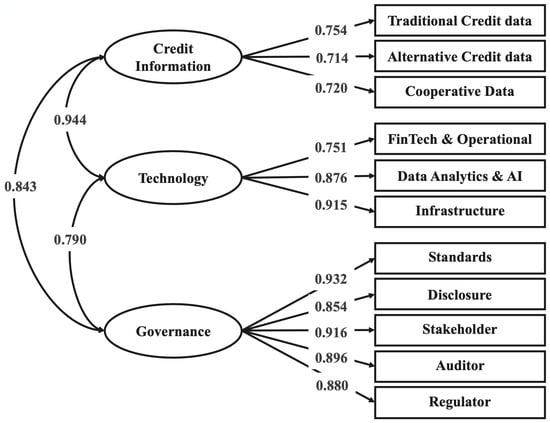
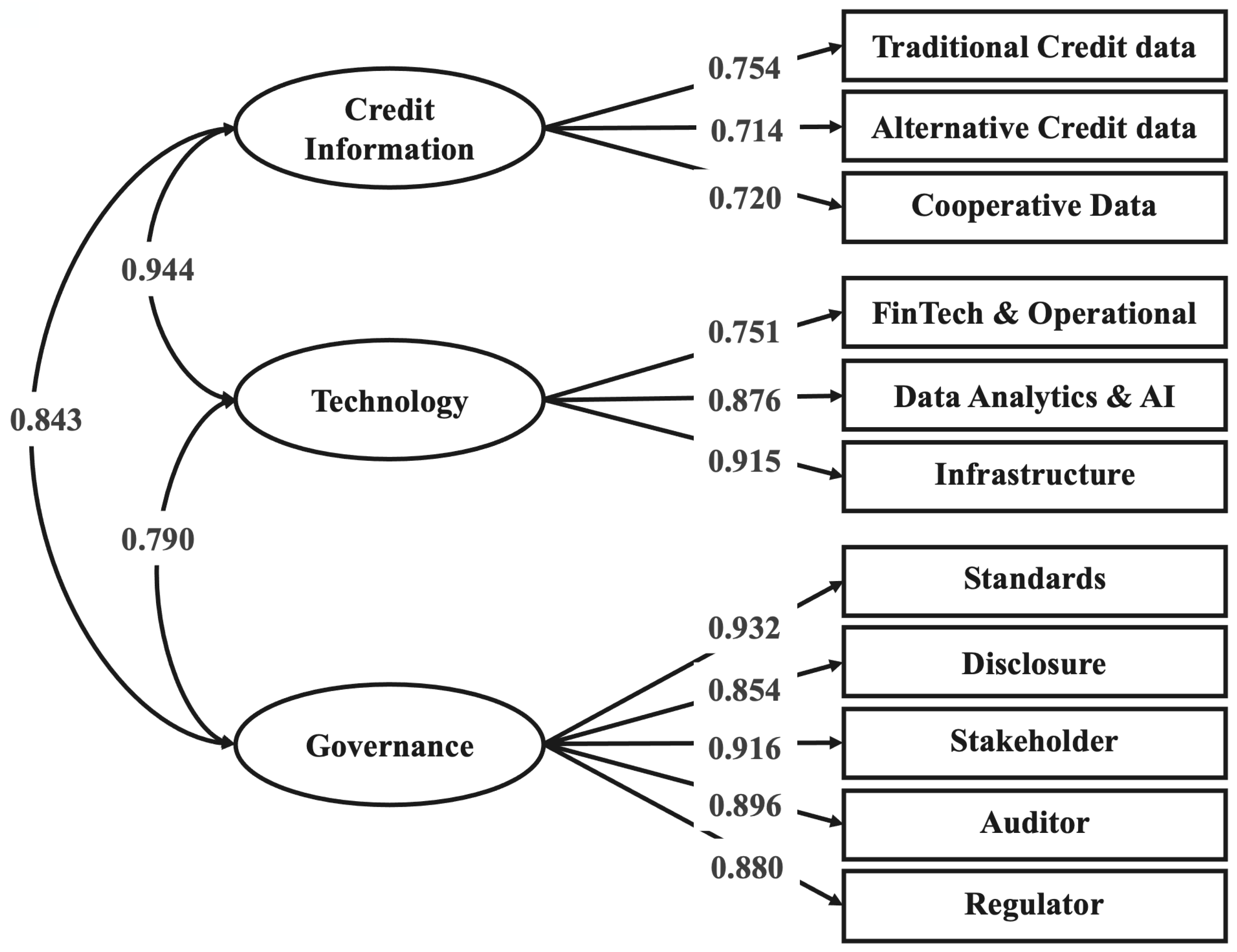
The measurement model was evaluated using first-order Confirmatory Factor Analysis (CFA), as illustrated in Figure 1, to verify the structural integrity, validity, and relationship patterns between the latent constructs and their respective observed indicators. The measurement model demonstrated an excellent fit with the empirical survey data. Specifically, the goodness-of-fit statistics were recorded as follows: χ2 = 32.207, df = 23, p = 0.096. The relative chi-square (χ2/df = 1.400) was well below the conservative threshold of 2.0, indicating excellent fit. Additionally, the baseline fit indices significantly exceeded the standard 0.95 benchmark, with the Goodness of Fit Index (GFI = 0.986), Normed Fit Index (NFI = 0.993), Tucker–Lewis Index (TLI = 0.995), and Comparative Fit Index (CFI = 0.998). The error and residual measures also remained well within the acceptable limits, with the Root Mean Square Error of Approximation (RMSEA = 0.031) and the Root Mean Square Residual (RMR = 0.010) confirming structural alignment.
Figure 1.
First-Order Confirmatory Factor Analysis Model of NCCC Components.
Convergent validity was verified by analyzing the standardized factor loadings and latent construct parameters. As detailed in Table 4, all standardized factor loadings (β) were highly statistically significant at p < 0.001, ranging from 0.731 to 0.935, thereby satisfying the conservative threshold of 0.50. Furthermore, Composite Reliability (CR) and Average Variance Extracted (AVE) values were computed for each latent construct. All constructs achieved CR scores substantially exceeding the recommended 0.70 threshold, and AVE values surpassed the 0.50 benchmark, confirming that the indicators captured more than 50% of the latent variance and verifying convergent validity.
Table 4.
First-Order Confirmatory Factor Analysis Results.
Discriminant validity was systematically assessed using both the Fornell–Larcker criterion and the Heterotrait–Monotrait (HTMT) ratio of correlations (Table 6). All diagonal AVE square roots exceeded the off-diagonal correlation values, and all HTMT ratios remained safely below the conservative threshold of 0.85, confirming that the latent constructs represent statistically distinct dimensions of NCCC effectiveness.
First-order Confirmatory Factor Analysis (CFA) was conducted using maximum likelihood estimation to evaluate the measurement model across the 11 latent first-order sub-constructs. As presented in the rebuilt Master Measurement Table (Table 4), all standardized factor loadings (β) exceeded the recommended 0.70 benchmark (ranging from 0.714 to 0.932), demonstrating strong indicator reliability. Internal consistency was confirmed with Cronbach’s alpha (α) values ranging from 0.812 to 0.959, well above the 0.70 threshold. Furthermore, Composite Reliability (CR) values ranged from 0.854 to 0.958, and Average Variance Extracted (AVE) ranged from 0.528 to 0.803, fully satisfying convergent validity criteria (CR > 0.70, AVE > 0.50) [53].
4.3. Structural Model Evaluation and Hypothesis Testing
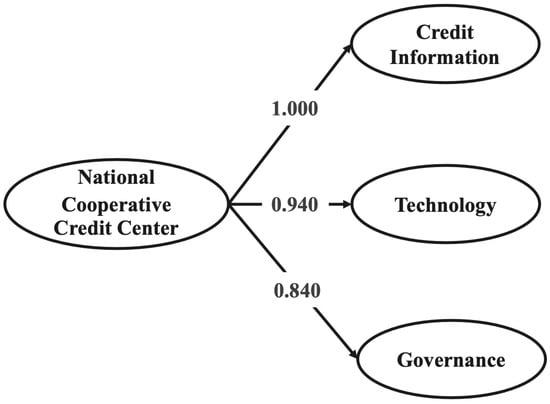
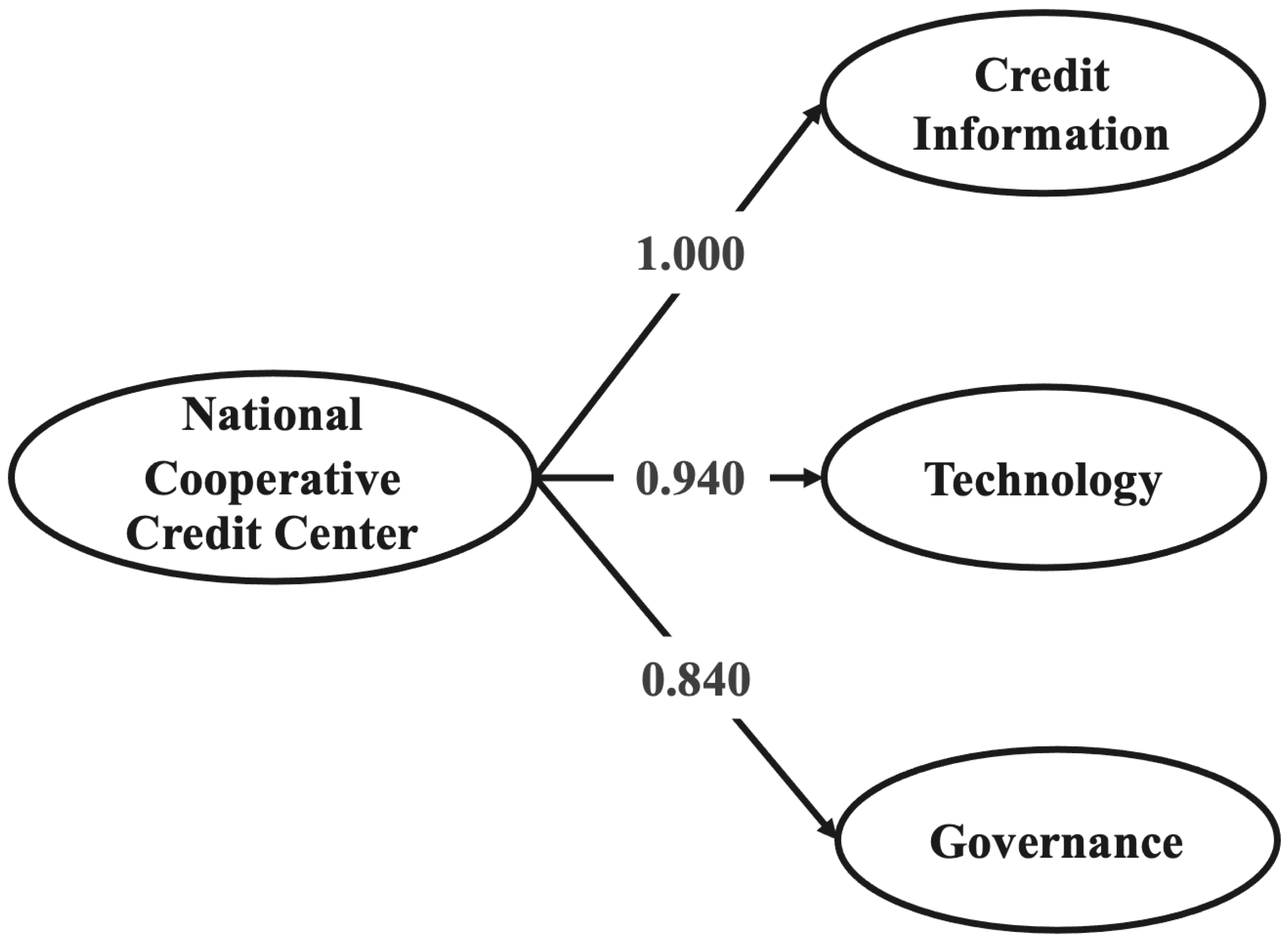
Following measurement verification, a second-order CB-SEM structural model was specified to evaluate overall National Cooperative Credit Center (NCCC) Effectiveness as a higher-order reflective construct. In the initial unconstrained maximum likelihood estimation, Credit Information Integration exhibited a standardized loading of β = 1.004 accompanied by a minor negative error variance (f1 = −0.002, p = 0.890). In structural equation modeling, an empirical loading slightly exceeding unity with a non-significant negative error variance represents a classic minor Heywood case, occurring when a first-order construct aligns almost perfectly with a higher-order factor [54,55]. To address this boundary anomaly rigorously, a Sensitivity Analysis was conducted by imposing an admissibility constraint fixing the residual error variance of f1 to 0.000. Under this constrained model, Credit Information Integration achieved a standardized loading of β = 1.000 (unstandardized b = 0.958, S.E. = 0.064, p < 0.001) and an explained variance of R2 = 1.000. Rather than indicating an immaculate empirical model, this R2 = 1.000 outcome reflects a formal boundary/admissibility constraint resulting from fixing the non-significant residual variance to zero and should be interpreted strictly as an empirical boundary condition. Technological Capacity loaded strongly at β = 0.940 (b = 1.000 reference, p < 0.001, R2 = 0.884), supporting H2, and Institutional Governance loaded at β = 0.840 (b = 0.891, S.E. = 0.062, p < 0.001, R2 = 0.705), supporting H1 (Figure 2; Table 5).
Figure 2.
Second-Order Confirmatory Factor Analysis Model of NCCC Effectiveness.
Importantly, overall model fit statistics for the constrained model (χ2 = 32.207, df = 23, p = 0.096, χ2/df = 1.400, GFI = 0.986, TLI = 0.995, CFI = 0.998, RMSEA = 0.031) remained identical to those of the unconstrained and first-order CFA models. Statistically, this mathematical equivalence occurs because a second-order factor model with exactly three first-order constructs (M = 3) is just-identified at the higher-order structural level (df_structural = 0), possessing exactly 3 structural parameters (three higher-order factor loadings) to account for the 3 estimated first-order factor covariances [49]. Consequently, the higher-order model imposes no additional overidentifying constraints on the sample covariance matrix beyond the first-order CFA specification, preserving identical overall goodness-of-fit parameters. Bias-corrected bootstrap confidence intervals (5000 resamples) verified the structural stability of all parameter estimates at p < 0.001.
Table 5.
Second-Order Confirmatory Factor Analysis Results.
Table 6.
Construct Correlation Matrix, Fornell–Larcker Criterion, and HTMT Ratios for Discriminant Validity.
5. Discussion and Sustainability Implications
The empirical validation of the structural model provides robust, quantitative evidence for the necessity of a “Governance-First Paradigm” in orchestrating centralized financial infrastructures within highly decentralized networks. By analyzing 431 highly stratified responses, this study substantiates that digital integration is fundamentally an institutional and democratic challenge rather than a simple data-engineering task.
5.1. The Primacy of Institutional Governance in Grassroots Finance
The structural equation modeling results reveal that all three dimensions serve as powerful manifestations of National Cooperative Credit Center (NCCC) Effectiveness, with Institutional Governance exhibiting a highly significant reflective loading (β = 0.840, p < 0.001, explaining 70.5% of its structural variance). This statistical dominance supports Hypothesis H1 and carries profound theoretical and practical implications. Within the cooperative sector, which is built on democratic member control, technological interventions cannot succeed in an institutional vacuum. Overcoming socio-institutional distrust and establishing legal interoperability represent structural preconditions that must strictly precede physical IT procurement.
These empirical dynamics demonstrate that sustainability preparedness and resilience in community-based finance are driven primarily by internal governance legitimacy rather than by mere external compliance mandates or raw technology capacity [21]. Attempting to resolve fragmented “islands of information” through rapid software deployment without prior standardization typically amplifies operational risks and compromises member trust [4,5]. As the open innovation literature suggests, collaborative networks are highly vulnerable to system opacity and asymmetrical power structures [4]. The findings of this study confirm that establishing standardized data definitions (Standards), transparent financial disclosures (Disclosure), and active stakeholder engagement (Stakeholders) are not administrative constraints, but are the essential socio-technical bedrocks that unlock technological utility. This outcome aligns with the Human–AI Governance (HAIG) framework, which positions institutional trust as a prerequisite for technological efficacy in complex ecosystems [7].
The empirical findings strongly substantiate the theoretical superiority of the integrated HAIG-TOE-TAM framework over unextended adoption models. The significant reflective loading of Institutional Governance (β = 0.840, R2 = 0.705, p < 0.001) confirms Hypothesis H1, proving that governance is not an administrative overhead but the primary structural antecedent of platform effectiveness. In decentralized cooperative networks, attempts to deploy advanced data analytics (Technological Capacity, β = 0.940) without prior legal, standard, and disclosure frameworks trigger organizational resistance and surveillance fears. By demonstrating that institutional trust precedes technological utility, this study provides empirical validation for HAIG’s trust-utility duality, proving that democratic oversight and standardized protocols serve as the necessary foundation for credit information integration (β = 1.000) in grassroots financial ecosystems.
5.2. Socio-Economic Sustainability and Ethical Financial Inclusion
The strong reflective loading of Credit Information Integration (β = 1.000, p < 0.001), supporting Hypothesis H3, directly connects this digital infrastructure to socioeconomic sustainability and the United Nations Sustainable Development Goals (UN-SDGs). Specifically, the creation of the NCCC addresses:
- SDG 1 (No Poverty) and SDG 10 (Reduced Inequalities): By mitigating credit information asymmetry, the system prevents systemic over-indebtedness while lowering barriers to capital for marginalized, “thin-file” cooperative members.
- SDG 8 (Decent Work and Economic Growth): Fostering institutional stability in a sector representing over 13% of Thailand’s GDP secures the economic livelihood of millions of agricultural and grassroots households [1].
- SDG 16 (Peace, Justice, and Strong Institutions): Enhancing the audit and supervisory capabilities of the Cooperative Auditing Department (CAD) establishes transparent, highly accountable financial institutions [1,9].
However, as cooperatives transition toward data-driven credit risk assessment, the ethical management of this information is paramount. This study advocates for the integration of alternative, cooperative-specific data (such as social capital indicators and transactional history with local cooperatives) as a justifiable proxy for conventional collateral [26,42]. Robust empirical evaluations in international cooperative systems confirm that while aggregate ESG scores often show no statistical link to risk-adjusted performance, the social pillar disclosure (encompassing employee welfare, member benefits, and local training) is the sole dimension that positively and significantly drives risk-adjusted ROA and ROE [37]. Fostering smallholder integration in value chains under structural political constraints is heavily dependent on such collective action to mitigate transaction costs and information asymmetry [56].
Rather than expanding invasive surveillance, this approach quantifies “social collateral” within a secure, democratic framework, enabling inclusive lending practices. Furthermore, to maintain member control, the deployment of advanced predictive analytics must be guided by Explainable AI (XAI) principles [20]. Because consumer resistance and AI mistrust in Thailand are heavily driven by perceived transparency and accountability risks [31], establishing non-financial disclosures is highly critical to legitimize digital platforms and enable socially conscious consumption in e-credit ecosystems [34]. Grassroots credit officers and cooperative members must have the ethical right to receive clear, non-technical explanations regarding automated lending decisions, preventing the algorithmic alienation of democratic communities [32,57].
5.3. A Three-Phase Strategic Policy Roadmap for NCCC Implementation
From a methodological perspective, the statistical behavior of the second-order structural model warrants cautious interpretation. The constrained parameter estimate of β = 1.000 and R2 = 1.000 for Credit Information Integration should not be over-interpreted as evidence of an immaculate empirical model or flawless predictive performance. Rather, in accordance with SEM estimation theory [58], this outcome reflects a formal mathematical boundary condition resulting from the zero-variance admissibility constraint imposed to resolve the unconstrained Heywood case. Furthermore, while the second-order model robustly evaluates the reflective factor hierarchy—confirming the relative structural weights of credit integration, technological capacity, and institutional governance as reflective pillars of NCCC effectiveness—it does not explicitly test directional, longitudinal causal pathways among the first-order constructs themselves (e.g., direct causal mediation from Institutional Governance to Technological Capacity). Future empirical research should employ longitudinal design frameworks or panel SEM to explicitly model directional causal dynamics and cross-lagged spillover effects across successive phases of digital platform deployment.
To translate these empirical findings into sustainable national policy, a complexity-aware, three-phase implementation roadmap is proposed. This sequential strategy ensures that institutional trust is maintained at each step of the digital transformation. Each phase of this transition can be mapped across a multi-layered enterprise architecture (comprising business, application, data, infrastructure, and governance) to optimize business-IT alignment [44].
Phase 1: Standardization and Legal Alignment (The Governance Foundation): Focuses strictly on creating unified data dictionaries, legal frameworks, and regulatory guidelines for cooperative credit data exchange. Legal mechanisms must protect member privacy (complying with Personal Data Protection Acts) and establish clear data sovereignty rules before any centralized database is constructed. This phase directly operationalizes the highest-performing constructs identified in the CFA model: Standards and Regulators. As proven in environmental policy research, combining mandatory information transparency with physical integration guidelines under a unified pilot structure produces the highest long-term compliance efficacy [22].
Phase 2: Decentralized Interoperability and API Integration (The Technological Enabler): Once the legal and standard foundations are established, physical–technological integration can commence (β = 0.940, supporting H2). Rather than building a singular, vulnerable data warehouse, the NCCC should employ a secure, decentralized API gateway architecture. This design preserves the operational autonomy of individual cooperatives while enabling real-time, secure credit queries, mitigating systemic double-borrowing risks. In addition to risk reduction, this structured information sharing framework improves collective ESG efficiency by eliminating unutilized dark data within the networks [6]. To ensure system durability, the orchestrator must design the vertical value-flow channels symmetric to horizontal interactions to prevent system decoupling or parasitic cooperation paradoxes [59].
Phase 3: Ethical Intelligence and Alternative Scoring (The Informational Multiplier): The final phase utilizes the integrated data streams to deploy advanced, responsible credit risk models. Machine learning algorithms, supported by XAI frameworks and alternative data integration (such as crop delivery cycles and social capital metrics), are deployed to provide precise, forward-looking risk assessments, completing the transition to a sustainable, inclusive, and resilient cooperative financial ecosystem.
6. Conclusions
This study evaluates a Governance-First Paradigm for centralized credit data infrastructure within cooperative financial ecosystems. Based on CB-SEM analysis of 431 cooperative decision-makers and regulatory auditors in Thailand, NCCC Effectiveness is represented across three core pillars: Credit Information Integration (β = 1.000, R2 = 1.000 under boundary constraint), Technological Capacity (β = 0.940, R2 = 0.884), and Institutional Governance (β = 0.840, R2 = 0.705). Model fit indices demonstrated good alignment (χ2 = 32.207, df = 23, p = 0.096, CFI = 0.998, RMSEA = 0.031), while multi-group invariance testing (Δχ2 = 2.14, p = 0.343) and collinearity VIF diagnostics (1.42–2.85) indicated minimal concern for common method bias. The findings suggest that digital integration in federated financial networks depends significantly on institutional trust, standardized data governance, and regulatory alignment alongside technical deployment, offering policy insights aligned with SDGs 1, 8, 10, and 16.
6.1. Theoretical and Practical Contributions
This study successfully develops and empirically validates a Governance-First Paradigm for orchestrating centralized credit data infrastructure in cooperative financial ecosystems. Utilizing CB-SEM on data from 431 cooperative decision-makers and regulatory auditors, the research demonstrates that Credit Information Integration (β = 1.000, R2 = 1.000), Technological Capacity (β = 0.940, R2 = 0.884), and Institutional Governance (β = 0.840, R2 = 0.705) jointly form highly cohesive, reflective pillars of overall platform effectiveness. The findings contribute to global sustainability goals (SDGs 1, 8, 10, and 16) by offering a scalable roadmap to eliminate financial information silos and strengthen rural socio-economic resilience.
Practically, this study offered policymakers and cooperative regulators a clear, three-phase implementation roadmap. It demonstrated that establishing standardized data definitions, robust legal frameworks, and secure decentralized API gateway architectures can effectively mitigate the systemic risks of double-borrowing and asymmetric credit information, thereby securing the financial stability of over 9000 cooperatives representing more than 13% of Thailand’s national GDP [1].
6.2. Limitations and Directions for Future Research
Despite the robust statistical validation and theoretical contributions, several limitations must be acknowledged. First, this study relied on a cross-sectional dataset collected within Thailand’s cooperative sector. While the sample size (n = 431) was highly stratified and representative, a longitudinal research design in future studies could capture the dynamic, long-term evolution of trust and system compliance as the NCCC transition progresses. Second, while the proposed model focused on covariance-based structural modeling to test the second-order hierarchical relationships, future research could employ mixed-methods approaches or qualitative case studies to explore the micro-level behavioral resistance of individual cooperative staff during the implementation phase.
Furthermore, as the NCCC platform transitions into operational reality, future technical investigations should focus on the algorithmic development of inclusive credit scoring engines. Specifically, empirical research is needed to pilot-test the integration of agricultural and socio-economic alternative data—such as crop delivery cycles, cooperative member participation rates, and local social capital metrics—as quantifiable proxies for traditional financial collateral. Finally, the practical deployment of automated credit decisions must be accompanied by the development of lightweight Explainable AI (XAI) frameworks, ensuring that grassroots officers and cooperative members retain the democratic right to transparent, understandable, and ethically accountable financial credit assessments.
Author Contributions
Conceptualization, T.K.; methodology, T.K.; software, T.K.; validation, T.M.; formal analysis, T.K.; investigation, T.K.; resources, T.M.; data curation, T.K.; writing—original draft preparation, T.K.; writing—review and editing, T.M.; visualization, T.K.; supervision, T.M.; project administration, T.M.; funding acquisition, T.M. All authors have read and agreed to the published version of the manuscript.
Funding
This research was supported by the Agricultural Research Development Agency (Public Organization) [grant number HRD6301014]. ARDA is a public government organization under the supervision of the Ministry of Agriculture and Cooperatives of Thailand.
Institutional Review Board Statement
The study was conducted in accordance with the Declaration of Helsinki, and approved by the Mahidol University Central Institutional Review Board (MU-CIRB) (Protocol Number: MU-CIRB 2023/326.1910; Date of Approval: 1 December 2023).
Informed Consent Statement
Informed consent was obtained from all subjects involved in the study prior to completing the online survey.
Data Availability Statement
The datasets generated and analyzed during this study are available from the corresponding author on reasonable request due to participant confidentiality and institutional data protection policies.
Acknowledgments
During the preparation of this manuscript, the authors used Gemini in order to improve language readability and assist in graphical abstract conceptualization. The authors reviewed and edited the output and take full responsibility for the content of this publication.
Conflicts of Interest
The authors declare no conflicts of interest. The funders had no role in the design of the study; in the collection, analyses, or interpretation of data; in the writing of the manuscript; or in the decision to publish the results.
Abbreviations
| NCCC | National Cooperative Credit Center |
| CB-SEM | Covariance-Based Structural Equation Modeling |
| CFA | Confirmatory Factor Analysis |
| CVI | Content Validity Index |
| SDG | Sustainable Development Goals |
| AMOS | Analysis of Moment Structures |
References
- Cooperative Auditing Department. Economic Condition of the Thai Cooperative Sector 2025; Technical Report; Ministry of Agriculture and Cooperatives: Bangkok, Thailand, 2025.
- Desrochers, M.; Fischer, K.P. The Power of Networks: Integration and Financial Cooperative Performance. Ann. Public Coop. Econ. 2005, 76, 307–354. [Google Scholar] [CrossRef] [Scilit]
- Laudon, K.; Laudon, J.; Elragal, A. Management Information Systems: Managing the Digital Firm, 13th ed.; Pearson: Boston, MA, USA, 2013. [Google Scholar]
- Yoon, S.; Oh, M. A complexity-aware digital governance conceptual framework for large-SME collaboration in open innovation ecosystems. J. Open Innov. Technol. Mark. Complex. 2026, 12, 100829. [Google Scholar] [CrossRef] [Scilit]
- Jappelli, T.; Pagano, M. Information sharing, lending and defaults: Cross-country evidence. J. Bank. Finance 2002, 26, 2017–2045. [Google Scholar] [CrossRef] [Scilit]
- Pilková, A.; Munk, M.; Benko, V.; Blažeková, P.; Kapusta, J. Pillar 3: Does banking regulation support stakeholders’ interest in banks financial and risk profile? PLoS ONE 2021, 16, e0258449. [Google Scholar] [CrossRef] [Scilit] [PubMed]
- Xie, W.; Wang, P.; Liao, K.; Lin, M.; Zheng, D. Does Government Data Governance Promote Firms’ Technological Catch-Up? Evidence from the Establishment of Big Data Administrations in China. Sustainability 2026, 18, 6526. [Google Scholar] [CrossRef] [Scilit]
- Engin, Z. Human-AI governance (HAIG): A trust-utility approach. J. Responsible Technol. 2026, 26, 100167. [Google Scholar] [CrossRef] [Scilit]
- Balcıoğlu, Y.S.; Çelik, A.A.; Altındağ, E. A turning point in AI: Europe’s human-centric approach to technology regulation. J. Responsible Technol. 2025, 23, 100128. [Google Scholar] [CrossRef] [Scilit]
- Davis, F.D. Perceived Usefulness, Perceived Ease of Use, and User Acceptance of Information Technology. MIS Q. 1989, 13, 319–340. [Google Scholar] [CrossRef] [Scilit] [PubMed]
- Venkatesh, V.; Davis, F.D. A Theoretical Extension of the Technology Acceptance Model: Four Longitudinal Field Studies. Manag. Sci. 2000, 46, 186–204. [Google Scholar] [CrossRef] [Scilit]
- DeLone, W.H.; McLean, E.R. The DeLone and McLean Model of Information Systems Success: A Ten-Year Update. J. Manag. Inf. Syst. 2003, 19, 9–30. [Google Scholar] [CrossRef] [Scilit]
- Navaretti, G.B.; Calzolari, G.; Mansilla-Fernandez, J.M.; Pozzolo, A.F. Fintech and Banking. Friends or Foes? Eur. Econ. Banks Regul. Real Sect. 2017, 2017, 9–30. [Google Scholar]
- Park, J.K.; Ahn, Y.M.; Ha, K.S.; Lee, J.B.; Yoo, G.Y. An AI-Blockchain-Integrated Real Options Framework for Sustainable Infrastructure Investment: Aligning Profitability with ESG and UN SDGs. Sustainability 2026, 18, 4631. [Google Scholar] [CrossRef] [Scilit]
- Chawviang, A.; Kiattisin, S. Sustainable Development: Smart Co-Operative Management Framework. Sustainability 2022, 14, 3641. [Google Scholar] [CrossRef] [Scilit]
- Hari, H.; Sharma, A.; Verma, S.; Chaturvedi, R. Exploring ethical frontiers of artificial intelligence in marketing. J. Responsible Technol. 2025, 21, 100103. [Google Scholar] [CrossRef] [Scilit]
- Helfaya, A.; Bui, P. Pursuing a corporate sustainable identity: Green governance strategy, hybrid vehicle development, knowledge and sustainability performance. J. Innov. Knowl. 2025, 10, 100660. [Google Scholar] [CrossRef] [Scilit]
- Basel Committee. Corporate Governance Principles for Banks; Technical Report; Bank for International Settlements: Basel, Switzerland, 2015. [Google Scholar]
- Hermalin, B.E.; Weisbach, M.S. Transparency and Corporate Governance; NBER Working Paper Series w12875; National Bureau of Economic Research: Cambridge, MA, USA, 2007. [Google Scholar]
- Khedr, A.M.; Jemmali, M.; Imtiyaz, I.; Ramic-Brkic, B. Recent progress in foundations of risk assessment and risk management based deep learning: A comprehensive review. J. Open Innov. Technol. Mark. Complex. 2026, 12, 100827. [Google Scholar] [CrossRef] [Scilit]
- Salazar-Baño, A.; Galarza, S.P.; Fernández, A.; Simbaña-Taipe, L.; Yépez, F. Governance Trust as a Structural Driver of Sustainability Preparedness: A Comparative SEM Analysis in Emerging Market Financial Cooperatives. Sustainability 2026, 18, 5768. [Google Scholar] [CrossRef] [Scilit]
- Gui, T.; Xiao, D.; Chen, J. Synergizing Governance and Technology: How Dual-Pilot Policies Enhance Green Innovation Through Information Transparency. Sustainability 2026, 18, 6566. [Google Scholar] [CrossRef] [Scilit]
- Sumail, L.O.; Oktrivina, A.; Hendryadi; Sunarsih, U. Linking entrepreneurial resilience, financial ambidexterity, and sustainable performance of small enterprises: The role of growth preparedness. J. Open Innov. Technol. Mark. Complex. 2026, 12, 100819. [Google Scholar] [CrossRef] [Scilit]
- Batini, C.; Scannapieco, M. Data Quality: Concepts, Methodologies and Techniques; Springer: Berlin/Heidelberg, Germany, 2006. [Google Scholar] [CrossRef] [Scilit]
- Choi, H. How fairness, accountability, and transparency shape algorithmic legitimacy and continuous usage intention in AI-driven OTA contexts: The moderating role of price sensitivity. J. Open Innov. Technol. Mark. Complex. 2026, 12, 100823. [Google Scholar] [CrossRef] [Scilit]
- Bhuyan, S. The ‘people’ factor in cooperatives: An analysis of members’ attitudes and behavior. Can. J. Agric. Econ. 2007, 55, 275–298. [Google Scholar] [CrossRef] [Scilit]
- Basel Committee. Pillar 3 Disclosure Requirements—Consolidated and Enhanced Framework; Technical Report; Bank for International Settlements: Basel, Switzerland, 2017. [Google Scholar]
- Vaz Ferreira, J. Corporate governance structures in the context of cooperative banking. Corp. Gov. Sustain. 2019, 3, 25–41. [Google Scholar] [CrossRef] [Scilit]
- Viano, C.; Avanzo, S.; Boella, G.; Schifanella, C.; Giorgino, V. Civic Blockchain: Making blockchains accessible for social collaborative economies. J. Responsible Technol. 2023, 15, 100066. [Google Scholar] [CrossRef] [Scilit]
- Cooperative Auditing Department. Annual Report 2024; Technical Report; Ministry of Agriculture and Cooperatives: Bangkok, Thailand, 2024.
- Sungkarungsri, P.; Kiattisin, S. When Advice Isn’t Trusted: Privacy, Transparency, and Accountability Risks Driving AI Mistrust and Consumer Resistance in Financial Advisory Services. Sustainability 2026, 18, 1354. [Google Scholar] [CrossRef] [Scilit]
- Nalbandian, L. Increasing the accountability of automated decision-making systems: An assessment of the automated decision-making system introduced in Canada’s temporary resident visa immigration stream. J. Responsible Technol. 2022, 10, 100023. [Google Scholar] [CrossRef] [Scilit]
- Chakri, P.; Pratap, S.; Lakshay; Gouda, S.K. An exploratory data analysis approach for analyzing financial accounting data using machine learning. Decis. Anal. J. 2023, 7, 100212. [Google Scholar] [CrossRef] [Scilit]
- Herrador-Alcaide, T.; Hernández-Solís, M. Empirical Study Regarding Non-Financial Disclosure for Social Conscious Consumption in the Spanish E-Credit Market. Sustainability 2019, 11, 866. [Google Scholar] [CrossRef] [Scilit]
- Sun, Y.; Liu, L.; Xu, Y.; Zeng, X.; Shi, Y.; Hu, H.; Jiang, J.; Abraham, A. Alternative data in finance and business: Emerging applications and theory analysis. Financ. Innov. 2024, 10, 127. [Google Scholar] [CrossRef] [Scilit]
- Yuliarmi, N.N.; Dunggio, M.; Yasa, I.N.M. Improving public welfare through strengthening social capital and cooperative empowerment. Cogent Bus. Manag. 2020, 7, 1841075. [Google Scholar] [CrossRef] [Scilit]
- Justen, C.F.; Decourt, R.F.; Macagnan, C.B.; Teixeira, B.D.M. Disclosure of Sustainability-Related Information and Risk-Adjusted Financial Performance of Agri-Food Cooperatives. Sustainability 2026, 18, 8606. [Google Scholar] [CrossRef] [Scilit]
- Wang, Z. Artificial Intelligence and Machine Learning in Credit Risk Assessment: Enhancing Accuracy and Ensuring Fairness. Open J. Soc. Sci. 2024, 12, 19–34. [Google Scholar] [CrossRef]
- Yamane, T. Statistics: An Introductory Analysis; Harper and Row: New York, NY, USA, 1967. [Google Scholar]
- Luo, Y.; Salterio, S. Governance Quality in a ‘Comply or Explain’ Governance Disclosure Regime. Corp. Gov. Int. Rev. 2014, 22, 460–481. [Google Scholar] [CrossRef] [Scilit]
- Seddon, P.B. A Respecification and Extension of the DeLone and McLean Model of Information Systems Success. Inf. Syst. Res. 1997, 8, 240–253. [Google Scholar] [CrossRef] [Scilit]
- World Bank. The Use of Alternative Data in Credit Risk Assessment; Technical Report; World Bank Group: Washington, DC, USA, 2024. [Google Scholar]
- Polit, D.F.; Beck, C.T. The content validity index: Are you sure you know what’s being reported? Critique and recommendations. Res. Nurs. Health 2006, 29, 489–497. [Google Scholar] [CrossRef] [Scilit] [PubMed]
- Chawviang, A.; Kiattisin, S.; Thirasakthana, M.; Mayakul, T. A Smart Co-Operative Management Framework Based on an EA Concept for Sustainable Development. Sustainability 2023, 15, 7328. [Google Scholar] [CrossRef] [Scilit]
- Stoffels, M.; Torre, D.M.; Sturgis, P.; Koster, A.S.; Westein, M.P.D.; Kusurkar, R.A. Steps and decisions involved when conducting structural equation modeling (SEM) analysis. Med. Teach. 2023, 45, 1343–1345. [Google Scholar] [CrossRef] [Scilit] [PubMed]
- Anderson, J.C.; Gerbing, D.W. Structural Equation Modeling in Practice: A Review of Recommended Two-Step Approach. Psychol. Bull. 1988, 103, 411–423. [Google Scholar] [CrossRef]
- Nevitt, J.; Hancock, G.R. Performance of bootstrapping approaches to model test statistics and parameter standard errors in covariance structure analysis. Struct. Equ. Model. 2001, 8, 353–377. [Google Scholar] [CrossRef] [Scilit] [PubMed]
- Bollen, K.A.; Stine, R.A. Bootstrapping goodness-of-fit measures in structural equation models. Sociol. Methods Res. 1992, 21, 205–229. [Google Scholar] [CrossRef] [Scilit]
- Byrne, B.M. Structural Equation Modeling with AMOS: Basic Concepts, Applications, and Programming, 3rd ed.; Routledge: London, UK, 2013. [Google Scholar] [CrossRef] [Scilit]
- Beran, T.N.; Violato, C. Structural equation modeling in medical research: A primer. BMC Res. Notes 2010, 3, 267. [Google Scholar] [CrossRef] [Scilit] [PubMed]
- Kock, N. Common method bias in PLS-SEM: A full collinearity assessment approach. Int. J. E-Collab. 2015, 11, 1–10. [Google Scholar]
- Nunnally, J.C. Psychometric Theory, 2nd ed.; McGraw-Hill: New York, NY, USA, 1978. [Google Scholar]
- Hair, J.F.; Risher, J.J.; Sarstedt, M.; Ringle, C.M. When to use and how to report the results of PLS-SEM. Eur. Bus. Rev. 2019, 31, 2–24. [Google Scholar] [CrossRef] [Scilit]
- Chen, F.; Bollen, K.A.; Paxton, P.; Curran, P.J.; Kirby, J.B. Improper solutions in structural equation models: Causes, consequences, and strategies. Sociol. Methods Res. 2001, 29, 468–508. [Google Scholar]
- Kolenikov, S.; Bollen, K.A. Testing negative error variances: Is a Heywood case a symptom of misspecification? Sociol. Methods Res. 2012, 41, 124–167. [Google Scholar]
- Mujahed, I.H.; Khamassi, F. Smallholder Market Integration Under Political Constraints: An Integrative Review of Governance, Transaction Costs, and Resilience in Sustainable Agri-Food Value Chains. Sustainability 2026, 18, 6994. [Google Scholar] [CrossRef] [Scilit]
- Kongthon, A.; Sae-Lim, P. Analyzing climate risk disclosures in the banking sector using transformer models and generative AI. J. Open Innov. Technol. Mark. Complex. 2026, 12, 100815. [Google Scholar] [CrossRef] [Scilit]
- Jöreskog, K.G. How Large Can a Standardized Coefficient Be? Technical Note; Scientific Software International: Lincolnwood, IL, USA, 1999; pp. 1–2. [Google Scholar]
- Li, X.; Liu, P. Value-Flow Symmetry and Sustainability in Digital Innovation Platform Ecosystems: A Heterogeneous-Actor Lotka–Volterra Analysis. Sustainability 2026, 18, 8453. [Google Scholar] [CrossRef] [Scilit]

Disclaimer/Publisher’s Note: The statements, opinions and data contained in all publications are solely those of the individual author(s) and contributor(s) and not of MDPI and/or the editor(s). MDPI and/or the editor(s) disclaim responsibility for any injury to people or property resulting from any ideas, methods, instructions or products referred to in the content. |
© 2026 by the authors. Licensee MDPI, Basel, Switzerland. This article is an open access article distributed under the terms and conditions of the Creative Commons Attribution (CC BY) license.