


Abstract
Rebuilding social trust and promoting sustainable consumption have emerged as significant research topics. Thus, this study investigates the associations between perceived corporate social responsibility (CSR) and consumer confidence (CC) at both the personal and national levels. It also explores the moderating role of self-efficacy in the relationship between perceived CSR and consumer confidence. Drawing on survey data from 207 university students in Eastern China, the findings indicate that perceived CSR is positively associated with both personal consumer confidence (PCC) and national consumer confidence (NCC). In addition, self-efficacy positively moderates the relationships between perceived CSR and consumer confidence. That is, the positive associations between perceived CSR and consumer confidence are stronger among consumers with higher self-efficacy. These findings provide theoretical and practical implications for understanding the relationships among perceived CSR, consumer confidence, and market prosperity.
1. Introduction
Since the outbreak of COVID-19, the global economy has faced substantial pressure from slowing economic growth, rising geopolitical risks, and increasing international trade frictions. These challenges have heightened consumers’ concerns about income stability and the overall economic outlook, leading consumers to adopt more cautious spending behaviors. During this period, household savings increased, while spending on non-essential goods and services declined. China provides a notable example. According to data from the World Bank and the International Monetary Fund, China’s total savings reached USD 7.76 trillion in 2023, and its national savings rate was 44.3%, placing it among the highest in the world. If consumer confidence (CC) remains low, consumer demand may weaken further, thereby slowing economic recovery. Therefore, rebuilding consumer confidence and stimulating market demand have become important issues for both academia and industry.
Corporate social responsibility (CSR) has evolved from a moral obligation into an important component of corporate sustainability strategies. Existing studies have shown that CSR is linked to favorable consumer responses [1]. Most research has focused on outcomes related to firms and brands. These studies show that CSR can enhance consumer trust [2], foster emotional bonds [3], and strengthen consumer–brand relationships [4]. These findings indicate that CSR plays an important role in consumers’ evaluations of firms and brands. However, limited research has examined whether consumers also incorporate information about firms’ socially responsible practices into their assessments of economic conditions.
Recent research provides some support for examining this possibility. Existing studies have linked CSR to regional economic development [5], sustainable social performance [6], and public welfare [7]. For example, Wu et al. [8] suggested that CSR can support regional economic growth by promoting innovation and creating employment opportunities. These findings suggest that the implications of CSR may extend beyond individual firms. However, evidence of social and economic implications does not establish whether consumers recognize these effects. It also remains unclear whether consumers take such information into account when evaluating economic conditions. Thus, an important question remains: do consumers view CSR only as information about a single firm, or do they also consider it when evaluating economic conditions?
Consumer confidence provides an important perspective for examining this issue. Unlike firm-specific attitudes and evaluations, consumer confidence reflects individuals’ subjective evaluations of their current and future financial situations as well as their perceptions of the overall economic climate [9]. Examining consumer confidence therefore allows CSR research to move beyond its traditional focus on firm- and brand-level outcomes. It also allows researchers to examine whether perceived CSR is positively associated with consumers’ perceptions of economic conditions. Accordingly, this study examines the associations between perceived CSR and consumer confidence at both the personal and national levels.
Notably, consumers may differ in how they understand and respond to the same CSR information. Self-efficacy may be an important factor associated with these differences. Self-efficacy refers to individuals’ beliefs about their ability to perform tasks and cope with challenges, which can influence how they interpret situations, respond to uncertainty, and anticipate future outcomes [10]. Although existing studies have examined the relationship between self-efficacy and individual cognition and behavior, less attention has been paid to the role of self-efficacy in consumers’ processing of CSR-related information. CSR activities can provide information about corporate actions and their social and economic implications, but consumers may differ in how they interpret and evaluate this information. These differences may be reflected in consumers’ assessments of national and personal economic conditions. Accordingly, this study further examines whether self-efficacy moderates the relationship between perceived CSR and consumer confidence.
This study makes three theoretical contributions. First, this study extends the theoretical boundary of CSR research by conceptualizing CSR as a source of economic information rather than merely a firm- or brand-level signal. Specifically, CSR practices can provide cues about corporate stability, employment, and future development, which consumers may use to form broader judgments about economic conditions and their own financial prospects at the individual level. Second, this study identifies self-efficacy as an important boundary condition in the relationship between perceived CSR and consumer confidence. Drawing on social cognitive theory, the study suggests that individual differences in self-efficacy may be associated with how consumers interpret and evaluate CSR-related information. Consumers with higher self-efficacy may be more inclined to consider the broader implications of CSR practices when forming future-oriented judgments. This perspective helps explain why identical CSR practices are associated with heterogeneous confidence responses among consumers. Third, this study develops an integrated theoretical framework for understanding the association between perceived CSR and consumer confidence by combining signaling theory, cognitive appraisal theory, and social cognitive theory. Signaling theory explains how consumers obtain information about firms, particularly aspects that are not directly observable, through observable CSR practices. Cognitive appraisal theory provides a perspective on how consumers evaluate such information when forming expectations about their personal financial situations and broader economic conditions. Social cognitive theory further explains why consumers’ interpretations and evaluations may vary according to individual differences in self-efficacy. Together, these perspectives provide a theoretical framework for understanding the positive associations between perceived CSR and both national and personal consumer confidence, as well as the moderating role of self-efficacy. The proposed framework offers a theoretical interpretation of these associations rather than a direct test of the underlying psychological processes.
2. Literature Review and Research Hypotheses
2.1. The Relationship Between Perceived Corporate Social Responsibility and Consumer Confidence
The modern concept of corporate social responsibility (CSR) can be traced to the work of Howard R. Bowen in 1953, who emphasized that businesspeople’s decisions and actions should be consistent with the objectives and values of society [11]. Since then, CSR has evolved from basic societal obligations to broader responsibilities toward multiple stakeholders, such as consumers, employees, the environment, and communities [12,13]. Moreover, CSR has been regarded as an effective approach to building corporate reputation, enhancing competitiveness, and achieving sustainable growth [14]. Nowadays, CSR has become a core element of business strategy, reflecting both a proactive response to external expectations and a deliberate alignment with long-term development goals [15]. Against this backdrop, the strategic implementation of CSR as a means of guiding corporate behavior, shaping public perceptions, and fostering social trust has become a critical research concern.
Consumer confidence is commonly operationalized as a macro-level economic index (e.g., the consumer confidence index, CCI), which reflects both individuals’ expectations about their personal financial future and the public’s overall perceptions of the economic climate [16]. Consistent with this conceptualization, this study treats consumer confidence as an individual-level perception, rather than as an indicator of objective macroeconomic conditions. Previous research has shown that the level of consumer confidence is positively related to consumption behavior. When consumer confidence rises, individuals tend to increase their spending; conversely, when consumer confidence decreases, they are more likely to engage in precautionary saving in anticipation of potential economic uncertainty [17]. Fluctuations in consumer confidence are closely associated with individuals’ spending decisions, which are in turn associated with variations in aggregate demand.
In this study, we conceptualize consumer confidence as consumers’ subjective evaluation of their current and future financial situations as well as their perceptions of the overall economic climate. This perspective extends research using aggregate consumer confidence indices by focusing on the psychological processes underlying variations in consumer confidence. Drawing on the framework proposed by Hampson et al. [16], this study conceptualizes consumer confidence (CC) as comprising two components: personal consumer confidence and national consumer confidence. PCC refers to individuals’ evaluations of their own financial circumstances, including expectations about income, spending capacity, and employment stability. These evaluations encompass judgments about whether household finances are likely to improve or deteriorate, as well as expectations regarding future financial conditions and the ability to maintain household consumption [18]. In contrast, NCC refers to individuals’ evaluations of current and future national economic conditions, including inflation, economic growth, and the labor market. These evaluations encompass perceptions of overall economic performance and employment conditions, as well as expectations regarding price developments and the future direction of the national economy [19].
The relationship between CSR and CC can be understood through several theories. From the perspective of signaling theory [20], CSR can serve as a positive signal that may reduce perceived uncertainty and help consumers form more favorable expectations about future consumption. Consumers often have limited access to information about economic conditions and future prospects. They therefore rely on observable actions by economic actors to form judgments about underlying conditions. CSR practices, including employee support, environmental investment, and social contributions, reflect firms’ continued involvement in economic and social activities. As firms are important participants in economic systems, their activities are closely connected with employment, investment, innovation, and social development. Accordingly, CSR practices may provide consumers with information that they consider when forming perceptions of broader economic conditions and future prospects.
Second, cognitive appraisal theory complements the signaling perspective by offering a theoretical account of how consumers may interpret external CSR signals and form subjective judgments. According to Lazarus’s cognitive appraisal theory [21], individuals’ responses to external events depend on their evaluations of the significance and implications of those events. From this perspective, consumers may interpret and evaluate CSR signals based on their personal cognitive experiences and value judgments, which may lead to heterogeneous perceptions of CSR practices. Such subjective appraisals may involve evaluating whether firms’ CSR activities are associated with sustainable business operations, long-term development potential, and the ability to cope with future uncertainty. Scholars have found that consumers evaluate the motives behind CSR initiatives, and distinguish between genuine and self-serving CSR activities (e.g., ref. [22]). When CSR practices are perceived as authentic and substantive, consumers may regard them as meaningful cues regarding firms’ business continuity and future development prospects. Such evaluations are associated with more favorable consumption expectations and stronger consumer confidence.
Moreover, existing research on CSR provides empirical evidence. In the marketplace, CSR initiatives function as strategic signals that demonstrate a firm’s prioritization of long-term value over short-term gains [23]. Thus, CSR can not only help build a responsible and trustworthy brand image [24], but also reflect a firm’s commitment to sustainable development in the marketplace [25]. Empirical evidence suggests that consumers’ perceptions of a firm’s CSR efforts are positively associated with their trust in the brand and their long-term loyalty [26]. Thus, as Ludvigson [9] suggested, consumer trust and loyalty may serve as psychological resources during periods of economic uncertainty and may be associated with stronger consumer confidence. In sum, CSR should be recognized as a source of information associated with consumer trust, future consumption expectations, and consumer confidence, rather than merely as a tool for reputation management.
At the national level, this study proposes that perceived CSR is positively associated with national consumer confidence (NCC), in connection with consumers’ subjective perceptions of national economic conditions. CSR-related information concerning firms’ engagement in employment, innovation, environmental protection, and social development may provide consumers with cues about firms’ economic and social contributions. Consumers may consider such information, alongside other sources of information, when forming subjective evaluations of broader national economic conditions. Consistent with this view, White and Alkandari [27] found that CSR activities undertaken by multinational companies can enhance positive perceptions of national development by demonstrating firms’ contributions to social progress. Thus, perceived CSR may extend beyond firm-level evaluations and be positively associated with consumers’ assessments of national economic conditions. These assessments may also be associated with consumers’ expectations about the country’s future economic prospects, which are central to NCC. De Boef and Kellstedt [28] found that favorable economic evaluations are associated with more positive consumer sentiment, suggesting that favorable perceptions of the broader economic environment correlate with higher levels of national economy confidence. Accordingly, perceived CSR may be positively associated with NCC in the context of consumers’ evaluations of national economic conditions and expectations about future economic prospects.
H1a.
Perceived corporate social responsibility is positively correlated with national consumer confidence.
At the personal level, CSR practices may provide consumers with information relevant to their own future financial circumstances. Corporate practices such as maintaining employment, providing fair compensation, and engaging in sustainable operations may convey information about firms’ business conditions and their commitment to employees and sustainable development. Consumers may consider such information when forming expectations about their future employment, income, and financial security. Wang et al. [29] found that CSR can reduce consumption-related uncertainty arising from information asymmetry by lowering consumers’ costs of obtaining and evaluating information. Hampson [16] further emphasized that consumer confidence is closely associated with individuals’ expectations regarding their future financial circumstances. When CSR practices are perceived as signals of firms’ employment and operational stability, consumers may develop more favorable expectations about their future income and financial security. Such expectations are linked to greater confidence in their ability to maintain or expand future consumption, a key component of personal consumer confidence. Therefore, perceived CSR may be positively associated with personal consumer confidence, in relation to more optimistic evaluations of future financial circumstances and consumption capacity.
H1b.
Perceived corporate social responsibility is positively correlated with personal consumer confidence.
2.2. The Moderating Role of Self-Efficacy in the Relationship Between Perceived Corporate Social Responsibility and Consumer Confidence
Social cognitive theory emphasizes that individuals do not respond to environmental information uniformly. Rather, their responses depend on the interplay between external circumstances and individual cognitive characteristics and psychological states [30]. Accordingly, differences in individuals’ cognitive orientations can shape how they attend to, interpret, and evaluate the same external information. Drawing on this framework, this study introduces self-efficacy, a core individual cognitive factor, as a moderator of the relationship between perceived CSR and consumer confidence. Self-efficacy, introduced by Albert Bandura [31], refers to individuals’ beliefs about their capability to execute actions required to achieve desired outcomes. These beliefs influence whether individuals engage in coping actions, the amount of effort they exert, and the persistence they demonstrate when facing obstacles or setbacks. Bandura [10] further expanded this concept by describing self-efficacy as individuals’ perceptions of their capacity to control specific behaviors or achieve certain outcomes through planned actions. In short, self-efficacy reflects individuals’ beliefs about their capabilities to perform tasks and achieve desired outcomes. Self-efficacy develops through direct personal experiences and vicarious observations of others’ behaviors.
These differences in cognitive orientation are associated with variations in how individuals interpret and evaluate CSR-related information when forming consumer confidence (CC). Consumers with high self-efficacy generally have greater confidence in their ability to understand information and make judgments [32]. Previous research has found a positive association between self-efficacy and the perceived credibility of CSR messages [33]. Consumers who perceive CSR information as authentic also tend to evaluate the companies communicating it more favorably [34]. Building on these findings, consumers with high self-efficacy may be more inclined to examine CSR-related information and attend to indications of operational stability, organizational capabilities, and long-term development potential conveyed by firms’ CSR practices. These indications may also inform consumers’ assessments of firms’ future prospects. At the personal level, such information is associated with expectations concerning future employment, income, and financial security; at the national level, such information may serve as an additional cue for consumers when evaluating national economic condition and future economic prospects. Thus, individuals with higher self-efficacy may be more inclined to consider the broader and longer-term implications of CSR practices for both their personal economic expectations and their perceptions of national economic conditions.
By contrast, low self-efficacy may be associated with a more cautious cognitive orientation when individuals encounter complex or uncertain corporate actions. As shown in prior studies, individuals with less confidence in their ability to understand complex information and cope with uncertain situations tend to pay greater attention to uncertainty and potential risks, while being less inclined to consider the potential implications of current information for future outcomes [35,36]. In the context of CSR, this orientation may be associated with a lower tendency to interpret firms’ sustained CSR engagement as an indication of their operational stability and long-term development potential, or to consider the broader implications of such firm-level information beyond the immediate corporate context. Consequently, CSR-related information may be considered more in relation to firms’ current behavior than to broader expectations about future economic conditions. Given that both personal and national consumer confidence involve judgments about future economic conditions, a weaker tendency to make such future-oriented inferences may correspond to a weaker association between perceived CSR and both dimensions of consumer confidence.
In summary, self-efficacy is associated with heterogeneous patterns in the relationship between CSR initiatives and CC. Individuals with high self-efficacy show a stronger positive association between perceived CSR and their consumer confidence, whereas individuals with low self-efficacy exhibit weaker positive associations with such initiatives. Given that CC comprises both personal and national components, the following hypothesis is proposed:
H2a.
Self-efficacy positively moderates the relationship between perceived CSR and national consumer confidence.
H2b.
Self-efficacy positively moderates the relationship between perceived CSR and personal consumer confidence.
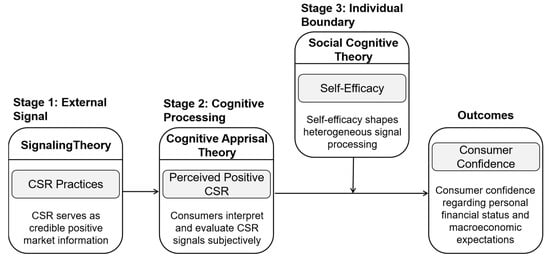
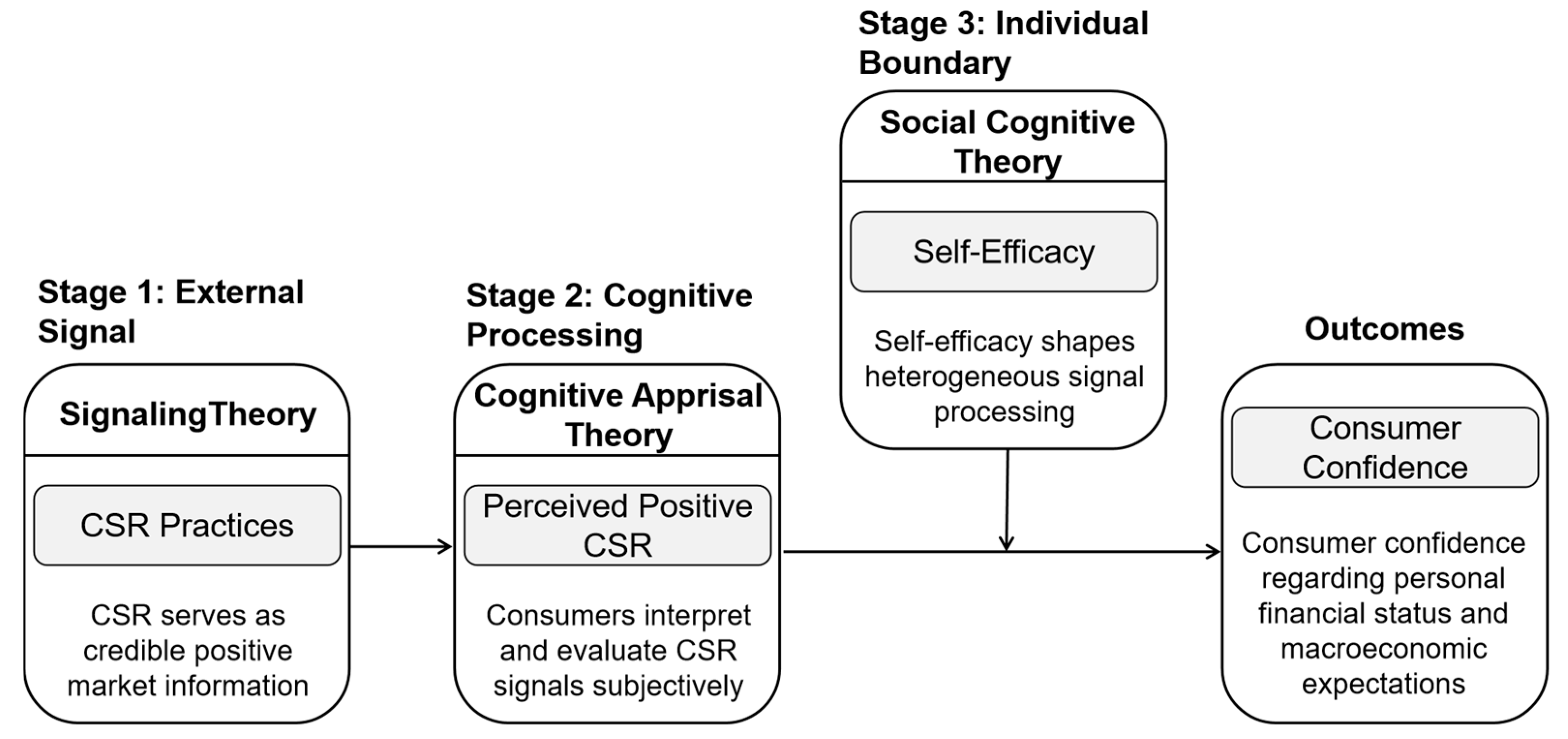
Based on the above theoretical arguments and hypotheses, the theoretical framework of this study is presented in Figure 1.
Figure 1.
Theoretical Framework. Note: This framework integrates three complementary theories to provide a theoretical account of the proposed associations and the moderating role of self-efficacy. Signaling theory underpins the validity of external CSR signals; cognitive appraisal theory clarifies the subjective cognitive transformation from objective CSR practices to individual perceived CSR; social cognitive theory explains the heterogeneous processing differences induced by self-efficacy, which shapes the boundary condition of the main effect.
3. Methodology
3.1. Study Design
This study employs a scenario-based cross-sectional survey. Key constructs, including perceived CSR, self-efficacy, and consumer confidence, are subjective psychological attributes that cannot be directly observed through objective data. This approach presents consistent CSR information to all respondents while capturing participants’ cognitive and psychological responses.
This study adopts a fixed presentation sequence: participants view CSR information before responding to measures of the psychological and outcome variables. This design helps to capture relational patterns and provides tentative evidence for the hypothesized associations.
Moreover, the pretest includes a manipulation check to verify the effectiveness of the scenario materials and does not test hypotheses. All research hypotheses are examined in the main survey.
3.2. Scenario Materials
The scenario was constructed using a two-paragraph reading passage. The first paragraph primarily described the impending opening of a supermarket named “Voice of Nature”, accompanied by a concise overview of the firm. Specifically, Voice of Nature is a small-scale regional supermarket chain that has decided to relocate its headquarters to Hefei City after operating in other provinces and cities for several years. The supermarket specializes in an array of daily necessities, leisure snacks, and agricultural by-products, including fresh produce, meats, dairy products, and so on. In addition, the supermarket chain also offers delivery services to its customers.
Notably, “Voice of Nature” is a fictional firm, which was chosen to control respondents’ pre-existing preferences for real-world companies and generalize the results. The supermarket was selected due to its familiarity among individuals. To eliminate potential industry-related interference, we added another familiar industry, such as the sports brand industry. The sports brand is described as an emerging niche regional brand specializing in the design, production and sales of sports equipment such as sports shoes and accessories. The remaining information was kept consistent with the supermarket description. In addition, the name “Voice of Nature”, which implies listening to the voice of nature, was intentionally chosen to serve as a psychological anchor for respondents. Drawing from cognitive psychology, the term “nature” is frequently associated with constructs such as “society”, “humanity”, and “sustainable development”. This naming strategy was employed to provide a foundational context for subsequent elaboration on the CSR initiatives described in the scenario.
The second paragraph of the reading material mainly outlines the CSR initiatives undertaken by Voice of Nature and the honors it has received from third-party organizations to enhance the credibility of the scenario. The main content is as follows: In addition to catering to the demands of faculty and student groups, Voice of Nature actively engages in CSR activities. The firm allocates a portion of its sales revenue to charitable organizations supporting disadvantaged groups and maintains a relief fund for earthquake and disaster response. Given its commitment to CSR, it is worth noting that the firm’s efforts have also been recognized. Recently, Voice of Nature was ranked among the top 100 companies to work for nationwide by an independent third party. The firm officially stated that it aspires to foster a happy environment for its customers, employees, and partners, and that assisting disaster-affected areas and disadvantaged groups is a crucial part of achieving this goal.
3.3. Pretest and Manipulation Check
Before conducting the survey, this study conducted a pretest to examine whether the reading material, especially the content related to CSR, could be correctly recognized and understood by respondents. Specifically, the second paragraph was randomly omitted for some respondents. That is, some respondents received the complete two-paragraph reading materials, while others received only the first paragraph, which contained only the corporate introduction. Respondents were then asked the following question: “Is this firm fulfilling CSR?”. The answer was measured using a 7-point Likert scale ranging from 1 (strongly disagree) to 7 (strongly agree).
This pretest was conducted using the online survey platform Wenjuanxing (www.wjx.cn), and the data were collected through snowball sampling. A total of 98 respondents (22 males and 76 females) participated in the pretest survey. Their ages ranged from 18 to 21 years (M = 19, SD = 0.42). A t-test was conducted to examine whether the ratings differed between respondents who received the reading material containing CSR-related content and those who received only the corporate introduction. As shown in Table 1, a statistically significant difference was found between the two groups, suggesting that the CSR-related content in the reading material was recognized by respondents. Respondents exposed to the CSR-related content reported a higher mean score (M = 5.82) than those who were not exposed to it (M = 4.50), with the difference being statistically significant at the 0.01 level. These results provide evidence that respondents were able to recognize the CSR-related content in the reading material. More detailed results are shown in Table 1.
Table 1.
Manipulation Check
3.4. Procedure and Participants
The questionnaires used for data collection were originally developed in English and subsequently translated into Chinese using back-translation techniques to minimize potential cultural and linguistic discrepancies and ensure semantic equivalence [37]. Following back-translation, the English and Chinese versions were reviewed to identify and resolve any wording discrepancies. The translated questionnaire was then reviewed by several scholars to assess its content validity. In addition, two rounds of focus group discussions were conducted to evaluate the clarity and comprehensibility of the translated items. Based on the feedback from these reviews and discussions, the Chinese questionnaire was finalized before the formal survey.
All participants completed an online questionnaire after being assured that there were no right or wrong answers and that their participation was completely anonymous. The sampling method is convenience sampling, a non-probability sampling strategy selecting subjects based on their accessibility and/or proximity to the study. More than 90% of studies utilized convenience sampling due to its low cost, high efficiency, and ease of implementation [38]. To maximize response rates and collect high-quality data, the survey was administered during college classes. University students were selected as participants because their relatively similar educational and life-stage backgrounds provide a suitable context for examining the association between perceived corporate social responsibility and consumer confidence. Additionally, we emphasize that the main subjects in the scenario were students, aiming to augment respondents’ sense of engagement, and potentially improve overall quality of survey responses.
Before data collection, the researchers contacted the course instructors and obtained their permission to conduct the survey. During class breaks, the researchers visited the classrooms, asked students whether they were willing to participate, and distributed the questionnaire link to those who voluntarily agreed to take part. Students completed the questionnaire online via the link. Participants were recruited from universities in Eastern China, with diverse academic majors including engineering, economics, accounting, investment science, logistics management and so on. The names of the universities were not recorded; therefore, the exact number of universities represented by the respondents was unknown. Participation was voluntary, and no cash rewards, course credit, or other material incentives were offered.
A total of 212 questionnaires were collected. During data quality screening, three questionnaires were excluded: one due to an excessively short completion time and two due to inconsistent responses. Before accessing the questionnaire, participants were required to confirm electronically that they were at least 18 years old. However, two respondents who had passed this initial age screening subsequently reported being 17 years old in the demographic section. To ensure compliance with the age eligibility criterion, these two questionnaires were also excluded.
A final sample of 207 valid questionnaires was retained for subsequent analysis. The participants were 36% male (n = 75), and the average age was 20 years, ranging from 18 to 30 years old. More than 57% were junior students, followed by freshmen (32%). This study also found that the largest proportion of participants reported a monthly household income of RMB 3000–6000 (33%), followed by those reporting an income of RMB 6000–9000 (30%).
3.5. Measurement of Variables and Standardization
In this study, the measurement instrument employed comprises a multi-item scale, which was developed based on prior literature. Firstly, perceived corporate social responsibility (CSR) was operationalized as the perception of the comprehensive CSR initiatives implemented by the fictional firm, “Voice of Nature”. The measurement items were derived from Inoue et al. [39] and Maignan [40], ensuring the validity and reliability of the CSR assessment. Secondly, self-efficacy (SE) was measured using a five-item scale adopted from the existing literature [41]. The five items retained the original substantive meanings, with no substantive changes to their content. Minor linguistic adjustments were made during the Chinese translation to ensure clarity and natural expression while preserving the intended meanings of the original items. An illustrative item is: “If I try enough, I am always able to resolve difficult problems.”
This scale was chosen for its ability to accurately capture the essence of self-efficacy in the context of our study. Perceived CSR and SE were measured with a 7-point Likert scale (e.g., 1 = completely disagreed, and 7 = completely agreed). Thirdly, consumer confidence (CC) was delineated into two distinct dimensions: national consumer confidence and personal consumer confidence. These dimensions were assessed using an 8-item scale developed by Hampson et al. [16], which has demonstrated its applicability in previous research. All items of CC used a 7-point evaluative response scale ranging from 1 = very pessimistic to 7 = very optimistic, with 4 = neutral.
Prior to hypothesis testing, all key constructs (i.e., perceived CSR, SE, NCC, and PCC) were standardized to facilitate comparisons across models and mitigate multicollinearity. Age, gender, and monthly household income were included in the analysis as control variables, given their potential associations with consumer confidence. Gender was treated as a categorical variable and dummy-coded. Age was recorded in years and treated as a continuous variable. Monthly household income was collected in five ordered categories and coded sequentially from 1 to 5, with higher values representing higher income categories. Both age and income were treated as continuous control variables and standardized before analysis.
4. Results
4.1. Common Method Bias and Scenario Scenario-Group Comparison
Common method bias (CMB) typically arises when the same data source or measurement environment is used alongside a consistent methodology. Thus, several procedural approaches were implemented to minimize CMB. First, respondents were guaranteed anonymity, with no identifying information collected. Second, the dependent variable (consumer confidence) was measured before the independent and moderating variables to limit carryover effects. Third, additional construct measures (e.g., perceived risk, corporate attitude) were inserted between the focal constructs to establish psychological separation. Fourth, items were phrased neutrally, and respondents were informed that no answers were right or wrong.
In addition, we conducted two statistical tests to assess the potential influence of CMV. First, the Harman single-factor test was conducted. The findings revealed that the first principal component accounted for 34.94% of the total variance in the unrotated factor matrix, suggesting that CMB is not severe in this dataset. Second, a full collinearity VIF assessment was conducted. Four regression analyses were performed, with each latent construct as the dependent variable and the remaining constructs as independent variables. All VIF values were well below the threshold of 3.3 (ranging from 1.062 to 1.686, mean = 1.295), further indicating that CMB is unlikely to materially distort the observed relationships. However, it should be noted that these statistical screening approaches cannot fully eliminate the possibility of CMB.
As mentioned before, both supermarket and sports brand scenarios were included in the survey. Accordingly, t-tests were conducted to compare the two scenario groups. The results showed no statistically significant mean differences in perceived CSR (p = 0.895), self-efficacy (p = 0.198), national consumer confidence (p = 0.548), or personal consumer confidence (p = 0.092). These findings provide a descriptive comparison of responses across the two scenario groups. The results are presented in Table 2.
Table 2.
The Scenario–Group Comparison.
4.2. Validation of Measures and Correlation Analysis
Preliminary evidence for the measurement structure and internal consistency was provided by exploratory factor analysis (EFA) and Cronbach’s alpha (Table 3). The EFA results indicated a four-factor structure. Specifically, perceived CSR and self-efficacy were each identified as distinct factors, whereas consumer confidence was divided into two factors: national consumer confidence and personal consumer confidence. All four factors exhibited eigenvalues greater than 1.0, with all items loading on their respective factors as expected. The Kaiser–Meyer–Olkin (KMO) measure of sampling adequacy was 0.852 and the Bartlett’s test of sphericity was χ2 = 2699.356 (p < 0.001). Factor loadings (FL) of the measurement items were also examined through EFA, and all FL scores exceeded the acceptable threshold of 0.5. Additionally, Cronbach’s α values, ranging from 0.801 to 0.965, demonstrated good internal consistency across the four factors.
Table 3.
Exploratory factor analysis results and descriptive statistics of values.
To establish convergent validity, discriminant validity, and construct reliability more rigorously, Confirmatory factor analysis (CFA) was employed. The model exhibited mixed fit: χ2(98) = 289.79, χ2/df = 2.96, CFI = 0.928, TLI = 0.912, RMSEA = 0.097 (90% CI [0.085, 0.111]). While CFI, TLI, and χ2/df met commonly accepted thresholds, the RMSEA indicated marginal model fit. Standardized factor loadings across items of each latent construct ranged from 0.554 to 0.944, offering initial evidence for convergent validity. All constructs exhibited composite reliability (CR) ranging from 0.815 to 0.965 and average variance extracted (AVE) ranging from 0.601 to 0.847, further supporting convergent validity.
Correlation analysis was conducted on all study variables, namely perceived corporate social responsibility (CSR), self-efficacy, and consumer confidence, which encompasses both national and personal dimensions. As shown in Table 4, perceived CSR and self-efficacy exhibited positive correlations with both national and personal consumer confidence. Consistent with expectations, a strong association was also observed between national and personal consumer confidence. Furthermore, the highest correlation coefficient was below the 0.65 threshold, suggesting that multicollinearity is not a significant concern [42]. Additionally, the means of these variables all exceeded 4, indicating generally positive perceptions and attitudes among individuals. In conclusion, these variables were significantly correlated with each other, thereby providing a foundation for our subsequent hypothesis testing.
Table 4.
Confirmatory factor analysis results and Pearson correlation coefficients.
4.3. Hypothesis Testing
The associations between perceived CSR and consumer confidence were examined using SPSS 18.0 through hierarchical linear regression analysis. For continuous predictors and outcome variables, the reported coefficients correspond to fully standardized coefficients. Coefficients for binary control variables are estimated with unstandardized dummy coding. Regression diagnostics were performed to assess multicollinearity. The variance inflation factors (VIFs) of all predictors in the regression models were below 1.7, indicating no serious multicollinearity. Influential outliers were also screened, and no influential observations were identified. In level 1, we conducted a regression analysis to evaluate the association between perceived CSR and national consumer confidence (NCC). Control variables (i.e., age, gender and income) were also included to mitigate potential confounding effects. Results in Table 5 showed that age was significantly associated with national consumer confidence, with an observed decline as age increases. More notably, the findings from Model 1 showed that perceived CSR was positively associated with national consumer confidence (Coefficient = 0.24, p < 0.01), lending support to H1a.
Table 5.
Regression results for perceived CSR, SE and NCC.
In level 2, we introduced the moderating variable into the regression analysis. The findings revealed that self-efficacy was positively associated with NCC (coefficient = 0.279, p < 0.01), as well as perceived CSR (coefficient = 0.187, p < 0.01). Proceeding to level 3, we incorporated the interaction term between perceived CSR and self-efficacy into the regression analysis. As shown in Model 3, the interaction term was positively associated with NCC (coefficient = 0.243, p < 0.01), providing further support for H2a. Additionally, our analysis revealed that the inclusion of self-efficacy led to an increase in the adjusted R2, from 0.06 in Model 1 to 0.224 in Model 3. Thus, it is important to consider self-efficacy in understanding the relationship between perceived CSR and NCC. Among the control variables, age was negatively associated with NCC, whereas gender and income showed no statistically significant associations.
To further examine the moderating effects, the PROCESS macro (Version 3.3, Model 1) for SPSS 18.0 was applied. All continuous predictors and outcome variables were standardized before conducting the moderation analysis via the PROCESS macro. The conditional effects were estimated based on standardized variables and reported as simple slopes derived from the moderation model. The confidence intervals (CI) reported were analytical 95% confidence intervals derived from the t-distribution.
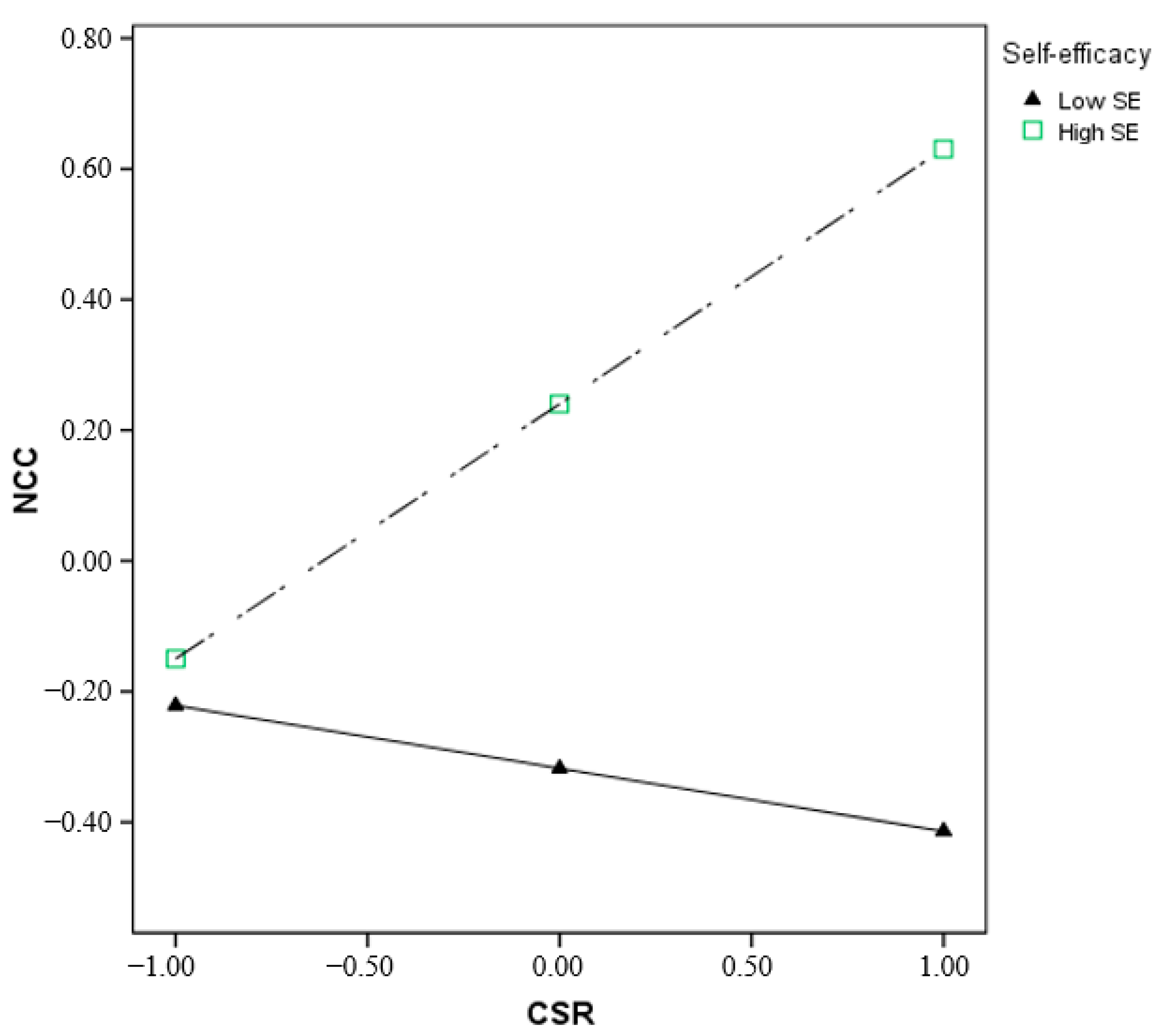
Consistent with the regression outcomes, the interaction remained significant, and control variables yielded identical significance patterns in PROCESS. As presented in Table 6, perceived CSR was significantly associated with NCC when self-efficacy was high (effect = 0.393, p < 0.001, 95% CI [0.243, 0.543]) and at the mean level (effect = 0.149, p < 0.05, 95% CI [0.022, 0.276]), but not when self-efficacy was low (effect = −0.095, p > 0.05, 95% CI [−0.263, 0.073]). The Johnson–Neyman analysis further indicated that the association between perceived CSR and NCC reached statistical significance for standardized self-efficacy values above −0.09, covering 47.83% of observations (an additional significant region was identified for self-efficacy < −1.42, accounting for merely 6.28% of the total sample; given the small proportion of observations within this range, this tail-end result was not interpreted in the main text to avoid over-interpretation). The moderation effect is visualized in Figure 2, showing that the positive association between perceived CSR and NCC is amplified at higher levels of self-efficacy.
Table 6.
The moderating effect of SE in the relationship between perceived CSR and NCC.
Figure 2.
Simple slope plot of the moderating effect of SE in the relationship between perceived CSR and NCC. Notes: perceived CSR = perceived corporate social responsibility; SE = self-efficacy; NCC = national consumer confidence.
In terms of personal consumer confidence, the identical analytical framework was employed in this study. Initially, control variables and perceived CSR were entered at level 1, followed by the introduction of self-efficacy at level 2. Lastly, the interaction term between perceived CSR and self-efficacy was included at level 3. The empirical findings presented in Table 7 provided support for our hypotheses.
Table 7.
Regression results for perceived CSR, SE and PCC.
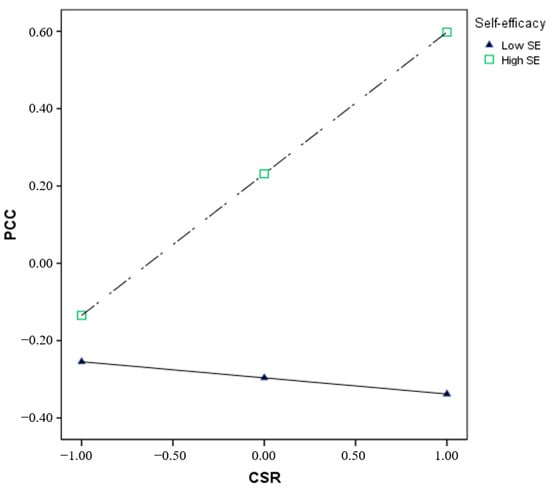
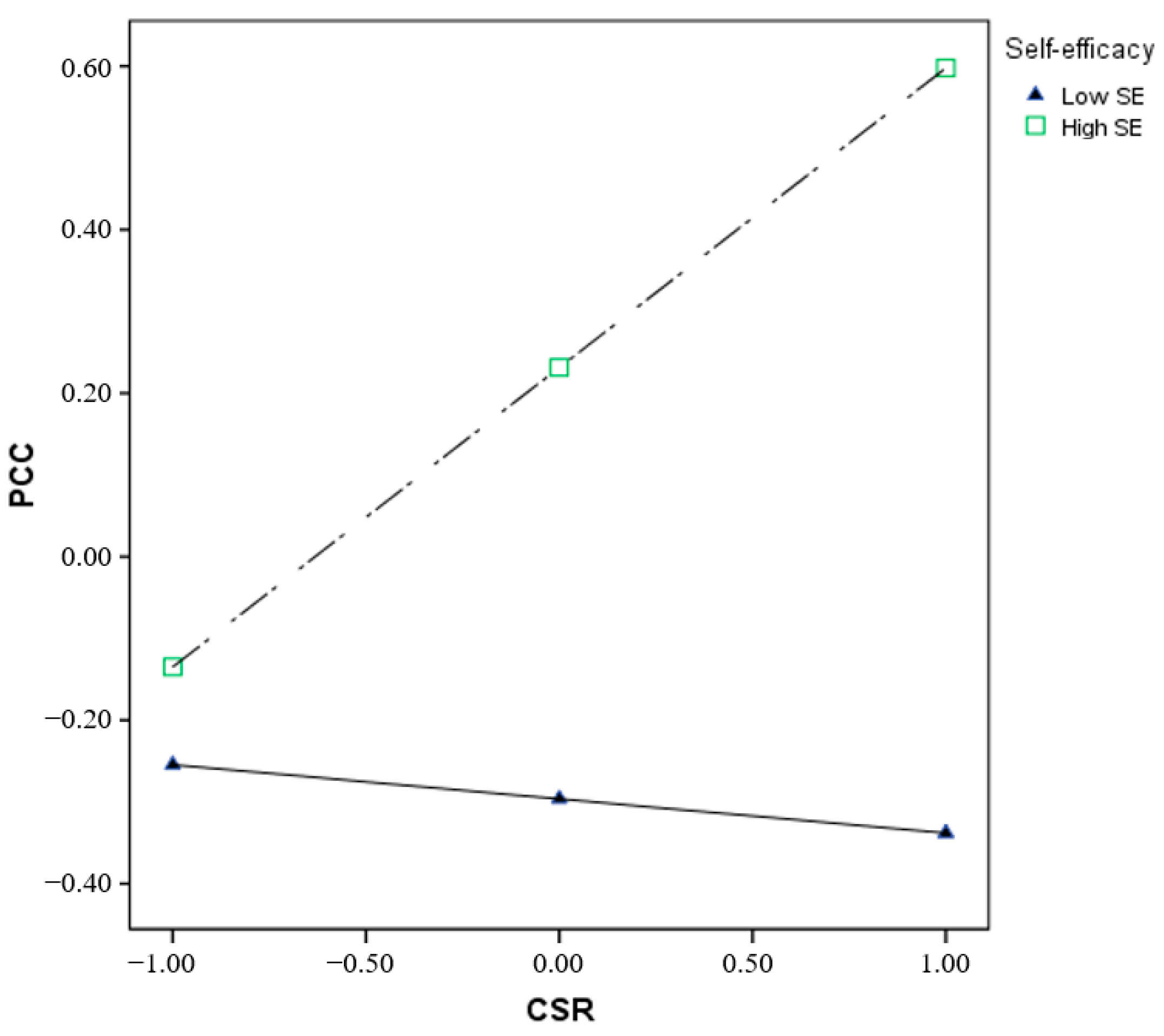
Specifically, Model 1 showed that perceived CSR was positively associated with personal consumer confidence (coefficient = 0.245, p < 0.01), lending support to H1b. Next, Model 2 revealed that self-efficacy was positively associated with personal consumer confidence (coefficient = 0.264, p < 0.01) and with perceived CSR (coefficient = 0.195, p < 0.01). Crucially, Model 3 showed a significant interaction effect between self-efficacy and perceived CSR in relation to personal consumer confidence (coefficient = 0.204, p < 0.01), further supporting H2b. Additionally, age and income were significantly associated with personal consumer confidence, with older individuals and those with lower incomes exhibiting lower levels of personal consumer confidence. Notably, the adjusted R2 increased from 0.128 in Model 1 to 0.256 in Model 3, indicating an improvement in the model’s explanatory power when self-efficacy and its interaction with perceived CSR were taken into account. Among the control variables, age showed a significant negative association with PCC, and income showed a significant positive association, whereas gender was not statistically significant.
Similarly, the PROCESS macro was used to examine the moderation effect. Results showed that the interaction remained significant and control variables yielded identical significance patterns. At a low level of self-efficacy (−1 SD), the conditional association between perceived CSR and PCC was not statistically significant (effect = −0.042, p > 0.05, 95% CI [−0.206, 0.123]). At the mean level, perceived CSR showed a significant positive association with PCC (effect = 0.163, p < 0.05, 95% CI [0.038, 0.287]). This association became stronger at a high level (+1 SD) and remained significant (effect = 0.368, p < 0.001, 95% CI [0.221, 0.515]). The Johnson–Neyman analysis further indicated that the association reached statistical significance for standardized self-efficacy values above −0.18 (58% of observations) (an additional significant region was identified for self-efficacy < −1.94 (covering 2.41% of observations); similarly, this tail-end result was not interpreted in the main text) (Table 8). The moderation effect is visualized in Figure 3, suggesting the importance of enhancing self-efficacy to maximize CSR benefits.
Table 8.
The moderating effect of SE in the relationship between perceived CSR and PCC.
Figure 3.
Simple slope plot of the moderating effect of SE in the relationship between perceived CSR and PCC. Notes: perceived CSR = perceived corporate social responsibility; SE = self-efficacy; PCC = personal consumer confidence.
In addition, residual diagnostics using Cook’s distance were performed to examine influential observations, with the cutoff set to 4/n (4/207 ≈ 0.019). Several observations exceeded this threshold. Supplementary analyses conducted after excluding these observations showed that the moderating effect and the main effect of self-efficacy remained significant and directionally consistent for both NCC and PCC. We also conducted supplementary bootstrap analyses with 5000 bootstrap resamples to obtain bias-corrected 95% bootstrap confidence intervals. The bootstrap results provided further support for the robustness of the moderating effect and the main effect of self-efficacy.
In summary, perceived CSR was positively associated with consumer confidence in both the national and personal dimensions, with self-efficacy moderating these associations. Among control variables, age was negatively associated with both dimensions of consumer confidence, while income was positively associated with personal consumer confidence only. These findings provide further insight into the relationships among perceived CSR, self-efficacy, and consumer confidence.
5. Conclusions and Implications
5.1. Main Conclusions
This study examines the relationship between perceived corporate social responsibility (CSR) and consumer confidence (CC), and identifies several key findings. First, perceived CSR is positively associated with CC at both the national and personal levels. This finding is consistent with prior research documenting the economic and social ramifications of CSR. The extant literature widely recognizes that CSR serves as a long-term strategic signal for firms, helping build credible corporate images and foster higher consumer trust and loyalty [23,24,26]. Such trust-based resources can correlate with stronger consumer confidence under uncertain conditions [9,16]. Building on these prior works, this study extends this line of inquiry. At the national level, firms’ CSR practices may provide consumers with information about the role of businesses in addressing social needs and contributing to economic and social development. This information can serve as a reference for consumers when assessing national economic conditions and future prospects. This interpretation is consistent with the perspective that corporate social activities are linked to public socioeconomic perceptions, as documented in [27]. At the personal level, perceived CSR may be associated with lower perceived information asymmetry and market uncertainty [29], alongside more favorable expectations regarding consumers’ future income and financial security. This interpretation is broadly consistent with the personal financial expectation framework proposed by Hampson [16]. Compared with prior studies, this study extends existing research by showing that perceived CSR is positively associated not only with consumers’ judgments of personal financial prospects but also with their subjective evaluations of national economic conditions, thereby extending the discussion of CSR’s broader socio-psychological associations.
Second, self-efficacy moderates the relationship between perceived CSR and consumer confidence. Individuals with high self-efficacy may be more inclined to attend to external informational cues, consider the potential long-term implications of corporate actions, and relate firm practices to future development. In contrast, individuals with low self-efficacy tend to focus on risks and uncertainties and form more conservative future-oriented inferences from external signals [35,36]. In the context of CSR, consumers with higher self-efficacy may be more inclined to associate CSR activities with corporate strength and potential economic stability, whereas those with lower self-efficacy may be less inclined to consider the potential implications of CSR-related information for future economic conditions. These arguments offer a possible theoretical interpretation of the moderating role of self-efficacy. The conditional effect analyses further illustrate this pattern. Specifically, the associations between perceived CSR and both national and personal consumer confidence were not statistically significant at the reported low level of self-efficacy (−1 SD), but were significantly positive at the mean and high levels. Overall, the positive associations between perceived CSR and consumer confidence differed across levels of self-efficacy, indicating that these associations were not uniformly significant across all levels. These findings contribute to ongoing discussions of heterogeneous consumer responses to CSR. They suggest that the associations between CSR information and consumer confidence may vary across individuals with different psychological characteristics, thereby highlighting the importance of considering individual-level boundary conditions when examining consumer responses to CSR. By examining both personal and national consumer confidence and identifying self-efficacy as a moderating variable, this study extends existing research beyond examining the overall associations between CSR and consumer confidence to consider how these associations vary across individuals.
Notably, income was positively associated with personal consumer confidence but not with national consumer confidence. This suggests that consumers’ assessments of their own financial situation are more closely tied to their actual economic resources, whereas their evaluations of national economic prospects may be shaped more by external information (e.g., media coverage, corporate communications) than by personal wealth. Furthermore, under heightened economic uncertainty or when facing personal unemployment risk, consumers may prioritize immediate financial concerns and pay greater attention to information about employment, income prospects, and overall economic conditions [44]. In addition, skepticism about firms’ motives or the authenticity of their CSR initiatives may undermine the credibility of CSR information [45,46]. These factors may weaken the positive association between perceived CSR and consumer confidence.
5.2. Theoretical Implications
This research advances CSR scholarship by proposing an integrated theoretical framework. By integrating signaling theory, cognitive appraisal theory, and social cognitive theory, the proposed framework provides a theoretical perspective on the informational role of CSR, the possible processes through which consumers interpret and evaluate CSR-related cues, and the variation in the associations between perceived CSR and CC across different self-efficacy levels. This integrated perspective moves beyond the traditional view of CSR as merely a driver of firm performance [47,48] or a reputational tool [49,50], offering a broader theoretical understanding of the relationship between CSR and consumer confidence.
In addition, this study extends prior studies by examining the associations between perceived CSR and both national and personal consumer confidence. Much existing CSR research focuses primarily on brand-related outcomes such as loyalty and brand trust [23,24,25]; by contrast, this study extends the scope of CSR research by showing that perceived CSR is positively associated not only with consumers’ judgments of personal financial prospects but also with their perceptions of national economic conditions. These findings broaden our understanding of the socio-psychological implications of CSR beyond firm- and brand-level outcomes.
The findings provide further insights into how different types of information may be associated with consumer confidence. Previous research by Boukes et al. [18] reported a positive association between positive economic news and overall consumer confidence, with a standardized coefficient of 0.03. Their findings highlight the relevance of information content to consumers’ economic perceptions. Similarly, CSR information may provide consumers with relevant cues about corporate stability and employment prospects, which they may consider when evaluating their personal financial situations and national economic outlook. Taken together, these findings suggest that different forms of information, including economic news and CSR-related information, may be relevant to consumers’ evaluations of economic conditions. This interpretation offers a possible informational perspective for understanding the positive associations between perceived CSR both PCC and NCC.
Moreover, this study identifies self-efficacy as a critical boundary condition in the association between perceived CSR and CC. While existing literature has emphasized corporate factors such as disclosure transparency [51] or corporate motivation [52], our findings highlight the importance of individual differences among consumers. Specifically, responses to perceived CSR vary according to consumers’ psychological profiles. Individuals with high self-efficacy tend to perceive CSR as a positive signal, and this perception is associated with higher levels of consumer. Conversely, consumers with low self-efficacy are more likely to display weaker responses to such signals. Accordingly, the positive association between perceived CSR and consumer confidence weakens for consumers with low self-efficacy. This finding identifies a condition under which perceived CSR may have little or no association with consumer confidence, thereby clarifying the boundary conditions of the hypothesized relationship. By focusing on individual psychological differences, this study highlights self-efficacy as an important moderator of the relationship between perceived CSR and CC.
5.3. Managerial Insights
Drawing on the findings of this study, several managerial implications can be considered. First, CSR activities not only convey firm-specific signals to the market but may also provide information that consumers consider when forming economic evaluations. At the national level, CSR-related information may serve as one of the cues consumers use to evaluate national economic conditions and future prospects, particularly in relation to firms’ business activities and perceived contributions to economic and social development. At the personal level, CSR-related information may provide cues about firms’ employment practices and business stability, which consumers may consider when forming expectations about their future employment, income, and financial security. Therefore, firms may consider incorporating CSR-related information into their consumer communication strategies. Providing clear, accessible, and consistent CSR information may help consumers better understand firms’ responsibility practices and form more informed evaluations.
Second, this study identifies self-efficacy as a key moderating variable, suggesting that the association between perceived CSR and consumer confidence varies across levels of self-efficacy. This finding provides a basis for firms to consider exploring differentiated CSR communication strategies. For consumers with higher self-efficacy, firms could consider provide authentic, long-term, and forward-looking CSR disclosures and examine whether such disclosures are associated with more favorable evaluations of CSR information and personal and national economic conditions. For consumers with lower self-efficacy, firms could explore clearer and more straightforward CSR messages and examine whether these approaches are associated with differences in consumers’ understanding of CSR information and evaluations of its credibility. These suggestions represent potential practical approaches rather than strategies validated by the present study. Their applicability and effectiveness require further investigation.
5.4. Limitations and Future Research
From a methodological perspective, this study adopts a scenario-based survey design, and its cross-sectional nature prevents strict causal inference. Future research could use longitudinal or randomized experimental designs to further examine the robustness of the proposed relationships. In addition, fictitious regional brand scenarios help control for potential contextual factors, yet the results may not fully generalize to real-brand contexts. Future studies may adopt real-brand stimuli and diverse industry settings for further cross-validation. Moreover, the relatively small and homogeneous convenience sample of university students may limit the generalizability of the findings beyond young university consumers. From a theoretical perspective, the relationship between perceived CSR and CC may also vary according to factors such as individual demographic characteristics, behavioral patterns, or prevailing social norms. Future studies could incorporate these factors to further examine the boundary conditions of the relationship between perceived CSR and CC. Notably, the proposed psychological process underlying this relationship was not directly measured in this study. The observed associations between perceived CSR and national consumer confidence represent a theoretical interpretation rather than empirically validated evidence of the proposed psychological process. We have also clarified that the proposed association between perceived CSR and national consumer confidence should be interpreted with caution, given the limited informational basis provided by a brief description of a single fictitious regional company for evaluating broader national economic conditions. Although the findings align with our conceptual reasoning, alternative explanations for these relationships cannot be fully ruled out. For example, general optimism and favorable affect may also provide alternative explanations for the observed relationships and warrant further investigation.
Author Contributions
Conceptualization, Y.F.; methodology, Y.F.; software, Y.F.; validation, Y.F., Y.Z. and H.G.; formal analysis, Y.F.; investigation, Y.F.; resources, Y.F.; data curation, Y.F.; writing—original draft preparation, Y.F., Y.Z. and H.G.; writing—review and editing, Y.F., Y.Z.; visualization, Y.F.; supervision, Y.F.; project administration, Y.F.; funding acquisition, Y.F. All authors have read and agreed to the published version of the manuscript.
Funding
This research was funded by Anhui Provincial Department of Education (Anhui Provincial Quality Improvement Project, grant number 2025cjkc046; Key Humanities and Social Science Research Project of Anhui Universities, grant number 2022AH051769), and Hefei University (Hefei University Quality Improvement Project, grant number 2025hfujyyb04; Hefei University Postgraduate Innovation Research Project, grant number 2024Yxscx26; Hefei University Talent Research Foundation Project, grant number 20RC65).
Institutional Review Board Statement
The study was conducted in accordance with the Declaration of Helsinki. Ethical review and approval were waived for this study by the School of Management internal review panel, Hefei University (internal archival reference number: HFUU20260520), and Article 32 of the Measures for Ethical Review of Life Science and Medical Research Involving Human Participants (2023), which exempts from ethical review research using human information data that does not cause harm to the human body and does not involve sensitive personal information or commercial interests.
Informed Consent Statement
Informed consent was obtained from all subjects involved in the study.
Data Availability Statement
Data can be provided upon request.
Conflicts of Interest
The authors declare no conflicts of interest.
Abbreviations
The following abbreviations are used in this manuscript:
| CSR | Corporate social responsibility |
| PCSR | Perceived corporate social responsibility |
| SE | Self-efficacy |
| CC | Consumer confidence |
| NCC | National consumer confidence |
| PCC | Personal consumer confidence |
Appendix A
Table A1.
Standardized Factor Loadings of Measurement Items.
References
- Sen, S.; Du, S.; Bhattacharya, C.B. Corporate social responsibility: A consumer psychology perspective. Curr. Opin. Psychol. 2016, 10, 70–75. [Google Scholar] [CrossRef] [Scilit]
- Berens, G.; Popma, W.T. Creating Consumer Confidence in CSR Communications. In Communicating Corporate Social Responsibility: Perspectives and Practice; Tench, R., Sun, W., Jones, B., Eds.; Emerald Group Publishing Limited: Bingley, UK, 2014; Volume 6, pp. 383–403. [Google Scholar]
- Pérez, A.; Rodríguez del Bosque, I. An Integrative Framework to Understand How CSR Affects Customer Loyalty through Identification, Emotions and Satisfaction. J. Bus. Ethics 2015, 129, 571–584. [Google Scholar] [CrossRef] [Scilit]
- Dahrouj, R.; Itani, O.S.; Hollebeek, L.D.; Eslami, H.; Kassar, A.-N. Which corporate social responsibility (CSR) approach optimizes customer engagement behavior? The role of customer-brand identification, brand love, and social communication. J. Retail. Consum. Serv. 2025, 84, 104230. [Google Scholar] [CrossRef] [Scilit]
- Guo, L.; Yang, L. The corporate economic influence and corporate social responsibility: Evidence from China. Sustainability 2023, 15, 10694. [Google Scholar] [CrossRef] [Scilit]
- Rehan, M.H.; Yeo, S.F.; Khan, I.U.; Tan, C.L. Redefying the strength between CSR and sustainable social performance through mediational role of green intellectual capital. Clean. Responsible Consum. 2025, 16, 100238. [Google Scholar] [CrossRef] [Scilit]
- Strotmann, H.; Volkert, J.; Schmidt, M. Multinational companies: Can they foster well-being in the eyes of the poor? Results from an empirical case study. Int. J. Corp. Soc. Responsib. 2019, 4, 2. [Google Scholar] [CrossRef] [Scilit]
- Wu, H.; Luo, S.; Li, S.; Xue, Y.; Hao, Y. Fostering urban inclusive green growth: Does corporate social responsibility (CSR) matter? J. Bus. Ethics 2024, 189, 677–698. [Google Scholar] [CrossRef] [Scilit]
- Ludvigson, S.C. Consumer confidence and consumer spending. J. Econ. Perspect. 2004, 18, 29–50. [Google Scholar] [CrossRef] [Scilit]
- Bandura, A. Perceived self-efficacy in cognitive development and functioning. Educ. Psychol. 1993, 28, 117–148. [Google Scholar] [CrossRef] [Scilit] [PubMed]
- Bowen, H.R. Social Responsibilities of the Businessman; Harper & Brothers: New York, NY, USA, 1953. [Google Scholar]
- Lee, M.D.P. A review of the theories of corporate social responsibility: Its evolutionary path and the road ahead. Int. J. Manag. Rev. 2008, 10, 53–73. [Google Scholar] [CrossRef] [Scilit]
- Porter, M.; Kramer, M. Strategy and society: The link between competitive advantage and corporate social responsibility. Harv. Bus. Rev. 2006, 84, 78–92. [Google Scholar] [PubMed]
- Closon, C.; Leys, C.; Hellemans, C. Perceptions of corporate social responsibility, organizational commitment and job satisfaction. Manag. Res. J. Iberoam. Acad. Manag. 2015, 13, 31–54. [Google Scholar] [CrossRef] [Scilit]
- Kim, M.; Kim, B.; Oh, S. Relational benefit on satisfaction and durability in strategic corporate social responsibility. Sustainability 2018, 10, 1104. [Google Scholar] [CrossRef] [Scilit]
- Hampson, D.P.; Gong, S.; Xie, Y. How consumer confidence affects price conscious behavior, The roles of financial vulnerability and locus of control. J. Bus. Res. 2021, 132, 693–704. [Google Scholar] [CrossRef] [Scilit] [PubMed]
- Mynaříková, L.; Pošta, V. The effect of consumer confidence and subjective well-being on consumers’ spending behavior. J. Happiness Stud. 2023, 24, 429–453. [Google Scholar] [CrossRef] [Scilit] [PubMed]
- Boukes, M.; Damstra, A.; Vliegenthart, R. Media effects across time and subject: How news coverage affects two out of four attributes of consumer confidence. Commun. Res. 2021, 48, 454–476. [Google Scholar] [CrossRef] [Scilit]
- Malovaná, S.; Hodula, M.; Frait, J. What does really drive consumer confidence? Soc. Indic. Res. 2021, 155, 885–913. [Google Scholar] [CrossRef] [Scilit] [PubMed]
- Spence, M. Job Market Signaling. In Uncertainty in Economics: Readings and Exercises; Diamond, P., Rothschild, M., Eds.; Academic Press: New York, NY, USA, 1978; pp. 281–306. [Google Scholar]
- Lazarus, R.S. Psychological Stress and the Coping Process; McGraw-Hill: New York, NY, USA, 1966. [Google Scholar]
- Sen, S.; Bhattacharya, C.B. Does doing good always lead to doing better? Consumer reactions to corporate social responsibility. J. Mark. Res. 2001, 38, 225–243. [Google Scholar] [CrossRef] [Scilit]
- Xie, W.F.; Dai, L.T. The double-edged sword of corporate social responsibility: How does value orientation affect consumer choice between CSR and corporate ability. Acta Psychol. 2025, 255, 104915. [Google Scholar] [CrossRef] [Scilit] [PubMed]
- Khan, I.; Fatma, M. CSR influence on brand image and consumer word of mouth: Mediating role of brand trust. Sustainability 2023, 15, 3409. [Google Scholar] [CrossRef] [Scilit]
- Wu, J.; Liew, C.Y. Corporate Social Responsibility Practices, Corporate Sustainable Development, Venture Capital and Corporate Governance: Evidence from Chinese Public Listed Firms. Asian Acad. Manag. J. Account. Finance 2024, 20, 273–303. [Google Scholar] [CrossRef] [Scilit]
- Kraus, S.; Cane, M.; Ribeiro-Soriano, D. Does doing good do well? An investigation into the relationship between consumer buying behavior and CSR. Econ. Res.-Ekon. Istraž. 2022, 35, 584–601. [Google Scholar] [CrossRef] [Scilit]
- White, C.L.; Alkandari, K. The influence of culture and infrastructure on CSR and country image: The case of Kuwait. Public Relat. Rev. 2019, 45, 101783. [Google Scholar] [CrossRef] [Scilit]
- De Boef, S.; Kellstedt, P.M. The political (and economic) origins of consumer confidence. Am. J. Political Sci. 2004, 48, 633–649. [Google Scholar] [CrossRef] [Scilit]
- Wang, Y.; Albitar, K.; Chbib, I. Connecting the dots: A systematic review of corporate social responsibility, information asymmetry, and economic implications. Corp. Soc. Responsib. Environ. Manag. 2024, 31, 5012–5031. [Google Scholar] [CrossRef] [Scilit]
- Bandura, A. Social Foundations of Thought and Action: A Social Cognitive Theory; Prentice-Hall: Englewood Cliffs, NJ, USA, 1986. [Google Scholar]
- Bandura, A. Self-efficacy: Toward a unifying theory of behavioral change. Psychol. Rev. 1977, 84, 191–215. [Google Scholar] [CrossRef] [Scilit] [PubMed]
- Reed, A.E.; Mikels, J.A.; Löckenhoff, C.E. Choosing with confidence: Self-efficacy and preferences for choice. Judgm. Decis. Mak. 2012, 7, 173–180. [Google Scholar] [CrossRef] [Scilit]
- Chakraborty, S.; Kwon, W.S. What triggers trust in CSR activities? Personal antecedents of CSR message believability and attitudes toward CSR message and the company. Soc. Bus. Rev. 2026, 21, 213–232. [Google Scholar] [CrossRef] [Scilit]
- Joo, S.; Miller, E.G.; Fink, J.S. Consumer evaluations of CSR authenticity: Development and validation of a multidimensional CSR authenticity scale. J. Bus. Res. 2019, 98, 236–249. [Google Scholar] [CrossRef] [Scilit]
- Flemming, D.; Feinkohl, I.; Cress, U.; Kimmerle, J. Individual uncertainty and the uncertainty of science: The impact of perceived conflict and general self-efficacy on the perception of tentativeness and credibility of scientific information. Front. Psychol. 2015, 6, 1859. [Google Scholar] [CrossRef] [Scilit] [PubMed]
- Rimal, R.N. Perceived risk and self-efficacy as motivators: Understanding individuals’ long-term use of health information. J. Commun. 2001, 51, 633–654. [Google Scholar] [CrossRef]
- Brislin, R.W. Back-translation for cross-cultural research. J. Cross-Cult. Psychol. 1970, 1, 185–216. [Google Scholar] [CrossRef] [Scilit]
- Jager, J.; Putnick, D.L.; Bornstein, M.H., II. More Than Just Convenient: The Scientific Merits of Homogeneous Convenience Samples. Monogr. Soc. Res. Child Dev. 2017, 82, 13–30. [Google Scholar] [CrossRef] [Scilit] [PubMed]
- Inoue, Y.; Funk, D.C.; McDonald, H. Predicting behavioral loyalty through corporate social responsibility: The mediating role of involvement and commitment. J. Bus. Res. 2017, 75, 46–56. [Google Scholar] [CrossRef] [Scilit]
- Maignan, I. Consumers’ perceptions of corporate social responsibilities: A cross-cultural comparison. J. Bus. Ethics 2001, 30, 57–72. [Google Scholar] [CrossRef] [Scilit]
- Sung, K.S.; Lee, S. Customer brand co-creation behavior and brand sincerity through CSR interactivity: The role of psychological implications in service-dominant logic. Int. J. Hosp. Manag. 2023, 108, 103388. [Google Scholar] [CrossRef] [Scilit]
- Tabachnick, B.G.; Fidell, L.S.; Ullman, J.B. Using Multivariate Statistics, 6th ed.; Pearson: Boston, MA, USA, 2013. [Google Scholar]
- Fornell, C.; Larcker, D.F. Evaluating Structural Equation Models with Unobservable Variables and Measurement Error. J. Mark. Res. 1981, 18, 39–50. [Google Scholar] [CrossRef] [Scilit]
- Roth, C.; Settele, S.; Wohlfart, J. Risk exposure and acquisition of macroeconomic information. Am. Econ. Rev. Insights 2022, 4, 34–53. [Google Scholar] [CrossRef] [Scilit]
- Alhumud, A.A.; Leonidou, L.C.; Alarfaj, W.; Ioannidis, A. Corporate social responsibility authenticity: Investigating its antecedents and outcomes. J. Bus. Res. 2016, 69, 1242–1249. [Google Scholar] [CrossRef] [Scilit]
- Nguyen, N.; Priporas, C.V.; McPherson, M.; Manyiwa, S. CSR-related consumer scepticism: A review of the literature and future research directions. J. Bus. Res. 2023, 169, 114294. [Google Scholar] [CrossRef] [Scilit]
- Sharma, D.; Chakraborty, S. Corporate social responsibility and financial performance: Does CSR strategic integration matter? Cogent Bus. Manag. 2024, 11, 2392182. [Google Scholar] [CrossRef] [Scilit]
- Li, W.; Yan, T.; Li, Y. Corporate social responsibility and financial performance in a cross-country context: A meta-analysis. J. Bus. Res. 2025, 190, 115218. [Google Scholar] [CrossRef] [Scilit]
- Shahid, S. Shadows of corporate social responsibility: An experimental study on intensity, motives, and legitimacy in organizational reputation. Corp. Soc. Responsib. Environ. Manag. 2025, 32, 3495–3510. [Google Scholar] [CrossRef] [Scilit]
- Yoon, Y.; Gürhan-Canli, Z.; Schwarz, N. The effect of corporate social responsibility (CSR) activities on companies with bad reputations. J. Consum. Psychol. 2006, 16, 377–390. [Google Scholar] [CrossRef] [Scilit] [PubMed]
- Alhumud, A.A.; Leonidou, L.C.; Alarfaj, W.; Ioannidis, A. The impact of digital CSR disclosure on customer trust and Engagement: The moderating role of consumer deontology and law obedience. J. Bus. Res. 2025, 186, 115035. [Google Scholar] [CrossRef] [Scilit]
- Ghanbarpour, T.; Gustafsson, A. How do corporate social responsibility (CSR) and innovativeness increase financial gains? A customer perspective analysis. J. Bus. Res. 2022, 140, 471–481. [Google Scholar] [CrossRef] [Scilit]

Disclaimer/Publisher’s Note: The statements, opinions and data contained in all publications are solely those of the individual author(s) and contributor(s) and not of MDPI and/or the editor(s). MDPI and/or the editor(s) disclaim responsibility for any injury to people or property resulting from any ideas, methods, instructions or products referred to in the content. |
© 2026 by the authors. Licensee MDPI, Basel, Switzerland. This article is an open access article distributed under the terms and conditions of the Creative Commons Attribution (CC BY) license.