


Abstract
This study employs an event study and ESG cross-sectional regressions to analyze the market reaction of Taiwan’s financial industry to stablecoin policies and the virtual-asset custody pilot. The empirical results show that the policy and pilot events have some short-term information effects and positive cumulative abnormal returns that are significant on most days of the event window. The contribution of this study lies in distinguishing among institutional clarification, business participation, and firm value enhancement and, by combining these with an analysis of the ESG pillars, in proposing an interpretation in which market valuation may involve a trade-off between business opportunities and responsibility costs rather than depending solely on policy liberalization or sustainability ratings. Furthermore, financial institutions would do well to commit resources in phases according to actual demand and risk-adjusted profitability, while policy effectiveness should be assessed jointly in terms of asset safety, service resilience, financial accessibility, and environmental outcomes, balancing commercial sustainability and shareholder wealth effects.
1. Introduction
Stablecoins have become a form of private money connecting cryptocurrency markets with the banking system [1,2]. For reserve-backed designs, stability depends on assets held in traditional finance [3]. As regulation expands, banks are drawn in as custodians, prospective issuers, or competitors. The European Union’s Markets in Crypto-Assets Regulation (MiCA) seeks legal certainty [4], Hong Kong’s Stablecoins Ordinance emphasizes reserve custody and trustee duties [5], and the United States adopted the GENIUS Act in 2025 [6]. These developments reflect an emerging international regulatory consensus [7], while the relative roles of stablecoins, tokenized deposits, and central bank digital currencies (CBDCs) remain contested [8,9]. Potential applications in tokenized green bonds and carbon credit settlements, cheaper payments, and broader investment access link stablecoin regulation to sustainable finance and financial inclusion [10,11].
Regulatory announcements matter for bank equities because they shape expectations about new financial activities. Although crypto asset prices respond to regulatory news and enforcement [12,13,14], the implications for banks remain ambiguous. Clearer rules can reduce uncertainty [4] and support custody services [15], while reserve placement rules may return stablecoin funds to banks as deposits [9]. Public digital money may crowd out deposits and raise funding costs [16], with intermediation effects depending on bank market power [17]. Research also examines stablecoin competition and bank deposit funding [18]. The channels through which such rules reach banks correspond to observable bank characteristics: the deposit funding share for reserves returned as deposits, fee income and trust assets for custody services, and the retail customer base for consumer protection duties. Central bank speeches move markets [19], and digital currency communication has been priced into US bank equities [20]. The timing and direction of bank shareholders’ responses therefore remain empirical questions.
Taiwan provides a sequence of stablecoin-related announcements by authorities with different mandates. The Financial Supervisory Commission (FSC) issued guidelines for virtual asset service providers (VASPs) in September 2023 and anti-money-laundering (AML) registration regulations in November 2024. Two days later, it formally launched a virtual-asset custody pilot, with applications accepted from 1 January 2025. In 2025, the FSC published the AML registration list and reported on the draft Virtual Asset Service Act. The Central Bank outlined a two-tier monetary system and wholesale CBDC infrastructure in December 2025. In April 2026, the Executive Yuan approved the draft Act, and the CBC released its CBDC outreach report. The Act subsequently promulgated on 22 July 2026, sets out full reserve and domestic custody rules and prohibits interest payments to holders [21] (Arts. 36–37). This development lies outside the government announcement sample.
Existing studies primarily examine cryptocurrency prices and trading [12,13,14], crypto-linked firms in the United States and Hong Kong [6,22], or bank reactions to communication by a single authority [20]. Less is known about incumbent banks’ responses to sequential announcements by multiple authorities or their relationship with environmental, social, and governance (ESG) profiles. Corporate social responsibility can condition shareholder reactions [23,24], while stablecoin services raise consumer protection and governance issues [25] and blockchain operations raise environmental concerns [26]. Accordingly, this study examines announcement day information effects and cumulative wealth effects, compares reactions across authorities, and explores pilot-related reactions and their association with ESG scores.
Relative to the closest studies, the Taiwanese setting allows us to observe the same incumbent banks responding to stablecoin-related announcements by authorities with different mandates within a single legal system. Tong et al. [6] and Gan [22] examine crypto-related firms and stablecoin-concept stocks around a single piece of legislation, the GENIUS Act and Hong Kong’s Stablecoins Ordinance, respectively; Beckmann et al. [20] study CBDC-related communication and US bank equities; and Bobiceanu et al. [27] show that banks’ stock reactions to prudential policy announcements depend on characteristics of the announcing authority, such as central bank independence. With the same market and legal system and largely the same banks, we compare licensing and supervisory announcements by the competent authority (the FSC) with institutional framework announcements by the CBC and the Executive Yuan between November 2024 and April 2026; because the two groups fall in different periods, the comparison also reflects the progress of the legislation. The study therefore examines bank shareholders’ responses to the sequence of steps that builds a stablecoin regime and, through the custody pilot, the responses of the institutions entering the new business. The cumulative abnormal returns of incumbent banks are significantly positive around both groups of announcements.
Using Taiwan Economic Journal (TEJ) data, we employ a market model event study with generalized autoregressive conditional heteroskedasticity (GARCH) errors to examine 22 listed Taiwanese banks and financial holding companies (FHCs) around four government announcements whose event windows do not overlap. We also analyze two regulatory events that preceded the custody pilot for the same 22 banks, with exploratory cross-sectional regressions relating cumulative abnormal returns (CARs) to ESG scores and to whether a bank is one of the four institutions linked to the pilot. Announcements by the CBC and the Executive Yuan, which concern the institutional framework, draw significantly positive abnormal returns (ARs) on the announcement day and the day after, whereas FSC announcements, which concern licensing and supervision, draw a significantly negative AR the day after; the CARs of both groups are significantly positive on most days of the event window. Around the pilot-related events, the 22 banks also show a significantly positive cumulative reaction on most days of the window. In the cross-sectional regressions, the social pillar has a significantly negative coefficient and the environmental pillar a significantly positive one, whereas the interactions with pilot participation show that the environmental association is significantly more negative for the four pilot institutions and that the negative social association does not hold for them; these interaction coefficients remain significant when any one observation is omitted.
The study contributes by distinguishing information effects from cumulative wealth effects and examining reactions across authorities and pilot institutions. The authority comparison complements research on prudential announcements [27], while the pilot analysis complements regulatory sandbox research focused on young fintech firms [28]. The exploratory ESG associations also connect prior findings on social responsibility and shareholder reactions [23] to banks’ entry into virtual-asset services. The findings inform how authorities coordinate policy, licensing, and supervisory communication, how pilot institutions phase their investment, and how stablecoin regulation measures social outcomes such as asset safety and financial accessibility. Section 2 reviews the literature; Section 3 presents the events, sample, and models; Section 4 reports the results; and Section 5 discusses the findings and concludes.
2. Literature Review
2.1. Institutional Characteristics and Market Functions of Stablecoins
Stablecoins are designed to provide a stable unit of account, medium of exchange, and liquid store of value. They are typically backed by fiat currencies, short-term bonds, or other low-risk assets and maintain their pegs through issuance and redemption mechanisms. Lyons and Viswanath-Natraj [2] emphasize that stability depends on effective arbitrage, accessible issuance and redemption channels, and confidence in the peg. These arrangements support transaction liquidity and can reduce currency conversion risk and transaction costs during periods of high market volatility [2].
The effectiveness of these mechanisms remains conditional on adequate reserves, transparent disclosure, and confidence in redemption. Opaque reserves, liquidity uncertainty, or impaired redemption may undermine the peg and trigger runs. Griffin and Shams [29] report a strong association between USDT issuance and Bitcoin price changes, raising concerns about over-issuance, reserve adequacy, and market manipulation. In addition, Maex and Slavov [30] find that stronger regulatory or market demands for reserve information are associated with improved transparency, including among stablecoins not directly regulated. Higher disclosure quality is also associated with greater price stability and market capitalization growth, highlighting the relevance of external governance and market trust.
Stablecoins therefore combine liquidity and transaction convenience [2] with vulnerabilities arising from inadequate reserves, opaque disclosure, and weak governance [29,30]. Their connections with traditional finance make these institutional conditions relevant to the transmission of financial stress. Information spillovers can transmit stress across financial markets [31], although apparent contagion may reflect interdependence [32]. This distinction warrants caution when interpreting stress transmission between cryptocurrency and traditional financial markets.
2.2. Stablecoins, Sustainable Finance, and Financial Inclusion
Tokenization could link digital financial infrastructure with sustainable finance by improving the traceability of green bond proceeds and carbon credit retirement [33,34] and by widening access to sustainable investment [11], although tokenized voluntary carbon credit markets remain thin [35]; shareholders already price sustainability-related financing decisions such as green bond issuance [36,37]. For banks, the relevance of these applications depends on settlement arrangements: tokenized assets and payments can be exchanged atomically through delivery-versus-payment (DvP) [38], authorities can facilitate coordination [39], and the choice of central bank money, tokenized bank deposits, or private stablecoins affects the allocation of settlement and custody business. In Taiwan, the CBC’s trial platform with participating banks used wholesale CBDC for deposit-token transfers and corporate bond DvP trials. Within this study’s ESG interpretation, reserve and custody rules represent the governance channel, and the energy use of the blockchains on which crypto assets run [26] represents the environmental channel; no environmental outcome is measured.
Digital finance also has implications for financial inclusion. It can extend payment and saving services to underserved users [10,40], while lower transfer costs can increase household remittances and improve risk sharing [41]. These potential benefits are accompanied by risks to retail and inexperienced users, making redemption rights, complaint handling, and fraud prevention integral to inclusion [42]. For banks, these consumer protection responsibilities represent the social channel of exposure when services harm customers. Together, the governance, environmental, and social channels guide the interpretation of bank shareholders’ reactions; their underlying mechanisms are not directly tested.
2.3. Regulatory Policy, Information Disclosure, and Market Reaction
Regulation can reduce information gaps and moral hazard and improve transparency and investor trust. However, it may also increase compliance costs, restrict innovation, or introduce uncertainty. Its market implications therefore depend on policy content, investor expectations, and institutional conditions [43]. Auer and Claessens [12] find that regulatory tightening often produces significant negative Bitcoin price reactions on the announcement day, whereas regulatory openness may generate positive reactions. These findings suggest that regulatory news conveys information about both market operating conditions and future industry prospects, with price responses depending on how investors assess the resulting opportunities and risks.
Moreover, Saggu et al. [14] report significant average price declines in crypto assets named in legal proceedings initiated by the U.S. Securities and Exchange Commission (SEC) within one week of those proceedings. Significant pre-announcement trading volume effects are also consistent with possible informed trading. For stablecoins, regulatory investigations, disclosure requirements, and legal disputes may similarly prompt investors to reassess the reserve and redemption arrangements supporting the peg. Related studies also showed the relevance of institutional design, reserve quality, disclosure, investor sentiment, financial stress, and regulation to stablecoin markets [2,12,14,29,30,44].
3. Research Methodology
3.1. Research Samples and Data Sources
This study examines the stock market reactions of Taiwan’s listed banks and Financial Supervisory Commission (FHC) to government stablecoin-related announcements and regulatory and pilot events associated with virtual-asset custody. The event study uses a market model with GARCH conditional variance to account for volatility clustering in daily returns [45,46]. Events were compiled from official FSC, Central Bank of the Republic of China (CBC), and Executive Yuan announcements and related news coverage. Because they include custody, AML registration, and CBDC developments within the broader virtual-asset framework, they are described as stablecoin-related rather than stablecoin-specific. This section presents the events, sample, and data; the market model, AR and CAR definitions, and testing conventions; and the cross-sectional ESG regressions for the pilot-related events.
The four government announcements span November 2024 to April 2026. The two FSC events comprise the custody pilot announcement (28 November 2024) and the AML-registered VASP list (22 September 2025). The two CBC and Executive Yuan events comprise the governor’s speech on a two-tier monetary system for stablecoins (4 December 2025) and the CBC’s CBDC outreach report (15 April 2026). The pilot sample covers the VASP guidelines (26 September 2023) and the AML registration regulations (26 November 2024). The stock sample comprises 22 listed Taiwanese banks and FHCs observed around the four government announcements and the two pilot-related events; four of them are institutions linked to the custody pilot. After excluding observations for which GARCH(1,1) estimation did not converge to a stationary solution, 80 observations remain for government announcements (40 for FSC and 40 for CBC and Executive Yuan announcements) and 38 for the pilot-related events. Daily stock and market returns are obtained from TEJ and are continuously compounded.
3.2. Market Model with Conditional Heteroskedasticity
The event study assesses stock market reactions to stablecoin-related announcements by comparing actual returns with expected normal returns. The difference, or abnormal return, captures the announcement’s information effect [47,48]. This method has been applied to corporate events [49], political and regulatory news [50,51], payment adoption [52], and prudential and cryptocurrency regulation [6,13,27]. Expected returns are estimated using the market model:
where is the return on stock on trading day t, is the market return, is the intercept, is the market beta, and is the disturbance. The standard OLS market model assumes constant disturbance variance, whereas daily returns commonly exhibit volatility clustering [45,46]. Accounting for conditional heteroskedasticity can improve estimation efficiency [53] and address variance misspecification [54]. Accordingly, this study specifies conditionally normal disturbances with GARCH(1,1) variance:
where is the information available at the end of day and is the conditional variance of . The constant (), ARCH coefficient (), and GARCH coefficient () determine the variance level, response to the previous squared disturbance, and persistence of the previous conditional variance, respectively. Their sum () measures volatility persistence. Positive variance requires , , and ; covariance stationarity requires [45]. For stock i, these variance parameters are denoted , and , distinct from the market model coefficients. The jointly estimated parameter vector is:
GARCH(1,1) captures persistent volatility with three variance parameters and allows event window variance forecasts to reflect volatility at the end of the estimation window [45]. Market models with GARCH errors have been proposed for event studies [54] and applied to electoral information [50]. The parameters are estimated by maximum likelihood using Newton–Raphson iteration:
where is the negative log-likelihood implied by Equations (1)–(3), is its gradient, is its matrix of second derivatives with respect to , both evaluated at the current estimate, and the superscript indexes the iteration, not the stock. The update is repeated until the estimates converge to , at which point is the observed information matrix. Observations without a converged stationary solution () are excluded, as noted under Research Samples and Data Sources.
The estimation window (, ) covers trading days −70 to −11, and the event window (W = [, ]) covers days −10 to +10. Using the maximum likelihood estimates () and (), abnormal returns are:
Under the null hypothesis of no announcement effect, Equation (1) also holds in the event window, giving:
Thus, AR contains both coefficient estimation error and the event window disturbance. Under the usual approximation of negligible estimation bias, its mean is zero. Treating market returns as given and assuming these components are uncorrelated, its variance is:
The first three terms represent coefficient estimation uncertainty, which declines as the estimation window lengthens; the last represents disturbance variance [48]. At convergence, the inverse observed information matrix estimates the parameter variance–covariance matrix:
Its relevant elements are:
Because the event window follows the estimation window, disturbance variance is obtained from multi-step GARCH forecasts [55]:
In Equation (11), the subscript marks the forecast origin, the last day of the estimation window, rather than an event window day: is the expectation formed on that day, is the number of days from that origin to the event window day being forecast, is the one-step-ahead conditional variance, and is the unconditional variance implied by the GARCH(1,1) parameters. Because , the forecast approaches geometrically as the horizon lengthens. Substituting Equations (10) and (11) into Equation (8) gives the full variance of each abnormal return.
Abnormal returns are then averaged across the stock–event observations and cumulated from day to day to obtain the cumulative abnormal return (CAR):
The cross-sectional mean, AR(t), measures the daily information effect, while CAR measures the cumulative wealth effect within the specified window [48]. The AR test divides AR(t) by its standard error, , where is the full variance in Equation (8), and treats abnormal returns as independent across stock–event observations, including those of banks that share an announcement date. The CAR test cumulates these variances from day −10 () together with the covariances of the coefficient estimation terms between adjacent days. With the full covariance of each CAR implied by Equation (8), the significance level of ten CARs falls, and one of them, the CAR on day +3 around the pilot-related events, is no longer significant. With 21 daily tests per group, about two days would be significant at the 10% level by chance.
3.3. Cross-Sectional Regression on ESG Scores
This study explores whether banks’ announcement returns around the pilot-related events vary with their ESG profiles and whether this variation differs for the institutions linked to the custody pilot. Social considerations concern consumer protection, financial inclusion, and customer trust, which custody services may place at risk when a stablecoin or intermediary fails [25,56]. Governance requirements cover reserve transparency, client asset segregation, and AML and know-your-customer (KYC) controls, imposing compliance costs while potentially channeling reserve and custody business to regulated institutions [15,57,58]. Environmental considerations involve blockchain energy use [26,59] and tokenized green bonds and carbon credits [33,34], with longer-term implications for banks. Since corporate social responsibility can condition shareholder reactions [23,24], investors may assess banks’ entry into virtual-asset services against their ESG profiles. The empirical model is:
Here, CARi,e denotes CARi,e(−1, +1), the cumulative abnormal return of bank i from day −1 to day +1 around event e, and Di equals 1 for the four institutions linked to the custody pilot and 0 otherwise. Explanatory variables comprise the TEJ environmental explanatory variable (E), social explanatory variable (S), and governance explanatory variable (G), each scored from 0 to 100 and reported for June and December periods, and their interactions with Di. The scores are those of the most recent half-year ending before each event, June 2023 for 26 September 2023, and June 2024 for 26 November 2024, both released before the events.
4. Empirical Results
Stablecoins combine digital technology with monetary and financial functions; they originate in crypto asset technology, yet their peg to a fiat currency ties them to the money and payment system [1,25]. Announcements by different agencies therefore carry different policy information, and the market can adjust its expectations of business opportunities, compliance costs, and risks separately. Under the Virtual Asset Service Act, the FSC is the competent authority, and the CBC takes part within its mandate, because a stablecoin issuance permit requires the CBC’s consent [21] (Arts. 2, 34). The CBC’s announcements concern money, foreign exchange, reserves, and the payment system, and the Executive Yuan’s concern policy integration and the progress of the bill; both bear on the feasibility and certainty of the institutional framework. The FSC’s announcements concern issuance and business entry, the supervision of institutions, internal control, and investor protection, and they bring banks business opportunities and compliance costs at the same time. This section examines the two groups in turn and then compares them.
4.1. Comparison Across Announcing Authorities
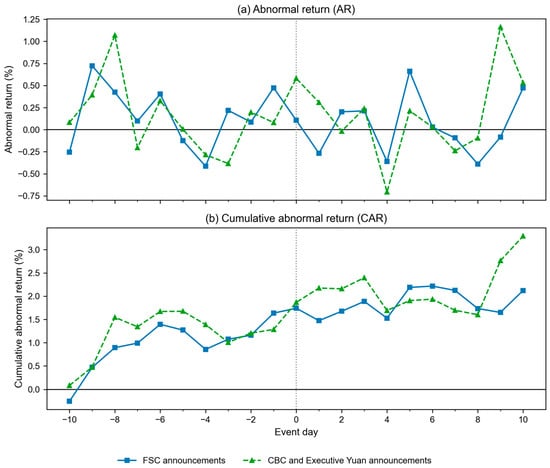
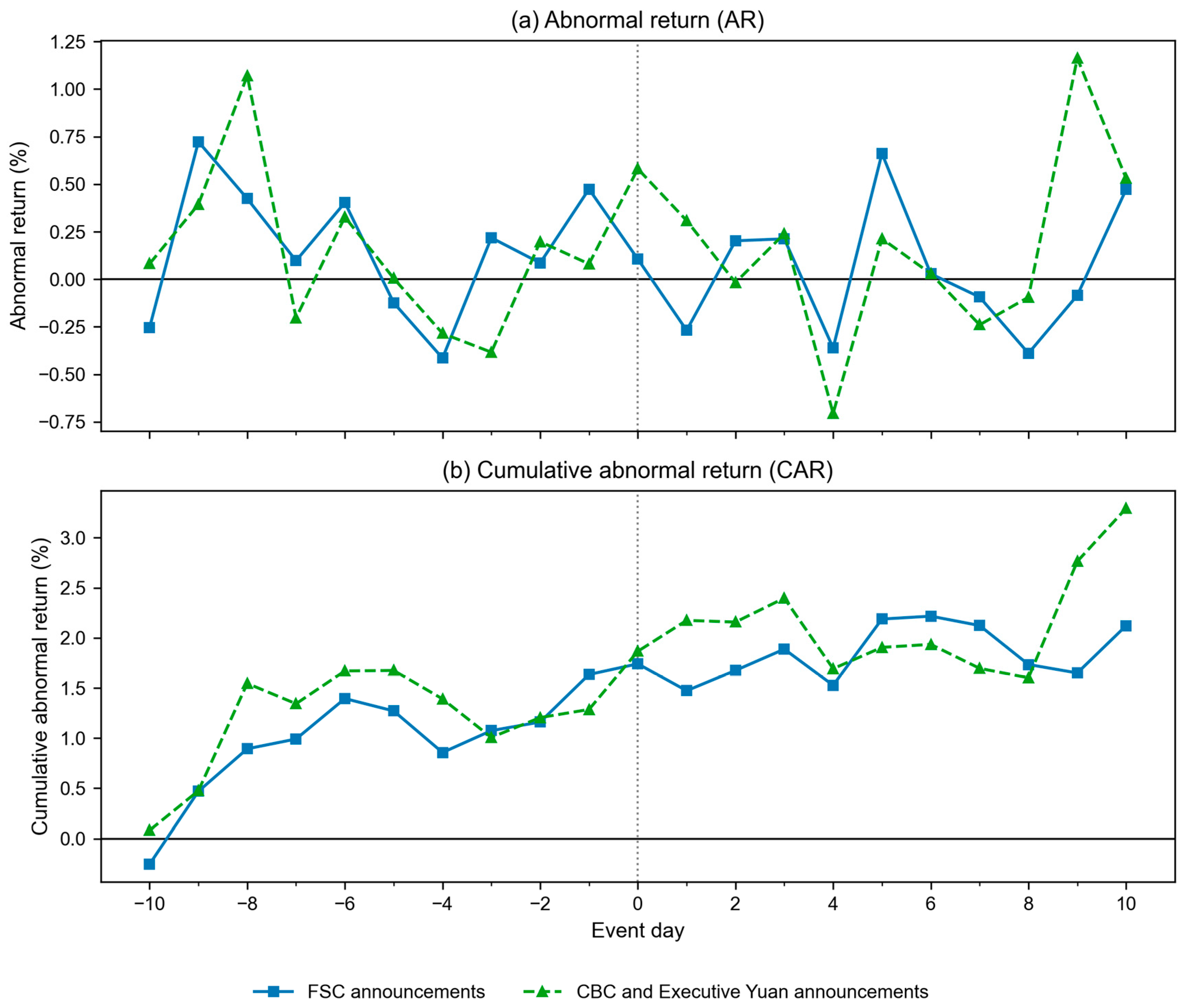
Figure 1 shows that the mean ARs of the two groups of announcements differ in timing and sign. The AR for CBC and Executive Yuan announcements turns from negative on day −3 to positive from day −2 to day +1, with the largest of these values on day 0, whereas the AR for FSC announcements is positive on day −1, close to zero on day 0, and negative on day +1. Both CARs rise over the window; the FSC CAR reaches its window high on day +6 and ends the window close to it, whereas the CBC and Executive Yuan CAR drops on day +4 and reaches its window high on day +10.
Figure 1.
AR and CAR around FSC Announcements Versus CBC and Executive Yuan Announcements.
The FSC announcements carry licensing and supervisory information. The FSC announced the virtual-asset custody pilot and published the list of VASPs that had completed AML registration. Each step defines who may enter the business and under what supervision, which offers banks a new line of business together with new compliance costs. The FSC releases of 28 November 2024, and, most likely, 22 September 2025, were made public after the market close, so day +1 was the first trading day on which they could be priced. Table 1 shows that the day-0 AR for these announcements is not significant; the first significant reaction after the announcement is a significantly negative AR on day +1, preceded, within five days of the announcement, by a significantly negative AR on day −4 and a significantly positive AR on day −1 and followed by a significantly negative AR on day +4 and a significantly positive AR on day +5.
Table 1.
AR for FSC Announcements and CBC and Executive Yuan Announcements.
The CBC and Executive Yuan announcements carry information on the institutional framework. In a speech, the CBC governor described a two-tier monetary system for stablecoins and two parallel tracks for payment innovation, upgrading the existing system while developing CBDC, with work shifting to wholesale CBDC infrastructure trials because a retail CBDC was not urgent; the CBC then published its report summarizing its CBDC outreach. Together these announcements bear on whether the framework fits the monetary and payment system and on how soon and how certainly it will be in place. Table 1 shows that their ARs on days 0 and +1 are significantly positive and that the AR on day +4 is significantly negative. The CBC report of April 15, 2026, was made public after the market close, so for this event day 0 precedes the release, and day +1 was the first trading day on which it could be priced.
The CARs of both groups of announcements are positive for most of the window (Table 2). For FSC announcements, the CAR is significantly negative on day −10 and significantly positive on every day from day −9 to day +10; for CBC and Executive Yuan announcements, the CAR is significantly positive on every day from day −9 to day +10. The two groups differ in the timing and sign of their mean ARs, which are significantly positive on days 0 and +1 for the CBC and Executive Yuan group and significantly negative on day +1 for the FSC group. Bank stock reactions to prudential announcements depend on the characteristics of the announcing authority [27]; here, the FSC as competent authority and the CBC and the Executive Yuan as the agencies that shape the monetary and legislative framework send information that the market prices separately, and the institutions linked to the custody pilot carry the supervisory side of this exposure most directly.
Table 2.
CAR for FSC Announcements and CBC and Executive Yuan Announcements.
A two-tier system anchored to central bank money keeps banks between wholesale CBDC and the public, whereas public digital money issued directly can crowd out deposits [16], and the CBC’s tokenized cash-flow trial platform uses wholesale CBDC as its settlement asset. This information points to deposits, fee income, and a settlement role, and the mean AR for these announcements is significantly positive on the announcement day and the day after, although for the April 15 report the announcement day precedes the after-close release. However, the licensing and supervisory information from the FSC concerns the social and governance aspect. The custody pilot was open to financial institutions and could serve general investors, extending a custodian bank’s consumer protection duties to retail crypto holdings, and AML registration sets compliance duties whose costs arrive before revenue.
4.2. Pilot Institutions
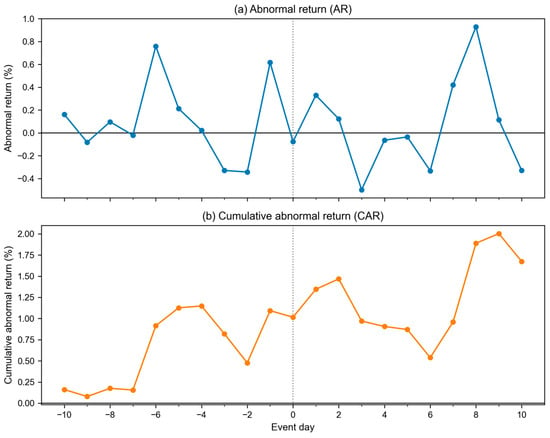
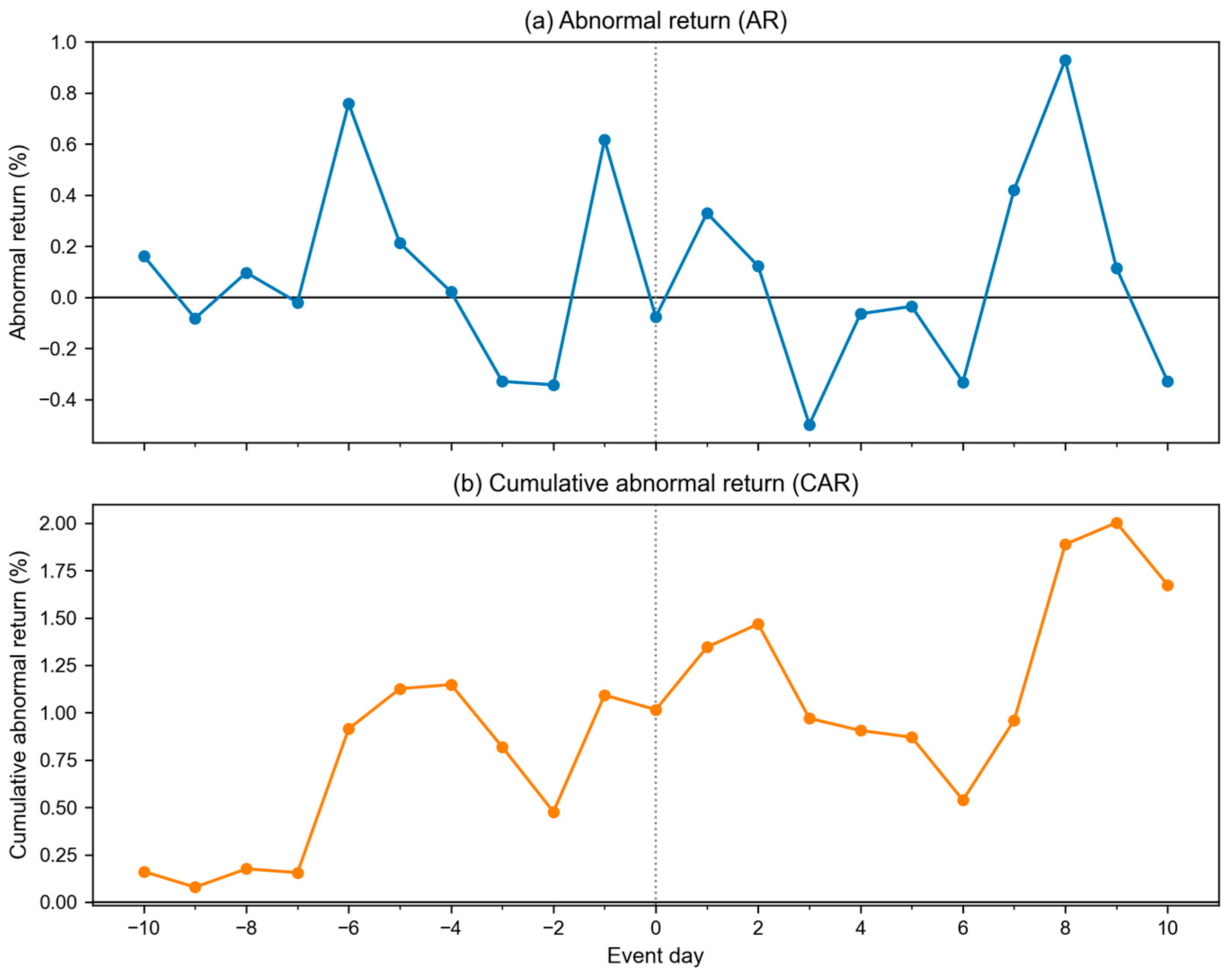
Around the two regulatory events that preceded the custody pilot, the CAR of the 22 banks and FHCs is positive throughout the window and reaches its highest value on day +9 (Figure 2). Across the 38 observations, the ARs on days −6, −1, +1, +7, and +8 are significantly positive, and those on days −3, −2, +3, +6, and +10 are significantly negative (Table 3). The day 0 AR is insignificant, and the CAR is significantly positive on days −6 to −3, −1 to +3, and +8 to +10.
Figure 2.
AR and CAR of Pilot Institutions around Regulatory and Pilot Events.
Table 3.
AR and CAR for Pilot Institutions around Announcement Day of Regulatory and Pilot Events.
4.3. ESG Performance and the Reaction of Pilot Institutions
The banks reacted very differently to the two pilot-related events. Across the 38 bank-event observations (22 banks, two events), the mean CAR(−1, +1) is significantly positive, and 24 of the 38 values are positive. The four institutions linked to the custody pilot account for seven of these observations. Because corporate social responsibility can condition how shareholders react to firm news [23,24], Table 4 regresses CAR(−1, +1) on the pilot indicator, the Environmental, Social and Governance factors, and their interactions with the indicator [60].
Table 4.
Cross-sectional Analysis of Wealth Effect for the Pilot Institutions.
In Table 4, Social factor is significantly negative and Environmental factor significantly positive, whereas Governance factor is not significant: among the banks outside the pilot, those with higher social scores have a lower CAR around the pilot-related events, and those with higher environmental scores a higher one. The interactions show that these associations differ for the pilot institutions. D × E is significantly negative, so that for the pilot institutions a higher environmental score goes with a lower CAR, and D × S is significantly positive, so that the negative association with the social score does not hold for them, whereas D × G is not significant. The pilot indicator is significantly positive; with the interactions included, it measures the difference between the pilot institutions and the other banks at zero pillar scores.
One possible reading of the social coefficient is that the VASP guidelines and the AML registration regulations signaled that banks entering virtual-asset services would extend their consumer protection duties to clients’ virtual assets: a custodian must keep client assets segregated from its own [15], illegal activity has accounted for a large share of bitcoin transactions [58], customers’ claims to deposited assets became uncertain when crypto firms failed [56], fraud is among the main consumer protection harms [42], and internal fraud and operational losses can cause reputational damage beyond the announced loss [61,62]. Banks with stronger social profiles would then have more customer trust at stake, consistent with evidence that firms with stronger CSR records gain less from favorable environmental news [23]. For the institutions that went on to join the pilot, the social association does not hold, and the negative environmental association points to a different exposure: entering custody ties them to crypto assets whose blockchain energy use [26,59] sits uneasily with strong environmental commitments.
D × E and D × S remain significant at the 5% level when any one of the 38 observations, including each of the seven pilot institution observations, is omitted, and in the full sample they are also significant at the 10% level with HC3 standard errors.
4.4. Investment Implications
Three implications follow for investors in bank stocks. First, stablecoin policy reaches banks through two kinds of information that bank stocks priced in opposite directions: information on the institutional framework from the CBC and the Executive Yuan, priced positively on the announcement day and post-announcement day, and licensing and supervisory information from the FSC, priced negatively the day after. Because the FSC is the competent authority and the CBC must consent to stablecoin issuance, investors need to follow both sources: the FSC for business entry and compliance costs, and the CBC and the Executive Yuan for the feasibility and timing of the framework. Second, both groups produced positive cumulative returns within the event window, consistent with expected deposits, fees, and a settlement role that depend on licensing, issuance, and infrastructure still to come. Investors can track these channels through the bank characteristics identified in Section 1. Third, ESG analysis of a bank’s stablecoin exposure may need to look at individual pillars: around pilot-related events, a higher social score went with a lower CAR among the banks outside the pilot, which fits the supervisory side of the exposure, in which custody would place crypto risk on the banks with the most customer trust at stake, whereas among the custody pilot institutions this association did not hold and a higher environmental score went with a lower CAR.
5. Conclusions
This study analyzes the market reaction of Taiwan’s financial industry to stablecoin-related institutional developments at two levels: government policy announcements and the virtual-asset custody pilot. The results show that policy support and pilot participation should not be directly equated with a lasting increase in firm value. Greater clarity about the direction of the institutional framework may improve market expectations, but business entry also brings customer protection, internal control, and compliance responsibilities, so that short-term abnormal returns, including the positive cumulative abnormal returns within the event window, do not necessarily translate into a lasting shareholder wealth effect. The positive cumulative returns around the pilot-related events do not by themselves show that financial innovation creates lasting value; the evidence is not yet sufficient to confirm its lasting wealth effect. Regulators would therefore do well to coordinate policy promotion, business entry, and supervisory requirements to improve the predictability of the institutional framework and the transparency of responsibilities [63]; financial institutions, for their part, should treat the pilot as a phase for validating demand and assessing costs and determine the scale of expansion on the basis of actual customer usage, unit service costs, and risk-adjusted profitability.
The ESG analysis suggests that the relationship between sustainability performance and the market valuation of a new business line is not simply positive. Among banks outside the pilot, the social pillar has a significantly negative relationship with CARs around the pilot-related events, whereas the institutions linked to the custody pilot differ in both their social and environmental relationships. This pattern is consistent with the market assessing the incremental value of the new business line cautiously where customer protection responsibilities are larger, while revenue remains uncertain and the related investments must be made first. However, the estimates are affected by model specification; a negative coefficient indicates only relatively lower event returns and does not amount to a loss of shareholder wealth, and still less can it be inferred that improving social responsibility or environmental performance would reduce firm value. Financial institutions should demonstrate the credibility of their business through actual outcomes such as client asset protection, conflict-of-interest management, and risk disclosure, rather than relying solely on existing ESG ratings, an approach consistent with the regulatory recommendations of the International Organization of Securities Commissions [64]. The effectiveness of financial inclusion should be measured by service safety, reasonable fees, and actual access to financial services for the underserved, rather than by the number of accounts or transaction volume alone.
The environmental pillar is associated with the CARs, but no environmental outcome is measured, so the evidence does not speak to the environmental performance of digital-asset business activities. Asset tokenization in itself does not amount to environmental improvement; assessing its environmental effect would require energy disclosure for the blockchain used [65] and comparable ESG data [66], and firms should reconcile their sustainability claims with their operating outcomes to reduce the risks of selective disclosure and greenwashing [67,68]. On this basis, this study argues that the effectiveness of stablecoin policy and the custody pilot should be evaluated in terms of both commercial sustainability and the public interest. Future research could relate announcement returns to the bank characteristics identified in Section 1, namely the deposit funding share, fee income and trust assets, and the retail customer base, using segment-level data to separate banking from the other activities of FHCs. Stock price reactions can reflect investors’ profit expectations but cannot replace the measurement of asset safety, service resilience, financial accessibility, and environmental outcomes; only a predictable framework, enforceable accountability, and verifiable outcomes help turn financial innovation into lasting operating capability and social benefit.
Author Contributions
Conceptualization, K.-H.S., F.-Y.L. and Y.-H.W.; methodology, F.-Y.L. and Y.-H.W.; software, K.-H.S.; validation, K.-H.S. and F.-M.L.; formal analysis, K.-H.S., F.-Y.L. and Y.-H.W.; investigation, F.-Y.L. and Y.-H.W.; resources, K.-H.S.; data curation, Y.-H.W.; writing—original draft preparation, F.-Y.L. and Y.-H.W.; writing—review and editing, Y.-H.W. and F.-M.L.; visualization, F.-M.L.; supervision, F.-M.L.; project administration, K.-H.S. and F.-Y.L. All authors have read and agreed to the published version of the manuscript.
Funding
This research received no external funding.
Institutional Review Board Statement
Not applicable.
Informed Consent Statement
Not applicable.
Data Availability Statement
Restrictions apply to the availability of these data. Data were obtained from taiwan economic journal (tej) database and are available https://www.tejwin.com/en/. The daily stock and market returns and the environmental, social, and governance scores were obtained from the Taiwan Economic Journal (TEJ) database under license and are available from the corresponding author with the permission of TEJ. The announcement dates were compiled from public releases of the FSC, the CBC, and the Executive Yuan.
Conflicts of Interest
The authors declare no conflicts of interest.
References
- Catalini, C.; de Gortari, A.; Shah, N. Some simple economics of stablecoins. Annu. Rev. Financ. Econ. 2022, 14, 117–135. [Google Scholar] [CrossRef] [Scilit]
- Lyons, R.K.; Viswanath-Natraj, G. What keeps stablecoins stable? J. Int. Money Finance 2023, 131, 102777. [Google Scholar] [CrossRef] [Scilit]
- Gorton, G.B.; Klee, E.C.; Ross, C.P.; Ross, S.Y.; Vardoulakis, A.P. Leverage and stablecoin pegs. J. Financ. Quant. Anal. 2026, 61, 99–136. [Google Scholar] [CrossRef] [Scilit]
- van der Linden, T.; Shirazi, T. Markets in crypto-assets regulation: Does it provide legal certainty and increase adoption of crypto-assets? Financ. Innov. 2023, 9, 22. [Google Scholar] [CrossRef] [Scilit] [PubMed]
- Mak, C.H.W. Trusts, trustees, and stablecoins: An analysis of Hong Kong’s Stablecoins Ordinance and its implications for trust law. Trusts Trustees 2025, 31, 447–454. [Google Scholar] [CrossRef] [Scilit]
- Tong, X.; Li, F.; Kunkel, R.A. Stablecoin regulation and market value: Announcement effects of the GENIUS Act of 2025 on crypto-related firms. J. Account. Finance 2026, 26, 16–26. [Google Scholar] [CrossRef] [Scilit]
- Arner, D.W.; Zetzsche, D.A.; Buckley, R.P.; Kirkwood, J.M. The financialisation of crypto: Designing an international regulatory consensus. Comput. Law Secur. Rev. 2024, 53, 105970. [Google Scholar] [CrossRef] [Scilit]
- Buckley, R.P. The contest between central bank digital currencies, stablecoins, and tokenized deposits: Which will likely win, and why? Cap. Mark. Law J. 2026, 21, kmag012. [Google Scholar] [CrossRef] [Scilit]
- Wang, J.J. Banks in the Age of Stablecoins: Some Possible Implications for Deposits, Credit, and Financial Intermediation; FEDS Notes; Board of Governors of the Federal Reserve System: Washington, DC, USA, 2025. [Google Scholar] [CrossRef] [Scilit]
- Arner, D.W.; Buckley, R.P.; Zetzsche, D.A.; Veidt, R. Sustainability, FinTech and financial inclusion. Eur. Bus. Organ. Law Rev. 2020, 21, 7–35. [Google Scholar] [CrossRef] [Scilit]
- Macchiavello, E.; Siri, M. Sustainable finance and fintech: Can technology contribute to achieving environmental goals? A preliminary assessment of “green fintech” and “sustainable digital finance.”. Eur. Co. Financ. Law Rev. 2022, 19, 128–174. [Google Scholar] [CrossRef] [Scilit]
- Auer, R.; Claessens, S. Cryptocurrency market reactions to regulatory news. In The Routledge Handbook of FinTech; Liaw, K.T., Ed.; Routledge: Abingdon, UK, 2021; pp. 455–468. [Google Scholar] [CrossRef] [Scilit]
- Cumming, D.; Fuchs, J.; Momtaz, P.P. Market reactions to cryptocurrency regulation: Risk, return and the role of enforcement quality. Br. J. Manag. 2025, 36, 1709–1745. [Google Scholar] [CrossRef] [Scilit]
- Saggu, A.; Ante, L.; Kopiec, K. Uncertain regulations, definite impacts: The impact of the U.S. Securities and Exchange Commission’s regulatory interventions on crypto assets. Finance Res. Lett. 2025, 72, 106413. [Google Scholar] [CrossRef] [Scilit]
- Zetzsche, D.A.; Nikolakopoulou, A. Crypto custody: An empirical assessment. J. Financ. Regul. 2025, 11, 73–97. [Google Scholar] [CrossRef] [Scilit]
- Keister, T.; Sanches, D. Should central banks issue digital currency? Rev. Econ. Stud. 2023, 90, 404–431. [Google Scholar] [CrossRef] [Scilit]
- Chiu, J.; Davoodalhosseini, S.M.; Jiang, J.; Zhu, Y. Bank market power and central bank digital currency: Theory and quantitative assessment. J. Polit. Econ. 2023, 131, 1213–1248. [Google Scholar] [CrossRef] [Scilit]
- Allen, B.K.; Allen, K.D.; Whitledge, M.D. Stablecoin competition and community bank deposit funding. Finance Res. Lett. 2026, 111, 110735. [Google Scholar] [CrossRef] [Scilit]
- Ahrens, M.; Erdemlioglu, D.; McMahon, M.; Neely, C.J.; Yang, X. Mind your language: Market responses to central bank speeches. J. Econom. 2025, 249, 105921. [Google Scholar] [CrossRef] [Scilit]
- Beckmann, L.; Debener, J.; Hark, P.F.; Pfingsten, A. CBDC and the shadow of bank disintermediation: US stock market insights on threats and remedies. Finance Res. Lett. 2024, 67, 105868. [Google Scholar] [CrossRef] [Scilit]
- Financial Supervisory Commission. Virtual Asset Service Act; Financial Supervisory Commission: New Taipei City, Taiwan, 2026. Available online: https://law.fsc.gov.tw/LawContent.aspx?id=GL004301 (accessed on 15 October 2026).
- Gan, Z. When rules become clear: Capital market reactions to Hong Kong’s Stablecoin Ordinance. Front. Polit. Sci. 2026, 8, 1925947. [Google Scholar] [CrossRef] [Scilit]
- Flammer, C. Corporate social responsibility and shareholder reaction: The environmental awareness of investors. Acad. Manag. J. 2013, 56, 758–781. [Google Scholar] [CrossRef] [Scilit]
- Krüger, P. Corporate goodness and shareholder wealth. J. Financ. Econ. 2015, 115, 304–329. [Google Scholar] [CrossRef] [Scilit]
- Adrian, T.; Mancini-Griffoli, T. The Rise of Digital Money; FinTech Note No. 2019/001; International Monetary Fund: Washington, DC, USA, 2019. [Google Scholar] [CrossRef] [Scilit]
- de Vries, A. Cryptocurrencies on the road to sustainability: Ethereum paving the way for Bitcoin. Patterns 2023, 4, 100633. [Google Scholar] [CrossRef] [Scilit] [PubMed]
- Bobiceanu, A.M.; Nistor, S.; Ongena, S. Banks’ stock market reaction to prudential policy announcements: The role of central bank independence and financial stability sentiment. J. Financ. Stab. 2026, 83, 101512. [Google Scholar] [CrossRef] [Scilit]
- Cornelli, G.; Doerr, S.; Gambacorta, L.; Merrouche, O. Regulatory sandboxes and fintech funding: Evidence from the UK. Rev. Finance 2024, 28, 203–233. [Google Scholar] [CrossRef] [Scilit]
- Griffin, J.M.; Shams, A. Is Bitcoin really untethered? J. Finance 2020, 75, 1913–1964. [Google Scholar] [CrossRef] [Scilit]
- Maex, S.A.; Slavov, S. Initial evidence on the content and market implications of stablecoin reserve reporting. J. Account. Public Policy 2025, 51, 107309. [Google Scholar] [CrossRef] [Scilit]
- King, M.A.; Wadhwani, S. Transmission of volatility between stock markets. Rev. Financ. Stud. 1990, 3, 5–33. [Google Scholar] [CrossRef] [Scilit]
- Forbes, K.J.; Rigobon, R. No contagion, only interdependence: Measuring stock market comovements. J. Finance 2002, 57, 2223–2261. [Google Scholar] [CrossRef] [Scilit]
- Malamas, V.; Dasaklis, T.K.; Arakelian, V.; Chondrokoukis, G. A blockchain framework for digitizing securities issuance: The case of green bonds. J. Sustain. Finance Investig. 2024, 14, 569–595. [Google Scholar] [CrossRef] [Scilit]
- Sipthorpe, A.; Brink, S.; Van Leeuwen, T.; Staffell, I. Blockchain solutions for carbon markets are nearing maturity. One Earth 2022, 5, 779–791. [Google Scholar] [CrossRef] [Scilit]
- Swinkels, L. Trading carbon credit tokens on the blockchain. Int. Rev. Econ. Finance 2024, 91, 720–733. [Google Scholar] [CrossRef] [Scilit]
- Flammer, C. Corporate green bonds. J. Financ. Econ. 2021, 142, 499–516. [Google Scholar] [CrossRef] [Scilit]
- Tang, D.Y.; Zhang, Y. Do shareholders benefit from green bonds? J. Corp. Finance 2020, 61, 101427. [Google Scholar] [CrossRef] [Scilit]
- Chiu, J.; Koeppl, T.V. Blockchain-based settlement for asset trading. Rev. Financ. Stud. 2019, 32, 1716–1753. [Google Scholar] [CrossRef] [Scilit]
- Benos, E.; Garratt, R.; Gurrola-Perez, P. The economics of distributed ledger technology for securities settlement. Ledger 2019, 4, 121–156. [Google Scholar] [CrossRef] [Scilit]
- Ozili, P.K. Impact of digital finance on financial inclusion and stability. Borsa Istanb. Rev. 2018, 18, 329–340. [Google Scholar] [CrossRef] [Scilit]
- Jack, W.; Suri, T. Risk sharing and transactions costs: Evidence from Kenya’s mobile money revolution. Am. Econ. Rev. 2014, 104, 183–223. [Google Scholar] [CrossRef] [Scilit]
- Garz, S.; Giné, X.; Karlan, D.; Mazer, R.; Sanford, C.; Zinman, J. Consumer protection for financial inclusion in low- and middle-income countries: Bridging regulator and academic perspectives. Annu. Rev. Financ. Econ. 2021, 13, 219–246. [Google Scholar] [CrossRef] [Scilit]
- La Porta, R.; Lopez-de-Silanes, F.; Shleifer, A.; Vishny, R.W. Law and finance. J. Polit. Econ. 1998, 106, 1113–1155. [Google Scholar] [CrossRef] [Scilit] [PubMed]
- Zetzsche, D.A.; Buckley, R.P.; Arner, D.W. Regulating Libra. Oxf. J. Leg. Stud. 2021, 41, 80–113. [Google Scholar] [CrossRef] [Scilit] [PubMed]
- Bollerslev, T. Generalized autoregressive conditional heteroskedasticity. J. Econom. 1986, 31, 307–327. [Google Scholar] [CrossRef] [Scilit]
- Engle, R.F. Autoregressive conditional heteroscedasticity with estimates of the variance of United Kingdom inflation. Econometrica 1982, 50, 987–1007. [Google Scholar] [CrossRef] [Scilit]
- Brown, S.J.; Warner, J.B. Using daily stock returns: The case of event studies. J. Financ. Econ. 1985, 14, 3–31. [Google Scholar] [CrossRef] [Scilit]
- MacKinlay, A.C. Event studies in economics and finance. J. Econ. Lit. 1997, 35, 13–39. [Google Scholar]
- Michaely, R.; Rubin, A.; Vedrashko, A. Are Friday announcements special? Overcoming selection bias. J. Financ. Econ. 2016, 122, 65–85. [Google Scholar] [CrossRef] [Scilit]
- Chuang, C.-C.; Wang, Y.-H. Electoral information in developed stock market: Testing conditional heteroscedasticity in the market model. Appl. Econ. 2010, 42, 1125–1131. [Google Scholar] [CrossRef] [Scilit]
- Wang, J.-S.; Chen, J.-T.; Chou, P.-H. Market reactions to the passage of the Financial Holding Company Act in Taiwan. Pac. Econ. Rev. 2008, 13, 453–472. [Google Scholar] [CrossRef] [Scilit]
- Chang, H.-Y.; Shih, K.-H.; Wang, Y.-H.; Chien, L.-J. An analysis on market reaction to mobile payment adoption: Comparison between financial and non-financial industry. Int. J. Mob. Commun. 2020, 18, 83–100. [Google Scholar] [CrossRef] [Scilit]
- Ghosh, A.K. Market model corrected for generalized autoregressive conditional heteroscedasticity and the small firm effect. J. Financ. Res. 1992, 15, 277–283. [Google Scholar] [CrossRef] [Scilit]
- de Jong, F.; Kemna, A.; Kloek, T. A contribution to event study methodology with an application to the Dutch stock market. J. Bank. Finance 1992, 16, 11–36. [Google Scholar] [CrossRef] [Scilit]
- Baillie, R.T.; Bollerslev, T. Prediction in dynamic models with time-dependent conditional variances. J. Econom. 1992, 52, 91–113. [Google Scholar] [CrossRef] [Scilit]
- Kokorin, I. The anatomy of crypto failures and investor protection under MiCAR. Cap. Mark. Law J. 2023, 18, 500–525. [Google Scholar] [CrossRef] [Scilit]
- Castrén, O.; Russo, R. Runs, transparency and regulation: On the optimal design of stablecoin frameworks. Econ. Lett. 2026, 258, 112720. [Google Scholar] [CrossRef] [Scilit]
- Foley, S.; Karlsen, J.R.; Putniņš, T.J. Sex, drugs, and Bitcoin: How much illegal activity is financed through cryptocurrencies? Rev. Financ. Stud. 2019, 32, 1798–1853. [Google Scholar] [CrossRef] [Scilit]
- Stoll, C.; Klaaßen, L.; Gallersdörfer, U. The carbon footprint of Bitcoin. Joule 2019, 3, 1647–1661. [Google Scholar] [CrossRef] [Scilit]
- White, H. A heteroskedasticity-consistent covariance matrix estimator and a direct test for heteroskedasticity. Econometrica 1980, 48, 817–838. [Google Scholar] [CrossRef] [Scilit]
- Gillet, R.; Hübner, G.; Plunus, S. Operational risk and reputation in the financial industry. J. Bank. Finance 2010, 34, 224–235. [Google Scholar] [CrossRef] [Scilit]
- Fiordelisi, F.; Soana, M.-G.; Schwizer, P. The determinants of reputational risk in the banking sector. J. Bank. Finance 2013, 37, 1359–1371. [Google Scholar] [CrossRef] [Scilit]
- Financial Stability Board. High-Level Recommendations for the Regulation, Supervision and Oversight of Global Stablecoin Arrangements: Final Report; Financial Stability Board: Basel, Switzerland, 2023. Available online: https://www.fsb.org/2023/07/high-level-recommendations-for-the-regulation-supervision-and-oversight-of-global-stablecoin-arrangements-final-report/ (accessed on 15 October 2026).
- International Organization of Securities Commissions. Policy Recommendations for Crypto and Digital Asset Markets: Final Report; FR11/2023; International Organization of Securities Commissions: Madrid, Spain, 2023. Available online: https://www.iosco.org/library/pubdocs/pdf/IOSCOPD747.pdf (accessed on 15 October 2026).
- European Commission. Commission Delegated Regulation (EU) 2025/422 of 17 December 2024 Supplementing Regulation (EU) 2023/1114 of the European Parliament and of the Council with Regard to Regulatory Technical Standards Specifying the Content, Methodologies and Presentation of Information in Respect of Sustainability Indicators in Relation to Adverse Impacts on the Climate and Other Environment-Related Adverse Impacts; Official Journal of the European Union, L 2025/422; European Commission: Brussels, Belgium, 2025. Available online: https://eur-lex.europa.eu/eli/reg_del/2025/422/oj (accessed on 15 October 2026).
- Christensen, D.M.; Serafeim, G.; Sikochi, A. Why is corporate virtue in the eye of the beholder? The case of ESG ratings. Account. Rev. 2022, 97, 147–175. [Google Scholar] [CrossRef] [Scilit]
- Christensen, H.B.; Hail, L.; Leuz, C. Mandatory CSR and sustainability reporting: Economic analysis and literature review. Rev. Account. Stud. 2021, 26, 1176–1248. [Google Scholar] [CrossRef] [Scilit]
- Financial Conduct Authority. Finalised Non-Handbook Guidance on the Anti-Greenwashing Rule; FG24/3; Financial Conduct Authority: London, UK, 2024. Available online: https://www.fca.org.uk/publication/finalised-guidance/fg24-3.pdf (accessed on 15 October 2026).

Disclaimer/Publisher’s Note: The statements, opinions and data contained in all publications are solely those of the individual author(s) and contributor(s) and not of MDPI and/or the editor(s). MDPI and/or the editor(s) disclaim responsibility for any injury to people or property resulting from any ideas, methods, instructions or products referred to in the content. |
© 2026 by the authors. Licensee MDPI, Basel, Switzerland. This article is an open access article distributed under the terms and conditions of the Creative Commons Attribution (CC BY) license.