


Abstract
This pilot study examines what becomes visible about university sustainability in public online discourse. From 14,621 harvested records, a sentence-level screen retained 536 posts and comments (Reddit, Hacker News and Lemmy; 2007–2026), coded with documented lexicons for strategy, curriculum, pedagogy, campus operations, community engagement, reporting and promotional communication. Instead of human inter-coder reliability, a blinded, AI-assisted semantic second pass by a different model family under a frozen prompt served as a provisional cross-method check on 236 retained units and 120 excluded records. The second pass judged 153 of 236 retained units as relevant. Campus operations was the most frequent domain in both methods (lexicon: 70.9% overall; second pass: 53.6%), but its lead depended on operational search terms; the second pass placed engagement (41.8%) ahead of curriculum (36.6%), indicating that the lexicon undercounted engagement. Cross-method concordance was substantial for curriculum and operations (κ = 0.67; 0.64) and weak for interpretive codes. Explicit SDG naming was rare (1.3%). Claims co-occurred with evidence more often than chance (OR = 3.10), being robust to length adjustment and a null permutation. The association between promotional communication and asserted claim–practice gaps remained undetermined, as 8 of 120 sampled excluded records were judged relevant, and 29 Global South communities searched in English yielded one unit. A provisional single-axis scheme grading the co-occurrence of claims, practice references and evidence (L0–L4) was not stable across methods (weighted κ = 0.13). This study documents what such evidence can and cannot support pending human validation.
1. Introduction
Higher-education institutions (HEIs) are expected to contribute to the 2030 Agenda through teaching, research, operations and engagement, and the Sustainable Development Goals (SDGs) have become a prominent frame for that contribution [1]. Critics caution that the framework can privilege institutional visibility over equity, leaving many learners and regions behind [2]. Whole-institution approaches treat coherence across governance, curriculum, campus practice and community relations as the defining feature of a sustainable university [3], and perceived institutional coherence is strongly associated with learners’ and educators’ empowerment for sustainability [4].
Universities also communicate sustainability intensively. Website analyses in the United States and Canada found that institutions publicise campus initiatives unevenly [5,6], sustainability rankings have created incentives to present SDG contributions to international audiences [7,8], and reporting has become more common, although it remains selective [9,10]. A worldwide survey found strong links between commitment and implementation, but implementation was typically compartmentalised [11]; that reviews of campus operations note a shortage of empirical data on implemented actions [12]; and that assessment tools rely mainly on internally available proxy indicators [13]. THE Impact Rankings provide a broadly sound overview of institutional sustainability performance, although institutions differ markedly in how they participate [14], and studies of UI GreenMetric point to self-selection and reporting bias [15].
These debates rely largely on what institutions publish. Much less is known about how sustainability work becomes visible in the discourse of students, staff and observers. Such discourse is not an institutional audit; it reflects platform cultures, genres and unequal participation [16,17]. It nonetheless offers a distinct visibility layer, showing which dimensions of university sustainability circulate outside official channels. Earlier analyses examined single channels or institutions [5,6,18]; methods for examining such discourse at scale, and evidence on how well automated coding captures it, remain limited.
This pilot study addresses that gap with 536 screened public evidence units. The unit of analysis is the text, not the institution, and all patterns are interpreted as properties of public visibility under a particular search design. Four research objectives (ROs) guide the study: RO1, to describe the visibility of strategy, curriculum, pedagogy, operations, engagement and reporting and its sensitivity to corpus construction; RO2, to test whether claims, practice references and evidence co-occur more or less often than the expected given text length; RO3, to explore recurring combinations of domains and their association with genre, platform and geography; and RO4, to propose a provisional scheme for grading the co-occurrence of claims, practice references and evidence and to assess its measurement properties.
The contributions are deliberately modest. Empirically, the study shows which domains and regions are visible in English-language platform discourse and which are almost absent. Methodologically, it documents a transparent lexicon pipeline together with its error profile—sensitivity to search terms, window construction, text length and clustering, as well as divergence from a blinded semantic second pass by a different model used as a provisional cross-method check—and shows which conclusions survive. Conceptually, it offers a single-axis coding scheme for evidential co-occurrence whose measurement properties are reported openly so that human-coded studies can test it.
2. Literature Review
2.1. Whole-Institution Integration
The whole-institution literature conceptualises sustainability as a property of connected domains: education, research, campus operations, outreach and governance [19,20]. Curriculum change follows several distinct, non-sequential patterns [21], and many universities report limited integration of the SDGs into teaching [22]. Campus operations are the most tangible domain and the focus of student-led campaigns such as fossil fuel divestment [23,24], while students often lack awareness of institutional initiatives [18,25]. Key sustainability competencies [26,27] depend on pedagogies that unfold inside classrooms and are rarely documented publicly.
2.2. Assessment, Reporting and Rankings
Assessment tools were developed to make sustainability verifiable but tend to reward easily measured inputs [28]. STARS analyses show uneven performance across categories [29], tools differ in scope and weighting [30,31], and holistic assessment needs benchmarks across management, academia, environment and engagement [32]. In 107 reports from 50 UK universities, only 12 covered all analytical categories, and self-critical disclosure was rare [10]. Rankings serve both as measurement and as promotion [7], top-ranked universities stand out on SDG 9 and SDG 16 [33], and SDG mapping is method-dependent [34].
2.3. Decoupling, Greenwashing and Greenhushing
Institutional theory explains why organisations adopt formal structures for legitimacy while buffering core activities [35,36], and decoupling can separate means from ends as well as policy from practice [37]. In business schools, decoupling of sustainability commitments was associated with configurations of size, wealth and expertise [38], and talk–action inconsistency had identifiable drivers [39]. Talk may also precede action [40]. Greenwashing denotes positive communication about poor performance [41,42,43], while firms may also understate their record [44], withhold certification [45] or under-communicate practices (greenhushing) [46]. In HEIs, greenwashing has been examined in reporting [10] and students’ responses to sustainability programmes [47], whereas greenhushing has received little attention in the literature we reviewed. Public allegations are treated here as asserted gaps and not proof of greenwashing.
2.4. Public Digital Evidence and Visibility Bias
Social media data offer scale and a stakeholder voice but are neither representative nor neutral [48]; platform users differ socioeconomically from the population [16], user-generated information has informational peripheries in the Global South [49], and Reddit’s governance shapes which voices are amplified [17]. Reddit research has grown rapidly with uneven ethical practice [50], and users often do not expect research use of their posts [51]. University social media can disseminate sustainability information [52]. Public evidence is therefore a visibility layer whose platform, query and screening biases are part of the findings.
2.5. Maturity Models, Configurations and the Research Gap
Maturity models describe progression, but design-oriented work stresses explicit requirements and validation [53], and reviews find that many models are descriptive and assume linear progression [54]. Configurational approaches treat combinations of attributes as potentially equifinal or asymmetric [55]. Three gaps follow. Alignment studies analyse institutional documents, rankings or surveys and rarely the independent public record; studies of public communication rarely distinguish practice references from reporting or from stakeholder allegations; and maturity models assume cumulative stages. This study addresses the first two gaps descriptively and replaces stages with a co-occurrence scheme whose measurement properties are tested rather than assumed.
3. Conceptual Framework
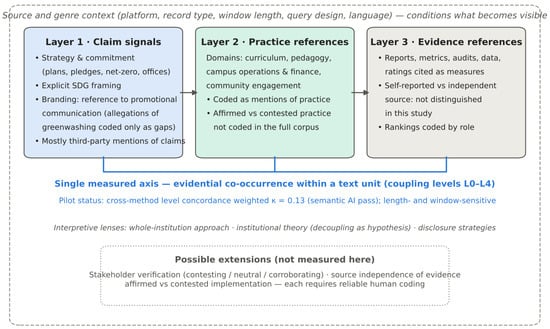
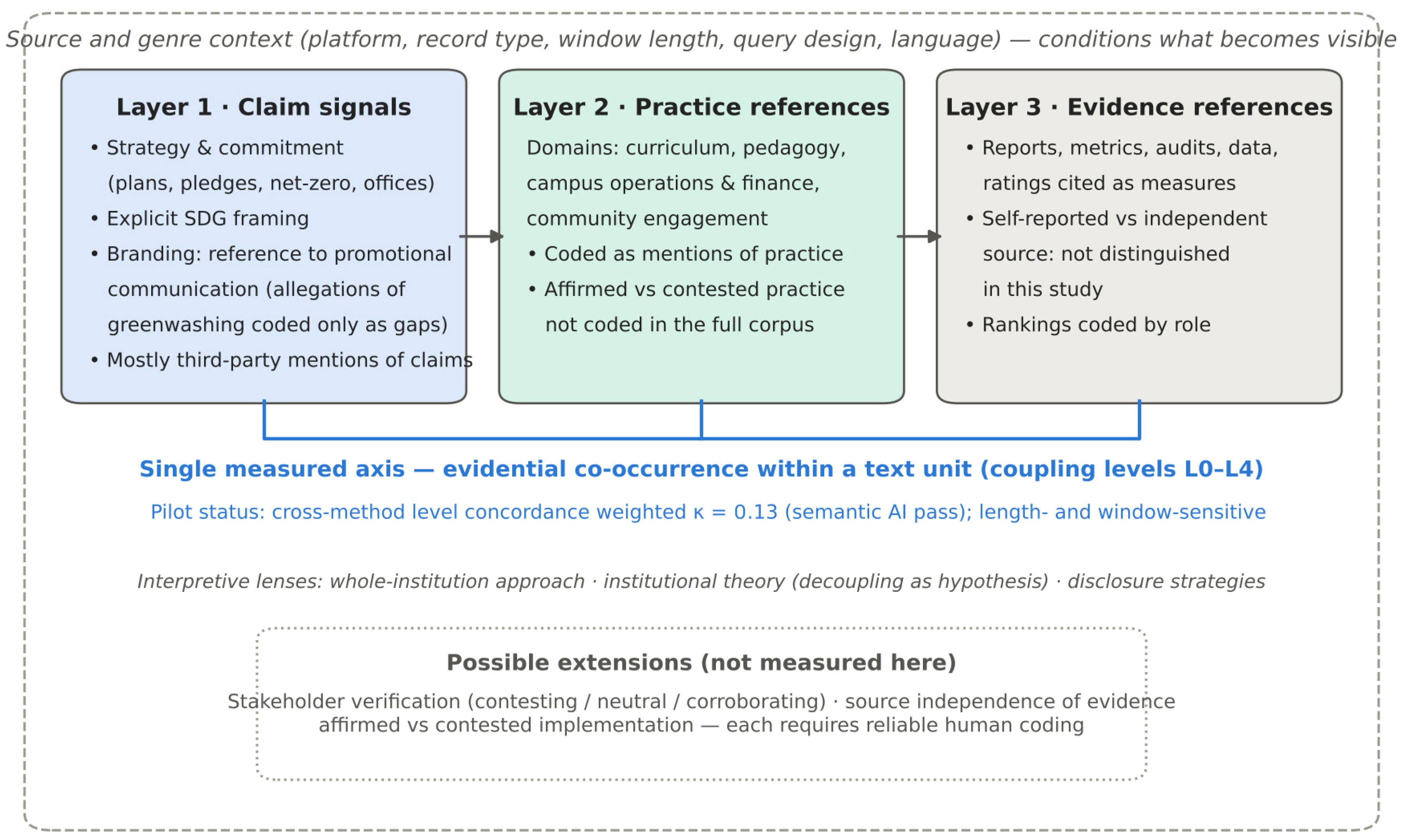
Figure 1 presents the Public Evidence Coupling Scheme. Layer 1 contains claim signals: strategy and commitment, explicit SDG framing and branding. Branding denotes a reference to promotional communication (marketing, public relations, slogans and reputation management); evaluative allegations such as "greenwashing" are coded only as asserted gaps. Because only three units were written in an institutional voice, claims in this corpus are mostly third-party mentions of institutional claims rather than claims made by institutions. Layer 2 contains references to practice in four domains: curriculum, pedagogy, campus operations and finance and community engagement. References are mentions and are not coded as affirmed or contested implementation. Layer 3 contains references to evidence: reports, metrics, audits and ratings cited as measures. Whether evidence is self-reported or independent is not distinguished. The single measured axis is evidential co-occurrence, or the degree to which the three layers appear together in one text. Stakeholder verification, source independence and affirmed implementation are retained only as possible extensions because they were not measured reliably. Source and genre context, including the window length and search design, conditions all layers; institutional theory and the whole-institution approach are interpretive lenses rather than properties the data can establish.
Figure 1.
Public-Evidence Coupling Scheme. Layers 1–3 define one measured axis of evidential co-occurrence. Verification and source independence are unmeasured extensions; source, genre and search design condition visibility.
4. Materials and Methods
4.1. Design and Levels of Analysis
The study used a cross-sectional, pilot content-analytic design. The primary unit was the public evidence unit, a post or comment coded on a context window formed by the union of all qualifying sentences and the two sentences before and after each (median of 66 words; interquartile range: 38–101). Because each further qualifying sentence lengthened the window, the window length was partly produced by the screen itself; Section 4.6 therefore adds two fixed-size windows. Institution-level aggregation is a descriptive sensitivity analysis restricted to institutions with at least five units. Table 1 specifies which inferences each level supports.
Table 1.
Levels of analysis and the inferences each level supports.
4.2. Corpus Construction, Platforms and Access
Data were collected on 26–27 October 2026 with the TinyFish web content service, which retrieved public pages and application programming interface (API) responses that were parsed locally. Reddit was accessed through the public Arctic Shift archive API (posts and complete comment trees). Searches covered 134 university and national communities—including 29 in Africa, Asia and Latin America—and 26 sustainability and higher-education topic communities using English terms (sustainability, climate, divest, SDG, net zero, green, recycling and solar). Hacker News (Algolia API), Lemmy (public instance APIs), Mastodon (public hashtag timelines) and Stack Exchange were also searched; Mastodon (40 records) and Stack Exchange (20) contributed no relevant units, and Bluesky refused public access. Thus, the analysed corpus came from three platforms. Reddit’s current terms require authorised access through its Data API, and Arctic Shift is a third-party archive of content previously collected through that API; the archive was used only for non-commercial academic analysis without bypassing access controls, excluding deleted and removed items and without redistributing content. Compliance of third-party archives with evolving platform terms was not settled, and replications should use Reddit’s official researcher access. Author names were replaced by salted SHA-256 pseudonyms, contact details and user mentions were masked, and institutions are reported by code (HEI-xx). Table 2 summarises the corpus.
Table 2.
Composition of the harvested corpus and relevance screening by platform.
4.3. Relevance Screening, Precision and Recall
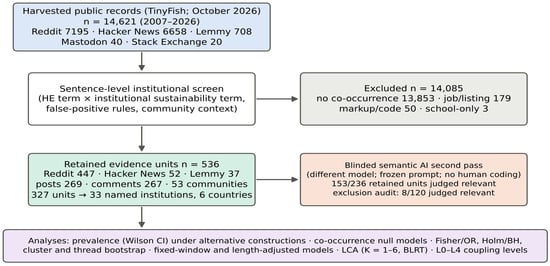
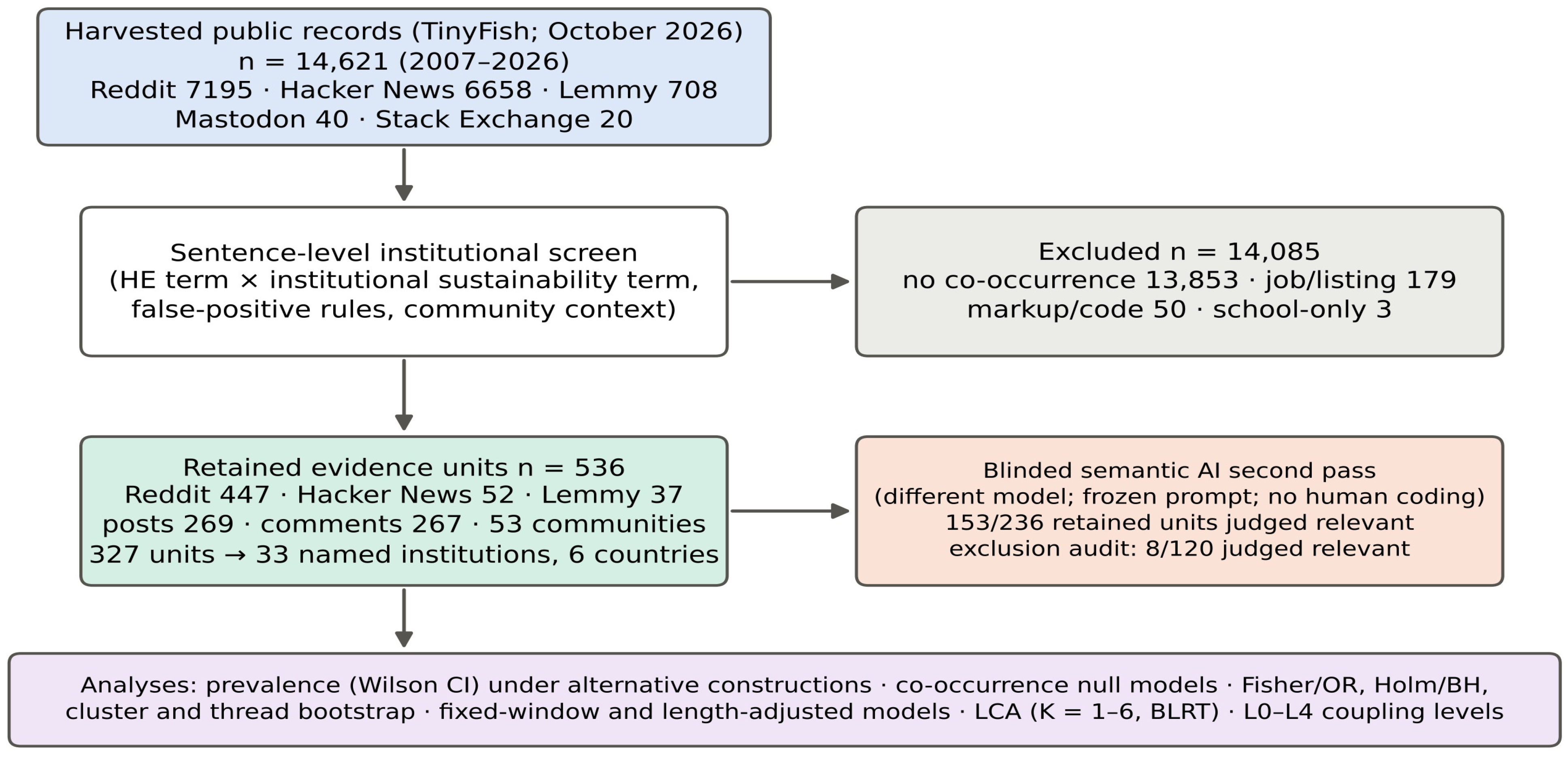
Records were split into sentences and retained by one of two routes: the co-occurrence rule when one sentence contained both an institutional higher-education term and an institutional sustainability term, or the community rule, when an institutional sustainability term appeared in a university community. False-positive patterns (financial “sustainability”, corporate campuses, expert attributions, job advertisements, markup, school-only references and non-environmental divestment) were removed before matching. The screen retained 536 records: 365 via co-occurrence and 171 (all Reddit) via the community rule (Figure 2). Relevance was examined only through the second pass (Section 4.5), which judged 153 of 236 retained units to be relevant (64.8%, 95% CI: 58.5–70.6), the confirmation rate to be semantic rather than precision, and 8 of 120 records sampled from 5880 excluded candidates to contain relevant higher-education or sustainability terms (6.7%, 3.4–12.6). Because the full set of excluded records was not sampled, and the second pass was not a reference standard, recall was not estimated. The exclusion audit indicates that some relevant discussion was missed. Applied to the whole candidate pool, even this low rate would correspond to several hundred records.
Figure 2.
Corpus construction, screening and the blinded AI-assisted cross-method check. No human coding was performed.
4.4. Coding Framework and SDG Mapping
Seven dimensions were coded as present or absent with lexicons applied to the context window. Strategy and commitment captured plans, pledges, targets, declarations, policies and sustainability offices; curriculum captured courses, programmes, minors and certificates; pedagogy captured teaching approaches such as project-based, experiential or living-lab learning; operations and finance captured energy, buildings, waste, food, transport, procurement and investment; engagement captured student groups, activism, campaigns and partnerships; reporting captured reports, metrics, audits and ratings; and branding captured references to marketing, public relations, brands, slogans and reputation. A claim was defined as strategy, explicit SDG framing or branding, a practice reference was defined as any of the four practice domains, and evidence was defined as reporting. An asserted claim–practice gap was coded when a structural contrast ("pledged … but still …") or an evaluative allegation (greenwashing, lip service or hypocrisy) occurred in the window after branding terms had been masked so that branding and gap shared no lexical triggers. Stance was coded but showed weak cross-method concordance (κ = 0.05) and was not analysed. SDG relevance was mapped with a researcher-assigned 17-goal lexicon distinct from explicit SDG naming; explicit naming was also coded in the second pass. Because 30 units predated 2016, estimates were repeated for the 506 units from 2016 onwards.
Lexicon coding was chosen because it is transparent and fully reproducible at corpus scale and because its error profile can be quantified. The lexicons, codebooks and screening rules were developed iteratively by the author with an AI system (Claude, Anthropic), which was therefore not used as the second coder; they are released in full (Files S2 and S3).
4.5. Blinded AI-Assisted Second Pass as a Provisional Cross-Method Check
Human double coding was not performed. Instead, a blinded, AI-assisted semantic second pass was used as a provisional cross-method check of the lexicon coding; it is the study’s only second coder. It was run on 3 November 2026 with gpt-6.1-sol (OpenAI), a different model family from the one used to build the pipeline, through the Manus OpenAI-compatible model proxy (medium reasoning; one structured-output request per case; strict JSON schema). The prompt and codebook were frozen before coding (SHA-256 2931852e…3306), and a 30-case technical pilot used the same prompt. The sample comprised all 236 retained units outside an earlier 300-unit validation template (223 Reddit and 13 Hacker News units) and 120 records drawn by simple random sampling (seed 20261103) from 5880 excluded candidates containing higher-education or sustainability terms. Cases were shuffled and given opaque identifiers; the model saw only text with URLs, e-mail addresses and user handles redacted and no lexicon codes, record identifiers, platform, community or sampling stratum. It coded relevance, the seven dimensions, explicit SDG naming, asserted gaps and stance, coding explicit content only and uncertain categories as absent. Branding required explicit promotional content, and evaluative terms such as "greenwashing" alone could support only a gap code. Outputs were checked for schema compliance only, one technically rejected response was retried, and no person adjudicated or altered any code. An earlier recoding by the pipeline’s own model was not used because it was not independent of the lexicons; 63 of the 236 units were included in it.
This design is a provisional cross-method check and not based on human inter-coder reliability for four reasons. First, reliability requires independent coders applying the same instrument [56,57]; a semantic AI pass compares two procedures. Thus, κ is reported only as descriptive concordance and neither procedure is treated as the reference standard. Second, comparing a dictionary method with a reading-based classifier follows the logic of methodological triangulation; convergence between methods with different error sources increases confidence, and divergence locates weak measures [58]. Third, large language models have matched or exceeded crowd workers and trained or expert coders on several annotation tasks [59,60], reaching up to 95% agreement with experts on political texts, with human adjudication of model disagreements improving accuracy further [61]. A semantic pass is therefore informative about content the lexicon misses. Fourth, models share training biases, vary across versions and, when proprietary, limit reproducibility. Therefore, they complement rather than replace human annotation [62,63,64]. Using a different model family blind to all primary information under a frozen and hashed prompt addresses the dependence between the pipeline and its check and supports reproducibility, while the remaining limitations are carried into every conclusion. Following the protocol, raw, positive and negative agreement and κ were computed on the retained units the second pass judged relevant (Table 3); the precision and recall of the lexicon were not calculated against the AI labels; and a human double-coding protocol was released (File S8).
Table 3.
Lexicon coding and the blinded semantic second pass on the 153 retained units judged relevant by the second pass (cross-method concordance, not reliability).
4.6. Statistical Analysis
Prevalence was estimated with Wilson 95% confidence intervals under six constructions. Among all units were the 153 retained units judged relevant by the second pass; units from 2016 onwards; each retention route; units without operational search terms (recycling, solar, green, divest or compost; n = 301); and two fixed windows: the first qualifying sentence with two sentences on either side and 60 words centred on that sentence. Co-occurrence of claims, practice references and evidence was tested with Fisher’s exact tests, thread-clustered logistic regressions adjusted for the log window length, the fixed windows and a permutation null model in which each indicator was shuffled independently within deciles of the window length (5000 permutations). Associations with asserted gaps used Haldane-corrected odds ratios with Holm and Benjamini–Hochberg adjustment [65,66], institution or community (59 clusters: 33 institutions plus the 26 source communities of unattributed units) and thread (374) bootstraps and cluster-robust regression [67,68]. Latent class analysis (LCA) of the seven dimensions was estimated for 1–6 classes with 60 random starts; selection considered the Bayesian information criterion (BIC), Akaike information criterion (AIC), sample size-adjusted BIC (SABIC), entropy, a parametric bootstrap likelihood ratio test (BLRT; 99 replicates) [69], average posterior probabilities [70] and bivariate residuals for local independence. The institution-level shares of units at L3–L4 were compared with the share expected from the window length (indirect standardisation).
4.7. Coupling Levels
Coupling levels were defined as thresholds and applied top-down with the first matching rule so that every unit received one level (Table 4). Levels were also computed from the second-pass codes on the 153 relevant units and compared with the lexicon levels using weighted κ with a bootstrap interval (5000 resamples). Because levels and latent classes are built from the same codes, their association is partly definitional and is reported descriptively.
Table 4.
Decision rules of the provisional coupling levels (applied top-down; first match).
4.8. Ethical Considerations
The study was a secondary analysis of publicly accessible online posts and comments, with no recruitment of, interaction with, intervention with or contact with participants and no private or access-restricted content. The author assessed the study against the Reglamento del Comité de Ética de la Investigación de la Universidad Católica de Temuco (Decreto de Rectoría 24/2025), under which such research does not require review by the committee; ethical approval and written informed consent were therefore not required under national legislation and institutional requirements. Risks were nonetheless minimised by following documented practice in Reddit research [50] and evidence that users often do not expect research use of public posts [51]. Usernames were replaced at collection via salted one-way pseudonyms with the salt withheld, and no usernames are reported; mentions, e-mail addresses and links were masked; deleted and removed items were excluded; no verbatim or paraphrased quotations are reported; record identifiers are not published; institutions are reported only by code; and results are presented in aggregate.
4.9. Data Availability and Auditability
The released coded-unit file contains, for each unit, an anonymous sequence number, platform, record type, year, retention route, anonymised institution code, window length and all codes; it contains no text and no record identifiers. Second-pass codes are released with blind identifiers only. To allow independent audit, the keys linking these numbers to public record identifiers and the institution key are available to the editor and reviewers in confidence and to researchers under a data use agreement that prohibits quotation and re-identification. Lexicons, codebooks, the second-pass protocol, coded cases and scripts and the human coding protocol are in Files S1–S9.
5. Results
5.1. Corpus and Screening
The 536 units comprised 447 Reddit (83.4%), 52 Hacker News and 37 Lemmy units—269 posts and 267 comments—from 374 threads and 53 communities. In total, 327 units were attributed to 33 named institutions in six countries (United States: 168; Canada: 128; Australia: 20; United Kingdom: 8; New Zealand: 2; China: 1); two further units were locatable only at the country level (Canada and Ghana), and 207 (38.6%) could not be located. Only three units were in an institutional voice.
5.2. RO1: Visibility of Domains and Its Sensitivity to Construction
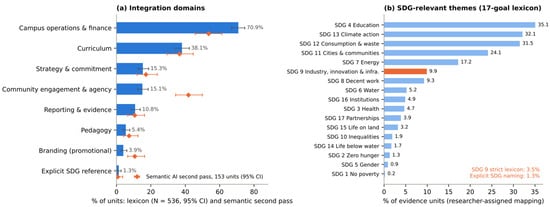
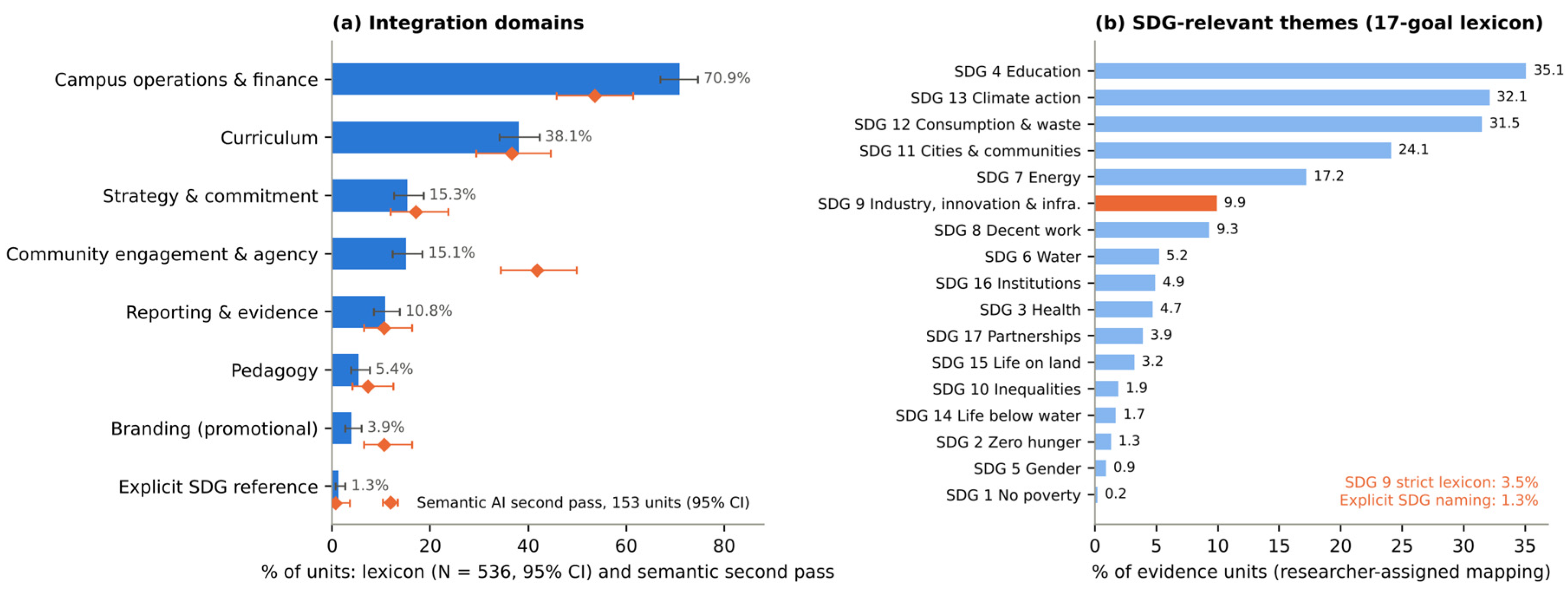
In the full corpus, campus operations and finance appeared in 70.9% of the units (95% CI: 66.9–74.6) and curriculum appeared in 38.1% (34.0–42.2), followed by strategy (15.3%), engagement (15.1%), reporting (10.8%), pedagogy (5.4%; 3.8–7.7), branding (3.9%) and explicit SDG naming (1.3%) (Figure 3a). On the 153 retained units the second pass judged relevant, operations was the most frequent domain under both (lexicon: 69.9%, 62.3–76.6; second pass: 53.6%, 45.7–61.3), but the second pass placed engagement (41.8%, 34.3–49.8) ahead of curriculum (36.6%, 29.4–44.5), whereas the lexicon found engagement in only 13.7% of the units (Table 3). The same ordering appeared among the 113 relevant units never included in any earlier recoding (operations: 51.3%; engagement: 39.8%; curriculum: 38.1%). Concordance was substantial for curriculum (κ = 0.67) and operations (κ = 0.64) but weak for engagement (κ = 0.21). Thus, the engagement lexicon probably missed much student and community action, and the ranking of curriculum and engagement is unresolved. Pedagogy was rare under both methods (5.9% and 7.2%), but they agreed on only one positive case (κ = 0.04), and thus its rarity is plausible but unconfirmed.
Figure 3.
Visibility of (a) domains in the lexicon coding (N = 536, 95% CI) with semantic second-pass estimates on the 153 units it judged relevant (95% CI) and (b) researcher-assigned SDG-relevant themes.
Table 5 shows how prevalence depends on construction. Estimates were stable across the 2016 and onwards subset, the relevant subset and fixed windows, and operations led under both retention routes. However, 43.7% of the units contained operational search terms, and among the 301 units without them, operations (48.8%, 43.2–54.5) and curriculum (49.8%, 44.2–55.4) were equally frequent. Recoding operations after masking those terms reduced its prevalence to 61.6%. The lead of operations was thus partly produced by the query bank, and the profile describes visibility under this search design, not a population estimate.
Table 5.
Prevalence (%) of domains under alternative constructions of the corpus and window.
The researcher-assigned mapping placed SDG 4 (35.1%), SDG 13 (32.1%), SDG 12 (31.5%), SDG 11 (24.1%) and SDG 7 (17.2%) first (Figure 3b). SDG 4 largely restates the curriculum and pedagogy codes (φ = 0.79), and innovation and infrastructure themes appeared in 9.9% of units (3.5% with a strict lexicon). Explicit SDG naming was rare under every construction (1.1–2.0%) and in the second pass (1 of 153 units).
5.3. RO2: Co-Occurrence of Claims, Practice References and Evidence
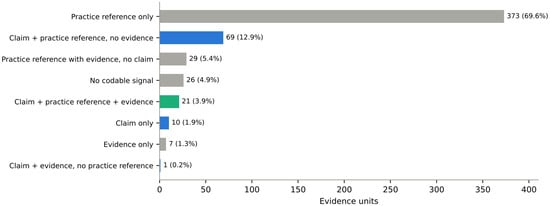
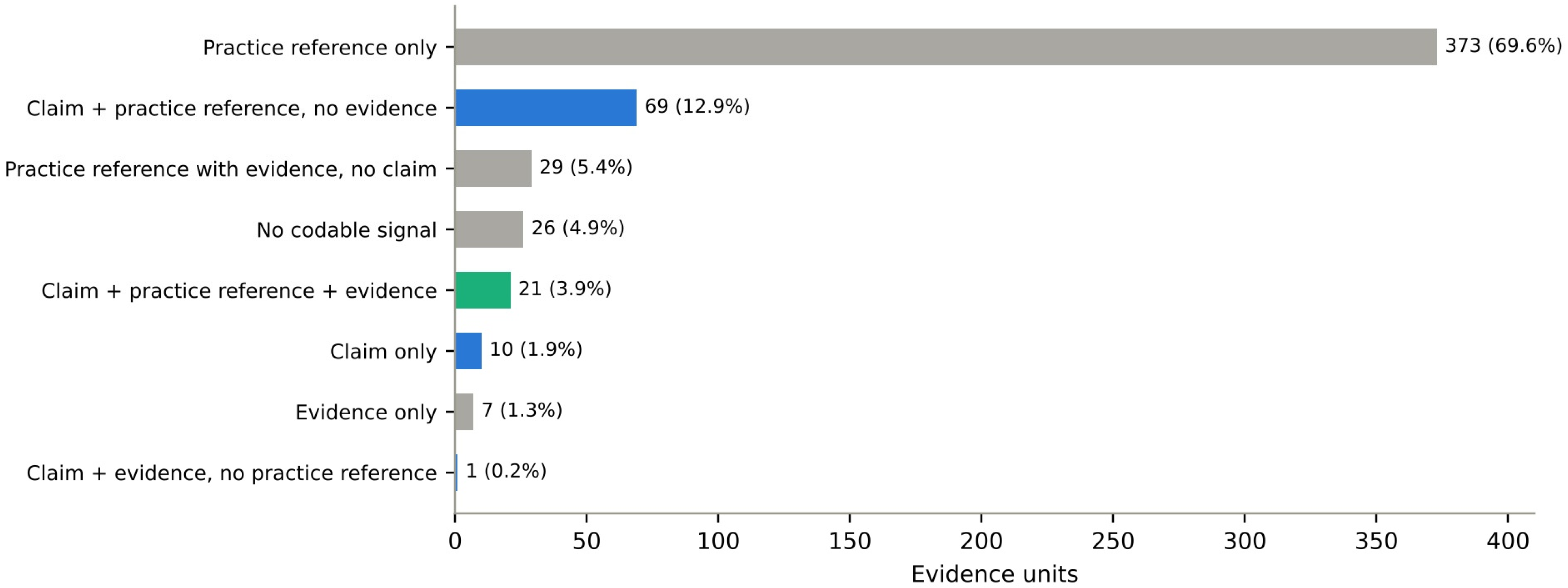
Most units contained practice references without a claim or evidence (373; 69.6%) (Figure 4). This rarity of full co-occurrence is expected in short texts and is not by itself informative. Therefore, co-occurrence was tested against chance. Evidence appeared in 22 of 101 claim-bearing units (21.8%) versus 36 of 435 other units (8.3%; OR = 3.10, 95% CI: 1.74–5.52, p < 0.001). The association persisted after adjustment for the window length (OR = 2.35, 1.34–4.13) and in the first-hit fixed window (OR = 3.51, 1.89–6.53) but was weaker and not significant in the 60-word window (OR = 1.93, 0.92–4.07). The joint presence of a claim, practice reference and evidence occurred in 21 units, compared with the 10.0 expected under independence and 14.1 (95% range 9–20) under the length-stratified permutation null (p = 0.019). Claims were, if anything, accompanied less often by practice references (length-adjusted OR = 0.44, 0.18–1.07). Claims and evidence therefore co-occurred more than chance, which does not support describing them as disconnected; because claims are mostly third-party mentions, these patterns concern discussion of institutions rather than institutional communication.
Figure 4.
Co-occurrence of claims, practice references and evidence in public evidence units (N = 536). Practice references are mentions, not affirmed implementations.
5.4. Asserted Gaps and Promotional Communication
Asserted claim–practice gaps occurred in 35 units (6.5%), and no dimension was significantly associated with them (Table 6). Of the 33 units that matched promotional or evaluative terms, 14 contained evaluative terms (e.g., greenwashing); 12 qualified only through those terms, leaving 21 units with descriptive promotional terms. When evaluative term count towards both codes, the two codes overlapped for construction (OR = 11.41); with non-overlapping codes, 2 of 21 branding units asserted gaps (9.5% versus 6.4%; OR = 1.85, 0.47–7.21; length-adjusted OR = 1.15). This null is uninformative because the branding lexicon captured only 1 of the 16 units the second pass classified as promotional communication (κ = 0.11); in the second pass, 1 of those units asserted a gap, as opposed to 4 of 137 others (OR = 2.87, 0.42–19.61). Whether promotional communication attracts disproportionate allegations is therefore undetermined.
Table 6.
Associations between lexicon-coded dimensions and asserted gaps (non-overlapping codes; N = 536).
5.5. RO3: Configurations, Genre and Geography
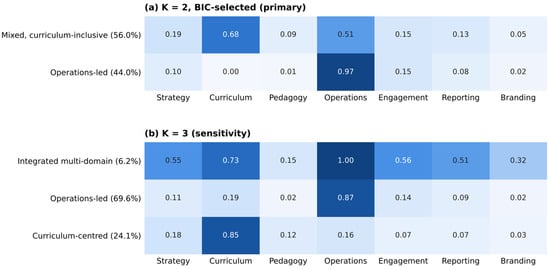
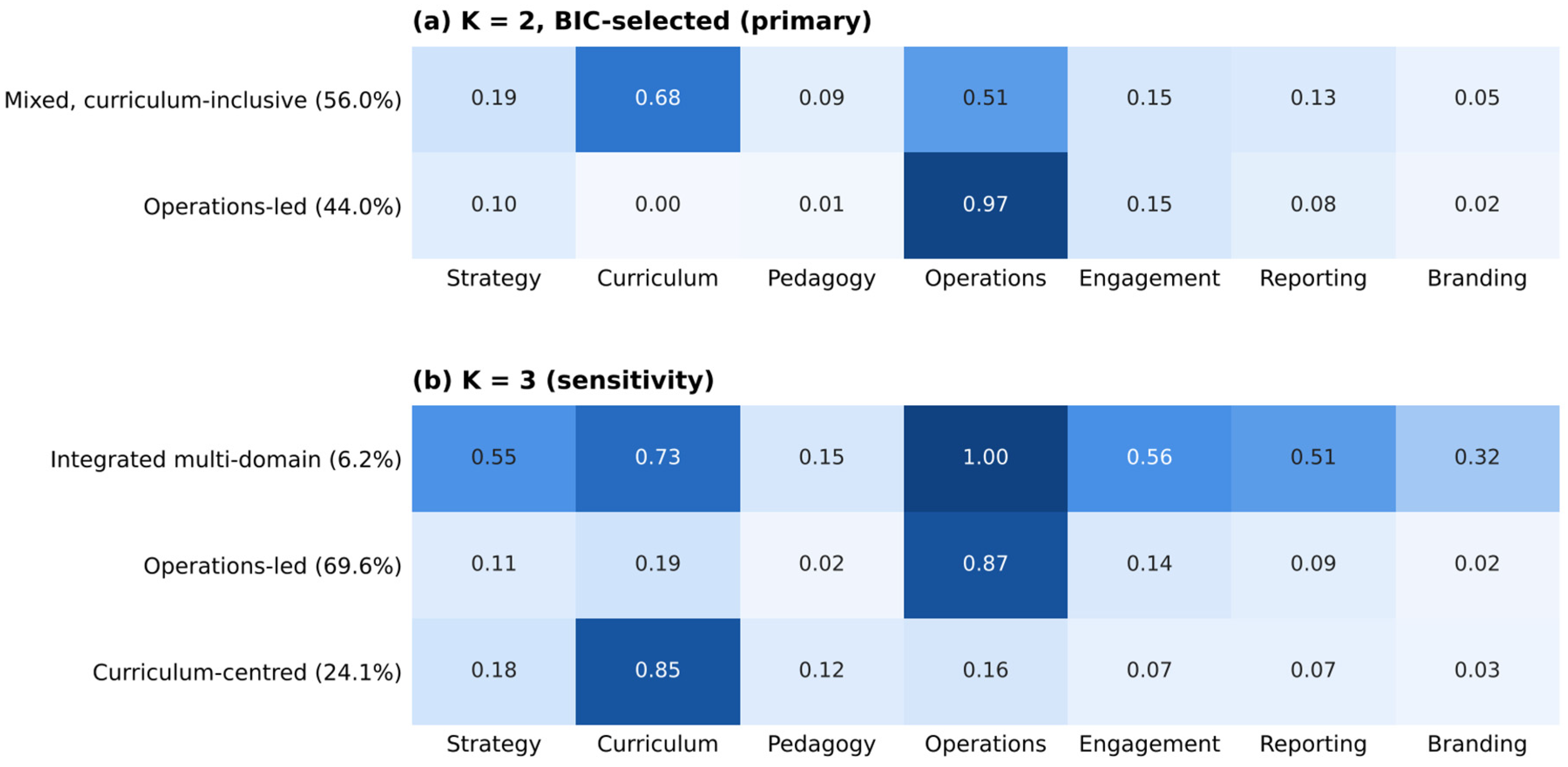
Curriculum and operations were negatively associated (OR = 0.20, 0.14–0.30) within both retention routes (0.34; 0.10), among units without operational query terms (0.30) and in the second pass (0.02). Because units were selected on a union of terms, this association may partly reflect selection (collider bias) and should not be read as a substantive trade-off. The LCA (Table 7) was ambiguous; BIC favoured two classes by 5.85 points, whereas AIC and SABIC favoured three. The entropy was 0.61 for two classes and 0.72 for three. The BLRT rejected one class in favour of two (p ≤ 0.01) and two in favour of three (p ≤ 0.01) but not three in favour of four (p = 0.150), and 5 of 21 bivariate residuals exceeded 3.84 under two classes (largest strategy–reporting: 13.0) but none under three, indicating local dependence in the two-class model. The two-class solution added little to the cross-tabulation; its modal assignment matched the rule "operations without curriculum" for 98.9% of the units, and the operations-led class had a curriculum probability at the boundary (0.00). The three-class solution separated operations-led (69.6%), curriculum-centred (24.1%) and a small multi-domain group (6.2%) (Figure 5). These groupings are descriptive.
Table 7.
Latent class model fit.
Figure 5.
Item response probabilities: (a) two-class model and (b) three-class model. Both are descriptive groupings of mentioned domains.
Comments were more often operations-led than posts after adjustment for window length and platform (OR = 2.17, 1.39–3.37), but with 83.4% of the units being from Reddit, platform and genre effects could not be separated reliably. Geographically, 297 of 329 locatable units (90.3%) concerned North America. Of the 29 African, Asian and Latin American communities searched, 2 returned any records (60 in total), and 1 yielded a retained unit, compared with 5041 Reddit records from the other 105 university and national communities. Because all queries were in English, this near absence reflects the search design as much as where discussion occurred; no geographic comparison was attempted.
5.6. RO4: Coupling Levels and Their Measurement Properties
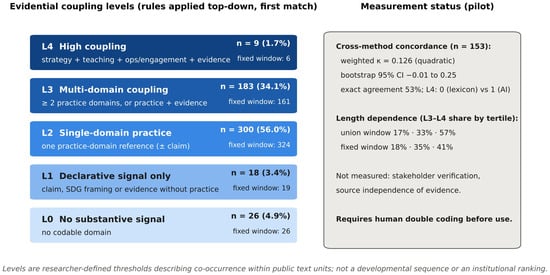
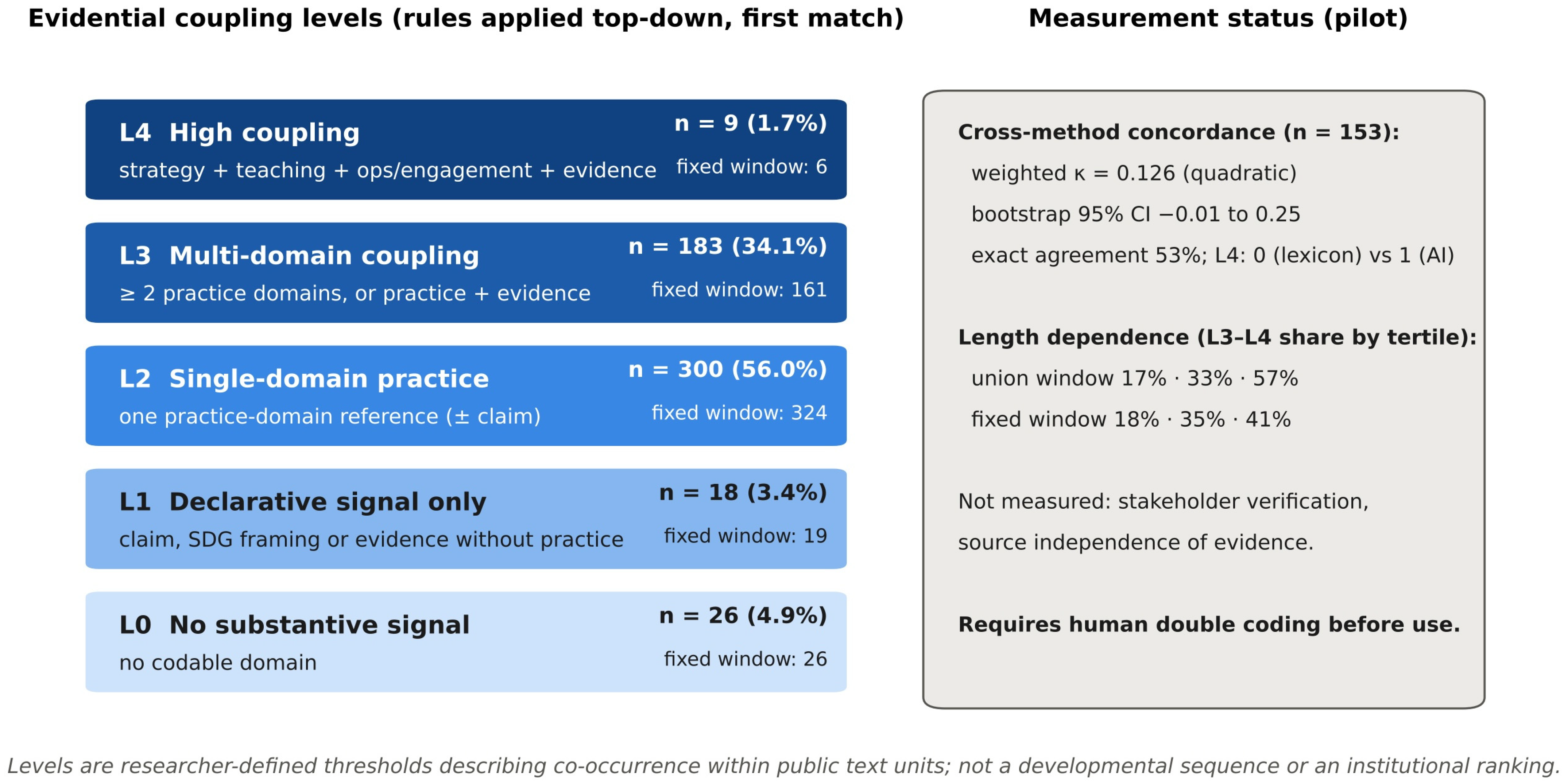
When applying the rules, 26 units were at L0, 18 were at L1, 300 were at L2, 183 were at L3, and 9 (1.7%) were at L4; 192 of 536 units (35.8%, 31.9–40.0) were at L3–L4 (Figure 6). On the 153 units the second pass judged relevant, the levels from the two methods agreed exactly for 52.9% (weighted κ = 0.06 linear, 0.126 quadratic; bootstrap 95% CI from −0.01 to 0.25); the L3–L4 shares were 32.0% and 37.3%, and L4 occurred zero times in the lexicon and one time in the second pass. Reporting, which defined L3 and L4, had one shared positive case, and engagement was frequently missed by the lexicon. Therefore, the level assignments were method-dependent. Coupling also depended on the length; the L3–L4 share rose from 16.9% to 57.5% across window length tertiles and from 17.9% to 41.0% across full-text tertiles in the first-hit fixed window, where 31.2% of the units reached L3–L4. A broader indicator of comprehensive integration (three or more of strategy, four practice domains and reporting) was less likely in comments than posts with the union window (OR = 0.39) but not in the first-hit fixed window (OR = 0.94, p = 0.85); L3–L4, which needed only two elements, did not differ by record type under either window. The record-type effect therefore reflected how the windows were built.
Figure 6.
Proposed coupling levels (one measured axis) with unit counts under the union and first-hit fixed windows and their cross-method concordance in this pilot.
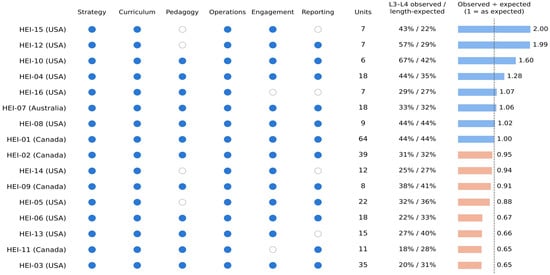
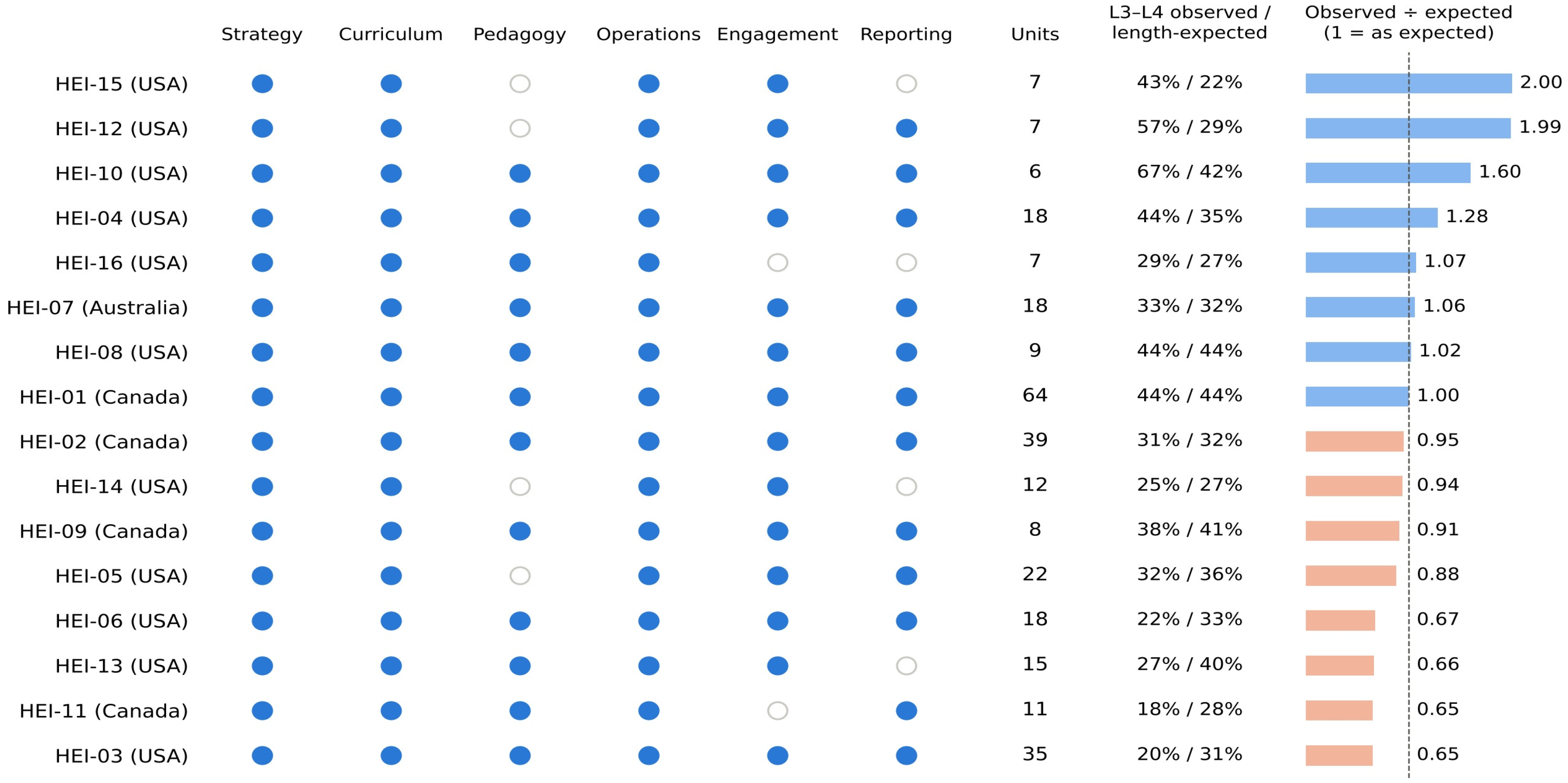
For the 16 institutions with five or more units, the observed L3–L4 shares ranged from 18% to 67%, and the ratio of observed to length-expected shares ranged from 0.65 to 2.00 (Figure 7). The ratios were most extreme for institutions with few units (ρ between units and ratio = −0.51), and thus the profiles describe visible breadth under small samples and are not rankings.
Figure 7.
Institution-level sensitivity analysis (anonymised institutions with at least five units): visible domains, units, observed and length-expected L3–L4 shares and their ratio.
5.7. Summary of Robustness
Table 8 summarises how each main finding behaved across the sensitivity analyses and the blinded AI-assisted second pass reported in Section 5.2, Section 5.3, Section 5.4, Section 5.5 and Section 5.6. Findings based on the two domains with substantial cross-method concordance were stable: operations remained the most frequent domain except among units without operational query terms, and claims co-occurred with evidence more often than chance under length adjustment, fixed windows and the permutation null. Findings that depend on interpretive codes were not stable: the ranking of curriculum and engagement, the rarity of pedagogy and the branding–gap association remain unresolved or undetermined, the latent configurations are descriptive only, and the coupling levels were not stable across methods. Recall of the screen could not be estimated. These statuses determine how each finding is interpreted in Section 6.
Table 8.
Status of the main findings.
6. Discussion
First, what becomes visible depends heavily on how visibility is sought. Operations led under most constructions and in the semantic second pass, consistent with the prominence of campus operations in sustainability research [12] and the emphasis of assessment tools on measurable proxies [13,28]. Yet, the lead disappeared among units without operational search terms, and the second pass ranked engagement above curriculum. The defensible conclusion is narrower than a ranking of domains: under English-language queries that included operational terms, operations were the most frequently mentioned domain, and student and community engagement—campaigns, divestment activism and student groups [23,24]—was probably more visible than lexicon coding detects. Pedagogy appears rare, which fits the difficulty of observing teaching from outside [26,27], but this was not confirmed.
Second, public discussion uses little SDG vocabulary. Only 1.1–2.0% of the units named the SDGs under any construction, although reporting and ranking channels use SDG categories extensively [7,33]. This suggests that the SDGs operate mainly as an institutional and evaluative language [1,8], although queries that included "SDG" were part of the design, and explicit naming was not second-coded. Because SDG mapping is method-dependent [34], the themes in Figure 3b describe researcher-assigned relevance only.
Third, claims and evidence are not disconnected in public discussion; they co-occurred more often than chance dictates, including after length adjustment and in most window definitions. The low absolute frequency of full co-occurrence reflects the brevity of comments rather than a "connection gap". Since nearly all claims were third-party mentions, the pattern indicates that people who discuss institutional commitments also tend to discuss data and reports. It cannot speak to organisational decoupling [37,38], greenhushing [46] or compartmentalised implementation [11], which require institution-linked documents.
Fourth, the branding question is open. Separating descriptions of promotion from allegations of greenwashing is necessary [41,43], but the separated branding lexicon captured almost none of what the semantic pass judged to be promotion. Therefore, its null could not be interpreted, and the second-pass estimate was too imprecise to decide. Research on selective reporting [10], students’ ambivalent responses to sustainability programmes [47] and legitimacy pressures [36] make the hypothesis plausible, but testing it requires human coding of an enlarged sample of promotional texts.
Fifth, configurations and genre effects are thinner than they appear. The two-class LCA largely reproduced the operations-by-curriculum cross-tabulation, the three-class model fit better on most criteria, and the negative curriculum–operations association may have been induced by selecting texts on a union of terms. Similarly, a record-type effect on comprehensive integration vanished when the windows had a fixed construction. These results caution against reading typologies or genre differences from screened corpora without checking how screening shapes them [48,55].
Sixth, geographic invisibility here was mainly a property of the search. English queries for Spanish-, Portuguese- and other-language communities returned almost nothing, and thus the near-absence of the Global South mirrors documented informational peripheries and participation biases [16,49] but does not measure them. Studies that aim to address concerns that SDG agendas leave regions behind [2] need multilingual query banks.
Seventh, the coupling scheme is a hypothesis about measurement rather than a finding about universities. Grading co-occurrence avoids the linear-stage assumption of maturity models [53,54] and is compatible with non-sequential patterns of curriculum change [21], but in this pilot, it depended on the window length and codes of low agreement, especially reporting. The scheme is offered so that its rules can be tested with human coding, not as a validated framework.
Eighth, the study illustrates both the use and limits of AI-assisted checks. A semantic pass by a different model, blind to the lexicon, converged with it on concrete domains and diverged on engagement, branding, reporting and coupling levels, which located the lexicon’s weaknesses: the triangulation logic of combining methods with different error sources [58]. Agreement with a language model is nevertheless not evidence of validity because models carry their own biases and proprietary versions change [63,64], and checks that resample the same frame cannot detect problems located in the query design, window construction or coding rules. Reporting cross-method divergence alongside sensitivity analyses [50,57,62] allows readers to judge what such evidence can bear.
7. Implications for Research Design
Because the corpus contained almost no institutional voice, and the measures were unvalidated, the implications concern how public discourse studies of university sustainability should be designed rather than what universities or ranking agencies should do. First, query banks should be balanced across domains (operational, curricular, pedagogical, engagement and governance terms) and multilingual, and prevalence should be reported with and without units matched by query terms. Second, coding windows should have a fixed construction, or results should be shown under alternative windows because windows that grow with each match manufacture length effects. Third, promotion and criticism of promotion require lexically independent codes, and a null from a low-recall code should be reported as undetermined. Fourth, automated or AI coding should be evaluated against independent human double coding on hold-out samples, with recall estimated and its conditionality stated. Fifth, configuration analyses should be compared with simple cross-tabulations and checked for selection-induced associations.
8. Limitations and Future Research
This is a pilot study. No human coding was performed; screening, coding and the second pass relied on lexicons and language models, and thus all agreement statistics had cross-method concordance, not reliability, and the validity of the measures was not established. Using a semantic AI pass rather than human coders was a pragmatic choice for a single-author, unfunded study, partly justified by evidence that language models can approach expert coders [60,61] and by the use of a different model family under a frozen prompt. However, the second pass covered 236 of 536 units and was platform-skewed (no Lemmy units). The prompt was written after earlier results were known, a proprietary model limits exact replication [64], and 63 of its units were seen by an earlier recoding. A human double-coding protocol is released for validation. Other limitations are the English-only, operations-weighted query bank; the dominance of Reddit and North America; the near-absence of an institutional voice; unestimated recall; codes of weak cross-method concordance; length-dependent coupling; clustering within threads and researcher-assigned SDG themes. Future research should complete human double coding, use balanced multilingual queries and link units to institutional documents.
9. Conclusions
This pilot analysis shows that campus operations are the most frequently mentioned domain of university sustainability under English-language queries that include operational terms, that explicit SDG language is rare, and that claims and evidence co-occur more often than chance dictates. A blinded semantic second pass by a different model, used as a provisional cross-method check rather than human reliability, supported the lead of operations, indicated that the lexicon undercounted engagement and left the ranking of engagement and curriculum unresolved. The link between promotional communication and asserted gaps was undetermined, recall was not estimated, and the Global South was invisible largely because of the search design. The single-axis coupling scheme was not stable across methods. The study is a documented pilot that specifies what a human-validated study of public sustainability discourse would need.
Supplementary Materials
The following supporting information can be downloaded at https://www.mdpi.com/article/10.3390/su182211490/s1. File S1: Search queries, communities and platform access details; File S2: Complete screening rules and 17-goal SDG lexicon; File S3: Codebooks and decision rules; File S4: Coded units (no text, no identifiers); File S5: Analysis scripts; File S6: Latent class stability and sensitivity analyses; File S7: Branding and gap coding and lexical-overlap analysis; File S8: Pilot sensitivity analyses and human double-coding protocol; File S9: Blinded AI-assisted semantic second pass.
Author Contributions
Conceptualization, O.A.L., F.O. and B.S.M.; methodology, O.A.L., F.O. and B.S.M.; software, O.A.L., F.O. and B.S.M.; validation, O.A.L., F.O. and B.S.M.; formal analysis, O.A.L., F.O. and B.S.M.; investigation, O.A.L., F.O. and B.S.M.; resources, O.A.L., F.O. and B.S.M.; data curation, O.A.L., F.O. and B.S.M.; writing—original draft preparation, O.A.L., F.O. and B.S.M.; writing—review and editing, O.A.L., F.O. and B.S.M.; visualization, O.A.L., F.O. and B.S.M.; supervision, O.A.L., F.O. and B.S.M.; project administration, O.A.L., F.O. and B.S.M. All authors have read and agreed to the published version of the manuscript.
Funding
This research received no external funding.
Institutional Review Board Statement
Not applicable.
Informed Consent Statement
Not applicable.
Data Availability Statement
The coded-unit file (codes and metadata without text or record identifiers), lexicons, codebooks, the second-pass protocol, frozen prompt and opaque-identifier coded cases, analysis scripts and the human-coding protocol are provided in Files S1–S9. Keys linking unit numbers and blind identifiers to public record identifiers, and the institution key, are available to the editor and reviewers in confidence, and to researchers under a data-use agreement prohibiting quotation and re-identification. Raw platform content is not redistributed.
Acknowledgments
During the preparation of this manuscript, the author used Claude (Anthropic, https://www.anthropic.com/) to collect data through TinyFish, develop lexicons, screening rules and codebooks, run the statistical analyses, prepare figures and draft text and used gpt-6.1-sol (OpenAI), accessed through the Manus platform under a frozen prompt, to perform the blinded semantic second pass reported in Section 4.5. No human coding was performed; the second pass is reported as a provisional cross-method check, not as reliability or validation. The author has reviewed and edited the output and takes full responsibility for the content of this publication.
Conflicts of Interest
The authors declare no conflicts of interest.
Abbreviations
The following abbreviations are used in this manuscript: AI = artificial intelligence; AIC = Akaike information criterion; API = application programming interface; BH = Benjamini–Hochberg; BIC = Bayesian information criterion; BLRT = bootstrap likelihood ratio test; CI = confidence interval; HEI = higher education institution; LCA = latent class analysis; OR = odds ratio; SABIC = sample size-adjusted BIC; SDG = Sustainable Development Goal; STARS = Sustainability Tracking, Assessment and Rating System.
References
- Chankseliani, M.; McCowan, T. Higher education and the Sustainable Development Goals. High. Educ. 2021, 81, 1–8. [Google Scholar] [CrossRef] [Scilit] [PubMed]
- Heleta, S.; Bagus, T. Sustainable development goals and higher education: Leaving many behind. High. Educ. 2021, 81, 163–177. [Google Scholar] [CrossRef] [Scilit]
- Holst, J. Towards coherence on sustainability in education: A systematic review of Whole Institution Approaches. Sustain. Sci. 2023, 18, 1015–1030. [Google Scholar] [CrossRef] [Scilit]
- Holst, J.; Grund, J.; Brock, A. Whole Institution Approach: Measurable and highly effective in empowering learners and educators for sustainability. Sustain. Sci. 2024, 19, 1359–1376. [Google Scholar] [CrossRef] [Scilit]
- Dade, A.; Hassenzahl, D.M. Communicating sustainability: A content analysis of website communications in the United States. Int. J. Sustain. High. Educ. 2013, 14, 254–263. [Google Scholar] [CrossRef] [Scilit]
- Amey, L.; Plummer, R.; Pickering, G. Website communications for campus sustainability: An analysis of Canadian universities. Int. J. Sustain. High. Educ. 2020, 21, 531–556. [Google Scholar] [CrossRef] [Scilit]
- Bautista-Puig, N.; Orduña-Malea, E.; Perez-Esparrells, C. Enhancing sustainable development goals or promoting universities? An analysis of the Times Higher Education Impact Rankings. Int. J. Sustain. High. Educ. 2022, 23, 211–231. [Google Scholar] [CrossRef] [Scilit]
- Buckner, E.; Zhang, Y. Sustainability rankings in higher education: ‘The right thing to do’ or the pursuit of global recognition? High. Educ. 2026, 91, 1775–1791. [Google Scholar] [CrossRef] [Scilit]
- Ceulemans, K.; Molderez, I.; Van Liedekerke, L. Sustainability reporting in higher education: A comprehensive review of the recent literature and paths for further research. J. Clean. Prod. 2015, 106, 127–143. [Google Scholar] [CrossRef] [Scilit]
- Lakhno, M. Green or green-washed? Examining sustainability reporting in higher education. High. Educ. Q. 2024, 78, 1099–1122. [Google Scholar] [CrossRef] [Scilit]
- Lozano, R.; Ceulemans, K.; Alonso-Almeida, M.; Huisingh, D.; Lozano, F.J.; Waas, T.; Lambrechts, W.; Lukman, R.; Hugé, J. A review of commitment and implementation of sustainable development in higher education: Results from a worldwide survey. J. Clean. Prod. 2015, 108, 1–18. [Google Scholar] [CrossRef] [Scilit]
- Amaral, A.R.; Rodrigues, E.; Gaspar, A.R.; Gomes, Á. A review of empirical data of sustainability initiatives in university campus operations. J. Clean. Prod. 2020, 250, 119558. [Google Scholar] [CrossRef] [Scilit]
- Findler, F.; Schönherr, N.; Lozano, R.; Stacherl, B. Assessing the impacts of higher education institutions on sustainable development—An analysis of tools and indicators. Sustainability 2019, 11, 59. [Google Scholar] [CrossRef] [Scilit]
- Urbano, V.M.; Arena, M.; Azzone, G.; Mayeres, M. Sustainable development in higher education: An in-depth analysis of Times Higher Education Impact Rankings. J. Clean. Prod. 2025, 501, 145302. [Google Scholar] [CrossRef] [Scilit]
- Alberti, C.; Civera, A.; Lehmann, E.E.; Meoli, M.; Otto, J.; Paleari, S. University sustainability rankings: A critical literature review on the UI GreenMetric ranking system. J. Technol. Transf. 2025, 50, 2752–2801. [Google Scholar] [CrossRef] [Scilit]
- Hargittai, E. Potential biases in big data: Omitted voices on social media. Soc. Sci. Comput. Rev. 2020, 38, 10–24. [Google Scholar] [CrossRef] [Scilit]
- Massanari, A. #Gamergate and The Fappening: How Reddit’s algorithm, governance, and culture support toxic technocultures. New Media Soc. 2017, 19, 329–346. [Google Scholar] [CrossRef] [Scilit]
- Emanuel, R.; Adams, J.N. College students’ perceptions of campus sustainability. Int. J. Sustain. High. Educ. 2011, 12, 79–92. [Google Scholar] [CrossRef] [Scilit]
- Menon, S.; Suresh, M. Synergizing education, research, campus operations, and community engagements towards sustainability in higher education: A literature review. Int. J. Sustain. High. Educ. 2020, 21, 1015–1051. [Google Scholar] [CrossRef] [Scilit]
- Findler, F.; Schönherr, N.; Lozano, R.; Reider, D.; Martinuzzi, A. The impacts of higher education institutions on sustainable development: A review and conceptualization. Int. J. Sustain. High. Educ. 2019, 20, 23–38. [Google Scholar] [CrossRef] [Scilit]
- Weiss, M.; Barth, M.; von Wehrden, H. The patterns of curriculum change processes that embed sustainability in higher education institutions. Sustain. Sci. 2021, 16, 1579–1593. [Google Scholar] [CrossRef] [Scilit]
- Leal Filho, W.; Shiel, C.; Paço, A.; Mifsud, M.; Ávila, L.V.; Brandli, L.L.; Molthan-Hill, P.; Pace, P.; Azeiteiro, U.M.; Vargas, V.R.; et al. Sustainable Development Goals and sustainability teaching at universities: Falling behind or getting ahead of the pack? J. Clean. Prod. 2019, 232, 285–294. [Google Scholar] [CrossRef] [Scilit]
- Healy, N.; Debski, J. Fossil fuel divestment: Implications for the future of sustainability discourse and action within higher education. Local Environ. 2017, 22, 699–724. [Google Scholar] [CrossRef] [Scilit]
- Gibson, D.; Duram, L.A. Shifting discourse on climate and sustainability: Key characteristics of the higher education fossil fuel divestment movement. Sustainability 2020, 12, 10069. [Google Scholar] [CrossRef] [Scilit]
- Dagiliūtė, R.; Liobikienė, G.; Minelgaitė, A. Sustainability at universities: Students’ perceptions from Green and Non-Green universities. J. Clean. Prod. 2018, 181, 473–482. [Google Scholar] [CrossRef] [Scilit]
- Wiek, A.; Withycombe, L.; Redman, C.L. Key competencies in sustainability: A reference framework for academic program development. Sustain. Sci. 2011, 6, 203–218. [Google Scholar] [CrossRef] [Scilit]
- Brundiers, K.; Barth, M.; Cebrián, G.; Cohen, M.; Diaz, L.; Doucette-Remington, S.; Dripps, W.; Habron, G.; Harré, N.; Jarchow, M.; et al. Key competencies in sustainability in higher education—Toward an agreed-upon reference framework. Sustain. Sci. 2021, 16, 13–29. [Google Scholar] [CrossRef] [Scilit]
- Shriberg, M. Institutional assessment tools for sustainability in higher education: Strengths, weaknesses, and implications for practice and theory. Int. J. Sustain. High. Educ. 2002, 3, 254–270. [Google Scholar] [CrossRef] [Scilit]
- Urbanski, M.; Leal Filho, W. Measuring sustainability at universities by means of the Sustainability Tracking, Assessment and Rating System (STARS): Early findings from STARS data. Environ. Dev. Sustain. 2015, 17, 209–220. [Google Scholar] [CrossRef] [Scilit]
- Berzosa, A.; Bernaldo, M.O.; Fernández-Sanchez, G. Sustainability assessment tools for higher education: An empirical comparative analysis. J. Clean. Prod. 2017, 161, 812–820. [Google Scholar] [CrossRef] [Scilit]
- Fischer, D.; Jenssen, S.; Tappeser, V. Getting an empirical hold of the sustainable university: A comparative analysis of evaluation frameworks across 12 contemporary sustainability assessment tools. Assess. Eval. High. Educ. 2015, 40, 785–800. [Google Scholar] [CrossRef] [Scilit]
- Alghamdi, N.; den Heijer, A.; de Jonge, H. Assessment tools’ indicators for sustainability in universities: An analytical overview. Int. J. Sustain. High. Educ. 2017, 18, 84–115. [Google Scholar] [CrossRef] [Scilit]
- De la Poza, E.; Merello, P.; Barberá, A.; Celani, A. Universities’ reporting on SDGs: Using THE Impact Rankings to model and measure their contribution to sustainability. Sustainability 2021, 13, 2038. [Google Scholar] [CrossRef] [Scilit]
- Armitage, C.S.; Lorenz, M.; Mikki, S. Mapping scholarly publications related to the Sustainable Development Goals: Do independent bibliometric approaches get the same results? Quant. Sci. Stud. 2020, 1, 1092–1108. [Google Scholar] [CrossRef] [Scilit]
- Meyer, J.W.; Rowan, B. Institutionalized organizations: Formal structure as myth and ceremony. Am. J. Sociol. 1977, 83, 340–363. [Google Scholar] [CrossRef] [Scilit] [PubMed]
- Suchman, M.C. Managing legitimacy: Strategic and institutional approaches. Acad. Manag. Rev. 1995, 20, 571–610. [Google Scholar] [CrossRef] [Scilit]
- Bromley, P.; Powell, W.W. From smoke and mirrors to walking the talk: Decoupling in the contemporary world. Acad. Manag. Ann. 2012, 6, 483–530. [Google Scholar] [CrossRef]
- Snelson-Powell, A.; Grosvold, J.; Millington, A. Business school legitimacy and the challenge of sustainability: A fuzzy set analysis of institutional decoupling. Acad. Manag. Learn. Educ. 2016, 15, 703–723. [Google Scholar] [CrossRef] [Scilit]
- Snelson-Powell, A.C.; Grosvold, J.; Millington, A.I. Organizational hypocrisy in business schools with sustainability commitments: The drivers of talk–action inconsistency. J. Bus. Res. 2020, 114, 408–420. [Google Scholar] [CrossRef] [Scilit]
- Christensen, L.T.; Morsing, M.; Thyssen, O. CSR as aspirational talk. Organization 2013, 20, 372–393. [Google Scholar] [CrossRef] [Scilit]
- Delmas, M.A.; Burbano, V.C. The drivers of greenwashing. Calif. Manag. Rev. 2011, 54, 64–87. [Google Scholar] [CrossRef] [Scilit]
- Lyon, T.P.; Montgomery, A.W. The means and end of greenwash. Organ. Environ. 2015, 28, 223–249. [Google Scholar] [CrossRef] [Scilit]
- Montgomery, A.W.; Lyon, T.P.; Barg, J. No end in sight? A greenwash review and research agenda. Organ. Environ. 2024, 37, 221–256. [Google Scholar] [CrossRef] [Scilit] [PubMed]
- Kim, E.-H.; Lyon, T.P. Greenwash vs. brownwash: Exaggeration and undue modesty in corporate sustainability disclosure. Organ. Sci. 2015, 26, 705–723. [Google Scholar] [CrossRef] [Scilit]
- Carlos, W.C.; Lewis, B.W. Strategic silence: Withholding certification status as a hypocrisy avoidance tactic. Adm. Sci. Q. 2018, 63, 130–169. [Google Scholar] [CrossRef] [Scilit]
- Font, X.; Elgammal, I.; Lamond, I. Greenhushing: The deliberate under communicating of sustainability practices by tourism businesses. J. Sustain. Tour. 2017, 25, 1007–1023. [Google Scholar] [CrossRef] [Scilit]
- Odugbesan, J.A.; Aghazadeh, S. Environmental support or just greenwashing? Understanding the impact of university sustainability programs on students’ eco-behaviours in Turkey. Innov. High. Educ. 2025, 50, 1461–1485. [Google Scholar] [CrossRef] [Scilit]
- Boyd, D.; Crawford, K. Critical questions for big data. Inf. Commun. Soc. 2012, 15, 662–679. [Google Scholar] [CrossRef] [Scilit]
- Graham, M.; Hogan, B.; Straumann, R.K.; Medhat, A. Uneven geographies of user-generated information: Patterns of increasing informational poverty. Ann. Assoc. Am. Geogr. 2014, 104, 746–764. [Google Scholar] [CrossRef] [Scilit]
- Proferes, N.; Jones, N.; Gilbert, S.; Fiesler, C.; Zimmer, M. Studying Reddit: A systematic overview of disciplines, approaches, methods, and ethics. Soc. Media Soc. 2021, 7, 20563051211019004. [Google Scholar] [CrossRef] [Scilit]
- Fiesler, C.; Proferes, N. “Participant” perceptions of Twitter research ethics. Soc. Media Soc. 2018, 4, 2056305118763366. [Google Scholar] [CrossRef] [Scilit]
- Gori, E.; Romolini, A.; Fissi, S.; Contri, M. Toward the dissemination of sustainability issues through social media in the higher education sector: Evidence from an Italian case. Sustainability 2020, 12, 4658. [Google Scholar] [CrossRef] [Scilit]
- Becker, J.; Knackstedt, R.; Pöppelbuß, J. Developing maturity models for IT management: A procedure model and its application. Bus. Inf. Syst. Eng. 2009, 1, 213–222. [Google Scholar] [CrossRef] [Scilit]
- Röglinger, M.; Pöppelbuß, J.; Becker, J. Maturity models in business process management. Bus. Process Manag. J. 2012, 18, 328–346. [Google Scholar] [CrossRef] [Scilit]
- Fiss, P.C. Building better causal theories: A fuzzy set approach to typologies in organization research. Acad. Manag. J. 2011, 54, 393–420. [Google Scholar] [CrossRef] [Scilit]
- Hayes, A.F.; Krippendorff, K. Answering the call for a standard reliability measure for coding data. Commun. Methods Meas. 2007, 1, 77–89. [Google Scholar] [CrossRef] [Scilit]
- O’Connor, C.; Joffe, H. Intercoder reliability in qualitative research: Debates and practical guidelines. Int. J. Qual. Methods 2020, 19, 1–13. [Google Scholar] [CrossRef] [Scilit]
- Jick, T.D. Mixing qualitative and quantitative methods: Triangulation in action. Adm. Sci. Q. 1979, 24, 602–611. [Google Scholar] [CrossRef] [Scilit]
- Gilardi, F.; Alizadeh, M.; Kubli, M. ChatGPT outperforms crowd workers for text-annotation tasks. Proc. Natl. Acad. Sci. USA 2023, 120, e2305016120. [Google Scholar] [CrossRef] [Scilit] [PubMed]
- Törnberg, P. Large language models outperform expert coders and supervised classifiers at annotating political social media messages. Soc. Sci. Comput. Rev. 2025, 43, 1181–1195. [Google Scholar] [CrossRef] [Scilit]
- Heseltine, M.; Clemm von Hohenberg, B. Large language models as a substitute for human experts in annotating political text. Res. Politics 2024, 11, 20531680241236239. [Google Scholar] [CrossRef] [Scilit]
- Ziems, C.; Held, W.; Shaikh, O.; Chen, J.; Zhang, Z.; Yang, D. Can large language models transform computational social science? Comput. Linguist. 2024, 50, 237–291. [Google Scholar] [CrossRef] [Scilit]
- Bail, C.A. Can generative AI improve social science? Proc. Natl. Acad. Sci. USA 2024, 121, e2314021121. [Google Scholar] [CrossRef] [Scilit] [PubMed]
- Ollion, É.; Shen, R.; Macanovic, A.; Chatelain, A. The dangers of using proprietary LLMs for research. Nat. Mach. Intell. 2024, 6, 4–5. [Google Scholar] [CrossRef] [Scilit]
- Holm, S. A simple sequentially rejective multiple test procedure. Scand. J. Stat. 1979, 6, 65–70. [Google Scholar]
- Benjamini, Y.; Hochberg, Y. Controlling the false discovery rate: A practical and powerful approach to multiple testing. J. R. Stat. Soc. Ser. B (Methodol.) 1995, 57, 289–300. [Google Scholar] [CrossRef] [Scilit]
- Cameron, A.C.; Gelbach, J.B.; Miller, D.L. Bootstrap-based improvements for inference with clustered errors. Rev. Econ. Stat. 2008, 90, 414–427. [Google Scholar] [CrossRef] [Scilit]
- Cameron, A.C.; Miller, D.L. A practitioner’s guide to cluster-robust inference. J. Hum. Resour. 2015, 50, 317–372. [Google Scholar] [CrossRef] [Scilit]
- Nylund, K.L.; Asparouhov, T.; Muthén, B.O. Deciding on the number of classes in latent class analysis and growth mixture modeling: A Monte Carlo simulation study. Struct. Equ. Model. 2007, 14, 535–569. [Google Scholar] [CrossRef] [Scilit]
- Weller, B.E.; Bowen, N.K.; Faubert, S.J. Latent class analysis: A guide to best practice. J. Black Psychol. 2020, 46, 287–311. [Google Scholar] [CrossRef] [Scilit]

Disclaimer/Publisher’s Note: The statements, opinions and data contained in all publications are solely those of the individual author(s) and contributor(s) and not of MDPI and/or the editor(s). MDPI and/or the editor(s) disclaim responsibility for any injury to people or property resulting from any ideas, methods, instructions or products referred to in the content. |
© 2026 by the authors. Licensee MDPI, Basel, Switzerland. This article is an open access article distributed under the terms and conditions of the Creative Commons Attribution (CC BY) license.